

Karnataka High Court: Section 144 Order Imposed In Bengaluru In December Illegal
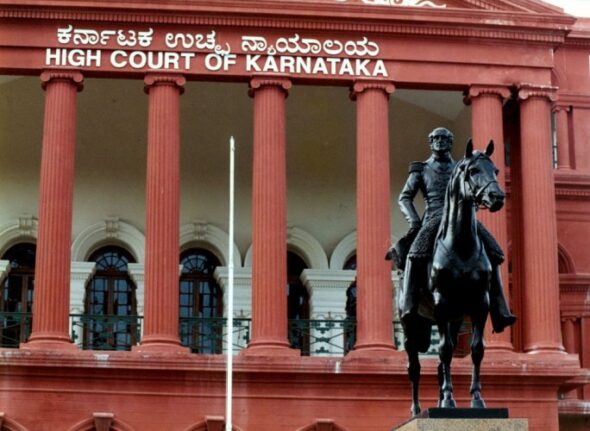
The prohibitory orders imposed in Bengaluru under Section 144 of the Code of Criminal Procedure on December 18 in view of CAAProtest are “illegal” and cannot stand scrutiny of law”, held the High Court of Karnataka on Thursday.
The Section 144 order was imposed on December 18 last year, in the wake of protests against the Citizenship Amendment Act (CAA).
Two days after the prohibitory order was passed, the High Court had taken up for hearing a challenge filed against the same. On that date, the Court said it would look into the legality of the Section 144 order.
The case concerned the legality of order passed under section 144, by the Bengaluru Police Commmssioner on December 18 banning all public rallies, which were to be held on December 19, against the Citizenship Amendment Act, in Bengaluru.
The Bench headed by Chief Justice Abhay S Oka also posed a volley of questions to Advocate General Prabhuling Navadgi, who appeared for the state government. These included:
“When permission for carrying out protests was given to certain organisations, then how can it be canceled overnight?
Can a sweeping order under Section 144 cancel an already granted permission?
Can the state go under the assumption that every protest will disturb the peace?”
Petitions were filed in the Karnataka High Court by Rajya Sabha Member of Parliament Rajeev Gowda, Member of the Karnataka Legislative Assembly, Sowmya Reddy, and others. The petitions have prayed for quashing of the order passed by the state government on December 18.
During the course of the hearings, the state government agreed to allow fresh applications for permission to conduct protests. The police would then consider these applications and decide them within 3-4 days, Navadgi had submitted before the Court.
After filing its statement of objections to the pleas, the state government on January 8 had stated before the Court that it was consistently respecting the people’s right to protest. It was also argued that the fundamental right to peaceful protest was subject to reasonable restrictions.
AG Navadgi further argued that Section 144 only placed temporary restrictions on the fundamental rights of the petitioners in order to ensure the safety of the public. He also stated that communications of the Divisional Deputy Commissioners were issued on the basis of various intelligence reports, which indicated that certain antisocial persons and organizations were planning to infiltrate the otherwise peaceful protests.
Senior advocate, Ravi Verma Kumar appearing for one of the petitioners, Leo Saldanha, and others, had argued that “The order passed is arbitrary and ex-facie illegal as there is no formation of opinion. Police can only regulate the rallies/dharnas or processions they cannot prohibit protest, it is a Fundamental Right of Citizen, guaranteed under article 19 of the Constitution of India.”
Read More: Karnataka: Anti-CAA-NRC-NPR protests in Hubballi by Sanitation Workers
Former Chief Justice raises questions at SC decisions on CAA, NRC, Ayodhya and article 370

From Kashmir to Sabarimala, the Ayodhya dispute to the Citizenship Act, how has the Supreme Court fared in recent times in upholding the constitutional rights of the people of India? Not very well, said former Chief Justice of the Delhi High Court, Ajit Prakash Shah.
Many of SC’s decisions have been questioned, The former president of Law commission Justice A P Shah has raised questions on many of the controversial judgments passed by Supreme Court.
Delivering the LC Jain Memorial Lecture instituted in the memory of the Gandhian activist Laxmi Chand Jain on February 10 in Delhi, Justice Shah said: “There are instances where freedoms that we have taken for granted are on unsteady ground, and where we are being made to doubt whether the Supreme Court is actually able to protect our rights at all or not. It is disturbing and unfortunate that we should still be asking questions of this kind, but some recent judgements and orders prompt such reflection.”
Even in a hearing in the Supreme Court, former Chief Justice Gogoi asked the authorities how many people are there in a particular detention centre. They said 900. Chief Justice got furious – he said why just 900, they should be thousands in the detention centre. This, coming from the Supreme Court of India, a rights court, do you still believe that it is a rights court?He accused that the Supreme court cannot show the guts to separate itself from the ruling government ideology. He also said, SC judgments also clearly show that the court has been under the influence of majoritarian public sentiments. The former judge said that the court has become more of an executive body “Several orders of the Supreme Court, including some orders in the Kashmir matter, suggest that the role of the Supreme Court as a counter-majoritarian institution, that is, as one that seeks to keep majoritarian impulses in check, is diminishing. On the other hand, as suggested by constitutional scholar Gautam Bhatia, the Court seems to be slowly taking on attributes of the executive itself. It seems to be drifting from a rights’ court to an executive court, as Bhatia points out, behaving in a way that is indistinguishable from the government, often issuing important policy decisions through its judgements, prioritising cases in specific – and sometimes worrisome – ways, and undertaking actions that would ordinarily be considered the domain of the government. Justice Shah said the Supreme court has not complied with these matters according to law and justice. He also criticized court´s new found penchant for sealed covers. “Distinguishing feature of court is transparency, for only then, can the institution assure the people that it is giving everyone a fair and equal chance to be heard. It has happened in the NRC case, the Rafale case, the CBI chief’s case, and the electoral bonds case, to name but a few. By shoving documents and facts that otherwise ought to be made public into sealed envelopes, the Court is signalling that it prefers the work ethic of the executive, believing truly that such secrecy is essential to deliver justice. He also questions the manner in which the court is prioritising the cases. Inaction also sends out powerful signals, as we can see in this case. This inaction also spoke louder than words when the Court found it had no time to deal with the many civil rights-related cases that were lying before it. In the case of the CAA, too, the Chief Justice of India first says petitions will be heard only after people stop violence, as though good behaviour were a condition precedent for seeking protection of rights. Scores of petitions were filed in the month of December 2019. The whole country was polarised, and there was even violence perpetrated against peaceful protesters by state authorities themselves. In this scenario, the Supreme Court proceeds to push the matter by four weeks, instead of commencing hearings immediately. This is deeply disappointing, to say the least. He also expressed his dissatisfaction at the way Supreme court has conducted NRC exercise and especially the role of former CJI Ranjan Gogoi. The Supreme Court decided to ask the persons claiming citizenship of India to prove their status, shifting the burden of proof away from requiring the state to show that the person was a foreigner. As it turns out, this migration theory has been proven to be completely incorrect. Out of the 1.9 million identified as foreigners, a majority are Hindus. These people are mostly poor and illiterate who are being made to prove that they are Indian citizens, based on documents such as of birth, schooling, and land-ownership. These documents are not easy to find or put together. Even if they are put together, they are rejected for issues with the English-language spelling of Bengali names, or in ages and dates of birth. And the person is declared a foreigner. The way the foreigner tribunal function is amazing – some official records were placed before us. These foreigner tribunals are manned by people who are appointed on yearly basis and the criteria for continuation of a foreigner tribunal member is in how many cases has he declared the person to be a foreigner. If the number is less, he will be discontinued. Even in a hearing in the Supreme Court, former Chief Justice Gogoi asked the authorities how many people are there in a particular detention centre. They said 900. Chief Justice got furious – he said why just 900, they should be thousands in the detention centre. This, coming from the Supreme Court of India, a rights court, do you still believe that it is a rights court? He strongly objected to the court´s judgement on the Ayodha ram temple. He said- This whole judgement is questionable. Despite acknowledging the illegality committed by the Hindus, first in 1949, by clandestinely keeping Ram Lalla idols in the mosque, and second, by wantonly demolishing the mosque in 1992, the court effectively rewarded the wrongdoer.
Nation at cross roads: Fascism has to be fought relentlessly on all fronts

Today, when the Nation is in crossroads trying to save the identity and values that Mahatma Gandhi stood and Dr. Babasaheb, engraved in our Constitution, Dr. H S Doreswamy 102-year-old Freedom Fighter and Gandhian has vowed to protest every month till the 2024 election raising the issues that are impacting the Nation and fight to end the fascist Government that is not only taking away the fundamental rights of the citizens but also is bringing divisive policies like CAA NPR NRC.
Modi Government has systematically eroding the basic foundation of the Constitution and diverting the attention from the failures of the Government for last 6 years. Unprecedented Economic crisis, highest rate of unemployment in 45 years, Agrarian crisis, Misuse of Administrative powers, Spreading Hate, Violation of basic Rights Diluting RTI, increasing Corruption are some of the serious issues raised by Dr H S Doreswamy during his 4-day protest starting 6th Feb to 9th Feb.
In the wake of thousands of protests happening across the Nation regarding CAA NPR NRC, Dr H S Doreswamy strongly felt the need to also raise all the issues that are hurting the Nation and its people at every step. Modi came to power claiming Saab Ka Saath, Saab Ka Vikas, Saab Ka Vishwas which is nothing more than a slogan looking at the hate and divide the country is going through in the last 6 years.
Under the banner of the Citizens’ Rights Action Committee, several organizations that have been working on different issues have joined hands to strengthen the fight. Dr. H S Doreswamy has expressed that protests across CAA NPR NRC that are happening across the State and Country should continue till the divisive acts/policies are withdrawn and the Committee will lead the protest exposing the failures of Modi Government.
It is indeed unfortunate that the atmosphere in the country has forced a 102yrs old Freedom Fighter to take to streets again, but it is equally inspiring for the young people to learn what it takes to fight for the Nation. Dr H S Doreswamy’s resolve to fight the Fascist Government was initially stalled by the State Government when the Police permissions were not given, and he started his protest at Townhall on 6th Feb courting arrest, forcing the Police and Administration to allow him to protest.
A call was given to all organizations, Students, Eminent Citizens to join the protest without disturbing the protests happening across the city. People like Shri Ramachandra Guha, Student Union Leader, Shri Rajeev Gowda and many other Eminent Citizens from all walks of life joined hands.
Continued efforts for the next-4 years is the only way to end the Fascist era, there is a clear danger to the Nation if the Fascist forces are not stopped and are defeated on all fronts to restore Human Right, Political Right, Economic Rights, Social Rights, Civic Rights. Even though CAA NPR NRC has triggered a nationwide protest against the Government many are equally concerned about all the issues that the Nation is facing today and in becomes the responsibility of every citizen to question the Government.
In a country of 130crs people that has 90crs voter less than 22crs voted for Modi, a brute majority in the Parliament does not authorize any Government to curb the Rights of the citizens and to violate the Constitution that each Parliamentarian took oath on.
Opinions expressed are personal.
Bihar: Muzaffarpur shelter home accused Brajesh Thakur sentenced to life imprisonment

A Delhi court on Tuesday sentenced Brajesh Thakur to imprisonment for life for sexual and physical abuse of minors at a shelter home in Muzaffarpur, Bihar, and held that being the owner of the childcare institution he was expected to display “compassion, sobriety and righteousness”.
Additional Sessions Judge (ASJ) Saurabh Kulshreshtha observed that Thakur “not only betrayed the trust and faith of the victim girls but also displayed extreme perversity and monstrosity by committing such abhorrent acts with numerous helpless minors girls”. Therefore, the court ruled, “it is not a fit case for adopting the reformative and therapeutic approach”. Brajesh Thakur was convicted of sexually and physically assaulting several girls at a shelter home in Muzaffarpur. The court on January 20 had convicted Brajesh Thakur, of several offences, including aggravated penetrative sexual assault under Section 6 of the Protection of Children from Sexual Offences (POCSO) Act, and offences of rape under the Indian Penal code (IPC). In its 1,546 page judgment, the court had also convicted Brajesh Thakur of offences under Indian Penal Code sections 120-B (criminal conspiracy), 324 (causing hurt by dangerous weapons or means), 323 (voluntarily causing hurt) and those relating to abetment, Section 21 (failure to report commission of an offence) of the POCSO Act and Section 75 (cruelty to child) of the Juvenile Justice Act. Besides Thakur, ASJ Kulshreshtha handed five other convicts life term till their last breath. Five of them were sentenced to life and six were sentenced to 10-year imprisonment. The two others were sentenced to three years and six months in jail, respectively. The court also imposed a fine of over Rs 30 lakh on Thakur. One of the female accused, Rosy Rani, former assistant director of child protection unit in Muzaffarpur, was convicted of offences under section 21(1) (failure to report the commission of an offence) of the POCSO Act. Female accused — Shaista Praveen, Indu Kumari, Minu Devi, Manju Devi, Chanda Devi, Neha Kumari, Hema Masih, Kiran Kumari — were held guilty of criminal conspiracy, abetment to rape, cruelty to child and failure to report the commission of an offence. Thakur had also once unsuccessfully contested assembly polls on Bihar People’s Party (BPP) ticket. Observing that the victims belonged to the poor strata, which justifies the need for grant of varying compensation, the court said that compensation between Rs 5. 50 lakh to Rs 10 lakh be paid to them. Some of them were asked to be paid compensation below Rs 1 lakh, keeping in mind the nature of sexual harassment. Thakur´and other convicts counsel pleaded for lenient and reformative approach as the convicts had no previous criminal record and have a chance of reforming themselves once they come out of jail. The court did not agree with the convicts’ plea for leniency and said, “…In this era, where protection of girl child and emancipation of women are avowed societal objectives, it is lamentable that minor girls housed in a State-sponsored, State-monitored and State-funded children’s home (Balika Grih, Muzaffarpur, Bihar), meant for providing a safe and secure environment to the children/girls in need of care and protection, were subjected to such horrendous acts of rape and sexual assault in that very home. The facts of the case, as have unfolded, do not warrant a lenient approach.” It also observed, “…this is not a case of a single solitary incident of rape, but a meticulously planned and ingeniously executed conspiracy wherein the caregivers, supervisors and administrators in State-sponsored children’s home themselves turned into predators, perpetrators of crime and abettors, and repeatedly subjected numerous minor girls to atrocious acts of rape and aggravated penetrative sexual assault over…about four years.” In his 156-page order on sentence, ASJ Kulshreshtha noted: “The convict is not a young boy charged with a solitary offence but a mature and experienced politician charged with (a) plethora of crimes and was the kingpin of the conspiracy. Further, a person who is the owner of, or who in fact manages and exercises control over the affairs of such a child care institution…is expected to display compassion, sobriety and righteousness…” The matter had come to light on May 26, 2018, after Tata Institute of Social Sciences (TISS) submitted a report to the Bihar government highlighting the alleged sexual abuse of minor girls in the shelter home for the first time. Brajesh Thakur was seen as a respected man running a Hindi daily in north Bihar, and an NGO that housed a shelter home for girls. Thakur knew people in a position in Muzaffarpur district administration and was a member of the Bihar government’s accreditation committee — the government gave his newspaper advertisement without ever checking the number of copies it printed and sold. The shelter case expose was, thus, more a “coincidental revelation”, according to the State Social Welfare Department’s Additional Chief Secretary Atul Prasad, who was a key person behind unearthing it.Delhi court also sends 11 others to jail for life in Muzaffarpur shelter home sexual assault case
— Press Trust of India (@PTI_News) February 11, 2020
Delhi: Shots fired at AAP MLA convoy , one volunteer dead

Hours after AAP historical victory in the Indian capital, the newly elected AAP MLA, Naresh Yadav had shots fired at his convoy killing an AAP volunteer.
The AAP Volunteer died of a bullet injury, leaving another volunteer injured. Naresh Yadav was returning from a temple visit along with some party volunteers when the incident happened.
The incident happened in Kishangarh village late Tuesday night.
Speaking to ANI, Narendra Yadav says- Around 4 rounds were fired. It happened all of a sudden. My vehicle was attacked. Police should find the assailant.
According to the police, the incident appears to be a case of a gang war between two groups. Police have detained a person for questioning. The victim who died during the firing, have earlier allegedly shot at the other group.
Police have found six-seven bullet shells at the crime scene and further investigation is underway.
Narendra Yadav had won from the Mehrauli assembly seat. The AAP won 62 constituencies with a voting percentage of 53.57%, while BJP got eight seats with a vote share of 38.51%. The Congress drew a blank for the second time consecutively in assembly elections in Delhi.
AAP sweeps Delhi 2020 elections, Delhi rejects the campaign of hate

Arvind Kejriwal led Aam Aadmi Party is all set to return to power in Delhi as the party forges ahead to a resounding victory in the Delhi Assembly elections.
As of now, AAP is leading in 58 seats, with wins in 5 more seats. This will be the third time in a row that Arvind Kejriwal will be the Chief Minister of Delhi.
The star faces of the party, Arvind Kejriwal, Atishi and Manish Sisodia also won from their respective seats.
AAP is also leading in areas like Okhla, Seelampur, Matia Mahal, Mustafabad which are Muslim dominated and saw violence during the anti CAA protests.
As of 3 pm, in Okhla, which houses Shaheen Bagh, the epicenter of the protests against the Citizenship Act, AAP sitting MLA Amanatullah Khan is leading by a margin of over 42,000 votes. BJP’s Braham Singh is a distant second with 7,312 votes in his favour.
BJP which had its entire campaign on Shaheen Bagh and national narrative of Kashmir, article 370 and Balakot is trailing with leads from only 8 seats currently. Despite that, the party has improved its stand from 3 seats in 2015 to 8 in 2020 elections.
Congress which had a very lackluster campaign and no CM candidate to show is completely wiped out of the city with not even a single seat.
BJP´s campaign this election has been that of communal polarisation with regular hate speeches and vitriol from BJP leaders. There were incidents of gun fires at shaheen bagh and Jamia neighborhood. Delhi has been a hotbed of anti – CAA and student protests since December onwards. It was hard to judge which way people will vote, but the results of Delhi Elections have shown that BJP´s politics of hate is not going down well with the people.
Delhi has also shown that it does not fall for the provocative hate speeches as seen by the election results. BJP is trailing in seats where Anurag Thakur, Parvesh Singh made provocative statements. They were also BJP’s star campaigners.
With the results of the Delhi elections, BJP´s saffron footprint is shrinking on the Indian map. It is also a huge setback for BJP soon after losing elections in Jharkhand and Maharashtra.
Delhi police attack jamia students again as they march towards Parliament
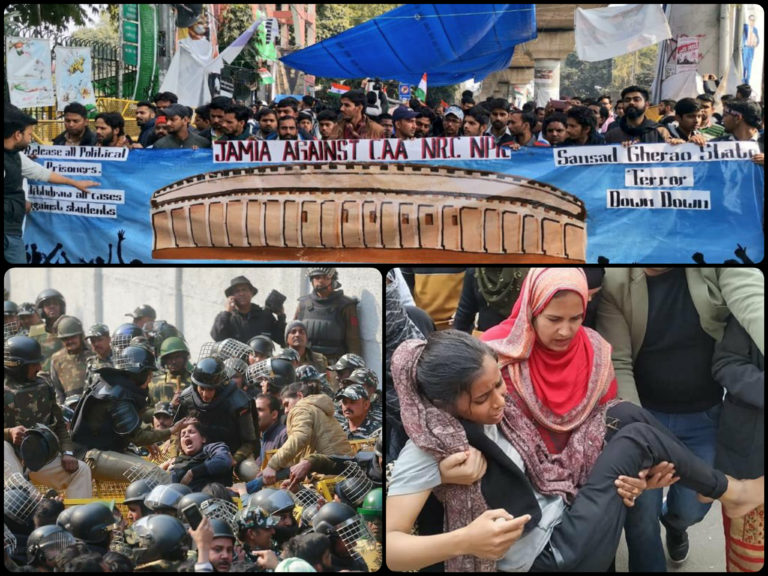
Students of Jamia Millia Islamia and Jamia Nagar in hundreds marched towards Parliament to protest against the National registry of citizens (NRC) and citizenship Amendment Act (CAA). They were stopped by the Delhi police. The police lathicharged the students injuring many.
The protesters were holding tricolor and banners and raised slogans against NRC and CAA.
A large number of the police force is deployed near Jamia after many Jamia students were stopped as they marched towards Parliament.
Delhi Police unleashes brutalities on Jamia students once again. Your lathis will not be able to break our resolve to fight against CAA/NRC/NPR. #IndiaAgainstCAA_NPR_NRC pic.twitter.com/66tpHXgTiX
— Umar Khalid (@UmarKhalidJNU) February 10, 2020
Police had barricaded the route, but many students moved ahead despite the barricade. After which police started attacking the students. According to the bystanders, the students were brutally attacked by the police in riot gear. Police did not give any warning to the students before the lathi-charge. Injured students were admitted to nearby hospitals. Many students were still adamant to march towards the parliament despite the police action.Just in: Large number of Force at Jamia Millia islamia to resist the March Jamia to Parliament street#Jamia pic.twitter.com/NGR0OzCYPg
— The Second Angle (@TheSecondAngle) February 10, 2020
SOS in Jamia
— Hum Bharat ke Log (@tauqirdanish) February 10, 2020
Heavy deployment of police & RAF in jamia,
Student were beaten brutally
They are Hitting their private parts, whether they are women or men, they are not taking care of anyone.#jamiaprotests #Jamia pic.twitter.com/8dAUt1Wj76
As per the latest report, Delhi police is not letting the ambulance carrying injured students pass through.
This is the second time that police has attacked Jamia students. Last year on 15th december 2019, police has entered and badly beaten students of jamia millia islamia university. Police had entered library and toilets and dragged students out of rooms and beaten them. Later it was revealed that police had also resorted to firing in the area. In their defence police said that protesters were throwing stones at them and police acted in retaliation. Delhi police action got international condemnation. Jamia students have been protesting for more than a month on the citizenship amendment act (CAA) and the national registry of citizens (NRC)Delhi police not giving way to ambulance.#DelhiPoliceSharamKaro #jamiamilliaislamia #Jamia pic.twitter.com/UdEP1nyL4x
— CAA / NRC Protest Info. (@NrcProtest) February 10, 2020
Delhi Women´s college students harassed by men chanting Jai Shri Ram
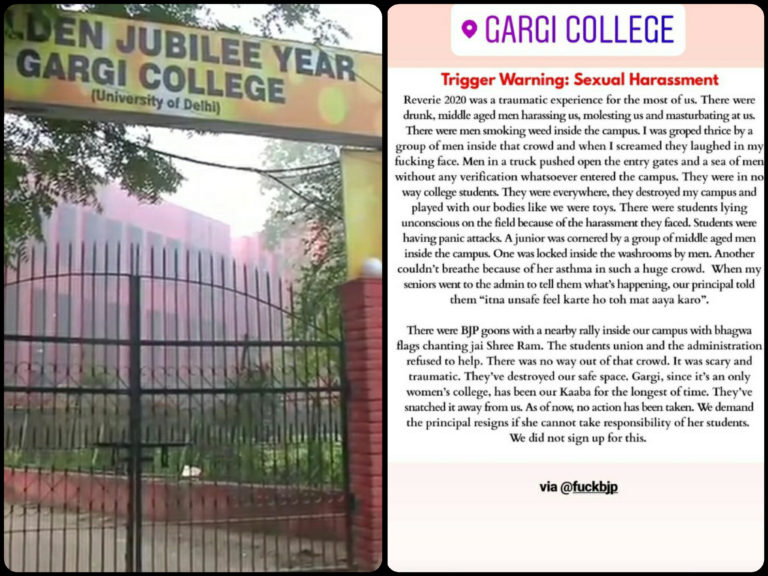
Women students in Delhi´s Gargi college suffered mass harassment at the hands of a group of middle-aged men, who barged into the college annual festival, molested, and masturbated at the women students.
According to the students, a large group of men from a pro-CAA rally that was happening near the college entered into the college premises.
The men were drunk, groped the students, locked them in washrooms and misbehaved with them.
The incident took place on 6th February during the annual college fest ´Reverie´but due to election fervor, the news was suppressed. The incident came to light after some students of the Delhi University’s Gargi College took to Instagram to narrate their unpleasant experiences during the February 6 college fest.
Slowly by 9th Feb. women started sharing their stories of assault over Facebook and twitter and soon it became viral. many in shock that such a thing could happen in an all-women college in the capital city.
In a social media post that has now gone viral, the students of Gargi College have said, “There were drunk, middle-aged men harassing us, molesting us and masturbating at us… I was groped thrice by a group of men inside that crowd and when I screamed they laughed…”.
In another social media post it has been said, “Girls were groped, locked in washrooms, stalked to the nearby Green Park metro, cat-called, eve-teased and misbehaved with during the festival.” Students allege that men came in trucks and entered the campus around 4:30 pm during the fest. They continued to harass the girls for several hours and the ordeal continued till around 9 pm.” Many students are unhappy and naturally angry with the way authorities have responded. The principal of the college Promila Kumar has shunned all responsibility for the attack on her college students.Mayhem happened at #GargiCollege today and literally no one is talking about it. Our girls were assaulted by drunk men. Amplify, take it to right channels please. @richa_singh @iamrana @abhisar_sharma @aaqibrk @hussainhaidry @tanwer_m pic.twitter.com/XXyDaVGVeQ
— Saumya Kulshreshtha (@Saumyakul) February 8, 2020
Today Delhi commission of women chairman Swati Maliwal visited the college and demanded Delhi police to investigate the case and arrest the culprits. The national human rights commission team also came to the college to record the events of 6th Feb. The students of the college have started protesting against the college inaction and demand the principal´s resignation.Our principal saying things like "itna unsafe feel hota hai toh mat aaya karo" is exactly how you normalise sexual harrasment and toxic masculinity. This is not how you "empower" a college with all women. Please just fucking resign. #GargiCollege
— Nishtha (@Nishtha54055655) February 9, 2020
Zee News anchor Sudhir Chaudhary rants on air, calls people of Delhi as selfish, lazy and freeloaders

The exit polls predict AAP emerging victorious in the Delhi Assembly elections. The news seems to have rattled Zee TV news anchor Sudhir Chaudhary. In his on-air telecast today he is seen ranting against people of Delhi for voting for AAP and making AAP victorious.
Sudhir Chaudhary lashed out at voters in Delhi after exit poll results for the Assembly elections were declared on Saturday evening. The exit polls results showed a clear majority for Arvind Kejriwal’s government.
The fact that Zee News and Sudhir Choudhary are pro-BJP is no secret. Zee News and Sudhir Choudhary have on many occasions peddled lies and fake propaganda against opposition or critics of BJP.
“Delhi residents do not care about the Balakot air strikes, Ram Temple in Ayodhya, or revocation of Jammu and Kashmir’s special status,” Chaudhary ranted. “They don’t even care about the country being fragmented into bits. They only care about their local struggles and not about bigger issues of national importance. The Delhi public has rejected BJP and national issues.”
He further added- “Public has told that politics is good to discuss on social media, good to see on news channels, good to read on newspapers, discuss in parties with drinks but when it comes to voting Delhi people see what they are getting for free! They will see where is “Sale” when they go for vote! They talk a lot of nation and nationalist, but they do not go out to vote. People of Delhi are lazy. They only want to share their viewpoints via their smartphones and do not want to come out to vote.”
From covert lies to overt lies
As if it was not enough of having declared the people of Delhi as lazy and freeloaders, he went ahead and further lied saying in Delhi, its not just free electricity, free water , free bus travel but free homes, free scooty is also offered. In his extrapolation, he added that- “if Pakistan prime minister Imran Khan came to Delhi and says their party PTI will also contest elections in Delhi and will pay off all their EMIs, Will Delhi people also vote for him? You have to think about this.. But looking at Delhi exit polls, it looks like the time to think about this is over. ” Mr Sudhir Chaudhary in his emotions and sycophancy towards BJP painted all of Delhi as in villainous color and as anti-national because in exit polls it showed AAP might win. There are some things that Mr. Chaudhary and we as the public have to think about. Allegiance to the ruling party is not allegiance to the country. There is a difference between love for government and love for the nation.Bidoon Jinsiya: “Without nationality”, Stateless in Kuwait

This is a series on people who have been declared “Stateless” or “Non-Citizen” by the countries that they inhabit.
Bidoon Jinsiya is an expression in Arabic that means “without nationality.” The expression is a lie, as most people who are Bidoon Jinsiya are Kuwaiti, but they were deprived of citizenship in Kuwait. Citizenship means belonging to a political community, which is a prerequisite for freedom. The world is full of people who have been deprived of citizenship and the rights that come from citizenship. There are many cases where people have lost their democratic claims on the state because of war or a political crisis. The story of Bidoon Jinsiya is one example. They may have a nationality, but they are stateless people.
On 28 January, the Kuwait courts sentence three protesters to 10 years to life jail sentences for their peaceful demonstration for the rights of stateless people in Kuwait. Last year, Kuwait came across controversy when Ayed Hamad Medath, a stateless person, committed suicide after being denied proper documentation. His death led to a demonstration by 15 stateless people last year, who said that Kuwait’s mismanagement of stateless people has led to violence and discrimination against Kuwaitis who have been denied recognition in their homeland.
The Kuwait government insisted that a lakh people live in Kuwait as stateless, or as Bidoon. They also insist that most of them are refugees from other countries. Bidoon activists insist that 2-3 lakh stateless people live in Kuwait and most are Kuwaitis who never received citizenship since independence. The Kuwait government still has not taken proper steps to naturalize those who they have deemed as eligible for citizenship.
 Kuwaiti citizens did not enrol for the police or the military. The state ended up recruiting foreign nationals. To avoid the controversy of hiring a mercenary army, the Kuwait government classified this population as stateless. Many of these people were from Iraq, and there has been an association of Bidoon people with Iraq. For a long time, a majority of the Kuwaiti armed forces were classified as Bidoon.
In the first two decades after Kuwait’s independence, people who were Bidoon enjoyed many freedoms. They still had access to employment, public education, and free healthcare, just as Kuwaiti citizens did. They could register marriages and receive other forms of identification. They did not have the right to vote, or hold protests. Those rights were only for Kuwaiti citizens. Being naturalized as a citizen did not immediately grant these rights. A person who is naturalized as a Kuwaiti citizen has to wait 30 years before they are allowed to vote.
How Bidoons came to be?
Kuwait had a strategic location in the Persian Gulf. When it was controlled by the Ottoman Empire, it retained political autonomy. The rulers made a deal with the British to keep it as a protectorate in 1899. After World War II, Kuwait became one of the largest oil exporters in the world and attracted labour from many parts of the world, including India. The elite in Kuwait ended the country’s protectorate status when Kuwait became independent in 1961. The young independent country had two challenges. To establish itself as a republic, it needed to create a list of citizens. It also needed to build an independent army and police force.The nationality law, which determined who was eligible for citizenship, favoured urban residents and people connected to influential communities. Many Kuwaitis were excluded from citizenship. Many people missed registration due to lack of awareness, living in remote areas, illiteracy or lack of proper documentation. This group became called the Bidoon jinsiya (Arabic for ‘without nationality’) or just Bidoon (‘without’).
Kuwaiti citizens did not enrol for the police or the military. The state ended up recruiting foreign nationals. To avoid the controversy of hiring a mercenary army, the Kuwait government classified this population as stateless. Many of these people were from Iraq, and there has been an association of Bidoon people with Iraq. For a long time, a majority of the Kuwaiti armed forces were classified as Bidoon.
In the first two decades after Kuwait’s independence, people who were Bidoon enjoyed many freedoms. They still had access to employment, public education, and free healthcare, just as Kuwaiti citizens did. They could register marriages and receive other forms of identification. They did not have the right to vote, or hold protests. Those rights were only for Kuwaiti citizens. Being naturalized as a citizen did not immediately grant these rights. A person who is naturalized as a Kuwaiti citizen has to wait 30 years before they are allowed to vote.
