The 23-year-old UP student who accused BJP leader Chinmayanand of rape was denied permission to sit for her third-semester examination Bareilly, UP.
Officials of Mahatma Jyotiba Phule Rohilkhand University (MJPRU), Bareilly have denied her permission to appear in her second-year LLM exams due to “low attendance”.
The university said that the student did not fulfill the mandatory rule of 75% attendance. It asked her to produce a court order to appear for the examination that will start on Tuesday.
The woman and three others are lodged in a Shahjahanpur jailfor allegedly blackmailing and demanding Rs 5 crore from Chinmayanand. The former Bharatiya Janata Party leader has also been lodged in the same jail since October 20.
This is happening despite the local CJM court granting her permission to appear for her exams and instructing the jail superintendent to send the woman to Bareilly in police custody.
In September, after the 23-year-old, who studied in a law college in Shahjahanpur, accused the BJP leader of sexual harassment in a video clip, his lawyers had filed a case of extortion and threat against unidentified persons.
Chinmayanand(born Krishna Pal Singh) is a former union minister from the Indian state of Uttar Pradesh. He was minister of state for internal affairs in third Vajpayee ministry. He was elected to 13th Lok Sabha from Jaunpur in Uttar Pradesh as a Bharatiya Janata Party candidate in 1999. He was a member of 10th Lok Sabha from Badaun in 1991 and from Machhlishahr in 1998.
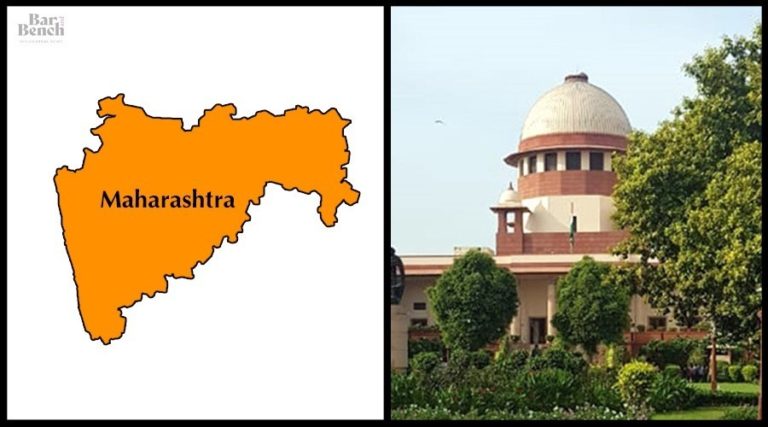
The Supreme Court on Tuesday ordered the Devendra Fadnavis- Ajit Pawar government to prove majority on wednesday on November 27 before 5 PM.
The trust vote in the Maharashtra Assembly will be held without a secret ballot and the proceedings must be live telecast, the apex court directed.
The top court also said that the pro-tem speaker must be appointed immediately and that proceedings should be completed by 5:00 pm on Wednesday.
The Maha Vikas Aghadi led by Shiv Sena is to file an application in the Supreme Court to restrain the Devendra Fadnavis from taking any policy decision till the floor test, if the court gives them more than 24 hours to prove majority in the house.
Yesterday, in a show of strength, Shiv Sena, NCP and congress brought its MLAs to Grand Hyatt hotel yesterday evening with the banner “We are 162”. MLAs of Shiv Sena-NCP-Congress took an oath to “not be lured” and “not help the BJP”.
“I swear that under the leadership of Sharad Pawar, Uddhav Thackeray and Sonia Gandhi, I will be honest to my party. I won’t get lured by anything. I will not do anything which will benefit BJP,” the pledge said.
The Supreme Court was hearing the plea filed by the Shiv Sena-Nationalist Congress Party-Congress alliance against the new government that was sworn-in early Saturday morning with Devendra Fadnavis of the BJP as Chief Minister and Ajit Pawar of the NCP as his deputy, creating a political upheaval in the state.
In the midst of an attack on universities and students, yesterday in Bangalore, a group of student and social organizations came together to form “Federation of Student Organizations for Free Education”.
The federation demands nationalization of education and saving JNU. The coalition has called for an important meeting tomorrow to discuss the matter further.
It is seen as a positive development in student politics. KVS, BVS, SFI, CFI, NSUI, SIO along with several Student bodies have participated in the meeting and have agreed on it unanimously.
Education is the fundamental right of everyone. The constitution also agrees to the fact that education should be free and compulsory for all. Savitribai Phule, Mahatma Jyotiba Phule, and Dr. BR Ambedkar have fought for it. Even now the struggle is continuing. But the successive ruling governments have tried to escape from the conditional responsibility of education. Governments have been directly responsible for mushrooming of private institutions, closing down government schools and colleges and their continuing assault on education with the latest fee hike at JNU.
Progressive people from Karnataka have joined their hand together to expose the government conspiracy to privatize education, to oppose fee hike across the country and to demand free education across India. It brought all the student organizations of Karnataka together and decided to lead this struggle. The new initiative is “Federation of Student Organizations for Free Education”.
The first preliminary meeting was held on November 23 in Gandhinagar, Bangalore under the leadership of Dr.CS Dwarkanath, former chairman of the Backward Classes Commission and BR Bhaskar Prasad, a youth activist.
BR Bhaskar Prasad said- The next meeting is scheduled to be held on Monday November 25th at 4 pm at the Freedom Park, Bangalore and invitations has been sent to ABVP, AISA, AIDSO and DSF organizations who are also expected to take part in it Education is free for everyone in the country, from LKG to PhD. Education must be nationalized.
This Federation hopes that everyone in this country should get equal education without caste and gender discrimination. The federation has given a call that this struggle is not only to save JNU but also for the future generations and to the prosperous future of the country.
How can we support the struggle of JNU students?
Student organisation representatives and their leaders leaving aside their party and ideological disagreements had attended the meeting at Gandhinagar office demanding free education for all from primary school and Ph.D degree along with the question of how can we immediately intervene and support JNU’s Student Struggle.
The meeting, which lasted for about two hours, involved a long discussion on many issues. “It was decided to call and invite more people who are concerned about the issue,” CS Dwarkanath said.
Srinivas from Bahujan Vidyarthi Sangathane (BVS) told his experience of studies in JNU and how coming from poor family it helped him a lot. – I completed MA, M.Phil, and Ph.D. from 2002 to 2010 at JNU, Delhi. JNU offers an excellent education at a very low cost. That is why there are poor talented students from all corners of India. I also went to JNU from my village and completed my studies with 300 rupees a year. Otherwise, I would not have been able to get through this. They do not impose their doctrine on anyone, even though there is much communist influence there. There is also ABVP, NSUI. We also started an organization called Bahujan Students Front. In spite of having several organizations, nobody forces their ideology on to others. The freedom that we get in JNU, makes us to realize the true reality of India and inspires us to build strong India. The BJP government is concerned that those who come out will sow the same thoughts in society. For this reason they are trying to finish off JNU. For saving it we are uniting in Karnataka.
The SC, on Sunday, 24 November, directed Solicitor General Tushar Mehta to produce the Governor’s letter recommending revocation of President’s rule and of inviting BJP to form government in Maharashtra, as well as the letter of support placed by Fadnavis, by 10:30, am on Monday, 25 November.
Appropriate orders will be passed by the Court after reviewing the relevant documents.
A bench of Justices NV Ramana, Ashok Bhushan and Sanjiv Khanna also issued notices to the Centre and Maharashtra government on a petition filed by the Shiv Sena-NCP-Congress combine against the Maharashtra Governor’s decision to swear in Fadnavis as chief minister. The court also issued a notice to Fadnavis and Dy chief minister Ajit Pawar.
Senior advocate Abhishek Manu Singhvi, appearing for Cong-NCP, asks how Governor could be satisfied that NCP MLAs supported Ajit Pawar when 41 NCP MLAs at 3:30 pm on Saturday said they didn’t support him and they were the NCP.
“Is this not the murder of democracy?”, Singhvi asked in court.
As the Shiv Sena-NCP-Congress prepared to form a government with Uddhav Thackeray as chief minister, the BJP quietly worked behind the scenes to dramatically turn the tables with help from Sharad Pawar’s nephew Ajit Pawar, who was sworn in as deputy chief minister on Saturday. The alliance had challenged the decision of the Governor to invite the BJP to form government in the state.
Senior advocate Kapil Sibal, appearing for Shiv Sena, cited 2018 Karnataka precedent and the Supreme Court order in the case.
In that case, SC had cut short 15 days given by Governor to BJP for the floor test and asked them to prove majority in 48 hours.
Terming Governor’s actions as biased and malafide, Sibal demanded immediate floor test in Maharashtra.
Shiv Sena, Congress, and NCP in their petition filed on 23 November evening urged that a floor test be conducted within 24 hours.
Yesterday morning was not just shocking for Thackrey family but for many Indian citizens when the morning newspaper headline read Uddhav Thackrey to be the chief minister but television screens pronounce Devendra Fadnavis taking oath as CM.
In a dramatic turn of events, early morning President rule was lifted from Maharashtra and Devendra Fadnavis was made chief minister and NCP Ajit Pawar DY CM.
Let’s take a look at the events that unfolded which Sanjay Raut, Shiv Sena leader called “Sin committed in the dark of the night”.
Friday evening 6.30- BJP national secretary in charge of Maharashtra, Bhupendra Yadav reaches Mumbai to finalize deal with Ajit Pawar who had given signals that he is ready to align with them
Friday night 11.45- Ajit Pawar finalizes the deal with BJP to form government.
Friday night 11.55- Fadnavis speaks to the party, requests for swearing-in before ShivSena-Congress-NCP lay claim for government formation
Saturday 12.30 AM Governor Koshyari cancels his trip to Delhi
Saturday 2.10 AM Secretary to governor told to submit revocation order at 5.47 a, and arrange swearing in at 6.30 AM.
2.30 AM Secretary informs he will submit file within two hours, advises 7.30 AM for swearing in.
Saturday 5.30 AM Devendra Fadnavis and Ajit Pawar reach Raj Bhavan
Saturday 5.47 AM President rule revoked
Saturday 7.50 AM Governor begins swearing- in ceremony
Saturday 8.01 AM News breaks of Fadvanis and Ajit Pawar taking oath as CM and Dy CM.
Saturday 8.16 AM PM Modi congratulates new CM and Dy CM on twitter.
Saturday 9.27 Am Sharad Pawar tweets that Ajit Pawar’s move to support BJP is his personal decision, not NCP’s.
To wash off the midnight hijack allegations, Fadnavis tells Media, people gave us a clear mandate it was Shiv Sena that aligned with other parties, hence President rule was implemented in the state.
How was President rule revoked in Maharashtra?
Many in the opposition have questioned the revocation of President rule in the state at 6 AM.
Union Minister Ravi Shankar Prasad answered that it was done under Rule 12 of the Allocation of Business Rules 1961. The rule says the Prime Minister can take a call on the matter to “meet a situation of extreme urgency or unforeseen contingency”.
According to rules, the imposition or revocation of President’s Rule needs a go-ahead from the Union cabinet. But in this case, it was Prime Minister Narendra Modi who gave the green signal.
But nobody has been able to tell what were the extremely urgent circumstances that made PM Modi to use his special powers
Officials said under Rule 12, the Prime Minister has special powers to bypass the need for Union Cabinet’s recommendation for revocation President’s Rule in Maharashtra.
The rule also stipulates that to invoke it, the proposal should be accompanied by a “detailed justification clearly bringing out the urgency involved in the matter and the exceptional circumstances that require it to be processed under Rule 12”.
What’s next?
Since then NCP has sacked Ajit Pawar as its house leader but not expelled him from the party.
Seven of the 11 MLAs who had initially gone with Ajit Pawar have come back to NCP fold claiming innocence of Ajit Pawar’s ploy.
Now the questions ahead of BJP Ajit Pawar combine is how will they prove majority if most NCP’s MLA still pledges loyalty to NCP.
Meanwhile, Congress, NCP and Shiv Sena are ferrying their legislators to other states or to hotels with security outside to prevent poaching from BJP.
Fadnavis has to prove his majority by November 30.
In the dizzying turn of events that post-election Maharashtra government formation has been, Saturday morning gave surprising news to many.
After a month-long deadlock and sparring between BJP and Shiv Sena, Devendra Fadnavis took oath as Chief Minister and Nationalist Congress party’s Ajit Pawar as Deputy CM this morning.
This will be Devendra Fadnavis second term as Maharashtra CM. Ajit Pawar is the nephew of NCP head Sharad Pawar.
Minutes after the oath-taking, Prime Minister Narendra Modi tweeted congratulating Fadnavis and Pawar.
To be noted that there was President rule in Maharashtra since last week, which was suddenly lifted for the oath taking ceremony today.
Till last night Shiv Sena, Congress, and NCP were in talks to form the government with Uddhav Thackrey as CM. According to sources, the ministerial post division was also discussed with Shiv Sena to get 16 ministerial berths, NCP – 15 and the Congress 12 posts. Until late night Shiv Sena leaders, Sharad Pawar and Congress leaders were in discussions on the post of Speaker, Deputy Speaker, and other portfolios.
Sharad Pawar had met PM Modi at the Parliament premises on 21 November, that is being hinted as the point of U-Turn for NCP, but Sharad Pawar NCP still continued having discussions with Shiv Sena and Congress until last night.
According to ANI reports, NCP chief Sharad Pawar was part of discussions for the formation of Devendra Fadnavis-led Maharashtra government and he was the one who approved Ajit Pawar name for Deputy CM.
But Sharad Pawar is denying to be part of this coalition and there seems to be a hint of breaking of NCP with Ajit Pawar and some MLAs.
Shiv Sena leader, Sanjay Raut is describing the turn of events as “Sin done in middle of night”. He said Ajit Pawar was with them in all the discussions till last night. BJP with power of money and might has cheated the people of Maharashtra and they will pay for it.
#WATCH Mumbai: NCP's Ajit Pawar takes oath as Deputy CM, oath administered by Maharashtra Governor Bhagat Singh Koshyari at Raj Bhawan. pic.twitter.com/TThGy9Guyr
Speaking to Media, Devendra Fadnavis said that the state did not need a ‘khichdi’ government the way Shiv Sena was trying to form.
Sharad Pawar and Uddhav Thackrey might address a joint press conference today.
Maharashtra governor Bhagat Singh Koshyari is a member of the Bharatiya Janata Party from Uttarakhand. He is also an RSS veteran, Koshyari served as National Vice President of BJP and party’s 1st State president for Uttarakhand.
The BJP won 105 seats, while the Shiv Sena won 56 seats in the Assembly elections. Opposition Congress won 44 seats, while the NCP won in 54 constituencies
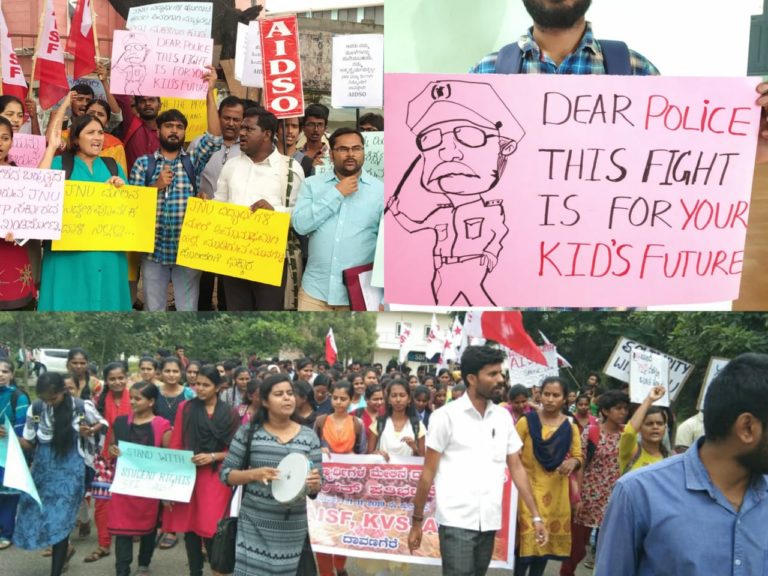
Students organizations across Karnataka protested in eleven districts including Bangalore condemning the attack on JNU students yesterday. Students want to raise their demands and highlight problems with their colleges, university departments and also wanted to express their deep solidarity to students of Jawaharlal Nehru University. Some student organisation has planned to protest tomorrow the nationwide call from JNUSU.
Bangalore
Students in Bangalore
In support of protesting JNU students SFI, AISF, AIDSO, KVS, and many other student organizations have registered their protest at Mysore Bank Circle in Bangalore.
Social activist B. Sripad Bhatt while speaking at the protests said, “The current central government is trying to take over JNU like other institutions. But, JNU is resisting this assault on them and hence the central government is attempting to destroy JNU”.
One thousand research papers are published from JNU every year. There are 8,000 students studying there and it costs around 500 crores annually. The central government, which spends over Rs 2,000 crore a year on its campaigns, is unfairly raising fees on these students” he questioned.
He also questioned the government “In Banaras Hindu University the police and the government are backing the protests to disallow Sanskrit teacher Feroze Khan from teaching. Students are performing a ritual ceremony to create trouble. Though this constituency is that of Prime minister himself he hasn’t uttered a word yet. But here in JNU, the students who are protesting to save democracy are being Lathicharged” he expressed his agony.
“The central government has decided to abolish University Grants Commission. UGC gives funds for research to different departments and research scholars. The government wants to control higher education by controlling the funding agency. The JNU fee hike is part of this conspiracy” He said expressing his anger.
V Ambarish and Gururaja Desai from SFI, Jyoti from AISF, Ashvini K.S and Ajay Kamat from AIDSO, Sarovar Benkigere and Gurumurthy from KVS and many others participated in protests.
Sarovar Benkikere, state convener of Karnataka Vidyarthi Sangathane (KVS) says-
The students from Dalit, Adivasi and poor families cannot afford education in private universities that charge exorbitant fees. The government wants to demolish the public sector completely. After destroying primary education and government schools, the next target is higher education. Students from Dalit, Adivasi and poor families cannot afford the expensive private schools and universities. This push for fee hike and privatization is just a means to push marginalized further out of the education sector. The government is cutting our thumbs to ensure that Dalits and Adivasis cannot study and education remain a stronghold of Upper castes. The government is following the tenets of Manusmriti and varnashram.
Raichur
There were protests by KVS, SFI and other progressive organizations in Raichur against the increase in fees for JNU students, the new education policy and privatization of education.
Students expressed their anger and condemned the police brutality in Delhi on JNU students. They appealed to the district authorities to express their concerns on student matters.
Student organisations in Raichur
Laxman Mandalgera of KVS- The government wants to silence the voice of youth. Police who were supposed to protect the peaceful students protest march towards Parliament, lathi-charged and used water cannons against the JNU students at the behest of the central government.
Sindanuru
A coalition of progressive organizations protested in Sindhanur condemning the fee hike in universities and physical assault by the police on JNU students. Samad Chaudhry, Nagaraj Pujar and many others participated in a protest in front of the Sindhur Taluk office by a
Davanagere
A protest at Davangere University was held yesterday condemning the attack on JNU students’ and supporting their struggle. Veena from AISF and SFI leaders attended the protests.
Students organisation at Davangere
Pavitra of KVS gave a statement- Normally you would see the percentage of women is low in higher education. But in JNU it is 50% because it is enshrined in its admission policies. Women in JNU are fighting for their right to study, a right that is often curtailed by families for lack of finances. It will be a huge setback to many women students who come to higher education with big hopes of making a career for themselves.
Many students cannot afford to buy books and all publications are not available online. Many students without resources lag behind because of this. So demand to have libraries open for longer periods to time is a valid demand and students across country have been demanding it for many years. But many TV channels and on social media, we see this demand is being made to look like students want to enjoy all night and want to be outside. What kind of people are these? these people are anti-education!!
In the police action against the protesting students, many students were dragged, attacked, one blind person was also attacked, women were molested. This is shameful of Delhi police to act this way and we condemn such actions and we are in solidarity with the demands of JNU students.
Kalaburgi
In Kalbarugi( Gulbarga), progressive organizations organized a procession and protested in front commissioner’s office in support of the JNU students. Activist and intellectual K Neela and KVS’s Rajendra Rajwala were present.
Kalaburgi student organisations
Rajendra Rajwala said- Students in Karnataka also face similar problems with high fees and general breakdown of education. The government’s only solution is to “Shut down Universities”.. This is what they want? Where will we study if they shut down universities? They want to shut down government universities and give space for Jio University so their friends can make money of the education sector.
Hampi Kannada University, Hospet
Student organisations like SFI, KVS, AISF, AIDSO organised the protests at Hampi kannada University. Santhosh HM of KVS, M Muniraju, Dodda basvaraju (SFI) were the lead organisers.
Hampi University students in solidarity with JNU students
Santhosh HM said – This government cannot see poor and dalits studying in universities because when they study they can ask questions and this government is afraid being questioned.
In Karnataka also similar problems like JNU. The fees are very high, for almost 9 months PhD students have not received their fellowship. We are in solidarity with JNU students who are raising the demands of students all over India.
Education should be free and for all!
Some things take their own sweet time to take the desired form; Sangh Parivar knows this truth very well.
Nation’s social and secular fabric was destroyed by the Babri Masjid- Mandir dispute in Ayodhya in recent decades. This was given an end by Supreme court.
Supreme court said this in clear words.
“The exclusion of the Muslims from worship and possession took place on the intervening night between 22/23 December 1949 when the mosque was desecrated by the installation of Hindu idols. The ouster of the Muslims on that occasion was not through any lawful authority but through an act which was calculated to deprive them of their place of worship.”
“After the proceedings under Section 145 of CrPC 1898 were initiated and a receiver was appointed following the attachment of the inner courtyard, worship of the Hindu idols was permitted. During the pendency of the suits, the entire structure of the mosque was brought down in a calculated act of destroying a place of public worship. The Muslims have been wrongly deprived of a mosque which had been constructed well over 450 years ago.”
As an answer, the supreme court has said this in paragraph 799. “We have already concluded that the three-way bifurcation(Sunny waqf board, Ram Lalla Virajman and Nirmohi Akhada) by the High Court was legally unsustainable. Even as a matter of maintaining public peace and tranquillity, the solution which commended itself to the High Court is not feasible. The disputed site admeasures all of 1500 square yards. Dividing the land will not subserve the interest of either of the parties or secure a lasting sense of peace and tranquillity. “
What happens outside the court related to a case which is subjudice is totally irrelevant for us. Law and constitution are our supreme pinnacles. Our justice, our judgement process is based only on these two factors’ law and constitution. Thus the supreme court has reiterated in hundreds of cases.
But one can see many glaring exceptions to this stand of the supreme court. Emergency imposed by Indira Gandhi is one example. ‘Court could not avoid getting influenced by outside environment’ for this opinion, a glaring example made its presence in history forever. The right to freedom of human being and right to live are the fundamental rights given by our constitution. (Though these are not unfettered).
During the emergency, a five-member bench of the supreme court gave a majority judgement saying these two rights can be dismissed.
In civil society, the right to life and personal freedom are fundamental rights of human beings… to surrender these rights to executive will not be allowed by the constitution and our laws.
Because of this dissenting judgement, he was denied promotion to the post of the chief justice, neglecting his seniority in service, a junior justice was promoted to the post and that was one of the egregious extremes of emergency.
In a later day, chief justice of supreme court apologized for this judgement. PN Bhagwati repented and said, he should have resigned than being part of such judgement.
This judgement is cited only as an example that the atmosphere outside the court can have an effect on a court judgement.
Even in Mandir Masjid dispute judgement, one cannot rule out the possibility of external factors influencing the verdict. But it is possible that, behind the current influence, a higher objective of ‘goodwill’ of maintaining social peace and harmony might have been there. The atmosphere outside the court that we see today was never seen in India before. Fierce Hindutva and aggressive nationalism have built a giant and ruthless majoritarian argument. The fact that from 1989, this dispute has spread communal polarization, violence, and hatred throughout India, must have been in the minds the judges. A good intention of avoiding another such trouble must have worked in delivering the judgement. Whatever the judgement, we must avoid feeling someone has won and someone has lost, this was said by the ruling party and the parivar behind it and it does look laudable from outset. But the ruling party and its back bone Sangha Parivar have already instigated the collective mood of majority of the country in favour of an idea of communal Hindu Rashtra. The ruling party and the parivar very well know that some things cannot be made to happen overnight. Then is it even possible that the apex court did not know this bitter truth? Thus, pros and cons that are possible if another work of hatred and violence were to affect the nation. That is why, the noble principle of delivering justice must have reduced itself into mere dispute settlement agreement. We should remember that delivering justice and dispute settlememt are two different things. If delivering justice was given priority, mandir and masjid both would have stayed together in that 2.77 acre space.
From October 2019, Chile has seen a movement, nearly 40 lakh people strong, calling for the end of their Neo-liberal legacy. The protests began when an organized group of school students protests a hike in public transport fees and escalated to the point of emergency being declared and the fall of the Chilean constitution.
Chile- Welfare state to Military Dictatorship
In the 1930s, the elite of Chile was concerned about a revolution and began to support a modern welfare-style economy. The Chilean government then became a modern democracy. Socialism began to grow in popularity in Chile. After the Cuban revolution established a Soviet ally in the Western Hemisphere, the Americans were concerned that Latin America would see more countries shift. In the 1960s, many countries in Latin America saw military takeovers of formal democracies.
In Chile, anti-socialist candidates were supported and funded by the American government. The appeal of socialism and the propaganda system were in a tussle for the popular spirit of the country. In 1970, a member of the Chilean Socialist Party, Salvador Guillermo Allende Gossens, was elected President in Chile after many failed attempts. Immediately, Allende raised the minimum wage, and increased the public sector, and increased spending on education and healthcare.
The American government targeted Allende. American copper companies operating in Chile lost when Allende nationalized the mining sector. Allende advocated a parliamentary path to socialism, as opposed to a violent revolution. At a time where socialism was linked with violence in anti-left propaganda, the Americans feared this would create the threat of a good example.
The American government actively started an anti-Allende campaign in Chile even before the election. This resulted in the polarization of Chile. The United States also engaged in a series of economic tactics to increase inflation in Chile, reducing the average wages in spite of raising the minimum wage when Allende was in power.
In 1973, leaders of the army staged a coup. Military leader, Augusto Pinochet was established as the leader of Chile. Allende opted to commit suicide rather than negotiate. It is not clear if the American government had any direct role in the coup, but the military leadership could not have survived without American support.
Pinochet’s Chile aggressively undid Allende’s reforms and pushed Chile to an unregulated market system, in the spirit of the Chicago school of economics. National industries were privatized. Trade Unions and progressive movements were violently suppressed, through torture and massacres. One of the most fascist acts was the conversion of the Estadio Nacional (National Stadium) in Santiago, Chile’s capital, to a prison camp where thousands were detained, tortured and executed for supporting Allende.
While criticizing the regime internationally, America supported the changes economically, alleviating many of the ill effects of privatization. Chile controlled inflation and stabilized wages, though inequality and development in the hinterlands suffered. This came at a cost as IMF debt which rose to the point of crisis, leading to the downfall of Pinochet. In 1980, Pinochet agreed to devolve power, by establishing a new constitution of Chile, which would be the governing framework of the country.
The Chilean Constitution and the Campaign for “NO”
The constitution was primarily drafted by supporters of Pinochet. It gave the military a lot of power. It kept laws restricting organizing in ways that were considered a threat to the country and kept a number of checks on representative institutions. The constitution was ratified by a controversial plebiscite, which was criticized for excessive military oversight.
As Pinochet devolved his power, the political leadership of Chile gradually shifted a group of center-left parties, who opposed the plebiscite, began to share power under the banner of the Concertación por el No, or Concertación (Campaign for the No, or Campaign).
chile No campaign
They campaigned for the constitution to be voted “No” in the plebiscite. The Concertación defeated Pinochet in 1989 and remained the dominant electoral formation until 2010.
The Concertación amended the constitution many times, but the basic Neo-liberal/military structure remained. This led to extreme inequality where people would struggle to make basic ends meet. As a result, issues like food prices, education costs, transport and healthcare costs were issues that rang with the people.
Student protests (2006-2019)- A timeline
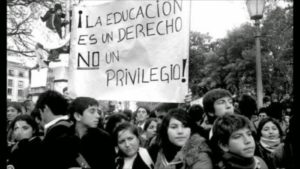
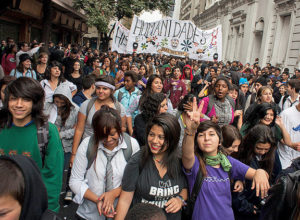
In 2006, the famous Penguin revolutionbroke out, when up to 8 lakh students began a national strike, demanding free bus travel for students, reduction of fees, waiving of entrance tests, nationalizing education and universal quality education. A lot of focus was on abolishing the Organic Constitutional Act of Teaching, which made the state a regulatory body in education, rather than a provider. The Act was something that the Concertación opposed. The strike began with Secondary School students and was called the Penguin revolution on account of their school uniforms. It then spread to universities.
The protests were largely peaceful, though in one instance when 2000 students marched through Santiago, there was a confrontation with the police. Some students threw rocks at the police, and the police firing tear gas and water cannons at the students. The strikes were considered successful, and many of the demands were met, though with strong resistance.
Education became a focal point in protesting the state. In 2008, more protests followed. This time, the protests were more effectively contained, but this led to the Concertación losing the elections in 2010.
In 2011, the Chilean Winter protests erupted. Again, the protests focused on education funding and were mostly by the school and university students. This time, the protests included more spectacles, with Flash Mobs, banging of pots and pans, pictures of students kissing at demonstrations circulating. Internationally, pictures of the protests spread on social media. The protests consolidated the leadership of school students, university students, and indigenous student leadership. Agitations continued for years. Regional protests began to gain momentum on other issues, such as gas prices, healthcare, minimum wages, and the rights of the fishing community. They died down with the return of the Concertación to power. The Concertación promised to end the for-profit education system and made a series of proposals, which were rejected by the Chile constitutional court.
The Concertación lost the 2018 election. Two factors in their loss this time was the term limits on the popular Michelle Bachelet (who was in power for two non-consecutive terms by this point), and infighting within the coalition. Pro-business Sebastián Piñera won his second non-consecutive term in 2018.
In October 2019, a group of students in Santiago protested a hike in the metro fare shouting the slogan ¡Evade! (evade!) where they would use the bus without paying. After confrontations with the police, the protests became more militant. The protest escalated to the point where students began to take over 80 metro stations. Police response began to involve tear gas and water cannons, and the protests began to inspire many others across the country within a few weeks. The state responded by declaring an emergency, but the protests only grew in strength.
The protests began to hit at the root of the education problem. The constitution of Chile had to be changed. The protesters demanded that the Piñera resign and that Chile adopts a new democratic constitution.
So far, the government has agreed to hold a referendum in April but many also fear that the repression might increase.
Also Read: Ecuador rejects IMF, Neoliberal agenda, protests all over the capital
Rosa Luxemburg, a german revolutionary in a 1916 anti-war pamphlet wrote- “Bourgeois society stands at the crossroads, either transition to Socialism or regression into Barbarism”. Now, more than a century of people’s struggles and political upheavals for a just and equitable society, the world is at crossroads again between Socialism for all and Barbarism of the rich.
Latin American political landscape is no stranger to class conflicts. Lately, the continent is witnessing a resurgence ofPink Tide after a series of right-wing governments (Argentina, Ecuador, Chile, Brazil) came to power in the last five years.
Recent elections in Argentinashow that people have rejected right-wing Macri’s austerity politics. Similarly, the neighbouring country Chileis also witnessing unprecedented protests against its billionaire right-wing President Piñera. Massive protests have erupted in Ecuadoragainst the IMF introduced austerity measures by Lenin Moreno and Venezuela has managed to withstand multiple coup attempts since January 2019.
Now, we see similar upheavals in Bolivia, where President Evo Morales who weeks after winning record 4th term presidential elections has resigned after a US-backed right-wing military coup.
Evo Morales: The first Indigenous President to be ousted in a US-backed coup
Evo Morales is the first indigenous leader in Bolivia’s history who came to power in December 2005 elections in a landslide victory through his Movement for Socialism (MAS). Till then, two-third of the population which consists of various indigenous communities was ruled by the country’s wealthy oligarchs. In his 13 year rule, he stood up for the poor, workers and peasants, opposed US imperialism and championed environmentalism by pushing through rights for the Mother Earth whom the indigenous population revere. His government reduced Bolivia’s poverty rate by more than half while quadrupling GDP per capita and sustaining one of the highest economic growth rates in the region.
How OAS and US-trained leaders help overthrow Morales
The OAS or Organisation of American States is a continental organization that was founded for the purposes of solidarity and cooperation among its member states within the Western Hemisphere. During the Cold War, this meant opposing leftism as a European influence; since the 1990s, the organization has focused on election monitoring.
As the results of Elections started pouring and it looked like Morales is winning the fourth term. On October 21, a day after the election, OAS issued a statement casting doubt on the process due to an “inexplicable” change in the trend of the vote count.
This statement was thoroughly debunked by the Center for Economic and Policy Research (CEPR), which found that the trend did not change and that Morales widened the gap over his rivals due to late reporting rural precincts, where he enjoys a tremendous advantage. However, the damage was done: protesters took to the streets decrying electoral fraud. The OAS stoked protests despite their statement being debunked and ensured that the coup was successful.
Morales fell for OAS trap and invited OAS to conduct an audit. THE OAS instead of releasing results of the full electoral audit on November 12 repeated the older claims from the October 21st statement and called for new elections.
The OAS behavior in Bolivia was condemned by several countries called it shameful and manipulative.
Meanwhile, the oligarchic right-wing opposition started rioting on streets in an organised manner. They went on to attack Morales supporters, kidnap some politicians, attacked Venezuela’s embassy and have burnt their homes over some vote recount irregularities. So far the right-wing has insisted removal of Morales but has not offered any evidence to the Vote miscount/irregularities and insisted removal of Evo Morales. They mobilised the right wing groups into streets and started attacking government buildings and destroying properties.
Despite being victorious in the elections, Morales announced to hold fresh elections to control the chaos on the streets.
The military and police still asked him to resign, forcing Morales to step down to “avoid further escalating violence and bloodshed”.
Due to threats to his life, Evo Morales with the help of his supporters has managed to reach Mexico City after he was granted Political asylum by Mexico’s President Andres Manuel Lopez Obrador.
Earlier this year, a coup was attempted in Venezuela by a political unknown Juan Guido. A similar political outsider, Luis Fernando Camacho has risen to the international spotlight as the main opposition leader in Bolivia. This openly racist and misogynist opposition figure is known to incite people with his anti-indigenous and racist rants. He is a white supremacist who is always seen with a Bible in hand and denounces the Bolivian indigenous beliefs. He comes from the country elite and his family is associated with many Far right anti-democratic movements in the country. His family was also been involved in the Panama Papers scandal through the registry of three offshore companies: Medis Overseas Corp., Navi International Holding, and Positive Real Estates. According to El Periodico, the coup was orchestrated by three US senators Ted Cruz, Bob Menendez, and Mario Rubio along with Bolivia’s Clergy, right-wing elites and supported by military and Police.
Some of Morales’s decisions have not gone done well with the country elites. Morales had tried to change the country’s constitution through a referendum. The older constitution was pro elite. Lately, Morales has also decided to nationalise the country’s lithium reserves. This has also angered the country Elites.
Courtesy Redfish Facebook page
Bolivia holds one of the largest Lithium reserves along with Argentina. Shortly before the coup, his government announced plans to nationalise the highly profitable lithium industry and to deal directly with the international market instead of exporting it at bargain prices to the West. Global demand for lithium, used to make cell phone batteries, parts of laptops and electric cars, is expected to triple in the next 15 years.
The right wing opposition has resorted to widespread violence attacking the state TV station, radio stations and Morales supporters and indigenous population of the country. In Chile, where the protesters waved Indigenous Mapuche flags, in Bolivia, the protesters, together with the police are seen burning the Indigenous Whipala flag. After the coup the security forces and right-wing para militias are rounding up and beating Indigenous people and Leftists in impoverished neighborhoods in La Paz. They have also arrested several government members threatening to kill them.
World leaders and organisations have condemned the coup and have expressed solidarity with Evo Morales and Bolivian people. After offering to resign he ended his resignation speech stating: “la lucha sigue” (“the struggle continues”). Bolivian people are fighting back against pro-coup police repression. Police stations have been burned down in several working class neighbourhoods in Cochabamba and El Alto as well as smaller municipalities. In spite of international condemnation, the opposition is threatening to kill the Anti-Coup protesters.
President Trump has supported the coup and has warned democratically elected Venezuela and Nicaragua governments of serious consequences. It only remains to be seen whether Bolivia will continue to support Evo Morales against the coup or plunge into a civil war fighting the security forces.
On 14th November, Bolivians flooded the streets of La Paz as trade unions and social movements called for a nationwide strike against the right-wing military coup and reject the self-appointed president Jeanine Añez.
People are being massacred in the streets of Bolivia. More than 23 people have been reported killed as they protested against the right-wing military coup and hundreds have been wounded from repressive means used by security forces.
https://www.facebook.com/watch/?v=566611574088100
(sources: Inter-American Commission on Human Rights, Defensora del Pueblo de La Paz and reporters on the ground)
Where are the outcries by world leaders? Where is the coverage by the international media?
The anti-indigenous backlash has also evoked memories of 2003 standoff between Bolivian indigenous ethnic groups and the national army that left more than 60 Aymaras ( Indigenous people) dead. Many analysts also fear a civil war-like situation.







 In 2006, the famous Penguin revolution broke out, when up to 8 lakh students began a national strike, demanding free bus travel for students, reduction of fees, waiving of entrance tests, nationalizing education and universal quality education. A lot of focus was on abolishing the Organic Constitutional Act of Teaching, which made the state a regulatory body in education, rather than a provider. The Act was something that the Concertación opposed. The strike began with Secondary School students and was called the Penguin revolution on account of their school uniforms. It then spread to universities.
The protests were largely peaceful, though in one instance when 2000 students marched through Santiago, there was a confrontation with the police. Some students threw rocks at the police, and the police firing tear gas and water cannons at the students. The strikes were considered successful, and many of the demands were met, though with strong resistance.
Education became a focal point in protesting the state. In 2008, more protests followed. This time, the protests were more effectively contained, but this led to the Concertación losing the elections in 2010.
In 2011, the Chilean Winter protests erupted. Again, the protests focused on education funding and were mostly by the school and university students. This time, the protests included more spectacles, with Flash Mobs, banging of pots and pans, pictures of students kissing at demonstrations circulating. Internationally, pictures of the protests spread on social media. The protests consolidated the leadership of school students, university students, and indigenous student leadership. Agitations continued for years. Regional protests began to gain momentum on other issues, such as gas prices, healthcare, minimum wages, and the rights of the fishing community. They died down with the return of the Concertación to power. The Concertación promised to end the for-profit education system and made a series of proposals, which were rejected by the Chile constitutional court.
The Concertación lost the 2018 election. Two factors in their loss this time was the term limits on the popular Michelle Bachelet (who was in power for two non-consecutive terms by this point), and infighting within the coalition. Pro-business Sebastián Piñera won his second non-consecutive term in 2018.
In October 2019, a group of students in Santiago protested a hike in the metro fare shouting the slogan ¡Evade! (evade!) where they would use the bus without paying. After confrontations with the police, the protests became more militant. The protest escalated to the point where students began to take over 80 metro stations. Police response began to involve tear gas and water cannons, and the protests began to inspire many others across the country within a few weeks. The state responded by declaring an emergency, but the protests only grew in strength.
The protests began to hit at the root of the education problem. The constitution of Chile had to be changed. The protesters demanded that the Piñera resign and that Chile adopts a new democratic constitution.
So far, the government has agreed to hold a referendum in April but many also fear that the repression might increase.
Also Read: Ecuador rejects IMF, Neoliberal agenda, protests all over the capital


