After the supreme court judgement about thedisqualified MLAs, the nomination process for the by-polls in Karnataka has started and so do the speculations about the winners and losers.
Even though Former CM Siddaramaiah said ‘We will win 12, don’t be surprised if we win all 15’, it is quite apparent that all three parties are in a miserable condition.
Gaurilankeshnews spoke to some of the ‘insiders’ in all the three parties and here is what we found out.
First the disqualified MLAs-
The disqualified MLAs who had won in the previous election and are now contesting on BJP ticket are not confident of winning. To get a simple majority in the assembly BJP needs 8 more seats and they are not confident about it.
BJP
BJP is in power, has a strong high command, they have scared the bigwigs of the opposition but in spite of all this, they are facing dissidence from inside the party. In Hosakote, son of the current BJP MP Bachchegowda has announced that he will contest the election as an independent; he had lost the election in 2018 as a BJP candidate.
The defeated BJP candidate from Athani constituency, Lakshman Savadi, is now deputy CM. He is made incharge of that constituency in the by-polls.
He has to see that defected Congress MLA Mahesh Kumatalli wins from here. But that will be an end to his career. Though from the outset, it looks like BJP will control the dissidence, we have to wait until the results to see how voters vote. Hence, BJP is not confident of winning more than 7 seats.
Congress
Now, Congress also doesn’t look like a good situation. So far, they have not been able to find a candidate to contest in Yeshwantpur. They couldn’t succeed in getting Javarai Gowda from JDS into their fold. So now, they have to field a candidate who will make sure that JDS candidate Javarai Gowda wins if they want to defeat the defected S.T.Somashekhar from there.
In Hosakote, if they want to defeat the disqualified BJP candidate MTB Nagaraj, then the independent candidate Sharat Bachcchegowda has to win. To ensure that they are fielding wife of Bairati Suresh.
In Chikkaballapur, the declared candidate Anjanappa is not willing to contest. They are trying to persuade him. It only shows that they are paving the way for Sudhakar to win. Even in Gokak, they have not been able to finalise the candidate. Inspite of the fact that congress has suffered because of defection, now they want to field a person from BJP to contest on Congress ticket. Nobody is sure that he will not go back to BJP when such a situation arises. Raju Kage who was defeated by Srimanth Patil of Congress in 2018 has now come to congress fold.
JDS is in the worse position among the three. Both Devegowda and H.D.Kumaraswamy have made it clear that they will support the BJP government. The irony is not lost anyone because it was BJP that was responsible for the ousting of the HD Kumaraswamy government.
In Mahalkshmi layout, where JDS MLA Gopalaiah has defected to BJP, the second choice for the constitutency R V Harish who has worked for the party since long has resigned two days ago. Because, he feels that the father son duo might get some migratory bird to the constituency and give him a ticket.
In Hunasuru, H Vishwanath had won on JDS ticket. Infact the state leadership of JDS had ensured it. But this time there are letting congress to win there.
Considering all this, it appears that out of 15, BJP might win 7, congress 5 and JDS 2. The remaining seat may be held by an independent candidate.
The article was first published in our kannada website. To read it in Kannada- Click here
Maharashtra logjam might be seeing its end now that NCP, ShivSena and Congress are working on a common minimum programme for the 5-year term.
As Shiv Sena-NCP-Congress alliance in Maharashtra takes final shape, it is now becoming clear that the coalition government between the three parties will indeed be headed by Shiv Sena.
NCP leader Nawab Malik today said, “The rift between Shiv Sena and BJP was over the CM post. So we are not going to contest for the CM post. The CM will be from Shiv Sena.”
Leaders of the Congress, NCP and Shiv Sena held meetings in Mumbai before a possible alliance with the Uddhav Thackeray-led party for government formation in Maharashtra. Since yesterday the three parties have been holding talks over a ‘common minimum programme.
The three are set to meet Governor Bhagat Singh Koshyari tomorrow. Sena will most likely propose Uddhav Thackeray or Eknath Shinde as CM.
Not everyone in Congress was on board with aligning with the Saffron party, Shiv Sena.
NCP chief Sharad Pawar said- The three parties want to form a stable government which will complete its five-year term and not go for midterm polls.
NCP, Shiv Sena, and Congress will meet the Governor at 3 pm tomorrow. The impasse in Maharashtra seems to dissolve as the three parties will make their claim over government formation.
Results to assembly polls were declared on 24th October. BJP won 105 seats, while Shiv Sena won 56 in the Assembly elections. Opposition Congress won 44 seats, while NCP won 54.
Despite their alliance getting a majority, the BJP and the Shiv Sen parted ways following a disagreement over powersharing with the Sena insisting on the chief minister’s post.
President Ram Nath Kovind on Tuesday, 12 November gave nod to impose President’s rule in Maharashtra after Governor Bhagat Singh Koshyari’s recommendation.
An angry Shiv Sena, which was trying to cobble together a non-BJP government with support from the NCP and the Congress, moved the Supreme Court challenging the governor’s decision on Monday to not grant it the three days to submit the letter of support for government formation in the state, but failed to get an urgent hearing.
Supreme Court verdict on thedisqualified MLAshas paved way for them to easily join BJP and contest the by-poll elections on BJP ticket.
Yesterday in the presence of Chief Minister B S Yediyurappa, state BJP chief Nalin Kumar Kateel and National General Secretary in charge of Karnataka, P Muralidhar Rao, the 16 disqualified Congress-JD(S) legislators on Thursday joined the BJP.
BJP that aims to win a majority of the 15 constituencies has fielded 13 of the disqualified Congress- JD(S) legislators as its candidates for the December 5 assembly byelections in Karnataka.
However, R Roshan Baig, a disqualified Congress legislator from Shivajinagar, was not inducted into the party on Thursday.
BJP sources cited “reservations” expressed by party leadership over Baig, who is facing inquiry in the IMA ponzi scam, among the reasons for his non-induction.
The Supreme Court on Wednesday had upheld the disqualification of 17 Congress-JD(S) MLAs in Karnataka by the then Assembly Speaker K R Ramesh Kumar but paved the way for them to contest the by-polls.
While upholding their disqualification, the apex court set aside the portion of the orders by the then speaker by which the legislators were disqualified till the end of the current Assembly’s term in 2023.
The disqualified Congress MLAs who joined BJP are are: Pratap Gowda Patil (Maski), B C Patil (Hirekerur), Shivram Hebbar (Yellapur), S T Somashekar (Yeshwanthpur), Byrati Basavaraj (K R Puram), Anand Singh (Vijayanagara), N Munirathna (R R Nagar), K Sudhakar (Chikkaballapura), MTB Nagaraj (Hoskote), Shrimant Patil (Kagwad), Ramesh Jarkiholi (Gokak), Mahesh Kumatalli (Athani) and R Shankar (Ranibennur).
JD(S) members who joined the party are K Gopalaiah (Mahalakshmi Layout), AH Vishwanath (Hunsur) and KC Narayana Gowda (K R Pet).
Bypolls to 15 of 17 seats represented by disqualified MLAs, whose resignation and absence from the trust vote had lead to the collapse of the H D Kumaraswamy-led coalition government in July, will be held on December 5.
In Hoskote BJP’s rebel and defeated candidate in 2018 assembly polls, Sharath Bachegowda has decided to contest the by-polls independently, with JD(S) also expressing intentions to support him.
In Kagwad, former BJP MLA Raju Kage has decided to quit the party and join Congress, which he has claimed has assured him a ticket.
BJP will need to win at least six out of those 15 seats to remain in power.
Fifteen out of the 17 constituencies represented by these MLAs will be going for by-polls, while by-elections to Maski and RR Nagar constituencies have been withheld as separate cases with regard to them, are pending before the High Court.
Of the 15 constituencies, 12 were represented by Congress and three by JD(S).
The last date for filing of nominations for the bypolls is November 18. The BJP will need to win at least six out of those 15 seats to remain in power.
A five-judge bench of the Supreme Court on Thursday, 14 November, referred the review petitions seeking a ban on entry of all women in Sabarimala temple to a larger seven-judge bench by 3:2 majority.
There were as many as 65 petitions — including 56 review petitions and four fresh writ petitions and five transfer pleas — which were filed after the apex court verdict of September last year sparked violent protests in Kerala.
The five-judge bench comprised of Ranjan Gogoi, A M Khanwilkar, Indu Malhotra, R F Nariman, and D Y Chandrachud. The SC gave a split verdict on the petitions filed against its 28th September 2018 verdict.
The five-judge bench unanimously agreed to refer the religious issues relating to Sabarimala, entry of women in mosques and practice of female genital mutilation in the Dawoodi Bohra community to a larger bench.
But had a split verdict on the please to review its decision regarding the entry of women into Sabarimala.
While Chief Justice Ranjan Gogoi and Justices A M Khanwilkar and Indu Malhotra decided to keep pending the pleas seeking a review of its decision until the higher bench hears it. The minority verdict by Justices R F Nariman and D Y Chandrachud gave a dissenting view by dismissing all the review pleas and directing compliance of its 28 September decision.
While reading out the verdict, CJI Ranjan Gogoi said, “The entry of women into places of worship is not limited to this temple only. It is also involved in the entry of women into mosques.”
The apex court did not stay its 28 September 2018 verdict, which had lifted the ban preventing women of all ages from entering the famous Ayyappa shrine in Kerala.
The top court, by a majority verdict of 4:1, on September 28, 2018, had lifted the ban that prevented women and girls between the age of 10 and 50 from entering the famous Ayyappa shrine in Kerala and held that the centuries-old Hindu religious practice was illegal and unconstitutional.
Bolivia President Evo Morales Ayma, the country´s first indigenous president has been forced to resign and flee to Mexico amid growing violence from right-wing groups who have police and military on their side.
Morales’s resignation came after the head of Bolivian Armed forces suggested he step down to “restore peace” in the country which has been plagued by right-wing protests and violence since Evo was re-elected in the Oct 20 presidential elections. Before his resignation, the Bolivian govt has denounced that an attempted coup by right-wing forces was underway as an effort to oust Morales.
After the resignation of Evo Morales on 10th Nov., Vice president Álvaro García Linera resigned as well along with other Bolivian authorities who were forced to resign under threat and violence.
Under Bolivia’s constitution, next in line would have been the leader of the Senate, Adriana Salvatierra, followed by the leader of the Chamber of Deputies, Víctor Borda, but both resigned.
Shortly after Mr. Morales’ resignation, Ms. Áñez, deputy leader of the senate, who is from the opposition Democratic Union party, announced her self as the interim president.
Mr Morales called it “the sneakiest and most nefarious coup in history”, pointing to the fact that due to his party’s boycott not enough senators had been present to approve the move.
What´s Next for Bolivia?
Under Bolivia’s constitution, Ms Áñez now has 90 days to call fresh elections. The interim leader said she was committed to holding new polls and taking “all measures necessary to pacify the country”.
Ms Áñez has said that she wants to speed up the process of calling new elections so a new president is in place by 22 January, the day Mr Morales’ term would have expired had he not resigned.
“God has allowed the Bible to come back into the (presidential) palace. May he bless us,” she said.
Morales in his statement from Mexico said- she had “declared herself… interim president without a legislative quorum, surrounded by a group of accomplices.”
Camacho’s family has constantly been related to secessionist and far-right anti-democratic movements in the country.
The man behind the Coup: Luis Fernando Camacho, Bolivia’s ‘Bolsonaro’
Luis Fernando Camacacho, right wing opposition
A political outsider, Luis Fernando Camacho has risen to the international spotlight as the main opposition figure leading the coup against President Evo Morales.
Luis Fernando Camacho has been conspiring with the US-appointed Venezuelan coup leaders and are all part of the same network of elite right-wingers, supported by the US and backed by rich capitalists.
He represents the anti-thesis of the plurinational State of Bolivia built by Morales in the last 13 years. Camacho’s family has constantly been related to secessionist and far-right anti-democratic movements in the country.
Evo Morales
Morales is one of the longest-serving presidents in the region which has 2/3 indigenous population. Morales first gained the presidency in 2006.
He was the first Indigenous president of Bolivia and re-established the nation as a plurinational state. Under his rule, Bolivia made huge gains for the people while improving Bolivia´s economy in the process.
The Bolivian coup has been widely condemned by the leaders from the South American countries. Mexico has granted political asylum to Morales.
US President Trump, on the other hand, has praised the attempted coup and has also warned Venezuela and Nicaragua of the same fate as Bolivia.
Venezuela and Nicaragua are currently suffering from harsh economic and commercial sanctions imposed by the U.S., which are illegal under international law.
Also Read: Nobel Peace Prize – A Noble prize or An Imperialist Tool?
The Supreme Court on Wednesday, 13 November held that office of Chief Justice of India comes under the purview of the Right to Information Act (RTI).
A five-judge constitution bench headed by Chief Justice Ranjan Gogoi and comprising Justices NV Ramana, DY Chandrachud, Deepak Gupta and Sanjiv Khanna was hearing the case.
The Supreme court ruled that the office of Chief Justice of India is a public authority.
The Supreme Court pronounced the historic judgement on the petitions challenging the Delhi High Court verdict bringing the office of the Chief Justice of India (CJI) within the ambit of RTI Act.
In a landmark verdict on January 10, 2010, the Delhi High Court had held that the office of the chief justice of India comes within the ambit of the RTI law, saying judicial independence was not a judge’s privilege, but a responsibility cast upon him.
The bench, headed by the chief justice, had wrapped up the hearing, saying nobody wants a “system of opaqueness”, but the judiciary cannot be destroyed in the name of transparency.
This judgement was construed as a personal attack on the then Chief Justice KG Balakrishnan, who had objected to divulging information in connection with judges under the RTI Act.
The judgement was reserved on 4 April on the appeals filed in 2010 by the Secretary-General of the apex court and its central public information officer challenging the Delhi High Court and the central information commission’s (CIC’s) orders.
RTI activist S.C. Agrawal initiated the proceedings to bring the Chief Justice office under the transparency law. Prashant Bhushan, representing Agarwal, had contended in the apex court the top court should not judge its own cause.
Bhushan insisted that the judiciary should not object to divulging the information, as the judges do not exist in a different universe, and instead support transparency. He had said the public interest should be prioritized in comparison with personal interests if the person concerned is holding a public office.
Prashant Bhushan insisted that the judiciary is not free from “Pubic Scrutiny”. He also pointed out at the deliberations of the Supreme Court collegium to be brought under the RTI on a case to case basis keeping public interest in mind.
Attorney General (AG) KK Venugopal, who was representing Supreme Court’s Central Public Information Officer (CPIO), had submitted that sharing information connected with Collegium, which is under the CJI office, would make judges and the government shy and destroy judicial independence. The CPIO is the authority tasked to respond to RTI queries related to the court.
Also Read: Ayodhya Verdict: Ramjanmabhoomi Trust gets disputed land, Muslims to get an alternate site
In 2019, large-scale protests in Haiti calling for the resignation of President Moise have grown. As in other parts of the world, the people’s sentiment are on the streets against corruption, rising food and fuel prices, and environmental and economic crisis.
Unfortunately, the protests are also at the crossroads of an international oil lobby. This crisis comes under a unique colonial context and should be seen through the rise and fall of one modern leader, Jean-Bertrand Aristide.
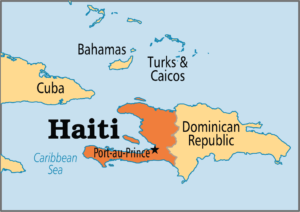
Haiti is the western Hispaniola island in the Caribbean sea. It neighbours the Dominican Republic on the east. Spain conquered the island by cruelly decimating the indigenous population and establishing a slave economy. The western part of the island was conquered by the French Empire and became Haiti. Haiti was a profitable colony, built on the backs of slaves, producing most of the world’s sugar, and led the world in production in coffee and indigo.
haitian revolution
Slavery had a high death toll, and there was a high volume of the slave trade. Now nearly 70% of the population are of mainly African descent, compared to the eastern Dominican Republic which is more a mixture of African and European descent.
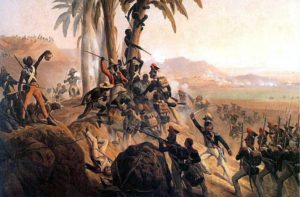
Haiti saw one of the greatest revolutions in history. While the French, American, and Russian revolution armies may have included 2-5% of the population, the Haitian revolution recruited over 8% of the population. Double that number acted as a reserve force. The death toll was high, but they established the first black republic in the world, being the first country in the world to proclaim equality irrespective of race.
Independent Haiti could never capitalize on its resources. France threatened to continue invading if the people Haiti did not compensate them for their losses in slaves and land. This led to Haiti regularly sending gold to France. The “debt” was not paid in full for nearly 150 years in 1947.
The first century of independence also struggled with a racial hierarchical system left behind by the French, a tense relationship with the Dominican Republic, and various attempts to overthrow the democracy by the Haitian elites. At the same time, there was a strong sentiment in the country to establish a pan-racial democracy and extended solidarity to freed slaves of African descent in the Western Hemisphere.
From the 1850s, the United States began to use its military to control Haiti. After World War II, American role became less direct. Corrupt pro-American leaders would be propped up, initially through the ballot, then later through a military coup. Popular struggles against the military-led to elections being reinstated, but American interference still hung overhead.
In 1990, a progressive Salesian priest, Jean-Bertrand Aristide won the first national election, against the American backed World Bank official Marc Bazin with overwhelming popularity. Aristide tackled the corrupt crony capitalism and reduced drug-trade related violence. His rule only lasted a few months. Aristide was unpopular with Haitian business leaders and was ousted in a military coup. The military ruled until international forces, led by the United States, reinstated elections and Aristide as President. The military was then abolished, though its former members became a source of right-wing militias in the future. America’s role in the restitution of democracy was caused by the organization of the Haitian community in America. Estimates of 2-3 lakh Haitians in America worked to push that government to oppose military rule in Haiti.
Aristide’s rule ended when he broke with his own party, claiming they were becoming distant from the people. He lost the next election to his Vice-President, Rene Préval, but he returned to power with even more popularity in the 2000 elections.
Aristide took bold stands. In 2003, Aristide angered Western powers by demanding that France repay the gold Haiti had earlier paid to them for restitution. Aristide’s final term ended with a coup that had the backing of big business leaders in Haiti. Right-wing militancy began to rise in this period of time when Aristide was forced out of Haiti. A UN peacekeeping force tried to keep control over the escalating violence that erupted in the aftermath of the coup. Aristide insisted that the American government was involved and attacked him through a disinformation campaign and coordination with the former Haitian army. Accusations against Aristide included money laundering, drug trafficking, and other forms of corruption. Aristide blamed America for this, saying that his return to power in the mid-90s was conditioned on a promise to privatize the Haitian economy in return to the protection of the interests of the Haitian people. He effectively promised to arm his enemies, and the American state had betrayed him.
In 2006, elections were reinstated when Préval took power, though this time with less luster. While he won with over 80% of the popular vote in the 1990s, this time he made just less than 50% of the vote. He obtained majority only after the Haitian NOTA votes were removed. Aristide felt that Préval was merely one of the many knives that could be placed in the back of Haiti.
Préval pushed privatization but strengthened economic ties with other Latin American countries, including Venezuela, Cuba, and the Dominican Republic. Aristide’s ousting soured relationships between Préval and Venezuelan President Hugo Chavez, but Chavez felt it was important to work with Haiti.
The Petrocaribe programme was an agreement among various Latin American countries, including Haiti, Cuba, Dominican Republic, and Jamaica. The deal was that Venezuela would export oil to these countries in response to economic and political solidarity with Venezuela. This agreement was unpopular with American oil companies, like Exxon, owing to the centrality of Venezuela.
Préval’s term was rocky, when food and fuel prices rose, leading to massive protests in 2008. His term ended in 2011, one year after the 2010 Haitian Earthquake, which destroyed the economy and killed lakhs. Préval’s infrastructure was accused of being class-biased, only protecting rich localities from natural disasters like hurricanes and earthquakes. Following his resignation, Préval left politics forever. After Préval the following leaders were anti-Aristide businessmen, Micheal Martelly and Jovenel Moise. Martelly reinstated the Haitian military.
2019 protests
In 2017, a Senate probe brought out a report showing mismanagement of funds under the Martelly and Préval presidencies under the Petrocaribe programme.
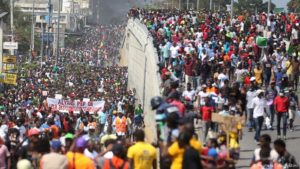
Protests exploded across Haiti as food and diesel prices rose. Protesters demanded a probe into the current government. The opposition, led by unrelated Jean-Charles Moise, called for a general strike and demand for the President Jovenel Moise to step down.
Protests in Haiti 2019
Protests escalated in February 2019, following a court inquiry that linked President Moise to corruption. Protests involved vandalism of luxury cars and attacking of stores. Opposition leader Moise had written to the UN asking for an impartial inquiry. The international response has been to decry the violence of the protesters, insisting that there be a dialogue by the contending parties, but is silent on the role of foreign countries.
Haiti is one of the poorest countries in the Western Hemisphere and is a very open story of colonization and corruption at work. The open antagonism of the military to a people’s democracy and the role of the international community in maintaining a proxy-colonial relationship should be a lesson to the world. Jean-Bertrand Aristide’s rise and fall is an instructive story in modern-day colonialism.
Also Read: Nobel Peace Prize to Ethiopian President: Another pawn in Global Geopolitics?
The Supreme Court on Wednesday, 13 November upheld the disqualification of 17 Karnataka MLAs of the former Congress-JD (S) MLAs government by the then Assembly speaker KR Ramesh Kumar, but said that they can recontest the 5 December bypolls.
The SC said the Speaker cannot disqualify an MLA till the end of the term of the assembly, which means the disqualified MLAs can contest the bypolls, nominations for which are being filed. The BJP is likely to field the rebels on most of the seats.
The apex court said that if elected, the MLAs can become ministers in the state cabinet or hold public office.
A three-judge bench of justices N V Ramana, Sanjiv Khanna and Krishna Murari had on 25 October reserved its verdict on the petitions filed by these disqualified MLAs.
The SC further said that its verdict is based on facts and circumstance of case and that it does not interfere in the speaker’s power to disqualify the members, adding that a speaker while examining a resignation could only inquire whether it is voluntary or not.
The top court said that the constitutional obligation and morality is applicable to both the government and opposition in a legislature.
Kumar had disqualified these 17 MLAs of ruling the Congress-JD(S) coalition ahead of a trust vote in July. Then chief minister H D Kumaraswamy had resigned after losing the trust vote, paving the way for the BJP-led government in the state under BS Yediyurappa.
The MLAs were disqualified from the 16th Karnataka Legislative Assembly by the then Speaker, Ramesh Kumar on July 25 and July 28 this year under the anti-defection law and were barred from contesting elections during the tenure of current assembly until 2023.
The disgruntled MLAs then moved the apex court challenging their disqualification. They sought quashing of the order passed by the speaker and prohibition imposed on them to contest elections.
By-polls to 15 out of these 17 assembly seats which fell vacant following the disqualification of MLAs are scheduled on 5 December and candidates are required to file their nomination papers between 11 November and 18 November.
The disqualified MLAs had recently approached the apex court seeking a direction to the Election Commission to postpone the assembly by-polls for these 15 seats till the pronouncement of verdict in the matter.
JNU students have been protesting against a steep fee hike and regressive hostel rules for the last 15 days.
On November 11, thousands of students at the New Delhi-based Jawaharlal Nehru University marched to the All India Council for Technical Education auditorium where the convocation ceremony for the university’s outgoing students was taking place. The vice president of India, Venkaiah Naidu was the chief guest of the convocation.
Students were holding “Say No to fee hike” and “fees must fall” slogans and placards and wanted to meet the HRD minister.
The students’ protest against massive fee hike and other regressive measures has been going on for the past 15 days. The protest march was led by the JNU students’ union (JNUSU).
The Vice-Chancellor of JNU has refused to engage with the students and discuss their demands, so students decided to meet human resource development minister Ramesh Pokhriyal ‘Nishank’ and submit their memorandum to him.
Seeing the student numbers in 1000s, police, and paramilitary deployed on the area started attacking students. Many students were brutally attacked by batons, lathis and charged with water cannons. Many students were injured in the police attack and some of the students were also detained.
message of Solidarity from BHU to JNU
JNU turned into an armed cantonment
The university gates were heavily barricaded on Monday morning to restrict a march of more than 3,000 students. Students who managed to get past the barricade were detained by the pre-deployed CRPF and police forces.
However, despite the police violence, the students refused to go back and were successful in submitting a memorandum of demands to the Minister of Human Resource Development, Ramesh Pokhriyal. The minister has given an assurance that the Ministry of Human Resource Development will arrange a meeting with the administration on the issue of fee hike and other measures.
Why are the students protesting?
The media that normally ignores JNU unless it has to make a scapegoat of the “Tukde Tukde gang”. The media attention came on Monday when students in 1000s came to AICTE meet HRD minister.
However, the protest started in the last week of October against the steep fee hike, university’s attempt to impose curfew timings on access to public spaces on the campus. It’s not just the university fee that is increased, but hostel rooms and mess charges are also doubled.
Almost half of JNU students come from below poverty line families with annual incomes of less than 1lakh 40 thousand Rupees.
Hostel fees have been increased 10 fold from Rs. 2700 to Rs.30,000 annually. In addition, students have to pay higher for the monthly mess bill and new water and electricity bills. An increase in mess charges only further adds Rs. 10,000 to student expenses.
This increase in fees is no coincidence. Since it came into power, JNU is an eyesore for BJP for its left-wing politics. It has been trying to control the university by its VC, Jagdish Kumar, who is an RSS man and has been at the center for a lot of protests since he took the position.
BJP had tried to defame the university and students by fake news and media campaign on social media and TV and portray them as the “anti-nationals” , “tukde tukde gang “and “urban Naxals” and such. Then it was the changes in admission policies to put more weightage to viva making it challenging for students from poorer margianlised backgrounds to qualify the exams.
JNU is one of the few government educational institutes that provide good education at much lower fees such that students from the poorest of the family can afford basic rights like food and shelter.
Students are not just protesting their fee hike but also the BJP govt’s education policy. The policy advocates for fund cuts especially fund cuts in higher education in successive budgets has led to such fee hikes in universities. This directly affects the future of thousands of students.
The neoliberal order that the government is implementing will be throwing the poor and marginalised out of the “temples of knowledge” and again in the lap of rich and elites.
The NDA government led by Prime Minister Narendra Modi has been spearheading a rapid neoliberal economic campaign in India, which threatens the idea of education for all, as high fees will make universities accessible only for the rich.
BJP government wants to dismantle the university so that it becomes easy to sell off and privatise the university. The plan is to make it like any other private university where only the rich and elite can get an education.
Former student leader Umar Khalid says: Our education system has taught us that education is not a commodity to be bought in the market. This government has enough money to waive off the lakhs of crores of corporate debt, but none to invest in education and health care.
If this fee hike is allowed to be pushed through, it would have a disastrous consequence for students, mostly those coming from marginalized backgrounds. They will be forced to drop out of the university. JNU right now is fighting for a dream that we all should aspire towards – that nobody is forced to discontinue education only because of want of resources.
A fortnight of tug of war between major political parties in Maharashtra has been futile and President’s rule is imposed in Maharashtra.
President Ram Nath Kovind on Tuesday, 12 November gave nod to impose President’s rule in Maharashtra after Governor Bhagat Singh Koshyari’s recommendation.
During the drama that went on for 19 days, Shiv Sena, Nationalist Congress Party and failed to reach a consensus on conditions to form a government. BJP was unable to form a government even after emerging as the single largest party in the state but short of the majority mark.
With the President’s rule imposed, now any party can approach the governor with a letter of support of 145 MLAs to form the government.
Nullifying the 8.30 pm deadline given to the NCP on Monday to stake claim to the government, Koshyari recommended President’s rule in the state where no political party has been able to form a government after the assembly polls last month.
The Union Cabinet in a meet chaired by PM Modi too recommended President’s rule in the state.
Timeline since Maharashtra assembly election results
Since the declaration of assembly elections results in Maharashtra, Shiv Sena has been trying its best to negotiate with BJP for the CM’s post. The impasse that last almost two weeks has further strained the relation between long-time allies. BJP declined to sharing of CM post with Shiv Sena for 2.5 years.
On 8 November 2019, Governor Bhagat Singh Koshyari invited BJP to form the government as the single largest party and prove the majority within 72 hours. However, BJP declined to form the government on 10 November 2019 as BJP didn’t have the numbers
Then the Governor invited the second-largest party, Shiv Sena, to form government within 24 hours. NCP agreed but Congress expressed hesitations over support to Shiv Sena.
On 11 November 2019, NCP, Congress starts high-level meeting to give support Shiv Sena or not. However, NCP decided to form the government with Shiv Sena. Governor also told that he would not give any more time period to the parties. On 11 November 2019, Governor invited NCP to form government within 24 hours.
Uddhav Thackeray, Sharad Pawar, Sonia Gandhi, and other leaders of the three parties were in talks to reach a solution for the impasse. However, after Shiv Sena failed to provide a letter for support, NCP got an invitation from the governor. After much deliberation and talks, the three parties could not come on the same page and the state had to see the president’s rule.
The BJP, which is ruling in the interim, has 105 MLAs and opted out of forming a government when its ally, the Sena, insisted on the Chief Minister’s post.
Shiv Sena raised questions about why it was only given 24 hours to prove the majority while the governer gave 72 hours to BJP for the same exercise. Shiv Sena filed a petition in the Supreme Court challenging the governor’s decision to not extend the time given to the party to prove the majority.