As the nation is still reeling from the brutal rape and murder of the young veterinarian from Hyderabad, another chilling news comes from Unnao, Uttar Pradesh.
A 20-year-old young woman, who survived a brutal rape by 5 men in march this year was set ablaze today by the same group of men.
She was raped by the five men in March while the police could manage to arrest only three of them and two others were still on the run.
The rape accused and his friends took the woman outside her village and into the fields and doused her in petrol before setting her on fire.
She was going to Raebareli with her parents when the incident happened. The survivor has suffered 90% burns and has been shifted to a government hospital in Lucknow and is in a critical condition, police added.
She has told investigators that she was set on fire by the two accused who had raped her a year ago and are presently on bail. They were accompanied by three of their associates.
According to sources one of these five men is the son of the village pradhan against whom the woman had lodged a rape complaint.
Police have arrested all five men involved in the crime including the main accused Shivam Trivedi.
Congress leader Priyanka Gandhi Vadra was is the State Congress in-charge has hit out at the UP government and accused it of lying about the law and order situation in the state.
कल देश के गृह मंत्री और उत्तर प्रदेश के मुख्यमंत्री ने साफ-साफ झूठ बोला कि यूपी की क़ानून व्यवस्था अच्छी हो चुकी।
हर रोज ऐसी घटनाओं को देखकर मन में रोष होता है। भाजपा नेताओं को भी अब फर्जी प्रचार से बाहर निकलना चाहिए।https://t.co/XGqvqu7Dxd
While the lawmakers make emotional pleas of lynching and castration in parliament, most political parties have a dismal track record in preventing rape. In last 2 years, in Uttar Pradesh itself two of BJP’s leaders were involved in rape case of college students and one was a minor.
Its been two years since the then 17-year-old girl, a minor from Unnao filed an FIR against the BJP MLA Kuldeep Singh Sengar for raping her. The rape survivor has knocked all possible doors and offices but to no avail. The case made headlines when she along with her family tried self immolate outside UP CM Adityanath residence in 2018.
I was raped. I have been running pillar to post for the last year but no one is listening to me. I want to see all of them arrested, otherwise, I will kill myself. I had even approached the CM to no result. When we lodged an FIR, we were threatened.
So far the girl has lost most of her family in trying to fight the case. She was in the hospital under critical condition when her car was hit by a truck. The accident killed her aunts and left her and her lawyer in grave condition.
Another high profile case from UP of BJP leader Chinmayanad, where the rape survivor was instead arrested on extortion charges when she accused and released videos incriminating the MP in the case of sexual harassment and sex under coercion. The rape survivor is in jail while the accused Chinmayanand is under hospital care claiming ill health.
The lack of seriousness of sexual violence cases and complicity of the political class in the act completely defy the emotional outpourings in the parliament. Maybe the political parties should clean their own parties and punish the accused in cases of sexual assaults before giving calls for lynching and castration.
The article was first published in Naanu Gauri. It is translated to English by Rajashekhar Akki.
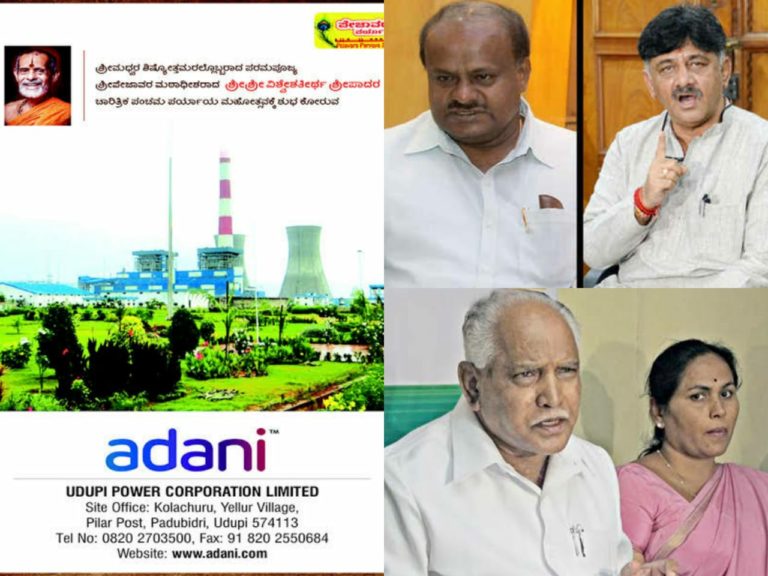
From the outset, it is a scandal of the BJP term. When the council committee was formed, Yeddyurappa and Shobha were already back in BJP. Congress heavyweight DK Shivakumar was the chairman of the council. If so, in another Jindal case, if not Yeddyurappa, at least Shobha should have gone to jail. Everyone thought so.
8335.57 crores i.e. more than 83 billion rupees. The accusation is that from 2010 to 2018 this is the additional amount paid to UPCL for buying electricity. In former chief minister HD Kumaraswamy’s letter to the house committee. 1600 cores. This is the fine amount (late payment fine) amount the electricity companies(ESCOMs) under the government need to pay the same UPCL of Adani. This is not an allegation, it is the order given by the central electricity control board on November 8th of this year.
Now pay attention to another number; 29,413 crores. This is the estimate of loss to the government due to the ‘deal’ done by then energy minister Shobha Karandlaje during the first term of Yeddyurappa as CM. This estimate was calculated by HD Kumaraswamy. And according to him, the person who buried this report was the head of house committee, DK Shivakumar. Now the same DK Shivakumar is close friend of HD Kumaraswamy.
So, what exactly is happening in the energy department? If these losses of thousands of crores have to be borne finally by the end customers, who are getting benefitted? Which companies benefitted along with politicians? When all the other private companies are making a profit, then why is the Karnataka electricity board’s Raichur electricity unit stops functioning repeatedly? Is there a connection between these two?
This is not at all any surprising matter in officers and political circles. 30 years ago, after the chief minister’s department, the second most powerful department was revenue ministry. Likewise, though home, excise and finance ministers were outside sphere of influence, they are still powerful ministries. Now, it has been a custom to retain finance ministry by the CM. Excise ministry doesn’t count much, revenue has lost its importance. Then which ministries gained? PWD, water resources or large irrigation, Bengaluru development and power ministry. This means, departments where large amounts of works or purchasing happen, those have become powerful departments. Either those who are very close to chief minister or the bigwigs get these ministries to manage.
You’ll understand ‘importance’ of this when you look at the people who had energy ministry in the last 15 years. HD Revanna, Shobha Karandlaje, KS Ishwarappa, again Shobha Karandlaje, Siddaramaiah, DK Shivakumar, HD Kumaraswami and now BS Yeddyurappa. In buying electricity from Private thermal power plants and solar plants and in buying coal for electricity plants under government, there is potential for doing irregularity and corruption of thousands of rupees. In these, short term, midterm and long term purchase agreements are made. In these transactions even 10% commission can get hundreds of crores of money to those in decision making, thus making it an important portfolio.
Megadeals during Shobha Karandlaje’s tenure
A deal like that happened when Shobha Karandlaje was the energy minister in the Yeddyurappa cabinet; it was obvious. Things were simple and straight. The state was facing an ‘electricity deficit’ and opportunities for buying it were increasing. A tender to buy 1980 megawatt electricity was called. A lot of people participated in the tender. One of them was JSW(Jindal) of Toranagal. A decision to buy electricity with a rate of 3.80 rupees per unit was about to be finalised. It was a long term agreement of 25 years. JSW had the responsibility of providing electricity at the predetermined rate.
But the finance department raised an objection to deal. Electricity was bought in Maharashtra, Gujrat, Rajasthan and other states for much lesser price. The companies which provided electricity there have submitted their tender in here too. Thermal plant Yaramaras, which is under the government is producing electricity for 3.177 rupees per unit and Yedlapur plant at 3.370, which is less than the JSW price. In such a scenario, we shouldn’t be buying electricity with higher rates; that was the objection. For that the secretary of energy ministry gave a detailed explanation.
“Though Adani power limited provides 50% electricity at 2.80 rupees per unit in Maharashtra, they use the domestic coal, coal is available in their state itself. Hence they don’t incur transportation charges. In Rajasthan too, Adani power supply electricity and their plant is situated in the state itself and they have the convenience of having a port. Hence rates are less. But here, for 25 years, the rate per unit will be between 3.792 and 3.856. This is profitable for us”. The file containing this explanation goes to energy minister Shobha Karandlaje, then it goes to the house committee for approval and purchases agreement needs to happen. A letter of intent too has been given.
Reason given and the real reason was entirely different.
But what is written in the latter to cabinet is ‘compared to other states, as the rate per unit is mentioned is higher, we can cancel this tender and can call for the new tender, for that approval of cabinet is requested’. The note to cancel the tender goes to the cabinet. Minister ignores the latter written bu their chief secretary, never ask why such things were written and or no explanation was sought. Instead of that they send the cabinet secretary asking to cancel that.
Legal advisors of the department also say that it is unlawful to recommend the tender process to be canceled without prior permission of the Karnataka Electricity control board when the tender was called with permission for buying electricity for 25 years.
Now, it does feel like what Shobha Karandlaje did was right. But the reality is different. After canceling this tender of buying electricity at the rate of 3.80 rupee per unit for 25 years, they buy electricity from the same JSW energy limited on a short term basis for the year 2011 -12. They are paid 1872.42 crores for 3952.01 million unit at the rate of 4.26 to 5.50 rupees per unit. In 2012-13, 4384 million units was bought for 1895.58 crores at the rate of 4.26 to 5.30 rupees per unit and during 2013-14 on a short term basis, 2786.08 million units was bought for 1371.99 cores at the rate of 4.92 rupees per unit.
With the above-mentioned numbers, if we consider the loss for 7 years at 5,895.14 crores, the loss to state treasury for 25 years would be 21,054 cores. And, as mentioned in the now-canceled 1580 megawatt bid, if we consider 85% load factor, annually the state would have got 11,765-megawatt electricity. So, if we consider a loss of 1 rupee per unit, the total loss in 25 years would be 29,413 crores. This means the beneficiaries of this colossal loss would be the ones who were in power that time and JSW company.
Yes, this was investigated and the results are even more intriguing.
This all this murky business was brought out to public notice and a house committee was formed and this was done by ex-chief minister HD Kumaraswami. He had spoken strongly about the issue in 2013 when Siddaramaiah government was formed. When a house committee was formed in 2014, DK Shivakumar, then energy minister made sure he himself became the chairman of the house committee. The committee had MLAs Narendraswami, Shivanand Patil, KN Rajanna, Basavraj Bommai, and Vishwesgwar Hegde Kageri. When asked who would be there in the committee from JDS, Kumaraswami said he would be there and he tried to expose the scam continuously inside the committee.
From outside, it is a scam that happened during BJP government. By the time the house committee was formed, Yeddyurappa and Shobha had returned to BJP. Congress heavyweight leader DK Shivakumar was the chairman of the committee. So, if not Yeddyurappa, at least Shobha Karandlaje should have been sent to prison. At least everyone thought so.
In November 2017, it was the time when the house committee appeared to be ready to submit its report. And at that time BJP was going full swing with accusations against then CM Siddaramaiah. Reports were published suggesting Siddaramaiah and DK Shivakumar will use the house committee report to tame BJP. Finally, before DK Shivakumar submitted its report, a TV channel was ready with the title ‘DK Shivakumar exposes BJP scam’ but nothing of that sort ever happened.
Kumaraswamy had taken a different stance and he had made it clear that he will not sign the report of the house committee. On October 28th that year, DK Shivakumar himself went his then arch-rival Kumaraswamyy’s home and got his signature on the report. He submitted the report on November 7th. The report gave a clean chit! Why did Kumaraswamy, who had made so much noise earlier kept quiet? And why Siddaramaiah didn’t make sure the truth came out? It is anybody’s guess.
What came out on November 8th?
It might seem that what came out of energy department may not be such a huge scam. But the burden has to be born the end-users of electricity. This time the beneficiary is none other than Gautam Adani. Adani power company, which is getting established as the biggest private electricity generating company, which is growing to have the potential of producing 20,000 megawatt by 2020.
A similar agreement (one mentioned above) was made with the Udupi power corporation (then owned by Nagarjun) on 26.12.2005. In April 2015, the ownership of the company went to Gautam Adani. Electricity supply had started after 2010. The electric supply company filed a suit in 2018 on different ESCOMS and PCKL, the middlemen agency of electric purchase, saying from 11.11.2010 and from 19.08.2012 till date, the bills for electricity supply and in 2010 and in 2012 and electricity bills supplied for 17 months were not paid. There is a board under central government that facilitate such suits.
Continuous enquiry happened there and the board gave a clear verdict saying a surcharge(fine) of 1,600 crores to be for delaying payments. On the other side, there have been agreements to provide electricity from big solar plants, which are supposed to be benami ownership of several politicians; electricity is provided through government plant too. Then, what is the necessity of buying electricity at a higher rate from companies like Adani power company? The question is by making these electricity purchasing agreements, are the government-owned electricity plants made to stop work deliberately?
With this, it is to be inquired as to why the government couldn’t put forth its arguments properly in front of the board and agreed to pay 1,600 crores, which eventually was born by the consumer. All these make one thing clear, many more shocking realities of power department need to be exposed.
On Monday, after the Uddhav Thackeray led Maharashtra government decided to review the Aarey and Bhima Koregaon cases, state NCP leader Jitendra Awhad among others have requested the Maha Vikas Aghadi government to withdraw the cases against rights activists in the Bhima Koregaon matter.
On January 1, 2018, during the Elgar Parishad, some elements –against the gathering of historic import to Dalits– incited violence against the Dalits at the commemoration of the battle of Bhima-Koregaon that had taken place in 1818 between the East India Company and the Peshwas of the Maratha confederacy. The clash claimed the life of one person and injured many others. After a probe in the matter was launched, the Maharashtra police picked up five activists branding them ‘urban Naxals’ alleging them to be part of a plot assassinate PM Modi in a ‘Rajiv Gandhi type’ attack.
The activists picked up were Arun Ferreira, Vernon Gonsalves, Sudha Bharadwaj, Varavara Rao among other accused – Shoma Sen, Surendra Gadling, Rona Wilson, and Sudhir Dhawale and Mahesh Raut. Gautam Navlakha is still being targeted. Before these arrests, there had been the arrests of Shoma Sen and others.
milind ekbote-sambhajibhide
Though there were cases launched against Sambhaji Bhide and Milind Ekbote, the men accused of orchestrating the violence, they were put on ice by the BJP government. All of the rights activists accused in the Bhima Koregaon case have been in custody for the past year or under house arrest and their bail applications have continuously been filibustered by the state.
Now that the Shiv Sena – NCP – Congress alliance has come to power in the State, Jitendra Awhad, NCP; Abu Azmi, SP; Manoj Jhadu, RJD and CPI leader D Raja has appealed the new CM Uddhav Thackeray to close the BhimaKoregaon case and bring relief to the activists.
Abu Azmi has said that the government will coordinate with Sharad Pawar to bring the truth to light while CPI leader D Raja has said that the move is important to protect the interests of activists who are putting their lives on the line by fighting for the interests of marginalized people.
The Bhima Koregaon matter turned out to be a saffron conspiracy according to the findings of the Rashtra Seva Dal, a social welfare organization working in the field on Dalit rights. More recently, another shocking fact came to the fore. The infamous WhatsApp spyware row that shook its users worldwide, was found to be targeting Bhima Koregaon activists. It was alleged that the Union government had used the Pegasus software to hack the phones of these activists to gain information that could sabotage their cause to free the wrongly accused rights activists.
It has been more than a year that these activists have been languishing in jail now while the real Hindutva brandishing culprits of divisiveness roam free. Will the strong persuasion of the Aghadi leaders push CM Thackeray to take the step towards the release of the rights activists and establish itself as a secular, liberal and democratic government?
Chronology of the events at Bhima Koregaon
Several of the accused have refuted the charges against them. But the court seems to go by the police’s version with scant regard to what petitioners are saying.
The following considerations may be taken for what they are worth:
Justice PB Sawant, one of the organizers of the Bhima-Koregaon ‘Elgar Parishad’ event on 1st January 2018, in an interview, testified that “For years these pilgrims had been going to Bhima Koregaon, no incident happened. Why did it happen last year only? Our sources tell us that these two people (Bhide and Ekbote) were working there at least two months before the violence because they knew many people were going to come because of the 200th anniversary.
This government wants to protect the Hindutva forces. They have been consistently trying to protect Hindutva activists who had indulged in violence. No Maoists were involved in the program and the activists had been arrested because they criticized the government.
Why did the Investigating Officer and courts not pay attention to the above statement by a respected judge, as a point of concern?
Various fact-findings took place, the most prominent amongst them was one conducted at the behest of Pune Rural IG, Vishwas Nangare Patil, wherein the ex-mayor of Pune was part of the team and visited many places and submitted its report on January 20, 2018. Summarizing the report, we find the following chronological events narrated in the report. Note the careful planning by communal forces.
On December 16, 2017, one person namely Kaustubh Kasture had posted on Facebook that there would be riots on January 01, 2018. This person supports Sambhaj iBhide and Milind Ekbote.
On December 30, 2017, Milind Ekbote took a meeting in Bhima Koregaon, where he decided to treat January 01, 2018 as a black day and ensure bandh all across the area.
On December 29, 2017, the memorial of GovindMahar, a man who carries the legacy of cremating Sambhaji Maharaj, son of Shivaji Maharaj, came to be defiled.
This resulted in a riot-like situation in Vadu Budruk and adjacent areas, however, all the villagers acted with responsibility and sorted out the issue amongst themselves and peace was restored. By December 30, 2017, though the issue at the Vadu Budruk was resolved peacefully, it is said that Sambhaji Bhide and Milind Ekbote, instigated the villagers.
On December 30, 2017, a message was circulated on social media that there is a meeting called by Sambhaji Bhide in Vadu Village on January 01, 2018 and the supporters should gather in large numbers.
On the night of December 31, 2017, PradipKand, Anil Kand and Ganesh Kand were threatening hotel owners to ensure bandh on January 01, 2018.
Suddenly on late night December 31, 2017, a letter was sent to the police station, near Bhima Koregaon purportedly written by Bhima Koregaon Gram Panchayat, wherein police were informed about the bandh to be observed next day.
This was first published in Sabrang India.
In the last four months, following a massive electoral victory clinched by the RSS-BJP, we have seen a spate of national policies that have paved the way for large-scale human rights violations. The recent decision taken up by the government to prepare a National Population Register (NPR) within September 2020, is no exception. This may be regarded as the first step towards the preparation of a National Register of Indian Citizens (NRIC), a pan-Indian version of the NRC exercise in Assam.
The NPR is envisioned as a list of country’s usual residents, who, as per the purpose of NPR, is defined to be a person who has stayed at a place for at least six months or intends to stay there for at least six months. The registrar general of citizen registration and census commissioner Vivek Joshi issued a notification, saying – “In pursuance of sub-rule (4) of rule 3 of the Citizenship (Registration of Citizens and Issue of National Identity Cards) Rules, 2003, the central government hereby decides to prepare and update the Population Register. The fieldwork for collection of information relating to all persons who are usually residing within the jurisdiction of local registrar shall be undertaken between the 1st day of April, 2020 to 30th September 2020”. The NPR will be prepared in all levels starting from the local (village/sub-town) level to sub-district, district, state and national level under provisions of the Citizenship Act, 1955 and the Citizenship (Registration of Citizens and Issue of National Identity Cards) Rules, 2003. It would be mandatory for every usual resident of India to register in the NPR that would contain demographic as well as biometric details. Clearly this move also aims to strip citizens of privacy and bring everyone under state surveillance.
During his pre-election speeches, Amit Shah made promises to scrap Article 370 and introduce a nationwide NRC meant to ‘weed out’, infiltrators. He went on to add that Hindu and Buddhist refugees would receive Indian citizenship, and thereby, clearly indicating that the refugees belonging to the Muslim community are the real target of such policies. The proposed Citizenship Amendment Bill (2019) is also an added measure to ensure denial of Indian citizenship to Muslim immigrants from Bangladesh, Pakistan, or Afghanistan while it may be granted to people hailing from other communities.
The NRC exercise in Assam starting in May, 2015 has given a glimpse of the tragedy that may ensue in the wake of its pan-Indian version. In order to be considered an Indian citizen, a person has to furnish certain documents specified by the government. The whole process of obtaining and maintaining such documents pertaining to the residence of a person reeks of privilege that many cannot afford. Assam is a flood-prone state where people are left every year at the mercy of the Bramhaputra and its distributaries. Many people living in these flood-plains are devoid of permanent homes, let alone documents establishing their residency and ancestry. During the recent floods in Assam, many people were forced to return to their flood-engulfed homes to retrieve the NRC documents. Even, several individuals died under the pressure of bureaucratic and legal formalities associated with NRC.
Clearly the fear of death was superseded by the fear of being rendered stateless. About 40 lakh people were excluded from the final draft of the NRC, which was published in July 2018. Most of them were from the Muslim community and belonging to the poorest and most vulnerable sections of Assam’s society. In spite of the extreme financial difficulty, many lawful citizens are carrying out legal battles to get enlisted in the NRC. Recently, on 31st August 2019, the updated NRC was published with the exclusion of 19.06 lakh people, who now have to face foreigners’ tribunals. According to several reports, even these tribunals are not following the proper judicial process and are pressured by the BJP-led state government to declare people foreigners. Even if we consider this recent list as proper and final, then also the credibility of Amit Shah’s claim of 40 lakh “termites” in Assam should come under serious questions. Moreover, there seems to be no consensus regarding the long term treatment of the so-called illegal immigrants and refugees. They have been put up in detention centers for an indefinite period of time, under inhumane conditions and never-ending stream of human rights violations. As of February 2019, the number of persons detained across six detention centers in Assam is 938, among which 823 have been declared as foreigners by tribunals. Till now 25 of such ‘declared foreigners’ died inside the detention camps due to the lack of basic facilities and harassment inside the jails. These detention centers may be equated to Nazi-era concentration camps that the media have been unwilling to bring to the public eye. Shamelessly, Assam government is preparing for ten more such detention centers.
The whole situation reminds one of the excesses committed by the Nazi regime in Germany after Hitler’s ascension to power. The process of villanising and othering a community, robbing them of their identity, stripping them of their political power, and receiving widespread approval for such extremities were necessary to pave the road to absolute fascism. Today NRC and other attempts that are made by the ruling dispensation in the last few months are fulfilling the long-cherished dream of RSS to build a Hindu Rashtra. Tomorrow NPR will assist this ongoing process.
The article was originally published in Spark magazine.
Dayamani Barla, famously known as the Iron lady of Jharkhand and is one of the most-known tribal activists and journalists in the country. She will be contesting assembly elections from Khunti seat in Jharkhand. Barla owns and runs a tea shop that supports her journalistic desire and career.
Khunti is scheduled to go to polls in Phase II of Jharkhand’s Assembly elections on December 7.
The total Tribal population constitutes 27 percent of the Jharkhand population of 3.19 crore. Dayamani Barla belongs to the Munda tribal group.
She will be contesting from Jharkhand Vikas Morcha-Prajatantrik (JVM-P) party. JVM-P is the party formed by former Chief Minister Babulal Marandi.
For the last 25 years, Barla has been fighting the state and several multinationals over the issues of land rights and the identity and culture of tribals. Barla is the National President of the Indian Social Action Forum (INSAF).
She became notable for her activism in opposing Arcelor Mittal’s steel plant in Eastern Jharkhand that tribal activists say would have displaced several villages. Barla won a number of prestigious awards for her activism and journalism.
This will be the second time in her life, she is about to contest elections. After unsuccessfully contesting from the Khunti Parliamentary seat on an AAP ticket in 2014.
Khunti : Epicentre of Pathhargarhi movement
Khunti has been at the forefront of a civil disobedience movement called Patthargarhi (Pathalgadi). The Patthargarhi movement was at its peak around mid last year. The movement involved placing records on stones by the villagers. The stones had provisions from the Fifth Schedule of the constitution and the Panchayats (Extension to Scheduled Areas) Act, 1996. Through the inscriptions, the villagers were asserting their rights to administer their own areas based on provisions in the Constitution.
Thousands of locals and Adivasis from neighbouring districts such as Lohardaga, Gumla, Simdega and Ranchi participated in the movement for several months. The state, however, discredited the legitimate movement as unconstitutional and the handiwork of naxals.
The police has registered several cases against named and unnamed people who have allegedly participated in the movement. They are charged under different sections of the Indian Penal Code (IPC) including 124A (sedition).
When asked about her decision to contest elections and about the movement Dayamani Barla says that “Patthargarhi is a tradition of adivasis. Tribals are being forced to part with their land at gun-point. They are being told that if they don’t part with their land, that land will be turned into their burial ground. What alternative does a tribal have, but to assert their rights? Rights that give them control over the land under gram sabha and of the natural resources within under the Fifth Schedule.
She said that since lawmakers weren’t thinking of “the local people before awarding our natural resources to some millionaire from outside. So we end up going in circles, fighting for our rights, which are squandered away by lawmakers, and fighting for them again. So I decided to go to the very place where laws are made”.
The first time she fought polls, the Lok Sabha elections in 2014, she says she was quite unfamiliar with the election process. “The Aam Aadmi Party (AAP) had given those elections tickets to many activists like Medha Patkar and Soni Sori. There was a feeling of optimism. But it was only after the elections that many of us understood the mechanism of fighting elections and how different it is from activism.”
In the atmosphere were crores are spent for elections, Dayamani Barla has very limited resources. She is crowdfunding her election campaign.
Click on the link hereto support her campaign.
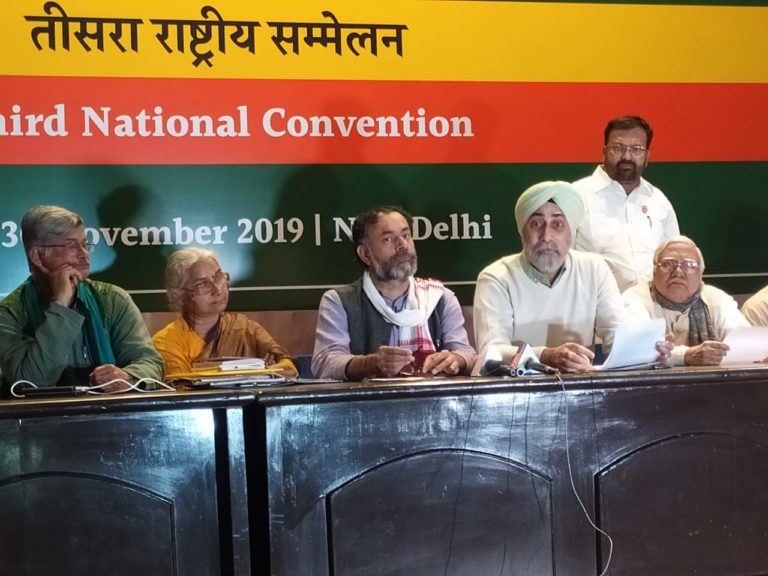
The 3rd National Convention of All India Kisan Sangharsh Coordination Committee (AIKSCC) which saw the participation of 800 delegates from 25 states, concluded on a high today afternoon at the Mavalankar Hall, Constitution Club, New Delhi.
The Convention had all members of the National Working Group speaking on various issues affecting the farmers and presenting resolutions on Forest Rights Act, on the implementation of LARR Act 2013 and against forced displacement of Tribals and Peasants, on Free Trade Agreements which allow massive dumping of agricultural produce and domination of MNCs in and control of the agriculture sector, Comprehensive Legislation for Rights of Agricultural Workers and Sharecroppers, against Corporate Loot of farmers, for Pension of Rs. 10,000 for all rural workforce, on revamping Crop Insurance and disaster compensation, and on losses suffered by J&K farmers.
In addition to the working group members, leaders of more than 100 organizations from across India addressed the Convention about the issues and activities in their states and made suggestions for the action program of AIKSCC. The Farmers’ Charter of AIKSCC covering 21 issues was presented and discussed at the Convention.
The future program of AIKSCC was discussed and declared in the concluding session of the Convention. Subsequently, the leadership of AIKSCC consisting of the national Working Group members led by convenor VM Singh, addressed a Press Conference and announced the future program.
AIKSCC declared that the farmers of the nation will organize a nationwide Grameen Bharat Bandh on January 8 in protest against the anti-farmer policies and inaction of the Centre and the States on the demands of the farmers. The protest will highlight the government’s failure on various fronts – its failure in ensuring Minimum Support Prices at C2+50% for all crops, in providing freedom from indebtedness, in implementing effective crop insurance and disaster compensation in the face of drought, floods and unseasonal rains, in implementing Forest Rights Act, etc. – and on other burning issues at state level.
The Convention also adopted a plan for strengthening the state units of AIKSCC across the country. Leading up to the January 8th protest, the state units of AIKSCC will plan preparatory programs and conduct outreach in various districts in their states.
The leaders who participated in the Press conference included VM Singh, Raju Shetty, Hannan Mollah, Medha Patkar, Atul Anjan, Dr. Ashish Mittal, Yogendra Yadav, Dr. Sunilam, Rajaram Singh, Dr. Darshan Pal, Satyawan, Pratibha Shinde, Avik Saha and Kiran Vissa.
When a society is starved of culture, they lap up whatever is presented to them in its name. Feature Films have been one of the main staples in the Telugu Cultural landscape. But, one look at the present set of films would give us a glimpse of what is presented in the name of culture and entertainment. Arts has ended up being a money-making industry with no connect with art or culture.
As I write this, students in many universities are demonised for protesting against fee hike. Such a society that speaks of demographic dividend but lets its youth be either jobless or at the door of corporate education can only produce ‘dead culture’.
It suffices to say that the Telugu film industry of today embodies such ‘dead culture’ in its lowliest form, and that too with huge viewership. But even in such a parched landscape once in a while we get to see a rare flowering. The last time it happened was one year back. Now once again we are lured towards that ritual in the form of George Reddy.
George Reddy Film, lest we make the mistake, is neither biopic of George Reddy nor a historical fiction based on his life and work. It was simply a film inspired by the life of the Radical Students’ Leader from Osmania University, Challa George Reddy. George Reddy, a charismatic student leader from Osmania University was murdered by the Sanghis when he almost decided to become a professional Revolutionary in those heydays of Naxalite Movement. Son of a Malayali Mother and Reddy Father from Chittor District, he spent his childhood in Kerala before moving back to Hyderabad with his mother. Though his father hails from a landlord family, the communist influence was no alien to George. His uncle was a well-respected Communist in Andhra Pradesh. A brilliant student, he was awarded gold medal for his performance in studies and keeping up with the spirit of the times of the Spring Thunder rejected all the brilliant opportunities that had come flying in his way. A brief understanding of Telangana of that time would necessitate appreciating the context of the film. The cultural and to a considerable extent the feudal economic relations were still ruling the roost in the Telangana region. It was the time when the armed movement was establishing itself in the rural hinterlands of Telangana, and to some extent in Andhra Pradesh. The armed movement, inspired by the Naxalbari struggle and the Srikakulam Peasants’ Armed Struggle, had its support base mostly from the exploited sections in the Telangana. Whatever the merits or demerits of the movement, we have to accept the impact it had on society and more importantly on the minds of the budding youngsters of that time. As brilliantly pointed out by K. Balagopal, Naxalites despite their theoretical aversion towards ‘Caste Question’ and their stated opposition to the Constitution were mainly responsible for democratizing the society and making sure that the progressive constitutional prerogatives were implemented in this country, mainly so in areas such as Telangana. It was in that context that the brilliant students and many youngsters like George Reddy left their lucrative careers and jumped headlong into the struggle. It was also the time when the hitherto excluded sections started coming to the University spaces. This is sort of peculiar to Telangana. Andhra Pradesh being under the colonial role got a head start in many aspects, education was one among them. Universities to which students from oppressed sections go can never be isolated islands like what these proliferating Private Universities are proving to be. So was Osmania University. The setting of the movie is at this particular University.
Coming to the film, the film should be seen as a symbolic representation of the Revolutionary. The film too is filled with symbolism, though most of the symbolic shots are drab and dry. ABCD for ABVP, for example. The one good shot is the framed photo of Vivekananda in the background of the ABCD’s office. The struggles in the University were merely limited to the strictly campus-related issues when the fight in the Osmania University was heavily in the nature of anti-feudal. The trickling of students from the oppressed communities started around the same time. The push back from the feudal sections represented by the students who were sons of the feudal lords is morphed into control over campus electoral politics. Such a reduction is in bad taste. It could have been dealt in a better manner. Also, the point that Feudal elements supported by RSS were also from the Reddy community is visibly missing in the movie. Perhaps, a conscious decision (It needs to be said that the filmmaker, as well as the producers of the movie, are Reddys). The regressive elements in the campus were merely limited to the rowdies from the Hyderabad city hell-bent on preserving their domination in the campus. Importantly, the film’s greatest crime is reducing the broader struggle of George and his companions to campus electoral political quibbling. Nonetheless, it is admirable that ‘Bharat Mata ki Jai’ slogan and the stock phrases and narratives of the Saghis (such as We have to protect our culture from these Muslims, We have to teach a lesson to the Pakistani dogs, etc) have been portrayed consistently as an aide to the politics of the ABCD union. Making such use of ‘Bharat Mata ki Jai’ slogan is truly admirable when even refusal to chant that slogan has become a death confirming act. But for some reason, the film team felt pressurized to make clear that they weren’t rooting for armed struggles. Such moralizing is unnecessary. They should have known that there were many ‘Naxalite movies’ in Telugu and few of them were indeed box-office hits. Not that one would actively root for such struggles, but the movie need not be intrusive- that too with drab symbolic shots- moralistic is my point.
Being a film that was expected to return profits, crass, patriarchal portrayal of women is all over the place. That’s the tragedy we were talking about above. Be it whatever, the element has to be portrayed. The film starts with a haughty academic researcher intent on ‘rectifying’ the history of George’s work lands up in Telangana to dig up the history. The life of George unfolds since then on the screen with the haughty researcher appearing once in a while in the frame. It is mostly a description of George’s life by his acquaintances. The film could have been 10-15 minutes less in duration.
All in all, one shouldn’t waste time quibbling over the historical inaccuracies in the movie. This movie was not made for Leftists of various sorts to trash out the historical details. This movie needs to be seen as introducing the forgotten legacy of opposition to the Fascists. If it succeeds even a bit in that the film would have achieved its stated purpose.
Author is an activist with Human Rights forum (HRF) Andhra pradesh. Disclaimer: The views and opinions expressed in this blog are those of the author and do not reflect the policy of the website.
Maharashtra’s battle for the hot seat of CM hopefully ended with today’s swearing-in of the newly-elected MLAs in Mumbai. The Congress, NCP, and Shiv Sena joined hands to form the alliance called the Maharashtra Vikas Aghadiand agreed on Uddhav Thackrey as the Chief Minister.
The sharing of portfolios within the alliance partners will be decided over the next couple of days.
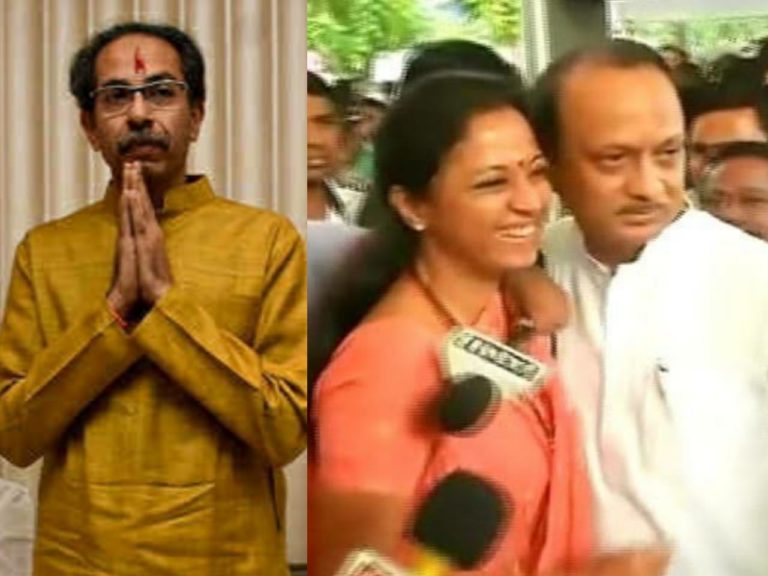
Ajit Pawar was also welcomed back into the family and party fold. He was seen hugging Sharad Pawar’s daughter and NCP MP Supriya Sule at the swearing-in ceremony.
After Ajit’s rebellion against his own party to back a BJP government led by Fadnavis on Saturday, a visibly moved Sule in her WhatsApp status had then said the Pawar family and the party had split. “Who do you trust in life. Never felt so cheated in life. Defended him, loved him. Look what I get in return,” she had said in another status post, about Ajit Pawar.
Ajit Pawar also attended the NCP MLAs meeting in Mumbai. Maharashtra NCP chief Jayant Patil and senior party leaders Chhagan Bhujbal and Dilip Walse Patil were also present in the meeting held at the Y B Chavan Centre. After Pawar’s appointment as the Deputy CM, he was sacked as the NCP’s legislature unit leader, but his party membership was not revoked.
Pawar was subsequently greeted with thumping of desks from NCP members when he went to the podium to take the oath.
The high drama of Maharashtra government ended yesterday with Fadnavis’s resignation hours after the Supreme Court ordered him to get the trust vote on Wednesday. The resignation confirms the perception that the BJP did not have the requisite numbers at the time that he was sworn in as CM in on Saturday morning.
After the supreme court order, Ajit Pawar who was holding the Dy CM position resigned followed by Fadnavis resignation.
“Democracy is not merely a form of government. It is primarily a mode of associated living, of conjoint communicated experience. It is essentially an attitude of respect and reverence towards fellow men.” –Dr. Ambedkar from Annihilation of Caste
On 26 November 1949, the Constituent Assembly of India approved the Indian Constitution. The drafting committee was chaired by Dr. Ambedkar, and came into effect on 26 January 1950, after which the Constituent Assembly was disbanded and was replaced with the Parliament of India.
The Constitution is often called a living document. That seems very abstract, because how can a book be alive? We might interpret this metaphorically, saying that the constitution speaks words that are close to our hearts, but the constitution is not poetry. The life of a constitution is different from other forms of life, and while a constitution might not die, it is possible to it to cease living.
What is a constitution? Laws are rules for the people. The constitution is the law for the laws. A constitution must prescribe for laws analogously to how laws prescribe for people. In principle, it governs what laws are needed and what must be prohibited.
Every nation-state is a Utopian project. Usually, the constitution is an expression of that utopia. The state hopes to organize its people into some ideal. A state doesn’t just govern society, but it also tries to make society into something. It might do so with laws, with violence, by directing resources, through education or a combination. In that sense, the Indian state is Utopian as well.
No state has lived up to the letter of their founding documents. The Indian constitution promises that India is a sovereign, socialist, secular, democratic republic and that India is to secure justice, liberty, equality and fraternity to all of its citizens. Many say that a constitution and its laws are just words on paper. India is not truly sovereign, socialist, secular, or democratic. The constitution might promise grand things in principle, but without any way to enforce those principles, those promises are meaningless.
The framers of the Indian constitution saw things differently. The constitution was to be a living document. It is not supposed to be an abstract set of rules that govern laws, but a moral imperative that infuses itself into society. In India, it was recognized that the state only governs part of society. Laws of caste, patriarchy, and capitalism operate side-by-side with the state. While the constitution promises life, liberty, equality, and fraternity, it must exist in a society that practices murder, oppression, hierarchy, and segregation. Even the best of laws must work in a society that discriminates its citizens, enslaves them and isolates them. How does a democratic state fulfill these constitutional promises?
Constitutional values can only work through the people of society, but murder, oppression, hierarchy, and segregation also can only work through people of society. The current balance only exists because members of society are organized in a particular way. People from dominant sections have access to resources and are connected to allow them to be dominant. People from marginalized sections do not have that access or connections. To approach liberty, equality, and fraternity, society needs to be organized differently. The law must break organizations that work against constitutional values, and encourage organizations that promote those values. The Indian constitution is designed to promote that kind of organization. Often there is a failure in meeting the values, sometimes at the level of the state and sometimes at the level of the people. Such organizing need not only be done through the mechanisms of the state. Any organization in society may work for these principles. Ideally the state should encourage such organizations, but in fact, such commitments have often put individuals at odds with the state.
Take the example of lynching. Lynching represents one of the most anti-constitutional forces as it deprives people of life, communities of equality and everyone of liberty. Lynching has risen in society because of changes in how people have organized. Older forms of isolation of marginalized people have made them vulnerable to attack. Newer forms of communication have made organizing violence faster. Organized movements have effectively spread ideologies of hate, fear and violence to many parts of the country. The Constitution may prescribe a solution if it undoes the isolation and vulnerability of marginalized people. If it can organize people from marginalized sections of society, and break the organization of the powerful who have the ability to directly labour and wealth. The state and society should work to reorder society to prevent marginalization and the murder that results.
Today, constitutional values are treated as hurdles, with loopholes to be exploited. If law-givers only treat the values of the constitution as a series of hurdles to work around, then they would not allow the constitution to live in society. The constitution becomes a static document, existing in the abstract. A living constitution is one that is part of the society it governs, rather than standing apart from it. If the constitution is only a set of words, then it can be amended to fit any purpose. The law then can act with brutality, oppressing, invading, and looting people.
If the spirit of the constitution has value, then the constitution ceases to live. When Dr. Ambedkar defined democracy, he called it a form of government where revolution can happen without the spilling of blood. He believed that open warfare in India would spell doom for the most marginalized members of society, and hopes that change in India could be worked out through the institutions and organizations of the state as governed by the constitution. As the state represents only one axis of power in India, it remains to be seen whether India can transition into its Utopian promise of securing justice, equality, liberty, and fraternity from forces of brutality, hierarchy, domination and hate. To give up on that promise is to give up on the state itself.
Views expressed are personal.
Ahead of floor test tomorrow, Devendra Fadnavis resigns as Maharashtra CM. Fadnavis stated in a press conference that he is going to submit his resignation before the governor.
In the press conference, Fadnavis accepted that they dont have the majority and BJP dont believe in poaching MLAs. He further added that BJP will work as an effective opposition.
Ahead of Devendra Fadnavis press conference, NCP leader Ajit Pawar resigned as the Maharashtra deputy chief minister in the Devendra Fadnavis government. Fadnavis is addressing the press conference from 3.30 pm.
Fadnavis blamed Shiv Sena for delaying the process of government formation.
” BJP waited for Shiv Sena but they never spoke to us. We had never promised Shiv Sena rotational CM”, says Fadnavis.
“BJP got the people’s mandate. If we had fought separately, we would have won a better mandate,” Fadnavis says.
The Supreme Court on Tuesday ordered the floor test for Maharashtra Assembly to be held on November 27 after hearing a joint plea by the Shiv Sena, Nationalist Congress Party (NCP) and Congress.
The three parties’ MLAs on Monday pledged allegiance to the three-party coalition at Mumbai’s Grand Hyatt. The coalition is claiming the Devendra Fadnavis-led government does not have the numbers while the Sena-NCP-Congress alliance has 162 MLAs and they can prove majority in the House if the floor test is taken.
Devendra Fadnavis to Maharashtra – Kabhi alvida na kehna
Earlier during the day, the Supreme Court ordered the Fadnavis government to prove its majority in a floor test in the Assembly on Wednesday.
After a meeting of the leaders of the Shiv Sena-NCP-Congress combine, Shiv Sena leader Sanjay Raut said Uddhav Thackeray will be the chief minister of Maharashtra for five years.