Indian Railways Earns Rs 429 Crores through Shramik Special Trains

0
An RTI query by activist Ajay Bose has revealed that Indian Railways earned Rs 428 Crore till Juner 29th ‘Shramik Special Trains’ during the COVID-19 induced lockdown. Special trains were run to transport migrant workers across the country from May 1st, 2020. Indian Railways also earned an additional revenue of 1 Crore in the month of July talking the revenue earned through the Shramik Special Trains to Rs 429 Crores. According to the estimates, 63 lakh migrants took the Shramik Special Trains to reach their homes. The Railways had operated a total of 4615 ‘Shramik Special Trains’ from 1st May to 9th of July out of which 4109, 493, and 13 trains ran in the month of May, June, and July respectively. The decision to start trains was taken after thousands of migrants took to walking, cycling, and other means to reach home when the nation-wide lockdown was imposed. The last of Shramik Special Train ran on July 9th.

Also Read: Modi government next surgical strike -Indian Railways up for sale!

A substantial amount of this revenue was paid up by the states from where the trains originated as per the Supreme Court orders. On 28th May, SC directed the states that no fares to be charged for migrants. However, on multiple instances and in multiple places, the administration – local and state compelled that the migrants bear these costs.
According to a report by Hindustan Times Indian Railways received the highest revenue from Gujarat, Maharashtra, and Tamil Nadu with Rs 102 crore, Rs 85 crore, and Rs 34 crore respectively towards the fare.
During the lockdown period, the narrative that the Indian Railways had to incur losses due to the operations of Shramik Special Trains was widely propagated. The RTI inquiry has shown hat instead Railways have profited off this exercise.
A migrant has a right to move back to their homes especially in times when there is a prevalent loss of lives and livelihoods of workers especially on the margins. It is the government´s duty to provide them with transportation.
After two months of silence and repeated criticism against the inaction of the Supreme Court to address one of the biggest humanitarian crisis, the  Supreme Court had ordered on 28th May that migrants must not be charged for their journey and had to be provided food and water. But by that time most of the migrants had already left for their homes with much suffering and loss of lives.
At the beginning of July, the Ministry of Railways announced that it has taken the first step towards privatisation of passenger train services. As part of its proposal, at least 151 modern trains or rakes will be introduced and 109 pairs of routes will be planned out for private train operations.
If the Indian Railways can earn revenue worth Rs. 429 crores in the time of crisis i.e the COVID 19 pandemic, then why does Railways ministry claims that Railways are going in losses and need to be privatised to provide better services to the public?

Read About:Corona Crisis & the Workers’ Movement- The labour report during the lockdown

Shree 420: Why this Masterpiece from Raj Kapoor needs a revisit

The nation-wide Coronavirus lockdown has highlighted the precarity and the struggles of migrant workers, who move from the rural countryside to urban centers in search of employment and better chances of socio-economic mobility. Many Bollywood movies have explored the journey and experiences of such workers; one of these is Raj Kapoor’s 1955 film, Shree 420. The film opens with the protagonist, Raj, travelling on a countryside road to the city of Bombay. Through Raj’s interactions with the city and its people, the themes of corruption, nationalism, class, and capitalism are brought up in this movie. The movie shows us the city’s crowded streets, with people hurrying about their own business with no regard for the others around them. This disregard prompts Raj to ask, “is everyone in this city deaf?”. A beggar on the street presents Bombay as made up of “buildings of cement and hearts of stone”, suggesting the insensitivity and apathy of the city folk towards the labourers and migrants living there.  
Still from the movie
Raj encounters the harshness of the city immediately when he finds out that there is no work available, and that one can only live by ‘420’ (cheating). He is deceived and robbed on the street right when he comes to the city – which seems to convey that in the brutal atmosphere of Bombay, one has to either become a conman or get conned. For immigrants like Raj, who have nothing and nobody in the city, survival depends on the goodwill and kind-heartedness of other migrant workers, who form a loose community. His ‘pure’ and honest nature when he first arrives is perceived by the city-dwellers as foolish naiveté. The necessity to be deceitful is highlighted even before he reaches the city when he manages to hail a car ride by pretending to be unconscious. This theme of honesty and deceit is brought out early in the film when deception fetches him a car ride but being truthful gets him thrown out on the road. Instances such as these show that the corrupting nature of the city is not so much due to ‘bad influence’, but rather due to bare necessity. However, it isn’t easy to completely justify corruption on the basis of necessity, because characters like Vidya show us that there is an element of personal agency too. One of the first transactions that Raj makes in the city is to sell or pawn away his honesty (a gold medal), which is symbolic. This can be read as the need to be deceitful in order to survive, or, as an act which displays Raj’s willingness to submit to the temptations of the city. It could also convey that in the exploitative system of capitalism, there is always a trade-off between gaining wealth and adhering to one’s principles/ethics. However, what is interesting is Raj’s explanation for why he chose the path of deceit. This highlights the close relationship between ‘corruption’ and class. He asks: “Why are lectures on truth and honesty always given to the poor? While the rich live by cheating and continue to gather wealth?” This idea is also reflected in Maya’s comment to him that; cheating on a small scale makes one a crook, but cheating on a larger scale makes you a philanthropist. It points to the exploitation inherent to a capitalist economy, which is usually not recognised by society in general or even the law in particular. This makes us question the narrow definition of ‘cheating’ under Section 420 (IPC), and points to the class interests which are favoured by it. That further raises the question of who is the real ‘420’, which is answered by the film’s title, Shree 420; hinting at the ‘respectable’, gentlemen’ class of crooks. The theme of ‘class’ is prevalent throughout the film, especially through the imagery of the cramped footpath right in front of a grand, spacious mansion, which conveys the vast inequality between the classes. The film shows how one is pushed towards becoming self-centred and prioritizing self-interest by the structures of society; Raj states that “when [he] was starving, homeless, and begging for work, the world didn’t care…so why should [he] care about the world now [when he is rich]?”. The film also conveys how the working classes too have bourgeois aspirations of marriage, wealth, luxury, and ‘honour’/’respect’. But these aspirations, for a majority, are unattainable. A corrupt businessman in the film states that he is “not selling houses, but selling a dream”; perhaps this shows us how the capitalist class not only exploits the lower classes as labourers, but also takes advantage of them as consumers of a bourgeois lifestyle. The idea of nation and national identity is also significantly explored in the movie. The lyrics of the song, ‘Mera Joota Hai Japani’, explore the sentiment of nationalism in a globalising era where Raj’s shoes, pants, topi are imported, but his ‘heart’ is ‘Hindustani’. But does being ‘Hindustani’ really mean anything for Raj? The same nationalist sentiment is also invoked by a wealthy, bourgeois politician to advertise and sell tooth-powder in the film. This reminds us that nationalism can be and is co-opted by the bourgeoisie and the market to serve their own interests. While the film provides a good critique of socio-economic inequality, perhaps it falls short at the end in presenting the path to equality as more focused ‘moral’, individual reform rather than through structural change. Read Next: Podcast on the Migrant Workers Report during the Lockdown

Contractual Workers Also Entitled to Child-care Leave: Uttarakhand HC

0
On Friday, a full bench of the Uttarakhand High Court reiterated that women who were contractual workers cannot be denied maternity leave or child-care leave (CCL) by an employer only due to their status of not being a regular employee. In this case of Tanuja Tolia v. State of Uttarakhand, a woman who was working on a contractual basis with the government health service in Uttarakhand had been denied CCL, which is available to regular employees. The Court added that, “ideally speaking a child care leave can be given to both the parents, father as well as mother, as the actual ‘beneficiary’ here” is the child. In 2015, a Division bench of the same High Court had held that contractual workers were entitled to CCL for 730 days; the period specified for regular employees in a 2011 Government Order. However, the full bench of the Court has now modified this earlier judgment, stating that it is “a contradiction in terms to suggest that a contractual employee, whose employment itself is for a period of 12 months, should be given 730 days child care leave”. Therefore, it has held that for contractual workers whose entire employment term is for one year, such employees shall be entitled to CCL for 31 days. The bench stated; “Such an employee can be granted paid child care leave for 31 days, on the same terms and principles as “earned leave”, as is given to other employees in G.O. dated 30.05.2011.” The Court referred to international law such as the Convention on the Elimination of Discrimination Against Women and the Convention on the Rights of the Children to emphasis the state’s special obligations towards women and children. Refreshingly, the High Court also referred to and cited scholarly articles on feminist analyses of labour and childcare. The Uttarakhand High Court stated that; “CCL is primarily for the benefit of a child. A child whose mother happens to be employed on a contractual basis with the Government, has the same needs as any other child. A denial of CCL to a government contractual employee would in effect mean a denial of the rights of a child. Rights which a child would have under Articles 14 and 21 of the Constitution of India”. The Court went on to stress that, “normally child care leave should not be denied. It could only be denied by the employer on very pressing valid and plausible reasons, which must be specifically stated, when such a request for child care leave is being denied.” The bench recognized that women contractual workers had previously been excluded from availing other maternity benefits too. “We must remember that maternity leave, which is in a way a precursor to the child care leave, went through a similar trajectory, as the child care leave. Like the child care leave today, even maternity leave was denied to a contractual worker”, the bench noted. In 2000, the Supreme Court held that maternity leave must be provided to women in all kinds of employment, including women who were muster roll workers, as opposed to regularized employees (Municipal Corporation of Delhi v. Female Workers (Muster Roll) (2000) 3 SCC 224).

Read Next:More States Suspend Labour Rights, Risking Lives of Daily Wage Labourers

History : Fall of Mussolini’s Fascist Regime in Italy, 77 years ago

On 25 July 1943 in Italy, amidst the Second World War, Italian dictator Benito Mussolini was voted out of power by his own Grand Council and was arrested. This marked the end of 21 years of fascist rule under Il Duce (‘the Leader’) Mussolini.

Rise of Fascism in Italy

“Those who cannot remember the past are condemned to repeat it”-George Santayana. These words of the writer, philosopher, and poet Santayana not only make a good quote but as there is a rise of fascistic tendencies across the world a daily reminder of how ignorant we are to history. It is in this context that we see the rise and fall of fascism in Italy. The outbreak of the first world war had resulted in a surge of Italian nationalism and the war was supported by a variety of political factions. Benito Mussolini who started his career as a journalist and was a socialist saw this as an opportunity for his own ambitions. While still associated with the socialist party, his writings indicate he rejected egalitarianism and believed in Nietzsche’s concept of übermensch. He was ousted of socialist party for his support for military intervention. In 1917 Mussolini got his start in politics with the help of a £100 weekly wage (the equivalent of £6000 as of 2009) from the British security service MI5, to keep anti-war protestors at home and to publish pro-war propaganda. In 1918, after serving in the First World War, Mussolini returned to Italy and openly began advocating the need for a dictator to lead the country. He charismatically argued that Italy needed “a man who is ruthless and energetic” to take control of the economic and political crises the country faced. He brought various fascist groups together to form his National Fascist Party (Fasci di Combattimento). The party soon began to gain popularity. On 24 October 1922, at a rally of over 40,000 Fascists in Naples, Mussolini issued an ultimatum to King Emanuele III: “Either the government will be given to us, or we will seize it by marching on Rome”. Threatened by the prospect of Fascists from all over the country descending upon Rome, the King sent a telegram to Mussolini, inviting him to form the government. Through rigged elections in 1924, and the dismantling of all constitutional and democratic institutions, Mussolini established himself as the dictator of Italy. In addition to building a police state, he also focused on creating propaganda to retain his popular support. During his regime, propaganda was used to build a personality cult around Mussolini. He portrayed himself as a macho strongman who excelled at everything from sports to music. Having worked as a journalist himself, Mussolini knew the power of words; thus, free speech was deeply controlled and censored by his party. A free press, trade unions, and political opposition parties were crushed and a network of spies and police was deployed to track any form of dissent among the public. However, Mussolini’s reckless military adventurism and his unchecked ambition to expand Italy’s territories led to the fall of his regime. Between 1935 and 1943, Mussolini led Italy into war “in Ethiopia, Spain, Albania, North Africa, the Mediterranean Sea, France, Greece”, and more! By 1943, when he was ousted out of power, Mussolini’s regime “was stretched far beyond its means”.

Mussolini’s Fall and Demise

On 24th July 1943, the Grand Council of the fascist regime gathered to discuss the position of Italy, which had suffered multiple military set-backs by then. Mussolini was old, ill (diagnosed with gastritis and duodenitis) and losing control over his government. One member of the Council, Dino Grandi, contended that it was the dictatorship that had brought the country close to military disaster and allowed ‘incompetent’ people to rise to positions of power. By then, the Allies had invaded Sicily and bombed Rome. The regime had also lost legitimacy in the eyes of a vast majority of the population. In these circumstances, the Grand Council passed a vote of “no confidence” on Mussolini’s leadership and decided to effect a transfer of power. Mussolini was too weak, physically and mentally, to resist or oppose this decision. After a short, formal meeting with King Victor Emanuele III, Mussolini was arrested by the police who had been waiting for a reason to remove him. Thereafter, he was placed under house arrest on the island of Ponza. When the Italian public heard the news of his arrest, they were relieved to finally see the end of his fascist regime. Cheerful crowds celebrated his arrest by defiguring images of the fascist dictator. A few months after Mussolini was voted out of power in July 1943, Nazi paratroopers rescued him from house arrest and prevented him from being turned over to the Allies. Hitler installed him as the puppet leader of Nazi-occupied territory in northern Italy, called the Italian Social Republic (a.k.a. the Republic of Salo). In April 1945, when Mussolini found out that the Nazis were negotiating a surrender with the Allies, he attempted to flee to Switzerland with his girlfriend, Clara Petacci. However, both of them were captured and shot dead by Italian partisans (who were anti-fascist guerrilla fighters). Their bodies were dumped unceremoniously in Milan’s public square, Piazzale Loreto. This carried symbolic meaning for anti-fascist forces in Italy; eight months earlier, fascists had displayed the bodies of 15 Italian partisans in the same square. When passers-by came upon Mussolini’s body, they threw vegetables at it, kicked it, spit on it, and one woman even emptied a pistol into his body to express her anger at the dictatorship. The bodies of Mussolini and his fellow fascists were hung upside-down at the square. Interestingly, some believe that this news of the public defilement of Mussolini’s corpse led Hitler to commit suicide two days later and have his body burned discretely, so as to avoid a similar fate. In the words of Paolo Monelli, writer and journalist- “The silence of the summer night is broken by songs, screams, clamors. A group exited by Caffè Aragno climbs up Via del Tritone screaming with a crazy explosion: ‘Citizens, wake up, they arrested Mussolini, Mussolini to death, down with Fascism!’ It sounded like the scream of a mute who gets his voice back after twenty years. Windows illuminate violently, front doors burst open, houses empty, all are out embracing each other, telling each other the news, with those simple and exuberant gestures belonging to people overwhelmed by emotion.” As the Italian intellectual, Ranuccio Bianchi Bandinelli, wrote in his diary at the time: “Behind the façade there was nothing. The first actor took his large cardboard head off and his idiot servants could be sent home with a cuff”.


Read Next: The Rise of COVID-19 in Times of Fascism: Timeline and The Path Ahead

Rape Survivor who was sent to jail for `Contempt of Court´ Recounts Her Traumatic Ordeal

0
On July 10th, the arrest and detention of a rape survivor and her support persons in Araria, Bihar caught national headlines. Today, more details have emerged about the humiliation and harassment that the rape survivor and her two support workers faced.

“If you were in my position, how would you feel? In these four days, I’ve recounted my experience of the night of the rape to the police so many times. So many times, I was the one who was blamed for this incident”, she said.

The rape survivor, Khushi (name changed to protect her identity), was made to spend 10 days in jail after a Magistrate charged her with contempt of court. Her two support persons from Jan Jagaran Shakti Sangathan (JJSS), Kalyani and Tanmay, are still in jail. On being released from custody, Khushi recounted the horrific ordeal she underwent in reporting and registering her rape complaint. With support and encouragement from Kalyani and Tanmay, Khushi gathered the courage to approach the police and file a complaint about the gang-rape committed on her. But after being made to wait for hours in court, in close proximity to a male accomplice of the alleged rapists, she became anxious and unnerved. “If you were in my position, how would you feel? In these four days, I’ve recounted my experience of the night of the rape to the police so many times. So many times, I was the one who was blamed for this incident”, she said. Khushi explained: “At court, after a long wait the judge called me inside. Now only he & I were in the room. I have never been in such an environment. ‘What will happen now? What will I have to do? Why are Kalyani didi & Tanmay Bhaiya not here with me?’, these thoughts were on my mind. Then he (judge) started to read out what he had written. His mouth was covered with a handkerchief. I could not understand my testimony when he was reading it out. I was wondering whether what I had said was what was written.” When she asked him if he could remove the handkerchief and then read out the statement, the judge refused. “Then the judge asked me to sign on that statement. I might not have gone to school but I know this much that until you don’t understand something, you shouldn’t sign on any piece of paper. I again said that I do not understand, please call Kalyani didi, she can read it out to me and once I understand it, I can sign it. The judge became incensed, saying – ‘why? don’t you trust me? Insolent girl, has no one ever taught you any manners?’ I was utterly numb. Had I said something wrong? I said, “no, I do trust you, but I am not able to understand what you have read out”…Then they called Kalyani didi. The judge was still enraged. Kalyani Didi and I apologized to him. Still, nobody was listening to us”, the rape survivor stated. Displaying shocking insensitivity and callousness, the judge apparently called Khushi “an insolent girl (badtameez ladki), again and again”. Referring to the rape survivior, the judge told Kalyani; “you all have not taught her any manners”. Khushi recalled that the two support workers also tried explaining to the judge that, “if Khushi is not able to understand her statement, it should be read out to her again”. But the judge was impatient with their requests, pointing out to them that he had “so much work”. The rape survivor stated: “There was so much commotion in that room that we understood that now we would not be heard…Tanmay bhaiya, Kalyani didi, and I kept standing there. They started to take a video of us and we were told that we were obstructing government work, so now we would have to be put in jail. I thought that when I have endured so much, this too then. I was granted bail after 10 days, but those who were standing with me are still in jail. We only wanted justice. We will not stop this fight.” Despite public outrage over the arrest and imprisonment of the two caregivers, Kalyani and Tanmay have been denied bail. Over 300 lawyers had also written to the Chief Justice of the Patna High Court urging the Court to intervene in the matter. Activists, women’s organisations, and Amnesty International India have demanded the immediate release of the social workers, especially in light of the spread of COVID-19 in prisons.    

Government Opposes Prof. GN Saibaba’s Bail Application

3
On Friday, the government opposed Professor GN Saibaba’s bail application at the Bombay High Court. GN Saibaba is a former Delhi University professor who is 90% disabled and wheelchair-bound. The professor is currently imprisoned in the Central Prison, Nagpur (High Security/Anda Cell) under the Unlawful Activities Prevention Act (UAPA) So far, there are 155 COVID-positive cases at the Nagpur Central Prison, including in the High-Security Cell. On 7 March 2017, Saibaba was sentenced to life for being associated with the Revolutionary Democratic Front (RDF), which the state alleged is linked to the banned CPI (Maoist) organisation. Even after 2 years of being undertrial on March 26, 2019, the High Court refused to suspend Saibaba’s sentence. He was convicted and sentenced to life under UAPA by a Sessions Court in Gadhchiroli on March 7, 2017. Last month, Saibaba had filed a criminal appeal praying for the suspension of his sentence and/or temporary medical bail on account of the COVID-19 pandemic. Professor Saibaba suffers from multiple ailments, including Sleep Apea, blackouts, Paralytic attacks, chest palpitations, and a cyst in the brain, for which he needs continuous medical attention. Saibaba’s appeal states that if he is held in jail, “there is no way Applicant can be given his treatment, without breaching the lockdown conditions, and exposing escort staff and Applicant to the risk of the infection”. It seeks for him to be released, so that his family can arrange the appropriate medical care as they see fit.

Also Read: No Bail for Human Rights Activists: Justice Delayed and Denied

Saibaba’s lawyer had informed the Court that, due to the lock-down, Saibaba’s access to medicines, health check-ups, and referrals to Specialist or tertiary healthcare centers has become restricted. But the government opposed his application, stating that the professor is being kept in a separate cell as a social distancing measure and is being given the necessary medical assistance. The affidavit filed by the police stated: “Saibaba is an active member of the Naxalite movement and helping them in their cause. If he is released on bail he will again contact naxal persons and he will conspire with Naxal persons and it will send the wrong message to society.” It begs to reiterate that Prof. GN SaiBaba is 90% disabled and is wheelchair-bound. Saibaba is one of the many scholars and activists who have recently been denied bail despite having a valid, pressing need for medical attention. His appeal will next be heard on July 28. First reported by Live Law.

Hungary: 80 journalists of Independent News Website quit over Government Interference

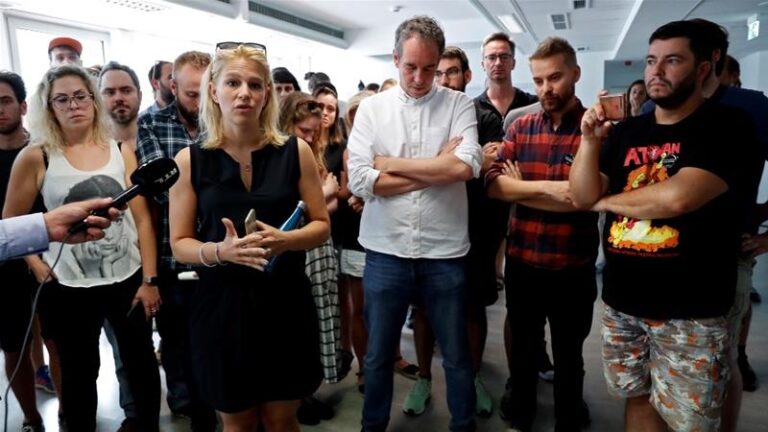
In another example of muzzling to press freedom, more than 70 journalists and staff at Hungary’s top news site Index have resigned. Dozens of journalists have walked out of Hungary’s top independent news site in protest at the removal of its editor-in-chief, as fears grow of government interference. The announcement comes just two days after the company’s editor-in-chief, Szabolcs Dull, was fired. Employees had described the decision by the president of the board, László Bodolai, as “unacceptable”. Index.hu is Hungary’s most-read news portal and a rare independent voice in a media landscape increasingly controlled by allies of Prime Minister Viktor Orban.

Also Read: Facebook blocks kannada website naanugauri(dot)com

On Thursday, Index held a staff meeting to request the reinstatement of Dull, which was “categorically refused”. “His dismissal is a clear interference in the composition of our staff, and we cannot regard it any other way but as an overt attempt to apply pressure,” said Index journalists in a joint statement. “The editorial board deemed that the conditions for independent operation are no longer in place and have initiated the termination of their employment.” Index’ deputy editor-in-chief, Veronika Munk, told Euronews Hungary that Dull’s sacking was a direct reason for her decision to resign. The website has long been a target of Hungarian Prime Minister Viktor Orban, who sought to exert more control over the country’s broadcast and media industry, according to Associated Press. Over the past decade, supporters of nationalist and conservative Prime Minister Viktor Orban have gradually taken control of Hungary’s independent media. Hungary is ranked 89th out of 180 countries on the Reporters without Borders World Press Freedom Index “The sacking of Szabolcs Dull was the step that made me think I can no longer do this job freely, following professional journalistic principles,” said Munk. “And I know that a lot of people among those who resigned think the same way.” A march and rally are planned on Friday night in solidarity with Index. In recent weeks the company said it felt its independence was “in danger” from external forces. In 2018, Index set up an “independence barometer” to monitor editorial freedoms, after a change in ownership which led to a loss of trust between staff and management. Last month, the barometer was changed to “in danger” from “independent” after it was confronted by management plans to reorganise the newsroom, which the editorial staff strongly opposed. Dull released a statement on Wednesday, saying he felt it was “no accident” that the editorial staff had felt endangered. Political journalist Daniel Renyi said he had expected mass resignations and sections of the newspaper to disappear. He told Euronews that the firing of Szabolcs Dull was “devastating”. “It’s very difficult to imagine a free Hungarian media market without the Index we know.” “Next year there might be more pressure on Hungary and Orban thinks this is the proper time to gain more influence in the independent media market,” said Renyi. Hungary is also in the midst of EU proceedings over concerns that they are violating legal standards that threaten the independence of judges and press freedoms. European Commission Vice President Věra Jourová said she has “big concerns” and expressed support for Index employees. “I would like to express my solidarity with the staff of Index who has been working under very difficult conditions,” Jourova said earlier this month. In a statement, the International Press Institute has also described the board resignations as “a devastating blow to journalism in Hungary”. Index.hu has been described as the largest and most influential of the country’s remaining independent media. “We’ve been saying this for years, written it down, shouted out loud that there are two conditions that guarantee the free, correct, and independent professional work,” Veronika Munk told Euronews Hungary. “One is that there is no external influence on the content of the site, and there is no external influence on the composition of the staff.” “They do not tell us what to publish on the site, and no one tells us from outside who to work with or not to work with.” News Source: Euro News and Reuters  

Facebook blocks kannada website naanugauri(dot)com

A reputed Kannada news portal Naanugauri(dot)com has been banned from Facebook since Friday. This means that none of the content from the website can be shared on Facebook by any means. The news portal was launched in April 2018, six months after the murder of activist journalist Gauri Lankesh and has quite a following on social media.

Why this attack?

In what can be seen as yet another attack on Progressive, Ethical, and Responsible Media, the news outlet, naanugauri(dot)com has been banned from Facebook from the early hours of 24th July 2020. While speaking with gaurilankeshnews.com, Muttu Raju, the subeditor of naanugauri(dot)com, said that they have covered news about BJP-MLA from Karkala Sunil Kumar and a critical review of One-year BJP rule in the state in the last issue( please visit naanugauri website to check these two articles in kannada). The issue with BJP MLA Sunil Kumar questioned if the BJP MLA is using the cement allotted for government projects to build his new bungalow. The BJP MLA did not like the news and had managed to get a stay on publishing news unfavourable to him. This is not the first time that BJP MP and MLAs have used the media gag order to stop publishing news that might hurt their reputation. Last year Tejasvi Surya, BJP´s candidate from Bangalore South managed to get a court order on Friday which bars 49 media houses from publishing “defamatory” articles about him. Tejasvi had approached the court after publications ran stories about him allegedly abusing women. We have been critical of governments whenever their actions are against the interest of people. We have seen when any news is not favourable to the BJP supporters, they troll and put abusive comments on our Facebook page and on our website. But atleast we could still publish our news and analysis articles. But the present situation should be seen as an attempt from the RSS-BJP and its Sangh Parivar outfits to wrongfully report our website on Facebook. It is unbelievable that Facebook has chosen to block all the content from a responsible media without intimating the outlet about the same or even citing the reasons for such moves. The Gauri Lankesh Media team has written to Facebook about the same against it. Similar censorship on the online portal of the Kannada daily Vartha Bharati had occurred twice in June 2017. After much uproar, Facebook had apologized for wrongfully blocking Vartha Bharathi and had called it a “technical error.”

Another attack on Progressive media houses?

While most of the print and television media for long has been ruled by the capitalist forces combined with regressive ideologies, progressive journalism managed to make a space for itself with the advent of the internet and social media platforms. While many such attempts have mostly attended to the English readers and audience, most of India still gets its news in the regional languages. This makes the need for progressive journalism in regional languages all the more important. Naanu Gauri is one of the very few progressive media outlets in Kannada. This is not just an attempt to stifle journalistic voice but a serious blow to regional and vernacular media which is already in danger. The BJP led governments have actively worked to curb the rights of journalists and attacked the very idea of journalism being a watchdog of the government. One such attempt was made when it introduced unacceptable measures like Media Policy in Jammu and Kashmir recently which sought to diminish the media and journalism as an outreach medium for the government and make it a puppet under the hands of the political forces, normatively against which it must be dissenting. This attack must be understood to be a project undertaken by the fascist and Brahmanical forces like RSS-BJP and its stooges that have worked alongside capitalistic forces like Facebook whose understanding of community guidelines stands questioned not just in India but across the world. While hatemongering pages and fake accounts continue to spread hate, violence, fear, and communalism through Facebook, it is only a measure to ensure that dissent and constitutional claims do not reach the people. With Section 144 in place almost across the country and the draconian laws put in place under the garb of health emergency to prevent any dissenting voices on streets had left the citizens of the country with internet and social media as the only fora to voice out concerns and dissent. In the wake of the governmental attacks on websites for criticizing the Draft Environmental Impact Assessment (EIA) Act, the regressive political forces in the country have conspired to keep progressive thoughts away from social media too. It is our duty as concerned citizens to not remain silent for such kind of media gags and fight for the remaining pro-people news organisations.

Read about: RSS workers threaten RT activist who exposed Maharashtra EC links to BJP IT cell


RSS workers threaten RTI activist who exposed Maharashtra EC links to BJP IT cell

Journalist and RTI Activist Saket Gokhale and his mother were threatened today by RSS workers today at his place. They passed on a threat to his mother and raised ‘Jai Shri Ram’ slogans in front of his house. This incident has come to light as he tweeted a video of the same and demanded urgent assistance from Home Minister of Maharashtra, Anil Deshmukh. In a series of tweets, he has also noted that he had received more than 130+ calls within 10 minutes from the BJP-RSS workers. He also has alleged that his phone number was leaked by the Ministry of Information and Broadcasting wherein they have failed to ensure that his details are not revealed while about his RTI application.  

No matter how many political twists the BJP gives, how many campaigns are run by Modi media, or how many threats I get from the sangh parivar: I will NEVER capitulate to Hindutva. India’s secularism & democracy are worth fighting for & dying for.- Saket Gokhale

In due course, an FIR was registered and the accused were booked based on the details of calls he had received in the day. He has been provided with protection by Thane Police as of now.

BJP IT Cell –  Election Commission Nexus

Yesterday, Saket had alleged that the Election Commission of India had hired the BJP IT Cell to manage its social media handle in Maharashtra in 2019 in the run-up to the Maharashtra State Assembly elections. Through his social media accounts including Twitter and Facebook, Saket Gokhale has pointed out that the Chief Electoral Officer of Maharashtra reporting to the Election Commission of India had issued social media advertisements in 2019 with the address being mentioned as “202 Pressman House, Ville Parle, Mumbai” which belonged to Signpost India, an advertising company which was a government empaneled agency during the Devendra Fadnavis led BJP Government in the state.

Shocking details:Election Commission of India literally hired the BJP IT Cell for handling their social media in…

Posted by Saket Gokhale on Thursday, July 23, 2020
  Interestingly, the same address was also used by a digital agency “Social Central” which was owned by Devang Dave – the National Convenor of IT & Social Media for BJP’s Youth Wing BJYM. Devang Dave was found to be a founder of many websites and pages supporting the BJP  including “The Fearless Indian” and “I Support Narendra Modi”.

“It is beyond SHOCKING that the Election Commission chose a BJP IT cell guy & his agency to handle their social media for Maharashtra elections.”  – Saket Gokhale

  While Election Commission of India has been envisioned to be an independent institution that is entrusted to hold free and fair elections which holds the key to the very functioning of a democracy. This allegation has raised eyebrows as the idea of democracy itself might have been compromised. Having taken note of the allegations, the spokesperson for the Election Commission of India has responded that it has demanded from the Chief Election Officer of Maharashtra a detailed report on the incident.

BJPs against Institutional functioning 

The present allegation is understood to have revealed yet another attack on the independent functioning of Democratic Institutions by BJP. The BJP is known to be notorious in terms of its attack on the institutions. It has attempted to either attack and dismantle major institutions like Planning Commission and UGC amongst others which secure the rights of the people and the constitutional values or have been trying to capture institutions through the appointment of its ideologues like in the case of judiciary and universities. Previously, Saket Gokhale had also brought to light that the links of present Chief Justice of India SA Bobde with BJP when Bobde was seen riding a high-end motorcycle. Saket Gokhale had revealed that this high-end bike was seen riding was registered in the name of Rohit Sonbaji Musale, son of Sonba Musale – a BJP leader from Nagpur. Bobde was also a nominee for them in the 2014 assembly elections. In 2019 Maharashtra State Legislative Assembly elections were held on 21 October. The ruling National Democratic Alliance (NDA) of the Bharatiya Janata Party (BJP) and Shiv Sena (SHS) won with a majority.

ZEE News targeted campaign against Saket Gokhale

In his series of tweets, he has also alleged Zee News had tried hard to push him to be live on their channel after running a targeted campaign against him earlier in the day. He had exposed the BJP IT Cell’s link with the Election Commission during Elections for Maharashtra State Assembly in 2019. Saket Gokhale has also been central in bringing to light the opacity of PM CARES fund and also the PM CARES ventilator scam. Because of these exposes he has been at the receiving end of trolling at social media sites like Twitter but a media house like ZEE media going after an RTI activist and participating in slander is unethical, to say the least. Read about: Corona Crisis & the Workers’ Movement- The labour report during the lockdown

Social Buzz: Twitter has a joke and you want to hear it

Twitter is normally not a place you would go for humor, its mostly used as a platform for celebrities and political parties and leaders to launch campaigns and connect to their followers. Mostly it’s used to make hateful trends, outrage, and a place for invisible trolls to abuse anyone who doesn’t follow their line of thinking. The latest trend #IHaveAJoke brought a smile on people´s faces and also gave people an excuse to vent out their frustrations amid political crises, lockdown, pandemic and job losses. People did not shy away from cracking jokes on politics, society, husbands, and yes coronavirus. Some might sting. Be ready for the burn.. Whats a joke if its not a social commentary.. right? check out some of the tweets and make some of your own maybe.. Activists are a serious lot but they can be funny too.. Saket Gokhale is an RTI activist. Social and gender inequality is a hard reality for half of the world´s population. But we can still take a joke.. on us or you.. depends.. Ouch.. burn…

Also Read: SC contempt notice to Prashant Bhushan over his tweets

Its 2020 and the true colors of journalism is not hidden from anyone. The mainstream media channels have become downright comic from being the lapdog to the establishment. COVID-19 has made many people work from home and rely on online meetings with their colleagues. Though many enjoy the comfort of home, the online connectivity and issues in bringing everyone online at the same time is still something that needs some streamlining Which one is your favorite joke?