Decoding the Politics of “Order”: Hathras Gangrape and Caste-Crimes in Uttar Pradesh

The investigation into the infamous Hathras rape case has been transferred to Central Bureau of Investigation (CBI) on Saturday. It is the same central agency that was termed “a caged parrot” by the Supreme Court way back in 2013; the agency that concluded its “thorough investigation” with a “no rape” result in 2014 Badayun gangrape and murder case of two teenage sisters. Seven years have passed since then, seems nothing has changed except the chronology of events: in Hathras case, the UP Police based on forensic report of AIIMS said there was no rape involved and then the case handed over to CBI. In Badayun gangrape, the CBI had finally said there was no rape.

Byte of ADG (Law and Order) Prashant Kumar

Drawing parallels, nothing could be much stark to observe that seven years later we have the BJP government both at the center and in UP whereas in 2013, both had non-BJP or so-called secular governments but the modus operandi in crimes against Dalits is more or less the same. Here we need to ask a few uncomfortable questions at the outset:

Why the BJP government headed by Yogi Adityanath in UP being specifically termed “anti-Dalit”? Why his supporters at the other side of the fence are rejecting this claim as “selective outrage”? Has something changed qualitatively in terms of justice delivery and law for Dalit victims after 2017 regime-change? If yes, then then what has changed in these years with respect to caste related crimes in UP? We need to define this change in specific terms.

The Myopia of NCRB Data

Media and the civil society usually build its “anti-Dalit” narrative on the basis of data. Going by the National Crime Records Bureau (NCRB) data on Crimes against Scheduled Castes, we can infer something more revealing that would demand a perspective to understand the character of state. Let us first have a look at the data from subsequent NCRB reports ranging from 2006 to 2019.

Over the decade to 2016 (2006-16), crime rate against Dalits rose by 25%; from 16.3 crimes per 100,000 Dalits reported in 2006, to 20.3 crimes in 2016, according to an IndiaSpend analysis of 2016 NCRB data. The number of trials completed in court dropped by 28%- from 20,495 in 2006 to 14,615 in 2016. UP with 33,455 such cases pending fared worst. With 10,426 incidents, Uttar Pradesh reported the highest number of cases of atrocities against Scheduled Castes accounting for 25.6 per cent in 2016.

Pic 1

On October 21, 2019, NCRB released their 2017 annual report on “Crime in India”, with state-wise data on atrocities committed against members of Scheduled Castes from 2015 to 2017. Uttar Pradesh had the greatest number of complaints registered against SC atrocities in all three years covered in the report, with 8,357 in 2015, 10,426 in 2016 and 11,444 in 2017. This means that more than a quarter of the total caste-related crimes occurred in Uttar Pradesh. As per the data, Uttar Pradesh has witnessed substantial increase of 47% from 2014 to 2018 in the crimes committed against Dalits.

In a recently released NCRB report, data showed crimes against SC increased by over 7 per cent in 2019 as compared with 2018. The NCRB data also show Uttar Pradesh recorded the maximum number of cases against Scheduled Castes – 11,829 cases or 25.8 per cent of the cases reported across the country in 2019.

Now comparing the 25.8 per cent data released in recent NCRB report on share of UP in cases against SC with Pic 1, we see a 0.6 per cent increase from the rate observed during 2006-16. The analysis of NCRB data Y-o-Y obviously paints a grim picture of UP but this picture is sort of permanent also.

In-fact, there is no such period in last 15 years when the crime against Dalits have dropped compared to the previous year. It has been consistently on the rise. Noting that UP has witnessed four consecutive non-BJP governments before 2017, the allegation of “selective outrage” seems to have a point.

Caste Politics of SP-BSP

Moreover, Samajwadi Party (SP) and Bahujan Samaj Party (BSP) are essentially and officially caste- based political groups whereas BJP neither claims nor is it. BJP is a Hindu majoritarian party that has tried to co-opt each and every caste group into its fold after the Mandal agitation.

The effect of a caste-based party in power could be easily seen by the number of fake SC-ST atrocity cases filed during BSP-led government and the atrocity on Dalits in SP-led government. During one and a half decade when a non-BJP government was in power in UP, the basic social fault-line that emerged due to the caste-character of ruling party was OBC Vs Dalit, specially Yadav Vs Dalit.

This conflict became so intense during these years that it could not help SP and BSP coming together in last Lok Sabha elections, as this writer reported during the polls in an article titled When A Bad Chemistry Eats into Fair Arithmetic.

The Ajay ‘Singh’ Bisht factor

Now coming to Yogi Adityanath who became Chief Minister in 2017, we could see a resurgent Rajpoot identity that was missing all these years after Chandrashekhar fell from power and Rajnath Singh moved to Center. Although we could see the political clout of this small community only by looking just at the numbers: only 7 per cent in population and still claim to have given 5 CM’s and 2 PM’s! A CSDS survey report says maximum votes garnered by BJP in 2009 and 2014 elections was from the Rajpoot community in UP.

Pic 2

This was the sole reason that the return of BJP in power with a Rajpoot Ajay Singh Bisht aka Yogi Adityanath as CM, Sulkhan Singh was made DGP and Raghvendra Singh was made Advocate General. State Cabinet saw 7 Rajpoot ministers in all and a total of 56 Rajpoot MLA’s entered the assembly.

Time was ripe for Rajpoot community to execute a final vengeance against their past ‘blotted’ by none other than Vishwanath Pratap Singh, the messiah of SC-ST people who implemented Mandal Commission recommendations in 1990. Since then VP Singh is a villain in the eyes of upper castes who robbed them (through reservation) of their ‘natural’ privileges arising out of the “double-born” status (as described in the Hindu scripture Manusmriti for Rajpoot and Brahmin castes).

Call for a Rajpootana

It is not a co-incidence that Yogi Adityanath assumed office on March 19, 2017 and a violent trouble broke out in Saharanpur on April 20th between Rajpoot and Dalit community. It was not a stand-alone and accidental violence. There was a well chalked out game-plan. The poster boy of this plan was Sher Singh Rana, murderer of Phoolan Devi and out on parole. The idea was to re-claim Rajpootana i.e. rule of the Rajpoot community from Rajasthan to Western UP. The headquarter of this project was Shakumbhari Devi temple in Saharanpur, revered by Rapoots right from Rajasthan to UP as their Kul Devi.    

Immediately after the Saharanpur anti-Dalit riots that saw more than 60 Dalit houses (specifically Jaatav houses, not Valmiki) burnt in Shabbirpur village, this writer visited the area and filed a long ground report after interviewing Rana. It was very clear from the writings on the wall that the Chief Minister is an accomplice and in-fact the patron of the call for establishing Rajpootana. Nothing could be more revealing than the pictures taken just around May 5th, 2017 in Saharanpur.

Uttar Pradesh
Pic 3 : A Rajpootana poster with CM Yogi’s face (credit: Abhishek Srivastava)
Uttar Pradesh
Embed Pic 4: A Rajpoot house in Shabbirpur with Jay Rajpootana (Pic credit: Abhishek Srivastava)

This Rajpootana theory was picked up by a few media outlets at that time but none followed it. Just before the Lok Sabha elections 2019, Yogi Adityanath visited Shakumbhari Devi temple in Saharanpur to start his electoral campaign. Sher Singh Rana, still out of jail was in full gear spreading hatred for Dalits and Bahujans throughout western UP. This again established the fact that Yogi Adityanath is active in the role of a caste leader and an accomplice to Rana in his project Rajpootana. See the pictures taken just before Lok Sabha elections 2019 and filed in a long report assigned by this writer.

 
Uttar Pradesh
Pic 5. Yogi Adityanath in Shakambari Devi temple, Saharanpur just before Lok Sabha Elections 2019 took off
Pic 6. Same Picture shared by a Rajpoot Karni Sena, Bihar Facebook group

The message was loud and clear: Rajpoot community can do anything to anyone in the state without fear of being punished.

The Confidence

Coming back to the recent Hathras case, an important development went unnoticed amidst call for justice to the victim. The Rajpoot community held its Panchayat in Hathras a couple of days back when the media was trying to enter Boolgarhi village. The video of this panchayat was posted on some select FB groups and doing rounds in WhatsApp groups but no one in media cared to carry it.

The speaker and people gathered in the meeting are referring to FSL report claiming that their boys are not rapists. The speaker in saffron kurta says: “We are key of this nation. If we will stand then it would be difficult for the whole country.”

Watch the video and see the confidence:

Caste panchayat of Rajpoot community in Hathras on October 1, 2020

This video speaks more than what the whole media has reported during last week. This is the confidence that comes out just because Chief Minister belongs to same caste. The Chief Minister is also aware of this caste-confidence and trust shown in him, so he tries his best to conceal secrets, barricade the village, gag media persons and MP’s, speak lies, conduct Narco test on the victim family etc.

The Mahant of Uttar Pradesh

The Chief Minister here is not a simple caste leader like Mulayam Singh Yadav or Mayawati. Be it Mulayam or Mayawati or for that reason any leader of any caste-group, their sole motto has been to get their fair share in the pie. The politics of so-called Social Justice in this country aspires for participation and share. Yogi Adityanath does not belong to that category of caste leaders.

Yogi is different in the sense that he is leading a revivalist project of change in the “Order”. Projecting himself as the caste-patron of Rajpoots, Yogi aspires to establish a feudal Rajpootana order i.e. the rule of Rajpoots. That is the reason why we see a desperation in his acts- lining up a thousand policemen on Delhi-Noida flyway to stop Rahul and Priyanka Gandhi from entering the state border.

Understanding caste-related crimes in Uttar Pradesh needs a perspective, not data. Data is misleading, but perspective is self-explaining. Criticizing Yogi Adityanath government on the basis of some conveniently picked-up incidents and data would never make a popular point. The point is to explain the caste-project that he is leading as a constitutional head of India’s largest state.

To answer all questions raised in the beginning, we just need to grasp the change in the character of leadership in Uttar Pradesh. The leadership in the form of Ajay Singh Bisht is for the first time “Head of an Order” i.e. Peethadheesh or Mahant. Previously he was Mahant of a Mutth. Now whole of Uttar Pradesh is his Mutth. The Order has to prevail at any cost, however big the constituency may be.

The author has worked as a journalist for several years and is the executive editor of a news and analysis website junputh.com  
US Bans Communists from becoming American citizens

0
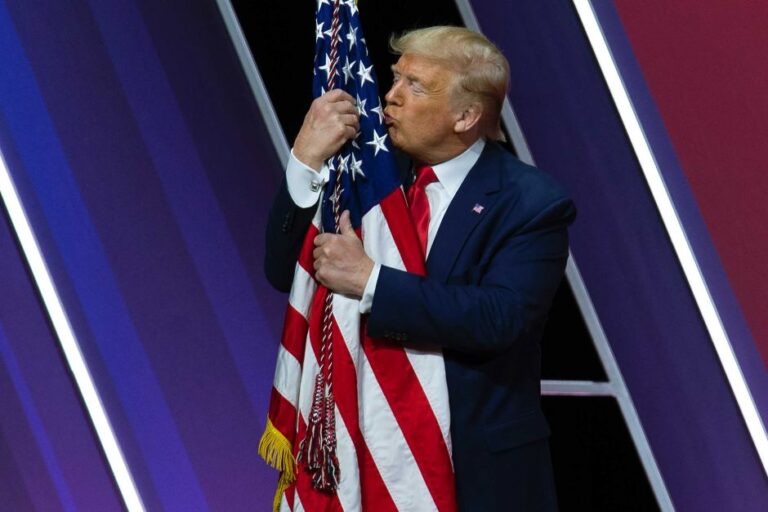
On October 2nd, USCIS announced a policy that will block immigrants who are members or affiliates of the Communist Party from becoming permanent residents, reports TelesurEnglish. The policy seems to be a part of the US’ aggressive policies against Chinese expansionism as it effectively blocks members of the Chinese Communist Party (CCP)- which has over 90 million members- from ever obtaining permanent residency or citizenship in the United States. Telesur reports that 2.5 million people, that is, 5.5% of the foreign born population in the U.S in 2018 were Chinese citizens. 67,000 Chinese immigrants were granted U.S. permanent residency that year, ranking it third in the nation of origin, after Mexico and Cuba. There are no official figures on how many of these immigrants were members of the Communist Party. The Qiao Collective writes: This policy is built on laws dating back to the 1918, which classified communists and anarchists as “security threats”, and to 1950 when the Internal Security Act excluded foreign members of Communist or “totalitarian” parties from becoming naturalized U.S. citizens. On 5th October this year, the United States accused China of threatening the global economy by exploiting natural resources; “While the Chinese people have suffered the worst environmental impacts of its actions, Beijing also threatens the global economy and global health by unsustainably exploiting natural resources and exporting its willful disregard for the environment through its One Belt One Road initiative,” the report added. Ironically, Trumps economic policies have been criticised of doing the same.

Attack on the Communist Party & Global Left

The policy excludes Communist parties in India, where they are part of the opposition and hold little power. A subsequent clause states that it applies to members of a communist party, “organised on a dictatorial basis, with so close an identity with its governmental policies, that the party and the government constitute an indistinguishable unit”. India, which is dominated by a right wing party- though arguably totalitarian- would not make the cut. Besides China,- who pose an economic threat to America as a superpower- this would impact millions in Cuba, Vietnam, Laos along with others. This adds a new dimension to American aggression towards the left- both within their state as well as those who may be pose a threat to global right and liberal capitalist nations. Many such nations had been forced into isolation in the past, and/or economically deprived.

Kashmir Times editor Anuradha Bhasin’s home ransacked

0

On Sunday, Kashmir Times editor Anuradha Bhasin went home to find her house being ransacked. In addition to that shock, she found a man, Dr Imran Ganai, sprawled on her bed. He was accompanied by a few security men.

She posted on social media:

Today some goons, led by Dr Imran Ganai, brother of Shehnaz Ganai, former MLC, entered the government flat allotted to…

Posted by Anuradha Bhasin on Sunday, October 4, 2020
    The apartment was first allotted to her father, Ved Bhasin, who is hailed as the ‘Grand Old Man’ of English journalism in Jammu and Kashmir. When Anuradha became an established journalist, the house was allotted to her. Under the changing political scenario, especially the revoking of Section 370, her work has come under scrutiny. Anuradha had approached the Supreme Court after the abrogation of Article 370 and 35A of the Constitution in 2019. In 2020, she stated that the region’s economy was in shambles and that they could not trust the government. Even if this raid may or may not be related, it should be noted raids are a common form of intimidation, though none of Anuradha’s officially allotted houses have been targeted before. Anuradha told Sabrang India that though she believes in due process, she was surprised that she wasn’t given a notice on the allotment status of the flat or an eviction notice. Moreover she questioned why the Shahnaz Ganai (whose brother Imran was in her house) had been allotted more than 5 flats within the locality.
“To add insult to injury Bhasin, a well known journalist, was told she must only go to the police station accompanied by a man if she wanted to file the complaint”.

Also Read: CBI raid on Karnataka Congress President DK Shivakumar : Congress terms it vindictive politics

UPSC student abused by authorities for questioning lack of concession

Soshim Keishing, a UPSC aspirant from Kamjong district in Manipur was beaten up by the local authorities in Rayotang, Ukhrul, where he currently resides.

According to the victim’s brother, Soshim and a fellow UPSC aspirant had gone to the authorities to request a travel pass to travel pass to travel to Imphal for their exams. The students were reluctant to pay the 50 Rupees fee for the same as they were hoping for a student concession, but following an argument with the authorities, they obliged.

“My brother had returned home when the secretary called him through the phone and asked him to come to the office again. He told the secretary that he had to study for his exams and he wasn’t interested in taking the argument any further. This was when the secretary took this personally and started berating and framing my brother for disrespecting the local authorities. My brother responded by asking the secretary if he was bluffing him and agreed to meet him at the house of one of the committee members,” the brother stated, according to a report in the Ukhrul Times.

An argument followed when the two met and, the secretary allegedly took him the community jail. Soshim repeated that he should be allowed a concession as he is a student, and not a businessman, the younger brother said. The authorities apparently took this personally, and framed it as disrespect towards and revolt against authorities, and told him to apologise.

When Soshim refused, they threatened the two to leave the locality within three days. When the victim refused to comply to this, he was handed over to the local action committee, who took him to a closed room and thrashed him till he was battered and bruised.

The beating was so brutal that Soshim eventually passed out. He was since admitted to a hospital and is on oxygen.

Also Read: The right to sign away your health data: The draft Health Data Management Policy

Court acquits Swaraj India leader DMN Murthy of Naxal charges

0
Swaraj India general secretary Doddipalya Narasimhamurthy who has been charged of indulging in naxal activities has been acquitted of all charges by Raichur District Court. In 1994 Raichur Police had registered three cases at Raichur rural (Yapaldinni) police station against Doddipalya Narasimhamurthy under the name of Vinod. Raichur police had arrested Narasimhamurthy on the basis of a 25 year old case registered at Netaji Nagar Police Station. He was charged under section 143, 147, 148, 307, 355, 385, 120 (B) and 124 (A) and 21 sections. According to police, DMN Murthy been absconding since 25 years.
Yogendra Yadav with DMN Murthy
The time span that the police was quoting DMN Murthy was very much part of public life in Karnataka and especially Bangalore. For the last 20 years he has been living in Bangalore and working as a journalist and activist on several platforms. He is also the head of Swaraj India Karnataka. Narasimha Murthy was taken into custody by the police subsequently after he attended the seminar conducted by Gauri Lankesh Fraternity in september 2019. He was interrogated by Superintendent of Police Dr C B Vedamurthy and DySp Shilavantar who questioned him for nearly one day. However Narasimhamurthy had out rightly rejected all the charges against him. The arrest of Narashimhamurthy had draw serious criticism from the across the state while people had staged several protest condemning the arrest and several renowned personalities had pressed for his immediate release. Narasimhamurthy had been kept in confinement for 77 day at Raichur prison as an undertrial. He was released in January 2020 on bail. Last week, the court did not find any evidence to prove that Narasimhamurthy was indeed  Vinod and acquitted him of all charges. Narasimhamurthy said that the court verdict had come as a relief as he was falsely implicated on serious charges.

CBI raid on Karnataka Congress President DK Shivakumar : Congress terms it vindictive politics

0
Bengaluru: KPCC Chief D K Shivkumar is yet under the scanner with the sleuths of the Central Bureau of Investigation (CBI)  raiding various premises of the Congressman since the wee hour on Monday. The opposition party leaders have called out  this as an act of vendetta politics by the ruling party. The IT officials held raids on the house belonging to Shivkumar located at Sadashiv Nagar in Bengaluru, officials have also been conducting searches at over 15 places linked to  Shivkumar including his business establishments and house at Dodda Aalanhalli in Kanakapura Constituency. The raids have been conducted close on the heels after the State government on September 25 last year had given sanctions to the central investigating agency to probe Shivakumar the congress strongman who is also an industrialist, under the prevention of corruption act. Shivkumar had been earlier grilled by the central agency on charges of acquisition of the disproportionate assets to his know source of income. The CBI sleuths led by CBI SP Thomson Josh have been carrying out the raids since 6 am which went on until afternoon. The officials have been tight-lipped and are yet to disclose information on their searches. In his reaction on the raids, Opposition leaders Siddaramaiah said BJP has always tried to indulge in vindictive politics and mislead public attention. The latest CBI raids on the premises of D K Shivakumar is another attempt to derail our preparation for by-polls. Siddaramaiah took to his twitter handle to condemn the raids and called it vendetta politics. The centre is resorting to cheap ticks. He added that the Narendra Modi government does not have the strength and morality to politically face the Congress party anbd hence is doing raids on congress leaders house  The raid on the Congress leader’s house just before the byelections in some constituencies. Last year, DK Shivakumar was arrested and was in jail for several days on charges of money laundering. Later the Delhi High Court had accorded him conditional bail on October 23rd 2019. Congress party has strongly condemned the raids, party state unit in-charge Ranadeep Singh Surjewala also tweeted-   Surjewala tweeted- The insidious game of intimidation & machinations of Modi-Yeddyurappa duo being executed by a puppet CBI by raiding @DKShivakumar won’t deter us. CBI should be unearthing the layers of corruption in Yeddyurappa Govt. But, ‘Raid Raj’ is their only ‘Machiavellian Move’ ! Let Modi & Yeddyurappa Govts & BJP’s frontal organizations i.e CBI-ED-Income Tax know that Congress workers & leaders will not be cowed down nor bow down before such devious attempts. Our resolve to fight for people & expose BJP’s maladministration only becomes stronger. Party senior leader Digvijay Singh also criticised the move and tweeted that CBI raids on DK Shivakumar and his brother is nothing but targeting powerful regional state leaders is a part of BJP/RSS combine strategy. Shivakumar is made of sterner stuff. He would prove his innocence” he said.     Jairam Ramesh also said, “ CBI had become Central Bureau of Intimidation”. Meanwhile Siddaramaiah in his series of tweets, CBI raid is a common election phenomenon of the BJP. Afraid of the loss in upcoming by-polls BJP had resorted to politics of vendetta. While the party said CBI had turned to BJP’s investigating agency while Enforcement Directorate had reduced to the BJP Election Morcha unit. The BJP had been destroying the democratic setup built by the invaluable contribution of freedom fighters’ it stated  

BSNL’s mass disenfranchisement of contract workers: Service Level Agreement & Austerity Measures

“If SLA is implemented, BSNL Contract Workers will lose all rights”

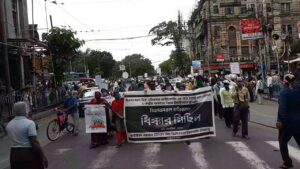
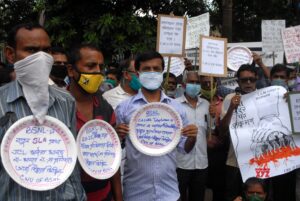
On 30th September, the newly formed contract workers union observed a “Black Day” and held protests against BSNL’s austerity measures and the Service Level Agreement (SLA). They will also be holding hunger strikes in the upcoming weeks seeking payment of dues, regularisation and the continuation of the Job Contract Labours system. 

GLN spoke to Contract Workers Union member Amitava Bhattacharya regarding the same:

The Job Contract Labour System

The contract workers began working under the Kolkata Telecommunications Department 25 years ago, five years before Bharat Sanchar Nigam Limited (BSNL) was even established. At the time, the worked under a “casual system”.

In 2002, a digital notification was put forward which allowed workers to be hired as contract labour. Based on this, a high power committee was created to determine contract work, and in 2004, the “Job Contract” scheme came into place, which regulated the employment of contract workers employed as Job Contract Labours (JCL).

Though JCL prohibits it, contract workers are often hired to do perennial work- such as creating bills, working as a peon, line man helper, etc. Officially, they are hired as sweepers, watchmen, etc, but their managers make them do this work covertly. In doing so, they’re able to increase profits making contract workers do the same jobs as permanent workers (differentiated as “employees”) but for lesser pay and without statutory benefits. JCL workers are also often not paid for months.

Introduction of Austerity Measures

For this reason, contract workers have been demanding regularisation and consistent pay by invoking the 1970 labour laws and 1972 gratuity act:

  1. A principal employer employing contract labour for work which is perennial in nature then the individual/s will become employee of the principal employer if one has worked for 240 days.
  2. Gratuity is paid when an employee completes 5 or more years of full time service with the employer(minimum 240 days a year).

However, austerity measures that came into place in 2019 to combat BSNL’s economic crisis made this difficult. Contract workers could only work for 13 days in a month, as opposed to 26, and those above the age of 55 were removed. For those who couldn’t work for 13 days, such as sweepers, work hours were reduced to 3 hours/day. As their working hours were halved, their continuity of service was interrupted. 

This effected their pay as well, which was cut down from an average of 16,000 to 8,000. However, the cut was only in theory as most workers hadn’t been paid in a year. The union brought these issues to the Calcutta high court, and in August 2020 an order was issued for the workers to be paid in 5 weeks. However, this was only for 13 days, and not 26. 12 workers had also committed suicide by that point. As of September 2020, more than 50,000 workers across the country still need to be paid.

Why are workers protesting SLA?

Even as workers are going through a crisis due to lack of payment and the COVID-19 pandemic, the BSNL management introduced a new notification called the Service Level Agreement. In this, contracts would be given out to bidders, and contract workers would be massively retrenched through outsourcing.

Despite the mistreatment of JCL workers by the Management, the introduction of the new SLA poses an even greater threat to their rights. The Job Contract Scheme prioritised the worker’s rights. Under JCL, even when contractors changed, the contract workers could work at the same place. It detailed the rights of contract workers, had institutionalised anti-discrimination policies and provided job security and stability. 

However, SLA prioritises the service itself, and workers are obligated to their contractors, and not to the company or jurisdiction. If BSNL feels that their work is not satisfactory according to pre-set parameters, contracts can be terminated. Under this new system, workers will have to leave along with the contractors, and BSNL would be absolved of all legal or labour issues related to workers.

 At the moment, there are 5000 workers in the Kolkata Communications District. Such a system- which prioritises profits rather than workers rights- puts them at a greater risk of not being paid as well as losing their work despite 25 years of service. As workers can be shifted at any time, it also makes it difficult for them to organise against the management in case of mistreatment since they wouldn’t be as familiar with workers or management, and for the fear of losing work. Combined with austerity measures, SLA also makes regularisation of contract workers impossible. 

Demands of the Contract Workers Union

Older unions that were registered under right and left parties, including TNC and CPIM, are apparently compromised in favour of the Management. Therefore, shortly before the first lockdown, a new union was formed for Contract Worker’s rights. Sure enough, despite pushback from contract workers, union leaders as well as employees unions signed a formal agreement in support of austerity measures as well as scrapping JCL. 

Amitava critiqued the management for introducing these measure during COVID time arguing it is a cruel tactic to avoid worker’s dissent. Many BSNL workers had contracted coronavirus as they had to work through the lockdown, and had not been paid for over a year. Though they will be made more vulnerable through these new measures, mobilisation could be more risky and difficult because of their current situation.

Nevertheless, thousands of workers are already protesting because of the severity of the issue. “While workers are also fighting for non-payment of dues their main fight is against SLA under which workers will lose all rights” explains Amitava. They assert that negotiations on regularisation of workers should be done on the basis of JCL. For this purpose, the workers observed a black day on September 30th, and will be conducting a continuous hunger strike  from October 15-17. They will continue these protests after the Durga Puja festival.

Read More: Modi government’s next surgical strike- Indian Railways up for sale!

The right to sign away your health data: The draft Health Data Management Policy

On Independence Day 2020, the Prime Minister announced a plan in his speech regarding the development of a nation-wide health ID programme to guarantee that every Indian would be counted by the National Digital Health Mission. On 26 August 2020, the Health Ministry announced a draft policy regarding healthcare data.

Originally the government offered very little time for comments, feedback and suggestions regarding the draft policy. This caused a blowback from many in the health sector saying that this was a serious matter which requires proper deliberation under normal circumstances, and during the COVID-19 pandemic, the health sector is overburdened. Feedback would hence be limited.

On reading, the policy appears to be a gateway to the telemedicine industry. While India has a Data Privacy Bill, it is not clear where medical data falls, and whether the current law can adequately handle the specific legal challenges that health data throws up. For example, in cases where a person is unconscious, or is a child, or otherwise incapacitated, they cannot provide consent. The current policy seeks to address those challenges and make the law surrounding medical data, its use and its transfer clearer.

The policy is a step towards the commodification of health data. It creates a framework allowing for informed consent regarding the use and movement of data and provides contingencies when a person cannot provide consent. The policy is weak on redressal mechanism, meaning that if someone’s privacy is abused, it would be difficult for that person to get justice. At a time when data can move quickly and easily without the person involved being aware, this is a deep concern.

Right to Privacy & Health as Property

Many groups have tried to raise this issue as one of privacy, but it strikes at a deeper level. To begin, there is a difference between what belongs to you, and what your property is. Your property can be bought, sold, and transferred. There are things that belong to you but cannot be bought, sold, or transferred. Our lives, bodies, relationships, and identities belong to us, but the rights to them cannot be bought, sold or otherwise transferred. If they could, we would be legalizing bonded labour and slavery.

The right to privacy might cover data that is so closely linked with our bodies, but the exact line around that right is murky. Our health data are extensions of our body. They make no sense without some reference to our body. This data is also only profitable to us, as it helps us maintain better health, but does not directly give us any monetary profit.

As individuals, we cannot profit off of our health data, but there are three ways our data can be profited off of. First, Health insurance companies can use our data to determine insurance rates. In a way, our visits to hospitals can be used against us to justify higher rates, as each visit gives them more information about the state of our health.

Second, data companies have learnt new ways, using new technologies to analyze health data. The linking of the Health ID to the Adhaar card or other national databases gives these firms a comprehensive database to profit off of our hospital visits.

Third, there has been a growing industry of telemedicine which tries to bypass the traditional hospitals and diagnose and prescribe treatment remotely.

“Real Consent” in Digital Age

The policy misleads regarding the protections it offers people by emphasizing informed consent. In the context of healthcare, consent has limited value. A patient seeking treatment is not in any strong position to give or withhold consent regarding matters of health data collection. If they refuse, they might put their health at risk.

Telemedicine might make matters to even more dangerous ends, as informed consent would become just a swipe on a smartphone. Telemedicine companies can promise that a comprehensive evaluation of one’s medical record would be required to give the best treatment, and this could easily be misused.

Beyond the issue of informed consent and the commodification of health, people have raised objections regarding the undemocratic nature of the practice. In a way, the State’s handling of the policy shows how informed consent can be misused if done the right way with little time to evaluate the policy.

Lack of Redressal Mechanism

Regarding the protection of a patient’s privacy, the policy offers many promises but does not properly layout the needed formal mechanisms or promises under the law that protect them. As such, the violation of property by third parties are in principle ruled out, but there are no stated remedies. While the policy spells out that certain types of data can be considered.

Most importantly, there is nothing in the policy to prevent the data from being used against someone economically. A company might request an algorithm to be applied to the data, which prevents social discrimination but does not prevent economic discrimination. This can be used by medical providers and insurance companies to adjust rates, or by potential employers.

While the law has been previously silent on the issue of health data privacy, health data in India has been notorious for being unreliable. The policy, which mandates a unique Health ID, provides the basis of a database. This health ID can be linked to any identification, but the Adhaar card is specifically mentioned in the policy as one possible link. If sufficient patients link their Health ID to their Adhaar card, it can create a national database on health data on Indians. As this law already is being passed in a hurry, it lays the groundwork for other laws that can use the data to serve any end.

With the growing connections between large data initiatives and the private health sector, there are many possibilities that this policy will open up. The policy was open for public consultation until 21 September 2020. The document can be accessed here.

Read More: Data Protection Bill: Protection of the State by the State and For the State

The author is a researcher based in Bangalore, India. Views are personal.

Judiciary has failed to deliver : Justice Gopal Gowda

0
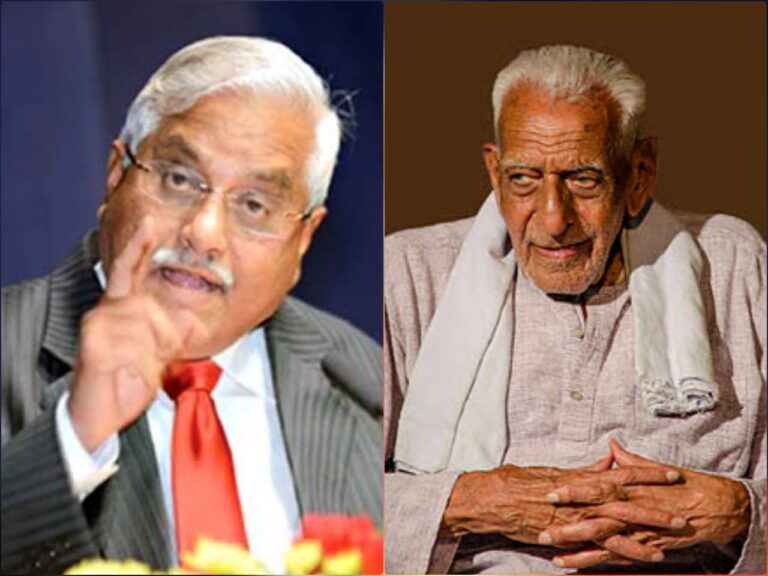
Bengaluru: Gandhi jayanti in the city was marked by the release of documentary ‘Mahan Tata/ The Great Grand Father’ that depicts the life and struggle of Gandhian centenarian freedom fighter H S Doreswamy. Collection of articles written by Doreswamy in a book form called “Gandhaian’s reply to Godse followers’ was also released. The documentary produced by media activist organisation Pedestrains Pictures was released by Justice (Retired) Gopal Gowda at Karnataka Scouts and Guides Auditorium in Bengaluru. Speaking on the occasion Justice Gopal Gowda  criticized the  political voices that have been critical of Doreswamy who had accompanied Mahatma Gandhi in the freedom struggle. These irresponsible politicians have no moral rights to speak of  the veteran. Persons speaking ill against the centenarian, who despite his ripe age had launched a struggle and fighting for the rights of the downtrodden are no leaders of the masses.  It was the freedom fighters like Doreswamy who ensured sovereignty to the nation. Those who speak ill of the veterans like HS Doreswamy ignore the invaluable contribution and struggle he has made to peoples movements.  “What could these politicians who with their ill gotten money bribe the people for votes could contribute to this nation” he questioned.  Gopal Gowda continued- I retired around four years ago. I have been observing how legislature, executive and judiciary are functioning. And I feel that for the first time in 72 years there is no rule of law. Our people are living in a situation where there is no governance as per Constitutional principles. There is an increase in rape, murder and incidents of violence and injustice. Judiciary is unable to provide justice to the people. He expressed anguish at the present state of affairs. He urged the Gandhian to advise farmers, youth and other about Gandhiji’s ideals and motivate them to engage in active agitations, he said. On the occasion of Gandhi Jayanti and book release Doreswamy said- “l am not pained by the criticism instead by the silence of one person who was very close to me who failed to show any resistance” the centenarian said while expressing displeasure. However, lot of people including Justice Gopal Gowda expressed their support. Just to give a befitting reply to the detractors this book is being brought out, which does not criticize any one and only aims to enlighten the critics and only seek for they regret their conduct, he said. Doreswamy clarified that he never undermined Veer Savarkar. But Savarkar had begged for mercy and written apology letters to the British regime and accepted to abide by all their conditions which was cowardice act as I see it. “Persons who has fought against the mighty and later if he writes apology letter they what should he be called” he questioned. Activist Sirimane Nagaraj said the documentary had been screened at 103 places at various places across the state including Bengaluru on the first day of its release. There was huge demand for screening the documentary while efforts were being made to reach it to every nook and corner of Karnataka. 

Also Read- Some forgotten goals of Mahatma Gandhi :Rajmohan Gandhi


What bothered Gandhi then is haunting us today

The fear that was absent during wartime started bothering Gandhi once the war ended. Gandhi ji started feeling lonely once it was sure that the British would leave and the preparations for the constitution started. Gandhi who never thought his convictions and his work would make him lonely did face this one fear till the end. The fear was of that of creating a modern state or the government system. The concept of state or the administration system was born in western countries as part of the modern administration system. Gandhiji was opposed to modernism because he thought it undermines or reduces and makes the inner strength of a man irrelevant. The state or the administration system which comes as part of modernism was a soulless machine according to Gandhi Ji. Gandhi Ji believed that this system would act cruelly on people and it suppresses them in an inhuman manner. He had absolutely no trust that this state would have a motherly heart. It is not that this question didn’t bother the then-contemporary giants like Babasaheb Ambedkar and Pandit Nehru. But they believed that this system would be in control. They believed that the immense power wielded by the state would be kept in check through laws/constitution/people’s power which meant through elections. Gandhi Ji didn’t seem to have that kind of confidence in democracy, its constitution, and other constitutional institutions etcetera. In his book Hind Swaraj, Gandhi Ji had criticised the British Parliament system in scathing words. Though Hind Swaraj was written in the first decade of the 20th century and it took some two decades for India to accept the parliamentary system based on the constitution, yet there were no significant changes in Gandhiji’s beliefs in that matter. His fears continued. Modern state, laws, court, audit institutions, and all such institutions were not completely trustworthy according to Gandhiji. There were clear possibilities that all these institutions would be misused by the mighty or the same institutions could get so powerful that they themselves could lose their purpose. His principle was that humankind has not discovered a mechanism(s) that would act as a barrier to prevent the misuse of the immense power that parliament, judiciary, and such institutions would gather. He believed some institution controlling people from outside or achieving success in people’s development is both a waste and vain. Because according to him, control and upliftment should come from within. He didn’t believe that an external institution is capable of such a thing. There didn’t see any special difference between ‘fear of king’ and ‘fear of having no king’ for him. Even as Gandhiji was living with the burden of these ideas, India was on the path of the formation of the modern state of parliamentary system by embracing it through the constitution. Gandhiji who had wielded such influence during the freedom struggle and when the time for all his fears and ideas were to become fruitful, or while the nation was readying itself for a new administrative system, why did Gandhiji become so irrelevant? Why did Gandhiji keep quiet when a system he opposed, the system he didn’t agree to come into existence in front of his eyes? Why did Gandhiji’s warning didn’t work? We can ask all such questions. But the times were different. The world had come far on the path of embracing this modern system. And Gandhiji had lost strength of swimming against the tide the whole world was going with. He was aware that it would be forest cry that no one would hear. And there’s another reason too. Gandhi who had anticipated the dangers of the modern state was not able to strongly advocate an alternative for it nor was there an opportunity for it. In reality, though he did have an alternative model, it was yet in the initial stage of ideation or one can say that it hadn’t yet crossed the initial experimentation stage. To comprehend what his alternative model was, one must read this book, “The Gandhian Constitution of Free India’  written by his close associate Shriram Narain. Though Gandhiji himself did not write the book, he wrote in the foreword of the book saying ‘These ideas can be interpreted as mine’. This book published much before the drafting of the Indian constitution began is totally different than the administration model that we are following. But it was not a tested model. By that time, the British Parliamentary model of administration was both known and ‘successful’. And it drew everyone towards it. The Gandhi model remained half-baked and at the discovery stage itself. Now, let’s come to the present. Doesn’t it feel that the fear what Gandhiji had is now bothering us too? A government that got majority through democratic means is acting without any control, not being accountable to any institutions, and acting as if it is paving its own way; this should scare anyone who has retained minimum values of humanity in them.  And this is not just the story of India. America, which kept telling the world as to how to strengthen democracy, how to deepen it is now overwrought by the gigantic power of the administrative system. Coming back to India, why do we not see the control of Parliament over power of the ruling system? Where is the control of the judiciary? Where is the control of constitutional laws? Everything is going in front of naked eyes as if there is no difference between totalitarian and democratic system. There is a point to the primary text which tells us about the difference between democracy and other systems. That point is, in a democracy anyone can question the ruling government or state. In the other system, one might have to pay with their head if asked questions to the state. But, the lesson of always asking questions in a democracy, forget the common citizen’s freedom to ask questions, the despotic nature has grown so much so that it has become impossible to ask questions in parliament. And those who are asking questions outside parliament are cruelly suppressed by slapping cases against them.
International Day of Democracy
PC: Shounak, https://5pvit.wordpress.com/2019/11/07/indian-democracys-identity-crisis/
This was the fear that haunted Gandhi Ji then. He was not against democracy per se but he had realised very clearly than anyone else that democracy too is a rule ‘ kratia’ (Latin word for the rule). How to control the rule in democracy was the puzzle which haunted him. There’s no answer for the question. There were others too who were aware of this fear about democracy and the lack of it. That’s the reason, many thinkers spoke in the line of ‘democracy is the worst system but we have accepted it because mankind hasn’t discovered a better system.’ But Gandhi is stubborn here too. His mind could never put his signature on the undeclared intellectual treaty. His mind kept craving for a strategy beyond democracy. But then his solution for this problem was in spirituality, which talked about the principle that a man should let go of the dependency on the state or administrative system.   After all, what is the reason for having a state; it is for controlling the society and the people of the society. The man should grow morally and ethically so much so that he or she should not feel the need to have any control of the state. The control should happen from within. If that happens, Gandhiji believed that there wouldn’t any need to control from outside. The very nobility of this solution makes us look at it as impractical. This is not a political solution. For this solution to work, man’s moral conscious needs to reach another level altogether. And that is another stage in evolution. What do we do till then? Is there a way to accelerate the cycle of evolution? We do not know. I don’t think Gandhiji has said something about this. But these ponderings represent both the past and future at the same time. The roots of this thought lie in Indian philosophy. After the battle of Mahabharata, the next king Yudishthir comes to Bhishma who’s lying on his deathbed to seek his blessings.  Bhishma then tells some subtleties to Yudhishthira about governance. “shape the people such that they wouldn’t need you” was one of the advice Bhishma gives Yudhishthira. That literally meant, create a society that doesn’t need a king. Gandhi’s thought too seems to follow this principle. The reason for saying this idea is related to the future too is that, if the democratic system goes on in the same way of the present days, it’ll collapse under its own weight. The new model that might get discovered in that future stage can be a model that is closer to Gandhiji’s ideas. Already, experiments of living without the obligation of any government have been seen. The author is a faculty at Azim Premji University. Views expressed are personal. 

Also Read- Some forgotten goals of Mahatma Gandhi: Rajmohan Gandhi