Bolivian leftists claim landslide victory in Presidential election

1

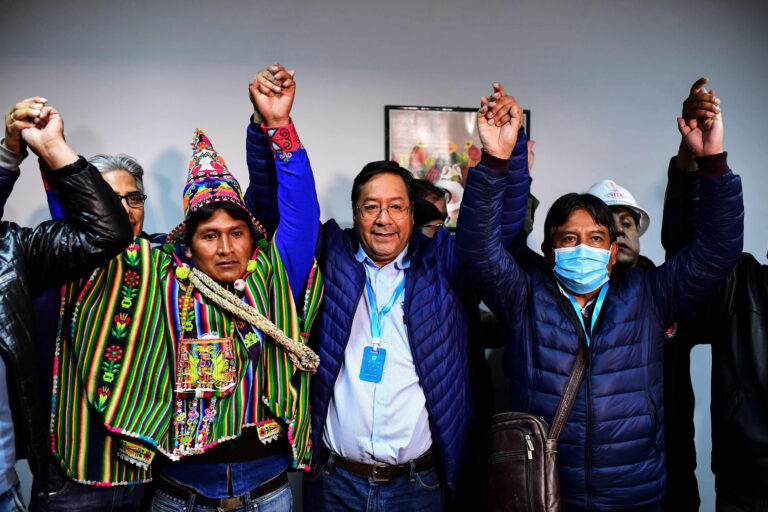
Today, 19th October, Evo Morales’ party Movement for Socialism (MAS) claimed victory in a presidential election. This is a huge win for Bolivian democratic forces and its indigenous population, who faced heavy suppression after the right-wing interim Government staged a US-backed coup last year. 

There has not yet been an official declaration and that could take days, but the “rapid count” shows a clear winner in the Morales’ handpicked successor, Luis Arce. Even the interim president tweeted:

“We do not yet have an official count, but from the data we have, Mr. Arce and Mr. Choquehuanca have won the election. I congratulate the winners and ask them to govern with Bolivia and democracy in mind.”
 
The news of landslide victory came as a surprise: pre-election polls did show Arce ahead but predicted a second round against centrist former President Carlos Mesa. To win the first round, a candidate needs more than 50% of the vote, or 40% while leading against the second-place candidate by 10%. According to the rapid count, the MAS candidate received at least 52% votes, while Mesa got only around 31.5%. This victory and the similar result to the 2019 elections also legitimises Morales’ victory in 2019, which the US depicted as undemocratic.

2019 Bolivian Election Crisis

In the 2019 elections, Morales had initially been declared president after MAS won 48% of the vote. However, this was highly disputed and the Organisation of American state alleged irregularities in the electoral process. For decades, US propaganda has depicted democratically leftist elected leaders as “dictators” and U.S.-supported coups as democratic. Morales attributed the coup to Western anger over his decision to sell some of the country’s lithium supply to China rather than Western companies.
 
After continued civil unrest of 21 days following these claims, trade unions, the military, and police of asked the Bolivian President to resign. Morales complied, along with other high-level politicians, and the Government of Mexico offered asylum after Morales cited fear for their families. Later, he shifted to Argentina. Morales had described the allegations of vote-rigging as part of a “coup.”

Suppression of Journalists by Bolivian interim Govt.

This did not calm things in Bolivia, and the Morales’ supporters staged large-scale protests. The right-wing Government responded with heavy-handed surveillance and policing measures. They were yet able to gain and maintain international legitimacy because of American backing and consolidation of power.

Before the pandemic itself, there was a strong intimidation of the media, and then-Minister of Communication, Roxana Lizárraga used “sedition” to publicly threaten journalists. Their phones and cameras were confiscated, they were subjected to continuous threats, and conversations on their phones were used to directly attack journalists. There were also blockades on investigations. They used “misinformation” as a reason for this, but Bolivian intellectuals point out this isn’t an issue in Bolivia, and if anything such misinformation was spread by the right-wing government and the US itself.

After the pandemic hit, the Bolivian right-wing Government used it as a justification for tightening information control. IACHR and international CSOs such as Amnesty International and Human Rights Watch considered these to be attacks against the fundamental rights to freedom of expression and information.

Indigenous Rights in Bolivia

Under Morales- Bolivia’s first indigenous president– and MAS, Bolivia’s poor and Indigenous majority secured rights and economic gains through social programs. They also pushed for nationalisation of oil and natural gas, which provided revenue for the same and made them financially secure.

Meanwhile, the right wing Government pushed forward racist revanchism, backed by Christian fundamentalism. They aimed to bring Bolivia back to the pre-2003 regime of authoritarian neoliberalism, especially by giving businessmen like Marinkovic direct political representation for agribusiness, finance, and oil and gas extraction interests. During protests led by indigineous populations, two massacres were committed by the military, and at least 19 (mostly indigenous people) were killed.

Bolivians have described this as a victory for the indigenous people, especially against American capitalism.


Koti Chennaya Series: Heroes of Tulu Folklore (Part-3)

0
[Note by the translator: The twin daivas(spirits) of Koti and Chennaya are one of the most popular folk deities of Tulunadu. Along with other daivas or bhutas such as Kallurti, Bobbarya, Maisandaya, Alibhuta, Koragajja, etc., Koti-Chennaya get venerated in the length and breadth of the Tulu region. Numerous studies suggest that most daivas are reminiscent of the folk heroes of that name, who were subjected to oppression of different sorts to maintain the hierarchical status-quo of the traditional Tulunadu. When they became mayaka (or perished fighting that oppression), they started getting venerated. Being born in the Billava¹ caste, Koti-Chennaya were subjected to constant treachery and harassment, even though they came close to power centres. It is roughly estimated that the twin brothers lived in the seventeenth or the eighteenth century. The following story of Koti and Chennaya is a translation based on the story written by Shri Panje Mangesha Rao, an early litterateur in Kannada. Panje himself got several (Tulu) versions of the story – one of them from Hermann Moegling of the Basel Mission. Comparing and contrasting, he finally arrived at the following story in the early twentieth century.] 

This is Part III of the 14 part Koti- Chennaya series

Part II  Part I

If the paddy sprouts should be fine, it is a practice to let go of the stagnant water and supply fresh water. Koti’s field was full of water and looked like a lake, whereas, Buddhivantha’s field was devoid of any water. It was dotted with egrets. Koti went straight to Buddhivantha’s house; bent his head and greeted him. Buddhivantha ignored Koti’s arrival deliberately and looked the other way. Koti greeted again and again. When he was continuously ignored, Koti said, “Sir, I greeted you four times, you never responded. Anyways! Had I greeted the kasarka(2) tree in the forest, it would have shed some dried leaves in response!” Mallaya Buddhivantha simply gestured by twitching his moustache. “Sir, it is three days since we sowed our fields. You should permit us to let go of the stagnant water therein”, with folded hands he requested. Buddhivantha was absolutely mute. Realising that he wouldn’t respond, Koti said, “Let my namaskara go to your forefathers”, and came down from there towards his fields. He created a small vent on the border of his field so that the water could flow out. The stagnant water gushed down to Buddhivantha’s field located below. As soon as Buddhivantha saw this, he called his servants, ordered them to cover and fill the vent, and stopped the water from flowing. Koti saw this and said “Sir, this is not right! If you have any vengeance against us, confront us directly; please don’t show it on the crops! Let the water flow as per the rule.” “Rule!? What did you say? Who gave you the rules – you, a Billava man! Is my field the way to water from your’s? Go… cut the forest beside your field! Draw a channel… Let’s see where the water goes!” Buddhivantha shouted. Koti responded, “Sir! I am calm by disposition. What if my brother Chennaya was in my place?!” “What are you rumbling? Your brother! Is he drunk on bison’s milk?! Does he come exploding the skies? Or does he appear cracking the Earth? Your brother!!!” Buddhivantha thundered with sarcasm. Chennaya, who was listening to all these exchanges from far, approached them with his silvery dagger. Yet, Buddhivantha continued to curse. Koti checked Chennaya who was on the verge of aggression. Addressing Mallaya Buddhivantha, Koti said “No Mallaya, don’t provoke! If you pour water on the head, it would flow down to the legs and not the other way round! Let the water flow down naturally! Please don’t prevent it! Don’t disobey the customary rules please!” Koti requested again with folded hands. “Rules… my foot…” Mallaya was about to burst out into another series of abuses. In this instance, Chennaya untangled himself from his brother’s clutches. Shouting aloud, he caught hold of Buddhivantha’s tuft of hair, broke his back, laid him on the floor and stabbed the dagger thrice into his chest. Mallaya Buddhivantha vomited blood and breathed his last. Koti-Chennaya performed the rites for the deceased. They buried his body near his field and turned towards his house. Seeing the twin men, Buddhivantha’s wife shuddered. When she saw the bloody dagger in the hands of Chennaya, she was sure what must have transpired. “Ayyo…” she screamed and ran towards the field. Chennaya said, “Anna, do you remember our childhood words to Buddhivantha? This is the time to get back the ball that was snatched from our tiny hands!” They went into the house, got the ball back and walked towards home. Buddhivantha’s wife rushed to Padumale Ballala, removing her jewels placed them at his feet and narrated what transpired. “Those who murdered will face death!” assured Ballala. He sent her home after consoling. Not only the beedu(3), but the whole village was terrified by the murder.  Meanwhile, Ballala sent for Koti-Chennaya. Before Koti-Chennaya reached home, their foster mother Sayina Baiditi had heard about the ghastly act committed by Chennaya and the Ballala’s fury about it. When the brothers arrived she started querying about the incident. “Koti, what happened?! Chennaya, what did you do?! We have to face tough times now!” Baiditi wailed. Koti replied, “Amma, Buddhivantha was unrestrained in his words. Chennaya was uncontrolled in his words and act. Buddhivantha’s rashness matched with Chennaya’s haste.” He bent his head with a sense of guilt. Sayina Baiditi said, “For what you have done Ballala is going to punish you gravely. Will he push you down the cliff?! Will he make an elephant trample you?! Will he throw you into a tank?! Oh my God! What will be your fate?!” She said crying. Looking at this, Chennaya said fervently, “Amma why do you cry? This dagger is sharp! And my hands are skillful. We need not be afraid of anybody. If they are truthful to us we can sacrifice everything for them! If they are unfair to us, we can take away their life, whoever they are!” Baiditi said, “Oh children! Now you can’t stay in this country for a moment. The whole of Padumale would be your enemy!” Koti replied, “In that case, we will go to another country! Is it written in our fate that we should drink the water of only Padumale? Absolutely not!” “If the Ballala comes to know about your plans to leave Padumale, he won’t sit quiet. He would order the guards on the border, the servants on the toll gate and people at the water sheds to catch you and get you back! You cannot escape his scrutiny and such escape is unbecoming too!” Baiditi advised. “In that case we shall meet him in his beedu(3) and then leave the place”, Chennaya declared. “Why should we be afraid of him?” As the mother and children were speaking, the servants of Ballala came and took the twins to his beedu. Before they left the place, Baiditi advised Koti as to how to behave before the Ballala. The twin set off to the beedu. They crossed the paddy fields, they crossed the barren land; they climbed the hillock; they got down; they crossed the river; they went through the main door of the fort; they went to the platform on the western side and then to the upper floor with the silvery top. Ballala saw them when they were in front of the beedu and thought, “the twins have grown to be tigers from meekish mice”. He readied himself to conduct an enquiry.

Glossary of Kannada and Tulu words 

  1.  A community in coastal Karnataka with almost one-fifth of the population in that region. The traditional occupation of the community was toddy tapping and working as agricultural help.

  2. A decorated plantain stem installed in the paddy field as an agricultural ritual. 

  3. The feudal homestead of the Ballala 


Another “Hathras”? Delhi Police shield accused in rape & death of Dalit girl

0

In early October, a Dalit girl who works as a domestic worker was found hanging in her employer’s home. Her family alleged that she was raped and potentially murdered by her employer. But the Delhi Police did not thoroughly investigate the case, and instead detained those demanding charging an FIR, including a journalist from the Caravan. The attack on the journalist created controversy online, but the case itself is not covered extensively.

Background

On October 4th, the 17-year-old Dalit domestic worker was found hanging from the roof of the driver’s room, where she was forced to stay by her employers. The police stated that there was no foul play and that the post mortem report showed a suicide. They reiterated this claim in a tweet after witnessing backlash regarding the attack of the journalist. The Caravan journalist Penkar had gone to the Model Town police station at 2:45. A small crowd of 30 people in total, consisting of students and activists and family had gathered around the station. The family was urging the police to register an FIR case against the employers for rape and abuse and abetting her death, but they refused. After that, the crowd began raising slogans condemning the Delhi police. They were arrested for violating DDMA order and subject to physical and verbal attacks. The family told the Wire that male police officers sexually misbehaved with female detainees. However, the police’s statement does not adequately answer why the girl would be motivated to commit suicide in the first place. Moreover, it also does not justify why the detainees, including the journalist and members of the family, were attacked.
delhi police attack
The victim’s family members show injuries sustained due to police beating | the Wire
The family’s claims provide an answer and would implicate the employers in her death because of their continued extreme verbal and physical assault. They stated that the girl was forced to sleep in the driver’s room and when she tried to inform her relatives, she was restrained and threatened by the employer’s wife. Her aunt told the Wire that she also received a distressing call on her day of death after three days of silence. According to the family, she had been raped for ten days by her employers, and that they potentially killed her.

How the Delhi Police mishandled the case

Re-evaluating the police’s statement in light of the family’s claims raises many questions on the purposeful mishandling of the case. The post-mortem report suggests she died of asphyxia and since her door was bolted from the inside, the police ruled the case a suicide. However, the report does not rule out evidence of rape or mention whether they had investigated the case in light of the accusations. Contrast this to the suicide case of Sushant Singh Rajput where months were spent by investigating agencies to frame people with no evidence. Investigation teams thoroughly investigated claims that Rhea Chakraborty played a role in Sushant Singh Rajput’s suicide, or even directly killed him, why didn’t they let the Dalit girl’s family file an FIR? Even if their claims weren’t true, the police should have thoroughly investigated the grievous charges. The family and student unions also accused the police of mishandling the body. Her aunt initially was allowed to see the body briefly at the scene, but they barred the rest of the family from seeing it at the station. The police told them to bring her father, who was a drug addict, and estranged from his children. For a few days, the family also did not know about her body’s whereabouts. She was only allowed to see her body very briefly on the 8th, the morning after the postmortem. That morning itself the police also seem to have hastily and forcefully cremated the body in the presence of 300 officers. If this is true- as the Allahabad HC pointed out in the Hathras case- it is a violation of the family and the victim’s fundamental rights.

A repeated pattern

The police not looking into the possibility of rape before closing the case is also especially irresponsible because of the high rate of similar incidents of rape, violence, and murder of domestic workers. Such cases are also especially high when the worker is a Dalit woman and/or a minor who does not live with her community or family. Most notably, in 2014, a domestic worker named Sabina Khatun‘s body was found hanging in her employer, Mr. Vijay Beri’s house. His sons, Apoorva and Abhishek Beri were prime suspects in her murder and rape. Her employer offered the family of the deceased three lakh to not demand an inquiry into her case. Three years later, domestic workers unions held mass protests since no charge was made against them. Much like the present case, here too the police refused to file an FIR against the accused and were pressurised into doing so by domestic workers unions. This narrative seems very similar to the Hathras case with regards to 1) the accused’s treatment of the victim 2) the police barring the family from their right to the victim’s body and 3) not respecting their wishes to take the case forward, 4) hastily cremating the body without conducting a thorough investigation on charges of rape and finally 5) arresting and attacking journalists covering the case or related protests. But as the Sabrang points out, what differs is in the press coverage of the two, as well as public response. Because of the hyper-saturation of some cases in the media, the fatigue felt afterward means similar cases don’t come to light, and the former is made out to be an anomaly rather than a repeated pattern.
Protests held by domestic workers with regards to the Sabina Khatun case | International Domestic Workers Federation
In order to bring justice to the victim and her family, an investigation should be carried out by an unbiased team looking into the claim that the victim was raped and that she was murdered. An investigation regarding the police’s mishandling of the case should also be carried out, questioning whether the police did hastily cremate the body and whether they looked into the charges of rape and abuse, as well as why they didn’t let the family file an FIR.

Another Caravan Reporter Assaulted by Delhi Police

1

On 16th October, Delhi police detained and assaulted 24-year-old Caravan reporter, Ahan Penkar. The Caravan released a statement, showing gruesome marks all over Penkar’s back from police brutality. The assistant commissioner of police of Model Town, Ajay Kumar, allegedly kicked and slapped Penkar when he was detained inside the Model Town police station.

Police brutality against the Caravan journalist and protestors

At 2:45, Penkar arrived outside the Model Town police station to cover a protest regarding the alleged rape and murder of the 17-year-old teenager in North Delhi. It was a small crowd- around 20 students and activists had gathered there along with ten of her relatives, demanding the police register an FIR in a case based on a complaint made by her relative. Members of the crowd had gone inside the station to register an FIR, and it was only after they refused that they began raising slogans condemning the Delhi police.

Most of the police were in plainclothes, making it difficult for the crowd to learn their name and rank. This is typical, and in many cases, police even refuse to show their names or badges even when arresting protestors, especially when cameras are around. 

Penkar was recording the incident with his phone but held his press card throughout the protest. A plainclothes official pointed him to ACP Ajay Kumar, who ordered to take him inside along with several others. They took him and several others into a room and made them sit on the floor. Several police officers entered and verbally and physically assaulted them one after the other. Penkar told the Caravan: 

 “Isko bhi dekh lenge,” Kumar said—we will see him also.

Police officials “grabbed my trousers from the back, my shirt from the front, and dragged me,” Penkar recalled. “They took my phone immediately, even before we had made it inside … The whole time, I was yelling, ‘I am a journalist, I work for The Caravan.’”

The Delhi police has a history of attacking journalists. In August, two Caravan journalists were attacked and sexually harassed from by Delhi Police. Shahid Tantray, Prabhjit Singh, and an anonymous woman. The police in Northeast Delhi threatened them with murder, sexually assaulted the woman, and subject them to communal slurs. The journalists were conducting a follow-up report about a woman complainant who had accused the police of sexual violence. 

Besides this, during the February riots and protests in Delhi, many journalists were attacked by the police, including Akash Napa of JK 24×7, who was shot, and Arvind Gunasekar of NDTV who lost some teeth. Saurabh Shukla, Mariam Alvi, Sushil Rathee of NDTV, Runjhun Sharma of News 18, Shivnarayan Purohit of Indian Express, Parvina Purkayastha of Times Now and Akshay Kumar Dongare and Tanushree Pandey of Aaj Tak were also attacked by the police. 

Related: Allahabad HC: UP Police violated human rights in Hathras rape case

FIR against actor Kangana Ranaut, sister for promoting communal disharmony

Bandra magistrate court has ordered registration of an FIR against actor Kangana Ranaut and her sister Rangoli Chandel allegedly for creating communal tension through their tweets and interviews.

The complainant had accused Kangana of creating a social divide between Hindu and Muslim artists via her tweets and interviews to channels. Earlier this week, the actor was booked by Karnataka police over her tweet allegedly targeting farmers protesting against contentious central farm laws. The case was registered under Indian Penal Code (IPC) sections, including 108 ?(abetment), wanton vilifiation upon a community (153A) and intentional insult with intent to provoke breach of peace (504). Last week, a Tumkuru court had directed the local Kyatasandra police station to book Kangana Ranaut for her tweet on farmers. The ruling came after a complaint was lodged by advocate L. Ramesh Naik last month. On September 21, Kangana had tweeted, “People who spread misinformation and rumours about CAA that caused riots are the same people who are now spreading misinformation about farmers’ bills and causing terror in the nation, they are terrorists.” Alleging that the tweet amounted to causing provocation, hurt, enmity between groups and intentional insult, Naik had filed the complaint against the actor in the Tumkur court on September 28 after the Tumkuru police refused to entertain his complaint. READ MORE: FIR against Kangana Ranaut for tweet on protests against Farmers Bills

Jharkhand boils in anger because of Stan Swamy’s wrongful arrest

0

Jharkhand capital Ranchi is witnessing large-scale unrest in response to the wrongful arrest of 83 year old Father Stan Swamy- a prominent Human Rights Activist engaged in the Bhima Koregaon case- from “Bagaicha” in Jharkhand on 8th October by the Mumbai NIA.

Since his arrest, people have been voicing their dissent online and taking it to the streets on a daily basis all over the country. And today, thousands of people from  various political parties and social organisations will take out a justice march from Ranchi’s district school to Raj Bhavan under the banner of “Stand with Stan Swami”. 

Who is Father Stan Swamy?

stan swamy
via the Wire

Stan Swamy was born in 1937 in Trichy, Tamil Nadu. He became a Jesuit at a young age and in 1957 decided to devote his life to the underprivileged and marginalised. He spent his life working on the rights of Adivasis and Dalit-Bahujans.

In 1965, he visited Chaibasa in Jharkhand, and since considered the state his home. A few years later, he received his master’s in sociology from Manila in the Philippines. After this, he stayed in a village with the ‘Ho’ tribals of Kolhan, where he came to know about their life and issues that adivasis face.

He went to Belgium to study and understand social systems in 1974, returning to India after receiving his PhD. For the next 15 years, he worked at the Bangalore-based research institute Indian Social Institute (ISI). There, he trained hundreds of youth to scientifically assess social problems and encouraged his students to work in grassroots movements.

In 1991, he went back to Jharkhand for worked. He worked on adivasi rights in Chaibasa for almost a decade and played a key role in establishing ‘Bagaicha’ in Ranchi. Bagaicha is a Jesuit social institution and training centre near Ranchi working in collaboration with people’s movements that are working against “unjust displacement, human rights violations, illegal land acquisitions, and policies that were designed or amended to acquire more land, making the indigenous people landless“.

stan swamy jharkhand
Adivasis stand with Stan Swamy – GoNewsIndia

Stan Swamy has been working for the constitutional rights of adivasis over water, forest and land for the last three decades. He has done incredible research work on displacement, looting of natural resources by corporates and the condition of prisoners under consideration. He has been vigorously raising his voice against anti-people amendments made in 2016 by the BJP government of Jharkhand in the CNT-SPT Act and the Land Acquisition Act. He also strongly opposed the BJP’s Raghubar Das government’s policy of handing over the land in the land bank to the corporate. He has been pushing for the implementation of the 5th Schedule of the Constitution and the PESA Act.

He has also raised his voice against issues like hunger deaths, problems with the Aadhar card and communal violence. He was among the founding members of the ‘Anti-Displacement Mass Development Movement’. They have been working for the release of adivasis who have been jailed, and extending solidarity and bringing attention to adivasi movements that have been made illegitimate through the label “maoist”.

Though he states he has never been to Bhima Koregaon, Stan Swamy was arrested from his home in Ranchi on Thursday evening, 8th October and taken to Mumbai where he was produced before a court on Friday. He is remanded to judicial custody till October 23rd.

Protests in Jharkhand and across India

stan swamy Jharkhand protest
Image via JanChowk

On 9th October, hundreds of people formed a human chain at Albert Ekka Chowk in Ranchi demanding the release of all political prisoners, the repeal of the draconian UAPA law, and for the arrest of the Hindutva leader, Milind Ekbote, who instigated violence at the annual Bhima Koregaon event as well as of Sambhaji Bhide. Since then, protests have also been held in several cities of the country (Patna, Kochi, Bangalore, Kolkata, Hyderabad, etc.), by mass organisations and catholic churches. 

On October 12, many socio-political activists held a day-long fast and staged a sit-in from 2 to 5 pm the next day at the Amar Shaheed Birsa Munda Samadhi site in Koker. On 13th October, the ‘Christian Youth Association’ burnt an effigy of the central government against the arrest of Father Stan Swamy at Albert Ekka Chowk in Ranchi.

 
jharkhand protest stan swamy
“Who all will you arrest?” via Janchowk

On October 14, several organisations including All India People’s Forum, Jharkhand Muslim Central Committee, Jharkhand Youth Federation and Association for Protection of Civil Rights protested against the arrest of Father Stan Swamy and Umar Khalid at Albert Ekka Chowk in Ranchi. On October 15, the staged a statewide protest against the arrest of Father Stan Swamy.

On the appeal of the Ranchi Catholic Church, silent protests were also held, along with prayers and human chains in Albert Ekka Chowk, Sarajna Chowk, Dr. Kamil Bulke Path, Dangra Toli Chowk, Kanta Toli Chowk.

stan swamy
Fathers hold silent protests across the country – the Hindu

Several ruling legislators, including Jharkhand Chief Minister Hemant Soren and Jharkhand Congress state president Dr. Rameshwar Oraon, also made statements opposing the arrest. They termed the move of the central fascist Modi government as wrong and unjust. 

Dr G N Saibaba on indefinite hunger strike to demand basic prisoner rights

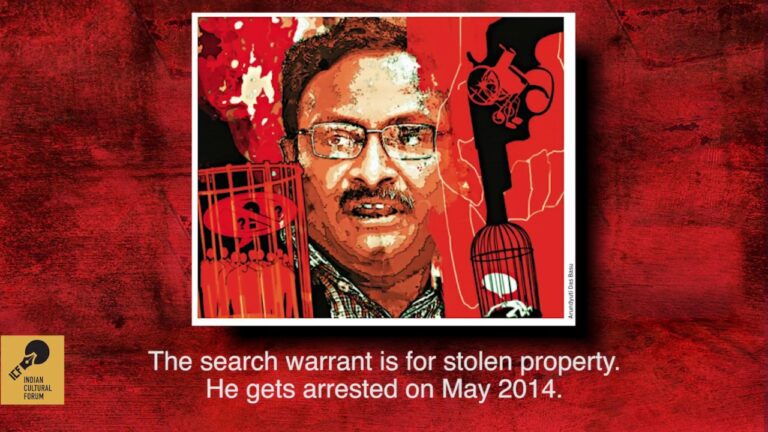
After months of being denied basic prisoner and human rights, Dr G N Saibaba has now resolved to go on an indefinite hunger strike, starting October 21st. Prison officials have denied Dr Saibaba- who is 90% disabled- basic rights such as access to to reading material, letters and- most alarmingly- medicines. He had been incarcerated under UAPA since 2014, and is in complete isolation in an “Anda cell”, and is at high-risk for COVID. 

His wife, A S Vasantha Kumari and the Committee for the Defence and Release of Dr G N Saibaba wrote statements requesting access to these rights on October 15th and 16th respectively.

Dr G N Saibaba
Image and story via GroundXero

Committee for the Defence and Release of Dr G N Saibaba

The Committee for the Defence and Release of Dr G N Saibaba is pained to hear that Dr Saibaba will be going on hunger strike to demand the basic rights of every prisoner (access to reading material, letters and medicines). His health is deteriorating and the threat of contracting COVID-19 looms large.

Dr G N Saibaba has resolved to observe a hunger strike starting from 21st October 2020 in light of the denial of basic medical facilities to him within the Nagpur Central Jail and the denial of books and letters sent to him from family and friends. Unfair restrictions and harassment faced by him are compounded by the inability of family or lawyers to visit him in jail due to the on-going global COVID-19 pandemic.

Dr G N Saibaba, a professor of English in Delhi University with 90% disability lodged in Nagpur Central Jail, is incarcerated under the draconian Unlawful Activities Prevention Act (UAPA) since 2014. He has spent the last several years suffering grave physical ailments including the gradual paralysis of his functional limbs due to neglect and continuous denial of adequate treatment by the jail authorities. The repeated denial of parole or medical bail to Dr G N Saibaba despite his deteriorating physical health and the vulnerabilities of a person with co-morbidities facing the threat of contracting COVID-19 inside the over-crowded jail is a grave threat to his life. At this stage, withholding medicine provided by the lawyer is extremely concerning, and deprives him of crucial life-saving medicines that he may require.

DU ex-professor Saibaba’s ailing mother dies, her final wish was to see her son | The Hindu

Related: Incarcerated Prof.GN Saibaba ´s mother passed away 

Previously, even parole to attend his mother’s funeral and last rites was denied. He has spent the last several years in an Anda cell reading and translating texts and writing poetry. Books and letters are crucial for the well-being of every prisoner and the denial of access to them is a violation of their rights. Despite the family and advocates sending books to Dr G N Saibaba over the last several months, books that are in English and freely available in the markets, they are being unduly confiscated and retained by the jail authorities without reason. Moreover, letters written by family members are also being confiscated and held by the authorities. This is a gross violation of the rights of a prisoner. Additionally, newspapers and news clippings sent by post are also being withheld.

Alarmingly, the basic medicines required for the different ailments suffered by Dr G N Saibaba are being withheld, endangering his life. Furthermore, the right of every prisoner to legal counsel is being violated in the name of the pandemic as he is not allowed to make more than two calls per month and lacks the opportunity to discuss his case with his lawyers.

Dr Saibaba has demanded these basic rights be ensured for a life of dignity within jail. Failure to provide these facilities has forced him to resolve to undertake a hunger strike. In light of his health, the on-going pandemic, the inability of family members and advocates to meet him and the wretched conditions within prison, a hunger strike is bound to endanger Dr G N Saibaba’s life.

The Committee for the Defence and Release of Dr G N Saibaba appeals to the Nagpur Central Jail authorities to intervene and ensure the basic rights of Dr G N Saibaba are upheld, he is provided medicines, books and letters and ensures that his life is not endangered. We appeal to all democratic organisations and individuals to raise these concerns with the Nagpur jail authorities to ensure that Dr Saibaba’s rights under the custody of the State are not infringed upon.

Committee for the Defence and Release of Dr G N Saibaba

Anda cell, solitary, Dr G N Saibaba
Life in an “Anda Cell” | Times of India

Letter of A S Vasantha Kumari, Wife of Dr G N Saibaba to Additional Director General (Prisons) Pune, Maharashtra.

Sub: Request to allow books and letters to Dr G N Saibaba and prevent him from going on to hunger strike in the Nagpur Central Jail, Nagpur.

Respected Sir,

My husband Dr G N Saibaba, who is a 90% disabled person, is presently in Nagpur Central Jail as a convicted Prisoner. Prof. Saibaba is an academician and intellectual and was jailed under UAPA on inappropriate charges.

I have been informed that he is facing hardships and harassment in Nagpur Central Jail due to the inhuman behaviour and unfair restrictions laid down by authorities. He has taken a decision to go on hunger strike from 21st October 2020 until his following demands are resolved:

The books supplied by the family members and advocates shall be handed over to him without much delay. All these books supplied to him are in English, some of them are poetry books and some of them are either novels or literature-based books that are not banned under the law of the land. These are books available in the market, with open access, and should be provided to him according to the Jail laws. Some books given by the family have not been provided to Prof. Saibaba for a long time, and are rotting in the godown.

Letters written by the family members are being stopped and held by the authorities for a long time and are not supplied to him.

As a policy the jail authorities stopped the purchase of newspapers by him in the Jail due to the Pandemic Covid-19. So, some newspaper clippings and printouts sent by post are not given to him and are being held by the authorities along with the handwritten or typed personal letters addressed to him.

Sometimes all the medicines given by his advocates are not being given to him. He has multiple health problems and needs to take prescribed medicines every day to save his life. This can endanger is already fragile health.

The number of telephone calls to talk to family members and advocates during this COVID-19 pandemic are restricted to one or two per month. Please allow to make four calls i.e. at least one telephone call per week to family members in addition to his advocates whenever required. It is necessary to make calls with advocates to discuss legal matters.

Under his present health conditions and the prevailing COVID-19 spread, this hunger strike will put Prof. Saibaba’s life in danger. I request your kind self to take necessary action in this regard and see that he will not go on a hunger strike and give him the basic rights he has as a prisoner, providing him with the books and medicine.

Thanking you

Yours faithfully,

(A.S. Vasantha Kumari)

Copy to

Superintendent, Nagpur Jail, Nagpur

Haryana: Youth protest with cycle rallies ,Demand Secure jobs

The unemployment rate in India has reached a crisis level but it seems to be of least importance to the governments. Youth are getting frustrated by getting degrees and giving exams but no jobs, those who are in jobs are suffering from insecure work conditions. Youth have been protesting and demanding the creation of jobs, recruitment in government posts for a couple of years.  To raise this issue, Student organisation, Chattra Ekta Manch organised a cycle rally in different districts of Haryana. Student communities have gone out in rallies in other states too for the same reason. The student community spread awareness about the rising unemployment in the country.  The students talked about the government’s lack of interest in creating jobs.
PC:Janjwar.com
“It is the duty of the government to create jobs for the youth of the country but instead, they are not even filling the vacant government positions. According to government data, there are 23 lakhs job vacancies. The ruling party is not even talking about jobs for the hardworking unemployed public of this country. When the government says Atmanirbhar Bharat it actually means it has rid itself of the responsibility of job creation”. Before coming to power BJP government promised to give 2 crore jobs but it was just a Jumla as Amit Shah also confirmed. The unemployment crisis has created a reserve army of Unemployeds that will serve as wage labour under this oppressive profit-making economic system. Until and unless the profit-making system is eliminated; there won’t be any improvement in the unemployment crisis.  The association has made some demands to address the rising unemployment-
  1. People should get work according to their ability
  2. Fill the lakhs of vacancies in the government departments
  3. Unemployed people should get an unemployment benefit of 20000Rs until they get a job. 
  4. Contract system should be ended
  5. The application form for jobs should be free
  6. The days of work for MNREGA should be increased to 200days and the wage to be increased to Rs 800/-
  7. It is of paramount importance that the government takes back the three farm bills
The leader of Chatra Ekta Manch said the government bad policies are resulting in the crisis that the whole country is facing. Despite having vacant positions government is not recruiting the youth. PM Modi promised 2 crore jobs, but that was also a jumla. Due to all this youth are forced to come out on the streets.  The students are planning to have a large movement in Sonipat on 20th Oct. and will continue their struggle until the government agrees to their demands. 

Read More: UP CM Yogi Promises Youth Jobs, ‘Yogi is a Liar’ Trends on Twitter

Bihar Elections: MGNREGA activist to fight for workers Rights

Those working under National Rural Employment Guarantee Act (MGNREGA workers), 2005 along with returned migrants are fighting back in the Bihar elections by putting up a candidate, Sanjay Sahni. 

Leader of MGNREGA Workers

Hailing from the Kurhani assembly constituency in Muzaffarpur, Sanjay Sahni, a leader of MGNREGA workers and the electrician-turned activist has been towards eradicating corruption in the MGNREGA scheme.

In 2011, he first came across the mismanagement of MGNREGA funds by elected representatives and district administration. Subsequently, he discovered that thousands of workers in his village of Mahant Maniyari were deeply miserable. He created the ‘Samaj Parivartan Shakti Sangathan (SPSS)-MNREGA Watch’ to spread awareness among MGNREGA workers and scrutinised policy implementation. His efforts assured MGNREGA labourers of 100 days work. SPSS was also involved in busting an illegal liquor industry in Ratnaull, which had caused many deaths.

MGNREGA workers sanjay sahni
SPSS Rally – via SPRF

Sanjay’s accidental scrutiny of the rural job guarantee scheme turned out to be a determined crusade against those who allegedly swindled the funds. The whole procedure of securing rural jobs to workers under the scheme had several questionable issues. One of the first things he noticed was that the job card would be issued to workers on paper while the wages were distributed between the middlemen and block officials.

Since then, Sahni has received threats and continuous forms of intimidation for his efforts towards ensuring worker’s rights. In 2014, an FIR was lodged against Sahni and since then he has had to endure physical and verbal attacks, death threats, and false FIRs.

According to Sahni, for MGNREGA to serve its purpose of providing work and reducing the concentration of power in the Mukhiya (village head) and block officials then workers need to be made aware of their entitlements as well as the decisions being made in their name.

MGNREGA workers sanjay sahni
SPSS with Sanjay Sahni – via Awaaz De

Since February many MGNREGA workers had been campaigning for Sahni with the desire to project him as their candidate in the upcoming Bihar Ellections.

One such worker, 60-year-old Mandeshri Devi from Mahant Maniyari told NewsClick,

“The plight of the downtrodden can only be taken seriously by someone who has faced such hardships. Sanjay’s edifying effort brought a wave of awareness among MGNREGA workers that caused discomfort to the power gallery.”

Workers Relief during COVID-19

The large-scale unemployment caused by the COVID-19 lockdown had disastrous efforts on MGNREGA workers. Besides unemployment, many were not given pending dues either; whether the suddenness of the lockdown was a legitimate reason for this or an excuse for mismanagement and corruption is up for debate. Lakhs of workers were under extreme financial distress and struggled because of the scarcity of food.

During this time, Sahni took many efforts to channelise complaints of workers. His call to action led to SWAN: Stranded Workers Action Network. A group of students, researchers, labour leaders, and concerned citizens, SWAN would receive data on stranded workers through Sahni, including bank account details for cash transfer.

Economist Jean Dreze said on Sahni’s decision to run for elections on behalf of MGNREGA workers.

“I came across this decision of our colleague (Sanjay), who is undoubtedly a committed and honest activist. He constantly has flagged concerns of MGNREGA workers in Bihar. Workers demanded him to be their representative so he took the decision to contest polls.”

Sanjay Sahni is asking for people to support him in his election campaign and has started a  fundraiser to support their campaign. 

Related: No Action in the Multi crore MGNREGA scam in Gujarat: Jignesh Mevani

Read More: Corona Chronicles: The High Tide of Hunger

Threats, conspiracies & faking FIRs: How Yogi avoids slander in Hathras, CPIML Reports

1

A five-member team of CPIML leaders met with the family of the deceased in the rape and murder case in Hathras, UP. The team consoled them and supported their demand for justice and to have the entire case investigated by an apex judge.

The CPIML team was led by State Committee member Nasir Shah, and included AIKM State Vice President Nathilal Pathak, Tara Singh, Rakesh Chaudhury, Manoj Kumar, Salim Khan, RYA leaders Aman and Vishnu Sharma. The administration stopped the team around 1 km away from the village and only allowed five members to meet the family.

On October 8th, CPIML state secretary Sudhakar Yadav released the team’s report.

The team reported that the family of the deceased is living in fear. The family belongs to the Valmiki caste and is poor. Due to their poverty and the upper caste status of the accused, the state administration has not shown any seriousness in the matter and also tried to cover up the investigation. From delay in registering FIR to not providing her with appropriate treatment to bungling up the medical report from Aligarh medical officer.

The report also mentions how the UP police covered up further investigation by committing another shameful act of burning the body of the rape victim late at night without the permission of her family. They also reported that the District Magistrate threatened the father, and even kicked family members. They even blocked representatives of the opposition and the media from meeting the family members- including members of the CPIML- in an attempt to cover the matter. Moreover, even though the entire village remains a police-PAC cantonment, the accused has been able to psychologically pressurise and intimidate the victim’s family. All this is happening at the behest of the government.

CPIML State Secretary Sudhakar Yadav stated that the Yogi government is trying to suppress questions regarding their shortcomings and failures, especially in the Hathras incident, but making this out to be an “international conspiracy” to defame them. So, they are registering FIR-after-FIR, while especially targeting journalists. These are clearly acts of targeted harassment. Yadav urged the public to not fall into this trap and intensify the fight to bring justice to the victim.

The report has demanded that FIR be filed against the District Magistrate and (now suspended) Superintendent of Police. They failed to punish the culprits, did not ensure the security of the victim’s family, were biased towards the accused’s side and intimidated the victim’s side.

The team also demanded the resignation of Yogi, who was complicit in the intimidation of activists, journalists, and the family. He did not withdraw cases lodged against political activists opposing the incident, stop the harassment of journalists or take any action ensuring the protection of women in incidents ranging from Hathras to Balrampur, Bhadohi, Azamgarh.