Dr G N Saibaba may lose his life if jail authorities don’t take action soon

The Committee for the Defence and Release of Dr G N Saibaba put out a second letter demanding that he be given the basic rights that is allowed of any prisoner. Prison officials have denied Dr Saibaba- who is 90% disabled- access to to reading material, letters and- most alarmingly- medicines.

In 2014, he was incarcerated under UAPA and is in complete isolation in an “Anda cell”, and is at high-risk for COVID. Last week, Dr G N Saibaba announced going on a indefinite hunger strike, starting October 21st as a final resort to access these rights.

The committee listed five basic demands in their press release:

  1. Do not confiscate and withhold the letters written by his family members and friends to him.

2. Supply every day news papers to him which were temporarily stopped due to the Pandemic Covid-19.

3. Allow him to speak to family over telephone at least four times a month during this pandemic time. Provide necessary support to call his advocates whenever required. 4. Make arrangements so that he will receive the necessary medicines and other items given by the family members and advocates immediately without any delay as his health is in precarious condition.

5. Immediately consider his request for parole as he is eligible for a regular parole or under emergency parole due to death of his mother.

Besides this, the committee urged concerned Jail authorities to take swift action so as to stop Dr G N Saibaba’s hunger strike, which would adversely affect his health. They pointed out that prison is meant to be a correctional place, not a place to punish. They fear that if the appropriate action isn’t taken soon, then Dr G N Saibaba might lose his life.

Read More: Dr G N Saibaba on indefinite hunger strike to demand basic prisoner rights

COMMITTEE FOR THE DEFENCE AND RELEASE OF DR G N SAIBABA: PRESS RELEASE

20-10-2020

To The Jail Superintendent, Nagpur Central Prison, Nagpur, Maharashtra.

Sub: Safeguard the rights of a Prisoner and prevent Dr. G.N. Saibaba from hunger strike by resolving his legitimate demands.

◆◆◆

Respected Sir,

Prof. Dr. G.N. Saibaba convicted under UAPA, is currently lodged in Nagpur Central Prison. He has been a Professor in the Department of English, Ramlal Anand College, affiliated to Delhi University before his arrest.

According to the information from his family members, we learn that Dr. G. N. Saibaba is going on a hunger strike from 21st October 2020 in the Nagpur Central Jail as he was denied basic rights.

He is 90% physically disabled and suffering from several ailments including a heart problem. On behalf of the Committee, we appeal to all the concerned Jail authorities to safeguard the rights of Dr. G.N. Saibaba as a prisoner and prevent him from sitting on hunger strike. We are afraid that his hunger strike will adversely affect his health amounting to further deterioration. You please convey the Defence committee’s appeal to him to defer his decision to go on hunger strike.

We also request you to take appropriate steps immediately to address the demands of Dr. G. N. Saibaba and stop him from going on Hunger Strike. We wish to draw your attention to the fact that prison is more a part of correctional administration and not a punishing place. We also appeal to you to resolve the following just and legitimate demands of Dr. G. N. Saibaba.

◆ Supply the books given by his family members and advocates to him as none of these books are banned under any law of the land.

◆ Do not confiscate and withhold the letters written by his family members and friends to him.

◆Supply every day news papers to him which were temporarily stopped due to the Pandemic Covid-19.

◆Allow him to speak to family over telephone at least four times a month during this pandemic time. Provide necessary support to call his advocates whenever required. ◆Make arrangements so that he will receive the necessary medicines and other items given by the family members and advocates immediately without any delay as his health is in precarious condition.

◆Immediately consider his request for parole as he is eligible for a regular parole or under emergency parole due to death of his mother.

The Committee urges prompt action by the Jail authorities in this regard and save the life of Dr. G. N. Saibaba.

Prof. Haragopal, Chairman On Behalf of the Defence Committee*

Related: UAPA and NIA amendments: Tools to silence dissenting voices

After Railway Employees put strike notice, Govt finally announces bonus

0

Since 2018, the Modi Government has been slowly privatising the Indian railways and in July began inviting Request for Qualifications (RFQ) to private players for the operation of passenger train services. Railway employees were already frustrated by this, but their outrage increased because of non-payment of bonus and dues. For this, unions announced  they will take “Direct Action” on 22nd October.

AIRF (All India Railwaymens Federation), the largest and oldest federation of railway employees, called for ‘Direct Action’ if the bonus is not received by 20th October. While what this means exactly has been unsure, people speculated that employees would completely stop work since they have been giving strike notices for some time against privatisation of AIR.
The Employees were frustrated by the lack of announcements regarding the bonuses, especially during this precarious time. Usually, the bonus is made available Sharadiya Navratri. But this time even after the day of Navratri, the government was silent about the bonus.
The bonus of 2019-20 is due and it is “unfair” to deny last year’s bonus, citing this year’s pandemic, the union said. Trade union leaders stated that the railway workers worked round the clock for seven days to maintain the necessary supplies from catering to the entire country in the lockdown, and felt cheated.
AIRF General Secretary Shiv Gopal Mishra said, “It was decided in the meeting that if the order is not issued by the Ministry of Railways for payment of productivity-related bonus from Railways by 20 October, then direct action will be taken on 22 October 2020.”
What will happen in direct action- strike, work boycott or nationwide protests was not clear. The federation has also expressed concern over issues related to privatisation, pension and dearness allowance of railways.
It seems to avoid such a scenario, the Government finally announced that payment of bonuses for the employees for 2019-2020. On Wednesday the Government approved of the bonus before Dussehra as part of the productivity-linked bonus (PLB) for the year 2019-2020. The the salary limit was fixed at Rs 7,000 per month. The maximum amount payable to an eligible railway employee as bonus has been fixed at Rs 17,951 for 78 days of work. This has been estimated to be around ₹ 2,081.68 crore in total for 11.58 workers.
“The decision of the Cabinet shall be implemented before the holidays for this year as well. For the year 2019-20, PLB equivalent to 78 days’ wages will be paid which is expected to motivate the employees for working towards improving the performance of the railways.” the cabinet said.
It is unsure how the unions will go forward with regards to their demands against privatisation, but there hasn’t been reports on today’s railway strike and it appears the question of direct action has been put on halt.

Is this part of Investigative Journalism?: Bombay HC slams Republic TV over SSR media trial

0

While hearing petitions seeking the regulations on the Sushant Singh Rajput case took place, the Bombay High Court criticised the “media trial” that took place, especially criticising Republic TV.

The bench consisted of Chief Justice Dipankar Dutta and Justice GS Kulkarni, who extensively questioned Advocate Malvika Trivedi, who represented Republic TV. The bench asked with regards to “ArrestRhea” hashtag the channel ran on Twitter, “Is this part of investigative journalism? Asking public about their opinion on who should be arrested?” 

The bench further questioned why the channel was stating that she should be arrested on charges of murder when even the police were investigating whether it was a suicide or homicide. 

“If you become the investigator, prosecutor and the judge, what is the use of us? Why are we here”

They accused Republic TV of disregarding the law as well, stating that if the Republic was really interested in unearthing the truth, they should have looked at the  Code of Criminal Procedure, under which investigative powers are given to the police. “Ignorance of the law is no excuse” the bench stated. 

The Republic TV advocate insisted that their reasoning behind this was to bring the news to the public. Trivedi argued that the Republic TV was only highlighting facts that were otherwise not brought on record. “Transparency of fact prime” they said, implying that the court was trying to curb freedom of the press.

But the court caught onto this, stating that the Bench was not suggesting that the media’s “throat be throttled.” headlines should be avoided. While truth should be brought to the public’s notice, The court’s interest was to only see whether the Republic’s reporting violated the Programme Code and is against laid down norms.

Trivedi insisted that the Republic had been following media guidelines and a framework of checks and balances. 

But the Court further criticised them for the way Sushant Singh Rajput’s death was reported on. When reporting on suicide, there are guidelines to be followed, and the headlines shouldn’t sensationalise the news. The media has a responsibility to protect the rights of the victim’s family as well as the accused.

Meanwhile, two other suits have also been filed against Arnab Goswami and Republic TV by Hansa Research and a former police officer. 

The Republic has responded to these by claiming that this is a plot to “Target Arnab”

Read More: Close to 70% of debates conducted by Navika Kumar and Arnab were on Sushant Singh…

Bihar Elections 2020: Why villagers in Samastipur are boycotting voting?

Campaigning for Bihar Elections is in full swing. While elections are proclaimed as a festival of democracy by the politicians for voters it is an occasion to address their grievances. In Samastipur, Bihar, villagers are planning to boycott voting in the assembly elections as the schools and employment situation has not improved. This is the third time in a row that the public has decided to boycott voting. The voters here boycotted the Lok Sabha 2019 Elections too.

Closure of Bihar’s only Jute mill 

Politicians making lofty promises are not a new thing during elections. Who can forget PM Modi’s promise of 2 crore jobs and 15 lakh rupees in every Indian account pre-2014 elections. By 2020, it has been proven to be nothing but a ‘jumla’. But the voters of Samastipur are taking the matter into their own hands but not voting as the politicians have no fulfilled any of their promises. Rameshwar jute mill at Muktapur, Bihar’s only jute mill was shut down three and a half years ago. It was the source of employment for more than 4,000 workers and farmers in many districts. Despite many calls from the workers and people of the area, the administration has not shown any interest in reviving the mill. All the calls of reopening the mill to mill management have gone to deaf ears. Since the time mill has closed there is neither electricity nor water supply in the worker’s quarters for the last 3 years. While many are waiting for the mill to start again, the majority have moved to bigger cities for other jobs. The mill had an annual turnover of Rs. 125 crore and its closure has been a blow to thousands of jute farmers from Purnia, Araria, Kishanganj, Saharsa, Madhepura, and Katihar districts who supplied their produce to the mill. There is anger among the workers for nonpayment of dues and bonuses from 2016-2019. Those who retired haven’t been paid Provident fund and gratuity.

Roads and Schools in Shambles

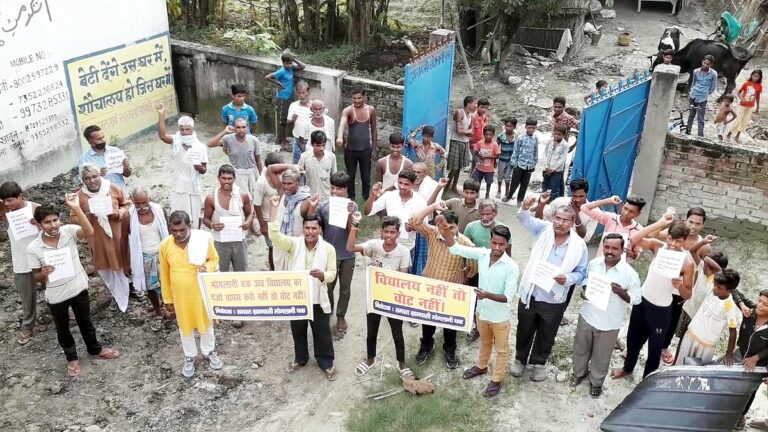
As the election campaign started so did the villagers cry for “No School, No Vote”. There is a lot of anger among the people for the negligence of high school in the Varisnagar block of Samastipur constituency. Around 1600 voters have decided to boycott elections because the promise of up-gradation of the Moglani chak school has not been fulfilled.
boycott
Villagers protesting- “No School, No Vote” at the varispur block school in Samstipur. PC: AAJ TAK
The government spent more than 16 lakh and classrooms were prepared and made ready for inauguration by the chief minister. But before the inauguration, another school was upgraded to high school neglecting the school at Moglani Chak. The villagers have protested against the officials at the education department but to no avail. The villagers have pleaded the matter to Education Minister and after getting tired of all at all levels they have taken the decision of boycotting the voting process in the coming assembly elections.
A consistent problem since 2018 is the poor condition of roads that lead to main cities. Despite many complaints and calls to DM, no improvement has happened. This is the cause of daily frustration for the villagers who in the absence of schools and jobs have to go to cities. UP Chief Minister Yogi Adityanath started the campaign for the Bharatiya Janata Party (BJP) in election-bound Bihar from yesterday. While he talks of Ram mandir and people are asking for livelihood. It remains to be seen if it is people issues that will take precedence or the politics of polarisation. READ MORE: Bihar Elections: MGNREGA activist to fight for workers Rights

Chileans urge citizens to reject dictatorial constitution

A week before Chileans vote in a referendum to replace their constitution, and on the anniversary of the 2019 protests which led to this move, mass demonstrations were held at the Plaza Italia. While the demonstrations in the morning were celebratory, the atmosphere shifted towards the evening with vandalism, looting and violence.

Churches and police stations were set ablaze. While firefighters were able to control most of these, the small Church of the Assumption, known as the “artists’ parish,” dating back to 1876 was destroyed. Mayor Daniel Jadue of the Communist Party of Chile was also hounded out by some protestors.

Firefighters try extinguishing Churches set ablaze | Courtesy: Al Jazeera

The Minister of the Interior and Security Víctor Perez stated this was coming from a minority of protesters.

This was significantly different from the morning when demonstrators, who were wearing masks, held up banners, sang and danced. Police also pulled back from the Plaza Italia gradually.

A 43 year old demonstrator, Viviana Donoso told AFP “It’s great, very good and positive…The people of Chile need to unite, and we have to believe that we can do things.”

Demonstrators called for their countrymen to approve the proposed change of the constitution. On October 25th, Chileans will vote to approve or reject the creation of a new constitution. Their current constitution was created by dictator Pinochet and completely sidelines public interests. Pinochet’s regime set an example for neoliberalism across the world with strong authoritarian governments adopting market-led policies and his Constitution reflected these ideals. When Pinochet conceived it, it gave excessive power to the military and safeguarded the interests of corporates. Though changes made in 2005 did provide some public control of the military, with lifetime senate seats being removed for top brass, but the key framework remained.

Related: The first 9/11: How the Parliamentary Path to Socialism in Chile was Crushed

2019 Chilean Protests

chileans
Courtesy: Redfish

Last year, protests broke out initially as a response to hike in metro fares in Santiago, but eventually turned into a demonstration against inequality and the Government favouring corporate interests. They demanded rights and safeguards for Indigenous people, higher pay, gender equity, pension reform, access to affordable public transportation, free public education and quality medical care and access to healthcare. One of the key demands was also the setting up of a new constitution as protestors hope that it will help them achieve these goals.

On one of the nights, police headquarters and a dozen metro stations were set ablaze, bus stops smashed, buildings vandalised and supermarkets looted. The protestors were angered because of police’s continued use of excessive force as they had been using tear gas, water canons and rubber bullets to attack the protestors. More than 30 people lost their lives during these demonstrations.

At the height of the protests in October, Chile pulled out of hosting two major international summits, the COP25 climate summit and the Apec trade forum.

COVID-19 and Chile’s Government

The protests eventually waned with the COVID-19 pandemic, and the Government, headed by Chile’s billionaire businessman president Sebastià Piñera, used the pandemic to counter major political change. The pandemic was used for heavy repression and to muzzle the opposition. Police officers have been using brutal force as a few weeks ago a policeman pushed a teenager off a bridge during a protest. This use of brutal force created widespread anger, and likely affected the violent turn that the protests took.

chilean soldier
Chilean soldier points his shotgun at demonstrators | Courtesy Al Jazeera

The primary target of the protests held now is Piñera. Currently, levels of inequality is similar to that of Pinochet’s dictatorial regime, and during the pandemic, he showed how out-of-touch he was with the lives of majority Chileans. There were limited health services, and the pandemic ravaged through crowded, working class neighbourhoods. Citizens did not have alternative shelter, and many were homeless. The deadly outbreak killed 13,600 Chileans, and more than 490,000 were infected.

A new democracy?

While General Pinochet’s military coup on September 11th, 1970 is considered to be the beginning of global neo-liberal era political scientists hope that the vote to convene a constitutional assembly in Chile might set a new example for democracies across the world. Chileans hope that the new document will bring leadership closer to and accountable to the people by bringing in formal mechanisms for citizen consultation and referendums and decentralisation. Political scientist Michael Albertus suggests that it could lead to greater rights for labor unions, establish health care and education as fundamental rights, guarantee equality for women, and grant greater autonomy to Indigenous groups.

chileans protest

Read More: ¡Evade!: How Chile’s student movement led the end of Neo-liberal tyranny

Arrested over a tweet, journalist Prashant Kanojia finally gets bail

After being arrested for a tweet, journalist Prashant Kanojia finally granted bail from the high court. Kanojia had been jailed for two months for a social media post. On 21st October, his wife, Jagaisha Arora tweeted:

Background

prashant kanojia
Courtesy: Facebook
On august 18th, Prashant Kanojia was arrested by the state police for allegedly posting a morphed photograph of leader of the Hindu Army, Sushil Tiwari, regarding the Ram Temple in Ayodhya. The FIR was filed on the basis of a complaint by Sub-inspector of the police station, Dinesh Kumar Shukla who found the post objectionable.

Related: Delhi-based Journalist Prashant Kanojia arrested by UP police for “some tweets”

Jagaisha Arora said, “The UP police came to our house half an hour [before the arrest]. Almost all of them were wearing civil clothes, only one cop was in police uniform. They arrested Prashant and said, ‘Tweet ka maamla hai.’ When I asked them which tweet are they talking about, they said, ‘Bohot tweet kiye hain tumney, upar sey orders aaye hain humein, follow toh karna padega’
Many deemed Kanojia’s arrest to be politically motivated and “driven by vendetta“. This was the third time the UP Police registered an FIR against Kanojia for a social media post. In June 2019, Kanojia was also arrested on the basis of another complaint by a sub-inspector, Vikas Kumar from Lucknow, for a tweet about Yogi Adityanaath. That time, he was released within a week on the basis of a Supreme Court order. This time around, Jagaisha Arora, Kanojia’s wife, found it much more difficult to avail bail. She had been trying to sustain a social media campaign alongside official requests and their inter-caste marriage became heavily scrutinised. Jagaisha also was subjected to many comments that wished death to Kanojia. Kanojia’s arrest was heavily criticised. Many activists including Teesta Setalvad, writers Meena Kandasamy, Politburo member of Communist Party of India Kavita Krishnan, and Gujarat MLA Jignesh Mevani, among others, released a statement urging the government to immediately release Kanojia. Oxford University, Johns Hopkins University, Columbia University, Jawaharlal Nehru University, Jadavpur University and several Indian Institutes of Technology also were signatories.

Read More: CBI raids and unlawful arrests of journalists and lawyers forewarn darker times

Remembering Jitendra & Brahminical Imposition of Durga Puja on Adivasis

My being Adivasi is enough to kill me, Naxalite or spy, that’s just an excuse. You have your eye on my land, Development and harmony, that’s just a ruse

-Poem by Jitendra Maravi

Remembering Jitendra

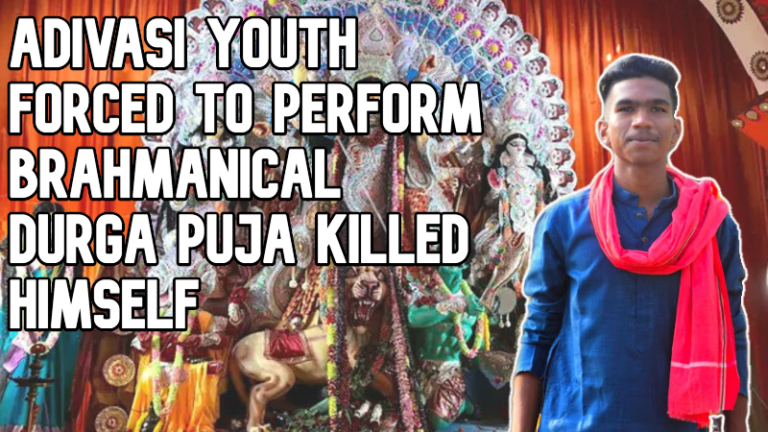
Last year, October 9th 2019, angered and frustrated by the imposition of brahminic and anti-adivasi festival, 22 year old Jitendra Maravi or “Sonu”, an active member of the movement responsible for the resurgence of Gond identity and heritage, killed himself in protest.

In Ketaka village of Surajpur district in the Adivasi-majority state of Chattisgarh, local officials forced Jitendra to perform the festival at his very own home. Durga Puja celebrates the killing of Bahujan God, Mahishasur. As Mulnivasis (indigenous population), Dalits, Adivasis and other Bahujan communities consider Ravan and Mahishasur their ancestors, and find the brahminical festival period to be a slap in their face.

Burning of Ravan and beheading of Mahishasur are both celebrated and hegemonically imposed around the same period, and is deeply offensive for Bahujans and Adivasis

Jitendra’s friend, Rupesh Markam told the Caravan that a Durga Puja committee was formed at the local level and his father, Dhansay Maravi, was also a part of it. His father was pressurised to force his son to perform Durga Puja at his house. According to Rupesh and his friends, Jitendra was upset with his father for performing the festival despite its demonisation if Mahishasur.

On September 26th, 2019 Jitendra and his friends had submitted a memorandum to the the district collector opposing the burning of Ravana’s effigy and demonising Mahishasur. Moreover, police arrested and jailed Jitendra the previous year for his opposition to the brahminical festival; he had posted a social media post criticising Durga puja and mentioning the greatness of Ravan and Mahishasur. Per court’s order, he was jailed for 55 days.

In his suicide letter, Jitendra wrote that the imposition of the festival in his very home made him feel as if “the 55 days of sacrifice had gone to waste” and that it was “breaking (him) day and night.” Through his suicide, Jitendra hoped he would achieve martyrdom for the Gond assertion movement that he was active in, especially against the celebration and imposition of Durga Puja.

At a local level, people raised questions about Jitendra’s suicide and the lack of police investigation against the accused, but this news was not covered at all at a State or National level.

Related: Mahisha Dusshera – Rediscovering of the forgotten history

Durga Pooja celebrates the brutal killing of Bahujan/Mulnivasi icons

Opposing Durga Puja

A veteran adivasi rights activist, Gulzar Singh Markam said that the RSS is pushing tribals towards Hinduism for their own political gain. While imposition of Brahminical rituals and festivals is true of all Savarna political parties and groups, the RSS wants to force Bahujans into the “Hindu” framework to push forward their anti-muslim agenda. Forcing Adivasis to perform Durga Puja- especially anti-brahminical activists like Jitendra- is part of the same plan. But such Brahminical stories directly attack their culture, history and traditions.

Adivasi and Dalit communities in various states besides Chhattisgarh, such as Madhya Pradesh, Odisha, Bihar, Jharkhand, Telangana, Andhra Pradesh, Maharashtra and Gujarat consider Mahishasur and Ravan as their ancestors. The framing of Bahujan icons as demonic or negative light is a method of subjugation through cultural domination.  Previously, in Pahankhanjor of Kanker district of Chattisgarh, Moolnivasis first warned authorities not to let other groups celebrate Durga Puja and, when this wasn’t implemented, registered an FIR and a case was taken forward.

Many Bahujans also oppose the festival as leftist leaders often force revolutionary work and protests to be put on halt during the festival period, especially in West Bengal.

Suicide note of the 22-year-old Adivasi youth, Jitendra Maravi:

~ This was my moral loss and I could not bear this loss. I have not taken this step out of fear, but only to open the eyes of these people. And the committee members are fully responsible for it. I want to apologise to all my friends, for leaving the fight midway. Remember one thing, that the revolution always demands sacrifice. I hope to achieve this martyrdom. Those who dishonour our ancestors should not be spared. This Durga Puja was breaking me day and night. I felt as if the 55 days of sacrifice had gone to waste. I would like my friends to fight my unfinished battle with much passion. I am always with all of you. I would like to apologise once again to all the people who were associated with me. I also want to apologise to my family members as they had to be ashamed because of me. I am giving you this last trouble. I won’t anymore. My body should not be dissected, this is my wish. Love Gondwana. – Sonu ~

Read More: Bangla Pokkho: Sub-Nationalism Cannot be A Solution to RSS Domination

Doctors at doorstep: Delhi provides helpline for senior Citizens

0
Now senior citizens in New Delhi can avail various services like that of psychologists, legal experts, doctors and administrative support at their doorstep. Delhi administration is setting up a centre for the availability of all the services, especially during covid 19 pandemic.

Senior Citizens can now avail doctors and psychologists at their doorstep

The move aims to provide holistic support to nearly 60000 senior citizens in the national capital. There is this Hasgulla helpline 1800111323. The helpline has been set up for senior citizens for the availability of various facilities. If they need medical assistance, psychological counseling, technology training, or the facilities of games like chess and carrom, they can refer to the Hasgulla helpline.

Team of psychologists, doctors, and legal experts to address the issues

Due to the Covid 19 pandemic, the senior citizens have been confined to their homes. They must stay inside their houses amid the covid pandemic. However, this may trigger psychological issues for senior citizens. The administration has a dedicated team of psychologists, legal experts, and doctors to address their issues.
The nodal officer, Nigin Shakya said, “Sometimes, senior citizens have psychological issues as they usually stay inside their houses due to Covid-19. The district administration has dedicated teams of psychologists, doctors, and legal experts to address the issues of senior citizens.”
Also, the administration is planning to set up nearly 500 Hasgulla clubs in coordination with RWA(Residents Welfare Association) and other organisations in New Delhi. Shakya also revealed that the first Hasgulla Club will be introduced in the Naraina area. Also, they are trying to create a WhatsApp group in coordination with RWA to reach more and more senior citizens.

READ MORE: World Mental Health Day 2020: Kindness is the need of the Hour

Honour Killing in Karnataka: Man murders daughter for loving a Dalit man

1
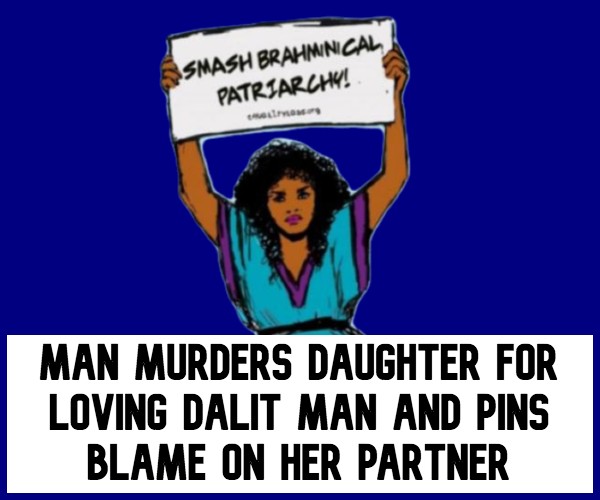
In Karnataka, a man killed his daughter who was in love with a Dalit man. Six days after her body was recovered from Magudi tank, the police arrested her father charging him of murder. Honour killings have increased in the last three years, and this case reflects the situation. The deceased girl was identified as B.com student, Hemalatha, who was in love with Puneeth, a Dalit farm labourer. Her father Krishnappa lodged a complaint on October 9th stating she was missing since the 8th. The next day, he said he told the police that he found her decomposed body in a pit near a mango grove. The father lied to the police, accusing his daughter’s partner of killing her. Thankfully, the police charged him, along with two of her cousins for murder. They were 21 year old Chetan, alias Yogi, and a 17-year-old boy. The trio smashed her head with a boulder, and then took her to the mango grove. The two adults were arrested on Friday, but one of them, a minor, is under detention, officials said. Though the trio initially insisted that the Puneeth killed the daughter, the police stated that they confessed upon further questioning. The police’s relatively swift action is remarkable as usually police cooperation is absent when seeking justice for honour killings.
honour killing
The family gathered around a mango grove, where the girl’s body was “found” | photo credit TOI

SC/ST atrocities and honour killings in Karnataka

Though the very fact that they arrested is positive news, the conviction rate in Karnataka is abysmal, at 0.4% in SC/ST cases. As of March 2020, of the 9,702 cases reported, only 46 have led to the conviction. At the same time, crimes against SC/ST people is the highest in Karnataka. While Uttar Pradesh reported the most cases in 2019 in terms of absolute number (2,309 cases and 2358 victims), the rate of cases- 5.6% per one lakh population of SC and ST people- was less than half of that of Karnataka, which was at least a whopping 12.8% for every one lakh people ( 1,298 cases and 1,520 victims). Though Uttar Pradesh reported the most cases that year in absolute numbers — with 2,309 cases and 2,358 victims — the rate of cases was 5.6 per one lakh population of SC and ST members. Even though Karnataka reported fewer cases — with 1,298 cases and 1,520 victims — the rate was 12.8. Some reports suggest that between 2011 and 2016, 13 people were murdered in honour killings. But according to recent reports in Tamil Nadu, 195 known cases of honour killings in Tamil Nadu alone. And, according to a report in 2015, between 2014 and 15 there was a rise in Honour killings by 796% across India. While these don’t directly show what the rates of crime and conviction are for honour killings where the one killed is upper caste, they reflect the justice system’s response when it comes to crimes based on caste, as well as patterns of violence.

Why no data or law on Honour Killings?

There is a considerable lack of data on honour killings as “honour crime” is not a separate offence. Honour killings are charged under homicide or murder, and can be charged as conspiracies in cases such as these. Other cases of honour crimes are reported under many different charges, making them impossible to track. For this reason, NCRB also left data on honour killings out from its 2019 report, along with lynchings, stating it is too “vague”. Lack of separate charges for honour killings also makes it easier for families to get away with the crime by destroying evidence in the name of cremation, and deeming it a suicide. Police wouldn’t look into these patterns as honour killings or crime. Though caste (or religion) is a major factor in the case at the level of arrest and conviction, it is not taken into account legally. “Honour crime” as a term is not even defined legally. Lawyers and activists have been urging the Government to bring in a law which defines honour crimes- especially honour killings for years. In 2012, the Law Commission even submitted a report which outlines a unique legal framework for dealing with honour killings. The Prohibition of Interference with the Freedom of Matrimonial Alliances Bill would have criminalised the unlawful assembly of groups of people for the purpose of condemning a marriage or intimidation of a couple, curbing activities and behaviours associated with honour crimes. It also suggested protections for the couple and punishment for the accused. However, no MP brought the Bill up in parliament. Politicians are afraid of upsetting Khap Panchayats, who have considerable political sway, and don’t want to upset them. Khap panchayat is the union of a few villages that mainly exists in North India. They often encourage honour killings of boys and girls of different religions and castes. For this reason, the Supreme Court had decreed in 2011 that they must be stamped out, though they continue to hold major importance in India. Most recently, they ordered the social boycott of an elderly man of 12 years for opposing child marriages. Legally defining an honour crime and bringing in a law regarding the same wouldn’t just bring justice, but even save lives. As Bharati tells the Swaddle, “Honour crimes are usually not one-off incidents; there’s a lot that comes before the murder like verbal harassment, physical assault, coercion, and kidnapping. Having a separate law would define the things leading up to these crimes.”

Read More: Karnataka: Upper caste men beat Dalit man over allegedly touching their bike

Punjab: Capt. Amarinder Singh Cautions on protests over Farm Laws

0
Chandigarh: As protests rock the Punjab and Haryana region over the new farm laws, Captain Amrinder Singh warned the central government of possible disruption to the peace in the state and threat to national security due to continued protests against the farm laws. He said he was prepared to “resign or be dismissed rather than bow to injustice towards Punjab’s farmers”. Nobody can tolerate religious hurt and attack on livelihood. .. “I am not afraid of resigning. I am not afraid of my government being dismissed. But I will not let the farmers suffer or be ruined,” the chief minister said on the second day of the special session of the Vidhan Sabha, adding that he had chosen to quit at the time of Operation Blue Star instead of “accepting or endorsing the assault on Sikh ethos”. This is what had happened in the 80s and 90s. He further warned that both China and Pakistan would collude and try to take advantage of any disruption to the state’s peace, which would pose a serious threat to national security. He also said if the farm laws are not revoked, angry youth would take to the streets and join the farmers, which would lead to chaos.

Moves Resolution against Farm laws

Stating that Agriculture is a state subject, Amarinder Singh moved the resolution against farm laws in the state assembly. He also introduced three bills in the assembly to counter the Centre’s farm laws. The resolution was moved by the Leader of the House on the second day of a special assembly session here over the new farm laws. The three bills introduced by Singh are — the Farmers Produce Trade and Commerce (Promotion and Facilitation) Special Provisions and Punjab Amendment Bill 2020, the Essential Commodities (Special Provisions and Punjab Amendment) Bill 2020, and the Farmers (Empowerment and Protection) Agreement on Price Assurance and Farm Services (Special Provisions and Punjab Amendment) Bill 2020. “In the name of Farming Laws, we have actually enacted Trade Laws. It is not farmers who will have access to a national market, but traders. Hence, the use of term “trade area” in the so-called Farmers legislations is also very telling,” said Amarinder while presenting the four Bills for consideration in the House. While reiterating his support to the agitating farmers, the CM also appealed to them to end the ‘Rail Roko’ agitation and blockades and allow movement of essential commodities. “We have stood with you, now it is your turn to stand with us,” he said in an appeal to the farmers.

Also Read: Where do the Political Parties in Punjab stand on the Farm Bills?

Blaming the BJP squarely for sidelining Punjab’s agriculture, Amarinder alleged since other states have now started providing food grains to the country, the Centre has ignored the farmers of Punjab who fed the country for 70 years. Pointing out that the state government had not been paid its promised GST, the CM questioned the Centre over failure to adhere to the constitutional guarantees. Amarinder made it clear that his government would not allow the state’s farming community and agriculture, which were the back of its growth and development, to be ruined by the BJP through such devious methods. His government’s four Bills, said the chief minister, was aimed at preventing the damage that the central laws would cause to the state and its agriculture while allying the fears of farmers and consumers.