Karnataka’s Ex-minister D.K. Shivakumar is granted conditional bail on Wednesday, by the Delhi High Court in the money laundering case filed by Enforcement Directorate (ED).
D.K. Shivakumar has been interrogated extensively by ED since the day of his arrest and further in the custodial period, the Court observed that no more interrogation is required in the future, the single judge bench of justice Suresh Kumar kait opined.
Justice Kait stated that the D K Shivakumar is not a flight-risk and he cannot tamper with evidence as all the documents are with ED. The court also said that he has not influenced the witnesses.
He has cooperated with all questions framed by ED. All documents pertaining to the case are with the Agency. Hence, D.K. Shivakumar is granted bail, Justice said.
Bail granted on a personal bond of 25 lakhs of rupees and two securities of the same amount.
D.K. Shivakumar moved to the Delhi High Court last month after the bail is denied by the Special Court.
On September 3, D.K. Shivakumar was arrested by ED in a money laundering case. D.K. Shivakumar has been claiming in the Court that all his assets were duly declared in his income tax declarations as well as nomination affidavits and there was no money laundering.
On the other hand, the Enforcement Directorate was arguing that it was a “classic case of money laundering” which “affects the whole economy of the country”. Assets and money owned by Shivakumar and his family were disproportionate to his income as an agriculturist and have been possessed by the misuse of public office. Based on these facts, ED has sought the refusal of bail to DK Shivakumar.
After D.K. Shivakumar’s arrest, he was sent to 14 days of judicial custody on September 17 and further extended till October 25. Senior Advocate Abhishek Manu Shingvi represented D.K. Shivakumar where as Assistance Solicitor General K.M. Nataraj for ED.
Sonia met D.K. Shivakumar just a few hours before Court’s hearing today
Just a few hours before the hearing, Sonia Gandhi met D.K. Shivakumar to show solidarity and to assure him that the whole party is with him, whether he gets bail or not. She discussed with him around 30 minutes in Tihar jail, party sources said.
In September, Sonia Gandhi met P. Chidambaram, Ex-Union Minister, who has been lodged in Tihar jail under INX Media case. Hence, this would be her second visit to Tihar jail to meet these two leaders. Sonia Gandhi discussed with D.K. Shivakumar and instill confidence in him, Party sources said.
Along with an employee Hanumanth of Karnataka Bhavan Delhi, Sunilkumar Sharma and Other associates, D.K.Shivakumar’s case is being booked under the Prevention of Money Laundering Act, by Enforcement Directorate (ED) soon after being seized unidentified money by Income Tax Officials which was kept at his home in Delhi.
D.K. Shivakumar was alleged that this money is being used for hawala and for tax evasion, thereby, he wanted to make his black money to white, which would be a serious offence against National interest.
Ex- Union Minister P. Chidambaram was granted bail on Tuesday, in Supreme Court, in the INX Media case filed by ED. However, he has to remain in the jail itself as he is facing another INX Media case, filed by CBI, in which both P. Chidambaram and his son Karthik Chidambaram are accused.
Congress Interim President Sonia Gandhi met D.K. Shivakumar, former Minister of Karnataka on Wednesday to show solidarity. Shivakumar is being detained in Tihar Jail, under the Judicial Custody of Enforcement Department (ED) in relation to a Money Laundering Case.
In September, Sonia Gandhi met P. Chidambaram, Ex-Union Minister, who has been lodged in Tihar jail under the INX Media case. Hence, this would be her second visit to Tihar jail to meet these two leaders. Sonia Gandhi talked with D.K. Shivakumar and instilled confidence in him, party sources said.
Trial Court denied to grant bail in the case, which was challenged by D.K. Shivakumar in Delhi High Court. The plea will be heard on Wednesday.
A few hours before start hearing, Sonia Gandhi met D.K. Shivakumar and instilled that whole party will remain with him, whether he get bail or not. She discussed with him around 30 minutes in Tihar jail, party sources said.
Since the beginning, ED has been arguing that D.K. Shivakumar should not be granted bail as he is an influential person and there may be a possibility of him tampering evidence and frightening witnesses. D.K. Shivakumar was arrested by ED on September 3, since then, his legal battle to get released continues. D.K.Shivakumar along with an employee Hanumanth, Karnataka Bhavan, Sunilkumar Sharma and other associates, is being booked under the Prevention of Money Laundering Act, by Enforcement Directorate (ED) soon after being seized un identified money by Income Tax Officials which was kept at his home in Delhi.
D.K. Shivakumar was accused that this money was being used for hawala and for tax evasion. He allegedly wanted to make his black money to white, which would be a serious offence, against National interest.
Ex- Union Minister P. Chidambaram was granted bail on Tuesday, in Supreme Court, in INX Media case. However, he has to remain in jail as he is facing another case, i.e. illegal gratification in the same INX Media case, filed by CBI, in which both P. Chidambaram and his son Karthik Chidambaram are accused.
There are many people (mafia) who are waiting to grab government school and its assets. They don’t care about children’s future. To achieve their selfish goals they can do anything. But there are others too; health of the society is as important to them as their own life, they thrive to make good health, education, and employment to each and everyone and they are ready to take up fights for their cause. These two people are always at loggerheads with each other.
We came across an inspiring story in Mysore, wherein people with honesty and commitment won a fight against people with muscle, power and money.
A century ago, the kings of Mysuru had opened a school for the queens and princesses. After independence, the school got transformed into Maharani’s New Type Model government kannada school (NTMS) and is reputed to have given education to thousands of children. The school is situated in the heart of Mysore and children of poor, daily wage workers are studying there. But the unfortunate thing is, the land now costs some crores of rupees….
Mysuru has a layout named after Swami Vivekananda, there are 4-5 statues of Vivekananda in the city. If they want to build a memorial, then there are lots of places. And they should build the memorial there instead of grabbing the land of government school by closing it down. We can respect Swami Vivekananda only if we print is thoughts and distribute them to people. – Prof Panditaradhya.
Mafia working under the trust of Swami Vivekananda has been eyeing this school situated in such a strategic place. The trust which has its roots in Tamil Nadu is conspiring to grab the school land by hook or crook. They are saying they want to build a memorial of Vivekananda because apparently Vivekananda once paid visit to the temple situated in the school’s premises. In 2013, when BJP was in power, they used the opportunity and got the order to vacate the school from there.
Parents of children studying in the school were distressed hearing the news that the NTMS school is getting closed and the children were to be transferred to Devras Urs School. In panic, some parents have already transfered their children to other schools.
Once this news became public, Kannada activists including SR Sudarshan, P. Mallesh, Samskruti Subramanya opposed this move.
These activists met the parents of the children and appealed them to join the fight to save the school. In 2014, only 23 children were studying in the school. These activists convinced parents to let the children study in the same school. A people movement was launched and pressure was put on then chief minister Siddaramaiah. Responding the concern Siddaramaiah gave oral order to the secretary of the education department and stopped the transfer of school land. The activist took a sigh of relief with the momentary victory. The trust which lost the case appealed to the high court.
To close down the school is to insult Swami Vivekananda
Swami Vivekananda believed that poor are god. He had pressed for education of girls. He had said that, What girls should study should be decided by the girls themselves and not by anyone else. By using name of such person and closing down the school of poor girls is the worst insult one could do to Swami Vivekananda. We are fighting to save this school because we respect Vivekananda.
– Deavnoora Mahadeva
For six years from then, school ran without any problems. Now the number of children studying in the school has increased to 48. Since last month, the trust became active again when BJP formed the government in Karnataka. The education department has come under pressure through primary education minister Suresh Kumar. Education department officials who toe the line of government have suddenly become ready to dismantle the school. Within moments of this news reaching the activists, hundreds of people started protesting against the move. They are asking why is the government in a hurry to close down the school when the matter is subjudice. They protested at the school premises day and night from 12th october to 14th october.
Prominent writers GH Nayak, Mira Nayak, Devanoora Mahadeva, SR Sudarsha, P. Mallesh, Prof. Panditaradhya, MLA SR Mahesh, ex MP Dhruva Narayan, and other eminent people have participated in the protest.
Parents have gone to Bengaluru and complained to the Child rights commission. As the protests intensified, Yeddyurappa wrote to Mysuru district collector and ordered not to transfer the school.
Due to the strong collective people’s movement, the school is saved and the children are smiling.
Yesterday, the Times of India reported that the Karnataka government would be putting the NRC “on the back burner”. Instead, they will create a database of undocumented immigrants and foreign nationals who have overstayed their visas.While it is a relief to hear that the NRC will not be implemented immediately, it seems as though the citizen database is essentially the first step towards the NRC.According to an officer with the Foreigners’ Regional Registration Office, there are only about 800 foreign nationals who have overstayed their visas. If they make up just 800 out of the 6.4 Crore residents of Karnataka, it seems like a waste of resources to track them down. The state has other pressing issues, such as the floods in coastal Karnataka, the agrarian crisis, and the poor infrastructure throughout the state.However, the BJP government at the centre, and Amit Shah, in particular, have been vocal about an all-India implementation of the NRC. So despite the apparent backtracking of the Karnataka government, they are still going ahead with the preparation of detention centers in Nelamangala taluk, Karnataka. The detention centre will be housed in an old social welfare department hostel. If the argument for implementing NRC in Karnataka is that there is economic scarcity, then we should be asking the government to implement policies to revive the economy, which is undergoing a major, visible recession. There is no other sensible argument in favour of the NRC. Every other argument is biased against members of minority communities. The motivation behind implementing the NRC seems to be identifying a scapegoat for all the problems of the state. In other words, it’s simply a distraction, taking away attention from the fact that the government is doing barely anything to address the problems in the state. It’s unclear as to how creating enmity between communities will help us grow rather than bring us down. Apart from the dubious motivations behind the NRC, there is no set plan as to what will happen to the people who are declared stateless. In order to deport Bangladeshi immigrants, India needs to draw up a deportation agreement with Bangladesh. As of now, India doesn’t have a reparation treaty with Bangladesh
With Amit Shah’s promise that Non-Muslim refugees will be given citizenship, we need to be suspicious of what the NRC will actually accomplish. At the moment it looks like it is just a political move designed to divide India along communal lines. Muslim workers who are legitimate citizens of India are worried that the documents they have will not be enough to protect them from being detained. Some have lost their identity papers in floods in Bihar, Assam, West Bengal and elsewhere. News18 reported that close to 4 Lakh people in Assam have given missed calls to the BJP in order to join the party. This is because they feel that membership in the BJP will protect them during the NRC process. The NRC is creating an environment of fear and suspicion. People are either worried that immigrants are taking away jobs – a worry that is entirely unsupported by data – or that they themselves will be declared non-citizens. It is hard to see how any of this is beneficial to the country or the state. Similarly, the exercise in creating a list of undocumented immigrants and foreign nationals will not yield any concrete benefits whatsoever. It is political rhetoric designed to distract from the real problems that the government should be working on.
Senior Congress leader and former finance minister P. Chidambaram was granted bail today in the Supreme Court, in the INX Media corruption case. The former Union minister will, however, continue to remain in jail.
Earlier, Delhi HC had denied bail on Sept 30th and this was challenged by P. Chidambaram in the Supreme Court.
The bench comprising Justices R Bhanumathi, A S Bopanna and Hrishikesh Roy, reserved judgement on Oct 18th and today SC has granted conditional bail to P. Chidambaram.
The bench granted bail to Chidambaram on a personal bond of Rs 1 lakh with one surety of the like amount.
The bench made it clear that Chidambaram will not leave the country without prior permission of the court and make himself available for interrogation as and when called by the probe agency. This grant of bail has no bearings on other proceedings which are against him, Court clarified.
The bench also said the high court should not have gone into the merits of the case while deciding Chidambaram’s petition.
During the hearing, CBI drew the attention to the Delhi HC judgment which cited that P. Chidambaram, who is a senior advocate and former Union Cabinet Minister, may be able to destroy the evidence and potentially influence witnesses. SC dismissed the appeal filed by CBI and granted conditional bail to P. Chidambaram.
Although P. Chidambaram is granted bail in the case filed by CBI, he is still in the custody of ED in INX Media case.
The CBI had registered an FIR on May 15, 2017, alleging irregularities in a Foreign Investment Promotion Board (FIPB) clearance granted to INX Media group for receiving overseas funds of Rs 305 crore in 2007, during Chidambaram’s tenure as the finance minister.
On Aug 21st 2019, Chidambaram was arrested in connection with the graft case by the CBI, which has recently charge-sheeted him and others, including his son Karti and some bureaucrats, for causing loss to the exchequer by allegedly committing offences under the Prevention of Corruption Act and the Indian Penal Code.
Thereafter, the ED lodged a money laundering case in this regard in 2017.
Senior Advocates Kapil Sibal and Abhishek Manu Shingvi argued for P. Chidambaram, whereas Solicitor General Tushar Mehta, for CBI. Kapil Sibal argued in SC that Chidambaram should be granted bail in the case as he was neither a ‘flight risk’ and nor there was any possibility of him tampering with the evidence.
Also Read: HD Kumaraswamy meets D.K. Shivakumar in Tihar
Today, former Chief Minister and JDS Chief H.D. Kumaraswamy met with Congress leader D.K. Shivakumar who is accused of money laundering case headed by Enforcement Directorate (ED).
But, according to the party sources, the very purpose of the meeting is to discuss about local body elections in Kanakapura and in Magadi Taluk in the Ramanagar District.
This is for the first time H.D. Kumaraswamy is meeting D.K. Shivakumar since his arrest by the ED in the month of August.
Although Ex-ministers Sa. Ra. Mahesh and C.S. Puttaraju were also present along with H.D. Kumaraswamy, but, ED only allowed HDK and D.K. Suresh, brother of D.K. Shivakumar, who is also MP, to meet him.
JDS and Congress sources said that Local body elections are held on Nov. 12th and code of conduct has been implemented from Oct. 20th, in the respective constituency.
Many political leaders opined that it is hard to win the election against the BJP ruling Government of Karnataka unless there is a joint effort between JDS -Congress. Hence, the meeting of these two leaders has attracted attention of the BJP Government in the state.
Meeting on personal equation
H.D. Kumaraswamy has reacted to his meet with D.K. Shivakumar saying – “the meeting is not political, but based on personal equation.
“I being a good friend of D.K. Shivakumar, It is my duty to instill confidence in him, although he is mentally strong”, said to reporters.
Congress interim President Sonia Gandhi is also expected to meet D.K. Shivakumar at Tihar jail today.
Today Court hearing
On the other side, The petition filed by Gouramma, the mother of D.K. Shivakumar, and his wife Usha, in the Delhi special court, urging to suspend summon issued by ED in the money laundering case and requested to release D.K. Shivakumar, will be heard today.
Earlier, D.K. Shivakumar challenged the order of the trial court in the Delhi high court, which denied bail, but in vain.
Last year, in the month of September, ED has filed a case against D.K.Shivakumar and Hanumantappa, an employee of karnataka Bhavana, in Delhi and others.
Since then, the agency (ED) has issued a notice to Gouramma and wife Usha, Brother D.K. Suresh, MP and Aishwarya, daughter of DKS, Belagavi rural MLA Laxmi Hebbalaker is also being questioned by ED.
Along with D.K. Shivakumar, his associate S.K. Sharma indulging in the transactions, worth crores of rupees, case filed.
The President of Karnataka state Apex Co-Operative Bank was also questioned by ED, in connection with money laundering case.
For the alleged offence under the Prevention of Money Laundering Act (PMLA), accused D.K. shivakumar was arrested on Sept. 3rd, by ED, presently lodged in Tihar jail under Judicial custody.
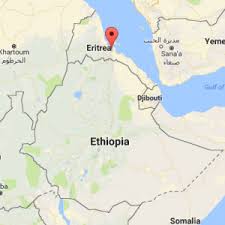
In 2019, the Nobel Peace Prize was awarded to Ethiopia Prime Minister Abiy Ahmed for his role in addressing the conflict between his country and neighboring Eritrea.
Last year, the two countries entered into a number of agreements, which was considered to signal the end of hostilities that has plagued them for decade. Notably, the two countries have entered into a series of economic agreements, which would facilitate trade and investment, leading some to feel that the Nobel Peace Prize was more for the ending of trade blocks, then for peace.
In this article, we explore the history of the conflict between these two countries.
While home to a number of ethnic groups and tribes, four regionally concentrated groups have a strong presence in the region. They are the Somali, (Eastern Ethiopia and Somalia), Oromo (South and Central Ethiopians), the Tigrayans (Northern Ethiopians and Eritreans), Tigres (Eritrea) and the Ahmarans (North of Central Ethiopia). In terms of population, Oromo and Amarans make up nearly a third of Ethiopia. The Tigrayans make up over half of the Eritrean population. More Tigrayans live in Ethiopia, but, as Ethiopia is much larger than Eritrea, they make up only about a sixteenth of the population. Tigres make up nearly a third of Eritrea. The rest of both countries are made up of smaller ethnic groups, amounting to not much more than 5% of the population each.
Map of Ethiopia
Ethiopia was ruled by the Solomonic dynasty, who claimed to be descendants of the Biblical King Solomon and Queen Sheba. The Kingdom ruled from 1270 until the modern age. Though there were struggles and the occasional break, the kingdom ruled the general area of Ethiopia and entered into agreements with the colonial powers of England, France, and Italy regarding borders during the infamous Scramble for Africa. The Scramble for Africa began in 1884 when the European powers drew up an agreement on how to divide Africa between them for conquest. Ethiopia was to go to Italy. Italy was successfully repelled after they attacked Ethiopia. The two countries eventually entered into the infamous Treaty of Wuchale in 1889 where Ethiopia would recognize Italy’s claims in Africa, including modern-day Eritrea, in return to military and economic support. Italy saw this as a way of establishing Ethiopia as a protectorate, while Ethiopia saw this as an agreement for mutual benefit. When Italy attempted to establish political dominance through this deal, the Ethiopians fought them off.
For the beginning part of the twentieth century, Italy controlled Eritrea, while Ethiopia remained independent. This continued until Italy conquered Ethiopia in the lead up to World War II. When Ethiopia became free, following the end of World War II, Eritrea (then Italian Abyssinia), was given to Ethiopia by the UK.
Initially, the kingdom of Ethiopia acknowledged that Eritrea had a separate national identity, and established the Ethiopian and Eritrean Federation. Eritrea retained political autonomy, but this lasted only 10 years after Eritrea was annexed. This led to 40 years of struggle against the Ethiopian state. These struggles continued even through the overthrow of the emperor by the Marxist-Leninist Derg forces. (Derg is Amharic for Committee)
Derg led to many reforms in Ethiopia during the 1970s, including increased spending on education and healthcare, land reforms, and the abolition of the monarchy. The Derg was a Soviet ally. Ethiopia was plunged into the middle of the Cold War proxy war, with an escalation of violence after the takeover. A number of groups were backed by enemies of the Soviet Union, including the United States and China. People and resources were organized on ideological and ethnic lines.
Ethiopia in relation to Eritrea
In Eritrea, the war was fought, both against Ethiopian control and between Eritrean liberation groups. Some of the largest groups in the conflict were American-backed Eritrean Liberation Front (ELF), and the radical left Eritrean People’s Liberation Front (EPLF). The conflict raged large, spilling into neighborliness Sudan. The ELPF defeated the ELF, and would eventually form the government of Eritrea after its independence.
ELPF’s strength lay in its alliance with the Tigrayan’s People’s Liberation Front (TPLF), who organized Tigrayan peasantry. The peasantry was resentful of the growing presence of the Ethiopian military and would organize guerilla tactics to fight them.
This period was riddled with disaster for Ethiopia, with a famine killing a million people, escalation of violence which killed half a million more, tens of thousands being detained by the Derg government without trial, declining support from the Soviet Union, and an economy getting increasingly dependent on foreign aid to manage these disasters. The Derg government fell in 1991, after which the people of Eritrea were given a UN-monitored referendum, which led to an overwhelming vote for independence. The ELF became the People’s Front for Democracy and Justice, and established a one-party state in Eritrea, while Ethiopia established a multi-party parliamentary state, which lasts until today.
The border between the two new countries, unfortunately, was ambiguous. The two countries agreed to the border between the Ethiopian kingdom and Italian Abyssinia, but some territories remained in dispute. These territories were mostly Tigrayan majority areas, and this led to a series of wars lasting through the 1990s. In 1998, Eritrea invaded Ethiopia leading to the two-year Eritrean-Ethiopian war, where lakhs of people died.
In 2000, Ethiopia and Eritrea signed the Algiers Agreement which allowed the United Nation to settle the dispute. The United Nation established the Eritrea–Ethiopia Boundary Commission to resolve the border dispute. Ethiopia contested the conclusion of that Commission. Areas along the border remained contested territories, including a Tigrayan village of Badme. This led to a series of border-related violence that continued until 2018. Both countries accused each other of sponsoring terrorism and supporting separatist groups. Eritrea was internationally isolated when in 2009, the United Nations imposed sanctions against the country for its role in the Somalian conflict.
In July 2018, Ethiopia agreed that Badme was rightfully the property of Eritrea, and the two countries harbored a number of deals that fostered a positive relationship going forward. The focus on Badme might be misleading, as the border is still very violent, and the deal focuses on trade, transport, and investment-related issues. Sanctions against Eritrea were also lifted when Ethiopia took up Eritrea’s case.
The history of this conflict can be taken as a cautionary tale of how violence perpetuated by the colonial legacy can sustain decades after formal agreements take place. It may also offer lessons on how agreements to overcome the burdens of the past work in a modern context. International borders have been determined by colonial conquest, and political structure is influenced by the international political economy. The people of Eritrea and Ethiopia have suffered due to a history of the famine, armed conflict, and international isolation. Principles of self-determination and cooperative diplomacy have been the only sources of relief for the countries, and the story is still unfolding.
The Supreme Court verdict on Ayodhya is due anytime before November 17 when the present Chief Justice of India, Ranjan Gogoi, retires from his job.
The 40-day-long hearings have been peppered with provocative, even irresponsible statements by the ‘Hindutva’ side that have even claimed that ‘the Supreme Court is ours!’
Clearly buoyed by the presence of acquiescent regimes in both Delhi and Lucknow, “seers” have now declared that their next target would be the mosques at Kashi and Mathura. Making brazenly provocative statements to the effect that their next agenda would be to ”free” Kashi and Mathura, what they threaten is clear: the demolition of the Gyan Vapi and the Shahi Idgah at Mathura.
An extremist body affiliated to the far-right Rashtriya Swayamsevak Sangh (RSS) and Vishwa Hindu Parishad (VHP), the All India Akhara Parishad (AIAP), an “apex body” of the politicised priests in the country, said on Thursday that it would launch a movement to get (read “demolish”) the mosques adjoining the Kashi Vishwanath Temple in Varanasi and Shrikrishna Janambhoomi in Mathura once the Ram Temple was built!
Not only do they seem sure of the outcome of the recent Supreme Court legal dispute, but these statements reported by the Bengaluru-based Deccan Herald, suggest that more communal strife and targeting of minority religious institutions and persons is in store.
‘Like the Babri Masjid, temples were also demolished at Kashi and Mathura to build mosques….the mosques must be demolished,” AIAP president Mahant Narendra Giri reportedly said on Thursday.
There is more: Giri, who is clearly backed by the most powerful within sections of the Indian establishment, also reportedly said that there was a ”pro-Hindu” government in Uttar Pradesh as well as at the Centre and hence, there should not be any problem in achieving the twin objectives.
”Like Ram Temple, Kashi and Mathura too are revered by the Hindus worldwide…they belong to us and we will take them,” the mahant (religious head) said. Giri said that the Muslims should withdraw their claims on Kashi and Mathura also to “promote communal harmony.”
Interestingly the Sunni Central Waqf Board, one of the main Muslim plaintiffs in the Ayodhya title suits, had, in its ”settlement proposal” to the Supreme Court-appointed mediation panel, sought that the Hindus withdraw their claims on the Kashi and Mathura mosques as one of the pre-conditions for resolving the dispute through negotiations.
For the likes of Giri and his accomplices within the Uttar Pradesh assembly and Indian parliament, however, there is no such thing as compromise. He has therefore made it clear, once again, that, “Hindus” would, under no circumstances, withdraw their claim on Kashi and Mathura.
An extremist leader of the VHP and BJP, Vinay Katiyar had also said that Kashi and Mathura too belonged to the Hindus. The mosques in Varanasi and Mathura adjoin the Kashi Vishwanath Temple and the Shrikrishna Janambhoomi respectively.
In the tumultuous 1980s-1990s, the bloodthirsty slogan, “Ayodhya-Babri sirf jhaanki hai, Kashi-Mathura ab baaqi hai”, had rent the air, as saffron-clad mobs had claimed India’s public spaces and streets.
Politically, however, while the infiltration into both government and its institutions was marked then, it was far from complete. Today, with both the Union government in Delhi and the state government in Lucknow led not just by the RSS-BJP but streams within these that are more extreme even than the leadership from 27-30 years ago, these “threats” bear an even more evil portent.
It is safe then to predict that India will see more and more attacks on its minority religious institutions, accompanied by a crass intimidation on minorities lives and their very existence.
India Today reported in 1993:
The dust from the demolition of the Babri Masjid has barely settled down. But, six months after the Ayodhya disaster, it is apparent that the Shahi Idgah adjacent to the Krishna Janmabhoomi Temple at Mathura will be the next target.
The BJP claims that Kashi and Mathura are not on its “agenda immediately”. But with VHP general secretary Ashok Singhal and RSS joint general secretary Rajendra Singh making no bones about the fact that Mathura is still very much on their agenda; it is just a question of time before the Hindutva forces strike again. As Singh declared: “What [L.K.] Advani has said is that they are not on their agenda immediately. But he has not said it will never be.”
And if the Ayodhya example is anything to go by, it may well be. After all, it took eight years after the VHP’s categorical call “for the removal of the three mosques built by the marauders at Ayodhya, Mathura and Kashi” before the Babri Masjid was razed to the ground.
The BJP adopted a formal resolution only in June 1989 at its national executive meeting, five years after the first VHP call was given in April 1984.
Now, with the Sri Krishna Janmabhoomi Trust already laying claim to the four-and-a-half acre land next to the mosque to use as a ranga manch (variety hall) for religious and cultural functions organised by the trust and temple authorities, it may not be long before the Idgah at Mathura goes the Babri Masjid way.
Our magazine Communalism Combat began in 1993 as a response to the collapse of the constitutional rule of law order in December 1992-January 1993. Archival issues of the magazine are available at www.sabrang.com. As we tracked the violent turn in India’s politics, in May 2003, six months after the brute Gujarat 2002 genocidal pogrom, we had exclusively reported on a list of ‘targets’ of shrines and places of worship that were either linked to South Asia’s vibrant Sufi tradition and or Islamic way of worship.
Clearly the bloodthirsty soldiers of the Hindu Rashtra believe that violent ‘destruction’ and ‘assertion’ is the only way.
This list had been sourced and circulated from an email. A close scrutiny of this list today, 16 years after its circulation and when India’s political horizon has shrunk to narrow visions of nationhood, clearly suggests that calculated and provoked violent religious conflict is still on the cards.
The list is elaborate and leaves no state or Union Territory of India untouched by its pre-selection. Delhi, our capital, has 72 ‘targets’ of the Hindutva brigade that include 11 in ‘Indrapat and Dhilila’ (Mehrauli), nine in Begumpura including the historic mosque there, six in Nizaumuddin including the revered Durgah that has been also beautifully restored by the Aga Khan Trust, five in Shahjanabad, eight in Hauz Khas, six in Ramakrishnapuram, four in Malaviyanagar, four at Lodhi Gardens, three in Purana Quila, one in Wazairabad, four in South Extension and six others.
Telangana has not been spared, neither has Diu, the Union Territory. Gujarat, needless to say, has a long list. Bengal (beware a BJP government there) has over 120 ‘targeted shrines’, Assam has not been spared either. The list published in Communalism Combat only contained a “summary”; clearly there is more.
For the vanguard of the Hindu Rahstra, represented by the governments in power in New Delhi and dominating the politics of several Indian states in 2019, a brute and violent assertion on mosques and monuments from India’s famed Mughal period is crucial to manipulate history and a past that suits its construct of an upper caste, Brahminical, Hindutva nation.
Integral to this political scheme is also relegating vast sections of Indians – who belong to faiths and cultures that are not straitjacketed into this hegemonic definition – into second class citizens. While Buddhists, Christians, rationalists, secularists, and communists are the ‘enemies of this imagined Hindu nation’, Muslims hold special place as its most venomous target.
When M.S. Golwalkar penned We and Our Nationhood Defined in 1939 — and this was also five years after the first brute attack on Gandhi’s life — he took inspiration from both Italy’s Benito Mussolini and Germany’s Adolf Hitler.
Less than two decades later, when the flagbearers of the ‘Muslim Islamic nation’ successfully tore into India’s construct of a more composite nationhood — and India was violently partitioned — a festering wound remained.
Since 1925, when the RSS began its project to re-fashion Indian society and its notion of the state, it has come a long way and now, six years away from its centenary celebrations, we are being warned. Will this project to utterly undermine India’s republican and constitutional base and convert it into a majoritarian, theocratic state, succeed?
Let’s have a look at the RSS’s seminal texts on the imagined Hindutva state that they wish India to be. All these other affiliates, the VHP and body of priests are in some manner or otherwise connected to this parent idea and by association, its political goal.
The official website of the RSS used to have a version of the e-book, Bunch of Thoughts. Now the website exists but the archival section is clearly under some sort of bot surveillance. However, both books are widely available online for those willing to be ‘watched’ by the RSS’s eagle eye and its widespread physical network of bookshops and socio-political community outlets.
The second text, We or Our Nationhood Defined by M. S. Golwalkar (first edition brought out in 1939) has been orally disowned by some in the RSS-BJP, even if copies are freely available on the internet. It is not available on the official RSS website anymore.
We at Communalism Combat have an, exclusive xerox copy of an earlier, 1947 edition.
In an exhaustive piece authored in December, 2015, I closely examined the tenets of the dream Hindu Rashtra as envisaged in these official texts of the RSS.
What is crucial to remember is this re-cap from 2015:RSS and BJP are anti-Constitution
The RSS and by ideological and organisational association, BJP that rules India today are fundamentally against the concept of Indian nation-hood, Indian citizenship as defined by the Constitution of India. At page 119 of the Bunch of Thoughts, the RSS’ sfoundational doctrine, the author has completely debunked the ‘absurdity of the concept of territorial nationalism’.
Golwalkar says, “They (we presume by this the RSS means the leaders in the Constituent Assembly) forgot that here was already a full-fledged ancient nation of the Hindus and the various communities which were living in the country were here either as guests, the Jews and Paris, or as invaders, the Muslim and Christians. They never faced the question how all such heterogeneous groups could be called as children of the soil merely because, by an accident, they happened to reside in a common territory under the rule of a common enemy. ”RSS unashamed about its aim to overturn the constitutional mandate“…We have been sufficiently fooled up till now by their exhortation that we Hindus, who are having a great philosophy of human brotherhood, catholicity of spirit and so on, should not narrow ourselves by the talk of Hindu Nationalism and all such ‘communal’, ‘medieval’ and ‘reactionary’ ideas! We must be able to see through the game and revert to the truth of our nationalism as an ancient fact and the Hindus being the national society of Bharat, so clearly restated by our revered founder when he decided the word ‘Rashtriya’ for our organisation.We must once again stand up in our true and full stature and boldly assert that we shall elevate the Hindu National Life in Bharat to the peak of glory and honour which has been its birthright since hoary time. (Page 127, Bunch of Thoughts, M.S. Golwalkar)
As mosques and our syncretic culture become the most obvious targets of this political project, underlying this re-fashioning of the physical and cultural is a brutal, modern ethnic cleansing of the physical presence and equal rights of vast sections of Indians, especially Muslim, who live, even today in everyday apprehension.
The climate of fear and intimidation, first unleashed through communal violence turned genocidal pogroms now takes on a state-sanctioned character as projects like the selective review of citizenship rights becomes a stated political programme.
The threatened demolition of mosques and dargahs is only but always accompanied by violent attacks on people whose faith is the target; accompanied by the sword and threat of the National Register of Citizens (never forget terms like “termite” and “traitorous infiltrator” bandied around), the brazen attempt is out and out servile subjugation. And this, to a population already in theory relegated to a second class status.
This story was originally published in The Wire.Teesta Setalvad is a civil rights activist, lawyer, and journalist, and runs Communalism Combat magazine.
“If injustice is meted out to our part of Karnataka, then I am going to fight for this cause till my death. Separate state of North Karnataka is a necessity.”The time has come now. Umesh Katti, BJP MLA, once again raised his voice, in Sankeshwara, Belgaum District.
He proposed to make a separate State by including 13 districts of North Karnataka and 3 districts of (Kollapur, Solapur, and Sangli)South Maharastra. “The region of North Karnataka has been ignored for long. The division is necessary for its development”- He said.
He also slammed Chief Minister B S Yediyurappa for making a commitment at an election rally in Jatt, Maharashtra, that he would release water from Karnataka’s Tubchi-Bableshwar lift irrigation project.
Terming it an “election gimmick”, Katti said, “Being the CM, Yediyurappa should refrain from making such childish statements.” He had made the announcement at a rally in Jatt on October 16.
“Why should Karnataka share water with Maharashtra when many areas of the state are suffering from drought?’’ he added. Katti questioned the stand of Fadnavis, Yediyurappa and PM Narendra Modi with regard to water sharing between the two states.
Referring to the Mahadayi water issue, he said- “The CMs of both states must sit across the table and take a call on such sensitive issues. Any decision on the sharing of water should not harm the interests of the people of Karnataka. When the state government is not ready to give enough water to its own people, how is it possible to give water to people outside?” he asked.
He said BJP is ruling in centre and in the states of Karnataka, Goa, and Maharashtra, where the Mahadayi river flows through. Devendra Fadnavis, PM Modi and Yeddyurappa have to resolve this issue.
If the interest of farmers is not protected by both State as well as Central Government, the issue of separating North Karnataka will rise without fail, he warned his own party.
Before I die, I may not become the Minister of Karnataka, but, I will become Chief-Minister of North-Karnataka, he added. Umesh Katti is a six-time MLA from Hukkeri constituency and he has been disgruntled ever since he was denied a cabinet berth in Karnataka BJP government.
Karnataka assembly session will be held in the month of March-2020, before that, Government has to take a decision regarding the issue of development of North-Karnataka, Umesh Katti cautioned.
Home Minister justifies CM’s stand
Home-Minister Basavaraja Bommai came to the rescue of chief minister stating that releasing water to Maharashtra is an old issue, not an election gimmick.
In continuation, in summer, 4 TMC water is to be released to Krishna and Bhima river. In turn, we have to release 4 TMC water is to be released to Broche river through Tubs lift irrigation. Hence, there is nothing wrong with the statement made by the CM, he justified.
Reacting to Umesh Katti´s comments, CM Yeddyurappa said in the interest of farmers of both the states (Karnataka-Maharashtra), the issue should not be made political. Bjp led government is committed to its words, he said.
Katti’s criticism came just weeks after Bijapur MLA Basanagouda Patil Yatnal criticized Prime Minister Narendra Modi for not providing adequate funds to rebuild affected parts of Karnataka. The centre has since then approved an additional Rs 1,813.75 crore from the National Disaster Response Fund to flood-hit Karnataka and Bihar.
Meanwhile, Farmers from North Karnataka are protesting in Bangalore for the last 4 days, urging to settle Mahadayi river dispute.
The article is part of our series on migration.“You can’t fight against the word ‘illegal’,” points out Chinmay Tumbe, who teaches Economics at IIM-Ahmedabad, “if you use the word ‘illegal’, the NRC becomes appealing.” The current argument for implementing the NRC is that illegal immigrants take away local jobs because they provide cheap labour. Immigrants also supposedly pose a security threat to the country. The large volume of immigrants in India is seen as a drain on national resources. But the numbers being touted by politicians and doing the rounds on social media may be completely baseless. “Sometime around the ‘90s and 2000s, this number started floating around: twenty million,” Tumbe says. “There was a rumour that this number came from an army general who made an estimate based on border crossings. But there was absolutely no basis for nor any proper methodology involved in arriving at this number.”
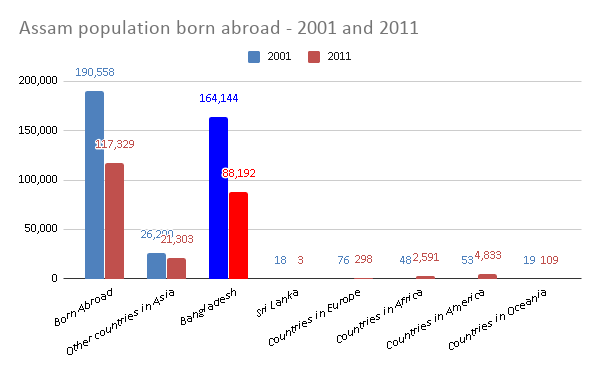
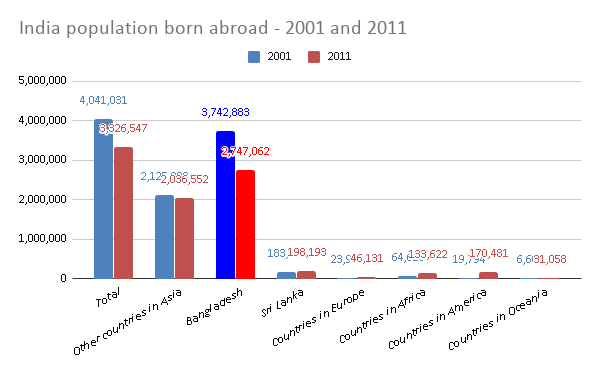
Recently released NRC data on migration shows that in fact, the number of undocumented migrants in Assam is approximately 1.9 million, or 19 lakhs. To put this in perspective, the population of India is 1.3 billion, or 137 crores, making the migrants in Assam 0.001% of the total population. Considering that the North-East, specifically Assam, has the largest volume of immigrants in the country, Tumbe estimates that there can’t be more than 2.5 million undocumented immigrants in total, which means that the percentage still stays at 0.001. Migrants in the state of Assam from 2001 and 2011 Census.Migrants in the state of Assam from 2001 and 2011 Census.As to the question of why there are this many immigrants, Tumbe says: “You don’t see any migration in the world without demand. These people provide labour, but with particular techniques. And these are the same people who have been doing this for generations now, so they have certain skills for which there is a demand – especially in agricultural labour.”This puts the alarmist rhetoric surrounding illegal immigration in a new light. After all, it makes sense, especially considering the large Indian and Pakistani diaspora in places like the UAE and Saudi Arabia. Most of us know at least two or three people who have emigrated from India to the Gulf, and who have perhaps overstayed their visas and settled down – but we would never consider them a security threat in any way. “These people are undocumented migrants – and they’re not undocumented terrorists, they’re undocumented workers,” Tumbe points out. “Are they dangerous to India? No. They’re coming as workers! And why are they undocumented? Either because they’re escaping adverse conditions so it’s out of desperation, or because they came legally, on a permit, and they didn’t want to go back, so they overstayed.”Neither of these two types of migrants are dangerous, at least at face value, to either the economy or to national security. There is no evidence whatsoever for undocumented migrants stealing jobs or engaging in terrorist activities. So then what is at the root of all the alarm? “A lot of it is political rhetoric,” Tumbe suggests, “There are people with genuine concerns – and it is true that immigration in certain districts is very high in terms of the percentage of the population – but to take the argument from a few districts of India to all the 700-odd districts of India makes no sense.” The districts in which immigration is the highest all lie in the North-East. The natural, mountainous border on India’s Western front means that it is nearly impossible to cross over; the case is different on its Eastern front. During India’s war with Pakistan in 1971, there was a large influx of refugees from East Pakistan, which then became Bangladesh. However, very few stayed on, and the ones that did acquired Indian citizenship. Between the 70s and 80s, however, there was considerable economic pressure to come to India. “This migration for the first time gets the colours of ‘illegal immigrants’”, Tumbe explains. Census data shows that in fact, between 2001-2011, the number of incoming immigrants from Bangladesh is reducing. In the last ten years, the Bangladeshi economy has improved, and research on Bangladeshi emigration shows that its citizens are going to the Gulf and Europe rather than coming to India. But the NRC is not really about numbers and hard facts. Rather, “[the] ‘illegals’ bogey is not so much about immigrants in general, but more about Muslim illegal immigrants, as in Western Europe”, points out Tumbe. According to the government, “Tibetan Buddhists are fine, Sri Lankan Hindus are fine, but Rohingya Muslims are not, Bangladeshi Muslims are not. So we know who’s going to be threatened by this. The NRC provides additional scope for harassment [of Muslims] – and at the end of the day, that is precisely why it is being done,” Tumbe states, “it’s a classic diversionary measure.”
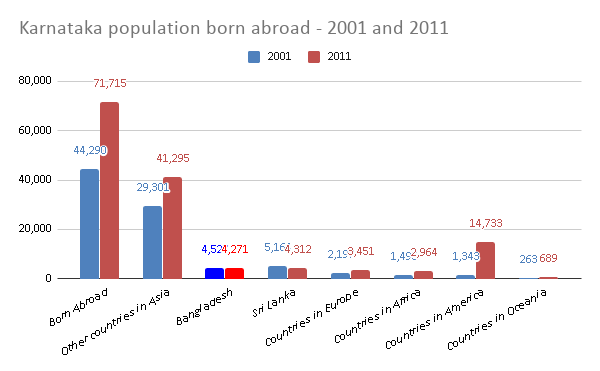
Moreover, the NRC doesn’t make sense from a cost-benefit perspective, a quick analysis makes that obvious. The government has already spent about 1000 Crores on the NRC in Assam – a 1000 Crores that could’ve gone into Swachh Bharat, Child Development Services, MNREGA, or any other nationally beneficial scheme. It’s true that 19 Lakh people have been identified – but what is the next step? The government can’t deport them, because there is no deportation agreement with anyone. This shows that the money and time spent on the NRC is for something other than tangible, material benefits. As for implementing it in Karnataka – which BJP MP Tejasvi Surya, among others, has called for – the prospect makes no sense. Tumbe estimates that the number of undocumented migrants in the state might be a few thousands. To implement it here would mean putting nearly everyone in hardship in order to single out the 0.001% – in Karnataka’s case, even less. “From a priority perspective, it just doesn’t make sense,” Tumbe notes. Migrants in the state of Karnataka from 2001 and 2011 Census.The government and the citizens clamouring for the national implementation of the NRC need to keep these things in mind: the lack of evidence that undocumented migrants are harmful to the economy, the lack of evidence that they are a security threat, and the communal flavour of the rhetoric surrounding the NRC – not to mention the fact that actually implementing it amounts to little more than a canny political chess move. Do we want India to stay colourful, multi-ethnic, and multilingual? Or do we want to be a country that weeds out the helpless and the hopeless, targeting those who have next to nothing?Chinmay Tumbe is a faculty member at IIM-Ahmedabad and author of India Moving: A History of Migration. Many thanks to Divij Sinha of the Indian Institute for Human Settlements for his help with interpreting Census of India data.