Kejriwal´s Diwali gift to Delhi: free bus rides for women and higher minimum wage

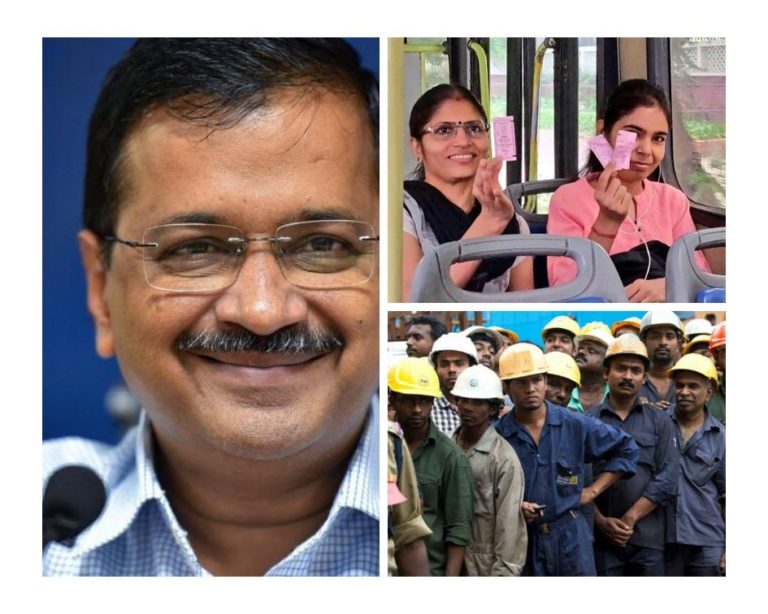
Delhi chief minister Arvind Kejriwal stays committed to women’s safety and workers’ rights in Delhi. As part of the AAP government scheme in Delhi, Arvind Kejriwal announced yesterday that women in Delhi can travel for free on DTC buses. Along with that, he announced that the number of marshals in Delhi buses to be increased to 13,000 from today. At present, there are 3,400 marshals in the DTC buses.

In his address  to the newly recruited bus marshals he said- “Today, I am entrusting you all with a responsibility to ensure the safety of women in each government bus and generate confidence in them so that they feel the comfort of a home in our buses,”

In his address, he said that this is his gift for Bhai Dooj to the sisters and mothers of Delhi, to make their commute easier and safer in the city. Delhi government also plans to extend free rides to students and senior citizens. He also announced that such a safety measure has not been done in any city in the world. CM Arvind kejriwal and Education minister Manish Sisodia tweeted about it on social media “Free-ride for women in Delhi buses has started from today. Congratulations Delhi! Apart from women’s safety, it will also increase the role of women in Delhi economy…,” Manish Sisodia said in a tweet in Hindi. He is getting a lot of praise as well as flak for his move. Some call it a political move ahead of elections. Though many women have praised the announcement and shared photos of pink tickets on Bhai dooj on social media. Women will be given pink tickets in Delhi Transport Corporation (DTC) and cluster buses to avail of the free-ride scheme. The Delhi government will reimburse transporters based on the number of pink tickets issued.

Hike in Minumum wage in Delhi

Along with the announcement of marshals for buses, Delhi CM, Kejriwal also announced the new minimum wages for workers. Minimum wages have been revised to Rs. 14,842 per month from 8,632 per month for unskilled labour; Rs 16,341 from Rs 9,542 for semi-skilled labour; and 17,991 from 10,471 for skilled labour. The hike, which was approved by the Supreme Court last week, is expected to benefit around 5 lakh workers in the capital, Kejriwal said, conceding that the implementation of the new rates will be a challenge.

Protest today against the arrest of Doddipallya Narasimha Murthy by Civil Society

0
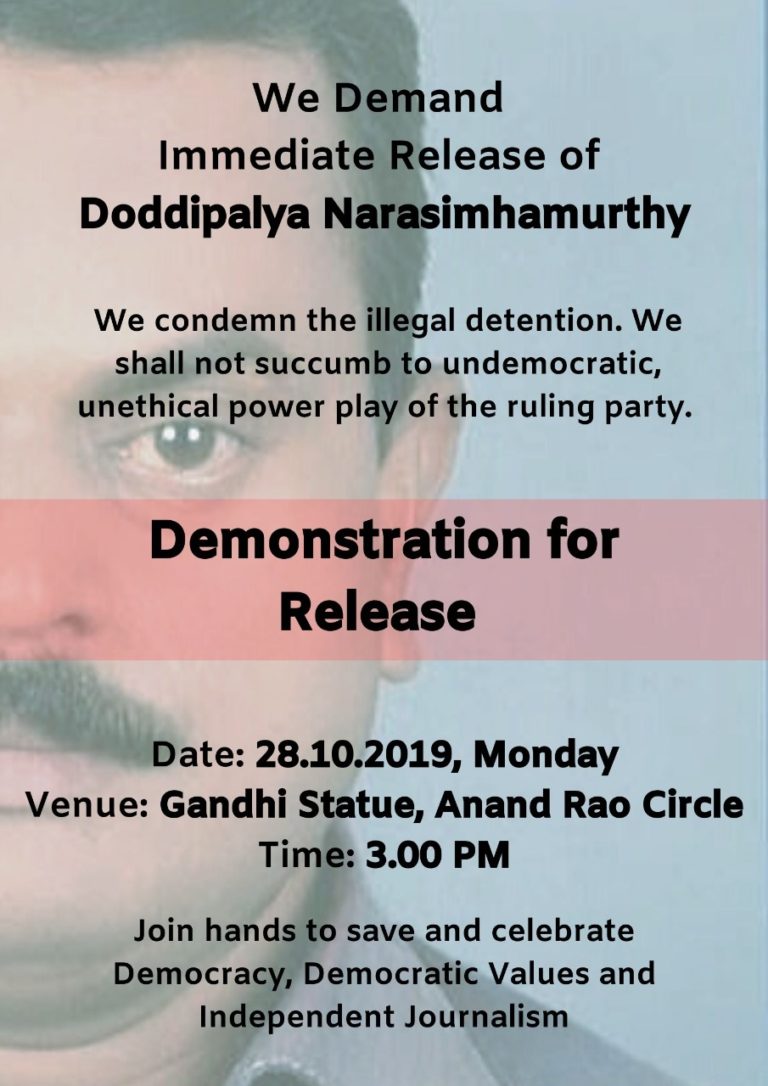
Today, civil society who are fighting for democracy has called for a massive protest in Bangalore, demanding the immediate release of journalist, activist and Swaraj India party State Secretary Doddipalya Narasimhamurthy. A protest march will be held in front of the Gandhi statue near Maurya Circle, Bangalore today at 3 pm. Hundreds of civil society members have expressed outrage over the ruling party’s repressive tendency again and again and the latest illegal arrest of journalist and social activist Doddipalya Narasimhamurthy, who is also the secretary of Gowri Media Trust. Hundreds of people have opposed the arrest of Narasimha Murthy on social media with Hashtag #We_are_with_DMNMurthy #We_are_with_Peoples_Media, and announced that they will take part in today’s protest.

ಈ ಪೋಸ್ಟನ್ನು ಓದಿ, ಇದಕ್ಕೆ ನಿಮಗೆ ಒಪ್ಪಿಗೆಯಿದ್ದರೆ ತಿಳಿಸಿ, ನಿಮ್ಮ ಹೆಸರನ್ನೂ ಸೇರಿಸಲಾಗುವುದು. ಈ ಸಂದರ್ಭದಲ್ಲಿ ನಾವೆಲ್ಲಾ ಪರಸ್ಪರ…

Posted by Muttu Raju on Sunday, 27 October 2019
We condemn the malicious arrest of Doddipalya Narasimhamurthy. We will not tolerate tyranny against the people-centric media, and if you are with the people-centric media we will add your name in the post and it is important we are all in this together says the FB post. More than one thousand people have expressed their support for the fight, according to a Facebook post.

Crimmigation: Making the Immigrant a Criminal in the United States

1
The article is part of our series on migration. In 2016, Donald Trump famously won the American Presidential election on a campaign where he promised to crack down on illegal immigration. The issue of immigration control has become an issue in many national elections over the past few years with claims that immigrants have been affecting everything from crime rates, the effectiveness of welfare programs, terrorism, employment rates, and overall societal morality. American policies on immigration and criminal justice have been an influential model across the world. To understand America’s policy on immigration and detention, we should see it in the context of white supremacy and mass incarceration.

Origins of Immigration Policy:

America was one of the first major modern democracies. American citizenship laws, at the founding of the nation, were not an entitlement to enter the country. They determined the right to take part in the political life of the country. Citizenship was initially exclusively for white, property-owning men, and gradually expanded to include people of colour and women during the late nineteenth century and early twentieth century. After the abolition of slavery in the mid-nineteenth century, there was a growing movement to grant the now free African Americans the right to vote. This expanding of rights to non-White people was seen as a threat to the domination of white people over black. Segregation laws, race riots, and lynching began to assert racial dominance for those in the country, and immigration laws began to assert control over those from other countries. Early chinese immigrants In 1875, the Page Act was passed, where migration from China, which supplied mostly coolie work, was restricted. Chinese migration to the United States started as a response to a growing labour demand in America in the construction of the railroads, coupled with social unrest in China at the time. People from China were treated like a scourge, whose families supposedly had many wives, were lazy, and did sex work. Many migrated to the west coast of America and were very poor. The Page Act prevented people of Chinese descent from becoming citizens. In 1882, the Chinese Exclusion Act was passed, where the race was a basis to restrict immigration. A combination of vigilante violence and formal deportation followed. This set the standard for the rights of foreign nationals in America. In the following two decades, the state evolved a policy to screen immigrants, and deport non-citizens on grounds of race, country of origin, political ideology and other supposed markers of moral character.

Making of the American Melting Pot- 

The policy continued to evolve until the 1950s, when America, in the head of the Cold War, tried to change its image to be a country that welcomed immigrants. During the Second World War, American Propaganda countered Nazi Propaganda by turning it around. Nazis claimed that America lost its racial purity and became a country of mutts (dogs who have not kept their breeds pure). In response, American propaganda portrayed ethnic and racial diversity as America’s strength. The propaganda was done for many reasons. It helped America maintain racially diverse allies. It helped maintain morale in an ethnically diverse military. It also used this language of cross-racial solidarity to garner support for racial targeting of people from enemy countries, like Japan, claiming that these people would be a threat to the racial harmony of the country.

In the 1950s and 60s, a growing black civil rights movement was seen as a threat to the establishment. In response, immigration policies began to change. Deportation cases dropped. John F. Kennedy became the first President of immigrant parents. Immigration policies were redesigned so that race was not explicitly a criterion for a visa. Country-wide quotas were introduced. Screening of immigration continued to selectively choose potential success stories to showcase.

Neo-liberal style of racism

In the late years of the Cold War, going into the Neo-liberal era of America, White supremacy reformed itself. Before the American civil rights movement, it was open and direct. After the passing of the Civil Rights Act, explicit discrimination was banned. In this era, White supremacy worked by implicitly hitting the community as a whole in coded ways, which were harder to challenge. To paraphrase Martin Luther King Jr., the signs preventing African Americans from entering certain rooms were taken down, but the roads leading them to those rooms were still rocky. Policies that systematically hit non-White communities, making those roads rockier, became more common. The American mass incarceration system allowed the government to prosecute black people. The immigration policy helped deal with the other growing minority, people from South and Central America. The investment in anti-immigration policies and infrastructure often carries with it an economy on its own. Investment in the initial capital often requires the use of that capital. Ties with private capital, which accelerated through the 1990s, led to the creation of lobby groups that affect politicians in a cyclical way. Extra-institutional requirements, like food contracts, reinforced the lobby group. Often these groups lobby politicians for their services as well as expansion. Detention facilities are seen as “jobs,” and link concerns for unemployment with the detention of immigrants in a complicated way. Institutions that specifically demonize and isolate people from the broader society are especially prone to this.

Criminalizing Mexican Immigrants:

These policies also coincided with the development of the North Atlantic Free Trade Agreement (NAFTA), where America opened trade relations with Mexico and Canada, and developed a narrative of Mexicans stealing American jobs in the 1990s. Many companies and rich people took advantage of the system to strengthen these laws, which broke a population’s ability to negotiate in a system sometimes called Crimmigration, most notable in hospitality and food services, agriculture, domestic work and home care, and logistics. Neo-liberal economic policies also resulted in waxing and waning American economy. Unemployment rates began to fluctuate in the 1980s like never before. Politicians of all stripes would make scapegoats out of recipients of welfare schemes, outsiders, racial minorities, and the poor. They were denounced in the media as drug users, criminals, people of loose morals, and terrorists. This association coupled with a history of obscuring immigration policies from judicial review made immigrants an ideal scapegoat.

It should be remembered always that Mexican is a racial code. Mexico is a country, not a race, and has people of different races in it. Some Mexicans are white and do not face as much discrimination in the US. Mexicans who have only part White ancestry or none at all tend to be the stereotype of the so-called illegal immigrant.

Rise of Deportations:

The 1980s marked a huge rise in deportations. In the first century, following the Page Act, nearly 20 lakh people had been deported. During the Presidency of Bill Clinton in the 1990s, little over 10 lakh people were deported. The next President, George Bush Jr., deported 20 lakh people. The President after that, Barack Obama, deported 30 lakh people. Immigrants detained at ICE Immigrant children detained at ICE Trump’s rise to the American Presidency began with a promise to become even less lenient on illegal immigration. One of his most controversial acts has been the changes to the Immigration and Customs Enforcement (ICE). ICE was founded in 2003 as part of the War on Terror policies to control foreign citizens suspected of terrorism. American public opinion supported the violation of due process and human rights to fight terrorism. Immigration was also space where human rights could be suspended, so ICE was formed to have impunity in its war on immigrants. The number of deportations has risen under the Trump administration, but they have not departed from the trend seen since the 1990s. What has changed is the virulence of it. More investigations, rabble-rousing, threats of mass raids, and reinforcements have occurred under Trump than under previous American presidents. This is dangerous for the country as a whole, as reliance on extra-judicial processes, and screening of people without respect for their rights. Many of these institutions were set in place during previous administrations and shows that policies based on hate and exclusion carry from one generation to the next, and give the next generation even more injustice to fight. Also Read: “All-India NRC Makes Absolutely No Sense”, Says IIM Professor  

Arrest of Doddipalya Narasimha Murthy: Mistaken Identity or politically motivated?

On the evening of 24th October, Karnataka’s Raichur police arrested Social activist Doddipalya Narasimha Murthy and have charged him in cases which have been already closed by the courts.

Since then, the police with their press meet and statements are finding it difficult to justify his arrest.

The press meet yesterday (25th Oct) by Raichur city SP Vedamurthy on DN Murthy’s arrest could not make much sense to anyone.

The police statement says-

“DMN Murthy(who goes by the name Vinod) was arrested for organising a meeting 25 years ago with 8 people against the government that the govt. is not doing anything for poor people. He has been absconding from last 25 years”

The police statement has received severe flak from all sections of society in Karnataka. The civil society that strives to uphold people´s voices for democracy has questioned the police whether what is happening elsewhere in the country has also started here in Karnataka?

Doddipalya Narasimha Murthy is presently working as a state secretary of the Swaraj India party, Karnataka. He is known in society for fighting for the oppressed causes and writing in different media spaces on various issues consistently from the past two decades.  He has been doing activism consistently including the struggle against BMIC Corridor publicly and not an absconding person as claimed by the police.

From 90’s he has provided jobs to many as an entrepreneur and is presently a journalist, writer, and activist in Karnataka. For more than a decade he has been a co-worker of Gauri Lankesh and is presently part of Gauri Lankesh Media Trust after Gauri’s assassination by right-wing elements aligned with ruling BJP’s ideology.

What raises suspicion in the public eye is the dramatic manner in which these arrests were made. The official narrative lacks consistency and is solely based on individual witness working in the police department. So far, the cases pertaining to his arrest have been officially closed by the respective courts and in one particular case, the petitioner himself had clearly backtracked that the alleged meeting did not take place due to which the case collapsed.

People fighting for equal and justifiable society, writers, activists, journalists led by Freedom fighter HS Doreswamy, Chukki Nanjundswamy, Indudhar Honnapur, N Venkatesh, Dinesh Amin Mattu, Dr Vijayamma, BT Lalitha Naik, S Raghunandan, G.Rajshekar, Dr Siddanagouda Patil, Nagaragere Ramesh etc have condemned the arrests and demanded the release of D N Murthy immediately in a signed Press release.

They have questioned the intention of police whether the arrest is a sign of silencing of dissent. People who are critical of government policies that are against the interests of the common people.

Welfare Party of India has condemned the arrest and demanded his immediate release stating it’s shameful on the part of police to say that a person who was leading several people’s struggle in public life is being accused to be absconding for 25 years.

Making of a Police state

With BJP back to power in Karnataka, the state police is showing signs of Gujaratification. BJP has managed to make a Police state first in Gujarat where it has ruled for almost 25 years, followed by Yogi raj in U.P. People are arrested with vague statements from police and with little to no evidence. This goes against the principles of democracy enshrined in the constitution of India.

Sanjeev Bhatt, IPS police officer, Gujrat cadre was recently arrested in a case from 1995. He was a vocal critic of PM Modi. UP has attained the status of Gundaraj under Yogi Adityanath where police is given a free hand to act with impunity. Last couple of months many cases have come where journalists where arrested on flimsy charges for just doing their job. Not to forget how Yogi shielded two BJP MPs in the much-publicised rape cases against them. One of the rape victims is in hospital after an attempt to her life was made. Most of her family was either killed or died trying to get justice. The second victim is framed in an extortion case and is in judicial custody.

Two months ago Bangalore police had arrested Karnataka Ranadheera Pade (Kannada organization) founder B. Harish Kumar on flimsy grounds of disturbing communal harmony when ruling party ministers have been giving derogatory and communal speeches openly in public spaces with no action taken against them. Last week, Vijayapura police have filed charges against protesters who organised “Justice for Danamma” urging justice for the Rape Victim.

It only remains to be seen if Karnataka too with the rest of the nonperforming BJP states will follow the ready-made path of Gujarat, UP and Jharkhand in creating a police state or fights back to protect its democratic space. Incidences like these help neither Karnataka nor India when the democratic spaces are stifled using Police and state machinery.

When overall governance and economy starts to fail only democratic thoughts and democratic action of the people concerned can overcome that crisis. The system of repression and violence is the solution often imposed by bigots and hope Karnataka will not follow that bigotry and reclaim its losing democratic spaces.

Also read: Karnataka: Journalist and State Secretary of Swaraj India Party arrested  

Karnataka: Journalist and State Secretary of Swaraj India Party arrested

0
Doddipalya Narasimha Murthy, journalist and the State Secretary of Swaraj India Party was arrested on 24th October Police in Raichur district. He was produced before the court yesterday and sent into judicial Custody. The next hearing is postponed to Nov. 6th due to festival holidays Doddipalya Narasimha Murthy told the reporters that he had come to Raichur to attend the Seminar on Alternative Media organised by “Gauri Lankesh Balaga’ (Gauri Lankesh Fraternity). He was arrested at the site of the event. Police have alleged that Doddipalya Narasimha Murthy goes by multiple names like Vinod, Basvaraj, etc. and is wanted in several cases in Raichur. In 1994, three cases were registered at Yapala Dinni  Police Station, Raichur Rural, and 1 case was registered at Netaji Nagar Station, Raichur. There was a rumour that 20 years back the Naxal by name of Vinod was residing in Raichur, and said to be that Doddipalya Narasimha Murthy was with him. Police said that this made them to arrest Doddipalya Narasimha Murthy. According to Police, DMN Murthy was absconding for the last 25 years, and is wanted in cases registered under 21 sections including section- 143, 147, 148, 307, 355, 385, 120 (b) and 120 n(a).

Fake cases registered 

Doddipalya Narasimha Murthy has denied all the allegations made by the police and categorically said that all the cases filed against him are fake, in front of SP Veda Murthy and DySP Sheelavantar, yesterday.

Politically motivated

Leaders of many Organisations reacted to the arrest saying that cases filed against Doddipalya Narasimha Murthy are politically motivated. Kumar Samatala, Executive Committee member, Karnataka Jana Shakti, reacted that,- ” Since 1990, Doddipalya Narasimha Murthy is part of several people´s movement and is in public and has fought against the BMIC for years together.  DN Murthy has a house in Bengaluru and lives there with his family. He also runs a Silk mill business with his elder brother. There is proof of all this. But he is arrested in the cases that happened in Raichur. This is totally false and politically motivated.” “He had been working as an Entrepreneur, Journalist and at present Secretary of Swaraj India Karnataka. But, Police has filed cases against him, probably they might be facing pressure from either Government or out of political vengeance. Police should withdraw its cases immediately, he urged.

Police face intense opposition in Social Media 

People are expressed their anger towards Police by criticising the act of suppressing leaders who have been fighting for the public cause. Journalist Dinesh Kumar Dinu said- Police statement that DN Murthy was arrested because he was active in Naxal Movement is a big joke. The case was said to be registered 20 years back and the police is acting on it now, he ironically slammed the police activity. Murthy should be released soon, he stressed. Journalist Harsh Kumar Kugwe also reacted and urged that Murthy is to be released immediately. It is not good to run the Politically sponsored show by the police, he opined.

Doddipalya Narasimha Murthy

DN Murthy is in the public movement in Karnataka, for the last 20-25 years.  From 2011, he was working as a journalist in “The Sunday Indian”. He has also worked for Gauri Lankesh Patrike. He is also part of Gauri Media trust, which was started after the death of Gauri lankesh in 2017. He is also the state secretary of Swaraj India since its inception. Read in Kannada: ದೊಡ್ಡಿಪಾಳ್ಯ ನರಸಿಂಹಮೂರ್ತಿ ಬಂಧನ ಖಂಡಿಸಿದ ಕರ್ನಾಟಕದ ಹಿರಿಯ ಗಣ್ಯರು : ಜಂಟಿ ಹೇಳಿಕೆ ಬಿಡುಗಡೆ

Jamia Millia University backs down to Students demands: Uninvites Israeli delegates

On Wednesday evening, protesting students at Jamia Millia Islamia called off their dharna after the university announced that it would not let delegates from Israel take part in any events on campus.  The university has also called off the disciplinary action they had initiated against five students, who had been issued show-cause notices for protesting a university event. The event, which was held by the Faculty of Architecture, was in partnership with Israel.  “We all are aware of the Human Rights violation being committed by Israeli occupation forces in Palestine and we felt it our responsibility to oppose Israel backed event on campus,” read a statement by protesting students. They had also raised Palestinian flags as a part of their protest.  “From the vocal support given to Palestine by the Jamia’s founding fathers to the commemoration of figures like Yasser Arafat and Edward Said by naming conference halls after them, Jamia has always retained deep solidarity with the struggle of Palestinian people. The administration that slanders against us and accuses us of tarnishing Jamia’s image is itself selling off the legacy of our founding fathers,” the statement further reads.  m.facebook.com/watch/?v=419431048768077&_rdr The peacefully protesting students had been assaulted by security guards as well as members of the Proctorial team. Moreover, they had been protesting for almost 10 days without any engagement from the administration. They did not respond to the show-cause notices issued by the university as they felt they had done nothing wrong. 
It is surprising that students were targeted for protesting in solidarity with Palestine since in 2014 the administration had released a statement condemning the Israeli offensive in Gaza. 
The Proctor claimed that the event was not held in association with Israel, but a delegate from the country had come to present a paper. However, the students allege that there are several documents showing that Israel was the partner country for the event. Students of Jamia had previously been issued show-cause notices for protesting against the HoD of the Fine Arts department on account of sexual harassment allegations and passing of lewd comments.  Also read: Palestine and India: The necessary road to Solidarity 

NDA setback in Maharashtra and Haryana Polls is Sigh of relief for Yeddyurappa

0
Karnataka Chief Minister BS Yeddyurappa is probably the only BJP leader who is not unhappy about the results of Haryana and Maharashtra assembly elections which were announced on Thursday, October 24th, where the BJP led NDA suffered a major setback after its stupendous performance in the recent Lok Sabha elections, says BJP Internal sources. With counting of votes, a clear picture of the assembly elections in Maharashtra and Haryana has emerged. The BJP-Shiv Sena alliance has emerged victorious in the state of Maharashtra, while Haryana showed a hung assembly.

Setback for BJP and Shiv Sena in Maharashtra

In Maharashtra, most of the exit polls had predicted CM Devendra Fadnavis to retain the power in Maharashtra. Here the BJP- Shiv Sena coalition proved to be right as exit polls predicted but not with huge majority. BJP on its own has won 105 seats, while the Shiv Sena has bagged 56 seats out of the total 288 seats. The NDA alliance won a total 161 out of 288 seats, where the magic number for the Maharashtra assembly is 145. Independent candidates have managed to win 13 seats. The NCP on its own has managed to win 54, while the Congress has won 44 seats this time. Earlier, most pollsters predicted a bigger victory for the BJP-Shiv Sena alliance. But NDA alliance managed to win only 161 out of 288 seats. It is a major setback for BJP who expected to win more than 150 seats on its own. BJP should think of why their alliance won fewer seats than they managed separately in the last assembly elections, after which they stitched up a post-poll alliance. Six ministers from the Maharashtra government have lost elections, which is a serious matter for ruling BJP. Again, the loss of Pankaja Munde from Parli shocked the BJP high command. Interestingly for the Shiv Sena, Aditya Thackeray’s victory from Worli is an encouraging sign. It is the first time someone from the Thackeray family has contested an election, ever since the party was formed in 1966. Shiv Sena which was on backfoot has emerged confident and gained lost ground. It will not make it an easy partnership for BJP.

Big loss for BJP in Haryana

In Haryana, BJP has managed to win 40 seats on its own out of the 90 assembly seats. Congress has won 31. The Jannayak Janata Party has won 10, while Independents have managed to win 7 seats. the INLD has won only 1 seat. The magic number is 46, where both BJP and Congress have not been able to touch on their own. Most exit polls had predicted that the BJP would absolutely decimate the opposition in Haryana. now, things have taken an unexpected turn. A hung assembly emerged where Dushyant Chautala’s JJP emerged as the possible kingmakers. Results of the by-elections to Assembly seats, held across the country, did not see any party come out on top. Congress-led UPA increased its vote share in 17 states by-elections where BJP led NDA faces huge loss.

Why is Yeddyurappa happy about BJP’s moral defeat?

BJP with its article 370 and hyper-nationalist rhetoric was hoping to have a landslide victory in Maharashtra and Haryana. It didn’t happen. It might succeed in making its government in both states but it cannot deny the fact that BJP lost its vote share in both states. This is going to be a great concern for Amit Shah for the coming elections in other states. And that is exactly the reason for Yeddyurappa’s temporary relief! If BJP would have won the Haryana and Maharashtra elections with huge majority, Amit Shah would have wanted to dissolve the Assembly in Karnataka and face the midterm elections. Naturally, BS Yeddyurappa doesn’t want to lose his position as Karnataka CM again! He is planning to win majority seats vacated by the disqualified 17 lawmakers to secure his government. If BJP does not fare well in Haryana and Maharashtra elections, then BJP high command might not risk going to midterm elections in Karnataka.

BS Yeddyurappa being sidelined in Karnataka BJP

BS Yeddyurappa is facing bitter rivalry in the state BJP unit. Elevation of BL Santosh as Organising Secretary in the BJP sends a signal for the party expansion in the South and a check on the Yeddyurappa. RSS strongman BL Santosh is the top intermediary between the Sangh and the BJP at the Centre. While Santosh’s appointment as General Secretary (Organization) in the BJP  is significant in terms of the party’s expansion plans in the southern region. His role in Karnataka is largely believed to be related to reducing Yeddyurappa and the Lingayat centrality to the BJP’s political identity. Yeddyurappa’s role was reduced to irrelevance in the recently held Lok Sabha elections with Santosh having the final say in candidate selection. For instance, in Bangalore South constituency Yeddyurappa, along with his supporters, believed that the late Ananth Kumar’s widow Tejaswini was the natural choice to contest the polls. However, Santosh picked the radical Tejaswi Surya for this prestigious seat. He is believed to be the most effective architect of the BJP’s extraordinary performance in the general election in which the party won 25 of the total 28 Lok Sabha seats in the State. Santosh, RSS pracharak with a clean image, believes that Yeddyurappa’s association with the mining scams hurts BJP politically. Yeddyurappa also publicly blamed Santosh for encouraging his rivals, especially KS Eshwarappa, who publicly denounced the former CM as ‘dictatorial’. Recently, The BJP appointed Lok Sabha MP Nalin Kumar Kateel, a staunch Hindutva leader, as the President of its Karnataka unit, in place of BS Yeddyurappa, who is now the Chief Minister of the southern state. With Yeddyurappa becoming the Karnataka Chief Minister, the saffron party has brought in his replacement in line with its “one person one post” norm. Now Nalin Kumar Kateel and BL Santosh together are trying to sideline BS Yeddyurappa. They are not considering BS Yeddyurappa’s decision in ticket allocation for Karnataka by-elections. B.L Santhosh is directly opposing the ticket for BSY proposal of giving up tickets for  17 disqualified MLAs for by-polls. Read More: Karnataka: Discord in BJP over seat allotment to disqualified MLAs

Haryana: Wrestler Babita Phogat,Yogeshwar Dutt and Tik Tok star Sonali Phogat lose on BJP seats

0

Phogat lost the Dadri seat to independent candidate Somvir Sangwan

Babita Phogat, a Commonwealth gold medalist in wrestling, joined the BJP in August this year. She was contesting from Dadri, a seat in Bhiwani-Mahendragarh Lok Sabha constituency which BJP has never won. Wrestler Yogeshwar Dutt, 2012 Olympic bronze medalist, also failed to turn the Bharatiya Janta Party’s fortunes and lost the Baroda seat by a margin of nearly 5000 votes. He lost it to Congress’ sitting MLA Sri Kishen Hooda, who had retained the seat in 2014 despite a stellar performance by the BJP. Both Dadri and Baroda seats are challenging as BJP has never won these seats. BJP was hoping to make inroads with the star power of the Olympic sports stars. Babita Phogal and Yogeshwar Dutt had joined the BJP in August and September, respectively, saying that they were impressed by the works of PM Narendra Modi and the BJP ideology. The Phogat sisters and their father Mahavir shot to limelight after Aamir Khan’s 2016 film “Dangal”. The success of the Phogat sisters has attracted substantial media attention, particularly due to the prevalent social issues in Haryana such as gender inequality, female foeticide.

Sonali Phogat- Tik Tok star loses to Congress leader Kuldeep Bishnoi 

sonali phogat
Another star power that BJP banked on is of Tik Tok star Sonali Phogat in Adampur constituency.  She was defeated by Senior Congress leader Kuldeep Bishnoi. From the election results in Haryana, it looks like that the anti-national and communal rhetoric of BJP candidates did not go down well with the public. People want jobs, resolution of the growing agrarian crisis and not chest-thumping on article 370. Many on social media cheered the loss of these candidates for their opportunist behavior and lack of any clear politics.
Phogat sisters are quite popular on social media and have been known for their pro-BJP and nationalistic tendencies for some time. Recently Babita Phogat also defended Haryana Chief Minister Manohar Lal Khattar after he courted controversy with his remarks on Kashmiri girls. She said- “Haryana Chief Minister Manohar Lal Khattar has not made any such statement that is offensive to our sisters and daughters. I urge media to not misinterpret his statement,” Also read: “Dangal” fame wrestler Babita Phogat and father join BJP ahead of Haryana assembly elections

Karnataka: Discord in BJP over seat allotment to disqualified MLAs

0
Echos of discontent in Karnataka BJP unit over ticket allotment to the 17 disqualified MLAs who belonged to Congress-JDS. BJP is facing opposition from party members who claim to be from the party from the beginning and warned of serious consequences if the disqualified MLAs are given preference over the original BJP leaders in ticket allotment for the by-elections. The party leadership is in turmoil, and are conducting many meetings in a day to resolve this issue. By-election will be held in 15 Assembly Constituencies, out of which, 8 Constituencies from South Karnataka, to choose a suitable candidate in each, is in question. Chief -Minister B.S. Yediyurappa and the party President Nalinkumar Kateel are also at odds, making it harder to crack this problem. Yesterday, most of the Party members opposed the decision of honoring disqualified MLAs by allocating seats, Many of them suggested , if they win, it will be affecting in Bruhat Bengaluru Mahanagara Palike’s election,  (BBMP) as they will support their (Congress-JDS) workers, not the workers of BJP. In other words, BJP will lose its control over BBMP and City as well. BJP workers from Yeshwanthpur Constituency also brought to the attention the disqualified MLA S.T.Somashekhara case, who has filed 13 cases against BJP workers. What would be the fate of BJP workers in the particular constituency? Meeting faced many such questions. MLAs N.L. Narendrababu, S. Harish and M. Nagaraj were opposed to ex congress  Gopalaiah who is also a disqualified member. Chief minister B.S. Yediyurappa tried to control the situation by saying that all members should follow party orders and the case of disqualified MPs is still pending with Supreme Court. BJP workers also brought to attention case of another prominent BJP leader Sharath Bachegowda who is not given a ticket from Hoskote this time. There are chances that he may rebel and run for election on an independent ticket. The workers and leaders are saying different things. This kind of atmosphere is making the leadership nervous. Interestingly, no objections came from K.R.Pura, Hunasuru and Shivajinagar constituencies regarding allotment of seats for disqualified MLAs. Soon after the meeting, CM. B.S. Yediyurappa addressed the press and said- “The meeting went without any objections. We took the decision unanimously to fight by-elections”. On October 26, another meeting will be held in Hubball, pertaining to seat allotment in North-Karnataka region, he said. Also Read: Karnataka: Dalit BJP MP denied entry into a Yadav village

Kathua rape and murder case: Court orders FIR against special investigation team members

0
A court in Jammu and Kashmir has directed to file FIR against six members of the Special Investigation Team that is investigating the gang rape and murder of an 8-year-old girl, Asifa in 2018 in Kathua district. Six of the team members are accused of torturing and coercing witnesses to give false statements. The order is based on a complaint from three persons alleging torture during interrogation to “provide false evidence” against one of the accused, Vishal Jangotra, who was later acquitted in the case. The judicial magistrate responded to a petition from the witnesses, Sachin Sharma, Neeraj Sharma, and Sahil Sharma. All three are residents of kathua and Samba districts. The order is based on a complaint from three persons alleging torture during interrogation to “provide false evidence” against one of the accused, Vishal Jangotra, who was later acquitted in the case. The SIT was constituted by the then PDP-BJP government headed by Mehbooba Mufti. In Kathua’s gang rape and murder case, an 8-year-old girl named Asifa went missing from her village. She belonged to the Muslim Bhakarwal community on 10th January 2018. She was found dead after a week. Medical reports showed evidence of gang rape and death after being crushed by a stone. Sleeping pills were also found in her system, due to which she went into a coma. The incident had triggered nationwide outrage and split the local population along religious lines. Two BJP ministers in the state government at the time, Choudhary Lal Singh and Chander Parkash Ganga, had publicly endorsed demands from family members of the accused for a CBI probe in the case. Facing a backlash, the two were made to quit the Cabinet. The case was also shifted to Pathankot following a Supreme Court order after lawyers in Kathua prevented Crime Branch officials from filing a charge sheet. The SIT’s investigations led to life terms in June for the three main accused: Sanji Ram, the caretaker of the prayer hall where the crime took place, Special Police Officer Deepak Khajuria and Parvesh Kumar. Three other accused — Sub Inspector Anand Dutta, Head Constable Tilak Raj and special police officer Surender Verma — were charged with destruction of evidence and awarded five years’ jail. Jangotra, who is the son of Sanji Ram, was given the benefit of doubt and acquitted by the special court hearing the case. The eighth accused was declared a juvenile and tried under related provisions. In their complaint against the SIT, Sachin Sharma, Neeraj Sharma and Sahil Sharma claimed that the investigators tortured them to depose against Jangotra. The three had first recorded their allegations during investigations in the case when they were produced before a magistrate for recording their statement. Following Jangotra’s acquittal, they lodged their complaint with the SHO of Pacca Danga station. “On October 5, we approached SSP (Jammu) but nothing has been done in the matter so far,” said their advocate Ankur Sharma. Jammu and Kashmir police chief Dilbag Singh on Wednesday said no witnesses were tortured and the court’s directive of an FIR against the investigating police officials would be followed. Also, Read Unnao rape case: Kuldeep Sengar to be tried under POCSO for rape and kidnapping