This is the first article in a series on the economic slowdown in Karnataka. For almost two years now, there has been a slowdown in the economy of the country. GDP in the April-June quarter of this financial year grew by only 5%, the lowest in the past six years. According to Goldman Sachs, more than 50% of this economic decline is driven by a decline in consumer demand. Anecdotal evidence shows that consumers across the board are buying less, and everyone seems to be feeling the pinch.
India’s auto industry, the fourth-largest in the world, has been one of the hardest-hit sectors during this recession. Karnataka, along with Maharashtra, Gujarat, and Delhi, contributes to nearly 1/3rd of vehicle sales in the country. But sales have declined nearly 25% as compared to last year. And despite the common assumption that this is due to the rising popularity of taxi aggregators such as Ola and Uber, reports show that their demand for passenger vehicles has also tapered in FY19. Alarmingly, the auto industry has laid off around 3,50,000 workers just between April and August 2019. That amounts to nearly 5% of Bengaluru’s population.This slowdown is clearly visible when one visits Peenya Industrial Area in Bengaluru. Peenya is one of the largest manufacturing hubs in the country, which employs over a million people. The area houses a large number of small and medium-sized factories that make auto parts, machining tools, and engineering components among other products. The slowdown in automobile sales has meant pink slips and mandatory vacation days for many in the area. Contract workers are usually the first to be suspended or let go, but many permanent employees have also been relieved of their jobs. Many employees have had their salaries slashed in half, and employers have had to cut down production days to reduce costs on their end.
Analysis
Part of the reason for this dramatic slowdown is a slew of government policies that have come into being over the last two years, including GST implementation. Small and Medium Enterprises (SMEs) have yet to adjust to the high tax slabs imposed on them with the new GST rates. Finance Minister Nirmala Sitharaman announced a tax cut for corporates on September 20th, but there was no change to the 22% tax rate for SMEs. There is also the mandatory transition to BS-VI emission norms, which means an increase in production costs and unsold inventory of BS-IV standard inventory in auto dealerships. The deadline for all auto manufacturers to be ready with BS-VI compliant vehicles is April 1st, 2020. By this time, they should have sold all their stock of BS-IV standard vehicles. However, there aren’t yet any guidelines from the government as to how to phase out this stock. Instead, government bodies have been told that they may replace their old vehicles with those that follow the new emission norms. This step should, hopefully, do something to boost the industry. Some experts also claim that the auto industry is in need of new kinds of employees. With the government’s emphasis on moving towards clean energy and mobility, and the global shift towards the same, automakers need experts in digital technologies, software engineering, and machine learning. There is an overall shift away from mechanical engineering processes and professionals. The job cuts in the industry, therefore, speak to the future of automobiles. However, it doesn’t seem like the demand for these new kinds of jobs will make up for the volume of job losses taking place at the moment. Whether it’s primarily because of government policies, or the global economic slowdown, the Indian state as well as the Karnataka government need to take action in the form of policies. These policies should be geared especially toward SMEs, who need it the most. Revival of SMEs will give a boost to the economy from the bottom-up.
Governor of Karnataka has turned deaf ears to farmers of North-Karnataka who are on indefinite strike in the premises of Sangolli Rayanna Railway Station, Bangaluru, urging water from Mahadayi river.As of today, it’s been 3 days that the farmers are protesting at the Majestic railway station even when it is raining. The Governor of Karnataka has not turned to the farmers to receive their memorandum pertaining to the water of Mahadayi. If this situation continues, the protest would go beyond control, farmers cautioned.Farmers both men and women who are on strike, came from various parts of North-Karnataka, through Hubballi, under the banner of “Bengaluru Chalo’ expressed their anger that the Governor is deaf to their demands and has not showed up or sent any representative even on the #3rd day of their protest.Due to rain, most of the farmers fell ill and are admitted to Victoria and K.C. General Hospital for their treatment. “On Gandhian philosophy, we are on strike. But, Government is not understanding it. If anything happens to farmers, Government will be responsible for the cause’, farmers warned.Deputy CM Govind Karajol came and requested to call off the protest. But, farmers did not agree. They urged to take them to Governor’s Office, as they do not have faith in the Government.Farmers are urging that Government has to publish its notification on the Mahadayi-Kalasa Bandoori project. Farmers are demanding that the Governor has to interfere and settle the problem by putting pressure on the Central Government. If not, problems of North-Karnataka, particularly, Mahadayi water issue would remain forever, farmers urged.
Read in Kannada
Dear fellow supermen and women of new India! I have discovered another blunder of western philosophy that has sapped all our manlinessand made us into a nation of idlers. Despite some well-intentioned leaders trying to make us true Bharatiya Purush, the rulers of the past 70 years never wanted the true character of this nation to flourish, so they propagated western philosophy. But the time has come to lift the veil of ignorance and let the nation realise its pure and pristine form.
Coming to the point, the western philosopher Descartes argued that the act of thinking is proof of the existence of human beings. Obviously, he was wrong. We have proved this beyond doubt. Not every human being thinks. Our purest deshbhakts don’t engage in this totally anti-national activity. Thinking is equal to sedition in their universe that is fast transforming into the only universe of the country. Yet the deshbhakts exist.
Thinking is fast becoming an outmoded activity. Why do you want to think? What is the purpose of thinking when the very minutest of details of one’s life has been already determined with absolute precision by some supernatural power. Rule of dharma makes the act of thinking superfluous. You have to think only when there is any doubt or dilemma.
Gandhiji had a jantar to resolve dilemma. He said that whenever your face doubt or dilemma regarding what action to take, think of the weakest person you have ever seen and think if your action can benefit him or not. That was to resolve dilemma.
Now, we have a new jantar. Of course, the rule of thumb is to not have any dilemma at all in the first place. However, given the 70 years of misrule, it will take some time for the nation to get rid of all its dilemmas and doubts. So, for the time being, whenever you have any dilemma or doubt, just think of any of the three divine matas – gau mata, bharat mata or ganga mata – is your action going to benefit any of these holy mothers? If not, the action is pure adharma.
This is the way to get rid of the vice of thinking. Rousseau had said that thinking man is a depraved animal. He was correct despite being a westerner (you see, we make allowance for some of them, for example, your guess!). That is absolutely true. The act of thinking is a perversion. It’s a sickness that the nation should get rid of as soon as possible.
Thinking makes people doubtful of the pure ideas of pure deshbhakts. They start doubting the action of the great natural leaders of the country. They start questioning the glorious history of the nation. They start doubting the time tested social institutions like caste and dowry and supremacy of the husband. They start breaking the culture of India, our family values, morals. Etc etc.
Thinking is a threat to the nation and its infinite glory.
How can you think when soldiers are dying on the border?
How can you think when gau bhakts are mocked in their own holy land?
How dare you think when the supreme leader is not even having a night of proper sleep for the nation?
So, the act of thinking as proof of existence is disproved as not only false but even dangerous. What is the fundamental proof of existence then? Well, I have discovered this proof after a long tapasya.
I hate, therefore I exist.
Yes. Hatred is the real proof of existence of a human being.
A true bharatiya purush and stree is one who hates Muslims, Dalits, women, Pakistan, beef-eaters, seculars, socialists, communists, reservations, Nehru etc. etc. at any cost and in any circumstance. He hates the body and all its manifestations and desires. He hates people in love. He hates women in charge of themselves. He hates the shudras and lowly people commanding higher positions, studying in universities. He hates any talk of human rights. He hates protests except when they are for nationalist causes like defending a rapist or murderers targeting Muslims.
Thinking can be the proof of the existence of lower beings of the western world, but for those born of Brahma’s mouth in the sacred land of bharatvarsha, hatred is the fundamental proof of existence. Those who don’t hate are not human.
So, fellow countrymen and women! It’s time to redeem our essence now. Let’s hate and prove that we exist.
The central government told the Supreme Court on Friday it is ready to rebuild the Saint Ravidas temple in Delhi at the same site where the shrine was demolished in August on the court’s orders.
Attorney General KK Venugopal submitted that the decision has been taken to ensure peace and harmony, after the demolition at south Delhi’s Tughlakabad had sparked widespread protests by devotees.
“That same 200 square metre area of the site can be handed over to a committee of devotees for construction of temple,” Venugopal said, adding that five out of seven petitioners, who approached court against demolition of temple have agreed to the proposal.
A bench of Justices Arun Mishra and S Ravindra Bhat took on record the offer made by Venugopal and asked parties seeking construction of a temple to submit objections if any by Monday.The court said it will pronounce its final judgment on the matter on October 23.
Read More: Dalits ask on Ravidas temple demolition- Why don’t they shift the Ram mandir to some other place?
On October 4, the top court had asked the parties involved in a plea seeking permission to rebuild the Guru Ravidas temple in Delhi’s Tughlaqabad forest area to come back to it with an amicable solution on a better location for the temple.
The Saint Ravidas temple was demolished by the Delhi Development Authority (DDA) on August 10 on the orders of the Supreme Court. Following the demolition of the 500-year-old temple, there were widespread protests and bandh in Punjab on August 13th due to the temple demolition. Key organizations advocating for Dalit rights had supported the call for a nationwide bandh.
The top court had said it respects everybody’s sentiments but the law has to be followed.
Attorney General has told the SC that he held consultation with all concerned parties including devotees and government officials and that the Centre has agreed to give the land considering sensitivity and faith of devotees for the site.
The issue also took a political hue with various parties demanding that the temple be reconstructed either at the same spot in the Tughlakabad forest area or at an alternative location.
The gathering in the national capital saw the presence of Delhi’s Social Justice Minister Rajendra Pal Gautam, Bhim Army chief Chandrashekhar Azad and spiritual leaders from the community.
The demolition of the temple in Delhi’s Tughlakabad locality had turned violent when police opened fire at the protestors, shelled tear gas and resorted to brutal lathi-charge injuring protestors. Due to a rumor that one of the protestors has died, the protest turned violent and there were some instances of vandalism.
Bhim Army chief Chandrashekhar Azad and 95 others were later sent to 14-day judicial custody on charges of rioting and unlawful assembly.
The members of the Ravidas or Ravidassia community are Dalits and form an offshoot of Sikhism. They follow Ravidas, whose teachings are also mentioned in the Guru Granth Sahib.
“I lost four brands the day I campaigned for candidates for Lok Sabha election, lost three events. The hit that my work took at the end of that experience…,” said Swara Bhaskar. Swara was at the 9th Indian Film project event where her upcoming film “Sheer Qorma”. poster was released.
Swara Bhaskar, Bollywood actress has campaigned for CPI leader Kanhaiya Kumar and Atishi Marlena of AAP during the Lok Sabha elections 2019.
Swara campaigning for Kanhaiya Kumar in Begusarai, BiharSwara Bhaskar in Delhi campaigning for AAP candidate Atishi Marlena
Swara is known for speaking against injustices and is quite vocal about social and political issues on social media and debates on TV channels. Due to her criticism of communal hatred and bigotry under the BJP government, she has been at the receiving end of brutal trolling by right-wing Hindutva brigade on social media. She regularly gets hate messages, rape, and death threats. Despite the real danger, Swara refuses to cower down. She takes it all in her stride with much amusement.
At the event, she was asked why Bollywood shies away from speaking on matters of relevance to the country. To that, she replied how being open about her support to Kanhaiya Kumar has cost her brand endorsements.
Swara added that the people have to understand that there is a cost to speaking up in public and many bollywood celebs do not want to risk their status or work or receive flak from society or sponsors.
“I am not saying, ‘Oh! I am so great,’ but if you’re going to make the stakes so high, that a superstar can talk about a dinner conversation and then face so much flak or another superstar can give his opinion and his car can be stoned on a shoot, then how can we expect people with legacies or public profiles to actually risk their lives, families, careers? Why should they? We need to ask ourselves questions as a society.”
“As public figures you’re more vulnerable to a lot of destructive negativity… If we want our public figures, people with legacies, to speak out and take responsible sides, then we have to become the society, which doesn’t punish people doing that,” the actor said
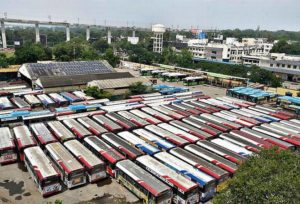
The indefinite strike by the employees of the Telangana State Road Transport Corporation (TSRTC) continued on the 11th day on Tuesday.
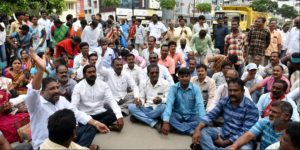
Students and left parties members also joined the Telangana RTC strikers
Three days after the death of a bus driver of the Telangana State Road Transport Corporation (TSRTC), Progressive student organizations on Monday, October 14th protested in front of Bus Bhavan, Hyderabad. The protest was in support of 48,000 agitating workers of different unions of TSRTC, who are demanding the merger of TSRTC with the government.
Expressing solidarity with RTC workers agitation, students took out a rally from the Arts College to Ministers quarters. When mild tension prevailed on the premises, police obstructed the student leaders of PDSU, AISF, SFI, TVV, and AIDSO and shifted them to Narayanaguda police station into preventive custody. All the arrested student activists were released in the evening.
Before the arrest, students of the left parties brunt the effigy of Chief Minister K Chandrashekar Rao at Arts College and raised slogans against the Telangana Government.
Strong Message to KCR Government
The student organization also expressed condolences to RTC worker Srinivas Reddy, who sacrificed his life for the demands of the striking RTC workers.
Telangana RTC employe who committed suicide
Two workers died as one tried to commit suicide during Strike
Earlier, D Srinivas Reddy, 55, a bus driver of TSRTC Khammam depot, who set himself ablaze at his house near Khammam on Saturday, reportedly in protest against the government, succumbed to his burn injuries at a hospital in Khammam.
A day after Reddy’s death, Surender Goud, 50, a conductor hanged himself in Hyderabad. He, like all other striking employees, had not received the salary for September and a cheque he had issued towards his EMI for a home loan had bounced.
On the same day another TSRTC driver who is around 40, attempted to immolate himself by pouring petrol at Narsampet depot in the Warangal district, however, police and union workers immediately prevented him from setting himself ablaze.
At least three other employees tried to kill themselves, giving a serious turn to the strike that began on October 5.
KCR arrogance to the plight of TRTC employees
Acting tough, Telangana Chief Minister K Chandrasekhar Rao issued an ultimatum to workers to return to work by 6 pm on October 5 but only a few did.
Known for his ‘dictatorial’ attitude´, KCR refused to take back the striking employees and to hold any talks with them.
By not paying September salaries to employees, especially during the festival time, KCR invited more criticism from the employees and the opposition who called him ‘arrogant’.
Further angering the striking employees, he unveiled plans to recruit temporary drivers and other employees and use more private buses. He directed the police chief to deal firmly with any attempt to disrupt the bus services being operated by RTC with the help of temporary staff.
He blamed the union leaders for instigating the RTC employees into taking extreme steps.
The government has extended holidays for educational institutions to deal with the transport problem.
State-wide bundh on 19th
The Joint Action Committee of RTC employees’ unions, which has begun an indefinite strike from October 5, decided to intensify the struggle. It has called for a State-wide bundh on October 19.
The Opposition parties Congress, BJP, Telugu Desam Party (TDP), Communist Party of India (CPI) and others are announced their solidarity for Bundh. They have attacked the state government for not doing anything to prevent the suicides of RTC workers and demanded compensation for families of the victim.
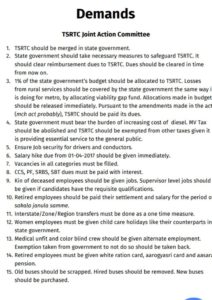
Main Demands of RTC Workers
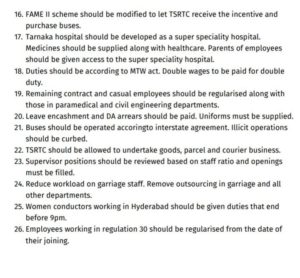
Demands laid out by the striking Telangana state RTC employeesDemands laid out by the striking Telangana state RTC employees
The RTC employees have demanded the merger of the corporation with the government. They also asked to reduce the tax on diesel, recruitment to various posts and besides pay revision.
Telangana High Court intervenes
Responding to the PILs, from the TSRTC union and the government, Telangana high court yesterday suggested both parties to take hold talks to resolve the crisis and posted the next hearing on October 18th.
The court suggested to the government to take the employees into confidence and also advised the employees to call off the strike and hold talks with the government.
The Joint Action Committee (JAC) of TSRTC employee unions said that the government has been callous towards their demands. instead of taking steps to look into their demands, the government said 48,000 employees dismissed themselves by not resuming duties.
The union said if the government invites them, they are ready to hold the talks.
The KCR government assured that it has made alternate arrangements of buses so that the public is not inconvenienced.
The government, however, said to the court that it cannot agree to the main demand for the merger of TSRTC with the government as this will lead to other corporations to demand the same.
After the Turkish invasion on 9th October, people around the world responded with messages of support on Twitter. Here are some of the messages, images, resources, videos and statements about and from Rojava.
Trigger warning: graphic violence.
#Turkey is bombing the #Kurds to chase them out of #Rojava in an act of ‘ethnic cleansing’ to replace the Kurds with a pro-ISIS Arab population. A war crime supported by the US is unfolding before our very eyes and being celebrated by jihadis in Canada. pic.twitter.com/fF7YZchOFV
Rojava, the autonomous Kurdish region in northern Syria, “is a society that is really unparalleled right now in the 21st century,” says Debbie Bookchin, co-founder of the Emergency Committee… https://t.co/tv3khG2jZk
This is what Turkish army is doing to Kurdish people so they leave Rojava and Islamists who celebrate ISIS could take over. It’s a shame that the US is supporting Turkey despite such open brutality. You have blood on your hands, @DonaldTrump.pic.twitter.com/37hH5JZQvC
Where’s the humanity that the whole world is talking about…!!!! HUMAN RIGHT is the greatest lie,look how dangerously Turkish army kill the civilian people of rojava, i want to say aren’t they considered as a human ? Or kurds are from another planet..!!!#Rojava#SaveRojavapic.twitter.com/uhYaLmQrhR
For us Kurds life too often is about resistance. In this war we gave 11.000 lives, uncountable much wounded. To then be drawn from the claws of one enemy to the other. Everything for nothing. It will be unforgivable if we have to hand in Rojava.
As long as the last Kurd stands (or is alive), Kurdistan will live too! Kurds in #Rojhalat (Iranian – Kurdistan) chanting and showing support for #Rojava#NSyria
Happening Now: the Court house/cityhall and Korean veterans bridge in Nashville has been lit the colors of Kurdistan flag in solidarity with Kurds and Rojava, with mayor @JohnCooper4Nash’s approval. #SaveRojavapic.twitter.com/AluTve2mFt
-132 civilians wounded
-39 civilians killed
*This doesn’t include total number of casualties from the airstrike in Sere Kaniye, on the 13th. Many casualties couldn’t be registered due to distortion.
Contact us for the full report. pic.twitter.com/Iia0dje564
— Rojava Information Center (@RojavaIC) October 14, 2019
We, in the Syrian Democratic Forces and our people in Serekaniye, stand together and strong in front of the enemy attacks, and pledge to fight until the last breath, and will not allow TR occupation occupy an inch from the territory of NE Syria.” pic.twitter.com/JJtB4Ll32o
— The Women’s Revolution in Rojava (@the_rojava) October 14, 2019
Boycott War Profiteers !
Stop the international collaboration with Turkish murderers
The weapon industries know no border for profit
USA, France, Germany, UK, Italy are accomplices
Silence is collaboration, let’s oppose them !#RiseUp4Rojava#WomenDefendRojavapic.twitter.com/yFAsJViWPn
— Internationalist Commune of Rojava (@CommuneInt) October 15, 2019
Activists Arun Ferreira, Sudha Bharadwaj, and Vernon Gonsalves have been in jail since August 2018. After hearing their bail Petition plea for two months, Justice SV Kotwal rejected it. All three have been booked under the Unlawful Activities Prevention Act, for allegedly inciting caste-based violence at Bhima-Koregaon on January 1st, 2018.According to LiveLaw, hearing a petition for over a month is highly unusual.
Arguing on behalf of the petitioners, the attorneys pointed out that the evidence for holding the activists in Yerwada jail is flimsy at best, with no concrete names or dates mentioned in any documents connecting them to the incident.Sudha Bharadwaj’s counsel Mr. Yug Chaudhury stated that none of the evidence supposedly indicting the activists should be admissible in a court of law. Bharadwaj pointed out that the court did not have an original version of any document, which also means that they cannot connect any of the documents to her via handwriting analysis. None of the documents are signed, verified or authenticated. Activist Arun Ferreira has been booked under the draconian UAPA before, spending 5 years in Nagpur jail previously. In connection with the Bhima-Koregaon case, Pune police had alleged that Ferreira attended a meeting celebrating the Golden Jubilee of the Naxalbari movement. Ferreira’s counsel Sudeep Pasbola refuted these claims.The Pune police has accused the trio of having strong connections with Maoists and being ‘anti-nationals’. Justice Kotwal himself opined that there was prima facie evidence connecting the three with CPI (Maoist), which is a banned organization, and attracts the UAPA. According to the Prosecution, the three accused are a part of various organizations which act as a front for the CPI(M), whose ultimate aim is to ‘destabilize the nation’. On Tuesday, the Supreme Court also disposed of the petition by activist Gautam Navlakha, which would quash an FIR against him. The head of the bench, Justice Arun Mishra, explained that it was not proper to quash an FIR during an ongoing investigation. This was in spite of the efforts of senior Advocate Dr. AM Singhvi, who submitted that Navlakha should not be charged under the UAPA.The Maharashtra state government claim that they have hard evidence connecting Navlakha with ‘Maoist conspiracies’.
Last Sunday, Trump and the Defense Secretary of the US ordered the remaining thousand American troops to withdraw from Northern Syria, leaving Kurdish forces to fight ISIS and Turkey alone.
American withdrawal from the region means that the Syrian Democratic Forces (SDF), mostly comprised of Kurdish civilians and troops, will have no allies in their fight against ISIS. It has also directly paved the way for the Turkish state to launch an offensive in Syria on October 9th, which has already caused the displacement of 1 Lakh civilians.
Trump’s own Department of Defence reportedly opposed the move to withdraw from Syria, however, to no avail. Possibly in response to all the backlash, Trump tweeted:
As I have stated strongly before, and just to reiterate, if Turkey does anything that I, in my great and unmatched wisdom, consider to be off limits, I will totally destroy and obliterate the Economy of Turkey (I’ve done before!). They must, with Europe and others, watch over…
The Turkish attack, which has now gone on for nearly a week, is intended to drive out the SDF from the border region to create a ‘buffer zone’. The Turkish state hopes to resettle many of the 36 Lakh refugees of the Syrian Civil War in this buffer area. Denying that the US pullout had instigated the Turkish offensive, a senior US official said on Monday, “This was not caused by any action of President Trump … nothing we did was going to deter the Turks from what they wanted to do. President Erdogan was going to act regardless.”
The Turkish state considers the SDF ‘separatists’ and ‘terrorists’, despite the fact that the SDF has fought on the frontlines of the war against ISIS. The SDF is associated with the Kurdistan Worker’s Party, which has long staged an insurgency against the Turkish state.Turkish President Erdogan and Syrian President Bashar Al-Assad
Turkish President Erdogan has responded negatively to international diplomatic statements, which have called on him to end the conflict via negotiation with the Syrian Kurds. The Turkish President has shrugged off the criticism by saying that he will not stop the offensive, “no matter what anyone says”.
Left with no allies, the SDF has struck a deal with the Syrian government – the same entity against which it has been fighting for the past 6-7 years. The Syrian dictatorship with Bashar al-Assad at its realm used chemical weapons more than 300 times on civilians in Syria. The SDF was fighting to establish democratic rule in the Northern region, and had succeeded in carving out a small autonomous entity known as Rojava.
Rojava
Rojava is an autonomous region in the North-East of Syria, which is governed along the lines of secular, democratic, socialist, feminist and ecological ideology. It follows a ‘co-governance’ policy in which each position at each level of government in the region includes a female equivalent, of equal authority to a male. The Rojava administration guarantees freedom of speech and freedom of the press, giving rise to a vibrant media landscape.
There is a Centre For Art and Democratic Culture, which showcases work from Kurdish artists. Rojava was formally established in 2014, and within a short span of time, the administration banned child marriage, honor killings, dowry, and discrimination against women. With the withdrawal of US forces, however, it seems as though Rojava’s existence is under threat.
Assad’s troops moved into Northern Syria on Sunday night. His government is strongly backed by Russia and Iran, which drastically lowers any chance of the US returning to fight alongside the SDF. This re-forging of diplomatic ties does not bode well for Rojava.
American Department of Defense spokesperson Jonathan Hoffman stated, “The Department of Defense made clear to Turkey — as did the President — that we do not endorse a Turkish operation in Northern Syria. The U.S. Armed Forces will not support, or be involved in any such operation.” On Monday, Trump imposed economic sanctions on Turkey and called for an immediate ceasefire. He promised to send Vice President Mike Pence to Ankara as soon as possible, in order to negotiate an end to the offensive. However, with no US presence on-ground, it’s unclear as to how Trump plans to monitor or execute a ceasefire. US Secretary of Defense Mark Esper is to visit NATO next week and urge them to take collective diplomatic measures to restrain Turkey’s offensive.
The SDF has always cooperated with the US forces, including agreeing to remove fortifications in order to create a ‘buffer zone’ between Syria and Turkey. This made them more vulnerable to a Turkish attack. According to a report by the Washington Post, residents of Rojava were “stunned” at the speed at which SDF forces were collapsing. “The Americans betrayed us. We don’t trust them anymore,” said a Kurdish woman who had to flee her home near the frontlines. Meanwhile, Turkish-backed Syrian rebels have launched operations to capture strategic points of offensive from the SDF.
The medical aid and food supplies from the Rojava administration that were going to the 1.3 lakh people displaced by warfare have also been suspended. Nearly half of the aid workers from the UN have been evacuated from the area, according to an anonymous source.
Trump and Turkey
This comes to the question of why Trump made the decision to withdraw US forces in the first place. Reuters reported that it was after a phone call with Turkish President Recep Tayyip Erdogan that Trump moved forward with the withdrawal. A full transcription of the phone call is yet to be released.
In an interview with right-wing news site Breitbart in 2015, Trump said, “I have a little conflict of interest ’cause I have a major, major building in Istanbul. It’s a tremendously successful job. It’s called Trump Towers—two towers, instead of one, not the usual one, it’s two.” This so-called conflict of interest might have something to do with Trump’s decision.
It is unclear as to what Washington could gain by withdrawing its troops, particularly because American soldiers on the ground are not happy with the move. Many US troops have expressed their disappointment and frustration, stating that they are ashamed and dismayed at how the US has chosen to position itself. They also expressed concern that potential allies in future conflicts might hesitate to partner with the US, seeing the withdrawal of troops as a lack of reliability. Many diplomats around the world see the move not only as a blow to human rights but to US credibility, given that it reverses many of the gains against ISIS.
After Turkish shellfire hit Northern Syria, hundreds of ISIS supporters escaped a detention camp there. The camp, which had around 12,000 people in total, held a separate annex for about a thousand ISIS supporters – an annex that is now empty.
There seems to be no end in sight for the conflict in the region, and Trump’s actions were a concrete pathway to increased bloodshed. While Trump’s sanctions on Turkey show that he is trying to backtrack, he is, as usual, taking to Twitter to defend himself.
….I would much rather focus on our Southern Border which abuts and is part of the United States of America. And by the way, numbers are way down and the WALL is being built!
Rojava’s autonomy, which is hard-won and precarious, can’t be destroyed now. Its destruction means more than another layer of conflict in the Middle East: it is the end of an experiment in radical democracy and inclusive self-government. In contrast to the dictatorial and authoritarian states that surround it, Rojava stood up for women’s rights, freedom of speech, and secularism. The end of Rojava means the end of the hope that a small island of peace can flourish in the midst of a sea of conflict.
CPI leader and former JNU student, Dr. Kanhaiya Kumar was denied permission by the Vice-Chancellor to deliver a lecture at Gulbarga University today.
Dr. Kanhaiya Kumar was to speak on the Indian constitution and the role of Youths.
The programme was organised by the Gulbarga University research scholar´s association and Guest lecturers association. The program was expected to be attended by about 5,000 people.
Parmala Ambekar, the acting Vice-Chancellor of Gulbarga University had given permission earlier. But today, she canceled the permission after ABVP, Ram sene and other pro-Hindutva groups submitted a letter to the VC.
The VC told the media that she has gotten directions from Governor Vaju Bhai Wala who has links to RSS to cancel the program.
Earlier, ABVP had urged the Vice-chancellor not to allow Kanhaiya Kumar to deliver a speech on the university campus. This was followed by protests from a large number of students to allow the program, after which the VC allowed the program to happen but with conditions that Kanhaiya does not make any provocative statement and stick to the said topic.
After that, the program location was shifted to on at B R Ambedkar Study and Research Institute in the morning. But the police did not let the program happen there as well.
Now the Program will be held in Ambedkar Grounds.



 This slowdown is clearly visible when one visits Peenya Industrial Area in Bengaluru. Peenya is one of the largest manufacturing hubs in the country, which employs over a million people. The area houses a large number of small and medium-sized factories that make auto parts, machining tools, and engineering components among other products. The slowdown in automobile sales has meant pink slips and mandatory vacation days for many in the area. Contract workers are usually the first to be suspended or let go, but many permanent employees have also been relieved of their jobs. Many employees have had their salaries slashed in half, and employers have had to cut down production days to reduce costs on their end.


 This is the way to get rid of the vice of thinking. Rousseau had said that thinking man is a depraved animal. He was correct despite being a westerner (you see, we make allowance for some of them, for example, your guess!). That is absolutely true. The act of thinking is a perversion. It’s a sickness that the nation should get rid of as soon as possible.

 The Saint Ravidas temple was demolished by the Delhi Development Authority (DDA) on August 10 on the orders of the Supreme Court. Following the demolition of the 500-year-old temple, there were widespread protests and bandh in Punjab on August 13th due to the temple demolition. Key organizations advocating for Dalit rights had supported the call for a nationwide bandh.
The top court had said it respects everybody’s sentiments but the law has to be followed.
Attorney General has told the SC that he held consultation with all concerned parties including devotees and government officials and that the Centre has agreed to give the land considering sensitivity and faith of devotees for the site.
The issue also took a political hue with various parties demanding that the temple be reconstructed either at the same spot in the Tughlakabad forest area or at an alternative location.
The gathering in the national capital saw the presence of Delhi’s Social Justice Minister Rajendra Pal Gautam, Bhim Army chief Chandrashekhar Azad and spiritual leaders from the community.
The demolition of the temple in Delhi’s Tughlakabad locality had turned violent when





 Rojava is an autonomous region in the North-East of Syria, which is governed along the lines of secular, democratic, socialist, feminist and ecological ideology. It follows a ‘co-governance’ policy in which each position at each level of government in the region includes a female equivalent, of equal authority to a male. The Rojava administration guarantees freedom of speech and freedom of the press, giving rise to a vibrant media landscape.
There is a Centre For Art and Democratic Culture, which showcases work from Kurdish artists. Rojava was formally established in 2014, and within a short span of time, the administration banned child marriage, honor killings, dowry, and discrimination against women. With the withdrawal of US forces, however, it seems as though Rojava’s existence is under threat.
Assad’s troops moved into Northern Syria on Sunday night. His government is strongly backed by Russia and Iran, which drastically lowers any chance of the US returning to fight alongside the SDF. This re-forging of diplomatic ties does not bode well for Rojava.
American Department of Defense spokesperson Jonathan Hoffman
 In an interview with right-wing news site Breitbart in 2015, Trump

