On August 17, Ankhi Das, Facebook’s Director of Public Policy, India, South & Central Asia, filed a complaint at the Delhi police cyber cell against alleged violent threats. In response, journalist Awesh Tiwari has filed an FIR with the Raipur Police on a number of charges under the IPC, including outraging religious feelings and incitement to violence. Both of these FIRs have come in the aftermath of a Wall Street Journal reportwhich showed that Ankhi Das had protected at least three BJP politicians from hate speech community guidelines for their facebook posts, which included incitement of violence and derogatory posts about Muslims. After that, her ties to the BJPwere explored, revealing that her sister is a long-time member of RSS-affiliated organizations, and that Ankhi Das had led a partnership between Facebook and the Election Commission.OpIndia was the first to access the complaint which the site posted in an article titled “After Rahul Gandhi attacks Facebook India’s Ankhi Das, she receives a threat to life, police complaint filed”. OpIndia is internationally well known to be a right-wing propaganda site, with Wikipedia blacklisting it, IFCN rejecting its application to be recognized as a fact-checker due to the number of fake news it has published, and the founder calling it a ‘blind mouthpiece’ of the BJP after he left the organization. It is interesting then, that Das decided to give access to her complaint to OpIndia. The headline itself gives a hint to the article, as it falsely alleges that Rahul Gandhi attacked Ankhi Das. In reality, he tweeted the article, critiquing Facebook and RSS-BJP.
BJP & RSS control Facebook & Whatsapp in India.
They spread fake news and hatred through it and use it to influence the electorate.
In her complaint, Ankhi Das cited violent threats to her life and body, sexually coloured remarks, and defamation, giving evidence of two tweets by anonymous accounts, two Facebook posts by Himanshu Deshmukh and Awesh Tiwari, and tweets by three accounts which she called defamatory and accused of circulating her picture.
While the entire complaint has been attached in the article, the annexures in which screenshots for these tweets and posts were attached, have not been included in the article. When we went to find the posts, we found that one of the alleged death threats was a tweet which said ‘Ankhi Das Murdabad’. ‘Murdabad’ is a common term which does not literally mean that someone should die, but rather denotes rejection, and is commonly used in order to reject a public figure.
The second tweet did not exist, which can either mean that the link was faulty or the tweet had been deleted. The alleged death threat by Himanshu Deshmukh was not available as his posts are only visible to friends. The post by Awesh Tiwari which she has linked can be seen below. Courtesy: FacebookThe post, originally in Hindi has been auto-translated here by Facebook and it is clear that it does not contain any threats but is rather a report of all known facts regarding Das’s links with the BJP. In the comments as well, he has not made any threats to Ankhi Das, except to say to a friend that they will try to find out her links with the Sangh Parivar and post about it soon. Then she alleged circulation of her photo along with defamatory comments. The first status she mentioned was by an account that has been deleted. The second tweet she mentioned was by Saket Gokhale, which can be seen below.
Facebook's Ankhi Das also attends sessions of "WOSY – World Organization of Students & Youth" which was led by her sister Rashmi Das.
Fun fact: WOSY runs out of the same office as the RSS-operated Rashtriya Kala Manch at 26, DDU Marg in Delhi.
He based his tweet on a public post made by the WOSY page, a screenshot of which he had attached. The picture he used was already in the public domain as well. Finally, the third post she mentioned also attached a picture of her already existing in the public domain along with calling her a ‘BJP-agent’ and said that she was responsible for spreading hate between Hindus and Muslims during elections. This is based on the documented fact of a partnership between Facebook and the Election Commission, with no regulation of political advertisements on Facebook.
— अरशद खान / Arshad Khan / أرشد خان (@IncArshadrewa) August 16, 2020
It seems that most of the allegations in the Ankhi Das’s complaint are not entirely accurate, and it is alarming seeing as the Delhi police have in the past played a huge role in the repression of students, activists, and Muslims. One of the accused in Das’s complaint, Awesh Tiwari, state bureau chief of Hindi news channel Swaraj Express, categorically refused ever having interacted with Ankhi Das, and filed an FIR against Ankhi Das with the Raipur Police, saying that he was being intimidated and prevented from doing his job as a journalist. He also reported being censored by Facebook previously for his posts that were critical of the government, including one regarding Pulwama and one regarding tribal agitations in Bhilai.
Jin charaghon se taasub ka dhuaan uthta hai
In charaghon ko bujha do toh ujale hongeBorn on January 1, 1950, Rahat Qureshi changed his last name to Indori after the city he was born in. He was a well known poet and lyricist, performing at mushaira after mushaira across the country and outside of it, drawing huge crowds every single time. Rahat Indori passed away due to a heart attack on August 11, 2020, just one day after he tested positive for COVID-19. Rahat’s father Rafatullah Qureshi was a cloth mill worker. He completed his schooling and his graduation in Indore, after which he went on to study Urdu literature at Barkatullah University in Bhopal. In 1985, he was awarded a PhD for his thesis, Urdu Main Mushaira, from Bhoj University, and later he would go on to teach Urdu at Islamia Karimia college and Indore University. Indeed, his immense command over a mushaira and the skill of his performance shows the amount of knowledge he had about his artform. Yet, unlike many other renowned poets, Rahat Indori was never one to use his poetry as an exhibition of his vocabulary or his knowledge of the Urdu language. Rather, his poetry was for people to understand, to find joy in, to find mischief and humour in, and to find possibilities of resistance in. Instead of reciting ghazals in a melody as was prevalent when he started out, Indori would simply recite his ghazals. Instead of romantic themes of love and beauty and individual feelings told in esoteric language and admired quietly, he used the medium and the fluidity of language to comment on society and represent collective sentiments. He also did not use pure forms of any language, often mixing Urdu and Hindi in the way that was often spoken. While all of us may not have had the fortune of attending any of his performances, even watching a recording can draw one in into the infectious joy and excitement that his recitation could create in an audience. Pausing in between each line, sometimes to explain, sometimes to make a joke, sometimes to point out something interesting, he would perform as if he was sharing an inside joke with the audience. Unlike many poets who may be hailed as the finest poets of our time or receive awards after awards, Rahat Indori struck a chord with people across the country, and outside, like no other, because of the sensitivity and nuance with which he critiqued those in power, whoever they were, never putting himself in any camp. It was with warmth and empathy that he would gauge the audience’s reaction to his ideas, like when while performing in Kashmir he sensed that a line from his shayari had created discomfort in the audience, he explained, “I was trying to put forward my point of view, but you’re Kashmiris and the real prey of the system. You know better”. Just like in the midst of this fascist regime and protests against the CAA and NRC, his poem echoed from every corner of the country and floated across crowds on posters, even during Indira Gandhi’s Emergency, his ideas and poetry were just as much of a threat to the State. He narrated humorously during one of his performances, that after he had called the government corrupt in his poem, the police had arrived at his door the next day. When they accused him of calling the government corrupt, he said, “I did say that the government is corrupt, but I didn’t say which country’s government”. In response, the police said, “Do you think we are stupid? As if we wouldn’t know which country’s government is corrupt”.
During the movement against CAA and NRC, he attended and performed at protest gatherings across the country. Sometimes he performed the poem that had become the revolutionary cry across the country –
Main jaanta hoon dushman bhi kam nahinLaikin hamari tarha jaan hateli pe thodi haiSabhi ka khoon shamil hai yehan ki mitti meinKisi ke baap ka Hindustan thodi hai
At a protest gathering in Hyderabad in January, he recited another poem, pointing at the ridiculousness of being asked to produce documents to prove one’s identity-
Main jab mar jaaonga to meri alag pehchaan likh denaLahu se meri peshani pe Hindustan likh denaIn spite of what he meant for so many people of the country, due to the threat he had come to present to the current government, he was hounded by insults and trolls even after his death. An old video of him poking fun at the then-PM Atal Bihari Javpayee, made him a target for right wing hate after his death, with people making conspiracy videos about him being a ‘Mujahid’, and the Prime Minister did not even acknowledge his death. Never aligning himself with any political party or group, Rahat Indori aligned himself with people’s interests over the interests of the powerful throughout his life, and he will be a symbol for the spirit of justice and equality that people’s movements are striving for, for years to come.
In an unprecedented show of resistance, workers heckled the Belarus President Alexander Lukashenko during his visit to a factory in the outskirts of Minsk amidst the unrest following his election. As he attempted to give his speech, the workers shouter, ‘Liar!’ and ‘Resign!’. Lukashenko is Europe’s longest-serving ruler, and has been in charge of Belarus for 26 years. Having come to power in 1994 soon after the collapse of the Soviet Union, he has long been considered an autocrat and elections under his rule have never been considered free or fair. However, rising discontent about pervasive corruption and poverty, a lack of opportunity and low pay reached its final stage during the pandemic. The stifling of opposition prior to the election had led to fears of falsification of the results, and various irregularities were documented amidst an internet lockdown. When the exit polls came out, Svetlana Tikhanovskaya, the opposition candidate, who had stood for elections in place of her arrested husband, was suggested to have won only 10% of the votes, in spite of the visible support she had gathered. Protests erupted across the country after the elections, with more than 6000 arrests taking place, amidst violent clashes where the police fired tear gas, rubber bullets, and stun grenades at the crowds. Tikhanovskaya, fearing for her safety, fled the country, while protests continued, steadily increasing in numbers. As protestors gathered outside the State television building, some 100 staff members came out to join the protestors.
#Belarus Interior Ministry: firearms were used against the protesters in Brest. Another line was crossed. They report about one person that was injured by a firearm.More than 1,000 people were arrested across the country, protests happened in 25 cities.51 people were hospitalised pic.twitter.com/G1Toj1yGK6
On Sunday, around 100,000 protestors came out on the streets of Belarus in the biggest protest to have ever taken place in the country. Meanwhile, Lukashenko has asked Putin for help, and Putin has offered help in accordance with a collective military pact.
Our Professor turned 54 on August 16, while in the custody of NIA. Prof. Hany Babu M.T.
from the Department of English, University of Delhi was arrested on July 28 by the NIA in a
series of ongoing harassment of academics, and activists who have been vocal against the
government and its policies. This act of suppressing dissenting voices in academic spaces
by the State threatens the very fabric of Indian democracy.
Prof. Babu has been a strong advocate for social justice and has worked strenuously in the anti-caste movement. As a professor of linguistics, his classes have always been about demanding equal space for the varying languages in India and looking at English as an emancipatory language. His teachings have made, and continue to make students critically approach caste supremacy hidden within the rubric of the Indian language structure. He has always highlighted the need for equality amongst language, and language speakers.
It should be underlined that eleven activists/scholars have already been arrested in the
Bhima Koregaon-Elgar Parishad case and nine out of these have been in jail for nearly
two years, as undertrials. We, the students of Prof Hany Babu are angry. It should be a sad
day for the country and everyone who has been a student should be concerned that a brilliant academic, and more so, a morally upright and innocent man is spending this day alone in custody.
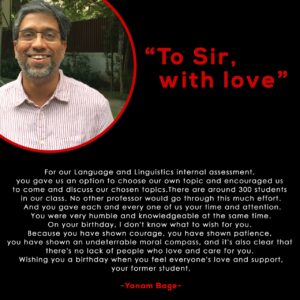
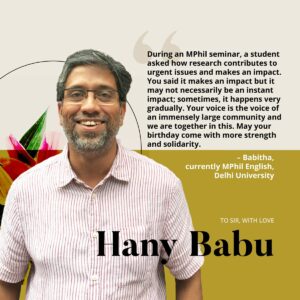
Under these circumstances, Students in Solidarity With Hany Babu, a collective composed of his present and former students, put out a call to students to send in birthday wishes and thereby express their solidarity with their professor. The responses shared a collective understanding of Prof. Hany Babu’s persona as a gentle, compassionate professor who not only taught his students about the exclusive nature of universities in India but also created an inclusive environment in an attempt to open the university space for all.
His student Siddi writes:
Your way of teaching with a sweet and humble voice and the way of describing things have
always inspired me and yours were among the few classes I regularly attended. Sir, one day I want to become a teacher like you and I want to have the strength you have.
As Jyotirmoy shares:
Like I have always said, if it was not for you, I would not learn to be proud of my mother
language Kamrupi, use it without shame in public, and develop a lifelong academic interest
in language and culture.
Another student Samiksha writes:
Happy Birthday, sir. You have been one of the best professors I have ever come across.
Your sincere efforts in a class taught us not just what was in the books but also about the
semantics of inclusivity and equality. We take immense pride in being the students of a Professor who speaks up against the wrongs and injustice in our world. We continue to learn from you.
While some students wrote about the popularity of his classes, which they would attend in
large numbers, even though attendance was not compulsory, others have written about the
exposure to the contemporary and its problems that they have gained from their classes.
As Adarsh writes:
Thank you for taking a subject that was one of the toughest in M.A. and making us feel
heard, and aware. Your sociolinguistics classes made me understand my home more, but
also made me realise how deeply language is rooted, even in caste and religion. This is
what your classes do sir, they make us question.
There were also wishes from students, who despite not being students of Prof. Babu shared
the grief and anger at the present situation.
Abeer, a young student writes:
I do not know you, yet I feel like I do. From what I’ve heard, you seem like a fatherly figure to many which to me is an ultimate form of respect.
Many students have written about the extra effort and dedication he has shown both in
his teaching and in helping them in solving their day to day issues.
Asief writes about the same:
We first met regarding some internal mark discrepancies students were facing in the
department. You guided us and from there, you have always been the go-to person for some of us whenever some issue related to the department or university crops up. You have been a welcoming presence in an unwelcoming space like Delhi University. You are an inspiration for students like us.
Many students express their shock, anger, and disbelief about the arrest and they also swear to stand with him.
We have received over 250+ emails, most of them recounting their personal experiences as
students of Prof. Babu. We have published very few of them. We strongly believe that a
teacher, mentor and activist like Prof. Hany Babu is an integral asset to the university space and his absence only ensures the further marginalisation of students from marginalised communities.
We demand an immediate release of our sir, Professor Hany Babu.
On July 24, the Naanugauri website, a progressive Kannada media outlet was banned from Facebook, after two articles were posted and shared, one reviewing one year of BJP rule in Karnataka, and another questioning whether BJP MLA Sunil Kumar was using cement allotted for government projects for building his own bungalow. This made the outlet unable to share any of the news from the website. This banning was done without intimation and without citing a specific reason, dealing a huge blow to the circulation of critical news from one of the few regional progressive media sources in Karnataka. Ankhi Das (2nd from right) with PM Narendra Modi in 2014This is not the first time that a progressive, anti-fascist voice has been stifled on Facebook. Another Kannada news portal Vartha Bharati had been banned in June, 2017, which was reinstated after Facebook claimed to have made a ‘technical error’. In 2017, Humans of Hindutva, a prominent progressive satire page which critiqued the RSS and BJP, had posted a picture with the caption ‘Take a ride on India’s bullet train’. The picture was of a bullet, on which were the photographs of various Indians shot and murdered by right-wing forces for speaking their opinions. These included Mahatma Gandhi, Gauri Lankesh, M.M. Kalburgi, Govind Pansare and Narendra Dabholkar. The post was removed, and HoH got a warning saying that if the page continued to post ‘objectionable content’ the admin would be asked to reveal their identity. This was in spite of the fact that every time a post had been removed or the page banned due to mass-reporting, Facebook had apologized and reinstated them. In 2018, an article by the Caravan, calling into question Amit Shah’s electoral affidavit, was not allowed by Facebook to be ‘boosted’, as is a common practise with most media outlets in order to find newer audiences. With no satisfactory reason given for this decision by Facebook, the Caravan appealed against it and asked for more substantial reasoning. The appeal process which was supposed to take only 3 days, took 10 days, after which the boost was finally approved, but without any response to why the earlier decision had been taken. The delay of 10 days again, heavily affected the circulation of an important article by what is an independent media house without traditional sources of advertising. Under the hashtag of #AntiIndiaFacebook, several other users have alleged censorship on Facebook for anti-BJP posts. The issue of Facebook’s bias towards the BJP has been raised on multiple occasions, including by Derek O’Brien in Parliament. Especially critiqued has been the role of Facebook and Whatsapp in spreading fake news and hate speech that has led to multiple instances of violence.However, what could have been dismissed as a theory has now been proved, as a Wall Street Journal report has outlined how Facebook has colluded with the BJP, especially under the current Policy Director, Ankhi Das. The report said that when T. Raja Singh, a BJP MLA in Telangana made a post saying that Rohingya Muslims should be shot, according to the Community Standards of Facebook, he qualified as a ‘dangerous individual’ and risked being banned from the platform. However, Das argued that punishing members of Modi’s party would damage the company’s business prospects in the country. According to the report, besides Singh, “Ankhi Das opposed the applying of the hate-speech rules to at least three other Hindu nationalist individuals and groups flagged internally for promoting or participating in violence”. T. Raja Singh continues to hold a verified account on the platform. As and when the WSJ sought comments on various other hate-speech posts made by BJP politicians, Facebook removed posts and suspended accounts in an attempt to cover its tracks. These actions included suspending the account of Anantkumar Hegde, who had posted about ‘Corona Jihad’, and some posts by Kapil Mishra. Even Kapil Mishra, whose posts incited the anti-Muslim violence in Delhi this year, continues to have an account on the platform. Ironically, in an opinion piece for the Indian Express in 2018, Ankhi Das wrote about Facebook’s strong stance against hate-speech, mentioning how they had taken efforts to ban Hizbul Mujahideen and al Qaeda affiliates. Saket Gokhale then investigated the ties that Ankhi Das has to the RSS-BJP. He found that Ankhi Das’s twin sister Rashmi Das is a member of the Sangh Parivar. The extent of her involvement can be found from an opinion piece she wrote in 2018 for the Firstpost. She wrote that she has been associated with the ABVP for more than 25 years, and as a student, she led the ABVP unit. Gokhale also posted an interview with Barkha Dutt from this year, where Rashmi Das justified the recent ABVP attacks on JNU students. She also led the World Organization of Students and Youth (WOSY) , which she mentioned is ‘ABVP’s massive network for international students on Indian university campuses’. In her article, she also refers to Hedgewar and Golwalkar, some of the earliest ideologues of the RSS who outlined its Hindu supremacist ideology, as ‘Doctorji’ and ‘Guruji’.
Here's an interview from @themojo_in with a certain Dr. Rashmi Das who is the former JNU President of the BJP's student wing ABVP. The interview happened in January.
In this, Rashmi Das justified ABVP's attack on JNU.
Fun fact: Rashmi Das is the sister of FB's Ankhi Das.
Ankhi Das, who joined Facebook in 2011, has been referred to as ‘Modi’s granddaughter’ by Facebook employees. In 2017, she launched a partnership between Facebook and the Election Commission for a ‘Voter Awareness’ Campaign’. Data breaches by Facebook that were acknowledged by the Election Commission in 2018, were ignored in favour of continuing the partnership. In February 2019, when an EC panel recommended that political advertisements on social media be pre-approved by the EC and a PIL regarding the same was filed in the Bombay HC, Facebook and Google were asked to submit affidavits regarding the same. While Google agreed to only post pre-approved advertisements, Facebook India did not agree with the proposal. In the days following these revelations, various opposition members have raised this issue, including Rahul Gandhi, and Shashi Tharoor. Meanwhile, WOSY has issued a legal notice against Saket Gokhale and ABVP has issued a statement against him, calling him a ‘string-puppet’ journalist. While the collusion between Facebook and the BJP-RSS and their tampering of democratic procedures has been made clear, BJP is steadily working on increasing its ability to manipulate data and regulate opposition through Facebook in upcoming times. A government-appointed panel headed by Infosys co-founder Kris Gopalakrishnan recently recommended the regulation of non-personal data collected by US tech companies, including Facebook. The panel listed research, national security and policymaking as the uses for this data and also proposed a mechanism for firms to share data with other entities. Ambani, who has in the past talked about ‘data colonization’ and argued for Indiandata to be used by Indian companies, recently announced an investment of 43,574 crore from Facebook.
The RSS-BJP government of India, led by a seasoned RSS whole-timer, Narendra Modi, has miserably failed in providing basic amenities, employment, education, security, and peace to 138 crores of Indians (out of which approximately 80% are Hindus). However, last August 5, he had joyous news to share with the people of the country. While laying the foundation of Ram Temple at Ayodhya on August 5, 2020, with the get-up of a prosperous Hindu sage, Prime Minister declared that the centuries of wait of the Hindus of the world was over, as Lord Ram’s birthplace was finally liberated from numerous attempts to destroy it. According to him, with his laying down the foundation of the Temple, India was writing a “glorious chapter” and declared that “Today, the Ram Janmabhoomi [birth-place] has become free from the centuries-old chain of destruction and resurrection”.
Goswami Tulsidas Put in Bad Light
As generally happens with our PM, he resorted to lies regarding the destruction of Ram birth-place temple for building Babri Mosque too. According to his narrative, borrowed from the RSS shakhas, Ayodhya represented a continuous war between Hindus and Muslims over the Ram Temple for almost the last five centuries.
While boasting of victory over the adversary (Muslims) he did not bother to look at the epic work of poetry in Avadhi language penned by Goswami Tulsidas, namely, Ramcharitmanas. This was the work that mesmerized India with the story of Lord Ram and the latter became the house-hold deity of every Hindu home.He penned this work from 1575-76. According to the Hindutva version, Ram’s birth-place temple was destroyed during 1538-1539. Thus the Ramcharitmanas, written almost 37 years after the so-called destruction of Ram birth-place temple should have mentioned this destruction. But it did not.
Are Hindutva zealots trying to say that the greatest story-teller and worshipper of Ram and his Court, Tulsidas, did not speak the truth in his historic work? Is it not an attempt to question the credibility of Goswami Tulsidas? Are the Hindutva zealots trying to say that Goswami Tulsidas kept mum on the issue of the destruction of a temple at Ram’s birth-place due to some ulterior motives?
Contempt of the Supreme Court Judgement
babri masjid
By claiming that the Ram Janmabhoomi “has become free from the centuries-old chain of destruction and resurrection”, the PM was openly contradicting the Supreme Court judgment on Ayodhya delivered on November 9, 2019, which said that the Babri Mosque was not built after demolishing any temple, and the appearance of the idol of Ram Lalla on the intervening night of 22/23 December 1949 was illegal. The judgment said that the demolition of the Babri Masjid in Ayodhya on December 6, 1992, was an “egregious violation of the rule of law”. The same judgment underlined the fact that “Muslims have been wrongly deprived of a mosque which had been constructed well over 450 years ago”. In fact, the PM could be tried for contempt of the Court for his Ayodhya speech.
Puri Temple is Fit Case for Justice
We saw above how Babri Mosque has been demolished and a grand Ram Temple is coming up on its place relying on a fake narrative. The RSS-BJP government led by PM Modi is committed to undoing the wrongdoings of the past. However, the Indian past looked through the Hindu Muslim binary has its serious limitations. One major problem is that despite India being a five-thousand-year-old civilization, it is only the period 0f approximately 700-800 years in which people with Muslim names ruled/attacked India, that is under scrutiny.
Let us get acquainted what the most important ideologue of the RSS/Hindutva and the second chief of it, MS Golwalkar wrote about the destruction of Somnath Temple in 1025-26 by Mahmud Ghazni. According to him:
“One thousand years back our people invited foreigners to invade us. A similar danger threatens us even today. How the glorious temple of Somnath was desecrated and devastated is a page of history. Mahmud Ghazi had heard of the wealth and splendor of Somnath. He crossed the Khyber Pass and set foot in Bharat to plunder the wealth of Somnath. He had to cross the great desert of Rajasthan. There was a time when he had no food, and no water for his army, and even for himself left to his fate, he would have perished, and the burning sands of Rajasthan would have consumed his bones. But no, Mahmud Ghazi made the local chieftains to believe that Saurashtra had expansionist designs against them. In their folly and pettiness, they believed him. And they joined him. When Mahmud Ghazi launched his assault on the great temple, it was Hindu, the blood of our blood, the flesh of our flesh, the soul of our soul-who stood in the vanguard of his army. Somnath was desecrated with the active help of the Hindus. These are facts ofhistory.”
[MS Golwalkar’s speech in Madurai cited in ‘Organiser’ dated January 4, 1950, pp. 12,15.]
If the RSS-BJP government is serious about executing its core issue of undoing religious injustice in India’s past then they should start working to hand over Jagannath Temple at Puri to Buddhists immediately. Swami Vivekananda who is regarded as an icon of the Hindutva politics and resurgent Hindu India by RSS, who was also the greatest narrator of ancient India’s past, unambiguously, declared that Jagannath Temple was originally a Buddhist Temple. According to his admission,
“To any man who knows anything about Indian history…the temple of Jagannath [sic] is an old Buddhistic temple. We took this and others over and re-Hinduised them. We shall have to do many things like that yet. “
[Swami Vivekananda, ‘The Sages of India’ in The Complete Works of Swami Vivekananda, Vol. 3, Advaita Ashram, Calcutta, p.264.]
It has been corroborated by another darling of the Hindutva camp. According to him, ‘Rath Yatra’, an integral part of Jagganath Temple was a Buddhist ritual too, taken from the original Buddhist temple. Bankim Chandra Chatterjee wrote:
“I am aware that another, and a very reasonable, account of the origin of the festival of Rath [at Jagganath Temple] has been given by General Cunningham in his work on the Bhilsa Topes. He there traces it to a similar festival of the Buddhists, in which the three symbols of the Buddhist faith, Buddha, Dhamma, and Sangha, were drawn in a car in the same fashion, and I believe about the same season as the Rath. It is a fact greatly in support of the theory, that the images of Jagannath, Balaram, and Subhadra, which now figure in the Rath, are near copies of the representations of Buddha, Dhamma, and Sangha, and appear to have been modeled upon them.”
[Chatterjee, Bankim Chandra, ‘On the origin of Hindu festivals’ in Essays & Letters, Rupa, Delhi, 2010, pp. 8-9.]
The Buddhist Temple at Puri was not the only one Hinduised. Founder of Arya Samaj, Swami Dayanand Saraswati while describing the heroics of Shankaracharya in Satyarth Prakash, wrote:
“For ten years he toured all over the country, refuted Jainism and advocated the Vedic religion. All the broken images that are nowadays dug out of the earth were broken in the time of Shankar, whilst those that are found whole here and there under the ground had been buried by the Jainis for fear of their being broken (by those who had renounced Jainism).”
[Satyarth Prakash BY Swami Dayanand Sarswati, chapterxi, p. 347.]
The Buddhist Temple at Puri is an important reminder, that the Hindutva rulers who declare their love for indigenous religions like Buddhism and Jainism should begin to handover their usurped temples and Vihars at the earliest to them.
Illustrator and poet Priyanka Paul became a target for a casteist and misogynist hate campaign by right-wing trolls after she posted an Instagram story parodying a recent viral video of an Indian-origin British spirituality influencer who goes by the username ‘wanderingkamya’. It is important to examine the context in which Priyanka was faced by this barrage of violent insults, and what it says about the Indian diaspora, caste, and right-wing narratives.
Where it all started: Celebration of Ram Mandir
Kamya made a celebratory post on August 5, the day of the ‘bhoomi pujan’ for the Ram Mandir in Ayodhya. According to the SC verdict, this temple will be built in spite of the unlawful demolition of the Babri Masjid by Hindu mobs accompanied by widespread violence. In her post, She referred to the ‘reconstruction’ of the Ram Mandir as a victory for ‘Indigenous heritage’, likening ‘Indian culture’ to Hinduism, and Hindu philosophy as the original ‘identity of the land’. Well versed with RSS narratives, she wrote, “And the history of our land is just as beautiful as it is tragic. Millions of Hindus killed by invaders. Thousands of temples demolished. Mostly through Islamic conquest but also British conquest.” While the post was liked by more than 23,000 people on Instagram, Kamya claimed that she received a lot of ‘hateful’ comments and messages. In response to this, she posted a video of herself crying out of distress caused by ‘Hinduphobia’, and it was this video that went viral.
Crying Hinduphobia and Appropriating Language of Social Justice
In the video, Kamya equates Hindus with Native Americans in the US, and questions why people are ready to support the latter but have only ‘hatred’ against the establishment of the Ram Mandir. She doesn’t mention the fact that the internationally recognized indigenous people of India are not Hindus, but rather, Adivasis or tribal communities. The Supreme Court also affirmed the Adivasis to be the ‘original inhabitants’ of India in 2011, and scholars of Indian history have argued that Adivasis are the descendants of the Indus Valley Civilisation, which preceded the internal migration of Aryan groups. In fact, caste-Hindu society has historically oppressed this group, seeing them as ‘uncivilised’ and ‘primitive’. While Kamya said that the establishment of the Ram Mandir was a victory for ‘colonized’ people, it is Adivasi lands and natural resources that have been colonized by the Indian state and capital for ages, leading to large scale displacement and violence.
Savarna Diaspora and ‘Brown’ Oppression
She also cries out saying that while people are ready to ask for justice for Black people from racism, they have only hate for the ‘pandits and saints’ of India. This arises out of a common discourse, especially amongst the Indian diaspora, where Indians are seen as one of many communities who can be called ‘people of colour’, and aligns them with the oppressed in anti-racist discourses. This discourse arises out of an attempt to erase caste as a core tenet of Hinduism and reframe Savarna privilege as ‘brown’ oppression. While Indians may be a minority in Western countries, most of the Indian diaspora comprises Brahmins and other Savarna Indians who are able to migrate due to this very privilege they have back at home. Through remittances and donations, these Indians are very much closely connected to the workings of political and social organizations back home, and have ample interest in preserving caste privileges. Be it the recent show ‘Never Have I Ever’ praised as groundbreaking minority representation propagating anti-Muslim ideas and glorifying Hindu rules of purity and pollution or NRI matrimonial ads– caste privilege is one of the most striking features of the majority of the Indian diaspora. The struggle for Black liberation, against modern slavery in the prison system, the widespread incarceration and demonisation of black people, police brutality, violence from white people, discrimination in work, healthcare, and education, and so on, are antithetical to the Savarna diaspora’s interests, a group that has historically profited off of the violent exploitation and oppression of Bahujans in India. The entire narrative of ‘Hinduphobia’ and oppression of ‘Hindus’ by ‘white colonizers’ ignores this crucial inequality in Hinduism, where there are vast differences between the social, economic, and political status of different castes. Anti-caste intellectuals like Suraj Yengde have pointed out the organic possibilities for solidarity between Dalit and Black movements against caste and race.
Priyanka Paul’s Parody of Kamya
Source: VogueIt was in order to point out these glaring hypocrisies in Kamya’s narrative, that Priyanka Paul made a satirical video, dressing up as Kamya, mimicking her accent, and making the point that Hindus are neither indigenous, nor oppressed, and that Kamya has ignored the years of oppression faced by the Bahujan and the historical presence of many other religions besides Hinduism in the country. She was one of many people who took to social media to poke fun at Kamya’s casteism and false victimhood through memes.
Abuse from Trolls and Propaganda Sites
In response, Priyanka received the vilest and violent casteist and misogynistic abusive messages on her social media, on comments, and over private messages. The messages used slurs and threats, shaming her for her caste, size, sexuality, religion, and gender, screenshots of a few of which she posted on her Instagram account.
Although her video was criticised for using explicit language, it is important to remember that no matter what her language may have been, the extent of abusive and derogatory messages she received were not proportionate or justified.
Meanwhile, an article posted on OpIndia proclaimed the very opposite- that Priyanka Paul was a Hinduphobic who should be arrested. The title proclaimed that Kamya received ‘rape and death threats for celebratory post on Ram Mandir Bhoomi Pujan’. However, when one goes through the screenshots attached to the article about the supposed abuse, there are no such threats, most of which critiqued her ideas on grounds of their casteist and fascist nature.On a statement on her Instagram page, Priyanka Paul rightly pointed out that there is absolutely no comparison between the mocking of Kamya’s video online and the violent abuses that Paul received, which would not have been justified no matter what she had done or said. She pointed out that as a Dalit woman, she will never be able to claim victimhood from caste-society as Kamya did, and that she is not going to apologize to “the very insecure Brahmanical Patriarchy who can’t handle a young woman who dares to speak her mind”.
India celebrated its 74th Independence Day on Saturday. In these celebrations, while there are some customs that have been followed since the inception of this independent state, a lot has changed when it comes to the people of the nation.
The flag hoisted on the Red Fort is a tricolor, which is not only a symbol of peace and prosperity but also a symbol of various religions living under one sky with peace and prosperity. However, the current political scenario seems opposite to what the custom represents.
The venom of hatred is being spewed by the ruling party, and a nation that should have stood together is dividing apart.
The nation where the religious belief of the political leaders should have been personal has now become a political agenda to gain votes of the majority. The Supreme Court, which was supposed to give decisions based on facts, passed judgments based on beliefs. The biggest example of which is Ayodhya temple’s ‘bhumi pujan’.
The Prime Minister of India addresses an election rally and says that the protesters of the Citizenship Act and NRC can be identified by their clothes, referring to the Muslims. Further, the Citizenship Act that was passed in the Parliament itself shows how India is heading towards the elimination of minorities.
While earlier one could barely find prominent political leaders giving hate speeches, now one uses slangs for minority extermination to gain prominence. Be it the Chief Minister of Uttar Pradesh, Yogi Adityanath, or Union Minister Giriraj Singh whose entire election campaign spat venom against the minority rather than speaking about the prosperity of citizens.
While Muslims form 10.5% of the population of India, there are only 27 Lok Sabha members to represent them, which constitutes only 4.42% of the Lower House.
Being a Muslim in a nation that is now driven by strong Majoritarian forces makes them feel left out and they constantly live under the fear of being lynched, called anti-national, etc. Thus though India is celebrating its Independence we are no longer celebrating what Independence actually stands for.
Academics from all over the country are speaking about Porf. Hany Babu. Below are the comments from Prof. Apoorvanand Professor, University of Delhi; Souradeep, Writer and Professor at Ashoka University and an excerpt from the Statement of Condemnation issued by All India Forum for Right to Education against his arrest.
Last year, my father called me and informed me that, “It is being reported on the TV that the police have raided the house of a professor of University of Delhi. Immediately I asked “Is it Dr. Hany Babu’s house? ”. I still do not know why my first thought was about Dr. Hany Babu. Probably due to the fact that Hany Babu had shouldered a very dangerous position as the Chairman of the Committee for the Defence of Sai Baba formed when another professor at Delhi University, GN Saibaba, was arrested by the police.
Prof. Apoorvanand, who teaches Hindi at the University of Delhi and was himself recently subjected to psychological violence by the Delhi police in the farce of investigation about North East Delhi pogrom.
Prof. Apporvanand says- Prof GN Sai Baba was arrested by the government on charges of involvement with the Maoist party and was sentenced in 2017. Dr. Hany Babu shouldered the responsibilities of the Committee for the Defence of Saibaba which intended to make the public aware of the facts against the ones he was charged with and to ensure that GN Saibaba’s human and constitutional rights are not violated. As a result of his relentless efforts to, the attacks by the state on the wheelchair-bound activist working for the people and an intellectual, Prof GN Saibaba was made public.
When Dr. Hany Babu was arrested on 28th July 2020, we all felt painful that we didn’t know when would we again have a chance to peek into Dr. Hany Babu’s classes which used to be filled up with students listening to his enchanting words as we walked past the corridors of the university. While running across the corridors between classes, we would now not get to see Dr. Hany Babu smiling at us. This left us dejected.
‘Hany Babu’s arrest was not an unexpected one at least for me. All of his friends and colleagues had long ago had understood that his commitment to the protection of the Constitutional Rights of the Dalit and Marginalized communities and his willingness to confront and overcome whatever obstructed him from working towards his commitment, could be dangerous to the present regime. However, we are very worried about the reason that National Investigation Agency (NIA) has noted to raid his house once in 2019 and again on 28th July 2020, and to call him for trials at Mumbai.
According to the NIA, one of the strongest reasons for Hany Babu’s arrest is that he was spreading anti-government and pro-Naxalite ideologies. This very argument is very strange to me. First, the NIA has not specified what is a pro-Naxalist ideology; this definition is very vague. Anyone dissenting against the government can easily be booked under this definition. Also, even if Hany Babu was dissenting against the government, how is it a justified reason for an arrest?
Why do we forget that the leaders of the Rashtriya Swayamsevak Sangh (RSS) and the leaders of the state have for more than 60 years been campaigning against the ruling governments and are exercising their democratic rights?
Another allegation made by the NIA is that the computer hard disk confiscated from Hany Babu’s house had evidence that he was in contact with the Maoists and the blueprint of attacks to be made to uproot the government. The NIA wants us to believe that there was a blueprint of the most dangerous subversive attacks on the government on the desktop of a professor who did not even have a password, so anyone can get access to his computer. We can understand that such claims were made to falsely accuse Hany Babu and other intellectuals. We also witness that these kinds of accusations were also made against the other arrested intellectuals’.
These issues should concern not only the friends and well-wishers of Hany Babu but also all those who respect and wish to uphold the rights that the Constitution of India provides to all its citizens. In case the practice of suppression and arrests of the voices dissenting against government policies or against the ideologies of the ruling party or its aids, or to speak on behalf of the oppressed is prevalent in society, it would mean that anyone at any point of time would fall victim to such evil practices. We must be aware and cautious about this. Therefore, it becomes the duty of all democrats to protest against the detention of one of our close associates, Dr Hany Babu, and to present the facts about him to the society.
Dr Hany Babu was born in Kerala in 1971 when the most vulnerable and oppressed communities of the country were asserting their existence through newer forms of struggles. Dr. Hany Babu pursued his graduation and post-graduation on the subject of English Literature and Linguistics from the University of Calicut, after which he chose the prestigious Central Institute of Foreign Languages, Hyderabad for undertaking research. Here, he undertook research on English Language and Phonetics and performed well in his Ph.D. Dr. Hany Babu was always interested in the relationship that India’s marginalized communities shared with the English language. He has always wanted to teach English to everyone so that people could speak fluently in English overcoming the obstacles of one’s social location, background, and lack of opportunities. In pursuance of his wish, he returned to CIFL in Hyderabad where he started teaching. He later went on to become a dear faculty to his students at the University of Delhi.
Dr. Hany Babu who was a profound practitioner of Ambedkarism always inspired everyone to learn about the true aspirations of the Constitution. Souradeep Roy, who was mentored by Dr Hany Babu in his MPhil course at the University of Delhi recalled Dr. Hany Babu that ‘He had a very strong belief in the progressive and transformative capacity of the Constitution. He encouraged all students his students to study the Constitution in relation to the social realities of India. He held Ambedkarite movement and its thought very close to his heart.’
A look at some of the recent writings of Dr. Hany Babu provides us a clearer introduction to his social concerns and his critical responses to contemporary issues. Breaking the ‘Chaturvarnya system of Languages: The Need to overhaul the language police’ (Economic and Political Weekly, June 10, 2017 LII 23: 112-119); ‘Converging struggles and Diverging interests: A look at at the recent unrest in universities’ (September 15th, Café Dissensus); ‘Unequal rights: Freedom, equality, life and liberty of citizens and “others”‘.
Dr. Hany Babu was continually involved not just in research and teaching, but also in social movements. One could note the presence of Dr. Hany Babu in the tents that the students would put up in the university during protests and hunger strikes at least for some time every day. He was a fearless voice. He did not try to protect or cover up the issue but stood for justice even when some colleagues in his own department were accused of sexual harassment.
India needs such fearless minds not just today but every day.
Translated from Kannada to English by Shashank SR
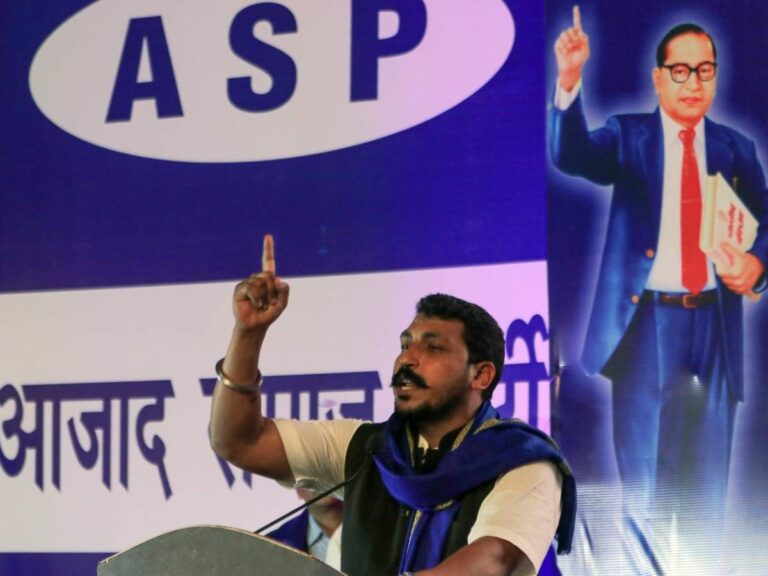
Bhim Army Chief Chandrashekhar Azad recently announced that his party, the Azad Samaj Party, will contest Vidhan Sabha elections in Bihar this year, and that the party has started preparing for the same. Criticising the current JD(U)-BJP government, he said that half of Bihar is still flooded, and the problem of unemployment is very prevalent in Bihar, with large numbers of people migrating to other states for work.
Officially launched on March 15, 2020, Chandrashekhar Azad asserted that the Azad Samaj Party was not just another political party, but rather a movement to reclaim the constitutional rights of every individual, especially the Dalits, tribal people, marginalised communities and women, and was firmly grounded in the ideals of Dr. B.R. Ambedkar and the political vision of Kanshiram. He said that this party aims to fill the void created by the unfortunate decline of the BSP, caused by the fact that the party brought upper-castes into positions of power.
Historically, the landowning status of upper castes in Bihar has not changed, sustaining even through changes in legislations through loopholes, and supported by a government dominated by upper castes as well. The domination of upper castes in the government changed slightly after the Mandal Commission and under the governments of Lalu Prasad Yadav and Nitish Kumar.
However, upper caste assertions have also stopped many attempts at increasing social justice, especially under the Nitish Kumar-BJP government, such as the disbanding of the Amir Das Commission that had been constituted to probe the role of the Ranvir Sena in caste massacres, and rejected the recommendations of the Bihar Land Reforms Commission, 2006-2008 which had proposed land distribution. The presence of the upper-caste militia that is responsible for massacres against Dalits and is still operational is also telling in understanding the dominance of upper-castes in Bihar, and violence against Dalits is extremely prevalant. This dominance and power is in stark contrast to the share of the population that the upper-castes have in Bihar, which is merely 15%. These castes can broadly be caterogised as Brahmins, Bhumihars, Kayasthas, and Rajputs.
With its message of social justice, and promise to prioritise the Bahujan of the state, the Azad Samaj Party’s participation in this election is extremely promising and if they win enough seats, can lead to a new era for gradually reversing the years of caste-based oppression in the state.








 “To any man who knows anything about Indian history…the temple of Jagannath [sic] is an old Buddhistic temple. We took this and others over and re-Hinduised them. We shall have to do many things like that yet. “