Hailing from Maharashtra’s Gadchiroli district, Mahesh Raut is a young prominent activist working for the rights of Adivasi communities in his district. Born in Lakhapur, a small village in Maharashtra, Mahesh completed his schooling from Gadchiroli and moved to Nagpur for graduation. He later went on to pursue higher education from the Tata Institute of Social Sciences, Mumbai. On completing his education he worked as Prime Minister Rural Development Fellow (PMRDF) in Gadchiroli. He has tirelessly advocated for laws like The Provisions of the Panchayats (Extension to Scheduled Areas) Act and Forest Rights Act which protect the democratic rights of indigenous communities against unlawful land grabbing by large corporations. Mahesh has consistently worked to protect and promote the rights of the marginalised within a Constitutional framework. On completion of his fellowship, Mahesh decided to continue working with the Adivasi communities in the State.
Mahesh organised and participated in mass movements to abet the cause of social welfare. He was the co-convenor of Visthapan Vidrohi Jan Vikas Andolan (VVJVA) which fights against the forced displacement of Adivasis and other marginalised people. As a member of VVJVA, Mahesh organised the Tendu leaves workers from Adivasi communities of the region to sell them directly in the market without the involvement of middlemen.
Along with campaigning for the Adivasis of the region, he also joined the Bharat Jan Andolan (BJA), an organisation started by late BD Sharma. Through his work with BJA, Mahesh has been instrumental in organising people for participative decision making in regions affected by mining projects, including the Surajgarh mining project.
His work against the atrocities of Police and several State authorities led to several cases being filed against him. According to a letter drafted by his PMRDF fellows, the State’s crackdown on Mahesh started from 2013 citing his consistent political engagement as one of the reasons for his harassment. His friend and fellow activist Sohini Shoaib, working in Bihar writes about her visit to Gadchiroli, “Mahesh was highly loved and respected in all these villages and one with the people I visited. They treated him as if he were a member of their own house! Some of them even tried to get me to convince him to get married: they thought he worked too hard and did not take care of his health enough. They hoped that finding a partner would help him feel less lonely, help him balance other aspects of life!”
In 2018, Mahesh was picked up by the Pune Police for his alleged involvement in organising the Elgar Parishad and his alleged Maoist links. He was booked under sections of the UAPA and arrested from his residence in Nagpur. Neither was he involved in organising the Elgar Parishad nor did he attend the 31st December events. His arrest is a clear crackdown of the State on Human Rights defenders who are struggling against the State and Corporation’s nexus. His contributions to promote and uphold the Constitutional rights of the marginalised identities have led him to persecution and consequent imprisonment. His incarceration is a standing testament of the State’s repression of Rights’ activists who protect the values of the Constitution which the same State is trampling upon.
The article is written by Bhima Koregaon Defence committee.
Surendra Gadling holds significant knowledge in special laws such as MCOCA, POTA, TADA, UAPA has handled many cases before various forums, including before hon’ble high court for the last 24 years. His professional work, which is his fundamental duty and is part of ensuring the fundamental rights of the accused person has brought him many enemies within the Police Machineries. Players there have been threatening him from time to time. However, those were hollow threats meant to intimidate and distract petitioners from the trial, and as a matured person petitioner chose to discourage them by discarding them.
During the time he has served people in conflict with the law, he had to handle many high profile matters, which had got publicity amongst masses and much of police attention.
His appointment as Special Public Prosecutors on demand by Women organizations, deploying of heaviest police bandobast, cordoning off-court premises, issuing alerts on the court hearing days, Police has thrown its absolute weight behind such cases. Despite all that, Gadling has been successful in convincing the courts of law about the innocence of the persons and discarding of ridiculous allegations. Among the persons Gadling defended many were charged with UAPA/TADA and labeled as terrorists or Naxalites. Some of these names will definitely be part of the history for their contribution towards society.
To name a few, Gadling represented Mr. Arun Ferreira and Mr. Dhanendra Bhurile, Vernon Gonsalves, Sudhir Dhawale.
Not only this Gadling has been instrumental in fighting cases of many activists coming from divergent ideology. He was one of the forefront lawyers in Khairlanji Hatyakand aftermath, Jawkheda Hatyakand, Manorama Kamble Hatyakand, Kawalewada Sanjay Khobragade murder case, Ramabai Ambedkar Nagar Hatyakand agitation cases, cases pertaining to fake encounter.
He was also part of the Bhima Koregaon riot fact-finding team. In one such dowry death case, women organization carried out extensive agitations demanding appointment of the petitioner as Special Public Prosecutor. After his appointment, despite a hostile investigation team, he managed to prove the case beyond reasonable doubt and obtained the conviction of the husband. After completion of the case, as a duty of prosecutor, the petitioner wrote to the higher-ups in the police department seeking stern action against police officers from the investigation team for their divisive role.
Advocate Surendra Gadling | Picture Courtesy: Huffpost
The above apart, being a lawyer, petitioner has played a major role with respect issues related to backward communities, in defense of reservation, in defense of the independence of the judiciary. He was instrumental in organizing much mass awareness public meetings on various human rights issues. He was equally instrumental in conducting fact-finding on various human rights issues in association with senior retired judges from the High Court And Supreme Court. He has been a voice against persecution of the lawyers by the police machinery. He had conducted fact-finding in Chhattisgarh and brought out a report about persecution and harassment of lawyers who take up cases pertaining to tribals trapped in UAPA cases.
Suffice it to say, the role of Gadling as a lawyer, as an activist has been quite unpleasant for power holders in the police department. For, his entry to the defense side would alter the outcome of the case.he as such has fearlessly defended many even when there was strong objection from bar associations, negative publicity in media and more importantly there was open threatening from investigating bodies. Given his act of defending those who are categorized as Naxals, police officials have made efforts to rope him in one or another way. There have been many instances when police officials have conveyed their displeasure towards him handling these cases or representing such accused person in various ways.
That during the famous trial of Prof G N Saibaba, Mr. Bawache the then Investigating Officer, in that case, had said it in the court premises itself that once Saibaba is sent to jail it will be the turn of Advocate Surendra Gadling. This particular threat was given right in front of juniors/associates of Gadling. It was clear that the threat was administered only to ensure that the defense counsel does not dare to function with a free mind. True to his threat, Mr. Bawache even got one of the surrendered Naxalite to give 164 statements in which he has attributed some of the most ridiculous allegations against Gadling. He is the same officer who is closely supervising along with some more unknown officers, the present case without officially being part of the investigation. Gadling though was never intimidated by such threats since the 1990s, the time when he had to keep his anticipatory bail order in his pocket on the day of his marriage. However this time the collusion of Police with BJP at center and State managed to find out a way to silence him temporarily.
But how could you silence a born activist? In Yerevan prison too Gadling’s legal advice helped more than 10 inmates to get out of prison. that’s why his stay in Taloja is made very much uncomfortable these days.
Gautam Navlakha launched an Independent Initiative on Kashmir in the 1980s and that was when we had some serious discussion on the Kashmir question at Delhi University. Many of us were so far confused about the way to formulate the J&K issue and most people were unaware of the historical facts. Gautam, then with the Economic and Political Weekly, was among the few who clearly underlined the political question of self-determination that was at the center of the debate. Gautam was among the very few who had grasped the issues, personally investigated the ground situation in Jammu and Kashmir, produced many fact-finding reports which shaped the thinking in the civil liberty movement in India. It helped all those who were keen to understand the underlying currents and pledge solidarity with the people of J & K.
As violence and counter-violence increased and repression by security forces and attacks by militants persisted, Gautam and the civil liberty activists in India and in J&K were the voices of sanity stressing the importance of respecting human rights and democratic process in J&K. Gautam and the forces of the democratic rights were the most solid links of the unity of people of J&K and the rest of India. And this solidarity has grown over the years as we can witness it today.
Today as the struggle for democracy in J&K goes on amidst severe repression, Gautam Navlakha is in jail in Pune as one of BK 12 (Prof. Hany Babu of Delhi University became the 12th a few days ago) – accused in the Bhima Koregaon Case including famous poets, lawyers, academics and social workers. This false case illustrating how the Indian state felt threatened by human rights workers has evoked strong protest all over India and abroad against the arbitrary arrests and denial of bail even in the face of the COVID infection.
The work done by people like Gautam Navlakha continues to inspire the struggle for democratic rights in India and in J&K. I had the privilege to work with Gautam in PUDR ( People’s Union for Democratic Rights, Delhi) and PIPFPD ( Pakistan-India People’s Forum for Peace and Democracy) for over three decades. He represents that generation of activist intellectuals whose determination, clarity of purpose, and fearlessness continue to inspire a generation of democratic youth.
Our struggle for democracy will continue despite all the challenges and we will surely see Gautam and the entire B K Twelve out with us soon in person to guide us forward.
Stand with the People of Jammu and Kashmir!
Demand restoration of Article 370!
Demand restoration of Statehood of J&K!
End military rule, Enforce Constitutional Rights!
Today, India celebrates its 74th independence day. There is a remarkable show of felicities. It appears that democracy in India is utopian, worthy of an occasion. But only on the surface. Countless numbers of social workers, activists, professors, students, and ‘’citizens of India’’ have been languishing in jails for being mere receptacles of opinions. It seems as if one can get away from owning illegal firearms but not incendiary ideas.Democracy in a fascist regime seems like a perfect cathedral worthy of worship. Yet no one can truly live in it. One can sing carols of its perfection, but it can provide a home to none but the pompous priests, the stalwarts of the regime. Like a cathedral, the call for a witch hunt is on the cards of its stakeholders.
One is made to respect the freedom struggle for the ethos of courage, resilience, and servitude to the idea of emancipation. But the freedom struggle today is a textbook fable and its emulation capable of leaving one a political prisoner.
The Independence Day celebration today will be a remarkable achievement for the BJP regime, which has overwritten the Nehruvian narrative of Kashmir. By disinclining Kashmir from an autonomous state to a union territory, the BJP has created its own mark in history. Kashmir ricochets from one political party to another without any reassuring future of its own. While one independence day to another fosters Kashmir territory as indelible to the Indian map, the people of the valley… not so much. Lakhs of people have been made to disappear, killed, made prisoners. They do not have access to Habeas corpus or the legal remedies of the constitution. Yet they are governed by this same constitution, or to put something incendiary into words, made prisoners of it. For, if rules and maxims only provide to imprison you and not liberate you, they are a textual dungeon. Yet prisoners of Kashmir differ from other prisoners of the “textual dungeon” of India because unlike Indian prisoners, they disappear from all paper and record. Thousands of dissenting Kashmiris picked up at night, “their history is only a memory”. One can be an unprivileged youth imprisoned for mere sloganeering. Or one can “debate’’ on primetime TV to reiterate how liberal democracy truly is. It is quite possible to be the wrong person at the perfectly right place. One can heckle a politician at a primetime studio about military excesses in a village in Kashmir, but one must never raise an opinion at ground zero itself. For, words can be levelled off as weapons, at the right place. Let me explain myself more. A political prisoner can spend as much time in jail as a gun yielding militant. But is it possible to imprison a suicide bomber with his vest past explosion? Or to imprison a person for a thought that departed? For something that crossed my mind yesterday? Could that lead me to prison today? Tomorrow? Or in the future? To arrest someone in the retrograde past making their future a fugitive?
The mere act of arrest for an opinion, a demonstration, a cartoon, makes the democratic structure appear weak. For a house made of cards, even the breeze is a threat.
The mere act of arrest for an opinion, a demonstration, a cartoon, makes the democratic structure appear weak. For a house made of cards, even the breeze is a threat. Political dissent threatens to reveal a festering rot within the political structure. And for majoritarian political regimes which express the rot of communalism, casteist politics as their garlanding image of edification, dissent translates as a danger. A danger that threatens to strip naked the emperor’s new clothes. Any person that threatens the government to address its shortcomings appears as a paramount enemy.A soothsaying prophecy of a future where people are arrested and made prisoners for having ideas is our horrible truth.While one may grow up reading about legal remedies for those arrested, one super exceptional law after another, not mentioned in textbooks, overwrites it. While Article 22 may prevent arbitrary detention, POTA, AFSPA and other acts may allow so. Yet elementary textbooks do not mention them in the same paragraphs as legal aides that provide emancipation to political prisoners. Isn’t it essential to let youth know, that freedom comes with fetters?While the CAA/NRC law may provide relief to “persecuted minorities’’ it does the exact opposite to those bereft of its scheme. On entering India, a Muslim becomes an immediate minority much subject to communal profiling. The persecution that the beneficiary was subject to in his homeland is now meted out to those bereft of the protection of CAA/NRC, i.e, the Muslim. By being subject to detention camps, racial profiling, degrading subjective treatment, the message of NRC seems insidious. To protect one minority while derailing another. To bolster the political extempore and narrative of the majoritarian political party. While the surface may suggest an empathic plea to protect a community, the deeper strata reveal shallow vote bank politics. But to voice, an opinion against it may lead one to prison. So, one must merely stay silent or worse. Celebrate the show. Or become the rot that threatens to imbue decay in the entire structure. One must then celebrate the Indian Independence Day and the spirit of the freedom fighters who fought against unlawful detention. While closing eyes on our own freedom fighters today.On March 23, my close friends Devangana and Natasha were detained for peacefully protesting against riots in northeast Delhi that left 51 dead. They are still detained with no closure of release.Mehreen Shah is a student at Delhi University. She is from Kashmir but living in Delhi currently.
In his seventh Independence Day address to the country as the Prime Minister, Narendra Modi hinted at various policies and projects that are either in the works or have been implemented recently. For anyone listening to Modi’s speech, all policies mentioned by him and every single action taken by this government seem to be taking the people of the country in a positive direction, especially helping those who are disenfranchised. However, it is through vague and contradictory language that many extremely dangerous policies are being justified in this speech.
Atma Nirbhar India and Privatisation
Modi’s speech focused on his new ‘campaign’ of Atma Nirbhar India. Although ‘Atma nirbhar’ means self-reliant, these policies are aimed at making the state reliant on private capital, both national and foreign. This is made clear when he says that it’s commendable that there has been an 18% rise in FDI (foreign direct investments). This also means that in this scheme of ‘self-reliance’, foreign capital is welcomed as long as the production takes place within the country. What this flowery language of ‘India’s potential’ hides is that foreign capital is most interested in investing in India due to the cheap prices of labour and resources created by government policies that give a free pass to exploitative labour and land-grabbing by corporates. Under this ‘campaign’, the Finance Ministry has declared 18 strategic sectors, outside of which all sectors will be completely privatised. In the strategic sectors, the government will start disinvesting and merging PSUs to the point where there will be only 1-4 public companies in each sector. The strategic sectors include banking, insurance, steel, fertiliser, coal, petroleum, defence equipment, power generation, and so on. In Modi’s speech, he refers especially to the space sector, saying “today, we have opened up our space sector to the private sector. When India’s space sector grows, our neighbours and the world benefits from it too”. Firstly, there is no explanation regarding how exactly we will ‘grow’ when the space sector is privatised. What may grow is the private sector’s profit. While India’s space sector has always had private participation, increased privatisation will have many harms. D. Raghunandan writes that previously most of ISRO’s endeavours have focused on developmental applications over national ego-boosting, but commercial players may not want to invest in application-based endeavours anymore. Further, since most space applications have dual civilian and military functions, private access can have undesirable consequences. Modi’s speech also refers to ‘self-reliance’ in agriculture, referring to the government recently passing three ordinances regarding agriculture. Modi says in his speech, “India has recently removed all restrictions from the agriculture and farming sector. This will benefit our farmer brothers and sisters immensely”. What he doesn’t mention is that ever since this ordinance has been passed, farmers organizations across the country have categorically rejected it and come out in protest against it. Not only have these ordinances not addressed the distress faced by farmers during the pandemic, but have rather sold their rights to private capital. The ordinances allow anyone to buy and sell agricultural produce, which will lead to big corporates making direct deals with farmers with little bargaining power. They also give legal sanctions to contract farming, which may lead to exploitative, precarious labour, and does not address the existing forms of exploitative contract labour between landless labourers and landlords.
New Education Policy and Digital India
Modi’s speech brought up the NEP saying that it will ‘will shape the India of the 21st century’. The NEP, which uses a lot of buzzwords like ‘inclusion’ and ‘interdisciplinary’ to appear progressive, has been criticised to create increased privatisation and brahminisation of education, and increase inequality of education. This will affect marginalized groups disproportionately since upper-class, upper-caste Indians will opt for private education, while others will be pushed into vocational education, withdrawn from English education, and prepared to go into technical and manual labour. Further, the stress on online education in the NEP has been criticised for not only creating inequality in education due to lack of access to technology but also to increase corporatisation and homogenisation of education and diluting its social character and critical potential. Similarly, Modi’s speech mentioned that he is launching a ‘National Digital Health Mission’. He says, “Every Indian will get a Health ID card…one Health ID will have the information of every test, every disease, which medicine was prescribed to you by which doctor, what the reports were”. Already in Kashmir, due to the lockdown and internet blockade, many people who had availed of the Ayushman Bharat National Health Insurance, could not access it as it was only accessible through e-cards. In the months before lockdown, the government frequently created internet blockades in areas where state repression or violence was taking place. This digital health card will create an additional form of repression when the State wants to control the people of any area. It will also increase the inaccessibility of healthcare, as the large numbers of people without certain documents or unable to navigate certain bureaucratic procedures are not able to access healthcare.
The PM said that this has been one year for this ‘new journey of development’ for Kashmir, and one year of rights for the women, Dalits, and refugees in Kashmir. After the abrogation of Section 370 and 35(A) in Kashmir on August 5, 2010, the people of Kashmir have faced immense violations of their human rights with indiscriminate arrests and violence and a complete communication blockade. The ‘development’ that he speaks of in Kashmir is nowhere to be seen, as education has been shut almost completely for more than a year, and students facing psychological distress. The healthcare system that was already overburdened is now reeling under the pressure of the pandemic, with doctors not being able to access the latest information, the community not being able to educate itself on the disease, lack of communication hindering treatment, and lack of medical equipment. Kashmiri doctors who have spoken up about these issues have been arrested and harassed. The region has suffered losses worth Rs 40,000 Crore, livelihoods have been devastated due to the lockdown, and unemployment has at its highest. None of this is mentioned in the speech. As for Dalit’s and women’s rights, it is an insidious way of undermining the brutal exploitation of Dalits that takes place under the Indian state, and the lack of women’s safety that is so prevalent that even the Supreme Court is not immune. In fact, in a report on July 22, a Dalit Sarpanch in Kishtwar, Kashmir, resigned after being tortured by an upper-caste BJP leader. Various reports have outlined the human rights violations and violence that Kashmiri women have suffered at the hands of the Indian military.
Climate Change
The PM said about climate change, that it is “of great concern to us, and we are focusing on clean energy and solar power to take us forward and ensure that our per capita carbon foot is reduced”. Recently, the Ministry of Environment, Forest and Climate Change (MoEFCC) proposed the draft Environmental Impact Assessment (EIA) notification 2020, which was opposed by people across the country due to its anti-environment agenda.The draft has exempted 40 kinds of industrial projects from requiring clearance by an expert committee and public consultation. These industries are known to be extremely harmful to the environment, including clay and sand extraction or digging wells or foundations of buildings, production of halogens, chemical fertilisers, acids manufacturing, biomedical waste treatment facilities, highways or expressways, offshore and onshore oil, gas and shale exploration, hydroelectric projects, and so on. The draft also excludes reporting by the public of violations and non-compliance, meaning that communities affected by modernization and development projects will not be able to legally resist them. Three environment advocacy groups that raised concerns about the draft EIA were censored by having their websites blocked as well. Meanwhile, the government has also privatised the coal sector and will be auctioning almost 40 coal blocks in environmentally valuable and Adivasi populated areas, to private companies, ignoring the opposition of Adivasi groups and state government’s decisions.
On the evening of December 12, 2019, soon after addressing a crowd of around a thousand protestors, Akhil Gogoi, leader of Krishak Mukti Sangram Samiti (KMSS) was arrested in Jorhat, Assam. KMSS is a renowned peasant organization in the region. It has been eight months of his wrongful incarceration with one after another botched up charge used against him, with no respite even after he was infected with the Coronavirus.
On December 13, a sub-inspector lodged a complaint in Guwahati claiming that Akhil Gogoi had “secretly merged” KMSS with a Maoist outfit called Revolutionary Communist Centre in 2009. The FIR alleged that after merging the two, Gogoi had arranged several meetings and “visited several parts of India including Delhi to further the activities of the proscribed organization”. The FIR further states, “As part of the larger conspiracy of CPI (Maoist), he and others have knowingly abetted, conspired, advocated, incited the acts preparatory to the commission of terrorist acts”.
The NIA registered a case against Akhil Gogoi on December 14, 2019, under IPC Sc.120B/124-A/153-B and UA (P) Act, 1967 Sec. 18/39. The charges included that KMSS had used the passage of the CAA in the parliament as an opportunity to create enmity between different groups on the grounds of religion, race, place of birth, residence, language “and done acts prejudicial to maintenance of harmony, using visible representations and spoken words, thus endangering the security and sovereignty of the state which is prejudicial to national integration.”
Gogoi was consequently sent to NIA custody for 10 days in Delhi and is lodged in Guwahati Central Jail since December 26, 2019. Almost all the top leaders of KMSS were put behind bars within a month, with the UAPA was slapped against four of them.
This however is not the first time that Gogoi has faced such a series of fabricated charges against him only to prolong custody and thereby break the momentum of any widely popular movement. On October 2, 2016, when protests against CAB began gaining impetus with Akhil Gogoi at the fore, Gogoi was picked up from Gandhibasti, Guwahati in connection with an earlier case of inciting protestors during an eviction drive against illegal settlers in and around the Kaziranga National Park. He was later sent to Lakhimpur Jail. He was remanded to a 14 days judicial custody on November 2, 2016, only to be re-arrested in connection with a case from 2006, and then again arrested, while in Golaghat Jail, for another case from 2015. He was released after 78 days of incarceration, but was arrested again on September 25, 2017, and slapped with the NSA.
If one goes through this maze of arrests and re-arrests, one doesn’t need to be a legal expert to realize that this is a gross travesty of justice systemically carried out by the BJP government in Assam to muzzle voices of dissent.
Akhil Gogoi’s journey of activism has never been a smooth one. It was not the mainstream regional parties, but Akhil Gogoi led KMSS which had been a strong opposition to the Congress government in Assam. As an RTI activist, Akhil Gogoi exposed scams and corruption by the then government and simultaneously led many mass movements against forceful evictions, corporate land grab, construction of big dams, along with protests for land settlement and forest rights of the local populace.
Ever since its inception in 2005 after actively being part of an anti-eviction movement in Doyang and Tengani, KMSS has stood by the struggles of the working class and peasants of Assam, fighting for their rights, resisting state exploitation and successfully intervening in inhumane and communally motivated multiple eviction drives. As an organization for the peasants and indigenous people, ensuring land rights of the Assamese people of all ethnic groups and communities demanded priority. The question of land cannot be overlooked for the region when one is trying to understand conflict and insecurities that unfolded over time. Eventually, they devised a well thought out Land Policy and continued the movement to guarantee land rights to the working people of Assam. Their efforts could secure land pattasforaround 20000 tribal villagers so far. KMSS had also initiated several movements against corrupt village panchayats and sent many village heads and district officials to jail.
After an abandoned oil well at Dikom caught fire in 2005, it took 45 days to bring the situation under control, and in November 2006, KMSS declared its opposition to the seismic survey for locating oil reserves in the Brahmaputra river bed undertaken by Oil India Limited (OIL). KMSS maintained that oil exploration in the highly eco-sensitive Dibru Saikhowa National Park area could be a serious threat to the local ecology and population. Unfortunately, as apprehended, the Baghjan oil rig recently caught fire causing enormous and irreparable damage to the lives of people, livestock, and the surrounding ecosystem.
KMSS asserts that its main aim is to fight the neo-colonial capitalist exploitation of the resources that belong to the people of Assam. Its opposition to big river dams, privatization of water, river linking projects, Special Economic Zone (SEZ), etc is part of its ideological fight against the neo-colonial agenda of the big capital.
KMSS leaders successfully launched a movement against unregulated Micro Finance institutions which had proved to be an affliction and had cost the lives and property of many. The schemes would mostly be availed by women as economic support, and thereby the protests demanding better control of these institutions by the Government saw huge participation of women in villages and small towns across Assam.
Ranging from the Assam Public Service Commission corruption scam in which the chairman was finally sent behind bars, to exposing many powerful politicians involved in scams, including Himanta Biswa Sarma, through RTI, Akhil Gogoi had been an unapologetic and uncompromising dissident. The NIA, while conducting raids at his house after his recent arrest, was looking for many such files which names political leaders and business tycoons.
Gogoi caught national attention with the successful and famous campaign against the construction of big dams, precisely the Lower Subansiri Dam, in 2007. The NHPC’s 2000 MW Lower Subansiri Dam work has been stalled since 2011, because of protests by KMSS. KMSS had also been opposing the unlawful construction of toll gates and exposing coal syndicate in the state.
After the BJP introduced the Citizenship (Amendment) Bill, 2016 to further their Hindu Rashtra project, under the abled leadership of Akhil Gogoi the entire state of Assam rose in unison against the Bill, with fervent protests starting in 2016. This was because the historical questions of nationality and migration in the Northeastern states have not been resolved, and the current regime was hell-bent on removing whatever little formal-level autonomy any indigenous community had, an issue that does not seem to concern the mainland India.
Gogoi wrote while he was in Golaghat Central Jail in 2016, “The issue of granting citizenship to Hindu Bangladeshi’s cannot be seen from the vote bank perspectives of Congress and the BJP . . . Even before independence, the RSS or the Sangh Parivar have been devoted to making India a ‘Hindu Nation’. The ‘Hindu Nation’ of the RSS is not only a mere Hindu nation, their Hindu nation is a capitalist state erected on the base of Hindutva which will have an imperialist character, i.e., it will have a goal of oppressing the small neighboring nation-states. Although the base of the state is capitalist, it is always controlled by the Hindutva superstructure. Their aim is to build an India which is Hindutva from outside, with a capitalist, free, neo-liberal economy from the inside (this Hindutva is not of the Dalits, tribals, so-called lower classes and the poor, this is casteist Hindutva controlled by the upper castes) . . . They are trying to destroy the independent and distinctive character of Assamese community and build it up as an imitative community of an Indian character so that it will be easier to loot the market of crude oil, coal, limestone, water, tea, as well as to enslave a historical nationalist force . . . The Assamese people will be made to fight among themselves, and then our national goal would be to fight among ourselves in Assam.”
What followed were massive and continued protests across the state and in Delhi having dialogues with Rajya Sabha members, led by KMSS because of which CAB could not be passed in the parliament in December 2018. But the BJP government, after coming to power for the second term in 2019, adamantly passed the CAB and made it an act which resulted in new and massive waves of protests across Assam and the country. As the government continued to hound democratic activists, KMSS leadership was targeted and put behind bars.
The NIA had failed to file a charge sheet within mandatory 90 days, which warranted Akhil Gogoi’s release but he was immediately arrested for other cases, transferred from one jail to another within the state. Gogoi had secured bail in all the cases, but to maintain his custody, frivolous charges were pressed again. The most recent one filed by the NIA on May 28, 2020 accuses Gogoi of torching a Circle office, a post office, and a Bank at Chabua on October 12, 2020 and another one accuses him of breaking a police officer’s nose by pelting stones.
On July 7, 2020, Gogoi was detected COVID positive, and massive protests rocked the state of Assam demanding his release and immediate medical attention. Though he was treated at the hospital, his bail was again rejected for the Chabua case and he continues to be in prison.
The tortures and killings in police and military custody continue to haunt the people of the state of Assam. By continuing to raise these concerns, Akhil Gogoi and his associates, have ironically become the state’s enemy kept behind bars.
Rahat Indori – the poet of the masses has passed awayas I sit down to write this article. His poetry seemed like cannons fired to the rulers who spread communal hatred. He was raged against their conspiracy to take away citizenship.
Sabhi ka khoon hai shamil yaha ki mitti me
Kisi ke baap ka hindustaan thodi hai..
Roughly translated to
Everybody’s blood and sweat have gone into the soil, it does not solely belong to any one person or community.
When he wrote-
Mein jab mar jaun, meri alag pehchaan likh dena,Lahoo se meri peshani pe Hindustan likh dena
Roughly translated to – When i die, write a unique identity for me, Write Hindustan on my forehead with my blood
Listening to it one can understand the anxiety and pain with which he had sung the songs of dissent. He was a loud voice in the protests. It was the need of the time to have Indori with us today when fascism has divided the whole country into lines of Hindu-Muslim religion. But can anyone defer death? We need to understand and believe that Indori who is no more with us would be much more influential than when he was alive.
As foundation stone for Ram Temple is laid at Ayodhya. The ones who had claimed that ‘… Mathura Kashi Baki Hai …’ are now heading to Krishna’s Mathura and Vishwanatha’s Varanasi. The hatred and destruction will continue to rise.
The one to solve Baba Saheb Ambedkar’s Rama-Krishna riddles is yet to come. On this occasion of Krishna Janmashtami, we should recall Hasrat Mohani, who truly believed in a fraternity.
The society that we live in today is in such marked contrast that one cannot even imagine coming together of Mathura’s Sri Krishna, Lenin’s Communist Russia, and the Islamic faith that Hasrat believed in. However, Mohani was a strange yet stubborn man who saw all these functioning together. He worshipped Krishna, Communism, and Islam together.
Syed Fazlul Hasan was popularly known as Hasrat Mohani (1875-1951). Hasrat was his pen name and Mohani comes from the Mohan, the town he was born in Unnao District of Uttar Pradesh.
He was a freedom fighter and an accomplished Urdu poet. Mohani’s poetry has been praised by critics and writers. Mohani responded to the political changes of his times through poetry, journalism and revolutions. He was a romanticist in poetry and a revolutionary in politics. He has authored many books and so did many about him.
Mohani was a rebel. He broke the accepted frameworks of values and traditions. He is one of them who adapted the political and social realities of their time into their literature. He was vehemently stubborn. To reconcile was not his way. He had advocated for ‘Complete Independence’ when Bal Gangadhar Tilak demanded ‘Home Rule’. However, he admired Tilak and wrote poems about him in his paper. He opposed both Gandhi and Jinnah. He was very much against the Partition.
Hasrat Mohani is seen with Dr BR Ambedkar
He was a staunch critic of the self-reliance doctrine advocated by Gandhi. He argued that the emancipation of the poor does not lie in how one spins the charaka. He was inspired by the Russian Revolution of 1917 led by Vladimir Lenin. He is said to have met Lenin. Though there is no evidence that Mohani met Lenin, it is certain that Mohani had met Stalin and discussed guerrilla warfare.
Mohani was a member of the Constituent Assembly. He was close to Babasaheb Ambedkar. He was the only member of the Constituent Assembly who did not sign on the final draft of the constitution. While some people say that he did not sign the draft constitution on his disagreement about the division of the country, others opine that he did so as he felt that Muslim communities’ issues were neglected.
Urdu Literary critic Akhtar Payyami said about Mohani that it was a strange phenomenon wherein Mohani, who was an avid scholar of Islamic thought and being profoundly religious, came across as an extremely romantic poet. Mohani’s lifestyle was very simple. He was inspired by socialist principles. He ran an Urdu newspaper. He had published an article challenging the British colonial policy on Egyptian education. He refused to spell out the name of the author despite tremendous pressure to do so. He carried the complete responsibility of the article. The British government accused him of treason and he was awarded a severe prison sentence. It was a sentence of heavy physical exertion of grinding 37.3 Kgs of wheat every day.
It was in the 1920s that the First Conference of the Communist Party of India was held in Kanpur. Mohani himself was the chair of its organizing and reception committee. He coined the notable slogan ‘Inquilab Zindabad’ (Long Live the Revolution!). Mohani identifies himself to be a believer of the Sufi tradition and a Communist Muslim.
Mohani was the pilgrim of the Muslim pilgrimage – Hajj Yatra eleven times. Yet, he did publish poems deeply worshipping Sri Krishna – the Hindu God. He used to visit Mathura to celebrate Krishna Janmashtami. He was a poet who memorized the poems that he sang while grinding wheat in the prison and noted them when he was released from the prison. There are also poems that he wrote when he was imprisoned in Pune’ Yerawada Jail accused of treason and was yearning to visit Mathura on Janmashtami.
Translated from Kannada to English by Shashank SR
The exclusive CCTV footage videos now available with gaurilankeshnews.com of the Sringeri incident reveals alarming developments. The whole perception towards the incident has changed within two days as Chikkamagaluru police have got new evidence of the incident in the CCTV footage. Chikkamagaluru police have been able to solve the case under the supervision of Super Intendent of Police.
A tense situation arose when a green flag had fallen over Shankaracharya’s statue at Sringeri in Chikkamagalur District, Karnataka. The BJP and far-right organizations led by former minister Jeevaraj had protested. They had alleged that the flag belonged to the SDPI (Social Democratic Party of India) organization and that SDPI had worked behind the incident. They also had demanded the government to ban SDPI.
The best case in example is how Shobha Karandlaje, BJP MLA from Udupi-Chikkamagaluru, and Vice President of BJP in Karnataka tweeted that “SDPI had Planted flag over Shankaracharya’s Statue and had incited violence.”
5. Planting SDPI flag on Sri Shankaracharya's statue in Sringeri & inciting violence.
It's high time that, Govt led by Sri @BSYBJP recommends central govt to ban this terror outfit.
Orgs like SDPI & PFI are threat to mankind, national security & for a harmonious society. 3/3 pic.twitter.com/qey1F2WIuc
However, the police have now cracked the incident by with the aid of CCTV footages that they collected and have arrested Milind – the accused. According to the Police, “Milind has stolen the flag from the mosque to when he was drunk and felt cold.”
The police had earlier had arrested Milind in a case of theft. People of some organizations had come into to get him released and in that backdrop, the investigation is continuing. It remains to be seen whether the same organization participated in the protests and wanted to shift the blame over to someone else.
Ever since the violence took place in Bangalore’s KG Halli and DJ Halli, the BJP and right-wing outfits have been actively demanding the banning of Popular Front of India (PFI) and Social Democratic Party of India (SDPI).
Watch the CCTV Footage of Milind stealing the flag from the Mosque here:
ಶೃಂಗೇರಿಯಲ್ಲಿ ಮಸೀದಿಯಿಂದ ಬಾವುಟ ಕದ್ದುಕೊಂಡು ಹೋಗುವ #ಎಕ್ಸ್ಕ್ಲೂಸಿವ್_ವೀಡಿಯೋಬಿಜೆಪಿ ಹಾಗೂ ಬಲಪಂಥೀಯ ಸಂಘಟನೆಗಳು ಘಟನೆಗೆ ಕೋಮು ಬಣ್ಣ ಹಚ್ಚಲು ಪ್ರಯತ್ನಿಸಿದ್ದವು….
Varavara Rao, 80-year old Telugu revolutionary poet, now incarcerated in Bhima Koregaon case and ailing in Nanavati Hospital, should not be left to die, as he is a symbol of people’s poetry, chronicler of people’s movements, upholder of popular democracy and rule of law, a teacher and a public speaker. One can gauge his popularity from the world-wide upsurge of expressions of protest against his imprisonment and solidarity with him, pouring in for the last ten days.
Rao was one of the founding members of the Revolutionary Writers’ Association, popularly known as Virasam
Born in 1940, Varavara Rao was a brilliant student throughout his education. He wrote his first poem when he was 17 and won the then prestigious Andhra Abhyudayotsavallu award for his poem in 1958. He was the convener of Mitra Mandali, a weekly literary meet in Warangal when he was a second-year degree student. He finished his post-graduation in Telugu language and literature and joined Ph.D. in 1962 but due to family’s financial conditions, left Ph.D. to take up a teaching job in 1964. After working as a lecturer in a degree college for one year, he got an appointment as a Publication Assistant in Directorate of Audio Visual Publicity, Ministry of Information and Broadcasting, Government of India in 1965. However, he loved teaching and came back to a college in Mahabubnagar in 1966 and worked for two years there. In 1968 when a philanthropist set up a degree college in his home town Warangal in 1968, he was one of the first faculty to join there. He retired from the same college in 1998, and during his career there he held many responsible positions including Principal, Controller of Examinations and Head, Board of Studies. In 1978, he again revived his Ph.D. study and submitted his thesis in 1982 and was awarded a doctorate.
His thesis on the relationship between society and literature is considered to be a path-breaking study in Telugu literary criticism.
Varavara rao with family
He began writing poetry since 1957 and gradually evolved from vague Nehruvian socialist ideas of the first decade of independence to a sense of betrayal by the next decade and ultimately reaching a strong belief in people’s creativity and struggles to usher in change and a better India. Rao was one of the founding members of the Revolutionary Writers’ Association, popularly known as Virasam.
With about 15 volumes of poetry to his credit, he also contributed to social consciousness through socio-political, literary analysis, literary criticism, public speaking and in the last five decades, he became one of the social icons and a highly sought-after public speaker and commentator. He used all his popularity and prowess to help people’s causes, small and big and defied the powers that be. In this process, he earned the wrath of the rulers, of all hues.
Rao was first arrested under the Maintenance of Internal Security Act (MISA) in Andhra Pradesh in 1973. He was then arrested during the Emergency and was kept under stringent scrutiny. He survived many attempts to his life post-Emergency. He was among the forty-six accused of conspiring to overthrow the Andhra Pradesh government in the Secunderabad conspiracy case and was sent to jail once again in 1985. Rao was also an accused in the Ramnagar conspiracy case where he was alleged to have attended a meeting where the plan to kill Andhra Pradesh Police constable Sambaiah and inspector Yadagiri Reddy was hatched. He was finally acquitted of the charges after seventeen years in 2003.
From the early 1970s to 2018, he was implicated in 25 cases and the prosecution could not prove a single charge in a single case in law courts and he was acquitted in all of them. He diligently followed the judicial proceedings in each of these 25 cases.
His popularity among people was so high that the erstwhile governments of Andhra Pradesh, both in 2002 and 2004, asked him to be a mediator between them and the Naxalites in their talks. Previous UPA government at the Centre and at least three state governments, Chattisgarh, Odisha, and West Bengal also sought his help in handling similar situations. His respect for rule of law also saw him filing a number of cases seeking judicial intervention in times of police and executive excesses with regard to fundamental rights enshrined in the constitution. He got the courts come to the rescue of the victims or their families through all these cases.
He, along with 10 others, have been languishing in jails for the last two years as accused in a case, famously known as Bhima Koregaon case. During these two years, partly due to the lack of proper medical care and partly because of the negligence of police and prison administrations, coupled with the stress involved in imprisonment, his health deteriorated. Particularly he has been suffering from electrolyte imbalance and fall in Sodium and Potassium levels, leading to loss of memory, confusion, incoherence. A popular public speaker with eloquent oration and elephantine memory is now reduced to searching for words, incoherent delirium.
He being a person in judicial custody, it is the responsibility of the judicial administration to protect his life and maintain reasonably good health. As it is proved that the jail administration could not protect his health, even after treatment and discharge from JJ Hospital and he developed the same ailments within four weeks, it is imperative that he gets good medical care under the supervision of family, near and dear.
Dr. Kafeel Khan is a pediatrician and was working in BRD medical college in Gorakhpur. He was suspended from the hospital after a large number of infants died at the hospital due to encephalitis in 2017. He was made a scapegoat for the whole incident. He was jailed for 9 months. The court has no found any evidence of medical negligence against him. He was released.
Dr. Kafeel Khan was arrested again in December 2019 because he spoke at Aligarh Muslim University on Citizenship Amendment Bill (CAA), which is called discriminatory and advised students to get their papers in order. He was booked for this speech under NSA and he and his family are being constantly harassed with dates after dates and rearrests.
As of date, Kafeel Khan, a 38-year-old pediatrician has been in jail for 480 days. He is currently in jail under the draconian National Security Act, which allows for a person to be held without charge or a lawyer for one year.
The following article was written by Dr. Kafeel Khan for Gauri’s 2019 Anniversary Edition last September when he was traveling throughout India, setting up medical camps in remote villages in India.
Prior to BRD oxygen tragedy I never realized there is so much hatred in the society in the name of caste /religion /socio-economic status/region/gender/disability. Never realized who is Akhlaq, Junaid, Pehlu khan, Why Rohit Vemula had to commit suicide? What was Una Tragedy? Why Gauri Lankesh was shot? I was a common doctor who loved to be with children.
BRD oxygen tragedy happened on 10th August 2017, which killed many children. The reason was the stoppage of the supply of liquid oxygen due to the non-payment of dues to the vendor. To hide government administrative failure I was made the scapegoat and imprisoned for nine months, though I left no stone unturned in saving the lives of kids on that day. After 9 months of hard times, emotional & physical turmoil, when I was trying to start from the scratch they tried to kill my brother and what followed later was horrible, unacceptable, the insensitive attitude of UP police as they tried their best to delay the emergency operation to remove the bullets for many hours – the 2nd attempt of murder by UP Police.
Honorable Allahabad High Court categorically stated that there is no evidence of medical negligence against me. Still, I am suspended for the past 2 years and government-sponsored victimization continues.
I spent these days roaming all over India, meeting people -I asked all of them, the same question. What is your expectation from your government? Most of them answered good health facilities, good school, and employment, alas these days the government is talking about Pakistan, immigrants, Kashmir, Triple Talak. This overdose of pseudo-Nationalism and pseudo-Hinduism is poisoning the young generation’s mind so much that they are not able to see reality and are living in a delusion of grandeur.
Media plays in hands of government to portray a particular community as bigoted and hold this community responsible for all the problems the country faces today, in the process whip up sentiments against the particular population. Opposition parties instead of agitating on the ground are trying to hide behind soft-Hindutava. Most dangerous is that any voice who does not agree with the saffron brigade’s version; they are dubbed anti-Hindu anti-National whether its leftists, secularists, writers, filmmakers, or historians. Mob-Lynching is a fast emerging trend where organized crime was done and the murderer would shoot the video to circulate it on social media to instill fear psychosis to one community and pseudo-euphoria in another.
In her last weekly column, late Gauri Lankesh wrote on the death of children at the Baba Raghav Das Medical College and Hospital in Gorakhpur and criticized my removal.
Today I am writing this article on her 2nd death anniversary.
I want to be more positive, more visionary, more Indian to counter the aura created by RSS divisive ideology. So much negativity had been spread- to counter that we should talk of positive things, as I am trying with free medical camps, my book release, telling people all is not over. Health / Education /Employment is still the issue but these issues are buried in the name of religion or nationalism issues. We have to create demand – we have to tell/ counsel people.
Whenever I was asked, “Why you oppose Modi Ji or Yogi Ji so much ?” I answered each time with the same enthusiasm that its not Modi JI or Yogi Ji that I oppose. I oppose their ideology which is based on hatred and violence, I oppose RSS’s divisive policy which is trying to divide people in the name of caste and religion since its inception(1925). India’s foundation is based on Pluralism, Humanity, communal harmony, equality, so lets spread love & peace.
Lastly, I assure myself and those millions who are praying for me that my sanctification, devotion, and determination towards serving my countrymen would continue regardless of the obstacles created by this regime. Government sponsered victimization is not going to break my zeal, my enthusiasm, my commitment towards the society. These difficulties have made me more determined to achieve my objectives and to win against all odds.
Jai Hind Jai Bharat




 As violence and counter-violence increased and repression by security forces and attacks by militants persisted, Gautam and the civil liberty activists in India and in J&K were the voices of sanity stressing the importance of respecting human rights and democratic process in J&K. Gautam and the forces of the democratic rights were the most solid links of the unity of people of J&K and the rest of India. And this solidarity has grown over the years as we can witness it today.
Today as the struggle for democracy in J&K goes on amidst severe repression, Gautam Navlakha is in jail in Pune as one of BK 12 (Prof. Hany Babu of Delhi University became the 12th a few days ago) – accused in the Bhima Koregaon Case including famous poets, lawyers, academics and social workers. This false case illustrating how the Indian state felt threatened by human rights workers has evoked strong protest all over India and abroad against the arbitrary arrests and denial of bail even in the face of the COVID infection.
The work done by people like Gautam Navlakha continues to inspire the struggle for democratic rights in India and in J&K. I had the privilege to work with Gautam in PUDR ( People’s Union for Democratic Rights, Delhi) and PIPFPD ( Pakistan-India People’s Forum for Peace and Democracy) for over three decades. He represents that generation of activist intellectuals whose determination, clarity of purpose, and fearlessness continue to inspire a generation of democratic youth.
Our struggle for democracy will continue despite all the challenges and we will surely see Gautam and the entire B K Twelve out with us soon in person to guide us forward.
Stand with the People of Jammu and Kashmir!
Demand restoration of Article 370!
Demand restoration of Statehood of J&K!
End military rule, Enforce Constitutional Rights!


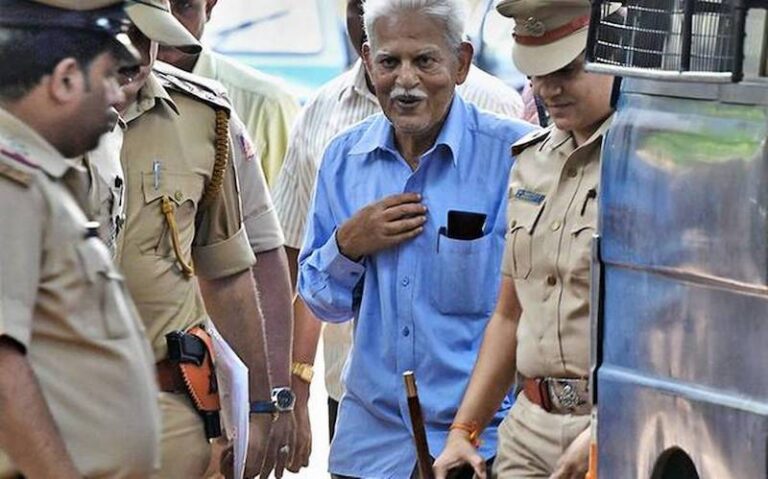

 Rao was first arrested under the Maintenance of Internal Security Act (MISA) in Andhra Pradesh in 1973. He was then arrested during the Emergency and was kept under stringent scrutiny. He survived many attempts to his life post-Emergency. He was among the forty-six accused of conspiring to overthrow the Andhra Pradesh government in the Secunderabad conspiracy case and was sent to jail once again in 1985. Rao was also an accused in the Ramnagar conspiracy case where he was alleged to have attended a meeting where the plan to kill Andhra Pradesh Police constable Sambaiah and inspector Yadagiri Reddy was hatched. He was finally acquitted of the charges after seventeen years in 2003.

