Republic Media Journalist Commits Suicide: Mass Lay-Offs in Journalism Industry

0

News of suicides across the country during the pandemic is showing a difficult truth about the lack of well-being and financial distress amongst workers in different sectors. One such sector seeing increasing uncertainty and distress is journalism, as a number of journalists have been reported to have committed suicide in recent times. 

According to a Workers Unity report, a reporter at Republic Bharat TV attempted to commit suicide in Varanasi on August 12. Rohit Shrivastav, who resided in a rented home in Raghuvar colony in Sigra Police Station’s jurisdiction. On August 8, his elder brother Gaurav had filed a missing person report, saying that he had been missing for four days. On August 12, it was found that he had jumped from the Vishwasundari bridge in Varanasi. He was taken out of the water with the help of divers and boatmen and admitted to the BHU trauma centre, where he succumbed to his injuries the next day. Republic Bharat TV, where he worked, is a Hindi news portal of the Republic Media Network. 

Rohit Shrivastav is not the only journalist to have committed suicide during the pandemic. On August 13, the Press Trust of India’s senior journalist PV Ramanujan committed suicide, and before that, in July, Tarun Sisodia, a journalist at Dainik Bhaskar who was being treated for COVID-19 at the AIIMS hospital in Delhi jumped from the hospital building and died. According to reports, he had been extremely troubled by the uncertainty of the lockdown and feared that he would lose his job. There have also been allegations that he was coerced into committing suicide or murdered, and enquiries have been launched. 

These suicides have happened in the context of large scale layoffs and salary cuts in the journalism industry. A report by Chitranshu Tewari on Newslaundry, one of the few publications which have committed to reporting on the journalism industry itself, explains that although labour law violations in other sectors find spaces in newspapers, workers in news media find themselves in precarious jobs as the media doesn’t report on its own industry, and there is a lack of laws to regulate the working conditions of journalists. While the Working Journalists Act provides protections against arbitrary terminations and protects workers under the contract system, the time and resources required to fight a legal battle are not available to most reporters. In fact, it took Hartosh Singh Bal, the political editor at the Caravan, five years to fight a legal battle against his former employer for wrongful termination. 

In the months after lockdown, various national and regional media houses have laid-off workers in large numbers. HT media laid off over 100 employees, ET Gujarati shut down and its entire team was terminated, Business Standard laid off around 85 employees over two rounds of retrenchments, Sakal Times laid off around 50-60 employees, and the Telegraph laid off around 35. Others include the Times Group, NDTV, and the Hindu. Extensive documentation of all the layoffs, salary cuts, and shutdowns of publications have been attempted by journalists here and here. 45 employees at the Quint were put on indefinite leave without pay. The 20 journalists who were terminated from the Hindu have sent a legal notice to their former employer saying that their termination was illegal as the legal dues were not paid. Air India put all of its casual employees out of work, which according to 2017 government data is around 13,810 people. 

However, what is especially distressing is the opaque and informal, and often unfair mechanisms through which these layoffs take place. Ranjita Rabha, a journalist at Prag News was pregnant at the time of the pandemic and the lockdown, and when she came to work she was told twice by the editors to stay home and rest. In May, Rabha, who had worked at the organisation for 10 years, was suddenly asked to resign. Her request for maternity leave, even without pay, was denied. According to a HuffPost report, many journalists were verbally asked to resign rather than enter a formal process of layoffs that involves a final settlement, in order to reduce costs for the management. When employees refused to resign, they were terminated, often without the legal dues. In Lokmat, a regional news publication in Maharashtra, many of the employees who were terminated had been working without contracts even after having asked for a contract repeatedly before. 

On April 16, the National Alliance of Journalists, the Delhi Union of Journalists, and the Brihanmumbai Union of Journalists moved the apex court to halt the prevailing layoffs, furloughs, and pay cuts in the Indian media during the pandemic. The Supreme Court has not yet received a reply from the Centre. 

While the media is occupied in the frenzy of Sushant Singh Rajput’s suicide and the conspiracies around it, the mental distress of their own workers caused by the precarity and uncertainty of their work does not find any space on the headlines. This epidemic of depression and stress will not end by finding a scapegoat but only by questioning the legal provisions for workers and economic structure of journalism in India.

Barring 18 Strategic Sectors, All Sectors will be Privatised: Finance Ministry

0
Eighteen strategic sectors have been identified by the finance ministry in a large scale move towards privatisation. The 18 sectors include banking, insurance, steel, fertiliser, petroleum and defence equipment. The 18 strategic sectors have been classified into three broad segments– mining and exploration, manufacturing, processing and generation, and the services sector.

The dangers of privatisation of the defence sector are enormous. A need for constant military expansion, where more war means more profit. Modi’s Islamophobia with Ambani-Adani business interests will profiteer with manufactured ‘security threats’ .

  The Finance Minister Nirmala Sitharaman had announced this policy as part of the ‘Atma Nirbhar Bharat’ economic support package earlier this year in May. According to the policy which is awaiting Cabinet approval, there will be a minimum of one and a maximum of four public-owned companies in the strategic sectors. Where there are more than four companies, they will be merged or privatised. The non-strategic sectors will be completely privatised. This is the first time since 1956 that such a policy, which has declared complete privatization in the non-strategic sectors, has been suggested.  According to a report by the Print, proposed policy will not apply to “autonomous organisations or trusts, regulatory authorities, refinancing institutions — many of which have been created through Acts of Parliament” and “central public sector enterprises that provide support to vulnerable groups through the financing of SCs, STs, minorities and backward classes, security printing and minting, and organisations like railways and posts that undertake commercial operations with a development mandate”. While this policy makes a differentiation between strategic and non-strategic sectors, what can be seen is that all sectors will have increased privatisation. The decision to define only what will not be completely privatised instead of what will be privatised is an ideological decision. Here, privatisation has been declared the norm and the presence of PSUs has become an exception. This provides scope to privatise nearly everything since nothing outside the 18 sectors has been defined. 

Privatisation of Coal, Banking and Defence Sectors

Since its first term, the Modi government has gradually pushed policies for increased privatisation in these sectors already, often directly against the demands of workers and peoples’ groups, but this is not limited to right-wing governments. In 2006, defence workers under the All India Defence Employees’ Federation (AIDEF), Indian National Defence Workers’ Federation (INDWF) and Bharatiya Pratiraksha Mazdoor Sangh (BPMS), demanded that the government turn down the recommendation of the Kelkar committee and roll back a policy of seeking private investment in defence factories. In 2014, the Modi government had raised the cap on FDIs in defence to 49% through the automatic route, and more in select cases. In 2017, AIDEF workers went on strike again to protest against the decision to allow for 100% FDI through the automatic route. In May this year, Nirmala Sitharaman announced that the cap would be raised from 49% to 74%. There is a steady increase in the amount of privatisation this government will allow in the defence sector. Sitharaman has also announced that the documents required to buy weapons, such as the ‘general staff qualitative requirement’ will be ‘simplified’ to make them more realistic, and weapon trial and testing procedures will be overhauled as well.  The dangers of this are alarming. The privatisation of the defence sector leads to a need for constant military expansion, where more war means more profit. The right-wing agenda of the Modi government will fit in perfectly with the business interests of Ambani and Adani, leading to more manufactured ‘security threats’ and the resulting violence, that often goes hand in hand with islamophobia. Corporates involved in the defence industry will also have a larger say in India’s foreign policies. The changes with respect to the GSQR will make it easier for certain organisations outside of the state military to potentially have access to large quantities of weapons as well. Another strategic sector is banks. Economic analyst Aunindyo Chakravarty points out that economically, there is no good case for the decision to privatise banks. He points out that the current state of government banks has been caused due to policies which pushed them to finance private companies’ projects, and that many private banks have shown signs of serious mismanagement and corruption, and before nationalisation, “a few corporate houses controlled all funds, credit flowed into speculation and the agriculture sector had virtually no access to credit”.  Another sector set to be privatised is coal. 40 coalfields in ecologically sensitive areas are going to be opened up for auction, where the eligibility criteria for bidding does not have a requirement for technical expertise in the sector. Majority of the coal blocks to be auctioned off are home to indigenous communities and crucial forest cover, and at least seven of the coal blocks were previously deemed as ‘no go’ areas for mining due to their environmental value. Various groups have protested and called for strikes against this decision, and four state governments (Jharkhand, Chhattisgarh, West Bengal, and Maharashtra) have opposed this decision. While the resources will be taken from coal-rich states, the state governments will not receive any of the supposed benefits of this decision but will rather have to deal with the social and environmental fallout. The auction, in which Adani is one of the bidders, will lead to large scale displacement of Adivasi communities, large scale deforestation, erosion of fossil fuel, increased pollution, exploitation of coal workers, and so on.  Similarly, privatisation in most sectors will lead to various socio-economic disadvantages to the people of the country. Certain sectors have historically functioned as services to the people by the government, to ensure accessibility to essentials, be it communication, transport, fuel, electricity, and so on. The quest for profit inevitably leads to the exclusion of various sections of society from being able to access these services, and further, often leads to the exploitation of workers, natural resources, and the rights of people to those natural resources. This privatisation policy has come barely after a few months of the dilution of labour rights as well. With all of these recent policies building up huge profits for the Ambanis and Adanis of the country, against the interest of multiple sections of society, the government seems to have made clear whom it is serving now.   

Shaheen Bagh BJP Row: Why Is It So Easy to Discredit Muslim Protestors?

0

A number of people who are residents of the Muslim majority areas Shaheen Bagh, Okhla, and Nizammuddin, reportedly joined the BJP on August 16. An induction ceremony took place in the presence of Delhi BJP leaders to welcome them into the party, with leaders speaking about how this shows the Muslim community’s faith in the party. BJP member Nighat Abbas who campaigned for the party in these areas, said, “There is a myth that Muslims are averse to the BJP which stands dispelled by people from the minority community joining the party”.

The event was reported on by major media outlets such as NDTV and Times Now as ‘Shaheen Bagh activists’ joining the BJP. The articles contained a variety of numbers, some saying it was 50 people, others saying it was 100. Later, Abbas mentioned that over 50 were from Shaheen Bagh, and the others were from Okhla and Nizammuddin, two localities that had escaped mention in the sensational breaking news. All initial reports mentioned 3 of these people by name- Shahzad Ali, a Dr. Mehreen, and Tabassum Hussain. BJP’s opportunity to claim its inclusivity for Muslims was soon ruined when the Aam Aadmi Party began to give media statements accusing the Shaheen Bagh protest and other anti-CAA protests as being scripted by the BJP for electoral gains. It is important to examine the media reportage and political back and forth taking place over this incident of new members joining the BJP. 

Firstly, the initial headlines show a clear attempt to sensationalise the event and frame all the Muslims who joined the BJP as protestors from the Shaheen Bagh sit-in without verification of their involvement in these protests. The reason the other localities were not mentioned is because those names simply did not command enough media space during the anti-NRC-CAA movement, the Muslims from those areas don’t have have extensive fake news campaigns launched against them, and ‘Okhla’ and ‘Nizammudin’ didn’t feature regularly in political speeches before the Delhi elections. 

Secondly, who were the people who joined BJP, what were their political affiliations prior to this, or what was the level of their engagement with the protests was not important for mainstream media outlets. No report has attempted to give a background of gynaecologist Dr. Mehreen, whose last name has not even been mentioned. Tabassum Hussain was a Aam Aadmi Party worker, and did not have any significant engagement with the anti-CAA-NRC protests. Shahzad Ali has in the past been affiliated with the Rashtirya Ulema Council (RUC), an orthodox, clergy-driven party, pro-BJP group of which he was the Delhi Secretary, and had also been associated with leaders of the Social Democratic Party of India (SDPI), a group opposed by the BJP. Nighat Abbas clarified in a report by Peppertales, that Ali was not a anti-CAA protestor but had been campaigning to convince other protestors to join the party, and that both Dr Mehreen and Tabassum Hussain, although residents of Shaheen Bagh, had never protested against CAA-NRC. According to other protestors who spoke to us, Shahzad Ali had organized a meeting where he had invited Indresh Kumar, leader of RSS-affiliated Muslim Rashtriya Manch. 

It is clear then that the people who have joined the BJP are of a variety of political affiliations and opinions and may or may not have engaged with the anti-CAA protests. Shaheen Bagh itself is a large locality with thousands of residents who may have regularly been in the vicinity of the protests, without participating in them. However, the BJP’s efforts in campaigning with Muslims from these areas and in highlighting their joining of the party reveals the BJP’s clear understanding of its various voting blocks. The RSS-BJP is known to have one of the most insidiously wide reaching campaigning strategies- its different wings appeal to different social groups, many of whom are in reality opposed by its central agenda of forming a Brahminical Hindu nation. The RSS has under it, specific groups for women, Muslims, trans people, Dalits, Adivasis, and so on, and moulds its image to appeal to different groups- be it appropriating the figure of Ambedkar or instigating Dalits and Adivasis to commit violence against Muslims. In that context, this was an important event for the BJP to highlight in order to increase its appeal for Muslims in a city where it is attempting to increase its electoral support. The BJP also perhaps understand the view that most Hindus, conservative or liberal, hold about Muslims, which AAP too attempted to capitalise on by calling the Shaheen Bagh protests a BJP plot. That the protestors decidedly remained leaderless in the spirit of collective resistance was used by all sides to colour the entirety of the protest as lacking integrity. Due to deep rooted prejudices, Hindus on all sides of the political spectrum, by virtue of living in a state where Muslims are ghettoized and stereotyped, essentially view Muslims, and by extension ‘Shaheen bagh’ as a homogenous category, where the actions of a few can immediately delegitimize all others. 

On one hand conservative Hindus may find appeal in various theories about the Shaheen Bagh protests that are commonly used to demonize Muslims- such as them being sell outs, them having ulterior motives to create violence, them being fed biryani by other political parties, and now, that they were misled by others into protesting. On the other hand, liberal support for Muslims, however widespread it may have been during the peak of the anti-CAA-NRC protests, is even at its best, conditional. Since even liberal Hindus, after all, answer to their Islamophobic castes and communities, their support towards Muslims is extended under the condition of not being proven wrong about their support. As a result, every act of every Muslim in this country is measured against the character of the entire community. Liberals were quick to withdraw support and condemn sit-in protests by Muslim women towards the beginning of the pandemic instead of extending understanding for the circumstances in which they may have taken that decision, they were quick to draw the line and condemn Muslims of Tablighi Jamaat when fake news stories about them spitting on nurses were floated around, and now, the line will be drawn at the apparent political fickleness and betrayal of the protestors. 

That the BJP benefitted by creating polarisation on the basis of the protests is true, but AAP has failed to understand that the BJP does not need to script an entire protest in order to create polarisation, which it has managed to do through sheer propaganda and fake rumours in other cases. Through their allegations, AAP has shown itself to hold the same views about Muslim anti-CAA-NRC protesters that BJP does, and made its priorities clear about which community it caters to. The Islamophobic ideas of AAP will only serve to further cement BJP’s dominance in Delhi in the future.  

Sonbhadra: Corrupt BJP MLC Attempting to Dispossess 64 Families of their Land

0
64 families living in Bahura, Sonbhadra, Uttar Pradesh received a sudden notice from a District Magistrate under the Uttar Pradesh Irrigation Department, saying that their homes have been built on illegally encroached upon government land, saying that if they fail to respond within 7 days, legal proceedings will be started against them.  This was prompted by a letter written by Kedar Nath Singh, a BJP Member of the Legislative Council (MLC) in Uttar Pradesh. On February 17, he lodged a complaint through Uttar Pradesh Government’s Integrated Grievance Redressal System, against illegal occupants encroaching on around 3.470 hectares of government land belonging to Bahura Gram Panchayat, requesting for boundaries to be made around the land so that it could be secured for government use. The next day, he wrote to the Chief Minister Yogi Adityanath, saying that the land had been sold by local goons for 10 lakh rupees and was illegally possessed, mostly by “Muslims from outside”. He further wrote, that it is located on SH-5A and is valuable land registered in the name of Government of UP, and it necessary to collect money from the illegal occupants in the form of land revenue and to register an FIR against them, saying that all of this is in the public interest.  The government enquiry of this matter took place in an expedited manner due to MLC’s letter. According to the enquiry report made by the Deputy District Magistrate of Robertsganj Tehsil on 6 March, the land area of 3.7470 hectares in Bahura is recorded under account number 5 under the name of the UP Government, which is managed by the Canal department, but there is a dense population of 64 families on the land. The Tehsil administration sent a separate report to the concerned Canal department for the necessary action in the case as well. However, unlike what has been mentioned in Singh’s letter, if we look at the social composition of the 64 families, it can be seen that Bahujans belonging to Kol, Chamar, Bahliya, Bind, Nai, Bhant, Beir, Fakir, Kahar, Lohar, Koiri, Kurmi, Ahir, Momin-Ansar castes live in Kutchha houses that have been constructed on plots of half-bigha to five-bigha, where one bigha is around 1,350 sq. ft. in UP. 21 families out of those who have received the notice are Muslim families, and the other 43 are Hindu. Out of these, 18 families belong to Scheduled Castes, and the rest belong to Other Backward Classes. Only one family, belonging to the Pathan caste, is an upper-caste family. In other words, none of the families who have received the notice belong to MLC Kedar Nath Singh’s caste or community. 
Electricity line and handpump installed as part of the government project
Although this land is now being called illegally encroached land, earlier, all the houses in the area had been given a government electricity connection. Dozens of houses have been built in the area under the Indira Awas Yojana, Pradhan Mantri Awas Yojana, and Mukhyamantri Awas Yojana, and in most of the houses, the government has constructed toilets as well. Clearly, multiple departments have spent money on the development of this area. If the land was indeed illegally encroached upon, why did the district administration sanction all these construction projects on this land, and why was the Canal block or the Irrigation department sleeping till now? 
Meanwhile, we must pay attention to Kedar Nath Singh’s previous activities since assuming the post of MLC. Singh, who is also the Chief Whip of the BJP in the UP Legislative Council, made 2.692 hectares of agricultural lands out to his son, Amit Kumar Singh in Bahura Gram Panchayat, and 0.253 hectares of land to his daughter-in-law Pragya Singh’s company ‘Jeevak Medical and Research Centre Pvt Ltd’ in Teentali Gram Panchayat. The UP government declared both of these lands as ‘non-agricultural’, hence exempting them from rent, although the land is still under cultivation. According to evidence accessed by the Vananchal Express, Singh spent lakhs of rupees from the MLA fund in order to develop the land owned by his daughter in law, including for the construction of paved drain, electricity line, RCC road, culvert, etc. He also spent money from the MLA funds to till the land owned by his son, and establish a power line of about one and a half kilometers from the Teentali turning point. The land has an RCC road, transformer, and a public hand pump has also been installed using MLA funds, in spite of the fact that there are no houses in the area. The 64 families received a sudden notice on June 19, in the midst of the pandemic, creating panic and distress amongst the people. In the midst of the pandemic, they have been trying to talk to leaders and officials to ask for help for saving their homes but have received no relief yet. 60-year-old Nirmal Kole, who lives there with his family of 8, said that their family has been residing in this land for seventy years, and they have no other place to go. Geeta, who belongs to the Chamar community, says that they are angry that they have been given this sudden notice, and they will fight the authorities, but not leave this land on which they have lived for years. The 64 families who received the notice have sent a written reply to the District Magistrate and demanded a withdrawal of the notice and said that taking any legal action based on the notice is a misuse of power. A human rights activist from Benaras, Dr. Lenin Raghuvanshi found out about the incident and sent a complaint to the National Human Rights Commission. Further, Congress candidate Singh from Varanasi (Graduate Constituency) Legislative Council has opposed the notice and demanded that the State Government stop this entire process. He has demanded an enquiry into the corrupt practices evident from the fact that MLA funds have been used for providing land, electricity, water, and concrete roads to Singh’s family members.  This article is translated and edited from an investigative report by Shiv Das, published in Vananchal Express.

Sushant Singh Case and Rhea Chakraborty: A Distraction From Government’s Failure

1
The name ‘Rhea Chakraborty’ has become in recent times, a shorthand term to basically refer to a woman who poisons a man’s mind against his family and tricks him into giving her all his money. Without going into the details of the case of Sushant Singh Rajput’s suicide and the subsequent FIR against Rhea Chakraborty, the fact is that no verdict has been made yet and it is without any substantial evidence that this name has been dominating the news cycle through conspiracy theories and gossip articles about her character, for weeks on end.  A moment that could have begun a national conversation on mental health and structural forms of exclusion has been milked for almost a month now for cheap headlines. Hundreds of news articles on the most minor and irrelevant details of the whereabouts, social media posts, so on, of every single person to have ever been associated with Sushant Singh Rajput, are posted every day. This is during one of the biggest crises of human rights, social justice, healthcare, education, and economic welfare in the country. 

Structural Issues Not As Lucrative as Individual Villains

What became clear during much of the media coverage of Sushant Singh Rajput’s suicide is that mainstream media in India can’t fathom structural issues without finding villains who become exceptions to the system.

An important conversation on institutional exclusion and mental health stood no chance in front of a woman who could have single handedly induced mental health issues in her live-in partner’s mind in order to control and manipulate him and his wealth.

A possible conversation on upper-caste monopoly of the media and especially Bollywood, was foregone for the much more lucrative option of finding individual flag bearers of ‘nepotism’. As if they had an agenda only against Rajput and were not running a highly brahminical industry that manufactures problematic cultural products and is impossible to break into without caste connections, thus excluding millions of people.  An important conversation on institutional exclusion and mental health stood no chance in front of a woman who could have single handedly induced mental health issues in her live-in partner’s mind in order to control and manipulate him and his wealth. At this point, all hope for the potential for such a conversation should be given up, as mobs of supporters under banners of “Justice for SSR” or “SSR Warriors’ hound Rhea Chakraborty, not only making extremely misogynistic comments about her, but also issuing rape and death threats. 

All Suicides Are Not Equal

Rohith Vemula committed suicide, caste-Hindu society was more preoccupied with finding his caste certificate than asking for any form of accountability from his university. There were no mass hate campaigns by caste-Hindu society against P. Appa Rao or Bandaru Dattatreya.

The narrative is this- Sushant Singh Rajput comes from a ‘humble’, ‘middle class’ family and has not only been excluded by the elites of Bollywood but has also been manipulated by Rhea Chakraborty, who is an ‘empowered’ woman with more ‘elite’ connections. While it may be true that Sushant Singh Rajput was an ‘outsider’ by Bollywood’s standards, the truth is, this mob of ‘warriors’ is not interested in the power dynamics of bullying and exclusion.       The romanticisation of an upper-caste Bihari man’s humble beginnings and the support it has gathered is in stark contrast to the suicides that should have shaken this country’s conscience a long time ago. Just four years ago, after Rohith Vemula committed suicide, caste-Hindu society was more preoccupied with finding his caste certificate than asking for any form of accountability from his university. There were no mass hate campaigns by caste-Hindu society against P. Appa Rao or Bandaru Dattatreya. Just a year ago, after Payal Tadvi committed suicide, there were no calls for justice from caste-Hindu society against Bhakti Mehare, Ankita Khandelwal or Hema Ahuja. And in these cases, there was actual proof of their consistent bullying and harassment, as well as its perpetrators. 

Lack of Regard for Journalistic Ethics

News reports have publicly announced Rhea’s address, her phone number, have tracked her every day whereabouts, leaked her call and message records, and made conspiracy theories without any proof.

Sushant Singh Rajput’s parents are well within their right to file an FIR regarding whatever accusations they have, even though some of them could be seen as questionable, including a complaint about why their consent was not sought before he went into mental health treatment. The due course of justice should investigate and address their accusations in a fair manner.  But the treatment of this case by the media goes against all ethics of journalism. News reports have publicly announced Rhea’s address, her phone number, have tracked her every day whereabouts, leaked her call and message records, and made conspiracy theories without any proof. A Mumbai resident who had a number similar to Rhea Chakraborty’s number has received abusive phone calls and threats for three days, distressing even him. What effect would this have on a woman who has received this abuse for weeks on end, where there is a chance for such threats to translate to physical violence?

Bengali Stereotyping and Pride 

A strain of hate against Rhea Chakraborty has also focused on her Bengali identity, referring to Bengali women as ‘witches’ who ‘trap’ men. In response to this, many have started defending Bengali cultural identity, be it while supporting or opposing Rhea Chakraborty. It is important to note that Bengali identity is not one that is particularly disadvantaged in the larger scheme of Indian politics or media, even though a section of upper-caste Bengalis try very hard to set themselves intellectually and culturally apart as superior to the ‘cow-belt’.  The large-scale migration of Bahujans from Bihar to Bengal, and especially Calcutta, who are largely employed as manual and contractual labour, has given rise to common anti-Bihari rhetoric in West Bengal about “outsiders” who are uncultured and dirty. In fact, a viral video for which Rhea herself has been attacked by Sushant Singh Rajput’s supporters is of her performing a long joke ridiculing a lower class woman. Hence it is misleading to take this opportunity to assert Bengali caste pride with respect to the supposed women’s empowerment, liberal values, and sexual freedom in Bengal.  However, there is no doubt that no matter what the women’s identities in this case had been, they would all have been attacked in the common patriarchal tactic of seeing a woman as being owned by her family and community. 

Untrustworthy Women and Fake Feminism

The ‘warriors’ in support of Sushant Singh Rajput have coincided with two other (often, incestuous) groups-  ‘mens’ rights activists’ on one hand and the right wing on the other, along with its trolls and media spokespersons. For men’s rights activists, this case is simply evidence for a long standing argument about male suicides being caused by the rise of ‘fake feminism’, and the supposed manipulation of men by women. The reason why this particular case, often with very irrelevant updates, has been so widely circulated and refused to leave the news cycle is that it confirms existing misogynistic ideas about women’s supposed ‘power’ over men.  By virtue of their sex, women have historically been seen as untrustworthy and sexually manipulative, a view endorsed by Hindu scriptures and various cultural products. In contrast, men are seen to be simple, righteous, and easy to manipulate. This serves to justify the inequality of actual, material power between men and women, as well as to legitimise the punishment of women for their inherently inferior personalities. This narrative of a woman capitalising off of her partner’s wealth and tearing him apart from his family often becomes the context for financial and physical abuse, and ostracisation, by in-laws against married women.

Right Wing Interest 

It was not long ago that Kangana Ranaut, before she was crying for justice for Kashmiri Pandits and cows, was also followed by a campaign to label her as a manipulative, crazy, witch. She is now, however, a champion of anti-nepotism with a large right-wing following, as she blames Deepika Padukone for having orchestrated JNU protests and boycotting Sushant Singh Rajput, all in one breath. Similarly, Arnab Goswami has taken a special interest in conducting this media trial, and trolling accounts abusing Rhea Chakraborty often also carry saffron in their bios. The right wing’s investment in this case is interesting, as the spotlight, just a few weeks ago, was on Bollywood personalities well known to attend private meetings with the Prime Minister and working on nation-building projects in Bollywood.  Further, the case is also an important marker in gathering support in upcoming elections and the power struggle between the state government in a non-BJP state and the central government. While the ‘warriors for justice’ narrative is that the change in jurisdiction is in order to escape the influence of the Bollywood elite that functions through the Shiv Sena, known to have used a lot of anti-Bihari rhetoric, it is important to remember that the Bihar police as well as the CBI is closer to the influence of the BJP, which is especially interested in reducing mass support for the Shiv Sena. Rajput’s family too, must have recognised the advantage they can get from their powerful caste community which the state government counts on back home. 

Why is the Media Doing This?

That the mainstream media is covering this case to this degree and creating such a captive audience is important in terms of the distraction it has created from several major erosions of social justice in the country during this period. These include but are not limited to large scale unemployment, lack of accessible healthcare during a pandemic, dilution of labour rights, large-scale privatisation of public sector undertakings, anti-farmer laws, unlawful arrests of anti-caste activists and interrogations of dissenting voices, arrests of protestors, medical negligence in prisons, auctioning off of natural resources, inaccessible online education, and so on. As long as people obsessively consume the latest updates regarding who said what in this case, they will not know that the government is completely failing to take care of its citizens during this critical and distressing period. In this context, the decision to constantly report on a case which is yet to go to court, is nothing but an insidious distraction masquerading as a quest for ‘justice’.  

Chattisgarh: 14 girls abducted from HIV Shelter Home, PUCL Advocate Assaulted and Arrested

0

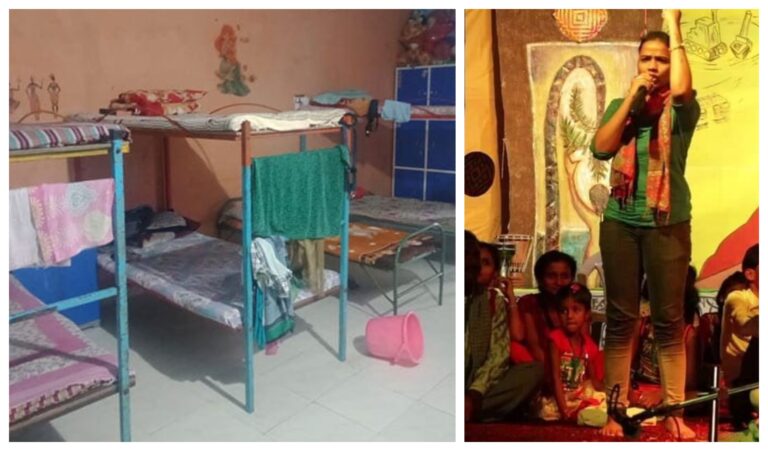
On August 17, fourteen HIV-positive girls from a non-profit shelter called ‘Apna Ghar’ in Bilaspur, Chattisgarh were allegedly beaten up and dragged out by officials who had orders from the district administration to close the facility. With them was advocate Priyanka Shukla, a member of PUCL, who attempted to question the officials and in response was assaulted and arrested. She is now admitted to CIMS hospital due to her injuries. 

According to a statement by PUCL, ‘Apna Ghar’ is the only shelter in Bilaspur that is equipped to deal with the needs of HIV positive children. The NGO’s director, Sanjeev Thakkar, who has been running the shelter for many years, had applied for a grant from the Women and Child Development Department. In response to the application, officials had demanded a ‘commission’ of 30 percent from the grant. When Thakkar refused to bribe the authorities, they claimed to have found certain discrepancies while checking the shelter and Thakkar began to receive notices about impending cancellation of its registration. It was then that the organization had reached out to Advocate Priyanka Shukla for legal assistance. 

On the day of the incident, officials from the Women and Child Development Department had arrived at the shelter without any prior warning, along with police, and demanded that all 14 wards of the shelter be handed over to them. PUCL wrote, “as per reports, they first switched off the CCTV cameras, then herded all the girls into a room, where they were physically assaulted as evidenced by blood spots at the Home”. The Superintendent of the shelter, Deepika Singh asked for a copy of the order to shut down the facility, which the officials refused to do and started manhandling her.

Advocate Shukla reached there in order to demand accountability from the officials and to oppose it especially on the ground that other shelter homes will not be suited to the needs of the wards and asked to see the order by which the girls were to be taken away, she was abused and assaulted as well. According to videos taken by neighbours which were accessed by TOI, the girls were dragged out by the hair, carried, and shoved into the police vehicles as they screamed and protested against the police’s actions. When Priyanka’s husband Anuj Shrivastava arrived at the shelter, he found blood and broken bangles scattered on the floor. Thus it seems that they were abducted by the police since they were taken without their or their families’ consent. 

Advocate Priyanka Shukla was finally arrested and charged with non-bailable section 353 of the IPC, and Deepika Singh and Sanjeev Thakkar were also named in the FIR. Anuj named Women and Child Development Officers Parvati Verma and Suresh Singh, Sarkanda Thana Incharge Sanip Ratre, and an officer of the Women’s police station, Prabhari Anju, as the officials who had assaulted Priyanka. According to him, the police delayed the examination of the wounds from the violence that happened at 12:30 pm and she was brought to CIMS after 6:00 pm, so that the marks of the violence on her face, hand and shoulder, would fade away. She was also taken from police station to police station in the police vehicle, to delay the process. Although they reached out to ministers of the city, they received no response or help. Anuj wrote, “their silence is forcing us to consider them as corrupt” and he wondered if the 30 per cent commission would have reached them as well. 

As of now, Advocate Priyanka Shukla has been released on bail by the Magistrate at Bilhai. However, there is no information about the whereabouts or wellbeing of the wards of the shelter. 

Delhi-based Journalist Prashant Kanojia arrested by UP police for “some tweets”

0

Uttar Pradesh Police has, once again arrested Delhi-based journalist Prashant Kanojia, for the second time this year, allegedly over his social media posts. He was arrested on Tuesday, August 18, from his south Delhi residence and taken to the local police station. Kanojia will reportedly be taken to Lucknow for further investigation “in connection with some tweets”. After a few journalists got to know the news on social media, Prashant Kanojia confirmed it with a retweet.

Soon, his wife Jagisha Arora, also a journalist, also confirmed it.

She told The Wire that the UP police came to their house on Tuesday afternoon to arrest him. She told the news portal that, almost all the police personnel were “wearing civil clothes, only one cop was in police uniform. They arrested Prashant and said, ‘Tweet ka maamla hai.’ When I asked them which tweet are they talking about, they said, ‘Bohot tweet kiye hain tumney, upar sey orders aaye hain humein, follow toh karna padega’.”  (Translation: It’s about tweets, you have tweeted a lot, the orders have come from above, we have to follow them.)

In April this year, Kanojia was booked for allegedly making some ‘objectionable remarks’ against the Prime Minister, and Uttar Pradesh Chief Minister. That complaint had been made by Shashank Shekhar Singh, a BJP leader, and a FIR was registered on the charges of defamation, printing or engraving matter known to be defamatory, circulating mischievous comments and obscenity under the Information and Technology Act. In 2019, he was arrested by the Lucknow police for allegedly making objectionable posts against CM Adityanath. He was released on bail by the Supreme Court after protests were  held against his arrest in various parts of the country.

After his arrest for the second time this year, many voices have risen on social media, in his support, and against the ongoing attacks, and targeting on journalists across the country, and in particular in Uttar Pradesh and Delhi.

Bhim Army chief Chandrashekhar Azad said Bahujan journalist Kanojia’s arrest was a “testimony to the dictatorial attitude of the Uttar Pradesh government. Now the government is suffering due to people reading and writing. We are constantly surrounded by times of emergency,”. He has demanded that the  “immediate release” of Kanojia must be ensured. 
  Scores of journalists, writers and activists have spoken out in Kanojia’s support and demanded his release. “No written orders or details were shared. He will be taken from Vasant Vihar to Lucknow, UP shortly #Release_Prashant_Kanojia,” posted writer Meena Kandasamy.

The Wire states that according to their sources this time “Kanojia has been arrested in relation to a tweet in which he had shared a morphed image of a poster with the name of Sushil Tiwari of the Hindu Army on it.” However, his wife told The Wire that Prashant Kanojia never posted the tweets he has purportedly been arrested for and said that the screenshot has been morphed. “You can check his Twitter, you will not find the tweet anywhere,” she told The Wire.


The FIR against Kanojia is dated August 17, and was filed by one Dinesh Kumar Shukla. Kanojia has been booked under Section 66 of the Information Technology Act, 2000, as well as various sections of the Indian Penal Code. They include: Sections are 153A (promoting enmity between different groups on grounds of religion, race, etc), 153B (assertions prejudicial to national-integration), 420 (cheating), 465 (forgery), 468 (forgery for purpose of cheating), 469 (forgery for purpose of harming reputation), 500 (defamation), 500 (1)(B) (likely to cause, fear or alarm to the public, or to any section of the public whereby any person may be induced to commit an offence against the State or against the public tranquility), and 505(2) ( promoting enmity, hatred or ill-will between classes).

https://lh6.googleusercontent.com/3xLtRtSC-pyM0xQB75OktJwTevXJkhFDKfP-i4Ah0VPrduYbPGoJ9zV_J5dzzrJWNB_Lw_lEL8h12NYGtldFTD3oi65UvZXBLpVkn_pkH4VvBcHrpyRBxeKcq2xrWSvM49B9aKAs

This article was originally published on Sabrang India.

Veteran Tulu Theatre and Film Artist Arvind Bolar forced to Apologize to VHP

A case has been filed against Arvind Bolar, a veteran Tulu theater and cinema artist and presenter of a regional private channel Walter Nandalike at the Kaavoor Police Station in Mangalore for allegedly satirizing astrologers. They had satirized priests and astrologers on a comedy show titled ‘Private Challenge’ telecasted by a popular regional channel in coastal Karnataka ‘Daijiworld’ on August 9th.
  In the comedy program, which was aired on August 9, artist Arvind Bolar portrayed the character of “Baredipi Astrologer” or a scripted astrologer. The program has satirized how astrologers claim to hypnotize people and also predict future events. However, a local person called Shivraj had filed a complaint in the police station for hurting religious sentiments. Several people had stood with the veteran actor and had opposed the filing of a case against the artist. #WeAreWithArvindBolar was trending on social media as people from Coastal Karnataka and elsewhere took to gather support for the actor. In the meantime, Channel presenter Walter Nandalike and artist Aravind Bolar appeared on the same channel and clarified about the incident that “They hadn’t spoken anything ill on the show, and that it was disheartening to see such attacks being hurled at them despite them doing no wrong. We apologize if our words had hurt anyone’s sentiments”.
However, on August 11th, Artist Arvind Bolar went into the Vishwa Hindu Parishad (VHP) office at 5 PM in the evening and apologized after the case was filed against him. Vartha Bharathi.in has reported that Vishwa Hindu Parishad Mangalore Division Secretary Sharan Pumpwell commented on the issue “Arvind Bolar personally visited the ‘Vishwasri’ Office of the Vishwa Hindu Parishad and apologized for the act. He has also that he will not do any scenes like this in the future”. Theatre artist Sadashiva, Vishwa Hindu Parishad District President Gopala Kuttaaru, Bajrang Dal’s Bhujanga Kulal, and Office bearers of Vishwa Hindu Parishad were present. Speaking about the issue with gaurilankeshnews.com, the veteran artist Arvind Bolar noted that “These kinds of incidents have been on the rise as youth circulate messages on WhatsApp and Facebook. As a senior artist, we must not get irritated with these happenings and resolve it within ourselves. Being someone who is involved in the theatre and film world, I have done many roles. However, this is the first time something has like this has happened. I did visit the Vishwa Hindu Parishad office. We have spoken about the issue because we have lived like a family in the region. This is nothing to be taken seriously. I’m a theatre and film artist. For me, the love that people have showered always is the most important thing. I’m grateful for it”.

Also Read: Karnataka Home Minister Assures Dropping Charges of a VHP leader in a Video

Bangalore: Lawyers Protest Against SC Verdict on Prashant Bhushan

1
On August 18, members of the Indian Association of Lawyers, advocates, and human rights activists from Bangalore held a protest at Maurya Circle, against the judgement of the Supreme Court against Prashant Bhushan.  The protest was organized after a call from the Bangalore Advocates Group. Around 70-100 people attended the peaceful demonstration in solidarity with Prashant Bhushan. According to Sarovar Benkikere, who is associated with the Karnataka Vidyarthi Sangathan (KVS), attendees included members of Dalit Sangharsh Samiti (DSS), KVS, and trans activists, including Mallu Kumbar, State coordinator of the Karnataka Sexual Minorities Forum. Protestors pointed out that the arrest of Prashant Bhushan is an attack on democracy. bangalore lawyers protest press release Narasimha Murthy, the organiser of the protest pointed out that the verdict has been announced in relation to his tweets, as well as a comment he made in 2009 and questioned why it is being taken up after such a long time. His tweet about the CJI riding a bike which costs 50 lakhs and is owned by a BJP leader during the pandemic was factual and was merely pointing out that the lockdown mode in the SC is denying access to justice to people. According to Murthy, Bhushan is one of the advocates who has worked and raised his voice for the voiceless, and he is being targeted just like the other advocates who have been targeted and arrested in relation to Bhima Koregaon. That a former CJI has been given a nomination for the Rajya Sabha is unprecedented in the history of India and is a major threat to the independence of the judiciary. “Irrespective of the caste, class, creed, gender, lawyers have the responsibility to oppose such unfair verdicts in every case”, Murthy said. They will plan their next action after the SC announces the punishment. Bangalore lawyers protest prashant bhushan Prashant Bhushan is a well known Public Interest Lawyer in the Supreme Court of India and an activist. Bhushan had posted two tweets, one about the Supreme Court on June 27 and the second about the Chief Justice of India Sharad Arvind Bobde on June 29. On July 22, the top court had issued a show-cause notice to Bhushan after initiating the suo motu criminal contempt against him for his two tweets.

Also Read: Criminal Contempt: Should It Be Unconstitutional?

Replying to the notice Bhushan had filed a detailed affidavit which ran for more than 140-pages and had stated that that expression of bona fide opinion about the Court would not amount to contempt. He had argued that the imperfection of the judiciary warranted criticisms. Bhushan had argued that his comment on CJI SA Bobde for his photo in which he was seated on a Harley Davidson motorcycle was meant to underline his anguish at the non-physical functioning of the Supreme Court for over three months, “as a result of which fundamental rights of citizens, such as those in detention, those destitute and poor, and others facing serious and urgent grievances were not being addressed or taken up for redressal”. The first tweet, reproduced in the court, said: “When historians in the future look back at the last six years to see how democracy has been destroyed in India even without a formal Emergency, they will particularly mark the role of the SC in this destruction, and more particularly the role of the last four CJIs.” The second tweet said: “The CJI rides a Rs 50-lakh motorcycle belonging to a BJP [Bharatiya Janata Party] leader at Raj Bhavan, Nagpur, without wearing a mask or helmet, at a time when he keeps the SC on lockdown mode denying citizens their fundamental right to access justice!” The bench that passed the verdict consisted of Justices Arun Mishra, B.R. Gavai, and Krishna Murari, who said that the tweets were based on distorted facts and amounted to malicious attack against the entire Supreme Court. Yesterday, more than 1,500 lawyers across the country wrote to the Supreme Court saying that the tweets did not qualify as contempt of court.  The lawyers included Sriram Panchu, Arvind Datar, Shyam Divan, Menaka Guruswamy, Raju Ramachandran, Biswajit Bhattacharya, Navroz Seervai, Janak Dwarkadas, Iqbal Chagla, Darius Khambata, Vrinda Grover, Mihir Desai, Kamini Jaiswal, and Karuna Nundy, and they argued that silencing critique will undermine the independence and strength of the Supreme Court. While he was tried for criminal contempt for a statement he made in an interview with Tehelka Magazine in 2009, where he had said that half of the previous 16 Chief Justices were corrupt, Bhushan argued that allegations of corruption in the judiciary must fall under the ambit of free speech. 

Criminal Contempt Petition in SC Against Swara Bhaskar

0
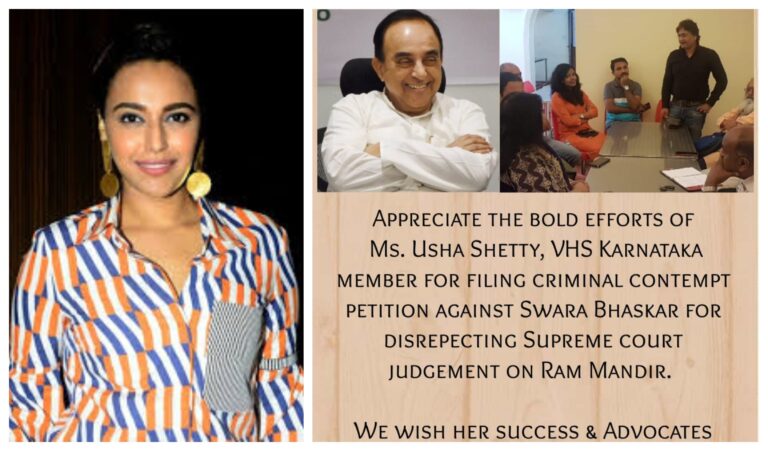
A petition moved before the Supreme Court on August 16 has sought the initiation of criminal contempt of court proceedings against Swara Bhaskar for her comments made at a panel discussion in February at the Mumbai Collective. Mumbai Collective is a group of citizens from Mumbai who organizes a two-day panel every year in order to discuss issues relating to secularism and democracy. Noted activists, intellectuals, and artists often participate in the event.  This year, at the event, Swara Bhaskar spoke about the Citizenship Amendment Act and the protests that had erupted across the country in order to resist the Act. The petition questioned her comments regarding the Supreme Court decision on the Ram Mandir in Ayodhya. According to the petition, she had said, “We are now in a situation where are courts are not sure whether they believe in the constitution or not…What then do we do and it seems to me that as everyone has said that the path is clear to us and it has been shown to us by you all whoever of you all have been part of the protest by the students by the women and by the citizen protestors it is to resist…” “We are living in a country where the Supreme Court of our country states in a judgment that the demolition of Babri Masjid was unlawful and in the same judgment rewards the same people who brought down the mosque…” While these comments were factual, and simply critiqued the contradiction in the verdict given by the Supreme Court, the petitioner said that Bhaskar was provoking the gathering to resist and revolt against the Apex court of India.  The petitioner is Usha Shetty, who is a leader of the right-wing organisation, Virat Hindustan Sangham (VHS) Karnataka, founded by Subramaniam Swamy. The petition was filed through advocates Anuj Saxena, Prakash Sharma, and Mahek Maheshwari. Mahek Maheshwari is the advocate who filed the complaint against Prashant Bhushan. Maheshwari began his legal career at BJP leader Subramaniam Swamy’s law office and is an active member of the Virat Hindustan Sangham.