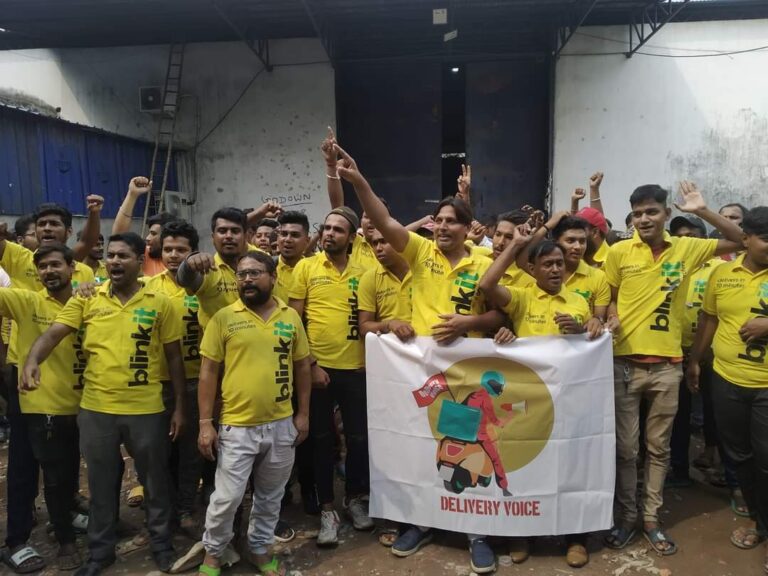
Kolkata: Last Tuesday, delivery workers of Blinkit Company in Kolkata began an indefinite strike following the company’s decision to introduce a new rate card with per-parcel-earning of Rs. 15 for new riders. The striking workers are demanding that per-parcel-earning should be the same for all rider workers and that new recruits should also be activated using the Rs. 25 ID, which was secured by the workers after a massive strike in September 2022.
Currently, at least 150 workers are on strike in Kestopur and Newtown, while workers at the Chinar Park hub have ended their struggle. According to sources, the Blinkit management retaliated against the striking workers yesterday by transforming all their IDs into Rs. 15 IDs. Meetings between the workers and the management are currently underway but it is unlikely for the workers’ demands to be met.
In September 2022, the company had arbitrarily reduced the delivery riders’ earnings on each parcel from Rs. 50 to Rs. 20, slashing their livelihood by more than half. In response, the protest movement by Blinkit delivery riders in September 2022 had forced every hub in the city to shut down. After almost a month of continued struggle, the workers secured a new rate card with per-parcel-earning amended to Rs. 25, and an incentive slab that allowed per-parcel-earning to jump to close to Rs. 40 if the order target reached 100. The company had also promised not to change rate cards for at least three years, however, no written agreement was made at that time.
Blinkit Management has now gone back on this promise by introducing a new form of ID with a per-parcel-earning of Rs. 15. While older workers will continue to keep their Rs. 25 rate cards, new recruits will only receive Rs. 15 per delivery.
Sources also claim that the new Distance Pay Rate Card (DPRE) permits new recruits to make deliveries beyond the previous limit of 3 kilometers. Due to this, delivery workers will have to make longer deliveries, which would reduce their total number of deliveries per day, and as a result, their daily earnings. Moreover, the company does not bear the cost of returning to the hub after completing a delivery, which means that the increased cost of petrol and bike maintenance due to longer deliveries will be borne by delivery workers themselves. Whether through direct means such as the new ID or through indirect means such as the increased delivery distance, Blinkit’s delivery workers are facing an immense loss of income.
The striking delivery workers are also concerned that the company may assign more deliveries to new recruits who are on a Rs. 15 rate card than those on a Rs. 25 rate card, as this would be more profitable for the company. Though the older workers would be earning more, their overall earnings may decrease if their deliveries per day are cut. Through such policies, the management can effectively reduce the income of all workers while also creating internal divisions and disunity between the old and new workers.
The company claims that it is making a loss and cannot afford to pay higher earnings to the delivery workers. However, the workers raise questions about the company’s ability to spend massive amounts on advertising and opening new hubs in Madhyamgram and Birati, while claiming to be loss-making. Blinkit CEO Albinder Dhindsa recently told Economic Times that Blinkit is in a position to comfortably grow their dark store count by around 30-40% over the next 12 months. In the third quarter that ended on December 31, 2022, Blinkit reported a revenue of Rs 301 crore, showing a quarter-on-quarter growth of 28%. During the same period, the gross order value (GOV) was Rs 1,749 crore, indicating an 18% quarter-on-quarter growth.
Ramanagara: In the name of cow protection, a group of miscreants, who called themselves members of Rashtriya Rakshna Pade , stopped a vehicle carrying cows with a license and assaulted the driver.
A vehicle transporting cows with a license was stopped and the driver was attacked and assaulted. The assault resulted in the death of the Muslim trader. The incident took place within the jurisdiction of Sathanur police station in the district.
The deceased person has been identified as Idrees Pasha (35), a resident of Mandya, and Syed Zaheer (40), who was in the vehicle, has been taken into police custody. Another is said to have absconded.
Puneeth Kerehalli who belongs to Rashtra Rakshna Pade which is supported by Sangh Parivar is behind the death of Idrees. Family members and friends of Idris staged a sit-in in front of the police station and demanded that he should be arrested immediately.
Idrees showed the documents of purchase of cows. But Puneet and his team stopped him and demanded ₹2 lakh rupees. When they were not paid, they threatened to kill him, they also abused him and told him to “Go to Pakistan”.
According to the FIR, Puneeth & group chased & intercepted their vehicle opposite to Sathaunur Police station. Two associates of Idrees were also injured, One of them (Syed) was handed over to Police. Idrees body was found a few hundred meters away from station in the morning.
Idrees body was found a few hundred meters away from Sathanur police station in the morning.
Since the news of the incident, photographs of Puneet with several prominent BJP leaders in Karnataka including Bengaluru South MP Tejaswi Surya, BJP National Secretary CT Ravi, began to surface on social media, indicating his proximity to the state’s ruling party.
The family members of the deceased claim that Puneet and his colleagues were cow vigilantes and demanded a sum of Rs 2 lakh to release Pasha. Pasha’s family members have been protesting with his body and demanding action against Puneet and his associates.
The parents of Pasha have alleged that it was a murder and Puneeth Kerehalli of the organization attacked them with a bat. They have filed a separate complaint that they are responsible for my son’s death.
The accused have been booked under Sections 302 (Murder), 341 (wrongful restraint), and 504 (Intentional insult with intent to provoke breach of the peace) of the IPC, based on a complaint lodged by Pasha’s family members.
Massive protest broke out on April 02 by Muslim Community in Mandya district. The protest was against Puneet Kerehalli who is the prime suspect in killing of a truck driver over cow vigilance.
The Yamuna Pushta And Delhi’s Developmental History
While there is no official record of when the Yamuna Pushta settlement came into being, oral testimonies and government documents point to the presence of farmers on the river banks from pre-colonial times. After the partition, refugees from Western Punjab settled on the banks and established the first non-agricultural settlement on the banks. With the formulation of the Master Plan in the 1960s, Delhi saw a boom in construction activity, bringing in many more migrant workers. During the Emergency (1975-77), over one hundred and eighty thousand jhuggis were removed from Yamuna Pushta and the people were resettled in the peripheries of the city. However, by 1982, many were welcomed back into the city to carry out construction activities for the Asiad Games. No housing arrangements were made for these workers and the Pushta once again became home to a substantial chunk of the city’s working masses. Through lobbying and political action, the residents of the Pushta gradually received civic amenities like water, electricity and toilets. The presence of political parties and NGOs enabled the Pushta to occupy a grey zone in terms of ‘the right to the city’.
Over the course of these decades, Delhi’s own policies saw a shift from that of socialized land to privatisation. Prior to the 1990’s, Delhi had no formal private property system with land being leased from the state. Private land sales needed to be deemed as for public interest before receiving approval. In the 1990’s, with the advent of the New Economic Policy, public land entered the private marketplace so that the Indian economy could access the reserve of land representing “untapped” capital, attract foreign investment and build world-class infrastructure. However, a big chunk of this “untapped capital” housed more than 50% of Delhi’s population in unauthorised settlements. These settlements had a complex legal and political history that included formal entitlements to 25% of residential land, only a fraction of which were provided overall in Delhi. Under the new economic model, central land gained artificial value, the Pushta also came to be seen as public land that was not being put to “productive use”. This rhetoric was used to evict urban dwellers from their home in the interest of financial powers. Undercutting this economic motivation was an aesthetic one, visible particularly in judicial action from the 2000s.
Demolitions Driven By Neoliberal Aesthetics
Following the rise of Public Interest Litigations (PILs) in the early 2000s, there was a massive growth in cases filed against working-class settlements particularly by the middle classes – represented by the Resident Welfare Associations (RWAs) and property owners’ associations. Weaponized by the middle classes, the courts issued a massive number of demolitions and became the primary mode through which slums are removed.
The courts tried to push state agencies to clear slums by invoking records of ownership and authorisation, but they soon realised that there was a complete absence of such bureaucratic records and baseline surveys. In fact, the Municipal Corporation records of the time showed that 70% of Delhi was “unauthorised” or violated land use codes and building bylaws – this includes not just slums but shopping malls and other large commercial and industrial properties. A strict enforcement of the Master Plan would then involve asking for all such properties to be demolished.
Contrary to the official narrative that settlements on the banks of the Yamuna need to be evicted due to environmental concerns, Yamuna Pushta demolitions have always been and continue to be about the aesthetic of a ‘world-class’ city.
In this situation, rather than determining legality through records and calculations, the court began to reinterpret “public nuisance” to include not just objects and actions but entire populations. By invoking phrases that pointed to an innate “uncleanliness” of slum dwelling populations, they gratuitously invoked Section 133 and Section 91 of the Code of Criminal Procedure (relating to public nuisances) to clear the city of slums. The petitions filed by the RWAs too were rife with such language, even invoking Article 21 to justify the clearing of the slums that were considered “unsightly”, “offensive” and “unhygienic”. While slum-dwellers were denied the status of “legal subjects” with urban citizenship, the middle classes constructed their subjecthood in opposition to the slum-dwellers.
The courts participated in this process by referring to Delhi as India’s “showpiece to the world”. Instead of directing the municipality to build better drainage, housing and waste management infrastructure to improve the city’s hygiene, the courts made a scapegoat of the working-class settlements and sought to eliminate them.
In The Name Of The Environment
In March 2003, the Delhi High Court took suo moto cognizance of the problem of pollution in the Yamuna River with respect to a petition about slum clearance. The bench baselessly blamed the Yamuna Pushta cluster of settlements for the pollution by claiming that they discharged sewage water and other filth into the river. Rather than scientific evidence to prove this claim, the court used photographs from a proposal by the Ministry of Tourism; the photographs showed slum dwellers as unsightly polluters, unfit for the eyes of foreign visitors and dignitaries. “Of the Pushta’s population of 3,50,000, an estimated 1,50,000 were displaced over the course of just one week in June, with the rest to follow”. Only 16% of those displaced from Yamuna Pushta were given resettlement plots. Others who qualified for plots found their names missing from municipal lists.
PC: Daily Sabah
Following this, the court continued to target slums on the Yamuna’s banks in the name of the environment and claiming that the settlements violated the layout plan of the area. An additional 10,000 jhuggis were cleared between 2006 to 2008, and 30,000 more jhuggis were identified for future removal. Meanwhile, other developments on the ecologically sensitive river bed, including the Akshardam Temple, the Commonwealth Games village and a Delhi Metro Rail depot, remained completely unaccused of the same. More projects, such as a shopping mall and housing for Delhi metro workers were waiting to be built on this ecologically sensitive zone. None of these projects met the same criticism as the settlement with regards to the area’s land-use designation. Indeed, while the slums appeared to be “filthy”, these projects fit neatly into the judge’s aesthetic sense and imagination of world-class developments.
The Delhi Water Board publicly acknowledged that pollution in the Yamuna River was not due to the presence of the slums but came from the twenty-two open drains (nalas) that carried untreated sewage from mostly middle-class residential colonies directly into the river. Despite this acknowledgement, important figures such as the managing director of the Delhi Metro Rail Corporation and the Chief Minister continued to claim that the slums were responsible for the pollution. This did not change even after the Central Pollution Control Board found that there was no improvement in water quality after the removal of 40,000 jhuggis from the banks of Yamuna. As showcased by the standing NGT order and the comment made by L-G VK Saxena, this false rhetoric continues to hold space even today.
Since then, Yamuna Pushta demolitions on these grounds are routine. For example, in 2015, the DDA had carried out a series ofdemolition drivesin over 100 acres of the Yamuna floodplains. In September 2020, more than 100 houses were bulldozed in Dhobi Ghat, a slum in Batla House. The Delhi Development Authority (DDA) cited the National Green Tribunal’s (NGT) law against construction on the river bank. In 2021, the DDA carried out a demolition drive near Lalita Park and Ramesh Park, rendering hundreds of people homeless. During this period, approval was given to various large projects like the construction of waste treatment plants that clearly violated the municipals solid waste management rules, and events like the World Culture Festival in December 2017, which was organised by the Art of Living Foundation and irreparably damaged the floodplains.
World Culture Festival in December 2017, which was organised by the Art of Living Foundation
Tool To Curb Dissent
Recent times have seen yet another dramatic increase in demolitions, with over 70 demolition drives being carried out since the start of this year in South Delhi alone. The MCD recently stated that these drives are being carried out to keep property construction within the parameters of the Master Plan 2021, and Unified Building Bylaws 2016, and that the drives would be further intensified. The BJP government, who’s empire is itself built on the historic demolition of the Babri Masjid in 1996, has begun using demolitions as tactic to threaten the minority Muslim population and curb dissent. By demolishing slum after slum, the government is able to simultaneously appeal to middle-class aesthetics that frown upon markers of poverty, acquire central land for very low prices to carry out ambitious development projects, and criminalise a largely Muslim working-class population. Demolitions now neatly tie together the current government’s neoliberal and hindutva ambitions.
The following sections draw largely from Asher Ghertner’s Ruled By Aesthetics (2015) to examine the role played by the globalised neoliberal aesthetic of “a world-class city” in Yamuna Pushta demolitions.
On 30 March 2023, Former US President Donald Trump has been indicted by a grand jury in New York in the New York Supreme Court over violations of campaign finance laws during the 2016 election. This will be the first time in US history that either a current or former president has faced a criminal indictment. The details of the charges are officially unknown but supposedly are with regards to payments made to keep “Stormy Daniels,” a former adult film actor quiet on her alleged extramarital sexual relations with Trump during the presidential campaign. Trump’s arraignment is scheduled for next Tuesday.
As the legal process unfolds and details come to the American people, many will be watching closely to see how it plays out, especially given the historic nature of the indictment. It remains to be seen how Trump and his supporters will respond to the charges, and what impact they will have on the American political landscape going forward.
Who is Stormy Daniels?
Stephanie Clifford, AKA Stormy Daniels, is a former adult film actor who gained public attention for her alleged affair with Trump. Stormy Daniels claimed to have met Trump in 2006 during a charity golf tournament in Lake Tahoe, where Trump invited her to dinner they engaged in consensual sex. However, Trump has denied this. The story gained attention in 2018 when it was revealed that Stormy Daniels received USD 1,30,000 for her silence just before the 2016 presidential election.
Corruption charge
The payment to Stormy Daniels is the subject of the Manhattan district attorney’s indictment of Trump for the possible violation of campaign finance laws. Stormy Daniels has become a public figure, making media appearances. She has even considered running for a US Senate seat in Louisiana in 2010. Stormy Daniels has spoken out against Trump.
While Trump has faced many lawsuits, the indictment is particularly serious both personally and politically. Beyond this trial, many investigations are already underway.
First, the investigations are being led by the Manhattan District Attorney. The Manhattan District Attorney is looking at the business practices of his family company, the Trump Organisation. They are examining whether the company committed various acts of fraud over several decades. This may reveal a longer history of corruption by the company.
Another investigation is being launched by the Department of Justice. The Department is looking into the removal of government documents from the White House. These documents were taken to Trump’s Florida estate, Mar-a-Lago after he left office.
Yet another investigation has looked at Trump’s alleged role in the attack on the US Capitol on 6 January 2021, when a mob of his supporters stormed the building, and also the New York attorney general is conducting a civil investigation against Trump and three of his children, accusing them of fraud and deception.
Attack on the US Capitol on 6 January 2021, when a mob of his supporters stormed the building,
Trump has called these accusations part of a witch hunt against him. People close to Trump have said that he wants to come to court in handcuffs as part of a presentation that he is being persecuted. This may resonate with his supporters and will be used by the Trump campaign to work in his favour politically in the future. Many of Trump’s enemies want him to face jail time, as they feel it would validate their feelings of him as a criminal. Even Stormy Daniels has reportedly celebrated the news. The indictment will have no bearing on Trump’s ability to run for elections in the future, as Trump has announced his intention to run for American President in the 2024 elections. The issue is going to be played up by both Trump and his opponents during his presidential campaign.
Why Right-wing politicians play the victim when charged with Corruption
Trump has spun the scandalous corruption charges against him as part of a campaign against him. Even in India, right-wing politicians have tried to usurp the moral high ground when accused of corruption. This works only when there is a passionate base of supporters who are committed to the personality of the politician rather than their performance. Despite horrible mismanagement of the American economy during his Presidency, Trump remains a powerful personality and could return despite the criminal charges against him.
100 years ago, soon after the 1917 Revolution, Russian Marxist-Feminist Alexandra Kollontai published a piece on ‘Communism and the Family’ (1920). The Marxist critique of family which Kollontai advances is considered ‘too radical’ even today and the destruction of traditional ‘family values’, which entailed women’s subjugation, is mourned. Yet, a century later, her ideas remain strikingly relevant to the struggles of working-class women in capitalist patriarchy. Below are selected excerpts (edited for clarity) from Kollontai’s article.
The typical family where the woman had no will of her own, no time of her own and no money of her own, is changing before our very eyes. In the course of history, the structure of the family has changed many times; it was once quite different from the family of today. There was a time when the kinship family was considered the norm: the mother headed a family consisting of her children, grandchildren and great-grandchildren, who lived and worked together. At another period the patriarchal family was the rule.
But over the last hundred years this customary family structure has been falling apart in all the countries where capitalism is dominant and where the number of factories and other enterprises which employ hired labour is increasing. It is the universal spread of female labour that has contributed most of all to the radical change in family life. Formerly only the man was considered a breadwinner. The wages of the “breadwinner” being insufficient for the needs of the family, the woman found herself obliged to look for a wage and to knock at the factory door.
What kind of “family life” can there be if the wife and mother is out at work for at least eight hours and, counting the travelling, is away from home for ten hours a day? The woman who is wife, mother and worker has to expend every ounce of energy to fulfil these roles. She has to work the same hours as her husband in some factory, printing-house or commercial establishment and then on top of that she has to find the time to attend to her household and look after her children. Capitalism has placed a crushing burden on woman’s shoulders: it has made her a wage-worker without having reduced her cares as housekeeper or mother. Woman staggers beneath the weight of this triple load. Life has never been easy for woman, but never has her lot been harder and more desperate than that of the millions of working women under the capitalist yoke in this heyday of factory production.
“The wives of the rich have long since been freed from these irritating and tiring domestic duties. Why should working woman continue to be burdened with them?”
The circumstances that held the family together no longer exist. The family is ceasing to be necessary either to its members or to the nation as a whole. The old family structure is now merely a hindrance. What used to make the old family so strong? First, because the husband and father was the family’s breadwinner; secondly, because the family economy was necessary to all its members: and thirdly, because children were brought up by their parents. What is left of this former type of family?
All that was formerly produced in the bosom of the family is now being manufactured on a mass scale in workshops and factories. What housekeeper would now bother to make candles, spin wool or weave, cloth? All these products can be bought in the shop next door… the working woman has neither the time nor the energy needed to perform these domestic operations. First and foremost, she is a hired worker. Thus, the family economy is gradually being deprived of all the domestic work without which our grandmothers could hardly have imagined a family. What was formerly produced in the family is now produced by the collective labour of working men and women in the factories. The family no longer produces; it only consumes.
The wives of the rich have long since been freed from these irritating and tiring domestic duties. Why should working woman continue to be burdened with them? But even if housework disappears, you may argue, there are still the children to look after. The family is supposed to bring up the children, but in reality proletarian children grow up on the streets. Under capitalism children [are] frequently, too frequently, a heavy and unbearable burden on the proletarian family.
The capitalists are well aware that the old type of family, where the woman is a slave and where the husband is responsible for the well-being of his wife and children, constitutes the best weapon in the struggle to stifle the desire of the working class for freedom and to weaken the revolutionary spirit of the working man and working woman. The worker is weighed down by his family cares and is obliged to compromise with capital. The father and mother are ready to agree to any terms when their children are hungry.
All the old pillars which supported the family as a social unit are being removed: the domestic economy is dying, and working-class parents are unable to take care of their children or provide them with sustenance and education. There is no escaping the fact: the old type of family has had its day.
The workers’ state needs new relations between the sexes, just as the narrow and exclusive affection of the mother for her own children must expand…, the indissoluble marriage based on the servitude of women is replaced by a free union of two equal members of the workers’ state who are united by love and mutual respect.
Excerpts are taken from here.
Read Next: Coronavirus Has Brought the Welfare State Back, and It Might be Here to Stay
Lahore: A high court in Pakistan on Thursday struck down a colonial-era sedition law that criminalised criticism of the federal and provincial governments, terming it inconsistent with the Constitution as reported by PTI.
Justice Shahid Karim of the Lahore High Court (LHC) annulled Section 124-A of the Pakistan Penal Code (PPC) dealing with sedition, the Dawn newspaper reported.
Justice Karim pronounced the verdict in response to identical petitions seeking to annul the sedition law, the paper said.
The provision is similar to Section 124A of the Indian Penal Code, which the country’s Supreme Court had last year put on hold.
The offence of sedition, if proven in both countries, carried a maximum penalty of life imprisonment.
One of the petitions against Pakistan’s sedition law said that it is a notorious tool for the suppression of “free speech and criticism in free and independent Pakistan”.
The petition added: “Every passing day, the intensity of registration of FIRs [first information reports] under this section is snowballing while the people of Pakistan have suffered a lot, as almost every criticism of government or state institutions has been treated as an offence under Section 124-A by law enforcement agencies.”
Justice Shahid Karim of the Lahore High Court (LHC) annulled the offence of sedition under section 124-A of the Pakistan Penal Code (PPC) while delivering the verdict on a batch of petitions that argued it was being used by ruling political parties against their rivals.
The law of sedition as contained in section 124-A was a residue and relic of the oppressive colonial legacy which had been introduced to rule the subjects not citizens, therefore, the provisions of the impugned section were repugnant to the constitutional guarantees including freedom of speech, movement, assembly, association and expression provided under Articles 15, 16, 17 and 19 of the Constitution, the petitioner said.
The petitioner’s counsel argued that the word ‘government’ as exists in section 124-A, PPC was surely and squarely defeated the freedoms which were created by the Constitution.
“The impugned section be declared void and ultra vires being inconsistent with and in derogation of fundamental rights in view of the mandate of Article 8 of the Constitution,” he pleaded.
After hearing the arguments, the court struck down the offence of sedition, terming it repugnant to the fundamental rights of the citizens protected in the Constitution.
The law states: “Whoever by words, either spoken or written, or by signs, or by visible representation, or otherwise, brings or attempts to bring into hatred or contempt, or excites or attempts to excite disaffection towards, the Federal or Provincial Government established by law shall be punished with imprisonment for life to which fine may be added, or with imprisonment which may extend to three years, to which fine may be added, or with fine.”
The petition stated that the Constitution of Pakistan gives every citizen the right to freedom of expression but still, Section 124-A is imposed for making speeches against the rulers.
According to the petition, the law has been recklessly used in Pakistan as a tool of exploitation to curb the right to free speech and expression guaranteed under Article 19 of the Constitution.
The petition said the law was serving as “a notorious tool for the suppression of dissent, free speech and criticism in free and independent Pakistan”.
Over the past few years, the petition argued, various politicians, journalists and activists had been booked under Section 124-A of the PPC.
“Every passing day, the intensity of registration of FIRs under this section is snowballing while the people of Pakistan have suffered a lot, as almost every criticism of the government or state institutions has been treated as an offence under Section 124-A by law enforcement agencies.”
Bengaluru: Atleast 29 civil society organisations in Karnataka including the Dalit Sangharsha Samiti(DSS), All India Forum for Right To Education (AIFRTE), Karnataka Janashakti (KJS), Bharat Gyan Vigyan Samiti (BGVS), Disability rights organisations, Students’, teachers and parents’ association have come together under the banner of People’s Alliance For Right to Education (PAFRE) to demand that all the political parties address concerns regarding educational issues in their manifestos in the run-up to the 2023 Assembly elections.
The organisations are campaigning that the political parties include their demands be included as Guaranteed Promises under the leadership of Dr. Niranjanaradhya VP, Eminent Development Educationist who is also on the Board of Advisors for the All India Forum for Right To Education.
Taking forward the campaign, the civil society groups had organised press conferences in atleast 11 districts demanding school education concerns be addressed.
Their demands included, among others the effective implementation of the Right To Education Act; provision of uniforms, books, bicycles, and other supplies in a timely manner; No schools be closed down or merged; provide Breakfast and eggs for all students alongside the effective implementation of the already existing Ksheera Bhagya and Mid Day Meals scheme and earmarking 15% of the state budget for education.
People’s Alliance for Fundamental Right to Education-PAFRE, is an alliance of people’s
movements working to realize the goal of fundamental right to education. It is a state- wide movement to promote health, nutrition and sensory development in young children, quality health care for all children right from the infants in the womb to the adults up to the age of 18 years, and to promote early childhood opportunities and quality education that complements sustainable human development.
They have also urged the citizenry to vote keeping in mind the theme “Vote for Quality Public Education System”.
PAFRE has alsoRight To Education Manifesto and are requesting all political parties to include these demands in their respective manifestos.
The Right to Education manifesto can be downloaded PAFRE Brochure for Election Manifesto -English Version
Opposition Leader Rahul Gandhi’s disqualification as a member of Parliamenthas not only made waves in India but also internationally. After US comments on the issue, Germany has also taken note.
The German foreign ministry today has released a statement saying ‘fundamental democratic principles’ should apply in the case of the Congress leader’s disqualification.
A spokesperson of the ministry said the Deutsch government had ‘taken note’ of the verdict by the Indian court and subsequent suspension of his ‘parliamentary mandate’.
“We have taken note of the verdict of first instance against the Indian opposition politician Rahul Gandhi as well as the suspension of his parliamentary mandate. To our knowledge, Mr Gandhi is in a position to appeal the verdict, ” said the spokesperson.
“It will then become clear whether this verdict will stand and whether the suspension of his mandate has any basis. We expect that the standards of judicial independence and fundamental democratic principles will equally apply to the proceedings against Rahul Gandhi,” the ministry added.
After the US, Germany warns Modi on the issue of jail sentence and suspension from Parliament of Rahul Gandhi and schools the principles of democracy. Modi was bluffing of being ‘Mother of Democracy’ becomes an errant child! pic.twitter.com/P1Pcqo4Up3
Notably, earlier this week, the US state department issued a statement saying Washington was ‘watching’ the matter whilst issuing a sermon on ‘democratic values’ to New Delhi.
“Respect for the rule of law and judicial independence is a cornerstone of any democracy. We are watching Mr Gandhi’s case in Indian courts and we engage with the Government of India on our shared commitment to democratic values, including freedom of expression,” said Vedant Patel, the US state department’s main deputy spokesperson.
Thank you Germany Foreign Affairs Ministry and Richard Walker @rbsw for taking note of how the Democracy is being compromised in India through persecution of @RahulGandhihttps://t.co/CNy6fPkBi3
Last week, a city court in the western Indian state of Gujarat convicted the Indian National Congress (INC) leader in a criminal defamation case for his alleged ‘Modi surname’ remarks.
The court sentenced Gandhi to two years in jail while imposing a fine of Rs 15,000 ($183), under the Indian Penal Code (IPC) sections 499 (defamation), 500 (punishment for defamation).
After an appeal, his sentence was suspended and bail granted to move an appeal against the conviction in under 30 days. However, the very next day, the Indian parliament disqualified the Indian MP from Wayanad – a district in the southern Indian state of Kerala.
It was in 2008 that the BJP came to power in Karnataka for the first time ever in a South Indian state. ‘BJP – Party with a difference’ was its slogan back then. BJP indulged in horse trading as it bought MLAs from other parties in the name of ‘Operation Kamala’ and managed to form the government. BJP was able to do so by expending the wealth it had looted from illegal mining at Bellary and elsewhere thereby proving that it stood different from all other parties! After this, major corruption scandals hit the BJP including cases of land grabbing, de – notification, illegal mining, and collection of bribes through checks coming to the fore. When these corruptions saw the light, the then CM Yeddiyurappa and an influential Minister Gali Janardhana Reddy was imprisoned all of which is well-documented in Karnataka’s political history. It is important to note that Gali Janardhana Reddy is banned from entering Bellary even till date.
Gali Janardhana Reddy and CM Yeddiyurappa
The BJP came to power for the second time after toppling the Congress-JDS alliance, again, thanks to Operation Kamala. BJPs second stint in power too is mired in a series of corruption scandals.
Against this backdrop, BJP seems to have become synonymous with corruption. An attempt is made here to provide a brief summary of the corruption and other scandals reported since the BJP came to power for the second time here in Karnataka.
Super CM Vijayendra Service Tax
It was in July 2019, that 76-year-old BS Yeddyurappa was sworn in as the Chief Minister of the state for the fourth time. However, on many platforms, his own party members had accused that it was Yeddiyurappa’s son, Mr. B.Y. Vijayendra who acted as the real Chief Minister and hence was known as ‘Super CM’. The opposition parties accused him of fixing commission rates for each job and criticized it as Super CM Vijayendra’s service tax. He had been accused of receiving bribes amounting to crores from Ramalingam Construction Company in cash and through the routes of shell companies for awarding housing project (BDA) contracts. Power TV conducted a sting operation and reported on this issue continuously. The case is still under investigation.
3,667 acres of land sold to Jindal Steel Works
In 2019, the Congress-JDS coalition government had decided to sell 3,667 acres of land to Jindal Steel Works for a very low price and BJP which was in the opposition staged massive protests against the same. However, when the BJP came to power, it allotted the 3,667 acres of land to Jindal Steel Works in April 2021.
Corona scam
Health Minister of Karnataka Dr. Sudhakar was accused of corruption amounting to hundreds of crores of rupees in the purchase of medical supplies during the Covid-19 pandemic. Also, one of the largest Covid-care centers with 10,000 beds was built at the Exhibition Grounds in Bengaluru. Allegations were made that money was looted in the name of establishing Covid-care centers and that the facilities were only available on bills and not in reality. During the second wave of Corona, when Bengaluru was witnessing an acute shortage of hospital beds, the Covid care center was closed down thereby leaving many patients people without a hospital bed and proper treatment. It was reported that the BJP ministers and legislators themselves were involved in the bed-blocking scamand made thousands of crores illegally, amidst the pandemic.
Meanwhile, the sex tape scandalof Irrigation minister Mr. Ramesh Jarakiholi, in the BJP government came to light and he had to resign.
Reign and Ruins under Basavaraja Bommai
Finally, it was in the last week of July 2021 that the BJP high command removed BS Yeddiyurappa and appointed Basavaraja Bommai as the new CM. The BJP high command appointed Basavaraja Bommai, side-lining other aspirants as the chief minister to pacify the Lingayat community after it had removed BS Yeddiyurappa unceremoniously from the position. Rumors were rife that the change was made to curb rampant corruption under Yeddiyurappa’s rule and his son Vijayendra’s interference in governance. However, after Basavaraja Bommai was appointed as the chief minister, the allegations of corruption only increased.
40% Commission Govt
Karnataka’s BJP government has been demanding 40% commission on all works and therefore the quality of works is being compromised alleged D. Kempanna, President of Karnataka Contractors Association. He wrote a letter to Prime Minister Narendra Modi, alleging that all the ministers and legislators were involved in this and therefore unable to do quality work. While it is a well-known fact contractors work hand-in-hand with the party in power, it was probably for the first time ever that the contractors have alleged corruption charges against a government. However, having received no reply from the Prime Minister’s office, he held a press conference and denounced the commission scam of the BJP government.
Bitcoin Scam
Within three months of Basavaraja Bommai taking charge as the chief minister of the state, his name was heard as the prime accused in the Bitcoin scam. While he continued to issue statement after statement that it was the ‘Handiwork of Congressmen’, an impartial investigation was not initiated. Later, a hacker named Sriki was arrested. Interestingly is that it was people associated with the BJP itself who had leaked information about this Bitcoin scam!
Santhosh Patil, a BJP activist, and contractor from Belgaum, who had accused Eshwarappa of demanding 40% commission committed suicide mysteriously on April 12, 2022, at a lodge in Udupi. He had alleged that ‘work worth crores of rupees had been undertaken without a work order, but the minister is not passing the bill’. Later, KS Eshwarappa was made an accused in the case. Then, the Rural Development Minister had to tender his resignation. Even though the BJP government investigated the issue and submitted a B-report stating that KS Eshwarappa was free of all charges, 40% of the commission charges were there to stay!
30% commission in the grants allotted to mathas?!
Shirahatti Jagadguru Fakir Dingaleshwar Swamiji raised objections that “Corruption has become so deep-rooted in the state that even the mathas (monasteries) must pay a commission of 30% to be able to get grants allotted by the government”.
PayCM posters were seen all over bangalore
The Congress party had run the Pay CM campaign to put the government in a quandary. Pay CM posters with the messages “Forty percent accepted here”, and “Scan this QR code to pay for Chief Minister’s corruption” designed much like the PayTM QR Codes suddenly appeared in Bengaluru, catching suddenly the attention of both, the public and media. It created a huge embarrassment for the BJP government.
The PSI scam
The PSI scandal came to light right after Santosh Patil’s suicide. In the process of recruitment for 545 PSI posts held in October 2021, illegality was alleged as bribes amounting to crores were taken from some candidates. Candidates who attempted only 21 questions were allotted 100 marks! There were allegations that blank OMR sheets were filled-up after the examination had ended. The kingpin of this scam was Divya Hagargi, a BJP leader from Kalaburagi was arrested. Photos of her with Home Minister Araga Gnanendra and Higher Education Minister Dr. Ashwath Narayan Gowda also went viral on the internet. Another person accused in the scam, Mr. Rudragowda Patil is trying for a BJP ticket in one of the constituencies for the upcoming elections.
Voter list scam
Chilume, an organization with the political and financial support of BJP Ministers and MLAs, removed the names of 27 lakh voters from the voters list from across the state in the name of voter awareness. Most of the voters whose names were removed from the electoral rolls belonged to the Muslim community.
In Bengaluru alone, the names of 6.69 lakh voters were deleted. Not only that, a political survey was conducted in 243 wards of Bangalore after fake ID cards of Booth Level Officers were made. Personal data of lakhs of voters was collected. The News Minute and Pratidhwani media had conducted a sting operation and exposed this fake network. Civil society took up the issue seriously and the citizenry was left in a panic as they were unsure whether their data too was compromised and whether their names were removed from the voter’s list. The Election Commission is currently investigating the case.
Santro Ravi Case
Santro Ravi, who was running a prostitution network to politicians and officials, had shifted out to deal with transfers when the BJP government came to power. An audio clip where he was lashing out at a DySP “The chief minister himself addresses me as Sir, you are a DySP after all” had gone viral. Santro Ravi, who claimed that he could get any transfer done irrespective of the level and region the post falls in had used the Government Kumarakrupa Guest House as his office. His photos with CM Basavaraja Bommai’s son, Home Minister Araga Gyanendra, and Education Minister BC Nagesh were widely circulated on the internet. He is currently languishing in jail.
Virupakshappa Madal’s son Prashant Madal was caught by the Lokayukta while receiving a bribe of 40 lakh rupees
In March 2023, BJP MLA Virupakshappa Madal’s son Prashant Madal was caught by the Lokayukta while receiving a bribe of 40 lakh rupees in connection with the award of a tender for the supply of perfumery items to KSDL. Virupakshappa also happens to be the Chairperson of KSDL (Karnataka Soaps and Detergents Limited). An FIR has been registered against them and this incident has only strengthened the allegation that the BJP government is a 40% commission government. Against this backdrop, BJP seems to have become synonymous with corruption. An attempt is made here to provide a brief summary of the corruption and other scandals reported since the BJP came to power for the second time here in Karnataka.
Not only this, the government had faced opposition for having demanded 50% commission saying that it would teach Vedic Maths. Allegations of Rs 430 crore illegality have been heard in the Ganga Kalyan Yojana. CM Basavaraja Bommai’s name has appeared again in the molasses scam and the list just continues. On the other hand, rowdy sheeters like Silent Sunil and Fighter Ravi are joining the BJP party. Overall, this government has thrived on scandals and scams.
While this is the story of the state government, the BJP at the center is involved in yet another kind of corruption. It is facing allegations of favoring hundreds of businessmen through its policies and receiving thousands of crores of rupees through election bonds as kickbacks. The government is silent on the allegations that it is lending loans to corrupt businessmen like Adani and selling profit-making public institutions for paltry prices. Congress MP Shashi Tharoor mocked Prime Minister Narendra Modi’s most famous slogan “Na Khaunga, Na Khane Doonga” saying that the slogan seems to have been about Beef. For the people of Karnataka who have witnessed a long series of corruption scandals under the BJP government, Tharoor’s words remain not just sarcastic.
(The author is a journalist with naanugauri.com. It was translated into English by Shashank SR)
The Karnataka Assembly election is scheduled to be held on May 10 and the results will be announced on May 13, said the Election Commission of India on Wednesday.
The election will be held for all 224 assembly constituencies. The election Model Code of conduct will be implemented from today (March 29).
During the press conference, he said “First-time voters have increased from 2018-19 by 9.17 lakhs in Karnataka. All young voters who are turning 18 years of age by April 1, will be able to vote in Karnataka Assembly elections.”
The Congress party announced its first list of 124 candidates on March 25. Former Karnataka Chief Minister Siddaramaiah will contest from Varuna and Karnataka Congress president DK Shivakumar will contest from Kanakapura constituency.
Schedule for Karnataka Assemble elections:
Date of issuing gazette notification: April 30Date of making nominations: April 20Date of scrutiny of nominations: April 23Last date for withdrawal of nominations: April 24Date of poll: May 10Date of counting: May 13
Earlier on March 20, the Aam Aadmi Party on March 20 also released its first list comprising 80 candidates. The party has said it will field candidates in all the 224 Assembly constituencies in the state.
The tenure of the Karnataka Legislative Assembly is scheduled to end on May 24, 2023.
The previous assembly elections in the state were held in May 2018.
There has been no clear mandate in Karnataka since 2004, barring the year 2013, when the Congress emerged victorious with a comfortable majority. The BJP emerged as the single largest party in the 2018 Assembly elections, winning 104 seats, but fell short of a majority by 9 seats. The Congress (80 seats) and JD(S), with 37 seats, quickly announced an alliance and formed the government. However, the JDS-Congress government fell a year later and BJP formed the government.




 Their demands included, among others the effective implementation of the Right To Education Act; provision of uniforms, books, bicycles, and other supplies in a timely manner; No schools be closed down or merged; provide Breakfast and eggs for all students alongside the effective implementation of the already existing Ksheera Bhagya and Mid Day Meals scheme and earmarking 15% of the state budget for education.
People’s Alliance for Fundamental Right to Education-PAFRE, is an alliance of people’s
movements working to realize the goal of fundamental right to education. It is a state- wide movement to promote health, nutrition and sensory development in young children, quality health care for all children right from the infants in the womb to the adults up to the age of 18 years, and to promote early childhood opportunities and quality education that complements sustainable human development.
They have also urged the citizenry to vote keeping in mind the theme “Vote for Quality Public Education System”.
PAFRE has also


 Karnataka’s BJP government has been demanding 40% commission on all works and therefore the quality of works is being compromised alleged D. Kempanna, President of Karnataka Contractors Association. He wrote a letter to Prime Minister Narendra Modi, alleging that all the ministers and legislators were involved in this and therefore unable to do quality work. While it is a well-known fact contractors work hand-in-hand with the party in power, it was probably for the first time ever that the contractors have alleged corruption charges against a government. However, having received no reply from the Prime Minister’s office, he held a press conference and denounced the commission scam of the BJP government.


 Earlier on March 20, the Aam Aadmi Party on March 20 also released its first list comprising 80 candidates. The party has said it will field candidates in all the 224 Assembly constituencies in the state.
The tenure of the Karnataka Legislative Assembly is scheduled to end on May 24, 2023.
The previous assembly elections in the state were held in May 2018.
There has been no clear mandate in Karnataka since 2004, barring the year 2013, when the Congress emerged victorious with a comfortable majority. The BJP emerged as the single largest party in the 2018 Assembly elections, winning 104 seats, but fell short of a majority by 9 seats. The Congress (80 seats) and JD(S), with 37 seats, quickly announced an alliance and formed the government. However, the JDS-Congress government fell a year later and BJP formed the government.
