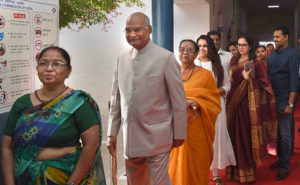

Stop watching news channels if you want to save your inner democracy – Ravish Kumar

From Facebook wall of Ravish Kumar India today and Aaj tak are repeatedly claiming that their exit poll sample size is 8 lakh and it was done in all Loksabha constituencies. In one region they have taken about 12,500 samples. Is it possible to predict the result of 16-17 lakh voters per constituency results by only 1200 voters response. I am not an expert in statistics or astrology. There are some regions where TV channels, newspapers and websites did debate shows and reporters spoke to people. Can only these people predict the results.

My criticism of news channels will not affect either news channels or the viewers. But i still ask you to stop watching news channels. I request you to understand news channels. The curiosity that you feel is not yours, its created by these channels. For ordinary viewers, to cross these artificial boundaries is as difficult as it is for me to solve percentage questions in mathematics. Dont even ask about fractions.

I urge you to carefully listen to the discussion of anchors and experts. You will realise when there is nothing to say then how artfully things are told with such importance and seriousness. This is the problem of TV channels worldwide. This is happening in India also, we are giving this to you on a platter and you are also taking it all in. Glitter and glamour is created instead of content. Channels have been having the same discussion thousand of times about 2019 since one year. This will be repeated until the formation of the government. will regurgitate the same discussion thousand  times that has been happening since last one year about 2019 will be repeated till the formation of the government. To say something in the times when there is nothing to say is the grammar of News channels.


News channels have converted this shortcoming into an asset. It has set a tradition that is difficult to come out of it. Anchor and analysis are fighting to remain relevant. Moreover, experts who speak well or who speak too much are called to make such discussions relevant, so that you do not feel that you are wasting your time.

This is the way of the world. Everyone is saying something. There are repeated tweets to tell that there are seven lakh samples from all over India, but not even more than 1300 in one Lok Sabha constituency. I am not dismissing the exit poll of one channel, i am dismissing exit polls of all the channels. Nobody has the formula to present the election related information in new way. Whatever you are watching and listening, if you pay attention you will realise that you have seen it before, heard it before.

Media has prepared a dumping ground for the consumption of its material. This dumping ground is called media society. In this media society, the common man with their common problems are displaced. They are replaced by the viewers who are prepared by the special drilling of these channels over time. In this media society, the anchors and viewers speak each others language. This is normalised in your mind until you face a problem, then you will realise that media is not showing you the basic issues. When you yourself are not looking for basic issue and were forced to watch something that is not a basic issue then who are you going to blame?

You can blame me for this because i asked you to not watch news channels. I am still sticking to my words. News channels have destroyed Indian democracy.

These channels have even destroyed your inner democracy. There are thousands of channels but no diversity. How is that possible? But it has been made possible. You have been turned into a vulture who sees any disagreement like a piece of meat. Information looks like a dead body. If you want you can watch TV, but i will still say that India should do a satyagrah of not watching news channels. If its possible do it, otherwise dont say that you were not warned by any TV person.

French economist Thomas Piketty and Pinarayi Vijayan discuss Kerala model

Renowned French Economist Thomas Piketty, met with Kerala chief Minister Pinarayi Vijayan who was on a tour to Paris. Piketty has expressed interest to study the Kerala model in economic growth and to submit recommendations for strengthening the state´s economy. Kerala CM had an hour-long discussion with Piketty and Prof. Lukas Chancel. Prof Lucas Chancel, co-director of the World Inequality Lab and of the World Inequality Database at the Paris School of Economics has made notable research on economic disparity in India Pinarayi discussed the government´s efforts to improve health and education sectors. Kerala CM also expressed his concerns over rising economic inequality in society and discussed the measures Kerala government is taking to counter them. The government is focussing on bringing the marginalised sections of the society into the mainstream.Kerala has also adopted social welfare pension scheme for people in unorganised sector which is a model for whole country. Piketty suggested measures like property tax, land tax and imposing more tax on the rich to counter economic inequality. Kerala CM has invited Piketty to visit the state and analyse  the economic inequalities and suggest remedies. Thomas Piketty is a French economist whose work focusses on wealth and income inequality. He is a professor at Paris school of economics and distinguished professor at London School of Economics. His book Capital in the Twenty-First Century came out in 2013 and quickly became a best seller. It brought the conversation back to the themes of wealth concentrations and distrbution over the past 250 years.    The book argues that the wealth inequality is worsening in the developed countries and proposes global wealth taxation as one of the measures to address the problem. Piketty has also advised the Congress party on the minimum income guarantee scheme `NYAY´. Piketty argues that Indian elite have treated the poor badly and its high time to move to the politics of wealth redistribution. Pinarayi Vijayan is on a 13-day-long four-nation European tour. He has been to Switzerland, Netherland and France. He visited  UK, France, Netherlands and Switzerland before returning on May 20.
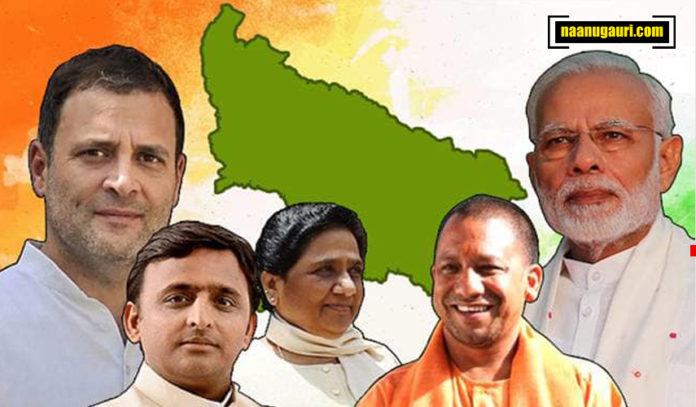
2019 Election: Of numbers and tales in Uttar Pradesh

//T. V. H. Prathamesh// While UP with its 80 seats has a disproportionate influence as far as elections are concerned. Consciousness of this power of numbers is not lost to the citizens of this  Gangetic plain province, where elections are marked with an air of color and festivity. Every punter in the chai ki dukaan would have  a prediction based on their assessment of hawa (public mood) and local power equations. More industrious among them would attempt to put a number to the intuition, and invest in the satta bazaar (the betting market). How does one really make an assessment of these polls. If we choose to cast a prediction based on the 2014 election data, and the 2019 candidature, it would be as follows:      
NDA (BJP+SBSP+AD) Gathbandhan (SP + BSP + RLD) INC Uncertain
29 37 2 12
    The method behind the number was on the following: (1) 2014 data still remains the most extensive quantified source of voter preferences, despite its datedness. The 2017 assembly data is largely irrelevant in this context. (2)  The numbers of votes that gathbandhan is expected to receive, per constituency is assumed to be the sum of votes that individual parties in the alliance received in 2014 polls in the said constituency. (3) A party or an alliance is predicted to have won a constituency if its: (a) The victory margin is greater than 2% of the net votes cast, in a particular constituency as per the 2014 data. This figure of 2% was done with keeping away small fluctuations and the complications that could arise out of alliance (b) In addition to the above, if a particular candidate has won the election they should belong the same party as in 2014. If a particular winning candidate in 2019, has switched sides, it becomes tricky to decouple the role of candidate and the party in the victory. (c) In addition to the above two criterion, there should be no strong contestants from a third party in these elections which could cause a split. We refer to a contestant as strong, if they are known public figures outside of their constituency or have won at least 2 or more parliamentary elections since 2004. Constituencies such as Moradabad where Imran Pratapgarhi is fielded by Congress and expected to split votes, belongs to this category. (4) If no candidate in a particular constituency matches  all the three above criterion, we list the constituency under the category: Uncertain. We can see that NDA can be expected to win around 29 seats by this data, and Gathbandhan would win 37. Depending on how the uncertain constituencies swing, we can expect NDA and Gathbandhan to reach a maximum of 41 and 49 respectively. It would be safe to assume the numbers here for the NDA are the upper limit, considering that 2014 was a wave election, which attracted many non-traditional voters to this camp. Such a feat would be tough to replicate. To get a better view of what 2019 might hold in store and what we could infer about the political landscape of Uttar Pradesh, it might be interesting to dwell in detail on some of the questions that arise out of the assumptions underlying these calculations. (a) Is it fair to assume that SP + BSP votes will add up, in other words, Would the votes necessarily transfer en bloc? The traditional core base of BSP are largely constituted of Jatavs, while the Samajwadi Party relied on the Yadav-Muslim combination to help them sail through elections. If some of the media reports are to believed, the transfer of votes between SP, BSP and RLD have largely been successful these elections. How is that these caste groups whose relations was described as politically antagonistic not too long back, could suddenly put behind their past to vote in this fashion? The clue to the mystery lies in changing agrarian relations in the countryside. According to the anthropologist Bernard Cohn, sometimes around 1950’s with the abolition of zamindari, there was a large scale shift of Yadav’s from the hereditary pastoral professions to peasantry. They largely remained small to large landowners engaged in a direct conflict with the traditional landlords often belonging to Thakur castes. With the changing demographics of rural Uttar Pradesh, and  heightened economic inequalities after neoliberal reforms, the bone of contention in rural UP shifted to the tension between the landowning peasant castes such as Yadavs, and agricultural labourers, which were mostly dalits. These heightened tensions on the ground, soon found their echoes in the corridors of power resulting in the infamous guest house scandal of 1990’s. However, the economic decline in the last decade, coupled with disastrous policies such as demonetization has adversely affected even the rich peasantry and almost immiserated the middle peasantry. The cry for remunerative prices which has been fairly visible in the recent peasant movements has been a characteristic feature of the middle peasant movements, right from the days of Mahendra Singh Tikait and Sharad Joshi. In a season of declining fortunes and loss of political power, it seems likely that Yadavs would have no hesitation in extending solidarity to dalits to arrest the slide. This might still not  explain why dalits would back their erstwhile oppressors. Perhaps the answer lies in the many symbolic gestures of respect that Mayawati has been receiving from the SP top brass , which seems to aimed at demonstrating earnestness of SP and placating the Dalit voter. The split in the Muslim votes post Muzaffarnagar in 2013, has not been the most optimal, as far as Muslim interests are concerned. One of the key positives with a gathbandhan in picture, as far as Muslims are concerned is the hope of preventing any vote-split that would only aide BJP.  One could conjecture without risking too much that the Muslim vote would transfer enmasse to the gathbandhan except in a few constituencies, where Congress might play the spoiler. (2) Will the vote shares look similar to 2019? That perhaps remains the hardest question to answer. If we go purely by caste arithmetic, BJP since 2014 has managed a near complete consolidation of the Tilak, Tarazu aur Talwar (Brahmin, Vaishya and Kshatriya) castes behind it under the flag of Hindutva and Modi.  This was a feat that it achieved for the first time since the early 1990’s, after which the Thakurs split away to SP and Brahmins flirted with the BSP.  It is further claimed that BJP’s victory in 2014 partly stemmed from its ability to woo over large sections of non-Jatav Dalit groups such as Pasis, and MBC castes such as Mallaahs. In the lead up to the 2019 elections , BJP’s has gone all out to override local power equations in favour of a high pitched presidential style campaign with the hope of retaining its 2014 vote base. The pitch of the campaign has been successful so far in rendering feeble all voices of dissatisfaction. Whether this high shrill of nationalism and personality cult actually overrides various issues surrounding economic distress remains to be seen. Similarly in terms of alliances, whether the merger with the Nishad Party compensates for the soured relationship with Suhel dev of Bharatiya Samaj Party, especially considering that have a loyal sub caste base, is a matter of speculation.  There is substantial hope among BJP ranks that PM’s flagships targeted schemes for the ‘poor’ such as Ujjwala Yojana, Individual Household Latrine and PM Aawas Yojana will help consolidate a base among the poor across caste divide. The ground-level implementation of these schemes, perhaps might not prove as celebratory. For instance, while the distribution of gas cylinders could be seen as a welcome move, the high refilling cost of Rs. 900 made the scheme a largely futile exercise.  Unless of course, it’s only objective was to earn a few good intention points for a certain bearded resident of Lok Kalyan Marg.   (3) Will the Congress attempts at have an effect? As seen above, only in perhaps at most 12 constituencies can one expect Congress to be of nuisance value to the gathbandhan. In the rest of constituencies, one finds an expected correlation between the caste of the BJP candidate and Congress candidate, suggesting a possible tacit understanding with the alliance to split BJP votes. For instance, in the constituency of Mathura, the Congress has fielded Mahesh Pathak, a businessman with a local reputation, who is certain to eat into the BJP’s Brahmin vote share. All these numbers and predictions arrived at by sifting data through the blunt sieves of universal criterion and quantification, often threaten to hide away many micro realities. For instance, in Kanpur the numbers might suggest that BJP with its 57% vote share in 2014, is mostly posed to retain the seat. But the twin-disaster of Demonetization and GST had an adverse impact on the economy of this small scale industrial hub. The absentee representative in form of Murali Manohar Joshi has only aided the palpable anger, and it seems likely that Congress under Shriprakash Jaiswal might wrest Kanpur away from BJP. While BJP hopes that a change of candidate and the narrative of nationalism and Pulwama will work a miracle for them. At a far distance from studios of Lucknow and Delhi, where debates run amok about nationalism, constitution and fascism, lies the constituency of Banda in  Bundelkhand which has the most telling tale of these elections. The sitting MP, Bhairon Prasad Mishra from the BJP, has been refused a ticket in 2019. In his place, BJP fielded RK Singh Patel, who contested the 2014 elections in Banda on a BSP ticket. Back in 2002, he was a cabinet minister in Samajwadi Party government. Meanwhile, Bal Kumar Patel, who was the SP candidate in 2014 and is locally known for being the brother of the dacoit Dadua, is the current Congress contestant. The gathbandhan candidate is the industrialist-businessman from Shyama Charan Gupta from Allahabad, who also happens to be sitting MP of Allahabad on a BJP ticket. Having been refused a BJP ticket from Allahabad, in favour of Rita Bahuguna Joshi  the former president of the UP Congress committee who morphed into a cabinet minister in BJP government, he switched to party and the constituency . The son of this socialist party candidate continues to be a member of the BJP. Author is a Mathematician by profession.The views expressed by the author are personal. 
Elections in West Bengal- a Terror Plot or Advent of The Phoenix?

//Ayan Pal// For Kannada Version- click here
      Remember, remember
      The 5th of November
The gunpowder treason and plot
      I know of no reason
   Why the gunpowder treason
    Should ever be forgot
No, Rajkumar Roy was no Guy Fawkes who tried to blow up the British parliament in 1605. He was an ordinary, jolly good fellow type teacher of Rahatpur High Madrassah in Raiganj, West Bengal, who was assigned the duty of presiding officer of booth no. 48, Sonapur FP school of 36 Itahar Assembly Constituency in the Panchayat Election of 2018. But what happened there is still a baffling mystery as his mutilated body was found next day on a rail track 25 kms away from his booth. Only future will tell whether this heart- trenching incident will be called as ‘November’ of Bengal politics but clearly it has affected the persuasion of the people of Bengal regarding polls which is already showing its repercussions in the ongoing general election and may redefine the structure of many future polls to come.
Polls in west Bengal have always been a bloody affair. Death toll has been recorded as 76 in 2003 Panchayat Election, 48 and 36 in the 2008 and 2013 version of it.In the 2018 one it was only 26, much lower than the previous ones. But the difference from it’s previous versions was the nature, realm and amount of terror. In 2013 a police officer named Tapas Chowdhury was shot dead during a student election nomination filing process in Harimohan Ghosh College, Kolkata. The last municipal election, held in 2015 also showed wide spread violence due to which many urban elites were unable to cast their votes. Even the ongoing General Election, a process rigorously monitored by mighty Election Commission of India, with the help of hundreds of companies of paramilitary forces, has seen murder of a voter within 50 meters of a booth, as well as events like clashes with security forces, rigging, bombing and firing frequently in each phase.
Birbhum: Voters queue to cast their vote at a polling station, during the 4th phase of Lok Sabha elections, in Birbhum, Monday, April 29, 2019. (PTI Photo)(PTI4_29_2019_000089B)
  These facts show how much violence prevails in the State of West Bengal when it faces any kind of election, be it local or legislative. But what it does not show is for the local bodies elections , even filing nomination or counting the votes are also bloody affairs. During the last panchayat election, which is a three tire one, namely, the gram Panchayat, Panchayat Samiti, and Zilla Parishad polls, a staggering number of 16814 GPs, (34.56%), 3059 PSs(33%) and 203 ZPs(26%)have been won by ruling TMC party unchallenged. A quick conclusion would be like it is a single party controlled state, but even any reluctant follower of West Bengal politics would know that from the time of independence this situation was never so bad , even during the 34 long years reigned by the Left-front. What is astonishing is Hon’ble Supreme Court’s view in this matter. There was at least 5 number of petitions filed in Calcutta High Court regarding various issues of Panchayet polls prior to its commencement. The issues included schedule of polls, security arrangements, obstruction in filing nomination etc. Unimaginable orders were passed by the judges, like allowing the filing of nomination via Whatsapp, and compensations to be paid to victims family by deducting the amount from the salaries of responsible officers! If only the Apex Court had taken the abnormalities regarding the poll results and the case matters of those filed in Calcutta High Court together, they would have gained a clear picture and may not have sanctioned this poll as valid one.
What exactly happened during the poll of 14.05.2018? Each and every person of Bengal knows that but only the official reports do not. The morning showed the day when large number of candidates were attacked in front of BDO and DM offices, by ruling party workers and goons to inhibit them from filing nominations all over the state. On the said day, the exact number of booth capturing, rigging, attack on voters and polling personnel will never be known. The whole election was conducted by West Bengal State Election Commission with the help of West Bengal Police, contractual Civic police, forest guards and homeguards. Armed with a mighty bamboo stick they were swamped in front of the goons armed with guns and hand-bombs. Even complete surrender to those goons could not save the forlorn polling personnel from the wrath of the thugs. Many of them returned home with bruise marks in their bodies, blood dropping from their torn lips and foreheads, fractured bones, shifted jaws ( literally)! Then came the news of the death of late Rajkumar Roy. People of Raiganj immediately started protesting by blocking the roads. They demanded answers like a) where was he during his last 24 hours of life, b) why the concerned RO was reluctant to his wife’s appeal? C)Why didn’t the said RO lodge an FIR regarding missing of an on-duty polling officer and so on. The administration was quick in replying that it was a clear case of suicide even before any official enquiry or any case report. They were also quick in booking the protesters under unbailable sections of IPC. Since most of the victims were teachers and non teaching staff of govt. run schools, they started protesting on social media and streets. The agitations were mainly unorganized and scattered, as no sustainable plan could have been taken. Also the opposition parties and teacher organizations controlled by them, refrained themselves from such protests. Though this step from their end can be rationalsed somehow, the role of the mainstream media was so biased that they not only shunned from publishing the news of such protests but also tried to spread hoax news like these protests were against the arrests of culprits responsible for late Rajkumar Roy’s death! Perhaps a curious Company Secretariat and Chartered Accountant can find the answer by looking at the Balance Sheets and Shareholding changes as well as changes in the Directorate levels of these media houses in recent years.  
  At this point some questions may come in anyone’s mind that why West Bengal is in such a disdaining and horrible state. This can be a point of research and therefore beyond the limits and objectives of this article. In a brief manner it can be said that the culture of marginalising the opposition by any means is not new in West Bengal politics. Based on mainly self- consuming agricultural and trade based economy, it’s revenue generation has been constantly under deficit. The present TMC government has come to power in 2011 riding on the anti- industry and pro agriculture movements like Singur Tata Nano factory and Nandigram Chemical Hub. TMC has maintained its stand by barring proposed Infosys SEZ and approving all type of illegal and absurd party worker based employee movements in various industries. This led to a large number of industrialists abstaining from investing here, and those already invested have already winded up their businesses. In such situations a state with long international border and high population density quickly goes down in the hand of Black Economy and that is exactly what happened with the flood of ponzi schemes( like infamous Sharada and Rose valley which are now under CBI investigations) and shell companies, real estate and supply( anything even kidneys!) syndicates, human trafficking, smuggling and so on. Government has almost stopped all kind of recruitment processes, dues to it’s workers are escalating but keeping a good track record of distributing freebies, organising fests in the name of any occasion. It is spending enormous tax payers money on beautification of the cities, has broken or mended rules to indulge the cream-leachers. In one word it has done everything that a government should not do.
West Bengal is demographically very interesting for any vote mongering politician’s point of view. The Dalit politics which prevails all over the country, had no sound base here. Based on the teachings of many stalwarts of Bengal Renaissance and idols like Swami Vivekanada, Rabindranath Tagore, Netaji Subhas, caste politics was always marginalised here. But the Mamata Banerjee government has not only rejuvenated this sector to gain votes, it has taken absurd schemes and treatments to spoil the minorities. As a result polarised pockets of votes have been created threatening the harmony of the people of Bengal and increasing communal tension.
The communal storm is looming over Bengal, with the advent of BJP as main opposition party and with a shattered economy under severe pressure, when a poll comes, the power mongers look at the opportunity of grabbing the cash flow of various Public Schemes as well as take control of the Black Economy and go out and out for it. They have little or no concern for the life or democratic rights of common voters or the polling personnel. Recently an apolitical forum representing teachers and other staff along with some educational enthusiasts named Shikshak- Shikshakormi-Shikshanuragi Oikyomancha tried to unite the polling personnel via social media, and started a movement to ensure the security of them with a demand of security by CAPF only. Depicting this duty as violation of Article 21 of Indian Constitution, they gave the slogans “ NO CRPF NO ELECTION DUTY” at various training centres. They also started e- mailing and meeting election officials from district to state level to convey their anguish. Under huge pressure, the Chief Election Commissioner had to release a press note ensuring the safety of polling personnel. This was an unprecedented incident in the history of Elections of India. Also the observers had to relocate the CRPF so that maximum number of booths are covered by them. Had this not been done, only people of Bengal know what would have happened in this election also.
Demagogues and dictators are running the Indian politics as well as governments for a quite long time. Somehow people even the educated ones are failing to judge between a “ strong government “ and a ‘totalitarian’ one. The result is showing by the weakening of democratic institutions and constitutional as well as social values. We have seen in the past that Civil Societies can be the fifth pillar of democracy and when all the remaining four get rusted, they can serve as the last frontier. Yes, they do have a high chance of fizzling out, but do we really have a choice? After all as Leon Trotsky said “ The end may justify the means as long as there is something that justifies the end”
Author is a teacher who is on election duty. He is also member of Shikshakormi-Shikshanuragi Oikyomancha, a forum to unite polling personnel (teachers and staff) in West bengal. 

Delhi LokSabha Elections- Triangular Battle of National and Quasi- regional Parties

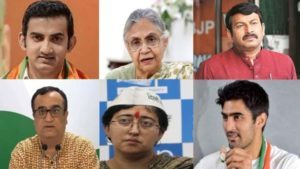
//Anish Nair// By evening yesterday, the Delhi Chief Election Officer recorded the voter turnout to be at 60% over 5% less than 2014 Lok Sabha election and over 7% less than 2015 assembly election. The dip is even more striking when one considers the fact that the election day was a Sunday, which should have ideally boosted electoral turnout. A general wisdom that political pundits on newspapers and TV shows repeat ad nauseam is that a significant dip in voter turnout is supposed to indicate a pro-incumbency trend. If one were to take this wisdom at its face value, the question that begs to be asked is who is the incumbent that will benefit here? This is a difficult question to answer, with the fact that both the central and the state government have more or less an equal say on matters of Delhi. As the capital of a nation and as an entity with its own localised set of issues and administrative concerns. As a national capital territory it is neither a state nor so much a union territory. And what’s more? The residents look at both these levels of government as equally responsible for their city, like a form of diarchy of the central government and the state.     So who is the incumbent for Delhi? The Aam Aadmi Party that runs the state government or the Bharatiya Janata Party that leads the centre? Arvind Kejriwal or Narendra Modi? This question has played out quite elaborately with no right answers in the current election season. Two national parties and a quasi-regional party are fighting a three-cornered contest over the 7 seats it returns to the Parliament. Let’s begin with a look at the campaigns of the three parties that are relevant in Delhi. While the national parties, BJP and Congress have almost entirely addressed the people of Delhi as a microcosm of the whole of India, AAP focused quite a lot on the matters that specifically affect the national capital territory. BJP leaders talked about national security and extolled the supposed successes of prime minister Modi. The Congress countered that with the promises of NYAY and focused on the failures of the prime minister. But the AAP candidates took a different route. They promised to push for full statehood, talked about Delhi’s latest progress in public education and the party manifesto also promised quotas to reserve most of the seats in higher education and government jobs to the “residents” of Delhi. For the BJP and Congress, their treatment of Delhi is not new. For them Delhi has always been more of a capital or a mini representation of the whole of India, unlike other states which are treated quite distinct from each other. So if the two parties fight the left government in Kerala over Sabarimala, they are now talking down Naveen Patnaik government in Odisha over what they claim to be a mismanagement of relief operations in the aftermath of cyclone Fani. All of this is done while also foregrounding the national battle between the ruling party and the opposition. But in Delhi they never seem to or do not feel the need to pay attention to the ‘local’, during a Lok Sabha election (lack of better words since regional consciousness is yet to be developed in Delhi). While AAP’s demand for full statehood for Delhi is an old one, the language of residents of Delhi being “second-class” citizens is new. So are the promises of a domicile quota and boasting of the achievements of the state in public education, the urban infrastructure, etc., indicating a certain push towards a regionalist identity that is yet to take shape. What is also notable is the stark difference between AAP’s campaign in 2014, where it tried to present itself as a national alternative to both the BJP and the Congress, and right now. Five years later it has come to limiting itself as a cluster of individual state parties operating largely in Punjab, Haryana and Delhi. Realistically it barely has any presence beyond the three, even though it tries to expand. But it is increasingly making peace with the idea of being a regional party for now rather than a national party. Local issues have always been at the centre of political discourse in the Vidhan Sabha elections, since the formation of the first state government in 1993, rarely ever spilling over to the next national election. It was this focus on local issues by the Congress in assembly election, that gave Sheila Dikshit three consecutive terms as the Chief Minister. AAP shift to a more regional approach has also pushed the other parties to try to account for what could be a changing political landscape. Bringing back of Dikshit at the helm of the Delhi Congress, after a brief retirement from active electoral politics since her defeat in 2013, and a circulation of a peculiar slogans and WhatsApp forwards from the usual Sanghi quarters, on the line of “Kendra me Modi, Dilli me Kejriwal” (Kejriwal in Delhi, but Modi at the Centre) can be seen.   This development is nevertheless alarming to the two national parties. For one it has to do with the general trend that emergence of regional parties or alternatives have had on both their prospects in several other states. More often than not, they eat into Congress’ votes and sometimes leadership, while attracting a cross-section of vote base along linguistic or ethnic lines that can act as a formidable electoral alternative to the BJP’s communal and ultra-nationalist attitude. In the case of AAP has definitely become a formidable force standing against the BJP in Delhi having replaced the Congress. In the elections of 2013, 2014 and 2015, the Congress has a seen a continuous decline from 25% to 15% to 9% of the votes, while having won none of the seats in the latter two. AAP on the other had began with 30% and went upwards to 33% to eventually 54% of the votes, in the same. The BJP, in the meanwhile, got 33%, 46% and 32% of the total votes polled. For BJP which has more or less maintained a third of the votes in Delhi, with the only exception being 2014 when it was riding on the ‘Modi wave’, seems to be set to do only marginally better and very unlikely to get more than 40% of the vote share. But whether or not it performs badly in the number of seats, would depend on how well the AAP can consolidate the rest of the votes in its favour. If the Congress can boost its performance by bringing back Dikshit, it is still less likely to actually win seats and more likely to cut down the winning chances of AAP and help the BJP sweep again. If the Congress performs as poorly as it did in 2014 and 2015, there is a good chance AAP can win 3-4 or even more seats, depending on how much the latter can eat into BJP’s potential votes.
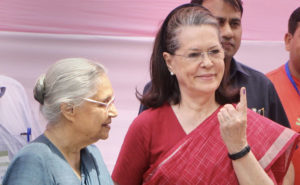
Elections 2019: 111-year old Bachan Singh, the oldest voter in Delhi casts vote
Bollywood celebes hailing from Delhi cast their vote
  This seesaw act between Congress and AAP was best demonstrated in the 2017 municipal elections, when Congress regained a lot of ground by securing 21% of the votes, with AAP 26% and BJP 37%. While the BJP did not make any significant gains, it swept the election because of the divided votes and won a two-thirds majority in the corporation. Although one might argue with the difference of voting in local, state and national-level elections, one can not undermine the very consistent voting pattern. And with that one can safely assume that if the Congress manages to make further gains and split more anti-BJP, there is a good chance for the BJP to win 5 or more seats, candidates notwithstanding. Eitherway, this will indicate a shifting narrative in the anti-BJP political parties, because any major gains Congress will make would be because it is led by Sheila Dikshit, who even though is contesting for the parliament has a very limited national profile but enjoys a great deal of popularity in Delhi. This can push the Congress to change its electoral strategy in Delhi to being more centred around Delhi, than as a mere microcosm of the nation. Author is a Delhi based Journalist. 

Irom Sharmila- The Iron lady of Manipur gives birth to twins in Bangalore

News Desk

`Manipur Iron Lady´ Irom Sharmila gave birth to twin baby girls on 12th May 2019 in Bengaluru coincidently on the occasion of Mothers day. The 46-year-old civil rights activist, delivered the babies at Cloudnine hospital, Malleswaram, Bangalore. 

Irom is famous across the world for her 16-year long hunger strike against the draconian Armed Forces Special Powers Act (AFSPA) in her home State Manipur. Manipur has been suffering insurgency since decades with death toll of 5000 people from year 2005-20015. On November 2, 2000, soldiers of the Assam Rifles opened fire on a crowd, which had women and children as well. The Army said the 10 people who were killed in the firing at Malom, a town in the Imphal valley, were insurgents and claimed immunity from prosecution under AFSPA. It was this massacre that led Sharmila to launch her fast.

Irom began a hunger strike on 5th November 2000 to repeal the Armed Forces Special Powers Act. During this time period, she was released and arrested, many times under “attempt to commit suicide”. She was confined to the prison ward of Jawaharlal Nehru Institute of Medical Sciences (JNIMS) in Imphal and was force-fed through nasogastric intubation to keep her alive. She ended the fast on 9 August 2016, after 16 years of fasting. Having refused food and water for more than 500 weeks, she has been called “the world’s longest hunger striker”. On International Women’s Day, 2014 she was voted the top woman icon of India by MSN Poll.

Armed Forces Special Powers Act (AFSPA)

AFSPA was passed as a law by Indian government in 1958. It applies to the seven north eastern states and Jammu and Kashmir. According to this special powers act, security forces have the power to search properties without a warrant, and to arrest people, and to use deadly force if there is “reasonable suspicion” that a person is acting against the state.

Struggle and Recognition

By 2004, Sharmila had become an “icon of public resistance”.  She wrote letters to the Prime Minister, the President, and the Home Minister. On 3 November 2011, 100 women formed a human chain in Ambari, Guwahati to show support for Sharmila, while other civil society groups staged a 24-hour fast in a show of solidarity. In 2011 the Save Sharmila Solidarity Campaign (SSSC) was launched to highlight Sharmila’s struggle. In December 2011,Pune University announced a scholarship program for 39 female Manipuri students to take degree courses in honour of Irom Sharmila Chanu’s 39 years of age.

Sharmila´s 16 year old peaceful resistance brought the attention of Indian public to the atrocities committed under AFSPA. In 2013 Amnesty International declared her a Prisoner of conscience, and said she “is being held solely for a peaceful expression of her beliefs.” The influence made by Irom Sharmila is often considered as one of the most powerful influences by personalities in the past and present.

By 2016, Sharmila has gotten disillusioned by the apathy of Manipuri people who did not join her in her fast and let her be the sacrificial lamb in the struggle against AFSPA. On 26 July 2016, she announced that she would end her fast and would contest state elections in Manipur. She stated that her decision to join politics is to continue her fight for removal of AFSPA. She launched a political party named Peoples’ Resurgence and Justice Alliance´ and contested Assembly elections in Manipur. However she lost the elections and received only 90 votes.


After the setback in electoral politics, she said she has no interest in politics and want to live a normal life. She married her then fiancé Goan-born British national Desmond Coutinho in 2017 and settled in Kodaikanal. Last year, however, they shifted to Bengaluru after Irom got pregnant.

The couple has named the twins Nix Sakhi and Autumn Tara. Their first daughter, Nix Sakhi, has been named after her late mother, Irom Sakhi. Their second daughter has been named after “a Buddhist goddess”.

Lok Sabha Election 2019 Phase 6: Penultimate phase of General Elections

News Desk

The sixth phase of 2019 Lok Sabha elections has started Sunday morning. Polling is being held in seven states on 59 parliamentary constituencies. According to election commission, in this phase 10.16 crore people will vote with 5.42 crore Men and 4.74 crore women voters. A total of 979 candidates including 769 independent candidates have been fielded with 54 from BJP, 49 from BSP and 46 from congress.

Out of 59 seats 34 are declared red alert seats. Red alert constituencies are those where 3 or more contesting candidates have declared criminal cases against themselves, according to the Association of Democratic Reforms (ADR). Elections will be held across 14 seats in Uttar Pradesh, 10 seats in Haryana, eight each in Bihar, Madhya Pradesh and West Bengal, seven seats in Delhi and four in Jharkhand. This will be lead to completion of 483 seats out of 543 seats of this election.

This phase will also decide the fate of key leaders including Aam Aadmi Party chief and Delhi chief minister Arvind Kejriwal, Samajwadi Party chief Akhilesh Yadav, Union Minister Maneka Gandhi and Congress leader Digvijaya Singh. Pragya Thakur, Malegaon bomb blast accused Pragya Thakur, BJP candidate is fielded against Digvijay Singh is contesting against

With this the second last leg of Indian general election will end.

Activists in Bengaluru protest against clean chit to CJI Ranjan Gogoi

Editorial Desk Read in kannada click here Dozens of lawyers, students, and other activists were detained on 10 May after they gathered to peacefully demonstrate against the mishandling of a complaint of sexual harassment against the now Chief Justice of the Supreme Court, Ranjan Gogoi. Against the complaint, the Supreme Court attempted to deal with the matter using an in-house committee comprising of judges who are junior to the accused, violating principles of due process. The demonstration only involved holding of placards and wearing of black masks across their mouth, while marching from the High Court to nearby Mysore Bank Circle. The police claimed to be holding the protesters as a preventive measure. However, the demonstrators had given due intimation to the police informing them of their intent, with an acknowledgement received. Those who were taken by the police were held in Halasuru Police station for about two hours before being released.
Lawyers, activists being picked up by police for protesting against present CJI

Police was waiting for protestors and detained them within minutes of the gathering
The demonstration was held on the same day that similar demonstrations were happening in other cities across the country. The demands were: 1. The Full Bench of the Supreme Court should restore public faith by taking steps to correct the grave injustice done to the complainant. 2. Follow due process and appoint a new committee which shall adhere to Vishakha guidelines, POSH Act, and protect interests of the complainant. 3. A copy of the Justice Bobde panel report should be given to the complainant immediately. 4. Provide adequate protection to the complainant. 5. That a retired woman Judge as an external member of the committee must be appointed. 6. That a respectable senior woman member of the Bar could also be considered as amicus curiae (friend of the court). 7. That the grievances raised by the complainant such as allowing her legal assistance by a lawyer should be redressed.

The complainant, a former Supreme Court staffer, had submitted a sworn affidavit to 22 judges on April 19, accusing CJI Gogoi of sexually harassing her on two occasions in October 2018. The CJI has denied the charges, claiming that the allegations were a part of a ‘larger threat to the judiciary.’

Swara Bhaskar – Campaigner Among Bollywood Sycophants

Film industry association with politics is not a new development but the manner in which present gang of Bollywood minions have neatly placed themselves in the well-oiled propaganda machine of BJP IT cell is nothing but disgraceful. What started as `spontaneous´ selfies became carefully curated twitter campaigns. This was followed by starring in Modi biopics and proclaiming open support for his re-election.

In such times there are some actors who are vocal in their criticism of the present regime, commenting on mob lynching of minorities and Dalits, cinema censorship to the growing intolerance in society. Many have been silenced by attacking their craftsmanship, their sponsors and even their families.

Swara Bhaskar is one such crusader who is undeterred by the relentless attack of right-wing trolls on social media. Social media is not a kind place for a woman, let alone a woman with political opinion. In an industry where women are mostly limited to eye candy and item girls, Swara has managed to keep her voice bold and unapologetic.

Swara grew up in Delhi, has an English literature degree from Delhi University and a masters in Sociology degree from JNU. Starting with theatre in Delhi, she got noticed with supporting roles in big-budget movies like Ranjhanna and Tanu weds Manu. She has also hosted Shyam Benegal TV mini-series Samvidhaan, which was based on the making of Indian Constitution. She has made her mark with her outstanding acting in independent movies like Anarkali of Arrah and Nil Batte Sannata.

Swara is known for speaking against injustices on social media and debates on TV channels. Due to her criticism of communal hatred and bigotry under the BJP government, she has been at the receiving end of brutal trolling by right-wing Hindutva brigade on social media. She regularly gets hate messages, rape, and death threats. Despite the real danger, Swara refuses to cower down. She takes it all in her stride with much amusement. 

She believes that the government instead of fighting the far-right religious mobs are nurturing them. Swara has been critical of BJP for fielding Pragya Thakur, a terror accused of Bhopal calling her a “mix of politics and crime”. Recently during Maharashtra elections, trolls were at it again to malign her image by commenting on a scene she did in a movie.  The slut-shaming attempt went in vain when Swara gave it back to them in her unique endearing manner. 

Swara´s has been quite outspoken when it came to Bollywood´s silence on #MeToo and regressive Bollywood movies. She wrote an open letter to director Sanjay leela Bhansali for glorifying Sati system in his movie Padmavat.

Elections 2019

Swara has not limited herself to just a social justice warrior on social media. For 2019 LokSabha elections, she has been campaigning for various candidates including Kanhaiya Kumar who is contesting from Bihar’s Begusarai district on a CPI ticket, CPI-M candidate Amra Ram from Sikar, Aatishi Marlena and Raghav Chadha from the Aam Aadmi Party.


Yeti sightings and the case of missing scientific temper

A week ago, the Indian Army tweeted that they had definite proof of the Yeti’s existence.While twitterati had a field day mocking Yeti and linking him to climate change, to Modiji and to India elections, the biggest embarrassment has been for the Indian army who has been a little too quick in posting pictures of “footprints” without further verification.

The Nepal Army and Director General of the Department of Wildlife and National Parks Man Bahadur Khadka have dismissed the Indian Army’s claim saying it is more likely that the footprints belong to a bear. Wildlife experts also informed that the Makalu Barun region is home to large snow bears and the footprints might belonged to them.

What/Who is Yeti?

The Yeti has been described as a tall ape like creature who lives in Himalayan mountains and mostly been part of folklores in the mountain regions of Nepal and Tibet. The name Yeti or Teh-meh is a sherpa word that means `man of the rock´.There are many stories of this creature terrorising mountaineers, campers and animals. Tales of the yeti are common around Himalayan ranges and Tibetan plateau. Stories spanning Nepal, Ladakh and Bhutan with different names for this mythical being.

Yeti sightings

For decades, people living in and around the region have claimed to have spotted “Yetis”, but never managed to get visual proof. During early 20th century when many westerners made frequent attempts of scaling the Himalayas, stories of strange footprints and snow man sightings started. Many have spent years of their lives obsessing over Yeti. Many made several mountaineering expeditions to search for the elusive Yeti. Yeti also entered pop culture with movies and comic books like Tintin in Tibet. Despite such attempts Yeti is somehow too shy to come out for a selfie!

Separating Yeti from the myth

In the absence of any concrete evidence, the general scientific community has regarded the Yeti as a legend. The harsh terrain has made it difficult to study the fauna (wildlife) of these areas and perhaps that is also the reason it made it easier to spin stories about a giant fearsome snowman. The most convincing evidence so far has come from a study done by Charlotte Lindqvist, an evolutionary biologist at the State University of New York in Buffalo. The study was published in Proceedings of the Royal Society B in November 2017. In this study the researchers matched DNA from hair samples found in Himalayas from various sources. These samples were collected by people living in Nepal´s upper Mustang region, from Reinhold Messner, a famous mountaineer and from museums across the world. Out fo the 23 samples collected,  22 samples matched with with a prehistoric bear from the Pleistocene epoch. One sample belonged to a dog.

The study found that most of the yeti samples belonged to two bear species: the Himalayan brown bear and the Tibetan brown bear. The study also shed some light on the distribution of brown bears in Tibetan plateau and western Himalyan region. This study represents the most rigorous analysis to date of samples suspected to derive from anomalous or mythical ‘hominid’-like creatures i.e Yeti, strongly suggesting that the biological basis of the yeti legend is local brown and black bears.

The missing Scientific temper

What the Lindqvist team found should have put the future Yeti arguments to rest. As we can see from the Indian army social media fiasco, it did not..After the attempts to elicit praise failed, Indian army public information unit issued statement clarifying their post-

Ladies & gentlemen, • The story is based on physical proofs of on the spot narration, photos and videos. • We got the inputs about 10 days back and yet we held on to it. Please do have a look at photos and videos (getting full tomorrow) that may surprise you. • But then we decided that there are photographic evidences which match with earlier theories. • Tweeted as we thought prudent to excite scientific temper and rekindle the interest. Some of us who reject the story, surely shall have a definite answer to the evidences. • As they say nature, history and science never write their final story.

Their story based on photos and videos ignored the fact that it also needed some supporting evidence and research to corroborate their hypothesis. Indian army claimed that they held the photos for 10 days and then released the photos to excite scientific temper. The so called prudent behaviour of Indian Army was anything but reflective of scientific temper. Scientific temper calls use of scientific method of observation, questioning, testing, analysing and discussion. If the Indian army had questioned, discussed with some wildlife expert or biologist before jumping to their conclusion, they would have saved themselves from this international embarrassment.. So much for scientific temper…

Scientific temper is an attitude that involves evidence, reason and application of logic not just reliance on one observation .Now, there are popular personalities who have fallen prey to social media traps in an attempt for likes and shares, but the way Indian army, a national organisation communicated, took credit of its `surprise´ findings was a little unflattering for its status. What is with our national organisations occupied in doing things that is not even their job description? Indian Army finding footprints of mythical beings, NSA finding caste of a student, Archaeological survey of India looking for Saraswati river, scientists researching on Pushpak Viman..

Ironically, the term Scientific temper was coined by our first Prime Minister Jawahar Lal Nehru, who has been the target of social media malicious and slander campaign through fake news and photoshop in last couple of years.