//Aditya Nath//You can’t win anything, forget elections, without the intent of winning it…!!its almost one month now that NDA emerged victorious in the 2019 Lok Sabha elections. The results were unprecedented even for hard core BJP supporters so one can imagine the skeptism of Modi detractors. Mr. Modi and his cabinet is settling into the NDA-2, but the murmurs about how BJP managed such an astonishing victory refuse to settle down. When analysing the results of the General Election 2019, a shot from the Film M S Dhoni by director Neeraj Pandey comes across my mind, where the protagonist while describing the cricket match played between his team and Punjab’s team, asks his friends that “do you know why we lost?” And then describes the why of the loss ‘We lost not because we didn’t played well, we lost because we were awestruck by the flamboyance of the captain of the opposite team (Yuvraj Singh in the film).’ If you can recall that scene, you would be able to correlate it with the unexpected results in elections 2019. Yes, everyone in the opposition was just awestruck by the name ‘Narendra Modi.’ All strategies from the party in power to the Grand Old Party (GoP) of India was revolving around this phenomenon called Modi. Otherwise, you don’t find any reason for a party like Indian National congress, that recently won handsomely in Rajasthan, ending up getting a duck. You talk to any expert in Rajasthan and the least they were giving to INC was 8-10 and come 23rd May the GoP struggled to even reduce the margin of loss. Yes, if one closely sees the margin between the winner and the loser in each of the 25 seats in Rajasthan, apart from Dausa (where the margin is around 78,000), the margin in every single seat goes in lakhs. Even the current CM, Ashok Gehlot’s son Vaibhav Gehlot lost the hometown seat of his father by a huge margin of 2.74 lacs.That’s the scale of victory in Rajasthan for the BJP which 5 months ago lost the state elections. So what happened ion ground? Did the present INC government took some drastic decisions which didn’t go well with the electorate? Or did the state organization of BJP did some magic on ground that ended up giving them 100% support in terms of seat share? Well, to me it’s neither of the above. Just remember the sloganeering in the state elections 5 months back and you would get the actual reason for such thumping win in the state. The most popular slogan in those election was ‘Modi tujhse Bair Nahin, Vasundhara teri Khair Nahin.’ Meaning We don’t have any qualms with Modi, but will not give any respite to Vasundhara. It’s this love with Modi that has swept the electorate. The “election experts” were giving sweeping statements like the narrative of panna pramukhs, the data analytic team of BJP, the lack lustre organization of INC etc .But all this failed against the biggest factor and that is the LOVE of the people for Modi. As they say ‘Pyaar mein aadmi andha ho jaata hai,’ The Love just blindfolds you, and that is exactly what happened everywhere. You talk to the local sabziwala, the watchmen, the auto driver, the club going youth and even the youth that doesn’t have any job security, 8 out of 10 people will agree that ‘Demonetization’ was disaster, that they dont have a job , inflation has gone up, but let’s give him another chance and see.
There were other reasons alsofor this love and forgiveness of the electorate for Mr. Modi. The religious polarisation the man evokes in masses, the image of a strong leader, the sweeping speeches, but the one reason I find is the fact that no electorate has any intention to bring down the government just in 5 years, especially if it is a central government and the face seeking another term is a strong one. 5 years, people feel is too less a time. You converse with people for sometime and they would at one point say ‘5 saal bahut kam hota hai bhaiya ji’, ‘5 years are too little time to judge.’ This is as nuanced as it gets when it comes to the electorate. The role of opposition parties cannot be ignored in handing the victory in BJP’s hands. In fact, when it comes to putting up a fight against the well-oiled election machinery of BJP, Mr. Modi’s statesman image, the opposition failed to show up. And Rajasthan is a classic case of that. Despite all the blind love or Bhakti for Mr. Modi, it was always clear that Congress will get at least 7-8 seats. Congress, the local leadership and Congress high command is to be blamed for its defeat. The reasons? Mnay!!The local congress leadership lacked vision and also suffered further from the ongoing tussle between Mr. Gehlot and Mr. Pilot. The party also failed to put up credible candidates on the seats that could have easily won. The classic mistake the party made is of annoying the Hanuman of Rajasthan (Hanuman Beniwal, the broke away leader of BJP who supported the Congress in state elections but got miffed in general elections). All this could have easily been avoided had the leadership, both the local and the central, thought seriously about winning. There was clearly no serious intent of winning in the congress party when it comes to the general elections in Rajasthan. The whole unit became complacent after the win of state elections thinking that the electorate once again will put faith in them. But sadly, they forgot the five-month old slogan of the state electorate where the love for Mr. Modi was clearly evident. And when they woke out from their slumber, their eyes were completely awestruck by the competitor they were fighting.
People fall in love, not all lovers are good, but we justify their acts out of our love and innocence. Love hurts when it is built on lies, money and deceit. But one emerges out wiser from failures in love .
Indians are emotional people.. Lets just hope that when India’s romance with Modi ends, We as a country also emerge out wiser.
Writer is a Political enthusiast and waste management entrepreneur based in Rajasthan
Read in Kannada hereIn Muzaffarpur district of Bihar, death toll of children due to acute encephalopathy syndrome (AES) has risen up to 112. The state is not new to the epidemic that is making national headlines. Deaths due to encephalitis have been happening in Muzaffarpur and neighbouring areas where lychee gardens are common from 1995. There are many factors to be blamed for the present situation from malnutrition, heat to weak immune system, all of which is exacerbated by certain chemicals present in lychee fruit. What is Acute Encephalopathy Syndrome (AES)?Acute encephalitis syndrome (AES) is a neurological disease caused by bacteria, viruses, parastes, fungus, chemicals and toxins. It causes inflammation of the brain. Symptoms may include fever, headache and seizures.The outbreak of AES coincides with monsoon and post monsoon period. It predominantly affects children below 15 years of age. Areas around Gangetic plain including Uttar Pradesh, Bihar, West bengal, Assam, parts of Tamil nadu are endemic for this disease. The disease is treatable with immediate hospital care and medications. Majority of cases from Bihar have been where the children have eaten unripe lychee fruit on empty stomach. Unripe fruit contains the toxins hypoglycin A and methylenecyclopropylglycine (MCPG). Hypoglycin A is a naturally occurring amino acid found in the unripened litchi that causes severe vomiting (Jamaican vomiting sickness), while MCPG is a poisonous compound found in litchi seeds that causes a sudden drop in blood sugar, vomiting, altered mental states leading to lethargy. These chemicals are present in high amount in unripe lychees.(link)According to the research done by Center for disease control and Indian organisations, the problem is not the lychee fruit, the problem is the already malnourished children eating these unripe lychees in early morning. With already low sugar levels, the ingestion of the fruit further lowers the blood glucose levels leading to delirium, coma and death in severe cases. Were the deaths preventable? Absolutely Yes!!As mentioned earlier this region is endemic to AES, and since 1995, there are cases of AES from this region. In 2012, the number of deaths were 122. The state health department came into action and developed a standard operating procedure (SOP) based on the symptoms of the disease to control it. This SOP involved village level ASHA workers, panchayat, state administration, media awareness programs and NGOs and it helped a great extent in curbing the disease. At that time, in Muzaffarpur, the health centers, doctors and nurses were well equipped with glucose kits and ORS packets. The ASHA and anganwadi workers were making the rounds in the night of the areas to check that children are not sleeping empty stomach. IN 2016, only 4 deaths were reported. So what went wrong in 2019?Malnourishment, laxity in application of SOP coupled with extreme heat waves and water scarcity have led to the present crisis in Bihar. In Bihar, almost 44% of children are malnourished. Malnourishment reduces the capacity to fight disease. Most of the deaths are of children from poor families who are also malnourished. According to a report from Down to Earth magazine, 70% of deaths are of girls from Maha Dalit community. The negligent attitude towards girl children added with poverty and food scarcity has caused many of these preventable deaths.Standard operating procedure (SOP) for control of AES in litchee producing areas in BiharAfter 20 deaths in a day on 10th June were reported, the state administration woke up from its slumber. The MoS health department Ashwini Choubey and chief minister Nitish Kumar admitted nonchalantly that due to elections, awareness programs were not proper this time. Awareness programs are a big part of the SOP (link). Authorities, state, and central ministers are making the rounds of the hospital, making grand announcements of new hospitals, more beds and ICUs, but nobody is asking where the money will come from for these ventures as the state health budget has been reduced considerably in last couple of years. Nitish Kumar visited the specialty hospital yesterday after the news hit national headlines.Where does the accountability lie? The resources and manpower that should have been used for the people were diverted for elections. Shouldn’t the responsibility lie with the state and central government that was too busy conducting election rallies (so that they can rule for another 5 years) and failed to conduct awareness programs? The state has also failed to improve the malnutrition levels in the state and has further reduced the health budgets over the years. One cannot blame hungry children or parents from eating readily available fruit but one can certainly make sure that no child sleeps on an empty stomach.
Since Girish Karnad’s death, so much has been written and said that there is probably nothing more that can be said. Newspapers devoted pages of their space to carry obituaries. Personal blogs were filled with anecdotes and affectionate comments. Condolence meetings were held in many cities, Bangalore, Dharwad, Shimoga, Pune, Nashik, Bombay, Bhopal, Ahmedabad, Kolkata, Delhi, and even London. Very rarely has a Kannada writer received such glowing tributes across the country and outside? Sivaram Karanth and U R Anantha Murthy are probably the only other writers whose death generated such glorious tributes. Is it perhaps that when Girish Karnad was with us until recently, we did not have a measure of his greatness, we did not entirely give him his due? I think so. The literary world often makes mistakes about contemporaries. Decades after our time, how will the world think of Girish Karnad?
Here is my take:
He will be remembered as an exceptionally versatile genius who straddled across several fields of creativity—theatre, drama, publishing, film-direction, and acting. He also will be seen as a perpetual outsider—a Konakni speaker writing in Kannada, a mathematician breaking into theatre, a dramatist entering the silver screen and an experimental cinema artist patronizing commercial films. He did all of this with ease, grace, and elegance which became synonymous with Karnad’s name over the last half-century.
He was a master of narratives. When Tughlaq was first presented, it was immediately read as a comment on Nehru’s India. Hayavadana, like URA’s Samskara, was instantly interpreted as an incisive reading of the post-colonial Indian modernity. Neither had anything in their plots that explicitly spoke of the contemporary; yet, he became the master story-teller who could make us sit up and think about the ‘here and now’ without sliding down to any simple ‘thesis’. Karnad knew his theatre with as much clarity as he knew his mathematical theorems.
All of his magic with words and stagecraft, his charm with the camera lens, his grace and sharp intellect were more than enough to make him a class by himself. But added to them, he had in him courage and a conscience that normally elude many greats in cinema and literature. He spoke out when it was most necessary. He did not get caught in petty literary politics and cinema gossip. While he was around, it was almost impossible for the world to associate him with any ‘group’. He remained himself, a free spirit, unfettered, indomitable and with unfailing compassion. Since Rabindranath Tagore, he was the only Indian whose creativity knew no boundaries of genres and whose work– because it was written in his native tongue–and attracted a worldwide audience. He is no more. All that we have with us is the plays he produced and the institutions he created and, yes, the message of being courageous in the face of dire threats.
The author is a Cultural Activist and Literary Critic. He is best known for the People’s Linguistic Survey of India and the Adivasi Academy created by him.
This is a two part series on Palestine. Part 1 can be found here In the previous part of this series on Palestine, Nakba and the Palestinian Boycott, Divestment and Sanctions movement, we looked at the history of Israel’s apartheid, colonization and occupation of Palestine, and the popular resistance mounted by Palestinians in the face of such egregious violations of their human rights. In the second part of this series, we will look closely at India’s relationship with Palestine- the collaboration between the regimes of India and Israel, and the people’s resistance that is growing against it.Historically, India upheld a strong commitment to supporting the Palestinian freedom struggle. Its roots lied in the commonality of anti-colonial struggles. While India won its independence from British rule in 1947, Palestinians suffered the Nakba in 1948- the mass expulsions and ethnic cleansing of Palestinians to establish the state of Israel. Government of India had declared 3 days of mourning on the passing of Palestinian Liberation Organization Chairman, Yasser Arafat, in 2004, whom we all remember as a friend of India. Indians could not get a visa to travel to Israel and apartheid South Africa until 1992- an act that is testimony to our commitment to human rights. This postage stamp, issued on the UN observance of International Day of Solidarity with the Palestinian People in 1981 sums up the story of India’s support to Palestine, a story that has fast changed and become unrecognizable.While this solidarity had started to erode in the 90s, when India opened trade and diplomatic relations, especially pivoted on arms purchase, these ties were covert. Under the NDA regimes, and especially with Narendra Modi at the helm of affairs, the alliance with Israel has become brazen and is being valourized by the ruling regime and its supporters. The basis of this, obviously, is the ideological affinity between the ruling right-wing regime in India and Israel. BJP and Sangh Parivar’s Hindutva are a mirror image of Zionism in their supremacist, exclusivist ideologies. And it is this that brings Modi and Netanyahu together. Israel has a government to government agreement with India, wherein Israeli agriculture corporations as well as projects are promoted as the panacea for our agrarian crisis. Especially in Karnataka, the state government has been spending hundreds of crores of rupees on ‘Israeli agriculture technology’, the results of which we are yet to see. Israeli corporation Netafim, which is involved in serving illegal Israeli settlements, has been incorporated in state subsidy schemes and is running projects that have previously understood to be detrimental to Indian farmers and as well as are selling expensive drip irrigation equipment in India. India’s film industry is increasing its collaboration with Israel, as part of another government agreement, helping whitewash Israel’s crimes. The most pernicious aspect of India’s ties with Israel is the military and security ties between the two. In the last years, India has bought nearly 50% of Israel’s weapons exports. The weapons Israel sells are promoted as ‘field tested’, implying that they have been used to kill or main Palestinians. Buying Israeli arms directly finances its military occupation of Palestine, and India is among the top states complicit in this egregious violation. In return, weapons and technology bought from Israel further militarize our society and entrench state repression. Most obviously, these methodologies are used to crush Kashmiri political struggles and commit gross human rights violations. India has also entered security agreements on counterterrorism, cybersecurity and police training with Israel. Every year, batches from the IPS academy in Hyderabad visit Israel as part of their training. It is not by chance that the sniper who killed protesters in Thoothukudi last year was as well trained in Israel. This is not to claim that Israel is the reason for growing state repression, but rather it provides an edge to already existing structures and systemic violence. Earlier this year, in the context of escalated tensions between India and Pakistan, the bombs that India dropped in Balakot, Pakistan, were of Israeli make. During the election campaign for 2019 Lok Sabha elections, Amit Shah, the party president of the BJP glorified India’s actions in how they bring India in the league of states like the US and Israel which enter enemy territories and attack. Riding on the wave of hyper nationalism, the has BJP won a second term. In this phase, India under Modi is expected to further deepen its ties with Israel. In the face of these escalating ties of complicity, conscientious individuals and organizations are joining and building the Palestinian led Boycott, Divestment and Sanctions movement. The movement, led by Palestinian civil society, aims to pressurize Israel to comply with international law and respect Palestinian human rights through non-violent tactics, inspired by the anti-apartheid struggle of South Africa. In India, farmersorganizations are leading the campaign against Netafim, artists and academics are coming together to oppose Israel’s whitewashing of its oppression by cynical use of art and culture. We are asking the Hindi film industry to not be a tool for covering up apartheid. Movements in global south are building common struggles against militarism in their contexts and for a comprehensive military embargo on Israel. Students in India are also a part of the global campaign against Hewlett Packard, the IT company that supports Israel’s apartheid, occupation and settler-colonialism.In today’s context, when right wing populism is on the rise globally and we are ourselves have seen Hindutva majoritarianism sweep the general elections, the struggle for Palestinian freedom is linked to own struggles for democracy, justice and secularism. In each instance, standing with Palestine is also standing for the values we cherish and are defending. Our silence only makes India’s complicity with Israel deeper, and further entrenches our own move towards becoming another Israel. Collective struggles, by building the BDS movement, is the most effective way forward from here.
The writer works for Palestine Solidarity in India
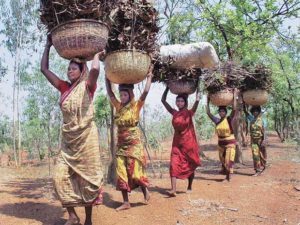
In February this year, the Supreme Court passed an order of eviction for over a ten lakh tribal people across the country and put another ten lakh in the risk of eviction for want of legal claims. This may be the biggest eviction order in history. 7,67,467 claims from members of Scheduled Tribes and 4,45,047 claims from other forest dwellers were rejected in 17 states. In south India, 3,74,818 claims were rejected. In Karnataka 35, 521 claims from Scheduled Tribes and an additional 1,41,019 claims from Other Forest Dwellers were rejected. The Supreme Court stayed this order.
According to the law, it is the Central government that failed to defend the Forest Rights Act. The Forest Rights Act came into force in 2007. According to the Forest Act, persons who have been either lived in the forests for over 75 years or have traditionally depended on the forest for livelihood may hold claims to these areas. The Forest Rights Act transferred the authority to protect and manage forests from the state through the Forest Department to Local Gram Sabhas. The Act gave executive and judicial power to those Grama Sabhas to recognize the rights of people from the forest. There are sabras at ward level to recognize tribal hamlets. There are also Sub-Divisional Level Committees and District-Level Committees. The Forest Rights Act also guarantees resettlement of alternative packages in certain situations where the state must evict them.
The Forest Rights Act has been a valuable tool in protecting the rights of people of the forest and protecting the forests themselves from industrial intrusion. These rights can be used simultaneously to protect the natural environment as well as to empower the communities that been custodians of that environment. In India, evictions, and decimation of the environment go together.
To be effective, the law requires awareness and access to institutions. Traditional forest dwellers have less access to the details of the law and are less aware of their rights, making implementation rare. The government has been slow in even regarding the recognition of people of the forest. Basic work had not been done, leading to many forest dwellers holding an ambiguous legal status. In January 2016, the Supreme Court directed States to file affidavits to show the status of claims. The next month in February, the Central government failed to even present lawyers to defend the Act. The callousness of the government has led to the precarious situation we have today.
While no Indian government has been supportive of the rights of Adivasis, the current government reversed many of the hard-earned rights of those people. The Forest Rights Act has been subverted by the state to remove any democratic protections forest dwellers have had. Initially, they took measures to remove the need for approval by the Gram Sabhas for permission in ecologically sensitive areas. This has led to a breeding ground of corruption where Evictions have been coming in the name of massive state projects, including roads, irrigation, the proposed bullet train, and mining projects.
This has turned into a tool for massive land grab of Forest lands by the state without any involvement of the local Gram Sabhas.
In 2015, the government set up the Subramanian Committee to suggest changes in India’s forest governance. One of its key recommendations was to amend the colonial-era Indian Forest Act. From the onset, the amendment process has been hidden from public debate. The Ministry of Tribal Affairs, the nodal ministry for the Forest Rights Act, was not included. Amendments to the Indian Forest Act now give forest rangers powers of detention without any hearing, search without due process, and discretionary powers to kill people found in the forest without any accountability. Penalties for offenses were increased, including imprisonment which has been increased from one month to seven years. Terms in the Forest Rights Act have also been redefined to promote the industry, and to weaken rights of the forest dwellers.
A second NDA term will further erode the Forest Rights Act. The government is keen on passing a National Forest Policy. The draft does not make any mention of communities traditionally from the forest and focuses on forests primarily as an economic resource. They also want to amend the Indian Forest Act from 1927 to empower the state administration and increase penalties against those found in violation of the law, which will very likely be used against those who have not been given proper identification.
Mineral-rich states, such as Odisha, Chattisgarh and Jharkhand have been accruing forest land under Land Banks for use by corporates for years, often without the knowledge of any of the local forest-dwelling communities.
As seen in Madikeri in Karnataka, forests are a salvation of many Adivasi communities from the Feudal and Capitalist oppression they face outside. Traditional forest dwellers, who are evicted from the forest, were kept in oppressive systems of indentured labor, and only by guaranteeing them rights and autonomy, do they have any hope of freedom. This benefits local landowners, as in the case of Madikeri, where the nexus of feudal plantation owners and prominent coffee retailers preferred the system be kept oppressive to ensure a servile labor force. In Madikeri, resistance from the community have yielded some gains.
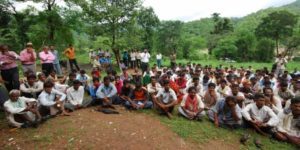
Diddali Protests, Madikeri, Karnataka-2016
Evictions of Forest Dwellers would lead to a huge scale impoverishment of the people. Many would be forced to find new forms of livelihood in a socio-political environment that has historically excluded them. Many have not had the opportunity to cultivate skills that work outside of the forest. In Karnataka, there is a fear that exploitation by dominant communities near the forests that might include bonded labour.
At the same time, the forests will suffer without the people who have traditionally grown with them. Removing the people of the forest is usually the first step to destroy the forest. Most governments of India have had a poor track record with regards to the forest, but the NDA has been especially bad. Since coming to power, the NDA reduced the radius of Eco-Sensitive Zones from 10 km to a shocking only 100 meters and has given industrial interests almost free access to the forest. While the number of proposals has been increasing each year, only 1.1% of industrial projects in eco-sensitive areas have been rejected between until 2018 during the NDA government, as opposed to 12% under the UPA –II, according to Centre for Science & Environment.
All of this points to the need to stand with those who have been facing the threat of eviction.
Is there anything surprising about the draft New Educational Policy, especially it’s view on language education? Anyone who had gone through the BJP’s language education policies over the years would respond with an emphatic, No. Undoubtedly, under the pressure from South Indian states, especially from Tamil Nadu the center has budged a little. The modified draft under the heading ‘Flexibility in the choice of languages’, has omitted references to the language that students may choose. Recommendation regarding the implementation of a three-language formula remains intact. Three language formula inherently is a root to allow for Hindi imposition, one could find no other reason than this for the emphasis on the number, three.
The aim of Hindi imposition upon the states which does not have Hindi as a regional language is plain and clear. It comes from a peculiar understanding of nationalism. Hindutva, the ideology of the ruling party in India, has always been immersed in its view of India as dominated by these elements, the Hindu and Hindi which in their perspective is the culture and language respectively of the true Indian. For the Hindu nationalist, these elements are the building blocks of the nation as they conceive it. Irrespective of the regional variation, which may be allowed, the national body ought to be, in this perspective, dominated by these elements. So all citizens within the nation, for them, must communicate to the Indian state through Hindi. Not just the any Hindi, but the Hindi which has been thoroughly Sanskritized.
BJP’s obsession with the Hindi imposition precedes even the organization itself. The predecessor of the BJP, the Jan Sangh in its resolution on 10th July 1965 accused Indian National Congress of going back on Hindi imposition. To quote, it states:
“To say that English should continue at the Centre so long as even a single non-Hindi state desires, is an index that the Congress Working Committee does not honestly desire the replacement of English by Hindi as the Centre’s Official language.”
It was the strong opposition to Hindi imposition from the states like Tamil Nadu which actually stopped the forward march of the north Indian language.
Obviously, BJP is not the only entity which tried to impose Hindi on the Indian population, Congress had played its own role. People like Purushottam Das Tandon, who was also the national president of Indian National Congress, were at the forefront of Hindi imposition. C. Rajagopalachari also played a role as the person who attempted to impose Hindi upon the Tamil population. In 1937, 1946, 1963, 1965, 1967, 1986 and 2014 the attempts were made to smuggle Hindi into the syllabuses and were withdrawn due to the protest.
A draft policy, like the one which has become controversial now. is meant to test the waters, to find the strength of the opposition to this move. Temporary withdrawal must not be seen as the final victory over these elements. BJP is clear that it needs to teach each and every child of this country Hindi. In the process of creating a single language, the Hindi has already intruded into the space of other languages in north India like the mythili, Bhojpuri, Marwari, etc. For most of these languages marginalization near completion. Marathi, even with the presence of a strong cultural and literary tradition, is facing severe threat from Hindi. South India has successfully resisted such imposition attempt till now.
Those trying to impose Hindi upon other languages must look into the experience around the globe to see the failures of the projects which sought to impose an alien language on a population. As inhabitants of the subcontinent, we need not even go on a world tour to identify the repercussions of such acts.
The idea of International Mother Language Day has origins in the brutal history of the subcontinent. The over-enthusiasm of the Pakistani ruling elites, to create a unifying element in their diverse country ended up in the language movement in East Pakistan. Later this very same movement forced to deal with an uncompromising and brutal regime turned into a secessionist movement, leading to the creation of Bangladesh in 1971. International Mother Language Day, declared so by UNESCO in 1999 is not just a call to protect mother tongue but it reminds us of the need for a democratic understanding to ensure harmony and integrity of a nation.
It must be recalled that Pakistan in an attempt to create a unified nation-state declared Urdu to be its national language. People of East Pakistan demanded that Bangla be made at least one of the national languages, in addition to Urdu. A mass protest ensued, taking different forms. On 21 February 1952, police opened fire on rallies. In the police, firing led to the death of 5, with hundreds of others injured. It is this day which is being observed throughout the world since 21 February 2000.
Another such event in the subcontinent is the brutal history of Sri Lanka. The prolonged civil war which saw the divided nation engaging most brutal acts of violence. The Official Language Act No. 33 of 1956, was an act passed in the Parliament of Ceylon in 1956. The act made Sinhala as the official language, while it failed to give Tamil due importance.
In India, due to the brutal majority of the so called Hindi heartland, the official language part of the Indian constitution and other laws already are in favour of the Hindi. Equipped by these mechanisms central governments in India have persisted on their attempts to implement Hindi in syllabuses across the country. Heavily funded projects such as Hindi prachar sabhas etc are also another manner in which the Indian state has sought to impose Hindi upon the non-speakers. As the government led by the Narendra Modi is entering its second term we find another attempt to impose Hindi. This time the opposition came from not just from Tamil Nadu, but also from Karnataka, Bengal, and Maharastra. Those at the center must realize and comprehend India as a multi-linguistic and plurinational state. This understanding must be embedded into the constitution and legal system of this country. The problem of persistence of the linguistic hegemony of Hindi needs to be put to rest finally.
We still have to grow as a society to accept the multilingual states as such. The idea of a nation-state as one which must have a single common language must change. It is not enough to verbally state it, but it must be enacted into the constitutional and legal system of this country.
The writer was a member of Ambedkar Periyar study circle at IIT Madras. He is programme producer at upfrontstories.
This May 15th marked the 71st anniversary of the Nakba (Arabic for catastrophe). Seven decades ago, Zionist militias destroyed 500 Palestinian villages, 11 towns and forcibly expelled over 300000 people to establish the settler-colonial state of Israel. Within a year, they had ethnically cleansed and captured 78% of Palestinian land and expelled about 800000 people. As of today, there are over 7 million Palestinian refugees around the world, who are denied their fundamental right to return to their homeland. Most can’t even come to see their homeland temporarily. For Palestinians, Nakba did not end in 1948: it is ongoing.
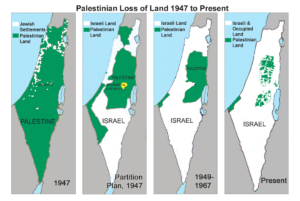
Israel’s apartheid, settler-colonialism and occupation
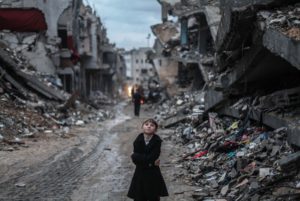
The above image is in understanding what Israel’s decades of military occupation has done to Palestine. Palestinian citizens of Israel live under an apartheid regime: last year the Knesset passed the Jewish Nation-State Law, conveying constitutional status to Israeli apartheid. Before this too there were over 60 laws discriminating against Palestinians, all of which has now has constitutional status in Israel. This includes discrimination in marriage, housing, healthcare, education and all other basic aspects of life. This apartheid is exacerbated in East Jerusalem. East Jerusalem, along with the rest of the West bank has been under occupation since 1967. Jerusalem as such has a unique international status, which means no nation has sovereignty over it. Yet, the United States moved its embassy to Jerusalem in December 2017, simply as an act of provocation and blatant disregard of international law. Palestinians in East Jerusalem live under the worst from of apartheid, and hold only the status of ‘residents’. They are evicted by Israeli forces systematically, as part of the project of Judaization of Jerusalem. In the occupied West Bank, Palestinians live staring the barrel of the Israeli gun every day, with checkpoints, home demolitions and violence by illegal settlers and Israeli forces. Over 60% of the area within the occupied West Bank is directly controlled by Israeli military, which includes majority of agricultural land that Palestinians cannot access without the threat of or actual violence. Israeli illegal settlements, with separate Jewish-only access roads, are growing in West Bank, as part of Israel’s strategy to create ‘facts on the ground’ and deprive Palestinians of resources necessary for life and livelihood. These settlements are in complete violation of international law. The apartheid wall, which the International Court of Justice found in contravention of International Law in its 2004 Advisory Opinion, snakes through the landscape of West Bank, disintegrating the land and turning it into a series of Bantustans.Gaza Strip has been under a brutal siege for over a decade, and is deemed to be uninhabitable by 2020. The blockade has de facto turned it into the largest open-air prison of the world, where 2 million people, most of them refugees, struggle to survive. Gaza has seen two massacres in a decade, and there is the recent killing and maiming of protesters in the Great Return March. Palestinians participating in the Great Return March have been asserting their UN mandated right to return to their homes, beyond the militarized barriers and the blockade that surrounds them. This itself is testimony to the fact that Israel’s settler-colonial, occupation and apartheid regime is met at every step with the Palestinian freedom struggle. The resistance of Palestinians is older than Israel itself.
Palestinian popular resistance
Resistance has been a way of life in Palestine. Post the first world war, Palestine was under British Mandate. From 1936 to 1939, Palestinians organized the Great Revolt, demanding independence and ending the policy of open Jewish immigration and land purchase (the latter ultimately led to the Nakba). This included a general strike and peasant revolts. This was followed by the partition of Palestine and forced transfer of Palestinians. Palestinian political organizing came under the leadership of Palestine Liberation Organization by the 1960s. In the late 1980s, Palestinians popular resistance took the form of the first Intifada (uprising), where spontaneous protests against Israeli aggression and occupation took the form of popular mobilization, boycotts, protests and civil disobedience that lasted for six years. From 2000-2005, following the failure of Camp David accord and postponement of Palestinians statehood, as well as Israeli belligerences, Palestinians mobilized for the second Intifada. In 2004, Palestinian academics and artists called for an academic and cultural boycott of Israel for its cynical use of art to whitewash its crimes against Palestinians. A year following that, Palestinian political parties, women’s groups, refugee networks, trade unions- the largest coalition of Palestinian civil society called for the measures of boycott, divestments and sanctions against Israel, until it meets their demands that include ending occupation, ending apartheid and respecting the right of refugees to return: all within the framework of the United Nations and international law. Inspired by the anti-apartheid struggle of South Africa, and partly Gandhi’s civil disobedience, this call for non-violent measures to pressure Israel have since received growing international support.Since its launch, the Boycott, Divestment and Sanctions (BDS) movement has seen many notable victories. All these have been a result of campaigning and mobilizing, led by Palestinians, and supported by solidarity groups all over the world. The movement has seen corporation such as Veolia, Orange and others end their ties with Israel, after losing millions of dollars due to public pressure. It has seen local councils ending contracts with the state of Israel and/or corporations that refuse to end their complicity with Israel’s crimes. In April last year, city council of Dublin ended its ties not only with Israel but also with Hewlett Packard and DXC technology- companies that support Israel’s occupation and apartheid.Hundreds of artists, musicians and filmmakers have refused to perform or show their work in Israel, with many of them such as Roger Waters, Mira Nair, Ken Loach and others leading the call for to cultural boycott. Academics like Judith Butler, Nobel prize winning George P Smith and many others have continually reminded the academic community to respect the Palestinian picket line. In the US and Europe, the McCarthyist repression of the movement has opened up debates on free speech reaching as far as the US Congress. The movement has changed the landscape of how the solidarity with Palestine can be practiced, calling upon the conscience of thinking person who respects the values of freedom, justice and equality.
The writer works for Palestine Solidarity in India
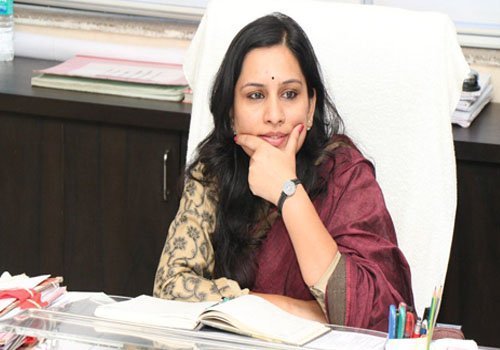
On 17 May, Ms Nidhi Choudhari, A Maharashtra IAS officer tweeted, “What an exceptional celebration of 150th birth year is going on. High time, we remove his face from our currency, his statutes from across the world, rename institutions/roads named after him! That would be a real tribute from all of us! ThankU Godse for 30.01.1948.”
Ms. Choudhari, had not expected such a fallout of one of her tweets about Mahatma Gandhi. Her sarcastic take questioning the celebration of Mahatma Gandhi anniversary landed her in trouble with the Nationalist Congress Party MLA Jitendra Ahwad. Mr. Ahwad demanded her immediate suspension for her “derogatory” tweet against father of the nation.
She later deleted her tweet and claimed it was written in a sarcastic vein but mistakenly taken at face value. She further clarified that she would never insult Mahatma Gandhi and was reacting to the negative posts on Gandhi on social media lately. She said she is pained to see the present reverence of Mahatma Gandhi killer, Nathuram Godse.
Ms. Choudhari had posted her earlier tweets where she is admiring Mahatma Gandhi to prove her point.
I have known no distinction between relatives & strangers, countrymen & foreigners, white & coloured, Hindus & Indians of other faiths, whether Mussalmans, Paris, Christians or Jews I may say that my heart is incapable of making any such distinctions#GandhiJi#TuesdayMorningpic.twitter.com/SDzEFEtBKh
— ????☪️निधि चौधरी✝️☸️ (@nidhichoudhari) April 9, 2019
Once again a few more tweets from past few months, plz read them. I have not created them now or deleted them. You may check today itself & understand how I feel for GandhiJi My favorite book is My Experiments with Gandhi, my favourite movie is GANDHI Deeply saddened today???? pic.twitter.com/OIaxQYcQuI
— ????☪️निधि चौधरी✝️☸️ (@nidhichoudhari) June 1, 2019
Ms. Nidhi Chowdhari has atleast corrected her mistake. Lets talk about some of the politicians from BJP who have been making remarks on Nathuram Godse.
Pragya Thakur, now BJP MP from Bhopal called Gandhi assassin Nathuram Godse as a “patriot”.
Usha Thakur, BJP MLA also had said earlier that “Godse was a nationalist and the circumstances under which he assassinated Gandhi were known to him only”.
Nalin Kumar Kateel, MP from South Kannada had compared Rajeev Gandhi with Godse.
Anant Kumar Hegde, BJP MP from Uttara kannada said “its time to move away and stop being apologetic about it” after Pragya Thakur comments on Godse.
No action was taken against these politicians. On the contrary, three out of four of these politicians are now elected member of parliament.
The tragic irony of the situation is that the person who is admirer of Gandhi might lose her job for her sarcastic tweet while those who openly hate Gandhi and worship Godse are running the show in the temple of democracy.
//Arani Basu//
For Kannada version- click hereThere are events that construe history. 23rd May 2019 was such in Bengal. With Hindutva brigade making inroads in a big way for the first time, Bengal’s socio-political topography may shift drastically towards the Right in days to come. At the same time sudden rise of the BJP could well spell political death knell for Mamata Banerjee and her party. How many of us in fact envisioned BJP’s strong and aggressive inroads in West Bengal? So far, West Bengal and the southern states of Kerala, Andhra Pradesh and Tamil Nadu were the states unfazed by BJP’s Hindutva politics but now that saffron wave has hit Bengal, it is time for some serious political reflections. There are three questions in hand: what helped the BJP capture 18 seats in West Bengal? What went wrong for Mamata Banerjee? Why did the CPI(M) fail to get even a single seat since its inception in Bengal?Lok Sabha 2019 election results have indicated two things for West Bengal. Firstly, it indicates that the voters are thoroughly dissatisfied with Mamata Banerjee led Trinamool Congress and secondly it shows that people in Bengal do not mind embracing Saffron terror. Caught between the binaries, a possible way out could have been the CPI(M). However, with continuous organizational disintegration, that looked unlikely. Let us start with the last question. CPI(M), once known for its organizational stronghold, is now suffering from leadership, youth mobilization and grass root connect. There is a massive dearth of fresh young leaders in the party with which the millennial could identify with. Arguably, this election has witnessed the highest number of voter turnout (67.11%) in independent India. In that view, one wonders, who have the millennial voted? It is likely that they have not voted for the Left-front in West Bengal. With lack of youth leaders and clear-cut agenda in place, it is unfortunate but not illogical that the CPI(M) have not won any seats. Next, coming to the second question, tunnel vision of vote-bank politics with little focus on actual deliverance went wrong for Mamata Banerjee. West Bengal has always had strong minority voters. It is crucial to remember that while the rest of the country burnt during 6th and 9th December, 1992 during Babri Masjid, Bengal did not experience the communal tremor. However, appeasement policies of the Trinamool Congress during the last eight years have not been taken well by the voters in West Bengal, it seems. No real job creation, massive oppression and violence in the interiors of the state and undivided appeasement towards the Islamic voters have made the non-Islamic or rather the Hindu voters in Bengal vote purely in communal lines i.e. in favour of the BJP. To add, BJP’s organizational capability proved way stronger than that of TMC or CPI(M). With Hindutva as the fodder, they have captured the pulse of the voters and exploited that right on time. While they have not offered anything tangible to the voters in terms of actual governance in last five years either, they have nonetheless sold the vision of unified India well. As a result, and coming back to the first question in hand, what helped the BJP capture 18 seats in West Bengal is TMC’s failed appeasement policies and the CPI(M)’s invisibility from the public spaces. In view of the road ahead, rise of the saffron terror of the BJP is likely to help the Left resurrect in Bengal, but it is a clear road to perdition for Mamata Banerjee-led TMC in the state. Once the BJP starts unleashing communal terror in Bengal, voters will soon understand the banality of their governance; but it is unlikely that they will hence turn to the TMC for shelter, a party that is functionally communal without wearing the rob out in public. Arani is a PhD from Humboldt University. He researches on media and politics in South Asia.
//Lokesh Malti Prakash//A couple of years back Mr Nathuram Godse’s atma got the news that there is a renewed interest in him and his deeds in India or Aryavarta ever since the deshbhakt government has come to power in Delhi. Enthused by the news, Mr Godse applied for a travel visa to earth. He was facing a lot of problems getting the requisite clearances. Apparently, bureaucratic red-tape has somehow found its way to Yamaraj’s office as well. The babus were not letting Godse’s file move without something in return. And when it moved, it so happened that the top officer was some congressi brat who wouldn’t let Godse visit the earth. Godse pulled some strings in heaven and some on earth as well. Finally, a fierce woman on earth gave a shap to that officer and he was transferred immediately. So, Godse got his travel visa to India. While on his earthly visit, I somehow got a chance to interview him before he went for a long samadhi in the newly built cave at Kedarnath. Presenting some snapshots of the interview here. Question – Mr Godse, how does it feel to be in headlines again after so many decades. Godse – Awesome! I would like to thank the Sadhvi for doing such a favour to me. Ever since the deshbhakts came to power I was hopeful of getting a place. You know, I have challenged Hitler that now I have more followers on earth than him. If he loses he has to drink gau mutra. I told him, only gau mutra can make him true aryan. Question – But the PM said he was unhappy. That he would never forgive Sadhvi from his heart.Godse – He is the PM. He has to appease so many people. That is the vice of democracy. You have to please everybody. Question – But saying that he won’t forgive means the Sadhvi has done something gravely questionable. Godse – See, it is election time. Election time is jumla time. Question – That means the PM is merely uttering a jumla and not the truth?Godse – Truth is what we make people believe to be true. Question – Some people say you are a deshbhakt. Is it jumla or the truth?Godse – It depends on the observer…Question – Not the person saying so?Godse – For him it can be a jumla. He knows he is throwing a jumla. But he also knows that it will be received as truth. That is the power of jumla. It is as illusionary as the PM forgiving someone from his heart – you need a heart for that – and yet it is as true as the PM saying that he will never forgive someone from his heart. Question – But what do you think? Are you a deshbhakt?Godse – I am a jumla. Question – That means it’s all a falsehood?Godse – Not falsehood but feel good. You feel good by a jumla that is its objective. That is the acche din. You have to feel good from within. You can feel good selling pakodas, or cleaning vehicles or selling tea. You can feel good by murdering. The sensation of feel good is much much greater that good feelings. I am not mincing words here. In our Indian philosophy everything is maya. That essentially means that the world is a grand jumla at work. So, you are already trapped in jumlas. Why blame me for just adding a few here. The only way out is getting moksha not nyaya. It’s a mirage. Question – But don’t people need nyaya more than moksha?Godse – People don’t know what they need. Did anyone say that he needs jumla? No. But the deshbhakt party knew that people need jumla. And they served it amply. For seven decades, secular governments starved the people. The deshbhakt government fed their empty stomachs with jumlas. That’s an achievement. Question – So, you live in clouds up there. Did any satellite spot your heavenly abode ever?Godse – Not at all. That’s the benefit of living in clouds. Satellites or radars cannot detect you ever. That’s how I landed India without Trump noticing any movement in the sky! Thereafter Mr Godse left for his samadhi. The writer is an activist, writer, poet and translator based in Bhopal.


 Well, to me it’s neither of the above. Just remember the sloganeering in the state elections 5 months back and you would get the actual reason for such thumping win in the state. The most popular slogan in those election was ‘Modi tujhse Bair Nahin, Vasundhara teri Khair Nahin.’ Meaning We don’t have any qualms with Modi, but will not give any respite to Vasundhara. It’s this love with Modi that has swept the electorate. The “election experts” were giving sweeping statements like the narrative of panna pramukhs, the data analytic team of BJP, the lack lustre organization of INC etc .But all this failed against the biggest factor and that is the LOVE of the people for Modi. As they say ‘Pyaar mein aadmi andha ho jaata hai,’ The Love just blindfolds you, and that is exactly what happened everywhere.
You talk to the local sabziwala, the watchmen, the auto driver, the club going youth and even the youth that doesn’t have any job security, 8 out of 10 people will agree that ‘Demonetization’ was disaster, that they dont have a job , inflation has gone up, but let’s give him another chance and see.
There were other reasons also for this love and forgiveness of the electorate for Mr. Modi. The religious polarisation the man evokes in masses, the image of a strong leader, the sweeping speeches, but the one reason I find is the fact that no electorate has any intention to bring down the government just in 5 years, especially if it is a central government and the face seeking another term is a strong one. 5 years, people feel is too less a time. You converse with people for sometime and they would at one point say ‘5 saal bahut kam hota hai bhaiya ji’, ‘5 years are too little time to judge.’ This is as nuanced as it gets when it comes to the electorate.
The role of opposition parties cannot be ignored in handing the victory in BJP’s hands. In fact, when it comes to putting up a fight against the well-oiled election machinery of BJP, Mr. Modi’s statesman image, the opposition failed to show up. And Rajasthan is a classic case of that.
Despite all the blind love or Bhakti for Mr. Modi, it was always clear that Congress will get at least 7-8 seats. Congress, the local leadership and Congress high command is to be blamed for its defeat. The reasons? Mnay!!
The local congress leadership lacked vision and also suffered further from the ongoing tussle between Mr. Gehlot and Mr. Pilot. The party also failed to put up credible candidates on the seats that could have easily won. The classic mistake the party made is of annoying the Hanuman of Rajasthan (Hanuman Beniwal, the broke away leader of BJP who supported the Congress in state elections but got miffed in general elections).
All this could have easily been avoided had the leadership, both the local and the central, thought seriously about winning. There was clearly no serious intent of winning in the congress party when it comes to the general elections in Rajasthan. The whole unit became complacent after the win of state elections thinking that the electorate once again will put faith in them. But sadly, they forgot the five-month old slogan of the state electorate where the love for Mr. Modi was clearly evident. And when they woke out from their slumber, their eyes were completely awestruck by the competitor they were fighting.
People fall in love, not all lovers are good, but we justify their acts out of our love and innocence. Love hurts when it is built on lies, money and deceit. But one emerges out wiser from failures in love .
Indians are emotional people.. Lets just hope that when India’s romance with Modi ends, We as a country also emerge out wiser.
Writer is a Political enthusiast and waste management entrepreneur based in Rajasthan

 Majority of cases from Bihar have been where the children have eaten unripe lychee fruit on empty stomach. Unripe fruit contains the toxins hypoglycin A and methylenecyclopropylglycine (MCPG). Hypoglycin A is a naturally occurring amino acid found in the unripened litchi that causes severe vomiting (Jamaican vomiting sickness), while MCPG is a poisonous compound found in litchi seeds that causes a sudden drop in blood sugar, vomiting, altered mental states leading to lethargy. These chemicals are present in high amount in unripe lychees.(link)
According to the research done by Center for disease control and Indian organisations, the problem is not the lychee fruit, the problem is the already malnourished children eating these unripe lychees in early morning. With already low sugar levels, the ingestion of the fruit further lowers the blood glucose levels leading to delirium, coma and death in severe cases.
Were the deaths preventable? Absolutely Yes!!
 As mentioned earlier this region is endemic to AES, and since 1995, there are cases of AES from this region. In 2012, the number of deaths were 122. The state health department came into action and developed a standard operating procedure (SOP) based on the symptoms of the disease to control it. This SOP involved village level ASHA workers, panchayat, state administration, media awareness programs and NGOs and it helped a great extent in curbing the disease. At that time, in Muzaffarpur, the health centers, doctors and nurses were well equipped with glucose kits and ORS packets. The ASHA and anganwadi workers were making the rounds in the night of the areas to check that children are not sleeping empty stomach. IN 2016, only 4 deaths were reported.
So what went wrong in 2019?
Malnourishment, laxity in application of SOP coupled with extreme heat waves and water scarcity have led to the present crisis in Bihar.
In Bihar, almost 44% of children are malnourished. Malnourishment reduces the capacity to fight disease. Most of the deaths are of children from poor families who are also malnourished. According to a report from Down to Earth magazine, 70% of deaths are of girls from Maha Dalit community. The negligent attitude towards girl children added with poverty and food scarcity has caused many of these preventable deaths.


 He will be remembered as an exceptionally versatile genius who straddled across several fields of creativity—theatre, drama, publishing, film-direction, and acting. He also will be seen as a perpetual outsider—a Konakni speaker writing in Kannada, a mathematician breaking into theatre, a dramatist entering the silver screen and an experimental cinema artist patronizing commercial films. He did all of this with ease, grace, and elegance which became synonymous with Karnad’s name over the last half-century.
 All of his magic with words and stagecraft, his charm with the camera lens, his grace and sharp intellect were more than enough to make him a class by himself. But added to them, he had in him courage and a conscience that normally elude many greats in cinema and literature. He spoke out when it was most necessary. He did not get caught in petty literary politics and cinema gossip. While he was around, it was almost impossible for the world to associate him with any ‘group’. He remained himself, a free spirit, unfettered, indomitable and with unfailing compassion. Since Rabindranath Tagore, he was the only Indian whose creativity knew no boundaries of genres and whose work– because it was written in his native tongue–and attracted a worldwide audience. He is no more. All that we have with us is the plays he produced and the institutions he created and, yes, the message of being courageous in the face of dire threats.
 The most pernicious aspect of India’s ties with Israel is the military and security ties between the two. In the last years, India has bought nearly 50% of Israel’s weapons exports. The weapons Israel sells are promoted as ‘field tested’, implying that they have been used to kill or main Palestinians. Buying Israeli arms directly finances its military occupation of Palestine, and India is among the top states complicit in this egregious violation. In return, weapons and technology bought from Israel further militarize our society and entrench state repression. Most obviously, these methodologies are used to crush Kashmiri political struggles and commit gross human rights violations. India has also entered security agreements on counterterrorism, cybersecurity and police training with Israel. Every year, batches from the IPS academy in Hyderabad visit Israel as part of their training. It is not by chance that the sniper who killed protesters in Thoothukudi last year was as well trained in Israel. This is not to claim that Israel is the reason for growing state repression, but rather it provides an edge to already existing structures and systemic violence.
Earlier this year, in the context of escalated tensions between India and Pakistan, the bombs that India dropped in Balakot, Pakistan, were of Israeli make. During the election campaign for 2019 Lok Sabha elections, Amit Shah, the party president of the BJP glorified India’s actions in how they bring India in the league of states like the US and Israel which enter enemy territories and attack. Riding on the wave of hyper nationalism, the has BJP won a second term. In this phase, India under Modi is expected to further deepen its ties with Israel.
 In the face of these escalating ties of complicity, conscientious individuals and organizations are joining and building the Palestinian led Boycott, Divestment and Sanctions movement. The movement, led by Palestinian civil society, aims to pressurize Israel to comply with international law and respect Palestinian human rights through non-violent tactics, inspired by the anti-apartheid struggle of South Africa. In India, farmers organizations are leading the campaign against Netafim, artists and academics are coming together to oppose Israel’s whitewashing of its oppression by cynical use of art and culture. We are asking the Hindi film industry to not be a tool for covering up apartheid. Movements in global south are building common struggles against militarism in their contexts and for a comprehensive military embargo on Israel. Students in India are also a part of the global campaign against Hewlett Packard, the IT company that supports Israel’s apartheid, occupation and settler-colonialism.
In today’s context, when right wing populism is on the rise globally and we are ourselves have seen Hindutva majoritarianism sweep the general elections, the struggle for Palestinian freedom is linked to own struggles for democracy, justice and secularism. In each instance, standing with Palestine is also standing for the values we cherish and are defending. Our silence only makes India’s complicity with Israel deeper, and further entrenches our own move towards becoming another Israel. Collective struggles, by building the BDS movement, is the most effective way forward from here.



 Obviously, BJP is not the only entity which tried to impose Hindi on the Indian population, Congress had played its own role. People like Purushottam Das Tandon, who was also the national president of Indian National Congress, were at the forefront of Hindi imposition. C. Rajagopalachari also played a role as the person who attempted to impose Hindi upon the Tamil population. In 1937, 1946, 1963, 1965, 1967, 1986 and 2014 the attempts were made to smuggle Hindi into the syllabuses and were withdrawn due to the protest.
 The idea of International Mother Language Day has origins in the brutal history of the subcontinent. The over-enthusiasm of the Pakistani ruling elites, to create a unifying element in their diverse country ended up in the language movement in East Pakistan. Later this very same movement forced to deal with an uncompromising and brutal regime turned into a secessionist movement, leading to the creation of Bangladesh in 1971. International Mother Language Day, declared so by UNESCO in 1999 is not just a call to protect mother tongue but it reminds us of the need for a democratic understanding to ensure harmony and integrity of a nation.

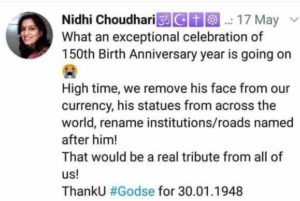 Ms. Choudhari, had not expected such a fallout of one of her tweets about Mahatma Gandhi. Her sarcastic take questioning the celebration of Mahatma Gandhi anniversary landed her in trouble with the Nationalist Congress Party MLA Jitendra Ahwad. Mr. Ahwad demanded her immediate suspension for her “derogatory” tweet against father of the nation.

 How many of us in fact envisioned BJP’s strong and aggressive inroads in West Bengal? So far, West Bengal and the southern states of Kerala, Andhra Pradesh and Tamil Nadu were the states unfazed by BJP’s Hindutva politics but now that saffron wave has hit Bengal, it is time for some serious political reflections. There are three questions in hand: what helped the BJP capture 18 seats in West Bengal? What went wrong for Mamata Banerjee? Why did the CPI(M) fail to get even a single seat since its inception in Bengal?
Lok Sabha 2019 election results have indicated two things for West Bengal. Firstly, it indicates that the voters are thoroughly dissatisfied with Mamata Banerjee led Trinamool Congress and secondly it shows that people in Bengal do not mind embracing Saffron terror. Caught between the binaries, a possible way out could have been the CPI(M). However, with continuous organizational disintegration, that looked unlikely.
Let us start with the last question. CPI(M), once known for its organizational stronghold, is now suffering from leadership, youth mobilization and grass root connect. There is a massive dearth of fresh young leaders in the party with which the millennial could identify with. Arguably, this election has witnessed the highest number of voter turnout (67.11%) in independent India. In that view, one wonders, who have the millennial voted? It is likely that they have not voted for the Left-front in West Bengal. With lack of youth leaders and clear-cut agenda in place, it is unfortunate but not illogical that the CPI(M) have not won any seats.
 Next, coming to the second question, tunnel vision of vote-bank politics with little focus on actual deliverance went wrong for Mamata Banerjee. West Bengal has always had strong minority voters. It is crucial to remember that while the rest of the country burnt during 6th and 9th December, 1992 during Babri Masjid, Bengal did not experience the communal tremor. However, appeasement policies of the Trinamool Congress during the last eight years have not been taken well by the voters in West Bengal, it seems. No real job creation, massive oppression and violence in the interiors of the state and undivided appeasement towards the Islamic voters have made the non-Islamic or rather the Hindu voters in Bengal vote purely in communal lines i.e. in favour of the BJP.
To add, BJP’s organizational capability proved way stronger than that of TMC or CPI(M). With Hindutva as the fodder, they have captured the pulse of the voters and exploited that right on time. While they have not offered anything tangible to the voters in terms of actual governance in last five years either, they have nonetheless sold the vision of unified India well. As a result, and coming back to the first question in hand, what helped the BJP capture 18 seats in West Bengal is TMC’s failed appeasement policies and the CPI(M)’s invisibility from the public spaces.
In view of the road ahead, rise of the saffron terror of the BJP is likely to help the Left resurrect in Bengal, but it is a clear road to perdition for Mamata Banerjee-led TMC in the state. Once the BJP starts unleashing communal terror in Bengal, voters will soon understand the banality of their governance; but it is unlikely that they will hence turn to the TMC for shelter, a party that is functionally communal without wearing the rob out in public.
Arani is a PhD from Humboldt University. He researches on media and politics in South Asia.

 //Lokesh Malti Prakash//
A couple of years back Mr Nathuram Godse’s atma got the news that there is a renewed interest in him and his deeds in India or Aryavarta ever since the deshbhakt government has come to power in Delhi. Enthused by the news, Mr Godse applied for a travel visa to earth. He was facing a lot of problems getting the requisite clearances. Apparently, bureaucratic red-tape has somehow found its way to Yamaraj’s office as well. The babus were not letting Godse’s file move without something in return. And when it moved, it so happened that the top officer was some congressi brat who wouldn’t let Godse visit the earth. Godse pulled some strings in heaven and some on earth as well. Finally, a fierce woman on earth gave a shap to that officer and he was transferred immediately. So, Godse got his travel visa to India. While on his earthly visit, I somehow got a chance to interview him before he went for a long samadhi in the newly built cave at Kedarnath. Presenting some snapshots of the interview here.
Question – Mr Godse, how does it feel to be in headlines again after so many decades.
Godse – Awesome! I would like to thank the Sadhvi for doing such a favour to me. Ever since the deshbhakts came to power I was hopeful of getting a place. You know, I have challenged Hitler that now I have more followers on earth than him. If he loses he has to drink gau mutra. I told him, only gau mutra can make him true aryan.
Question – But the PM said he was unhappy. That he would never forgive Sadhvi from his heart.
Godse – He is the PM. He has to appease so many people. That is the vice of democracy. You have to please everybody.
Question – But saying that he won’t forgive means the Sadhvi has done something gravely questionable.
Godse – See, it is election time. Election time is jumla time.
Question – That means the PM is merely uttering a jumla and not the truth?
Godse – Truth is what we make people believe to be true.
Question – Some people say you are a deshbhakt. Is it jumla or the truth?
Godse – It depends on the observer…
Question – Not the person saying so?
Godse – For him it can be a jumla. He knows he is throwing a jumla. But he also knows that it will be received as truth. That is the power of jumla. It is as illusionary as the PM forgiving someone from his heart – you need a heart for that – and yet it is as true as the PM saying that he will never forgive someone from his heart.
Question – But what do you think? Are you a deshbhakt?
Godse – I am a jumla.
Question – That means it’s all a falsehood?
Godse – Not falsehood but feel good. You feel good by a jumla that is its objective. That is the acche din. You have to feel good from within. You can feel good selling pakodas, or cleaning vehicles or selling tea. You can feel good by murdering. The sensation of feel good is much much greater that good feelings. I am not mincing words here. In our Indian philosophy everything is maya. That essentially means that the world is a grand jumla at work. So, you are already trapped in jumlas. Why blame me for just adding a few here. The only way out is getting moksha not nyaya. It’s a mirage.
Question – But don’t people need nyaya more than moksha?
Godse – People don’t know what they need. Did anyone say that he needs jumla? No. But the deshbhakt party knew that people need jumla. And they served it amply. For seven decades, secular governments starved the people. The deshbhakt government fed their empty stomachs with jumlas. That’s an achievement.
Question – So, you live in clouds up there. Did any satellite spot your heavenly abode ever?
Godse – Not at all. That’s the benefit of living in clouds. Satellites or radars cannot detect you ever. That’s how I landed India without Trump noticing any movement in the sky!
Thereafter Mr Godse left for his samadhi.
The writer is an activist, writer, poet and translator based in Bhopal.