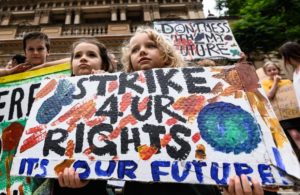


Millions join in Youth led Global Climate Strike

0
Yesterday the world witnessed a historic event when over four million people took part in global climate strike across 150 nations. The majority of the protestors were students and workers who skipped school and work to join the demonstrations. The movement focused on three demands: 100% clean energy; keeping fossil fuels in the ground and helping climate refugees. The demonstrations started in the Pacific Islands before quickly getting started across Australia, Asia, Europe, Africa, the Middle East and North and South America. In India, more than 14,000 people signed up for 26 events across the country as part of the global strikes. In Delhi, more than 2,000 students and schoolchildren demanded the Prime Minister to declare an immediate climate emergency in India.
Climate Strike, karnataka
Climate Strike_ Delhi
 
Climate Strike_ Delhi
  From New York to Guatemala City, Sydney to Kabul, and Cape Town to London, protesters in hundreds of cities around the world took the streets, demanding their governments take urgent steps to tackle the climate crisis and prevent an environmental catastrophe.
Climate Strike_Nairobi, Kenya
              The event is a part of the school strike for climate movement, inspired by Swedish climate activist Greta Thunberg. Greta Thunberg,16 years of age, the Swedish teenager who came to limelight when she started by skipping school every Friday and stood outside Swedish Parliament calling for stronger climate action. Soon, other students engaged in similar protests in their own communities. Together they organized a school climate strike movement, under the name Fridays for Future. After Thunberg addressed the 2018 United Nations Climate Change Conference, student strikes took place every week somewhere in the world. In 2019, there were at least two coordinated multi-city protests involving over one million pupils each.

The strike comes three days before world leaders meet in New York for the United Nations Emergency Climate Summit to discuss climate change mitigation strategies, including the move from fossil fuels to renewable energy sources.

Many NGOs, unions, social movements, and companies also joined in the strikes including  350.org, Amnesty International, Extinction Rebellion, Greenpeace International, Oxfam, WWF, Patagonia, Ben & Jerry’s, Lush, Atlassian, and more. New York City public schools have announced plans to “excuse students to participate in climate strikes”, with parents’ permission. Some Australian companies have formed the “Not Business As Usual alliance”, and have encouraged their workers to join the strikes in their respective cities, and advocate for all Australian companies to support taking climate action. In the United Kingdom, the UK General Strike for Climate,was the first general strike in Britain since the 1926 United Kingdom general strike.  

Public venues overflowed in major cities, and the streets were flooded with young and old across the nation, toppling records and showing the deep concern and strong desire for government action to address the climate crisis. Student organizers estimate a more than doubling of numbers since the last climate strike rallies held six months ago in March 2019, well exceeding their expectations.

The protests are taking place across 4,500 locations in 150 countries. On 20 September, organisers reported that 1.4 million people took part in the German strikes, and an estimated 300,000 protesters took part in Australian strikes. A rally in London drew 100,000 participants, according to organisers.  The organisers plan to strike the full week from 20 to 27 September proposed for a worldwide general climate strike called the Earth Strike.  

I am ashamed of what I have done- Chinmayanand tells SIT team

0
Former BJP MP and Union minister Swami Chinmayanand, accused of raping a law student inside his ashram in UP’s Shahjahanpur have admitted to most allegations against him when confronted with the massage videos of him with the students by the Special Investigation Team (SIT). “Ab aapne sab dekh liya hai. Main kya bolun. Apne kiye pe sharminda hoon (Now you have seen everything. What more can I say? I am ashamed of what I have done).”

He was arrested by the UP police early Friday morning from his ashram on charges of stalking, criminal intimidation and as a person in a position of authority seducing a woman for ‘sexual intercourse not amounting to rape’, and sent to a district jail for 14 days.

According to a report by ThePrint, IG Naveen Arora, who is heading the SIT, said: “He accepted and admitted to most allegations that were made by the student, on the basis of which we have booked him for rape and have arrested him.” The police have also found records of over 230 calls between Chinmayanand and the law student — mostly made by him. Read More: UP law student alleges BJP leader Swami Chinmayanand of rape and physical exploitation for one year Video clips as evidence from the student found to be genuine  The law student has submitted 7-8 clips as evidence to the SIT team. Some of these clips have also made it to the internet and are now viral. The forensic team has tested the clips for authenticity and found them to be genuine and are now the crucial evidence in the case. The student had recorded the videos from a camera fitted in her spectacles to gather evidence against Chinmayanand. When Chinmayanand was shown the videos, he admitted that he had asked for massages and have also threatened the girl when she refused to abide by his orders. He can be seen getting a massage from the girl and talking in obscene language with the girl in the video clips. According to the sources in the SIT team – “He held these massage sessions inside a private room in his ashram, which most people do not have access to,” When confronted with the rape allegations, the former union minister said “one thing led to another. I am ashamed”. According to some of the videos, Chinmayanand lured the student by promising her more money, a hostel room, and a job.  “He lured her by promising Rs 25,000 per semester, a job and room in the hostel. When she refused, he threatened to use his clout and wipe out her family — kill her father and brother,” the second source said. “The chats that are clearly audible in these clips show how he intimidated the student to get sexual favors.” Swami Chinmayanand reputation is not unknown to the people of Shahjahanpur, and there are several references by the girl and by others that there are more students who were called in by Chinmayanand. “The video clips make a passing reference of more girls coming to ‘serve’ Chinmayanand. He also names a few girls, but no one has come forward to give a formal complaint,” a police officer said.

Asked about this, IG Arora said: “It is suspected that there are more victims of this abuse and we urge students to come to us with proof. No one till now has turned in any evidence. The investigation in the matter is still on and if there are more such cases, our team will take action accordingly.”


Nowhere in the world people sent to gas chambers to die, says SC on manual scavenging

0
Expressing serious concern over people dying during manual scavenging and sewage cleaning in India, the Supreme Court Wednesday said nowhere in the world people are sent to “gas chambers to die”. Although over 70 years have passed since the Independence, caste discrimination still persists in the country, the apex court said while making scathing observations on the practice. A bench headed by Justice Arun Mishra questioned Attorney General K K Venugopal, appearing for the Centre, as to why proper protective gear like mask and oxygen cylinders were not being provided to people engaged in manual scavenging and cleaning of sewage or manholes. “Why are you not providing them masks and oxygen cylinders? In no country in the world, people are sent to gas chambers to die. Four to five people are dying due to this every month,” said the bench also comprising justices M R Shah and B R Gavai. The Constitution has provided that all human beings are equal but they are not being given equal facilities by the authorities, it said. The bench termed as “inhuman” the situation where the people are not provided with any protective gear and they are dying during the process of cleaning sewage and manholes across the country. The apex court made these hard-hitting observations while it was hearing the Centre’s plea seeking review of its last year’s verdict which had virtually diluted the provisions of arrest under the SC/ST Act. Venugopal told the bench that no law of tort, which deals with civil wrong and its liabilities thereof, is developed in the country and the magistrates are not empowered to take cognisance on their own of such incidents. A case can’t be filed against the person who is sweeping the street or cleaning the manholes but the supervisory officers or the authorities, on whose instruction the work is carried out, should be held liable for this, he said. “This is most inhuman to treat the human beings like this,” the bench observed. The bench also made observations on the aspect of untouchability in the country. “Despite the constitution abolishing untouchability in the country, I am asking you, people, do you shake hands with them? The answer is no. That is the way we are going on. The condition must improve. We have moved 70 years since Independence but these things are still happening,” Justice Mishra said.

Democracy under Detention: Report details horrors of NRC in Assam

1
A Fact-Finding Team of United Against Hate (UAH) visited Assam recently to explore the aftermath of the final list of NRC which has declared 19 lakh people to be foreigners and are going to strip them of their citizenship. During the visit to the state, the Fact-Finding Team met several people who have been directly impacted by NRC, lawyers, members of civil society and other stakeholders to make their assessment. The members of Fact-Finding team were Nadeem Khan from UAH, Prashant Tandon, senior journalist, Sanjay Kumar, journalist, and Afroz Ahmed Sahil, documentary filmmaker. The team addressed a Press Conference on 17 September in Press Club, New Delhi. The team members briefed the press about the Fact Finding report. They talked about the horrors and trauma of people cutting across communities who had been deleted from the final NRC list. They also talked about the incompetence of the Foreign Tribunals that are going to re-examine the claim of the people who have been excluded. They also talked about the detention centers which are unfortunately being constructed by laborers who themselves have been excluded from NRC and could be jailed in those same centers in the future. The guest speakers in the Press Conference were Ravi Nair and Supreme Court Advocates Sanjay Hegde and Fuzail Ayyubi. All of them have been active against the draconian NRC project.   Ravi Nair said, “people migrate for jobs all over India. These poor labourers often lack documents but now they are thinking of making this project All India. India will have to face severe criticism in the upcoming sessions of the UN Human Rights Council. Universal declaration of human rights is being violated dreadfully by this NRC project. Right to nationality is after all non-negotiable.” Fuzail Ayyubi said, “Foreign Tribunal (FT) takes away the basic identity of people. Facing FT itself is harassment. Moreover, the people sitting in the FT are not competent enough to take such major decisions about the lives of millions of people. No appellate authority is present within FT. There is no upper layer of appeal making this project more inhuman”. A short documentary called “The state of Stateless in Assam” prepared by Afroz Ahmed Sahil, a member of the Fact-Finding Team was screened.

Video courtesy: United against Hate team. 

Nadeem Khan also added that it is on record in Assam Assembly that the CM has met the FT members twice to give directions. This itself questions the unbiased judicial nature of the Foreign Tribunal. Sanjay Hegde said, “when SC gives a final decision, it is often wrong. Citizenship is a right to have rights, which itself has been put into questions through NRC. Descendents over generations are now asked to show papers to prove their citizenship. Absence of someone from the NRC list does not prove that someone is not an Indian citizen. To the minds of many people in Assam, all Bengali speaking Muslims are Bangladeshis which is absolutely baseless. Behind the 20 lakh people mentioned in NRC, are 20 lakh families and many more lakh people going destitute paying lawyers. This will lead to disenfranchisement and a humongous humanitarian crisis which will put the entire democracy in jeopardy.

The fact-finding report reveals some startling details:

The way the whole exercise of the NRC was conducted in the last five years it smacks of a mindset. It was designed to fix certain targets. This becomes all the more clear when we look at the functioning of the NRC, the operation of the Foreigners Tribunals (FT), the composition of the FTs, biases of the judiciary and the administrative machinery.

The ruling BJP built up its anti-Muslim bogey on the back of infiltration from Bangladesh. It came to power promising sending all the illegal immigrants out of the country. But the final NRC figure belies the hope of the ruling party and busts a long-held myth that majority of the Bengali speaking Muslims living in Assam are foreigners.

Fact-Finding Team interacted with many people, mostly poor, across districts whose claims of citizenship has been rejected by Foreign Tribunals. Their testimonies give a clear indication that FTs are not functioning as independent tribunals and involving judicious and professional methods in disposing of cases brought before them.

Fact-Finding Team found that a large number of cases (55 percent) have been decided by FTs ex parte or in absentia. As per media reports over 60,000 people have been declared foreigners ex parte since 1985. There is a section of the floating population, mainly daily wagers, for employment-related reasons. There have been instances that notices are either being sent to old addresses (native places) whereas ‘opposite party’ – against whom case has been filed is residing in his\her place of work. Often cases have been filed far off places making it difficult for people against whom cases have been filed to appear in FTs and defend themselves

The big question that the NRC poses is: can India afford to have so many people as stateless citizens? Why a civil and democratic society needs a detention center to house so-called illegal immigrants?  

Karnataka: Dalit BJP MP denied entry into a Yadav village

0
In a clear case of caste discrimination, a Dalit BJP MP in Karnataka was prevented from entering the Golla Hatti (Yadav settlement) in a village in Tumkuru district on Monday. A. Narayanaswamy, BJP MP from Chitradurga went to Pemmanahalli village in Pavagada taluk of Tumkuru district. The village falls under his Lok Sabha constituency. The purpose of the visit was to highlight the health and infrastructure issues that people were facing in the village to the officials from Biocon Foundation and Narayana Hrudayala. “We had visited many government schools and hospitals in the Pavagada region and the plan was to urge these two companies to invest in developing infrastructure and facilities in this area,” says Narayanaswamy. But the MP was met with shock and disappointment when some people asked him not to enter because of his caste (Madiga) and said it was against their traditions. “I was adamant that they (residents) should stop this practice but they insisted that the priests in the village did not allow any previous MLAs or MPs from my community to enter the village,” the MP said.
Following outrage over the incident, Golla community seer Sri Krishna Yadavananda along with other leaders visited the settlement on Tuesday. The villagers resolved to organize an event in the presence of Narayanaswamy on Friday. “It was not right to deny him entry. We must mingle with members of all communities and should not discriminate,” the seer advised. Narayanaswamy is a four-time Karnataka MLA and was the chief whip of the BJP’s Karnataka legislative party. He also served as a cabinet minister in the Karnataka government. Narayanaswamy, a former Social Welfare Minister and a three-time MLA from Anekal in Bengaluru, says this is the first time he has faced such kind of discrimination in his political career. The Chitradurga Lok Sabha seat is a reserved category seat meant for members of the Scheduled Castes

Golla (Yadav ) community

While A. Narayanaswamy is a Dalit, the Gollas belong to the Other Backward Class (OBC). Golla community as OBCs in Karnataka is socially and economically backward community. Belonging to a lower caste status in the caste system they also suffer discrimination at the hands of upper castes. The community is known to be quite conservative and ritualistic in their practices. They follow stringent rules and regulations in their own community, especially for women. The community women during menstruation have to spend three days outside the settlement in a thatched hut and to be brought back to the village after the purification ritual. Pregnant women are also sent to these hutments to deliver babies on their own. Despite such practices being dangerous to women’s lives, the community clings to such practices to date. Several social organisations, intellectuals, and activists like Bala Guru Murthy have worked on bringing the community into the mainstream and towards eradicating such social practices. Dr. C Dwarakanath, former president of Karnataka state commission for backward caste and tribes also worked towards convincing the leaders of the community to educate the people and shun the superstitious practices.

The caste system as graded inequality

Dr. B. R. Ambedkar has described the Indian caste system as that of Graded inequality. Such a system divides the sufferers themselves based on unequal burdens and benefits. Under graded inequality, the middle and lower classes suffer on one hard from the castes above them but benefit from the castes that are below them in the caste hierarchy. Such a system also prevents the lower classes from uniting and fighting the upper castes. In a statement today, A. Narayanaswamy has vowed to remove untouchability and superstition in his constituency. He has appealed for collective action from different segments of society. “The government, the mutts, nonprofits, and officials should join hands against this. Let them sit in these villages and win people’s hearts.”

Zimbabwe: Freedom with Strings

0
The area now known Zimbabwe was colonized in the late nineteenth century by British diamond trader, Cecil Rhodes. As with India, the colonization of this part of Africa was done gradually by taking control from many local leaders and went under the British South Africa country before going directly under the British crown. The land was named Rhodesia, in honour of the British agent Rhodes. Following the Second World War, there was a wave of migration of white settles to Rhodesia. Many of the migrants were from the military who fought in World War II, and were considered inferior to the earlier white settlers and colonists, as they did not have an aristocratic background typical of colonists. Many of them were middle class and working-class white people who were looking new livelihoods after World War II and Rhodesia’s booming economy was attractive. In the 1960s, there were movements for greater autonomy in the region and the result was a partition of Rhodesia into two independent Black lead nation, in parts of Rhodesia where the white population was low (becoming in time Malawi and Zambia today), and a greater autonomy for a white led African nation of Zimbabwe. The white-led country retained the name Rhodesia. The transition was turbulent especially in 1965, when Rhodesia declared independence. This state did not have international recognition and was led by a former air force pilot, Ian Smith. Internationally, the British were still considered the rulers of Rhodesia. In the decade that followed, many communities in Rhodesia began to take to militancy, leading to war. The War was called either the Zimbabwean War of Liberation or the Rhodesian Bush War. The sides included the Zimbabwe African National Union (ZANU) and the Zimbabwe African People’s Union (ZAPU). The ZANU was led by Robert Mugabe and was support by the Shona speaking people, who represented nearly two-thirds of the country. The Shona people were primarily drawn from the rural peasantry of the country, and were mostly landless and demanded land redistribution. The ZAPU was led by Joshua Nkomo and was supported by the Ndebele people, who were a prominent minority group in Rhodesia, constituting almost one-sixth of the country. The ZAPU got international support from the Soviet Union, and the ZANU people got international support from the People’s Republic of China. As the war continued, it became embroiled in many similar conflicts in neighbouring countries, but the war finally ended with the setting up of the Zimbabwe Constitution in 1979. This was called the Lanchester Agreement, where the British met with the revolutionary forces to broker a peace settlement. The agreement reserved 20% of the new country’s parliament seats for the white population. There was also an understanding that land reforms from white to blacks would not be pushed for. These policies remained a barrier for any post-liberation socialist reforms to take place. Nearly 40% of the land in Zimbabwe was owned by a few thousand white families, and the remaining white population felt that their time in the new Zimbabwe was over, and began to migrate to other countries in Africa and Europe. Western powers also would impose sanctions on the country on the grounds of land seizures, civil unrest and human rights violations. This put the new nation into a difficult situation. To put a nail into the coffin, the gold standard, a commodity that Zimbabwe was rich in, was being replaced. The Soviet Union, an ally in the struggle, was coming towards collapse. Zimbabwe became reliant on support from Western Powers and International Aid to continue. The public debt of Zimbabwe steadily rose, going from 20% of its GDP at the time of independence to nearly 100% in 2008. It hovered around 60% for much of the 1990s. Being a poor country, Zimbabwe fell into old colonial relations, with energy resources, like oil, constituting most of its import and tobacco and mining products constituting its exports. The losing ground in trade, high public debt, and the inability to implement proper socialist reforms held Zimbabwe in place, both politically and economically. Politically, this led to tensions between the ZANU and ZAPU parties. The ZAPU accused the Mugabe-led government of ignoring the needs of Western Zimbabwe and leaving them to recurrent famine. Some struggles resurfaced and became militant, leading to low-level warring, where estimates of tens of thousands of civilians were killed by the government. Any half-measured attempts by the Mugabe-government to attempt reforms led to an international outcry of anti-white racism by the government. The 2000s and 2010s were the worst effects on the Zimbabwean economy. Inflation grew to astronomical levels, from 7% per annum in 1980, to about 112% in 2001, and 8 thousand crore percent in 2008. Hyperinflation made government regulation nearly impossible, and there was a growing black market. Poverty rates and unemployment rates became the worst in the world, estimated to around 80% poverty and 95% unemployment. In 2009, the Zimbabwe government decided to give up on the Zimbabwe dollar altogether. Debates occurred as to whether to adopt the Chinese yuan, but ultimately, they were made to adopt the US dollar. In 2015, Zimbabwe demonetized their dollar in favour of the US dollar. Only recently, has the Zimbabwean dollar come back into circulation. Coverage on Zimbabwe mostly focuses on the moral character of its 40-year long leader, Robert Mugabe, and even sympathetic international media coverage sees him as a principled revolutionary turned corrupt and tyrannical politician, but often ignores the economic and political context of Zimbabwe. Zimbabwe is the product of an anti-colonial struggle, but the legacy of colonialism continues to plague it.

Another Biopic on Modi: Sanjay Leela Bhansali to make movie titled `Mann Bairagi´

0
Bollywood Actor Akshay Kumar and Telugu actor Prabhas were the first to share the poster for Sanjay Leela Bhansali’s upcoming production, a film based on the life of Prime Minister Narendra Modi, Mann Bairagi. The poster was shared on social media on Tuesday on the occasion of the PM’s 69th birthday.
Saaho star Prabhas also shared the poster, writing, “A special film on a special person by a special filmmaker on this special day, Happy Birthday @narendramodi Sir. So happy to present the first look of Sanjay Leela Bhansali & Mahaveer Jain’s ‘Mann Bairagi’, an untold story of our PM, directed by Ssanjay Tripaathy.”
Sanjay Leela Bhansali described Mann Bairagi, as an hour-long special feature which means that it would be more on the lines of a short film.
 
The upcoming film is written and directed by Ssanjay Tripaathy and is described as the “untold story from the life of the Prime Minister which has not been in the public domain so far.” It is co-produced by Mahaveer Jain. This is not the first time a film has been made on PM Modi. Earlier this year actor Vivek Anand Oberoi was seen playing the Indian Prime Minister in the film PM Narendra Modi. A web-series too was made on the leader’s life titled Modi: Journey of a Common Man. Speaking about the appeal of the film, Ssanjay said, “For me, it’s a human interest story about the self-discovery of a person who went on to become such a strong leader of our country.” Although not everybody on social media shared the same enthusiasm!
  lest our readers forget, last year, Sanjay Leela Bhansali´s film “Padmavat” release landed in trouble due to Rajput outfit ´karni Sena´which held protests against the release of the film. According to them, the film hurt Rajput pride and sentiments. The members of Karni Sena got support from BJP politicians in Rajasthan. The members of Karni Sena had slapped Bhansali and threatened to cut Deepika Padukone’s nose. The film got released and Karni Sena praised the movie for “glorifying Rajput values”. The film made Deepika a superstar and Bhansali made millions of the publicity gained from the controversy. Strangely Karni Sena took back their threats after the movie release. All noses remained intact. Now with Bollywood totally in cahoots with ruling party, liberals should choose better issues that deserve real outrage rather than movies that glorify casteist and misogynistic values.

Yemen Strike on Saudi Oil facility and its Imapct on Oil Prices

0

The self-fulfilling prophecy of Modi Bhakts paying 100 rupees per liter of petrol to see Modi in power might come true very soon.

Despite the low crude oil prices in the international markets since Modi came to power, the government is selling petrol and diesel at a high price to Indian consumers. For almost half a decade, the record low crude oil prices are set to increase with the latest events unfolding in Saudi Arabia.

Two oil processing plants at Abqaiq (World’s Largest) and Khurais in Saudi Arabia have been hit by drones from the Houthi rebels of Yemen. Due to this attack, oil prices have seen a record 20% jump. This is the second time in the history that such a jump in oil prices is seen since the Jan 14, 1991, Gulf War. The oil prices are expected to rise above 100 dollars per barrel from the present ~54 dollars per barrel.

On September 14th drones or cruise missile fired by Yemeni Houthis has lit the world’s biggest oil stabilization facility at Abqaiq on fire.

The stabilization process is a form of partial distillation which sweetens “sour” crude oil (removes the hydrogen sulfide) and reduces vapour pressure, thereby making the crude oil safe for shipment in tankers. This Saudi State-owned Aramco’s oil and gas processing station is the world’s largest oil processing station which handles the world’s largest conventional oilfield, the supergiant Ghawar, and exports to terminals Ras Tanura and gas (the world’s biggest offshore oil loading facility) and Juaymah. Abqaiq processes 6.8 million barrels of crude oil each day. More than two-thirds of all Saudi oil and gas production runs through it.

The second target of the attack was Khurais with the processing capacity of 1.8 million barrels a day situated near the country’s second-largest oil field. Both installations were more than 1,000 km from Yemen. It is not clear yet how much of the facility was damaged or destroyed through 17 locations of the Abqaiq plant were on fire.
Yemen, one of the poorest countries in the world, facing the brutal wrath of war unleashed by Saudi Arabia and UAE aided by western weaponry since 2015 is claiming responsibility of the attack. More than two-thirds of the Yemen population are displaced and on the verge of severe malnutrition due to Saudi led bombing and blockade of Yemen.

US response

America and Saudi led coalition against Iran are using this opportunity to blame and increase its hostility towards Iran using the latest attacks. The American secretary of state Mike Pompeo has squarely blamed the attack on Iran followed by Trump tweeting the same. One American senator has even suggested bombing Iranian oil fields. Iranian Foreign Minister MJ Zarif blasted Pompeo’s claims on Sunday, accusing the US of switching from its “failed” policy of “maximum pressure” to one of “maximum deceit” by blaming Iran for the Houthis’ attacks. Russia and China have expressed serious concerns over attacks on Saudi and have warned against rushing to conclusions. The Russian and Chinese foreign ministry spokespersons have also stated that this American overt military talk without proper investigation and evidence is unacceptable.

The Foreign Ministry of Russia also stated that the attacks were a “direct consequence of the continuing crisis in Yemen,” namely the civil war and the Saudi-led military operation in that country which began in 2015. Mohammed al-Bukhaiti, a member of the Houthis’ Supreme Political Council, has stated “Saudi Arabia declared war against Yemen on the grounds that our missile inventory posed a threat to its security. Today, we are surprised to see that when we hit Saudi oil wells, they exonerate Yemen from conducting these strikes and accuse others of doing them. This is viewed as an own criminal decree of conviction. It also shows their cowardice,”

The unilateral and illegitimate sanctions against Iran and subsequently against Venezuela came into effect from last November. Since then the two crisis has pushed the world towards instability in the oil market already. India under American pressure stopped purchasing crude oil from Iran from April 2019. So, India will be affected maximum in this crisis as it is caught between American lies on promised Saudi oil and its betrayal to Iran. While the Indian public will face problems in increased oil prices and subsequent price rise in trading goods, we will also see the increase in the jingoistic pitch to protect any questions to be raised to Mr, Modi and his ministers.

With the overall economy slowing down, diminishing growth indicators and massive unemployment, this oil price rise will literally be adding fuel to fire!

PIL filed against Jaggi vasudev “Cauvery Calling” campaign

0
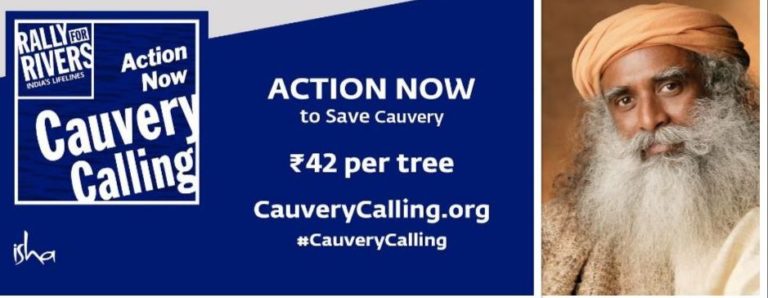
Public interest litigation filed by in the Karnataka High Court seeks directions to Isha Foundation, headed by Guruji Jaggi Vasudev, not to collect any funds from the public for the ‘Cauvery calling project’, in the interest of equity and justice. The advocate, A.V. Amarnathan, states that the campaign calls for the planting of trees across the Cauvery river from Talacauvery to Tiruvarur. It aims to raise 253 crore plants for which it is collecting Rs 42 per tree, which sums up to Rs 10,626 crore. As per the petition, the foundation is planning to plant trees, across the Cauvery river from the birthplace Talacauvery to Thiruvarur. A stretch of 639.1kms, it has started its Bike rally from Talacauvery to Thiruvarur. The petitioner is closely watching the media report. The foundation is planning to plant 253 crores plants to save the Cauvery River. The respondent is collecting Rs. 42 per tree planting from the public. That means it is collecting a whooping sum of Rs 253 X 42 in a total of Rs, 10,626 crores. This collection of money from the public is very disturbing. The PIL says that “Foundation claims that it has conducted studies regarding the Cauvery Basin. But it ought to have submitted the said report to the State. And the state after deliberating the said studies should have given approval. But no such process is carried out. The petitioner submits that no private organization can be permitted to carry out any work, on the Government land, without there being a proper approval from the state.” The petitioner cited the example of Satya Sai Baba had taken up a project of bringing drinking water from Andhra Pradesh to Chennai without taking money from the public. It prays for directions to the foundation to stop collecting funds from the public along with directions to the state to look into the Cauvery Calling campaign to take appropriate steps.  

Robert Mugabe(1924-2019): The Maker of Modern Zimbabwe

0

Robert Mugabe, who passed away on 6 September 2019, was the leader of Zimbabwe for nearly 40 years. He was a controversial figure who straggled the line of African liberation struggles in a messy era of neo-liberal ascendance. In his time, he championed African Independence and black emancipation, but also saw a decline of his country’s sovereignty to the forces of capitalism.

Mugabe was born in 1924 to a family from the Shona community. The Shona community represents nearly two-thirds of the current Zimbabwean population and the bulk of the rural peasantry in the country. He began his adult life as a teacher, but within a few years, he began to be involved in politics, supporting the National Democratic Party under Joshua Nkomo. The National Democratic Party was replaced by the Zimbabwe African People’s Union (ZAPU). At the time, Zimbabwe was called Rhodesia and was controlled by the minority Rhodesian White population. In 1964, Mugabe began taking part in non-violent protests against the white rule in Zimbabwe, which led to him being imprisoned for sedition for a decade. He had lost a son while in jail and was not allowed to visit him. He began to adopt Marxist- Leninism and upon his release, he left Zimbabwe and formed Zimbabwe African National Union (ZANU). ZANU carried on the struggle for Zimbabwean independence by organizing the rural Zimbabwean Shona peasantry. At the same time, ZAPU had also become militant, organizing the people in industrial areas, leading to the Zimbabwean liberation war. The war lasted nearly 10 years. After the war ended, Rhodesia was renamed Zimbabwe and elections were held, where ZANU won the majority, and the lead opposition party was ZAPU. ZANU was renamed ZANU-PF (Patriotic Forces).

On winning the election, Mugabe was said to have softened his stance. He called for reconciliation between the white population and the black population of Zimbabwe. He also integrated the revolutionary forces who followed ZANU and ZAPU into the Zimbabwean army. He had promised that he would not take any steps to nationalize white-owned land, even only 6000 white families controlled around 40% of the land in Zimbabwe. Still, many white politicians accused Mugabe of having an anti-white bias. In general, his actions did not make any strong socialist impact on the country. His economic policies increased spending on healthcare and education but were also strongly directed towards attracting foreign investments. While education indicators were rising in the 1980s, the real income of Zimbabwe fell.

Relations with Nkomo’s ZAPU party also soured after independence, leading to ethnic tensions with the Ndebele people, the ethnic base of the ZAPU. Some members of the community accused Mugabe of forgetting them. Unwilling to anger the white population, Mugabe failed to implement needed land reforms in the country to prevent famine in the country. Some former members of the militant wing of ZAPU, then began working with militant groups and violence began to escalate, leading the over thousand of civilian deaths in Zimbabwe. Western powers hoped that Mugabe would continue his policy of appeasement to the White Zimbabweans, and prevented the issue from being raised internationally. While at the time, Mugabe denied any violence done by the state against the people, later in life, Mugabe said that the violence had reached mad proportions.

In the late 1980s, Mugabe moved further away from socialism, removing any reference to Marxism or scientific socialism in his party’s literature. Zimbabwe also increased the number of loans it took from the IMF and it’s economic policies also began to become more capitalist. Mugabe tried abandoning his white appeasement policies and tried to redistribute the land belonging to whites, which amounted to nearly half of Zimbabwe’s fertile land. Western powers, the World Bank and the IMF put pressure on the state, on the threat of withdrawing foreign aid, which led to an appeal process. Even within Zimbabwe, there were accusations of corruption and mismanagement of land reforms, as many landless blacks who were eligible for land could not get land.

In 1992, Mugabe’s first wife, Sally Hafron, had died. It then was revealed that Mugabe was having an affair with his, then secretary, Grace Marufu, who was also married. While Sally was considered a mother figure in the nation. Grace was considered to be more materialist. Her relationship with older members of Mugabe’s party, ZANU-PF were tense, as she was seen as a usurper.

The late 90s saw Mugabe making appeals against the white powers, both inside and outside of the country, in time of a declining economy and failed reforms. ZANU-PF began to lose popularity through the 1990s and the 2000s, though it managed to retain power, either on its own or through a coalition. Mugabe’s more open statements against the white population angered the foreign powers who accused Mugabe of anti-white racism.

In 2017, as Mugabe was getting older, his relationship with other members in ZANU-PF deteriorated. He had intended for Grace Mugabe to succeed him, though she was very unpopular with the old guard of ZANU-PF. Robert Mugabe’s relationship with Emmerson Mnangagwa, earlier his second in command, collapsed when Mugabe dismissed him as Vice-President, leading to Mnangagwa to collude with other members of ZANU-PF and the army to place Mugabe under house arrest.

In Mugabe’s final days, he insisted that the government after him was illegitimate, and supported parties opposing ZANU-PF. His health deteriorated over the last two years, leading to his death on 6 September 2019 at about 10:40 a.m.

Mugabe’s legacy is mixed from any ideological perspective. The western powers criticized him for human rights abuses, appeals to the black majority, and an authoritarian streak that lasted almost 40 years. His government began with a promise of black liberation in Zimbabwe but ended down a road of crony capitalism and lack-luster reforms. As many leaders in the neo-liberal era, Mugabe’s place was both as a threat and as essential to the neo-liberal agenda. Mugabe spoke many important truth to the people, but failed to implement the needed reforms for his country, stopping at a series of half-measures.

Part-2 – continued