

Emiretus Professorship: Prabhat Patnaik, a former professor at JNU explains in an open letter

Prabhat Patnaik, a former professor at JNU writes an open letter about the Emeritus Professorship of Romila Thapar at JNU.
Professor Romila Thapar, the well-known historian and my long-time colleague at the Jawaharlal Nehru University (JNU), received a letter from the Registrar of JNU in July 2019, asking her to submit her curriculum vitae (CV) so that a committee appointed by the university could evaluate her work and decide whether she should continue as professor emerita of the JNU. Thapar retired in 1991 and was made emeritus soon after.
The current Executive Council of the JNU seems to be unaware of even the meaning of an emeritus professorship. It seems to think that it is an appointment against a post for which there are multiple applications. An emeritus position is completely different. There are no posts and nobody ever applies for it. It is an honor conferred for life by the university on a retiring or retired professor in appreciation of their outstanding past work. This is true of every university in the world. This current action of the JNU contradicts the very basis on which the status of professor emeritus was conferred on retired faculty in the JNU.
It needs to be reiterated that in the letter conferring the title of professor emeritus/emerita, it is described as honorary and is for life. It is clearly stated that it is in recognition of the outstanding contribution in teaching and research of the professor so honoured, and as an esteemed faculty member for outstanding academic achievements.
The current Executive Council and administration of JNU have either not understood, or have chosen to overlook, the import of this. Hence it needs to be explained for their benefit.
That the emeritus professorship is honorary means just that. The university does not have to make any special arrangements, financial or otherwise, to accommodate such professors. It is only a status that is conferred by the university on the retirement of a selected faculty member. So the question of making positions available for other potential candidates does not arise. It costs the university nothing. The choice of professor emeritus is a comment on the academic values of the university. There can be any number of such professors. It is quite clearly an honour that is given for life; therefore any periodic reassessment is out of the question.
The honour is not conferred for work in the future, work that is yet to be done, but for the work that the faculty member has done before retirement. This means that it is based on the work that the professor has done before the award was conferred. It is a lifetime achievement award as well; therefore any assessment of work subsequent to the award is not required. The continuity of the award is not dependent on future work.
When a university confers this honour, there is no question of any prior submission of an application for it nor of a CV. Detailed information about the academic achievements and activities of its faculty should, in any case, be known to the university from its own website and records, provided these are properly maintained by the administration. There should be no need to ask for CVs. Nor is there any need for testimonials and peer group views since it is conferred.
In her response to the registrar, Thapar has reminded the university administration that they should be aware of what it means to confer an emeritus professorship, as has been explained above. Furthermore, she has quite rightly asked, what exactly is the committee going to assess and how? Is it going to give a grade to the books that she has published since becoming a professor emerita, the major one, The Past before Us, being a pioneering study of historiography in early India? Is it going to evaluate the fact that she was awarded the Kluge Prize in History in 2008, which is regarded as equivalent to the Nobel and is given specifically in disciplines not covered by the Nobel Prize? How is the committee going to grade the other publications and the other awards?
Ironically, just prior to receiving this letter from the registrar of JNU, Thapar received a letter from the American Philosophical Society (APS), informing her that she has been selected for membership of the society. The APS is the oldest scholarly society in the United States with a restricted membership selected on the basis of intellectual achievement.
The contrast in the treatment of a reputed Indian scholar by a foreign learned society, and the university that the scholar has served for decades and of which she was among the founding professors, is too stark to be missed. The Centre for Historical Studies of the JNU has also objected to this attempt to reconsider the status of emeritus for Thapar. There is much talk these days about improving the quality of our higher education. This would remain a chimera if our outstanding scholars are treated in this manner by their own universities.
Prabhat Patnaik
Delhi.
The move was criticized by many professors and by many intellectuals on social media calling it a politically motivated move. Professor Thapar is a strong critic of policies of privatisation of education, erosion of autonomy of institutions and crushing of dissent by institutions, including JNU.” Thapar has always been vocal about the current ruling government. In her book, The Public Intellectual in India, she had critically analysed the growing intolerance in India under the Narendra Modi regime.
Thapar has been a teacher and a researcher for many years now. She has specialised in the history of early India. From 1970 to 1991, she was a professor at JNU, and later in 1993, she was chosen as professor emerita.
4000 kashmiris arrested since August 5, Indian government official data reveals
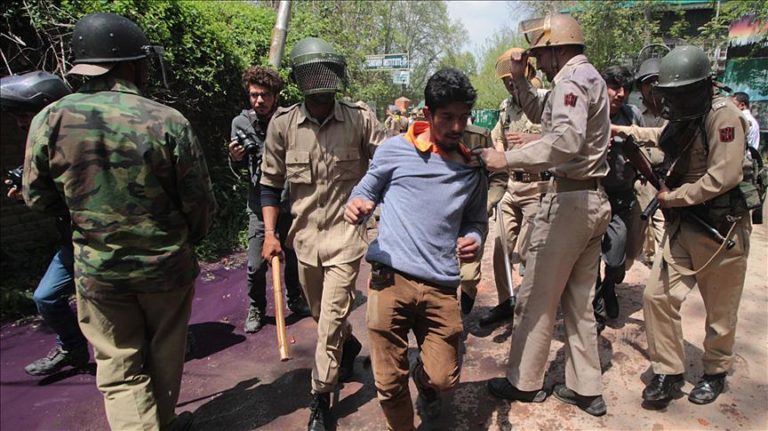
According to an Indian government report accessed by Reuters, nearly 4,000 Kashmiris have been arrested since the scrapping of article 370 indicating the scale of the biggest crackdown in Kashmir.
Kashmir has been in turmoil since India stripped it of its limited autonomy and statehood on Aug. 5, leading to clashes between security forces and residents and inflaming tension with Pakistan.In an attempt to stifle the protests that the reform sparked in Kashmir, India cut internet and mobile services and imposed curfew-like restrictions in many areas. It has also arrested more than 3,800 people, according to a government report dated Sept. 6 and seen by Reuters, though about 2,600 have since been released. It was not clear on what basis most of the people were being held but an Indian official said some were held under the Public Safety Act, a law in Jammu and Kashmir state that allows for detention for up to two years without charge.
The data for the first time shows the extent of the detentions, as well as indicating who was picked up and where.
The report contains data from the 13 police districts that make up the Kashmir Valley, the most populous part of the Himalayan region where the main city of Srinagar is located. The largest number of arrests were in Srinagar, the data shows, at nearly 1,000. Earlier unrest often centered in rural areas. More than 200 politicians, including two former chief ministers of the state, were arrested, along with more than 100 leaders and activists from an umbrella organization of pro-separatist political groups. Of the detained political leaders, more than 80 were from the People’s Democratic Party, formerly in coalition in Jammu and Kashmir state with the ruling Bharatiya Janata Party. About 70 are from the National Conference, which has for years dominated politics in Indian Kashmir, and more than a dozen from India’s main opposition Congress party. The bulk of those arrested – more than 3,000 – were listed as “stone pelters and other miscreants”. On Sunday, 85 detainees were shifted to a prison in Agra in northern India, a police source said. A spokeswoman for India’s interior ministry did not respond to a request for comment. Neither did Jammu and Kashmir police.Ravish Kumar – People´s journalist in the cacophony of fake news and Bikau media

Ravish Kumar, popularly known as Ravish, has emerged in the last few years as the conscience keeper of the nation. He occupies the place in the hearts of millions who sit before the TV sets every evening at 9 PM to watch him speak their thoughts and express their agony about the shrinking space of media and the rampant spread of fake news.
His viewers are spread over all continents. Wherever in the world, Hindi is spoken, understood, there Ravish has his fans. They watch his shows, read his blogs and circulate these among the network of their friends. Thus ravish has now become the daily news in India.
Awards and Recognition
His work has brought him many distinguished awards, the latest being the Roman Magsaysay Award from the Philippines based Magsaysay Foundation. In 2016, he has been chosen as the best journalist by the Bombay Press Club. He received the Ramnath Goenka Award for Excellence in Journalism in 2013 and again in 2017. In the same year, he also received the Kuldip Nayar Foundation Journalism award. There are literally dozens of other awards that have been showered on him. During the selection process for the First Gauri Memorial Award, the Jury Members unanimously came up with his name. What is about this 43 years old young man, coming from a Bhojpuri background, educated entirely within India and engaged in journalism in Hindi— and not English, like the founder of NDTV Pranav Roy – that has caught the imagination of the entire nation?
Ravish- The person, the scholar, the anchor
Ravish is not an aggressive news-TV anchor. One has never heard him shout at the persons with whom he is in a discussion. Ravish has the ability to listen very intently to everyone he engages with. He puts into his silence a rather strange kind of skepticism, the independence of his thoughts. He does not use his position as the show-anchor either to belittle or to bolster-up the ego of his respondents. In all his shows, he is aloof and alert at the same time, empathetic and skeptical at the same time. And, in between his sentences, he comes up with a unique kind of smile that has now become the brand icon for Ravish. It is the smile of a sensitive person who knows that the media in India has caved in, has hit the rock-bottom, has become a theatre of noise and empty-posturing. His smile is a mix of scorn, frustration, irony and non-violable independence of his mind. It seems to say, “I know what you are up to, but I know you are wrong.”
Ravish comes to his studio well prepared. He is an avid reader and when he reads anything, he reads it carefully. He had once called me on his ‘Prime Time’ show for an hour-long discussion on language diversity in India. That morning, some of my books were getting released in a Delhi auditorium. I noticed that he attended the entire programme; and when he left quietly, he left a number with a friend asking me to call. After my book release event was over, I did so. He then asked me to come to the NDTV studio for recording a conversation. I thought his questions would be based on what he had heard in the lectures that morning. I was pleasantly surprised to see in his hand two of my books. Our discussion made it amply clear that he had read both of the books quite deeply. And, these were not light reading. He must have spent at least a week pouring over them. This, I thought, was quite unusual. I have been interviewed by many other journalists. But, in very few cases, I have seen them come really so well prepared. Ravish was simply the very best among them.
It is not just his good looks, his photogenic face, his smile, his scholarship and his ability to ask questions that make him the phenomenon that he is. In addition to all of these, he has the courage to say that the political forces and the ruling dispensation have made a mockery of freedom. Despite scorn and threats of intimidation raining on him every day, he has carried on with his mission without an iota of fear. When most other TV anchors are willing to go to any length, or rather low, for increasing the viewership rates (TRPs), Ravish is able to say in no uncertain words that the viewers should switch of the TV sets and go out in open air. He has the courage to keep the entire TV –screen dark and tell the viewers that it is no longer the medium for truth.
His crusade against fake news, lies, intimidation, far-mongering, and mob-violence, in times when most media persons have accepted the collapse of media as an irreversible condition of that once noble profession, Ravish has stood up, with very few among his peers, like a man determined to speak truth and nothing but the truth. That determination, that courage and that genuine sense of responsibility make him a unique person of our time. Long after the current regime has gone into forgotten history, Ravish will be remembered as an inspiring example of an uncompromising commitment to the citizen’s rights of freedom and dignity in an avowed democracy.
G N Devy is a writer and a cultural activist.Piyush Goyal does a Nirmala! Einstein discovered Gravity!!
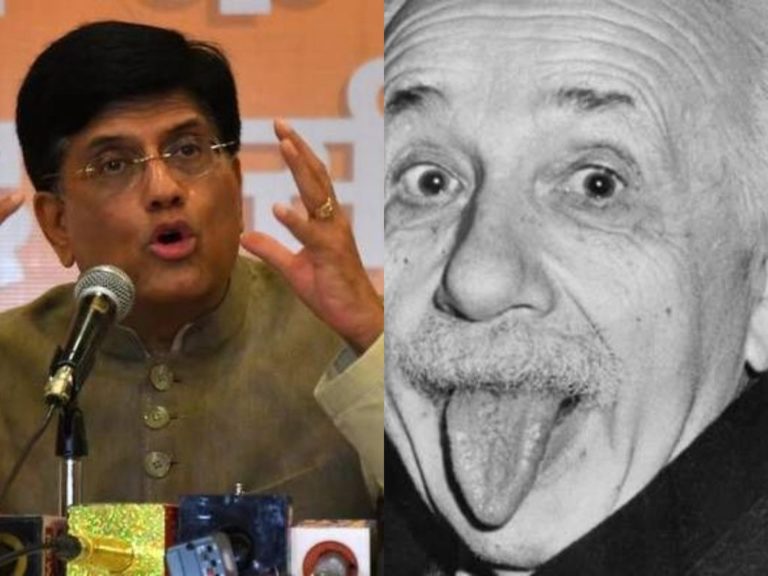
Einstein has quoted- “Only two things are infinite, the universe and human stupidity, and I’m not sure about the former”.
BJP ministers in their attempt to defend the government against the allegations of an economic slowdown are definitely making us question the former. After Finance Minister Nirmala Sitharaman’s blamed the millennials as the reason behind the crisis in the auto sector, today, Union commerce minister Piyush Goyal made another embarrassing faux pas. In a board of Trade meeting, he apparently credited Einstein for discovering Gravity!! FYI, for our readers, it was Newton who discovered gravity in 1687.
Yes, this guy!!
Today, the union commerce minister in an angry rant went against those who do the GDP said- “Don’t get into the calculations that you see on television…don’t get into those maths. Maths have never helped Einstein discover gravity.” BJP has been trying hard in five years to manipulate GDP to dismiss the charges of the economic slowdown. In the past, they have dismissed the various surveys and statistics that show economic slowdown, fudged employment data. They have proposed that there are `different´ ways of calculating GDP. All to dismiss the economic crisis and job losses. After five years of listening bizarre statements from BJP leaders, the Indian public is now used to of such statements and responds through the way they know best- Internet Memes!!Why should Nirmala have all the fun? Piyush Goyal has just delivered a blockbuster dialogue
— Srivatsa (@srivatsayb) September 12, 2019
"Don't get into calculations about the economy. Don't get into maths. Maths never helped Einstein discover Gravity" ????
Millennials and Maths are the problem. Not Modi Govt. Understood? pic.twitter.com/JCoCIbdoxp
Why should Nirmala have all the fun? Piyush Goyal has just delivered a blockbuster dialogue
— Srivatsa (@srivatsayb) September 12, 2019
"Don't get into calculations about the economy. Don't get into maths. Maths never helped Einstein discover Gravity" ????
Millennials and Maths are the problem. Not Modi Govt. Understood? pic.twitter.com/JCoCIbdoxp
Did Piyush Goyal get his CA degree from Yell? pic.twitter.com/J9ltLzXfBA
— Swati Chaturvedi (@bainjal) September 12, 2019
It takes special talent to deliver such bullshit with so much confidence. Well done @PiyushGoyal , you have beaten @nsitharaman in absurdity. pic.twitter.com/cuIIPm1ZJh
— Roshan Rai (@RoshanKrRai) September 12, 2019
World : Newton discovered Gravity
— Srivatsa (@srivatsayb) September 12, 2019
Goyal : Einstein discovered Gravity
Pokhriyal : Hold my beer… pic.twitter.com/yTxtLMYWvC
Twitterati respond to Nirmala Sitharaman´s blame of auto slowdown on Millennials
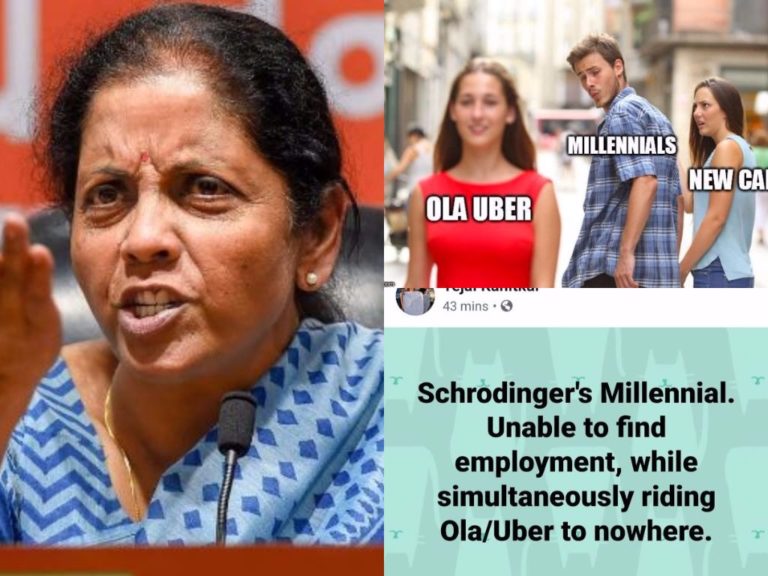
Poor Millennials!! as if they haven’t been demonised enough by the baby boomer generation for being ´lazy,avocado-eating, selfie and Instagrammed generation´, Finance Minister Nirmala Sitharaman joined the gang and blamed them for the automobile industry slowdown on Millennials taking Ola and Uber over buying a car.
Millenials the generation born between 1980 to mid 1990s, in the information and digital age are also known to be identified with these markers. Although generation gap is not a new thing and such comments from the older generation are all too common, but coming from the finance minister was bit unexpected.
 In US, since the economic downturn of 2008, the trade and media pundits had started blaming the millenials for everything, from tanking the economy, not buying houses, studying longer, being liberal to unstable job market. Nirmala Sitharaman seem to have taken a leaf out of the American conservative playbook but Indian millennials are not taking it so easily and they gave it back to her through their favourite medium, the twitter!
#BycottMillennials and #SayItLikeNirmalaTai trending on twitter today as Indians tried to grapple with Nirmala Sitharaman comments.


In US, since the economic downturn of 2008, the trade and media pundits had started blaming the millenials for everything, from tanking the economy, not buying houses, studying longer, being liberal to unstable job market. Nirmala Sitharaman seem to have taken a leaf out of the American conservative playbook but Indian millennials are not taking it so easily and they gave it back to her through their favourite medium, the twitter!
#BycottMillennials and #SayItLikeNirmalaTai trending on twitter today as Indians tried to grapple with Nirmala Sitharaman comments.
Millennials are down because, well… Depression.#SayItLikeNirmalaTai
— meghnad (@Memeghnad) September 10, 2019
Indian Rupees is falling due to Gravity .#SayItLikeNirmalaTai
— Sardarism™ (@Sardarism) September 10, 2019
Millennials were born into the worst financial crisis and are facing severely limited employment prospects even in developed countries. India is facing one of the worst unemployment rates in its history. According to a recent survey, one-third of India’s skilled youth are jobless. India has one of the highest population of young working people. This should work for its advantage as these young people can contribute to the growth of the economy. But India seems to be unable to capitalise on its demographic dividend. The economic reforms and employment programs that are needed to bring the youth out of this crisis are ignored for short term and ill-informed measures. A week ago, PM Modi and Nirmala Sitharaman were talking about making India a 5 trillion economy and now the Finance Minister is giving bizarre comments on the young generation. Nirmala Sitharaman will do well if she focusses on fixing the economy instead of fixing the people to fit in a bad economy.Fair & Lovely sales are low because life is unfair. #SayItLikeNirmalaTai
— WisePosterior (@faadukela) September 10, 2019
Kashmiri Student based in Bangalore files petition before the karnataka High court against J&K Lockdown
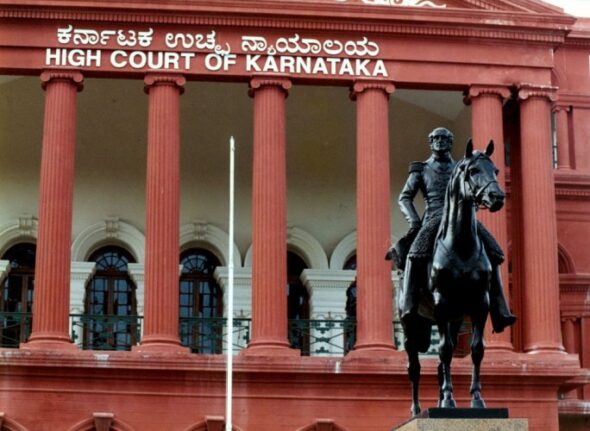
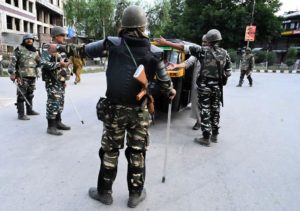
It has more than a month since the Central Government imposed a complete communication shutdown in Kashmir. While restrictions have been eased in the Jammu region, the Kashmir valley continues to remain under clamp down with internet and cellular network services suspended.
On 19 August 2019, a young Kashmiri student based in Bangalore moved to the Karnataka High Court to challenge the complete communication blockade as violative of fundamental rights of residents of Kashmir and their loved ones living outside the State.
The Petitioner was forced to approach the High Court because he had been unable to establish contact with his family members in Kashmir. He was especially worried because many of his family members suffer from various health problems and due to the communication shutdown and strict curfews, it has become difficult to call for help or reach hospitals in time.
The Petition argues that the complete communication blockade violates Articles 14, 19(1)(a) and 21 of the Constitution of India and it is incompatible with India’s obligations under international human rights law. Most importantly, the Petition highlights that the communication shutdown seems to lack any legal basis because there is no order authorizing the suspension of telecom and internet services which is available in the public domain.
The plea prays for by way of interim relief directions to authorities to produce all relevant orders, notices, or circulars issued by authorities under which suspension or shut down of communication in Kashmir was ordered.
As a constitutional democracy, what sets India apart is our stated commitment to the rule of law. While imposing such severe and indiscriminate restrictions on an entire community, the Government must at the very least act in a transparent manner. Without access to the legal orders, it is impossible to know under which law the shutdown has been ordered, on what grounds, by which government authority, for what period of time, and whether it has been subjected to any kind of review.
The Karnataka High Court on September 9, granted time till September 13, to the Union Government to give details of petitions pending for hearing before the Supreme Court in regards to the alleged communication blackout in Jammu and Kashmir, post the abrogation of Article 370.
Assistant Solicitor General argued that 12 petitions are pending before the Supreme Court and therefore since the petitions are subjudice before the Supreme Court, this court cannot entertain this petition.Advocate Vishwajit Sadananda appearing for the petitioner argued that no other petition except the one filed by Anuradha Bhasin on the issue of communication blackout is pending before the Supreme Court. Bhasin’s petition is on journalist and media freedom and so one could argue that the scope of the petition is different. The crux of these hearings has been the maintainability of the Petition in light of a similar petition filed by Mr. Tehseen Poonawalla being pending before the Supreme Court. During the hearings, the counsel for the Petitioner has clarified that this case is different because the Petitioner is personally affected by the communication shutdown. Further, High Courts in India have independent and concurrent powers to protect the fundamental rights of individuals within their territorial jurisdiction.
Courtesy: https://internetfreedom.inActor Urmila Matondkar quits Congress, Why young women leaders find it difficult to survive in Congress?
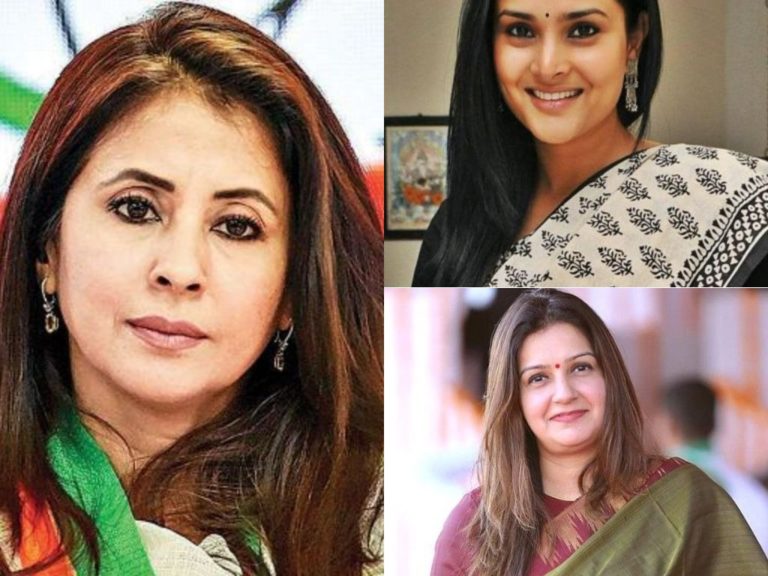
Months before Maharashtra assembly elections, Urmila Matondkar resigns from the Congress party. Urmila resigned on Tuesday 10 September, citing ” petty in-house politics” as the primary reason.
In a statement, Matondkar said: “My political and social sensibilities refuse to allow vested interests in the party to use me as a mean to fight petty in-house politics instead of working on a bigger goal in Mumbai Congress.”
Urmila, a hugely popular and successful Bollywood actress joined Congress 5 months ago and contested the Mumbai North Lok Sabha elections unsuccessfully against Bharatiya Janata Party MP Gopal Shetty.
Urmila´s departure is not good news for congress which has already many leaders dissatisfied with party leadership and looking to jump ships after its poor performance in 2019 Lok Sabha elections.
Urmila had criticised the party leadership in the state earlier in a letter to Milin Deora, the then Mumbai Congress chief, Matondkar in July 2019. She has complained about the close associates of Sanjay Nirupam, for their conduct during the run-up to the Lok Sabha elections. She said the duo has shown a “total lack of coordination, honesty, and efficiency, ensuring a disastrous outcome”.
Why Congress cannot retain young and outspoken women leaders?
Urmila is not the first women leader to have quit from Congress in the last one year. Before the 2019 elections, Priyanka Chaturvedi, General Secretary of Indian Youth Congress also quit Congress. She had expressed her dismay about UPCC (Uttar Pradesh Congress Committee) reinstating some party workers who were earlier suspended for their unruly behavior with her. She later joined Shiv Sena party. Chaturvedi had famously taken a dig at Smriti Irani on filing a false affidavit of her educational credentials by singing a parody to the theme of Irani’s previous TV serial Kyunki Saas Bhi Kabhi Bahu Thi as “Kyuki Mantri Bhi Kabhi Graduate Thi”.
Divya Spandana aka Ramya, Kannada actress turned politician was also shown cold shoulder in the Karnataka congress despite being a one time MP from Mandya constituency. To her credit, she won 2013 by-election with a comfortable margin. She contested the 2014 Lok sabha election again on congress ticket and lost with a narrow margin. She was quite popular in the region but none of the congress leaders including Ambareesh supported or campaigned for her.
Later in 2017, Ramya was given the role of chief of the All India Congress Committee’s social media wing in May 2017. She is credited for turning around the party’s online presence compared to the BJP, which had a robust IT cell already. She is also known for her sharp and witty responses to the BJP and directly criticizing the Narendra Modi-Amit Shah duo. Due to her outspoken and vocal stance on social media, she was targetted heavily by Modi supporters and social media trolls. During these smear campaigns also Karnataka Congress didn’t come out in her support. A month ago, she has also resigned from her social media in-charge and deactivated her twitter, facebook and Instagram accounts.
As congress spokespersons, they managed to breach the social media landscape that was mainly occupied by BJP and Hindutva forces. Both Ramya and Chaturvedi discussed and defended congress policies on social media. They were quite vocal critics of Modi, Amit Shah, and Smriti Irani.
Being young women, Urmila, Priyanka, and Ramya were targetted on social media and were not taken seriously by their own party men. There is already paucity of women leaders in politics. Congress, the grand old party is already accused of propagating dynasty politics, though other parties are no different. Most of the political space is occupied by old men, their children or Yes- men. Despite their popularity and hard work, women with no political background or mentor are at the receiving end of misogynistic and dismissive behavior from their party and society. This does not set a good model for any political party or young aspiring politicians.
Faye D´Souza resigns as Executive editor from Mirror now
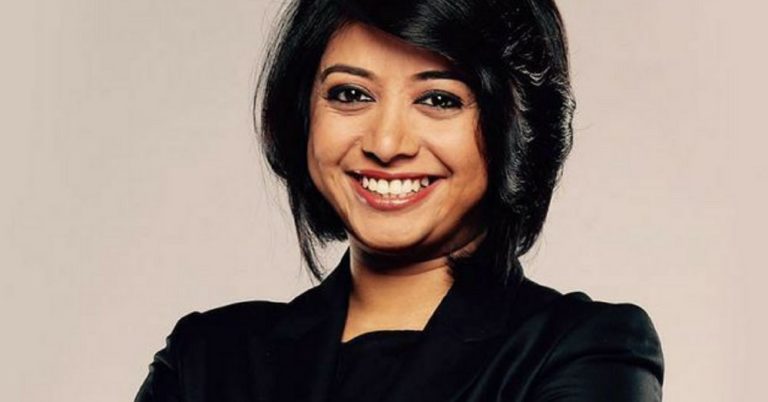
Faye D´Souza one of the popular and vocal faces in TV news has resigned from her position as the Executive Editor from Mirror Now channel. As per current updates, Vinay Tewari has taken over as the new Managing Editor at the news channel.
According to Mumbai Live, Hector Kenneth, who previously served as Vice President and input head at Times Now has now been appointed as the input head of both, Mirror Now and Times Now.
 Faye D’Souza was also doing a new chat show with film celebrities on Romedy now since Sept 1.
Faye D’Souza, who held the position of the Editor at ET Now, joined the Times Group in October 2008. Prior to that, she was employed at CNBC-TV18 for four years.
Faye has been felicitated by the Redlink Award for ‘Journalist of the Year’. Mirror Now under Faye D´Souza became the voice of common man among the English news channels. Her primetime show, The Urban Debate´ was quite popular. She would raise social and political issues on her panel discussions. Her no-nonsense and bold attitude stood out among the sold-out media voices.
Reasons for resignation are not known. Rumors of layoffs at Times Now network and the present government unhappy with Faye’s critical stance and questioning attitude.
Faye D’Souza was also doing a new chat show with film celebrities on Romedy now since Sept 1.
Faye D’Souza, who held the position of the Editor at ET Now, joined the Times Group in October 2008. Prior to that, she was employed at CNBC-TV18 for four years.
Faye has been felicitated by the Redlink Award for ‘Journalist of the Year’. Mirror Now under Faye D´Souza became the voice of common man among the English news channels. Her primetime show, The Urban Debate´ was quite popular. She would raise social and political issues on her panel discussions. Her no-nonsense and bold attitude stood out among the sold-out media voices.
Reasons for resignation are not known. Rumors of layoffs at Times Now network and the present government unhappy with Faye’s critical stance and questioning attitude.
As the news befell viewers on Twitter, many are speculating the reasons for her resignation and her viewers are not too happy and want her to come backBreaking news: sources say @fayedsouza was asked to resign since @PiyushGoyal did like her asking questions on the government. unelectable @PiyushGoyal pressurized @vineetjaintimes to remove her from mirror now. #media #msm #opmsm
— Ravi verma #shutdownsterlite #destroyaadhaar (@aadharscam) September 9, 2019
We want @fayedsouza to be back on @MirrorNow
— Ketan Nardhani (@ketan83) September 9, 2019
No one can ever replace her…. She was our only voice against the issues citizens used to face. #FayeDSouzaComeBack ???? pic.twitter.com/4z8tWsRgNA
One more Journalist who has paid the price for speaking out. The system now needs propagandists and not those who stick to journalism.
— SANJAY HEGDE (@sanjayuvacha) September 9, 2019
https://t.co/Qwv5o5G3Dv
From now stop watching @MirrorNow as @fayedsouza resigned and the channel is now owned by Modi propagandist times network.
— Kaushik ????✍️ Vanaja-Raj (@rationalkaushik) September 9, 2019
People are hired on basis of their skills but fired once they start to grill. @fayedsouza was no exception. @MirrorNow should have stood firmly to their ethics instead of stooping to #Modi.
— Mohit (@EruditePeacenik) September 9, 2019
Now we have only @ndtv as our last bastion of truth. https://t.co/RWf6yXPjmQ
UP law student alleges BJP leader Swami Chinmayanand of rape and physical exploitation for one year

The law student from Shahjahanpur who had leveled harassment charges against BJP leader Swami Chinmayanand, on Monday, 9 September, alleged he raped her, and also physically exploited her for one year.
Addressing media persons in Shahjahanpur, she claimed that the police were refusing to register the rape case. “Swami Chinmayanand raped me and even exploited me physically for one year,” she alleged before media persons, her face covered with a black scarf.
“The Delhi Police has registered this complaint at Lodhi Road police station and has forwarded it to Shahjahanpur Police, which is not registering the rape case,” she said.
The Delhi Police has forwarded the complaint to the Special Investigation Team (SIT). On Sunday, 8 September, the SIT began its probe into the case by recording statements of the family members of the student.
“On Sunday, the SIT quizzed me for about 11 hours. I have told them about the rape. Even after telling them everything, they have not arrested Chinmayanand yet,” she said.
On September 4, the Supreme Court had ordered the transfer of the Shahjahanpur law student and her brother to other law colleges affiliated to Bareilly university saying, “for us their future is important”.
The woman had gone missing after leveling allegations against Chinmayanand in a video and was later found in Rajasthan by UP police.
The apex court judges had said the woman raised certain grievances against the institution where she studied and her parents had some apprehensions about the safety of their children.
The SIT on Saturday also visited Chinmayanand’s residence, ashram and the college run by him where she studied, according to the college principal. The SIT, headed by Inspector General of Police Naveen Arora, has been set up by the UP government on the Supreme Court’s order. The team visited the college hostel where the room of the law student has already been sealed, he said.
The team also visited the Mukukshu Ashram of the BJP leader and toured the five colleges run by the ashram, Principal Avnish Misra had told PTI yesterday.
West Bengal passes anti lynching bill, BJP opposes it!