Friday, November 20, 2026

HowdyModi to AdiosModi : Protests outside Houston event venue

0
As a majority of Indians slept last night, Prime minister Modi addressed a large gathering of Indian Americans in an event called `Howdy Modi´organised by an Indian American organisation called Texas Indian Forum in Houston, Texas.
While the Indian media showed the joy and jubilation of NRIs when Narendra Modi addressed them, there were protests outside the NRG stadium by civil society organisations against the human rights violations committed under the Narendra Modi regime in last 5 years. 
Protestors carrying placards comparing Modi to Hitler and telling him to go back with slogans like #AdiosModi. The protestors were questioning the silence and lockdown on Kashmir and the increasing incidence of Mob lynchings of Dalits and minorities.  There were chants of  “Modi, Modi you can’t hide, you committed genocide”.
Hindus for Human Rights co-founder Sunita Viswanath said, “We are horrified that our religion which teaches vasudaiva kutumbakam is being hijacked by extremists and nationalists”.
“We are especially appalled by the most recent nightmare of the Kashmiri people, and the situation of 1.9 million people in India who are rendered stateless due to the imposition of the travesty called the National Register of Citizens,” Viswanathan added.
  Modi’s critics called the Howdy Modi event in Houston a place where white extremists met Hindu extremists.

Ravish Kumar receives Gauri Lankesh National Journalism Award

1
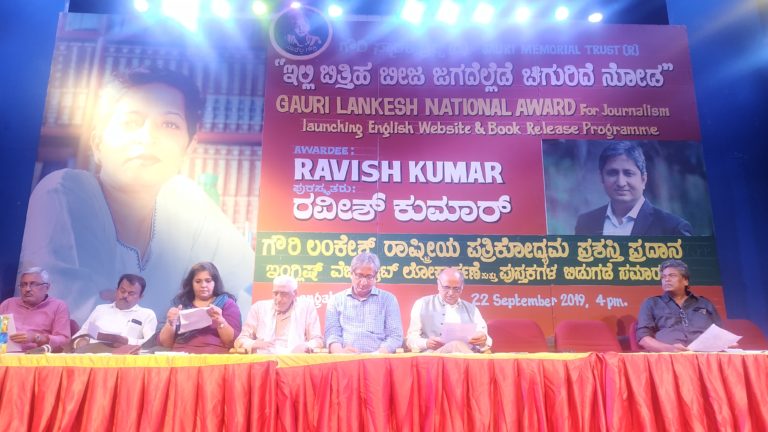
Today Ravish Kumar will be conferred with the Gauri Lankesh National Journalism award in Bangalore. In an award ceremony, freedom fighter H.S. Doreswamy will give the award to Ravish Kumar for his upholding the values of the constitution and freedom of speech. Ravish Kumar is known for his pro-people journalism and bringing the voice of common people on his show `Prime Time´. Since last year, the Trust has been observing September 5th as ‘Gauri Day’ to advocate free-thinking and upholding the value of speaking truth to power. As a part of its activity, the Trust has instituted an annual award in the name of Gauri Lankesh to be given to an outstanding journalist, who has shown exemplary commitment to their profession. The award carries a plaquette and a cash award of Rs. One lakh.

Read more: Ravish Kumar – People´s journalist in the cacophony of fake news and Bikau media


Kafeel Khan- People want Health, education and Employment, not Hate

0

Jignesh Mevani : Buddha, Basvanna and Ambedkar’s teachings are road map for a new vision of Modern India

1
I am deeply humbled to have been asked to write in Gauri Lankesh Patrike. Gauri Lankesh was a mentor, a guide and most importantly a friend who loved and cared for everyone extremely deeply. She touched innumerable lives through her work and fearless activism, and I feel honoured to have known her so closely, and that she touched my life in so many different ways. For Indians who have faith in secular and democratic values, and believe that all of us are equal citizens irrespective of our gender, caste, religion or political beliefs, these are  extremely trying times. The rise and consolidation of fascist forces, wrapped in the tyrannical ideology of Hindutva, threatens to destroy the secular fabric of Indian society, which has been in existence for centuries. Just as the British, for 200 years, divided our country by pitting sect against sect, and religion against religion, the Narendra Modi-led BJP government is following the exact same formula in order to garner this false notion of Hindu supremacy. The sharp rise in mob lynchings against Dalits and Muslims, since 2014, is an everyday manifestation of the BJP’s divisive and oppressive ideology. Apart from being hell-bent on destroying India’s social and secular fabric, the BJP government has successfully crippled democratic institutions from its independence. Today, the judiciary, the parliament and most importantly, the media have become watchdogs to the government, rather than watchdogs for the people to keep government power in check.  Which is why it is extremely important to recognise the efforts and fearlessness of journalists like Ravish Kumar, who deservedly is receiving the inaugural Gauri Lankesh Award. Given these trying times, it is crucial for progressive forces to come together to not just fight the malice of this fascist rule, but to also provide an alternative vision to the people of our country. To seek inspiration for this we don’t need to go too far, India has been home to some of the greatest thinkers and leaders who have provided us with roadmaps of how to make Indian society more just and equal. We must seek inspiration from the teachings of Basavanna, Buddha and Babasaheb Ambedkar, while also being mindful of crafting out a new vision for modern India. In the coming decade, India is set to become the youngest nation on the planet. This young and bustling population will require vibrant and diverse universities that foster creativity and provide this youth a space to freely pursue whatever passions they might hold. It is a devastating fact that India currently has the highest suicide rate among students in the world. It speaks of a much larger problem in our education system, when its central stakeholder does not find any hope or will to live. In the coming decade, all education reform must focus heavily to bring down this shameful number. We must also create newer forms of industries that provide this young population decent working conditions, while at the same time ensuring the young people have enough time to explore and pursue other passions and interests in their personal life. This new and young society must also be one that provides space for all kinds of love. Nobody in this country should fear loving someone irrespective of their caste, religion, gender or sexual preferences. While I am aware that this hope and vision seems very far-fetched in these dark times, there are still rays of hope that exist in our everyday lives. The way people like Gauri and Ravish have lived their messages and philosophies through their work and everyday practice, is inspiring countless number of people. It is now time for progressive forces from across the country to build on their invaluable work and not just get rid of the fascist forces that have consumed our nation, but also create a vision for a new, progressive, inclusive and tolerant India. Jignesh Mevani is a social worker and lawyer. He spearheaded “Chalo Una”  movement in Gujarat in 2016 against flogging of Dalits in Una. He succeeded in bringing the issues of land rights and a life of dignity for Dalits. After the success in the movement, He also contested assembly elections in 2017 as an independent candidate and emerged victorious. He is now the MLA from Vadgam district in Gujarat. 

Jagmohan Singh: Empower the Youth and common people with Rational Ideas

0
No doubt we are faced with the most challenging times . It is the time when brute force is preeminent. Both in the state machinery as well as in the Bhakats. But it is the challenge which provide opportunity and the strength to think afresh and boldly stand with the new ideas. But the fundamentals must be clear such to distinguish between Nationalism (Rashtarwad) and Patriotism ( Desh Prem ). Rashtarwad or Natioanlism as preached now was borrowed from west at a time in the face of economic crisis, this idea was propagated in Japan ,Spain , Italy and German and was meant for taking over power. Hence power is the central motive . It needs that an enemy be created to target for all ills. Where as Patriotism or Desh Prem is centered around solving problem of public in general . The motivation force of the nationalism is hate where as that of patriotism is love. George Orwell notes that negative nationalist “ sees history as endless rise and decline of great power units , and every event demonstrate that his side is on upgrade and some hatred rival is down grade. … having picked his side he persuade himself that it is strongest. Nationalist is power hunger tempered by self deception . … A nationalist has indifference to reality. He not only disapprove of atrocities committed by his own side , but he has remarkable capacity for not even hearing about them. He is haunted by the belief that past can be altered. He spend his time in a fantasy world in which things happen as they should. “ These are some of the symptoms which make us clear that what type of challenge this situation offers .Understanding it we have to work consistently. In this 100th year of Jallianwala Bagh Massacre , let us not forget that Michel O’Dwyer and Dyer were acting as British Nationalists where as the Indian patriots were forging patriotism by solving the food price rise by running common kitchen open to every citizen irrespective of Caste and religion . Thus forging a Hindu Muslim unity to the extent that celebration of Ram Navami which fell on 9th April was celebrated jointly by Hindus and Muslim . The procession was lead by Dr Bashir. It was this unity which reminded the british rulers of 1857 and they acted so mercilessly . Let us remember what Shaheed Bhagat Singh and B K Dutt wrote to editor modern review in Dec 1929. “ Revolution …. is the spirit, the longing for a change for the better. The people generally get accustomed to the established order of things and begin to tremble at the very idea of a change. It is this lethargic spirit that needs be replaced by the revolutionary spirit. Otherwise degeneration gains the upper hand and the whole humanity is led stray by the reactionary forces. Such a state of affairs leads to stagnation and paralysis in human progress. The spirit of Revolution should always permeate the soul of humanity, so that the reactionary forces may not accumulate (strength) to check its eternal onward march. Old order should change, always and ever, yielding place to new, so that one “good” order may not corrupt the world. It is in this sense that we raise the shout “Long Live Revolution” It was this spirit which was being injected by Our beloved Gauri Lankesh . As Bhagat Singh said that they can kill the person but ideas lives on . The duty falls on us is to empower the young and commoners with rational ideas . May this quote from Bhagat Singh guide us. “The leaders show Philanthropy but this does not bring social change . For social change one needs to generate a scientifically oriented social dynamic force. “ This is the road ahead .History is witness that the human progress which will give solution to the real historical needs of people , may be delayed by divisive forces but it has to come . We are the facilitator of it. Let us determinedly go on and bring clarity in thinking . Jagmohan Singh Professor Jagmohan Singh is a former Professor at Punjab Agricultural University and Bhagat Singh’s nephew. He has been committed to dissemination of Bhagat Singh’s ideas He has digitized most of the essential writings of Bhagat Singh. He is also the founding member of the Association For Democratic Rights (Punjab), the JAMHURI ADHIKAR SABHA which was formed in 1978. The association was conceived as a mass based group to investigate first hand the reports of violation of human rights and put it in the public domain to help people’s movements in the fight for justice.

Nandini Sundar : The art of creating‘happy’ open-air prisons

3
In 2005 the BJP government of Chhattisgarh claimed that  Salwa Judum was a self-initiated people’s movement aiming to finish Naxalism, and people were flocking to Salwa Judum camps which would be models of development. Instead, all the people who were forcibly incarcerated in Salwa Judum camps fled back to their villages as soon as they were able and fifteen years on, the Naxalites are hardly finished, even if weakened. The villagers whose homes were burnt by Salwa Judum or those whose family members were killed in the conflict, and who have still not got justice, are living testaments to how lies purveyed by the media and ruling parties remain simply lies. In listening to the government and media talk about how happy Kashmiris are with the abrogation of Article 370 and Article 35 A, I am constantly reminded of Chhattisgarh and the government’s claim that people were so happy to leave their villages. Just as in Kashmir, media, factfinding groups and even opposition parties who wanted to visit to ascertain the truth were prevented from doing so. While people did not face the same kind of communications blockade, simply because few people used phones, in practice they were blockaded from communicating by not being allowed to meet in bazaars or visit each other for fear of being randomly killed or arrested en route. And just as in Chhattisgarh, Salwa Judum was jointly carried out by the ruling BJP government and the opposition Congress leader, Mahendra Karma – in the case of Kashmir, almost the entire opposition has been weak, silent or divided. The utter shame of Kejriwal demanding full statehood for Delhi and congratulating the BJP for demolishing the full statehood of Kashmir is not lost on anyone. State parties which could find themselves similarly put under President’s rule one day and waking up to a changed geography the next – all seem to be suffering from some strange kind of Stockholm syndrome where they are under the captive sway of the BJP’s overwhelming presence. Or perhaps we owe this sorry spectacle to the BJP’s powers over investigative agencies like the ED and CBI. The BJP claim that sarpanches in J & K will be strengthened will make them like those in Bastar – only on paper and working with the administration, while people hate them and they need insurance from the people. One cannot have democracy only at the bottom and imprisonment at the top or vice versa. Democracy is a long chain which links everyone and once one link is broken, the chain is useless. The mainstream press has usually gone along with the government when it comes to national security issues, especially in the peripheries. Thus when Mizoram was being subjected to grouping and the entire population was being uprooted, an Indian Express editorial, dated 7 January 1967 stated: ‘Evacuation of the entire village population over 4000 sq miles is a spectacular operation which implies either that the situation is more serious than the authorities want the country to believe or that a newer determined effort is about to be made to wipe out the last vestiges of rebellion. The evacuation will help in isolating and mopping up the rebel bands but resettlement of 60,000 people far away from their houses will present serious difficulties. Operation Security will involve a measure of force.’ Currently there is not only the willingness to accept ‘a measure of force’ but active triumphalism by the media with headlines like ‘historic moment’, ‘geography being redrawn n´, ‘surgical strike’ etc.. This is even worse than the Emergency – where as Advani famously said, the media crawled when they were merely asked to bend. Here they celebrated when they should have condemned, and were vocal cheerleaders of the destruction of democracy when we needed them to defend it. It is at times like this when one most misses fearless voices like Gauri Lankesh. Underlying all this is, of course, corporate interests. Just as it is being said that the removal of Article 35 A will create more investment opportunities, we will soon be told that the removal of the 5th Schedule and laws against Adivasi land alienation should also go so that Adivasis can benefit. In Jharkhand, steps have already been taken to weaken the Chotanagpur Tenancy Act and the Santhal Pargana Tenancy Act. What happens in the peripheries happens in the centre. The Emergency in Kashmir will soon take the form of a declared All India Emergency. The undeclared one is of course already upon us. Nandini Sundar, a sociology professor at Delhi School of Economics. She has a Ph.D. in anthropology and has done extensive research work on the tribes in Bastar, their socio-economic conditions and how the law operates there. Because of her expose of state machinery involvement in the atrocity on tribals in Bastar, she is a constant target of trolls and threats from the Hindutva Brigade. 

Rumble of the Volcano: Senthil Sasikanth

0
Congrats folks! You are witnessing history in the making. One that I and many of us like me never dreamt of seeing. Remember seeing that Discovery channel’s documentary on World War II and asking yourself “how on earth did this madness happen?”  I am sure the most haunting question in your mind would have been “how did average Germans with high familial values went behind this mad man?” “What made them hate and despise fellow humans?” I am sure you never found a plausible answer. Watch closely.  Observe the change that has happened in the last 6 years in you and the people around you. You have started being more nationalistic and have started being more assertive about it. You have started feeling that the country has been in a state of decline (of course only before the messiah arrived). You have started venting your anger on the people and groups that you think are responsible for the decline of this great country. You have clearly started taking sides and feel a revived sense of power. When Kashmir was put on a clampdown you did rejoice and say “saala yeh pehle hi karna thaa…”. When the Pulwama attack happened and the prime minister went on TV to say “Bohat badi galti kar chukein hein… Bohat badi keemat chukane padegi….” your hearts pumped and your imagination went straight to the imagery of elite forces and fighter planes bombing the shit out of Pakistan. Your college WhatsApp catchup groups are now teeming with “Us vs Them”, BJP era vs Congress era fights, etc. About the chest-thumping and jingoistic pride in social media, the less said the better.  I think you get the point. All we realize is that there is something churning in this country. Something which has not happened for a long time. Right? I hear that this is all communal politics. Yeah. But then that hue of politics is not new to this country. Jan Sangh, the political arm of RSS, was formed in the year 1951. Communal politics is not new to this country. The nadir of that brand was witnessed on 6th December 1992. But what is this new thing? Why is it so exciting? At the risk of you terming this article bordering paranoia, let me introduce you to a new creature which you have heard and despised but have never experienced. Ladies and gentlemen! Welcome FASCISM to the land of Bapu. Oh.. don’t shoo it off. I know India is a vibrant democracy. Bear with me till the introduction is complete! I take liberty in quoting various research works about Fascism to highlight its basic tenets. I particularly rely on the works of one Jason Stanley, an American philosopher and a Professor of Philosophy at Yale University to explain the same. Firstly, Fascism starts by a projection of a father figure to establish a patriarchy. Patriarchy is the key element here. It is not a concept, ideology or a party. It is a person in flesh and blood. A heroic figure.  This patriarchal father figure then goes on to embody the values of the country and in due course becomes the sole embodiment of the values of the country. All decisions and achievements are taken in his name. It would be naïve to highlight who in recent times has gained this status. Note the difference in the previous NDA regime where there was communal politics, hate crimes, etc., but no patriarch. Shri Vajpayee and Shri Advani had their own status but never did they grow beyond the RSS and the Sangh. Secondly, the patriarch goes on to create a narrative of a mythical past and glory that once was there and then would single out a group as being responsible for the decline in the values and culture of the society. With the RSS agenda and the Jan Sangh’s own objectives this part becomes easy for Mr. Modi as the template is already set. As a crescendo, the call is on for the country men for the reversal of a declining nation. The common folk are called to support this initiative of creating the great nation through hyper-nationalistic appeals. Remember “Ache din ayegi…” ,“ Kaala Dhan”? The third major strategy of fascism is to take control of all the intellectual organizations which would question or debate the strategy of the system. Remember the attack on JNU? Has anyone witnessed anything like that in the recent history? It would be a fallacy to think that this was random. Media houses would be compelled to comply and the institutions of checks and balances would also be meticulously compromised.  A situation of intellectual void is created which sets up the ground for the propaganda machine to roll in its glory. Fourthly, the majority population is made to feel victimized. This is an easy task in a society which is to balance all socio-economic groups aiming at a ‘just society’. The fear of ‘Us vs Them’ is created and is brought into the popular narrative of the people. I had studied in a pluralistic college in which I had spent 4 years and I don’t remember a day when we had any discussion based on our identities. In recent times when I go through the discussions in our college social media groups, I find more than 70 percent of the discussion is between identities veiled as Congress era Vs BJP era and of course “Us Vs Them. The terms “Urban Naxals” and “Prestitude” are thrown around liberally.  But the underlying hate vibe of the arguments against ‘Them’ are very clear to even an uninformed mind. A parallel is often drawn with the emergency during the Indira Gandhi period. It certainly was a dark period. And surely was an authoritarian regime where the government took over control and people were made to suffer due to curtailment of fundamental rights.  But what is happening now is the systematic poisoning of minds which creates a lynch mob bereft of kindness or sympathy.  And this is how people fall prey to the propaganda machine of the Fascist juggernaut. It is also difficult to specifically define fascist strategies as unlike other systems like communism or socialism, fascism doesn’t have set working agenda. It keeps varying according to the patriarch’s whims and fancies. It is clear to me that the fascist machinery has spread its tentacles all over the country.  Minority bashing under the guise of nation building has become the norm. Aren’t we creating an entire generation filled with hatred and mob mentality with sheer contempt for human rights and values? Aren’t we propagating an ideology of hate to the extent of glorifying the assassin of the Mahatma? India, born with the ideals of Gandhi and the vision of other tall leaders, is slowly turning into something which will leave a deep scar not only on the soul of this country, but also on future generations. Erich Seligman Fromm, a world renowned social psychologist and survivor of the Nazi onslaught said something which is very relatable to India at this juncture: “When Fascism came into power, most people were unprepared, both theoretically and practically. They were unable to believe that man could exhibit such propensities for evil, such lust for power, such disregard for the rights of the weak, or such yearning for submission. Only a few had been aware of the rumbling of the volcano preceding the outbreak.” – Erich Fromm, Escape from Freedom I hope the ones who are unaware quickly wake from their normal nationalistic overtones and see that it is no more about Hindutva but it has mutated into a fascist volcano waiting to burst. You don’t want to be a fence sitter and wait till the explosion happens. Do you? Go for your family and children and give them safe and love-filled country to live in. And for the rest aware ones, Do your part. The clock is ticking.      

Teesta Setalvad: How Indian Democracy is being turned on Its Head

0
There was a slight difference between May 26, 2014 and May 30, 2019 in the calibration around the events. Both dates, five years’ part, saw the swearing in of a supremacist government in power in India by a substantial majority.  If the 2014 victory was tentative yet triumphant, there were attempts to paint a show and a narrative, of South Asian leaders, including Pakistani prime minister, Nawaz Sharif and others being invited to attend. While sections Indian elite and stars from Bollywood dotted the forecourt of the President’s residence, Rashtrapati Bhawan, New Delhi, the message to neighbours was that India is the Big Brother who is extending a hand. With a penchant for making history and some tough beginnings to surpass, Modi was and has always been into painting a grand narrative. India’s first prime minister, Jawaharlal Nehru was a celebrated internationalist, his firm belief in collaborations among the developing nations, fed on his socialist roots, led him, along with other legendary leaders to the emergence of the Non Aligned Movement (NAM). That changed in the early 1990s s a Congress under a leadership committed to “freeing India from a controlled economy” chose the path of neo-liberal economics, drawing closer not just to the United States. Under NDA-I, an alliance government also led by Hindu supremacists, Israel too -earlier shunned for its treatment of the Palestine question –became friend from foe. Given the vitriol of the campaign that led to Mode’s first victory, his almost no holds barred unleashing of hatred, the “us” versus “them”; where the us are only and only “Hindu India” (never mind the segregations of caste complications that come with the term), his master stroke of inviting ‘enemy nation’ Pakistan to share the glory of his electoral win, was hailed by many for the strategic shift in narrative it was not meant to be. Appealing to a vast section of India as the ‘tea seller’ from an un-entitled background, there was no shame for his followers that the man aspired to riches, be it a coat that cost Rest, 10,00,000 (when he met President Obama in Delhi months later) or a Mont Blanc pen that cost Rs 1,00,000 as he signed documents to take his oath wore expressions of crass personal wealth. The first five years of the regime were sign of times of come. Over-centralising of power, an assault on university campuses especially on student leaders who questioned this hegemonic and proto-fascist ideology that has groomed Modi since teenage years, cutback on workers and farmers rights, arrests on activists and lawyers and worst of all, lynchings of Indians who did not fit the definition of the ‘ideal’ Indian –that is Muslims, Dalits, Christians and Communists (read dissenter) were brutally killed. The slaying of rationalists Narendra Dabholkar, Govind Pansare, MM Kalburgi and Gauri Lankesh (only the first happened before 2014), by an extreme right wing group was also something India has not often seen. The fountainhead of the thinking read ideology of this regime –that sets its sharply apart from other parties even those like the Congress who have resorted to authoritarianism in the past –is the Rashtriya Swayamsevak Sangh (RSS).  Founded in 1925, its core belief is that India should not be a democratic republic but a Hindu theocracy; it subscribes to unequal and discriminatory levels of citizenship (following both Mussolini and Hitler) and is wedded (in its own writings) to overthrow the Constitution. Propaganda around the glory of the nation and ‘development’ subsumed the gory 2014-2019 reality of violence, fear and lynchings. The unilateral and many would say shameless move to de-monetise all of India’s legal currency crippled India’s flagging economy and virtually killed the informal sector. Reports of the aggrandisement of the ruling party’s coffers came in only to be snuffed out by men who led the party and were intolerant of reality shows. Those men are now in positions of unbridled power today.
I wrote some months ago that this government ‘has all but declared a war against its own people.’ That was before the 2019 results that took the supremacist victory to even higher levels, making a mockery of Parliamentary debate and all-party dialogue. The second Modi regime sworn in this year has had a busy few months (less than three to date) sending down this message.
Parliament that met to pass the budget in July, has been used thereafter to push through legislation(s) without even the show of referring them to Parliamentary Committees for consultation or feedback. Not only does this second regime seem in a particular hurry; but, as the swearing in ceremony on June 30 showed –this time the guests at the same venue had doubled to 8,000– there was no need (or inclination) this time for India to send any messages. internationally. One sixth of the world live in India, and as sole spokespersons for those over whom they now rule the Modi 2.0 regime felt no real need to assuage any concerns. The first session of Parliament not only further perverted the UAPA law (Unlawful Prevention of Atrocities Act), amended by the (2004) Congress-led regime (those amendments were ironically supported by the supremacist BJP at the time with only the parliamentary left vociferously opposing validating laws that had serious questions for personal liberties. Even during the previous ten years of Congress rule –which had an otherwise decent record–of legislating on rights (be it the right to information, rural work, right to food, or rights of forest workers/Adivasis), these draconian provisions of the then amended UAPA were used selectively in targeting youth from the minority on charges –often judged by courts to be fabricated –of “terrorism.” Now these aberrations have been taken a step further. And the Modi 2.0 regime has now passed an amendment that allows even an individual to be unilaterally declared a terrorist –without judicial scrutiny and only by the government’s executive decision –and his/her properties to be attached and seized. As if these amendments were not bad enough, the completely unilateral and unconstitutional abrogation of Article 370 of the Indian Constitution and stripping the state of Jammu and Kashmir of its special status (a legal requirement under the state’s Instrument of Accession to the Indian Union) on August 5, is the worst example of Modi 2.0 regime’s running roughshod over law, decency, morality and the Constitution. Kashmir, the Valley has been blocked in or blotted out, internet and communications shut down, even landline phone connections shut down. A fundamental decision that affects the very existential reality of the Kashmiri people has been taken without hearing their voice or representation. The state has been under President’s rule for months. If the Modi 1.0 government will be recognised for subverting and perverting India’s institutions by appointing to crucial posts –men and women who have no regard for notions of equality and non -discrimination– the second time round, the regime will be target Indian federalism. No Indian state is now safe from these rapacious hands.

How did Modi Regime 2.0 notch up its spectacular victory?

A realistic assessment for most of us before the results were out was that the BJP itself would get about 180-200 and in alliance, the NDA would notch up about 220 or 240 seats out of the total 542 seats that make up Indian Parliament. It’s the 80 to 100 seats extra and the massive margins in some that appeared programmed (and even manipulated for some) to send out a message. The manner in which the Election Commission of India (ECI) functioned through the entire seven stage polling phase has raised eyebrows. There was clear effort not to question either the huge display of funds (beyond legal limits) used by the ruling party nor check violation of election law: through misuse of official position or speech that violated Constitutional norms (read hate speech). More money was spent on the Indian 2019 election than on the American elections, $Six billion dollars! Of which 80 per cent has been spent by the ruling BJP. They have, through their enactment of a non transparent and opaque law (electoral bonds) –during the last term –ensured that both have the money and do not need to disclose the source. Neither the ECI nor India’s Supreme Court have in any real sense questioned this abuse. This reflects on the erosion (if not complete takeover) of our institutions whom we expect to uphold foundational Constitutional principles The RSS, the ideological backbone of the BJP election machine has always had a formidable cultural and social presence, again made easy with the free flow of funds from abroad to its various outfits. Whether the RSS works on charity or education, a core component is its ideological slant, bending or perverting Indian minds towards an unquestioning authoritarianism where a supremacist male Hindu hierarchy is both valorised and validated. Through de-monetisation and election bonds those access to funds has grown even further and the BJP now has an election machine that can compete with the RSS’ octopus like organisation. Propaganda, the key tool of any authoritarian proto-fascist regime is run, or fuelled through its paid saffron shirts. The party has put in place a formidable 24 hour connected network that disseminates their message (read propaganda) which again is not one message but layered and several messages: these valourise the one strong leader (now two or three!) willing to strike out for drastic change, vilify the opposition (the BJP sine its last term has spoken of a Congress-mukt (free) Bharat (India), “promote” every government scheme that they have introduced –its efficacy multiplied and glorified a thousand times over through this well-oiled propaganda — and all the while, layer this with a sub-conscious message of othering and ‘hatred.’ Months before the May 2019 elections, the poor economic conditions, farmer’s protests, a revived and belligerent opposition, charges of corruption over the Rafael deal had started to bother the dispensation. Come February 2019 and the Pulwama terror attack on CRPF personnel in the Kashmir Valley was quickly diverted away from the abysmal intelligence and governance failure that it was, to a high voltage chest thumping show of nationalistic machismo. Within a week, a staged ‘attack’ on Pakistan at Balakot –even the efficacy, efficiency and truth behind this raises serious questions — provided the requisite miniscule and banal fodder to re-furbish Modi as the man India needed, the man against evil. Finally serious questions of EVM tampering have also been raised that cannot be wished away. The battle, to be fought, and that must be fought, needs to factor in and deal with all of these things. The scarcely veiled and calibrated messages of Muslim bashing/othering, aggressive pseudo nationalism, the ‘selling” of the government schemes need to be dealt with. As does the shameful belittling of the opposition that is also happening at alarming speed with little regard for facts or the truth. It is this formidable body of misinformation and meticulously well organised and well oiled/ healed organisation that we collectively need to counter. How, is the question? Who can do this? Political parties that in the Opposition that look moribund need to be moved, shoved, pushed. By us Indians, citizens. Remember, also that (unlike in 2014 when even if the results were more startling they at least appeared believable) this time state power has also been (illegally used) to garner data from Facebook and other platforms to the service of one party, to help further disseminate the propagandist message, through WhatsApp groups and for FB messaging. There are also the structural issues of sections of our voters who have been deliberately or otherwise disenfranchised (missing voters) and how will we get rectified now? And, bringing our voter out to vote. How are we going to do that? A hard and meticulous strategy for political education and cultural messaging that includes the the history and relevance of principles of Constitutionalism is as relevant today as ever before and needs not just to be created and disseminated but organised. Every space, school, college, office, gram panchayat needs to be involved. The campaign needs to be sustained, layered, fun but not only fun, historic, relevant, aimed at building real perceptions away from heaps of propaganda filled hate. Two little instances give me hope. One is from the day before yesterday, when left parties organised a protest at Azad Maidan in Mumbai against the dismantling of Article 370. Many present felt that engaging with the Mumbai commuter was useful, there was curiosity in the midst of misinformation, that then can be our first lesson; how do we re-furbish energies towards re-building a sense of resistances after first establishing our new sense of communities? Second, our Opposition may be weak in Parliament. However, can Indians creatively work to show a strong united opposition on India’s streets?


Maharashtra, Haryana Assembly Elections on 21 October, results on 24th

0
The Central Election Commission today announced the dates for the Maharashtra and Haryana Assembly elections. Election Commissioner Sunil Arora said in a press conference today that the election will be held on October 21 and the results will be announced on October 24. Nomination Submission Start: From 27th September Last date for submission of nominations: October 04 Nominal Review: October 05 Opportunity to withdraw nomination: Until October 07 Election: October 21st Result: October 24th Elections will be held for 90 seats in Haryana and 288 seats in Maharashtra. 8.9 crore voters are in Maharashtra. Haryana has 1.82 crore voters. The Maharashtra and Haryana Assembly elections will be held in a single phase on 21 October, the CEC said on 21 September. Counting will take place on 24 October. Haryana has 1.82 crore registered voters and Maharashtra has 8.94 crore voters. By-elections will be held in 64 constituencies across 18 states and union territories as well on 21 October. Counting will take place for the same on 24 October.

By-elections

Several states including Karnataka’s 15 assembly constituencies have also announced the by-election by-elections. Nomination Submission Start: From September 23rd Deadline for nomination: September 30 Nominal Review: October 01 Opportunity to withdraw nomination: Until October 03 Election: October 21st Result: October 24th The by-polls will be held for Arunachal Pradesh (02), Assam (04), Bihar (05), Chhattisgarh (04), Gujarat (4) and Himachal Pradesh (2). The Karnataka Congress and the JDS 17 MLAs have been declared unqualified by the Speaker for their resignation. There will be elections for 15 of them. In this election, the limit has been set for each candidate to spend Rs 28 lakh. The Commission has appealed to the candidates to use environmentally friendly materials in elections.

Gauri Lankesh National Award for Journalism – Programme Schedule

0
Tomorrow Ravish Kumar will be felicitated with Gauri Lankesh National Award for Journalism. There will also be the release of the special edition of Nyayapatha by K. Phani Raj.   Prof. Ganesh N Devi, writer and a well known linguist will be giving the memorial lecture. www.gaurilankeshnews.com, the English website will be officially launched by Kavitha Lankesh, sister of Gauri Lankesh and a film director. D. Umapathy´s and Vinaya Okkunda´s books will be released on this occasion.