

Known for his no-nonsense attitude, Seshan was credited with ushering in major electoral reforms during his tenure as the 10th CEC between December 12, 1990, and December 11, 1996.
T N Seshan: The man behind Electoral reforms no more

Former chief election commissioner T N Seshan, who strictly enforced the model code of conduct and led the game-changing electoral reforms in the 1990s, died here on Sunday following a cardiac arrest. He was 86.
Born Tirunellai Narayana Iyer Seshan on December 15, 1932, in Thirunellai, Palakkad district of Kerala, he fearlessly took on both inert officials and slack political parties to ensure fair and free elections in the country during his trail-blazing six-year stint between 1990 and 1996 as the chief election commissioner.
The legendary Seshan was not keeping good health for the past couple of years and passed away at 9:45 pm, his daughter Srividhya told PTI.
Though Seshan was largely confined to his home due to age-related health issues for the past couple of years, he was always passionate to write about his journey, the people he knew and eventful years in service of the people.
Till he took over, political parties ferrying people to the polling stations were considered quite “normal,” and it was during Seshan’s stint that it became impossible with the model code being made sacrosanct.
He reigned in muscle and money power during elections and ensured that bogus voting was averted to a large extent.
Such reforms were unheard of till he took over as the 10th chief election commissioner in 1990.
In his zealous mission to cleanse the electoral system, he earned the wrath of politicians including late AIADMK supremo J Jayalalithaa who had hit out at him for being “arrogant.”
He had won kudos and laurels as well including the Ramon Magsaysay Award in 1996 for exemplary work in public, government service.
The citation had said, “In electing T N Seshan to receive the 1996 Ramon Magsaysay Award for Government Service, the board of trustees recognises his resolute actions to bring order, fairness, and integrity to elections in India, the world’s largest democracy.”
In his acceptance speech of the prestigious award, Seshan had said, “I deemed this award a tribute to the process of democracy throughout the free world, to the wisdom of millions of India’s electorate not always necessarily formally educated, to the millions of Indian voters who have overcome disabilities of economic status, social disability, poverty, and prejudice to walk into the ballot booth and use that little marking stamp to decidedly say who they want to rule over them.”
Among other aspects, it recalled Seshan dispatching Central Police Forces to suppress local goons and prevent theft of ballot boxes.
A no-nonsense attitude was his hallmark, and he ensured checks and balances at all levels to see that the entire election process right from the scrutiny of nominations to conduct of polls were carried out according to the rule book.
From deploying election observers for fair play to fixing election schedules in a staggered fashion to help station security forces and rule out then-infamous “booth capturing,” especially in states like Bihar and Uttar Pradesh, Seshan led a slew of initiatives some of which invited the wrath of parties.
In 1993, the government made the EC a three-member body and appointed two more commissioners and it was then perceived as an attempt to rein in the unpredictable Seshan.
Known for his tough and straight talk, he once said he will tend the “garden in his house,” following retirement and not look for any assignments from the government.
Post-retirement, he unsuccessfully contested against K R Narayanan in the 1997 presidential elections. In 1999 Lok Sabha elections, he fought against BJP stalwart L K Advani from Gandhinagar constituency in Gujarat but lost.
Brazil´s ex president Lula released from prison

On 8 November 2019, Luiz Inacio Lula da Silva, popularly known as Lula, was released from prison after the Brazilian Supreme Court overturned a law requiring imprisonment of accused if their conviction sustains the first appeal. This case is expected to lead to the release of many of Lula’s allies, and re-energize the Workers’ party in Brazil.
Lula was raised in the early Cold War era of Brazil. Since 1964, the Brazilian military held tight control over the elections, where every leader had to be approved by the military. This led to a decline in worker’s rights, which influenced young Lula’s way of thinking.
As an adult, he joined the Steel labor union and helped organize strikes against multinational companies. He co-founded the Workers’ Party (PT) in 1980, and began running on a platform to change the system. They organized the “Diretas Já!” (Direct Now!) campaign where they demanded direct election of the President of Brazil by the people. Brazil got their first direct election in 1989. Lula ran for President, promising land reforms and defaulting of Brazil’s international debt.
He lost to Fernando Cardosa, who implemented many Neo-liberal financial reforms. Brazil’s debt increased from a third to over half of the GDP, and the Real (pron: Ri-al, symbol R$) was pegged to the American Dollar. Cardosa also implemented many welfare schemes to promote education.
In 2003, Lula won in the election. He implemented policies towards agrarian reform and poverty eradication. Though he won on a left-wing platform, Lula had to navigate business interests and a Neo-liberal international community. He built upon popular programs introduced by Cardosa’s government. Lula did not antagonize the IMF, and actually used the budget surplus to pay off Brazil’s IMF loans. Brazil escaped decades of being an indebted nation and became a crediting nation for the first time. He also followed many trends of privatization. He removed subsidies on agriculture and partially privatized the railways, which contributed to the budget surplus, and helped the Brazilian economy weather the global 2008 financial crisis. Internationally, he placed Brazil as a moderating force, keeping good relationships with countries all around, including Venezuela and the USA. He completed his two terms (the Presidential limit in Brazil) successfully with an approval rating of 90%, succeeded by his chief of staff, Dilma Rousseff.
From 2004, the infamous Mensalão scandal (monthly stipend scandal), where political parties were accused of using money from state-owner companies to buy votes from other parties, at a rate of R$ 30,000 per month to support their political projects, plagued the Lula government. R$ 30,000 was equal to Rs 7 lakh then, and the GDP per capita was approximately R$ 23,000 per year. The scandal was explosive, not because of its size, but because of its integration with the government. Brazilians were used to corruption, but using state funds to buy votes was a new variety. Lula was not
Another scandal, the Lava Jato (pron. lava auto, meaning Operation Car Wash), involving approximately Rs 20 cr, was a money laundering scheme that Lula was implicated in. The case was processed at an alarming speed, especially given a case of this size. The judge, Sergio Moro, has been accused of being against the Lula government and close to Bolsonaro with leaked Telegram messages, and audio recordings showing him mocking the defense cases, plotting with the prosecution to prevent Lula from running in 2018, and giving advice to the prosecution.
Also Read: Nobel Peace Prize – A Noble prize or An Imperialist Tool?
Supreme Court Verdict on Ayodhya leaves much to be desired: Swaraj India

The Supreme Court has given a final verdict on the vexed Babri Masjid-Ram Janambhoomi dispute.
In a constitutional democracy, it is the duty of every citizen to accept this unanimous verdict of the apex court, following a due process of law, subject to legal remedies. Swaraj India calls upon all Indians to accept the verdict in this spirit even if they do not agree with its substance.
The verdict leaves much to be desired. While the Supreme Court observed that the demolition of Babri Masjid by a mob was an unlawful act, yet its verdict appears to legitimise that act. While the Supreme Court has acknowledged that neither party has legitimate claim on the disputed land, yet it offers it to one of the parties. No doubt, the court attempts to craft a compromise but it does not appear fair or consistent with the court’s own reasoning. The Waqf Board and many activists are not happy with the compromise offered by the court and with good reason. There is an apprehension that the growing majoritarian sentiment may have cast its shadow on the Supreme Court as well.
Also Read: Gandhi grandson on SC verdict: Nathuram Godse “murderer but also Patriot”
Notwithstanding all these infirmities, this verdict should be accepted as a closure to this dispute that has cost the country a lot. The Supreme Court must now also take steps to ensure that those guilty of the demolition of Babri Masjid are punished expeditiously.
We fervently hope that this verdict brings to closure this and all such disputes. We expect that government, courts, and society at large will remain firm to implement the Places of Worship (Special Provisions) Act, 1991 passed by the Indian parliament that bars any disputes on the status of religious places as these stood on 15 August 1947.
This is a moment to reflect for all of us. This is a moment to introspect for those who frequently asserted that faith is above law and they will not accept the judicial verdict. We hope that this verdict leads to universal respect for rule of law. This is also a moment for secular politics to reflect about its inherent weaknesses that brought the situation to this impasse. This is the moment to rethink and revitalise secular politics.
Media Cell
Swaraj India
Babri Masjid case: When matters of faith prevail over rule of law

The three-part series is a brief history of the Babri Masjid- Ramjanmabhoomi dispute. Its written by a collective of lawyers and activists called “People for Peace and Justice”.
The destruction of Babri Masjid on December 6th, 1992 became a major flashpoint in post-colonial India, signifying the arrival of the Hindu communal Right into National Politics.
The Supreme Court today in its verdict on the 2.27 acre of disputed land in Ayodhya directed that Hindus will get the disputed land while the Muslim faith to get an alternate site for the construction of the mosque.
This piece is concerned with tracing the extraordinary legal journey the dispute over the land took, through multiple litigations.
The dispute went through Six phases of litigation, the first, in the colonial period and the rest post-colonial. Here, the emphasis is on events after Independence, wherein Indians ceased to be colonial subjects and became right bearing citizens, shortly the Constitution of India came into effect, wherein India committed itself to be a Secular State.
With the exception of the colonial phase, this piece demonstrates that all legal phases went on to Judicially legitimize several crimes that eventually lead to a historic mosque being converted into a temple1, by ignoring very basic foundational principles of our legal system. Thus, the focus is limited to legal principles, less on archeological evidence of whether a temple existed under the mosque or not. Before moving ahead, it is important to have a look at the map of the disputed area, 2 which reveals that an outer courtyard containing idols (Ram Chabutra) co-existed with the Mosque then before its demolition.
Phase 1- Colonial Era
The first suit relevant to the disputed area was filed in 1885, by the Nirmohi Akhara Chief priest Mahanth Raghubar Das in the first suit in the Trial Court/Sub-Judge, Faizabad; seeking permission to construct a temple over Chabutra Janam Asthan (Ram Chandra’s Birthplace). It must be noted that this claim was made for an area outside the current disputed area. The Court was of the opinion that granting permission to construct a temple would result in riots between the two communities. This judgment was appealed by the plaintiff, wherein the first and second appellate court upheld the trial court verdict, stating some important observations in the Second appeal:- “The Hindus seem to have got very limited rights of access to certain spots within the precincts adjoining the mosque and they have for a series of years been persistently trying to increase those rights and to erect buildings on two spots in the enclosure: (a) Sita ki Rasoi(b) Ram Chandar ki Janam Bhumi….. The Executive authorities have persistently refused these encroachments and absolutely forbid any alteration of the ‘status quo’.Phase 2- Placing of Idols in the Mosque
On 23rd December 1949, a radio message sent at 10:30 am by District Magistrate Faizabad to the CM of UP stated that:- ‘A few Hindus Entered Babri Masjid at night when the Masjid was deserted and installed a Deity there. DM, SP, and force at the spot. Situation under control. Police Picket of 15 persons was on duty at night but did not apparently act’ Large scale worship of the idols placed under the central dome of the mosque caused communal disturbance around the area. The City magistrate, then attached the disputed property7 to the court to ensure no communal violence takes place and locked the disputed structure. But no action was taken to remove the idols.Phase 3- Civil Suits Filed by parties claiming title over the disputed land
Subsequently, in 1950- two civil suits were filed by Hindu Parties claiming title to the disputed land. In one of the suits, the trial court passed an interim order ensuring that no one interferes with idols placed under the dome. However, the disputed structure was closed and no entry to the structure was possible. This order was then confirmed by the High Court, completing the first step of judicially legitimizing the crime committed on 23rd December 1949. The stand of the Uttar Pradesh government in these suits, was that the place was used as a mosque till 1949. In 1959, Nirmohi Akhara filed a suit claiming title to the disputed structure, followed by the Sunni Wakf Board in 1961. (SWB)Phase 4- Opening of Locks by District Court Faizabad
While these suits were pending, on 1st February 1986, the district judge, Faizabad on an application from a private individual (not a party to the suits), passed an order for unlocking the gate of the inner courtyard of the Babri Masjid to allow free access for Puja.Shockingly, no Muslim parties to the suits were made a party to this hearing. The Sunni Wakf Board, UP, in whose records the Masjid stood as a Waqf board property was not even informed. The district authorities maintained the ‘sanctity of law’ by complying with the order, and with a stroke of a pen a historic mosque built more than 500 years ago was converted into a Hindu Temple.. The Government of UP, who was a defendant in this matter, did not choose to appeal this order or apply for a stay.This completed the second step of judicially legitimizing the crime committed on 23rd December 1949 by violating foundational principles in law; a person not a party to the civil court regarding the disputed area has no the right or capacity to bring an action in a court (Locus standi) and that the Sunni wakf Board was not heard at all; a violation of principles of Natural Justice.
Ram Lalla as a petitioner and the Demolition of Babri Masjid
In 1989, Deoki Nandan Agarwal, the ‘next friend’9 of the Ram Lalla (Deity), now treated as a separate legal personality, filed another suit claiming title to the disputed structure. Subsequently, all the suits were transferred to Allahabad High Court and were ordered to be heard together. Meanwhile, the movement to construct a Ram-Temple gathered momentum, led by the Vishwa Hindu Parishad (VHP) and backed by the Bharatiya Janata Party(BJP), who formed the state government in UP in June 1991. On 6th December, 1992, around mid-day, a crowd addressed by leaders of the VHP and BJP, climbed the Babri Masjid structure and started damaging the domes, and within a short period of time the whole structure was demolished. This became a trigger for communal riots, not only in UP but all over the country. This prompted the imposition of President’s Rule, and the Acquisition of disputed area by the Central Government.Gandhi grandson on SC verdict: Nathuram Godse “murderer but also Patriot”
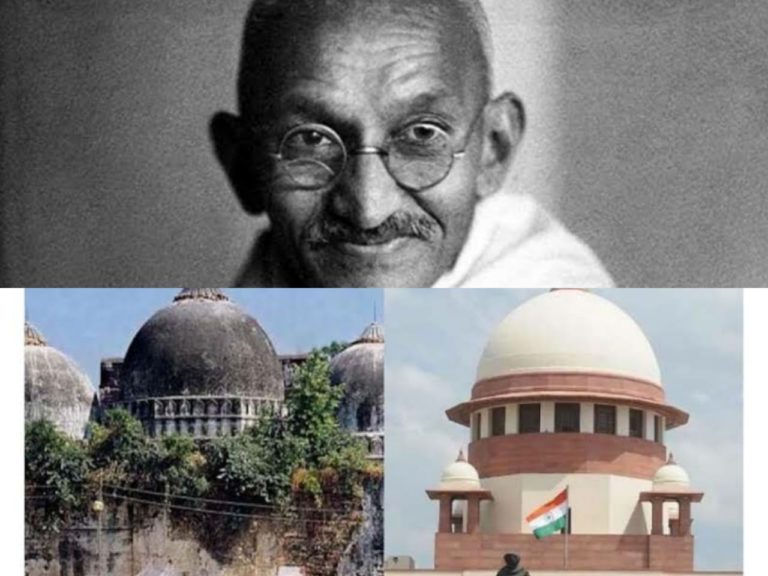
Supreme Court today gave the disputed land in Ayodhya to Hindu parties and a separate 5 acre land to Sunni Waqf board.
The little over 1000 page judgement has perplexed many and many have found the judgement full of contradictions.
Mahatma Gandhi grandson Tushar Gandhi tweeted on the matter on his twitter account.
This is how Mahatma Gandhi’s great-grandson Tushar Gandhi reacted to the Supreme Court verdict on the Ayodhya title suit which cleared the way for the construction of a Ram Temple at the disputed site at Ayodhya. He also questioned the judgement which looked like its pleasing everyone but not really serving justice.If the Gandhi Murder case was retried by the Supreme Court today, the verdict would have been Nathuram Godse is a Murderer but he is also a Desh Bhakt.
— Tushar (@TusharG) November 9, 2019
Please all is not Justice.
— Tushar (@TusharG) November 9, 2019
Please all is politics.
— Tushar (@TusharG) November 9, 2019
In a unanimous verdict, the SC on Saturday paved the way for the construction of a Ram Temple at the disputed site at Ayodhya, and directed the Centre to allot an alternative 5-acre plot to the Sunni Waqf Board for building a new mosque at a “prominent” place in the holy town in Uttar Pradesh.Today for some reason I am reminded of a James Bond movie title. ‘On His Majesty’s Secret Service’.
— Tushar (@TusharG) November 9, 2019
Polarised social media in the wake of SC verdict on Ayodhya
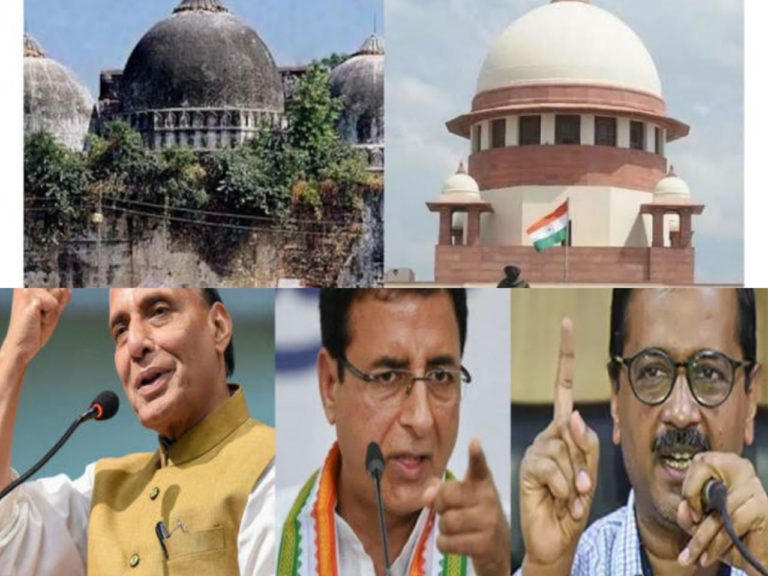
After the Supreme court verdict, the political class of India has been quick to share their response on the land dispute.
SC in today´s verdict has given the disputed land to Hindus (through a trust), and an alternative plot will be handed over to the Sunni Waqf Board.
Social media had a lot to say on the matter as #AYODHYAVERDICT trends at the number 1 trend on Twitter today.
Congress, BJP, AAP, Shiv Sena have praised the Ayodhya land dispute and called for peace and harmony.
The Honourable Supreme Court has given its verdict on the Ayodhya issue. This verdict shouldn’t be seen as a win or loss for anybody.
— Narendra Modi (@narendramodi) November 9, 2019
Be it Ram Bhakti or Rahim Bhakti, it is imperative that we strengthen the spirit of Rashtra Bhakti.
May peace and harmony prevail!
Aaditya Thackeray, a man of few words, had literally 3 words to say in his twitter account on the SC verdict.श्रीराम जन्मभूमि पर सर्वसम्मति से आये सर्वोच्च न्यायालय के फैसले का मैं स्वागत करता हूँ।
— Amit Shah (@AmitShah) November 9, 2019
मैं सभी समुदायों और धर्म के लोगों से अपील करता हूँ कि हम इस निर्णय को सहजता से स्वीकारते हुए शांति और सौहार्द से परिपूर्ण ‘एक भारत-श्रेष्ठ भारत’ के अपने संकल्प के प्रति कटिबद्ध रहें।
जय श्री राम!
— Aaditya Thackeray (@AUThackeray) November 9, 2019
The Congress on Saturday said it respects the Supreme Court verdict in the Ayodhya case and is in favour of Ram temple construction. In a resolution passed by the Congress Working Committee chaired by party chief Sonia Gandhi, the Congress also appealed to all parties concerned and all communities to “abide by the secular values and spirit of fraternity enshrined in the Constitution and to maintain peace and harmony”.The Judgment of Hon'ble Supreme Court on Ayodhya is historic. The Judgement will further strengthen India’s social fabric.
— Rajnath Singh (@rajnathsingh) November 9, 2019
I urge everyone to take the verdict with equanimity and magnanimity. I also appeal to the people to maintain peace & harmony after this landmark verdict. pic.twitter.com/DWnVRPuXMG
We should respect the judgement of Supreme Court on RamJanmaBhumi – BabriMasjid land issue. Let us have belief in the Constitution framed in the democratic setup. Let Peace & Harmony prevail.#AyodhyaCase#AYODHYAVERDICT
— Siddaramaiah (@siddaramaiah) November 9, 2019
Many concerend citizens have also highlighted that SC said that demolition of the babri masjid was illegal and asked why none of the culprits were punished.सभी पक्षों की दलीलें सुनने के बाद SC की बेंच के पाँचों जजों ने एकमत से आज अपना निर्णय दिया। हम SC के फ़ैसले का स्वागत करते हैं। कई दशकों के विवाद पर आज SC ने निर्णय दिया। वर्षों पुराना विवाद आज ख़त्म हुआ। मेरी सभी लोगों से अपील है कि शांति एवं सौहार्द बनाए रखें
— Arvind Kejriwal (@ArvindKejriwal) November 9, 2019
Lord Ram gets disputed land. But what happens to the "criminal" act of the Babri Masjid demolition? SC said today it was a criminal act. But none has been punished yet. Replugging @Outlookindia story. #AYODHYAVERDICT #BabriMasjid https://t.co/xCdqmSKfkI
— Ruben Banerjee (@Rubenbanerjee) November 9, 2019
Placing of idols in 1949 was illegal. Demolition in 1992 was illegal. But two wrongs have made for land rights.
— naresh fernandes (@tajmahalfoxtrot) November 9, 2019
Asaduddin Owaisi, chief of the All India Majis-e-Ittehadul Muslimeen (AIMIM), reacted to the Supreme Court’s Ayodhya verdict with a single photo on Twitter. Owaisi posted the book cover of Supreme But Not Infallible: Essays in Honour of the Supreme Court of India.This SC has showed again and again how it is totally subservient to the government. In their new Ram Raj there is no truth, no justice, no shame
— N S (@nandinisundar) November 9, 2019
— Asaduddin Owaisi (@asadowaisi) November 9, 2019
Nearly an hour before his post, he retweeted the All India Muslim Personal Law Board’s tweet, which quoted its general secretary reaction to the judgement.
 “The Ayodhya verdict holds no value for us. We are dissatisfied with the verdict. It has a lot of contradictions. We will seek a review,” the Sunni Waqf board’s lawyer Zafaryab Jilani said after the judgement.
There were many who tried to show how India´s secular status is debatable, and its fast turning towards fascistic tendencies.
“The Ayodhya verdict holds no value for us. We are dissatisfied with the verdict. It has a lot of contradictions. We will seek a review,” the Sunni Waqf board’s lawyer Zafaryab Jilani said after the judgement.
There were many who tried to show how India´s secular status is debatable, and its fast turning towards fascistic tendencies.
Same day Two different countries two different stories .#BabriMasjid pic.twitter.com/WTQWscRPua
— Floki (@flokisays) November 9, 2019
Ayodhya Verdict: Ramjanmabhoomi Trust gets disputed land, Muslims to get alternate site
The Supreme Court today in its verdict on the 2.27 acre of disputed land in Ayodhya directed that Hindus will get the disputed land while the Muslim faith to get an alternate site for the construction of the mosque.
“Inappropriate for Supreme Court to enter into the area of theology, the true test is faith and belief of worshippers of the mosque,” says apex court bench, reading our the Ayodhya verdict.
Hindu faith which was represented by Ram Lala Virajman a minor was considered a juristic entity by the court. Ram Lalla was represented by a “friend of Ram Lalla”, a VHP representative.
While stating that faith is a matter of individual believers. The judgement says that hindus consider ayodhya as birth place of Ram.
SC decided in favor of the Hindu faith. SC has asked the responsibility of the land to be given to a trust under central government. The SC has also asked the central government to prepare a road map in the next 3 months.
In its decision, SC gives the inner and outer land(the 2.27 acre of disputed land) to the trust, and management of the land to be given to the trust. Till then the possession of land is with the government.
Sunni Waqf board claim dismissed
Supreme court dismisses Shia wakf board claim to the Ayodhya disputed land. Sunni waqf board to get 5 acres of land in a prominent location, not at the disputed site. Sunni board has claimed that from its construction till demolition Muslims used to offer board. In the outside courtyard, there was a tradition of Hindus offering prayers. Both religions used to pray peacefully. SC said that Muslims do not have a rightful claim over the outer courtyard and that Muslim side could not prove their exclusive right to ownership of this land. Muslim personal law board spokesperson has said that they are not satisfied with the judgement and they might file for a review petition. They are disappointed with the inner courtyard being given to the Hindu community.Nirmohi Akhara claims rejected but part of the Trust in management of the land
Nirmohi Akhara’s claim to be serving the deity is rejected by the supreme court. Akhara has no right on the land. The Supreme Court has unanimously barred the claim of Nirmohi Akhara, says it is not a “shebait.”. Nirmohi Akhara is barred by limitation. Shebait is the perpetual right to worship a deity. Nirmohi akhara had claimed their right to worship and ownership to the Sanctum Sancoturm (garbh greh). SC also stated that Demolition of mosque in 1992 and placing of idols in 1949 was a violation of law. The verdict for illegal demolition is still pending. The people who orchestrated the demolition were not punished and many of them are in power. The Ayodha verdict comes nine years after the Allahabad High Court ordered that the disputed land be equally divided between the three parties — Ram Lalla, Sunni Waqf Board, and the Nirmohi Akhara. As a precautionary measure, the border of Nepal to adjoining areas of UP are sealed. Temporary jails have also been created in UP. Some people are also arrested in Andhra Pradesh. RSS chief Mohan Bhagwat will address the media post-verdict. Read more:‘Kashi-Mathura Baaqi Hain’: Why the Ayodhya Verdict Won’t Offer Any Respite From Saffron HatredAyodhya land dispute: Supreme court to announce its verdict tomorrow at 10.30AM
The Supreme Court is scheduled to pronounce the verdict on the Ayodhya land dispute in the history of India tomorrow i.e Saturday, 9 November.
The apex court is likely to pronounce judgement at 10:30 am in the morning.
Section 144 has been imposed in Ayodhya since October 14 till 10 December in anticipation of the verdict in the case.
Ministry of Home Affairs (MHA) has deployed around 4,000 paramilitary personnel across Uttar Pradesh. Schools and colleges are to remain closed for the next 3 days in Uttar Pradesh.
A five-judge bench of the top court, including Gogoi, Justices SA Bobde, DY Chandrachud, Ashok Bhushan and Abdul Nazeer, heard the arguments in the case for 40 days and reserved its verdict on 16 October.
Chief Justice Ranjan Gogoi will retire on 17th November, the week after the judgement.
The Ayodhya dispute is a political, historical and socio-religious debate in India, centered on a plot of land in the city of Ayodhya, located in Faizabad district, Uttar Pradesh. The issues revolve around the control of a site traditionally regarded among Hindus to be the birthplace of the Hindu deity Rama the history and location of the Babri Masjid at the site, and whether a previous Hindu temple was demolished or modified to create the mosque.
Also Read:‘Kashi-Mathura Baaqi Hain’: Why the Ayodhya Verdict Won’t Offer Any Respite From Saffron Hatred
Karnataka: Couple killed in a case of Honour killing in Gadag
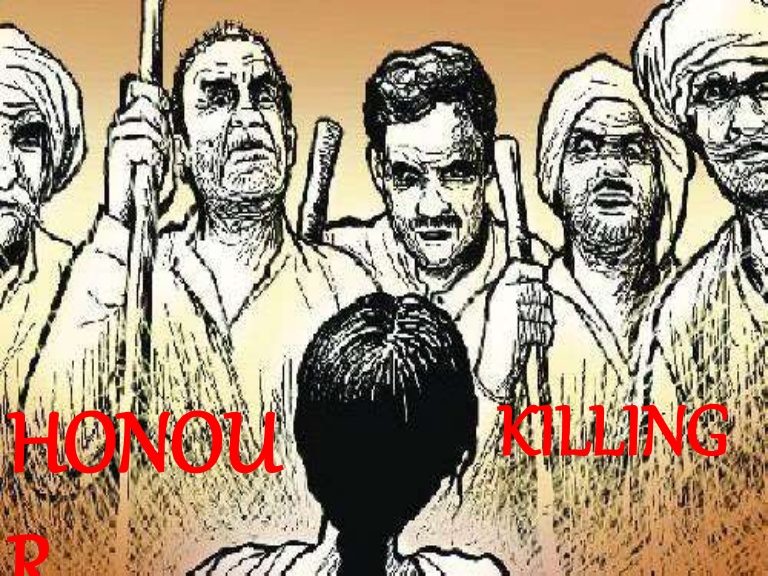
In Gadag, in a suspected case of honour killing, a young married couple was allegedly killed by the woman’s brothers in Lakkalakatti village of Gajendragad Taluk.
The deceased Ramesh Maadaar (29) and his wife Gangamma (23) got married four years ago. Gangamma’s parents had opposed the marriage and threatened their daughter not to come to the village.
On Wednesday, November 6 morning, Gangamma’s family members picked up a fight with Ramesh and then rushed to the couple’s house and attacked them with a sickle and axe. Ramesh died on the spot, while his wife succumbed in the taluk hospital.
Speaking on the issue Superintendent of Police (SP) Srinath Joshi said, “The accused have been identified as Shivappa, Ravi and Ramesh Rathore. Belonging to the Lambani community, Gangamma had married a Dalit man three years ago. They also had two children together. ”The local Police have registered a case in this regard and investigation is underway.
Data from the National Crime Records Bureau (NCRB) for 2017 released last month shows the State topping in the rate of atrocities against members of Scheduled Caste and Scheduled Tribe communities.
Though Uttar Pradesh reported the most cases that year in absolute numbers — with 2,309 cases and 2,358 victims — the rate of cases was 5.6 per one lakh population of SC and ST members. Even though Karnataka reported fewer cases — with 1,298 cases and 1,520 victims — the rate was 12.8.
This year NCRB did not give data on lynchings and Honour killing in the country.
In 2016, Karnataka had recorded the highest number of SC/ST atrocity cases even in absolute numbers. Bangalore city is the second number in the SC/ST atrocities cases.
Many Dalit activists attribute to better awareness among Dalits and social activism in the community that is helping victims fight.
Despite such high rates of SC/ST atrocity cases registered, the conviction rate remains abysmally low. Karnataka in the 2017 NCRB report was also the state with the lowest conviction rate for SC/ST atrocities followed by Andhra Pradesh.
Disqualified MLA declared Yeddyurappa offered him 1000 crore, begins campaigning

Last week, a video with the voice of Karnataka CM BS Yeddyurappa came out, where he accepted Operation Lotus that brought down the congress-JDS coalition government. He also alleged that Union home minister Amit Shah was directly involved in keeping the defected MLA s in Mumbai. Since then another defected MLA Narayan Gowda from Krishanraja Pete has come out and accepted it.
Narayan Gowda was in JDS before he resigned and joined BJP in the storm that brought down the Karnataka government in August.
While speaking to his supporters in Mandya on Tuesday, he accepted that Yeddyurappa had promised him 1,000 crores for the development of Krishnarajpete constituency. He said he was summoned to Yeddyurappas’s home, where he expressed his support to make him chief minister again.
He said his support was only in exchange for the money for the development of his constituency. “Don’t you think I should support such a great person. So I did it.”
The case of the 17 disqualified MLAs is still pending in the supreme court. The court verdict will decide whether they will be allowed to contest the elections. But that hasn’t stopped KC Narayan Gowda from campaigning in his constituency.
He was seen strategizing and making campaigns with his supporters. His campaign started with criticizing JDS and praising BS Yeddyurappa.