The citizenship Amendment bill 2019 was passed by the Lok Sabha yesterday with 300 yes and 80 No amid massive protests across the country. On Wednesday, the bill will be tabled in Rajya Sabha.
What does the Citizenship Amendment Bill (CAB) say?
The bill seeks to protect non-Muslim refugees from Bangladesh, Pakistan, and Afghanistan. It reduces the duration of time people from these communities need to get citizenship. It amends the clause in the Citizenship Act 1955 from stating that “persons belonging to minority communities, namely, Hindus, Sikhs, Buddhists, Jains, Parsis and Christians from Afghanistan, Bangladesh and Pakistan, who have been exempted by the Central Government… shall not be treated as illegal migrants for the purposes of that Act.”
The bill grants rights to a new class of migrants from these three countries, and relaxes the requirement of residence in India.
Extending the rights of migrants from other countries is welcome, but the bill exclusively denies that rights to Muslims, which is the problematic part of the Bill. The bill violates the constitution for discriminating on the basis of religion. This policy is aimed at sending a clear message to Muslims from Bangladesh. The Bill would give the state more power in harassing Bengali Muslims across the country.
The many criticisms of the bill are that the bill works on the colonial logic of seeing conflict in the region through a religious lens. many opposition parties have also compared Amit Shah with Mohammad Ali Zinnah (founders of Muslim league) and Savarkar (proposed two-nation theory). Both wanted pre-independent India to be divided based on religion.
Why the push for the Citizenship amendment now?
After trying to push the NRC in Assam, the BJP found many Hindus were also excluded, and their plan to focus on Muslims alone backfired. NRC was an important tool for the BJP to attack the Muslim population as it assumed people were guilty until proven innocent. Rampant abuse of NRC would lead to detention and deportation of Hindus as well as Muslims, undermining their plan. The citizenship amendment bill would give them the ability to focus their harassment to Muslims alone.
Article 15 of the Constitution prohibits discrimination on the basis of religion or by place of birth by the State. The Citizenship Amendment Act is in violation of the law in principle as it has conditions both on religion and place of birth. Unlike other laws regulating travel to and from Pakistan, the Amendment specifically mentions the religion of the people involved.
The extension of NRC would lead to a disaster as any Muslim who can be accused of being Pakistani, Afghanistani or Bangladeshi would be vulnerable to a test of citizenship. If they are poor or if they come from a transient community, they are very likely to fail the test. By dividing the non-Muslim population out, the BJP would get free rein, as they could easily create a smokescreen of fear and deception to justify a crackdown. As in the case of 1992, even if they are not in power, right-wing Hindu forces can use the law to create false cases anywhere in the country.
Many communities across the North East have protested how this bill, not only refuses to acknowledge their historical concerns about the demographic shift on ethnic or linguistic lines but promotes a Delhi-centred ideology regarding what the demographics of the population should be. Each state has had a complicated history regarding their autonomy, and the bill has been seen as Dehli ignoring their historical demands of self-determination as the center is deciding who has the right to be in their state.
With the implementation of NRC in Assam, the BJP has adopted in its strategy to attack the Muslim community as each region has a different communal equation. In Assam, tension is more on linguistic lines, and local groups complained that the state was selectively appropriating their rage by not inquiring into Bangladeshi Hindus in the region. Certain areas have raised the citizenship issue against certain communities.
The Citizenship Amendment Act will give BJP all the ammunition it needs to attack the Muslim population in and outside India. Time and again, BJP politicians have attacked Muslims for terrorism, trying to overtake the Hindu population. One can only imagine how it their propaganda machine will be once it is made a law. Remember during the Rohingya crisis, where Muslims were the persecuted minorities when the rhetoric of “bringing terrorism from Pakistan and Afghanistan.
All signs point to further abuse of citizenship law to further an agenda of hate. The Bill in its present form is supported by the NDA parties including JD(U) and Lok Janshakti party, which were uncertain earlier. Amit Shah has met with local leaders from the North East to get support for the bill, in spite of protests against it. Even though it broke with the NDA, the Shiv Sena supports the bill. The bill has been opposed by INC, SP, NCP, RJD, JD(S), TMC, CPM, CPI, BSP, and AAP.
The remarks and actions of various members of the state in response to the violent assault on Dr. Priyanka Reddy should be seen as a way to direct the righteous public anger to create a draconian state.
The anger of Dr. Reddy’s rape and murder is justified, as it is a signal of an unending battle the women of India have had to face. Enough is enough.
We should be wary of how the state co-opts our anger, as the outcome might be even more dangerous, especially at a time, where the state uses public anger to extend its power over the people.
Elites and states use public anger to push their own agenda. If we look at the history of sexual assault and law, there is a disturbing history of using sexual assault laws to create authoritarian, anti-minority systems that crush dissent and resistance.
How has law treated cases of sexual assault historically?
Throughout history, laws come from a mixture of religious and secular sources derived from faith and reason, but until recently laws have not given much emphasis on prohibiting rape or sexual assault. In fact, much more is prescribed about policing women’s sexuality, protecting the integrity of families, punishing “forbidden” sexual acts, and punishing sexual infidelity.
In ancient times, households were considered units of society, and laws revolved around households, not individuals. All of the major law-givers said that houses were unique and no prescription should be made, except that men should rule over women, elders over youngsters, and there should be a dominance of certain households over other households based on the local conditions of whether caste, slavery, or feudalism was practiced.
Even in modern times, rape has only recently been seen as a crime, in spite of the progress made in many spheres. As women were treated as property, rape was treated more like theft of property. Until the 1970s, rape laws primarily promoted the same principles of privileging people based on sex, age, and community.
In India, it took a long time to change the laws to accept male victims of sexual assault. Only ten years ago, did we get proper legislation protecting child victims of sexual assault, and rape by husband is still not a criminal offense, though it has been included under the Domestic Violence law.
How anger against sexual assault was used to promote lynching in America
In the United States, with the formal end of slavery, the freedom of the African American population was seen as a threat to the White population. A common trope to scare people was the “Mullatto,” who was black but looked partially white. These tropes were used to spread fear of a rapist, who steels white women and brainwashes them.
This fear led to widespread lynching in the United States. Even though most lynchings were based on property and wage disputes, a substantial number of lynch victims were women, and often lynchings destroyed entire towns, the stereotype of lynching being a legitimate way to protect White women was common.
Here, we can see that the dominant community, in conjunction with the state, used fear of sexual assault to suppress another community. Black activists had to work for nearly a century (from the 1880s to the 1980s) to see an end of lynching against the black community. The first 30 years required a lot of documentation and study of lynching cases. The next 20 years required a movement to create an anti-lynching bill, which never got passed. The next 30 years required movements to pass anti-segregation laws, which were the major systemic causes of lynching, and then lynching began to decline.
Deviancy theory
Deviancy theory is a model for understanding crime and criminal behavior. The theory states that in certain instances, an act is seen as an aberration in society. This aberration causes a disturbance in people’s minds, and many parts of society come together to remove the aberration. Sometimes this happens spontaneously and sometimes there are systems that act to do so. When caught in the frenzy of this disturbance, people might exercise violent urges, as they have social sanction to do so. They may call for murder. They may riot. They may attack people, including people related to the event. They might victim blame because they are not guided entirely by morals, but by passion.
In such a context, elites might take advantage and try to change society to their desires. They might increase surveillance, promote arbitrary arrests, normalize custodial rape/torture/murder, etc.
How the Right is trying to use anger against minorities
In India, the Hindu right has been making concerted efforts to normalize violence against the Muslim community. Until now, they have used instances of terrorism, fear of demographic shift, and stories of conversion as examples of aberrations to target the Muslim communities. Recently, they have been trying to encourage citizens to attack Muslims.
First, sexual assault was used routinely as a tool of domination during the Godhra riots. Then, the normalized vigilante violence to police morality by attacking inter-religious couples. Then, they applied it to people who eat beef, which was code for religious minorities. Then, they started spreading it to child kidnappers. Now, they will use public anger against sexual assault to attack religious minorities.
As with the case of beef lynching, the moral issue creates a smokescreen. In America, even though lynching was usually not related to sexual assault, the myth of the black rapist was a cover to justify violence and racism. Many African American activists had to work hard, covering thousands of cases to fight that myth. Even today the myth is common, though lynching has stopped.
What we need to focus on
If the state were serious in ending sexual assault, they only need to follow their own advice.
The Justice Verma Committee report contains a plethora of unused recommendations.
The report focused on the legal dimensions of sexual assault and showed that by our own legal system, we are not doing nearly enough, but it also concluded that corporeal punishments like the death penalty and chemical castration would not reduce cases of sexual assault.
The report also recommended more surveillance for police to ensure proper registering of cases.
Society discourages survivors or representatives of victims of sexual assault continue to bring cases to light, so unless major changes happen, the law only touches the tip of the iceberg. To combat sexual assault, we have to face the grim reality that it is not an aberration, but all too normal.
Reforms that have come are also not given proper attention. The Nirbhaya fund remains underutilized. There exist resources, plans, and infrastructure for the state to effectively reduce instances of sexual assault, but these things are rarely used.
Beyond that, there are many other structural features that need to be addressed, such as the representation of women, and marginalized people in the judiciary and police. As the case of sexual harassment against the Chief Justice showed, the problem is top-down.
Systemic features of sexual assault often do not find attention from those who see sexual assault as an aberration.
Caution against manipulation
Sexual violence is entrenched in the Indian system from top to bottom. Instead of acting on fixing the system, the state is using instances of sexual assault to further their own agenda. After years of using the death penalty and encounter killings to execute political prisoners, the state uses stories of sexual assault to legitimate state murder, both of the formal and informal variety. The Karnataka government tried to use sexual assault as an excuse to extend a registry for migrant workers. If we do not focus our anger to address the real problems, the state will direct our anger towards us.
From October 2019, mass protests have erupted in Iraq. The protests have been against the constant foreign interference by both the United States and Iran, the unbearable corruption in the public sector and a failing economy. The state clamped down on the protests by shutting down the internet in most of the country. In some cases violence broke out. Hundreds have been killed in the protests. By the end of November, the Prime Minister, Adil Abdul Mahdi resigned.
These protests are part of a decade long struggle by the people of Iraq to fight the colonization they have experienced for over a century. Since the American invasion of Iraq, people feel the already authoritarian system has become corrupt and stagnant. Iraq also stands between the actions of the USA and Iran.
Since 2014, Shia cleric Muqtada Al-Sadr began to rise as a leader. He is a very popular and charismatic figure in Iraqi. The Sadr family is one of the most influential Shia families in Iraq and has produced many Islamic leaders and scholars. In the 1990s, the family worked against Saddam Hussein’s government, and adopted a strong pro-poor populist. Since the establishment of the current regime, Muqtada Al-Sadr managed to represent the movement, being seen as someone who could both speak to the streets and to the elites.
The global south generally has not had the agency to determine borders, but Iraq maybe one of the most tragic examples of this. They were part of the Ottoman Empire. The Ottoman Empire fell because of cooperation between a budding Arab nationalist movement and the British and French forces in World War I. The Arabs were betrayed when the British and French divided up their winnings after the war, and laid down the countries of Syria and Iraq after. The British joined the provinces of Baghdad, Basra and Mosul to make Iraq. Immediately, struggle began against British rule. The British placed a puppet government when they left, which was latter disposed.
Iraq’s high oil reserves and strategic location placed it in the crossfire of the Cold War. In the 1960s, the Ba’ath party, the product of a secular pan-Arab movement rose to power, and through the party, Saddam Hussein came to power.
Saddam Hussein’s rule of Iraq was plagued by internal and international conflict. War with Iran in the 1980s, war US in the 1990s, uprisings by the Kurdish people, and instability caused by a feeling that the Shia majority could rise in the way they did in Iran, all contributed to a violent, yet delicate balance of power in Iraq, which was being held together in Hussein’s state.
With the invasion of Iraq and the overthrow of Saddam Hussein in 2003, the shaky balance was lost. The Iraqi state was rewritten. The constitution of Iraq was redrawn, and now serves American interests under the language of freedom and democracy. The new Iraqi centre was unable to become a credible power again. The new constitution gave a strong federal structure, which was used by the American forces and companies to work with local governments to settle troops and buy oil, and it left both the Iraqi people and the economy under the control of America. The American War on terror left a huge wave of death and terror in its wake.
In this period, the public sector was also hit hard. Education, electricity sectors, and health were beginning to fail. Decades of conflict and American economic aggression meant Iraq already had difficulty providing for its people. Invasion further destroyed infrastructure. After the global financial crisis in 2008, things only got worse. Corruption was said to have increased. Many Iraqi teachers started giving tuition outside of their class. Local administration became more notably corrupt. For many local Iraqi people, this persistent corruption and the growing inability to access basic infrastructure became a source of discontent.
The government also allocated power along communal lines. Though the constitution prohibited explicit discrimination, the power was distributed in such a way that the Prime Minister would be Shia, the President would be Kurdish, and the Speaker of parliament would be a Sunni Arab. Shia Arabs represent over two-thirds of the country. Sunni Kurds represent about a sixth of the country, and Sunni Arabs. From 2008, the Shia political elites also began to faction.
Iran has been trying to exercise control in the region through the organizing of Al-Hashd Ash-Sha’bi (Popular Mobilization Forces, PMF), which, like Hezbollah in Lebanon, are coordinated groups that work with the Iran government. PMF forces put Iraq in conflict with Israel through the Iran-Israel conflict. ISIS continues to enjoy support, both foreign and domestic in Iraq.
From 2011, mass protests occurred almost every year or two. The original 2011 protests were said to have been inspired by the Tunisian Arab Spring, but the state cracked down on them, as part of the war on terror and the growing threat of ISIS, but the Iraqi people have been regularly coming to the streets for change. The demands of the protesters are met partially at times, though many Iraqis feel these changes do not address the systemic problems that country is facing regarding the public sector and the state’s ability to manage violence in the region.
Last year, protests began, this time inspired by the Yellow vests movement in France. Social media has played an important role in organising.
Protests will continue until the structural problems in the Iraqi public sector are addressed. Iraqi people need secure and affordable education, healthcare, electricity and water.
Protesters know that the problems started in 2003, and the solution would be in a change to the constitution of Iraq. Foreign powers in the United States and Iran have an interest in keeping things the way they are.
Without a fundamental change in the system of governing Iraq, which gives them the ability to determine their own fates, the structural problems will remain. Iraq is held with the chains of its colonial past, which has caused the gridlock it experiences today.
The opinion expressed are those of the author and do not necessarily reflect the official position of Gauri Lankesh News.
Addressing a press conference today at his residence, former chief Minister Siddaramaiah today resigned from his position as the leader of congress legislature party taking the moral responsibility for the party’s defeat in bypolls in Karnataka.
Dinesh Gundu Rao also resigned from his position as Karnataka Congress president.
The Congress’s defeat was a major blow to Siddaramaiah.
Speaking to the press, Siddaramaiah said, “I believe in democracy. In these 15 segments, the voters have delivered their verdict and I respect and accept it. My expectation was that the voters would reject those who defected and betrayed their own parties. I had expected that the voters will teach them a lesson. But my expectation has fallen flat today. I accept the people’s verdict. As the leader of the Congress Legislature Party, there are a few things I have to uphold and hence, I resign from my post as leader of the Congress Legislature Party.”
Siddaramaiah said that he will be sending his resignation letter to Congress President Sonia Gandhi, Karnataka in-charge KC Venugopal and Karnataka Pradesh Congress Committee President Dinesh Gundu Rao.
Within an hour of Siddaramaiah resignation, Dinesh Gundu Rao also announced his resignation and addressed the media-
“Rahul Gandhi had chosen me as KPCC president, I have given it my 100%, to guide the party to the best possible position. But after the results today, as a moral responsibility, I have tendered my resignation to Sonia Gandhi. I am still ready to serve the party in any capacity, as decided by AICC and state leadership. I am always with the Congress.”
The results were announced on Monday and the BJP won 12 seats while the Congress won two seats. The JD(S) did not win a single seat in the bye-polls.
17 congress and JD(S) MLAs resigned and brought down the coalition government in August this year. After which BJP came into power. The vacant constituencies went for elections on December 5.
Congress was hoping the issue of disqualified MLAs would work in its favour and unseat BJP from power.
Congress tried to derive sympathy from DK Shivkumar arrest but after the results, it looks like the people were not impressed.
DK Shivakumar said that “people have accepted defector”.
Now with these bye elections, BJP has solidified its entry in South India and Congress only remaining stronghold is gone.
Home Minister Amit Shah on Monday tabled the controversial Citizenship (Amendment) Bill (CAB), 2019, in Lok Sabha that seeks to grant Indian citizenship to non-Muslim refugees from Pakistan, Bangladesh and Afghanistan escaping religious persecution there.
Lok Sabha today debated and voted on the contentious Citizenship Amendment Bill, which seeks to profoundly alter how Indian citizenship will be determined by offering Indian nationality on grounds of ‘religious persecution’ to Hindus and other minorities from Pakistan, Bangladesh and Afghanistan.
The Bill seeks to amend the six-decade-old Citizenship Act but has caused ruckus in the parliament with strong protests and sloganeering from Opposition leaders.
The bill has sharply divided political and intellectual opinion, with Congress, TMC, Left, other ‘secular’ parties like DMK, SP, BSP and RJD as well as liberal commentators opposing religion being a criterion for pointedly excluding Muslims.
On the other hand, BJP and right-wing opinion has drawn a distinction between a continuing process of non-Muslim population transfer since Partition and an illegal influx that threatens demographic and social balance.
Raising concerns over the move, Congress leader Adhir Ranjan Chowdhury flagged the concerns of the bill and said, “It is nothing but targeted legislation for the minority people of our country.”
Refuting the claims, Shah said “the Bill is not even .001% against minorities in the country”.
So far the bill has got 293 yes and 82 Nos.
TMC MP Saugata Roy opposed the bill saying- “While abrogating Article 370, you said one law, one nation. Now you say, the Citizenship Bill will not include areas like Meghalaya, Tripura, Assam and Mizoram. The Bill is divisive. It is against everything and violates Article 14 of the Constitution.”
N. K. Premachandran, Revolutionary Socialist Party MP challenged the bill saying- “This is the first time in the history of India, that in order to acquire citizenship, the main factor is religion. This House has no legislature competence,”
Asaduddin Owaisi in his opposition appealed to the Speaker- “Save country from such a law&save Home Minister also otherwise like in Nuremberg race laws and Israel’s citizenship act, Home Minister’s name will be featured with Hitler and David Ben-Gurion.
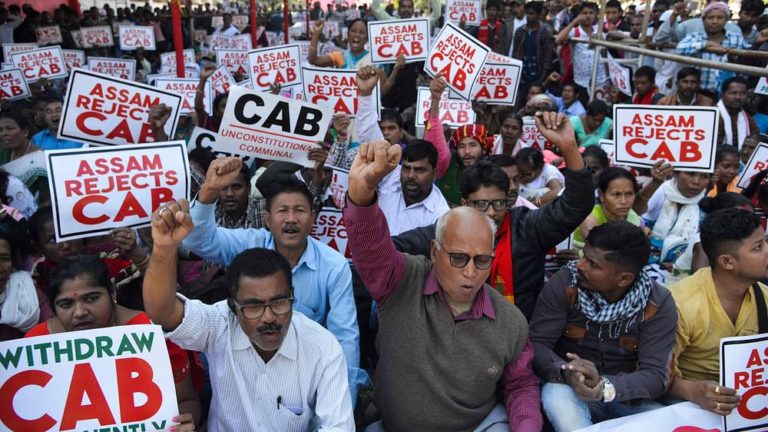
Meanwhile, lakhs of people are protesting in many parts of the country opposing the citizenship Amendment Bill in Delhi, bangalore, West bengal and Assam.
DELHIASSAMMysore Bank circle, Bangalore
In Asssam, massive protests erupted on December 6th opposing CAB. Protests on the streets, within various Government premises by various organizations, political parties, rights and social organizations. The clearance of CAB by the Union Cabinet has generated a huge discontent among people of Assamese nationality.
Protests erupted in New Delhi outside the Parliament, near jantar mantar and near mahatma Gandhi statue by various organsiation when CAB was introduced in the Parliament
A group of Indian scientists and scholars from within and without the country have released a note of protestagainst the draft Citizenship Amendment Bill.
They state that the bill violates the spirit of Article 14 of the Indian Constitution. Over 750 scholars from around the world have signed the note, including the directors of three major research institutions: Sandip Trivedi (Tata Institute of Fundamental Research, Mumbai), Rajesh Gopakumar (International Centre for Theoretical Sciences, Bengaluru) and Atish Dabholkar (International Centre for Theoretical Physics, Italy).
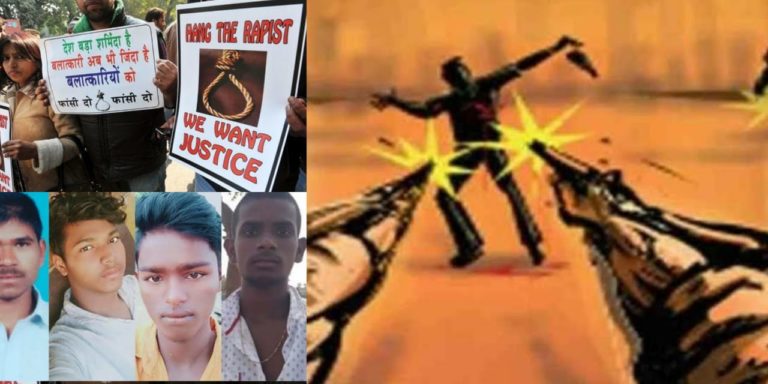
Cyberabad police in Hyderabad Friday early morning killed four accused in the gang rape and murder of the 26-year-old veterinarian in what they call as ‘encounter’. Police said they were attacked by the accused with sticks and stones, their weapons were snatched.
The events took place between early morning 3 PM to 6.30. The police claimed they had gone to the crime scene to recreate the crime scene and to collect the material objects like cell phone fo the victim.
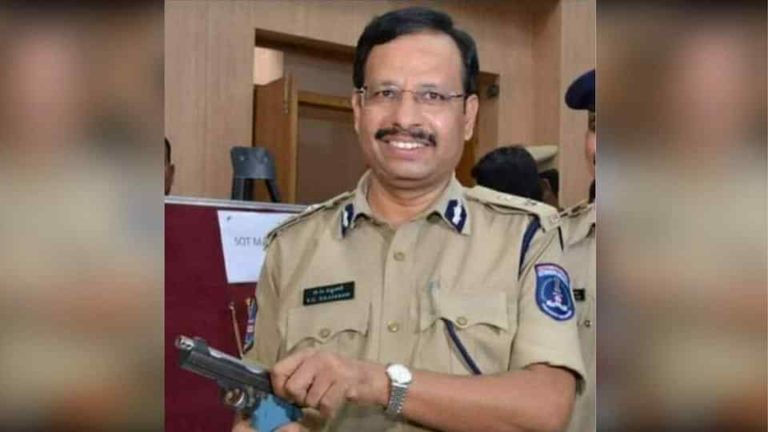
The police comissioner CV Sajjanar, gave the press briefing in the afternoon. “they confused the police, attacked them with sticks, snatched weapons from the cops and started firing. “The police had to fire in retaliation killing the four persons.” he also said that the law has done its duty.
Andhra Pradesh of which Telangana was a part of is no new to encounter killings.
Several elements of this morning’s killings are similar to a case in 2008, where three men accused of an acid attack were also suddenly killed in a ‘police encounter’ in Warangal, Telangana.
Is it a coincidence that both investigations are headed by the same police officer?
V S Sajjanar was born in the Hubbali district of Karnataka and is a 1996 batch IPS officer.
V S Sajjanar who is the police commissioner of Cyberabad police, where the encounter of the four rape-accused happened was the Police Superintendent in Warangal at the time of 2008 encounter in the acid attack case.
The Warangal encounter shot Sajjanar into the spotlight and earned the moniker ‘encounter specialist’.
When one looks at the events of Friday morning, one finds them strangely similar to the Warangal incident that happened 11 years ago.
In both cases, the police claimed that the accused men tried to escape and thus were shot. In fact, police all over India use the same script for encounter.
In December 2008, the AP police gunned down three men accused of throwing acid on two women engineering students. In this case, the police were informed that the girls were being harassed by these men, the police did not take any action. Bu after the acid attack, arrests were made 48 hours within the attack on the girl and the encounter happened within three days.
Similar to Friday’s reported encounter, the then SP said that a police team had gone with the accused to the scene of the crime to collect evidence. However, the men reportedly tried to attack the cops with crude bombs. Sajjanar had said that the cops opened fire in self-defence, killing all three accused.
The police told the media that the accused men, taken to the spot for a reconstruction of the crime scene, attempted to attack the cops by taking their guns.
Though the families of the accused and rights activists had questioned the encounter, Sajjanar became a local hero.
The AP Chief Minister of the erstwhile united state at the time was Congress’ (late) YS Rajashekar Reddy.
Sounds familiar??
It doesn’t end there. After the Warangal encounter, VS Sajjanar also oversaw the encounter of alleged Maoists P. Sudhakar Reddy and his associate in May 2009.
Does call for stricter punishment or Encounters reduce?end crimes against Women?
In 2008, Andhra Pradesh had one of the country’s highest rates of crimes against women. The Warangal incident happened in 2008.
In 2015, Andhra Pradesh emerged as the state with the highest number of acid attacks in South India.
That means the encounters of the cry for stricter punishment was not a deterrent in the cases of violence against women.
Post Nirbhaya, many stricter laws were made and the death penalty was mandated in the case of rape with minors. But from 2012 to 2019, we have only seen an increase in violence against women and children with even more brutality. The calls for the death penalty have only lead to the accused killing the rape victims to destroy evidence.
In most cases of rape survivors, police don’t even register the case, but when public outcry increases after the news of rape and brutality, to cover its negligence, police resort to encounter or custodial killing.
National Human Rights Commission has taken cognizance of the matter and has ordered an inquiry into the encounters.
“Enough is enough”Rape of women and children must be prevented. And no ‘encounters’ in our name.Protest venue: December 9th, Monday, from 4.30p, onwards at Town hall, Bangalore.
More than 20 women organisations have come together to protest against increasing sexual violence against women, children and sexual minorities on December 9th at 4.30 PM at Town hall Bengaluru.
In their joint statement, they have said-
We, everyone, who cares about women’s rights and human rights strongly condemn the atrocities and rapes happening on women and we also condemn the experiments of ‘death sentence’ as revenge for these atrocities.
A death sentence is NOT the answer to rape.
An ugly and perverse face of our society has been exposed to the world in just last one week. The horrific rape and murder of veterinary doctor Disha(name changed as per court order) has proved that the world’s largest democracy is not as democratic as it looks like.
In just one week, rape and murder in Chattisgarh, Maharashtra, and Chamrajnagar and Kalburgi in Karnataka have been reported. The many instances of gang rape and attempt to murder in Uttar Pradesh beats all these incidents. In Unnao, UP, gang rape survivor was set on fire by her “rapists” while she was going to court proceedings. The woman with 90% burns is fighting for her life in the hospital. These incidents show that women’s lives are in danger in this country.
Today, Hyderabad police carried out the “encounter” of the suspects in the rape and murder of Disha. Police say – ‘they had to be fired at as they were trying to escape’. Everyone is celebrating these encounters, the case hasn’t been investigated completely and the accused haven’t gotten a fair trial, but the encounters are hailed as justice to the victim. This sets a very dangerous precedent where calls for
We see a variety of reactions to these horrific incidents, there is sadness, helplessness and a genuine questioning our society. Along with these, we also hear voices like ‘enough of candle burning’, burn the rapists’, kill the rapists. To be noted it is not just the common emotional people but politicians occupying responsible positions too gave such irresponsible statements. In all this noise, the debate about what to do to stop these horrific incidents and the real work that needs to be done is taking a backseat.
Society needs to change so that rapes do not happen!
Rapes do not happen just because of sexual desire. Those who have seen violence and those who’ve experienced violence since their childhood tend to develop these violent tendencies. This has been seen in 70% of violence against women. These incidents of violence against women will continue till we have a culture of insulting, inflict violence, suppress and even kill women. To change this, we need to teach the children about gender equality and put an end to the day to day violence practiced by elders against women.
Governments should incorporate the school curriculum in order to curb discrimination and promote a mindset that sees men and women as equals.
A patriarchal society teaches men to subjugate women, use force on them, rape them to prove their masculinity. We need to establish that this concept of hollow ‘masculinity’ is wrong and men women can lead a healthy life only by having mutual respect.
Criminal action be taken against politicians and officers, who in times of such horrific incidents, instead of carrying out their responsibilities they issue statements which are irrelevant, absurd, which are targeted against a particular community.
Government should take strict action against those who spread false narrative like ‘rapes happen because of the revealing dress worn by women, because women attract such things, because these women are amoral etc’ these arguments which put the blame of rape on the victims make the rapists feel proud of themselves when they should be repenting their crimes. This narrative which indirectly supports violence against women should be stopped.
Websites, advertisements, and cinemas that show misleading content about women should be restricted.
Every stage of the investigation, evidence collection, and inquiry in cases of rape and sexual violence should be done with utmost seriousness and with sensitivity and empathy towards the victim, only then the culprits won’t get released and make murder attempts on the victim. Only the process of delivering justice can scare those who have the mindset to rape and violate women and killing some people will never scare the future rapists.
Hence, all those who care for the rights of women and citizen, those who want to protect the health of society are getting together on December 9th , a day before world human rights day at Town hall, Bengaluru from 4.30pm to 7pm for a protest meeting. We are saying ‘women too have human rights, it’s our responsibility to protect them’.‘single window’ centres, which offer all kinds of support to the victims should be started in each district.
These are the actions that need to be taken to prevent rapes. If we do not take steps with these long term goals, we will be wasting our time to find an answer for this social menace.
We appeal to representatives of media to support or demand and help us spread this news widely.
Following organisations and people are signatories to this Press release.
1. JIH Malyali women’s wing
2. Karnataka garments allied worker union, Ramanagara
3. Kotresh kottur
4. Institute for alternative research and development (IARRD)
5.Dr. Sylvia karpagam
6. Karuna jeevakalyana trust.
7. Grama Seva sangatane
8. Human rights empowerment council of India
9. Shiva mallikarjun
10. Pushpa
11. AIPWA
12. Stree jagruthi samiti
13. Mahila Munnade
14. Gamana
15. Sadhana Mahila sangha
16. Garments mahila Karmikara munnade
17. Slum janandolana
18. Human rights law network (HRLN)
19. Peoples movement against sexual assault (PMASA)
20. Karnataka Sex Worker Union
21. Garment and Textiles workers Union (GATWU)
22. Sadananda modi Bijapur
23. Savita Bijapur
24. Gita Chadda
25. SOGDS
26. Bharati Devi
AIPWA: All India Progressive Women Organisation statement on Hyderabad fake encounter
The four suspects in the Hyderabad rape and murder case have been killed by the police in an early morning “encounter”. This “encounter” has all the hallmarks of a custodial murder, dressed up to look like an “encounter”. Since the suspects were in police custody, and thus unarmed, it is clear that the police is lying when it claims they were killed when “attacking the police” at the crime scene where they had been taken to “recreate” the events of the night the rape-murder occurred.
Remember the case of teenage Meena Khalkho in Chhattisgarh, gang raped and killed by Chhattisgarh police who then dressed up the killing as an encounter, branding Meena a Maoist.
We, as a country, will now be told that “justice” has been done, the victim avenged. And now we can all go back to business as usual, reassured that our police, our government, our society are righteous, and the evil rapists are no more.
But this justice is counterfeit. A system that offers murder as “justice” is a system that is telling women – we can’t ensure the streets are safe, can’t investigate crimes against women to ensure there’s enough evidence to prove guilt, can’t protect rape survivors (one was burnt alive yesterday in UP), can’t ensure that survivors get dignity in Court. All they can do is act like a lynch mob and ask us, the people, to accept lynching as the only possible justice.
We must also remember that these four men were suspects. We do not know if there was a shred of evidence proving their guilt, beyond the custodial confessions which police in India routinely obtain through torture. Torture does not reveal the truth. Tortured men will say anything the torturers want to hear. So we do not even know whether the four men killed are really the ones who raped and killed the doctor in Hyderabad.
The same Hyderabad police which mocked the desperate attempts of the victim’s parents to find their daughter, which is issuing “Dos and Donts for women”, i.e telling women to stay home after 8 pm because the police can’t/won’t do their job of keeping streets safe, is now telling us to believe they caught and “punished” the rapists, and acted as Judge, jury, and executioner. This is a cruel joke.
Women’s movement groups will be the first to say – this is not justice. This is a ploy to shut down our demand for accountability from the police, judiciary, governments, and justice and dignity for women. Instead of being accountable to his job and answering our questions about his Government’s failures to safeguard women’s rights, the Telangana CM and his police have acted as leaders of a lynch mob.
For those arguing this kind of custodial killing is a “deterrent”, think again. The Hyderabad and Telangana police are notorious for this kind of custodial murder. In 2008, the Hyderabad police committed the custodial murder of three men accused in an acid attack case. That murder didn’t deter crimes against women in Hyderabad, Telangana, or India. Acid attacks, rapes, murders of women continue to happen with impunity.
We demand a thorough investigation into the alleged “encounter”. The police personnel responsible must be arrested and prosecuted and must be asked to prove in court that all four men were killed in self-defense. Why is this important, not only for human rights but for women’s rights?
Because a police force that can kill with impunity, no questions asked, can also rape and kill women with impunity, confident that no questions will be asked.
Remember the case of teenage Meena Khalkho in Chhattisgarh, gang-raped and killed by Chhattisgarh police who then dressed up the killing as an encounter, branding Meena a Maoist.
A judicial inquiry found that the encounter was staged to cover up a gang rape and murder by the police. That gang of rapists and killers are yet to face trial, yet to face any kind of justice.
Many TV channels and right-wing social media armies will tell you that we, the women’s movement activists, are the enemy because we do not accept custodial murder and lynching as justice. These channels and armies are the same who defended the rallies held to protect the accused in the Kathua case, the same who defend the Kathua rapists even after they were convicted in a court of law! They are the same who brand the complainant in the CJI Gogoi sexual harassment case as a liar, the same who slut-shame JNU and Jadavpur women students who complain of sexual harassment, the same who defend the gang-rape accused MLA Kuldeep Sengar.
We, activists of the women’s movement, continue to demand substantive justice for women. We want the police to do its job, and protect women’s rights, not act as Judge and executioner. We do not want a mythical “collective conscience” appeased by the murder of men the police declares to be rapists. We want society’s conscience to change and be more respectful and supportive of women complainants in rape and sexual harassment cases, and more alert and active in rejecting victim-blaming and rape culture.
– Rati Rao, President, AIPWA
– Meena Tiwari, General Secretary, AIPWA
– Kavita Krishnan, Secretary AIPWA
Twitterati had a field day today at the expense of Finance Minister Nirmala Sitharaman’s latest blooper in the Parliament.
Today during the debate in Lok Sabha government on the steep price rise of onions, Nirmala Sitharaman said that she doesn’t eat much onions.
Sitharaman was talking about the government measures to tackle the price rise of onions. NCP MP Supriya Sule questioned Sitharaman, “Why has the production of onion gone down? We export rice and milk and so many other products. Onion grower is a small farmer and he really needs to be protected.”
In her response, she gave a bizarre answer adding “I don’t eat much onion and garlic. So dont worry. I come from such a family which doesn’t have much to do with onion.” here is the clip of her statement-
The steep hike in onion price normally makes everyone cry, but courtesy Nirmala tai, atleast now we have something to laugh about. Within no time, #SayItLikeNirmalaTai started trending on social media. Here are some of the posts.-
Many also pointed out her response was arrogant and casteist as most of India does eat onion and garlic unlike that minority Tamil Brahmin community that she belongs to.
This bizarre statement from Nirmala Sitharaman shows us the reality of Modi govt
The hilarity doesn’t stop there, because BJP minister are known to make bizzare statements all the time. One can only question their intellect and ability to run their ministries when they make ridiculous statements like these.
Another BJP leader Ashwini Choubey says ” Onion causes cancer and he has never eaten onion in his life”
This is no the first time that Nirmala Sitharaman has put her foot in her mouth. Two months ago, She had blamed Millenials taking ola and uber over buying a car for the automobile industry slowdown.
After Finance Minister Nirmala Sitharaman’s blamed the millennials as the reason behind the crisis in the auto sector, today, Union commerce minister Piyush Goyal made another embarrassing faux pas. In a board of Trade meetings, he apparently credited Einstein for discovering Gravity!!
Transgender Persons (Protection of Rights) Bill, 2019, which was passed by Lok Sabha on August 5th has been passed by Rajya Sabha as well on November 26th. The bill was aimed at the welfare of transgender persons has been at the center of protests across the country with members of the transgender community taking to the streets in Delhi, Bengaluru, and Chennai among other cities.
Members of the transgender community claim that the bill is quite contrary to its main objective- the protection of trans-men and trans-women.
The Bill defines a transperson as someone whose gender does not match the one assigned at birth and prohibits discrimination against them in employment, education, housing, healthcare and other services. It also allows for certification after such a person undergoes surgery to change gender. The application and a certificate from a medical superintendent or chief medical officer of the medical institution where the surgery took place should be given to the District Magistrate for a revised certificate.
Many in the trans communities have raised objections to the gender certificate from the District Magistrate. The bill clearly ignored the Standing Committee recommendation which suggested that this certification process be overseen by a Screening Committee comprising a chief medical officer, district social welfare officer, psychiatrist, government officer and member of the transgender community.
Many from the Transgender community, sexual minorites, progressive citizenry came to the streets to protest and appeal to president Ramanath Kovind to not sign this bill and return it to Rajya sabha because this bill is anti-constitutional in nature and president should order a comprehensive debate on this matter.
Protests were seen in Bengaluru town hall on 27th of November in Bengaluru and Mysore cities of Karnataka. The Karnataka sexual minorities forum Bengaluru was joined by Dalit Sangharsha Samiti and other progressive organizations.
While speaking to the Gauri Lankesh News, Mallapa Kumbar of the Karnataka Sexual minorities forum Bengaluru said-
Transgender rights bill protest in MysoreTransgender rights bill protest at Bangalore town hall
This ‘transgender persons (protection of rights) bill 2019 is completely against basic tenets of our constitution and against the values of democracy. The suggestions of transgender community have been totally ignored in drafting the bill and the bill is against the community’s wishes. In 2014 supreme court had given a historic judgement recognizing the most exploited and neglected transgender people as third gender. And most importantly this judgement had upheld constitutional ethics and had ordered to give complete freedom to choose their choice of gender. But the current bill neglects all these points and instead of bringing the community into the mainstream, it criminalizes the community. And it has been passed both the houses of parliament. Our community has been opposing this bill for the last four years and if they really want to empower the community, they should have a consultation with the community and consider the violence faced by the members of the community.
The bill is regressive and does not include points from the very progressive Nalsa judgement 2014 and the private bill of Tiruchi Siva (Tamilnadu MLC),The Rights of Transgendered Persons, 2014 which actually talk about a range of entitlements of such persons, providing specifically for them in health, education sectors, skill development and employment opportunities, and protection from abuse and torture. It was passed in the Rajya Sabha. Instead, the government brought this bill which is not only unconstitutional but anti-democratic.
Another person from the sexual minorities forum said-
MPs who are unaware of our existence and who were totally ignorant of 2014 NALSA judgement have drafted the bill and passed it. We feel and want to convey that in the country which has the biggest ever written constitution, this bill is biggest betrayal of constitution and to the exploited community. We condemn the authoritarian attitude of not consulting the affected people before drafting a bill about the very affected people. And we will never agree to the bill, which curtails our constitutional rights.
The transgender community in Tamil Nadu has taken to a unique way to urge President Ram Nath Kovind not to sign the Bill passed in Parliament. The Tamil Nadu Rainbow Coalition (TNRC) along with a number of other groups is sending postcards to the President. According to a report by TheNewsMinute, as many as 7,000 postcards have already been sent by TNRC and members of various other transgender rights’ groups. It further urges the President to “respect the voice of the unheard” by refusing to give the Bill legal validity.



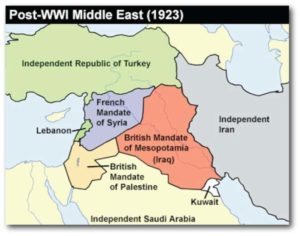 The global south generally has not had the agency to determine borders, but Iraq maybe one of the most tragic examples of this. They were part of the Ottoman Empire. The Ottoman Empire fell because of cooperation between a budding Arab nationalist movement and the British and French forces in World War I. The Arabs were betrayed when the British and French divided up their winnings after the war, and laid down the countries of Syria and Iraq after. The British joined the provinces of Baghdad, Basra and Mosul to make Iraq. Immediately, struggle began against British rule. The British placed a puppet government when they left, which was latter disposed.
Iraq’s high oil reserves and strategic location placed it in the crossfire of the Cold War. In the 1960s, the Ba’ath party, the product of a secular pan-Arab movement rose to power, and through the party, Saddam Hussein came to power.
 Saddam Hussein’s rule of Iraq was plagued by internal and international conflict. War with Iran in the 1980s, war US in the 1990s, uprisings by the Kurdish people, and instability caused by a feeling that the Shia majority could rise in the way they did in Iran, all contributed to a violent, yet delicate balance of power in Iraq, which was being held together in Hussein’s state.
With the invasion of Iraq and the overthrow of Saddam Hussein in 2003, the shaky balance was lost. The Iraqi state was rewritten. The constitution of Iraq was redrawn, and now serves American interests under the language of freedom and democracy. The new Iraqi centre was unable to become a credible power again. The new constitution gave a strong federal structure, which was used by the American forces and companies to work with local governments to settle troops and buy oil, and it left both the Iraqi people and the economy under the control of America. The American War on terror left a huge wave of death and terror in its wake.
In this period, the public sector was also hit hard. Education, electricity sectors, and health were beginning to fail. Decades of conflict and American economic aggression meant Iraq already had difficulty providing for its people. Invasion further destroyed infrastructure. After the global financial crisis in 2008, things only got worse. Corruption was said to have increased. Many Iraqi teachers started giving tuition outside of their class. Local administration became more notably corrupt. For many local Iraqi people, this persistent corruption and the growing inability to access basic infrastructure became a source of discontent.
The government also allocated power along communal lines. Though the constitution prohibited explicit discrimination, the power was distributed in such a way that the Prime Minister would be Shia, the President would be Kurdish, and the Speaker of parliament would be a Sunni Arab. Shia Arabs represent over two-thirds of the country. Sunni Kurds represent about a sixth of the country, and Sunni Arabs. From 2008, the Shia political elites also began to faction.
Iran has been trying to exercise control in the region through the organizing of Al-Hashd Ash-Sha’bi (Popular Mobilization Forces, PMF), which, like Hezbollah in Lebanon, are coordinated groups that work with the Iran government. PMF forces put Iraq in conflict with Israel through the Iran-Israel conflict. ISIS continues to enjoy support, both foreign and domestic in Iraq.
From 2011, mass protests occurred almost every year or two. The original 2011 protests were said to have been inspired by the Tunisian Arab Spring, but the state cracked down on them, as part of the war on terror and the growing threat of ISIS, but the Iraqi people have been regularly coming to the streets for change. The demands of the protesters are met partially at times, though many Iraqis feel these changes do not address the systemic problems that country is facing regarding the public sector and the state’s ability to manage violence in the region.
Last year, protests began, this time inspired by the Yellow vests movement in France. Social media has played an important role in organising.
Protests will continue until the structural problems in the Iraqi public sector are addressed. Iraqi people need secure and affordable education, healthcare, electricity and water.
Protesters know that the problems started in 2003, and the solution would be in a change to the constitution of Iraq. Foreign powers in the United States and Iran have an interest in keeping things the way they are.
Without a fundamental change in the system of governing Iraq, which gives them the ability to determine their own fates, the structural problems will remain. Iraq is held with the chains of its colonial past, which has caused the gridlock it experiences today.
The opinion expressed are those of the author and do not necessarily reflect the official position of Gauri Lankesh News.


 The Bill seeks to amend the six-decade-old Citizenship Act but has caused ruckus in the parliament with strong protests and sloganeering from Opposition leaders.
The bill has sharply divided political and intellectual opinion, with Congress, TMC, Left, other ‘secular’ parties like DMK, SP, BSP and RJD as well as liberal commentators opposing religion being a criterion for pointedly excluding Muslims.
On the other hand, BJP and right-wing opinion has drawn a distinction between a continuing process of non-Muslim population transfer since Partition and an illegal influx that threatens demographic and social balance.




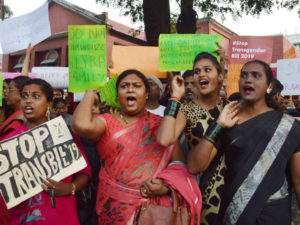 The transgender community in Tamil Nadu has taken to a unique way to urge President Ram Nath Kovind not to sign the Bill passed in Parliament. The Tamil Nadu Rainbow Coalition (TNRC) along with a number of other groups is sending postcards to the President. According to a report by TheNewsMinute, as many as 7,000 postcards have already been sent by TNRC and members of various other transgender rights’ groups. It further urges the President to “respect the voice of the unheard” by refusing to give the Bill legal validity.
