Delhi: Delhi police once again mute spectator to pro-CAA rioters violence, Sec. 144 imposed

0
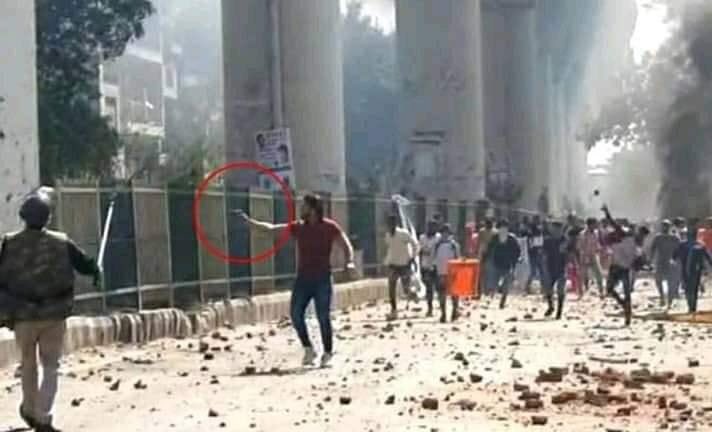
The Northeast Delhi region saw more incidences of violence and arson violence from Maupur and Chandbagh areas today afternoon. One police constable named Ratan Lal has died during the riots. Section 144 imposed in parts of Northeast Delhi. The situation was tense since last night when there were incidences of stone pelting from pro-CAA protesters. On Sunday, former Delhi MLA and Bharatiya Janata Party leader Kapil Mishra took out a rally against the anti-Citizenship (Amendment) Act protest in Jaffrabad, North East Delhi. He also issued a call through Twitter urging people to gather and “prevent another Shaheen Bagh” protest from taking place near the Jaffrabad Metro Station. Soon after, violence broke out, there were instances of stone-pelting and some vehicles being damaged. There is photographic and video evidence that shows the pro-CAA mob participating in the violence with the complicity of the Delhi police. In many videos, police are seen handing helmets to the rioters. In one video, a man is seen brandishing a gun and firing in front of a cop, but the cop doesn’t respond.   1Leading a pro-CAA rally in Maujpur on Sunday, Mishra had said, “We have given a three-day ultimatum to the Delhi Police to get the road cleared. Get the Jafrabad and Chandbagh road cleared”. A day after he led a gathering of pro-CAA protesters at Maujpur, Delhi BJP leader Kapil Mishra Monday appealed the pro and anti-CAA groups clashing in northeast Delhi to exercise restraint, adding that violence is not the solution to anything. In a gesture that is typical of BJP leaders, Kapil Mishra on his twitter handle has asked the rioters to stop the violence. “Violence not the solution should stop. Delhi´s brotherhood should be maintained. pro-CAA or anti-CAA should stop the violence immediately. Kapil Mishra’s reply comes a day after he led a pro-CAA protest in Maujpur area of northeast Delhi, shortly after which violence broke out in the area. He has also issued an ultimatum to Delhi police to clear the roads in the pro-CAA rally. He has said in his speech, they ( pro-CAA people) will not listen to even Delhi police if the roads are not cleared. many also the violence from the pro-CAA protestors instigated by Kapil Sharma speech the day before. There were also videos where the rioters were seen chanting “Har har Mahadev and “Jai Shri Ram”.  

Supreme Court’s (New) Reservations Judgment and Its Discontents

0
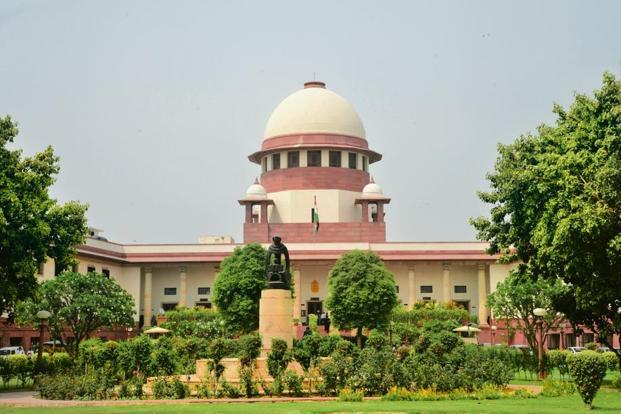
On 7 February, a two-judge bench of the Supreme Court handed down a judgment holding that Article 16(4) of the Constitution is only an enabling provision, and does not confer a “right” to reservations. The context of the case was as follows: in 2012, the government of Uttarakhand decided to fill up the posts in the state’s public services without providing reservations to Scheduled Castes (SCs) and Scheduled Tribes (STs). This was challenged, and after a round of litigation before the Uttarakhand High Court, that court directed “the State Government to collect quantifiable data regarding inadequacy of the representation of the Scheduled Castes and Scheduled Tribes in government services which would enable the State Government to take a considered decision on providing or not providing reservation.” Appellants argued before the Supreme Court that the judgment of the Uttarakhand High Court was wrong, as “there is no constitutional duty on the part of the State Government to provide reservations.” Once, therefore, the government had taken the decision (in 2012) not to provide reservations, that decision could not be challenged. Appellants further argued that as the collection of “quantifiable data” was a precursor to providing reservations, it followed ipso facto that “there is no necessity for collection of any quantifiable data after the Government has taken a decision not to provide reservations.” The Court agreed with these submissions, and also agreed with its 2016 judgment in Suresh Kumar Gautam v State of UP, where these contentions had been accepted. In paragraph 12 of the judgment, it noted that: “It is for the State Government to decide whether reservations are required in the matter of appointment and promotions to public posts. The language in clauses (4) and (4-A) of Article 16 is clear, according to which, the inadequacy of representation is a matter within the subjective satisfaction of the State. The State can form its own opinion on the basis of the material it has in its possession already or it may gather such material through a Commission/Committee, person or authority. All that is required is that there must be some material on the basis of which the opinion is formed.” This, however, was limited to situations where the State made provisions for reservation. That, however—the Court held—was purely discretionary. Consequently: “As the Government is not bound to provide reservation in promotions, we are of the opinion that there is no justifiable reason for the High Court to have declared the proceeding dated 05.09.2012 as illegal.” In other words, there was no obligation upon the State to collect data in order to deny reservations. There are, however, two problems with this line of reasoning, that I set out below-

Article 16 and Substantive Equality

The first is the Court’s characterisation of Article 16(4) as a purely enabling provision, and its conclusion from that inadequacy of representation is a matter within “the subjective satisfaction” of the State. This, however, is at odds with the scheme of Article 16 of the Constitution as interpreted by the Supreme Court. Until the mid-1970s, the Supreme Court’s position was that Article 16(4) was an exception to the guarantee of equality of opportunity set out in Article 16(1). In other words, 16(4) carved out space (for inadequately represented sections) where the normal principles of equality of opportunity would not apply. It was, of course, up to the State whether or not it chose to avail of this exception, and provide for reservations. In NM Thomas, however, that position changed. It was held that Article 16(4) is not an exception to, but a facet of Article 16(1). That changed interpretation flowed from the Supreme Court’s evolving understanding that the Articles 14–15–16 “Equality Code” under the Constitution was not about bare formal equality, but about substantive equality—i.e., equality that took into account existing social and structural disadvantages, and required the State to remedy them. This understanding of constitutional substantive equality has never seriously been questioned after N.M. Thomas, and has recently been reaffirmed (albeit in the contexts of Articles 14 and 15) in Navtej Johar and Joseph Shine. Consequently, if Article 16(4) is a facet of Article 16(1), then it necessarily follows that what Article 16(1) guarantees is a right to substantive equality of opportunity (and 16(4) is—in the words of NM Thomas—an “emphatic restatement of that right.” Consequently, while it is correct to say that there is no right to reservations (as the language of 16(4) is indeed enabling), there is a right to substantive equality. This, in turn, means that if the status quo involves formally equal treatment of individuals in substantively unequal circumstances—when it comes to appointments or promotions in public services—Article 16(1) is breached. The Uttarakhand High Court was well aware of this distinction (as it also was in another judgment it delivered a few days later). Consequently, it did not direct the government to provide reservations. What it did do was direct the government to collect data on the inadequacy of representation, so that a decision could be taken on how to remedy existing substantive inequality. This—as Karan Lahiri (an advocate practicing at the Supreme Court) has argued in an article—is a reading of the scheme of Article 16 that places a “power plus duty” upon the government. As Lahiri writes, “a constitutional provision conferring power/discretion on a State authority, couched in permissive language, is to be treated as a provision containing a power coupled with a duty, if the failure or conscious omission on the part of such authority to act would nullify the effect of another/other constitutional provision, or render nugatory a constitutional principle emerging from a mosaic of constitutional provisions.” Lahiri then argues that if Article 16(4) was to be read as a purely enabling provision that conferred no duties, this would mean that while there was an obligation upon the State to collect data before it granted reservations, there would be no such obligation if it chose not to do so. However, this would mean that: “There is a hurdle created to pull up backward groups, but none for pulling them down, or for ignoring them entirely. This, I believe, is inconsistent with the equality code of our Constitution, and Article 16 itself contains no textual basis for such asymmetry. It is this asymmetry problem that can be remedied if the Supreme Court recognizes the fact that Article 16 contains within it an enabling power coupled with a positive duty.” Notice that the asymmetry problem is taken care of by NM Thomas’ reading of Article 16: because that reading makes the pulling up of “backward groups” an obligation upon the State. On the Supreme Court’s reading, however, it is made explicit that the government must collect data if it wants to provide reservations/substantive equality (“pull up”), but is not obligated to do any such thing if it wants to deny reservations/substantive equality (“pull down/ignore”). This is obviously at variance with the constitutional scheme.

What about NALSA?

The second problem is a more straightforward one. Recall that in NALSA v Union of India, the Supreme Court had taken judicial notice of the fact that the transgender community was underrepresented in government employment, and on that basis, had specifically directed affirmative action measures under Article 16. It follows from this that if indeed it has been found that a group falls within the scope of Article 16(4), the demands of substantive equality under Article 16(1) require the State to take measures to bring about real and effective parity. Thus, while admittedly there is no free-standing right to reservations, there is a right contingent upon a finding that a particular group is underrepresented. If that is the case, however, than the obligation can simply be defeated if the State chooses not to conduct the data collection exercise at all. Consequently, it follows from NALSA that data collection to determine inadequacy of representation is indeed an obligation upon the State, as that is the pre-requisite for the further affirmative action that NALSA found mandatory. Conclusion It is submitted, therefore, that the Supreme Court’s judgment is at variance with NM Thomas, with NALSA, and indeed with the scheme of Article 16 and the Equality Code. Once we agree that Article 16(1) guarantees a substantive right to equality of opportunity, it necessarily follows that a coherent reading of the scheme of Article 16 reveals that the discretion of the State under 16(4) is not unbounded. 16(4) codifies a “power plus duty”: the State is empowered to decide upon reservations, but it has a duty to collect information pertinent to that decision. Any other reading would defeat the basic idea of substantive equality under Article 16(1). Source: Live law (Gautam Bhatia is a Delhi based Lawyer.)

Adivasis demand separate religion category in the Upcoming Census

1
Adivasis are demanding separate religion for their communities in the census 2021. For long people belonging to tribal communities are clubbed as part of Hindu religion. BJP and RSS consider tribals as Hindu. On 18th January 2020, at Jantar Mantar, in a one-day demonstration, Adivasis organisations from 19 states have gathered demanding a separate religion for them. They say- ” Adivasis are not Hindus.We are not happy that we were counted as Hindus in the last census.” The Adivasi representatives are demanding that there should be a separate religion column for Adivasis in the census form because they dont consider them as Hindu, Muslim, Sikh, Buddhist, Jain, Christian or parsi. Census data collects a lot of information based on which government makes its policies. Adivasis Tribals are scattered all over the country. With the present grouping of Adivasis in Hindu religion does not give the correct estimate of Adivasi population in India. In census if they are counted as separate category, it will help in framing policies suitable for Adivasi population.

From British Raj to Indian Raj: Story of successive governmental apathy

The anger and disappointment towards the successive governments is understandable. Tribals are not only the most marginalised sections of society but also the poorest. Despite Tribal welfare ministry and departments, Tribals in India have been at the receiving end of governmental apathy and even state-sponsored atrocities in many parts of India. During British rule in India, there was a separate Adivasi religious code. after independence, in 1951 when the first census in independent India was being conducted, ‘tribe’ was available as the ninth option under the column for religion. It was later removed. The representatives allege that its removal has led tribes to be counted under different religions, which they say causes great harm to their communities. The organisers of the programme, national Adivasi indigenous religious coordination committee Arvind Uraon says – Since 1980 adivasis have been demanding separate religion but the government is not paying attention to their demands.

Also Read: Turning back the clock: How the state is reversing gains made by traditional forest-dwelling communities

Delhi University professor Nitisha Khalkho says- in August 2019, a national convention was also conducted on a separate religious identity for Adivasis in port Blair. Adivasi representatives from all over India were present there. There it was decided to push further the demand for separate religion in the census form. It was decided those who can come to Jantar Mantar in Delhi will come here those who cannot will demonstration at their respective state offices. Mahendra Dhruva, a tribal activist from Bihar, says the census form has only six options under the religion column – Hindu, Muslim, Christian, Buddhist, Jain and Sikh. “If we do not consider ourselves followers of any of these religions, which option should we choose? Before 2011, a seventh option, “Others” was provided and most of us used to opt for it. But now, even that has been removed,” he said. He adds, “If you look at the statistics of all the censuses of the British era (from 1871 to 1931), there was provision for tribes to choose Aboriginal as an option. After independence, the government removed it, so that tribes are counted as either Hindus or followers of other religions. Left with no choice, many people are being forced to choose other religions.” He alleges that the removal of the ‘Aboriginal’ option is an attempt by the government to make them “religious slaves”. As per instructions issued for the census conducted in 2001, the six religions – Hinduism, Islam, Christianity, Buddhism, Jainism, and Sikhism – were given the code 1-6. If a person follows another religion, the enumerator is asked to write the name. The government has made it clear that the other religions will not be given a code number. A similar method was adopted in the 2011 Census.

India’s Citizenship Amendment Act may leave Muslims stateless, says UN chief

2
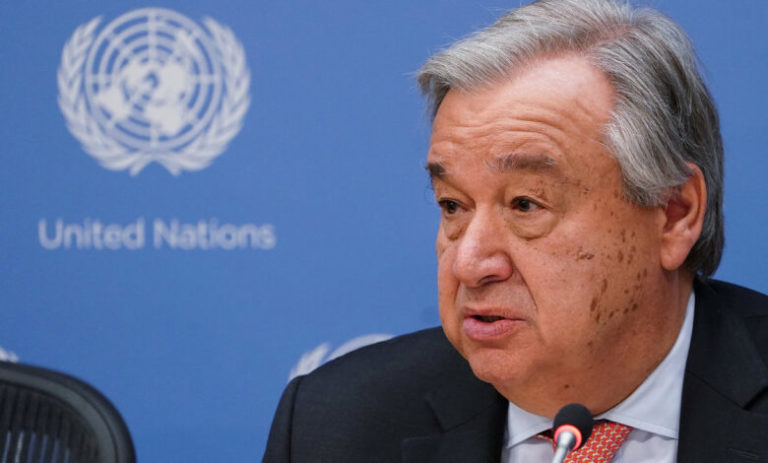
UN Secretary-General Antonio Guterres has said that India’s contentious Citizenship Amendment Act may render a large number of Muslims stateless. Expressing concern over CAA and the proposed National Register of Citizens (NRC), he said it is necessary to do everything to prevent “statelessness” when a nationality law is changed. Talking about this CAA and NRC, the UN chief, who was on a visit to Pakistan, said he was concerned because… “this is an area in which the relevant UN body is quite active”. “The present High Commissioner for Refugees is quite active in this situation like many others like this. Because there is a risk of statelessness created by those national laws,” Guterres told Dawn News TV in an interview. “It is absolutely essential when a nationality law is changed, the statelessness is prevented. Because when the basic right of anyone anywhere is to have a country that a person calls his, then everything should be done in order to avoid statelessness,” he said. The new citizenship law passed by the Indian Parliament in December 2019 offers citizenship to non-Muslim persecuted religious minorities from Pakistan, Bangladesh, and Afghanistan. After the enactment of the law, widespread protests erupted across the country over fears that it may marginalise the minority Muslim community. The Indian government has maintained that the CAA is meant for minorities persecuted in three neighbouring countries due to their faith. The government has called the issue an internal matter of the country. On the other hand, the NRC has been prepared to identify genuine Indian citizens living in Assam since March 24, 1971, or before, and identify illegal Bangladeshi migrants in the state.
Out of 3.3 crore applicants, over 19 lakh people were excluded from the final NRC published on August 30 2019. 
On Kashmir, Guterres said two reports by the UN High Commissioner on Kashmir played an important role in “clarifying exactly what is happening” there and “it is essential that these reports are taken seriously”. During his Pakistan visit, the UN chief had offered to help India and Pakistan to resolve the long-pending Kashmir issue. But New Delhi rejected his offer, saying there is no role or scope for third-party mediation. The already strained ties between India and Pakistan nose-dived after India revoked Jammu and Kashmir’s special status on August 5.

Karnataka: Former CM HD Kumaraswamy recites Anti-CAA poem in Assembly, questions anti-CAA arrests

0
Bangalore: Yesterday in the Karnataka Assembly session, former CM HD Kumaraswamy criticised the arrests of poets, writers, and teachers who wrote or spoke against the Citizenship Amendment Act (CAA). He questioned the Yeddyurappa government, for arresting Siraj Bisaralli, a Kannada poet. and writer. Bisarali was arrested for reciting a poem against CAA and NRC poem in a poet´s meet during the ´Anegundi festival´ in the Gangavati town of Koppal district of North Karnataka. ‘Anegundi Utsav’ was held by the Kannada and Culture Department in association with the district administration on Jan 9-10. Siraj Bisaralli shared the poem on social networking sites. Raja Baxi, an editor of an online portal, Kannadanet.com uploaded the video of his recitation on YouTube and other sites. He was also arrested. The poem asks some questions like- when the prime minister Modi will furnish his records for the CAA? HD Kumaraswamy also questioned the arrests of a teacher and the principal of the school for writing a play on CAA in Shaheen School in Bidar district of Karnataka. The police action of keeping a young mother in detention and questioning small children multiple times for long hours was also heavily criticised.
Kumaraswamy said- Don’t run the government to make someone happy. BJP government has proved by its actions that it is anti-Muslim, anti-Dalit and anti Women.
In both the Bidar and Gangavathi cases, the cases were booked at the behest of BJP and its youth wing leaders, who themselves declared the poems and plays as anti-national. He stated earlier examples where poets have written even more critical poetry, but there were no cases of sedition on them, instead, they were applauded. He stated the example of Poet Nisar Ahmed, who wrote a poem about politicians called “Kurigalu Sir Kurigalu”, which called people as sheep who follow the politicians. He also gave the example of Gopal Krishna Adiga, who wrote a poem against then Prime Minister Jawahar Lal Nehru called “Nehru Nivruttaraguvudilla” meaning ´Nehru never retires´. These poets were not put in jails or were harassed by police and government. Why is this government so afraid of small poems and plays? He questioned. He recited Siraj Bisaralli´s poem to show his discontent with the government overreach. The translated version of the poem is below-

*When will you show your Documents*

In the queue of Aadhar and ration cards With thumb impressions and foolery of servers People are losing their livelihood You, demanding their documents When will you show your documents?   Hey you, tearing the pages of history Of those who sacrificed their lives to free the nation Of those martyred who wanted whose names went unknown When will you show your documents?   You, demanding the papers of the Taj Of the Char Minar, of the Gumbaz Of the Qutub Minar and of the Red Fort, When will you show your documents?   The pimps who boot-licked the British Now drinking the intoxicated blood of religious hatred You, the descendant of the Goebbels, When will you show your documents?   In my town, those selling Pakoda and Tea To make a living, haven’t sold their humanity Haven’t sold their Self-esteem, haven’t sold falsified stories Tell me, when will you show your documents?   Who pumped the punctured tires And brought them on roads, Never sold their selves But you, who sold the nation When will you show your documents?   For you, who deceived the countrymen, Duping the papers is no big a deal But, when will you show the documents? Of humanity in you, if at all there is.          

“Photographs Disclose Police Men Pelting Stones On The Crowd”: Karnataka HC Grants Bail To Anti-CAA Protesters

0
 
  • Partisan investigation with bad intention on part of police
  • No footage or photograph produced before court to show the presence of victims
  • Instead photographs disclose that the policemen themselves were pelting stones on the crowd.
  • Accused framed because of their being Muslims and member of PFI
  • Opposing the implementation of CAA and NRC is not an “unlawful object”
  • Deliberate attempt to coverup police excesses by implicating innocent persons
  • Overzealousness of police evident in FIR against the person killed 
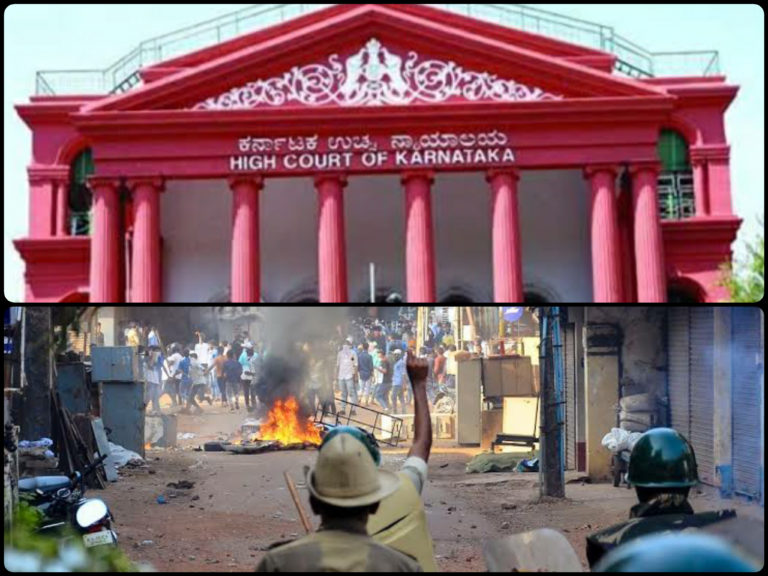
Observing that “Investigation appears to be mala fide and partisan,” the Karnataka High Court has granted bail to 22 people, charged by the Mangalore police, on charges of unlawful assembly armed with lethal weapons, attempting to set fire to North Police Station, Mangaluru and obstructing the police from discharging their duties and causing damage to public property, etc., in violation of the prohibitory order imposed by the Commissioner of Police, Mangaluru, under section 144 Cr.P.C on December 19, 2019. The accused are allegedly part of rally carried out to protest against the Citizenship Amendment Act. Justice John Michael Cunha, while granting bail to the accused said; “In an offence involving a large number of accused, identity and participation of each accused must be fixed with reasonable certainty. In the present cases, a perusal of the case records produced by the learned SPP-I indicates that the identity of the accused involved in the alleged incident appear to have been fixed on the basis of their affiliation to PFI (Popular Front Of India) and they being members of the Muslim community. Though it is stated that the involvement of the petitioners is captured in the CCTV footage and photographs, no such material is produced before this Court showing the presence of any one of the petitioners at the spot armed with deadly weapons.” On an objection made by the state that there was a hint as to holding of protest by the Muslim youth on 19.12.2019, opposing implementation of CAA by the Central Government and in that connection, the Commissioner of Police, Mangaluru had imposed prohibitory order under section 144 Cr.P.C. from 9.00 p.m. on 18.12.2019 till 12.00 midnight of 20.12.2019, the court said “This assertion indicates that common object of the assembly was to oppose the implementation of CAA and NRC which by itself is not an “unlawful object” within the meaning of section 141 of IPC.” Commenting on the evidence collected by the investigating agency the court said; “The material collected by the Investigating Agency does not contain any specific evidence as to the presence of any one of the petitioners at the spot; on the other hand, omnibus allegations are made against the Muslim crowd of 1500 – 2000, alleging that they were armed with weapons like stones, soda bottles, and glass pieces. The photographs produced by learned SPP-I depict that hardly any member of the crowd was armed with weapons except one of them holding a bottle. In none of these photographs, police station or policemen are seen in the vicinity. On the other hand, photographs produced by the petitioners disclose that the policemen themselves were pelting stones on the crowd.” The bench also considered the fact that 31 FIR’s have been registered by the police against protestors but on complaints made by the family of the injured and those persons who died in police firing, no case has been registered. It said “Even though the law required the police to register independent FIRs in view of the specific complaint made against the police officers making out cognizable offences, the respondent police have failed to register FIRs which would go to show that a deliberate attempt is underway to cover up police excesses by implicating innocent persons at the whims and caprice of the police. Overzealousness of the police is also evident from the fact that FIRs are registered under section 307 IPC, against the persons killed by the police themselves. In the wake of the counter allegations made against the police and in the backdrop of the failure of the police to register the FIRs based on the complaints lodged by the victims, the possibility of false and mistaken implication cannot be ruled out.” The bench said it was passing the order granting bail because; “In the above circumstances, it would be travesty of justice to deny bail to the petitioners and sacrifice their liberties to the mercy of the District Administration and the police. The records indicate that a deliberate attempt has been made to trump-up evidence and to deprive the liberties of petitioners by fabricating evidence. It is not disputed that none of the petitioners have any criminal antecedents. The allegations leveled against the petitioners are not punishable with death or imprisonment for life. There is no direct evidence to connect the petitioners with the alleged offences. Investigation appears to be mala fide and partisan. In the said circumstances, in order to protect the rights and liberties of the petitioners, it is necessary to admit them to bail.” The court directed the accused be released on bail of furnishing bond in a sum of Rs.1,00,000/- Source: livelaw

NPR will not be implemented in Madhya Pradesh: CM Kamal Nath

0
The Congress government led by Chief Minister Kamal Nath has declared that it will not implement the National Population Register (NPR) in the state of Madhya Pradesh. CM Kamal Nath who had earlier passed a resolution against the Citizenship Amendment Act (CAA) on Monday asserted that there is no move “at present” to undertake the exercise of the NPR in the state. His clarification came after Congress MLA Arif Masood’s protest against the state government’s decision to update the NPR, demanding a rollback of the same. In a statement, Nath told reporters, “The NPR notification about which talks were going on was issued on December 9, 2019. After this, the Centre has decided to implement the Citizen (Amendment) Act (passed by Parliament on December 11). It means the NPR notified by the government is not the one under the CAA 2019, but as per the provisions of CAA- 1955s 2003s rule 3. Despite this, the NPR will not be implemented in the state.”

Read More: Aadhaar, NRC, and NPR: Part of 360 degree Mass Surveillance

The NPR is scheduled to be carried out with the house listing Census exercise from April 1 to September 30, with the Central Commission claiming the NPR’s objective would be to create a comprehensive identity database of every “usual resident” of the country. Nationwide, agitations have stemmed up against the CAA and NPR, claiming that NPR would be the first step to the National Register of Citizens (NRC); an exercise which if carried out along with the CAA, could render lakhs of citizens ‘stateless’. Kerala CM Pinarayi Vijayan has also declared that the NPR will not be implemented there. The coalition government in Maharashtra seems to have different views with regards to the NPR. While the Nationalist Congress Party (NCP) minister Jitendra Awhad has expressed that the government is against the CAA-NPR-NRC, the CM of Maharashtra, Uddhav Thackeray has said that the NPR and the CAA will not harm anyone. Addressing the media Thackeray said, “CAA and NRC are different issues. NPR is the third issue. Nobody should fear about the CAA. NRC hasn’t come and will not come. If NRC is implemented, it will create problems not only for Muslims but for Hindus, Dalits, tribals and others. Centre has not made any statement on NRC. NPR is a census and I will go through columns given in the form. I don’t think there will be any problem with it. The census is carried out every ten years.” Maharashtra has agreed to begin the enrolment under NPR from May 1.  

Maharashtra: Women organisations met Sharad Pawar demand to pass resolution against NPR, NRC and CAA

0
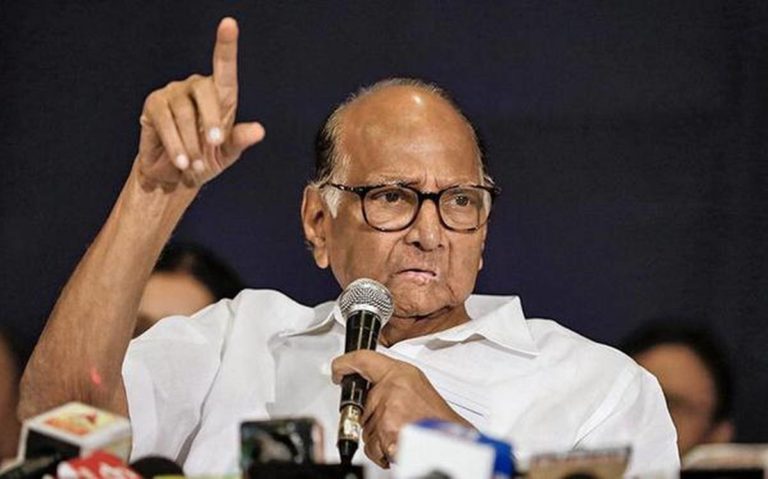
Around 25-30 Women representatives from 21 organisations across Mumbai, Dahanu, Raigad, Pune, Sangli working for adivasis, workers, slum dwellers, rag pickers, sex workers met Mr. Sharad Pawar today with a demand that Maharashtra government should pass a resolution against NPR, NRC & CAA in Vidhan Sabha. The representatives explained how adversely the NPR & NRC will affect different marginalized groups in the society. And how this is not just a question of Muslims. This meeting was held on the backdrop of the announcement of NPR getting implemented in Maharashtra from 1st May. Supriya Sule, Jitendra Avadh were present for the meeting along with Sharad Pawar. Women representatives also talked about how the police is harassing the protesters in Mumbai who are peacefully protesting. Mr. Pawar said that as a party they share the same position on CAA, NRC, NPR as the people protesting against it. But as a coalition government, they need to have a dialogue with the CM on this. And they’ll have it soon. Mr.Jitendra Avadh suggested the delegation to also visit Maharashtra Chief Minister on this issue so that he understands how different groups will be affected by the same. They also reassured the group that police cases against them will be looked into. The group has now planned to meet Cm in the coming 4-5 days. The contingent of organizations and activists decided that a protest meeting against NPR should be held before the Vidhan Sabha session starts with the same demand for a resolution to be passed in Vidhan Sabha against NPR. The protests against CAA, NPR and NRC are primarily seen as Muslim only protests although these exercises affect all who are landless and will not be able to prove their identity or grandparent identity as well as land documents. With this in consideration, it was decided that all people and groups affected across religions should be represented in this meeting. The Muslim-only protests are leaving the state unaffected. Hence the next protest should conver to the government that their voter base across religions will be affected by this law and not just Muslims. This protest meeting will be held on 23rd February  at 4 PM in Hutatma Chowk, Fort, Mumbai.    

Sisterhood unites to fight oppression: Dalit and Adivasi forest workers meet Shaheen Bagh protesters

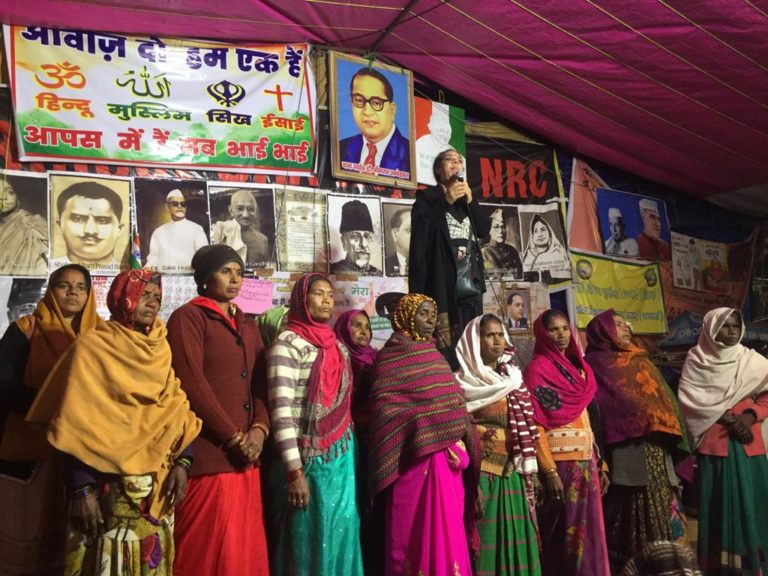
Recently a contingent of 23 Dalit and Adivasi forest workers from Lakhimpur Khikri, Sonbhadra and Manikpur arrived in New Delhi to express solidarity with people protesting the Citizenship Amendment Act (CAA). The visiting contingent comprised members of the All India Union of Forest Working People (AIUFWP). Just like the protests at Shaheen Bagh are predominantly led by women, the movement for forest rights in Uttar Pradesh’s Sonbhadra region has been spearheaded by women. AIUFWP deputy general secretary Roma Malik, as well as senior union members like Sokalo Gond, Rajkumari Bhuiya, Kismatiya Gond and many others, met with protesters at Shaheen Bagh, where folk singers from Sonbhadra also sang songs of protest. Amir Khan, an activist working with the union said, “The Indian state is playing same tactics to exclude or disenfranchise these oppressed groups despite Forest Rights Act 2006, which guaranteed their claim over the forest and its resources through Individual and Community Forest claim. There is a similar pattern of NRC wherein they have been asked to share their 3 generations documents i.e. 75-year land records to have a claim on their Forest and its resources.” Read More: Turning back the clock: How the state is reversing gains made by traditional forest-dwelling communities On Sunday, a group of women protesters from Shaheen Bagh also organized a rally to march to the Ministry of Home Affairs. “After Amit Shah offered to talk to protesters to help the protesters gain better understanding of CAA, the protesting women including ‘dadis’ decided to tell him that they were neither ignorant nor confused about the CAA. They know that it is unconstitutional and want it to be scrapped. In fact, they said they could help Amit Shah understand the Constitution. That is why they wanted to march to the MHA,” said Khan explaining the reason behind yesterday’s rally. But the police prevented the protesters from marching to the MHA. “First, he offers to talk, then he does not come to meet the protesters, and when they try to visit him, the police who reports to him, stop them,” Khan wonders aloud. The story was first published on the Sabrang media portal. 

Magsaysay Award Winner Sandeep Pandey Arrested on Way to Anti-CAA Protest

0
Magsaysay Award winning activist Dr. Sandeep Pandey was arrested on Monday afternoon in Lucknow while he was about to participate in an anti-CAA protest. He was released on bail after being produced in the District Magistrate’s court. According to a report by India Tomorrow, nine other persons who were accompanying Pandey have also been arrested and brought to the Thakurganj police station Thakurganj Station House Officer (SHO) Pramod Kumar said that they had been arrested under Section 151 (knowingly joining or continuing in assembly of five or more persons after it has been commanded to disperse), in the apprehension of breach of peace. According to reports, Dr. Pandey and his associates had reached the Clock Tower and were planning to take out a march to the other protest site in Ujariyagaon village in Gomti Nagar area. For the past one month, hundreds of people, all women, have been holding round-the-clock sit-in at the Clock Tower in protest against CAA-NRC-NPR. The local police have made several attempts to remove the protest but the women have resisted the crackdown. The SHO said that Dr. Pandey and his associates were also distributing pamphlets against CAA. According to a complaint filed by Hindu Mahasabha national vice-president Rajiv Kumar, the activist had passed the comments while addressing anti-citizenship law protesters at the Aligarh Muslim University on January 19. He also allegedly claimed that the same people who had tried to “divide Hindus and Muslims” during the British Raj were trying to do it again. A first information report was filed against Sandeep Pandey under sections 153 A (provocation with intent to cause riots) and 505 (1)b (inciting public or community to commit an offence) back then. Last month, another police case was filed against Sandeep Pandey for allegedly making “inappropriate comments” against Hindutva ideologue VD Savarkar. Sandeep Pandey, an alumnus of the Banaras Hindu University and the University of Californa, Berkeley, had won the Ramon Magsaysay award in the emergent leadership category in 2002. Since CAA was passed by the Parliament on December 11, there have been massive nationwide protests against the discriminatory citizenship law. Most of these protests have been peaceful. During some protests on December 19-20 in UP, violence erupted. More than 20 people were killed, mostly in police firing. The UP state police booked thousands of people and arrested hundreds of them. Two weeks back, the UP police arrested Gorakhpur-based paediatrician, Dr. Kafeel Khan, in Mumbai on charges of delivering a provocative speech during anti-CAA protest at the Aligarh Muslim University on December 12 last year. He was granted bail by the Aligarh court on February 10 but hours before his release on Feb 14, the state government booked him under the stringent National Security Act.