The United States has over 9,00,000 lakh cases of coronavirus in the country. The cases have continued to grow and more and more people are in need of medical care. During such a time, a rule by the Health and Human Services department is being passed that allows doctors to discriminate against LGBTQI people and deny them access to health-care.
The rule that is being passed scraps the Obama-era policy that was in place to protect LGTBQ people from discrimination. In a time when the USA is battling against a pandemic, this rule will is not only discriminatory but is putting lives of LGBTQI members in danger.
“I’m really scared about what that means for testing, for treatment, for people’s comfort-seeking care. This is not the time we want people to avoid seeking care and treatment,” said Sharita Gruberg, who works on LGBTQI issues for CAP.
The Trump administration is almost on its way to complete the rewrite of section 1557 of the Patient Protection and Affordable Care Act. The law prohibits discrimination on the basis of race, color, national origin, sex, age, or disability in certain health programs or activities. The law was made in response to activists and health-care providers who reported that LGBTQI people were being turned away from health-care services and bullied for seeking health-care. It also offered protection to transgender people. In 2016 a court blocked these protections because of backlash from religious groups. The Trump administration has tried to weaken these protections further ever since.
Many LGBTQI people do not have ties with their families and due to social discrimination, there are many jobs that are inaccessible to them. This pushes many of them to the margins of society where they are more likely to contract illnesses. According to an American national survey, 65 percent of LGBTQ adults have pre-existing conditions such as diabetes, asthma, heart disease, or HIV*. This makes accessing healthcare, especially in these times, necessary. Though due to the discrimination they face many LGBTQ people cannot access care services.
A survey by the Centre of American Progress has found that 29% of transgender adults in the USA have said that health-care professionals have refused to see them because of their gender identity. LGBTQ people are seven times more likely to avoid visits to doctors because of the discrimination they have faced previously. According to reports, 60% of LGB people and 70% of trans and gender non-conforming people reported refusal of care, harsh language, and physical roughness because of their sexual orientation and/or gender identity. HRC Foundation’s analysis of the 2018 BRFSS, shows 17% of LGBTQ adults do not have any kind of health insurance coverage, 23% of LGBTQ adults of color, 22% of transgender adults and 32% of transgender adults of color have no form of health coverage. This could lead to economic hardships on the community and make them a high-risk group during this pandemic.
“I’m scared to say this out loud, but I’m afraid that trans people will face things like being deprioritized for ventilators or for care,” Bre Kidman, a non-binary candidate for US Senate in Maine, said to Vox
HHS declined to comment on the possibility of a pending rule and has said that there are no protections that are being scrapped as it is only upholding the 2016 judgment.
*Findings from a nationally representative survey commissioned and designed by CAP and fielded by Knowledge Networks, which surveyed 1,864 individuals about their experiences with health insurance and health care.
The coronavirus can infect anyone, but recent reporting has shown your socioeconomic status can play a big role, with a combination of job security, access to health care and mobility widening the gap in infection and mortality rates between rich and poor.
The wealthy work remotely and flee to resorts or pastoral second homes, while the urban poor are packed into small apartments and compelled to keep showing up to work.
As a medievalist, I’ve seen a version of this story before.
Giovanni Boccaccio
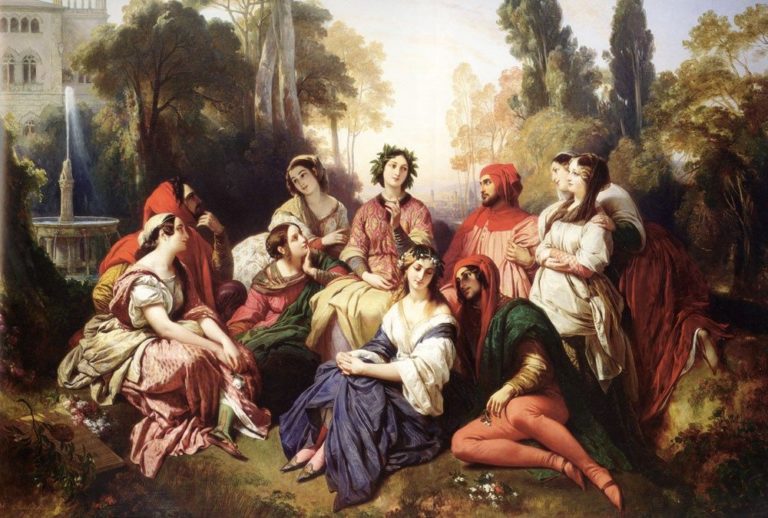
Following the 1348 Black Death in Italy, the Italian writer Giovanni Boccaccio wrote a collection of 100 novellas titled, “The Decameron.” These stories, though fictional, give us a window into medieval life during the Black Death – and how some of the same fissures opened up between the rich and the poor. Cultural historians today see “The Decameron” as an invaluable source of information on everyday life in 14th-century Italy.
Boccaccio was born in 1313 as the illegitimate son of a Florentine banker. A product of the middle class, he wrote, in “The Decameron,” stories about merchants and servants. This was unusual for his time, as medieval literature tended to focus on the lives of the nobility.
“The Decameron” begins with a gripping, graphic description of the Black Death, which was so virulent that a person who contracted it would die within four to seven days. Between 1347 and 1351, it killed between 40% and 50% of Europe’s population. Some of Boccaccio’s own family members died.
In this opening section, Boccaccio describes the rich secluding themselves at home, where they enjoy quality wines and provisions, music and other entertainment. The very wealthiest – whom Boccaccio describes as “ruthless” – deserted their neighborhoods altogether, retreating to comfortable estates in the countryside, “as though the plague was meant to harry only those remaining within their city walls.”
Josse Lieferinxe’s ‘Saint Sebastian Interceding for the Plague Stricken’ (c. 1498)
Meanwhile, the middle class or poor, forced to stay at home, “caught the plague by the thousand right there in their own neighborhood, day after day” and swiftly passed away. Servants dutifully attended to the sick in wealthy households, often succumbing to the illness themselves. Many, unable to leave Florence and convinced of their imminent death, decided to simply drink and party away their final days in nihilistic revelries, while in rural areas, laborers died “like brute beasts rather than human beings; night and day, with never a doctor to attend them.”
After the bleak description of the plague, Boccaccio shifts to the 100 stories. They’re narrated by 10 nobles who have fled the pallor of death hanging over Florence to luxuriate in amply stocked country mansions. From there, they tell their tales.
One key issue in “The Decameron” is how wealth and advantage can impair people’s abilities to empathize with the hardships of others. Boccaccio begins the forward with the proverb, “It is inherently human to show pity to those who are afflicted.” Yet in many of the tales, he goes on to present characters who are sharply indifferent to the pain of others, blinded by their own drives and ambition.
In one fantasy story, a dead man returns from hell every Friday and ritually slaughters the same woman who had rejected him when he was alive. In another, a widow fends off a leering priest by tricking him into sleeping with her maid. In a third, the narrator praises a character for his undying loyalty to his friend when, in fact, he has profoundly betrayed that friend over many years.
Humans, Boccaccio seems to be saying, can think of themselves as upstanding and moral – but unawares, they may show indifference to others. We see this in the 10 storytellers themselves: They make a pact to live virtuously in their well-appointed retreats. Yet while they pamper themselves, they indulge in some stories that illustrate brutality, betrayal, and exploitation.
Boccaccio wanted to challenge his readers and make them think about their responsibilities to others. “The Decameron” raises the questions: How do the rich relate to the poor during times of widespread suffering? What is the value of life?
In our own pandemic, with millions unemployed due to a virus that has killed thousands, these issues are strikingly relevant.
The article was first published here. The author is an English professor at the University of Maryland, Baltimore County, US.
In Part 1 of the report, Gauri Lankesh news covered what happened at Padarayanapura, Bangalore. Part 2 of the report talks about how Kannada news channels used the vandalism incident to whip up Islamophobia.
Each Pandemic brings with it a set of lessons. One important lessonfrom previous pandemics is that authoritarian responses only make things worse. Interventions are more effective when they worked in cooperation with the people.
What happened in Padarayanapura, Bangalore was a classic case of state and machinery’s authoritarian response, coupled with hate-mongering media coverage.
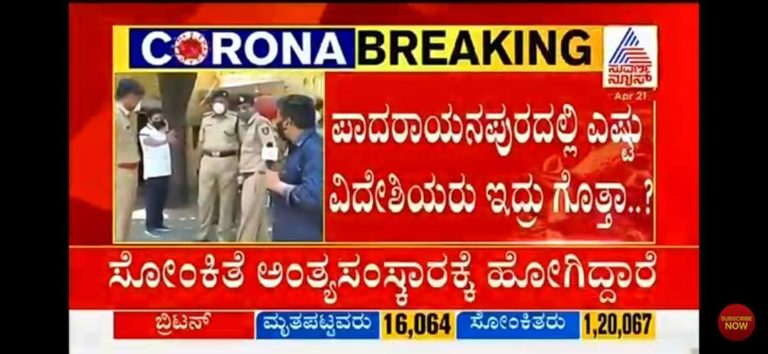
Despite Bangalore police commissioner statement to media that no officer was attacked or injured in the incident, many media channels presented an exaggerated version of the incident and ran the story that police and health officials were attacked.
Explaining the situation and taking people into confidence is very crucial.
The local corporator Imran Pasha and Zameer Ahmed said the incident could have been prevented if they had had they been informed and if the transfer of people into quarantine was done during the day.
Imran Pasha said that he along with Zameer Ahmed have been working together from Day 1 to keep people informed about the developments and are coordinating with various Government departments to ensure smooth running of the operations.
Vandalism portrayed as “Muslims plan of genocide” by TV channels
However, most TV channels seem to have their own agenda. Like vultures, they jumped at the opportunity to blame Muslims for not cooperating with the government.
Many news reports have come out blaming Imran Pasha and Zameer Ahmed for the events that transpired on Sunday night and calling him “King of terrorists”.
Despite Police denying any violence against police or health workers, Kannada channels ran false stories of Muslims in the area attacking police.
Words like Jihadi virus, Rakshaka, devils, sinners and dirty people were used to describe the residents of the area, which also happens to be Muslim dominated.
There is no bigger threat to the peace and security of Karnataka than Kannada TV channels.
Some reports went ahead and declared the area as “This is the Republic of Padarayanapura” and that the Govt orders do not apply there and suggested that the approval of Imran Pasha and Zameer Ahmed were needed to get anything done.
Did BJP leaders add fuel to the fire?
Many BJP leaders who hold ministerial berths in present government like Shobha Karandlaje, MP from Chikamagalur constituency; the Minister of Tourism and MP from Chikamagalur, C.T. Ravi; Renukacharya from Honnale and Minister of Rural Development, K.S. Eshwarappa gave statements to TV channels.
Pramod Muthalik of SriRama Sene in a video that became viral said that its a planned attack and Zameer Ahmed is responsible for it. He also stated that those arrested should be paraded naked and their properties must be seized.
In all the statements, the BJP leaders pushed the narrative of “Us Vs Them”.
CT Ravi, Tourism MinisterAccording to C.T. Ravi, “they” do not understand normal language, they need to be told in their own language. They are misusing the good nature of our Chief Minister.According to Ms. Shobha Karandlaje, this is “Corona Jihad”. She said that this would not have happened if her statements after the first such incident were taken seriously. Why is it that everyone follows one law, but, “they” cannot?
Many such statements had come out and by Monday noon, TV9 had started reporting with the headline- “A genocidal plot is going on at Padarayanapura”.
Kasturi channel which is supported by JDS had spread the message about Zameer Ahmed who has jumped to Congress from JDS, saying “Where are you, terrorist King, Zameer?”
Bangalore Police Commissioner unwilling to make ‘controversial remarks’
The differences between the statements issued by the Police Commissioner that “there was no attack on anyone”, and the statement from the Home Minister later that there was an attack needed to be verified by enquiring Senior Police officers.
We spoke to the officials in order to verify the truth in these above statements. We also wanted to know the opinion of Police officials regarding the hate messages about Genocide televised by many channels.
When asked about these, the Police Commissioner Bhaskar Rao said “we are doing our duty, we do not like to comment on such news. We do not want to get into any controversy regarding the TV channels; I and my team would like to focus just on our work”.
First police statement do not mention any kind of organised attack.
One police official talking to reporters on the morning after the attack said “ The videos show what happens when a crowd of around 100 people goes around shouting and destroying the sheet metal. However, the situation was bought under control very quickly. It was not an organised attack. It is difficult to say how people may act out of frustration in the coming days. We are worried about the attempts being made to turn this incident into a communal issue. Speaking from my common sense I can say that the fear and hate propaganda being adopted by the TV channels is prone to push people into depression. There is a great possibility of this turning into a dangerous situation if a particular community is targeted. Yesterday was a very small trailer of the events that could occur in the future if this continues”.The audio recording of the above-mentioned conversations is available at naanugauri.com. Identities of some people are not revealed here as they fear trouble if their name is mentioned. Uptil now, no evidence to support that this was an organized attack was found, we hope that investigations will shed more light on this matter.
Will any legal action be taken against the channels spreading fake news and propaganda?
The consequences of spreading hate against Muslims and fake news could be grave and legal action should be taken against the ones who spread such messages. This responsibility lies on the shoulders of the local representatives and the community leaders. The officials who were supposed to involve local representatives are also at fault. Mistakes by the health officials in failing to inform the local representatives are understandable as they are under immense pressure. However, the communalisation and targeting of Muslims cannot be given the same consideration. The ruling party members are to blame for this and are solely responsible. It is the Chief minister’s duty to correct his representatives and ensure that it does not happen again.
Prime minister Narendra Modi had tweeted days before the incident that the Coronavirus does not attack based on religion. We need to stand united and fight as one against this disease . However, some people from his party did not speak in support of his narrative of standing united.
Gauri Lankesh’s team spoke to the different sources about the incident in Padarayanapura and has tried to cover the issue objectively. The report is covered in two parts. This part 1 of the report.
The Padarayanapura incident which took place on Sunday night has been making a lot of noise in Kannada News Channels. Everyone has condemned this incident irrespective of party affiliations. But the ruling party members, ministers, and supporters have reacted with extreme views.
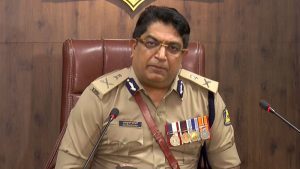
Bangalore Police Commissioner Bhaskar Rao
Bangalore police commissioner Bhaskar Rao visited the spot on the night of the incident. Next day, according to Vijay Karnataka, he gave a statement saying-
“The attack from the suspected was not right. We will take action against them. No official was attacked or injured in the incident, we will deploy more police personnel for the protection of officials working there. Please do not politicise this issue”.
All political parties have condemned the incident and have expressed their support for the Government in this time and have appealed to people not to communalise the issue and have asked for their support in the fight against COVID -19
Home minister Basavaraj Bommai also visited the spot on Monday morning and ordered strict action against the miscreants. Contrary to the police commissioner, Bommai made a statement that Police personnel was also attacked. TV news channels added their own spin to the story and ran the news that Muslim COVID positive people attacked police in Padarayanpura.
Bangalore Corona Hotspots and Padarayanapura
Padarayanapura near to City Market was declared one of the COVID-19 hotspots red zone. The area along with Bapuji Nagar was completely sealed by the civic authorities when 18 people were found to be COVID-19 positive. Entry and exit points were monitored by police personals.
Poor and densely populated neighbourhood
Padarayanapura and the neigbouring area extremely poor neighborhoods, with around 10-15 people living in each house. 5 out of the 7 cases that were identified by April 14th were traced to people living in the same building. Most residents were daily wage workers. The total population of the area is around 45,000. The ward Corporator is Imran Pasha, and the ward belongs to Chamarajapet constituency, the officer being Zammer Ahmed Khan and P.C Mohan is the Lok Sabha MP from this region.
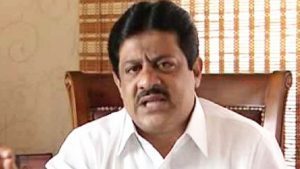
Zameer Ahmed, Area MLC
The possibility of infection spreading within the members of the region remains despite the seal down measures. 7 new cases were identified on April 18th. These 7 people were confirmed primary and secondary contacts of previous COVID patients. Due to their contact history, as per the current guidelines, it is crucial to quarantine these people ( in designated places like hospitals, hotels or wedding halls).
The quarantine process was going as planned / without any issues
The quarantine procedure was followed as usual. Accordingly, the first 35 people, followed by 15, then 5, and yesterday, 17 people have been quarantined. The local MLC, Imran Pasha was also present to ensure a smooth procedure. According to him, people were scared and anxious during earlier visits as well but they did not resort to protests; they cooperated well with the medical and BBMP staff.
Due to the lockdown followed by sealing most people rely on food packets provided by BBMP, but BBMP distribution was too little. Though Imran Pasha announced that BBMP and himself have distributed 4000 and 3500 kits respectively, each made of 18 kg of essential groceries. The frustration of sealing operation and the feeling that Muslims are being targeted was there in some of the residents.
The unlucky fate of Padarayanapura
Despite all the growth and development of Bangalore, some areas remain poor and backward. In such areas substance abuse is common. It is quite possible that some of the youth were acting out of withdrawal symptoms.
After 7 new cases were detected on April 18th, the BBMP authorities arrived to take 58 people into quarantine. Although there was no resistance from them in the beginning, due to lack of availability of rooms, etc., the authorities decided to leave and come back on Monday.
During this time, the information regarding quarantining the secondary contacts and overall importance of quarantine were not conveyed properly to the 58 people. The BBMP health official was also not reachable.
As the next batch of the vehicle with 20 people was getting ready to leave, some people started asking if testing on-site and quarantining there itself is a possibility. The argument turned heated and sources say that one person was asked to leave his food in between and leave immediately (this has to be verified).
Notorious activities of miscreant groups
At the same time, some youth groups started yelling and questioning. Some youngsters (between the age of 15 and 25 years as per 3 different witnesses) started gathering in groups. Moving in groups, estimated to be around 100 people, they started removing the barricades and sheet metal used to seal down the area. At one place, they removed/destroyed the shamiana that was being used by the Police personnel, broke tables and chairs, damaged street lights. The Corporator and Police at the scene have tried to stop them and as per Imraan Pasha and some social workers, all this took place within a span of 15- 20 mins.
This was followed by more Police force arriving at the scene and Senior officers ensuring that the situation did not get out of control. Starting from then, until the Home Secretary arrived in the morning, a total of 59 people were arrested. One woman who has been known to be a local Ganja supplier has also been arrested. Sources say that the people who were supposed to be quarantined have now been successfully taken.
“I have a one-year-old baby and no money to even buy milk,” said an aggrieved Krishna Mandal. Krishna, from Jharkhand, has been working as a daily wage factory worker in Tirupur, Tamil Nadu. He hasn’t been paid since the lockdown. Pampi Kumari and her husband from Bihar work as daily wage labourers in Gurugram, Haryana. She worked in a medical supplies company while her husband worked as a construction worker. She hasn’t been able to work recently due to a liver problem and since the lockdown, her husband has not been paid his daily wages. They are left with only Rs 200 to survive the rest of the extended lockdown added to which are Pampi’s medical expenses that have already crossed Rs 10,000. Suresh Yadav, from Jharkhand, is a driver in a loading yard and has been stranded in Sundargarh, Odisha. His vehicle has been his home since March 24th and he only has Rs 50 remaining. He neither has accessories to cook nor has access to feeding centres.
These remind us of the lines from Leo Tolstoy’s novel Anna Karenina: “Happy families are all alike. Unhappy families are unhappy in their own way.”
Scenes of their discontent and resistance against the lockdown and its extension came to the fore recently in Surat and Mumbai as thousands gathered on the street. All they want is to be extricated from the continued trauma imposed by the brutal lockdown and be able to go home; the most basic of human needs.
Since the lockdown, a group of 73 volunteers, called the Stranded Workers Action Network (SWAN), has been responding to distress calls from migrant workers across the country and making small cash transfers to meet basic needs in addition to connecting workers to local organizations and the administration. Between March 27th and April 13th, around 10,000 stranded workers have reached out. A detailed report can be found here. The report is not a research study but is an outcome of relief work that SWAN is doing. The relief work is continuing.
The observations from the data gathered, while not uniform in response rates due to the evolving nature of SWAN’s work, still yields a disturbing overview. Around 49% (out of 2707 workers for whom we have this data) had just 1 day of rations left. 96% (out of 9302 workers) had not received rations from the government and 70% (out of 2293) had not received any cooked food. And, more than 44% were absolutely emergency calls with no food or cash. What is the most disturbing is the following: Rate of hunger is exceeding the rate of relief. Percentage of people who said they have less than 1 day of rations increased from 36% to 49% in the third week of lockdown while the percentage of people who received government rations increased from 1% to only 4% in the third week of lockdown
The unilateral decision of a lockdown without any consultation with state governments has taken both the migrant workers and the bureaucracy by surprise. The response from state administrations has varied. The Principal Secretary, Rural Development and Panchayat Raj, Karnataka, Ms. Uma Mahadevan, has responded to our SOS requests for rations, humanely and with urgency. About 33 per cent of the workers in Karnataka had rations for just 1 day. However, the response from administrators in other states have been patchy. Maharashtra has been particularly bad. As of April 20, more than 73% of 1366 workers who reached out to us from Maharashtra have said that they have ration lasting for less than 1 day.
To prevent the migration of the distressed due to the lockdown, the Ministry of Home Affairs issued an order on 29th March seeking that employers should pay the workers full wages and homeowners shouldn’t be charging rent from stranded workers. However, 90%(out of 4503 workers) have said that they have not been paid during the lockdown.
There is a statutory obligation to record migrant labour in many legislations that is binding on the central and state governments such as the National Disaster Management Act (2005), the InterState Migrant Worker Act (1979), and the Street Vendors Act (2014), among others. Further, there are other wage laws mandating that workers are entitled to the payment of full and timely wages, to displacement allowance, and even a home journey allowance.
In response to a Public Interest Litigation (Writ petition (civil) Diary no 10801/2020) to this end by Harsh Mander and Anjali Bharadwaj vs Union of India, the Chief Justice of India (CJI) recently remarked: “If they are being provided meals, then why do they need money for meals?” However, from the people we have spoken with, more than 78 per cent of nearly 2000 stranded workers who responded to this question said that they have less than Rs 300 left. With the remaining Rs 300, they have to survive till the month end, be able to buy soaps, oil, water, vegetables, medicines, recharge their phones, pay room rent and also return home. This also when about 90% out of 4503 workers said that they have not been paid during the lockdown. In the light of such alarming testimonies of around 10,000 workers, the CJI’s remark appears to underestimate the extent of the humanitarian crisis and the need for money. Food and cash for the stranded workers are not binaries. At such times, it behoves the Apex Court to oversee rather than overlook.
635 academics and civil society activists (including the petitioners) had appealed to the central government on 24th March with an array of emergency relief measures. Among other things, the appeal sought an emergency cash relief of Rs 7,000 per household for at least 2 months for the bottom 80 percent of the households. The need for such a relief measure can also be backed by the government’s own data. According to the Periodic Labour Force Survey (PLFS) of 2017-18, about 82 percent of the households earn less than the minimum living wages of Rs 18,000 per month as arrived at in the 7th Pay Commission and 69 percent of the households earn less than 400 per day (average daily wage). Since the lockdown, even the relief measures in the aforementioned appeal seem inadequate. Indeed, when Vivekananda, a migrant worker from Jharkhand in Bangalore, reached out, his wife was not able to feed her infant because she had not eaten anything for 2 days.
We debated whether to change the names of the workers mentioned in this article to preserve anonymity. But we haven’t. How much more can we anonymise the already anonymous who have been forced to occupy the cracks of our society? There is still some time to stem the extent of the devastation, take this opportunity and reimagine a truly equitable welfare state, assuring a life of dignity and security for all. As an immediate measure, with more than 78 million tonnes of grain in FCI godowns, we urge universalisation of free rations, increase feeding centres, and give at least Rs 7,000 per month to all the stranded. Women, and, in particular, pregnant women, are in urgent need for nutritional supplements and sanitary pads along with ration supplies. We are, otherwise, staring at an unprecedented multidimensional crisis; of hunger, malnutrition, crime, and death.
Rajendran is a SWAN volunteer. This is collective work and is written on behalf of all the tireless SWAN volunteers. Rajendran teaches at Azim Premji University, Bangalore.
The National Commission for Women released data about rising cases of Domestic Violence during the period of the lockdown. The pandemic has also had a gendered impact on women wherein they are forced to stay with their abuser due to the lockdown. This trend of rising incidents of domestic violence has been noticed all across the world.
As many courts, hospitals, and helplines have shut down, women are finding it difficult to reach out for support. Civil society groups have also faced challenges in lending a hand during this lockdown. In this context, Law and Society committee (NLSIU, Bangalore), in collaboration with Centre for Women and the Law (NLSIU) and The Leaflet organised a webinar called- Women & The Pandemic: The Challenge of Domestic Violence on 20th April 2020.
The webinar explored legal remedies that women have in this period and how civil society can help despite the lockdown.
T.K. Rajalakshmi, Senior Deputy Editor Frontline started the discussion with a broad overview of the situation. She mentioned that even the Un secretary-general is talking about rising cases of domestic violence but there hasn’t been any message from government on this. The Ministry of Women and Child Development has also not made any efforts to build support mechanisms to help women through the lockdown.
At the time when COVID-19 helplines themselves do not function well, how can one expect helplines that help victims of DV to function?
She addressed the fact that the pandemic is seen only as a health crisis but no one is talking about the crisis that women and children are facing as a result of COVID-19. They have to bear the social cost of the virus which arises from the economic loss that their abusive partners face due to the lockdown.
Indira Jaising, Senior Advocate and Founder, Lawyers Collective gave a historical overview of the DV law. She said that under sec, 498A domestic violence is criminal law. When women came with cases of DV, they would want to know if these cases could be tried through Civil Law so that they could access entitlements that were not provided under criminal law. As a response, activists and lawyers worked to broaden the definition of the DV law. One of the rights that women had under the new law was the right to reside in the house of their husbands. The irony of this lockdown is that they are now forced to reside in the same household, and the household becomes a jail for them. The DV that they experience is now literally custodial violence.
She said women do not and have not left violent situations because they do not have any matrimonial property and would have to leave empty-handed. One of the solutions that she suggests is to have policemen as protection officers, as abusers might be afraid of police presence. What is important now, she iterated, is to document these stories.
Adrija Bose, Associate Editor, News 18, shared her interactions with UP police during her field reporting on DV. According to Police, the first week of lockdown there were fewer cases of DV. This could be because of the lack of mobile phones with women. As men own phones at home and have more access to phones, 71% to 38% for women, making calls to helplines might come at the cost of their safety.
While the NCW has now started accepting complaints via e-mail and WhatsApp as well, the state response is still very limited. In other parts of the world, countries have been responding to the rise in DV cases, like France and Spain, but India seems to be ignorant about this.
There have been several incidences of police brutality during the lockdown, this does not instil confidence in women to come out to complain to the police. It is worrying that many redressal mechanisms for women are unreachable.
According to Anuradha Kapoor, Director, SWAYAM, a women´s rights organisation, many women are locked in their homes, they have no place to reach out for support. Even if they do reach out for support, the police are also overburdened and even if they do get to move them out, they have nowhere to move them.
Shelters are not taking women in because many are worried about the spread of the virus. She said that because the legal system is not functioning, seeking redressal to the violence is hard. She suggests that abusers should be moved out of these environments instead of forcing women to leave. With no response from the government and no advertising of DV numbers, Anuradha said that we will only see a rise in deaths due to DV.
Jhuma Sen, Assistant Director, Centre for Human Rights Studies, Jindal Global Law School spoke about how the narrative during the lockdown is “Stay at home. Stay safe.” Often a home is said to be a safe place.
This kind of messaging can be very damaging for victims of domestic violence. Feminists have time and again said that homes are violent spaces. With the lockdown, women are faced with more burdens. They have to engage in care work and invisible work and at the same time live in closed spaces with their abusers. She said that these are gendered implications of the lockdown.
Sangeeta Rege, Coordinator, Centre for Enquiry into Health and Allied Themes (CEHAT) spoke about CEHAT’s work with the BMC during the lockdown. CEHAT’s Dilaasa centers are spread across Mumbai and 13 centers are functioning. Dilaasa works to provide psychological support to victims of DV. They have developed safety plans for both the team of counselors and for the victims of abuse. They have gotten 103 police vans that go to the victim’s house, speak to the abuser, and if need be move the victim out of the house. The volunteers on the other end talk to shelter homes and ask them to take women in. They also ensure that they talk to abusers and previous Dilaasa users to see if things are under control. As many victims can not make it to the hospitals, CEHAT has also put up helpline numbers and shared them with the users. These have been important steps that civil society has taken, while working with the government, to ensure victims are safe.
Padma Deosthali, Public Health Expert, CEHAT (Bihar) spoke about Sahaj, an organization has been using a health system response to DV. They have been engaging in working with counselors and training them to engage with victims of domestic violence and rape. They also reach out to Anganwadi workers, ASHAs to inform them about these services and how to access them.
The webinar brought out the intricacies that are hidden in fighting the rise in Domestic violence cases and it is important that the government take cognizance of the problem and make activities that support the victims of domestic violence essential.
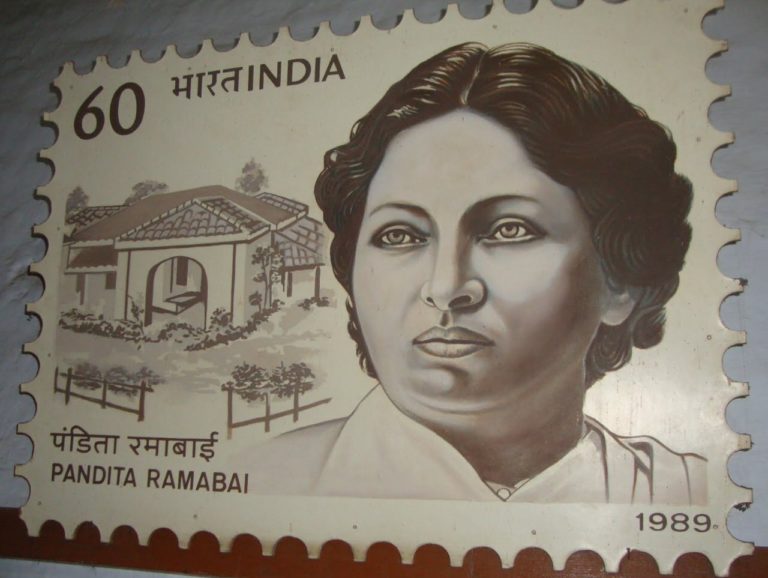
Pandita Ramabai was an educator, a social reformer, and a feminist. In 19th century India, she was one of the first Brahmin women to break patriarchal norms and move out of the confined boundaries that were set for Brahmin women.
Ramabai was well-read in Sanskrit literature even though Sanskrit was a language reserved for men, she married outside of her caste in the 19th century which was unheard of amongst Brahmins, she converted to Christianity, on her own accord, and also studied in prestigious institutions across the US and the UK.
Pandita Ramabai was an outspoken advocate of women’s rights and was a well-known activist in the 19th century, even though women then were usually pushed to the margins of public life. She was unapologetically courageous as she went across the world delivering lectures about women’s emancipation and women’s education. She founded the Arya Mahila Samaj in Pune which focused on promoting women’s education and stopping child marriage.
In a time when widows were ill-treated and burnt on the pyre, Ramabai broke those shackles of patriarchy and did not shy away from being in public as a widow, a single mother, and a women’s rights activist. In many ways, her path was made easier by women like Savitribai Phule who had fought against all odds to ensure girls and women were educated. Ramabai continued to follow in her footsteps.
Pandita Ramabai was born Rama Dongre in 1858 to a Brahmin family, she later converted to Christianity. She was taught Sanskrit by her father, Anant Shastri Dongre, even though learning Sanskrit was limited to men. This was the first instance where Ramabai broke out of the rigid gender code. Tragedy struck Ramabai when she was 16. She lost her parents and sister to the famine. Ramabai had to beg for food during this time to try and save her family.
After this, she and her brother traveled the country reciting Sanskrit scriptures and they moved to Calcutta in 1878. When she reached Calcutta, her knowledge of Hindu scriptures caught the eye of Sanskrit scholars. They invited her to give lectures and talks and also invited her to speak on women and their emancipation. It was scholars from the University of Calcutta who conferred her with the title “Pandita.”
In 1880 Ramabai married outside her caste to a Bengali lawyer, Bipin Behari Medhvi. But within two years of their marriage, her husband passed away and she became a single mother to Manorama, their daughter. This is when she moved to Pune, at the age of 23, and started the Arya Mahila Samaj. It was seen as a radical organization that was trying to do away with the dominance of men.
She went to study medicine in London in 1883 but due to her progressive deafness, she was denied this opportunity. She started teaching Marathi and Sanskrit to women at Cheltenham Ladies College instead. During her time in London, she converted to Christianity and changed her name to Mary. This angered many of her supporters. She converted as she felt a deep disconnect from her religion and her faith. Even though she had converted, she did not give in to the rules of the Church blindly. “I am, it is true, a member of the Church of Christ, but I am not bound to accept every word that falls down from the lips of priests or bishops. I have just with great efforts freed myself from the yoke of the Indian priestly tribe, so I am not at present willing to place myself under another similar yoke,” she said in a letter to a nun who was deeply disturbed by Ramabai’s questioning of Christianity. Ramabai continued to wear Indian clothes and remained a vegetarian. Ramabai also challenged the notion that God was a man and believed that God was neither man nor woman, which further worried the Church.
In 1886 she left for the US. During her time in the US Ramabai addressed hundreds of gatherings and “she spent a lot of time speaking, writing, entertaining, and thinking.” During this time, she wrote her best-known work “The High Caste Hindu Woman” to highlight the plight of widowhood among Brahmin women. Ramabai wanted to collect money for widows back home. American Ramabai Association was formed with the help of women’s groups to support Ramabai financially in her mission.
She was also sensitive to the questions of race. According to a piece in the New York Times, “In a letter to her daughter, she described meeting the escaped slave and abolitionist Harriet Tubman and urged Manorama to be ‘as helpful to her own dear countrywomen as Harriet was and is to her own people.’”
Once she came back, she set up homes for widows. She also set up a church that received a lot of backlash from Hindu elites. A newspaper called the Kesari said she was trying to “set afire the ancient religion of her compatriots with the help of foreigners”
Ramabai spent all her life struggling against Brahmin patriarchal structures and she refused to back down. She was a feminist who not only worked on the emancipation of women but also understood caste, race, and religious issues that were barriers towards equality.
Ramabai died in 1922 at the age of 63 due to health issues. Ramabai’s ruthless refusal to bow down to the Hindu patriarchal order, her perseverance to expose the status of women in the country, her dedication to her cause, and her identity as an outspoken feminist resulted in the Hindu order suppressing her story and erasing her role as one of India’s early social reformers.
One could argue that the absence of the founding ideals of democracy, such as equality, liberty and fraternity, in our past customs, in the imagination of our past societies, and the many religions practised here, has led to the difficulty in our acceptance and practice of those values in the present day. If that is true we should have understood these ideals and inculcated them within ourselves and moved on after becoming a country with a constitution and universal adult franchise. Although we have been able to understand the concepts of equality and liberty, at least on a theoretical level, maybe because of our interpretation of the word fraternity as Bhra-thru-thva, we may not have been able to understand the real meaning and importance of the word and have miserably failed to implement it.
We often hear that Dr BR Ambedkar had borrowed the word fraternity from the French Revolution. Although Ambedkar acknowledges the fact that the French revolutionaries invented and used the word fraternity, he clarifies that he found the true meaning of the word in the Buddha Bhouda Dharma that he was practising.
Ambedkar said ‘Positively, my Social Philosophy, may be said to be enshrined in three words. Liberty, Equality, and Fraternity. Let no one, however, say that I have borrowed my philosophy from the French Revolution. I have not. My philosophy has roots in religion and not in political science. I have derived them from the teachings of my Master, the Buddha. In his philosophy, liberty and equality had a place, but he added that unlimited liberty destroyed equality, and absolute equality left no room for liberty.
In his Philosophy, the law had a place only as a safeguard against the breaches of liberty and equality; but He did not believe that law can be a guarantee for breaches of liberty or equality. He gave the highest place to the fraternity as the only real safeguard against the denial of liberty or equality or fraternity which was another name for brotherhood or humanity, which was again another name for religion’. [BAWS Chapter 17, page 503]
Post-independence, Ambedkar was concerned about India’s political system. He had explained several challenges that India faces as it implements a democratic system. He had said that ‘Democracy is more than a political machine, It is even more than a social system. It is the attitude of mind or a philosophy of life’. Having declared that the survival of such a democracy depends on the socialisation of the hearts and minds of the people living in it, he called the democratic society a prerequisite for a democratic government. Fraternity is an important quality that is necessary for the creation of this democratic society. He had said that we can find this in the principal of Maitreyi taught by the Buddha. To be able to see all other living beings with love, to respond to the pains and sorrows of fellow citizens, to be able to see fellow citizens as one’s own people, such a feeling of brotherhood is maitreyi. Ambedkar believed that this maitreyi or fraternity is at the root of democracy, and he also imagined the feebleness of a democracy where this root has not burrowed deep enough. [BAWS Chapter 4, pages 281-287]
Babasaheb used to say that the reason democracy did not grow in the past here in India is that, in India Hindu Dharma never preached the concept of fraternity. The fact that democracy was absent in Hindu society was not an accident. He said, the classification of society into Varnas and Castes, Castes and Outcastes, were not just theories but were decrees. They were all barricades raised against democracy. Ambedkar also clarified that the principle of “All are God’s children” could not have laid a strong foundation for democracy but the Hindu principles of Aham Brahmasmi and Thathvamasi had the strength to build a democracy. He goes on to discuss that Brahminism concealed this potential by creating castes and subcastes, by creating a graded system of higher and lower castes, by denying them space for common experiences and kindness needed in responding to the hardships of one another, by giving no scope for the socialisation of the people, and thus stifling the growth of democracy here.
If one observes the current phenomenon, it can be said that our education- that is of those of us on the upper layer of the society and belonging to the privileged castes -has not been successful in inculcating within us a feeling of maitreyi or the ideals of fraternity. But those who have stuck to the privileges and notions that have led to the distortion, decline, and moral decadence of our society, required this education. There was a need to invoke the moral consciousness of the people belonging to those castes that had historically exploited and committed atrocities against the lower castes. If this moral consciousness had been invoked within a majority of people, the kind of country that we had envisioned could have become a reality. We would not be seeing the dance of religious nationalism today.
Bhiku Parekh, the political scientist who was the first speaker of the Ambedkar Memorial Lecture Series at the Ambedkar University in Delhi has said ‘The idea of fraternity is neglected in much of modern, especially liberal, thought, and Ambedkar was right to stress its importance without embracing a narrow nationalism. As a victim of social inequality himself, he saw the role that fellow feeling plays in inspiring the struggle against injustices. Although one can be inspired by an abstract commitment to the ideals of equality and justice, one’s struggle acquires energy and tenacity when one can see the victims in their concreteness, identify with them, feel their pain and sorrow and make them one’s own; in short, when one is guided by what Ambedkar called ‘fellow feeling’. He was right to stress the role of moral emotions and reject a narrow intellectualist view of moral and political life.
Ambedkar’s analysis of the nation, with which he associated the idea of fraternity, is equally rich and suggestive. A nation for him was not an abstraction, a transcendental entity hovering over its members. Rather, it was nothing other than its members in their intricate relations and interdependence. To serve the nation was nothing more and nothing less than to serve its members and promote their well-being. This is why Ambedkar felt that India’s independence struggle could not be conducted in isolation from the internal struggle against its oppressive social order. As he observed, the nation is not a primordial entity but a collective creation of its members and has claims on them only to the extent that it includes them all in its self-understanding. Like Tagore and Gandhi Ambedkar’s concept of nationhood has a humanist orientation and remarkably free from the collectivism, narrowness and aggressive generally associated with it’. [Conversations with Ambedkar, (E): Valerian Rodrigues].
When the preamble of the constitution was submitted to the drafting committee on the 6th of November 1948, it became a subject of heated arguments and major altercations. But the clause that introduced the idea of fraternity in the preamble was praised and unanimously accepted from constitution assembly. In his speech on the 6th of November 1948, Thakur Das Bagwan, a member from East Punjab to the constitution assembly said, ‘I think, Sir, that the soul of this Constitution is contained in the Preamble and I am glad to express my sense of gratitude to Dr Ambedkar for having added the word ‘fraternity’ to the Preamble. Now, Sir, I want to apply the touch-stone of this Preamble to the entire Constitution. If Justice, Liberty, Equality and Fraternity are to be found in this Constitution, if we can get this ideal through this Constitution, I maintain that the Constitution is good’. That moment when the idea of fraternity, which had not appeared in any previous drafts of the constitution’s preamble, was included in Ambedkar’s preamble- it became a milestone in the idea of an independent India.
Being someone who was influenced by the doyens of modern political philosophy such as John Dewey and Harold Joseph Laski, Ambedkar strived to find equivalent ideas to modern democracy within the cultural heritage of India. He dreamt of a new nation and he built it exclusively denying a chance to the argument that the ideas of equality, fraternity, liberty, and democracy were imported Ideas from western countries, as made by some religious fundamentalists. But seventy years has not been long enough for the idea of fraternity, which was at the heart of his dream, to seep into the hearts of the vast majority of the population. The need of the hour is that we must wake up and embrace the idea of fraternity to fully realise his dream of building an India that stands on the strong foundations of freedom and equality.
The article was originally published in Nyaya Patha. It has been translated into English by Subhash Urs.
As of today morning, the US had 792,913 COVID-19 positive cases and 42,517 deaths and the numbers continue to climb. Amidst this, citizens in some of the states have taken to the streets to protest against the lockdown.
Since Trump has been pretending to carry business, as usual, most state governors have taken matters into their own hands and have imposed varying degrees of lockdown according to the situation in the respective states.
Some states across the US are slowly opening-up businesses and are easing restrictions depending on the severity of the pandemic. This has led to unease among other states who are also itching for the lockdown to ease despite the high COVID19 positive cases. This has manifested into Democrats Vs Republicans showdown as many Trump supporters only want lockdown to be eased because their governors is a Democrat.
Health-workers who are at the frontline of the fight against COVID19 have advised against this action and some states are still following the stay at home orders.
Who are the protestors?
The organizers of these protests have largely been conservative, pro-Trump and pro-gun activists. These demonstrations are much like Trump campaign events, with pro-Trump banners, t-shirts, and signs. Organizers have claimed that the protests are grass-root driven, but on a closer examination, it is clear that this is being run by right-wing groups and is one of the protests was funded by the family of Trump’s education secretary, Betsy Davos.
Protestors in front of the Capitol building
Trump´s Response to the Protests
Trump’s response and the response of the White House have been mixed. The COVID-19 taskforce gave a step by step plan on how the country plans to reopen state economies. In this phase by phase plan, each phase is to last 2 weeks.
Soon after this announcement was made, Trump took to Twitter to show support to the first set of protests that took place in Michigan. He then wrote a series of tweets in support of ‘liberating’ other states from the stringent lockdown measures, which he said were taken too far by the state governors.
Many of these protesters believe that the lockdown is too stringent and will affect their businesses and the local economy. The Trump supporters are protesting outside state governors offices claiming the are forced to take unemployment benefits which they don’t want.. All they want to do is go back to work.
Protest along Meridian in front of Governor’s residence demanding Gov Holcomb end stay-at-home order #WTHRpic.twitter.com/lQ01qz0Pyd
Many of these protesters claim the lockdown has taken away their freedom and because of lockdown they are unable to visit their hairdressers to get their hair coloured.
USA (📺) If you attended this protest, … you could be dead within 3-to-30 days. pic.twitter.com/vq9MmQBtYH
— COVID-19 Coronavirus (@COVID19Coronav1) April 19, 2020
Another look at the ‘operation gridlock’ protest taking place outside the State Capitol in Downtown Sacramento. pic.twitter.com/3N268zgGud
Source: Daily Mail UK
Trump told reporters- at a White House briefing- that the protestors have ‘got cabin fever.’ “Their life was taken away from them. They want their lives back. These people love our country. They want to get back to work,” he added.
“To have an American president encourage people to violate the law, I can’t remember any time during my time in America where we have seen such a thing,” said the Washington state governor in response to Trump’s tweets.
Jax Weaver and her 7-year-old daughter at the Austin rally: “I’m not worried about catching the virus. If we did catch the virus, I feel that we’re healthy enough to fight it.” pic.twitter.com/1t0Jav9U8S
Public Response to the protests
While the protests take place across the country, they have not been garnering large crowds. According to a Pew Research Centre survey found that only 32% of the population wanted the lockdown to be lifted. While 66% of the people believed the lockdown needs to continue and were worried that the restrictions will be lifted too quickly. Many have taken to Twitter to voice their opinions against these protests. Health-care workers have gone one step ahead and have taken to the streets (maintaining social distance) and have blocked these protests by standing in defiance.
The healthcare workers are being lauded as heroes for facing off with protesters [Alyson McClaran/Reuters]Health-care workers Stand in front of vehicles in counter-protest to the anti-lockdown rally in Colorado
Displays of an illiterate mindset. Protestors actually telling healthcare workers to ‘go to china’! How ironic that the same will take care of them when they are admitted in!#ProtestLockdown#LockThemAllUp https://t.co/qOrbWkYr4D
As the protests continue, only time will tell whether these ‘repressed protestors’ will get what they want or will the US fall deeper into the black hole of the ongoing health crisis
Sacramento, California: A driver holds out a sign about being repressed as hundreds of people gather to protest the lockdown in spite of shelter-in-place rules still being in effect. Source: Daily Mail UK
After Goa was declared Corona´free, Manipur becomes the second zero covid-19 state in India.
Manipur’s chief minister N. Biren Singh tweeted confirming that 2 people who were infected from corona have fully recovered and tested negative for covid-19. One of the two people infected in the Manipur state was that of a 23-year-old woman who had returned from the United Kingdom, which was the first case of the state. The second patient was a 65-year-old man who was found to have contracted the disease following his return from the Tablighi Jamaat event in Delhi’s Nizamuddin area. https://twitter.com/NBirenSingh/status/1251909744605921285?s=20Goa has had no new cases since April 3 and became the first corona free state by recovering the seven patients who were infected by the coronavirus. Six of the seven infected people had foreign travel history and another one was the brother of a positive patient. Pramod Swant, the Chief Minister of Goa said that these seven recovered patients will be quarantined at government facilities and later at home. He said that though this was a happy moment for the state and especially the frontline workers this was not the time for relaxing, and that social distancing has to be ensured. He said that the lockdown will continue until the central government decides. He added that the borders with Maharashtra and Karnataka will remain closed, and anyone entering the state under special circumstances will have to stay in a government quarantine center.https://twitter.com/DrPramodPSawant/status/1251825939400413184?s=20Vishwajit Rane, the Health Minister of Goa tweeted about Goa being the first state in the country to be corona free and expressed his solidarity with the country in fighting with the coronavirus.https://twitter.com/visrane/status/1251824595218231296?s=20Goa was one of the States that had announced the lockdown in their state from the day of Janata Curfew on 22 March. Goa had started the thermal test and screening of tourists and other people from other states of the country and ensured home quarantine even before the Janata Curfew took place. Once the numbers of infected people increased in the state the CM decided to seal the borders of Goa as it shares its borders with Maharashtra and Karnataka. After Janata Curfew the Chief Minister of Goa had extended the curfew for 23 and 24 march, people were restricted to come out of their homes. Goa in total has tested over 800 people of whom seven were positive of coronavirus and are now recovered and tested negative. “The first lot of seafarers will return in 3-4 days once the government makes it official. Those already at Indian ports or closest to the coast will return first. The seafarers returning will be subjected to government quarantine followed by home quarantine. Goa has made available 8,000 rooms for goan seafarers” the chief minister, Dr. Pramod Sawant said. Manipur and Goa, both the states can start their business activities while following the mandatory safety protocol, said the Union Home Ministry.





 The local corporator Imran Pasha and Zameer Ahmed said the incident could have been prevented if they had had they been informed and if the transfer of people into quarantine was done during the day.
Imran Pasha said that he along with Zameer Ahmed have been working together from Day 1 to keep people informed about the developments and are coordinating with various Government departments to ensure smooth running of the operations.

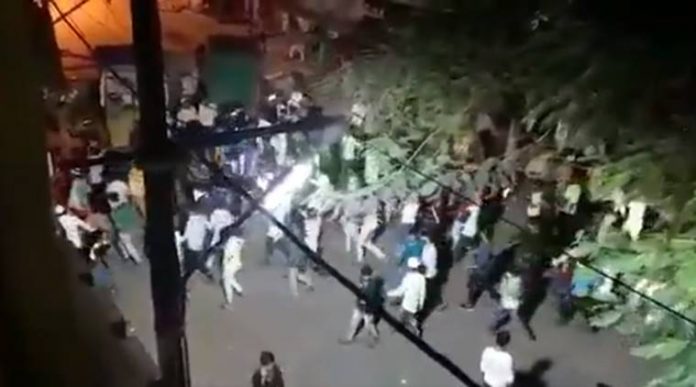
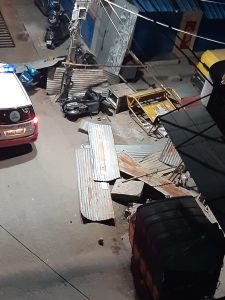 At the same time, some youth groups started yelling and questioning. Some youngsters (between the age of 15 and 25 years as per 3 different witnesses) started gathering in groups. Moving in groups, estimated to be around 100 people, they started removing the barricades and sheet metal used to seal down the area. At one place, they removed/destroyed the shamiana that was being used by the Police personnel, broke tables and chairs, damaged street lights. The Corporator and Police at the scene have tried to stop them and as per Imraan Pasha and some social workers, all this took place within a span of 15- 20 mins.
This was followed by more Police force arriving at the scene and Senior officers ensuring that the situation did not get out of control. Starting from then, until the Home Secretary arrived in the morning, a total of 59 people were arrested. One woman who has been known to be a local Ganja supplier has also been arrested. Sources say that the people who were supposed to be quarantined have now been successfully taken.

 Scenes of their discontent and resistance against the lockdown and its extension came to the fore recently in Surat and Mumbai as thousands gathered on the street. All they want is to be extricated from the continued trauma imposed by the brutal lockdown and be able to go home; the most basic of human needs.
Since the lockdown, a group of 73 volunteers, called the Stranded Workers Action Network (SWAN), has been responding to distress calls from migrant workers across the country and making small cash transfers to meet basic needs in addition to connecting workers to local organizations and the administration. Between March 27th and April 13th, around 10,000 stranded workers have reached out. A detailed report can be found here. The report is not a research study but is an outcome of relief work that SWAN is doing. The relief work is continuing.
The observations from the data gathered, while not uniform in response rates due to the evolving nature of SWAN’s work, still yields a disturbing overview. Around 49% (out of 2707 workers for whom we have this data) had just 1 day of rations left. 96% (out of 9302 workers) had not received rations from the government and 70% (out of 2293) had not received any cooked food. And, more than 44% were absolutely emergency calls with no food or cash. What is the most disturbing is the following: Rate of hunger is exceeding the rate of relief. Percentage of people who said they have less than 1 day of rations increased from 36% to 49% in the third week of lockdown while the percentage of people who received government rations increased from 1% to only 4% in the third week of lockdown
The unilateral decision of a lockdown without any consultation with state governments has taken both the migrant workers and the bureaucracy by surprise. The response from state administrations has varied. The Principal Secretary, Rural Development and Panchayat Raj, Karnataka, Ms. Uma Mahadevan, has responded to our SOS requests for rations, humanely and with urgency. About 33 per cent of the workers in Karnataka had rations for just 1 day. However, the response from administrators in other states have been patchy. Maharashtra has been particularly bad. As of April 20, more than 73% of 1366 workers who reached out to us from Maharashtra have said that they have ration lasting for less than 1 day.
To prevent the migration of the distressed due to the lockdown, the Ministry of Home Affairs issued an order on 29th March seeking that employers should pay the workers full wages and homeowners shouldn’t be charging rent from stranded workers. However, 90%(out of 4503 workers) have said that they have not been paid during the lockdown.
There is a statutory obligation to record migrant labour in many legislations that is binding on the central and state governments such as the National Disaster Management Act (2005), the InterState Migrant Worker Act (1979), and the Street Vendors Act (2014), among others. Further, there are other wage laws mandating that workers are entitled to the payment of full and timely wages, to displacement allowance, and even a home journey allowance.
In response to a Public Interest Litigation (Writ petition (civil) Diary no 10801/2020) to this end by Harsh Mander and Anjali Bharadwaj vs Union of India, the Chief Justice of India (CJI) recently remarked: “If they are being provided meals, then why do they need money for meals?” However, from the people we have spoken with, more than 78 per cent of nearly 2000 stranded workers who responded to this question said that they have less than Rs 300 left. With the remaining Rs 300, they have to survive till the month end, be able to buy soaps, oil, water, vegetables, medicines, recharge their phones, pay room rent and also return home. This also when about 90% out of 4503 workers said that they have not been paid during the lockdown. In the light of such alarming testimonies of around 10,000 workers, the CJI’s remark appears to underestimate the extent of the humanitarian crisis and the need for money. Food and cash for the stranded workers are not binaries. At such times, it behoves the Apex Court to oversee rather than overlook.
635 academics and civil society activists (including the petitioners) had appealed to the central government on 24th March with an array of emergency relief measures. Among other things, the appeal sought an emergency cash relief of Rs 7,000 per household for at least 2 months for the bottom 80 percent of the households. The need for such a relief measure can also be backed by the government’s own data. According to the Periodic Labour Force Survey (PLFS) of 2017-18, about 82 percent of the households earn less than the minimum living wages of Rs 18,000 per month as arrived at in the 7th Pay Commission and 69 percent of the households earn less than 400 per day (average daily wage). Since the lockdown, even the relief measures in the aforementioned appeal seem inadequate. Indeed, when Vivekananda, a migrant worker from Jharkhand in Bangalore, reached out, his wife was not able to feed her infant because she had not eaten anything for 2 days.
We debated whether to change the names of the workers mentioned in this article to preserve anonymity. But we haven’t. How much more can we anonymise the already anonymous who have been forced to occupy the cracks of our society? There is still some time to stem the extent of the devastation, take this opportunity and reimagine a truly equitable welfare state, assuring a life of dignity and security for all. As an immediate measure, with more than 78 million tonnes of grain in FCI godowns, we urge universalisation of free rations, increase feeding centres, and give at least Rs 7,000 per month to all the stranded. Women, and, in particular, pregnant women, are in urgent need for nutritional supplements and sanitary pads along with ration supplies. We are, otherwise, staring at an unprecedented multidimensional crisis; of hunger, malnutrition, crime, and death.
Rajendran is a SWAN volunteer. This is collective work and is written on behalf of all the tireless SWAN volunteers. Rajendran teaches at Azim Premji University, Bangalore.

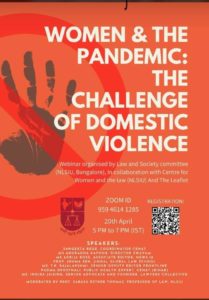 As many courts, hospitals, and helplines have shut down, women are finding it difficult to reach out for support. Civil society groups have also faced challenges in lending a hand during this lockdown. In this context, Law and Society committee (NLSIU, Bangalore), in collaboration with Centre for Women and the Law (NLSIU) and The Leaflet organised a webinar called- Women & The Pandemic: The Challenge of Domestic Violence on 20th April 2020.
The webinar explored legal remedies that women have in this period and how civil society can help despite the lockdown.
T.K. Rajalakshmi, Senior Deputy Editor Frontline started the discussion with a broad overview of the situation. She mentioned that even the Un secretary-general is talking about rising cases of domestic violence but there hasn’t been any message from government on this. The Ministry of Women and Child Development has also not made any efforts to build support mechanisms to help women through the lockdown.
At the time when COVID-19 helplines themselves do not function well, how can one expect helplines that help victims of DV to function?
She addressed the fact that the pandemic is seen only as a health crisis but no one is talking about the crisis that women and children are facing as a result of COVID-19. They have to bear the social cost of the virus which arises from the economic loss that their abusive partners face due to the lockdown.
Indira Jaising, Senior Advocate and Founder, Lawyers Collective gave a historical overview of the DV law. She said that under sec, 498A domestic violence is criminal law. When women came with cases of DV, they would want to know if these cases could be tried through Civil Law so that they could access entitlements that were not provided under criminal law. As a response, activists and lawyers worked to broaden the definition of the DV law. One of the rights that women had under the new law was the right to reside in the house of their husbands. The irony of this lockdown is that they are now forced to reside in the same household, and the household becomes a jail for them. The DV that they experience is now literally custodial violence.
She said women do not and have not left violent situations because they do not have any matrimonial property and would have to leave empty-handed. One of the solutions that she suggests is to have policemen as protection officers, as abusers might be afraid of police presence. What is important now, she iterated, is to document these stories.
Adrija Bose, Associate Editor, News 18, shared her interactions with UP police during her field reporting on DV. According to Police, the first week of lockdown there were fewer cases of DV. This could be because of the lack of mobile phones with women. As men own phones at home and have more access to phones, 71% to 38% for women, making calls to helplines might come at the cost of their safety.
While the NCW has now started accepting complaints via e-mail and WhatsApp as well, the state response is still very limited. In other parts of the world, countries have been responding to the rise in DV cases, like France and Spain, but India seems to be ignorant about this.
There have been several incidences of police brutality during the lockdown, this does not instil confidence in women to come out to complain to the police. It is worrying that many redressal mechanisms for women are unreachable.
According to Anuradha Kapoor, Director, SWAYAM, a women´s rights organisation, many women are locked in their homes, they have no place to reach out for support. Even if they do reach out for support, the police are also overburdened and even if they do get to move them out, they have nowhere to move them.
Shelters are not taking women in because many are worried about the spread of the virus. She said that because the legal system is not functioning, seeking redressal to the violence is hard. She suggests that abusers should be moved out of these environments instead of forcing women to leave. With no response from the government and no advertising of DV numbers, Anuradha said that we will only see a rise in deaths due to DV.
Jhuma Sen, Assistant Director, Centre for Human Rights Studies, Jindal Global Law School spoke about how the narrative during the lockdown is “Stay at home. Stay safe.” Often a home is said to be a safe place.
This kind of messaging can be very damaging for victims of domestic violence. Feminists have time and again said that homes are violent spaces. With the lockdown, women are faced with more burdens. They have to engage in care work and invisible work and at the same time live in closed spaces with their abusers. She said that these are gendered implications of the lockdown.
Sangeeta Rege, Coordinator, Centre for Enquiry into Health and Allied Themes (CEHAT) spoke about CEHAT’s work with the BMC during the lockdown. CEHAT’s Dilaasa centers are spread across Mumbai and 13 centers are functioning. Dilaasa works to provide psychological support to victims of DV. They have developed safety plans for both the team of counselors and for the victims of abuse. They have gotten 103 police vans that go to the victim’s house, speak to the abuser, and if need be move the victim out of the house. The volunteers on the other end talk to shelter homes and ask them to take women in. They also ensure that they talk to abusers and previous Dilaasa users to see if things are under control. As many victims can not make it to the hospitals, CEHAT has also put up helpline numbers and shared them with the users. These have been important steps that civil society has taken, while working with the government, to ensure victims are safe.
Padma Deosthali, Public Health Expert, CEHAT (Bihar) spoke about Sahaj, an organization has been using a health system response to DV. They have been engaging in working with counselors and training them to engage with victims of domestic violence and rape. They also reach out to Anganwadi workers, ASHAs to inform them about these services and how to access them.
The webinar brought out the intricacies that are hidden in fighting the rise in Domestic violence cases and it is important that the government take cognizance of the problem and make activities that support the victims of domestic violence essential.