

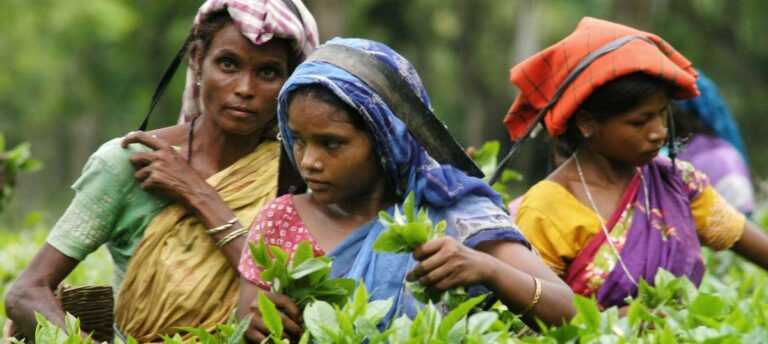
Adivasis in Tea Gardens of Assam: Identity and Denial of ST Status

2

The state of Assam has witnessed a lot of migration over the years, of which some have been enforced by colonial rule. One of these streams of migration is that of the Adivasis of central India, who were forced to migrate to Assam as labour in the tea gardens.

The Tea Gardens of Assam were first established by the British colonial government, who realized that there is a lack of labor to employ in the field. In colonial India, Bengal was an educationally developed place and so, Bengali upper-caste people were brought into Assam and were employed in high government posts. These Bengalis were known as Babus. In Assam, the Bengali Babus employed a few other people from Assam as Sardars. The job of the Sardar was to bring people from Central India and employ them in the tea gardens of Assam. Lakhs of Adivasi people were forcefully brought on ships through the Brahmaputra sea route. The Adivasi people who were brought to the tea gardens would be paid only one paisa for 12 hours’ worth of work. If any person tried to escape or take rest during work hours, they were punished and beaten.

tea gardens of assam
Source: Navrang India

After independence, the ownership of the tea garden went from the British officials to private companies like TATA, Jindal, etc. The situation for the tea garden workers did not remain the same but it became more complex. The Adivasi people who were brought from central India to Assam were a heterogeneous group. Part of this group were people from the Tanti community, which is a Scheduled Caste in Odisha. So, due to these complexities and state politics, the Adivasi community was denied ST status and were instead included int the OBC category in 1970. 

Adivasi Identity, Culture, and language

The Adivasi people who were brought from Central Indian states like Jharkhand, Chhattisgarh, Odisha, etc. belonged to several tribal communities like Santhal, Oroan, Munda, Kharia, etc. During the colonial period, they were employed as unskilled laborers because of the prejudice that the British officials held that Adivasi people do not have brains and only physical strength. So, during that period the people were not known because of their tribal identity but only as laborers, and were labeled as Bagania (tea garden workers).

After Independence, in order to maintain their vote bank among the Upper caste people of the Assamese community and other elite people in Assam the Congress government denied Scheduled Tribe status to the Central Indian Adivasi people. The Congress government labeled the community as ‘tea tribes’. ‘Tea tribe’ is now considered a derogatory term among intellectuals of the Adivasi community. The question that was raised from the community was, how can anyone’s identity be labeled based on the work that they were forced to do by colonial forces? Be it as ‘bagania’ or ‘tea tribes’, the Adivasi people lost their claim over their own identity due to the colonial and the elite-Brahminical forces.

Courtesy: Ahmad Masoon, Reuters

Secondly, they lost their culture, tradition, and language as well. Primary schools in tea garden areas are not maintained by the government but by the tea garden authorities. In primary schools, Adivasi children are not taught any Adivasi languages but they are taught English, Assamese, and Hindi. Slowly, the Adivasi people lost their language and came under the dominant forces of the Assamese language. Over time, like their language, they lost their tradition and culture due to dominant Hindutava dominant forces.

Among Adivasis, there is the culture and tradition of worshipping trees, nature, the sun, and the moon. In the conflict between their worshipping culture and Hindu forces, the Adivasi people were brought under the forces of Hinduism. In many instances, this happened in the process of translations of Adivasi languages into Hindi. For example, while the person who performs worship and devotion is known as ‘Pahan’ it has been translated into Hindi as ‘pujari’.

The introduction of Hinduism has introduced the caste system and the concept of purity and impurity in the Adivasi community as well. Now, generally, the people from the community refer to the tribe and its sects as Jati (caste). The concept of purity and impurity have created hierarchies amongst the Adivasi people. For example, the Oroan community considers itself to be higher born than the Santhals and Doms. The introduction of the caste system has also worsened the status of women. For example, even today, a menstruating woman is considered impure and is locked in one room. In this way, the Central Indian Adivasi people in Assam have lost their culture, tradition, and language and fallen in the net of casteism, where the women are oppressed within their community.

Denial of ST status, land rights, and low wages

The crisis of the workers in tea gardens is very much rooted in three core problems- the denial of ST status, land rights, and low wages. When the Constitution was framed, Adivasi people were brought under the category of Scheduled Tribe in order to uplift them and to make reparations for the historical injustice that has been done to the community. But the tea garden workers who were much behind even the other tribal communities were not given ST status.

Due to the denial of ST status, they have been disadvantaged in many fields like education, employment, etc, and due to the historical injustice against them, it is nearly impossible for them to compete with the people from the General category or Other Backward Classes.

The upper caste people from the Assamese community who have a stronghold in state politics also tried their level best to not provide them ST status, as the Adivasi people are large in number, and if they get ST status, can become a threat for them. Now for decades, they have been promised that they will be provided ST status but no party that has come to power has fulfilled this promise. The issue of ST status has become a mechanism for the political parties to grab votes from the community.

Attempts at Organizing for ST Status

There have been many times when the community’s movement against the government to demand ST status was very strong, but every time the communities became united, the unity was broken by the creation of divisions amongst them. Somehow the politicians were successful in making the people believe that their political organization is dominated by one tribal community and others are getting overshadowed. For example, the people were made to believe that AASA (All Adivasi student’s Association) is dominated by the people from the Oroan tribe which overshadowed the other tribes, especially the Mundas.

The suspicion and the division become so enrooted that AASA got divided and another political party, called Assam Chai Majdoor Sangh, was formed. The division weakened the whole protest for the demand for ST status.

The second time when AASA mobilized people to get united for demanding ST status and Rafel Khujur was an MP candidate from Congress, every Adivasi decided that they will vote for Rafel Khujur and he will fight in parliament for ST status. However, BJP bribed another candidate Pradeep Nag from the Adivasi community to contest against Rafel Khujur. At the end of the election, Pradeep Nag won and the whole demand for ST status was dismantled.

After that, when people organized among themselves recently and organized the protest against the government saying that they will not participate in the election if they are not given ST status under the banner ‘no ST no vote’, the protest was dismantled by the political parties by bribing people in the community with one JIO mobile phone and local Alcohol.

Assam tea garden workers protest
Courtesy: Deccan Herald

The denial of ST status has kept the people of the community away from education and employment. When there is no employment, they move back to the tea garden where they are paid only Rs. 167 which is much less than the minimum wage of Rs. 350. Second, the people are so poor that it is impossible for them to buy land outside the tea gardens. Inside the tea gardens, in the quarters where they live, they do not have any land rights and to ensure that they have land to live on they are forced to join the tea gardens. This lack of land right is responsible for people not moving out and working in the tea gardens even when they are paid extremely low wages. The low payment pushes them into poverty, poverty creates illiteracy, frustration, alcoholism, and violence, and the vicious circle of exploitation and slavery continues. 

Balaka Chattaraj is pursuing her M.A in social work with a specialisation in Dalit and tribal studies at TISS, Mumbai. This article is based on her fieldwork conducted in Assam. For accessing the full report she can be contacted at [email protected].

BJP Leader’s Son Selling Illegally Printed NCERT Books Worth 50 Crores

0

BJP Leader Sanjeev Gupta’s son Sachin Gupta was found to be running a business of illegally printed NCERT books from Meerut, Uttar Pradesh. Nearly 1,50,000 illegally printed NCERT books were found in a raid by a joint team of Military Intelligence, UP Special Task Force, and the local police, from a facility in Kashigaon in Meerut District.

The value of the illegally printed NCERT books is estimated to be around 50 crore rupees. The books catered to all classes starting from class 1. According to some reports, Sachin Gupta also illegally printed boards for Uttar Pradesh State Board. The books were being supplied to many states including Uttarakhand, Delhi, Hariyana, Madhya Pradesh, and Rajasthan. Reportedly, the books were transported in vehicles with BJP flags in order to avoid suspicion.

17 male workers and 5 women workers were apprehended, and the male workers were detained for questioning.

The owner Sachin Gupta fled the factory during the raid and reached his main factory in Mohkampur Enclave near Sabzimandi at Delhi Road and destroyed similar books stored there by burning them. Six printing machines were seized from the main factory by the police team.

Sachin Gupta is BJP Leader Sanjeev Gupta’s son, and in a hoarding found in the Mohkampur printing press, Sanjeev Gupta has been called BJP’s Metropolitan Vice President. Besides the BJP Metropolitan president, many other public representatives have also been included. Sanjeev Gupta is also the Convener of the Gandhi Sankalp Padyatra’s Meerut-Hapur Loksabha.

According to a Live Hindustan report, after this was found by the police, a certain BJP leader had called the Senior Superintendent of Police. The phone call was recieved by the SSP’s Public Relations Officer while the SSP was busy in a meeting. The BJP leader said that he had something very important to talk about with the SSP, but was not able to talk to him. Sources say that the BJP leader had called to speak about this case itself.

Rona Wilson: Fighting for Political Prisoners

Rona Wilson is a research scholar and has worked on the condition of political prisoners, the use of draconian laws such as the Unlawful Activities Prevention Act (UAPA) and other legal conundrums. He has actively campaigned for political prisoners such as Prof. GN Saibaba, Hem Mishra, and others who were arrested for speaking against Operation Green Hunt which was a policy of war waged by the government on marginalized Adivasis in Central India.

Rona got interested in working with political prisoners after being actively involved in the campaign for the release of late Prof. SAR Geelani, a Kashmiri scholar and teacher, who was wrongfully arrested, tortured and subjected to inhuman treatment in the Parliament Attack case.

In fact, upon Prof. Geelani’s acquittal and release, Rona and Prof. Geelani with other activists formed the Committee for the Release of Political Prisoners (CRPP). Rona was the Public Relations Secretary of CRPP and it was through CRPP that Prof. Geelani and Rona involved themselves in Prof. Saibaba’s case and fought for his release.

As a part of CRPP, Rona Wilson organized several conventions against the unconstitutional nature of draconian laws like UAPA, National Security Act (NSA), Armed Forces Special Powers Act (AFSPA), various state-level Public Security Acts (PSA), etc. and against the arbitrary use of the death penalty, a punishment that overwhelmingly targets Dalits and Muslims in this country. CRPP has demanded the implementation of the United Nations Convention on Prisoners and pleaded “to arrange legal assistance to those who are in a disadvantageous position or discriminated against toward receiving a fair trial on account of media projections or the police, military or Government’s undue propaganda”.

Ironically Rona has been made a political prisoner under the same draconian UAPA.

Rona Wilson
Courtesy: Dalit Camera on Youtube

Rona was born in Kollam, Kerala, and lived there until he graduated in Zoology. Then he moved to Puducherry Central University to do his post-graduation in Political Science and International Relations. Thereafter he went to Jawaharlal Nehru University (JNU) where he received his Masters in Philosophy (MPhil). He loves football and closely follows the game particularly of Latin America.

Recently, he was accepted by the University of Surrey and the University of Leicester to pursue his doctorate. The topic of his proposed thesis is “The Fiction of the Muslim Other: State, Law and The Politics of Naming in Contemporary India”. His thesis states that “Islamophobia has been used as an ideology to consolidate the politics of Hindutva by the ruling class in India.”

He was inclined to study the social construction of the Muslim man as a ‘terrorist’. He wanted to understand how the law is used to create a fiction of a militant Muslim man, ‘a terrorist masculinity’, that is then used by an ideological state apparatus to create the quintessential trope of the Muslim ‘other’ amongst the majority of the population while projecting Muslim women as docile bodies that need the protection of the Indian state.

After the arrest, not only has Rona himself been unable to pursue his doctorate studies, but the legal aid that he used to provide has also been curtailed.

Rona Wilson is a human rights activist for life, and his struggle continues within the confines of prison as he knows only too well the cost of being targeted, branded, and denied justice.

This article was originally published on ‘Mumbai Rises to Save Democracy’.

Sudha Bharadwaj: Defender of the People, Nuisance to the State

“The 6th Annual Harvard Law International Women’s Day Portrait Exhibit showcases the astounding contributions of women around the world to the areas of law and policy. The honorees — each of whom were nominated by HLS students, faculty or staff — are powerful voices in their respective fields, whether they are sitting on a high court bench, standing in front of a classroom, or marching in the streets.”

Or whether they are sitting in jail.

Advocate Sudha Bharadwaj is a 2019 honoree of the Harvard Law International Women’s day exhibition and is sitting in a jail cell in Pune. How did these conflicting positions come about?

Sudha grew up to illustrious parents and spent the first part of her life as an American citizen. In the next 30 years of her life, she worked tirelessly in Chhattisgarh Mukti Morcha (CMM) as a trade unionist and eventually as a lawyer after the CMM, hamstrung in their legal battles by unscrupulous lawyers, found in her the courage and integrity needed to challenge powerful opponents in the courtrooms.

She founded Janhit, giving rigorous legal aid to several industrial workers, villages fighting acquisition and mining, Adivasi communities fighting for forest rights, environmental cases, and PIL litigation. Janhit filed cases against powerful industrial houses such as Jindal, Vedanta, BALCO, Lafarge Holcim, D.B. Power, Vandana Vidyut, SECL, Bhilai Steel Plant, Monnet Steel, Adani, Hindalco, Grasim, Ultratech and others.

Sudha Bharadwaj
Courtesy: The Quint

Sudha Bharadwaj was instrumental in rebuilding the group after the arrest and incarceration of its then-President, Dr. Binayak Sen. During this time, she was appointed as the General Secretary of People’s Union for Civil Liberties (PUCL) and worked on issues of human trafficking and attacks on minorities. She also assisted families of victims of human rights violations looked upon as casualties in the conflict zone of Bastar and supported journalists and activists who dared raise their voices and pen against the State excesses in Bastar. She was elected recently as Vice President of the Indian Association of Peoples’ Lawyers (IAPL) and was active in campaigns against attacks on Dalit and human rights lawyers in Chhattisgarh and facilitated an IAPL fact-finding into it.

“If you try to be safe and in the middle, you will never succeed.” – Sudha Bharadwaj, The Wire

Sudha was arrested from her Faridabad home which she was sharing with her daughter, Maaysha. During this time, she was a Visiting Professor at the National Law University Delhi, taking Seminar Courses on tribal rights, land acquisition, and the Fifth and Sixth Schedules. This year she was to have taught “Law and Justice in a Globalising World”. Sadly, and ironically, she can’t teach the class as she is in jail. The loss, the students inform us, is all theirs.

Her daughter Maaysha, has in several letters candidly brought to fore Sudha’s tireless spirit and her commitment to her work, “If fighting for the rights of Adivasis, fighting for workers and peasants, fighting against repression and exploitation and giving up one’s whole life for them is being a Naxalite then I guess Naxalites are pretty good.”

Sudha Bharadwaj
Courtesy: PTI

Guneet Ahuja, Advocate, Delhi, in an open letter, writes about Sudha, “On my first meeting with Sudha ji, I asked her about the competing narratives regarding the condition of indigenous communities in Bastar. Her reply left a deep impact on me: “For a pedestrian on a narrow lane, the car driver is causing the trouble. For the car driver, the pedestrian is the nuisance. Your perspectives change based on where you are placed.”

Sudha is the pedestrian along with all the people she fights for. She believes the road belongs to us. The State is the car that doesn’t want nuisance pedestrians in the way, believes the road belongs to it and wants it lined with the businesses of its cronies. To the  State, Sudha belongs in jail. To us, she is a defender of human rights.

This article was originally published by ‘Mumbai Rises to Save Democracy‘.

Prashant Bhushan and Contempt Laws in Democracies

The Supreme Court has found Prashant Bhushan guilty for contempt for two tweets both of which the Court found ‘undermines the dignity and authority of the institution of the Supreme Court of India and the CJI and directly affronts the majesty of law’. The tweets were also seen by the Court as undermining the ‘the trust and the confidence of the people’ in the ability of the judiciary to ‘deliver fearless and impartial justice’.

By this judgement, the Supreme Court narrowed the protection given to freedom of speech and expression and ignored its own jurisprudence where the power of contempt was to be invoked rarely. Its worth recalling Justice Krishna Iyer’s understanding in Re: S. Mulgaokar, where he wisely observed that, ‘court is willing to ignore, by a majestic liberalism, trivial and venial offences – the  dogs may bark, the caravan will pass.’ However in this case the Supreme Court seems to have ignored Justice Krishna Iyer’s dictum and preferred to see the two tweets as having the effect of shaking public confidence in the administration of justice. This is a puzzling conclusion as Prashant Bhushan’s reply affidavit elaborately documents, the kind of criticism levied by Prashant Bhushan has been levied not just by legal academics and media commentators but also by former judges of the Supreme Court. This thin skinned approach of the Court sits uneasily with other democracies where the power of contempt has been read narrowly by the Courts. In the United Kingdom, Lord Denning observed as follows: “Let me say at once that we will never use this jurisdiction as a means to uphold our own dignity. That must rest on surer foundations. Nor will we use it to suppress those who speak against us. We do not fear criticism, nor do we resent it. For there is something far more important at stake. It is no less than freedom of speech itself. It is the right of every man, in parliament or out of it, in the press or over the broadcast, to make fair comment, even outspoken comment, on matters of public interest’ In the United States, the offence of “scandalizing the court” has been limited in application for several decades. The Supreme Court has made it clear, in a series of cases, that the publication must create a “clear and present danger” to the administration of justice, if contempt is at all to be invoked. In Canada, in the case R V. Kyoto, when a lawyer criticized the decision calling it a ‘mockery of justice and stating that ‘it stinks to high hell’, the Court noted that, ‘Some criticism may be well founded, some suggestions for change worth adopting. But the courts  are  not  fragile flowers  that  will  wither  in  the  hot  heat  of  controversy..’ The Law Commission of Australia disagreed with the core reason why contempt was on the statute books noting, ‘The rationale of the offence, namely, the undermining of public confidence in the administration of justice seems highly speculative and some might say that it is too vague a principle to justify imposing restrictions upon freedom of speech.’

In contrast, the law on contempt has been kept alive in the ex-colonies. In fact nineteenth century case of McLeod v. St. Aubyn, the Privy Council argued that ‘Committals for contempt of court by scandalizing the court itself have become obsolete in this country’ … ‘But it must be considered that in small colonies, consisting principally of coloured populations, the enforcement in proper cases of committal for contempt of court for attacks on the court may be absolutely necessary to preserve in such a community the dignity of and respect for the court’.

It is this colonial legacy of insulating the Courts from criticism which is being continued when the contempt jurisdiction is invoked. Even though the power of contempt is constitutionally recognized, its important that its use should be limited keeping in mind the fact that the Constitution recognizes that Indians today have the freedom of speech and expression. Again it is Prashant Bhushan’s reply affidavit, (which the Court in a failure of due process does not even advert to in its judgment) which painstakingly substantiates the two tweets, letting us know how the Court has failed to perform its constitutional duty. The reason why citizens need to stand up today, is because if we go back to the emergency era, as Prashant Bhushan put it, ‘It is a matter of historical record that it was not the institutions and the erudite and learned people manning them that stood up for the Constitution and its democratic values, but ordinary citizens who fought for their democratic rights.’

Contempt of Criticism: Prashant Bhushan contempt case

The Hon’ble Supreme Court on 14th August held Mr. Prashant Bhushan guilty of criminal contempt for making two tweets:

  • When historians in the future look back at the last six years to see how democracy has been destroyed in India even without a formal Emergency, they will particularly mark the role of the SC in this destruction, and more particularly the role of the last four CJIs.”
  • The CJI rides a Rs 50-lakh motorcycle belonging to a BJP [Bharatiya Janata Party] leader at Raj Bhavan, Nagpur, without wearing a mask or helmet, at a time when he keeps the SC on lockdown mode denying citizens their fundamental right to access justice!

The primary reasons to hold these tweets contemptuous was that they brought disrepute to the administration of justice and undermined the dignity of the Hon’ble Supreme Court of India and the office of CJI.

Contrary to its previous decisions on matters of contempt, this Supreme Court decision clamps down on freedom of speech and expression. Mr. Bhushan’s 134-page reply affidavit was given no weightage in evaluating whether these tweets amounted to fair criticism of the judiciary.

The Law of Contempt in India

If it is this easy to bring disrepute to the highest court and shake people’s confidence in the judiciary then maybe the court isn’t as invincible as it ought to be.

This appalling judgement restricting freedom of speech and expression nudges us to unravel the idea behind the law of contempt in India. This concept is heavily influenced by the law of contempt in England. In the 12th century England, the king was the supreme power in resolving disputes.[1] It was he, who established courts to resolve disputes which were endowed with the same authority. Questioning the authority of the king or the court and scandalizing it amounted to contempt.

Contempt of court in a modern democracy derives its authority from the rule of law.[2] One crucial aspect of the rule of law is the independence of the judiciary. For this independence, a court must have the power to vindicate its own dignity and enforce obedience to its mandates. Article 129 of the Constitution of India and The Contempt of Courts Act, 1971 aims to protect the supremacy of the judiciary and people’s faith in it. Ironically enough, the act of England that laid down the foundation of criminal contempt in India was abolished in 2013, owing to its obsolete nature. Why this Act continues to be in force and widely used in India is a lingering question.

India continues to criminalize scandalizing of the court as ‘criminal contempt’. There are no specified criteria of what amounts to ‘scandalizing authority of the court’. Absence of which allows the courts to have a free hand in interpreting the term subjectively (read arbitrary action). It was this freehand that gave the power to the court, to call its criticism – contempt.

All bonafide opinions about the judiciary are well protected under Article 19(1)(a) as fair criticism and cannot be held as contempt as long as they do not cause imminent danger to the administration of justice or bring the institution into disrepute.[3] Mr. Bhushan’s statements do neither. If it is this easy to bring disrepute to the highest court and shake people’s confidence in the judiciary then maybe the court isn’t as invincible as it ought to be.

Did the Supreme Court go wrong?

On July 22, the bench headed by Hon’ble Justice Arun Mishra issued contempt of court notice to Mr. Bhushan in a ‘suo moto’ case regarding two tweets mentioned before. In the same breath, the court found these tweets prima facie contemptuous.

In deciding whether both the tweets were ‘scandalous’, the considerations taken by the court were the surrounding circumstances, scandalous nature of the tweets, the stature of the contemnor, and the extent of the publication of the tweet.

Although, the primary considerations in determining whether an act is ‘scandalous’ ought to be, “Whether the reflection on the conduct or character of the judge is within the limits of fair and reasonable criticism, and whether it is a mere libel or defamation of the judge, or amounts to a contempt of court. lf it is a mere declamatory attack on the judge and is not calculated to interfere with the due course of justice or the proper administration of the law by such court, it is not proper to proceed by way of contempt.”, as held in Brahama Prakash case[1].

Both the tweets, at best, can be contested to be a declamatory attack on the judge/s without interference with the due course of justice. For the same reasons of non-interference with the administration of justice, the Law Minister P.N Dua was held not guilty for criminal contempt.[2] While deciding the matter, the Supreme Court recognized the inability of the courts of law to deliver quick and substantial justice to the needy and urged that the judiciary searches for light inward. Departing from this magnanimity, the court turned a blind eye to the substance of the criticism which should have been at the center of this decision.

The tweets did not substantially interfere with the due court of justice, hence cannot be punished for contempt[3]. In 2000, it was held, “It is not enough that there should be some technical contempt of court but it must be shown that the act of contempt would otherwise substantially interfere with the due course of justice which has been equated with “due administration of justice”.[1]

The first tweet is limited to the action of the judges. Judge and justice cannot be understood interchangeably while determining contempt. The distinction made is,

“…the keyword is “justice”, not “judge”; the key-note thought is unobstructed public justice, not the self-defense of a judge; the corner-stone of the contempt law is the accommodation of two Constitutional values-the right of free speech and the right to independent justice. The ignition of contempt action should be substantial and mala fide interference with fearless judicial action, not fair comment or trivial reflections on the judicial process and personnel.” [2]

The Supreme Court’s disregard of the 134-page affidavit points to the court’s failure to evaluate the truth of the second tweet. The second tweet was explained in the same affidavit giving factual bloopers of the preceding 4 CJI’s. In the array of heavily critiqued judgments, this criticism is surely warranted for.

For all these reasons, the Hon’ble Supreme court did go wrong.

Is the identity of the contemnor inconsequential?

The court’s emphasis on Mr. Bhushan’s 30 years’ experience and knowledge in the field of law, to determine the contempt in his tweets is baseless. The focus on his identity for an opinion that is the common perception of a section of the society leads to the question, are all those who publicly share his opinion also going to be held guilty of contempt by the court?

This calls our attention to the observation of Retd. Hon’ble Justice Khehar while deciding the case of Justice C.S Karnan,

“The task at our hands is unpleasant. It concerns the actions of a Judge of a High Court. This should never happen. But then, in the process of administration of justice, the individual’s identity is clearly inconsequential. This Court is expected to record its conclusions, without fear or favor, affection, or ill-will.”[3]

The targeted prosecution of an eminent lawyer based on his identity is a direct attack on free speech with the intention to instill fear amongst lawyers scrutinizing the functioning of the judiciary.

References: 

  1. Ronald Goldfarb, The History of the Contempt Power, 1961 WASH. U. L. Q. 1 (1961), Available at https://openscholarship.wustl.edu/law_lawreview/vol1961/iss1/6, pg 7-8.
  2. In Re Arundhati Roy, AIR 2002 SC 1375.
  3. P.N. Dua vs. P. Shiv Shanker and Ors., AIR 1988 SC 1208 – “29. Bearing in mind the trend in the law of contempt as noticed before, as well as some of the decisions noticed by Krishna Iyer, J. in S. Mulgaokar’s case (supra) the speech of the Minister read in its proper perspective, did not bring the administration of justice into disrepute or impair administration of justice. In some portions of the speech the language used could have been avoided by the Minister having the background of being a former Judge of the High Court. The Minister perhaps could have achieved his purpose by making his language mild but his facts deadly. With these observations, it must be held that there was no imminent danger of interference with the administration of justice, nor of bringing an institution into disrepute. In that view, it must be held that the Minister was not guilty of contempt of this Court.”
  4. Brahama Prakash Sharma v. U.P., 1953 SCR 1169.
  5. P.N. Dua vs. P. Shiv Shanker and Ors., AIR 1988 SC 1208
  6. Sec 13 (a) “No court shall impose a sentence under this Act for a contempt of court unless it is satisfied that the contempt is of such a nature that it substantially interferes, or tends substantially to interfere with the due course of justice.
  7. Murray & Co. v. Ashok Kr. Newatia, AIR 2000 SC 833.
  8. Shri Baradakanta Mishra v. The Registrar of Orissa High Court & Anr., AIR 1974 SC 710.
  9. In Re: Hon’ble Justice C.S. Karnan, AIR 2017 SC 3191.

Lawyers Protest Against Prashant Bhushan Verdict Outside Bangalore City Civil Court

0
Lawyers from the Indian Association of Lawyers and All India Lawyers Association for Justice stood in protest outside the City Civil Court in Bangalore in solidarity with Prashant Bhushan and in order to condemn the Supreme Court verdict that held him guilty of contempt of the Court.  This is one of many demonstrations and protests across the country, where lawyers have been standing up against the decision of the court, in solidarity with Prashant Bhushan, in order to defend the right to free speech, the right to reasonably criticise the judiciary, and the right to demand transparency and accountability from the Supreme Court and the system of law.      Prashant Bhushan is a well known Public Interest Lawyer in the Supreme Court of India and an activist. Bhushan had posted two tweets, one about the Supreme Court on June 27 and the second about the Chief Justice of India Sharad Arvind Bobde on June 29. On July 22, the top court had issued a show-cause notice to Bhushan after initiating the suo motu criminal contempt against him for his two tweets. The first tweet, reproduced in the court, said: “When historians in the future look back at the last six years to see how democracy has been destroyed in India even without a formal Emergency, they will particularly mark the role of the SC in this destruction, and more particularly the role of the last four CJIs.” The second tweet said: “The CJI rides a Rs 50-lakh motorcycle belonging to a BJP [Bharatiya Janata Party] leader at Raj Bhavan, Nagpur, without wearing a mask or helmet, at a time when he keeps the SC on lockdown mode denying citizens their fundamental right to access justice!” Recently, 1,500 lawyers across the country wrote to the Supreme Court saying that the tweets did not qualify as contempt of court.  In a statement made to the Supreme court today, Prashant Bhushan wrote that his tweets represented his bonafide beliefs, the expression of which must be permissible in any democracy. Expressing that he was pained to have been misunderstood but refusing to apologize for beliefs that he still holds, he wrote, “Public scrutiny is desirable for the healthy functioning of the judiciary itself”, he wrote.  Prashant Bhushan protest  

Bhim Army Chief Chandrashekhar Aazad Arrested by UP Police

0

Bhim Army Chief and leader of Azad Samaj Party Chandrashekhar Aazad was arrested by the UP police yesterday while he was on his way to meet the family of Satyamev Jayate, a Dalit village head who was killed by upper castes in Azamgarh, UP. Along with him, around 400 people who were accompanying him have been arrested as well. 

When Chandrashekhar Azad arrived at Azamgarh to meet the family along with 400 others, the police stopped him at the border of Azamgarh under the jurisdiction of Atraulia police station at the Lohra Tol Plaza, and didn’t allow him to enter. As a result, he began a dharna at the border itself. The dharna went for about 3 hours, and at around 7 pm, everyone was arrested. 

https://twitter.com/BhimArmyChief/status/1296399699537047552

Satyamev Jayate was murdered on the eve on Independence Day in Azamgarh, and is survived by his joint family of 30. His elder brother held 4 youth responsible for the murder, named Shreyansh Kumar Dube, Vivek Singh aka Golu, Vijendra Singh aka Gappu, and Wasim. In the days leading up to the murder, Shreyansh Kumar Dube had asked Satyamev Jayate for a character certificate. Since Dube’s father had asked him to refuse, he had said no. Dube came to his house many times to argue about this. 

Two days before the murder, he had arrived drunk at Satyamev Jayate’s house and using verbally abusive language, had threatened to kill him. On August 14, he called Satyamev Jayate out saying that someone from the village was calling him and drove him to the scene where they had already arranged for a shooter. The shooter shot and killed Satyamev Jayate. While villagers were protesting following his death, the police lathi-charged on the crowd, and in the chaos that followed, a child came under the wheels of a police vehicle and died. According to Satyamev Jayate’s niece, some people have been coming to the village and threatening them saying that only one murder has taken place, but nine are yet to come. 

Before Chandrashekhar Aazad, the Azamgarh police also stopped members of opposition parties from entering the area, including Ajay Kumar Lallu, President of the Uttar Pradesh State Congress Committee, the MP P.L Puniya, and Maharashtra Cabinet Minister and Chairman for SC department of All India Congress Committee, Nitin Raut, who has also been arrested. 

Peepli (Live!): Poverty Without Causes

Farmer suicides, or the economic condition of farmers broadly, has not been a subject of popular interest in the Bollywood film industry. Films like Mother India (1957), Ganga Jumna (1961) and Upkaar (1967) dealt with issues like rural poverty and exploitation of the peasants by zamindar and moneylenders. Peepli Live is a recent exercise in exploring farmer’s issues in Hindi cinema, directed by Anusha Rizvi and Mahmood Farooqui, and produced as a “cinema of concern” by Aamir Khan within mainstream Bollywood cinema.

The protagonists of the movie are Natha and Budhiya, who consider committing suicide in order to avail the compensation of 1 lakh from the government to repay their bank loan. As the news gets picked up by the local newspaper, and spreads to national news channels as well, it is sensationalised by the media and their plight becomes a new game in the hands of those in power. The film unfolds like a hard-hitting satire that casts a gaze over a range of ‘real issues’ bothering ‘real people’ in contemporary India: the pathetic condition of rural economy, the ever-growing rural-urban divide, vote-bank politics, a political class that is not really bothered about the poor farmers, and the corporatised media houses owned by political parties and lusting for TRP.

A couple of brilliant scenes capture the futility of the development mechanism that India has adopted. In one scene, a local official is seen to be gifting Natha a ‘Lal Bahadur’ (read hand pump), without providing him the means to install it. Not surprisingly, the hand pump is left unused in the courtyard and soon becomes a play thing for the kids. In another scene, Natha is being gifted a colour television, that would remind one of Marie Antoinette saying, ‘If they don’t have food, let them have cake!’ In yet another scene, one finds officials running their heads through an array of official documents concerning the ‘garibi hatao’ schemes, only to realise that nothing addresses the specific issue of farmer suicides (TOI, 2016).

The film gains points in portraying the true rustic character of its protagonists through the cast that it employs, but the authenticity is limited to their accent and non-verbal gestures. The focus of the film does not revolve around the protagonist and his family, and deliberately ignores the intimate familial dynamics. As a result, it exhibits concern for a certain section of the society without identifying with them. The audience is overtly made aware that the rural protagonists belong to a different world, and therefore, the agrarian crisis seems like a myth. The agrarian crisis should be understood and therefore analysed as a multi-layered complex structural failure stemming from corporatisation of agriculture, industrialisation, privatisation and liberalisation, economic destabilisation and hence, deprivation in the rural agricultural sector. These capitalist processes often have state sanctions, wherein the state becomes the violent architect of large scale migrations and farmer suicides.

One can find some critique of the media and our political system herein, but the film fails to provide an insight into the politics behind agricultural subsidies, indebtedness and suicides. Peepli Live claims to be politically driven, but does not scratch below the surface of the complex web of agrarian crisis, and therefore its reception presents a “pseudo-liberal aura of political consciousness, intellectuality and morality”. The fact that the film does not really critique state policies, or the corporate houses, and like always downplays the role of caste and class dynamics in a typical rural setup in India, reflects on the class and corporate interests that it is probably catering to.

Peepli Live is non-committal and deceptive in its approach towards rural indebtedness, unlike movies like Mother India and Upkaar. This can be attributed to the fact that corporatisation of the economy has increased mobility and diversified capital usage, that was not present in the 1950s and 1960s. Earlier, films could be produced independently, unlike now when production is dependent on other benefactors of the economy as well, especially those attacked in such movies (e.g., moneylenders, landowners, etc.).

If the film had dealt with the incapacity of corporates as a reason behind indebtedness, or micro-finance as a severe usury, it would have had a better impact. But needless to say, that could have disturbed certain financing agencies for the next ‘socially concerned’ movie, and even the big corporate houses. Hence, Peepli Live has tactfully avoided the two most probable causes for rural indebtedness, and also depicted that very little can be done on a structural level to address this grave matter.

Despite several reports showing high correlation between farmer suicides and the caste/ class the farmer belongs to, none of this seems to be challenged in the film. Another important aspect that has been trivialised much is the issue of massive migration of farmers to the cities in search of better livelihood options, away from the vicious cycle of drought, indebtedness and deprivation. One finds Natha as a construction worker in Delhi in the closing scene, but there exists no critical insight as to how he ended up there. The audience is made to believe that it is an escape from the intrusive media. The satire, hereby, turns into a mere caricature of a deprived rural agrarian life, and the political issue becomes camouflaged behind a circus orchestrated by political leaders and the media.

Though one cannot critique a film on the lines of how it should have better portrayed the storyline, Peepli Live recognises itself as humanist, and quite intentionally evades the political and economic issues at play. Indebtedness followed by suicide is viewed from a humanist point of view, and the numerous economic causes that force farmers to take loans and opt for alternate cropping patterns are largely ignored. The film, in an attempt to realistically represent a political satire, ends up making a mockery of a situation as grave as farmer suicides.

Prashant Bhushan: Open criticism of Institutions is necessary in a democracy

Senior advocate and activist Prashant Bhushan on Thursday told the Supreme Court that he was “pained” that the bench had held him guilty of contempt. He reiterated that the two tweets in question were an expression of his beliefs and that open criticism is required in a healthy democracy. A bench of Justices Arun Mishra, B.R. Gavai and Krishna Murari had held Bhushan in contempt for two tweets – one about Chief Justice of India S.A. Bobde riding a motorcycle without a mask during the pandemic and the other about the perceived deterioration in India’s democracy and the role of six former CJIs – on August 14. Thursday morning was the sentencing hearing for the case. Senior advocate Dushyant Dave, appearing for Bhushan, had said that the sentencing should be postponed until he has filed a review and it has been decided on. The bench disagreed, but Justice Mishra said no punishment would begin before the review process was complete. “‘We will be fair to you, whether or not you are fair to us,” the judge said. After Bhushan’s lawyers had argued in his defence, holding that his tweets should not be regarded as contempt at all, Justice Arun Mishra offered to give Bhushan a few days’ time so he could “rethink his statement”. The judge also said that Bhushan’s pro bono work was admirable and would work in his favour during sentencing. After Bhushan’s lawyers had argued in his defence, holding that his tweets should not be regarded as contempt at all, Justice Arun Mishra offered to give Bhushan a few days’ time so he could “rethink his statement”. The judge also said that Bhushan’s pro bono work was admirable and would work in his favour during sentencing. The Supreme Court’s decision to hold Bhushan in contempt has been widely criticised by retired judges of the Supreme Court and high courts, lawyers, politicians, members of the civil society and others. It is being seen as an attempt to quash reasonable dissent.

Also Read: Bangalore: Lawyers Protest Against SC Verdict on Prashant Bhushan

Following is the Prashant Bhushan full statement to the court- I have gone through the judgment of this Hon’ble Court. I am pained that I have been held guilty of committing contempt of the Court whose majesty I have tried to uphold — not as a courtier or cheerleader but as a humble guard – for over three decades, at some personal and professional cost. I am pained, not because I may be punished, but because I have been grossly misunderstood. I am shocked that the court holds me guilty of “malicious, scurrilous, calculated attack” on the institution of administration of justice. I am dismayed that the Court has arrived at this conclusion without providing any evidence of my motives to launch such an attack. I must confess that I am disappointed that the court did not find it necessary to serve me with a copy of the complaint on the basis of which the suo motu notice was issued, nor found it necessary to respond to the specific averments made by me in my reply affidavit or the many submissions of my counsel. I find it hard to believe that the Court finds my tweet “has the effect of destabilizing the very foundation of this important pillar of Indian democracy”. I can only reiterate that these two tweets represented my bonafide beliefs, the expression of which must be permissible in any democracy. Indeed, public scrutiny is desirable for the healthy functioning of the judiciary itself. I believe that open criticism of any institution is necessary in a democracy, to safeguard the constitutional order. We are living through that moment in our history when higher principles must trump routine obligations when saving the constitutional order must come before personal and professional niceties, when considerations of the present must not come in the way of discharging our responsibility towards the future. Failing to speak up would have been a dereliction of duty, especially for an officer of the court like myself. My tweets were nothing but a small attempt to discharge what I considered to be my highest duty at this juncture in the history of our republic. I did not tweet in a fit of absence mindedness. It would be insincere and contemptuous on my part to offer an apology for the tweets that expressed what was and continues to be my bonafide belief. Therefore, I can only humbly paraphrase what the father of the nation Mahatma Gandhi had said in his trial: I do not ask for mercy. I do not appeal to magnanimity. I am here, therefore, to cheerfully submit to any penalty that can lawfully be inflicted upon me for what the Court has determined to be an offense, and what appears to me to be the highest duty of a citizen.
