National Unemployment Day on PM Narendra Modi’s Birthday

3

Prime Minister Narendra Modi’s birthday today is being celebrated by the people of the country as ‘National Unemployment Day’. After the recent protests held for ‘5 minutes at 5 pm’ on September 5, and ‘9 minutes at 9 pm’ on September 9, the people of the country are protesting for 17 minutes at 17:00 hrs today, on September 17.

#NationalUnemploymentDay and #राष्ट्रीय_बेरोजगार_दिवस (National Unemployment Day) have both been the top trending hashtags on Twitter today as protestors express their views about the complete failure of the economy under the current government.

This is part of a recent wave of opposition to the Modi government, with the youth at the forefront, where thousands of people are expressing their discontent with the government. The government’s recent decision to conduct various exams in spite of widespread opposition and appeals from students began this wave a discontent, that has been further solidified by the effects of the massively mishandled pandemic, the record fall in the GDP of 23.9 percent, rising unemployment and inflation, and large-scale privatization.

According to a report by Koustav Das on India Today, over 18.9 million salaried individuals or 21 per cent of the overall workforce had lost their jobs due to the pandemic as of July. Currently, 1 in every 10 people living in urban areas does not have a job. According to another report by Anand Patel, The National Sample Survey Office’s (NSSO) job survey for 2017-18 had shown a spike in the unemployment rate to over 6 per cent, the highest in 45 years, but the report was not released by the government, which termed it as a draft report. For the first time, there has been a huge reduction in regular salaried jobs as well, hitting the middle class more than before.

And yet, the government has turned a blind eye to the massive financial crisis looming in front of the country, choosing instead to focus on corporates and their profits. Amit Bhaduri writes,

“No matter lockdown or pandemic, the government changes labor and environmental laws to help the industry. It gave them tax break in terms of foregone government revenue which is almost double the money it spends today on MGNREGA…

The government is not interested in the economy. Instead, the government is interested in protecting and augmenting the fortune of its selected group of industrialist friends who in turn would help it in times of election.”
This irreverent expression of dissent on the birthday of the Prime Minister himself by such large numbers of people, unaffiliated with any groups, in the middle of a pandemic, would have been unthinkable even a few months ago, when Modi was still seen as an infallible, supreme, leader. The BJP IT cell is falling behind, and the will of people is making itself unapparent against the inhumanity of this government.

Karnataka BJP Rajya Sabha member Ashok Gasti Critical

0

Bengaluru: Ashok Gasti of the ruling party who was newly inducted as a Rajyasabha member just three months ago was diagnosed to be COVID-positive and in critical condition.

Reports of the death of Ashok Gasti have been circulating since evening today with several BJP members giving condolences on his untimely death on twitter. The news soon got viral and most news outlets published the same news of his “death”.


Soon, the BJP Karnataka cell on twitter confirmed that Asok Gasti is alive but in critical condition.

The BJP Karnataka twitter handle stated- There are reports in media about Asok Gasti´s ill health. He is still getting treatment in the hospital and the party unit prays for his rebirth.

Ashok Gasti is admitted to a hospital in Bengaluru after he was tested positive for COVID-19 a fortnight ago. Hailing from Raichur district in Karnataka, Gasti is a lawyer by profession and belongs to the Savita (Barber) community.

He took oath as a member of the upper house very recently but unfortunate that he could not participate in his first-ever parliamentary session as its member. He had served as chairman of the Backward Class Commission. At a time when political heavyweights were lobbying for getting nominated to the Rajya Sabha, the party recognizing the grass-root level worker and loyalist have elected him to the upper house.

Also Read- Pramod Muthalik founder of Sri Ram Sena gives communal colour to Mandya Murders

More than a Thousand Remain Prisoned Despite Completion of their Sentence

0

Every year, the National Crime Records Bureau makes the statistics of inmates in different jails of the country public. The NCRB’s report Prison Statistics in India contains almost all the statistics related to the prisoners. But in response to a question posed by Phulo Devi Netam in Rajya Sabha, the government gave an interesting answer. Netam asked the government to give data of the detention of prisoners 1) imprisoned in excess of the jail’s capacity 2) whose sentences have been halved 3) who have been sentenced to full punishment and 4) under consideration.

In response, Minister of State for Home Affairs Kishan Reddy released the data till 31 December 2019. According to these, the total capacity of inmates in the country’s jails is 4,03,739. But, there are 4,78,600 inmates, so 74,861 are imprisoned in excess to the capacity.

The states with overcrowded jails include Arunachal Pradesh, Assam, Chhattisgarh, Gujarat, Haryana, Himachal Pradesh, Jammu and Kashmir, Jharkhand, Karnataka, Kerala, Madhya Pradesh, Maharashtra, Meghalaya, Mizoram, Punjab, Sikkim, Uttar Pradesh, Uttarakhand, West Bengal, Daman-Diu and Delhi. In 14 states and union territories (UTs), the number of prisoners is below capacity.

More than a thousand prisoners in jail despite completion of the punishment

The Government also replied that 1,031 people in the country have completed their sentences but are still in jail. They are unable to pay the imposed fine and thus aren’t let go. Only 12 states and UTs don’t hold prisoners who finished their sentences.

The highest number of such prisoners are in Uttar Pradesh (192 prisoners). This is followed by Mizoram (114), Kerala (111), Assam (104), Madhya Pradesh (78), Punjab (67) and Rajasthan (66).

More Inmates Under Consideration than Guilty

Government statistics show that a large number of prisoners in jails aren’t convicted; of a total of 4,78,000 inmates, 3,30,000 are under consideration. That is, they haven’t been proven guilty.

Also Read: Dalits, Adivasis, Muslims Overrepresented in Prisons: NCRB Data

Loan repayments Extorted from Poor as the Corporates Go Free: Protest in Bihar

0

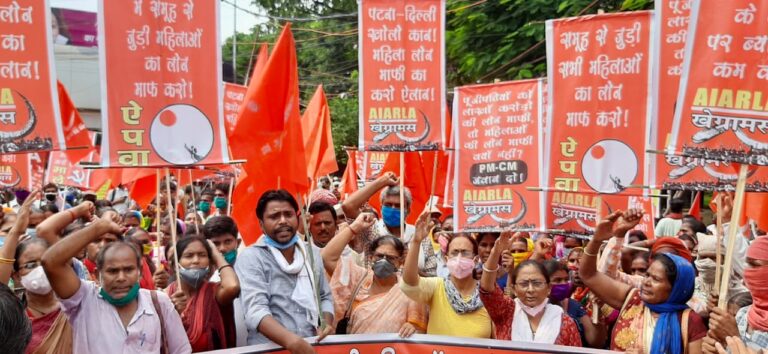
Farmers, workers, and women came out in protest in Bihar on September 15 against the economic exploitation of marginalized people during the lockdown and the insensitivity shown by the banks to the poor.

Ever since the beginning of the pandemic and the lockdown, the working class have found themselves in severe distress. Not only has the government not provided any relief to them, but instead has continued to collect debt repayments from self-help groups, even as big corporates are being exempted from loan repayments.

In order to oppose this, CPI(ML), AIARLA and AIPWA called for a nationwide protest on September 15. Thousands of women took to the streets in UP and Bihar to protest.

Apart from Patna in Bihar, thousands of rural women came out in protest in Bihar, on the streets in Siwan, Darbhanga, Samastipur, Jehanabad, Ara, etc, and demanded a stop to the extortion of small loans by microfinance companies.

Protestors raised slogans demanding that the interest rate be reduced to half, that interest on interest be stopped, that loans taken by women’s self-help groups be forgiven, and questioning why women’s loans are not being forgiven even though capitalists are getting loan waivers worth lakhs of crores of rupees.

The protest march in Patna was stopped at the radio station, where protestors brought up the issue of widespread unemployment and starvation, due to work being shut for the past 5 to 6 months and a complete lack of income. Although the Prime Minister had announced a scheme for employment, there is no certainty about whether that will come to fruition. Even education of poor children has been halted for six months. Expenses like electricity bills are continuing as before. In such a situation, without any livelihood, how are women’s groups to repay the loans they had taken before the pandemic?

After the immense crisis created by the lockdown, poor and marginalized communities across the country are being forced to come out on the streets to protest even during a pandemic. This shows that the people have had enough of the government’s complete neglect and inhumanity towards its own people.

Originally reported by Janchowk. 

Kannada gets its first Anti-caste Rapper: Harish Kamble

Harish Kamble, a young music enthusiast from Karnataka has taken the social media platform by storm with his unique piece of musical art. Harish makes rap songs that critique the prevalent caste system, injustice, inequality, atrocities against marginalized and suppressed classes. He is the first-ever hip-hop rap music artist in Kannada who sings songs debunking caste. The anti-caste rapper uses his poetry and unique art as a weapon, in a three-minute musical video challenging the upper classes to give up caste-based discrimination before questioning reservation while pitching for the establishment of an egalitarian society: “You first stop discriminating against people on the basis of caste and religion, then we will give up reservation.” In the music video called “Jati” ( caste) Harish talks about how caste system keeps the society backward and puts lower caste people at a disadvantage.
Harish Kamble, the young musician and a social activist hails from a peasant family in Hatyal village located in the historically significant Basava Kalyan in Bidar district in North Karnataka. A science graduate, Harish ekes out a living working as a teacher. Now in his mid-twenties, Harish developed a passion for writing poetry during his college days. He enjoys reading books of historical icons like Buddha, Basava, Ambedkar who strived for humanity.

Also Read: Pariyerum Perumal (2018): Can Love Bloom in Caste Ridden Society?

Many young budding writers focus to write on romance, land, water, and other issues but Harish decided to speak his heart. Young Harish has chosen the Bandaya (Rebel) genre regarded as progressive literature to express his thoughts and his latest experiment in fusing this literature to modern rap music is quite impressive. Harish says, he aspires to recall, revamp the Vachana movement giving it with the modern touch and contributing his bit. Vachanas are the writings in Kannada that evolved in the 11th century CE as part of the Sharana Movement fought superstition and brought awareness to mankind. The budding artist first uploaded his first rap song on social media last year platform but it is during the pandemic that his video is getting a lot of appreciation. He has also got opposition and threatening calls from people who do not like the critique of the caste system. Speaking to gaurilankeshnews.com, Harish termed the attack on the rights of people as detrimental to the very essence of the constitution. He also stressed on the need for youth to become aware to secure the democracy, secular credential at a time when caste, religion-based intolerance is gaining strength. His other musical piece “Mahamari Kathe” the young musician has tried to unveil the distress of the poor people due to the anti-poor policies of the government, particularly during the present ongoing COVID 19 pandemic. “Rajaneeti” his other hip hop is in the making and would be soon released he reveled. Harish is of the firm opinion that evils like caste-based discrimination, untouchability would not end by just adhering to ‘sahapankti bhojana’ (an inter-caste shared meal) and stresses for complete inclusiveness. He also said that opposition raised against the telecasting of ‘Mahanayak’ the popular Kannada serial on the life of visionary Dr. Ambedkar was very unfortunate and hope that people opposing would mend their approach. Although rap song is not popular in Kannada, Harish has developed expertise in the art form on his own, which highlight his innovative skills. He also aspires to carve a niche in the small screen and cinema industry if an opportunity comes. Harish says- “Racial discrimination in America led to the birth of rap and Hip hop in America and this art form subsequently gained popularity in the rest of the world. Youths have a major inclination towards this art form and there is a growing demand for rap songs including in India which is no exception.
Pramod Muthalik founder of Sri Ram Sena gives communal colour to Mandya Murders

0
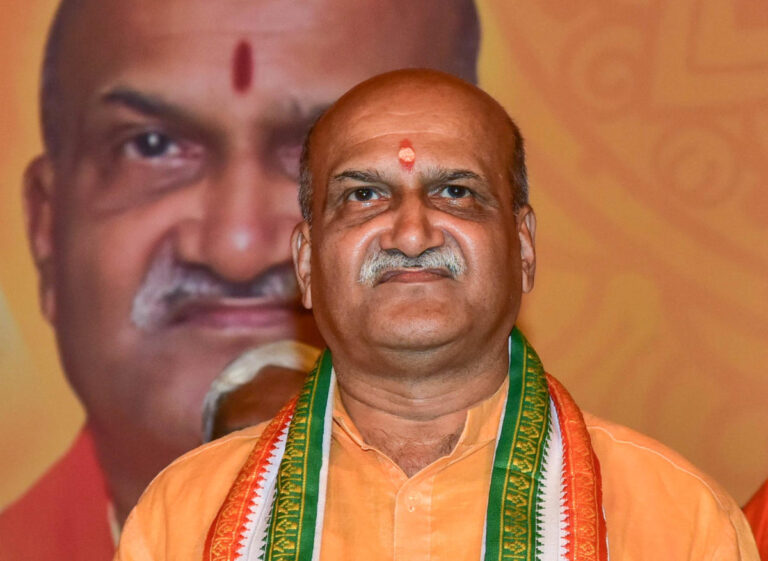
Mandya, Karnataka: Hindutva protagonist and Sri Ram Sena chief Pramod Mutalik has tried to give a communal colour to the murder case of three priests in Mandya district. A murder case was reported at the Arakeshwar temple recently at Mandya in connection to which the jurisdictional police have arrested five persons out of which three were nabbed on Monday. According to the police statement, all arrested belong to the majority community and the murders were committed for money. Police have arrested two people earlier and have recovered 1.25 lakh while nine-persons are suspected to be involved in the murder case. Despite the fact that five-person arrested are all belonging to the majority community, evidence of the loot and police statement Pramod Muthalik is trying to make it a communal colour.

Also Read:Veteran Tulu Theatre and Film Artist Arvind Bolar forced to Apologize to VHP

Based on the prima facie evidence it looks like it was murder for money as the donation box had been looted. Mutalik says the three murders might not have occurred merely to loot the donation box and said by giving statement that Islamic Jihadists were involved in this murder and demanded a thorough inquiry into the incident. He also fumed over the defunct close circuit cameras in the temple and urged action against the concerned officials of the archeological department while demanding their immediate suspension.

The murders 

Ganesh, Prakash, and Anand who were working as priests and security personnel were in the temple had been murdered in the temple premises while they were asleep at early hours on 11th Sept 2020. The incident had come to light only when devotees visited the temple in the morning. The police have arrested five-persons including Manju of Toppanhalli, Vijay of Andhra Pradesh, and Chandru alias Gandhi of Arekal Doddi. Police had to resort to firing as the accused trio allegedly tried to attack and escape when police tried to nab them. They have now been admitted to Maddur taluk hospital and subsequently shifted to district hospital.  A day after the incident, Police arrested two people and recovered 1.25 lakh while nine people are suspected to be involved in the murder case. Superintendent of Police K Parashuram has appreciated the police personnel for the action in nabbing the accused culprits. Speaking to Gauri Lankesh News Parashuram clarified that murders were the handy work of a professional gang that is involved in robbery and looting. Parashuram outrightly ruled out the allegations of the jihadist angle made by Pramod Mutalik. Further investigations will however put more light on the incident.

Pramod Muthalik and Sir Ram Sene

A Bajrang Dal member in his early life, he formed the Karnataka unit of the Shiv Sena after being expelled from Bajrang Dal. He quit Shiv Sena over the Belgaum border dispute and then formed Sri Ram Sena. He joined Karnataka BJP in 2014 but was forced to quit the party amid widespread criticism and protests from other members He contested the 2014 Lok Sabha elections as an Independent Candidate from Bangalore South and Dharwad constituencies in Karnataka but lost both. Sindagi Flag hoisting: It is not the first time Muthalik has made attempts to incite communal flare-up and had raised a range of bogies against imagined jihadi groups in the past. The pro-Hindu organization had raised hue and cry over the Sindhagi flag hoisting incident in which the perpetrators later turned out to be a member of Sri Ram Sena.  Pramod Mutalik later disowned the accused Parashuram Waghmore and said the latter belonged to RSS. He was later acquitted in the flag hoisting case. Parashuram Waghmore is also one of the main accused in the Gauri Lankesh murder case. Hubli court blast: Nagaraj Jambagi, mastermind of the Hubli court blast was a personal assistant to Pramod Muthalik. The former who faced charges of planting a bomb under the Venkatapur Bridge near Dharwad was murdered in a well-planned conspiracy by his own associates in jail premises. Muthalik associates have such a notorious history. Mangalore Pub Incident: Pramod Muthalik and his organization came to national limelight when in 2009, the Ram Sena men led an attack on a Mangalore pub, where women were beaten and manhandled. Muthalik defended the attack saying that girls going to pub was against Indian culture. In 2018, he along with 24 others were acquitted by the court from the charges related to the 2009 Mangalore pub attack.

Kunal Kamra Speaks Up on Umar Khalid’s Arrest under UAPA

On Monday, former Jawaharlal Nehru University student leader Umar Khalid was arrested by the Delhi Police Special Cell under the Unlawful Activities (Prevention) Act (UAPA) for his alleged role in the Delhi riots. Khalid’s arrest had been met with an outcry from people online under the hashtag IStandwithUmar. This includes stand up comedian, Kunal Kamra.   Kamra wrote,

“Last we spoke, he told me that they have been intimidating powerless people who were close to Umar & the Delhi police is forcing them to testify against them. He laughingly said that every night I hit the bed thinking this could be the last night I spend at home. I think his merit was decided at his birth….

I have never felt this feeling of helplessness & anger because there’s no grey area (sic), another side, a possible doubt in my mind which makes me think he did something wrong for which he deserved to be jailed under UAPA….My conclusion is politics is not a place for people like Umar.”

Khalid is one of the many students, Muslim activists, academics, and journalists who had been peacefully protesting against the CAA and NRC. State forces have now framed many of them as the inciting forces for the Delhi Riots (which many refer to as an “anti-muslim pogrom”). This is part of a pattern where victims of riots and activists who spoke against it are being falsely implicated through UAPA. This includes Safoora Zargar, Pinjra Tod activists Devangana Kalita and Natasha Narwal, and Sharjeel Imam. Meanwhile, the police haven’t attempted arresting BJP member Kapil Mishra who incited violence against peaceful protestors, especially Muslims, by saying “Goli maron salon ko!” (“Shoot the bastards!”).  Besides the Delhi Riots, police also arrested members of the Kabir Kala Manch, Jyoti Jagtap, Sagar Gorkhe and Ramesh Gaichor in the last. However, anti-caste activists criticised Savarna leftists and liberals for lack of support. Besides Kamra, entertainers such as Prakash Raj and Shehla Rashid have also spoken in favour of Khalid, and against UAPA.

Also Read: Neither Kapil Mishra nor Anurag Thakur! In Tahir Hussain media has found the convenient scapegoat


Harry Potter author JK Rowling faces criticism over her new book, accused of Transphobia

0
JK Rowling, the famous British author of the Harry Potter series is embroiled in another social media storm after the release of her latest book, Troubled Blood. In JK Rowling’s latest book, Troubled Blood, protagonist, Cormoran Strike, a private detective, investigates a cis male serial killer who dresses as a muslim woman to kill his cis female victims, according to the latest review from The Telegraph. As a result, the author, who goes by the male pseudonym “Robert Galbraith”, has received severe backlash. This is, in no doubt, at least partly a result of the transphobic comments made by the author on previous occasions. Rowling first received backlash from online users as well as LGBT+ activist groups, such as GLAAD, when she wrote in support of Maya Forester. Forester was a researcher and self-proclaimed “gender critical” feminist and had filed a lawsuit against employer when her contract was not renewed after they discovered her involvement in online campaigns opposing government proposals to reform the Gender Recognition Act. Forester had already incited a complex debate in the UK, but following Rowling’s tweet it gained international attention.  On June 7, Rowling responded to an article from Devex titled: “Opinion: Creating a more equal post-COVID-19 world for people who menstruate.” Rowling’s attempt at sarcasm was quickly picked up by members of the LGBT+ community and allies, leading to large-scale backlash, and Rowling was deemed a “terf” (Trans-Exclusionary Radical Feminist) by many. Some took issue with Rowling apparently defining women as “people who menstruate”, potentially excluding AFAB (Assigned Female at Birth) transpeople’s access to medical rights as well as cis women who don’t menstruate. Others praised her for speaking out on what some trans-exclusionary feminists refer to as “transgenderism.” In a series of tweets, Rowling went on to write that “If sex isn’t real, there’s no same-sex attraction. If sex isn’t real, the lived reality of women globally is erased. I know and love trans people, but erasing the concept of sex removes the ability of many to meaningfully discuss their lives. It isn’t hate to speak the truth.” She doubled down on the same in an extremely personal essay about her own abusive past, where she also wrote of her concerns regarding the increasing number of young people transitioning. In the essay she also stated that she gained the support of many lesbians in the process, who wrote to her that they had been afraid to speak on the matter.  However, some users have critiqued Rowling for, as a cisgender and heterosexual white woman, using lesbians as a shield for her own views of transwomen, especially considering of the lack of representation of queer persons in her books for children or adults. Her books have also been criticised for often having cisgender male leads or protagonists. Her most recent book, Troubled Blood received criticism because of an early review from the Telegraph which describes the main investigation in which a cis male character dresses up as a muslim woman to murder. Such depictions have been the inspiration of many movies in the past, such as the horror film Silence of the Lambs, and trans activists such as Laverne Cox have argued that such depictions of gender non conforming people as a threat to cisgender women’s safety as well as “liars” in media have led to the greater number of attacks on trans women, especially from cis men.  On 14th September, #RIPJKROWLING trended internationally, though some came to the defence of Rowling, including actor James Dreyfus. Dreyfus wrote “The fact the disgusting hashtag #RIPJKRowling is trending on this mess of a platform, tells you everything you need to know about the mindset of these TRAs. Read the comments. Don’t ever ask me to justify my position on this again. It’s sick. Just sick. #IStandWithJKRowling.” While many younger Harry Potter stars had since criticised Rowling’s views, after the renewed backlash for the Strike series, Robbie Coltrane, who played Hagrid in her series, came to her defense. On 15th September, Coltrane told Radio Times, “I don’t think what she said was offensive really. I don’t know why but there’s a whole Twitter generation of people who hang around waiting to be offended.” 

Also Read: International Day of Democracy Amidst The Decline of Democratic Pillars


#OnThisDay- German Jews Stripped of Citizenship: The Nuremberg Laws

On the 15th of September, 1835- exactly 85 years ago- the Nazi Party announced new antisemitic and racist laws during their annual party rally known as “the Nuremberg Laws”. Collectively, the laws institutionalised many of the racial theories prevalent in Nazi ideology, particularly that of “racial infamy”. Designed by Adolf Hitler, these laws stripped Jews and (later) black and Romani people of Reich citizenship (“Law of the Reich Citizen”)  and forbade marriage or sexual relationships between these groups and “German or kindred blood” (“Law for the Protection of German Blood and German Honour”). By the time the laws were introduced, Hitler imprisoned and/or killed many of his political opponents, and the Nazi party could easily approve these laws.  On October 18, 1935, new marriage laws were introduced. The “Law for the Protection of the Hereditary Health of the German People”, required all prospective marriage partners to obtain a certificate of fitness to marry. People suffering “hereditary illnesses” and contagious diseases and those in violation of the Nuremberg Laws were not granted these. This was an extension of the “Sterilisation law”, enacted on July 14, 1933, which allowed for the compulsory sterilisation of persons whom the Genetic Health Court deemed as suffering from “hereditary diseases”, and medicalised the Jewish population.
nuremberg laws
PC-wikimedia
On November 14th of the same year, Jews were further defined as a racial category and not religious groups who practiced Judaism. As racialised subjects, they were defined as persons with at least one Jewish grandparent, and thus including thousands of people who had converted from Judaism to another religion, including Roman Catholic priests and nuns and Protestant ministers. On the same date, Hitler extended the laws to prohibit marriage and sexual relations between so-called “Aryan” Germans with anyone who could produce “racially suspect” offspring. A week later, Wilhelm Frick-  the minister of the interior- interpreted this to include Romani and Black people and their offsprings. Under them, Jews were also not allowed to fly the German flag or employ “female subjects of German or kindred blood who are under the age of 45 years” in domestic service. In 1937 and 1938, the Nazis began impoverishing Jews through the “Aryanization” of Jewish businesses. Jewish businesses had to register, Jewish workers and managers were dismissed, and ownership of these businesses was transferred to non-Jewish Germans, who bargained prices fixed by Nazis. They also banned Jewish lawyers from practicing, and Jewish doctors from treating to treat non-Jews. The segregation of Jews would continue with further enactments, as soon their passports would be stamped with a red “J” and Jews were forced to adopt names that were identifiable as “Jewish”. This made it easy for police to identify them.  With regards to these laws, in his 1940 book We, or Our Nationhood Defined, MS Golwalker, “the supreme leader of the RSS” writes:
“To keep up the purity of its race and culture, Germany shocked the world by her purging the country of the Semitic races—the Jews. Race pride at its highest has been manifested here, a good lesson for us in Hindustan to learn and profit by.”
To this, Roy writes, “How do you translate this in modern terms if not as the National Register of Citizens coupled with the Citizenship Amendment Bill? This is the RSS’s version of Germany’s 1935 Nuremberg Laws, by which German citizens were only those who had been granted citizenship papers—legacy papers—by the government of the Third Reich. The amendment against Muslims is the first such amendment. Others will no doubt follow, against Christians, Dalits, Communists—all enemies of the RSS.” Nearly a year has passed since the introduction of CAA, and 85 years since that of the Nuremberg laws. It is useful to remember that in both, the status of citizenship is determined through citizenship papers granted by the government in cases where one is able to prove one’s parentage as part of a racialised, religious and caste group which aligns with a national identity. And as historians and sociologists remind us, both create a secondary class of the “non-citizen”, be it in the jews or the muslims, and eventually work towards institutionalising a legal system of graded inequality, whether that of India’s caste system or the racial hierarchy of Nazi Germany.  

Monsoon Session of Parliament: First Two Days Without Question Hour

0

The monsoon session of the Parliament, the first to be held since the beginning of the COVID-19 pandemic, began on September 14. Both the chambers of the Indian parliament were integrated for this session, for the first time in Indian history.

This monsoon session of the Parliament was marked by the scrapping of the Question Hour, which was opposed strongly by members of the opposition on the first day of the session, including Hyderabad MP Asaduddin Owaisi from AIMIM and Berhampore MP Adhir Ranjan Chowdhury from INC, who argued that this was strangling democracy.

The three recent ordinances relating to agriculture, which have received widespread opposition from farmer’s groups and civil society members for promoting the interests of agriculture businesses more than farmers, were replaced with similar bills, including the  Farmers (Empowerment and Protection) Agreement of Price Assurance and Farm Services Bill, 2020, the Farmers’ Produce Trade and Commerce (Promotion and Facilitation) Bill, 2020, and the Essential Commodities (Amendment) Ordinance, 2020. The Congress opposed the Bills, saying they will give ‘freedom to corporates to brutally exploit farmers and take away protection that minimum support price provides’. MPs from Left parties protested against the same in front of the Gandhi Statue in the Parliament.

The Parliament passed the National Commission for Homoeopathy Bill and the National Commission for Indian System of Medicine Bill. It is not clear what the “Indian system” of Medicine is and it can be suspected that these bills will promote unscientific medical practices, the likes of which have already been promoted by various BJP members.

During the Rajya Sabha Zero Hour, Samajwadi Party MP, raised the issue of the entertainment industry being harassed by social media. Congress MP KC Venugopal raised the issue of the Adani group winning bigs to operate and develop 6 airports, calling it a violation of norms and avoidance of the advice of various ministeries and departments, to give airports to a single private entity.

The Aircraft (Amendment) Bill, 2020, was passed by the Rajya Sabha, which amends the 1934 Act. The Bill seeks to change three regulatory bodies to statutory bodies which will be headed by a Director General appointed by the Centre, no doubt to allow the BJP-led government to ensure the implementation of business interests without interference.

Meanwhile, Union Labour Ministry ignored the crucial issue of the widespread deaths of migrants during the lockdown, saying that no question of compensation arises as there is no data on migrant deaths.

TMC MP Mahua Moitra pointed out the written answers given in Parliament, highlighting the need for a Question Hour.