International Day of Democracy Amidst The Decline of Democratic Pillars

0

15 September is observed as the International Day of Democracy based on a 2007 resolution of the United Nations General Assembly. The resolution was passed in accordance with the Universal Declaration on Democracy adopted by the Inter-Parliamentary Union in September 1997, which affirms the principles of democracy, the elements and exercise of democratic government, and the intentional scope of democracy. 

The observance of the International Day of Democracy is meant to be an opportunity for parliaments emphasize the importance of democracy and its processes, and to self-assess a parliament’s performance of democratic functions and identify steps to strengthen its effectiveness. 

The theme for this year’s International Day of Democracy is “COVID-19: A Spotlight on Democracy”. The pandemic has presented many challenges to governments across the world and some of the concerns regarding the state of democracy during the pandemic, include:

Measures to control the flow of information and crackdown on freedom of expression and press freedom against an existing background of shrinking civic space.
Arrest, detention, prosecution or persecution of political opponents, journalists, doctors and healthcare workers, activists and others for allegedly spreading “fake news”.
Aggressive cyber-policing and increased online surveillance.
Postponement of elections is raising serious constitutional issues in some cases and may lead to rising tensions

The various ways in which the Covid-19 crisis may impair democracy and increase authoritarianism, need to be addressed and counteracted in various ways. These include: 

developing media literacy and digital safety, more critical than ever as activism is forced online, so as to address the risk of suppression, interference and closing of civic space;
fighting misinformation, disinformation and hate speech, which have mushroomed in the crisis;
training journalists remotely to report on the impact of the pandemic with in-depth, fact-checked coverage, while staying safe on the front line;
empowering women against gender-based violence, which has surged amid Covid-19 lockdowns, quarantines, and social and economic pressures;
helping to highlight the challenges of inequality and weak service delivery made worse by the crisis, with specific focus on the needs and rights of women, youth, minorities and other marginalized populations, so as to help hold governments to account.

While governments genuinely interested in preserving democracy might take this day as an opportunity to strengthen their democratic structures, truth is that the largest democracies in the world are being ruled by political players who would be most benefited by a complete erosion of democracy, be it Modi representing the interests of Brahminical capitalism in India or Trump representing White supremacist capitalism in the USA. 

Experts have pointed out how the independence of the four pillars of democracy, namely the legislature, the executive, the judiciary, and the media, have all been continuously undermined by an all-powerful executive. 

international day of democracy
Courtesy: Indian Express

This month, the Lok Sabha decided that the monsoon session of Parliament would be held without a Question Hour. The Question Hour is a segment of a parliament session during which MPs are allowed to ask questions of the government, and is a crucial process for ensuring the accountability of the executive to the legislature.

The members of the legislature, who are meant to be representatives of people’s interests, have no framework of accountability to ensure that they indeed represent people’s interests. Instead, members of the legislature operate on the interests of the party. At present, the BJP commands 56.01 percent of the seats of the Lok Sabha, with the second-highest number of seats commanded by any party being a mere 9.43 percent. 

The executive and the legislature are effectively controlled by the same one party, which is continuously attempting to bypass any checks and balances that may reduce its control, including the scrapping of Question Hour, and before this strategies such as passing bills as ‘money bills’ ensuring that the Rajya Sabha, in which it did not have a majority at the time, would not be able to pass it, or avoiding assigning bills to be examined by standing committees. 

Maneesh Chhiber points out the erosion of independent executive bodies,

“In my view, the police have gone rogue on several occasions, the Income Tax department is seen as one of the most corrupt departments, the so-called independent investigating agencies like the CBI and ED are happy being hand-maidens of whichever party is in power. The lure of post-retirement jobs often drives the in-the-job decisions of our bureaucrats. 
Independent institutions like the Election Commission, the Comptroller and Auditor General of India (CAG) and Central Information Commission seem to have become extensions of the government, or should one say the party in power.”

In March this year, in an unprecedented move, the former Chief Justice of India, Ranjan Gogoi was nominated to be a member of the Rajya Sabha by the President, bringing to question the severe erosion of the independence of the judiciary as well. Allegations of corruption in the Judiciary and collusion between judges and the BJP-RSS have been met with undue defensiveness and suppression from the judiciary. 

The fourth pillar of democracy, a free and independent media, meant to provide a check to the functioning of the government and the judiciary is as hollow as it has ever been. BJP-RSS linked persons have had enormous control over the spread of information and hate speech, be it on Facebook or Republic TV. 

While members of the BJP may not directly be part of all pillar and all independent bodies, that there are no checks on members of independent bodies having links to the RSS, ensures the nexus of the executive with the very bodies meant to put a check on it. Further, democratic structures are immensely undermined by the fact that all the pillars are unabashedly tied to and promote the business interests of the richest few people of the country. 

“No Data on Deaths of Migrant Workers, Cannot Give Compensation”: Labour Ministry

1
The Government has not maintained a record on the number of migrant worker deaths amidst the lockdown and so “the question (of compensation) does not arise”, the Union labour ministry informed the parliament on Monday. Their response has been met with critique and anger from activists as well as the opposition; Kerala Finance Minister, Thomas Isaac deemed it “utter callousness” and Congress leader Rahul Gandhi wrote, “If you haven’t counted, have the deaths not taken place?” On September 11th, Union Minister Santosh Kumar Gangwar stated that the Government is working on a database of migrant labourers. On September 8th and 10th respectively, the Centre also advised states to ensure enrolment of workers into various schemes and issued a detailed advisory on migrants worker’s welfare. These statements and advisory were critiqued by labour rights activists, who argued that there is no commitment to wages, decent facilities, and enforcement.

Listen to our Podcast on the Migrant Workers Report during the Lockdown

To make matters worse, the centre seems to not have any concrete idea of the situation of most migrant workers as of now: On the first day of the monsoon session (which is the first since the countrywide lockdown that was imposed to combat the COVID-19 pandemic) the Union Labour Ministry was asked if the government had any data on migrant workers who returned to their states, and whether the families of migrant workers who died would be given any compensation for their loss. In his written response, Gangawar stated, “No such data is maintained. The question does not arise in view of the above”. The Government also noted that “no data is maintained of job losses during the pandemic.” Moreover, when asked if the Union Government had failed to maintain a record of and assess the problems faced by migrant workers during the lockdown, the government stated:

“India, as a nation, has responded through the central government, state governments, local bodies, self-help groups, resident welfare associations, medical health professionals, sanitation workers as well as a large number of genuine and bonafide nongovernmental organisations in the nation’s fight against the unprecedented humanitarian crisis due to the outbreak of Covid-19 and country-wide lockdown.” 

Much like the above statement, most of the responses from the Government have been vague and lacking in any basis in systematic records. With regards to whether free rations were distributed to all ration card holders, Gangawar responded that state-wise details are not available, but that “80 crore people are being provided additional 5 kg wheat or rice and 1 kg of preferred pulses, free of cost every month till November 2020.” When asked of complaints regarding corruption in the distribution of rations, the minister simply stated that  “whenever any complaint is received, the action is taken as per existing rules.” Lack of clarity with regards to the same is especially concerning since early reports from the Centre with regards to financial assistance for COVID relief were proved to have been incorrect by the Hindu. Gangawar also mentioned that other ministries were also helping them address the concerns of migrant workers. According to the Wire, “the Ministry of Food Processing Industries has sanctioned 700 food processing and preservation and infrastructure projects in which migrant labourers will get employment. And the Ministry of Transport and Highways has identified the ongoing works and new road construction works in which migrant workers would be employed.” The Ministry of Women and Child Development has launched “various schemes and extended Anganwadi services to children of migrant workers” according to Gangawar. Due to a lack of effort from the Government, the burden of recording databases has fallen on NGOs and individual citizens. According to a World Bank report from April, since its enforcement on March 25th, the lockdown has impacted the livelihood of nearly 40 million internal migrants. As of July, at least 110 migrants died on railway premises when Shramik trains were running, and a minimum of 198 migrant workers were killed in road accidents during the lockdown. News18 created a map of these accidents, and many people took to twitter to document and collate such news and on-ground reports, alleging that over 300 migrant workers “died in lockdown due to starvation, exhaustion, accident.” Documented by people online- In stark contrast to the treatment of these workers, the Aviation Minister Hardeep Singh Puri stated during the session that around 1.6 million Indians who are stranded abroad have been brought back to the country under the Vande Bharat Mission. Not only were they able to create a clear record, the ministry was also given the resources to help these citizens. The differences in the response from the Union Government with regards to the situation of internal migrant labourers and those living abroad shows a serious lack of concern for poor workers, especially when international attention is not placed on the country.

Protest by Left Parties against Centre’s ‘anti-farmers policies’

0
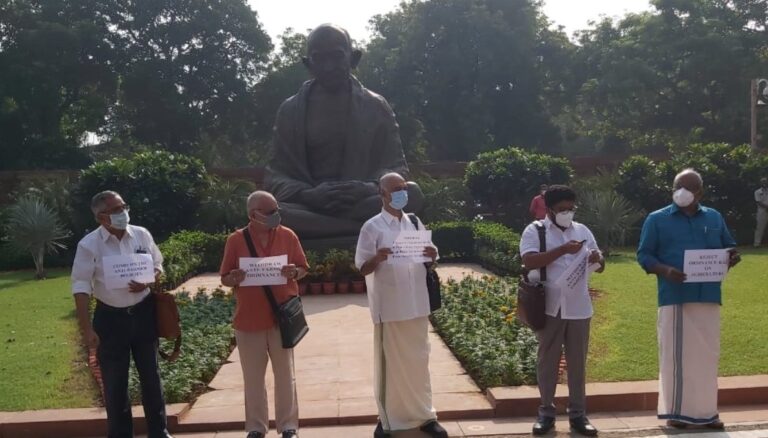
Members of Parliament (MPs) of the Left parties protested in front of the Mahatma Gandhi statue in the Parliament House premises, over their demand for withdrawal of ‘anti-farmers policies’.   “Government in the name of Covid is unleashing an attack on democracy, Parliament and institutions under the Constitution. So Left parties, CPI, CPI-M we came here to register our protest,” CPI MP Binoy Viswam told ANI. CPI-M’s MP KK Ragesh said, “All the three ordinances are against the interest of the farmers and they are promulgated to save the interest of corporates. That is why we are opposed to it,” Yesterday, Congress leader Rahul Gandhi had termed the agriculture ordinances rolled out by the centre as “black” ordinances and said that these are a fatal attack on farming community. Farmers in Punjab, Haryana, Delhi, Karnataka are protesting against the recent agriculture ordinances passed by the Union Cabinet. On June 5, President Ram Nath Kovind had promulgated three ordinances to usher in agricultural reforms for raising the income of the farmers and giving them more freedom to sell their produce.The President promulgated Farmers’ Produce Trade and Commerce (Promotion & Facilitation) Ordinance 2020, Farmers (Empowerment and Protection) Agreement on Price Assurance and Farm Services Ordinance 2020 and the Essential Commodities (Amendment) Ordinance Act, 2020.

Protests took place in Delhi, Haryana, Patna, Chhattisgarh, and in various places in Uttar Pradesh, Tamil Nadu, Jharkhand, Odisha, Karnataka, and Maharashtra on the anniversary of Quit India Movement.

Also Read-  `Save India´on Quit India Day: Nationwide Farmers, Trade Unions protests

SC restrains Sudarshan TV from telecast of UPSC Jihad Show

2
The Supreme Court today directed Sudarshan TV to defer the broadcast of its program touted as a ”big expose on the conspiracy” regarding Muslims “infiltrating government service”, until further orders as reported by bar and bench. The Bench of Justices DY Chandrachud and KM Joseph took up the matter for hearing today after earlier refusing to impose a pre-broadcast ban on the controversial program. The Court also called for the setting up of a committee of five citizens who can come up with standards for electronic media. It said, “We don’t want any persons of politically divisive nature and we need members who are of commendable stature.” Appearing for the petitioners, Senior Advocate Anoop George Chaudhari informed the Court that there were only 292 Muslims in the services at present. He said, “If you read the transcript you will see that they say Muslims are infiltrating the civil services. They say how Muslim OBCs are eating the share of other OBCs.The show has graphs they have used words like “ha***** gaddar” in the show. Very unfortunate words.” Justice Chandrachud also noted that the petition prays for guidelines on how media show report some issues. Justice Joseph made an important observation that the ownership of media channels must be disclosed.

“We need to look at the ownership of the visual media. Entire shareholding pattern of the company must be on site for public. Revenue model of that company should also be put up to check if government is putting more ads in one and less in another.”

Justice Joseph also commented on the manner in which debates are conducted on news channels. On the topic of the Sudarshan TV broadcast itself, Justice Chandrachud observed,

“The anchor’s grievance is that a particular group is gaining entry into civil services. How insidious is this? Such insidious charges also put a question mark on the UPSC exams. Aspersions have been cast on UPSC. Such allegations are without any factual basis, how can this be allowed? Can such programs be allowed in a free society?”

“Shouldn’t there be enforceable standards that the media profess itself to so that Article 19(1)(a) is upheld?” Solicitor General Tushar Mehta in his response stated that- “Freedom of the journalist is supreme. It would be disastrous for any democracy to control the press. Justice Joseph replied- “When we talk about journalistic freedom, it is not absolute. He shares the same freedom as other citizens. There is no separate freedom for journalists like in the US. We need journalists who are fair in their debates.” Justice Chandrachud slammed Sudarshan TV advocate Shyam Diwan saying-

“Your client is doing a disservice to the nation and is not accepting India is a melting point of diverse culture. Your client needs to exercise his freedom with caution.”

Justice Chandrachud also went ahead to blast the advocate from News Broadcasters Association for giving a blind eye to such kind of media slander “We need to ask you if you exist apart from the letterhead. What do you do when a parallel criminal investigation goes on in the media and reputation is tarnished?” Counsel for the intervenors made their arguments, after which Farasat sought to share his screen to show the Bench clips of the programme titled ‘Bindaas Bol’. After watching the clip, the Court directed Sudarshan TV to defer the broadcast of its remaining episodes till September 17, when the matter will be heard next. Chandrachud J – “We are concerned that when you say students who are part of Jamia Millia Islamia are part of a group to infiltrate civil services…we can’t tolerate.” “As a Supreme Court of the nation we cannot allow you to say that Muslims are infiltrating civil services. You cannot say that the journalist has absolute freedom doing this.” Justice Joseph pointed out that Rule 6 of the Programme Code notes that cable TV programs cannot show anything that targets a particular religion or a community. In the final Submission Advocate, Gautam Bhatia stated- “Our main point in the IA is that there needs to be a certain standard to judge hate speech. Here, in this case, a community is being vilified. To that extent that they are not being able to respond. In this case, the pre-telecast restraint parameter is different.” After hearing the parties, the Court noted in its order, “Situation from pre-broadcast ban stage has changed. Petitioners submit that fake news have been shown in the program and screenshots from the program and transcripts have been shown to state that program states its a conspiracy to infiltrate civil service… It has been argued that program has become a focal point of hate speech in the country… …it appears to the court that object of the program is to vilify the Muslim community and make it responsible for an insidious attempt to infiltrate the civil services. We are duty bound to ensure adherence to the Programme Code formed under Cable TV Act… …edifice of a stable democratic society and observance of constitutional rights and duties is based on co-existence of communities. Any attempt to vilify a community must be viewed with disfavour. We are of the view that there is a change in circumstances… ..episodes broadcasted till now show nature and objective of the program. Pending further orders of the Court, Sudarshan News stands injuncted from making any more broadcasts on this subject on any other name too.” The promo of the show shared by the channel’s Editor-in-Chief Suresh Chavhanke, with hashtag ‘UPSC Jihad’, had garnered criticism from several quarters. A group of former civil servants under the collective “Constitutional Conduct” have filed an intervention application in the Supreme Court, seeking a ruling on the scope of “hate speech”. Before this, they had written to various government bodies seeking action against Sudharshan TV’s “UPSC Jihad” show.    

PM CARES Fund Not A ‘Public Authority’ Under RTI Act: Centre Tells In Lok Sabha

0
The Union Ministry of Corporate Affairs has said in the Lok Sabha that the Prime Minister’s Citizen Assistance and Relief in Emergency Situations Fund (PM CARES Fund), though set up by the Central Government, is not a ‘public authority’ under Section 2(h) of the Right to Information Act, 2005. This was told by Anurag Thakur, Minister of State for Finance and Corporate Affairs, as a reply to an unstarred question raised by Sunil Dattatray Tatkare, Member of Parliament from Maharashtra, belonging to the Nationalist Congress Party. According to Livelaw.com, The NCP MP further asked the “reasons for amending the Companies Act retrospectively two months later on May 26, 2020, effectively nullifying the MCA’s stated position on the PM-CARES Fund and MCA’s amendment of Schedule VII to free PM-CARES of any public authority”. The Ministry’s response to this query was : “The Ministry on 28.03.2020 conveyed that contribution made to PM CARES Fund would be eligible as CSR activity under the Companies Act, 2013 and subsequently, issued a gazette notification to this effect”.

Secrecy surrounding PM CARES Fund 

In May, the Prime Minister’s Office had refused to divulge information related to PM CARES Fund by stating that it was not a ‘public authority’. A petition is pending in the Delhi High Court seeking a declaration that PM CARES Fund comes under the RTI Act. Last month, the Supreme Court had turned down a plea to transfer the funds from PM CARES To the National Disaster Response Fund. The top court further observed that PM CARES was a trust for which CAG audit was not necessary. The PM CARES Fund was created on 28 March 2020, “with the primary objective of dealing with any kind of emergency or distress situation, like posed by the COVID-19 pandemic”. Prime Minister is the ex-officio Chairman of the PM CARES Fund and the Minister of Defence, Minister of Home Affairs and Minister of Finance, Government of India are ex-officio Trustees of the Fund.

Also Read: Marginal, small farmers will be snatched off all their farmland: Sasikanth Senthil 


Marginal, small farmers will be snatched off all their farmland: Sasikanth Senthil 

0
Mysuru: Former IAS officer Sasikanth Senthil while addressing a protest gathering of farmers warned the farmers of the consequences of such ordinances. Expressing his apprehension he said- These ordinances would result in these farmers turning landless and being reduced to mere farm laborers in the next five years. Terming the amendments brought to the Karnataka Land Reforms Act as “damaging amendments” Senthil criticized the state government for taking the ordinance route for effecting the amendments. Sasikanth Senthil was addressing the launch of the statewide awareness campaign organised to protest against the amendment under the banner of “Bhoomi Mattu Vasati Hakku Vanchita Horata Samiti” ( The movement for landless and shelter)  near the resting place of Devaraj Urs at Hunsur in Mysuru. The land reforms brought by the ruling Bharatiya Janata Party government in the state were highly detrimental and would spell doom on the farmers particularly marginal and with small landholdings. The repealing of important sections of the Act that guaranteed rights of land ownership to the landless will allow non-agriculturists to buy farmland and remove the existing ceiling limit on ownership and was done only to favor the capitalist and industrialist. The government is subverting the democratic process and also subverting the aspirations of the Karnataka Land Reforms Act. It had brought amendments to key laws governing land acquisition in the absence of any discussion debate and without availing the public opinion taking advantage of the Pandemic. The government misusing the COVID19 crisis when people’s hands and mouth were tied is unfortunate. Recalling revolutionary contributions, Senthil said former chief minister Urs the champion of land reforms had made tillers as the owner of the land which had ensured farmers to lead proud and respectable lives even in the 21st century. The law helped countless landless laborers who were toiling for a meager amount in the fields of other farmers become farmers by having their own land. The Act is based on the principle of “land belongs to the tiller’. This is a bold step. Such a law does not exist anywhere in the country. We have to be proud of such a law. But the BJP government had overturned such significant reforms to favor the haves to help them own lands. Senthil, who condemned the functioning and opposing the anti-people policies of the centre had resigned from his post said that the reforms brought to the land reforms act were totally unacceptable. “No government had dared to bring such sweeping changes in the post-independence era” he rued. “I am of the apprehensive that there would be hardly one or two acres or any land left for the farmers in a few years from now and it would not be a surprise to see farmers working as laborers in their own land” he stated and called upon people to fight to retain the essence in the Land Reforms Act.
Read More: More Amendment to Land Reform Act: Need for Non-Co-Operation Movement


Clarify Scope of Hate Speech: Civil Servants To SC On UPSC Jihad Issue

1
A group of former civil servants under the collective “Constitutional Conduct” have filed an intervention application in the Supreme Court, seeking a ruling on the scope of “hate speech”. Before this, they had written to various government bodies seeking action against Sudharshan TV’s “UPSC Jihad” show, Recently, Suresh Chavhanke, editor-in-chief of Sudarshan News, announced an expose of “Muslim infiltration” of civil services, calling students passing out of Jamia’s Residential Coaching Academy (RCA) and clearing the Union Public Service Commission (UPSC) as “Jamia ke Jihadi” and the phenomenon of Muslims in the civil services as “UPSC Jihad”. While this was widely condemned, a Supreme Court bench of Justices D Y Chandrachud and K M Joseph had refused to impose a pre-broadcast ban on the show, but noted that the petition that highlighted that the expression of views derogatory to a particular community had a divisive potential and had raised significant issues bearing on the protection of constitutional rights. In their letter on September 1, signed by 91 former civil servants belonging to the All India and Central Services who have worked with the Central Government as well as different State Governments of India, highlighted the various grounds on which action should be taken against Sudarshan TV. First, the show would generate hatred towards the Muslim community. Second, it will tar the tar the impeccable reputation of the Union Public Service Commission (UPSC), the premier organisation for civil service recruitment, by claiming that it is biased in its recruitment processes. Third, it will spread a false belief about a disproportionate increase in the number of Muslims being selected for government services, in which Muslims are vastly underrepresented. Fourth, it will malign the reputation of Jamia Millia Islamia, which has recently been rated as the top central university in India. Finally, the use of terms like “UPSC jihad” and “Civil Services jihad” will divide the civil administration of the country along religious lines. Since the Court had indicated that it would consider the larger questions dealing with the lines between freedom of speech and hate speech, the petitioners appealed for the Court to issue an authoritative ruling setting out the scope of “hate speech”. The Constitutional right to freedom of speech protects “offensive” speech but not “hate speech”, hence the petitioners asked for the distinction between the two to be made clear.

Corona Sceptic MP Anant Kumar Hegde tested Positive for COVID-19

1
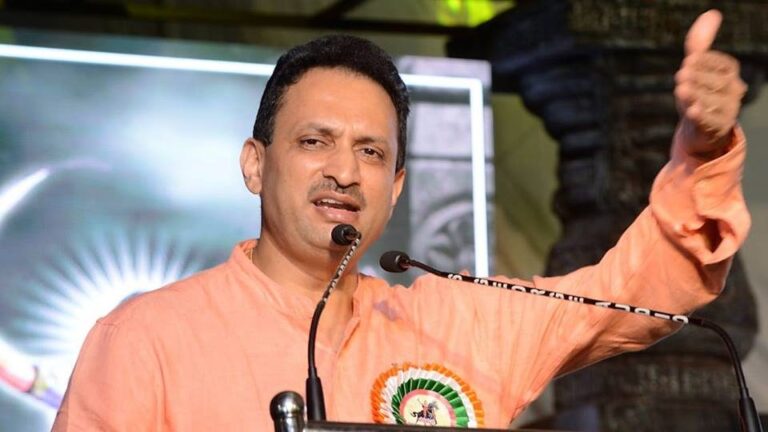
Anant Kumar Hegde, former Union Minister of State for Skill Development and Entrepreneurship and the incumbent Member of Parliament for Uttara Kannada constituency has been found to be COVID-19 positive. He was found to be COVID positive after the mandatory tests were carried out before the monsoon session this morning. The Lok Sabha members were tested at the Parliament House on September 13 and September 14.At least 17 MPs have tested positive for coronavirus. Including Anand Kumar hegde, Meenakshi Lekhi and Parvesh Sahib there are 17 MPs who were found to be infected with COVID-19. Others who have been detected COVID-19 positive include Sukhbir Singh, Hanuman Beniwal, Sukanata Majumdar, Goddeti Madhavi, Pratap Rao Jadav, Janardan Singh, Bidyut Baran, Pradan Baruah, N Reddeppa, Selvam G, Pratap Rao Patil, Ram Shankar Katheria, Satya Pal Singh and Rodmal Nagar.

Anant Kumar Hegde- The Rabble Rouser

Hegde, a long time RSS and ABVP member is known for making controversial statements against anybody who does not agree with RSS ideology. He has called for changing the constitution and has made many crass statements against women and Muslims. During the early phase of the COVID 19 crisis, he had downplayed the disease saying that there is no such thing as Corona, it’s only running nose and cold. On June 18, 2020, when the BJP Government in Karnataka observed “Mask Day” in the state to create awareness among the masses during the COVID-19 crisis, Ananth Kumar Hegde was seen attending a meeting in Karwar without wearing a mask. Social media users debated that when an elected representative cannot follow the norm and observe the “Mask Day” how was the government expecting general people to follow it. When questioned about not using a mask, he said, “When I look at people with masks, I am reminded of Ramayana”.        

Maoist Literature, Presence at protest not grounds of arrest under UAPA: Kochi HC

1
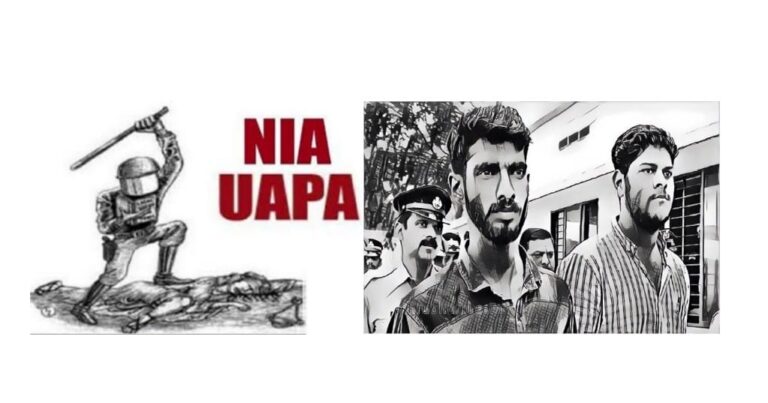
UAPA Arrested Youth from Kerala Granted Bail by Special NIA Court Two youths from Kozhikode who had been charged under the UAPA last year for their alleged Maoist links were granted bail by a Kochi NIA Special Court. The two arrested were Taha Fazal and Alan Shuhaib, both branch committee members of the CPI(M) and students of journalism and law at Kannur University.

In 2019, Fazal and Shuhaib had been protesting against the encounter killing of four people suspected to be Maoists in the Manjeekkandi forest of Attappady in Palakkad district. The four people had been killed by the Kerala Thunderbolts, a special force of the police that carries out counterinsurgency operations. While the police force claimed that they had shot the 4 people for self defence, the killings were widely condemned by various parties, and termed as a ‘fake encounter’.

At the time, the CPI, the second largest constituent of the Left Democratic Front after the CPI(M), had submitted a report to Chief Minister Pinarayi Vijayan taking the stand that it was a fake encounter, Newsminute reported. They took the stand that although they did not agree with the Maoists, it was undemocratic to simply kill them in fake encounters, and the LDF, by and large, agreed that the Maoist issue should be treated as more of a socio-economic problem than a law and order one.

A police patrolling team had allegedly spotted Fazal and Shuhaib under “suspicious circumstances” and seized the leaflets they were distributing which were allegedly promoting Maoism. They were taken into custody and their homes were searched, where the police gathered more “material” as evidence of their pro-Maoist links. According to a report on Sabrang India, these materials included books titled “Caste Issues in India” and “Organizational democracy – disagreement with Lenin”, portraits of Che Guevara, poster images reading “Ban UAPA”, “Kurdistan Solidarity network Kerala”, images of a CPIM flag, photo of Maoist leader Roopesh, an image of a hanging PM Modi, and so on.

While their pleas for bail had been rejected twice before, Judge Anil K Bhaskar at the NIA Special Court finally granted them bail, saying that “Mere possession of Maoist literature, presence in anti-government protests or strong political beliefs does not make a person complicit in terrorist activity.”

The Judge further pointed out,

“Being a Maoist is not a crime, though the political ideology of Maoists does not synchronise with our constitutional polity. It becomes adverse only when there is any positive act from the side of the accused to instigate violence. Prima facie there is nothing to suggest any overt act on the side of the accused in this regard.”

While the Left government in Kerala might condemn the acts of the Central Government in arresting human rights activists and dissenters, it is important to note that the existence of the Unlawful Activities Prevention Act allows any government, irrespective of its ideology, to target and repress anyone whose dissent is inconvenient for the party in power.

UAPA, NSA, PSA -Tools to suppress dissent

The BJP government has, using this law, targeted human rights activists and academics in the Bhima Koregaon case, then in the aftermath of the Abrogation of Article 370 and 35(A), and recently, in the arrests of anti-CAA-NRC protesters by framing them for the Delhi riots. The nature of the law makes it possible for the police to incriminate anyone based on something as simple as owning books that discuss social issues. Under this law, there is no definition of what constitutes as an intent to commit a terrorist act, and anything from a book about caste to a picture of a communist leader, which the police can search for and seize without any warrant, can be enough for someone to be arrested for years without any conviction.

The state has managed to make anything and everything antinational and Maoist! 

Under the present dispensation, even the slightest criticism of the government can land someone in jail under non-bailable draconian laws like UAPA and NSA. We can see this from the relentless arrests of teachers, lecturers, and students under UAPA for mere presence at the protest site during the Anti-CAA protests in Delhi. This is enough to discourage any well-intentioned person from raising his/her voice. Already there are very few dissenting voices, such an authoritarian atmosphere where you might be incriminated for mere possession of Che Guevara poster or anti-caste literature will silence them even further. In such a police state even having a divergent thought is enough to be called anti-national and Maoist… Even Taha Fazal and Alan Shuhaib, both members of the ruling party in the State, were not immune to wrongful arrest under this law. Such a law, that allows for the incarceration of innocent people, of students and thinkers and protestors who have done nothing but uphold the values of the constitution and fought continuously for the ideals of social justice in our country, must be opposed tooth and nail irrespective of which party is in power.

Our Culture do not Recognise Same-sex Marriages: Centre Tells Delhi HC

0
The Centre today opposed a plea filed before the Delhi High Court seeking recognition and registration of same-sex marriages under the Hindu Marriage Act, 1956. Solicitor General of India Tushar Mehta before the division bench of Chief Justice D.N. Patel and Justice Prateek Jalan submitted that such registration is not permissible as the prayer, if granted, would run contrary to the statutory provisions already in place. “Our law, society, values don’t recognise marriage – which is a sacrament – between a same-sex couple,” submitted Mehta in the Delhi High Court, adding that one has to a man and a woman for a marriage to not fall within degrees of the prohibited relationship under the Hindu Marriage Act. “As per law, a marriage is only between a husband and a wife”, argued Mehta to urge that the Hindu Marriage Act (the Act) itself did not recognize same-sex marriages. Mehta also submitted that the judgment of the constitutional bench of the Supreme Court “merely decriminalizes homosexuality or lesbians. Nothing more, nothing less”. The counsel representing petitioner Abhijit Iyer Mitra and others earlier submitted that such marriages were not being registered in absence of any declaration. It was argued that the Supreme Court has already ruled that there is no legal bar on homosexual relationships. The denial of registration is violative of the right to equality and right to life, it was argued. Acknowledging that though the position of law might be different, the Bench stated that “changes are happening across the world.” The Court went on to suggest that the petitioners, who are activists and members of the LGBTQ community, could first try and get their marriage registered and if in case they were denied, they could approach the Court with their grievance. Appearing on behalf of the petitioners, Advocate Raghav Awasthi informed Court that there have been instances of gay couples getting married but being refused registration. The Court thus asked the petitioners to bring on record all those persons who are aggrieved by the non-registration of same-sex marriages on the next date of hearing and posted the matter to be considered again on October 21. The petition filed on behalf of activists and members of the LGBTQ community avers that the Hindu Marriage Act (the Act) allows a marriage to take place between ‘any two Hindus’, without discriminating between homosexuals and heterosexuals. The court on Monday adjourned the case to October while asking petitioner counsel to bring on record the facts or instances where persons are aggrieved of non-registration of such marriage.