SOCIAL activist and Magsaysay Award winner Sandeep Pandey and his activist wife Arundhati Dhuru were put under house arrest in Lucknow on Sunday to prevent them from holding a protest dharna against the revocation of article 370 and communication blockade in Jammu and Kashmir.
The proposed protest ‘Stand for Kashmir’ was to be held on Sunday evening at the GPO Park, according to an IANS report.
“All of a sudden, police in four vans arrived at our house in the morning and told us that we cannot stage the dharna, because of prohibitory orders in the city. They said the prohibitory orders would be lifted after Independence Day. So I told them that we would stage the dharna after the orders are lifted. Yet, they are standing outside my house and no one is allowed to enter or leave the house,” Pandey was quoted as saying over the telephone.
His wife Arundhati Dhuru is the national convener of the National Alliance of People’s Movement.
Several activists, journalists, and civil society members have slammed the UP government for their house arrest.
Courtesy: the leaflet
Today CPI(M) general secretary Sitaram Yecury and D. Raja were detained at the Srinagar airport and denied entry into the city. They had gone to Srinagar to meet their party colleagues.
“They showed us a legal order which did not allow any entry into Srinagar. It stated that even escorted movement int the city is not permitted due to security reasons. We are still trying to negotiate with them,” Mr. Yechury told PTI over the phone.
Mr. Yechury told the press that he had written to Jammu and Kashmir Governor Satya Pal Malik on August 8, informing him of their visit and requesting him to facilitate their entry. In the letter, he mentions the purpose of the visit. He also tweeted the handwritten letter to Jammu and Kashmir governor Satya Pal Malik earlier today. The letter was to notify him that he and D. Raja would be taking the 9.55 am IndiGo flight to Srinagar to visit CPI(M) leader Yusuf Tarigami. Tarigami, an MLA in the “dissolved J&K assembly” was not well, Yechury had written.
Com D Raja and I are on our way to Srinagar on the 9.55 am Indigo flight to meet Com Yousuf Tarigami and our other comrades in Jammu & Kashmir pic.twitter.com/axRKZkLbV6
He said – “Both of us had written to the Governor requesting him that there should be no hurdles to our visit… despite that we have been detained. I wanted to meet my ailing colleague and our comrades who are here,”
In a statement issued by the CPI(M) party, it said such an act by the government is “anti-democratic” and showed the ruling BJP’s “authoritarian face”.
.@SitaramYechury has being detained at Srinagar Airport and not allowed to move anywhere. This despite the fact that he had informed the administration about his visit to meet CPIM MLA MY Tarigami who is not well & other party workers. We strongly protest this illegal detention.
On August 8, Congress leader Ghulam Nabi Azad was detained and sent back to Delhi from the Srinagar airport.
There are reports of around 500 political workers and leaders including ex-chief minister Omar Abdullah and Mehbooba Mufti. National Conference leader and ex-chief minister Farooq Abdullah is also under house arrest.
Section 144 has been imposed on the state and security forces have been deployed in massive numbers across the Valley, particularly in Srinagar city and major towns, and barricades have been erected every 100 meters. As of now, all telephone and internet connections have also been snapped in the Valley and only three news channels, including state-run Doordarshan, can be accessed through cable TV networks.
Bombay High Court grants bail to the three accused doctors Bhakti Mehre, Hema Ahuja and Ankita Khandelwal. The three doctors were accused of abetment of suicide of Dr. Payal Tadvi. The three will have to submit a surety of Rs 2 Lakh and appear before the crime branch every alternate day. They are not allowed to travel outside Mumbai without permission and not allowed to go inside Nair Hospital.
Dr. Payal Tadvi, who belonged to the Scheduled Tribe community, committed suicide in her hostel room at BYL Nair hospital on May 22. Since her suicide, the family had accused the three doctors who had been harassing her with casteist slurs on a daily basis.
During the investigation, the team found that there was a handwritten suicide note that was destroyed by the three doctors after she was found hanging in her room. They also deleted the suicide note from her phone. But the investigating team managed to retrieve it.
The suicide note details her daily ordeal under the hands of the three senior doctors and how her complaints were ignored by the Department head. Based on the suicide letter retrieved from her phone and statements from the colleagues, the three doctors were booked under charges of abetment of suicide and under SC/ST Prevention of Atrocities Act.
A Delhi court on Friday framed charges against expelled BJP MLA Kuldeep Singh Sengar for allegedly raping a minor in 2017. The court ordered the framing of charges under various charges, including rape, criminal conspiracy, and kidnapping.
Since the vicitm was a minor at the time fo the incident in 2017, the judge directed the charges to be framed under the Protection of Children from Sexual Offences (POCSO) Act.
On July 28th, the rape survivor met with an accident where a truck rammed into the car she was traveling with her lawyer and two aunts to Raebareli court. While the two aunts didnt survive, the survivor and her lawyer suffered fatal injuries and are now airlifted to AIIMS, Delhi for treatment. The survivor is battling a severe blood infection making her treatment difficult.
BJP MLA Sengar and the accomplices also framed for criminal conspiracy
The CBI told the court yesterday that Sengar and his brother had assaulted the father of the girl and framed him in an Arms Act case, accusing him of possessing a country-made pistol and four live cartridges. This was done in collusion with three state police officials and five others. These three police officials, accused in the case of assaulting the survivor’s father, included the then Makhi police station’s in-charge Ashok Singh Bhadauria, Sub Inspector Kamta Prasad and Constable Amir Khan.
“Hitler´s primary rules were: never allow the public to cool off; never admit a fault or wrong; never concede that there may be some good in your enemy; never leave room for alternatives; never accept blame; concentrate on one enemy at a time and blame him for everything that goes wrong; people will believe a big lie sooner than a little one; and if you repeat it frequently enough people will sooner or later believe it.”
The above quote is from the report, A Psychological Analysis of Adolph Hitler: His Life and Legend, by Walter C. Langer.
On Monday, Amit Shah proposed to scrap Article 370 and made claims about how article 370 is an impediment in the development of the region.
He said that people of “the country” wanted to know why Article 370 was still in operation in Jammu and Kashmir, and why “despite getting so much money, its people are still poor.” “Article 370 ensures there is no PPP model, no private investment in the state. 370 ensures healthcare in Jammu and Kashmir suffers, no doctor wants to go there. 370 ensures there is no right to education for the children of Kashmir,” Shah said.
Well, he lied.
According to national family health survey 205-16, Kashmir is far better on the development indices compared to other Indian states and much better than Gujarat, the purported model state according to BJP and its supporters.
Although it is true that while J&K lags in job creation, investment and growth but that is the case with the rest of the country. The per capita domestic product of Jammu and Kashmir as of 2016-17 is low but higher than most other northern states.
Despite being heavily militarized, the state is not as backward as several north Indian states that have had no such exceptional laws, and have in fact been ruled for substantial periods by the BJP itself.
According to a report from Hindu, Jammu, and Kashmir also fares much better in other human development indices like life expectancy, healthcare, and education compared to other states in India, something that the esteemed Home minister claimed is the reason 370 should be removed.
In 2017, Jammu and Kashmir’s Human Development Index (HDI) was 0.68, higher than even States like Andhra Pradesh and Gujarat. Kerala had the highest HDI (0.77) while Bihar had the least (0.57). The Human Development Index (HDI) is a composite index of life expectancy, education, and per capita income indicators.
Jammu & Kashmir has a fertility rate of 1.6 which is comparable to developed countries like the UK and US. Also, the state has better systems in place for the children born as compared to other states with an infant mortality rate (IMR) of 24 while Madhya Pradesh had the highest (47 infant deaths per 1000). The national average for IMR was 31. Goa had the lowest IMR (8 infant deaths per 1000)
Amit Shah claimed that Article 370 is the reason the state is “still poor”. Once again he was wrong. J&K stood eighth in terms of poverty rate (10.35)%. while Chhattisgarh had the highest poverty rate of 39.93%. The national average was 21.92%. Goa had the lowest poverty rate of 5.09%.
According to Amit Shah, scrapping of 370 and 35A, will bring in investment, growth, and jobs. Well, the same rhetoric was fed to the rest of the country minus any article abrogation, before 2014 elections. 5 years on, the economy is in recession, unemployment rates are the highest in last 45 years, Prime minister solution to it is to open ´pakora stalls. There was no article stopping development in UP, Bihar and other backward states of India. Can the home minister explain?
What does Amit Shah mean when he says Kashmir is lacking development?
Since the last couple of years, we have been fed this model that development only happens when large industries are set up. For the large industry to be set up, the land is acquired from the locals by force or coercion by the government and state machinery. When the locals become landless, they either flee the region or work for measly wages in these industries. We have seen this kind of development model in Central and East India. These are also the regions which are the poorest and fail in all development indices. So whose development is Mr. Amit Shah talking about?
Why would the home minister lie to the parliament and to the people of India?
This was never about development. Its a land acquisition project. The whole point of the exercise was to take away whatever remaining autonomy the people of Kashmir have and bring it further under the control of the central government. Centre´s muscular approach of militarization has further alienated the population. If that was NDA´s intention then it has succeeded in it. Now as next step it wants to control it through political subjugation.
Kashmir valley is the only Muslim majority region in the country. By taking away article 35A, BJP is pushing its agenda of changing the demographics of the region. By allowing Hindu settlers to buy land there, the intention is to reduce the Muslim majority and make them second class citizens. The move is to bulldoze any future resistance that may come when the central government wants to push the local muslim population out, remove its claim of autonomy and complete its nationalisation project.
“I say with all respect to our Constitution that it just does not matter what your Constitution says; if the people of Kashmir do not want it, it will not go there. Because what is the alternative? The alternative is compulsion and coercion…We have fought in good fight about Kashmir on the field of battle… (and) …in many a chancellery of the world and in the United Nations, but, above all, we have fought this fight in the hearts and minds of men and women of that State of Jammu and Kashmir.”– Nehru, speaking in the Lok Sabha in 1952
Nehru’s promise lies in tatters today; as does every other promise of autonomy made by the Government of India. Article 370 gives a ‘special status’ to the State of Jammu and Kashmir. On Monday, the Government effectively abolished that status. It did so without touching the provision. It also brought in a constitutional amendment, without amending the constitution. Crucially, it did all of this after zero consultation with the people affected by it all. Before delving into the legalities of what happened in Parliament, it is imperative to understand the background in which Article 370 was made a part of the Indian Constitution.
Partition and the Indian Independence Act
British rule ended with the creation of two new dominions – India and Pakistan. The princely states were not incorporated into either dominion. The Indian Independence Act provided that all powers returned to the individual states. Rulers had the authority to determine their state’s future. They were encouraged by then Viceroy Lord Mountbatten to accede to one of the dominions. Prior to partition, 562 accessions were accepted by the incoming Indian and Pakistani governments. However, three major princely states, declined to accede to either dominion.
The Accession of Kashmir
At the time of partition, Jammu and Kashmir was a Muslim majority state ruled by a Hindu king. Accession to either India or Pakistan seemed equally plausible. When British sovereignty lapsed, Maharaja Hari Singh had not decided as to whether Kashmir would accede to India or Pakistan. He executed a standstill agreement with Pakistan, and requested India for time to consider an agreement.
During this standstill, Pakistani raiders, with the support of the Pakistani Army, began advancing on Kashmir in October 1947. A panicked Maharaja invited Indian forces into Kashmir to provide temporary protection. Subsequently, the Maharaja executed an instrument of accession with India. Under the instrument, defence, external affairs, and communications were listed under the exclusive domain of the central government. All other plenary powers would remain vested within the state government.
Kashmir and the Indian Constitution
Article 370 limits the authority of Parliament to pass legislation for the State of Jammu and Kashmir. Under Articles 370 (1) (b) and 370 (1) (d), the Parliament has to confine legislation affecting the state to areas enumerated in a list attached to the Instrument of Accession. Legislation on other matters can be passed only if it is explicitly concurred to by the Government of Jammu and Kashmir. Under Article 370 (3), the President can modify or even repeal Article 370. However, this could be done only with the concurrence of the Constituent Assembly of the state.
The Amendments
The Constituent Assembly of Kashmir disbanded in 1956. Almost all members are presumably dead. Since Article 370 could be modified only with the concurrence of the Assembly, many believed that Article 370 had become a permanent part of the Constitution. The Government has however paved the way for amending Article 370 by a novel way. At the core of yesterday’s legislative business, lies Presidential Order C.O. 272 which amends Article 367. Article 367 is the interpretation clause of the Constitution.
The amended Article 367 declares that “the expression ‘Constituent Assembly of the State…’ in Article 370 (3) shall be read to mean ‘Legislative Assembly of the State’. Now bear in mind, that Article 370 could only be modified by the Constituent Assembly of the state. However, because of the amendment, it can now be done away by a recommendation of the state legislature. Given that the State does not presently have a legislature, this role can be performed by the Governor. Thus, all the Government now needs to do away with Article 370 is to get a recommendation from the Governor.
Legal Issues
The Presidential Order amending Article 367 draws its authority from Article 370 (1). Article 370 (1) deals with the power of the Parliament to make laws for the State of Jammu and Kashmir. It does not provide the President the power to amend sundry provisions of the Constitution. An amendment to the Constitution can only be made under Article 368. It requires a 2/3rd majority of Parliament, present and voting. This has not been attempted and leaves the legality of the Presidential Order in serious doubt.
Further, assuming that the President did indeed have the power to pass the order under Article 370 (1), the same could only have done with the concurrence of the State Government. In fact, the order itself begins by saying that it has been made “in the exercise of powers conferred by clause (1) of Article 370 of the Constitution, the President with concurrence of the Government of State of Jammu and Kashmir”.
Jammu and Kashmir has not had a government for months. Instead of consulting the government, the President has consulted the governor. As is well-known, the governor is the representative of the Union Government in the State. So in effect, the Union Government has consulted itself. It is hard to see how this is legal.
It must also be noted that the Presidential Order does not ostensibly amend Article 370. It amends Article 367. However, assuming that these amendments are legal, the ultimate effect of the amendments is on the substance of Article 370. Thus in essence, since the Government could not amend Article 370 directly, it chose to do so indirectly. The Supreme Court has time and again held that this is not legal.
Conclusion
Article 370 has not been amended yet. However, given the amendments to Article 367, the writing is on the wall. The Rajya Sabha has already passed a resolution recommending that the president abrogate most of Article 370. The government has also introduced a re-organization bill that splits up the state of Jammu and Kashmir into the Union Territories of Ladakh (without a legislature) and Jammu and Kashmir (with a legislature).
In the aftermath, cheerleaders of the Government have tried to sell the constitutional changes as ones that will usher in prosperity for the people of Kashmir. If that was the case, the people would have been consulted. Yesterday’s events come at the end of weeks of troop mobilisation, lies by those in the highest offices of the state, and a complete shut-down of communications in the valley. They are a fraud on the people of Kashmir, on the Constitution and on all the values that our democracy holds dear.
The article was first published in Business standard. The authors are lawyers who practise in the Supreme Court.
Bhoomi matu Vasati hakku vanchitara horata Samiti (The committee for land and shelter rights ) headed by freedom fighter HS Doreswamy, will hold a special program for land and housing for the poor in Bangalore from August 14 to August 15.
The team held a press meet today at the press club Bangalore. Here are some points discussed at the press meet. A member of the Bhim Army had also joined the press meet.
Mr. Chandrashekar Azad ‘Ravan’ from UP, the founder of the Bheem Army and the thunderous voice of the Dalits and the persecuted people, will be the chief guest on this occasion and will deliver his message of the unflinching struggle of the people for emancipation. A number of veteran pro-people agitators, leaders of fighting organisations, social activists will stand shoulder-to-shoulder with thousands of the aggrieved people from all over the state on this meaningful occasion. Outline of the programme: ✰ Aug. 14th – a lamp (hanate) procession after sunset: Majestic rly.stn to Banappa Park. ✰ 14th-15th – whole night: program of Resistance – speeches, cultural programmes, etc. ✰ 11.30-12 midnight – Message of Struggle from Mr. Chandrashekar ‘Ravan’, chief guest. ✰ 12.05 midnight: Flag Hoisting and call for real independence: by H.S.Doreswamy. ✰ 15th morning – March for our Rights – from Banappa Park towards Parade Grounds. Noor Sridhar, Committee member said, The Mid-night Independence Day programme is being organised on the night of 14th of August this year in order to make the “souls-sold” rulers and their governments to act once again on these issues, to reprimand their unconcern and lethargy towards the poor, to send a firm message to them that ‘this is not a movement that would subside and die out’, and to mark the occasion of the Independence Day as a day of taking a pledge of consolidating and intensifying the struggle.
the government has not granted land to farmers who submitted for land grant even after three decades. The government has not even formed the tehsil level Land Grant Committees. And sanction of pattas for the houses/huts built by the poor people on government/private lands under the promised ‘Akrama- Sakrama’ (94C/94CC) scheme has also not been undertaken. Instead, forceful, violent eviction of these ‘unauthorized’ dwellers and tillers is going on everywhere; and the infamous Forest Department has launched a virtual ‘bulldozer war’ on these poor people all over the state!
Kumar Samatala of Karnataka Janashakti said- Mr. H.S.Doreswamy, who unfurled the National Flag 72 years ago on the joyful occasion of the country’s hard-fought independence will also unfurl the ‘Poor People’s Independence Day National Flag’ on this occasion, and will initiate another ‘never-say-die’ battle for the real freedom of the poor and oppressed people.Bhoomi mattu vasati hakku vanchita horata samiti (Committee for the Rights of the Land and Housing Deprived), an umbrella forum of several pro-people fighting organisations, was launched three years ago in 2016 to coincide with the occasion of the Birth Centenary of the former CM D.Devaraj Urs. The aim of the committee was –
‘To achieve at least a piece of land enough for a dignified life for those agricultural families who want to pursue agriculture, and a small home enough for a respectful living for all the housing deprived’.
Thanks to the series of struggles conducted under the leadership of this forum, a high level meeting of several ministers and principal secretaries of the concerned ministries and the Chief Secretary along with a delegation of the ‘Committee’ led by the veteran, centenarian freedom fighter Mr. H.S. Doreswamy was convened by the then CM Mr. Siddharamaiah in January 2018. The government acceded to all the demands put forward by the Committee, and constituted a High-Level Committee consisting of the principal secretaries of the concerned departments and two members of the Committee, to facilitate the speedy redressal of the problems cited by the Committee. It also agreed to allow fresh applications in Form no. 57 for grant of land by the bagair-hukum’ tillers up to January 2005 and made amendments to the Land Revenue Act to this effect. More than 4 lakh people have applied for new applications. However, the committee complains that the old Form 50-53 petitions have not been disposed of, no new applications have been touched, and no land grant committees have been restructured.
Yesterday, Article 370 of the Indian constitution that gave special status and autonomy to the state of Jammu and Kashmir was abolished in the parliament. According to the Article, the other articles of the Indian Constitution that gave power to the Central Government would be applied to Jammu and Kashmir only with the concurrence of the State’s constituent assembly. The move by the home minister Amit Shah was brought amidst curfew, communication blockade and arrests of political leaders in Kashmir. While the decision was cheered by many BJP supporters, the move brought sharp criticism from some opposition leaders and civil society activists that it has ignored the voice of the people of Kashmir and will further escalate tension in the region.Protests started in different parts of the country soon after the bill was passed. The Left parties staged a demonstration at Jantar Mantar here, slamming the Modi government for scrapping Article 370 and demanded that the earlier status of the state be restored.DelhiDelhiDelhi
Protests by civil right groups also took place in Bhopal, Khammam (Andhra Pradesh) and Bangalore
BangaloreBhopalBhopalKhammam, Andhra PradeshThe article was revoked through a presidential order rendering Article 370 and article 35A ineffective. Amit Shah also introduced Jammu and Kashmir reorganization bill bifurcating the state into Jammu and Kashmir and Ladakh, both given the status of the union territory. The move demoted the status of Jammu and Kashmir and Ladakh to Union territory undermining the autonomy of the people of Jammu and Kashmir while bringing it directly under the control of the central government.
The National Medical Commission (NMC) bill was passed in the Rajya Sabha on August 1st. It stands to repeal the Indian Medical Council act of 1956 and dissolves the Medical Council of India(MCI), hitherto the apex body involved in the regulation of undergraduate and postgraduate medical education in the country.
The MCI has faced a host of corruption charges since 2001 and come under increasing criticism and scrutiny. It was eventually dissolved by the President of India in 2010. This paved the way for the introduction of the NMC act, passed as an ordinance in January 2019 and eventually by the Lok Sabha and the Rajya Sabha. Following this, there were nationwide protests by medical students and doctors in the form of strikes. What led to these protests and why are doctors opposed to the NMC bill?
The NMC for effective functioning needs to be an autonomous and ideally a representative body. Further, professional concerns require it to be an institution at least predominantly made up by doctors. However as per the NMC bill most of the members of the council will be appointees of the central government and mostly ex-official government servants and Directors of reputed institutions. While the recommendation for selection was through a rigorous process of predefined criteria, the bill provides for election of only 20% of the members through the process. Thus the new council for regulation of medical education assumes the character of a bureaucratic department which does not represent all the different regional concerns of the country and may thus fail at appropriate and sensitive state-wise regulation and implementation.
The second and a major concern of the doctors is the provision of license to community healthcare practitioners/practitioners of AYUSH system of medicine for practicing modern medicine after a bridge course of 6 months. The rationale behind this policy is the shortage of medical practitioners in the rural areas and the poor doctor to patient ratio in the country. While the rationale is justified, the means here seems misguided and may lead to detrimental consequences. The training in these systems of medicine even with respect to the basics of anatomy and physiology greatly differs. A training of 6 months is extremely inadequate for the induction of one practitioner into another system. It undermines the AYUSH systems of medicine. It also does not address the fact that most rural hospitals suffer more from a lack of basic medicines and infrastructure than a lack of trained staff. The practice may in turn lead to increased errors and cause a delay in dispensation of ideal medical treatment to patients with untoward consequences. Differential regulation of the practice in rural and urban areas gives rise to further ambiguity.
The MCI was mainly found to be corrupt with respect to regulation of education in private medical colleges. The bill is extremely weak when it comes to ensuring that these practices are discontinued. The previous act required medical colleges to be inspected at multiple check points. However, each inspection was said to have become an excuse for extortion. The present bill instead of ensuring that inspections are duly supervised by external ombudsman or reviewed, has simply curtailed the number drastically. That is an ineffective system of regulation and provides no regulatory mechanism to ensure that standards of education are consistently maintained. The other major concern with private medical colleges was the fee structure. The present bill will regulate only upto 40% of the seats thus leaving at least 60% if not more unregulated and thus affordable only to the rich.
A major concern and in particular the cause for the strike by the medical students is an addition exam ‘NEXT’ to be introduced for licensing of medical practitioners. Ideally, the NMC should aim at the standardisation of medical education. The very need for an additional exam for licensing apart from the annual examinations that Medical students undergo through a rigorous and stressful process belies confidence in the system and makes those examinations redundant. The proposed objective format of the exam is not ideal for such purpose. This exam cannot substitute the entrance exam for postgraduate training as both have completely different objectives. While a licensing exam needs to assess basic competence, a competitive exam needs to be rigorous to differentiate between two candidates. It only adds further ambivalence to an already stressful situation.
Accountability or its lack thereof was the primary reason for the malpractices within the MCI. The bill does nothing by way of ensuring “checks and balances” to ensure that NMC does not suffer from the same lapses.
While doctors have raised the above objections, they recognise that they have failed at ethical internal regulation of their own systems. The bill may be a step in the right direction but is severely inadequate in its present form. Medical education requires systematic, long term planning. Also it is only one aspect of building the health infrastructure of the country which is the final Aim. The bill introduces multiple stop gap policy measures which might become more of a liability in the future and proposes few if any creative solutions to the problems encountered.
The author Kirti Sharma is a fetal medicine specialist/ Obstetrician with an MA in History of Medicine. She is also a member of Swaraj Abhiyan
Netravati river usually flows very slowly near Jappinamogaru-Mangalore as if it is reluctant to join the sea. But during high monsoon its like a flood. The sea is just a few kms away from there. Siddartha wanted to meet the sea of success in the corporate world, though he started as a very small entrepreneur from western Ghats from where rivers like Netravati take origin. In life, to most people, Siddhartha was only known as the son-in-law of the important politician, SM Krishna. To the outside world, his empire was only an off-shoot of SM Krishna’s political power. He often stands as an example of the nepotism of those in power, the interests of businessmen who fund political battles, and business that transgresses government rules and regulations. But that’s not all Siddhartha is. Siddhartha was born to Chatnalli Gangayya Hegde, in Malnad. His is a story of an ambitious young man in an ordinary family, rising to heights, and killing himself in order to exit the insides of the corporate system. His journey cannot be understood with superficial details. When this author visited Mudigere a few years back, something surprising took place. One of the comrades, who organized the coffee plantation workers there, spoke of Siddhartha Hegde with immense pride. According to him, most workers at ABC company’s estate were getting the facilities which were otherwise the maximum demands of the workers’ movements at that time. Probably the workers’ demands themselves were so minimum. And it is also because if rich businessmen possess basic simplicity and compassion, people are satisfied. Those businessmen become idols for the public. Due to Siddhartha’s simple ways, and for the way he used a very small share of his profits for the benefit of the general public, he did not have many critics in the Chikmagalur district.Siddhartha studied Economics in St. Aloysius College in Mangalore. In one of his interviews, he claimed that he read Marx in the communist library next to Aloysius college, but he always believed that like other corporates, that he must first generate wealth. After his degree, he went to Mumbai and trained under Mahendrabhai in Lonavala. He realised the importance of the stock market in its early days, in the ‘80s. After spending two years in Bombay, he received 7.5 lakhs from his father, returned to Bengaluru and started ‘Shivan Securities’. He bought 60,000 shares of Infosys and sold it all when its value had increased 6 times. Then, he took on the coffee plantation, during a time when coffee rates were low. In 1992, the regulations over coffee were lifted and its value quadrupled. By 1993, the coffee plantation had expanded to 3000 acres! Thus, the ABC company was born. Its turnover went from Rs. 6 Crore to Rs. 2500 crore by 2015. By 1995, it had grown into one of the largest coffee exporters in the country. In the next few years, he continued to expand through Mindtree Software, Chetan Wood Processing Pvt Ltd, Barefoot Resorts and Dark Forest Furniture. He also got married to SM Krishna’s daughter, Malavika.A chance meeting with a third-generation coffee seller from Germany inspired him. Soon, 20 Coffee Day shops propped up in various parts of South India. Rather than selling coffee beans, they would sell coffee powder, at a significant profit. Later, inspired by Beer Cafe in Singapore, he started an internet cafe with his friends on Brigade Road. That’s how Cafe Coffee Day was born. Now, there are over 1500 cafes and over 600 shops across the country. By then, his father-in-law became the Chief Minister of Karnataka. He took advantage of this situation and expanded. He moved his company to the Mumbai Stock Exchange. Meanwhile, SM Krishna became the Governor of Maharashtra in 2004, and later, the Union Foreign Minister in 2009. In 2011, he entered the shipping business. His circles now claim that he was pushed to suicide due to his attempts to acquire a company that owned 70% of the global market. By 2015, Siddhartha had encountered a major crisis. He was stuck within debts for some of his companies. To solve these problems, he simply had to sell the shares of his reputed brands: Cafe Coffee Day and Mindtree. Apparently, Cafe Coffee Day was being negotiated to be sold to Coca Cola; 20% of Mindtree’s shares were sold to L&T. This was when the IT problem began, he wrote in his last letter. The Income Tax Department began to attach his assets and transactions. This closed the only available route to set his business right. Siddhartha’s letter states that he then conducted transactions that his family and top business officials have not been privy to. While the Ministry of Corporate Affairs marks his debt at Rs. 8,000 crores, CCD circles claim it could be anywhere between Rs. 10 thousand crores to Rs. 15 thousand crores. The government currently in power abandons rules to help such entrepreneurs; it puts out a red carpet to make corporations comfortable. However, why these problems were not resolved even after SM Krishna’s joined BJP remains a mystery. In fact, the IT Officer, supposedly Arun Jaitley’s confidante, is accused in Siddhartha’s letter. How was an entrepreneur with a 12000-acre estate, a stock exchange company, and an influential father-in-law still unable to solve his financial crisis? More information may shed light on this baffling question in the coming days. His empire, it must be noted, led to the creation of around 50,000 jobs. Coffee Day sustained the livelihoods of many in Karnataka. On one of his frequent visits to Kolkata, he is said to have stepped into his own Cafe Coffee Day in uniform, to serve coffee. He saw the way that they treated workers: nobody said thanks, no ‘Happy New Year’s, no smiles. He wondered how the staff would maintain their enthusiasm in such an environment, and empathized with their predicament. Siddhartha had a delicate personality; he generously helped schools in Malnad and Chikmagalur. He was known, not only as the son of Gangayya Hegde but also as the son-in-law of SM Krishna.However, the cracks within his business brought him down, as he himself once said“It’s true that his holding company had a loan of Rs. 1000 Crore; this debt was incurred to buy the shares of Sequoia Capital and Goldman Sachs in Retail. Another Rs. 200 Crores was borrowed to buy more shares of Mindtree. If we sold our Mindtree shares, the entire company’s debt would be taken care of. But we do not wish to sell the company, it has brought us 40% profit in the last 16 years.”Apart from having problems in his business, this situation highlights the extent to which Siddhartha was being squeezed out by the IT department and his creditors. These problems exist even for Gujarati businessmen, but Gujarati politicians are currently in power in Delhi and can assist them. Perhaps the Gujarati politicians did not help resolve Siddhartha’s crisis in order to undermine his influential father-in-law. In a crony, capitalist world, there are a growing number of people who are willing to go to any lengths to ease their wealth. Perhaps, due to his sensitive personality, Siddhartha Hegde was unwilling to play by the crooked rules of this game. As someone who set out to achieve great things, discovering his status as a failed entrepreneur perhaps incited his death.In an interview with a journalist, he himself said almost prophetically, “Entrepreneurs don’t retire. They die.”
The Protection of Children against Sexual Offences Act (POCSO),2012, amendment in 2019 has shown a remarkable increase in the penalisation of sexual assault against children, now including the death penalty for cases of aggravated penetrative sexual assault. Though there are multiple ethical questions that are raised for the use of capital punishment as a deterrent to such crimes, one must introspect on whether those perpetrating these crimes are in fact deterred by any law. Since the law’s implementation from 2012 there have been increasing cases of child sexual assault registered with each passing year, the 2016 NCRB report stated that the number of cases registered under the Act had grown by 178.6 percent in 2014 with no reduction in the following years (THE PROTECTION OF CHILDREN FROM SEXUAL OFFENCES (AMENDMENT) BILL, 2019: Statement for Objects and Reasons, 2019 ).
These numbers though disheartening also show that parents have also grown aware of the law and have begun to utilise it. The Unnao case highlights the multiple failures of the POCSO Act with intermediaries such as the police unwilling to file the complaint till the passing of a year, despite the fact that the law states that the cases must be tried within that period of time. Despite such instances, there has been no amendment in the law that looks into effective penalisation for the role of other intermediaries in the protection of those accused of the sexual assault of minors. According to the Act as it stands the only form of penalisation for anyone caught in the abetting of the accused haven’t been clearly defined in the law, so if someone was to threaten the victim’s family and turn them into hostile witnesses it wouldn’t be tried under POCSO directly. In the case of Unnao the multiple individuals it has taken to orchestrate the various acts of violence would not be tried under the fast track courts, because abetment is charged under different legislation. We know in multiple cases that victims turn hostile, often due to intimidation by the accused and external help. Thus ensuring that cases are acquitted, protecting serial offenders. Though one may not be able to deter a serial offender, those aiding him should be dissuaded as far as possible. In this aspect, penalisation must be looked into the abetting of cases under POCSO with a much more intensive approach. In the case of the Kathua rape case involving the murder and rape of an eight-year-old child, large groups protested the incarceration of the accused. This example highlights how there isn’t any level of deterrence from the Act, it is in this way that the amendment doesn’t understand that the accused alone isn’t an assaulter but all those aiding him to promote sexual assault. Therefore with this degree of insulation, through social networks and power equations, capital punishment does nothing to change the social context of the individual. For that, the trial actually has to occur, for that to occur the victims and their families shouldn’t be threatened or coerced into silence.Despite the increase in the number of cases registered under the Act (with the overall number of cases for the rape of children in 2016 were 19,765 cases (Tiwary, 2017 ), how many accused of this crime actually go to prison remains unclear. When looking at details for the number of incarcerated individuals there exists no clear differentiation in the 2016 NCRB report regarding the child sexual offenses and other forms of rape. However, we do know that in the case of Mumbai 17percent of incarcerated prisoners in the city were tried under POCSO (Hafeez, 2019 ). This could also be a product of the fact that it was a metropolitan hub, access to courts, legal aid, police stations, hospitals, etc all aid in the prosecution of such cases. Yet the states which have shown some of the most massive increases in the registration appear to be the states such as Madhya Pradesh, Uttar Pradesh, Odisha, etc (Tiwary, 2017 )which have a higher rural population belt. The trying of those cases in a fair manner needs to be investigated and the incarceration rates for these states need to be verified. One of the improvements to the trying of such cases is the creation of tribunal courts for districts and towns with over 100 cases pending under POCSO mandated by the Supreme Court (Bureau, 2019 ). The judgment hopes that by doing so there could be swifter access to justice in the coming years. However, justice does not merely begin from trying in the court it is important to look into the manner in which children are being approached in terms of medical professionals and police officers during the filing of the FIR. We know that the law attempts to ensure that the victim should be made to feel comfortable when filing the charge, that the filing of the FIR could even be done outside the police station in a place the child feels safe. Despite this and other aspects of the legislation ensuring the special courts for children should be comfortable spaces for them, often in the case of Karnataka, there have been instances where children were seated next to the accused in the waiting rooms of the special courts (Kothari & Ravi, 2016 ). Another important Amendment to POCSO was the inclusion of a fine towards the victim and their family in addition to other incarceration charges. The fine is to be calculated based on the victim’s medical expenses and rehabilitation due to the sexual assault case. As most victims will require medical assistance for a long period of time with regards also to mental health aid and physical aid, the fine should take into account future costs incurred by the family over a longer period of time rather than the immediate medical cost of the child due to the sexual assault. The author has previously taught as a teaching assistant for the Institute for Public policy, National Law School of India University.
Its been two years since the then 17-year-old girl, a minor from Unnao filed an FIR against the BJP MLA Kuldeep Singh Sengar for raping her. The rape survivor has knocked all possible doors and offices but to no avail. The case made headlines when she along with her family tried self immolate outside UP CM Adityanath residence in 2018.
I was raped. I have been running pillar to post for the last year but no one is listening to me. I want to see all of them arrested, otherwise, I will kill myself. I had even approached the CM to no result. When we lodged an FIR, we were threatened.
Lucknow: A woman & her family allegedly attempted suicide outside CM Residence. Her family alleges the woman was raped by a BJP MLA & his accomplices & no action is being taken. pic.twitter.com/Srl5yQqhXP
During this time, the BJP MLA and his men have been harassing the family to withdraw the case. Her father was arrested on false charges and killed in custody. Her uncle is languishing in jail. The only witness was also arrested on false charges and also died mysteriously. Two days ago, a truck hit the car she was in with her aunts and her lawyer. The accident killed her two aunts and the survivor and the lawyer are in hospital with critical injuries.
She has written a letter to Chief Justice of India Ranjan Gogoi, two weeks before the accident, alleging threats to her life from the BJP MLA. In the letter to the CJI, the young rape victim, her mother, sister, uncle, and aunt alleged that the henchmen of the accused, Bharatiya Janata Party (BJP) MLA Kuldeep Singh Sengar, were threatening to implicate them in false cases if they did not settle the case.
But it wasn’t till the fatal road accident and the national outcry that it followed that the supreme court has acted on the case. Supreme Court has asked to transfer all five cases in connection with the rape survivor, from Lucknow to Delhi. The court has also said the trial in the case should be completed within 45 days. The court also gave Rs 25 lakh compensation to the rape survivor to be paid by the Uttar Pradesh government.
The CBI lawyer had asked for the case to the adjourned till Friday. But the Supreme court refused to accept the plea. A bench headed by Chief Justice Ranjan Gogoi rejected Mehta’s contention, saying the CBI director can gather the information of the cases on the telephone and apprise the bench on Thursday.
Faced with massive public outrage, BJP which was trying to discredit the rape survivor and was protecting Kuldeep Sengar has now expelled him since the accident.
In this climate of fear and political clout, We cannot expect much from Political parties, but the Supreme court actions also look like too little too late. If the supreme court had acted a year ago, most of her family would still be alive and she would not be in a hospital with fatal injuries.
On 15 July, 2019, the Lok Sabha passed the National Investigation Agency (Amendment) Bill (NIA), and on 24 July, 2019, it passed the Unlawful Activities Prevention Act (Amendment) Bill (UAPA). These bills give even more sweeping powers to Central governments in investigating and prosecuting individuals.
If the UAPA Amendment Bill is passed in the Rajya Sabha, the UAPA will empower the central government to designate individuals as terrorists. The need to do so was defended by Union Minister Amit Shah on the grounds that other countries have provisions for their states to declare individuals as terrorists, and the Indian state requires the power to do so as well. He said that individuals who “plant terrorist literature” and promote “terrorist theory” should be designated as terrorists.
While the opposition raised voices against the amendment , notably Mahua Moitra (TMC), Asaduddin Owaisi (AIMIM), Danish Ali (BSP), and others , who raised concerns about the use of these amendments in settling political vendettas by the center and how the bill infringes on basic human rights to a fair hearing and keeps power of the central government beyond reasonable checks. The amendment would give the central government the right to designate individuals as a terrorist without the need for evidence or trial and judicial oversight. The definition of terrorism in the bill is vague, and can easily be misused to criminalize thoughts, possession of literature, and many other forms of association. The appeal process against being labeled a process is so complicated that no ordinary person innocent of charges could ever successfully remove the label.
The NIA Amendment bill broadens the powers of the central government in investigating cases they feel are linked with terrorism, including cybercrimes. Together the bills give the central government more power in going after individuals it deems to be a threat.
In the early 2000s, NDA-I passed a series of anti-terror legislation, which allowed the state to violate due process, specifically the Prevention of Terrorism Act (POTA). When the UPA took power again, they repealed POTA, but folded many of the definitions of terrorism and anti-terror legislation into the UAPA, by amending the act. This kept the worst parts POTA alive, keeping it part of the arsenal the state could use to ban organizations and curtail individual rights without any appeal to due process, including appeals, the need for a charge sheet. When it was ratified, the Indian constitution guaranteed the right of freedom of expression, assembly, and association under Article 19 of the constitution. Article 14 (Right to Equality), Article 19 and Article 21 (Right to Life and Personal Liberties) have been called by constitutional scholars as to the “Golden Triangle” of the Indian Constitution, which was designed to be fundamental rights on which a democratic society would grow from. The battle to safeguard these rights is a battle as old as the Indian state. In 1950, one year after the constitution was ratified, when the incipient state attempted to ban literature that was critical of it, the courts noted that the provisions under Article 19 protected even radical literature, prompting the legislature to amend the constitution. The first amendment to the constitution was to article 19 which allowed the state to make, what it called reasonable restrictions to the rights enshrined in article 19, and included protecting the “public order” as one of the grounds for reasonable restrictions. During the early 1960s, when the DMK included independence from India in its election manifesto, coupled with the fear of infiltration during the Indo-Chinese war, the Indian state set up a council to look into the issue of restricting the rights in Article 19 for the purpose of national security. In 1963, the 16th amendment to the Constitution, which empowered the Parliament to pass laws regarding the imposition of restrictions of Article 19 rights, was passed. In December 1967, the UAPA was passed, empowering the state to ban any organization that was deemed a threat to national sovereignty without the judiciary.
The UAPA has been criticized as being draconian even before in the way it does not give restrictions on the state in how it pursues an arrest or ban, how it criminalizes thoughts and beliefs, the vagueness of what it defines as unlawful activity and terrorism, and its use for suppressing dissent and perpetual imprisonment of political prisoners.
According to the National Crime Record Bureau statistics, nearly one thousand cases are booked under UAPA every year, but scarcely 11 convictions occur each year. UAPA cases rarely make it to court, take a long time to be disposed of, and even then, the law is not intended to punish criminal activity, but to assert power. As the UAPA forgoes judicial oversight, cases brought under UAPA are usually flimsy and serve no just purpose.
The UAPA has been used routinely to harass and imprison people raising dissenting voices, including last year when raided the homes of various human rights activists across the country. A notable case was that of Delhi University professor, GN Saibaba, who, owing to his deteriorating health and weak physical condition, is wheelchair-bound, 90% disabled, and is physically suffering in prison.
Arbitrary use of anti-terror laws has usually been counter-productive. For example, in the case of POTA, only 13 people were convicted in the 4,349 cases it covered. Arbitrary anti-terror laws usually lead to the flawed and uncertain procedure, which often backfire in preventing violent activities and create an unending sense of undeclared war reminiscent of the emergency.
The National Investigation Agency is a central agency formed in 2008 after the Mumbai attacks with the mandate to combat terrorism across India. The Agency was created by the NIA (Amendment) Bill with only six members of parliament opposing. The NIA now has the power to investigate offenses regarding human trafficking, counterfeit, prohibited arms, explosives, and cybercrimes. The amendment has greatly increased the jurisdiction of the NIA, as it allows the NIA to investigate offenses taking place outside of India, subject to international treaties and foreign law, and allows the central government to override local police. The NIA also is empowered to constitute special courts that are capable of imposing penalties, including the death penalty.
These two amendments are steps to turning India from a modern democracy to a feudal estate. The amendment to the UAPA makes it clear that the Central government does not need evidence or procedure when deeming people criminals anymore, and makes a mockery of the judicial process by allowing the central government a free hand choosing its enemies. The amendment to the NIA gives the central government the ability to override local police and handle cases on its own. Neither amendment makes the country any safer as gathering proper evidence, the use of correct authorities and the evaluation by an unbiased judiciary are the only ways to make the country safe from anti-social evidence. All these amendments do is gives those who are in power in the center an additional weapon in their arsenal to attack those that raise a dissenting voice, and violate the rights of subjects in an undeclared emergency era.
//Tara M Rai//
Zaira Wasim will not be the next Madhubala. She won’t be the child star you can fawn over, while she’s sexualized on screen. You won’t see her grow on screen, starring in one successful movie to another, until, of course, she becomes too old. You wouldn’t be updated on the changes in her figure and romantic partners, all tailored to Bollywood’s latest demands. At 18 years of age, she has had a successful five-year career in Bollywood, displaying incredible talent in hugely popular films. However, on the cusp of adulthood, she realized that Bollywood is not for her, and decided to leave. She attributed her decision largely to her feelings towards her faith, Islam, in a letter she posted on social media. Public reaction was explosive; suddenly, it seemed that our Indian public was actually indignant that a woman was stepping out of a position of power and putting her religion before her career.The crux of the situation is that someone was unhappy and decided to leave the space making her unhappy. And instead of expressing concern and support, many actors and media personalities attacked her decision to further their own faux feminist, liberal, and Islamophobic agendas. Or in the case of Raveena Tandon, self-righteously demanded respect for a misogynistic, exploitative industry. If one stops to think, Wasim is now 18. She has just reached the legal age of consent. That means that her participation in the film industry, as it is for all child actors across the globe, lacked the complete consent of an adult. By making this decision, she is asserting her non-consent, her refusal to live the life of a Bollywood star. It is ironic that while she was a minor playing her roles in Bollywood’s attempts at progressiveness, she was lauded by the general liberal population; but the moment she exercised her right to consent, her choices were condemned with such alacrity by the same population. No one wondered why, the moment she gained more control over her life, she upped and left the film industry. Now we know that Bollywood is, frankly, a terrible environment for young women. We were aware of this before #MeToo, albeit perhaps in various stages of denial, and the movement has made the fact inescapable. The industry is entirely patriarchal, with rampant sexual harassment and abuse, toxic beauty requirements, substance abuse, nepotism, and too much money. The same goes for Hollywood. And the harassment runs deep and disillusioning, with directors of the most ‘progressive’ films turning out to be harassers. On top of this, Bollywood celebrities are now openly supporting Hindutva fascism, with Priyanka Chopra inviting Modi to her wedding, Akshay Kumar and Kangana Ranaut endorsing Modi, and the latter loudly espousing conservative right-wing views, to name a few. Simultaneously, the content being produced feeds into the same narrative of Hindu nationalism, especially with films like Uri reaping in the profits. It is hardly surprising, then, that Wasim, a Kashmiri Muslim woman, would feel like she did not “belong” in Bollywood and was not “truly happy” working in the industry. There are enough possible reasons for her to leave, and a feminist or otherwise progressive public would be quick to understand that, without demanding explanations. The main criticisms leveled at Wasim were that she was succumbing to the alleged oppression of Islam by giving up her Bollywood career, thereby causing a blow to feminism, and that she was simply brainwashed – the latter involving speculations of her becoming a jihadi by Payal Rohatgi with a #JaiShriRam and a nod to freedom of expression. These were espoused with some variation by men and women in the industry and the news. Despite their apparently opposing perspectives, these two points sound quite similar. Both invalidate the actress’ agency and imply a fear of Islam. The latter is the usual Hindutva assertion, fed by the fixation of ‘secular’ liberals on Wasim’s religion. The former, however, does not quite match up. Bollywood specializes in promoting misogynistic stereotypes on how women should behave, objectifying women on screen, and teaching us that consent comes in the way of ‘real’ romance. A few movies actively denounce these ideas to varying degrees, like Deepa Mehta’s Fire, for example, but an overwhelming amount contributes to this culture, idolizing toxic masculinity as always (think Kabir Singh, Sanju, Simmba). How, then, is it feminist to participate in this industry, perpetuating these stereotypes in some way or other? Neither is it immoral (for the sake of progressiveness or conservatism), for young women to act in Bollywood – this is how one makes it big, and as a young actress, one usually has little choice in the kinds of films one acts in to rise in the industry, especially if one has no contacts. It is a career choice – careers definitely being steps to empowerment – but unless one uses it to challenge the status quo, it cannot be called feminist. And leaving the industry is not unfeminist (a point to note is that Wasim’s future career plans are unknown), especially if it is having adverse effects on a woman’s well-being, which Wasim quite clearly stated was the case. What is unfeminist is expecting her to ‘push through the pain,’ as is unfortunately valorized in women – but this patriarchal notion only serves to keep women subordinated in unhealthy, painful situations.The issue skirts close to the ever-growing practice of choice feminism, as Barkha Dutt points out in her shortsighted views on Wasim’s exit, saying “choice is sometimes a complicated word. For women, especially.” Choice feminism is simply a fallacious (but harmful) liberal interpretation of feminism, that celebrates the making of any choice by a woman as empowering – this empowerment being purely individual, and therefore it does not matter if it is significant to the larger movement. Strikingly, it refuses to take into account the basis and historical motivations of these choices – how the patriarchy plays an invisible hand in a woman’s choice to get married to a man or wax her legs. While there is nothing wrong in making these choices, there is nothing feminist about them. Now, Wasim’s choice is not touted as feminist, though detractors may accuse her supporters of being choice feminists. However, they would be wrong, as this is not a meaningless choice that only aligns with existing power structures, because the religion in question is Islam, a minority religion. This, then, becomes an assertion of her marginalized identity, as well as being a means for her to find solace after a difficult time. Neither of these would please an upper-caste, Hindu public.In all the outcry around the oppression of religion, people seemed to ignore the biggest religious oppressor there is, which is Hinduism and its perpetuation of hierarchy and violence. Hinduism has been consistently present in Bollywood films and the public lives of celebrities. When Nusrat Jahan, TMC MLA, and Muslim, put on sindoor for her oath-taking ceremony, where were the cries of brainwashing and fears of her turning into a Hindu terrorist? These wouldn’t even have been unrealistic concerns. Reactions of Wasim’s fellow women celebrities were perhaps most disappointing, especially as some of them were Muslim. They displayed a lack of empathy and solidarity that are crucial in such a hugely patriarchal setting, where women are constantly targeted. A few supportive and indignant voices, such as Nagma calling her courageous, lauding her work and wishing her well; Saba Naqvi asking, “Who on earth are we to judge #ZairaWasim and her choices..a spiritual path works for many people,” were relieving. However, even feminist writers like Taslima Nasreen displayed a complete lack of understanding, calling Wasim’s choice “a moronic decision,” and lamenting that “so many talents in the Muslim community are forced to go under the darkness of the burqa,” again stigmatizing the burqa.
A lot of the unnecessary backlash stems from a larger elite liberal culture of absolutely having to declare an opinion on anything that sounds remotely political, to prove one’s liberal attitudes. And liberals usually choose to ignore serious political concerns or see them as private conversation topics, rather than speaking up in public and inviting possible discomfort to their inflow of wealth. Wasim’s case seemed a safe bet, Islam and not Hindusims was being called regressive, and women doing anything could be termed feminist or unfeminist. All of this is, however, is at the expense of someone’s well-being. This ties in with the other toxic culture of inspecting and judging every move a woman, especially a celebrity, make; men get away without much judgment unless they have other marginalized identities that are weaponized against them (the Khans do not count). The more on the margins one is in the public arena, the more one’s mundane actions are scrutinised because the dominant voice is naturally the majority’s. Tara is a Psychology student and co-heads Feminist Collective. The opinions expressed in this publication are those of the author.References: https://economictimes.indiatimes.com/magazines/panache/zaira-wasim-quits-bollywood-nagma-lauds-courageous-girl-raveena-criticises-taslima-nasreen-calls-it-a-moronic-decision/articleshow/70018054.cmshttps://www.aljazeera.com/indepth/opinion/zaira-wasim-controversy-reveals-contemporary-india-190703092002011.htmlhttps://www.aljazeera.com/indepth/features/zaira-wasim-decision-quit-bollywood-faith-stirs-debate-190702111327288.html
After a two day wait to get approval from the center, Yeddyurappa meets the governer this morning. He will be taking oath as Chief minister at 6 Pm today.
After the dramatic two weeks in Karnataka assembly, the Kumaraswamy coalition government lost the trust vote followed by Kumaraswamy resignation as the CM.
This will be Yeddyurappa´s fourth stint as a CM. Mr. Yeddyurappa has never completed a term. His last term was in May 2018 after Karnataka elections which lasted just 48 hours, not having enough numbers. This led to Congress and Mr. Kumaraswamy’s Janata Dal-Secular tying up to keep the BJP out of power.
Dr Payal Tadvi, 2nd-year gynaecology student, belonged to Bhil Adivasi Muslim community. She was found hanging from the ceiling of her room on May 22 2019. Her family had accused three senior doctors of caste discrimination that led to the suicide of Dr Tadvi. The three doctors are in judicial custody since then. A charge sheet filed by the Mumbai police this week has substantiated her family ́s claims about the role of the three doctors in the suicide of Dr Tadvi.
The charge sheet includes 180 statements of Payal´s colleagues, other staff members and seniors of the hospital. One of the crucial statements is that of Payal’s friend, Snehal, who has told the police that Payal was harassed by the accused who targeted her for belonging to a Scheduled Tribe, the Bhil Tadvi community. In addition, the charge sheet also has the suicide note that was retrieved from Payal’s mobile phone.
A three-page suicide note written on civic hospital notepaper was found by the Mumbai police team. In the letter, She has named the three accused Dr Hema Ahuja, Dr Bhakti Mehare and Dr Ankita Khandelwal, for her and her friend Snehal ́s condition. The letter details her daily ordeal under the hands of the three senior doctors and how her complaints were ignored by the Department head. Payal said that the accused harassed them in front of everyone, patients and staff, almost every day.
Full text of Dr Payal Tadvi’s suicide note
“I am really sorry mom and dad to take away my life. I know how much I mean to you all and also you are work to me, but no, at this stage everything has become unbearable. I cannot stand a minute with them. From last one year we have been bearing them hoping one day this will end. But now I can only see the end there is no way out of it really I cannot find way out it. I’m stuck each and everyday is similar to as days are just passing off but we are moving nowhere why this is so? What is the personal thing between us that is causing you to trouble us?
I have made this decision after trying everything out. I found out no one is there to stand for us, support us in this department. In fact it is all our fault, or we are at fault has been concluded. I have chosen this branch with all passion cause I always wanted to be gynaecologist. I step into this college hoping I will get to learn under such good institute. But people started showing their colours. Initially me and Snehal didn’t come forward and said anything to anyone. The torture continued to the level that I could not bear. I complain against them but it showed no result. Condition was similar and it was still going on. Now be it a mistake or now we are so teared apart in front of everyone, patients, staff almost everyday.
I have lost my professional life, personal life, everything because it has been declared by them that they will not let me learn anything until they are here in Nair. I have been purposely posted in PMC ward so that I cannot learn about the ANC and Gynec patients. I am prohibited from handling labour room from last three weeks because they don’t find me efficient. I have been asked to stay out of labour room during OPD hours. Also they asked me to do HMIS entry on computer they do not allow me check patients, all I am doing is clerical work.
Despite putting all efforts, still the condition not improving but I am becoming mentally disturbed. Environment is not healthy to work and I’ve lost hope for anything to change cause I know it won’t. No output will come out if standing/speaking up for yourself. I hold Hema Ahuja, Bhakti Mehare and Ankita Khandelwal responsible for condition of my and Snehal. What they have made is today or what they have portrayed us in front of SHO, lecturers head of unit and hea did department. I have tried a lot come forward many times spoke with madam about this but nothing has been done. I literally do not see anyway. I can only see THE END.
With apology to my parents and beloved ones.
I don’t know how Snehal will cope up with these three. I am also sorry to leave you with them.”
Mumbai crime branch breakthrough with the suicide note
The charge sheet has revealed shocking details of how the three doctors tried to destroy evidence from Payal´s hostel room. Dr Khandelwal and Dr Mehare were the first people to reach the hostel room where Tadvi killed herself and take her body to the trauma ward, after which they returned to the room. Police believe that the original note, along with the photos, were destroyed by the accused. The police had earlier presented CCTV footage in court, showing them enter the room. The police claimed they were trying to destroy the suicide note and other evidence. The photos of the suicide note retrieved from her phone by the forensic lab corroborate the witness statements and her family claims of caste discrimination and abetment of suicide.
Doctors Hema Ahuja, Bhakti Mehare and Ankita Khandelwal are named in the charge sheet with the police claiming that they committed offences under the Scheduled Castes and the Scheduled Tribes (Prevention of Atrocities) Act, Maharashtra Prohibition of Ragging Act, Information Technology Act and abetment of suicide, destruction of evidence and common intent under the Indian Penal Code.
N. Mahesh, BSP ́s lone MLA in the Karnataka government abstained from the Karnataka government trust vote, despite special orders from BSP supremo Mayawati, to vote in favor of JDS-Congress coalition in the Kumaraswamy Government trust vote. He was expelled from the party for defying the party orders.
N. Mahesh has been getting a lot of criticism from activists and political observers for skipping the crucial vote, especially during a time of crisis in state politics. Many feel that at a time like this when the whole country was following Karnataka politics, he could have used this platform to express his party ́s stand and expose BJP ́s horse-trading tactics. Ambedakartie, writer and social activist C. Krishnamurthy said Mahesh is a disappointment to the entire Bahujan movement.
In a press conference yesterday, he issued a clarification saying there has been a communication gap and that he did not disobey party orders. He elaborated that he didn’t receive any message from Mayawati to vote for the Kumaraswamy government. During the 2019 Lok Sabha elections, BSP fielded candidates independently from 28 constituencies, without seeking alliances. Post Lok Sabha elections, the coalition dynamics had changed and he had consulted Dr Ashok Siddharth, a member of the Uttar Pradesh Rajya Sabha and party’s Karnataka in-charge on the trust vote and he had told him to remain independent. He said he was in his constituency for the same reason.
In the press conference, he stated that the information sent out via Twitter, has caused this communication gap and that he has not disobeyed the party high command or violated any party instructions.
N Mahesh was the District Social Welfare Officer in Kollegal before he entered politics. Inspired by Bahujan philosophy, he resigned from his government position and joined the movement. Along with his friend Gopinath, he played a crucial role in building BSP and BVS in the state. After three consecutive defeats, an alliance with JDS helped him become an MLA. He also worked as the Minister for Primary and Secondary Education for four months, after which he was made to resign.
//Venkatesh Nayak//
“If it ain’t broke, don’t fix it”- is an age-old saying that has guided many a practical person, including governments. The National Democratic Alliance in its third term (NDA-III) seeks to encroach upon Parliament’s power to determine the salaries and allowances payable and the tenure fixed by The Right to Information Act (RTI Act) for Information Commissioners at the Central and State level. The motion to move the Bill to amend this law was supported by 224 MPs- a rare occasion where a vote and subsequently a division was required to merely table the Bill in the House. The bill was tabled in Lok Sabha on 22nd July 2019. Going by this vote and the composition of the House, it is likely to pass muster.
In its current form, the RTI Act equates the salaries and allowances to the Central Chief Information Commissioner, other Central Information Commissioners and the heads of State Information Commissions with that of the members of the Election Commission. State Information Commissioners are entitled to salaries and allowances similar to the Chief Secretary- the highest-ranking babu in a State. They all are granted tenure of five years and can serve for this period as Information Commissioners or head of such bodies or until they reach the age of 65 years.
The Central Government wants to remove this fixity by seeking the power to make Rules to determine salaries and allowances and tenure of all Information Commissioners across the country (except Jammu and Kashmir to which the Central RTI Act does not apply). While tabling the amendment Bill, the Union Minister of State for Personnel, Public Grievances and Pensions tried to explain that such bodies established by an ordinary statute cannot be equated with constitutional bodies like the Election Commission of India for the purpose of fixing salary and allowances. What detailed justification he will give for removing fixity of tenure remains to be seen. The initial debate also demonstrated the Government’s reluctance to accede to the Opposition’s demand to refer this Bill to a Parliamentary Standing Committee.
Public memory is short. This is where historians, civil society advocates and the investigative media must come in to delve deep into legislative history and critically examine the Government’s justification for bringing in these amendments.CVC Act lays down parity in salary with the UPSC- a constitutional body
The Minister’s justification for the RTI amendments starkly contradicts the position on the same issue taken during NDA-I. Under the Vajpayee regime, the Government introduced the Central Vigilance Commission (CVC) Bill in the same house in 1998. The Bill lapsed with the dissolution of the Lok Sabha and was re-introduced in December 1999. Four years later and after due deliberations in the Parliamentary Standing Committee and both Houses, the Bill became law.
Section 5(7) of the Act equates the salary and allowances of the Central Vigilance Commissioner with that drawn by the Chairperson of the Union Public Service Commission established under Article 315 of the Constitution. The two Vigilance Commissioners in the CVC are entitled to draw salaries and allowances at par with the Members of the UPSC. Thanks to the 7th Pay Commission’s recommendations accepted by NDA-II in 2017, the salaries payable to the Chairperson and the Members of the UPSC have been hiked to the same level as that of a Judge of the Supreme Court.
Nothing in the text of the Constitution requires Parliament to establish a CVC. The necessity of such a body to deal with matters relating to corruption and vigilance in the Central Government and Central public sector undertakings was first identified by the K. Santhanam Committee in 1964. So the CVC performs a purely statutory function, albeit, to uphold the constitutional imperatives of the rule of law and corruption-free governance.
The Information Commissions established under the RTI Act are required to champion the regime of transparency envisioned by the RTI Act- this is one of the initial conditions for corruption-free governance. The Preamble of the RTI Act justifies the establishment of the regime of transparency in order to contain corruption and enable the governed to hold Government and its instrumentalities accountable. While the CVC has only recommendatory powers, the decisions of Information Commissions are binding unless set aside by a High Court or the Supreme Court of India. They can also impose penalties on errant Public Information Officers and award compensation to citizens who suffer any loss or detriment on account of wrongful denial or unreasonable delay in the furnishing of information.
If the CVC can be equated with a constitutional body by the UPSC, why can this principle not apply to Information Commissions as already enshrined in the RTI Act? In view of the NDA’s track record of according high status to such regulatory bodies, the justification that the Union Minister for Personnel gave for bringing in the RTI Amendment Bill is unconvincing- plain and simple.
NHRC Chairperson and Members receive salaries equal to Supreme Court Judges
There is another way of approaching this issue. The Statement of Objects and Reasons attached to the RTI Bill, when it was tabled in the Lok Sabha in 2004, clarified that the legislation sought to give effect to the citizen’s fundamental right to obtain information from governments. In a series of landmark judgments delivered since 1975, the Supreme Court had read this right into the fundamental right to free speech and expression guaranteed under Article 19 of the Constitution. So the Information Commissions’ work has a very important constitutional mandate- to protect, promote and fulfill a fundamental right.
Earlier in 1993, Parliament enacted the Protection of Human Rights Act (PoHRA) (gazetted on 8th January, 1994) to create a statutory framework for the establishment of the National Human Rights Commission and State Human Rights Commissions in all States (except Jammu and Kashmir where a similar body was created in 1997 by an Act of the State Legislature). PoHRA replaced an Ordinance that the President had issued before Parliament legislated on the subject. In December 1993, under the PV Narasimha Rao’s Government, the Government Gazetted Rules fixing the salaries and allowances of the Chairperson and Members of the NHRC. The Chairperson is entitled to draw the same salary offered to the Chief Justice of India and the Members are entitled to receive salaries and allowances in the manner of Judges of the Supreme Court. Click here for the Gazette Notification.
Unlike the Information Commissions which have the power to impose penalties on civil servants for contravening the provisions of the RTI Act, the NHRC admitted before the Supreme Court in 2017 that it was a toothless tiger [Extra-Judl. Exec. Victim Families Asson. Vs Union of India and Ors.]. Despite this candid admission which the Court noted with serious concern, it identified four roles that the NHRC plays under the Act, namely- protector, advisor, monitor and educator of human rights (see para 32 of the judgement). A close examination of the RTI Act indicates that the Information Commissions play a similar role with regard to the fundamental right to information deemed to be a part of Article 19(1)(a) of the Constitution. Additionally, Information Commissions resolve disputes when governments unreasonably deny access to information. Both the NHRC and the Information Commissions are statutory bodies with mandates to protect one or more fundamental rights guaranteed by the Constitution.
Rather than maintain parity in such institutions, the Government is seeking powers to decide on the salaries and tenure of Information Commissions across the country. This move has other constitutional implications which we will reflect upon in our next despatch. However, going by the Union Minister’s justification for the RTI Amendment Bill, should citizens expect the downgrading of salaries and tenures of the heads and members of the CVC and the NHRC in the near future? If not, the proposed RTI amendments will smack of manifest arbitrariness- a ground for challenging their validity in the Constitutional Courts. All said the Government’s explanation for amending the RTI Act is unconvincing. What is the problem it is trying to fix through these amendments?
Venkatesh Nayak is a prominent RTI activist and the Coordinator of the Access to Justice Programme of Commonwealth Human Rights Initiative (CHRI).
The provocative Hindutva brigade is at it again. Even after the BJP has come to power the second time, the hate-mongering of the Hindutva brigade continues unabated.
This time it is the controversial VHP leader Sadhvi Prachi who has gained a following making provocative and controversial statements. During the inauguration ceremony in Baghpat, Western UP, she called for Muslims to be shunned from making Kanwar for devotees of Lord Shiva in Haridwar.
The ‘Kanwar Yatra’ is an annual pilgrimage of Lord Shiva’s devotees. Kanwariyas (pilgrims) visit places like Haridwar, Gaumukh and Gangotri in Uttarakhand and Sultanganj in Bihar to fetch holy waters of River Ganga and worship Shiva with the same water.
Prachi was relentless in spreading venom against Muslims. She called for the boycott of Muslims who make Kanwar for the Hindu devotees. “99 percent of Muslims make Kanwar for Lord Shiva devotees in Haridwar. They should be boycotted. They should be asked to leave from there. Hindus of my country should get employment opportunities,” – She said.
She did not stop at that and further instigated the crowd with her inflammatory statements. She asked devotees to keep Maala( garland) in one hand and Bhaala (spear) in other like Lord Shiva. She exhorted the crowd to not be like Gandhis and be ready for revenge.
Pragya gained prominence for her participation in the movement that led to the demolition of the Babri Masjid in 1992. She was also the founding chairperson of Durga Vahini, the women’s wing of Vishwa Hindu Parishad.
49 distinguished personalities from the world of cinema, theatre and academia along with activists have written an open letter to Priminster Modi expressing concern over the tragic events like lynchings happening in recent times in the country.
They demanded that the lynching of Muslims, Dalits and other minorities be immediately stopped.
Expressing their concern they say- “We were shocked to learn from the NCRB that there have been no less than 840 instances of atrocities against Dalits in the year 2016, and a definite decline in the percentage of convictions,” “You have criticized such lynchings in Parliament Mr. Prime Minister, but that is not enough! What action has actually been taken against the perpetrators?”
“Regrettably ‘Jai Shri Ram’ has become a provocative ‘war-cry’ today that leads to law and order problems, and many lynchings take place in its name. It is shocking that so much violence should be perpetrated in the name of religion! These are not the Middle Ages! The name of Ram is sacred to many in the majority community of India. As the highest Executive of this country, you must put a stop to the name of Ram being defiled in this manner,” the letter said.
The letter also highlighted the significance of dissent in a democracy.
There is no democracy without dissent. People should not be branded anti-national or urban Naxal and incarcerated because of dissent against the government.”
“We hope our suggestions will be taken in the spirit that they are meant – as Indians genuinely concerned with, and anxious about, the fate of our nation,” it said.
The signatories to the letter include Bengali actor-director Aparna Sen, Konkana Sen Sharma, southern filmmaker-actor Revathy, Mani Rathnam, social activist Binayak Sen and sociologist Ashis Nandy among others.


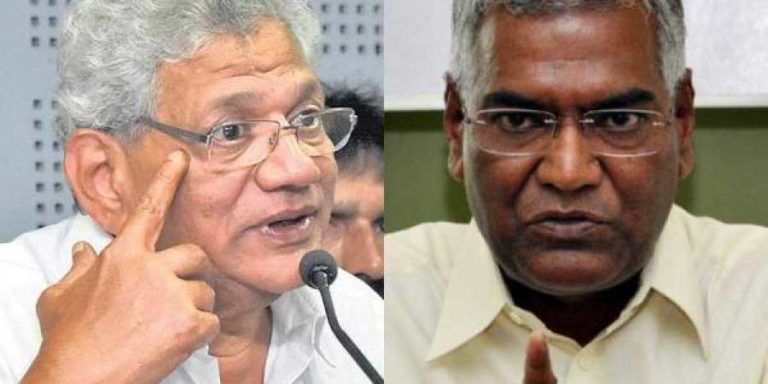


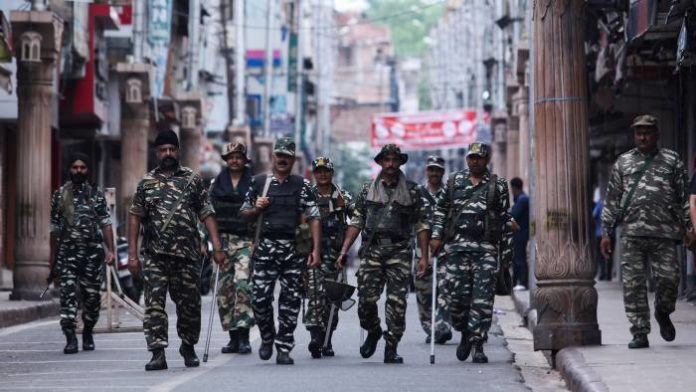
 He said that people of “the country” wanted to know why Article 370 was still in operation in Jammu and Kashmir, and why “despite getting so much money, its people are still poor.” “Article 370 ensures there is no PPP model, no private investment in the state. 370 ensures healthcare in Jammu and Kashmir suffers, no doctor wants to go there. 370 ensures there is no right to education for the children of Kashmir,” Shah said.
 Although it is true that while J&K lags in job creation, investment and growth but that is the case with the rest of the country. The per capita domestic product of Jammu and Kashmir as of 2016-17 is low but higher than most other northern states.


 During this standstill, Pakistani raiders, with the support of the Pakistani Army, began advancing on Kashmir in October 1947. A panicked Maharaja invited Indian forces into Kashmir to provide temporary protection. Subsequently, the Maharaja executed an instrument of accession with India. Under the instrument, defence, external affairs, and communications were listed under the exclusive domain of the central government. All other plenary powers would remain vested within the state government.


 Outline of the programme:
✰ Aug. 14th – a lamp (hanate) procession after sunset: Majestic rly.stn to Banappa Park.
✰ 14th-15th – whole night: program of Resistance – speeches, cultural programmes, etc.
✰ 11.30-12 midnight – Message of Struggle from Mr. Chandrashekar ‘Ravan’, chief guest.
✰ 12.05 midnight: Flag Hoisting and call for real independence: by H.S.Doreswamy. ✰ 15th morning – March for our Rights – from Banappa Park towards Parade Grounds.
Noor Sridhar, Committee member said, The Mid-night Independence Day programme is being organised on the night of 14th of August this year in order to make the “souls-sold” rulers and their governments to act once again on these issues, to reprimand their unconcern and lethargy towards the poor, to send a firm message to them that ‘this is not a movement that would subside and die out’, and to mark the occasion of the Independence Day as a day of taking a pledge of consolidating and intensifying the struggle.


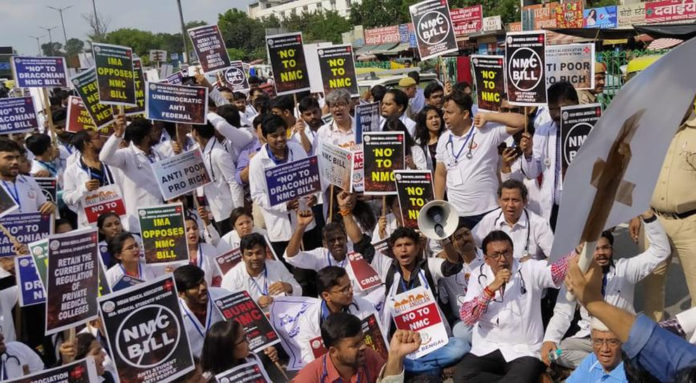
 The NMC for effective functioning needs to be an autonomous and ideally a representative body. Further, professional concerns require it to be an institution at least predominantly made up by doctors. However as per the NMC bill most of the members of the council will be appointees of the central government and mostly ex-official government servants and Directors of reputed institutions. While the recommendation for selection was through a rigorous process of predefined criteria, the bill provides for election of only 20% of the members through the process. Thus the new council for regulation of medical education assumes the character of a bureaucratic department which does not represent all the different regional concerns of the country and may thus fail at appropriate and sensitive state-wise regulation and implementation.
 A major concern and in particular the cause for the strike by the medical students is an addition exam ‘NEXT’ to be introduced for licensing of medical practitioners. Ideally, the NMC should aim at the standardisation of medical education. The very need for an additional exam for licensing apart from the annual examinations that Medical students undergo through a rigorous and stressful process belies confidence in the system and makes those examinations redundant. The proposed objective format of the exam is not ideal for such purpose. This exam cannot substitute the entrance exam for postgraduate training as both have completely different objectives. While a licensing exam needs to assess basic competence, a competitive exam needs to be rigorous to differentiate between two candidates. It only adds further ambivalence to an already stressful situation.

 Siddhartha studied Economics in St. Aloysius College in Mangalore. In one of his interviews, he claimed that he read Marx in the communist library next to Aloysius college, but he always believed that like other corporates, that he must first generate wealth. After his degree, he went to Mumbai and trained under Mahendrabhai in Lonavala. He realised the importance of the stock market in its early days, in the ‘80s. After spending two years in Bombay, he received 7.5 lakhs from his father, returned to Bengaluru and started ‘Shivan Securities’. He bought 60,000 shares of Infosys and sold it all when its value had increased 6 times. Then, he took on the coffee plantation, during a time when coffee rates were low. In 1992, the regulations over coffee were lifted and its value quadrupled. By 1993, the coffee plantation had expanded to 3000 acres! Thus, the ABC company was born. Its turnover went from Rs. 6 Crore to Rs. 2500 crore by 2015. By 1995, it had grown into one of the largest coffee exporters in the country. In the next few years, he continued to expand through Mindtree Software, Chetan Wood Processing Pvt Ltd, Barefoot Resorts and Dark Forest Furniture. He also got married to SM Krishna’s daughter, Malavika.
A chance meeting with a third-generation coffee seller from Germany inspired him. Soon, 20 Coffee Day shops propped up in various parts of South India. Rather than selling coffee beans, they would sell coffee powder, at a significant profit. Later, inspired by Beer Cafe in Singapore, he started an internet cafe with his friends on Brigade Road. That’s how Cafe Coffee Day was born. Now, there are over 1500 cafes and over 600 shops across the country. By then, his father-in-law became the Chief Minister of Karnataka. He took advantage of this situation and expanded. He moved his company to the Mumbai Stock Exchange. Meanwhile, SM Krishna became the Governor of Maharashtra in 2004, and later, the Union Foreign Minister in 2009.
In 2011, he entered the shipping business. His circles now claim that he was pushed to suicide due to his attempts to acquire a company that owned 70% of the global market. By 2015, Siddhartha had encountered a major crisis. He was stuck within debts for some of his companies. To solve these problems, he simply had to sell the shares of his reputed brands: Cafe Coffee Day and Mindtree. Apparently, Cafe Coffee Day was being negotiated to be sold to Coca Cola; 20% of Mindtree’s shares were sold to L&T. This was when the IT problem began, he wrote in his last letter. The Income Tax Department began to attach his assets and transactions. This closed the only available route to set his business right. Siddhartha’s letter states that he then conducted transactions that his family and top business officials have not been privy to. While the Ministry of Corporate Affairs marks his debt at Rs. 8,000 crores, CCD circles claim it could be anywhere between Rs. 10 thousand crores to Rs. 15 thousand crores.
The government currently in power abandons rules to help such entrepreneurs; it puts out a red carpet to make corporations comfortable. However, why these problems were not resolved even after SM Krishna’s joined BJP remains a mystery. In fact, the IT Officer, supposedly Arun Jaitley’s confidante, is accused in Siddhartha’s letter. How was an entrepreneur with a 12000-acre estate, a stock exchange company, and an influential father-in-law still unable to solve his financial crisis? More information may shed light on this baffling question in the coming days.
His empire, it must be noted, led to the creation of around 50,000 jobs. Coffee Day sustained the livelihoods of many in Karnataka. On one of his frequent visits to Kolkata, he is said to have stepped into his own Cafe Coffee Day in uniform, to serve coffee. He saw the way that they treated workers: nobody said thanks, no ‘Happy New Year’s, no smiles. He wondered how the staff would maintain their enthusiasm in such an environment, and empathized with their predicament. Siddhartha had a delicate personality; he generously helped schools in Malnad and Chikmagalur. He was known, not only as the son of Gangayya Hegde but also as the son-in-law of SM Krishna.
However, the cracks within his business brought him down, as he himself once said
“It’s true that his holding company had a loan of Rs. 1000 Crore; this debt was incurred to buy the shares of Sequoia Capital and Goldman Sachs in Retail. Another Rs. 200 Crores was borrowed to buy more shares of Mindtree. If we sold our Mindtree shares, the entire company’s debt would be taken care of. But we do not wish to sell the company, it has brought us 40% profit in the last 16 years.”
Apart from having problems in his business, this situation highlights the extent to which Siddhartha was being squeezed out by the IT department and his creditors. These problems exist even for Gujarati businessmen, but Gujarati politicians are currently in power in Delhi and can assist them. Perhaps the Gujarati politicians did not help resolve Siddhartha’s crisis in order to undermine his influential father-in-law. In a crony, capitalist world, there are a growing number of people who are willing to go to any lengths to ease their wealth. Perhaps, due to his sensitive personality, Siddhartha Hegde was unwilling to play by the crooked rules of this game. As someone who set out to achieve great things, discovering his status as a failed entrepreneur perhaps incited his death.
In an interview with a journalist, he himself said almost prophetically, “Entrepreneurs don’t retire. They die.”

 These numbers though disheartening also show that parents have also grown aware of the law and have begun to utilise it. The Unnao case highlights the multiple failures of the POCSO Act with intermediaries such as the police unwilling to file the complaint till the passing of a year, despite the fact that the law states that the cases must be tried within that period of time. Despite such instances, there has been no amendment in the law that looks into effective penalisation for the role of other intermediaries in the protection of those accused of the sexual assault of minors.
According to the Act as it stands the only form of penalisation for anyone caught in the abetting of the accused haven’t been clearly defined in the law, so if someone was to threaten the victim’s family and turn them into hostile witnesses it wouldn’t be tried under POCSO directly. In the case of Unnao the multiple individuals it has taken to orchestrate the various acts of violence would not be tried under the fast track courts, because abetment is charged under different legislation. We know in multiple cases that victims turn hostile, often due to intimidation by the accused and external help. Thus ensuring that cases are acquitted, protecting serial offenders. Though one may not be able to deter a serial offender, those aiding him should be dissuaded as far as possible. In this aspect, penalisation must be looked into the abetting of cases under POCSO with a much more intensive approach. In the case of the Kathua rape case involving the murder and rape of an eight-year-old child, large groups protested the incarceration of the accused. This example highlights how there isn’t any level of deterrence from the Act, it is in this way that the amendment doesn’t understand that the accused alone isn’t an assaulter but all those aiding him to promote sexual assault. Therefore with this degree of insulation, through social networks and power equations, capital punishment does nothing to change the social context of the individual. For that, the trial actually has to occur, for that to occur the victims and their families shouldn’t be threatened or coerced into silence.
Despite the increase in the number of cases registered under the Act (with the overall number of cases for the rape of children in 2016 were 19,765 cases (Tiwary, 2017 ), how many accused of this crime actually go to prison remains unclear. When looking at details for the number of incarcerated individuals there exists no clear differentiation in the 2016 NCRB report regarding the child sexual offenses and other forms of rape. However, we do know that in the case of Mumbai 17percent of incarcerated prisoners in the city were tried under POCSO (Hafeez, 2019 ). This could also be a product of the fact that it was a metropolitan hub, access to courts, legal aid, police stations, hospitals, etc all aid in the prosecution of such cases. Yet the states which have shown some of the most massive increases in the registration appear to be the states such as Madhya Pradesh, Uttar Pradesh, Odisha, etc (Tiwary, 2017 )which have a higher rural population belt.
The trying of those cases in a fair manner needs to be investigated and the incarceration rates for these states need to be verified. One of the improvements to the trying of such cases is the creation of tribunal courts for districts and towns with over 100 cases pending under POCSO mandated by the Supreme Court (Bureau, 2019 ). The judgment hopes that by doing so there could be swifter access to justice in the coming years.
However, justice does not merely begin from trying in the court it is important to look into the manner in which children are being approached in terms of medical professionals and police officers during the filing of the FIR. We know that the law attempts to ensure that the victim should be made to feel comfortable when filing the charge, that the filing of the FIR could even be done outside the police station in a place the child feels safe. Despite this and other aspects of the legislation ensuring the special courts for children should be comfortable spaces for them, often in the case of Karnataka, there have been instances where children were seated next to the accused in the waiting rooms of the special courts (Kothari & Ravi, 2016 ).
Another important Amendment to POCSO was the inclusion of a fine towards the victim and their family in addition to other incarceration charges. The fine is to be calculated based on the victim’s medical expenses and rehabilitation due to the sexual assault case. As most victims will require medical assistance for a long period of time with regards also to mental health aid and physical aid, the fine should take into account future costs incurred by the family over a longer period of time rather than the immediate medical cost of the child due to the sexual assault.
The author has previously taught as a teaching assistant for the Institute for Public policy, National Law School of India University.


 If the UAPA Amendment Bill is passed in the Rajya Sabha, the UAPA will empower the central government to designate individuals as terrorists. The need to do so was defended by Union Minister Amit Shah on the grounds that other countries have provisions for their states to declare individuals as terrorists, and the Indian state requires the power to do so as well. He said that individuals who “plant terrorist literature” and promote “terrorist theory” should be designated as terrorists.
While the opposition raised voices against the amendment , notably Mahua Moitra (TMC), Asaduddin Owaisi (AIMIM), Danish Ali (BSP), and others , who raised concerns about the use of these amendments in settling political vendettas by the center and how the bill infringes on basic human rights to a fair hearing and keeps power of the central government beyond reasonable checks. The amendment would give the central government the right to designate individuals as a terrorist without the need for evidence or trial and judicial oversight. The definition of terrorism in the bill is vague, and can easily be misused to criminalize thoughts, possession of literature, and many other forms of association. The appeal process against being labeled a process is so complicated that no ordinary person innocent of charges could ever successfully remove the label.


 The UAPA has been used routinely to harass and imprison people raising dissenting voices, including last year when raided the homes of various human rights activists across the country. A notable case was that of Delhi University professor, GN Saibaba, who, owing to his deteriorating health and weak physical condition, is wheelchair-bound, 90% disabled, and is physically suffering in prison.
Arbitrary use of anti-terror laws has usually been counter-productive. For example, in the case of POTA, only 13 people were convicted in the 4,349 cases it covered. Arbitrary anti-terror laws usually lead to the flawed and uncertain procedure, which often backfire in preventing violent activities and create an unending sense of undeclared war reminiscent of the emergency.
The National Investigation Agency is a central agency formed in 2008 after the Mumbai attacks with the mandate to combat terrorism across India. The Agency was created by the NIA (Amendment) Bill with only six members of parliament opposing. The NIA now has the power to investigate offenses regarding human trafficking, counterfeit, prohibited arms, explosives, and cybercrimes. The amendment has greatly increased the jurisdiction of the NIA, as it allows the NIA to investigate offenses taking place outside of India, subject to international treaties and foreign law, and allows the central government to override local police. The NIA also is empowered to constitute special courts that are capable of imposing penalties, including the death penalty.
These two amendments are steps to turning India from a modern democracy to a feudal estate. The amendment to the UAPA makes it clear that the Central government does not need evidence or procedure when deeming people criminals anymore, and makes a mockery of the judicial process by allowing the central government a free hand choosing its enemies. The amendment to the NIA gives the central government the ability to override local police and handle cases on its own. Neither amendment makes the country any safer as gathering proper evidence, the use of correct authorities and the evaluation by an unbiased judiciary are the only ways to make the country safe from anti-social evidence. All these amendments do is gives those who are in power in the center an additional weapon in their arsenal to attack those that raise a dissenting voice, and violate the rights of subjects in an undeclared emergency era.

 The crux of the situation is that someone was unhappy and decided to leave the space making her unhappy. And instead of expressing concern and support, many actors and media personalities attacked her decision to further their own faux feminist, liberal, and Islamophobic agendas. Or in the case of Raveena Tandon, self-righteously demanded respect for a misogynistic, exploitative industry. If one stops to think, Wasim is now 18. She has just reached the legal age of consent. That means that her participation in the film industry, as it is for all child actors across the globe, lacked the complete consent of an adult. By making this decision, she is asserting her non-consent, her refusal to live the life of a Bollywood star. It is ironic that while she was a minor playing her roles in Bollywood’s attempts at progressiveness, she was lauded by the general liberal population; but the moment she exercised her right to consent, her choices were condemned with such alacrity by the same population. No one wondered why, the moment she gained more control over her life, she upped and left the film industry.
Now we know that Bollywood is, frankly, a terrible environment for young women. We were aware of this before #MeToo, albeit perhaps in various stages of denial, and the movement has made the fact inescapable. The industry is entirely patriarchal, with rampant sexual harassment and abuse, toxic beauty requirements, substance abuse, nepotism, and too much money. The same goes for Hollywood. And the harassment runs deep and disillusioning, with directors of the most ‘progressive’ films turning out to be harassers. On top of this, Bollywood celebrities are now openly supporting Hindutva fascism, with Priyanka Chopra inviting Modi to her wedding, Akshay Kumar and Kangana Ranaut endorsing Modi, and the latter loudly espousing conservative right-wing views, to name a few. Simultaneously, the content being produced feeds into the same narrative of Hindu nationalism, especially with films like Uri reaping in the profits. It is hardly surprising, then, that Wasim, a Kashmiri Muslim woman, would feel like she did not “belong” in Bollywood and was not “truly happy” working in the industry. There are enough possible reasons for her to leave, and a feminist or otherwise progressive public would be quick to understand that, without demanding explanations.
 The main criticisms leveled at Wasim were that she was succumbing to the alleged oppression of Islam by giving up her Bollywood career, thereby causing a blow to feminism, and that she was simply brainwashed – the latter involving speculations of her becoming a jihadi by Payal Rohatgi with a #JaiShriRam and a nod to freedom of expression. These were espoused with some variation by men and women in the industry and the news. Despite their apparently opposing perspectives, these two points sound quite similar. Both invalidate the actress’ agency and imply a fear of Islam. The latter is the usual Hindutva assertion, fed by the fixation of ‘secular’ liberals on Wasim’s religion. The former, however, does not quite match up. Bollywood specializes in promoting misogynistic stereotypes on how women should behave, objectifying women on screen, and teaching us that consent comes in the way of ‘real’ romance. A few movies actively denounce these ideas to varying degrees, like Deepa Mehta’s Fire, for example, but an overwhelming amount contributes to this culture, idolizing toxic masculinity as always (think Kabir Singh, Sanju, Simmba). How, then, is it feminist to participate in this industry, perpetuating these stereotypes in some way or other? Neither is it immoral (for the sake of progressiveness or conservatism), for young women to act in Bollywood – this is how one makes it big, and as a young actress, one usually has little choice in the kinds of films one acts in to rise in the industry, especially if one has no contacts. It is a career choice – careers definitely being steps to empowerment – but unless one uses it to challenge the status quo, it cannot be called feminist. And leaving the industry is not unfeminist (a point to note is that Wasim’s future career plans are unknown), especially if it is having adverse effects on a woman’s well-being, which Wasim quite clearly stated was the case. What is unfeminist is expecting her to ‘push through the pain,’ as is unfortunately valorized in women – but this patriarchal notion only serves to keep women subordinated in unhealthy, painful situations.
 The issue skirts close to the ever-growing practice of choice feminism, as Barkha Dutt points out in her shortsighted views on Wasim’s exit, saying “choice is sometimes a complicated word. For women, especially.” Choice feminism is simply a fallacious (but harmful) liberal interpretation of feminism, that celebrates the making of any choice by a woman as empowering – this empowerment being purely individual, and therefore it does not matter if it is significant to the larger movement. Strikingly, it refuses to take into account the basis and historical motivations of these choices – how the patriarchy plays an invisible hand in a woman’s choice to get married to a man or wax her legs. While there is nothing wrong in making these choices, there is nothing feminist about them. Now, Wasim’s choice is not touted as feminist, though detractors may accuse her supporters of being choice feminists. However, they would be wrong, as this is not a meaningless choice that only aligns with existing power structures, because the religion in question is Islam, a minority religion. This, then, becomes an assertion of her marginalized identity, as well as being a means for her to find solace after a difficult time. Neither of these would please an upper-caste, Hindu public.
In all the outcry around the oppression of religion, people seemed to ignore the biggest religious oppressor there is, which is Hinduism and its perpetuation of hierarchy and violence. Hinduism has been consistently present in Bollywood films and the public lives of celebrities. When Nusrat Jahan, TMC MLA, and Muslim, put on sindoor for her oath-taking ceremony, where were the cries of brainwashing and fears of her turning into a Hindu terrorist? These wouldn’t even have been unrealistic concerns.
Reactions of Wasim’s fellow women celebrities were perhaps most disappointing, especially as some of them were Muslim. They displayed a lack of empathy and solidarity that are crucial in such a hugely patriarchal setting, where women are constantly targeted. A few supportive and indignant voices, such as Nagma calling her courageous, lauding her work and wishing her well; Saba Naqvi asking, “Who on earth are we to judge #ZairaWasim and her choices..a spiritual path works for many people,” were relieving. However, even feminist writers like Taslima Nasreen displayed a complete lack of understanding, calling Wasim’s choice “a moronic decision,” and lamenting that “so many talents in the Muslim community are forced to go under the darkness of the burqa,” again stigmatizing the burqa.
A lot of the unnecessary backlash stems from a larger elite liberal culture of absolutely having to declare an opinion on anything that sounds remotely political, to prove one’s liberal attitudes. And liberals usually choose to ignore serious political concerns or see them as private conversation topics, rather than speaking up in public and inviting possible discomfort to their inflow of wealth. Wasim’s case seemed a safe bet, Islam and not Hindusims was being called regressive, and women doing anything could be termed feminist or unfeminist. All of this is, however, is at the expense of someone’s well-being. This ties in with the other toxic culture of inspecting and judging every move a woman, especially a celebrity, make; men get away without much judgment unless they have other marginalized identities that are weaponized against them (the Khans do not count). The more on the margins one is in the public arena, the more one’s mundane actions are scrutinised because the dominant voice is naturally the majority’s.
Tara is a Psychology student and co-heads Feminist Collective. The opinions expressed in this publication are those of the author.
References:
https://economictimes.indiatimes.com/magazines/panache/zaira-wasim-quits-bollywood-nagma-lauds-courageous-girl-raveena-criticises-taslima-nasreen-calls-it-a-moronic-decision/articleshow/70018054.cms
https://www.aljazeera.com/indepth/opinion/zaira-wasim-controversy-reveals-contemporary-india-190703092002011.html
https://www.aljazeera.com/indepth/features/zaira-wasim-decision-quit-bollywood-faith-stirs-debate-190702111327288.html

 Mumbai crime branch breakthrough with the suicide note
The charge sheet has revealed shocking details of how the three doctors tried to destroy evidence from Payal´s hostel room. Dr Khandelwal and Dr Mehare were the first people to reach the hostel room where Tadvi killed herself and take her body to the trauma ward, after which they returned to the room. Police believe that the original note, along with the photos, were destroyed by the accused. The police had earlier presented CCTV footage in court, showing them enter the room. The police claimed they were trying to destroy the suicide note and other evidence. The photos of the suicide note retrieved from her phone by the forensic lab corroborate the witness statements and her family claims of caste discrimination and abetment of suicide.
Doctors Hema Ahuja, Bhakti Mehare and Ankita Khandelwal are named in the charge sheet with the police claiming that they committed offences under the Scheduled Castes and the Scheduled Tribes (Prevention of Atrocities) Act, Maharashtra Prohibition of Ragging Act, Information Technology Act and abetment of suicide, destruction of evidence and common intent under the Indian Penal Code.