The Supreme Court on Monday directed the Gujarat Government to pay Rs 50 lakh compensation and provide job within two weeks to a Bilkis Bano, the woman who survived gangrape during 2002 Gujarat riots.
Earlier on April 23 also SC had directed the Gujarat government to pay the compensation of Rs 50 lakh, a job, and residential accommodation but the Gujarat government did not comply with the supreme court orders.
The bench headed by Chief Justice Ranjan Gogoi also questioned the Gujarat government- “Why has the compensation not been paid? Why haven’t you paid?”
The court dismissed the possibility of a reconsideration of their decision and directed the state to comply with its order within 2 weeks. “Even 2 weeks’ time is not needed”, commented the Chief Justice.
Bilkis Husband Yakoob Rasool told PTI- “The Supreme Court on April 13 told the state government to give her compensation within 15 days. It has been over five months now, but the government did not contact us even once, let alone follow the court order,”
Mr. Rasool said his family sent two notices to the Vijay Rupani-led state government, reminding of the top court order, but the government did not reply, after which they approached the Supreme Court again.
All we know is that Bilkis suffered a lot in last 17 years, but never gave up the fight,” he said.
Bilkis Bano case
On March 3, 2002, Bilkis Bano’s family was attacked by a mob at Randhikpur village near Ahmedabad during the post-Godhra riots.
Bilkis, 21 years and five months pregnant at that time, was gang-raped and several members of her family were killed. During the riots, 14 members of Bilkis’ family were killed, including her two-and-half-year old daughter who was snatched from her mother’s arms and smashed on a rock.
Bilkis Bano was illiterate and was not well off economically. Police and magistrates dismissed her case in 2003. The national human rights commission backed her petition in the Supreme Court which led to a CBI inquiry. In January 2004, the CBI arrested all the accused named by Bilkis Bano. The CBI also exhumed the bodies of those killed for examination.
She kept receiving threats forcing her to change her residence as many as 20 times in two years. She later filed a plea in the Supreme Court for transfer of the case outside Gujarat. The Supreme Court in August 2004 shifted the trial of Bilkis Bano case from Gujarat to Mumbai. The Supreme Court in August 2004 shifted the trial of Bilkis Bano case from Gujarat to Mumbai.
The Trial case
A special court had on January 21, 2008, convicted and sentenced to life imprisonment 11 men for raping Bano and murdering seven of her family members in the aftermath of the Godhra riots, while acquitting seven persons including the policemen and doctors.
She also sought disciplinary proceedings against the police officials who were convicted by the High Court in the case. The bench was informed by the state’s counsel that pension benefits of the erring officials have been stopped and the IPS officer who was convicted by the Bombay High Court in the case has been demoted by two ranks.
The high court, on May 4, 2017, convicted seven people – five policemen and two doctors – under charges of not performing their duties and tampering of evidence. The top court had on July 10, 2017, dismissed the appeals of two doctors and four policemen, including an IPS officer R S Bhagora, challenging their conviction by the high court saying there was “clear-cut evidence” against them. One of the officers did not appeal.
After four years, the trial court in Mumbai found 13 of 20 accused guilty. The court awarded life sentence to 11 of the convicts.
In 1947 an American TV puppet show named “Howdy Doody” became popular. In this show usual peanut gallery (front row audience) was replaced by children and they would cheer at the puppet and the instructions of the TV show hosts with commercials of Colgate and Wonder Bread in between breaks.
The term Howdy is often used as a shortened expression for “How do you do” in many parts America and term doody was the popular puppet in the show that the children cheered for. The Houston event organised by Texas India Forum, just like Howdy doody show had many corporate sponsors. Walmart which is trying to enter Indian Market, Hospitality company Oyo hotels funded by Trump supporter Peter Thiel and Tellurian a natural gas company that has recently struck a deal with Indian Public Sector energy company. In fact, the first thing Modi did in Houston before the rally was meet energy executives of Tellurium, ExxonMobil and many other global energy companies.
This marriage of convenience is not entirely surprising as the foreign policies of the USA and India are on a converging path from the past three decades and even more so after Modi came to power. Trump was even invited for the India republic day celebration of 2018 which was turned down later by Trump. Trump on his part is building detention camps for illegal immigrants near Mexican borders and Modi is building detention centres in Assam in the name of illegal immigrants. In fact, the biggest applause and cheers from the audience came when Trump called India an ally in the fight against “Radical Islamic Terror”. Trump is bombing Islamic countries more than Bush or Obama administration.
While Modi is pursuing the “India First” policy, Trump is pursuing his Make America Great Again through America First Policy. And for contradictions, America First policy is being compromised as Lockheed martin is manufacturing F-16 parts in India under the “Make in India” banner. Along with this, there are also plans to tweak the existing F-16’s and producing what America calls F-21 in India. Trump has initiated the biggest ever trade war against China and facing a lot of backlash for his policies in Afghanistan, Syria, Yemen and ongoing crises directed against Iran.
Modi on his part has pushed India towards America like never before. Under his administration, Logistics Exchange Memorandum of Agreement was signed in August 2016 known as LEMOA and Communications Compatibility and Security Agreement on 2018 SEP called COMCASA which brings both the countries militarily closer. The coming together of Trump and Modi is also seen as the converging ideologies of White Supremacy with Hindutva in America. Both are built on mixture of Islamophobia and nationalism based on racial superiority.
Protests outside the Howdy Modi event
This event is also seen as an extension of Prime Minister Narendra Modi’s electoral juggernaut overseas into America. With more than 50,000 people attending Narendra Modi’s “Howdy Modi” event, current President Donald Trump hopes to gain the support of increasing Indian American voting population(which traditionally voted for Democratic Party) in the coming next year November 3, 2020, presidential elections. Modi even spoke in 8 Indian languages to say “everything is fine” in India, when in fact entire Kashmir is under military rule with complete communication shut down from the last two months. The economy under severe stress and Institutions afters institutions are rendered toothless with the onslaught of the ruling party’s virulent Hindutva ideology. The powerful PR machinery was even successful is Trump promoting Modi to the status of “Father of India”.
The gradual shift in the Indian Identity into a religious nationalistic character is not only dangerous for itself but for all the oppressed communities it has stood with historically. When the Majority of Indians and Americans are suffering due to the ill-advised and dictatorial policies of the two leaders, it only remains to be seen how far this puppet show will keep the peanut gallery happy in both countries.
Last weekend, a rainbow coalition of organizations and individuals launched the South Asian People’s Action on Climate Crisis (SAPACC) in Hyderabad. It was attended by more than 300 people from across South Asia.
Over four days, representatives from India, Nepal, Bangladesh, Maldives, and Sri Lanka met to articulate action-oriented demands that could mobilize their respective governments and the United Nations towards taking climate crisis mitigating actions, along with strategies to exert pressure on their implementation. Students, farmers, workers, fisher-persons, adivasis and activists alongside scientists, engineers, teachers among others – who recognize the urgency of demanding collective action at a global level – put forth resolutions and supported a petition demanding an equitable and ecologically sound climate-emergency action plan implemented by the UN.
Displayed at SAPACC
Estimates by Mr. Tariq Karim, former Bangladesh High Commissioner to India, find that over 50 million Bangladeshi people – roughly 6 times the population of London – will become climate refugees by 2050. By the 21st century, that number will rise; and the country of Maldives will drown, displacing its population of 400 thousand. Significant stress and possible conflict can be anticipated in the near future, considering the extreme weather events, water scarcity and sea level rise that will affect India, Pakistan, Sri Lanka, and Afghanistan. About half of the glacial ice spread across 75,000 km2 of the Himalayas today may be lost, with Bhutan and Nepal experiencing glacial lake outburst floods in 2100.
Meera Sanghamitra, Human Rights activist and Mohit Garg, filmmaker at SAPACC.Deekshya Illangasinghe from South Asians for Human Rights chairing a session on SAPACCs core demands.
We are not confronting climate ‘change’, but climate ‘crisis’. According to the Intergovernmental Panel on Climate Change (IPCC), we have till 2050 to cut carbon emissions to zero if the Earth is to remain habitable. Unfortunately, governments have been reluctant to take mitigation measures. Voluntary pledges made in the 2015 inter-governmental Paris Agreement by large emitters, particularly from the North, are inadequate to keep temperature rise below the 1.5 – 2 degree redline. Additionally, USA has announced its intention to withdraw from the Paris agreement and has not been following its commitments. USA’s reluctance to transition from fossil fuels has influenced countries like France and China too.
Fridays For Future, Global Climate Strike in Hyderabad on September 20, 2019. Photo: Takoyangba Lemtur.
As a result, people are mobilizing to pressure their governments. Many international climate campaigns have amassed support, including Extinction Rebellion from the UK and the European children’s School Strike movement, but the reaction in India and South Asia has been slow beyond the urban middle class. Given the urgency of this crisis, in May 2019, a group of scientists and representatives of trade unions and people’s movements in India and South Asia, decided to launch a campaign.
Completely people-funded and focused on addressing the vulnerability of South Asian countries due to climate change, SAPACC’s meeting marks the first of its kind in South Asia. Despite housing a quarter of the world’s population, South Asia has emitted only 3.5% of the world’s historic emissions since the Industrial Revolution. And yet, it will be among the worst affected regions. The Global Climate Change Risk Index, 2019 reported that as of 2017, Sri Lanka, Nepal, and Bangladesh were in the top ten countries most affected by climate change impacts.
Harbhajan Singh Sidhu, general secretary of Indian national trade union centre, Hind Mazdoor Sabha, addresses SAPACC at Hari Hara Kala Bhavan on September 18, 2019. Photo: Gangadhar Pandey
Given the inequality of climate risk and impacts, South Asian civil society organizations are demanding action at a crucial time. “Learning good strategy through the context of different countries is vital to combat climate change. Exchange of knowledge and experiences provides solidarity and support across borders”, said Deekshya Illangasinghe from South Asians for Human Rights, based in Colombo, after chairing a session on SAPACC’s core demands. South Asia will be one of the hardest-hit regions in the world, with specific populations most at risk, so SAPACC also included focused group discussions on impacts of this crisis with fish workers, farmers, women, youth and workers.
These experiences of people who directly feel the fingerprints of human action on the climate emphasize that no country can tackle the crisis on its own. Young people from across the world are raising their voices against inheriting a socio-ecologically unjust future. However, voices of the most vulnerable are still marginalized in the narrative on climate crisis impacts. While keeping these voices at the forefront, SAPACC aims to influence public policy on the crisis in South Asia and mobilize mass action to mitigate it. It will keep this momentum alive by forming a coordinating body to take the action forward in a collective manner on the South Asian level. Members will be writing to their respective governments to declare a climate crisis, and act on it in a timely and proportionate manner. Extend solidarity to keep the climate and change the economy. As a people’s coalition, we must keep this fight alive.
Riya Behl studied Sociology-Anthropology and Environmental Studies at Ashoka University. She is currently a Mother Teresa Fellow, working with Rythu Swarajya Vedika, a policy advocacy collective that supports tenant farmers and farmer suicide families in Telangana and Andhra Pradesh.
In the 1800s, the Indian population in the United States was weak, politically, economically and numerically. They migrated as labourers after the abolition of slavery and would mostly marry into the communities of other oppressed races, and settled mostly in the newly settled western areas.
Industrial Revolution and the Second World War
Starting in the late 1800s and early 1900s, as an effort to benefit from industrial progress and scientific advancement, some Indians began to migrate to America in educated and middle-class capacities, using scholarships given by the British government or from Princely states. They were few in number, and those who did not return to India faced racial discrimination. They were not able to get citizenship. They were not able to marry people from different races, and they faced hostility and discrimination. Some of them eventually became involved in radical politics, fighting racism and class oppression in America and imperialism in India. The most famous organization was the Ghadar Party that facilitated revolutionary action in India. At the time, Asians from all countries were held in contempt by the wider American society. White Americans were suspicious of Asians, holding on the idea that they were unruly, lazy and barbarous.
During the Second World War, the Nazi party attempted to smear the American image by pointing to its racial diversity. American people were described as being interbred of dogs having lost any racial purity. American country propaganda responded by portraying its racial diversity as its strength and as representative of liberal values. After the war was over, this put American into a trap. On one side, it built an image of multiracial solidarity. This would be crucial in developing alliances in the post-war era when the United Kingdom and France, traditional American allies, would lose direct control in Asia and Africa. On the other side, anti-racist movements progressed and many leaders advocated for leftist reforms.
This led to a change in American immigration policies that allowed Asians to become citizens and eventually reformed the immigration policy. The immigration policy was reformed more as a way of managing the impression of America as a racist state than to accommodate progressive movements. Countries were given migration quotas, and a selection criterion developed to make sure that skilled labour with high levels of education migrated in. Many Asian success stories were highlighted to dismiss allegations of racism in American society.
The Model Minority
In this period, Japanese, Chinese and Indians were described as the “Model Minority,” who because of cultural values of hard work and respect for education, could overcome any limitations racism could impose. They were displayed as proof that allegations by African American, Native American and Latin American communities of racism were false excuses. Asians existed in small enough numbers, not to be a threat to the established racist order. Indians, because of their relatively advantaged position in the British Empire in colonial administration and trade, would be approved for immigration even from countries where they were a small minority.
From India, community and education networks gave Upper-caste Hindus and Christians an advantage in the immigration process. More so than other Asians, a large number of immigration visas to the US are based on family support. Even after reaching the US, these networks help newly arrived Indians get support in times of need, often being the basis of their survival in America. Unlike other “model minorities” like Jews, East Asians, and Southeast Asians, Indians often have to distinguish themselves from other minorities, (e.g.: Middle Eastern, Black, Hispanic, and less well-off South Asians). This creates a situation where they often have to double-down on the more traditional aspects of their identity. Even when they try to break those traditional systems, they become aspirant, attempting to secure more privileged positions.
Around the time immigration picked up for Indians, India also went through a process of social transformation. In the 1950s-1970s, investment in higher education increased and primarily benefited upper-castes. In the 1970s and 1980s, many of them began to migrate to the US and set up organizations there. The RSS benefited from this trend by working through the Viswa Hindu Parishad (VHP).
In the 1960s, members of the RSS formed front organizations that could survive its banning. The VHP was formed to be a religious face. It was founded in 1966 and maintained a set of laws to distance itself from politics. Over the years, the VHP organized Hindu religious leaders and moved on to organize them abroad as well. They set up its first American office in 1970.
VHP organized Hindus abroad, using networks run through universities and temples. Even language and ethnic groups, which organize on caste networks, create a dual identity for Indians as needing to show respect for conservative aspects of their parent nation. Fissures in this come from identities that do not fit into the traditional landscape of Indian culture, such as people from marginalized castes, people whose families remember separatist struggles, people from gender and sexual minorities.
The VHP developed networks for Indians to send money to their organizations in the form of remittances. Today money sent from the US is equivalent to nearly 0.8% of the Indian GDP, and money sent from abroad overall, is 4% of the Indian GDP. This is up from 0.5% in 1991. This helps make the RSS the NGO with the highest amount of foreign funding.
Not all of this funding is through direct Hindutva propaganda. As documented by the Campaign to Stop the Funding of Hate, there are front organizations, such as the innocent-sounding names like Indian Development Relief Fund, who funnel money towards Sangh activities. However, a high amount of support for those activities depends upon the support they have garnered from the Indian community.
Shifts in Indian Identity
The Indian identity is based on the colonial image of Indian civilization. The idea of being Indian abroad does not compel Indians abroad to challenge structures of oppression, as it did in the early twentieth century. With the changes in immigration policies, the Indian immigration experience must be placed in a privileged position within white supremacy, where oppression within and outside of the community persists.
Despite being a former colony, being Indian only in rare circumstances compels Indians abroad to show solidarity with other struggles against oppression, in the way Latin American, African, or even Muslim identities do. Unless a new understanding of being Indian, which foregrounds global solidarity with the oppressed and prioritizes the most oppressed in the community, being an Indian in a multicultural environment will be tied to supporting systems of oppression. Organizations that placate the more conservative impulses will continue to hold sway.
A fact-finding report released by a team of women activists who have visited Kashmir from September 17-21. The report was released yesterday in Delhi Press Club. The team comprising of Annie Raja, Kawaljit Kaur and Pankhuri Zaheer from the National Federation of Indian Women, Poonam Kaushik of Pragatisheel Mahila Sangathan Delhi and Syeda Hameed of Muslim Women’s Forum.
The report titled “Women´s Voice details the ground realities of the state after the Centre’s decision of abrogating Articles 370 and 35A of the Indian Constitution. The team visited 17 villages all across Kashmir.
The team visited Srinagar and seventeen villages of Shopian, Pulwama, and Bandipora. They went to hospitals, schools, homes, market places, spoke to people in the rural as well as urban areas, to men, women, youth, and children.
This Report covered the account of the population that has lived for 43 days under complete lockdown. Shops, hotels, schools, colleges, institutions, and universities were closed.
The report tells several accounts of people living under lockdown. Their stories sound more like living in a war zone.
“They (army persons) pour kerosene on our ration supplies. During random checking of houses which occurs at all odd hours of the night, the army persons come in and throw out the family. “
The team found that peoples’ experiences were the same in all the villages they visited. They all spoke of lights to be turned off around 8 PM. In Bandipora, we saw a young girl who made the mistake of keeping a lamp-lit to read for her exam on the chance that her school may open soon. Army men angered by this breach of 2 ‘curfew’, jumped the wall to barge in. Father and son, the only males in the house were taken away for questioning. ‘What questions?’, no one dared ask. The two have been detained since then. ‘We insist that men should go indoors after 6 PM. Man or boy seen after dusk is a huge risk. If absolutely necessary, we women go outside’.
The report tells several accounts of villagers telling their plight during such difficult times:
Zarina from a village near Bandipora district headquarters recounts ‘In a reflex action, my four-year-old places a finger on her lips when she hears a dog bark after dusk. Barking dogs mean an imminent visit by the army. I can’t switch on the phone for light so I can take my little girl to the toilet. Light shows from far and if that happens our men pay with their lives.”
There were also accounts of people complaining of the inability to respond to health emergencies, to inform family members about the death of dear ones.
Army pounces on young boys; it seems they hate their very sight. When fathers go to rescue their children they are made to deposit money, anywhere between 20000 to 60000’. So palpable is their hatred for Kashmiri youth that when there is the dreaded knock on the door of a home, an old man is sent to open it. ‘We hope and pray they will spare an old man. But their slaps land on all faces, regardless whether they are old or young, or even the very young.
Boys as young as 14 or 15 are taken away, tortured, some for as long as 45 days. A woman recounted how they came for her 22-year-old son. But since his hand was in plaster they took away her 14 years old instead. In another village, we heard that two men were brutally beaten. No reason. One returned, after 20 days, broken in body and spirit. The other is still in custody. According to the report, around 13000 boys lifted during this lockdown. The families do not know about the whereabouts. Many are sent to jails in different parts of India.
The team has set forth a list of demands in the report:The report concludes: “Everywhere we went there were two inexorable sentiments. First, desire for Azadi; they want nothing of either India or Pakistan. The humiliation and torture they have suffered for 70 years has reached a point of no return. Abrogation of 370 some say has snapped the last tie they had with India. Even those people who always stood with the Indian state have been rejected by the government. Since all their leaders have been placed under PSA [Public Safety Act] or under house arrest, the common people have become their own leaders. Their suffering is untold, so is their patience. The second was the mothers’ anguished cries…their children’s lives should not be snuffed out by gun and jackboots.”
• Immediately restore all communication lines in Kashmir including internet and mobile networks.
• Restore Article 370 and 35 A.
• All future decisions about the political future of Jammu and Kashmir must be taken through a process of dialogue with the people of Jammu and Kashmir.
• All army personnel must be removed from the civilian areas of Jammu and Kashmir.
• A time-bound inquiry committee must be constituted to look into the excesses committed by the army.
According to the ANI report on 25th September. Wednesday – The law student who had accused Swami Chinmayanand of sexually harassing her, has been arrested by the SIT (Special Investigation Team) for allegedly trying to extort money from him. The rape survivor has been sent to 14 days of judicial custody.
After the 23-year-old, who studied in a law college in Shahjahanpur, accused the BJP leader of sexual harassment in a video clip, his lawyers had filed a case of extortion and threat against unidentified persons.
Yesterday, the student´s lawyer had told the press that the Court has allowed an anticipatory bail application on the victim’s behalf and the next date of hearing has been fixed on 26 September.
The police arrested her a day before the hearing of her anticipatory bail.
Chinmayanand’s lawyers had alleged that a WhatsApp message demanding Rs 5 crore was sent to Chinmayanand’s mobile phone. The message, they alleged, threatened to make some video clips viral if the amount was not paid.
The UP Police had earlier arrested three youths in this connection, they have now taken the survivor into custody as well. A local court in Shahjahanpur had rejected the bail pleas of the three youths on Monday.
According to the lawyer of the student -“She was dragged so aggressively that her slippers fell and she was not even allowed to pick them up. Also, when she requested to use the washroom, she was not allowed. Is this how a rape survivor treated in our country?” asked the student’s lawyer, Seema Mishra.
The student was questioned on the extortion case yesterday. SIT had questioned the student of her involvement in the extortion case. The student has maintained that she was not at all involved in it.
The rape survivor´s lawyer also denied these allegations and said that the whole case is as an attempt by the police to weaken the main case of sexual assault against Chinmayanand by levying these allegations.
“It is a completely biased investigation. It is shocking that they have not booked him for rape, for which the punishment is not less than 20 years, and have just put (IPC section) 376-C (not amounting to rape), a much-diluted section, just to protect him. It is ridiculous,” she said. “The girl had been suffering for a year and that is what she gets in the end.”
The SIT claims to have “enough ” to implicate the law student in the extortion case. Last week, the SIT has arrested three persons for allegedly sending a text message to Chinmayanand to extort Rs 5 crore from him. According to sources in the SIT, a complex web of phone calls and digital evidence, including a video and CCTV footage, suggested that the law student too was part of the conspiracy hatched by the three men to extort money from the BJP leader.
According to SIT, it has call records between the law student and six of her friends from January.
Out of these, the most number of calls were exchanged in the month of August — just before that alleged extortion call was made to Chinmayanand. The SIT also claims that the law student was also seen in a video in which the three men can be seen discussing the extortion attempt.
Chinmayanand who was arrested on Friday has been booked under sections 354 D (stalking), 342 (wrongful confinement) and 506 (criminal intimidation), and Section 376C ( sexual intercourse not amounting to the offence of rape) of the Indian Penal Code.
He has been admitted to SGPGI hospital in Lucknow citing poor health reasons. According to the doctor, his vital stats are good.
In another shocking incident of lynching in Madhya Pradesh, two Dalit children were allegedly beaten to death by some people for defecating in front of a panchayat building in Madhya Pradesh’s Shivpuri district on Wednesday, police said.
The incident took place in Bhavkedhi village in the morning, Sirsod police station’s inspector R S Dhakad said.
The two children, Roshani (12) and Avinash (10), suffered serious injuries in the incident and were rushed to the district hospital where doctors declared them dead, he said. Efforts were on to arrest the culprits, he said.
Earlier in July, a 58-year old man was allegedly beaten to death by a mob on suspicion of stealing peacocks in Madhya Pradesh’s Neemuch district. Nine persons were arrested in connection with the crime.
Lynching- a fast-growing menace
Lynching is on the increase in the country and is becoming a bigger menace than the country can handle with laws and bills. The earlier targets were Muslims and Dalits under suspicion of cow slaughtering. Now, this mob mentality is swallowing anything that is sees as suspicious. Last month, more than 20 incidents of mob attacks related to rumored child lifting/kidnapping came to light from UP and Bihar.
The state which is very quick to book any citizen under sedition charges seems to be totally incapable of arresting or taking action against the culprits of lynching even when there is video evidence in many instances of lynching. Many BJP leaders have actively worked towards promoting such incidents by praising, garlanding the culprits of the lynchings.
Supreme court in a last year’s order has directed a series of measures against mob violence and public lynching, of which those transporting cows were frequent victims. In the order the Supreme court also directed the state to take preventive and remedial measures.
Despite the civil society outrage, most states haven’t acted on the incidents of mob violence. Only, the states of Rajasthan and West Bengal have passed anti-lynching bills.
Instead of doing social awareness programs to prevent such incidents and faster action on the culprits of mob violence, some states have resorted to using rare laws to handle the mob lynching incidents.
In Uttar Pradesh which has seen some of the worse of mob lynching related deaths, the state decided to slap the national security act (NSA) against those who are found to inciting or spreading rumours on social media.
Congress’s government in Madhya Pradesh went a step further in the misuse of NSA when it arrested five people under NSA, allegedly carrying cattle and suspicious of cattle slaughter.
The national security act (NSA) is to prevent activities that endanger the country’s security or public order. In India, where normally the law is misused to silence political dissenters and vocal critics, this is a new low. it can lead to a maximum of one year in prison through executive order without trial or bail and is being used against those suspected of offenses against cows.
The idea of India faces an unprecedented challenge. Preventing a dismantling of the Republic of India, as we have known it, is the most pressing political task of our times post the 2019 verdict. This is our yugadharma. So far the response to this challenge has been marked by intellectual lethargy, political paralysis, and the opposition’s obsession with mere anti-Modism.
Opposition to the Modi regime is marked by an inability to fathom the extent of the challenge it poses, unwillingness to recognize its deep roots and failure to think beyond quick-fixes. So far, the Modi regime has evoked a series of predictable responses from its opponents: a passive wait for the bubble to burst; simple-minded anti-Modiism attempts to take on the regime on its own turf and trying to build a grand coalition of the discredited anti-BJP parties. None of these strategies has succeeded so far, none is likely to succeed.
In their obsession with Narendra Modi, his critics make him a larger-than-life figure. In their desire to counter Modi’s attempt to take credit for everything positive, they end up producing a mirror image: Modi critics tend to blame Modi for everything. A lynching in some corner of the country, the failure of one agricultural policy, badly managed balance sheet in the Budget – everything is blamed on the PM. Modi critics do as much publicity for him as his fawning supporters.
Second, most Modi critics suffer from knee-jerk anti-Modism. Since a policy or an action is associated with him or his government, we must oppose him. I suspect that much of the criticism of many policies of this government is because it was produced under the Modi government. Besides, Modi critics tend to have it both ways. If he dies one thing, we attack him. If he were not to do so, we would have attacked him even more furiously. The trouble with this routine, knee-jerk opposition is that it loses the public. People see it for what it is: opposition for the sake of opposition.
Third, and most importantly, Modi critics live in denial. They fail to acknowledge Modi’s popularity and fail to understand the reasons behind it. The inability to foresee the outcome of the 2019 Lok Sabha elections was a classic illustration of this failure. No doubt, Modi’s popularity had dipped in the second half of 2018. But post-Pulwama and post-Balakot, his popularity was head and shoulder above all the opposition leaders put together. After that, the election was no contest at all. But most Modi critics were disconnected from this reality. Even after the election results, many Modi critics continue to live in denial. They find it hard to acknowledge that the BJP won, not because of any EVM manipulation but because people wanted to give Modi another chance.
Such a failure to acknowledge Modi’s popularity leaves little room to understand the reasons for it. It is nearly impossible for Modi critics to see those ordinary voters may have had good reasons to vote for Modi. Just as American liberals find it impossible to believe that anyone within their senses could vote for Donald Trump, Modi critics find it impossible to make sense of an ordinary Indian voter. Modi critics find themselves in a smaller and yet smaller circle of opinion, culturally cut off from the rest of society. The end result is disbelief, anxiety, and angst, but no meaningful action. This is a recipe for political paralysis.
We need to make a fresh start. We need to acknowledge that we have entered a new political age. We need to admit that popular preferences, taste and indeed yardsticks have changed beyond recognition. We need to confront that our older vocabulary does not work with the new generation, that many of our tactics fall flat on its face. We have lost touch with the pic and we cannot elect a new people. The only way forward is that we appreciate the dangers, acknowledge the depth of the challenge and then prepare a road map that combines short- and mid-term strategies with a long-term vision. In the last instance, it is a cultural battle that has to be won with the help of innovative ideas and smart communication.
The author is the national president of Swaraj India.
In a historic decision, the United Kingdom Supreme Court has unanimously declared the suspension of the UK Parliament by prime minister Boris Johnson ahead of Brexit to be unlawful and void.
Supreme Court President Brenda Hale observed that the suspension was “unlawful because it had the effect of frustrating or preventing the ability of Parliament to carry out its constitutional functions without reasonable justification.”
She said the court’s decision means Parliament was never legally suspended and is technically still sitting.
The decision followed three days of hearings last week before a panel of 11 judges.
In this nation without a written constitution, the case marked a rare confrontation between the prime minister, the courts and Parliament over their rights and responsibilities.
It revolved around whether Johnson acted lawfully when he advised the queen to suspend Parliament for five weeks during a crucial time frame before the Oct. 31 Brexit deadline when Britain is scheduled to leave the European Union.
British PM, Johnson, who is in New York for the UN General Assembly, has refused to say whether he will resign if he is found to have broken the law, or will seek to shut down Parliament again.
Following the verdict, British Labour leader Jeremy Corbyn demanded that Boris Johnson call a new election. During Labour Party’s annual conference in Brighton, Corbyn was quoted as saying by Reuters, “I invite Boris Johnson, in the historic words, to ‘consider his position’.”
The Higher Regional Court in Frankfurt, Germany said in a ruling on Monday that hangovers are an “illness”. The decision comes in the wake of the famous Oktoberfest in Munich.
Oktoberfest is the german public holiday celebrated chiefly in the southern part of Germany where people gather from all over Germany and Europe. The festival is characterised by its beer-soaked revelry and celebrations in traditional peasant wear (leather pants and drindl).
The judgment came after plaintiffs claimed a company offering anti-hangover “shots” and powders was making unlawful claims about curing the after-effects of alcohol. The firm claimed that its product could alleviate symptoms of alcoholism and could prevent the emergence of a hangover.
The court ruled that since a Kater (hangover in German) is an illness, a food company can’t make claims to heal it.
The court defines illness as even small or temporary disruptions to the normal state or normal activity of the body, including tiredness, nausea, and headaches. The firm claimed its product could alleviate these symptoms.
Refusing the firm claim that its advertisement was covered under the protection granted to “nutrition and health claims” made in commercial communications under the EU Health Claim Regulation, the Higher Regional Court supported the decision rendered by the district court last year and said,
`Food and drinks cannot be promoted as being able to combat illnesses´. Information about a food product cannot ascribe any properties for preventing, treating or healing a human illness or give the impression of such a property,” the court’s statement said, according to Deutsche Welle, the German public broadcaster.
It added, “It is not relevant that the symptoms regularly disappear on their own and require no medical treatment.”




 The term Howdy is often used as a shortened expression for “How do you do” in many parts America and term doody was the popular puppet in the show that the children cheered for. The Houston event organised by Texas India Forum, just like Howdy doody show had many corporate sponsors. Walmart which is trying to enter Indian Market, Hospitality company Oyo hotels funded by Trump supporter Peter Thiel and Tellurian a natural gas company that has recently struck a deal with Indian Public Sector energy company. In fact, the first thing Modi did in Houston before the rally was meet energy executives of Tellurium, ExxonMobil and many other global energy companies.
This marriage of convenience is not entirely surprising as the foreign policies of the USA and India are on a converging path from the past three decades and even more so after Modi came to power. Trump was even invited for the India republic day celebration of 2018 which was turned down later by Trump. Trump on his part is building detention camps for illegal immigrants near Mexican borders and Modi is building detention centres in Assam in the name of illegal immigrants. In fact, the biggest applause and cheers from the audience came when Trump called India an ally in the fight against “Radical Islamic Terror”. Trump is bombing Islamic countries more than Bush or Obama administration.
While Modi is pursuing the “India First” policy, Trump is pursuing his Make America Great Again through America First Policy. And for contradictions, America First policy is being compromised as Lockheed martin is manufacturing F-16 parts in India under the “Make in India” banner. Along with this, there are also plans to tweak the existing F-16’s and producing what America calls F-21 in India. Trump has initiated the biggest ever trade war against China and facing a lot of backlash for his policies in Afghanistan, Syria, Yemen and ongoing crises directed against Iran.
Modi on his part has pushed India towards America like never before. Under his administration, Logistics Exchange Memorandum of Agreement was signed in August 2016 known as LEMOA and Communications Compatibility and Security Agreement on 2018 SEP called COMCASA which brings both the countries militarily closer. The coming together of Trump and Modi is also seen as the converging ideologies of White Supremacy with Hindutva in America. Both are built on mixture of Islamophobia and nationalism based on racial superiority.


 Starting in the late 1800s and early 1900s, as an effort to benefit from industrial progress and scientific advancement, some Indians began to migrate to America in educated and middle-class capacities, using scholarships given by the British government or from Princely states. They were few in number, and those who did not return to India faced racial discrimination. They were not able to get citizenship. They were not able to marry people from different races, and they faced hostility and discrimination. Some of them eventually became involved in radical politics, fighting racism and class oppression in America and imperialism in India. The most famous organization was the Ghadar Party that facilitated revolutionary action in India. At the time, Asians from all countries were held in contempt by the wider American society. White Americans were suspicious of Asians, holding on the idea that they were unruly, lazy and barbarous.
During the Second World War, the Nazi party attempted to smear the American image by pointing to its racial diversity. American people were described as being interbred of dogs having lost any racial purity. American country propaganda responded by portraying its racial diversity as its strength and as representative of liberal values. After the war was over, this put American into a trap. On one side, it built an image of multiracial solidarity. This would be crucial in developing alliances in the post-war era when the United Kingdom and France, traditional American allies, would lose direct control in Asia and Africa. On the other side, anti-racist movements progressed and many leaders advocated for leftist reforms.
This led to a change in American immigration policies that allowed Asians to become citizens and eventually reformed the immigration policy. The immigration policy was reformed more as a way of managing the impression of America as a racist state than to accommodate progressive movements. Countries were given migration quotas, and a selection criterion developed to make sure that skilled labour with high levels of education migrated in. Many Asian success stories were highlighted to dismiss allegations of racism in American society.
 From India, community and education networks gave Upper-caste Hindus and Christians an advantage in the immigration process. More so than other Asians, a large number of immigration visas to the US are based on family support. Even after reaching the US, these networks help newly arrived Indians get support in times of need, often being the basis of their survival in America. Unlike other “model minorities” like Jews, East Asians, and Southeast Asians, Indians often have to distinguish themselves from other minorities, (e.g.: Middle Eastern, Black, Hispanic, and less well-off South Asians). This creates a situation where they often have to double-down on the more traditional aspects of their identity. Even when they try to break those traditional systems, they become aspirant, attempting to secure more privileged positions.
 VHP organized Hindus abroad, using networks run through universities and temples. Even language and ethnic groups, which organize on caste networks, create a dual identity for Indians as needing to show respect for conservative aspects of their parent nation. Fissures in this come from identities that do not fit into the traditional landscape of Indian culture, such as people from marginalized castes, people whose families remember separatist struggles, people from gender and sexual minorities.
 Not all of this funding is through direct Hindutva propaganda. As documented by the Campaign to Stop the Funding of Hate, there are front organizations, such as the innocent-sounding names like Indian Development Relief Fund, who funnel money towards Sangh activities. However, a high amount of support for those activities depends upon the support they have garnered from the Indian community.
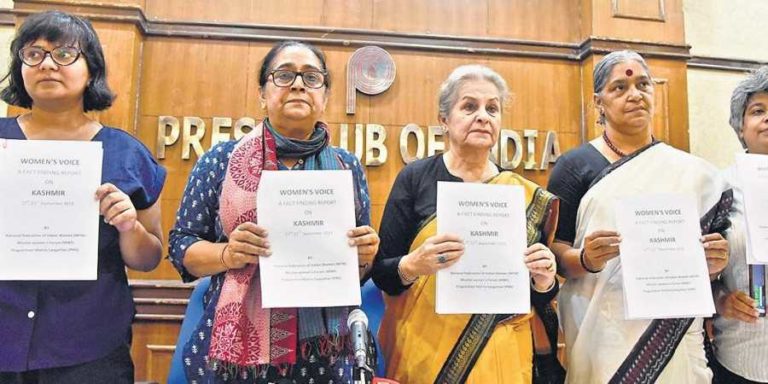
 This Report covered the account of the population that has lived for 43 days under complete lockdown. Shops, hotels, schools, colleges, institutions, and universities were closed.
The report tells several accounts of people living under lockdown. Their stories sound more like living in a war zone.


 Following the verdict, British Labour leader Jeremy Corbyn demanded that Boris Johnson call a new election. During Labour Party’s annual conference in Brighton, Corbyn was quoted as saying by Reuters, “I invite Boris Johnson, in the historic words, to ‘consider his position’.”

 Oktoberfest is the german public holiday celebrated chiefly in the southern part of Germany where people gather from all over Germany and Europe. The festival is characterised by its beer-soaked revelry and celebrations in traditional peasant wear (leather pants and drindl).
 The court defines illness as even small or temporary disruptions to the normal state or normal activity of the body, including tiredness, nausea, and headaches. The firm claimed its product could alleviate these symptoms.
Refusing the firm claim that its advertisement was covered under the protection granted to “nutrition and health claims” made in commercial communications under the EU Health Claim Regulation, the Higher Regional Court supported the decision rendered by the district court last year and said,
`Food and drinks cannot be promoted as being able to combat illnesses´. Information about a food product cannot ascribe any properties for preventing, treating or healing a human illness or give the impression of such a property,” the court’s statement said, according to Deutsche Welle, the German public broadcaster.
It added, “It is not relevant that the symptoms regularly disappear on their own and require no medical treatment.”