Translated by Rajashekhar Akki
Last week when Kumaraswamy made a statement on the possibility of the JDS-BJP coalition it looked almost reckless. But as the week passed it definitely had clear calculations underneath. Now, former PM Devegowda has gone a step further and given clear assurance to the BJP government. Not that it has to do anything with ideology, its all about saving the very existence of JDS.
Yesterday while talking to reporters, Devegowda said that There are no permanent friends and enemies in politics. It changes according to the situation. He tried to defend it by saying that – ‘Siddaramaiah is the leader of AHINDA, I don’t know what leader I am. There can be another election but I am not capable of it. So elections shouldn’t happen’. He said.
Some MLAs have shown an inclination towards BJP and given the history of BJP in poaching MLAs, the horse-trading doesn’t look like a distant possibility.
This week’s development doesnt make the situation any better for H D Devegowda. Some JDS MLCs including Gubbi MLA Srinivas held a meeting and discussed going to a resort. When Devegowda called a meeting of dissatisfied MLAs, the same time Kumaraswami took a flight to London. In such situations, father and son acting as if they have a difference of opinion, expressing helpless in meetings and the father blaming the son or the son blaming his father is one of the technique father-son duo use to tackle such crises. But at the end of the day, they both come to the same stand. Though the difference of opinion between the father and son can be real, they have the expertise to use it to manage dissidence.
The same thing is happening now too. Devegowda has said the same things that HD Kumaraswamy has said. The reasons put forward might seem different. “ I am now convinced that the coalition government fell because of Siddaramaiah”, said Devegowda. It means, to target Siddaramaiah instead of congress, to join hands with BJP and to prepare a narrative that is needed for polarisation of AHINDA versus upper caste; this is the calculation behind all this. This narrative of polarization itself saved JDS in the last assembly elections. But it was dented due to JDS and congress coalition. Now again, to save his core base, he’s trying the same polarization. This was quite apparent in Devegowda’s balanced talk today.
Devegowda who’s also close to Sharad Pawar, what was heard in JDS circle was that, after the unstable situation in Hariyana and Maharashtra, it is quite unlikely that he (Devegowda) will join hands with BJP. But in Karnataka, the situation of JDS seemed quite difficult. There’s merit in Devegowda’s words when he said, it’ll be difficult if we face elections now. Whatever changes that might happen in states but there seems to be no power that might shake Modi-Shah duo in the centre. So, a seasoned politician would definitely know better than getting into an unwanted problematic situation.
So, this time Devegowda hasn’t shown any hesitations. The last when they had a coalition with BJP, words like ‘communalism and secularism’ did end up coming from his mouth but this time, along with showing opposition to Siddaramaiah, he has given clear indication of his support to Yeddyurappa government. Along with this, he has also spread out his future plans; building the party. Whatever criticism we have for ideological opportunism, we have to admire this quality of Devegowda.
Whatever circus they do, it is clear that the Yeddyurappa government will not last for its full term. So, saving the government for some time and preparing for the next election in the meantime is better; that is Devegowda’s calculation. Anyway, they will have to form a coalition with either of the party; they can only build the party to create enough instability to keep the compulsion. In the meantime, they just have to rein in Siddaramaiah.
And probably, Siddaramaiah’s growth too lies in opposing the politics of Yeddyurappa and Devegowda. So, we are seeing the repeat of what happened in 2018.
Less than a month ago, the Norwegian Nobel peace prize committee announced the Nobel peace prize. Lately, the Nobel peace prize has been more used to extend the interests of Western imperialistic interests. This year’s award to the young Ethiopian president Abiy Ahmed Ali should be seen in that light.
A new geopolitical game is being played in Ethiopia for trade and commerce with a false notion of peace. Historically, Ethiopia is called the gateway to Africa strategically located at the horn of Africa geopolitics. Also, Ethiopia historically has not been colonised like the rest of Africa.
With the ongoing shifts in geopolitics, the currently serving president of Ethiopia is being awarded 2019 Nobel Peace prize is trying to open up the horn of Africa nation to western capital. The 43-year-old president Abiy Ahmed Ali is chosen one amongst the 301 candidates (223 individuals and 78 organisations) nominated for the 2019 Nobel Peace prize (which includes jailed journalist Julian Assange and young climate change activist Greta Thunberg).
The award has been given in recognition “for his efforts to achieve peace and international cooperation, and in particular for his decisive initiative to resolve the border conflict with neighbouring Eritrea” according to Nobel Peace prize committee. The announcement also stated that “the prize is also meant to recognise all the stakeholders working for peace and reconciliation in Ethiopia and in the East and Northeast African regions”.
A former Army intelligence officer Abiy has a bachelor’s degree in computer engineering (2001), Master of Arts degree from Greenwich University London (2011), and an MBA degree from Addis Ababa University (2013) and has completed his PhD in 2017 at the Institute for Peace and Security Studies, Addis Ababa University with a thesis entitled “Social Capital and its Role in Traditional Conflict Resolution in Ethiopia. His published research article on de-escalation strategies in the Horn of Africa has played an important role in securing the peace prize it is said. He comes from the Oromo ethnic group, which is the most populous in Ethiopia’s nation of 100 million, comprising some 84 different ethnic groups.
Following the end of the socialist military Derg Rule, Eritrea succeeded from Ethiopia and Ethiopia became landlocked and cut off from the Red Sea. Since then the two countries were fighting a war on border disputes for nearly two decades (1998 -2018). Two months into the office, in July 2018, Ahmed finalized a sudden peace initiative with Eritrea buy giving up the disputed land to Eritrea. This was done by facilitating of Eritrean leader Isaias Afwerki in Ethiopian Capital Addis Ababa. This move has angered many Ethiopians and especially the minority group in northern Ethiopia (bordering Eritrea) Tigray People’s Liberation Front (TPLF) who have lost close to 1,50,000 people in the civil war. The TPLF is also a partner in Abiy’s ruling coalition government. This has angered many Ethiopians and has the potential to trigger ethnic fractures in the future Ethiopian politics.
It has been reported that America, Saudi Arabia, and The United Arab Emirates have played a major behind the scene role in this peace deal as the Horn of Africa is increasingly becoming a strategic location for entry to Africa. The peace deal between Ethiopia and Eritrea was facilitated by US officials in spite of Washington sanctioning and isolating Eritrea over alleged human rights abuses under its long-time leader Afwerki in the past.
After the peace deal was reached the two leaders were facilitated with gold medallions by the Emirati Crown Prince Mohammed bin Zayed in UAE. This was followed by one of the most important political assassinations of Ethiopian engineer Simegnew Bekele (53) who was overseeing the ambitious $5 billion Golden Renaissance dam project(Africa’s Largest dam on Blue Nile river) which was largely self-financed and partly funded by China. Until then, the IMF and Western finance capital had been kept at bay in Ethiopia’s development.
With the ongoing geopolitical shakeup in the North Africa region and especially in the horn of Africa, the Nobel Peace prize to Abiy is seen as west trying to negate growing China’s clout in the region. As soon as Abiy came to power in April of 2018 he has signaled a shift in the internal and international politics of Ethiopia. This shift has also given the US, a greater role in the economics of the country removing the dominant role of China has been playing the region. Under his presidency, he has promised to open key sectors of the economy to foreign capital and for that, he has been praised by the western media as a “Reformer”. Until then Ethiopia was seen as the African model of Chinese-assisted development for the entire continent as Ethiopia was seen as a gateway to Africa.
It only remains to be seen whether Abiy Ahmed Ali will steer Ethiopia to greater heights in the prosperity of the country ushering peace or turns out to be just a pawn in the grand Imperialistic Geopolitical chessboard. But, the history of peace prize post-’90s has been marred with controversies after it has been given to actors, promoters or mute spectators of violence or willing pawns in the strategic plan of Western imperialism. After receiving Peace prize Abiy Ali has already given conflicting statements about the completion of the dam and has threated to use force against Egypt in Parliament debate on October 11 for opposing the dam.
Since then the peace prize being awarded from 1901 has largely been given to individuals and institutions from Europe and America with few exceptions. Only after the ’70s, the award has been given to diverse groups of individuals from other parts of the world.
Overall, the concept of peace for the Nobel Peace committee is more to do with the alignment of the recipient’s views with the Christian Centric western imperialistic world view. The objective of nonviolence and peace in this worldview has always aligned with expansionary tactics of oppressor more than protecting the oppressed.
Modi meets kissinger and Tony Blair
A war criminal like Henry Kissinger also gets awarded with Nobel peace prize who slaughtered hundreds and thousands in Vietnam, Laos, and Cambodia. Between 1964 and 1973 during the Vietnam War 260 million bombs were dropped in the region with an average of 8 bombs per minute by the American forces.
Nobel peace prize was also awarded to Obama (2009) who after receiving the prize bombed seven countries (Iraq, Afghanistan, Pakistan, Somalia, Yemen, Libya, and Syria) in 6 years on an average of 34 bombs per day. Under his command a hospital in Kunduz, Afghanistan was bombed in October 2015 using 40MM cannon made by Bofors, a company once owned by Alfred Nobel (founder of peace prize!!) killing a dozen people and three children which he later apologised saying it was a tragic accident.
Aung San Suu Kyi- was seen as a beacon for universal human rights – a principled activist willing to give up her freedom to stand up to the ruthless generals who ruled Myanmar for decades was awarded the Nobel Peace Prize in 1991. The Nobel Peace prize committee called her “an outstanding example of the power of the powerless”.They could not be any more wrong. Since becoming Myanmar’s de facto leader in 2016, the country remains as repressive as ever. Ms. Suu Kyi has been accused of ethnic cleansing and the possible genocide of Rohingyas.She was also stripped of Amnesty International human rights award.
The Nobel peace prize to Malala Yousufzai, then 15-year-old girl who gained instant international fame when she was shot in the head by the Taliban while she along with other girls were going to school in 2012. Malala was transferred to the UK for treatment. She was lapped up by Western politicians and media and the world got another shot at denouncing Taliban (Surprise, Surprise.. It’s not that the Taliban is very popular in Pakistan or Afghanistan). Not to forget the US facilitated the rise of the Taliban with large amounts of weapons to counter USSR.
Many sympathised with Malala and rightfully took up the cause of universal right to education, however, there were many critics who pointed out the western bigotry in championing Malala. Malala and many more girls in different parts of the world want to go to school and are denied that right. But one should look at the devastation caused by continuous western wars since the 1950s which have killed more children, left many orphans and have denied more girls an education via their missiles than the Taliban has by their bullets. Many criticised the award as a means to positively portray US intervention in Pakistan and Afghanistan.
In 2006 Muhammad Yunus and the Grameen Bank were awarded the Nobel Peace Prize in recognition of his pioneering work in the fight against poverty through the microcredit system. The Microcredit system instead of poverty alleviation makes poverty worseand traps the poor in a cycle of debt.
As Jason Hinkel rightly puts out in his piece in the Guardian–
It promises revolution without the messiness of class struggle. And, what is more, it promises that we can help save the poor while making money from it. It’s the neoliberal development strategy par excellence. Forget about colonialism, structural adjustment, austerity, financial crises, land grabs, tax evasion, and climate change. Forget about challenging the concentration of power and wealth. And, above all, forget about collective mobilisation. Bankers shall be our new heroes and debt our salvation. Debt, incidentally, is a great way to keep people docile.
Most of these individual winners have become another political pawn in extending western geopolitical and economic interests in the Global South.
While there are many unsung men and women who are working towards making the world a more just and equitable society, the Nobel peace prize committee chooses well-groomed, well connected, NGOised and propped up individuals to whitewash the collective crimes of war and structural policies of Western powers.
Peace for Global South means freedom from the neoliberal order that creates poverty in the first place. Peace means freedom from dictatorial regimes that create economic austerity and chaos. Peace for Global South means freedom from manufactured wars and loss of lives of millions!
Its time to ask what does Peace means for the Western powers and NATO that dictates the Nobel Peace prize committees?
On Saturday morning, people came out to protest at the town hall in Bangalore to save the Western Ghats. They were against the expansion of the Kaiga Nuclear Power Plant, power transmission line from Goa to Chhattisgarh and Sharavathi Valley Pump Storage Power Plant which will lead to the cutting of 3.7 lakh mature trees and destroy 376 hectares of forests.The three government projects will see the destruction of a minimum of 3.7 lakh trees in the western ghats.The activist, Vallesh Kaushik was wearing a breathing mask attached to the handheld plant pot as he protested against the state and central governments for destroying the core of the fragile ecosystem in the Western Ghats in the name of development.Photo credits: Deccan HeraldVallesh said, “If governments don’t start realizing the importance of conserving the environment, then children in the coming generations will have to walk with mobile oxygen cylinders as there won’t be any fresh air to breathe.”United conservation movement, a non-governmental organization held the protest, which other environmentalists, wildlife activists, agriculturalists, and other like-minded people. According to the protestors, these policies along with the others have put nearly 50 lakh trees in the state at risk. At this time only 5.6% of states area consists of forest land. These projects will also lead to fragmentation of wildlife corridors such as the ones for tigers and lion-tailed macaques.The activists said that most of the trees are endemic to the western ghats and would be over 400 years old.The Western Ghats has lost 20,000 hectares over the last 17 years, due to increasing urbanisation and development of tourist resorts. It is listed as the ‘hottest hotspot’ of biological diversity, its home to 325 endangered flora and fauna species and is the place of origin of the Cauvery river.A naturalist Ullas Kumar said “They are pushing all this in the name of development but as a result of nuclear plant people are getting cancer in their early teens. While the government is not conducting any studies on their own, they are not acknowledging the studies done by NGOs. While there might be a power for some, the people there will suffer indefinitely.”“The authorities concerned must explain the dire need for these projects, and establish whether their overall benefits outweigh the total cost to society,” said Joseph Hoover, convenor, UCM.Following the demonstrations, the activists under the banner of the United Conservation Movement, are set to meet Chief Minister BS Yediyurappa on Monday and submit a memorandum.
Also read: Aarey forest: Sec 144 Imposed, 29 arrests as activists protests cutting trees
Supreme court on Tuesday said that it would consider the leaked audio clip where Karnataka chief minister BS Yeddyurappa has spoken about the role of home minister Amit Shah in successfully keeping the 17 MLAs in Mumbai for more than a month.The deserting of 17 congress-JDS MLAs had triggered the discussion onanti-defection lawsin India and why it needs a relook.
Congress leader Kapil Sibal had approached the top court with a viral video that shows Yediyurappa responding to opposition within the party to the BJP giving tickets to rebel MLAs from the Congress and Janata Dal-Secular for the December 5 by-polls to 15 seats. In this tape, Yediyurappa is purportedly seen speaking about a BJP role in the resignation of the 17 rebel legislators that led to the fall of the HD Kumaraswamy government.
The top court had last month completed hearing arguments and reserved its verdict on petitions challenging the disqualification of 17 Karnataka MLAs before the trust vote of the HD Kumaraswamy government.
The Congress filed a new request after the viral video emerged to back up its allegation of a BJP role in the resignation of the rebel MLAs. The Speaker hadn’t accepted their resignation requests and disqualified them under the anti-defection law which was seen to bar them from contesting elections during the life of the current assembly.
The Kumaraswamy-led JD (S)-Congress coalition government lost the trust vote in July this year after 15 legislators of the two parties resigned in the first week of July, claiming that the ruling dispensation had failed to fulfill the aspirations of the people of the state. The BJP had then assumed the power with Yediyurappa as the chief minister.
On Monday, November 4, as per the call of All India Kisan Sangharsh Coordination Committee (AIKSCC), farmers across the country demonstrated against India being a party to the Regional Comprehensive Economic Partnership (RCEP). RCEP, a free trade agreement, consists of 16 countries, including 10 ASEAN (Association of Southeast Asian Nations) countries along with China, Japan, South Korea, Australia, New Zealand and India.Though the RCEP agreement was to be signed on Monday in Bangkok, India reportedly raised concerns over the small scale industries and deferred the agreement. Farmers’ groups and people’s movements, however, demand India’s withdrawal from the agreement.No to RCEPAcross the country, farmers and people who had gathered at district and lower administrative offices at nearly 500 areas, burned the effigy of RCEP and urged the government to step back from the agreement. Raising slogans against RCEP, farmers shared their concerns and asserted for their rights.Announcing the decision, Prime Minister Narendra Modi said, “The present form of the RCEP Agreement does not fully reflect the basic spirit and the agreed guiding principles of the RCEP. It also does not address satisfactorily India’s outstanding issues and concerns. In such a situation, it is not possible for India to join RCEP Agreement.”Home Minister Amit Shah said, “India’s decision to not sign the RCEP agreement is a result of Prime Minister Narendra Modi’s strong leadership and unflinching resolve to ensure national interest in all circumstances. It shall ensure support to our farmers, MSMEs, dairy and manufacturing sector, pharmaceutical, steel and chemical industries,” reported ANI.
In the wake of deteriorating air quality since Diwali in Delhi, the Supreme court today raps up the governments of Punjab, Haryana, and UP to respond on crop stubble burning despite orders against it.
On Monday, the AQI at 4 pm in Delhi read 416, which is still in the ‘severe’ category, according to the Central Pollution Control Board (CPCB).
Supreme court questioned the Delhi government odd-even schemes and also issues a list of directives to control the entry of heavy diesel vehicles and to take stock of the industries that contribute to pollution.
The Supreme court issued a list of directions on Monday, considering the harm that air pollution is causing in Delhi NCR. The court also expressed its displeasure at the negligence of earlier directions by government bodies.
The key directions comprise:
Chief secretaries of Punjab, Haryana, and UP are summoned on November 6 to brief the court on measures to curb crop stubble burning.
Directs collectors and police officials to ensure that no further crop stubble burning takes place. Gram Pradhans and local administration will also be held responsible if stubble burning takes place.
Delhi government has been directed to take suggestions from experts and work with other bodies to tackle the problem of garbage. EPCA to assist in preventing the entry of heavy vehicles.
Directs ban on construction and demolition activities in Delhi and NCR. local administration would be penalized one lakh rupees in case of violation.
Puts a stop on coal-based industries. Will be penalized if not followed.
Municipal bodies directed to prevent open dumping of garbage.
Directs sprinkling of water on roads and planning of traffic to reduce congestion in order to prevent road dust. To be taken up by the Delhi police.
Bans use of diesel generators in Delhi NCR until further orders.
State governments should form a high-level committee to deal with the crisis.
The people are advised by the SC not to enter Delhi or leave their homes in Delhi. The bench of justices Arun Mishra and Deepak Gupta, considered the issue of air pollution in Delhi-NCR in the wake of the EPCA declaring a public health emergency taking note of the severely deteriorated air quality. The bench also observed that the life span was coming down due to pollution.
The bench questioned the Delhi government’s odd-even vehicle scheme, which kicked off on Monday and asked it to submit the data of pollution levels of previous periods when the scheme was initiated to curb air pollution.
Justice Mishra said that Delhi has been choking, Delhi chokes every year but the Delhi govt and the center are only seen passing the buck. He said this before the bench summoned experts to address courts on the issue.
Delhi-NCR has been in a thick blanket of smog since the festival of Diwali on October 27. On Sunday, the national capital’s average air quality index (AQI) stood at 494, the highest since November 6, 2016 when it was 497.
The court has asked the state concerned to prepare a roadmap within three weeks to prevent a situation that is presently prevailing in the region due to toxic air quality.
“Let the state governments of Punjab, Haryana, and UP explain why they should not be asked to pay compensation as they have totally failed to implement the order against stubble burning”, ordered the court.
“Time has come to seek accountability for the gross violation of Article 21. Farmers cannot seek protection. Through satellite images, it has been seen that widespread burning took place in Punjab while four districts were involved in Haryana. Pollution is causing problems for neighboring states. Everyone from chief secretary to Gram Pradhan is answerable” observed Justice Mishra in the order.
Article 21 states that “no person shall be deprived of his life or personal liberty except according to the procedure established by law”
“It cannot be done in a civilised country, If people do not respect the rights of others, then they also have no rights. The right to life is the most important right. No room is safe to live in Delhi. People are not safe even inside their houses. It is atrocious,” the bench said.
“The air quality index (AQI) level in bedrooms is above 500-600. This is the figure in Lutyens Delhi. Can we survive this? This is not the way we can survive. People are losing precious years of their life due to this” it said.
The senior advocate Aparajeet Singh told the bench that stubble burning contributes to about 46% of pollution in Delhi-NCR.
The bench said the directions should be given wide publicity in TV, Media, Radio and also at Gram Panchayat level so that people can be made aware of it.
It directed the court-mandated Environment Pollution Control Authority (EPCA) to take the decision regarding whether to ban entry of diesel trucks in Delhi and also about industries, which are contributing to pollution and could be shut down during this period.
The court also said that the authorities must ensure that there is no power cut in Delhi-NCR so that generators are not used except in emergency services.
With inputs from live law.in and economic times.
Also Read: Kejriwal´s Diwali gift to Delhi: free bus rides for women and higher minimum wage
Bruhat Bengaluru Mahanagara Palike (BBMP) has continuously defaulted in complying with rules regarding the processing of solid waste dumping the unprocessed solid waste in quarries and causing damage to the environment. Karnataka High court has asked the state government to dissolve BBMP under Karnataka Municipal Corporations Act and Environment (Protection) Act, 1986.
While hearing a bunch of petitions highlighting the non-compliance of rules and illegal dumping by BBMP a division bench of Chief Justice Abhay Oka and Justice S R Krishna Kumar expressed concern about the impact of such failures have on the environment.
Justice Oka said,
“Though 19 years have gone by after the MSW Rules, 2000 were enacted, today the situation in the city of Bengaluru, which is stated o be a ‘garden city’, is that more than 3/4th of daily generation of solid waste is being illegally dumped by the Bruhat Bengaluru Mahanagara Palike (for short ‘the BBMP’) without scientifically processing it.”
“Considering the complete failure to implement both the Rules, there is a gross violation of the fundamental rights of the citizens under Article 21 of the Constitution of India in the city. If there is a consistent failure on the part of the BBMP to comply with the SWM (solid waste management) Rules of 2016 and even C and D waste Management Rules and if generation of the solid waste continues to increase, it will cause an ecological disaster.”
The Karnataka High Court has directed the State Government to consider whether action of dissolving the Bruhat Bengaluru Mahanagara Palike (BBMP) deserves to be taken under Section 99(1) of Karnataka Municipal Corporations Act, for making persistent defaults in the performance of its duties imposed by Municipal Solid Waste (MSW) Rules, 2000 and Solid Waste Management Rule, 2016 and the other Rules framed under the Environment (Protection) Act, 1986.
Out of the average generation of solid waste, in Bengaluru of about 5700 tonnes per day, more than 4400 tonnes of solid waste per day is being illegally disposed of/dumped. Also, C and D waste is being dumped in the city without there being any facility available for processing the same.
The bench has directed State and BBMP to file compliance reports by December 18, on enumerating steps taken for compliance of SWM Rules. It said, “Depending upon the progress made which can be seen from the compliance report, the Court will consider the question of passing a drastic order of imposing an embargo on the grant of building permissions by the BBMP.”
The compliance report will also have to deal with the aspects of the disposal of E-waste, plastic waste, bio-medical waste, hazardous waste and other wastes as provided in the various Rules. Karnataka State Pollution Control Board is free to take action against BBMP and all concerned for violation of law and pendency of these petitions will not operate as any restriction.
FARMERS PLAN NATIONWIDE PROTEST AGAINST RCEP ON NOVEMBER 4 :All India Kisan Sangharsh Coordination Committee (AIKSCC), a coalition of over 250 farmer organisations in the country, said tens of lakhs of farmers across the country would participate in a nationwide protest on November 4 to warn the government against going ahead with inclusion of agriculture in the RCEP free trade agreement, farmer leaders said here on Thursday.The farmers would hold demonstrations and burn the effigy of “the RCEP document” at district, and lower administrative offices across the country asking the Narendra Modi led NDA government to desist from going ahead with the signing of the RCEP multilateral trade agreement involving 16 countries, AIKSCC convenor V M Singh and other working committee members told reporters. The Prime Minister is expected to participate in RCEP Leaders Summit in Bangkok on November 4.FARMERS APPREHENSION: Elaborating on the apprehensions of the farmers, the AIKSCC leaders said that RCEP is likely to hurt the Indian agriculture and dairy sector in a way no other trade agreement has so far. Till now, the general norm has been to keep agriculture out of Free Trade Agreements, a convention followed even in the ongoing EU-US free trade negotiations.Forced reduction in tariffs to zero or near-zero would cripple the Indian dairy sector, thus affecting the livelihood of nearly 10 crore families. Similarly, threats are awaiting farmers who cultivate wheat and cotton (the challenge from Australia and China), oilseeds (the challenge of palm oil import) and plantation crops (pepper, coconut, areca nut, cardamom, rubber, etc).RCEP ( Regional Comprehensive Economic Partnership ) is a trade pact being negotiated by 16 countries. Negotiations were formally being launched in November 2012 at the Asean summit in Cambodia The trade pact is close to being concluded.ASEAN ( 10 COUNTRIES ) :Brunei, Cambodia, Indonesia, Laos, Malaysia, Myanmar, the Philippines, Singapore, Thailand and Vietnam, China, Japan, India, Australia, South Korea and New Zealand. KEY CONCERNS: The RCEP will permanently bring down import duties on most agricultural commodities to zero. Many countries are looking to dump their agricultural produce in India.Seed companies will get more powers to protect their Intellectual Property Rights, and farmers would be criminalised when they save and exchange seeds.Foreign corporations could bypass national courts and sue our governments for favouring our farmers and workers at private arbitration tribunals. STATEMENTS MADE BY ACTIVISTS: At a public speak, P. Sainath discussed how India’s agrarian crisis has gone beyond the agrarian and is reaching into many other layers and sectors of society. Over 300,000 farmers have committed suicide in India between 1995 and 2015. A gross underestimate, but it is still a terrible figure that officialdom admits to. Yogendra Yadav, an Indian activist raised his voice against RCEP on Twitter. “The farmer is the central issue in the country. The AAP movement in this state and elsewhere was addressing more urban-centric issues, our Yatra will take up those of the farmers and the Dalits,” he told Economic Times.
While addressing a press conference in Delhi on Friday, Congress leader Jairam Ramesh on Prime Minister Narendra Modi’s next month visit to Bangkok to sign RCEP agreement, said, “After demonetization and GST it’ll be a third big jolt to our economy when the Prime Minister will go to Bangkok next month and express India’s agreement to RCEP.” ” RCEP will result in liberalisation in imports from China. We don’t know what was discussed in Wuhan or Mahabalipuram but we can see the results, there will be liberalisation in imports from China. ‘Made in India’ is not mentioned now. It’ll encourage ‘Made in China ‘,” he added.Gram Seva Sangh supports Reject RCEP. Activist Prassana of Gram Seva Sangh explains, ” Our farmers, milk mans’, vegetable vendors and other vendors are suffering because of the highly subsidized products from other countries. Already because of the government’s plans with the WTO the farmers and the labourers are in extensive trouble. On top of this RCEP is going to get them into more trouble to shut down. We all should reject this idea otherwise this country will drown. We all must go against this idea vigorously only then there will be changes. We all must come together for the change and stand together against this idea”.There are trade economists and free trade proponents who believe that the RCEP is beneficial for the Indian economy. In a very compelling argument in The Hindu Business Line (7 January 2019), Geethanjali Natraj and Garima Sahdev infer that the long-term benefits of joining the bloc far outweigh the short-run costs. The authors state, “… if India wants its ‘Make in India’ to become globally successful, it must participate positively to become a part of the Asian value and supply chain which either begins or ends in India”.CONS:According to government data, India’s economy expanded at its slowest pace in over six years. Growth in the country’s Gross Domestic Product (GDP) stood at 5% in the first quarter of the current financial year (2019-2020), compared with 5.8% in the previous quarter and 8% in the quarter ended June 30, 2018. A slowdown in sales of cars to biscuits and lakhs of estimated job cuts across sectors plagued the economic growth of the country.While the introduction of GST was thought of to be a major step in this regard by rationalising supply-chains and removing the fragmented nature of the markets, multiple rates of GST often cause problems of compliance across the value-chain of a commodity. On the input side, critical reforms need to take place in the labour market. Despite low relative labour cost, labour productivity in India in manufacturing is still one of the lowest in the world, and spatially fragmented labour laws escalate costs of the transaction. Regional trade agreements like the RCEP need not always be beneficial from the “Make in India” perspective. “Make in India” is definitely the flagship project to attract foreign investment, this was never conceived of at the cost of the domestic industry. Even after more than a quarter of a century of economic reforms, Indian manufacturing is yet to mature to be competitive enough to face the vagaries of competition brought about by international trade. This situation prevails because of a host of unimplemented reforms in the product and factor markets. Under such circumstances, the Indian industry is hardly in a position to compete in a level playing ground in a free-trade region. “Make in India” is meant to create enabling conditions for both domestic and foreign businesses to thrive. If the domestic industry has to thrive, it needs protection as also the enabling conditions created by factor and product market reforms. Mega-trade deals like the RCEP may derail the timing and coordination of such plans. Tirsha is a journalism student from Bangalore.
Seema Azad is a freelance journalist and runs a bimonthly magazine called Dastak (knock) on Adivasi and land issues. She is also a national council member of PUCL (people’s union of civil liberties). Her number was also on the list of people in the WhatsApp Snoopgate. Following is part of a conversation with Seema and excepts from her Facebook page after the incident.
On 30th October, Seema received a message from WhatsApp that was different than other messages. It said that in May 2019, many phones were compromised through spyware using WhatsApp video call and her number is also on that list. She was told to go to the website of Toronto citizen cell and check out some security solutions.
Seema: The message had me worried but I shrugged the message thinking its a routine message from WhatsApp sent to all users to update to the latest version.
The next day, I saw a story in India express that Spyware called Pegasus made by an Israeli firm is used by Indian security agencies to spy on people. The list includes around 1400 people around the world, including lawyers, journalists, human rights activists using this spyware. They all had received a message from Whatsapp. After reading that report I felt that I should have taken that message seriously. I never thought that my name would be on the list of 1400 people. Calls from international numbers kept on coming on WhatsApp for around 2-3 months, but it stopped around 4 months ago. When I checked on true caller the numbers showed to be originating from Sweden or Switzerland.
The bimonthly magazine Dastak brought out by Seema AzadQ- What was your first reaction?
Seema-I am not surprised by the fact that that government secret service agencies spy on people. I use the smartphone very carefully. But the truth is no matter how much you try to secure your privacy settings, you cannot stop yourself from getting spied on.
Many years ago Julian Assange has said: “ Smart Phone in your bedroom is like a cannon in your room, it can always be used against you”.
If not the government, a private agency will do it.
I am surprised that out of 1400 people on that list and 24 Indians, my name is there. I write against the government but I never thought that I could be spied on. I am surprised state government considers me such a threat. Now I feel that my name has come, but other people are also being spied upon. I feel activists should work on these issues and work on some antidote to such spy attacks.
Those all who have received the call from Toronto citizen cell are told that it is indeed their government that is spying on them.
Q: Should it worry all of us? and why?
Seema: What I find more surprising is that this is not an issue for common people. For them, secret agencies going through your phone is not an invasion of privacy but a normal thing. People did not even oppose the linking of AADHAR with every personal document. Linking of the phone with AADHAR has made it even easier to spy on people. That is also the reason we oppose AADHAR.
Many of my friends who are not activists have many times argued with me that “ For security reasons the government has the right to know everything about us, there is nothing wrong with it…Those who do wrong are the ones who are worried.” I ask them they should make their family infighting between mother-in-law and daughter- in law also public. When the daughter in law calls police why do they bribe police and send them away, they should also make this public. My friend might not have agreed but he became quiet after this.
So I want to tell such people that right to privacy is our fundamental right, In the name of security you cannot look into our home and our phones. This is an abuse of our fundamental right. It is our backward mentality that we don’t find anything wrong in giving up our privacy for security.
The government will not find anything suspicious on my phone. But who gave the government the right to snoop into my personal photos, personal documents, and emails. The spyware can look into all activities in the room that the phone is in. We do not let people to tell our private stuff to strangers but because of our regressive mentality and ignorance, we have let government and private agencies enter not just our home but our bedrooms and bathrooms. Through targeted advertising, social media is also subconsciously forcing us to buy our favorite products.
Q- Do you feel that the government has done this snooping as part of surveillance or is there a more sinister operation behind this?
Seema: The government will not find anything suspicious on my phone. But what is worrisome is what Nihal Singh Rathod has said. It’s not just spying, but they can implant anything in your hard disk. As we know, many of the activists accused in the Bhima Koregaon case are also on this list.
Nihal Singh Rathod, Nagpur based lawyer who represents several of the accused in Bhima Koregaon case has said something very damning after the expose –“We have consistently been saying that many of the so-called ‘letters’ obtained by the police have been planted on the hard-drives of activists, Now it is clear just how they planted these files on Mr. Gadling’s computer.”
This is more worrisome for me if they have implanted something in the hard disks that is a big risk for everyone. Anyone can be implicated and arrested.
Q: Most names on the list are people who are accused in Bhima Koregaon case or are Dalit and Adivasi activists/journalists/lawyers? What do you think of that?
Seema: It looks like the government is most afraid of people who are working on Dalit and Adivasi rights because it is these people who can uproot their Manuwadi regime. It shows that these people are doing some real work that the government is threatened by them.
And this is another step in the series of how the state is troubling many Dalit/ Adivasi and minority activists as we saw in the case of Chalo Una, Bhima Koregaon’s case, Sudha Bhardwaj, Anand Teltumbde arrests and harassment. They are targeting those people who can break the myth of Hindu unity and Hindu versus Muslim binary that the state is pushing towards people.
Q) As of now the government has brushed the issue and has, in turn, questioned WhatsApp on this breach. In the coming days, it is quite possible that some more information that proves that it is indeed Indian government that was spying on these people. What do you think the government will do?
There is one old supreme court judgment that says that terrorists (in the eyes of the government) don’t have privacy. Their phone can be decrypted and we want to know what is the source of malware, there is no problem with it. So, It seems like an atmosphere is being created where in some time the government may say that we have done in the past and we will do in the future as well. And spying on people will be normalised like this.
Even if it has come out in the open, it has not hurt the government at all. It has created chaos, an atmosphere of fear, which is beneficial for the government. It is not just us who is worried about being spied but there is also a fear just by association, people who are related to us, work with us might also be a target of such spying in the future. It has already sown division and doubt in people’s minds. I also got that feeling in all the calls I received since the incident.
NSO also told that they sell the app to government agencies and not private entities. Also the kind of expenditure that this kind of exercise demands is not possible for any private entity, only government machinery can undertake such a venture. It is told that the cost of spying for 1400 people is 6454 crore rupees, out of which the virus installation itself costs 4900 crores. There is no doubt that this is done by the government, who else will benefit from this? Fascist governments are becoming so scared that to control the population, they are putting more and more surveillance.
In this case, one should not dismiss Facebook and WhatsApp. This time they are not involved but we all know how much they respect the private data of its users. Some months ago Facebook was accused of not just keeping personal data of its users but also selling it to private buyers. In a congressional question hour, Mark Zuckerberg could not give a satisfactory reply to it. In the past, Facebook has shared Kashmir ́s Burhan Wani ́s information with security agencies which led to his killing by security forces. The question is not who Burhan Wani was but that Is facebook not cheating us by giving information about one of its customers. If you don’t find sharing of Burhan Wani information wrong then there shouldn’t be anything wrong with the leaking of your personal data. This shows that all forms of media are not with us but with the tyrannical government.
Now that Whatsapp snoopgate has come out, we should not think that only these people are the target, in reality, the whole country is in an invisible prison who are spied on by many proxy mediums. If you speak against the government, you are a target.
It took me some time to reflect on what has happened. It’s not just an attack on our phones it is an attack on our mind. It is to alienate and put stress on us. This expose can cause chaos in society and can be used to silence many voices, we should be aware of it.
I want to tell the secret Intelligence agencies that- See , here I am, I am still writing and still fighting. I will speak and write against this spying. Privacy is our constitutional right, those who abuse it are the culprits. We need to join hands against this abuse, not be doubtful or to alienate ourselves.
Also read: CBI raids and unlawful arrests of journalists and lawyers forewarn darker times








 Forced reduction in tariffs to zero or near-zero would cripple the Indian dairy sector, thus affecting the livelihood of nearly 10 crore families. Similarly, threats are awaiting farmers who cultivate wheat and cotton (the challenge from Australia and China), oilseeds (the challenge of palm oil import) and plantation crops (pepper, coconut, areca nut, cardamom, rubber, etc).
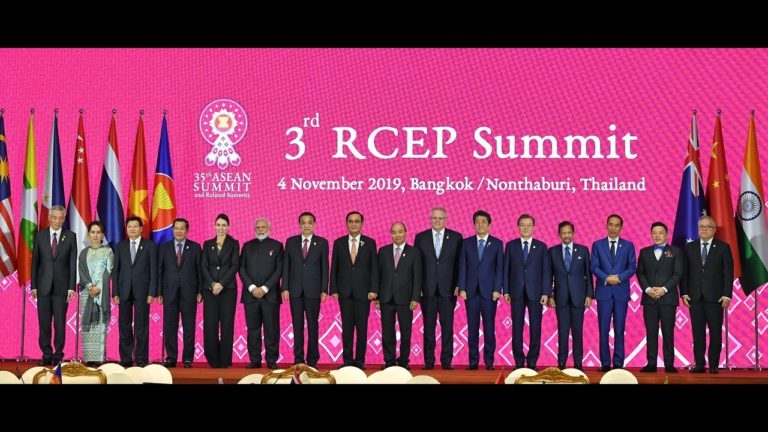
RCEP ( Regional Comprehensive Economic Partnership ) is a trade pact being negotiated by 16 countries. Negotiations were formally being launched in November 2012 at the Asean summit in Cambodia The trade pact is close to being concluded.
ASEAN ( 10 COUNTRIES ) :
Brunei, Cambodia, Indonesia, Laos, Malaysia, Myanmar, the Philippines, Singapore, Thailand and Vietnam, China, Japan, India, Australia, South Korea and New Zealand.
KEY CONCERNS:
The RCEP will permanently bring down import duties on most agricultural commodities to zero. Many countries are looking to dump their agricultural produce in India.
Seed companies will get more powers to protect their Intellectual Property Rights, and farmers would be criminalised when they save and exchange seeds.
Foreign corporations could bypass national courts and sue our governments for favouring our farmers and workers at private arbitration tribunals.
STATEMENTS MADE BY ACTIVISTS:
At a public speak, P. Sainath discussed how India’s agrarian crisis has gone beyond the agrarian and is reaching into many other layers and sectors of society. Over 300,000 farmers have committed suicide in India between 1995 and 2015. A gross underestimate, but it is still a terrible figure that officialdom admits to.
Yogendra Yadav, an Indian activist raised his voice against RCEP on Twitter.

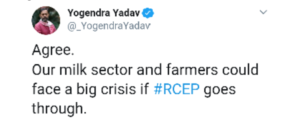
 “The farmer is the central issue in the country. The AAP movement in this state and elsewhere was addressing more urban-centric issues, our Yatra will take up those of the farmers and the Dalits,” he told Economic Times.


 Q- What was your first reaction?
Seema-I am not surprised by the fact that that government secret service agencies spy on people. I use the smartphone very carefully. But the truth is no matter how much you try to secure your privacy settings, you cannot stop yourself from getting spied on.