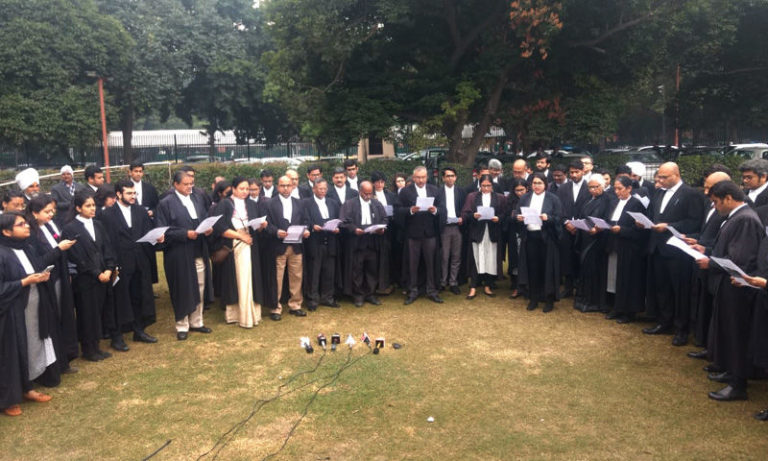
A group of lawyers gathered today at the Supreme Court lawns to read out the Preamble to the Constitution of India.
Copies of the Preamble were distributed to the lawyers present and the same was read out peacefully in unison.
Emphasis on the upholding of the tenets of the Constitution of India has gained traction over the past month, with protests against the purported unconstitutional nature of the Citizenship (Amendment) Act, 2019 as well as the alleged police brutality inflicted upon students of various universities. The same has sparked widespread protests and marches across the country. In retaliation to curb the same, severe clampdown in the form of mass detentions and internet shutdowns have taken place.
A more recent controversy that has since prompted national debate concerns violence in Universities. Petitions alleging brutality by the police on students of the Jamia Milia Islamia University and the Aligarh Muslim University were initially filed before the Supreme Court.
The demonstration comes in the backdrop of protests following the passing of the Citizenship Amendment Act, 2019.
Recently, a gathering of Madras High Court lawyers also read out the Preamble of the Constitution as part of a protest against the Citizenship Amendment Act.
A number of petitions challenging various aspects of the controversial legislation are pending before the Supreme Court. The Bench led by Chief Justice of India SA Bobde is due to take up the matter later this month.
However, after the Supreme Court declined to take up the matter on an urgent basis, the petitions were redirected to be taken up by the respective jurisdictional courts.
A statement was also issued by the Supreme Court Bar Association today condemning the violence on JNU students:
“The Executive Committee of the Supreme Court Bar Association today resolved to strongly condemn the violence against JNU students by anti-social elements. It further resolved to condemn the inaction on the part of Delhi Police, and called upon the authorities to act and ensure that the Rule of Law prevailed”, the statement said.
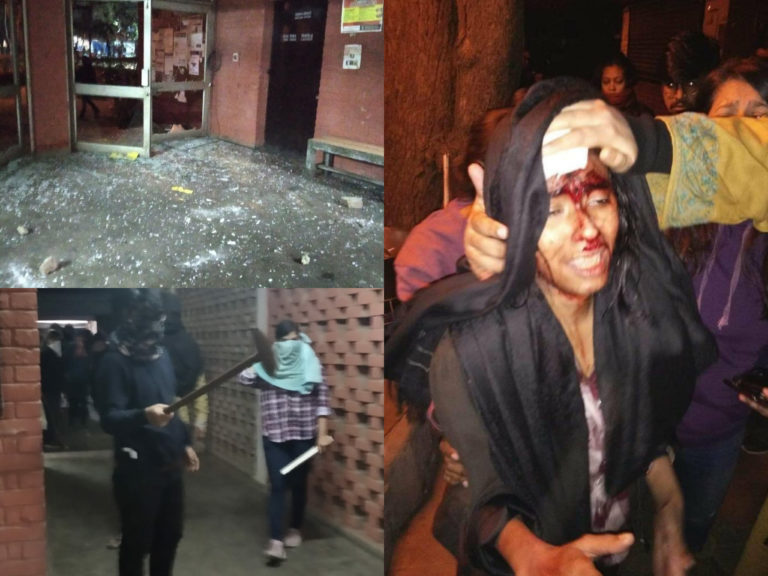
Last weekend, armed persons entered the Jawaharlal Nehru University (JNU) campus to attack the university students.
Hindu Raksha Dal, a far-right organisation has taken responsibility for the attack on students and professors in JNU on Sunday.Hindu Raksha dal leader Bhupendra Tomar alias Pinky Chaudhary in an interview to ANI said that the outfit’s workers barged into the JNU campus on Sunday night. Hindu Raksha Dal is a political party based in Ghaziabad, UP. He further added- “ JNU is a hotbed of anti-national activities. We can’t tolerate this. We take full responsibility for the attack in JNU and would like to say that they were our workers”.
Pinky Chaudhary,Hindu Raksha Dal: JNU is a hotbed of anti-national activities, we can't tolerate this. We take full responsibility of the attack in JNU and would like to say that they were our workers. #JNUViolencepic.twitter.com/2GkCIOqOFO
Tomar, popularly known as Pinki Bhaiya, said he and his Right-wing outfit take full responsibility for the attack. “They live in our country, they eat here, get their education here and then indulge in anti-national activities those involved in that JNU act were all our workers. We are always ready to sacrifice our lives for the country,” he further mentioned.According to government sources, claims made by Chaudhary are being investigated. To identify masked men who attacked JNU, the Delhi police are taking the help of video footage as well as face recognition systems, sources added.The JNU Students’ Union, whose leader Aishe Ghosh was seen with blood trickling down her face, has accused the ABVP of leading the night attack. The ABVP has denied the allegation, and in turn, blamed the attack on the Left.In the flood of video and images emerging from Sunday night’s mob attack, one visual trail appears to link the ABVP to the attack. In one image, a young man identified as Vikas Patel, a member of ABVP’s JNU executive committee, is seen with a group of around a dozen young men armed with lathis.The violence drew strong reactions from opposition parties that hit out at the BJP and accused “those in power” of trying to scuttle the voice of students.Home and HRD ministries have sought reports from the Delhi Police and JNU administration, respectively. Home Minister Amit Shah spoke to the Delhi Police chief and enquired about the situation at JNU.
Students all over India have come out on streets in protest to condemn the attack on college campuses and in solidarity with students and faculty at JNU.
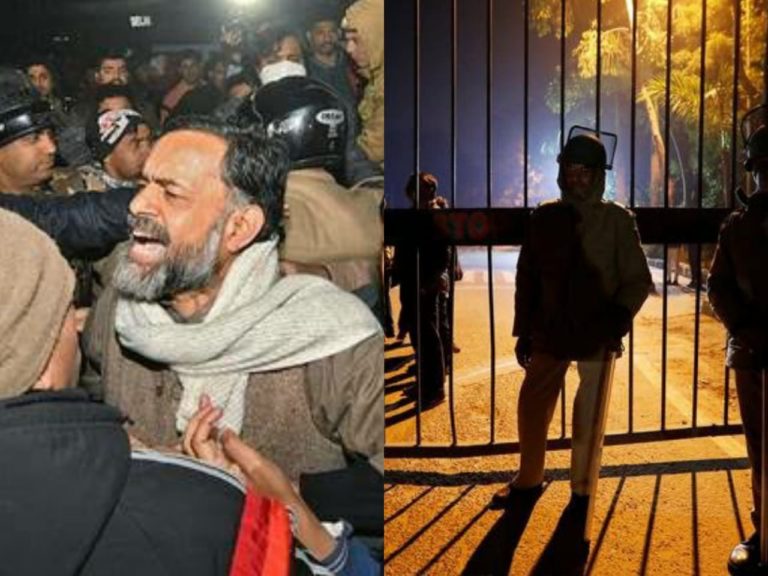
Yesterday in the mayhem created by the mob violence at JNU, Swaraj Abhiyan chief Yogendra Yadav was also attacked by ABVP goons when he came to asess the situation.
Yogendra Yadav was outside the JNU gate along with many other students and police. He shared details of the attack on his social media account.
He was assaulted thrice on Sunday evening at the Jawaharlal Nehru University (JNU) during protests after a masked mob terrorized the campus, beating students and teachers with iron rods, leaving 34 injured.
“The police watched as I was kicked. I fell on a road divider on his back, he said. The first attack was around 9:30 pm, he said, accusing the police of dragging and pushing him too. Mr Yadav said he was attacked for the second time at 10:50 pm. The third assault, he claimed, was around 12:30 am, at the AIIMS hospital, where injured students were taken after the mob attack. He alleged that he was pushed by the police in the presence of a senior officer despite the fact that he was there as a patient. He further added that he was with (CPI leader) D Raja when 20-30 goons attacked him, kept abusing, shoving, hitting him. He fell on his back on the road divider (soft tissue injury, no fracture), then kicked in his face (eye bruise). Police simply watched everything. DCP came later.Yogendra Yadav accused the Vice-Chancellor of JNU, M Jagadesh Kumar has presided over the intellectual as well as physical destruction of the university.“Outside Trauma Centre, AIIMS. When I arrived for check-up and MLC, outside emergency, Inspector Shiv raj hit my colleague Raja and my driver and then pushed me (in the presence of ADCP Parvinder Singh) despite knowing I was a patient,” Mr Yadav said.
Police Inaction
Alleging that police personnel were mere spectators, the activist said, “If the police is afraid, they can take out their uniform”. Yadav said that it was not spontaneous but a well-planned attack as the “viral screenshots of WhatsApp group ‘Friends of RSS’ showed members planned to assemble outside JNU”.
Eyewitness accounts say that around 50 goons entered the campus around 6.30 pm on Sunday. The students’ union tweeted that the attackers were “unknown ABVP goons” and were even beating up professors trying to protect students.Many students allege that the police personnel deployed on the campus were standing instead of controlling the situation. JNUSU vice-president Saket Moon said, “The police have been in the campus since afternoon, but they have done nothing”. Others pointed to the delay in calling in the police and their failure to make any arrest.Police blocked the roads leading to JNU so many students and well wishers could not reach the location.
Masked goons also attacked the ambulance that was going inside the campus to help the injured.
Aaj Tak journalist Ashutosh Mishra had been beaten up brutally by the goons. The reporter and cameraman were heckled between the violence.
Protests happened at midnight at many places in India
Students and teachers reached ITO, Delhi police headquarters. Many students and teachers from jamia also joined in solidarity and held a demonstration demanding answers from the Delhi police.
Protests at Aligarh Muslim University against violence on JNU students earlier today:
AMU students hold solidarity protest for JNU students. Teachers association issues a statement condemning the barbaric act demand intervention of CJI. #JNUViolencepic.twitter.com/47b3reLbjN
FTII Students Protest Students of the Film & Television Institute of India (FTII) in Pune on late Sunday night staged a protest condemning the attack on students of Jawaharlal Nehru University in Delhi. They held a demonstration outside the gate of the premier film institute, holding banners with message “FTII stands with JNU, condemns the violence of ABVP Goons”.Protest at the Gateway of India (Mumbai)Students from various colleges in Mumbai joined the protest at the Gateway of India in Mumbai today morning to condemn the violence at the Jawaharlal Nehru University in Delhi. The students shouted slogans condemning the violence.
Mumbai: Students from different colleges gather outside Gateway of India to protest against the violence in Jawaharlal Nehru University earlier today. #Maharashtrapic.twitter.com/6XL5Sqk425
Protest in KolkataStudents of Kolkata’s Jadavpur University began their protest today morning. Slogans and chants against the violence perpetrated against students and faculty of JNU were heard in visuals shared on social media.
Students of Kolkata's Jadavpur university begin their protest in solidarity with JNU
Protest in Kerala In Kerala, members of the SFI’s state unit marched till the Accountant General’s Office in Thiruvananthapuram. “From the beginning, the [Narendra] Modi government from the beginning has been trying to destroy educational institutions in our country,” said VA Vineesh, the SFI state president. “They are saffronising and capitalising the education sector. But we won’t bend to this, we will ideologically oppose their attempt to destroy us with weapons.”
A group of people have reportedly attacked several students and teachers of Jawaharlal Nehru University including the Jawaharlal Nehru University Student Union (JNUSU), President Aishee Ghosh.
In a video being circulated online, JNUSU’s President Aishe Ghosh, with blood running down her face, can be heard saying, “I’ve been brutally attacked by goons who were masked, I have been bleeding… I am not in a condition to talk.”
ABVP is going on rampage in JNU to threaten students protesting against fee-hike. Currently huge crowd has gathered around Sabarmati Dhaba with lathis & rods. They are entering hostels & beating up students indiscriminately.#SOSJNUpic.twitter.com/Yb0McU1TTj
Injured students have been taken to the AIIMS trauma center. They have sustained head injuries and two students are in serious condition.
The reports and images coming out of the campus are shocking. Many students are tweeting the videos and images of the terror in JNU.
Students say that masked goons from ABVP have entered the campus and are terrorising the students. They have attacked students with rods and stones. The guards have left the hostel premises.
"#Jnu gates shut. Beating of students and professors. They are coming to hostels " I'm sorry, but its NOT OK People are coming with bats and broken bottles What's happening @CPDelhi@AmitShah
The ABVP attackers have entered Koyna Hostel. This is an all female hostel. The women, and mess workers, are terrified. The terrorists are trying to break the doors. #SOSJNU#EmergencyinJNU
Meanwhile JNUSU has given a statement and asked the students to gather at main gate to resist the violence inside the campus. The statement is-
ABVP in police presence is moving around with lathis, rods, hammers with their faces under masks. They are pelting bricks, climbing over walls and getting into hostels and beating up students. Several teachers and students have also been beaten up. JNUSU President Aishe Ghosh has been brutally attacked and her head is bleeding very badly. Students are trying to save themselves while being chased by ABVP goons while the police is complicit in their crimes, it is taking the orders from Sanghi Professors, forcing students to chant Bharat Mata ki Jai slogans!
It is an emergency situation we request all media persons, civil society, and medical and legal help immediately. Call Vasant Kunj Police Station and demand accountability from this saffron Police!
APPEAL TO ASSEMBLE 9 PM TODAY AT JNU MAIN GATE TO STOP REIGN OF TERROR INSIDE CAMPUS
I am so shocked to know abt the violence at JNU. Students attacked brutally. Police shud immediately stop violence and restore peace. How will the country progress if our students will not be safe inside univ campus?
Yogendra Yadav not allowed to enter JNU campus and harassed ABVP members while Delhi Police stands by.
I am at AIIMS, Trauma Centre, 15 students of JNU got admitted here with severe head injuries inflicted through sharp weapons & rods. 2 of the student are in serious condition including JNU SU President and are shifted to red area, all the students were brutally beaten.#SOSJNU
The masked mob entered the girl’s hostels and vandalised the rooms, broken doors and glasses.
These are photos depicting the carnage, carried out in the hostels. These terrorists entered this campus and unleashed terror while the the Vice Chancellor of this University, the guards and Delhi Police stood by as enablers. #SOSJNU#EmergencyinJNUpic.twitter.com/E4FqnQ2YS3
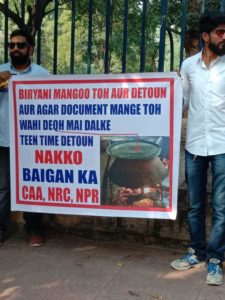
Hundreds of protesters carrying the Indian tricolour flag took part in a peaceful march chanting the slogan against Narendra Modi’s new Citizenship law. The protest, dubbed the ‘Million March’, was organised by an umbrella group of Muslim and civil society organisations. More than 40 per cent of Hyderabad’s estimated population of nearly 7 million are Muslims.
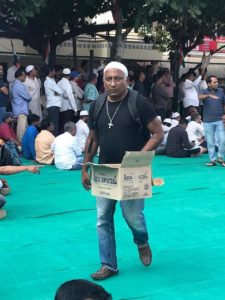
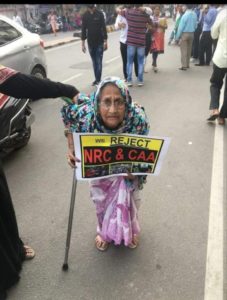
Hyderabad witnessed a sea of people at the protest site of Dharna Chowk as early as 10AM. People from all walks of life, religions, community, men, women, children, people even in their seventies, daily wage earners came out to protest.
People left behind their jobs and came out to protest. “We are not concerned about the results this march would yield. We do not know if our protests are heard by the leaders who sit at the Centre. But when the government threatens us to prove our citizenship, it is our duty that we take to the streets and fight for our rights,” a middle-aged woman, mentioned while interviewing.
Police had only given permission for a smaller gathering of 1000 people but that didn’t defy people and many were coming till late afternoon.
It's Hyderabad public on roads against CAA, NRC and NPR in #MillionMarch.
Its a public movement no party can take credit for this. @KTRTRS@asadowaisi u r losing the ground.
“First, they implemented demonetisation. Now, they are forcing a citizen as old as I am, to protest against an Act which will ask us to prove our citizenship. Why does our Prime Minister want us to wait all day long in queues in hope of documents and papers that will prove we are indeed citizens of this country? We hardly earn enough working hard every day and now this government will force us to leave behind our jobs and wait in queues,” Hussain says.
Ocean of people in Hyderabad during #MillionMarch against CAA.
Women, including housewives and the elderly, too gathered in large numbers and occupied space inside the stadium, chanting slogans and urging more women to join them. While many women were seen leading marches, there were also young mothers who sat at the protest venue along with their toddlers.
The new law eases the path for non-Muslim minorities from the neighbouring Muslim-majority nations of Afghanistan, Bangladesh and Pakistan to gain Indian citizenship. But, if combined with a proposed national register of citizens, critics of the CAA fear it will discriminate against minority Muslims in India and chip away at India’s secular constitution.
Modi government has been facing its hardest opposition from the Indian population since it came to power in 2014. At least 25 people have been killed in protest-related clashes with police since early December.
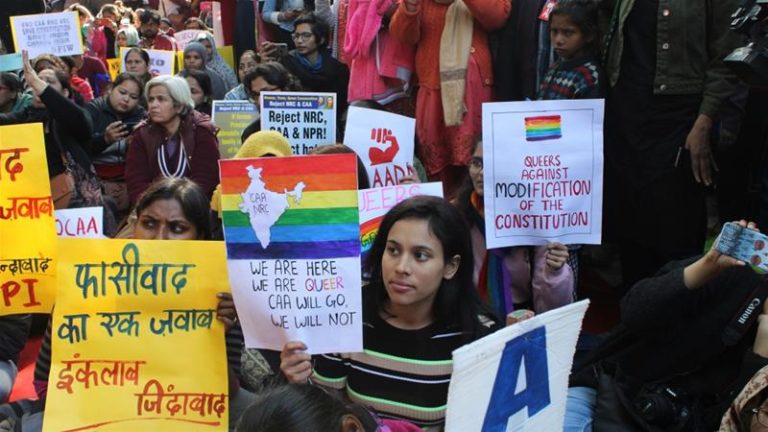
This Friday several parts of the country saw members of transgender, queer and sexual minorities join hands with various other marginalized groups to protest against the NRC-CAA-NPR combined attack on the Indian constitution.
January 3, which marks the birth anniversary of reformer and anti-caste activist Savitribai Phule, witnessed protests in many places including Delhi, Calcutta, Bangalore, Bhopal, Ranchi, Chandigarh, Hyderabad, Guntur, and Ahmedabad.
Transgender and queer communities suffer from discrimination and violence in various forms from the state, administration and even their families. Many have suffered violence and have been kicked out of their families for their gender identity. They oppose the citizen amendment law because of its discriminatory nature which many trans people already suffer.
Vivek Azad, a transman, who works for the transgender community said- “We are still fighting for our identity in this country and now we are being asked for papers to prove our citizenship, That is why are opposing this law,”.
He added- “Some of my documents were burnt by my family after I had an altercation with them. How do I get those back? Those who left their homes, like me, are fighting for our basic rights and existence. And now we are being made to fight for our citizenship too,”
The march in Delhi was called by nearly 50 women rights and transgender/queer groups including All India Network of sex workers, Telangana Hijra Intersex Trans Samiti, The Queer Muslim Project, Pink List, TransNow Collective, Birsa Ambedkar Phule Students Association, Basti Suraksha Manch, National Federation of Indian Women, National Hawker Federation among others.
Delhi being the capital has been the center of CAA-NRC protests for the past month, its the first time that trans and queer groups have raised their voices against the NRC-CAA.
Many transgenders also raised the issue of not having documents aligned to the names and gender of their choice. “Since transgender people are forced to leave their homes at a very early age and drop out of schools due to violence and transphobia, they don’t have the crucial documents,” said Pavel Sagolsem, a non-binary gender activist.
The sex workers in the protest also raised the concerns of documents that prove their identity owning to the nature of their work. Most often sex workers are trafficked from one city to another and have no documents to prove their identity or of their children.
The NRC is yet another example of a patriarchal society where children will be required to prove their father’s identity. Is then the government turning a blind eye to a mother’s relationship with her children, said President o All India Network of Sex Workers, Kusum.
NRC and CAA are discriminatory by excluding Muslims, as a trans-Muslim, they are doubly marginalized- says Lameeya Parveen of The Queer Muslim Project.
Rafiul Alom Rahman, the founder of The Queer Muslim Project which works to address intersectional issues affecting LGBTQI Muslims, said the government hasn’t even defined the term persecuted minorities.
Rahman, who hails from Assam, added a pan-India CAA-NRC would be a recipe for disaster. “Reports stated that around 2,000 transgender persons were left out of the final NRC in Assam.”
Kerala has been inspiring other states to take stand against the dictatorial and unconstitutional laws being pushed on the Indian population. Today Kerala chief minister Pinarayi Vijayan wrote letters to 11 non-BJP chief ministers in the country to build unity among the states against the citizenship Amendment Act (CAA) that was passed in December last year.
Kerala was also the first state to pass a resolution demanding that CAA be scrapped.The resolution was passed on 31st December 2019. The CM cited that the act goes against the secular fabric fo the nation and would lead to ‘religion-based discrimination’. The resolution was passed by ruling as well as opposition parties except for the lone BJP MLA.
Vijayan has written letters to chief ministers of Andhra Pradesh, Bihar, Delhi, Jharkhand, Maharashtra, Madhya Pradesh, Odisha, Punjab, Puducherry, Rajasthan, and West Bengal. Bihar is the only state among the lot where the BJP is an alliance partner. The rest of the states are ruled by Congress, Congress-led coalitions and regional parties.
In his letter, CM Vijayan writes, “Apprehensions have risen among large sections of our society consequent to the Citizenship Amendment Act, 2019. The need of the hour is unity among all Indians to protect and preserve our cherished values of democracy and secularism. People from various cross-sections of the society irrespective of any differences they might have a need to stand united in preserving the basic tenets of our polity which form the cornerstone of Indian democracy.”
Pinarayi Vijayan letter to non BJP state CMs
He points to the Kerala government’s decision to suspend all activities of the National Population Register (NPR) in the state and for taking up a resolution that ultimately received bipartisan support from all MLAs except the lone BJP MLA from Nemom, O Rajagopal.
“States which have the opinion that CAA should be repealed can also consider similar steps so that it will be an eye-opener to the proponents of the CAA and NRC,” writes Vijayan in the letter.
All the 11 chief ministers, including the recently-elected Hemant Soren of Jharkhand, have indicated their opposition to the NRC exercise. Massive protests have been held across the country by Muslim organizations, civil society groups, students and the public against CAA-NRC alleging that the move is discriminatory and violates articles 13 and 14 of the constitution.
Since the Citizenship Amendment act was passed in Rajya Sabha, there has been massive opposition against it from the people. People from all walks of life, all religions, young, oldwho came out to save the secular fabric of India defying prohibitory orders and extreme weather conditions in various parts of the country.
India has seen one of the biggest protests probably since the emergency days. The continuous protests have also put the home minister on a back foot for some time.
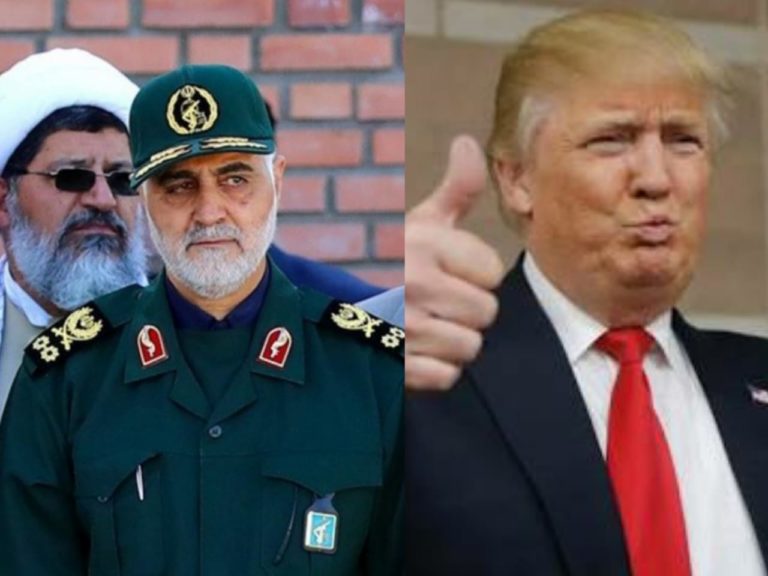
The madness of the American War machine has triggered another major crisis in the Middle East which might lead to another full-scale war in the region. Commander of the Quds Force of Iran’s Islamic Revolutionary Guard Corps, Maj. Gen. Qasem Soleimani and several leaders of the Iraqi Popular Mobilization Forces have been killed in the missile strikes near the Baghdad International Airport on Thursday night.
Iran has named Esmail Qaani the new chief of Iran’s elite Quds force. Qaani was formerly the deputy commander.
Pentagon has confirmed that Trump directed the assassination of Iran’s second most powerful leader to deter future Iranian attacks. Trump who is also facing impeachment later tweeted the American Flag, possibly to invoke the patriotic fervor. Israel and Saudi Arabia are on high alert following the attack.
Qasem Soleimani also known as Sardar Soleimani had been the head of the Islamic Revolutionary Guard Corps (IRGC) for the last 23 years. He is well known in the region as the main person who was responsible for the defeat of ISIS in both Iraq and Syria. This high profile assassination comes at a time when escalations are soaring between the United States and Iran. America has been accusing Iran of backing attacks on it in Iraqi soil though no proof has been presented so far. An American air raid on an Iraqi militia last weekend killed more than 20 people. This triggered a heated protests at the US embassy complex in Baghdad with protesters where demonstrators smashed windows, lit fires and chanted “Death to America” slogans. Americans blamed Iran for the uprisings and accused IRGC of fomenting hatred against America in the region. Most of the Iraqi lives were destroyed by the war on terror that America started in 2003 with false evidence that Iraq’s Saddam Hussain has “Weapons of mass destruction”.
Iranian Supreme Leader Ali Khamenei has stated that the death of the Quds commander will only double the motivation for resistance against the United States and Israel.
“Undoubtedly, the great Iranian nation and other freedom-loving countries in the region will avenge the United States for its terrible crime”, Iran’s president Rouhani stated. Iran’s foreign minister Javed Zarif has stated “The US’ act of international terrorism, targeting & assassinating General Soleimani. The most effective force fighting Daesh (ISIS), Al Nusrah, Al Qaeda is extremely dangerous & a foolish escalation. Iraqi Prime minister Abdul Mahdi has stated Assassination of Soleimani is an act of Aggression and breach of Iraq’s sovereignty that will lead to war in Iraq, region and the world. Popular Iraqi Shia Leader al-Sadr has ordered his followers to Prepare to Defend Iraq.
The assassination comes at a time when both American President Trump and Israel’s Prime minister Netanyahu and facing trouble on home ground.
Trump was impeached on 18th December on grounds of abuse of power and obstruction of justice. Similarly, Netanyahu after facing defeat in the elections a couple of months ago is now facing arrest in corruption charges. It works for both of them to use trouble in the Middle East as a distraction from their own failures on the domestic front, and Iran serves as a perfect enemy.
When it comes to the Middle East, It’s basically the same script!!
Trump who accused Obama of trying to start a new war against Iran for his 2nd term, now himself is doing the same. Clinton who was impeached in 1998 also ordered similar airstrikes on Iraq. And Trump now is also facing impending trial in the Senate ahead of November’s presidential elections clearly knows the impact of military conflict to shield himself from trouble.
The Russian Foreign Ministry has offered condolences and officially condemned the US strike on Iraq’s Baghdad that killed Major General Qassem Soleimani, the commander of the Qods Force of Iran’s Islamic Revolution Guards Corps, and Abu Mahdi al-Muhandis, the second-in-command of Iraq’s Popular Mobilization Units.
“We consider the killing of Soleimani as a result of an American missile strike in the vicinity of Baghdad as an adventurous step that will lead to increased tensions throughout the region. Soleimani devotedly served the cause of protecting Iran’s national interests,” the Foreign Ministry said, according to Russia’s RIA Novosti.
The impact of this conflict has already sent the Indian rupee to slide near to one month low at 71.61 per dollar on Friday morning. The expense of Oil imports is expected to rise severely as India imports 84% of its oil and India under US pressure stopped buying Iranian oil from May 2019. With rising inflation, sliding economy Prime Minister Narendra Modi is staring at economic disaster with only NPR, NCR and CAAto divert attention from the public. He has already started invoking Pakistan sentiments heavily in his speeches and the army chief himself giving statements against threats from Pakistan points to the direction of conflict the country is heading towards.
A character in the Kannada TV serial Silly Lalli called Lalithaamba, a social worker, would always open her mouth to say, “Trust me, trust me please”. After passing the Citizenship Amendment Act, our Prime Minister while addressing the shaken public, essentially tweeted, saying “Don’t get anxious. Trust me, I am your sevak.” Watching this felt like Narendra Modi’s words and Silly Lily’s social worker Lalithaamba’s words were falling into the same rhythm.
The irony is that, in recent times, people have probably not believed anyone like they have believed Narendra Modi. People have trusted him, insanely. Is it just one or two things that Modi has gotten the public to believe and that the people have believed?
He had said he would bring back black money hoarded abroad and would deposit Rs 15 lakh in every Indian’s bank account. People believed him. There may even be some who still believe and are waiting.
But today the situation is such that there is no guarantee even about the money that people already have in their own bank accounts. He also bragged and promised people that he would create crores of jobs annually. People believed him and brought him into power.
But with the employment situation today, forget about creating new jobs, the jobs that exist are themselves shrinking. In the past 45 years, the rate of unemployment has increased the most during the Modi regime. Similarly, saying he would double farmers’ incomes he has only doubled their distress.
Moreover, during the stressful time that was created after the note ban, Modi’s promise to the nation was: “I have only asked for 50 days. Give me time till December 30. After that, if any fault is found in my intentions or my actions, I am willing to suffer any punishment given by the country”
It has been nearly three years since Modi uttered these words. Even today, the disaster caused by the note ban is still burning across India. All of this is strongly reminiscent of Mahabharata’s Uttara’s macho posturing. One can’t figure out whether this is the fault of those who believe or the ones who make them believe. People have never trusted anyone else like they have trusted Modi and Modi has betrayed people’s trust in the way that no one else has done before. I speak these words in pain.
Modi’s governance style is akin to warming oneself up at a fire that has been lit by inciting beliefs and emotions about caste, religion, language, etc that lay asleep in the community. The most recent example of this is the Citizenship Amendment Act. Where will these take us? More economic collapse, more unemployment, more price rises, more mob lynchings that people indulge in, leading one to doubt whether a government is in existence or not.
The Modi government has failed at resolving the problems that are eating away the nation. He is inciting people’s beliefs and emotions so that they may forget the pain caused by these problems. This is like creating another pain to forget the first. But if you provoke beliefs and emotions and let them loose then they become demons baying for blood. This is what is happening today.
If through the CAA and NRC, India is made into a religion based nation it will be like rats and bandicoots burrowing through and eating up the very life of the constitution, disfiguring the very form of it. Karnataka Rajya Raitha Sangha’s President Badagalapura Nagendra’s words that “India should not become another Pakistan” is the alarm bell.
Prime Minister Narendra Modi and BJP president Amit Shah. Photo: Reuters
If the religion-based Pakistan becomes our ideal, India will lose its Indianness. The mindset of ‘my enemy is committing atrocities so I too will commit atrocities’ will drag people who think like that into ruin. The Modi-Shah gang, who have set out to make India a religion-based country modeled on Pakistan, are becoming the supreme bhakts of Pakistan without they themselves knowing it. Hence while incorporating models of different countries and different religions there should be some wisdom to it.
For example, however high an eagle flies its eye is always focused on the rotting garbage on land. But for a swan, even if one mixes milk and water, it will drink only the milk. This hamsa ksheera nyaya concept is the very character of Paramahamsa. He assimilated all the positives in Indian philosophies and set aside the contradictions.
Vivekananda too saw the good in Hinduism, Islam, Christianity etc. For example, wouldn’t brotherhood and hugging, that is inherent in Islam, be a medicine for the Chaturvarna Hindu dharma racked with the illness of untouchability and caste discrimination?
A chakravarthi should always have everyone’s trust even if his governance is viewed as the thuggish governance of feudal lords. Otherwise one would feel that it is the feudal lords who are sitting in the place of the chakravarthi. For instance, Giani Zail Singh, after becoming the president, conducted himself with the dignity that the position demanded.
Even H.D. Deve Gowda, whose politics in Karnataka was objectionable on several grounds, on becoming the Prime Minister, behaved in a way that was appropriate for his position. He made an attempt to untangle the problems in Punjab, Kashmir, North-east India by winning over the hearts of people.
I have several reservations about Manmohan Singh as well. But upon seeing the collapse of the Indian economy, he spoke with a lot of pain and not a Hitler-like roar. One should heed these softly spoken words. Similarly, the BJP’s Vajpayee who said “If India is not secular, then India is not India at all.” behaved like a chakravarthi, much like Deve Gowda.
So, a request from Modi-Shah: Don’t turn into eagles, do change into swans. The time is close at hand for the country to start a conversation, not just with students, people’s organisations and the opposition parties, but also with the innocent believers of the RSS, BJP and its allies.de
Devanoora Mahadeva is a Kannada writer who has been conferred with the Padma Shri as well as the Sahitya Akademi award both of which he returned in protest against the growing intolerance in the country. A public intellectual and Dalit activist he has been a guiding force to various social movements in Karnataka and the country.
This article was first published in Kannada in Varthabharati on December 20, 2019. It has been translated into English by Rashmi Munikempanna.
A Chilean protest song damning the culture of rape that went viral in early December this year has inspired people all over the world. The song, Un Violador en Tu Camino (A rapist in your path), written by Lastesis, a feminist theater group, was performed at the Chilean protests calling for a change in the constitution.
The song’s powerful lyrics point to the political nature of rape, demanding that we look at the political forces that systemically allow rape to persist.
“The rapist is you, the rapist is the police, the judge, the state, the president. The oppressive state is the male rapist.” goes the lyrics.
“It’s not my fault, not where I was, not what I wore, the rapist is you!”
the song can be seen here.
On Monday, Nov 25, the International Day for the Elimination of Violence Against Women, feminist collective Lastesis from Valparaiso took the streets in the center of Santiago de Chile and showed a stunning performance in front of the Supreme Court of Chile. The powerful statement against sexual assault of women by men can be seen as an allegory of the accusation of the suppressive Chilean state, whose police and military forces have killed, tortured and violated numerous protesters as well as innocent bystanders during the biggest civil protests since the end of the military dictatorship in 1989.
Feminism in Chile
The women’s movement in Chile can be traced to the nineteenth century. Early woman’s rights movements focused on, what is called first-wave feminist issues, like the right to work, vote, get an education and own property. Feminism was earlier associated with middle-class European women.
With the military coup organized by Augusto Pinochet, the state became intensely repressive against all political activity. The labor movement and struggles from the indigenous communities were under heavy fire. During Pinochet’s regime, women organized study groups to discuss women’s issues. These would often happen in people’s homes or other “non-political” spaces to avoid posing a direct threat to Pinochet’s regime, though a lot of revolutionary movements working to topple Pinochet worked in those spaces. The intense oppression against traditional movements, which were male-dominated to these spaces, shifted the leadership and content of these movements towards women. Some circles grew in size and resembled the church mass. In Santiago, the Círculo de Estudios de la Mujer, or Women’s Studies Circle was said to have had hundreds of participants.
After Pinochet stepped down from power, it is not clear what had happened. Many of the feminists of this period had a complicated relationship with the state.While the woman’s movement made certain gains, they lost a presence in the public sphere. Marital Rape was criminalized in 1999. In 2006, Michelle Bachelet became the first women President of Chile, winning with 54% of the vote. Some scholars have said that in this period, the feminist movement moved away from mass organizing, into more formal domains.
Neo-liberal reforms instituted by Pinochet meant that healthcare, public transport, and education, which disproportionately affect women and their labour, were hit hard. With the co-option of women’s issues by institutions of the state and the destruction of traditional labour movements, the ability of women’s movements to organically address these issues fell. Women continued to suffer, and many women began to feel the traditional feminist movement could not take up their issues.
Mapuche
The Mapuche make up about 10% of the population of Chile, and nearly 85% of the Chilean indigenous community. In the Mapuche community, oral traditions have been very important in remembering violence, both by the state and by patriarchy. With the rise of Pinochet, the violence increased. Mapuche women, in their traditional roles in the society as healers, educators, and child-rearing, had an intimate relationship with the environment, public sector, and the community. They have been torch-bearers for resistance, linking together many issues organically. The protests in November also speak to the heavy oppression of the indigenous population.
Salvador Allende, who was deposed of by Pinochet, the Chilean dictator, was said to have had a more conciliatory position regarding the Mapuche, as his government recognized that they had a distinct culture and heritage within Chile. Pinochet instituted 701 Decree that gave up to 75% subsidies for lumber companies that managed the forest. This led to the impoverishment of those dependent on the forest, and a huge toll on the environment. The Mapuche who resisted were constantly called terrorists and threats to national security. Leaders were frequently detained. Law 18.314 (the Anti-terrorist law) was frequently used to crush dissent. The result was that the Mapuche saw White supremacy, state repression and corporate greed along the same axis. As such repression makes women especially vulnerable, Mapuche women have associated the state as an apparatus of patriarchy as well.
Current protests
The children from all communities were raised in this basic context. With the heavy suppression of all forms of mass organizing, the children heard stories of mass resistance, but did not have the opportunity to see it. Women taking their analysis, oral histories and memories of older struggles were the inspiration for the next generation, though their generation had another set of struggles.
During the 2000s, the cost of education and transport rose, which directly affected students. While they remembered other forms of struggle from their homes, these issues prompted protests. From 2006, when students across Santiago marched in protest against the Neo-liberal education system, where the public provision of education was closing down, in favor of a voucher system, where poorer students would go to private schools in exchange for compensation from the state.
From 2006-2013, student-led struggles grew and led to certain concessions from the state, though these concessions were lost in court. Influenced by social media, many of these struggles began to interface with movements they saw online. The Arab Spring, Black Lives Matters, Me too!, and marches for the environment would find connection with the protesters in Chile.
Being a street-level mass struggle, these movements could coordinate with many others, be they labour movements, indigenous movements, sexual assault, etc. From these protests, we can see how a culture of mass mobilization can be created anew after decades.
The 2019 Chilean protests, like the 2006 protests, started ultimately from a rise in the metro fare, which the children of Santiago found unreasonable. The lessons from the Chilean winter of 2011-13 showed them that their movement could not restrict itself to education, and called for a total change on the system. As their movements evolved, they exposed the interconnectedness of injustice, pointing the patriarchy, the state, capitalism, the abuse of nature, all as part of their struggle.
The author is a mathematician based in Bangalore. Views are personal.




 Police had only given permission for a smaller gathering of 1000 people but that didn’t defy people and many were coming till late afternoon.
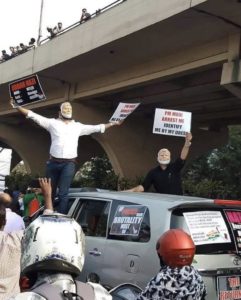 The new law eases the path for non-Muslim minorities from the neighbouring Muslim-majority nations of Afghanistan, Bangladesh and Pakistan to gain Indian citizenship. But, if combined with a proposed national register of citizens, critics of the CAA fear it will discriminate against minority Muslims in India and chip away at India’s secular constitution.
Modi government has been facing its hardest opposition from the Indian population since it came to power in 2014. At least 25 people have been killed in protest-related clashes with police since early December.