

Karnataka High Court: Streamline travel of Migrant workers, free travel for those without money
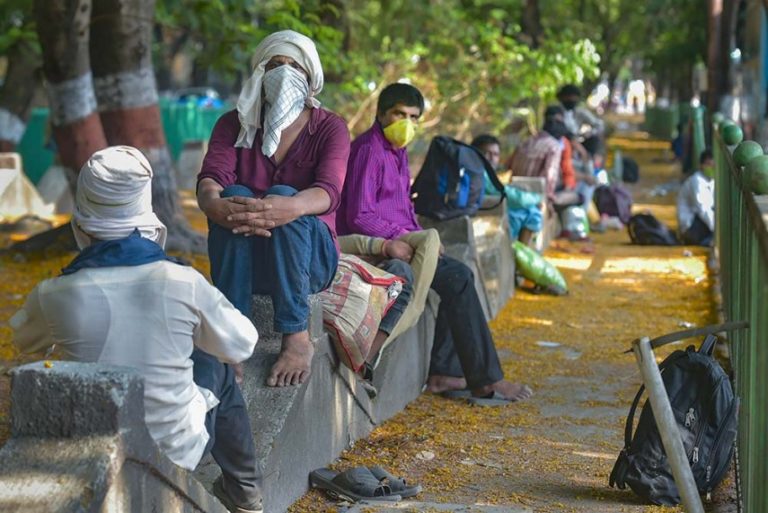
The Karnataka High Court on Tuesday directed the Central and State Government to take immediate decision on the question of paying railway fare of those migrant workers who are wanting to travel back to their states but cannot do so due to their inability to pay.
A division bench of Chief Justice Abhay Oka and Justice B V Nagarathna said:
“Prima facie, it appears to us that considering the constitutional rights of the migrant workers, no one should be deprived of an opportunity to go back to his own state only for the reason that he has no capacity to pay for the transport. The reason is that inability to pay is due to loss of livelihood.”
It added,
“The State Government and the Central Government, during this difficult time, must appreciate the major contribution made by the migrant workers in a large number of public projects as well as private projects which have contributed to the improvement of the infrastructure in all the States and the improvement of the economy. At a time when the migrant workers who have made such a huge contribution are facing distress, both the Central and State governments must come forward to help them to ensure that at the earliest, they return back to their home States. Ideally, no migrant worker should be deprived of an opportunity to travel back to his home State, if he wishes to do so”
In this regard, the Court noted that as per the order of Ministry of Railways issued on May 2, the State Government which arranges for the “Shramik” trains is expected to pay the train fare. The court urged the governments to find a solution on this issue which will ensure that the rights of those migrant workers who wish to go back to their respective states are not infringed only because they are in distress and are not in a position to pay the traveling charges.
The bench referring to the communication dated May 11, made by the Home Secretary of the Government of India to the Chief Secretaries of all the States, seeking cooperation to run more ‘Shramik’ special trains to transport migrant labourers, said “If the migrant workers are unable to pay the train fare, it will be impossible to facilitate their travel at a faster rate.” In the last paragraph of that letter, the Union Home Secretary had urged all Chief Secretaries to receive all “Shramik Trains” without hindrance and facilitate faster movement of the migrant workers to their native places. Taking note of this, the bench ordered :
“Therefore, apart from the Central Government, even the State of Karnataka must look into the issue and take immediate decision on the question of paying railway fare to those migrant workers who are not able to travel due to their inability to pay”.
The bench directed the State Government to immediately convene a meeting of all the Trade Unions, Employers’ Associations and NGOs in the State with a view to ascertain whether any contribution can come from the Employers’ Association, Trade Unions and NGOs which can be used for bearing the Train fares of the migrant workers who are not in a position to pay the train fare. The State is also told to work out a time schedule for facilitating the transport of these migrant workers to their respective states and a broad time schedule be communicated to them.
The government was also told that migrant labourers be made aware of the state’s policy decision to allow them to return to their respective states by special trains. The bench said
“Because the assurance of the State Government that every migrant worker will be allowed to go back to his home State has not reached them a large number of migrant workers are found on highways making an endeavor to walk up to their respective states. They feel insecure about their prospects of returning to their respective homes and, therefore, in the entire State, we see a scenario of the migrant workers walking on the highways.
The bench noted “even as of today, a large number of migrant workers are found on highways who are making an endeavour to walk up to their respective states”. When the bench as told that many migrants have not been paid their wages, it observed :
“The grievance about the non-payment of wages must be looked into by the State Government and its agencies”.
The state informed the court that ten trains will be arranged from May 16 to May 20, for the benefit of the migrant workers from Bihar to reach their State. To which the court suggested it to take help of all the Trade Unions and Non-Governmental Organisations, (NGOs’) who are working in the field to ensure that the assurance of the State reaches the migrant workers who have already registered with the State Government. The court has asked the governments to reply on the above aspects on May 18. The state is also told to provide details of the special trains so far arranged from various places in the state and the special trains which are scheduled to run in near future. Give details of the facilities extended to the migrant workers who are from the State of Karnataka and who are working in other States. Necessary details such as requests received by the State of Karnataka, steps taken for repatriation of the migrant workers to Karnataka, etc are to be placed on record.
Source: www.livelaw.com
Gujarat HC: People at large are hungry, Migrant Workers suffering Most

The Gujarat High Court on Monday took suo moto notice of the various news reports about the sufferings of migrant workers, daily wage earners and the poor people during the lockdown.
In a report from livelaw.com, a division bench comprising Justices J.B.Pardiwala and Justice Ilesh J. Vora observed:
“It appears that people at large are hungry. People are without any food or shelter. It seems that it is the outcome of a complete lockdown. Whatever little help the poor people used to receive from the NGOs, other charitable institutions and volunteers, have come to a grinding halt. It has been reported that more than two hundred people living on the footpaths near the Ellisbridge have not had a morsel of food for the past four days”.
The bench further noted:
“In such circumstances, it is the paramount duty of the State Authorities to ensure that its citizen does not go hungry. Necessary arrangements need to be made for the distribution of food packets all over the city of Ahmedabad, areas on the outskirts, and also other parts of the State of Gujarat. The situation seems to be going out of control. Although the State Government is doing its best to combat the situation, yet we find that something is wrong somewhere. It appears that there is no proper coordination amongst various departments of the State Government. What is most essential as of now is a more humane approach or touch”.
Taking note of the report published in ‘The Indian Express’ titled as “Migrant workers made to wait for 19 hours in Gujarat to board train to UP”, the court recorded in its order that-
“It appears that migrant workers are suffering the most. They are desperate to go back to their homes i.e. to their native States across the country. We appreciate the efforts of the State authorities, which are being made to transport the migrant workers to their respective States by way of Trains, Buses, etc”.
The court went on to observe-
“However, it seems that before they are able to board the Train or a Bus they have to suffer like anything for hours together in this scorching heat of almost 45 degrees. The State Authorities should come forward with some modalities or plans to smoothen and ease the process so that the migrant workers may not have to wait for hours and hours together before they are able to board the trains or bus”.
“The State Government should keep in mind that they are at present dealing with the most downtrodden, underprivileged, and weaker sections of the society. They are all afraid. They are not afraid of COVID19, but they are afraid that they would die due to starvation”, the court said.
According to the High Court, in such circumstances, it becomes the paramount duty of the State Government to assure and repose confidence in the downtrodden class of people that they will be taken care of in the best possible manner.
“We would like to convey a message to the people at large that do not lose heart. Everything that Has a Beginning Has an End. NOVEL COVID19 is not immortal. We all need to stand united and fight. People with resources should stand beside the frail, aged, needy, and poor. Trust in the Almighty”, the court said.
Court has fixed May 14 as the next date of hearing.
Karnataka: Government follow suit of other states and decides to change labour laws

States like UP and MP have taken steps to help the economy recover after the COVID pandemic. This recovery comes at the cost of the rights of labourers. Labour laws in both these states, and slowly other states, are being amended to allow benefits to corporates and make it easier for them to hire and fire their employees and deny them benefits. A state that has followed suit is the BJP-led Karnataka Government. The proposed amendments are expected to make life easier for large, medium, and small industries that are struggling with serious cash flow issues following seven weeks of lockdown.
B.S.Yediyurappa’s government is deliberating relaxing minimum wage laws, increasing overtime working hours to 100 hours per quarter from 72 hours, and easing compliance with key labour laws. The government will amend the Factories Act, Industrial Disputes Act, and the Contract Labour Act, among others. The provisions of the amended Factories Act will apply to units employing 40 or more persons while the Industrial Disputes Act will apply to units with 300 or more workers, up from 100 or more workers at present. Following the amendment, the cap of employees under the Contract Labour Act will go up to 50 from 20. During a meeting with members of the Karnataka chapter of the Confederation of Indian Industries (CII) and government officials, P Manivannan reportedly said that CM Yediyurappa had asked for a review of minimum wages being paid in the state.
“We will not do anything that will go against the interests of labourers. These are measures we have proposed for the time being to tide over the challenges thrown at us by Covid-19 pandemic. The government will review them once the crisis is over,” labour and sugar minister Shivaram Hebbar told Economic Times. “Since the new Covid-19 protocol requires industrial units and offices to have only 33% of attendance at a time, we want them to introduce shifts and make up for the loss of productivity.”
Responding to the move by the government, senior labour leader P. Balan from Karnataka says-
“These ordinances are atrocious, retrograde, and barbaric. It will result in the termination of all permanent employee services. The suspension of labour laws is an utter violation of Article 39 a to e of the constitution of India. It is further, a violation of Articles 14, 19, and 21 of the constitution of India.”
Karnataka Shramik Shakti member Sathish Aravind says relaxing labour laws for three years is a big blow to workers in Karnataka. By replacing P. Manivannan with Commerce and Industries Department M Maheshwar Rao, the government has shown its intention that it is favouring industries and does not care about the workers.
We are going to submit a memorandum to District Commissioner in the next two days and if this continues, we will do a strike against such atrocious ordinance.
AICCTU also responded to this in a series of tweets
“When workers are deprived of food, shelter and wages, the Labour Secretary is assuring industrialists that no action will be taken if labour laws are violated,” Maitreyi Krishnan from the All India Central Council of Trade Unions said. She said these assurances were “blatantly illegal and an abdication of their duty.” This comes soon after the government amended the Land Reforms Act, 1961, under which industries can now directly buy land from farmers without intervention from the government, albeit with some restrictions.Thread. We all thought that @myogiadityanath move to scrap labour laws for 3 years was bad. In this meeting today with @FollowCII @mani1972ias our labour sec. , said karnataka will do better than UP. What does it mean sir ? @BSYBJP sir are you planning to remove all laws too? 1/n pic.twitter.com/fKcv9tO3vG
— AICCTU Karnataka (@aicctukar) May 9, 2020
Central government big lie: No free trains for Migrant workers
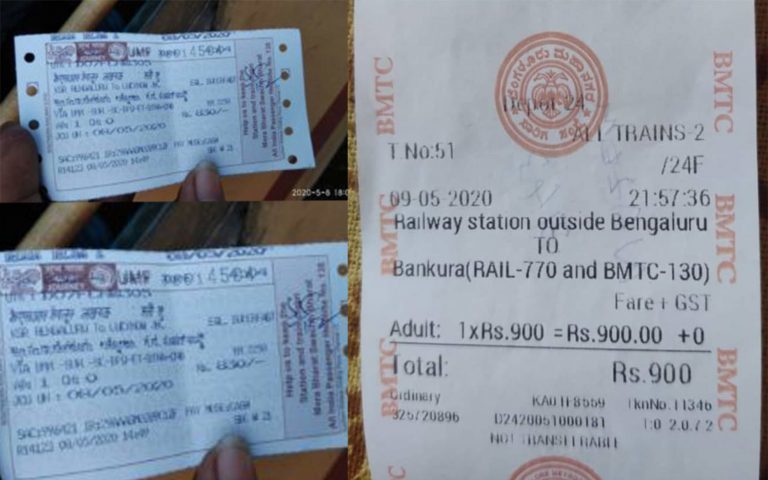
There is no end to the suffering of migrant workers in Karnataka. The central government last Monday boasted about the arrangement of the free train journey for the stranded labourers. The Indian government claimed that it will bear 85% cost of the ticket fare, but it was found that migrant labourers had to pay for the full railway fare.
It was found that migrant workers who were going from majestic to Malur (Andhra Pradesh), Chikkabanavara and including many other railway stations had to pay the BMTC bus fare two or more times to that of the normal fare, leading to the further exploitation of the stranded labourers who were already suffering due to the lockdown.
 When the government had finally announced to provide special Shramik Trains to the migrant labourers to return to their home but with no compensation of the fares. Many politicians, celebrities and civil society members had criticised this move of the central government. Sonia Gandhi had announced that the Congress party will pay for the tickets of the migrant labourers across the country.
Later the Central government announced that 85% of the railway fares will be borne by the center while 15% will have to be taken up by the state governments and that the fares will not be charged by the migrant labourers, but all these government claims have failed on the ground.
Karnataka BJP general secretary BL Santosh also made the announcement of free travel for the migrant workers. But all the announcements are more words as we can see that all the migrant workers from Bangalore are being charged for travelling.
When the government had finally announced to provide special Shramik Trains to the migrant labourers to return to their home but with no compensation of the fares. Many politicians, celebrities and civil society members had criticised this move of the central government. Sonia Gandhi had announced that the Congress party will pay for the tickets of the migrant labourers across the country.
Later the Central government announced that 85% of the railway fares will be borne by the center while 15% will have to be taken up by the state governments and that the fares will not be charged by the migrant labourers, but all these government claims have failed on the ground.
Karnataka BJP general secretary BL Santosh also made the announcement of free travel for the migrant workers. But all the announcements are more words as we can see that all the migrant workers from Bangalore are being charged for travelling.
Read More: More States suspend labour rights risking the lives of many daily wage labourers
WHERE IS THE PM CARES FUND GOING? Even after some trains have started, due to lack of facilities and the failure of the central government in ensuring free travel, many migrant labourers are forced to go by walk to their homes. During these times, the central government which is supposed to help the workers is instead looting them. Government’s PM cares fund has collected thousands of crores but the question arises is why the information related to it is not being made transparent to the public. The fund could be used to pay for the tickets of migrant workers. Each train is carrying around 1200 passengers, Karnataka state itself has around 5-6 lakh migrant workers. At this pace, It will take almost 2 months to move these workers to their homes. This is making workers even more frustrated. Therefore there is demand that more trains should be provided. Migrant workers already in pain, the government should work towards reducing the pain and not aggravating it. Overall, migrant workers’ lives are uncertain from the beginning of the lockdown. There have also been accusations that the government has made it difficult for migrant workers by introducing new rules every other day. The article was first published here in www.naanugauri.com. It was translated into Kannada by Neha Kumari.Arundhati Roy, Jean Drèze, Naom Chomsky and Others launch Progressive International

In December 2018, the Democracy in Europe Movement led by Yanis Varoufakis, former minister of finance of Greece, and the Sanders Institute led by independent US Senator and Democratic presidential candidate Bernie Sanders issued an open call for the progressive forces in the world to unite. This call gave birth to the Progressive International on the 11th of May. “There is a global struggle taking place of enormous consequence,” Progressive International said. “Nothing less than the future of the planet is at stake.”
This is a coalition of left-leaning intellectuals, activists, and political leaders from around the world with an interim council of which includes Noam Chomsky, Aruna Roy, Arundhati Roy, Harsh Mandar, Jean Drez, Sarika Sinha among others.
Also Read: More States suspend labour rights risking the lives of many daily wage labourers
From Latin America, political leaders such as the Ecuadorean ex-president Rafael Correa; former Brazilian presidential candidate Fernando Haddad; former Brazilian Foreign Minister Celso Amorim; Bolivian former Vice President Alvaro Garcia Linera are part of the founding members.“Never before has international solidarity been more necessary—and more absent,” says General Coordinator of Progressive International, David Adler. ” Only a common international front can match the scale of our crises, reclaim our institutions, and defeat a rising authoritarian nationalism. That is why, we are launching the Progressive International, a global initiative with a mission to unite, organize, and mobilize progressive forces around the world.” The activities of the initiative are divided amongst three pillars. The Movement pillar aims to connect, support, and mobilize activists across the globe and forge global networks that coordinate work across borders. Through toolkits and training, they bring the members together. The Blueprint pillar convenes activists, thinkers, and practitioners to develop principles and policy blueprints of a progressive international order. The Wire pillar is building a coalition of progressive media outlets to report grassroots stories and share perspectives from around the world. They aspire for a world that is Decolonised, where all nations determine their collective destiny free from oppression, Solidaristic where the struggle of each is the struggle of all, Post-capitalist, that rewards all forms of labour while abolishing the cult of work, Plural, where the difference is celebrated as strength, Sustainable, that respects planetary boundaries and protects frontline communities, and Ecological, that brings human society into harmony with its habitat among other things. Varoufakis told the Guardian Monday that a left coalition had “been urgent for quite a while now” and that he hoped the crises brought about by the coronavirus had not made the left “late to the party.” “The stakes could not be higher,” says the Progressive International. “The Covid-19 pandemic has revealed the urgent need for universal healthcare, worker protections, and international cooperation. Only a Progressive International can match the scale of these challenges and stand up for collective rights against those that would profit from fear, bigotry, and alienation.” In September, the Council will meet for the inaugural Summit of the PI in Reykjavik, Iceland, hosted by the Prime Minister of Iceland and the Left-Green Movement, to analyze the challenges of the 21st century and consider proposals from the Progressive International membership.The time has come for progressives everywhere to form a common front.
— Progressive International (@ProgIntl) May 11, 2020
Join us today, and help us build the Progressive International — brick by brick, member by member, action by action. https://t.co/4KFoVA88rp pic.twitter.com/JeGVeynuLc
“The ambitions of this initiative are undoubtedly high — no higher than the present crisis demands. But the Progressive International is only as powerful as its membership, and to reclaim the world after Covid-19, we will need a powerful movement of progressive forces. So join the Progressive International and work with us to build this common front.” said David Adler. Visit Progressive International to become a member and to know more.Climate change. Inequality. Poverty. Pandemics.
— Progressive International (@ProgIntl) May 11, 2020
PI Council member @GaelGarciaB knows: The only way to solve these global problems is through global solidarity.
Join us: https://t.co/gSzsiCiz51 pic.twitter.com/wgZJuBmRkP
Administration tries to grab Tribal land as Gujarat HC reject PIL
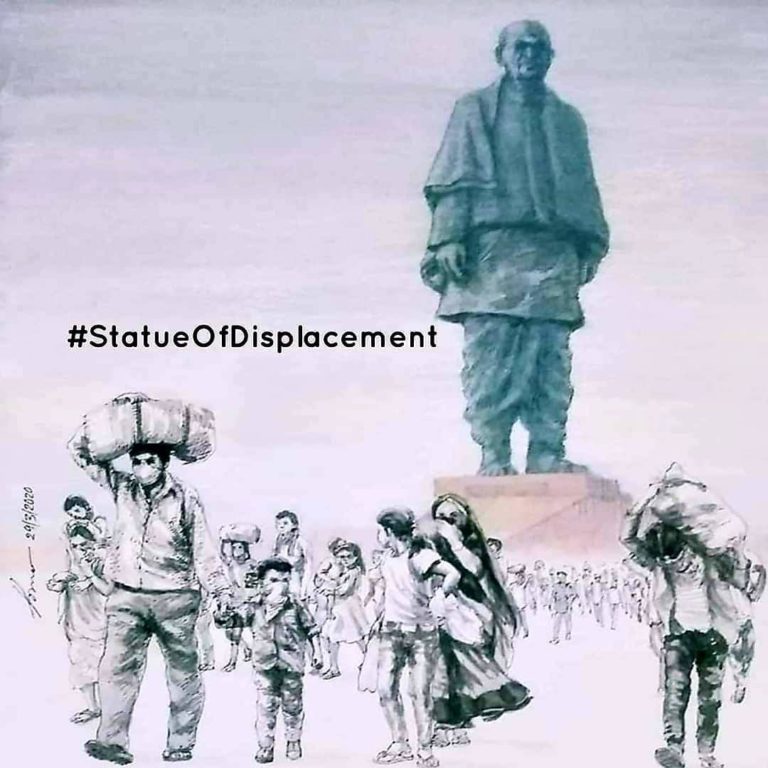
The Gujarat High Court has dismissed a 2019 Public Interest Litigation that had sought the protection of livelihoods of tribals from five villages of Narmada district near the Statue of Unity at Kevadia colony.
Activists Mahesh Pandya, Anand Mazgaonkar, Ashok Naik and Jatin Sheth filed the PIL in 2019. They represented the villagers and tribals from the villages of Kevadia, Vagadia, Navagam, Limdi, and Gora. The PIL had contended that while the state government acquired the land parcels in the five villages as long back as 1960, 1961 and 1962, the villagers continued to be in possession of the land and cultivate there. Citing Section 24 (2) of the act, it was submitted that if an acquired land remains unoccupied for five years, the acquisition gets canceled.
In response to this petition, the High Court observed that this could not be treated as a case of a PIL as individual rights over the land had to be established. The court dismissed the petition stating that every resident of these villages must file individual claim over the land and said that the PIL filed on behalf of a total of 1800 persons (295 families) cannot be sanctioned. The individual has to establish that compensation was not paid to them and that they continued to be in possession of the land.
“Such rights are individual rights attached to each of the present residents who are claiming possession. Thus also, the petition on behalf of such 1,800 persons (295 families) cannot be entertained as a Public Interest Litigation,” observed the judgment. It also noted that third parties can not represent individual claims. “Such claimants would have to establish and pass both the tests of compensation not being paid to them and also that they are continuing in possession,” it added.
MLA ChotuBhai Vasva shared videos of the tensions that arose when the Police came soon after the judgment to try and strong-arm the tribals into giving up the land.
He says in his Facebook post- I hope that the media shows this to the people. This video has come from Kevadia, Gujarat. During the Corona Pandemic, what is #BJP government doing is for the whole country to see. In the name of #statueOfUnity, this government wants to destroy the constitution and end the history and identity of Adivasis. #Coronavirus pandemic is just an excuse, in reality, during the corona scare, the government want to loot the adivasi land.
#statueofunity is #statueofdisplacement
BJP government has started looting Kevadia tribal land in the guise of #coronavirus #Lokdown. People of Gujarat should also see which media channel raises this issue and shows it as breaking news. Does the government now wish that people forget the Lok Down and go on agitation on the roads?”
#coronavirus के वक़्त #Lokdown मे बीजेपी सरकार ने पुलिसकर्मियों को साथ रखके #केवड़िया के आदिवासी ओकी जमीन लूटने की जो शुरुआत की हैदेश/राज्य का कोंन सा मीडिया इसपर आवाज उठाता है या नही ओर ब्रेकिंग न्यूज में दिखाता है या नही वो भी गुजरात की जनता देखे क्या अब सरकार चाहती है कि लोग सरकार की तरह लोक डाउन को भूलकर सड़को पर आंदोलन करने निकले ?ABP Asmita TV9 Gujarati News18 Gujarati BBC News Gujarati VTV Gujarati News and Beyond Ahmedabad Mirror
Posted by Chhotubhai A Vasava on Sunday, May 10, 2020
आशा है मीडिया देश की जनता को ये सच दिखाएगा यह गुजरात केवडिया से आया आज का विडियो है#कोरोना महामारी के इस वक्त #भाजपा…
Posted by Chhotubhai A Vasava on Saturday, May 9, 2020
Also Read: Turning back the clock: How the state is reversing gains made by traditional forest-dwelling communities
More States suspend labour rights risking the lives of many daily wage labourers

The UP government on May 06th passed an ordinance, Uttar Pradesh Temporary Exemption from Certain Labour Laws Ordinance, 2020 (‘Ordinance’), that suspended 35 out of the 38 labor laws that are in existence for a period of three years. This is being done so that there will be a promised inflow of investment from the private sector. Since labour falls in the concurrent list, the states can only make the ordinances but the Center has to approve it. Once the President’s assent is received, it will be made into law.
Out of the 38 laws, the 3 that were exempt were Section 5 of the Payment of Wages Act, 1936, the Employees Compensation Act, 1932, the Bonded Labour System (Abolition) Act, 1976, and the Building and Other Construction Workers Act, 1996. Provisions of laws pertaining to women and children, like the Maternity Act, Child Labour Act, are also being retained. Laws like The Minimum Wages Act, The Maternity Benefit Act, The Equal Remuneration Act, the Trade Unions Act, Industrial Disputes Act, Industrial Employment (Standing Orders) Act, The Factories Act, Contract Labor Act, Inter0state Migrant Workmen Act, WorkingJournalists Act, EPF and Misc provisions Act, Employees State Insurance Act, Payment of Bonus Act, Unorganized WOrerks’s Social Security Act are some of the laws that will be suspended.
With the suspension of these acts, the employer can make the workers work overtime, for how many ever hours, without holidays, and without minimum wages. As many of the states barely impose the Unorganised Workers’ Social Security Act, 2008 even today, this suspension pushes the labour rights push India back by a hundred years. Hundred years ago India ratified the International Labour Organization convention.
“The horticultural and economical activities in the states have been severely affected and slowed down due to the outbreak of COVID-19. This is because businesses and economic activities came to a halt more or less due to the national lockdown,” a press statement issued by the state government said.
In another BJP ruled state, Madhya Pradesh, the Chief Minister has said that the state government will exempt new manufacturing units from most provisions under the Factories Act, 1948 for the next 1000 days (or over two-and-a-half years). This will allow more factories to operate without following safety and health norms and give a free hand to new companies to “keep laborers in service as per their convenience”.
This new ordinance allows industries more flexibility to hire and fire workers, to determine their pay, and not have to give them benefits. Seven left parties, led by the Communist Party of India (Marxist) general secretary, Sitaram Yechury, have written a letter President Ram Nath Kovind for urgent intervention on this issue to stop “such naked savagery against the working class and the working people.” Even right-wing labour unions have condemned this act. “This is the worst time to make amendments to labour laws,” said CK Saji Narayana, president of the Bharatiya Mazdoor Sangh, which is affiliated to the RSS.
Many other states like Rajasthan, Punjab, Himachal Pradesh, and Gujarat have amended their respective Factories Acts to increase the work time to 12 hours/day and 72 hours/week in place of 8 hours/day and 48 hours/week. Apart from Punjab, no other state has promised over-time pay. Many other states are also moving to the central government to make changes in their labour laws. Rajasthan has also amended the Industrial Disputes Act to increase lay-offs and retrenchment to 300 from to 100 and the threshold of membership of trade unions has increased from 15% to 30% There have been many left-liberals, right-wing economists, and centrist who have come out to protect this ordinance. They have argued that the relaxation of these laws will help give the economy the boost it needs, they also argue that some jobs with no labour rights is better than no jobs with all the labour rights and that 90% of the workforce never had labour protection so this should not matter anyway. In other liberal circles, many have cried about pay-cuts within companies that are being done to salaried white-collar workers. When we choose whose rights are okay to suspend and whose rights are not, we must recognize that this is a classist and casteist response. The scrapping of these rights includes requirements to provide toilet breaks, weekly holidays, canteens, the right to sit among many others. This is a violation of fundamental rights, and a government that suspends the rights of its people for the profit of its companies is an exploitative casteist state. As many migrants are still marching back home and facing the burden of the lockdown, this violation of their rights will only add to their woes and could be unforgiving to their economic and social health.Letter to Hon’ble President: On nullification of the labour laws and the hard-won democratic rights of the vast majority of Indian people in the name of fighting the Covid-19 pandemic. Stop this reversal of rights of those who are the real value creators & the builders of India. pic.twitter.com/g0vo96Skee
— Sitaram Yechury (@SitaramYechury) May 8, 2020
Also Read: May Day 2020: International Labour Day in Pictures
FIR filed against Baba Ramdev for spreading false news about coronavirus

During a show on AajTak news on 25th April, “What is the cure for #Covid19” Baba Ramdev advised pouring mustard oil through the nose which would force the virus into the stomach and the virus will be killed due to the juiced in the stomach. He has also said that holding your breath for a minute will prove if one has coronavirus or not. If you can hold it, then you don’t have the virus. He also advised that doing pranayama will help fight against the virus.
In response to this, Hitendra Pithadia, the National Convenor of Scheduled Caste Cell in the Congress Party, filed an application against the Ramdev Baba. He filed the application and requested that under sections 52 and 54 of the National Disaster Management Act, Section 401 (1) (b) of the Indian Penal Code and Section 66 of the IT Act an FIR should be filed against Baba Ramdev.
 In the application, Hitendra Pithadia, a resident of Vejalpur stated that according to the Fact check of the Press Information Bureau, the prescription of using mustard oil has been described as baseless. and denied that by holding your breath for 10 seconds will help you find out if there are symptoms of the COVID-19. These fact checks were done on April 1st and Baba Ramdev still continues to share false information, confusing the public.

 He has written that considering the said complaint as Tahrir, it should be treated as an FIR and appropriate action should be taken by investigating the case and registering a case against Baba Ramdev and Aaj Tak channel.
Hitendra Pithadia has also taken screenshots of PIB Fact Check to prove that the comments made by Baba Ramdev were misleading and false. He has also posted the said video as proof.

In the application, Hitendra Pithadia, a resident of Vejalpur stated that according to the Fact check of the Press Information Bureau, the prescription of using mustard oil has been described as baseless. and denied that by holding your breath for 10 seconds will help you find out if there are symptoms of the COVID-19. These fact checks were done on April 1st and Baba Ramdev still continues to share false information, confusing the public.
Also Read: Poor coordination between states has put Migrant workers in a limbo
He pointed to the fact that academicians, researchers, and virologists are working to find solutions to the virus. AajTak and Ramdev baba have done no research on the matter and neither are they working on finding cures for the virus. He asked that the government take strong actions against both AajTak and Baba Ramdev. He said that AajTak should be made to apologize to the public for sharing misleading and false information and that Baba Ramdev should be kept away from the media and not propagate false information.
He has written that considering the said complaint as Tahrir, it should be treated as an FIR and appropriate action should be taken by investigating the case and registering a case against Baba Ramdev and Aaj Tak channel.
Hitendra Pithadia has also taken screenshots of PIB Fact Check to prove that the comments made by Baba Ramdev were misleading and false. He has also posted the said video as proof.
NDMA Releases Guidelines for Industries after the Vizag Gas Leak
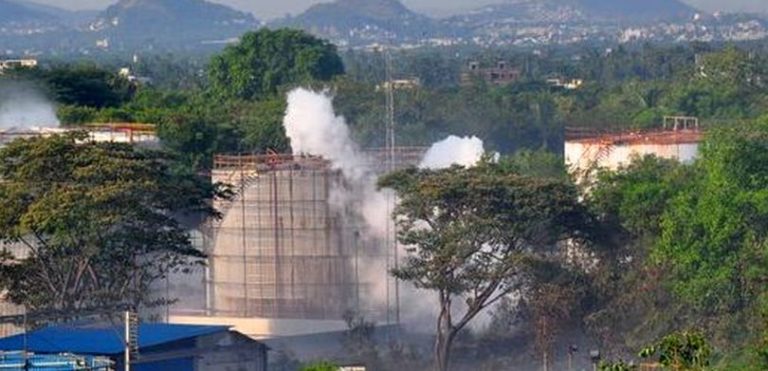
The National Disaster Management Authority has released guidelines for reopening industries after lockdown, the precautions to be taken for the safety of the plants as well as the workers. These guidelines came in the wake of the Vizag Gas leak which led to hundreds of people falling sick and the death of at least eleven people.
In a communication to the states the NDMA said that due to the extended lockdown period and closure of the industrial units, some operators may not have taken into account the standard operating procedures. This could have resulted in residual chemicals still being present in valves and pipes that could be harmful. As a response to the gas leak, the guidelines say that the first week should be used as a trial run after ensuring all safety protocols are in place. “While restarting the unit, consider the first week as the trial or test run period; ensure all safety protocols, and try not to achieve high production targets,” said the order, adding that employees be sensitised to identify abnormalities such as strange sounds or smell, exposed wires, vibrations, leaks, smoke, abnormal wobbling, irregular grinding or other potentially hazardous signs requiring urgent attention.
The State governments have been told to ensure, through the district officials concerned, that the off-site disaster management plan of the respective Major Accidental Hazard (MAH) units are up-to-date.
It said, companies should not try to achieve high production targets. There should be 24-hour sanitisation of the factory premises. The factories need to maintain a sanitisation routine every two-three hours especially in the common areas that include lunch rooms and common tables which will have to be wiped clean with disinfectants after every single use, it added.
For accommodation, the NDMA said, sanitisation needs to be performed regularly to ensure worker safety and reduce the spread of contamination. The employers should be provided with hand sanitisers, masks, face protection shields, and PPEs, ensure 24-hour sanitization of the factory premises, accommodation of workers should also be sanitised regularly, and their temperature checked twice a day. Those showing symptoms should not report to work.
The disaster management authority said that in order to minimise the risk and to encourage a successful restart of the industrial units, the following guidelines are being issued:
1. While restarting the unit, consider the first week as the trial or test run period; ensure all safety protocols; and not try to achieve high production targets.
2. To minimize the risk it is important that employees who work on specific equipment are sensitized and made aware of the need to identify abnormalities like strange sounds or smell, exposed wires, vibrations, leaks, smoke, abnormal wobbling, irregular grinding or other potentially hazardous signs which indicate the need for an immediate maintenance or if required shutdown.
3. Especially during the Covid-19 times, ensure all lockout and tagout procedures are in place on a daily basis (not applicable for units running 24hrs).
4. Inspection of all equipment as per the safety protocols during the restart phase
5. In case the industry has any difficulty in managing crucial backward linkages that may be critical for their safe functioning, they should approach the local district administration for specific assistance. District Magistrates may be instructed to ensure that in such instances, the industrial unit may be facilitated to run their end to end operations, in the overall interests of industrial security.
The order said, “Check for already opened storage vessels, containers, bags or silos for possible oxidation/chemical reaction/rusting/ rotting, etc. HAZMAT chemicals in the storage need to be checked for chemical stability before using for any processes.”
“Ensure the arrangement for round-the-clock emergency crews/professional technical teams provided with MAH and cluster of MAH should have extended coverage of 200 km to reach transport accident spots for help,” it said.
Managerial and administrative staff should work one shift at 33% capacity, but overriding priority should be given to those dealing with safety. The employees should not share tools or workstations to the extent possible.
The detailed list of specific guidelines have been given here
How Colonial British governments handled Cholera Outbreaks in India
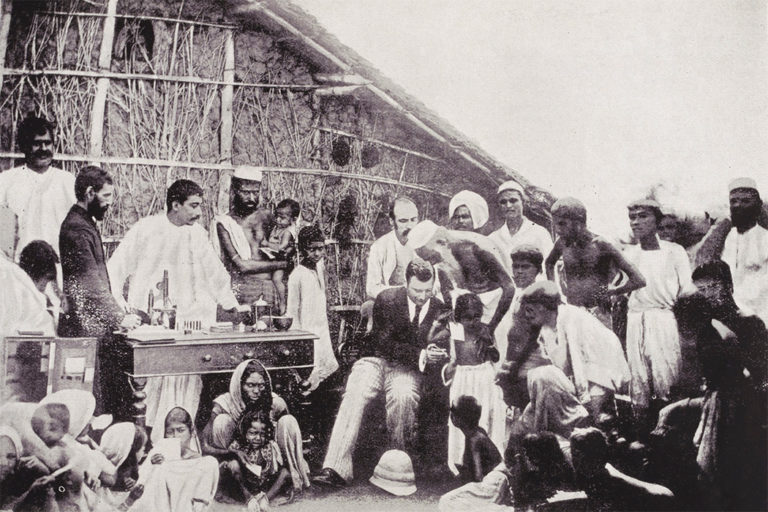
Cholera, sometimes called the Blue Death because a person’s skin may turn bluish-gray from extreme loss of fluids, has been responsible for nearly a lakh deaths every year. Over the past 250 years, millions have died in 6 global pandemics. Today, Cholera pandemics are associated with disasters, such as war or natural calamities.
Cholera is caused by the bacteria Vibrio Cholerae, which usually spread through fecal matter. While many people can carry the disease without showing any symptoms, some people can develop extreme cases of diarrhea, which can lead to dehydration. If untreated, a person can die within hours due to a lack of water.
The disease existed in the Gangetic plain for centuries, but the rapid urbanization and trade that followed British colonization created conditions for a pandemic. Overcrowding and industrialization led to poor sanitation conditions.
While Cholera outbreaks may have happened many times in history, Trade and war by the colonial government caused it to spread across the world. From the first major outbreak in the 1810s, British troops carried the disease to different countries. Outbreaks of Cholera would occur nearly every twenty years, and the reach spread, to across Southern Asia, from Indonesia to China in the 1810s. Then to Europe and America in the 1830s. In the 1850s, it spread across America. In the 1860s, it spread through Africa and the Middle East.
In response to the pandemic Cholera caused, the British developed the first systems of public health and sanitation. Cities began to be designed so that they would move water in and out of buildings quickly, through piped water. Early systems of sanitation were about moving waste out of the view of the city. This was done in the name of the people, but it did not help all people equally. Some suffered. When pipe water moved the wastewater far away, manual scavengers continued to be employed, but now they had to work in concentrated filth. Their work became more dangerous and illnesses became even worse.
Surveillance and social distancing norms also came into force but were less successful. Pilgrimage sites, which were also used by some for political mobilization, came under scrutiny. Laws to regulate travel by pilgrims were not so effective, as for many people in the country, pilgrimages were a natural response to a sudden illness in the community. The British government was able to surveil the pilgrim sites, and a crackdown on any political mobilizations that occurred, but this did little to prevent the spread of Cholera. The British were also able to use the massive pilgrimages, Kumbla Mela in particular, to justify their draconian policies.
The history of Cholera is linked to the history of public health in India. While trade and rapid industrialization were the cause of the Cholera outbreaks and spread, the state responded focusing on developing systems of public healthcare and sanitation. It also tried to take advantage of the situation by pushing systems of surveillance. The measures adopted by the state did not protect everyone equally, and across the world, the poor and the working class were not protected. In India, with the caste inequalities, some communities were pushed into greater risk.
Recently, with a public lockdown that aims to protect people from another pandemic, we can ask again. Who is being protected? Who is being placed at risk?
