

Clarify stand on bearing rail fare of migrant Workers: Karnataka HC to state

Earlier this week, the high court asked Karnataka to make its stand clear on funding the train fares of migrant workers as the states have to bear 15% while the center will bear 85% of the train ticket fare, as announced by the central government two weeks back.
The high court asked this after a memo dated May 16, placed in the court on behalf of the government of India said that some states had paid in advance to arrange the travel of migrant workers. An ongoing hearing in Karnataka high court has revealed that with some home states not paying for their migrant workers, including Karnataka, migrant workers are having to pay from their own pockets to travel home.
Migrant Workers gather in thousands at Bandra Station for Shramik Special Trains

Mumbai witnessed a flood of migrants desperate to leave the city gathering outside Mumbai´s Bandra station at 10-11 AM today to catch a Shramik special train.
Shramik trains are a special initiative arranged by the government to ferry home the lakhs of migrant labourers stranded across India’s urban centres by the Covid-19 lockdown. While the lockdown began on 25 March, the trains were announced on 1 May.
A Shramik train was scheduled to depart from Bandra for Purnia, Bihar, at noon. However, migrant workers gathered in hordes due to a rumor that suggested more trains were to set off from Bandra for Bihar later in the day.
As a result, around 4-5000 people gathered outside the station. Though many had to return home disappointed, only 1000 people could get into trains as there weren’t enough trains to take them to Bihar.
According to sources, the Shramik special train was going from Mumbai to Bihar. There were rumors of the train to Bihar and that led to crowding and chaos at the station. The migrants had to register and only the ones who had registered could go.A repeat of the April incident. Crowds again gather at Bandra station in Mumbai.
— Jiten Gajaria (@jitengajaria) May 19, 2020
Where is the lockdown? Where is the govt?
CM @OfficeofUT is busy wooing Corona to live with him and @AUThackeray is either preaching to other MLAs or doing PR on sanitary pads. pic.twitter.com/x55aKYFdKc
By noon, the situation had begun to resemble the recent crowd of migrants a month ago. Police evacuated the station soon after by resorting to lathi-charge to disperse the crowd. Among those arriving at the station were a large number of women and children. Additional forces have also been called to the spot from nearby police stations. Videos from the scene show a sea of people at the Bandra terminus. In a video clip of Tuesday’s incident that went viral on social media, a large number of migrants were seen carrying their luggage and running towards the gate of the Bandra Terminus.Hunger Games, Day-60, India; In major cities, the lockdown seems to have broken. The government has lost control. Hunger and desperation have trumped the fear of the police. Despite that Indian cases are going up exponentially, many cities are opening, for they cannot enforce it. pic.twitter.com/6MMVQ7txmA
— Jayant Bhandari (@JayantBhandari5) May 19, 2020
There are 20 lakh laborers in the state who are trying to move to their own states. Most are from Uttar Pradesh, Bihar, and West Bengal. So far, the Maharashtra government has sent about 3 lakh laborers to their state. There is no record of these laborers driving or walking. This has been confirmed by state Home Minister Anil Deshmukh. “Today, a Shramik Special train was scheduled for Purnia from Bandra Terminus for which passengers registered with state authorities were to travel. But many people who were not registered and not called by state authorities gathered on the bridge and the road near station,” said a Western Railways official.Who will take responsibility, if number of cases in #Bandra #Navpada increases after this mess ? Who is responsible for this mismanagement?
— Adil Khatri (@AdilKhatri12) May 19, 2020
No more sugar coated tweets !@MantralayaRoom@mybmc@PiyushGoyal@OfficeofUT@Dev_Fadnavis @zeeshan_iyc @richapintoTOI @manthanmTOI pic.twitter.com/qUV0RbXekO
The incident comes over a month after hundreds of migrant workers had assembled near the Bandra station over their demand that arrangements be made for them to return to their native places in the wake of the coronavirus-enforced lockdown.Bandra terminus managed by best CM of Universe @OfficeofUT 😡😡👎👎pic.twitter.com/JJjNhX1nZX
— 🇮🇳Sandeep Singh🇮🇳 (@sandeepfromvns) May 19, 2020
Migrant Crisis: Justice Being Denied, 57 Days and Counting

It has been a few days since Prime Minister Mr. Narendra Modi announced the Atma Nirbhar Bharat Abhiyan, comprising a ₹20-lakh- crore economic package supposedly to help the Indian population and economy. Details of the same were announced by Finance Minister Mrs. Nirmala Sitharaman in five tranches, each discussing benefits and stimulus for different sectors of the economy. Specifically, in the second tranche of this economic package, the Finance Minister announced a few measures which would benefit migrant workers.
Ever since I started volunteering with the Stranded Workers Action Network (SWAN), I have been in contact with several migrant workers personally. I have also been hearing about the experiences of my colleagues providing migrants basic necessities such as money and/or ration according to their requirements. SWAN volunteers have been working on the crisis being faced by migrant workers since March 27, 2020. Till date, SWAN has provided support to more than 22,000 migrant workers all over the country. We are a group of about 100 volunteers including postgraduate students, academics, labour leaders, researchers and civil society workers. Because of this close connection, I am well aware of the ground reality which is the complete opposite of what the government claims it to be.
Its nothing but a Human Tragedy: Madras HC on Migrant labourers Condition
While discussing the second tranche, the Finance Minister stated that three meals a day were being provided at government shelters to migrant workers all across the country every day. Nothing could be further from the truth. In my personal experience, when these workers were asked whether they have received any cash transfers or ration from the government, almost each and every one of them have replied in the negative. Some of them received cooked food or ration from some non-governmental organisations a few times, but that’s about it. When the Atmanirbhar Bharat Abhiyan was announced by the Prime Minister, I had a small hope that maybe now the government would step up, actually help these migrant workers, and provide them some immediate relief. I was mistaken. For when you look at the fine print of the ₹20-lakh-crore economic package, there is nothing that will provide people any kind of relief right away. Millions of workers have been forced to walk hundreds of kilometres to reach their homes amidst a lockdown from an infectious disease contracted by stepping out and coming in contact with others who are possibly infected. What this lockdown has meant for the workers is that they have no jobs and no money to survive. Whatever little savings they could manage from the meagre incomes have been depleted and they cannot feed themselves or their families. What adds to their misery and destitution is the absence of any kind of relief provision by the government. They have lost all hope and faith. So, this economic package, as economists have pointed out, is too little and too late. This sad ground reality has exposed the government’s inaction towards these migrant workers. One of the measures the second tranche mentions is those migrant workers and their families will be provided 5kg rice/wheat per person and 1kg of chana (pulses) per family per month for two months, free of cost. According to official reports, the Food Corporation of India and other state agencies had an accumulated stock of around 78 million (7.8 crores) tonnes of rice and wheat by March 2020. Once un-milled paddy is added, the total stock rises to a whopping 98 million tonnes. This is much more than the officially recommended buffer stock of 21 million tonnes for the month of April in any year. If only the above-mentioned 5kg is distributed, not for two but six months, to about 80% of the population (100 crores), the total stock used would be around 30 million tonnes. This is almost half of the available 78 million tonnes. Then why have the measures been announced for only two months? The package also states that even people without ration cards would get the same amount of ration, however, this is incorrect. People holding ration cards under the National Food Security Act will get 5kg rice/wheat which they pay for besides the free 5kg, doubling their ration allowance from what unregistered people will receive. Economists have said that this relief measure of ₹3,500 crores providing free grains to migrant workers should be universalised to deal with the distress faced by the workers, seeing that the government has the ability to do so. This tranche also mentions Affordable Rental Housing Complexes (ARHC) for migrant workers travelling from one state to another. Implementation of this will really take a lot of time and these workers need homes now. It also mentions ₹5,000 crores worth special credit facility for street vendors, the official language being “the government will launch a special scheme in a month…”. Given this government’s track record I have little faith they will follow through. There are also astonishing statistics related to this issue. Of the 1.96 lakh tonnes of pulses to be distributed to more than 19 crore households this month, only 30,000 tonnes have been distributed so far (as on 28 April 2020), according to the Consumer Affairs Department. Also, only 15% of poor households have received 1 kg of pulses promised to them for April. According to my knowledge, there have been around 600 migrant deaths to date either due to accidents while travelling on highways, starvation, or suicides. Data for this has been collected by Kanika Sharma and others through the news. I was listening to a news debate where a panelist said that by now there should have been a huge revolution by these workers. But this hasn’t happened because these migrant workers have lost all hope and faith in this government and hence, hold no motivation to even revolt. The complete economic package will only help India become self-reliant in the long run. Whereas these migrant workers need immediate help now. They have been needing it since the past 57 days. The severity of the problems faced by them cannot be stressed enough.Widesprerad Condemnation of the Arrest of another Jamia student

Taking advantage of COVID19 lockdown, Delhi Police continues to arrest students associated with Jamia University and Anti-CAA protests.
On 17th May, Delhi Police arrested Jamia Milla Islamia student leader Asif Iqbal Tanha. He has been booked for “orchestrating the anti-CAA protests and riots” in Delhi’s Jamia area on December 15. Asif Iqbal Tanha was produced before a metropolitan magistrate who remanded him in judicial custody till May 31.
According to sources, Asif had been called for interrogation by the Special Cell on April 8, he had cooperated with the police and answered all questions asked. This was almost the fifth time he had been called by the Crime Branch for questioning.
23-year-old Asif Iqbal Tanha, who hails from Jharkhand, is a student of the Persian Department at Jamia Millia Islamia. He was taken for interrogation by a special cell of Delhi police on Friday and was arrested by the Crime Branch, Chanakyapuri on Saturday. He was produced before the Duty Magistrate at Saket court.
Crime Branch requested a 3 Days Police Custody Remand for Asif which the Magistrate rejected. Asif has instead been sent to 14 days of Judicial Custody. Two days before his arrest, the Delhi Police raided his hostel room near the university.
Delhi Police has once again added to its growing list of student activists arrested while the nation continues to struggle under yet another extension to the Covid-19 lockdown.
Asif´s arrest is seen as another addition to the recent spate of student arrests who were part of Anti-CAA protests. Civil rights activists have called these actions an attempt to silence democratic voices, and quell any attempts by citizens to question the authorities.
Asif Tanha is a dear friend and has been a formidable presence in various protest grounds and events. The man was a rallying mobilizer for the protests at Jamia, a truly strong voice against injustice and untruths.#ReleaseAsifTanha #Islamophobia_In_India pic.twitter.com/d2egRhth0v
— ️Ladeeda Farzana (@ladeedafarzana) May 17, 2020
Nadeem Khan, spokesperson of United Against Hope condemned the arrest fo Asif Tanha and calls it a continuation of the relentless witch-hunt of students and activists in the middle of the lockdown caused by the pandemic. The official statement from the United Against Hate group has been circulated the continuous arrests amid lockdown and how it is dangerous to the health of students- Many other students have been called continuously for interrogation making a mockery of the lockdown and jeopardizing the health of the student. One head constable in that Special Cell Office has been tested positive with COVID 19. Asif had been earlier called for interrogation by the Special Cell on 08.04.2020 and he had cooperated with the police. Prior to this, he has been called for interrogation as many as four times by the Crime Branch. He dutifully went there and cooperated as a responsible citizen all the four times. Despite the months-long ‘investigation’ and repeated interrogation, the police have found no evidence against him for the simple reason that he has committed no crime. This is the third student of Jamia Millia Islamia that the Delhi Police has arrested since the lockdown, after the arrest of research scholars Meeran Haider and Safoora Zargar under the draconian UAPA. Besides, the President of the Jamia Alumni Association Shifa-ur-Rehman is also under custody. This is a concerted attempt by the Delhi Police to target students of Jamia Millia Islamia, which had emerged as one of the epicentre of the democratic mass upsurge against the unconstitutional CAA. It seems after JNU, the Delhi Police has found a new university to demonize, criminalize and target. A pregnant Safoora continues to remain in prison in the middle of the pandemic at grave risk to her as well as her child’s health and life. Several democratic forces across the country have expressed outrage at these actions of the Delhi Police. But it seems the Delhi Police is too keen to please its political masters. The real perpetrators and actors who incited and carried out the violence are being left scot-free. They have found the lockdown as the perfect opportunity to target these democratic voices, when there is no possibility of protests and there would hardly be any coverage of its nefarious witch-hunt. We condemn this ongoing witch-hunt of students and anti-CAA activists in the strongest possible terms and demand that all students and anti-CAA activists be released immediately and unconditionally.This is a crackdown on unapologetic Muslim leaders like Asif Tanha, Safoora, Khalid Saifi, Meeran, Sharjeel, Tahir Madni, Ishrat Jahan, Dr Zafarul Islam Khan. Ruling class (govt and section of oppn & civil society) want Muslim to be either uncle toms or silent victims https://t.co/Yt4On50IaL
— Aditya Menon (@AdityaMenon22) May 17, 2020
Each and every arrest of those who protested against the unconstitutional CAA is politically motivated and false. Govt wants to crush our voices by such arrests. Arrest of Asif Iqbal Tanha is another brazen attempt to curb powerful Muslim voices of disssent.#ReleaseAsifTanha
— Nabiya Khan | نبیہ خان (@NabiyaKhan11) May 17, 2020
These are some faces who have been arrested unlawfully during the Lockdown by making false allegations against them.
— Gabbar 🐯 (@Gabbar0099) May 18, 2020
Right to peaceful protest is one's fundamental right and these activists have been abiding by the law throughout the time.#ReleaseAsifTanha pic.twitter.com/TBKbFj3uMk
Why women leaders are excelling during the coronavirus pandemic
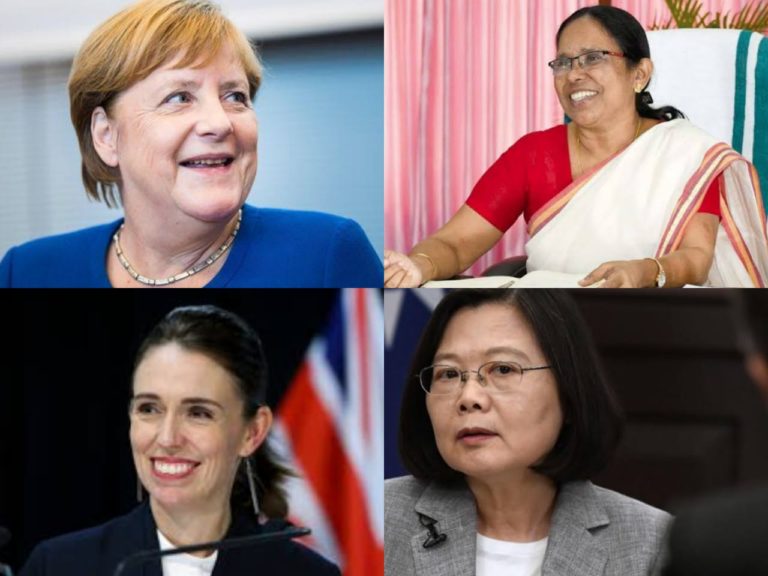
Since the beginning of the ongoing coronavirus pandemic, there’s been a lot of media attention paid to the relationship between female leaders at the helm of various nations and the effectiveness of their handling of the COVID-19 crisis.
The actions of female leaders in Denmark, Finland, Germany, Iceland, New Zealand, Norway, Iceland, Finland, Germany, Taiwan, and New Zealand are cited as supporting evidence that women are managing the crisis better than their male counterparts.
Resilience, pragmatism, benevolence, trust in collective common sense, mutual aid, and humility are mentioned as common features of the success of these women leaders.
It would be easy to conclude outright that women make better leaders than men. Our academic education and experience as certified corporate directors, however, tell us that would be an overly simplistic verdict, and it’s actually more complicated than that.
Let’s broaden our perspective. What if countries led by women are managing the pandemic more effectively not because they are women, but because the election of women is a reflection of societies where there is a greater presence of women in many positions of power, in all sectors?
Greater involvement of women results in a broader perspective on the crisis and paves the way for the deployment of richer and more complete solutions than if they had been imagined by a homogeneous group.
In India also, the state of Kerala, that reported the first case of COVID-19 has in March has successfully fought the virus and most of the credit goes to its female health minister. KK Shailaja, the health and Social welfare Minister from the Indian state of Kerala has been hailed as the reason a state of 35 million people has only lost four to the virus.
Equitable countries managing pandemic better
Let’s see how this hypothesis holds up, based on the World Economic Forum’s annual study on gender parity among countries that are members of the Organisation for Economic Co-operation and Development (OECD). Gender parity is measured in terms of the participation of men and women in society and the opportunities available to each gender in terms of access to health, education and employment, among others. The forum’s Global Gender Gap Report 2020 ranks countries in terms of their gender equality performance. Those that have fought the pandemic most effectively and are led by women rank high on the list. The report also shows those same countries rank high when it comes to having women on corporate boards. It, therefore, leads us to conclude that more egalitarian societies are better managed.Read More: Vietnam: How a small nation is leading the way in the fight against the pandemic
In those countries, power is enhanced by the complementary nature of two genders contributing. The added value of this complimentary factor in business management, for example, has been the subject of several studies. One of them, entitled “Delivering through Diversity,” by American consulting firm McKinsey, suggests that businesses with a more equitable gender balance perform better financially. Are countries with greater gender parity managed differently? We observe that in these ecosystems, leadership is driven by supposed “feminine qualities” — empathy, compassion, listening, and collaboration. These are distinct from the characteristics associated with the exercise of traditional managerial, supervisory, and controlling power. It should be noted, however, that these different gender-based attributes are more reflective of the perceptions, stereotypes, and biases that characterize our societies. Women can display supposedly male management traits and vice versa.Female-type leadership required
That means gender-balanced environments produce more robust decisions. These environments also represent leadership where female-like values dominate. The challenges of the 21st-century call for a new type of leadership, different from that based on command and control. These challenges include climate change, health, the environment, the depletion of the Earth’s resources, the aging population and the shortage of talent, the virtual management of production and employee contributions, and the development of new technologies. This new type of leadership primarily involves resilience, courage, flexibility, listening, empathy, collaboration, caring, and recognition of collective contribution. The participation of everyone’s intelligence becomes the key to success. These are all characteristics of traditionally feminine management. In order to overcome the obstacles of the 21st century and to be successful, organizations and countries must, therefore, diversify their sources of talent as much as possible, giving priority to gender. Let’s look at the Canadian business world as an example.Work-family balance
The various difficulties encountered by women due to bias, stereotypes, work-family balance, absences due to maternity and corporate policies that are not adapted to the unique challenges faced by women result in few of them reaching the highest levels of Canadian organizations. Only four percent of the positions of president and chief executive officer are held by women, and none of them are among the 60 largest companies listed on the Toronto Stock Exchange. Another area where there is a need for action is STEM (science, technology, engineering, and mathematics). In its report, “Cracking the Code: Education of Girls and Women in Science, Technology, Engineering and Mathematics (STEM),” UNESCO makes this disturbing observation:“Only 35 per cent of girls worldwide study STEM subjects … only three per cent of female students in higher education choose to study information and communication technologies (ICT). This gender disparity is all the more alarming as STEM careers are often referred to as the jobs of the future, the engine of innovation, social well-being, inclusive growth and sustainable development.There is an urgent need to increase the representation of women in all positions of influence. Our female students, among others, need female role models to encourage them to go for it. In this regard, the John Molson School of Business at Concordia University in Montréal is increasing its efforts to hire female teachers and researchers to make women’s presence in the classroom a norm, not an exception. Only this balance will pave the way for new leadership, creating a better world. Louise Champoux-Paillé, Cadre en exercice John Molson School of Business Concordia, Concordia University. Anne-Marie Croteau, Dean, John Molson School of Business, Concordia University. The article was first published at www.theconversation.com It is republished here under Creative Commons license.
Its nothing but a Human Tragedy:Madras HC on Migrant labourers Condition

The Madras High Court on Friday observed “it is a pity to see the migrant labourers walking for days together to reach their native places and in the process, some of them had lost their lives due to accidents. The Government authorities of all the States should have extended their human services to those migrant labourers”.
The Court was hearing a habeas corpus petition seeking direction to the Director-General of Police, Chennai to produce the bodies of migrant workers Mr.Ilayaraja @ Ganesan, and 400 others who had been illegally detained by the Superintendent of Police (SP), Sangli District, Maharashtra.
A division bench of Justices N.Kirubakaran and R. Hemalatha, however, observed,
“Though the Governments have taken care of every section of the society to the maximum extent possible, the migrant workers and the agricultural workforce are the neglected lot and they are the sufferers to the maximum…”“This Court would like to know whether coordinated efforts have been taken by all the State Governments in consultation with the Central Government to address the sufferings of the migrant labourers”, the Madras HC said. It, therefore, ordered to implead Union of India and Tamil Nadu government in the matter. It went on to add, “most of the workers lost their jobs, no shelter is said to have been provided apart from lack of supply of adequate food. After waiting for a considerable time, they started migrating to their native states by foot. It is very unfortunate that those persons were neglected by all the authorities”. “The heartbreaking stories are reported in the print as well as visual media that millions of workers were compelled to start walking to their native States with their little children carrying all their belongings over their head, surviving on the food provided by good Samaritans, as no steps were taken by the Governments to help those migrant workers”, the court noted in the order. “It is also reported that some people starved to death due to hunger. 16 workers working in a steel factory in Julna, Maharashtra, who were sleeping on rail tracks while returning to Madhya Pradesh were crushed to death near Karmad around 30 km from Aurangabad by a goods train on 08.05.2020. Even after the sorrow and sufferings of the migrant workers were reported in the media, nothing happened for the past one month as there was no coordinated effort between the States”, the court observed. The court also recorded in the order that “there are a number of toll gates available and those toll gates should have been made as checking points to provide food, shelter and medical help to the migrant labourers”. “However, it is very pathetic to note that neither the native States nor the States through which they were walking all along took care of them and failed to provide even the basic amenities such as food and shelter and even if the had been provided, they were negligible”, the court added. In this regard, the high court has directed both the Central Government and Tamil Nadu Government to appraise the court with the following information:
- Whether any data is being maintained by the Government of India regarding the details of migrant workers working in each State/Union Territories in India?
- If so, what is the number of migrant workers in each State/Union Territories in India and the details regarding their nativity?
- What is the number of migrant workers stranded in each State/Union Territories in India as on today?
- What are all the assistance provided to those migrant workers by the respective States as well as the Union Government?
- Whether those migrant workers are allowed to cross the State borders or prevented from crossing the borders and if they are prevented, whether they are provided with basic amenities such as food, shelter and medical assistance?
- How many migrant workers died on their way to the native States?
- To which States/Union Territories, the deceased workers belong to?
- What are the relief measures/compensation provided to the families of those migrant workers who lost their lives on their way back to their native States?
- How many migrant workers in each State/Union Territories have been evacuated from their working States to their native States through buses/trains throughout India?
- What are all the steps taken to transport the remaining people to their native States?
- Whether migration of people is one of the reasons for spread of Covid-19?
- Whether the Central Government has instructed the respective States/Union Territories to provide financial assistance, job opportunities in their native State/Union Territories for the labourers who migrated from other States?
Read More: Gujarat HC: People at large are hungry, Migrant Workers suffering Most
UP Govt Withdraws 12-hour Shift Controversial Order For Industrial Workers

The Uttar Pradesh government on Friday has withdrawn its controversial order of 12-hour shifts for workers in industrial units, against the usual 8-hour day, after a notice from the Allahabad High Court. However, its recently issued ordinance to exempt establishments in the state from all labour laws but four remains unchanged.
A separate government order related to working hours has been withdrawn following a PIL in the high court, shows a note, dated May 15, and signed by Suresh Chand, principal secretary of labour in the Uttar Pradesh government to the Allahabad high court for information.
Also Read: Karnataka: Government follow suit of other states and decides to change labour laws
On May 8,2020, the Uttar Pradesh government, has, through an ordinance suspended a total of 38 labour laws and only four laws will continue to be applicable in the state, including the Section 5 of the Payment of Wages Act, 1936, Workmen Compensation Act, 1932, Bonded Labour System (Abolition) Act, 1976, and the Building and Other Construction Workers Act, 1996. These laws included provisions related to working hours, overtime, intervals for rest, etc. as stipulated under Sections 51, 54, 56 and 59 of the Factories Act, until July 19, 2020. As per that notification, Factories were permitted to employ their labour/ workers for 12 hours a day, instead of 8 hours as stipulated under the Act. An official statement said the decision to exempt businesses from the purview of almost all labour laws was taken as economic and business activities in the state have been badly affected by the coronavirus spread. However, an increase in working hours in industrial units was through a separate executive order which now stands withdrawn. Many trade unions, including RSS-affiliated BMS, had threatened agitation against BJP-ruled states like UP, Gujarat and MP who have in the last fortnight brought in sweeping changes in the labour laws through ordinance route. Assailing the same, the UP Worker’s Front, through Advocates Pranjal Shukla and Vinayak Mittal had moved the High Court, stating that the same violates Constitutional values. The Allahabad High Court on Thursday issued notice to the UP Government in a PIL challenging the Government order for relaxation of certain labour laws, particularly the provisions of the Factories Act, 1948, in the state. The matter was heard by the bench of Chief Justice Govind Mathur and Justice Siddhartha Varma, which issued notice to the Government and posted the matter for consideration on May 18.New Zealand : Indian leader kicked out from prestigious body for his Islamophobic remark

In the first of its kind a well-known New Zealand-Indian community leader, Kantilal Bhagabhai Patel has been sacked from the membership of the Wellington Justice of Peace Association after some of his social media posts deemed anti-Muslim. This comes in the wake of several Indian expats facing action for their Islamophobic remark in Arab and European nations.
According to the Muslim Mirror website, the association, which is based in New Zealand capital Wellington has referred the matter to its national body and has asked it to consult with the Ministry of Justice in connection with his posts.
Ann Clark, who is the Vice President of the Association said: “We were appalled at the posts.”
Replying to a complainant of Patel’s posts, Clark stated, “We have completed our investigation and have concluded that these posts were not consistent with the standards expected of a Justice of the Peace. Mr. Patel has been advised of that and the consequences for him. We are in the process of dealing with that.”
In that email, Ms. Clark wrote to the complainant, “We were appalled at the posts.”
“I hope you are willing to accept the apologises of the Wellington Justices of the Peace Association for the actions of this now-former member of our Association,” she added.
Notably, Mr. Patel was awarded the Queen Service Medal (QSM) in 2004 and Pride of India Award in 2005 and he is a former General Secretary of Auckland Indian Association and past Assistant Secretary of the Wellington Indian Association.
This news was first published in Muslim Mirror
16th May as Justice Day: Stand With Dr. Anand Teltumbde and other Activists

Dr. Anand Teltumbde, one of India’s leading scholars, public intellectuals, and human rights activists is in jail for a month now. We appeal to the country to observe May 16th as Justice Day to express our solidarity with him and other activists and intellectuals imprisoned under the Bhima Koregaon case.
Dr. Anand Teltumbde is today a national icon for justice. Born into a poor Dalit family in a village in Maharashtra, he worked as a painter to earn his education. He went on to become a mechanical engineer, before completing his doctorate in Cybernetics and an MBA from IIM Ahmedabad. One of the pioneers of data analytics in the country, he rose to become MD and CEO of Petronet India, a public sector undertaking, before taking up a professorship at IIT, Kharagpur. At the time of his arrest he was working as senior professor and chair, Big Data Analytics in Goa Institute of Management. His biographical journey reminds us of the life of Babasaheb Bhimrao Ambedkar, whose granddaughter he is married to.
Over the last two decades or so, Professor Teltumbde has emerged as one of India’s most coherent and respected voices of social justice. Through his writings and public engagements, he has raised voice against caste and other forms of oppression, while at the same time interrogating all forms of dogmas and orthodoxies. While expounding and elaborating on Dr Ambedkar’s ideas, he has cautioned us against Babasaheb’s deification and pushed the frontiers of our thinking on social justice. His uncompromising and passionate defence of constitutional values and human rights has brought him to question the policies of various regimes including the current one. It is hard to escape the conclusion that his arrest on Babasaheb’s anniversary is an outcome of his trenchant critique of the roots of the present system of oppression.
A firm believer in civil rights as an instrument to advance social justice, Dr. Teltumbde has been for long associated with the civil rights movement in the country. It is tragic that such an icon of justice is today at the receiving end of systemic injustice. It is shocking that a life long opponent of violent action stands accused of plotting political violence through a convention called by two retired High Court judges, a convention that he did not attend! It is ridiculous that he has been charged, among other things, of a conspiracy to assassinate the PM, without a shred of evidence. In this context, it is even more reprehensible that Dr. Teltumbde and other activists have been booked under the draconian UAPA that is being used to deny them bail and a fair and expeditious trial. It is strange that the National Investigation Agency suddenly and unilaterally took over the investigation in his case from Maharashtra Police, as soon as regime change in Maharashtra opened the possibility of a fair inquiry. It is a shame that a 69-year-old man, more susceptible to Covid-19 due to his pre-existing medical condition, was sent to prison just when under-trials and even convicts were being released to avoid exposure to the pandemic.
A prisoner of conscience, today Dr. Teltumbde represents resistance to oppression and injustice the world over. No wonder, academics, intellectuals, artists, activists, leaders, and civil rights organisations from India and abroad have raised their voice against his arrest. These include Amnesty International, India Civil Watch, Scholars at Risk Network, Professor Amartya Sen, Noam Chomsky, Jean Dreze, B. L. Mungekar, Arundhati Roy, Aparna Sen, Romila Thapar, Prabhat Patnaik, Devaki Jain, Prakash Ambedkar and Maja Daruwala, besides nearly 5,000 concerned citizens.
Therefore we propose that the coming Saturday, the 16th of May, the day he completes one month in jail, should be observed as a Justice Day, both to demand justice for Dr. Teltumbde and his co-accused activists in the Bhima Koregaon case and to reaffirm the idea of a just society that he has upheld. We hope that this contributes to a climate where citizens are not arrested for the views and values that they hold. Given the present restrictions on public gathering due to Coronavirus pandemic, we propose that we observe that day in the following way:
We all change our social media DP (profile picture) for one day on 16th May and put Dr Teltumbde’s picture (enclosed here)
We join a two-hour campaign on social media, from 4 pm to 6 pm, on 16th May to demand #Justice4Teltumbde
Starting that day, we organise webinars and virtual meetings through the month of May where we read and discuss Dr. Teltumbde’s and Babasaheb Ambedkar’s writings on social justice and civil liberties.
We call upon all those who cherish our constitutional values to participate in Justice Day and follow it up with on-ground meetings and protests when the present restrictions are lifted.
Following are the signatories
Rajmohan Gandhi (Writer, Research Professor, University of Illinois at Urbana Champaign)
Prashant Bhushan (Advocate, Supreme Court)
Admiral Ramdas (Former Chief of Naval Staff of the India)
Ajaykumar Singh (Former DGP & IGP, Karnataka State)
Anand Kumar, Prof (Rtd) JNU and President, Citizens for Communal Harmony
AN Yellappa Reddy (Environmentalist, Former Secretary, Ministry of Environment & Forestry, Karnataka)
Aruna Roy (Founder, Mazdoor Kisan Shakti Sangathan)
Ekanthayya (Veteran Political Leader and Former Minister, Karnataka)
Justice AP Shah (Former Chief Justice, Delhi High Court & Former Chairman, Law Commission of India)
Justice HN Nagamohan Das (Former Judge, High Court of Karnataka)
Justice Sudarshan Reddy (Former Justice Supreme Court of India)
KC Raghu (Nutritional Expert & Industrialist)
Kodandaramayya (Former Police Commissioner, Bengaluru City
Krishna (KR Pete) (Former Speaker, Karnataka Legislative Assembly)
Kumar Prashant (President, Gandhi Peace Foundation)
Mariswamy (Former Director Genaral of Police, Karnataka)
SK Kantha (Labour Leader & Former Labour Welfare Minister)
Suhas Palshikar, Prof (Rtd) Savitribai Phule University, Pune and Editor, Studies in Indian Politics
Vaidehi (Writer, Sahitya Academy Awardee)
Wajahat Habibullah (Former Chief Information Commissioner)
Yogendra Yadav (President, Swaraj India)
Justice AJ Sadashiva (Former Judge, High Court of Karnataka)
Prof. Ravi Verma Kumar (Former Advocate General of Karnataka)
Sugata Raju (Senior Journalist)
Malay Bhattacharya (Professor Indian Institute of Management Bangalore)
Bezwada Wilson (Magassey Awardee)
Trilochana Sastry (Professor Indian Institute of Management, Bengaluru)
Dinesh Amin Mattu (Senior Journalist)
Abhay (Grameena Kooli Karmikara Sanghatane Karnataka)
Indudhara Honnapura (Senior Jouranlist)
B T Venkatesh (Senior counsel Advocate)
Salil Shetty (Former Secretary General of the human rights organization Amnesty International)
S.R. Hiremath (National President Citizens for Democracy)
Devanoora Mahadeva (Writer, Padmashree awardee and Central Sahitya Akademy awardee)
Hordes of migrant workers stuck in districts other than Bangalore, Will the Government take notice of it?

The national lockdown due to the Corona crisis has severely affected migrant workers not only in metros like Bangalore but all across the country. With no work, money to afford food, many have been walking thousands of kilometres to get back home. While there have been reports of many people being injured from accidents, some have even lost their lives. The central government has, after many such incidents and criticism from all around, started the ‘Shramik special’ trains for migrant workers.
Although the central government has assured that it will bear 85 % of the cost of train tickets, reports are coming in from many parts of the state that the migrant workers themselves are paying for the tickets. In Karnataka, trains were set to depart from Bangalore, however, due to some reasons, these were cancelled. This was followed by a severe backlash from labour organisations, which led to the Government finally agreeing to start the train services.
Around 400 migrant workers at Malpe port were stuck in a similar situation. As it is the fishing season right now, the employers were reluctant to let the migrants return. Their native State governments have also not shown any interest in getting them back home, as a result of which these workers were stuck at the port. Only after some social workers contacted the Opposition leader in Andhra Pradesh, Chandrababu Naidu, arrangements were made for these workers to get back home to Andhra.
However, the current situation is such that, many migrant workers are stuck in the many districts outside Bangalore. Many workers are even/still unaware of the situation and are just waiting in despair to find some work.
Among these, workers from Andhra Pradesh were six workers from Uttar Pradesh, who are reported to be missing, by social workers. When enquired among others, it has been found that these workers have started walking back home and the social workers have revealed that contact has not been possible with the migrant workers.
Due to the lack of right information, it is estimated that around 263 migrants from Jharkand are still stuck in various parts of Udupi district. Although a Shramik train destined to Jharkand’s Hatia, starting from Mangalore, via Udupi was started on May 10th, the workers were not informed about this. This dire situation is due to the fact that Karnataka government focus is only on Bangalore.
According to these migrant workers, employers often just use them as machines. In such a situation, it is the responsibility of the local administration to help the migrant workers on humanitarian grounds.
Jharkhand, a state with majority Adivasi population has people who have migrated to various parts of the country in search of work. The Jharkhand State Govt has been doing all efforts in getting back the people to their homes. Chief Minister Hemanth Soren has requested the Central Govt that the cost of the Shramik special trains to get these workers back has to be borne by the Central Govt.
Most local politicians and leaders are ignorant towards the problems faced by the migrants since they don’t have a vote here in Karnataka.
Only 168 out of the 263 migrant workers from Jharkhand who are left behind in Udupi have registered their names officially. Most others are unaware of what to do and are awaiting help from someone. The same is the case of workers in Manipal, who are left with no information about what is going on.
All eyes and hopes are now on the local district administration of Udupi. These people have worked there for years and are now in need of support to survive. The social workers on the ground are of the opinion that if the officials arrange for these workers to reach Bangalore, they would be able to board the Bangalore – Hatia express and get home.
Similar reports are coming from Bellary, KGF, Kumta and Bijapur of migrants from UP, Bihar, Jharkahnd and West Bengal stuck without food or any bus or train transport to go to their states. There is also no arrangement to come to Bangalore.
The article was first published in www.naanugauri.com. It is translated into English by Sumana Narayana.
