In June 2022, the UK government attempted to begin the first of what is expected to be many deportations of refugees who have sought refuge in the UK to Rwanda. The refugees come from different parts of the world, but the United Kingdom has entered into a deal with the government of Rwanda to take in refugees in exchange for USD 150,000,000. The deal has been called cruel and traumatizing to those who have sought asylum in the UK.When the first round of deportations was called, the refugees challenged the deportation legally individually, claiming that the deportation undermined their dignity. The UK Court of Appeal rejected the case. The first deportation was supposed to happen on 14 June 2022. The European Court of Human Rights issued an injunction to keep the plane with the refugees from taking off. It was a last-minute intervention, keeping 7 asylum seekers from leaving the UK.
Why relocate refugees?
Boris Johnson’s Premiership rode on fear of foreigners. On 14 April 2022, Prime Minister Boris Johnson gave a speech where he said he would work to end “illegal” migration. He claimed that immigration is causing strain on welfare services in the country. He claimed that “illegal” immigration is a result of human trafficking and the only way to stop it is to punish the people who have been trafficked with high sentences. He said that his government would invest nearly 500 million pounds in surveillance technology and military personnel to prevent the incoming of migrants from the sea and that he has opened a deal with the country of Rwanda to take in any refugees. Boris Johnson said that this arrangement would deter trafficking and discourage future refugees from making the dangerous trip to the UK across the English Channel.Many refugees come to Europe by risking their lives on small boats.The United Nations Refugee Agency criticized the move, saying that the UK is shirking its responsibility and that Rwanda has had a shaky history of human rights. This deal sets a precedent for richer countries to pass their responsibilities regarding refugees to poorer countries.Rwanda has defended the deal claiming that accusations against their human rights records are unfounded. Rwanda has promised asylum seekers up to 5 years’ stay as well as economic support. In 2014, Rwanda attempted a similar deal with Israel, when Israel paid the Rwanda government USD 5,000 per refugee. The refugees came mainly from Sudan and Eritrea. Israel sent nearly 4,000 refugees to Rwanda. The plan failed miserably. Those who tried to stay in Israel faced detention. Refugees who went to Rwanda were not given proper documents and could not stay. They mostly fled the country and travelled through many countries at great risk.Rwanda is already home to 130,000 refugees coming from neighbouring countries in Africa.
What is a refugee?
According to the UNHCR, a Refugee is someone, owing to a well-founded fear of being persecuted for reasons of race, religion, nationality, membership of a particular social group or political opinion, who is outside the country of their nationality, unwilling to avail of protection within the country due to fear, has lost their nationality, or is unable or unwilling to return to the country of their nationality due to fear. Refugees also include people outside of the country of their nationality or habitual residence who fear or experience violence due to disruptions in the public order.The United Kingdom received nearly 50,000 applications for asylum in 2021 with Iran being the number 1 source of origin, with nearly 10,000. Other countries of origin include Eritrea, Albania, Iraq and Syria. In the UK, there are currently over 80,000 pending applications. It is estimated that there are over 1,00,000 asylum seekers in the UK.Owing to poor awareness, a hostile government and desperate situations, refugees are often forced into the informal sector, where they work for low wages, and can be targeted by the state or by a local population that is hostile to them. Scholars have noticed that undocumented immigrants are often criminalized to make their work cheaper in a phenomenon known as Crimmigration. By putting harsh penalties on undocumented immigrants, workers are given lower wages. This helps big business and bypasses the hard-won rights of local struggles. Politicians also use the fear of immigration to pit the native working class against immigrants.In the world, there are almost 25 million refugees. Most refugees seek asylum in countries neighbouring their country of origin. Often refugees have to constantly migrate until they are granted asylum. Many of them are under threat and move to areas where they have some community. Asylum seekers often do not know the laws regarding immigration and live in countries where they do not have the right to work, being forced into the informal economy, where they are targeted.Why are countries across the world cracking down on Refugees?
After World War II, countries across the world tried to become more open to immigration. During the Cold War, many countries sought status by showing how open and diverse their countries were, being representative of the world at large. However, since the 1970s, there was a rollback in these policies. From the 1970s onwards, many countries claimed they were losing autonomy. Politicians began fearmongering. They would blame terrorism, organized crime and drug use on immigrant populations. Undocumented immigrants, who earlier worked in the unorganized sector of the economy, became easy targets, as they did not have a voice. This is true even in India, where since the 1980s, immigration laws and fear-mongering have left migrant working populations in the informal sector in a precarious position.Despite Boris Johnson’s bravado, experts are unsure how effectively the plan to relocate refugees will be. Refugees have a problem with documentation. The policy only creates a climate of fear that they will be caught and sent to an unknown fate.The author is a mathematician and political observer based in Bangalore.
In September 2019, a research article crucially important for South Asia was published in Science under the title “The formation of human populations in South and Central Asia”(Science Vol. 365, No. 6457). Based on the genetic study of several hundred ‘ancient humans’, the article was jointly authored by 108 collaborating scientists working in some of the best science institutions and in more than twenty countries. It stated “The primary ancestral population of modern South Asians is a mixture of people related to early Holocene populations of Iran and South Asia that we detect in outlier individuals from two sites in cultural contact with the Indus Valley Civilization (IVC). After the IVC’s decline, this population mixed with north-western groups with Steppe ancestry to form the “Ancestral North Indians” (ANI) and also mixed with south-eastern groups to form the “Ancestral South Indians” The report generated further research by other scholars in Archeology and Genetics over the last few years.
A report with such a technical complexity and scientific depth normally tends to remain outside the horizon of interests of citizens. Yet, it acquires significance today since some deeply disturbing terms which the civilised world discarded long ago are being resurrected in India. The most crucial among these is the term ‘pure’. On the face of it, it is not an offending word. It gets used for any unadulterated variety of food or drink or jewellery metals. That indeed has been its meaning in all domains of language except one. The exception is Eugenics, a theory severely condemned as ‘an immoral science’. In it, the term ‘pure’, and its antonym ‘impure’ used as adjectives for ‘blood’ provide foundation for Racism.
In the German language of the 1930s, untermenschen–subhumans—was widely used for the people other than ‘the people with pure-Aryan blood’. Nine decades later, the world has yet not overcome the horror and the tragedy wrought by the untermenschen-sociology. It was not just an unscientific idea and an immoral politics but it actually became the theoretical handle for forcing millions of innocent humans to concentration camps and mass graves. The 19th century Johann Fitche’s ideas of Volkish nationalism, Eugenics applied to social restructuring, the storm-troopers of Hitler who made complete mockery of any civilised law and the technological might of Germany were the four pillars that created Hitlerism.
Hitler wanted to establish a “pure” Aryan race in Germany
The main justification provided by Hitler to violence and cruelty was that the Serbs, Poles, Jews, Gypsies, Asians were not of ‘the pure Aryan blood ‘and, therefore, did not deserve survival. Within two years of Hitler’s coming to power, the Jews were banned in May 1935 from entry into the armed forces and in September of that year the most shameful law for the ‘Protection of German Blood and Honour’ was passed. It criminalised intermarriages and sexual relations between the ‘pure blood Germans’ and the ‘polluting’ Jews.
Nazi Concentration Camp in Poland
Shocking though, the ugly term ‘racial purity’ has found its resurrection in India in 2022. The Union Ministry of Culture has put out, as the New Indian Express of 1st June reports, funds for DNA profiling kits and instruments for “establishing the genetic history and trace the purity of races in India.” The Scientist at whose behest the project is being launched stated “We want to see how mutation and mixing of genes in the Indian population has happened in the past 10,000 years” he goes on to add, “ We will then have a clear cut idea of the genetic history. You may even say that this will be an effort to trace the purity of races in India.” The Culture Ministry quickly declared that the news was fake. The scientist in question distanced himself from the report by claiming that his words were wrongly reported. But, following the claim and the counter claim, a group of eminent scientistsin India issued a statement warning of how dated and how dangerous the notion of ‘race’ is, and how Genetics no longer looks at it as ‘scientific.’ The group that issued the statement included some of the most illustrious Indian scientists and historians. Chilling and completely out of sync with the Constitution of India as the idea is, what indeed can be the ‘purity of races’ in the Indian context? Is it tied with the age old caste system based on the fear of pollution, or is it trying to target the migrants to India during the medieval times? The present regime requires no genetic tests for creating second-class citizens; it has already invented many methods to divide society.
Dongria Kondh Adivasi
One can get to the heart of the project by looking at the list of ‘communities’ that have been subjected to gene-testing. They are typically the ‘language ‘isolates’—as the Nehalis in Buldhana district of Maharashtra—or the Adivasi such as the Jarwas and Nicobaris of Andaman islands or the Malpahadis and Kondhs of Odisha. These precisely were the communities targeted when two decades ago the pharmaceutical multinationals were in search of ‘unadulterated cells’. That search proved a mere chimera. If Genetics knows so, why go for the Adivasis again? The answer is, it is already well established that the different populations in India have claim to a shared mitochondrial DNA, the one inherited from the mother’s side. Using this already known scientific fact, the Culture Ministry’s project can easily move to ruling out the Adivasis as the sole first inhabitants of the sub-continent. That will clear the path for propagating the unscientific claim that the imagined pre-Harappan Sanskrit speaking people migrated from India westward in the rest of Asia and towards the north into the steppes. The RSS view of history is obsessively interested in proving that Sanskrit was in use during the Indus Valley civilisation times. This view, entirely unsupported by scientific evidence claims it was first developed in India and then it spread out in the rest of the world as the ancestor of many languages outside India.
For half a century before Hitler came to power, similar arguments were put forward regarding the imagined prehistoric home of the Aryans. The game, this time, is the same, no matter if a group of more than hundred best scientists have already exposed the absurdity of the claim. The RSS has built for its cultural narrative on a castle of sand. Is the Culture Ministry building a pseudo-scientific show-case for it? Its outcome will not be just the denying the Adivasis their cultural space, not just denying science its legitimacy but also legitimacy to social disharmony between the so-called pure and the so-called impure citizens. As genes get inspected and words get resurrected, the guarantee of equal citizenship given by the Constitution may get mired in hatred and stark injustice. ‘Pure’ is not just an innocent adjective. It can turn vicious when applied to ‘race.’ Let us hope the Ministry of Culture publicly assures Indians that it will not be a party to the idea for which there should be no place in civilised society.
G. N. Devy is a Cultural activist based in Karnataka.
Samyukta Kisan Morcha has declared its support to the nationwide protest of youth against the new Agnipath scheme of recruitment in the armed forces. Appealing to keep the protests peaceful, Samyukta Farmers Front has termed the scheme as anti-military, anti-farmer and anti-national.
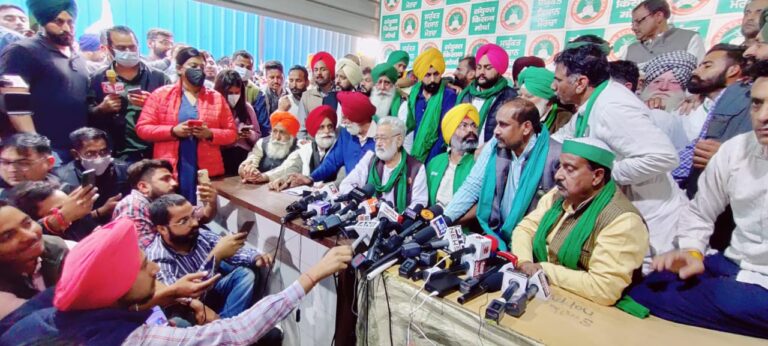
SKM said that the central government is bent upon destroying the spirit of the slogan “Jai Jawan Jai Kisan”, it is the duty of the farmer’s movement to stand shoulder to shoulder with the jawans in this struggle. Accordingly, Samyukta Kisan Morcha will observe protest day across the country on this Friday, June 24. This decision was taken by the 7 member coordination committee of Samyukta Kisan Morcha in its meeting held in Karnal (Haryana) today.
The jawan of this country is a uniformed farmer: SKM
Describing the scheme as playing with the future of the country, Samyukta Kisan Morcha said that it is not only playing with the national security and dreams of unemployed youth, but also with the farmer families of the country. The jawan of this country is a uniformed farmer. Most of the soldiers are from farmer families. Army job is tied to the honor and economic strength of lakhs of farmer families. It is a matter of shame for the country that Prime Minister Narendra Modi, who started his victory campaign by rallying ex-servicemen with the promise of “One Rank One Pension”, has now launched this scheme of “No Rank No Pension”.
The huge cut in regular recruitment in the army is a betrayal of the farmer sons who had cherished the dream of serving in the army for years. It is not a coincidence that in this scheme, recruiting under the rule of “All India All Class” will result in the biggest reduction in recruitment from the very areas where the farmer’s movement was more active.According to SKM this is another ploy to take revenge on the farmers.
SKM Appeals All youth, mass organizations and political parties join the protest day
Samyukta Kisan Morcha has decided to observe a nationwide protest day against the scheme on Friday, June 24, the day of the start of Agniveer recruitment. On that day a memorandum will be submitted to the President of India, the Supreme Commander of the Armed Forces, after organizing peaceful demonstrations at all district, tehsil or block headquarters with the slogan “Jai Jawan Jai Kisan”, and effigy of the Union Government will be burned. Samyukta Kisan Morcha has appealed to all the youth opposing this scheme to join this protest day by respecting the dignity of this peaceful protest. The Morcha has appealed to all the mass organisations, mass movements and political parties of the country to join this protest.
The next national meet of Samyukta Kisan Morcha has been scheduled on Sunday, July 3 in Ghaziabad. Decisions related to the upcoming program and organization of the front will be taken in this meeting.
Issued by-
Dr. Darshan Pal, Hannan Mollah, Jagjit Singh Dallewal, Joginder Singh Ugrahan, Shivkumar Sharma (Kakka ji), Yudhveer Singh, Yogendra Yadav
On the eve of International Domestic Workers Day the article attempts to roughly jot-down a brief legal history of dealing with the question of domestic work. From the change of nomenclature from ‘servant’ to ‘domestic worker’, situated within the macro-economic changes of labour market since late colonial period, domestic workers have travelled a long path and still there is no formal law in India for regulation and resolution of disputes.
Promises since Azadi
India is marking the 75th year of its independence this year. In 2022, we also cross another marker – a decade of India being signatory to the ILO Convention-189. This, something the governments here have resisted to ratify with a law or policy until now. Even with many inadequacies and problems, the governments of Pakistan and Bangladesh have taken more initiative to pass national and regional level policies respectively for domestic workers in their countries. In spite of rising numbers of Sri Lankan domestic workers, including international migrants, the governments and employers there also seem resistant to bring out a national level policy or law.
The track record of countries in Latin America seems better historically, with Uruguay, Chile, Argentina, Ecuador, Bolivia, Brazil and many others increasing and mandating the minimum wages, with mandatory social security registrations. Some of their provisions go back to the 1940s when domestic workers there found recognition in laws related to labour.
Source: ILO, 2016.
At the time of India gaining independence, there was some engagement on whether to recognize domestic workers as workers or not. The sub-committee on labour under the National Planning Committee actually suggested an extension of labour laws to all ‘excluded’ categories of workers, including domestic workers. However, upon citing ‘administrative issues and complexities’, this suggestion was rejected by the committee. A number of private member bills have been introduced in the Lok Sabha and Rajya Sabha since then.
Some of the first bills were introduced by Dalit MPs, who wanted to interlink the agenda of anti-caste struggle with the overwhelming numbers of domestic workers from scheduled castes and other backward communities. It is important to note that way back in the late 1940s, there was recognition that the majority of domestic workers hailed from backward classes and castes. Scholars have argued that even though these initiatives did have an abolitionist undertone, more so because of the overwhelming servitude embedded in the relationship, it prompted more productive discussions on the need of improving working conditions, acknowledging that such a discussion then could be the beginning point.
A series of strikes in the 1950s also speeded up the efforts to enact a law for domestic workers rights. Two other private bills were introduced in 1972 and 1977. Interestingly, all these bills have listed the same set of demands that is being raised by domestic worker associations and unions even today, signalling the absolute apathy that has been the establishment’s approach since then. The fact that the Indian Parliament then only reached consensus to make a national registry of domestic workers instead of passing a bill stands hollow given that even today, the government has no official records of the numbers of domestic workers in the country. Important to note here is that both the bills were presented by a SC member of the BJP then, Hukam Chand Kachwai in the aftermath of strikes by domestic workers in Bombay city then. A series of strikes in the 1980s in Pune and initiatives in other cities like Karnataka led to the formation of Molkarin Sanghatane as well as Gruhu Karmika Sangha in these states respectively. Unions were also formed in Goa, Delhi and Calcutta. This was followed by introduction of private bills again in 1989 as well as 1991 by politicians associated with the Congress party, the Janata Dal as well as socialist party.
Source (TW): @UnionSGU
At the turn of the millennium, India still did not have a law for domestic workers irrespective of various efforts by unions, politicians and activists. It is important to note that earlier domestic workers unions had predominantly male membership before the overwhelming feminization that the sector has undergone in the neoliberal era. Owing to a host of reasons – including agrarian distress driven migration, and shifts in migration patterns has led to this overwhelming shift to female domestic workers in the country. In the 1981 census, it was reported that 60% of domestic workers in urban India were women. Even though regional variations had been strong, especially the states of south reporting more women employed as domestic workers, a skill-based division of labour continued to persist. And men employed then, especially as cooks, reported higher wages than women. While women were mostly employed as ayahs, maids and for utensil cleaning, men were employed as drivers, gardeners and dhobis. Women’s movement was also making important interventions for regulating the working conditions for domestic workers, through its’ engagements through Towards Equality (1974) and Shramshakthi (1988), two important reports that it was commissioned to engage with the status of women, in relation to work, well-being and education.
2008-2019-A decade of further illusions
Due to the overwhelming shift towards feminization and interlinkages of trafficking and domestic work globally, there has been pressure on international organisations like the ILO to reinitiate its discussion on rights of domestic workers. As an earlier abolitionist utopia which believed that as the economy expanded, domestic work would cease to be an employment option for women and that they would be co-opted into dignified work proved wrong and reality pointed to the expansion of domestic work as a major source of employment for women globally, these discussions were inevitable. In India, starting with the migration of women from Kerala to the middle-east to international migrations streams predominated by women from the global south for paid domestic work all over western Europe and the middle-east prompted further discussions and underscores the need of protective measures. Many incidents of sexual abuse, physical violence, captivity and harassment of domestic workers were brought into limelight by activists in host countries in these regions.
In the case of India, a series of anti-poor middle-class activism organised by the Resident Welfare Associations (RWAs) also propelled worker associations to initiate demands for regulations and registration of RWAs and agencies respectively. In the absence of any formal mechanisms, today networked relations between the local administration-police and RWAs play the most arbitrary role in the work lives of domestic workers. They are probably the only set of workers who are required to be ‘verified’ by the local police, who face constant suspicion-distrust at the workplace and whose wages are often determined by a body like the RWA.
A series of slum demolitions in big cities throughout the country also pointed to the precariousness with which majority of the domestic workers are employed in our big cities, forcefully removed often without a notice and ‘rehabilitated’ miles away from their workplaces.
Two laws in the last two decades – The Unorganised Workers’ Social Security Act, 2008 as well as the POSH ACT, 2013 – recognised domestic workers as workers. Both explicitly discuss domestic workers as workers, by elaborating on working conditions as well as defining the home as a workplace respectively. Even though discussions and debates during these legislations have foregrounded the need for a separate legislation, especially to comprehensively address the complexities of the sector, it continues to be lost in notifications, draft laws by unions or even of formal government bodies and in private bills of 2016 and 2017, amidst the cacophony of competing party systems and vote bank politics.
What now? The promise that evades
Clearly, the promise of a national level law or a policy seems to be an ever-evasive strategy undertaken by the government to domestic worker unions and civil society groups. Even though the initial draft of the Code on Social Security mentioned domestic workers, the final draft that was passed, the SS Code does not name domestic workers as recipients of social security welfare measures. Unions and civil society organisations have also questioned the complete break-down of the labour law regime since the passing of the anti-people labour codes. Platformization of the sector is raising further important confusions on the definition of a gig worker and domestic worker. Every now and then, there is a press release or a notification, like this promise and admission in 2019, where the government admitted that there is no data of domestic workers in the country, and another declaration of a survey in 2021. The only pittance available now are the schemefied set of rights given to informal workers in the country. Nine states have notified Domestic Workers in the scheduled employment list of Minimum Wages, even when its implementation is questionable. As the implementation of the anti-worker new labour codes are on the pipeline and trade unions are opposing it, the issues of the sectors which have been kept outside the ambit of labour law even in the previous law, needs more serious attention within the trade union movements.
References:
1) Sonal Sharma. “Domestic workers, class hegemony and the Indian state: a sociological perspective.” South Asian History and Culture (2022).
2) Nicola Cunnigham Armacost. “Domestic Workers in India- A case for legislative action.’ Journal of the Indian Law Institute Vol 36, no. 1 (Jan-March 1994): 53-63.
Arya Thomas ([email protected]) is an activist of Sangrami Gharelu-kamgar Union (SGU)
Some day, therefore, medicine will have to convert itself into a science that serves to prevent disease and orient the public toward carrying out its medical duties. Medicine should only intervene in cases of extreme urgency, to perform surgery or something else which lies outside the skills of the people of the new society we are creating. And our task now is to orient the creative abilities of all medical professionals toward the tasks of social medicine.- Che Guevara in his speech to Cuban militia in 1960.
Today is Che Guevara’s birth anniversary and social media is replete with photos and quotes from Che. Che is remembered as a revolutionary and one of the heroes of the Cuban Revolution. In popular imagination, despite the Western propaganda, his iconic photo in military gear and beret is among the top 100 most famous photograph in the world.
Even among the left and progressive circles despite Che’s celebrity like status, much of his work after the Cuban revolution either remain unknown or is not considered glamorous for consumption. But I believe Che Guevara’s role after the revolution is equally and probably more significant and revolutionary than during the revolution. It put the foundation for a new Cuba with the socialist thought and people at its centre.
For more than two years, the world struggled to contain a virus and keep its populations safe but failing at it. Barring a few, most countries saw a massive COVID positivity rate and high fatalities. What is obvious but some find is surprising that most developed countries, the so called beacons of human evolution and intelligence were the most affected. To these observers, one thing seem to the missing is the flawed idea of medical care in these countries.
The tiny virus has not only brought the world to a standstill but also exposed the completely privatised and for-profit healthcare model that is espoused by these countries. Words like Quality Universal Healthcare are making a comeback because if we are all equal then we should also have access to equal healthcare.
Mass Cremations, India. PC: DW
From one wave to another, we saw the run down govt hospitals as well as posh private hospitals crumble under huge patient load, shortage of doctors, nurses and caregivers. In many hospitals, nurses haven’t even been paid for months. In rural areas, the primary health centres are either non existent or bereft of any facilities or healthcare providers.
That is why, I am reminded of Che Guevara, the doctor and his vision of Social Medicine.
Journey from a Medical Student to Revolutionary Soldier
In 1951, Che, a medical student took a road trip across Latin America in 1951 that changed his life. During the trip Ernesto and his friend worked as labourers and volunteered at the San Pablo leper colony in Peru on the banks of Amazon river.
The journey brought a fundamental change in him as he was deeply affected by intense poverty that he saw in every corner of the continent. These journeys brought him face to face with the economic hardships of the people of Latin America.
Che during his travels in Latin America
This is also where he recalled seeing the most impressive example of solidarity and loyalty among the men who had nothing materially. The solidarity that he sees among the lepers is how he thought all of society should operate.
Much after his death, Che’s diary was published in the 1990s as “Motorcycle Diaries” and became a New York Times best-seller and was adapted into a 2004 award-winning film of the same name.
Che’s vision of “New Man” and Revolutionary Medicine
Che’s travels across Latin America, his role as soldier and doctor during Cuban Revolution shaped his vision for the future.
Che and Fidel
After the January 1, 1959, victory that overthrew Fulgencio Batista, the new Cuban constitution included Che’s dream of free medical care for all as a human right. This gave Che a chance to combine his interest in socialist theory with his thoughts on social medicine into what he called “Revolutionary Medicine”. While in Cuba, Che used his near-celebrity status to lead the charge for revolutionizing medicine (Cueto & Palmer, 2015).
Che’s idea of social medicine went in parallel with the construction of a new Cuba and a “New Man”. Che hoped this “New Man” to be ultimately selfless and cooperative, hardworking, gender blind, non materialistic, incorruptible and anti imperialistic. His holistic approach to medicine was more focused on prevention than treatment and is beautifully illustrated in his speech-
“The principle upon which the fight against disease should be based is the creation of a robust body; but not the creation of a robust body by the artistic work of a doctor upon a weak organism; rather, the creation of a robust body with the work of the whole collectivity, upon the entire social collectivity.”
Che’s idea of social medicine is further emphasised when he talks about treatment of disease and how doctors should view interconnectedness of health, disease and society. Che says-
We shall see that diseases need not always be treated as they are in big-city hospitals. We shall see that the doctor has to be a farmer also and plant new foods and sow, by example, the desire to consume new foods, to diversify the Cuban nutritional structure, which is so limited, so poor, in one of the richest countries in the world, agriculturally and potentially.
A disconnected social system led to a disconnected health system. The Cuban revolutionary govt. connected the remote unreachable parts of the island with new hospitals and clinics. along with addressing crises of literacy, racism, poverty, and housing.
Within one year Cuban literacy campaign brought lilteracy from 60 to 97%.
Cuba has more than three times doctors per capita than the US. In 2020, eighty-nine thousand doctors, eighty-four thousand nurses, and nine thousand students graduated from medical studies.
Cuban medical internationalism
Fidel Castro had defined the medics of Cuba as Cuba’s “army of white coats”. For years now this army has been going across countries helping them through outbreaks of deadly viruses, be it SARS, Ebola, Cholera, or now Coronavirus.
During the COVID-19 pandemic, Cuba sent its first mission to Lombardy, Italy’s worst-hit region. Soon after Italy, it has sent its missions to over 20 countries. Cuban mission has been recommended for Nobel Peace Prize as part of worldwide humanitarian efforts during the pandemic.
Cuban doctors arrive in Italy to help fight COVID-19. Matteo Bazzi/EPA
Since 1963, Cuba has been training and sending medical personnels to several nations as part of its international solidarity and humanitarian ventures. Cuba provides more medical personnel to the developing world than all the G8 countries combined. It has 30,000 health personnel including 19,000 doctors in international collaborations in 103 different countries.
Cuba has also invested heavily in biotech sector to develop medicine and vaccines and support a prevention-oriented healthcare system. It developed the first vaccine to treat meningitis B and the only effective treatment for serious diabetic ulcers. Cuba is also known for exporting vaccines to treat Dengue fever to over 30 different nations.
Cuban pandemic control at home
As of today, Cuba has 1.58lakh cases of Covid 19 with 1.5lakh recovered and only 1,027 deaths.
Cuba started its lockdown a little before the first case was discovered. It took an ‘all-hands-on-board’ approach and responded swiftly to the threat. Cuba followed strict quarantine, contact tracing, massive testing and door to door frequent consultations.
Cuba is also the smallest country in the world to develop its own Covid-19 vaccine. Cuba has developed two of 23 vaccines worldwide that have entered phase III trials. The vaccines Soberana 2 is already being used for mass vaccination in the country.
Che’s vision of the New Cuba entailed the selfless, hardworking and non materialistic service to the nation and Cuba has been successful in revolutionising medicine and biotech sector with welfare of people at its core.
Samyukta Kisan Morcha has condemned the attack on farm leader and Bharatiya Kisan Union spokesperson Rakesh Tikait in Bengaluru today. Based on the information received so far, it is clear that this incident took place yesterday afternoon during a press conference at Gandhi Bhavan in Bengaluru, which was organized by the Karnataka Rajya Raitha Sangh, a farm organization affiliated to SKM.
In this conference, farm leaders Mr. Rakesh Tikait, Mr. Yudhveer Singh and Ms. Kavitha Kuruganti were refuting the propaganda against the farmers movement by TV channels in the past few days. During this, one person got up in a pre-planned manner and hit the TV channel’s mic on Rakesh Tikait’s face and another person came and threw ink at him. The attackers were raising slogans of “Jai Modi” and “Modi, Modi”.
The main accused Bharat Shetty has been identified and is in police custody. The photo of the prime accused along with former Karnataka Chief Minister Yeddyurappa, BJP’s state vice president Vijayendra, current Home Minister Araga Jnanendra and Irrigation Minister Govind Karjol has now made it clear that the attack was sponsored by the BJP.
Accused Bharat Shetty with Karnataka Irrigation Minister Govind Karjol
SKM has also accused the ruling govt of BJP government that had not made any security arrangements, despite the tense atmosphere due to a TV channel propaganda campaign against the farmers’ movement for the past few days. SKM in its statement has highlighted the fact that the ink could have been replaced with acid or even a bomb, the consequences of which could have been fatal. It is now clear that the attackers had the full support of the BJP and the Karnataka government.
Accused Bharat Shetty with former Karnataka Chief Minister Yeddyurappa
It is not for the first time that Rakesh Tikait has been attacked in the past as well. Therefore, the Samyukta Kisan Morcha demands that the culprits of this incident should be given strict punishment, the police officers guilty for this negligence should be immediately suspended, a judicial inquiry should be ordered into this incident and the political conspiracy behind it, and Rakesh Tikait should be be provided security.
This incident has once again exposed the anti-farmer face of BJP. Farmers know how to teach a lesson through peaceful and democratic means to this government, which has repeatedly cheated the farmers and sponsored attacks on them.
After the controversy erupted over a call given by pro-Hindu outfits to evacuate all Muslims doing business near the temples, gaurillankeshnews.com decided to gauge the opinions of Hindu traders doing business near mosques in Bangalore city for decades.
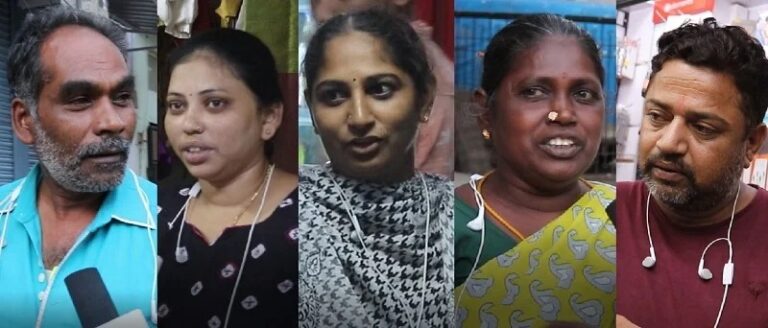
The objective was to know whether these Hindu traders have ever been troubled by Muslims for doing business near the mosques. Here are the excerpts of the interview of some of the Hindu traders who are doing business near the mosque.
“ Many Muslims who are passing by this road, do business with us. I have set up my business near the Masjid itself, yet till date no Muslim has ever asked me not to set up stall near the mosque. No one should trouble poor people in the name of religion”, said Krishna, one of the traders who is native of Mandya district.
Krishna who comes from Mandya does business around the mosque
Selling lime and other vegetables for nearly eight years near Basavanagudi mosque in his pushcart, he is upset with the developments taking place where Muslims are being forced to remove shops set up near temples.
The Kazi street of Basavanagudi in Bengaluru always bustles with crowds which only swell during the present Ramzan month. The traders, mainly the fruit vendors, are doing brisk business during this holy month.
In the shops located in the basement of the mosque, people of Hindu and Muslims community to business without any problem.
Roopa is running a tailoring shop near masjid
In one of the shops, a Hindu family has been doing business for the last 42 years. Rupa Raghavendra who is doing tailoring work, says that her father in law has been doing tailoring work for over four decades.
“ Now, my husband and I have continued this occupation. The shop belongs to the mosque, yet no Muslim has ever troubled us. They have always been friendly with us. But we are extremely disappointed with the news that Muslims are being forced not to do business near temples”, she said.
Claiming that she has more Muslims customers than Hindu, she said that unnecessary controversy is being created to divide people. “ People have already lost their earnings because of the COVID pandemic. Let people to live and earn don’t bring religion in that”, she appealed.
Sunanda who runs a Nandini franchise near Masjid in Bsavanagudi shopkeeper at Nandini Products, opposite the Basavanagudi spoke about the Hindu Muslim brotherhood
A stall of Nandini milk products is located opposite the Mosque. When talked to Sunanda, who was in the shop, said that her husband has been doing the business for nearly 25 years. People of Hindu and Muslims live harmoniously. She too claimed that the majority of their customers are Muslims.
Dhanalakshmi of Tamil Nadu has been living near the Basavanagudi Mosque by selling vegetables and fruits for the past ten years.
Dhanalaksmi, a woman of Salem district in Tamil Nadu also has set up a fruit stall near the masjid for the last ten years. “ The relation between me and Muslims here has developed so strong that they inquire if I remain absent even for a day. This is the concern they have about me and my family”, she said.
SA Khader, Customer
S.A Khadar, one of the customers who is regularly purchasing fruits from these Hindu traders, said that he has been purchasing fruits from Hindu sellers for several years.
Sharing his views, Mohammed Sharif, a local resident said that there is simply no objection for people of any community to do business near the Masjid. “ In fact nobody bothered about their religion”, he said.
Ahmed Sharif gets a bakery near Basavanagudi mosque
He opined that the government should treat everyone equally without discriminating among the people.
Bangalore: With the message of shedding hatred and building the nation by spreading communal harmony, the organization, Spoorthi Dhama has decided to celebrate the birth anniversary of B. R. Ambedkar this year.
The event is scheduled to be held on April 14 at office of the organisation located at Anjana Nagar of Magadi road in Bangalore.
During the programme, six activists will be honored with Bodhivruksha and Bodhivardhana award for working towards upliftment of the downtrodden communities.
The event will take place today during Ambedkar festival where various cultural events to showcase the unity and brotherhood of the country will be performed by various artists.
The events will have dance, songs, poetry recitation, painting and exchange of thoughts in the morning.
The award distribution function will be held at 6:00 pm, which will be inaugurated by Former Chief Minister and Leader of the Opposition in Assembly, Siddaramaiah.
President of Spoorthi Dhama, S. Mariswamy to preside over the function. Justice V. Gopalgowda to distribute awards. Activist G. Ramakrishna to be the chief guest.
Bodhivriksha Award
The Bodhivriksha Award will be given to Dr. R. S. Praveen Kumar. He has dedicated his
life to impart holistic quality education as an administrator of Social Welfare & Tribal Welfare Residential Schools in Telangana/Andhra Pradesh. The schools have transformed the lives of more than 2 lakh children of daily wagers/other labourers. His endeavours have created a metamorphic change in such communities. In the last 5 years, 325 students have secured medical seats, 220 made it to IIT/NIT’s and thousands to country’s top universities and have come out with flying colours.
To infuse the culture of sharing the knowledge, he has initiated student led village learning circles, thus taking the community towards development.
Born in Allampur village of Telangana’s Mahabubnagar dist., Dr. R. S. Praveen Kumar, was an IPS officer. He quit his profession to quench his heart’s calling to empower the downtrodden communities after 24 years of yeoman service. The 55 year old Messaiah, who is on a yearlong ‘Bahujan Yaatra’ in Telangana now, has reiterated the power of knowledge and redefined the persons and personalities.
Bodhivardhana Awards
Mr. Guruprasad Keregodu: Guruprasad Keregodu, State convenor of Dalit Sangharsha Samithi has committedly engaged in the movement since its inception. His struggle in establishing residential schools for grass root communities children, securing land for landless farmers, liquor prohibition, hostel reformation are very significant. He also led the struggle against nude worship ritual of Dalit women in Chandragutti.
Mrs. D. Nagalakshmi:Mrs. Nagalakshmi, a convenor of of ASHA (Accredited Social Health Activist) Worker’s Association, has dedicated her life to better the lives ASHA workers since 28 years. She successfully addressed the civilian’s social issues as a convenor of the Ballari District Civil Struggle Committee. Nagalakshmi’s serious concern has brought together numerous women into the fold and strengthened the cause.
Mr. Padmaalaya Nagaraj: A teacher by profession, Mr. Padmaalaya Nagaraj is a unique researcher. His works on ethnic epistemological systems has added a meaningful dimension to the native philosophy. Padmaalaya’s exploration has directed the struggle of grass root communities to evolve the methods to counter the hegemonic structures. This barefoot philosopher’s writing on harmonious living culture of all the communities is a silver lining in the cloud; he extends the same through interaction and sharing with the people.
Dr. Mahendrakumar B.P: Mahendrakumar, a botanist, has dedicated his life to better the lives of Adivasis through rights’ activism. His endeavours have resulted in the inclusion of ‘Siddi’ community into the Tribes Schedule. His struggle against the government’s decision to displace the Kunubi & Siddi communities was successful; thus securing the rightful authority for all the forest dwelling communities. He is a comrade of all the progressive movements in Karnataka.
Mrs. Mary Lobo: Mrs. Lobo, a compassionate medical nurse, has engaged herself in nursing the bedridden at their homes and counseling their family to nurse & cope up with the trauma from past 12 years, irrespective of class, caste and religion. This good samaritan has cared for more than 1720 patients. Mary chooses to take care of aged patients neglected by their families thus reiterating the belief in humanity.
While Bodhivruksha award comprises Rs. 1 lakh cash and a citation, Bodhivardhan award comprises Rs. 25,000 cash and a citation, the release added.
A Facebook post shared last week by BJP Youth Wing National President, Tejasvi Surya where he is spinning Charkha at Sabarmati Ashram in Gujarat has made subject to lot of social media trolling due to the sheer hypocrisy of the post made by Surya.
In his post, Surya, the BJP MP of Bengaluru South said that “Mahatma Gandhi Ji has left an indelible mark in India’s history. Today, I had the opportunity to visit Sabarmati Ashram along with karyakartas of BJYM Gujarat and learn more about Gandhi Ji’s life in Gujarat.”
Surya has got his photo captured sitting at the Charkha and spinning it. Later he praised Gandhiji . Several internet users have called it nothing but a sheer hypocrisy of the BJP leader.
On the one hand, the BJP leaders are propagating Hindutva and standing for Nathuram Godse who killed Gandhiji, on the other, they praise Bapu.
The BJP has been following this conflicting and contradictory stand for long.
On several occasions, the BJP leaders have made every effort to defame Gandhiji and praised the act of Godse. On such statements, Surya has never uttered a word, social media was quick to point out.
MK Gandhi was known world over for his ideas on non violence and he was a symbol of religious tolerance. But in Karnataka for instance, the BJP government is silently supporting communal elements which are frequently spewing venom against Muslims.
Tejasvi Surya is known for regularly gives anti-Muslim statements. But now Surya praising Gandhi who always stood for the unity of Hindu-Muslims is nothing but hypocrisy.
Here are a few comments made for the post of Surya-
“ You are the leader of the vandal group that created a ruckus outside the residence of Delhi CM Arvind Kejriwal where the aged parent of the CM lives. You should be ashamed of yourself”, said one social media user Rajiv Kumar.
The founder of Khatabook, Ravish Naresh shared about the problems of basic infrastructure in Bengaluru. Quoting that, Vivekanand Reddy says “ Do not travel across the country for fake speech and publicity. There is much work to be done in your constituency. Bangalore South has several IT companies, first try to address the issues of your constituency. Take the list of issues and go to Delhi to get them addressed”, he said.
Another net user, Kiran Prasad calls Surya the worst politician of Indian history. “ You are not eligible to sit at the place where Gandhiji was sitting. Don’t sit there, else Godse will be upset”.
Another user Raju Thakur wants Surya to raise the slogan ‘Godse Murdabad’.
D. S. Goursih said that those who oppose the Gandhian ideology and celebrate his assassination, has not right to visit that Ashram.
Another user D. S. Doreswamy said that perhaps, Surya has gone to express remorse for these statements which were issued in the past.
Maruti Sorkunte has asked Surya what he will call Godse, the first terrorist of independent India. “ It is nothing but a high level of hypocrisy” said Anilkumar Chikkadalvatta.
Some of the supporters of BJP and RSS have also commented on the post.
Surya got slammed from followers of BJP too. They used derogatory remarks against Gandhiji and used foul words to reply in their comments.
One user commented- “ You are saying you have visited Gandhi Ashram. Besides this, you are saying you have learnt several valuable lessons about the life of Gandhi. Please clarify whether you have been to Gandhi Ashram for your love or hate for Gandhi.
One more important aspect is that, the majority of those who are commenting lightly about Gandhiji are from the BJP, this is fact, he said.
After the goons of Sri Ram Sene vandalized the stall of poor Nabisab Killedar who was selling watermelons outside Nuggikeri Hanuman temple in Dharwad, not only the support is coming from all quarters for this aged Muslim vendor but the same people are also severely criticizing Sene law breakers for their inhuman act of destroying watermelons of poor vender.
It may be noted that a couple of days ago, the goons of Sene visited the stall of Nabisab and destroyed around five quintals of watermelons which he had kept for selling.
According to Nabisab, he has been selling the fruits outside the temple for the last fifteen years, and never faced any problem from anybody. But goons of Sene who could not tolerate Muslims selling fruits outside the temple, vandalized his shop and threw melons all over the road.
When the video of this hooliganism went viral, people of all faiths expressed their anger over Sene men and extended sympathy for the poor vendor.
Besides criticizing Sene, the people have also taken the ruling BJP government to task for letting the Hindutva goons take law into their hands.
People have wondered how one group of rightwing can do anything and everything in the name of protecting Hindu religion and government acting as mute spectator.
People of various walks of life and activists, even the politicians too have expressed ire for the incident.
Strongly condemning the hooligan act of sene members, Leader of the Opposition in assembly, Siddaramaiah has slammed CM Basavaraj Bommai by asking him to take action against Sene goons if he is still in power as CM.
He said that if it was not possible to do even such a simple act as a CM then he should resign from the post and save the dignity of the chair.
Asserting that such goons have no right to take the name of Lord Ram, he said that CM has completely outsourced his government to Sangh Parivar and hired goons on contract basis.
Stating that CM neither has control over the party nor his own Cabinet, he said that CM thinks that he can save his position by mortgaging the government to Sangh Parivar.
Siddaramaiah said that that is the result of the sins committed by the CM when he said that every action has a reaction to goonda elements of Sangh Parivar.
Responding to the Dharwad incident, Former Chief Minister and JD(S) leader, H. D. Kumaraswamy had called it a disgusting and cowardly act of Sene goons of destroying the shop of a poor man kept outside the famous temple of Dharwad.
“ There is no difference between the blood-shedding terrorists in Kashmir and the destructive forces of Sene who are setting the peace and harmony of the State on fire. It is completely an uncivilized act of wasting the edible food”, he remarked.
He also criticized the Bommai government for giving free hands to goons and hooligans to rule the roost.
Many people have taken to social media to criticise the incident. Hulikunte Murti has asked all the Dalit activists to join hands to protest against such hooliganism.
Recalling the incident when by wearing blue shawl, hundreds of Dalit activists extended solidarity to Muslims girls who wants to wear Hijab, he said that time has come again to show similar solidity with the poor man, Nabisab.
Chandru Tarahunise another user said that for some people it may look like just a destroyed watermelon, but in reality it is the future of our children which is shattered. He has called upon people of all sections of the society to raise their voice in unity against such inhuman acts.




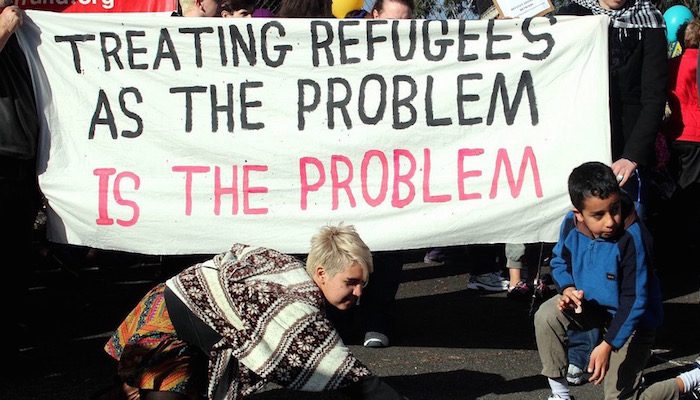 In the world, there are almost 25 million refugees. Most refugees seek asylum in countries neighbouring their country of origin. Often refugees have to constantly migrate until they are granted asylum. Many of them are under threat and move to areas where they have some community. Asylum seekers often do not know the laws regarding immigration and live in countries where they do not have the right to work, being forced into the informal economy, where they are targeted.
Why are countries across the world cracking down on Refugees?
After World War II, countries across the world tried to become more open to immigration. During the Cold War, many countries sought status by showing how open and diverse their countries were, being representative of the world at large. However, since the 1970s, there was a rollback in these policies. From the 1970s onwards, many countries claimed they were losing autonomy. Politicians began fearmongering. They would blame terrorism, organized crime and drug use on immigrant populations. Undocumented immigrants, who earlier worked in the unorganized sector of the economy, became easy targets, as they did not have a voice. This is true even in India, where since the 1980s, immigration laws and fear-mongering have left migrant working populations in the informal sector in a precarious position.
Despite Boris Johnson’s bravado, experts are unsure how effectively the plan to relocate refugees will be. Refugees have a problem with documentation. The policy only creates a climate of fear that they will be caught and sent to an unknown fate.
The author is a mathematician and political observer based in Bangalore.


 For half a century before Hitler came to power, similar arguments were put forward regarding the imagined prehistoric home of the Aryans. The game, this time, is the same, no matter if a group of more than hundred best scientists have already exposed the absurdity of the claim. The RSS has built for its cultural narrative on a castle of sand. Is the Culture Ministry building a pseudo-scientific show-case for it? Its outcome will not be just the denying the Adivasis their cultural space, not just denying science its legitimacy but also legitimacy to social disharmony between the so-called pure and the so-called impure citizens. As genes get inspected and words get resurrected, the guarantee of equal citizenship given by the Constitution may get mired in hatred and stark injustice. ‘Pure’ is not just an innocent adjective. It can turn vicious when applied to ‘race.’ Let us hope the Ministry of Culture publicly assures Indians that it will not be a party to the idea for which there should be no place in civilised society.


 Two laws in the last two decades – The Unorganised Workers’ Social Security Act, 2008 as well as the POSH ACT, 2013 – recognised domestic workers as workers. Both explicitly discuss domestic workers as workers, by elaborating on working conditions as well as defining the home as a workplace respectively. Even though discussions and debates during these legislations have foregrounded the need for a separate legislation, especially to comprehensively address the complexities of the sector, it continues to be lost in notifications, draft laws by unions or even of formal government bodies and in private bills of 2016 and 2017, amidst the cacophony of competing party systems and vote bank politics.


 Cuba started its lockdown a little before the first case was discovered. It took an ‘all-hands-on-board’ approach and responded swiftly to the threat. Cuba followed strict quarantine, contact tracing, massive testing and door to door frequent consultations.
Cuba is also the smallest country in the world to develop its own Covid-19 vaccine. Cuba has developed two of 23 vaccines worldwide that have entered phase III trials. The vaccines Soberana 2 is already being used for mass vaccination in the country.
Che’s vision of the New Cuba entailed the selfless, hardworking and non materialistic service to the nation and Cuba has been successful in revolutionising medicine and biotech sector with welfare of people at its core.