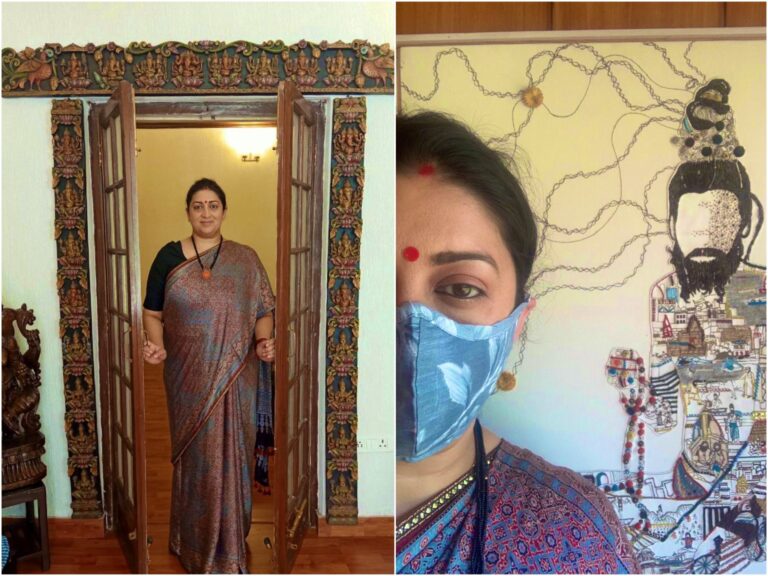
While India celebrates the National Handloom Day August 7, 2020, the Narendra Modi government has abolished the All India Handloom Board as well as the All India Handicrafts Board recently.
However, the BJP Government known for paying only lip-service with no real intent of bettering the lives of people has only recently abolished that All India Handloom Board and All India Handicrafts Boards on July 27th and August 3rd respectively and this is the first time that India is celebrating its National Handloom Day without the advisory boards in place.
In a move that has become so typical of the BJP government, Smriti Irani, Union Minister of Textiles has been tweeting extensively today about Handlooms and promoting it on social media.
Smriti Irani took to twitter to promote handlooms with the #Vocal4Handmade among her colleagues and celebrities as she requested them to take an active part in the campaign.
Handloom can enrich our daily lives and surroundings in many ways; from clothing to furnishing to Masks in Covid times to wall hanging. Bring home handmade in India!
Ignorant as many of her followers and celebs are who like to join every twitter bandwagon obliged with their photos in handloom sarees.
But not every one of Twitterati was enthusiastic about the online campaign and many pointed out the hypocrisy of the “pride” that the minster is taking in Handloom day while abolishing the Handloom and Handicrafts board.
Takes an immense lack of shame to say this 5 days after permanently shutting down the Handloom Board. https://t.co/FwJ168KCXf
The handloom board was formed in 1992 “to advise the Government in formulating policy for the overall development” of the sector. The handicraft board, dating back seven decades, similarly was mandated to advise in formulation of all development programmes “keeping in view socio-economic cultural and artistic perspective.”
BJP's Myth vs Reality
Promotion of handloom after scrapping the handloom board.
The Union Ministry of Textile released two separate notifications July 27 (No.1/13/2017-DCHL/Coordn/AIHB) and August 3 (No. K-12012/5/5/2013-P&R/AIHB) to announce the abolition.
Handloom and handicrafts employ a sizeable number of Indians. They have been spoken of as the second-most prominent employer, after agriculture, in rural India.
To prove Modi government’s love for Handloom sector, Smriti Irani has quietly abolished 28 years old Handloom Board. 👏👏👏👏👏👏 Well done Narendra Modi. What a way to go local. https://t.co/CmG3qrcZRk
Nearly 2.8 million households in India, mostly rural, were associated with handloom work, according to the Third National Handloom Census of Weavers and Allied Workers 2010. Among them, nearly 1.7 million were in the North East.
Ironic to see the Textile Minister promote #Vocal4Handmade after the Centre has decided to scrap the Handloom Board and Handicrafts Board at a time when weavers & artisans are bearing the severe economic brunt of the pandemic. https://t.co/YIRta6uzkY
While many may point out that such boards are defunct anyway and this is a move towards Modi government mantra of maximum governance minimum government such boards do have a role in representing various stakeholders across India. These stake holders who made up two-thirds of the boards used to bring their issues to the table directly, bypassing bottlenecks, said Ramesh Menon, founder of non-profit Save the Loom.
The Union Minister for Textiles Smriti Irani will also be in conversation with Sadhguru on National Handloom Day.
A document in which India admitted Chinese intrusion nto its territory in the Eastern Ladakh Region which was put up on the Ministry of Defence Website has disappeared after two days.
This was the first official document that had noted about ‘Chinese Aggression’ since territorial disputes between the neighbours had escalated. 20 Indian soldiers were killed on June 15th in the worst fight between the neighbors for decades now.
The 4-page document detailing the “Major Activities of Depart of Defence for the Month of June 2020” which had a subsection on “Chinese Aggression on LAC” which was posted up on the Ministry’s Website under the ‘What’s New’ section ‘ had noted that “Chinese aggression has been increasing along the Line of Actual Control (LAC) and more particularly in Galwan valley since May 5, 2020. The Chinese side has transgressed in the areas of Kungrang Nala, Gogra, and north bank of Pangong Tso Lake on May 17-18,” the ministry said in the “What’s New” section on its website, under the title “Chinese Aggression on LAC”.
It has to be noted that the website has documents that summarize the major activities that the Defence Ministry undertakes each month. However, only the document for the month of July is missing.
The incident has raised concerns over India’s territorial sovereignty as PM Narendra Modi had in June repeatedly claimed that there was no intrusion by China on India’s territory whatsoever through his Media assurances.
Even in the All-Party meeting that PM Narendra Modi had called, he had denied any Chinese intrusions stating that “Neither has anyone intruded into our territory nor taken over any post. Our forces are doing what they have to do to protect the country, whether it is deployment, action, or counter-action. Our patrolling capacity has increased due to newly built infrastructure, especially along LAC.”
Read About:How the RSS leadership bowed to Indira Gandhi: 45th anniv of the Emergency
President of the Indian National Congress Rahul Gandhi has tweeted about the issue and has noted that “Forget standing up to China, India’s PM lacks the courage even to name them Denying China is in our territory and removing documents from websites won’t change the facts,”
Forget standing up to China, India’s PM lacks the courage even to name them.
Denying China is in our territory and removing documents from websites won’t change the facts.https://t.co/oQuxn77FRs
India and China have had Five rounds of talks in order to de-escalate the border tensions. The last meetings took place between Lieutenant General Harinder Singh, General Officer Commanding (GOC) of the 14 Corps of the Indian Army, and Major General Liu Lin of the Chinese People’s Liberation Army took place on 2nd August at the Chushul-Moldo point on LAC.
On 6th August 2020, the NIA interrogated Father Stan Swamy, a prominent human rights activist from Jharkhand, for nearly two and a half hours in relation to the Bhima Koregaon case. This interrogation took place at his Ranchi residence in Bagaicha, Namkum. Father Stan SwamyIt is widely known that originally hailing from Kerala, Father Stan Swamy has been fighting for the issues of Adivasis and Mulnivasis in Jharkhand for almost 50 years. He was also one of the founding members of the Visthapan Virodhi Janvikas Andolan (VVJA). He has done significant work with undertrials in Jharkhand prisons. He is one of the most eminent human rights activists in Jharkhand. During the tenure of the previous BJP government in Jharkhand, Father Stan Swamy was one of the many social activists who were slapped with sedition cases in relation to the Pathalgadi movement. In December 2019 after the government changed, all the sedition cases lodged against these activists were revoked. Stan Swamy has remained vocal of the constant looting of land in Jharkhand. In relation to the Bhima Koregaon case, Father Stan Swamy’s house has been raided before this as well. On 28th August 2018, the Maharashtra police raided his Ranchi residence in Bagaicha, Namkum, and seized his laptop, CDs, pen drives, mobile, and various other things. Since then Father Stan Swamy has become a target for the Bhima Koregaon case like other intellectuals. The fascist central government has started a third round of arrests in relation to the Bhima Koregaon case and has constantly been using this as an excuse to harass the intellectuals of our country. We must stand on the side of our intellectuals and express our solidarity, and stand strong against the oppressive actions of this fascist government.This article has been translated in English by Damayanti Saha.
Around 1350 signatories, including prominent activists, journalists, academics, and artists released a statement on August 6, 2020, titled “Nationwide condemnation of Delhi Police regarding their interrogation of Prof. Apoorvanand “. The statement asserted that the interrogation of Prof. Apoorvanand was not a normal inquiry but part of a larger strategy to stifle dissenting voices and create a police state in India. On August 3, the Special Branch of the Delhi police had called in Prof. Apoorvanand, and interrogated him for 5 hours in connection with the Northeast Delhi riots, and seized his phone. Prof. Apoorvanand has been critical of the politics of hate and violence carried out by the state in recent times. The current government has arrested, harassed, and targeted many activists and intellectuals in connection to the Delhi riots, and the Elgar Parishad case before that. The arrests include Anand Teltumbde, Varavara Rao, Chandrashekhar Azad, Hany Babu, Gulfisha Fatima, Safoora Zargar, Devangana Kalita, Natasha Narwal, Amulya Leona, and countless others. The statement said, “Under the omnibus FIR 59 of 2020 alone, more than 17 arrests have taken place already under the UAPA, and over two hundred have been arrested under sections of the IPC”. The statement outline all the charges mentioned against Prof. Apoorvanand mentioned in the summoning- 43F of the Unlawful Activities (Prevention) Act, or UAPA, 19 sections of the IPC; two sections each of the Prevention of Damage of Public Property (PDPP) Act; two sections of the Arms Act; and, finally, four different sections of the UAPA.The statement asserts that the arrests are an active attempt to frame those who have been critical of the government and participated in the Anti-CAA-NRC protests as being “masterminds” behind the violence in Delhi. Meanwhile, the police show complete inaction when it comes to investigating BJP leaders who have been seen instigating violence on public television.The statement warned that this is the most serious crisis that the Indian democracy has faced since Independence, and is far more critical than Indira Gandhi’s emergency 45 years ago. The signatories wrote-“We appeal to all citizens committed to the values enshrined in the Indian Constitution – freedom of speech, equality before the law, secularism – to resist this attempt to turn India into a police state where all dissent is criminalized under the most draconian laws. We demand that this systematic harassment of voices critical of the government and the blatant misuse of the law and the state apparatus be stopped immediately. If we fail to protest the muzzling of our democracy today, there may be no democracy left tomorrow.”
Advocate Prashant Bhushan has not backed down from exposing corruption within the judiciary even after the Supreme Court charged him with contempt of court last month. After pulling up Bhushan for his tweet on CJI Bobde (which has now been withheld by Twitter), the Court also resumed hearing an 11-year-old contempt case that had not been taken up since 2012.
CJI rides a 50 Lakh motorcycle belonging to a BJP leader at Raj Bhavan Nagpur, without a mask or helmet, at a time when he keeps the SC in Lockdown mode denying citizens their fundamental right to access Justice! pic.twitter.com/PwKOS22iMz
Bhushan has filed a 142-page affidavit explaining why his tweets constitute fair criticism and do not amount to contempt of court. He stated that the June 29th tweet on CJI Bobde riding a motorcycle without a helmet or a mask “was meant to highlight the incongruity of the situation where the CJI (being the administrative head of the Supreme Court) keeps the court virtually in lockdown due to COVID fears…is on the other hand seen in a public place with several people around him without a mask”.
On the second tweet concerning the role of the previous four CJIs in the ‘destruction of democracy’, Bhushan contended that he was “expressing his bona fide opinion about the state of affairs”. “At a time when the country witnessed an assault on all democratic norms, liberty of citizens, and the secular fabric, the Supreme court by various acts of omission and commission acted in a manner that allowed the majoritarian executive at the centre to trample upon the rights of citizens”, his affidavit states.
Advocate Dushyant Dave, who is representing Bhushan, argued on Wednesday in court that; “No one can claim infallibility which includes the judges. Hundreds of people tweeted after the photo was clicked of the CJI riding the bike. Is the court going to charge all with contempt of court?”. Bhushan has also stated that making remarks about the conduct of the CJI cannot be seen as amounting to ‘scandalizing or lowering the authority of the Court’ because; “To assume or suggest that ‘the CJI is the SC, and the SC is the CJI’ is to undermine the institution of the Supreme Court of India”.
His lawyer, Dave, told the Court: “[Bhushan] criticizes the court because of love and affection for the institution. He did not impute any motives. Please don’t misunderstand him.” Dave referred to Justice PB Gajendragadhkar’s acute observation that, “If judges decay contempt power will not save them”.
Prashant Bhushan’s affidavit also makes detailed references to instances of corruption within the judiciary, to justify and support the claims he made on Twitter regarding the role of CJIs in destroying democracy. The affidavit cites examples of the medical college bribery cases, the judges press conference, the impeachment proceedings against CJI Dipak Misra, and the judgments on the BH Loya and Bhima Koregaon cases. Bhushan has not shied away from highlighting the controversial circumstances around ex-CJI Ranjan Gogoi’s Rajya Sabha nomination.
Bhushan concluded his submission to the Court, stating: “I could multiply these instances but I think the above cases and their decisions and the inaction of the courts in dealing with some of these critical cases are enough for me to form my opinion about the role played by this Hon’ble Supreme Court in last 6 years in undermining democracy which bonafide opinion I am entitled to form, hold, & express”.
In solidarity with Prashant Bhushan, 16 other civil rights activists have urged the Court to drop the contempt proceedings against him. The activists are; Aruna Roy, Jayati Ghosh, Shantha Sinha, P Sainath, EAS Sarma, TM Krishna, Jagdeep Chhokkar, Anjali Bhardwaj, Bezwada Wilson, Nikhil Dey, SR Hiremath, Prabhat Patnaik, Deb Mukharji, Wajah Habibullah, and Syeda Saiyidain Hameed.
They have filed an application asking to be impleaded as parties alongside Bhushan in the case initiated against him. The activists stated that they are willing to risk facing all the consequences which may arise against them should the Court find Bhushan’s tweets to constitute criminal contempt. However, their impleadment application was rejected by the Supreme Court registry on the ground that “contempt proceedings are a matter strictly between the Court and the alleged contemnor”.
Baba Ramdev’s company Patanjali Ayurved’s product will not be able to sell its immunity booster product as the ‘Coronil’ tablet anymore after the Madras High Court made absolute an interim injunction passed last month.
In a report by bar and bench While the company has been marketing this tablet as a cure for the Coronavirus, the HC said Patanjali is merely “chasing further profits by exploiting the fear and panic among the general public by projecting a cure for the Coronavirus, when actually their ‘Coronil Tablet’ is not a cure but rather an immunity booster for cough, cold and fever”.
The name ‘Coronil’ is an infringement on a trademarked registered by Chennai-based Arudra Engineering Private Limited, for ‘CORONIL-92 B’ as an Acid inhibitor product for industrial cleaning and chemical preparations for industrial use in June 1993. The defendants, Patanjali and Divya Yog Mandir Trust were not able to show due cause for using this name as the tablet has no connection to the Coronavirus, and further, they had merely applied for registration of the name and it was still in the initial stages of registration.
The court noted that there are organizations that are helping people during this critical period without seeking recognition and directed the defendants to pay Rs 5 lakhs each towards the Adyar Cancer Institute and the Government Yoga and Naturopathy Medical College and Hospital, Arumbakkam.
In the first week of July, Yoga Guru Baba Ramdev had launched an Ayurveda medicine for Corona Virus called “Coronil” claiming huge success with the clinical trials. After the public launch of an alleged claim for Covid-19, Pathanjali Ayurveda’s marketing stunt with ‘Coronil’ has effectively backfired. The claims made by Pathanjali were publicized prematurely and with no clinical data to prove that they are safe and effective.
Nearly 90 percent of Dalit – Bahujan students who enroll in school for grade one are pushed out of education by the 12th standard. These students should not be called ‘dropouts’ because they do not leave the education system of their own choice but are rather pushed out by the structural casteism and prejudice prevalent in Indian classrooms. Rather than beginning to address such appalling inequality in the education system, the New Education Policy (NEP) attempts to legitimize the various caste-based divisions in the education system. The NEP pays only a lip-service to ‘equitable’ education. It essentially provides freedom for private players to make profits in education. It does not state anything about the regulation of private schools or universities and their profit. It suggests that philanthropic investments in education may provide tax cuts, and further, that private universities run for profit are still eligible for government assistance. When there remains a stark inequality in the education system in the form of private institutions as opposed to public institutions and further in the form of tiered division of schools and colleges, it is pointless and also misleading to talk about equitable or inclusive education. In fact, an already existing policy document considered as a marker of equitable education the 1966 Kothari Commission doesn’t even find a mention. The Kothari Commission has recommended equal and uniform structures and plans across all schools. Indicators of equal structures education include uniform student-teacher ratio, access to science labs after Grade 6. These are not mentioned because such uniformity would directly fo against the goals of profit-oriented private education. The division between public and private institutions is often along caste lines, with Savarna students paying for a higher quality of education, while most Bahujan students attend underfunded, understaffed, government schools. An already existing danger of private institutions in higher education is further enabled in the NEP under the guise of ‘transparency’ and ‘less regulation’. It refers to an unregulated system wherein educational institutions will conduct ‘self-regulation’ by submitting online forms without any intervention of any government authority. This is applicable to private universities as well. This creates an atmosphere where private institutions will be able to bypass social justice laws such as reservations or implementation of SC/ST cells. Private Institutions cannot will cannot also be held accountable for their spending or its hiring and admission procedures amongst other concerns. Another aspect of the NEP that is clearly aimed at increasing caste-divisions is the plan to provide vocational education Grade 6 onwards. The groundwork for this was laid by the 2016 Amendment to the Child Labour (Prohibition and Regulation) Act, that said when children under the age of 14 work for their parents, it will not be considered child labour which legitimized child labour in caste-based occupations. In English-medium private schools, parents of upper-caste children will not be enthusiastic about ‘vocational’ education especially if it involves physical labour. Hence, it is likely that with differential implementations, students in government schools specially Bahujan students would be pushed by educational institutions to go into caste-based occupations and prepare themselves for cheap labour. While the NEP claims that there will be no hard separation between academics and vocational education, it is clear that students pushed into labour will slowly be disadvantaged in the education system with drops in attendance, less time for study and so on. The NEP of any structures to ensure that students who get into vocational education and caste-based occupations are able to complete their education and choose their profession after the 12th standard. The creation of this pool of cheap labour using Bahujan students is important for the larger plan that the NEP stands for, i.e., investment of foreign capital to pursue the goals of capitalistic development which will require a large labour force which does not have the tools to recognize or critique their oppression. Similarly, the ‘flexible’ assessment, with options for students to sit for A-level or B-level exams also formalizes inequality between students and creates inequality of opportunity in higher education and employment. NEP also states that ‘wherever possible, the medium of instruction until at least Grade 5, but preferably till Grade 8 and beyond, will be the home language/mother tongue/local language/regional language’, and does not mandate that the medium of instruction be changed. This would mean a lack of access to English education in Government schools. This further leads to the migration of students who can afford it to private schools. English is the language that allows Bahujan students to seek opportunities in higher education and employment outside their state and hence often outside of the influence of local upper-caste networks. The NEP encouraging this inequality in the medium of instruction is dangerously aimed at reinforcing caste oppression. The NEP states that Sanskrit will be offered “at all levels of school and higher education” and as a result, teachers will be appointed and departments will be funded at every level as well. The justification for this is the promotion of classical languages. However, all other classical languages have been ignored in this proposal. NEP states that other classical and historical languages will be documented and stored in the digital medium. The message is clear- the only language that will be funded and taught at all levels is that in which Brahmanism and caste ideology have its roots, while other languages, such as Tamil, Pali, amongst others which have in them anti-caste knowledge and discourses will be ignored. This blatant promotion of brahminical knowledge is clear in the NEP’s thrust on ancient Indian culture, which conveniently erases those philosophical and religious traditions which resisted Brahminism, such as Charavaka and Lokayat philosophical tradition, and Buddhism. The NEP also mentions that ‘meritorious’ students from ashram shalas in Adivasi areas will receive the relaxation in fees and ‘meritorious’ teachers will receive special training and facilities. Firstly, this relaxation of fees is strange since the policy contradicts itself by saying that the RTE will be extended and education will be free of cost. This means that either there will be costs to the education not made clear in the policy, or that the ‘meritorious’ scholarship is simply an attempt to undermine reservations and replace them with scholarships. Secondly, we must question what it means to be ‘meritorious’. For students, it will be those who get the most marks in online exams based on a highly unequal and homogenized system of education, and for teachers, it will be those who are most likely to abide by the ideology of the Brahmanical and corporate education system. The use of the word ‘meritorious’ in this policy document is hence alarming. The NEP also pays lip-service to gender sensitization in an attempt to present itself as a liberal policy. However, patriarchy in India is inherently linked to caste, and neither can be tackled without the other. The NEP not only lacks measures aimed at addressing caste but rather attempts in various ways, to reinforce and strengthen caste prejudices. At present, less than 10 percent of Bahujan students who enroll in school are able to access higher education, and even the presence of this minuscule number of Bahujan threatens upper-caste society and makes them come out on the streets against reservations. If the focus was shifted to why the majority of Bahujan students are not able to reach the 12th standard, then the entire concept of ‘merit’ would be challenged. A truly equitable and emancipatory education system needs to tackle the social problems of caste, patriarchy, disability, and so on directly. The NEP not only ignores these problems but rather is geared towards creating slavery and disenfranchisement. This article is based on a recent webinar by Dr. Anil Sadgopal titled ‘New “Exclusion” Policy 2020: Corporatization, Manuvadikaran, and Over-centralization of Education ‘.Also Read:Narrow Vision and Missed Opportunities: National Education Policy 2020
Today, the 6th of August marks 29 years since the cold-blooded massacre of Dalits in Tsunduru in Andhra Pradesh by a mob of Reddys and Kapus, followed by years of gross injustice meted out to the survivors and the victims’ families by the police, the judiciary, and the state. The trajectory of the numerous injustices committed against the Dalits of Tsunduru shows the lengths to which Savarnas in this country can go to preserve their caste privileges and power and how deeply violent and inhumane caste-Hindu society is.
For a long time before the 6th of August, the people of the dominant landowning Reddy caste of Tsunduru felt angered and threatened by the gradual social upliftment that the Dalits of the village had carved out for themselves. The village was starkly divided by a road going down its middle into a Dalitwada and an upper-caste area. The Dalits were mainly employed as agricultural labourers in Reddy-owned lands. According to Jaladi Moses, a survivor and the president of the Tsunduru Dalita Badhitula Porata Committee. In addition, many of the Dalit youths at that time had begun to migrate to the nearby town of Tenali where they pursued higher education in Ambedkar college. Empowered by the anti-caste knowledge of Ambedkar, Phule and Periyar, they began to organize and assert themselves.
Many Dalits converted themselves to Christianity, took part in cultural programmes, invoked radical icons like Ambedkar, and slowly resisted the caste stranglehold in the village. Angered by this lack of subservience, the dominant caste members felt justified in creating conflicts over non-issues, some of which were a Dalit boy’s foot touching the foot of an upper-caste boy and a Dalit youth being seen reading a newspaper in a barber-shop. The dominant caste members also enforced a social boycott, ensuring that Dalits were not able to go to their fields or enter their localities.
The deep-rooted need for the powerful caste to oppress and show the oppressed their place is what Reddy caste-solidarity operated on. According to Moses, a day before the massacre, the caste heads of the community met with the then Home Minister Mysoora Reddy in a private hotel room. The Chief Minister at the time was also from the same caste. The police, in-complete nexus with the upper caste interests, ensured that the premeditated murders took place with as little scope for consequences for the perpetrators as possible.
On the 6th of August, the local policemen induced the Dalits to flee to the nearby fields, misleading them by saying that potential attacks could take place in their homes. In the fields, a mob of around 300 Reddy and Kapu men from not just Tsunduru but also the nearby villages of Modukuru, Valiveru, Munnangivaripalem, Vellaturu and Manchalawas, were waiting with weapons including axes, iron rods, spears and so on. Here, eight Dalits were brutally murdered, their bodies were stuffed into gunny bags and thrown into the Tungabhadra canal, and others were chased and brutally tortured. The police were clearly not only aware that this massacre would take place, but in the period that followed, made clear their caste allegiance, as the murders were denied, FIRs were delayed, reports were recorded with inconsistencies, and the bodies were recovered by the survivors and the victims’ families on their own.
Tsunduru Under Police Seige | Picture Courtesy: Report of APCLC titled ‘The Chundur Carnage’
The cruelty of caste society and its agents claimed a number of more Dalit lives after the massacre. On seeing his brother’s corpse, Mandru Parishuddha Rao, the elder brother of one of the victims, suffered a heart attack and passed away. Dr. Ravi Kumar, one of the doctors performing a post-mortem, felt severe emotional distress on seeing the mutilated bodies of the victims and committed suicide. Vice President of the Tsunduru Dalita Badhitula Porata Committee, one of the main witnesses to the incident and a politically motivated youth was murdered in the police firing on September 10, 1991 during a hunger strike to demand justice for the victims.
With sustained efforts and conviction, the Dalits of Tsunduru continued the struggle for justice, in spite of pressures from all sides. While the State attempted to dilute their anger by offering token compensations including welfare measures and reparations such as jobs or houses, they raised the slogan of ‘Justice not Welfare’. The compensations they demanded were for the whole community rather than individual measures. For example, Anoop Kumar and Ashokan Nambiar wrote, “The cinema theatre where the massacre was sparked off has been converted into an Ambedkar Residential School only on their demand”. They buried the victims at the heart of the village, naming it ‘Rakta Kshetram’ to serve as a constant reminder of the violence committed by the Reddys. They also demanded that a court be set up in their village as they could not travel to the district court, leading to the setting up of a Special Court in Tsunduru. They also demanded a special public prosecutor and a judge who had a positive track record while dealing with cases of atrocities against Dalits. All of these efforts were taken by the Dalits to ensure that justice is delivered to them and the usual methods of suppressing and diluting the victims’ demands are not successful on them. Many organizations like Democratic Action Forum for Dalits and Minorities, Kuluvivaksha Vyatirekha Porata Samithi, and Kulanirmulana Porata Samiti continued to struggle actively to ensure justice for years. While many of the survivors and the victims’ families attempted to boycott the Reddy fields, they had to go back to the fields of the murderers of their family members after a year due to the lack of any other work.
On 31 July in 2007, out of the 212 accused, the Special Court pronounced 123 as ‘not guilty’, 33 of the accused had died and out of the remaining 56, 21 were sentenced to life imprisonment. Others were punished with merely one year of imprisonment or fines. Both, the victims and the accused made appeals to the High Court. However, only the appeal of the accused was taken up, and all the convicted and the accused were acquitted in 2014 citing lack of evidence, inconsistencies of witness reports, delay in FIR, and other such technicalities for which the victims were clearly not responsible. While the Supreme Court stayed the High court order, justice is yet to be delivered. While the Dalits of Tsundur are haunted by the memory and pain of the violence their families have suffered and forced to see the murderers roaming free. Many of the accused have risen in prominence and have become active in local politics.
Read More about the Massacre:
Andhra Pradesh Civil Liberties Committee’s Report on the Tsunduru Massacre can be accessedhere.
Human Rights Forum’s Report on the Tsunduru Massacre and its Aftermath can be accessed here.
As Modi government covered up the failure of the abrogation of article 370 and article 35A and a year of complete lockdown in Jammu and Kashmir with Bhoomi Poojan in Ayodhya, it is Indians must reflect on what did we gain from putting the entire population of a state in lockdown depriving them of not just basic necessities but their rights and dignity.
Several reports have focussed on human rights violations, arbitrary arrests and detentions, and the media blockade over the last year. This is something that we Indians do not think of because for many, Human rights are an alien concept..unless well it comes to them!
Since the COVID19 pandemic broke out, and most parts of the country were under complete lockdown, many commented- Now do you know what Kashmir is going through! Well, No sir, this is not all!
Internet Shutdown
For many Indians, lockdown meant the idea of not being able to leave their home, hoard food supplies, and night curfews. But many people forget there are things that are taken for granted in cities including electricity, mobile phones, and the internet! Being inside a house one can watch TV, movies, watch Netflix, talk to your family and work from home! However, Kashmiris could do none of these things..because there was no internet for the most part of the year and when it was restored it was 2G internet. Can you remember what was 2G like because we cannot!
Internet shutdown meant literally meant a complete halt on the activities of life especially in the times of Corona outbreak which caused immense restrictions on movement. Despite multiple petitions both in the High Court and Supreme Court, internet blockade was not lifted. It was only by March 4 that all the websites were granted access on 2G internet. Even on May 11th, the Supreme Court rejected a plea for the restoration of 4G internet services although agreeing in principle that the governmental actions were against previously laid down principles. One cannot resist but blame the Apex Court among all other institutions for abdicating its responsibilities to ensure that the rights of the people are not violated. India´s internet shutdown in Kashmir is the longest ever in a democracy. Yes, India gained a record of putting 7 million people to return to a pre-Internet era.
Education during the one year of Lockdown and in COVID times
The regional administration shut down all educational institutions in the region on August 4, 2019, in the run-up to India’s decision to overrule whatever limited autonomy was left in Kashmir. As of today, students in Kashmir have faced a paralysis in their education for almost a year, and the regional administration has said in a recent order that schools will remain shut until at least August 31.
The massive military and communication blockade was accompanied by lockdown restrictions which meant that educational institutions remained shut until February 24, when classes resumed briefly, before being thrust into another lockdown due to the Covid-19 pandemic. Even when the government opened up the schools, parents were terrified to send their children to school due to the constant arrests and communication blockade. Meanwhile, exams continued to take place, with students being asked to fill the exam material at home. The years of the trauma by living in a conflict zone is now coupled with a lack of any educational environment which according to child psychology experts, has caused a huge spike in mental health issues amongst children. Now, the move towards online education is especially harmful to Kashmiri students. The complete internet lockdown in the region was later changed to allow only 2G connectivity. Teachers and students at both the school and university level report the difficulties of uploading and accessing classes and other material online. In June, students from the Central University of Kashmir protested outside their campus, demanding mass promotions, taking into account their lack of access to classes and additionally, the distress faced by them in this educational year.
Healthcare
The lockdown that started on the night of 4th august 2019 heavily impacted health services. People with life-threatening illnesses/accidents could not access hospitals due to curfews, travel restrictions, army blockades, with no telephone, or mobile connectivity whatsoever. The lack of 3G/4G internet connectivity also impacted the quality of healthcare in the region during the pandemic. Healthcare professionals are not able to access current information, public health guidelines, the latest research on the coronavirus, as well as accurate updates on transmission in the region. Further, telemedicine and online consultations are made impossible, limiting patient care in the already understaffed and weak healthcare system in the region. This internet lockdown by India goes directly against statements by international free speech experts who have highlighted that restricting access to the internet is indefensible during a health crisis when access to information is crucial. Even before the pandemic hit, healthcare was severely affected by the lockdown in Kashmir. Lack of internet connectivity meant that almost 1.4 million people who were eligible for the Ayushman Bharat National Health Insurance, a government-funded insurance plan for the poor and vulnerable were not able to access it as it operates completely through e-cards. Due to the curfews and blockade of transport and communication, many patients who required urgent and regular treatments were not able to reach the hospitals on time, many patients who did not live in areas with access to specialists were not able to contact hospitals from other areas, and media reports also suggested huge shortages of life-saving medicines. However, doctors who raised concerns regarding these issues, such as Dr. Omar Salim Akhtar, were arrested soon after giving media statements. In fact, the Directorate of Health Services in Kashmir issued a circular on April 1, threatening government servants with “strict action” if they made any attempt to publicly criticize the State’s response to the pandemic. Many doctors, such as Dr. Syed Maqbool, alleged police harassment and abuse, leading to the Doctors Association of Kashmir calling for a protest in May. Doctors have reported the overall underprepared nature of the healthcare system in Kashmir due to understaffing, with Kashmir having the lowest doctor to patient ratio compared to all regions of India, as well as massive shortages of protective equipment, medicine, testing kits, and so on.
Economy
J&K was one of the better performing states of India before August 2019 both economically and in terms of Human Development Indices (HDIs). However, since August 2019, the state has suffered immensely on economic terms noted the Jammu & Kashmir: The Impact of Lockdowns on Human Rights report. According to the report, the Kashmir region alone has suffered losses worth Rs 40,000 Crore over the past 11 months (As estimated by Kashmir Chamber of Commerce and Industry) and similar figures had not yet been arrived at for the Jammu region. Almost all livelihoods have been devastated as the region faced several issues during the year including Post-abrogation lockdowns which was followed by restriction of the internet to 2G speeds in J&K. It also suffered from Covid-19 lockdown and opening up of J&K economy to companies from other parts of the country between August 2019 and July 2020. Even the unemployment rates have reached its pinnacle at almost 18%, which is almost twice the national average. The new domicile rules issued has furthered the chances of unemployment for the people from the region. Under the new rules, only people who have lived in the state for over 15 years or have studied for at least 7 years would be considered domicile. Earlier, the permanent residents of the state were considered as a domicile.
Is this the kind of Kashmir that Indians wanted? Is the Hindu collective thirst quenched now with the destruction of Kashmir? Will the building of Ram Temple in Ayodhya and caging a whole state for more than a year get rid of pertinent Indian problems of poverty, unemployment, and overall governmental apathy?
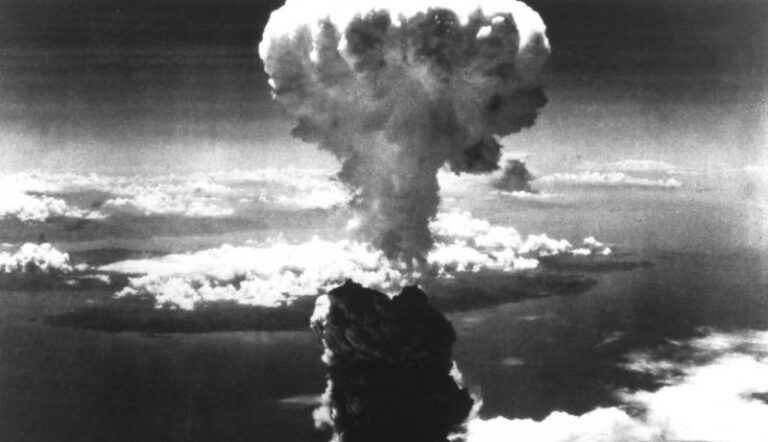
August 6th, 2020 marks the 75th year of the World’s First Nuclear Bomb Attack on Hiroshima in Honshu Island of Japan. At 8.15 AM that the nuclear weapon ‘Little Boy’ was dropped on Hiroshima by the American bomber plane ‘Enola Gay’. Just three days later, on 9th August 1945, Nagasaki city in Japan’s Kyushu Island was devastated with ‘Fat Man’.
A 1998 study posited a figure of 202,118 registered deaths resulting from the Hiroshima and 40-80,000 in Nagasaki. Half of the deaths happened on the same day. Large numbers of people continued to die for months afterward from the effects of burns, radiation sickness, and other injuries, compounded by illness and malnutrition. In both cities, most of the dead were civilians and they accounted for more than 90% of all deaths registered.
Each year, visitors gather in thousands in remembrance and support of the victims of the biggest man-made humanitarian disaster at the Hiroshima Peace Memorial Park. However, owing to the covid pandemic outbreak only the survivors known as ‘hibakusha’, their relatives, and a few dignitaries were allowed to gather at Hiroshima’s main event. Many of them dressed in black were wearing masks and offered silent prayers.
“We must never allow this painful past to repeat itself. Civil society must reject self-centered nationalism and unite against all threats… We must unite against threats to humanity and avoid repeating our tragic past.” – Shinzo Abe (Prime Minister of Japan)
Prime Minister Shinzo Abe pledged Japan’s commitment to a nuclear-free world by stating that the country would bridge between world nuclear powers to reach common ground on the issue.
In order to bring about a world free of nuclear weapons, we must carry out our mission of passing down to future generations, beyond borders, the memory of the atomic bombings, never allowing it to fade away. I renewed my resolution in this regard. (4/4)
After offering the prayers for those who lost their lives, Hiroshima’s Mayor Kazumi Matsui spoke about the present global scenario and that world must unite against global threats including the coronavirus pandemic outbreak.
He also added, “We must never allow this painful past to repeat itself. Civil society must reject self-centered nationalism and unite against all threats… We must unite against threats to humanity and avoid repeating our tragic past.” urging everyone to work towards a nuclear-weapon-free world and demanded that Japan sign and ratify the United Nations Nuclear Weapons Ban treaty adopted in 2017.
Even after 75 years of one of the biggest attacks on humanitarian understanding and fraternity, the world has failed to understand that it had to come together against the use of nuclear arms. The number of nuclear weapons that stood at more than 70000 weapons at the peak time of the Cold War era has steadily reduced since the late 1980s. However, by the end of 2019, it was estimated that around 14000 nuclear weapons existed. Though the USA and Russia together own more than 90% of these nuclear weapons, they are modernizing their nuclear arms. Even the other countries with smaller nuclear arsenals are either developing and deploying newer systems or have expressed intentions to do so which is alarming. Even more alarming is the trend of the nations to hide statuses about their nuclear weaponry. Even the military spending of almost all regions of the world have seen increases. It is only in the Sub-Saharan African region that we witness a reduction in military expenditure.
These indicate the trends of embracing violence can also be attributed to the rise of hyper-nationalistic discourses across the major world nations. Even in India, one can witness the rise of the hyper-nationalistic discourses as violence is welcomed over peace. A case in point is how the media outlets reported the issue of India-China territorial conflict. The disputes occurred in June 2020 between the two nuclear-armed superpower nations of the South-Asian region in June 2020. The media houses, especially the TV media both at the national and regional levels largely had irresponsibly and dangerously pushed for war in its rhetoric. They completely dismissed any thoughts on the need for maintaining peace and resolving territorial disputes with diplomacy. The media failed to take note that war is always an indicator of the failure of diplomacy and negotiations.
At these times, the world must unite – right from the grassroots against not just the use of nuclear weapons but also against all forms of human rights violations, more so against the state-sponsored human rights violations. We must care for citizens of our nation and also of other nations, especially of the “third-world” nations. We must push for peace-building and socio-economic and cultural equality among all nations and communities by addressing other immediate and important concerns and join in with the survivors of the nuclear attacks.
Read About:Lebanon: Massive explosion in Beirut kills 100 and counting