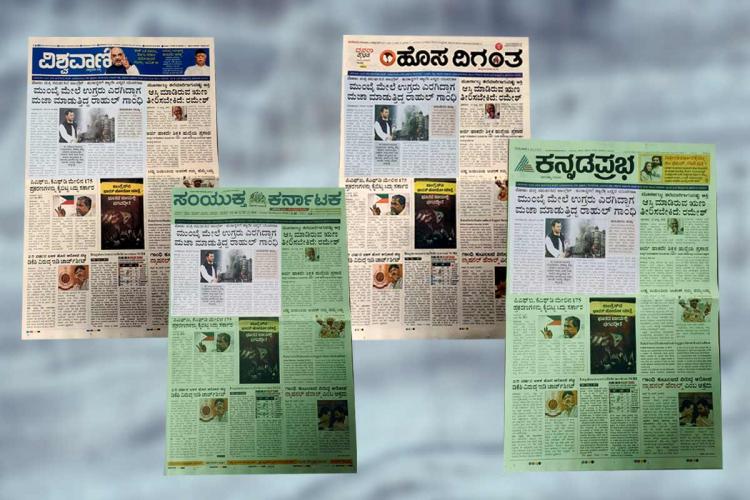
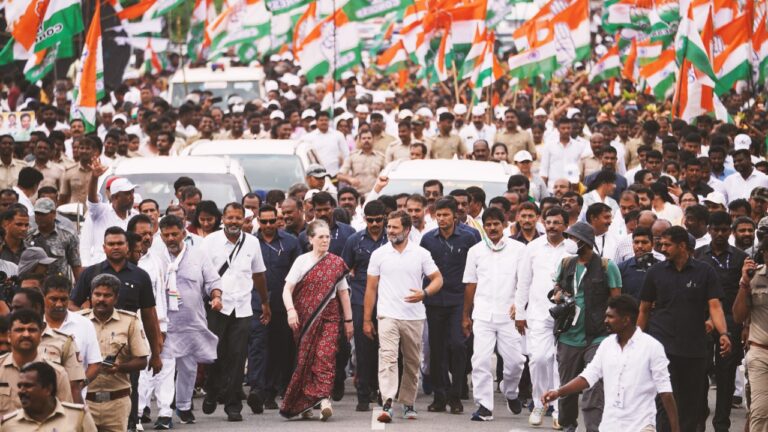
On the 5th day of the Bharat Jodo Yatra, Congres former president Sonia Gandhi joined the Bharat Jodo Yatra. On the same day, BJP has advertised offensive and derogatory news about Rahul Gandhi and the congress party. The Identical news with the same text, and format appeared in 4 news dailies namely Vishwavani, Samyukta Karnataka, Hosadigantha, and Kannada Prabha.
“Rahul Gandhi was having fun during Mumbai terrorist attack” was the title of the article in all four newspapers. The content went further mocked Tipu Sultan Jayanti, the National Herald newspaper and opposition leader Siddaramaiah, KPCC President DK Shivakumar, former Speaker Ramesh Kumar,
Many have reacted to the ad saying it represents the abysmal level of politics that the BJP represents and the fact that it could not tolerate the success of Bharat Jodo Yatra in Karnataka. Also, they have condemned and criticized the 4 newspaper for publishing ads that goes against the spirit of journalism.
PC:newsminute.com
“This is the worst ad ever. This is proof that journalism has reached rock bottom. BJP has given lead news advertisements with design and heading to all three newspapers. The bills for this might also be expensive. Even if other newspapers have done it, Kannada Prabha should not have been tarnished and brought to the streets like this” said Dinesh Kumar Dinoo who is a journalist and an activist.
Senior journalist Rajaram Thallur has opined that “After seeing the front page BJP news from the 4 newspapers one thing is clear. BJP and its sangh parivar were saying Rahul has raised a family. That is, the BJP itself has accepted that Rahul is no longer Pappu. They now feel that Rahul is a serious competitor for power. So, for the first time, without using the word “Pappu”, they have made a serious political charge against Rahul Gandhi. This is the result of the BJP and its Parivar feeling that Rahul’s Bharat Jodo Yatra is a political success. To this extent Congressmen should be happy about these advertisements”
Bellary: Bellary Zilla Gani Karmikara Sangha (Bellary District Mine Workers’ Association) affiliated to All India Central Council of Trade Unions (AICCTU) will be organizing a 70 km protest march from Sanduru town in Bellary district to the District Collector’s office at Bellary demanding the implementation of Rehabilitation and Resettlement (R & R) Policy for All Mine Workers on 11th, 12th and 13th October 2022.
All the mining activities had come to a grinding halt after the Supreme Court had ordered the closure of Iron-Ore mines in the district in July 2021 and thus, 25,000 workers had lost their jobs overnight. However, no steps had been taken for their rehabilitation.
Why did workers lose their jobs post the SC Order?
Speaking at the press conference in Bellary, AICCTU State President Clifton D Rozario explained the issue in detail stating that-
“With the order of the Hon’ble Supreme Court in July 2011, all mining activities were stopped in several mines in Bellary district without complying with several provisions relating to retrenchment of workers and several labour laws were violated in the process. As a result, more than 25,000 workers lost their jobs and were left by the streets without being provided any compensation or rehabilitation. Using the Supreme Court order as a pretext, the mine owners had denied the workers their statutory rights including retrenchment compensations.”
He further stated that the mine owners had to comply with the provisions of the Industrial Disputes Act and other relevant laws before dismissing the workers. However, none of these provisions were complied with and entire families including young children and elderly people were pushed to face hardships. He estimated that almost 1 lakh people were caught in trouble due to the non-compliance with various provisions.
Workers’ situation then-
The condition of the Bellary mine workers has been deplorable since the beginning and that they had even risked their lives to work at the mines. These workers are from the most vulnerable and marginalized communities and are not even paid minimum wages. The work that the workers were put into had been life-threatening and they were not even provided any basic facilities and proper safety equipment.
Workers’ situation Now-
Elaborating on the situation of workers today, Clifton stated that, “while employment opportunities are being recreated as several mines have now resumed their operations, the statutory right of first priority in employment to the workers who have undergone illegal retrenchment cannot be denied. However, some mines had taken to employing illegal system by hiring new persons, especially migrant workers from other states through contract system without following the law. He also expressed outrage that the mining companies have completely violated labour laws by not providing jobs to the miners who lost their jobs despite the resumption of mining activities.
In R&R, a comprehensive plan is being prepared and implemented for environmental revival of mine-affected areas among other departments. However, the mine workers and their families who are in financial distress due to job loss are neglected.
Demands Made Under R&R
AICCTU state committee member, Nagaraj Pujar said, “All mine workers should be given comprehensive rehabilitation and employment in R&R. Land should be allotted to all mine workers and houses should be built. Anganwadi, community hall, library, labour centre, primary health centre and other necessary infrastructure must be provided in the area where the mine workers are living. A hospital should be built for the miners and free medical services should be provided miners’ families. He also demanded that free education and subsidy for higher education along with financial assistance for marriage be provided to mine workers’ children.
The protest march will start from Sandur APMC market on October 11 and will continue until the Bellary district administration office is besieged on October 13.
Bellary District Mine Workers Association President Y. Gopi, Vice President M. Malliswamy, General Secretary A. Yariswamy, Honorary President P. Venkatesh were also present in the press conference.
Its been one year since theLakhimpur Khiri incidentwhere protesting farmers were mowed down by BJP MP Ashish Mishra. On the anniversary of the incident, Rahul Gandhi who is on a nationwide Bharat Jodo Yatra to unite the people of the country tweeted about giving justice to the victims. He also tweeted that Farmer’s agitation was the inspiration for Bharat Jodo Yatra.
In his tweet, he said, “Even after one year Lakhimpur Kheri martyrs have not got justice because of only one reason – BJP protects the criminals. When we decided to do #BharatJodoYatra, the farmers’ movement was a big inspiration for us. This struggle will not end without providing justice to the Annadaatas.”
ವರ್ಷ ಕಳೆದರೂ ಲಖೀಂಪುರ ಖೇರಿಯ ಹುತಾತ್ಮ ರೈತರಿಗೆ ನ್ಯಾಯ ಸಿಕ್ಕಿಲ್ಲ.
ಕಾರಣ ಒಂದೇ – ಬಿಜೆಪಿ ಯಾವಾಗಲೂ ಅಪರಾಧಿಗಳನ್ನು ರಕ್ಷಿಸುತ್ತಿದೆ.
ನಾವು #ಭಾರತಐಕ್ಯತಾಯಾತ್ರೆ ಮಾಡಲು ನಿರ್ಧರಿಸಿದಾಗ, ರೈತರ ಚಳುವಳಿ ನಮಗೆ ದೊಡ್ಡ ಸ್ಫೂರ್ತಿಯಾಗಿತ್ತು.
Congress leader Rahul Gandhi launched the ‘Bharat Jodo Yatra’ (Uniting India rally) in Kanyakumari on September 7. The yatra is being billed by the party as the longest rally mounted in the country over the last century.
Urging everyone to participate in the yatra, Congress stated that the rally is meant to provide an alternative to the “politics of fear, bigotry, and prejudice” and to the economics of livelihood destruction, increasing unemployment, and growing inequalities.
The Congress asserted that its ‘Bharat Jodo Yatra’ from Kashmir to Kanyakumari is not a ‘Mann Ki Baat’ in any manner, but its objective is to ensure that the concerns and demands of the people reach Delhi.
The march will cover 12 states and two Union territories. It will be about 3,500 km long and will be completed in about 150 days, senior party leader Jairam Ramesh told reporters last week.
Jairam Ramesh said simultaneously with the main yatra, there will be separate small Bharat Jodo Yatras in states such as Assam, Tripura, Bihar, Odisha, Sikkim, West Bengal, and Nagaland.
It will cover a distance of 511 kilometers across 21 days in Karnataka, the party’s state president D K Shivakumar said on Monday.
On day 23 of the yatra, Rahul Gandhi received a grand reception in Mysore. He also visited the Lingayat muth and Gandhi ashram there.
In the pouring rain, he gave a rousing speech saying nothing can stop the march. As the rain poured, people could be seen holding chairs over their heads. “It’s raining and we haven’t stopped the yatra. Come heat, cyclone or cold, we are not going to stop,” the senior Congress leader said.
Braving the rain, he launched a scathing attack on the BJP-led state government, accusing it of corruption and saying that it took 40 percent commission for sanctioning work. “Neither has the Prime Minister taken any action against it nor has the Chief Minister,” Rahul said.
The Yatra is taking a 2-day break due to Ayuda Puja Festival and the Dusshera festival. The yatra will resume from Pandavapura of Mandya district on 6th October.
Honnavar: CBI has filed a B report(closure report) after 5 years of investigating the death of Paresh Mesta in the coastal town of Honnavar, Karnataka.
CBI in its investigation has found that Paresh’s death was caused due to drowning and not murder as was said by state BJP leaders. BJP lies were amplified by the media and the Sangh Parivar. Paresh’s death was sensationalized by media and Sangh Parivar in the runup to the 2018 elections accusing the Congress government headed by Siddariamiah of trying to cover up the political murder of their activist.
Though there is no evidence he was linked to Sangh Parivar, BJP claimed that he was a Sangh Parivar activist after his death.
The intensity of the protests by Sangh Parivar in the streets, social media, and communal media had forced the Siddaramiah government to hand over the investigation to CBI 10 days after his death came to light.
Communal Politics over Death of Paresh Mesta
18-year-old Paresh Mesta who hailed from fishermen’s community went missing in the coastal town of Honnavar on 6th December 2017 after clashes broke out between Hindus and Muslims. Two days later his body was found floating in the Shettikere lake near a temple in Honnavar town. Protests erupted in neighboring towns, villages, and districts. BJP spearheaded a campaign of “Justice for Paresh Mesta”. BJP and Sangh Parivar did a propaganda blitz and campaigned against congress in Uttara Kannada, Udupi, Shivamogga, and Dakshina Kannada districts accusing it of trying to shield the murderers and destroying evidence.
BJP State general secretary and MP of Udupi Chikkamagalur constituency Shoba Karadlaje alleged that Paresh’s Body has been mutilated, castrated and the head was slipt with a weapon by ‘Jihadi elements.
Uttara Kannada District MP Ananth Kumar Hedge accused the Congress government of destroying evidence and protecting Muslims from this heinous crime. He even warned the Congress government to be prepared for Marikamba Habba(Local Sacrificial Festival) alluding to violence. Every BJP and Sangh Parivar activist amplified the death of Paresh to feed their electoral needs.
Translating Communal Clashes to Electoral Gains
Though police and the doctor who conducted Post morterm in Kasturba Medical College, Mangalore, denied all the claims of torture and mutilation by the BJP. Despite that, the protests intensified. Several Muslims were attacked during this period and the local bar associations took unofficially not to take up Muslim men accused in December 6th clashes. People were urged to vote and avenge the death of Hindus under the congress government.
Media coverage of Paresh’s death
BL Santosh, the now National General Secretary of BJP tweeted about Paresh during elections along with other alleged Hindutva activists. Posters projecting Paresh as a Hindu tiger came up across the coastal and Malnadu region. The entire coastal towns were gripped with communal tensions. BJP had won only 1 seat out of 6 in Uttara Kannada and 1 in 8 in Dakshina Kannada, None in Shivamogga, 1 out of 5 in Udupi, and 2 out of 5 in Chikkamagalur districts in the previous 2013 elections. BJP after this communal campaign BJP had won 4 out of 6 in Uttara Kannada, 7 out of 8 in Dakshina Kannada, 6 out of 7 in Shivamogga, 5 out of 5 In Udupi, and 4 out of 5 in Chikkamagalur Districts in 2018 Assembly elections.
I voted …. Rudresh , Sharath Madivala , Deepak Rao , Paresh Mestha & 10s of other’s flashes in front of my eyes while pressing the button … #KarnatakaVotes4BJPpic.twitter.com/PaiF0u6KYn
“The CBI report of the Paresh Mesta death being an accidental one and not a case of murder is a slap in the face of the Karnataka BJP. The BJP should apologise for the false allegations made against us,” “Behind every seat won by the BJP in 2018, there is the blood of innocent youth like Paresh Mesta. The blood of innocent people is stuck to the seat of power that is being currently enjoyed by the BJP in Karnataka.”
Courtesy: Satish Acharya
Mysore: Police resorted to lathi charge near VC Farm Gate in Mandya enroute Mysore after farmers from the region had hit the streets protesting against the anti-farmer policies adopted by the BJP Government in the state of Karnataka.
The farmers along with their cattle and pets had hit the streets at eight different locations attempting to block entry to the ‘Cultural City’ Mysore on the most important day of Dasara Festivities which is marked by the world-famous Jamboo Savari (Elephant Procession). The incident has been reported from one such blockade at VC Farm Gate near Mandya where 150 farmers have been arrested and 1 farmer was left seriously injured.
Demands of the Farmers
The farmers had hit the streets upon the call of Karnataka Rajya Raitha Sangha (KRRS), against the indifference of the chief minister Basavaraja Bommai towards farmers’ issues. While the farmers had placed before the government a 22-point demand charter, the major demands included:
The price for a tonne of sugarcane be set at Rs. 4500 alongside
Declaration of the Agricultural Support Programme
Permanent stopping of Illegal mining around Krishna Raja Sagar (KRS) dam and
Repeal of amendment to Karnataka Electricity Act
The farmers’ outfit had planned to have the roadblocks at eight different entry points to the city of Mysore including Mandya, Maddur, Malavalli, T. Narasipura, Ilwala, Nanjanagudu, Srirangapatna, and KR Pete. It was also reported that the state had heightened the security late at night by resorting to heavy police deployment across the city.
Speaking to the media, Madhuchandan SC, President of Mandya District Milk Producers’ Struggle Committee and Founder of Organic Mandya stated, “The Government had to listen to the issues faced by the farmers and address them. However, it has resorted to quelling our voices. However, we, the annadatas will not back off. If a fair price is not provided for our products, a huge struggle will have to be waged and the government will have to face the consequences”.
Fact-checkers Mohammed Zubair and Pratik Sinha are among the contenders to win the 2022 Nobel Peace Prize, reports Time.
Founder of the fact checking website Alt News, Pratik Sinha and Mohammed Zubair are among the contenders to win the 2022 Nobel Peace Prize according to report by Time magazine.
Journalists Pratik Sinha and Mohammed Zubair, co-founders of Indian fact checking website AltNews, have relentlessly been battling misinformation in India, where the Hindu nationalist BJP party has been accused of frequently stoking discrimination against Muslims. Sinha and Zubair have methodologically debunked rumors and fake news circulating on social media and called out hate speech.
Mr Zubair was arrested in June this year by the Delhi police for a or a meme he tweeted four years ago.
Journalists around the world condemned the arrest and argued it was retribution for his fact-checking work. “It is apparent that AltNews’ alert vigilance was resented by those who use disinformation as a tool to polarize the society and rake nationalist sentiments,” said a June 28 statement from the Editors Guild of India. The Committee to Protect Journalists also called for Zubair’s release—pointing to his arrest as “another low for press freedom in India, where the government has created a hostile and unsafe environment for members of the press reporting on sectarian issues.”
The winner of the Nobel Peace Prize will be announced at 11am local time on Friday in Oslo, Norway.
The Peace Prize is one of six awards established by Swedish chemist (and inventor of dynamite) Alfred Nobel in 1895. The prize is considered the most expansive in its recognition, given that it awards people “who have conferred the greatest benefit to humankind.” The other five recognize contributions in literature, physics, chemistry, physiology or medicine, and economic sciences.
The winner is selected by the five-person Norwegian Nobel Committee, which is appointed by Norway’s parliament.
There are about 343 candidates – 251 are individuals and 92 are organizations – in the running for the Nobel Peace Prize for 2022.
Other Favourites
The other nominees include Ukrainian President Volodymyr Zelensky,The World Health Organization, Climate activist Greta Thunberg, Nature broadcaster David Attenborough, Belarusian opposition politician Sviatlana Tsikhanouskaya,Pope Francis, Tuvalu’s foreign minister Simon Kofe, and Myanmar’s National Unity government.
Other contenders
Bookmakers also mention Uyghur activist Ilham Tohti, Hong Kong pro-democracy advocate Nathan Law Kwun-chung, the Kyiv Independent, the European Convention on Human Rights, and the Center for Applied Nonviolent Action and Strategies (CANVAS).
The Peace Research Institute Oslo—which researches peaceful relations between states, groups, and people—releases an annual personal shortlist for the Peace Prize. This year, their picks for the prize included some other names and groups, such as Indian activist Harsh Mander, the International Court of Justice, Hong Kong activist Agnes Chow Ting, and the Human Rights Data Analysis Group (HRDAG).
Belthangady: Sangh Parivar outfit, the Vishwa Hindu Parishad and Bajrangdal known for its involvement in hate crimes and bombings across the country has evoked a controversy yet again.
This time around, the Belthangady taluk unit of the Vishwa Hindu Parishad (VHP) and Bajrangdal had on the occasion of the Auydha Puja had given a call to perform ‘puja of weapons’ in open. The incident was reported in Belthangady taluk of Dakshina Kannada district in Karnataka.
The Belthangady taluk unit of Communist Party of India -Marxist (CPIM) has demanded that the district administration and the Police Department must immediately intervene and stop the same.
They also issued a warning that if in case the district administration and the police department fails to step in and stop this, then the progressive organizations of the taluk will be forced to intervene and that the responsibility for the consequences thereafter must be shouldered by the government.
They also remarked that “An RSS leader had recently submitted an affidavit to the Supreme Court stating that it was involved in bomb blasts across the across in pursuance of its political gains. In continuation of such terrorist acts, the Sangh Parivar in the name of ‘Ayudha Puja’ has openly displayed guns, pistols, swords, trishuls and are found offering pooja to the same.”
In a significant development a delegation of 5 Muslim intellectuals namely former chief election commissioner S Y Quraishi; former senior bureaucrat Najeeb Jung; former AMU vice-chancellor and Lt Gen (retd) Zameer U Shah; politician-cum-journalist Shahid Siddiqui (presently with RLD); and businessman Saeed Shervani [Samajvadi Party] met RSS Supremo, Mohan Bhagwat at RSS Delhi headquarters (The Indian Express, September 22, 2022). The meeting was kept secret for reasons known to the participants and was held in August.
According to the Muslim intellectuals the meeting held in “a very cordial” atmosphere continued for 75 minutes whereas time allotted was 30 minutes! In a post-meeting justification of the parleys Quraishi stated (The Indian Express, September 26) that their main concern was “the insecurity being increasingly felt by the Muslim community in the wake of recurring incidents of lynching of innocents, calls by Hindutva hotheads for genocide and the marginalisation of the community in almost every sphere”.
This delegation consisting high-ranking former Indian government administrators, a top-most military commander and two members of Parliament was expected to be familiar with the protocols of a democratic constitutional polity that the above mentioned issues fall in the realm of governance. They should have met Indian PM or Home Minister to demand corrective measures. If not satisfied they should have approached the President of India. However, they decided to approach RSS top brass which has no legal sanctity.
They may rightly argue that since RSS controls BJP [RSS does not hide the fact that BJP is its political appendage (RSS Hindi publication Parm Vaibhav ke Path Per, 1997) and BJP rulers from PM to most of his cabinet members, BJP CMs and Governors of States publically declare to be RSS members) why not approach the source of Power itself! This meeting with an extra-constitutional authority is tantamount to justify the extra-constitutional role played by Sanjay Gandhi during the Emergency. Did these Muslim intellectuals believe that they were living in the Emergency times?
Golwakar || Courtesy: Wikipedia
This model opted by Muslim intellectuals presents a horrendous option for other minorities in India. By this logic Hindus, Sikhs and anti-Islamist Muslims being targetted by Islam-o-fascists in Jammu Kashmir should approach organizations like Hizbul Mujahideen, and Jaish-e-Mohammed for securing safety of life and property!
Another troubling issue is how these Muslim intellectuals came to the conclusion that RSS represents all Hindus of India. Have they lost faith in common Hindus of India who do not support RSS and remain faithful to the democratic-secular polity of India?
Muslim intellectuals wishing to open Hot Line with the de facto ruler of India, RSS should have done home work on cow-slaughter before the meeting. It was the most important ideologue of RSS, MS Golwalkar who claimed in 1966 (RSS publication ‘Spotlight’) that cow-slaughter began with the arrival of Muslims who wanted to “stamp out every vestige of self-respect in Hindus”. It is not corroborated even by Swami Vivekananda who stated (February 2, 1900): “You will be astonished if I tell you that, according to old ceremonials, he is not a good Hindu who does not eat beef.” The beef-slaughter as a Muslim crime is the creation of RSS hate propaganda. Large number of Dalits and Christians too consume beef. The Muslim intellectuals should have informed Mohan Bhagwat that RSS-BJP run governments in Goa, Karnataka and all North-eastern States allow cow-slaughter. Then why punish Muslims and Dalits only?
RSS organizations have been in the forefront of spreading the bogey that Muslims in few decades would outnumber Hindus in India. The Muslim intellectuals should have shared with Mohan Bhagwat that despite 1000 years of Muslim rule (as claimed by RSS) the first census in India held in 1871-72 recorded: “140½ millions of Hindus and Sikhs, or 73½ per cent., 40¾ millions of Muslims, or 21½ per cent.” Now Muslims constitute only 14% of the population. He also should have been told that in USA, Australia, Canada, New Zealand and UK population of Hindus has increased by almost 100% in last one decade or so. Should it be a matter of alarm for Christians of these countries? Only Racists bother about increase/decrease in population of any section in their respective countries.
Muslim intellectuals looking for salvation at the altar of RSS must not forget that Muslims/Islam or other minorities in India can survive only when Indian democratic-secular-egalitarian polity framed under the guidance of Dr. BR Ambedkar survives. It may have many infirmities but is the only guarantee against majoritarianism or Hindutva bigotry.
In this regard RSS is not only antithetical to Muslims but Indian democratic-secular Constitution. The Indian Constituent Assembly approved the Constitution on November 26, 1949. RSS instantly rejected it through an editorial in its English organ Organiser (November 29) demanding promulgation of Manusmriti. Earlier RSS icon VD Savarkar had declared it as the most worshippable scripture after Vedas. It is to be noted that Manusmriti decrees sub-human status for Hindu women and Sudras. It was burnt on December 25, 1927 in the presence of Dr. Ambedkar during Mahad agitation who also called upon to commemorate every 25th December as ‘Manusmriti Dahan Divas’.
RSS hated every symbol of democratic-secular Indian polity. On the eve of Independence Organiser (August 14, 1947) denigrated the National Flag by declaring that it will “never be respected and owned by Hindus. The word three is in itself an evil, and a flag having three colours…is injurious to a country.” In the same issue, in an editorial (‘Whither’) RSS rejected the whole concept of a secular state by arguing: “in Hindusthan only the Hindus form the nation and the national structure must be built on that safe and sound foundation…the nation itself must be built up of Hindus, on Hindu traditions, culture, ideas and aspirations.”
Quraishi gleefully informs us that Mohan Bhagwat emphasized on 3 things: “Hindutva is an inclusive concept in which all communities have equal room…the Indian Constitution is sacrosanct, and the entire country has to abide by it. He sought to dispel the fear that RSS is seeking to abandon the Constitution at the first opportunity. And, that Muslims will not be disenfranchised.” If Muslim intellectuals were familiar with Savarkar’s Hindutva (1923) and Golwalkar’s We or Our Nationhood Defined (1939) and Bunch of Thoughts [1966] these claims would not have gone unchallenged. The first two Holy Books for RSS demand the cleansing of Muslims (and Christians) from India as Jews were cleansed by Hitler in Germany. The last one has a chapter (XVI) titled ‘Internal Threats’ which declares Muslims and Christians as enemy number one and two and describes Indian Constitution as worthless and anti-Hindu. Mohan Bhagwat has never disowned these works.
Interestingly, RSS has not issued any statement corroborating the Muslim intellectuals’ version. In fact, according to press reports RSS prachar pramukh (national publicity chief), Sunil Ambekar declined to comment.
It is sad that a group of Muslim intellectuals on behalf of “the middle class and educated Muslim” as confessed by Shahid Siddiqui is legitimizing an organization which is waiting for an opportune time to finally demolish the largest democracy in the world. They did not bother to confront the RSS chief with the facts of the pauperization of ordinary Indians, mounting unemployment, hunger, and violence against women. These issues should have been the main concern as Muslims standing at the lowest pedestal socially, financially, and politically are naturally the worst sufferers. Sadly they did not touch the wide use of terror laws by the government run by the RSS cadres under which a large number of Muslim activists and non-Muslim activists are being kept perpetually in detention. These are critical times for the Indian democracy; if it is demolished there is no possibility of surviving of minorities including Muslims. India needs intellectuals who stand in defence of the Indian democracy and not restrict themselves to demand security for a minuscule section of one particular community from an extra-constitutional power centre.
[An edited version appeared in the Indian Express, Delhi, September 27, 2022.
On 25 September 2022, Italy held a snap election following the government crisis. The Brothers of Italy Party emerged as the single largest party with nearly a quarter of the popular vote. As head of a right-wing collation comes Giorgia Meloni. Meloni will be the most right-wing leader of Italy since Mussolini. She is a proponent of the White Replacement theory that says that the white population is disappearing and will be replaced by racial minorities, and to stop this, Italy must stop immigration and kick racial minorities out of the country.
The election comes after many years of political instability and populist politics. The rightward shift in Italian politics can be seen as a result of frustration with the crisis of the previous government. The crisis began on 14 June 2022, when Italy’s Five Star Movement refused to support a proposal of Italian President Mario Draghi regarding support for the cost of the living for Italians. The Five Star Movement, which supports a uniform basic income for all Italians insisted that the bill did not go far enough. This led to the dissolution of the Italian Parliament. The coalition government led by Mario Draghi lost critical support leading to the need for new elections. The Draghi-led coalition was an unstable coalition that tried to unite political parties of conflicting ideologies. Five Star itself recently went through a split in the context of the Russian invasion of Ukraine. Some members of the party felt that Italy should not be involved in conflicts regarding NATO or the EU, and opposed Draghi’s opposition to Russia.
Origins of this Government
In 2018, Italy had its most recent general election. No party was able to secure a majority. The largest party was the Five Star Party. The Five Star Party was founded by Italian comedian Beppe Grillo in 2009. He began expressing jokes and criticism against the rampant corruption of Italian politicians on his blog, which coalesced into a movement of people seeking to change the system. Grillo’s humour was profane, racist and misogynistic, but conveyed a feeling of being beyond ideology. Many people felt that he was telling the truth in a straightforward way. His followers liked his style of transcending euphemisms and political doublespeak. He did not have a clear ideology. Most of his followers would revolt against the elite classes, but they did not have many concrete political programs. Rather they were reactionaries. Most of them were suspicious of the European Union. The Five Star movement was a reactionary party that capitalized on the frustrations many Italians had with the Italian political elites. Italy had been plagued with many scandals, sexual, political and monetary. It is hard to classify Five Star as either left or right wing. They supported certain environmentalist policies. They supported a Universal Basic Income for all Italians. They opposed immigration and promoted xenophobia against the migrant population in Italy.
Five Star Movement
Initially, Five Star tried to enter into a coalition with the League, a far Right-Wing party to form the government. This coalition lasted a year when the League broke the coalition. Five Star then formed a coalition with the Democratic Party, a centre-left party, and the Free and Equal Party, a left-wing party. This coalition also lasted a year due to fighting within the Democratic Party.
The split came when the European Union provided a stimulus package to its member countries. Within the Democratic Party, there were two camps. One felt it should spend the package on infrastructure projects. The other felt it should be directed by an expert committee. The fight became politicized and polarizing leading to the collapse of the government.
Enter Draghi
Unable to form a stable coalition with either the left or right parties in the Parliament, it looked as if Five Star would not be able to form another government. However, with the pandemic raging on, it was not feasible to hold another election. Former Governor of Bank of Italy and the President of the European Central Bank, Draghi was seen as a neutral technocratic bureacrat. Unlike the Five Star party, which was seen as appealing to popular sentiments and was also directionless, Draghi believed in consulting expert opinion. He was known as a banker and an administrator. This was seen as an important step in managing Italy through the COVID-19 Pandemic. Draghi was thought to be able to take hard but needed decisions, and was good at implementing policies. Italy was one of the first countries to have experienced the full weight of the pandemic the year before.
Mario Draghi
Big businesses welcomed Draghi as he was close to them as a banker. They worked with him to protect their interests during the pandemic when public sentiment turned to welfare programs and redistribution of wealth. Among the support base of Five Star, Draghi has been seen as a puppet of the European Union. His identity as a banker and a bureaucrat made him very unpopular with the constituency of his strongest ally.
Outside of the Five Star support base, Draghi was generally approved. Many appreciated the stability and the direction he gave the Italian government during the later part of the Pandemic. As a result, most other political parties left and right, gave conditional support to Draghi’s government. With all of the political parties of Italy behind him, Draghi managed to keep a steady ship during the pandemic. However, tensions began to surface as the crisis ended.
Cracks in the Coalition
With the Russian invasion of Ukraine, infighting began within Five Star. Two camps emerged. One was pro-Russian. The pro-Russian faction criticized NATO for its eastward expansion and for causing the Ukraine crisis. They advocated for a diplomatic solution and were hesitant to send aid to Ukraine, for fear that it would lead to an arms race in the region. The other faction was made up of Five Star politicians who felt that the pro-Russian politicians were undermining Italy’s position within the European Union. They formed a new Party called Together for the Future and left Five Star.
Things came to a head when the leader of Five Star opposed Draghi’s proposed support of Cost of living Package, insisting that it was not enough. Draghi took this opposition to his proposal as a sign that his government was on its last legs and resigned.
Future for Italy
Five Star lost a lot of support, and many of its allies have lost support among their base due to their political manoeuvres as parts of alliances with Five Star. The Brothers of Italy made huge gains. The Brothers of Italy never allied with the Five Star Party, and did not suffered the taint of politics that other parties have. The party takes a harsh stance against immigration. The future government will be xenophobic as the Brothers of Italy will make a crackdown on the Italian migrant population and consequence the informal sector of the Italian economy a priority.
On 28 January 2022, the Argentine government announced a nearly $45 billion deal with the International Monetary Fund. In response, thousands of people took to the streets of the nation’s capital in Bueno Aires answering a call by leftist civil society organizations. The protesters have called for the government to cut ties with the IMF.
The deal was a restructuring of a deal made in 2018 when Argentina went into extreme levels of inflation, leading to a heavy devaluation of the Argentine Peso. The economic crisis was sparked by a combination of drought and the return of many businesses from Argentina to the United States. This resulted in a huge loss of tax revenue and a drop in demand for the Peso. The Argentinan government then sought a loan from the IMF of nearly $50 billion and agreed to cut public spending, which later expanded to $57 billion, making it the largest loan by the IMF in history. The government managed to curb inflation slightly, but with the COVID Pandemic, the country fell into dire straights once again.
Debt trap after debt trap
Over the past 50 years, Argentina has spiralled into international debt traps. Nearly a hundred years ago, Argentina had a very large GDP. Many thought that it would dominate the Southern Americas the way the US dominated the northern Americas. The economy was extremely unequal and underdeveloped, but it was culturally and economically very influential.
Argentina has been a democracy since 1983 with elections happening regularly. However, the government was still very beholden to foreign markets. By 1985, then President Raul Alfonsin, instituted austerity measures, leading to an economic collapse in the late 1980s. The resulting collapse led to a huge public deficit and popular upheaval. The Country began borrowing from the IMF.
Rise of the Piqueteros
The labour movement was known as the Piqueteros.Piquetero is Spanish, meaning picketer, referring to their protests outside of their place of work. As jobs were cut, the Piqueteros became a national movement to protect poor working-class people. Over time, the Piqueteros became more organized in their actions. They began to make decisions by the assembly, developing support systems across working groups, and helping build worker cooperatives. They also worked with local crime mafias, leading to disrepute with the middle class, and making them targets of attack by right-wing politicians.
The Argentine Great Depression
In the late 1990s, many of Argentina’s trading partners (Latin American countries in similar situations) were getting economically weaker. Argentina then fell into depression, sometimes called the Argentine Great Depression. The economy shrank by nearly a quarter with nearly half the country living below the poverty line.
By 2001, the devaluation of the Peso snowballed, as people were getting rid of the currency however they could. The loss of value caused social unrest. Many people in Argentina blamed American and European banks. Confrontations with the police by the people were followed by the state declaring emergency at the end of 2001. The government then floated the Peso, leading many poor people to lose their savings. Many businesses left the country.
In this situation, Piqueteros started to take direct control over local factories. They would face resistance from the police, but some factory cooperatives ran. Many workers began organizing assemblies to help take care of the situation created by the crisis, creating solidarity among the poor and the working class.
The following year, the resurgent demands for Argentine goods (mostly from China) and the resolution of the South American economic crisis in other countries eased the Depression in Argentina. The government defaulted on the IMF loan and introduced a dual currency system to control devaluation. The years of hyperinflation also made Argentine goods competitive on the market, leading to the return of capital to the country. The crisis, though very present, began to ebb. Starting in 2005, Argentina began paying back its debt to the IMF on schedule using bonds, completing payments by 2006, despite the 2004 energy crisis. The payment was seen by many Argentinians as an end to the ignominious indebtedness.
Piquetero leaders began working with local governments to provide welfare schemes, losing their radical edge. Politicians began to coopt leaders in the Piquetero movement, making them lose support from traditional left groups. In some localities, they were associated with local crime, making them targets of attacks from right-wing politicians and the middle class. Eventually, the Piquetero movement fragmented.
Debt crisis: Another time around
In 2015, with rising food prices, the Argentine economy went into another crisis. The government responded with more deregulation. They floated the exchange value of the peso, reduced subsidies, and opened up capital markets. Foreign investment grew, but trouble came around the corner. In 2018, inflation began to creep in again, and the state ran out of foreign currency reserves, leading to the devaluation of the peso, repeating the follies that led to the crisis of the late 1990s. The government then applied to the IMF for its infamous $50 billion debt.
In 2020, Argentina instituted one of the strictest COVID lockdowns, leading to a 10% shrinkage of the economy amidst extreme inflation. The economic crisis led to hardships for many Argentinians who took to the streets this year. Protests continue.
Protests against IMF
Experts have argued that the popular political solutions to the Argentine crisis are too expensive, and would require higher levels of indebtedness for the country. Politicians have called for national unity in times of crisis. Protesters have demanded that the government step in and work for the people against foreign capital. Without the movements of the 1990s active anymore, the country continues to stay in gridlock. Protesters on the ground march across the country expressing anger and frustration with the current system, calling for the prosecution of its politicians and to forget its debt to there IMF. Inflation rates have reached 70% in Argentina, and have wiped out the savings of the people. They say that there is a need to pay pensions, for the education of the people, and the elimination of poverty in the country.
Read more about over coverage of crises created by IMF here.




 BJP State general secretary and MP of Udupi Chikkamagalur constituency Shoba Karadlaje alleged that Paresh’s Body has been mutilated, castrated and the head was slipt with a weapon by ‘Jihadi elements.
Uttara Kannada District MP Ananth Kumar Hedge accused the Congress government of destroying evidence and protecting Muslims from this heinous crime. He even warned the Congress government to be prepared for Marikamba Habba(Local Sacrificial Festival) alluding to violence. Every BJP and Sangh Parivar activist amplified the death of Paresh to feed their electoral needs.


 The Belthangady taluk unit of Communist Party of India -Marxist (CPIM) has demanded that the district administration and the Police Department must immediately intervene and stop the same.
They also issued a warning that if in case the district administration and the police department fails to step in and stop this, then the progressive organizations of the taluk will be forced to intervene and that the responsibility for the consequences thereafter must be shouldered by the government.
They also remarked that “An RSS leader had recently submitted an affidavit to the Supreme Court stating that it was involved in bomb blasts across the across in pursuance of its political gains. In continuation of such terrorist acts, the Sangh Parivar in the name of ‘Ayudha Puja’ has openly displayed guns, pistols, swords, trishuls and are found offering pooja to the same.”


 In this regard RSS is not only antithetical to Muslims but Indian democratic-secular Constitution. The Indian Constituent Assembly approved the Constitution on November 26, 1949. RSS instantly rejected it through an editorial in its English organ Organiser (November 29) demanding promulgation of Manusmriti. Earlier RSS icon VD Savarkar had declared it as the most worshippable scripture after Vedas. It is to be noted that Manusmriti decrees sub-human status for Hindu women and Sudras. It was burnt on December 25, 1927 in the presence of Dr. Ambedkar during Mahad agitation who also called upon to commemorate every 25th December as ‘Manusmriti Dahan Divas’.
RSS hated every symbol of democratic-secular Indian polity. On the eve of Independence Organiser (August 14, 1947) denigrated the National Flag by declaring that it will “never be respected and owned by Hindus. The word three is in itself an evil, and a flag having three colours…is injurious to a country.” In the same issue, in an editorial (‘Whither’) RSS rejected the whole concept of a secular state by arguing: “in Hindusthan only the Hindus form the nation and the national structure must be built on that safe and sound foundation…the nation itself must be built up of Hindus, on Hindu traditions, culture, ideas and aspirations.”