In a first, a hundred companies in the United Kingdom have decided to move to a permanent four-day working week for all employees with no loss of pay. Around 2,600 employees at 100 companies are set to benefit from the new working pattern.
The two biggest companies that have signed up are Atom Bank and global marketing company Awin, who each have about 450 staff in the UK.
Adam Ross, Awin’s chief executive, said adopting the four-day week was “one of the most transformative initiatives we’ve seen in the history of the company,” according to The Guardian.
Furthermore, proponents of the four-day week say that the five-day pattern is a hangover from an earlier economic age. They argue that a four-day week would drive companies to improve their productivity, meaning they can create the same output using fewer hours.
The UK Campaign is also coordinating the world’s biggest pilot scheme for about 70 companies, which employ about 3,300 workers, to adopt the four-day week in a trial with researchers at the Universities of Cambridge and Oxford, Boston College and think tank Autonomy.
In September, 88 per cent of those companies in a survey at the middle of the trial said the four-day week was working “well” for their business at that stage of the trial. About 95% of the companies surveyed said productivity had either stayed the same or improved since the introduction, The Guardian reported.
Most of the companies that have officially adopted the four-day week are in the service sector such as technology, events or marketing companies. However, the campaign said that some manufacturing and construction employers had also signed up.
Belgium had also introduced a four-day workweek for employees who want it. In February, Belgian employees won the right to perform a full workweek in four days instead of the usual five without loss of salary. The bill came into force on November 21, allowing employees to decide whether to work four or five days a week.
On the call of Samyukt Kisan Morcha (SKM), farmers, supported by workers, students, youth, women and ordinary people, held mega foot-marches and rallies yesterday.
Protest gatherings were held at 25 state capitals, more than 300 district headquarters and numerous tehsil headquarters. Altogether, it is estimated that more than 3000 protests were held all over India. More than 5 million people came out on the streets to join the ‘Raj Bhawan Chalo’ or ‘March to Raj Bhawan’ call of SKM, to register their protest against the anti-farmer BJP-led Union Govt and send Memorandum of Demand of Farmers to the President of India through State Governors, to intervene and stop the anti-farmer activity of the ruling party at the Centre.
Massive Gatherings all over India
Massive gathering of lakhs of people were witnessed at Chandigarh, Lucknow, Patna, Kolkata, Trivandrum, Chennai Hyderabad, Bhopal, Jaipur and many other state capitals.
In a massive show of collective strength more than 5 million farmers came out on the streets of India yesterday. Farmers had a list of demands
The demands include-
1) Legally Guaranteed Minimum Support Price (MSP) at C2+50% for all produce for all farmers
2) Freedom from Indebtedness through a comprehensive Loan Waiver scheme
3) Withdrawal of Electricity Amendment Bill 2022
4) Dismissal and Legal Action against Union Minister of State for Home Affairs Ajay Mishra Teni, who is accused in the Lakhimpur Kheri massacre of farmers and a journalist
5) Comprehensive and Effective Crop Insurance Scheme to speedily compensate farmers for crop loss due to natural calamities
6) Farmers Pension of Rs 5,000 per month to all marginal, small and medium scale farmers and agricultural workers
7) Withdrawal of all False Cases registered against Farmers during the Farmers’ Movement
8) Payment of Compensation to families of all farmers who were martyred during Farmers’ Movement, along with the major local demands of the respective states.
It may be recalled that the date 26th November is also Constitution Day, when our Constitution was signed and later on became the foundation of laws of the land. It was also on 26th November in 2020 that SKM had launched the historic “Delhi Chalo” movement, which became the world’s longest and largest farmers movement, and led to the astounding victory of farmers against the corporate-political nexus to oust farmers from their land and livelihood. The nationwide “March to Raj Bhawans” on 26th November marks the beginning of the next phase of the farmers protest.
Bangalore, Karnataka
In Bangalore there was a protest meet and book release on farmers rebellion from samyuktha Karnataka. A photo exhibit on yearlong massive farmers struggle by Karnataka janashakthi was also put on display.
Calcutta, West Bengal
Massive turn out of thousands in protest foot March and rally in Kolkata with people from all walks of life joining it.
Massive protests in Madhya Pradesh, Jharkhand, Chattisgarh and Chennai.
SKM congratulates all farmers, farm labourers, workers, students, youth, women and other concerned citizens for the grand success of the ‘Raj Bhawan Chalo’ program and appeals to all across the country to prepare for and join continuous and committed nationwide struggles till all the demands are met.
Media Cell, Samyukta Kisan Morcha
Anand Teltumbde walks out of Taloja Central Prison in Navi Mumbai a day after the Supreme Court dismissed the National Investigation Agency’s (NIA) plea challenging his bail.
Speaking to reporters outside the jail, the scholar-activist said, “I am happy to be released after 31 months, but it is so unfortunate the way the case was put on us.”
Teltumbde was granted bailby the Bombay High Court last Friday (November 18). The central agency challenged the order in the apex court, which dismissed its plea Friday, saying it “will not interfere”.
A bench headed by Chief Justice of India D Y Chandrachud dismissed the NIA’s appeal with a two-line order: “The SLP is dismissed. However, the observations in the impugned judgment of the High Court shall not be treated as conclusive final findings in all proceedings.”
Anand Teltumbde was arrested on ,14th April 2020, the birthday of Babasaheb Ambedkar.
Teltumbde was arrested by the NIA on April 14, 2020 after he surrendered before the agency.
The case against Teltumbde by the NIA was that he was one of the convenors of the December Elgar Parishad event, where he also had made provocative speeches leading to riots on January 1, 2018.
During the bail hearing, Senior Advocate Mihir Desai appearing for Teltumbde pointed out that as per the chargesheets against Teltumbde no terror acts could be attributed to him and hence there was no bar to release him on bail under the Unlawful Activities Prevention Act (UAPA).
Desai also pointed out that being an academician, Teltumbde was often invited for various conferences, national and international, and attending the same was not a crime.
Teltumbde is the third of the 16 accused arrested in the case to be released on bail. Telugu poet and activist Varavara Rao was granted bail on medical grounds by the Supreme Court in August this year. Lawyer-activist Sudha Bharadwaj was granted default bail in December last year.
On November 19, activist Gautam Navlakha was moved from Taloja Central Prison to house arrest in Navi Mumbai after the Supreme Court rejected the NIA’s appeal against the court’s earlier order allowing his house arrest.
The other accused, including activists Vernon Gonsalves, Rona Wilson, Surendra Gadling, and Prof Shoma Sen, remain in jail.
The Supreme Court on Friday dismissed an appeal filed by the National Investigation Agency against a Bombay High Court order granting bail to Dalit rights activist Anand Teltumbde in the case relating to his alleged role in the Bhima Koregaon violence of 2018.
A bench of Chief Justice of India DY Chandrachud (CJI) and Justice Hima Kohli said that it will not interfere with the High Court order.
“We will not interfere. Dismissed,” the Court said.
However, it added that the observations by High Court in its bail order will not weigh during trial.
The National Investigation Agency (NIA) moved the present appeal before the Supreme Court challenging a November 18 order of the Bombay High Court granting bail to the activist.
The case against Teltumbde by the NIA was that he was one of the convenors of the December Elgar Parishad event, where he also had made provocative speeches leading to riots on January 1, 2018.
The scholar had moved the High Court in September last year after the Special Court under the NIA Act had rejected his bail holding that he was a member of banned organisation, Communist Party of India (Maoist).
The High Court had passed its order granting bail after extensively hearing the bail application.
The High Court had said that there was no evidence prima facie against Teltumbde to suggest that he indulged in ‘terrorist acts’ under the Unlawful Activities Prevention Act, as alleged by the National Investigation Agency (NIA).
The bench had stated that only the offences under Section 38 and 39 (relating to membership in terrorist organisation) were made out against Teltumbde.
The maximum punishment in those offences is 10 years of imprisonment, and Teltumbde had already been incarcerated for more than 2 years in prison, the High Court had said.
In view of this, it released him on bail after payment of ₹1 lakh as surety.
The High Court had stayed its order for a week to enable the NIA to file appeal before the Supreme Court. The NIA’s petition before the top court said that the High Court erroneously granted bail to Teltumbde after conducting a “mini trial and a roving inquiry”.
It was pointed out that while hearing the bail petition, the High Court examined in detail as many as five documents seized during investigation along with three statements.
Further, the NIA contended that the High Court minutely went into the details of each document, and made observations that would influence the trial and investigation.
If Teltumbde is allowed bail, NIA’s efforts would suffer a fatal blow, it was stated.
Senior Counsel Kapil Sibal, appearing for Teltumbde, however countered the submissions.
“All the documents shown here are not recovered from me, none of them. they are not even emails,” he said.
He vehemently argued that Teltumbde is a Dalit rights activist and the foreign trip he had undertaken as alleged was sponsored by the hosting institute.
“He wrote about impact of neo liberal globalization on dalits. This is the issue, wherever there is a Dalit issue he is there. They (NIA) say he was funded for Paris visit. The institute had paid for the trip. No money comes from anywhere else,” Sibal said.
Sibal also questioned the logic in dubbing a person as associated with CPI (Maoist) merely because the person is addressed as a ‘comrade’ by someone.
“Their (NIA’s) best case is if someone refers to Anand Teltumbde as ‘dear comrade’ then he becomes an active member of the CPI (Maoist). He has travelled to LSE, MIT etc to deliver lectures etc. High Court notes that the person is of intellectual eminence. Just because he is the elder brother of deceased maoist person does not make him guilty,” Sibal said.
Source: Bar&Bench
Bengaluru: Thousands of voters expressed their anger against BBMP officials and the Election Commission after they learnt that their names had been removed from the voter list.
Names of over six lakh voters from 28 constituencies in Bengaluru Urban have reportedly been removed and voters alleged that the NGO Chilume Trust, which was revising the voter list, has targeted people from minority communities.
Nusrat Bhanu, a resident of Rahamat Nagar, said to The New Indian Express , “Our community has been targeted by the NGO and BBMP officials. My neighbours and I have been voting for 50 years and some of the vegetable vendors in the area were shocked that their names had been deleted from the list. We have had our houses here for the last 80 years. I think BJP party workers are behind this scam and they intentionally deleted 65 names in our locality.”
Karnataka: Water Tank ‘Cleaned’ with Cow Urine after Dalit Woman Drank Water from it
Syed Mehboob, an engineer from Sultanpalya, said, “They have taken away our right by removing our names. I checked the Election Commission website and also called the helpline centre which confirmed that my name has been removed. I have taken leave from work and voted for the last 15 years.”
BBMP launches campaign
District election officer and BBMP Chief Commissioner Tushar Girinath, after going through the draft voter list, said the BBMP has launched a special campaign till December 8 to allow name deletion, background identity card name addition and correction.
After visiting ward offices at various Assembly constituencies in the city, Girinath said voters should take advantage of the campaign and submit their claims and objections.
Voter Suppression
Cases like these where names of voters are removed from the voting list comes in the category of Voter suppression. Voter suppression is a strategy used to influence the outcome of an election by discouraging or preventing specific groups of people from voting. Voter suppression attempts to reduce the number of voters who might vote against a candidate or proposition.
The tactics of voter suppression range from minor changes that make voting less convenient, to physically intimidating and even physically attacking prospective voters, which is illegal. Voter suppression can be effective if a significant number of voters are intimidated or disenfranchised.
In a rather baffling incident, certain ‘upper caste’ residents of Heggotara Village of Chamarajanagar District in Karnataka drained all the water from a tank, from which a Dalit woman drank water and ‘cleaned’ it with gomutra or cow urine.
The incident occurred on November 18 during a wedding when the bride’s relatives from Sargur in HD Kote taluk had come for the wedding. After the ceremony, when they were walking towards the bus stand, one of the women drank water from the tank. A man, upon seeing this, called other villagers and they all berated the woman for sullying the water in the tank.
After the woman left the village, the residents of Lingayat Beedhi opened the taps of the tank, released all the water, and cleaned it with gomutra.
The revenue inspector and village accountant conducted a spot inspection and confirmed the incident. The officials later submitted a report to the tehsildar. ON Sunday, tehsildar IE Basavaraju and social welfare department officials visited the spot and held discussions with villagers. The officials told villagers that the water storage tank is a public property and everyone could drink water from it. The tehsildar also took over 20 Dalit youth to all public drinking water taps in the village and made them drink water, reported Hindustan Times.
Further, the tehsildar is trying to track the woman who was abused to record her statement and file a complaint, A complaint has already been registered by members of the community at Chamarajanagara rural police station.
It can be seen in this video how, in a wasteful manner, the water of the tank is being drained out for it to be cleaned later with cow urine, in a mindless bid to purify it.
In Chamrajnagar, after a Dalit woman drank water from a water tank, Brahmins purified the tank with cow urine, tried to stop her from drinking water by saying that it is the street of Brahmins, registered a case in the same water tank Dalits were allowed to drink water from… pic.twitter.com/vT38vN2ryc
It is pertinent to note here that such acts are an infringement of Article 17 of the Indian Constitution which abolishes untouchability and also are punishable as offences under the Scheduled Caste and Scheduled Tribe (Prevention of Atrocities) Act, 1989.
The Bombay High Court on Friday granted bail to Dalit rights activist and scholar Anand Teltumbde presently detained in Taloja Central Prison since 2020 for his alleged role in the Bhima Koregaon violence of 2018.
A bench of Justices AS Gadkari and Milind Jadhav pronounced the verdict today after extensively hearing the application and reserving its order last week.
The Court stayed its order for a week to enable the National Investigation Agency (NIA) to file appeal before the Supreme Court.
The case against Teltumbde by the NIA was that he was one of the convenors of the December Elgar Parishad event, where he also had made provocative speeches leading to riots on January 1, 2018.
Advocate Sandesh Patil appearing for NIA argued that the speeches made at the event were allegedly backed by a banned terrorist outfit, the Communist Party of India (Maoist).
He also produced the relevant excerpts from the chargesheets and annexed evidence to show the material that the agency had collected against the accused to show his alleged involvement in the event.
He also pointed out that Teltumbde was secretly in touch with his brother, alleged Maoist leader Milind Teltumbde, who was killed in an encounter in Gadchiroli earlier this year.
Patil also argued that Teltumbde would attend several international conferences where he would allegedly further Maoist agenda.
The scholar had moved the High Court in September last year after the Special Court under the NIA Act had rejected his bail holding that he was a member of banned organisation, Communist Party of India (Maoist).
Teltumbde in his plea also sought quashing of the order of the Special Court under the National Investigation Agency (NIA) Act rejecting his bail on the following grounds:
That chargesheet reads into thousands of pages and NIA admittedly intends to examine more than 200 witnesses; due to this it would take years to complete the trial and that would mean continued incarceration for years;
That object of bail is to secure attendance of accused at the trial, bail should not be withheld as a punishment.
The plea also pointed out that the special court order incorrectly held that he was part of banned organisation.
He submitted that the only way an organisation could be declared “banned” was after the Central government notified the same or added it under the Schedule of the UAPA.
Senior Advocate Mihir Desai appearing for Teltumbde pleaded that if bail is not granted, the minimum that should be done in his case would be to place him under house arrest instead of jail.
He pointed out that as per the chargesheets against Teltumbde no terror acts could be attributed to him and hence there was no bar to release him on bail under the Unlawful Activities Prevention Act (UAPA).
Desai also pointed out that being an academician, Teltumbde was often invited for various conferences, national and international, and attending the same was not a crime.
New Delhi– Thousands of workers from every corner of the country raised their voices in unison at the Ramlila Grounds in New Delhi, as part of ‘Mazdoor Aakrosh Rally’ organized by Mazdoor Adhikar Sangharsh Abhiyan (MASA) on November 13th.
Among the main demands of the workers were :
Workers demanded the withdrawal of the four new anti-worker labour codes passed by the Indian government.
an end to the privatisation drive of public industries and assets.
permanent and secure employment for all
Rs. 26,000 as minimum monthly wage.
a monthly unemployment allowance of Rs. 15,000
declaration of lay-offs, closures and retrenchments as illegal.
abolition of the contract system and various kinds of temporary employment
recognition of domestic-gig-scheme workers under labour laws
job security, housing, healthcare, child care for all migrant and rural workers and universal PDS.
Over five thousand workers, students and teachers from 18 states including Delhi NCR, Uttar Pradesh, Haryana, Uttarakhand, Punjab, Rajasthan, Bihar, Bengal, Assam, Himachal, Chhattisgarh, Karnataka, Tamil Nadu, Andhra Pradesh, Telangana, Maharashtra and Gujarat participated in the demonstration.
Exif_JPEG_420
The march reflected the rising disquiet within the working class in India, being pushed to the wall with rising cost of living, stagnant and even decreasing wages and rising unemployment and social insecurity.
The workers were met with heavy police deployment and barricading despite having notified the administration months in advance of the program. The march pushed aside two rounds of barricading to block the main Jawaharlal Nehru Marg towards New Delhi railway station. A delegation submitted the memorandum containing the six central demands to the President’s office.
The rally concluded with a pledge to strengthen and extend the scope of the platform and build an uncompromising, militant and continuous working class struggle against the neoliberal policies of the government.
women working as anganwadi bhajan mathsThe Rally was addressed by representatives from the sixteen constituent organisations of MASA, i.e. All India Workers Council, Grameen Mazdoor Union (Bihar), Indian Council of Trade Unions (ICTU), Indian Federation of Trade Unions (IFTU), IFTU (Sarwahara), Inqlabi Mazdoor Kendra, Inqlabi Mazdoor Kendra Punjab, Jan Sangharsh Manch Haryana, Karnataka Shramika Shakthi, Lal Jhanda Mazdoor Union (Samanvay Samiti), Mazdoor Sahayata Samiti, Mazdoor Sahyog Kendra, New Democratic Labour Front-State Coordination Committee (NDLF SCC Tamilnadu), Socialist Workers Centre (Tamilnadu), Struggling Workers Coordination Centre (SWCC, West Bengal), Trade Union Centre of India (TUCI).
Cultural performances by teams from Karnataka, Telangana, Tamil Nadu, Punjab and West Bengal energised the rally with songs of struggle and transformation.
The air reverberated with revolutionary slogans and demands representing workers from the vast spectrum of industries and regions of the country in attendance at the march as the ground was transformed into a sea of red flags.
The protest was joined by organised private sector workers from automobile, engineering, textile, garment and food processing industries including the struggling terminated workers of Maruti Suzuki, the Maruti Suzuki Workers’ Union, Belsonnica Employees Union and contract workers from Sunbeam and Hitachi in Haryana; Daikin Air Conditioner Workers’ Union and Daido Mazdoor Union from Neemrana, Rajasthan; Bhagwati Micromax, Nestle, Parle, Rocket Riddhi Siddhi, Karolia Lighting, Voltas, Intrark and other unions from Uttarakhand; unions from Hindi Motors, Kanoria Jute Mill, Bauria Cotton Mills and other units from West Bengal and Steel and Molding Workers Union (Punjab); Workers from public sector enterprises including BHEL (Uttarakhand), BSNL (WB), Eastern Coalfields Limited (WB), Singareni Collieries Company Limited (Telangana) and Indian Railways (Eastern UP); Tea Plantation workers from Jakai, Nahorkotia, Gotonga, Naginijan, Jaipur, Samuguri, Hautley, Furkating and Missamara Tea Estates in Assam and Margaret’s Hope, Dhotrey, Baghrakote, Phulbari and Peshok Tea Gardens from Darjeeling joined the rally in significant numbers. Unions of rural workers and urban unorganized sectors such as Anganwadi Workers and Helpers Union (Haryana), MGNREGA and Sarva Kamgar Union (Himachal Pradesh), Chhattisgarh Mukti Morcha Mazdoor Karyakarta Samiti (Chhattisgarh), Nirman Mazdoor Sangharsh Union (Bihar), Rural Employees Union (Haryana) and others among MNREGA, Sanitation, Construction, Domestic work, Anganwadi, Mid-day meal, IT-ITES, gig workers, loading-unloading and private transport from different states lent immense strength to the march. The mobilisation witnessed a strong presence of women workers.
Workers from Rural and agricultural areas
The program was the culmination of a four month long widespread agitational campaign on six central demands. The campaign was carried out both jointly and independently by the constituent organizations of MASA at factory gates, labour lines, fields, mines and industrial areas across the country.
Three regional conventions were held in Kolkata, Hyderabad and Delhi in the build up to the march.
The march reflected the rising disquiet within the working class in India, being pushed to the wall with rising cost of living, stagnant and even decreasing wages and rising unemployment and social insecurity.
Slogans for working class unity across lines of communal divisions, regional and sectoral differences were also raised. Such a wide ranging section of the country’s working class coming together as an organised force sent an important message to the central and state governments.
The sense of unity and camaraderie in the march is sure to bring fresh energy among all who participated in the demonstration, to organise the working class and fight back the unbridled capitalist exploitation ongoing in the country and the world today!
On 13 September, an aspiring 22-year-old law student, Mahsa Amini, from the Kurdish Iranian community was arrested by the Gast-e Ershad (Guidance Patrol, popularly known as the Morality police) for not wearing a proper head cover and for immodest attire. She was visiting Tehran. She was with her brother when she was arrested. While at the police station, her brother was told that his sister died of a sudden heart attack and brain seizure. She was taken to Kasra Hospital in Tehran, where she lay comatose for 2 days. On 16 September, he passed away in the intensive care unit.
Witnesses to her detention said that she was abused and tortured by the police. News of her arrest and hospitalization broke out on the day of her death. While Iranian police denied any allegation of torture leading to her death, reports from the hospital and other pieces of evidence surfaced that contradicted the police narrative. Protests against the Gast-e Ershad began on 16 September, starting at the Kasra Hospital and grew. The government responded by instituting an internet blackout. Protests have continued to this day. Many prominent politicians in Iran have dismissed the protesters as rioters.
Mahsa Amini
Hundreds have died in the protests and thousands have been arrested. The names of those who have died have renewed the strength of the protests, with the protests spreading across the country, including rural areas and non-Persian regions of Iran.
At the heart of the issue is Iran’s peculiar institution of Gast-e Ershad. The Gast-e Ershad is a special wing of the Iranian police dedicated to ensuring public morality and decency. They primarily enforce a dress code for women in public but have been known to come after men if they wear clothing that appears too imitative of foreign trends.
Since the 1979 Islamic Iranian Revolution, Iran implemented laws on public morality, including mandating that women wear a headscarf in public. For most of its history, these laws were enforced by the Islamic Revolution Committees, and later by the consolidated police force in 1991. The Gaste-e Ershad was established as a specialized squad of the police that reported directly to the Supreme Leader in 2005.
Gender and Economy
While the Islamic revolution lay the groundwork for enforced public morality, the women’s movement in Iran was always very active. At the local level, Iranian women were very involved in politics and made huge gains for themselves and society. This has been reflected in generations of local women’s leadership, high education levels for women, and female employment, even though high-level leadership were still held exclusively by men.
Family and Morality
The Iranian state, earlier, encouraged education for women and small families. Imam Khomeini, the Supreme leader of Iran, as well as other religious clerics, issues fatwas (religious opinions) that contraception is allowed in Islam. The government integrated family planning programs into the public health sector. The high rates of education of women meant that women were getting married later.
The family planning programs were successful, bringing the growth rate down from 4% in 1983 to 1% in 1995. The population growth rate remained stable. In the early 2000s, Iran reached the replacement fertility rate of 2 children per woman. At the same time, life expectancy grew from 53 years in 1983 to 68 years in 1995. Iran began to see an ageing population for the first time. In terms of family planning, Iran became a role model in the world, but internally, these shifts were seen as a crisis. As dangerous as overpopulation was, an ageing population was also seen as a crisis.
In 2005, Mahmoud Ahmadinejad, former mayor of Tehran and notable hardliner, became President of Iran. His Presidency was marked by a more aggressive nationalism than his predecessor. He was concerned that Iran needed to become strong, and that included having a larger population. He reversed many of the family planning policies of his predecessors. He was supported by the Supreme Leader, Ali Khamenei.
Gasht e ershad, Iran’s morality Police
Khamenei was known for his conservative and pro-market politics, though he was not as popular as previous Supreme Leaders. Ahmadinejad’s Presidency gave Khamenei more range to implement his policies. That year, he established the Gast-e Ershad, which was dedicated to ensuring women in Iran wear hijabs, and would directly report to the Supreme Leader. This dedicated centralized cultural police force became notorious for harassing women.
Economic Factors
From the late 2010s, Iran was declared a rogue state by Western powers. Iran was then burdened with heavy sanctions. This led to a weak economy. The American Obama administration was on the edge of a reconciliatory agreement with the famous Iran Nuclear deal, but his successor, Donald Trump, returned relations to a status quo, leading to Iran being isolated once more.
Since 2010, and continuing to the current day, the Iranian economy hit women’s employment worse than men’s, leading to less independence for women in the country. Women have been systematically replaced by men in the workplace, leading to high rates of unemployment for women. As the economy got worse, women have been disappearing in Iranian public spaces at an alarming pace.
Sanctions have led to a weakening Iranian Rial. The value of the Rial is nearly a tenth of what it was 5 years ago. This has led to greater costs of living for the Iranian household. For women in Iran, this has meant more extreme feelings of hopelessness and insecurity. In Iranian society, women used to have certain spaces for the assertion, which has been curtailed as a result of the current economy.
Leading up to today
As the spaces for women have shrunk, the government doubled downed on restricting their independence by encouraging women to have more children and rolling back support for contraceptives. The power of the Gast-e Ershad waned slightly under the Presidency of moderate Hassan Rouhani but has resurged under the Presidency of the conservative Ebrahmin Raisi in 2021. Raisi believes in sex segregation and the Islamization of Universities.
In light of the growing hardlining of the government and the shrinking space for women in Iran, women in Iran have raised the slogan Zan, Zendegi, Azaadi (Women, Life, Freedom), calling for an end to the draconian dress code. The slogan originated in Kurdish (Jin, Jiyan, Azadi) as part of the women’s struggle in the Kurdish regions of Turkey and Syria, but has now spread to Iran as a feminist slogan calling for the respect of women, their lives and their freedom.
The author is a mathematician and political observer based in Bangalore.
In the by-elections held for seven wards of Bijapur Municipal Corporation and Kollegala Municipality, BJP has achieved a comfortable victory.
The result has taken away the sense of comfort that the Bharat Jodo Yatra had created in some progressive circles and brought ground realities to the forefront..
Bijapur is the constituency with the highest Muslim population in the entire Karnataka… But out of the 35 seats in the Municipal Corporation here, the BJP won 17 seats, while the Congress won 10 seats. BJP has never won so many seats in the history of Bijapur elections.
Kollegala is a constituency where BSP politics is deeply entrenched.. After MLA N. Mahesh left BSP and joined BJP, 7 members elected from BSP followed him and their membership was canceled due to violation of party whip. Thus, 6 out of the 7 seats in the by-elections held for the municipal council has been bagged by BJP. BSP candidates who contested in three wards in the last election got 4, 8 and 13 votes and have lost miserably.
The Congress and the BSP, which were against the BJP on both sides, have miserably failed to understand and reverse the BJP’s caste assimilation and grassroots Hindutva politics.
This is not just a victory of BJP’s money power. Nor not just the Congress-BSP defeat.
In the rumor mills of politics, fights between rival factions of the same party, compromise agreements between opposing leaders, game of compromises and betrayals among dignitaries, and the money the BJP might have showered could be among the many reasons for this victory.
However, this victory is dangerous in the long run because it is the win by “Subaltern Hindutva” strategy of the Sangh Parivar.
For example, BJP’s victory and Congress’ defeat in Bijapur Municipal Assembly, which has the highest concentration of Muslim voters in Karnataka, can also be a political forecast for the coming days.
Out of 35 seats in Bijapur Municipal Corporation, BJP contested 33 seats and Congress 35 seats. Congress had given seats to 17 Muslim candidates. But AIMIM and SDPI also fought together as Muslims in competition with Congress. AIMIM is also successful. Congress has a strong Hindu base on that side and on the other side the Muslim base has collapsed.
On the other hand, BJP has given all its seats to Hindus only. Although seats were mainly given to strong castes, in addition to that, seats were given to Madiga, Harinashikari, Mangagarodi, Ganiga, Adi Banajiga, Handewazira, and other castes which were neglected by the Congress and other parties till now.
In reserved constituencies, BJP has given one seat to Madiga community, Congress has not given any seat to Madiga community.
In the rest of the reserved constituencies, the BJP fielded candidates from the touchable community.
Many of them have won.
Those communities who have got official recognition and status for the first time can happily support caste politics and Hindutva politics of powerful castes won by BJP…
…..and can also become mediators to take their entire community to the BJP side in the upcoming Legislative Assembly and Lok Sabha elections…….
In addition, the Sangh Parivar will not stop there.
Given the experience of North India, there is a long-term plan to make these communities foot soldiers of Hinduism.
The Sangh Parivar-BJP governments keeps patronizing a small group of these neglected communities financially and politically and hold it up as a role model for the community.
While the politics so far has prevented this community from even seeing a big dream, maintaining and nurturing this small strata will not be a big challenge for the BJP in the near future.
The Sangha Parivar provides a mythological and historical framework for worshiping this subordinate position in Brahmanical hierarchy without contradicting it.
In a region ruled by Muslim kings like Bijapur, the clan history will be filled with anti-Muslim baggage and make them foot soldiers of Hindutva.
Forget about Congress giving seats to these most neglected communities, so far they have been taken for granted and completely ignored.
In such a political context:
– Without commitment, engagement and leadership of an alternative political-cultural program to give political agency to these neglected communities…
-If the Congress or the social organizations in alliance with it, only talk of communal opposition… or
– If asked to vote for the parties that have ignored them till now..
They may think BJP and RSS better than all of them.
It is this “grassroots Hindutva” politics in Uttar Pradesh and North India that has given BJP votes and Hindutva fascism a strong grassroots base. It is now giving results in Karnataka too.
This is not only the success of Hindutva politics, but also the failure of Congress and other parties’ parliamentary politics and progressive movements.
The challenge of grassroots Hindutva politics cannot be defeated by top level electoral secular politics of Congress or other parties.
Equality-Empathy based Equality Movement which can forge a grassroots level awareness by bringing people together on the basis of their common issues can counter the politics of Sangh Parivar..isn’t it?
The author is a senior journalist and political observer based in Karnataka. The article is translated in English by Bharath Hebbal.




 The demands include-
1) Legally Guaranteed Minimum Support Price (MSP) at C2+50% for all produce for all farmers
2) Freedom from Indebtedness through a comprehensive Loan Waiver scheme
3) Withdrawal of Electricity Amendment Bill 2022
4) Dismissal and Legal Action against Union Minister of State for Home Affairs Ajay Mishra Teni, who is accused in the Lakhimpur Kheri massacre of farmers and a journalist
5) Comprehensive and Effective Crop Insurance Scheme to speedily compensate farmers for crop loss due to natural calamities
6) Farmers Pension of Rs 5,000 per month to all marginal, small and medium scale farmers and agricultural workers
7) Withdrawal of all False Cases registered against Farmers during the Farmers’ Movement
8) Payment of Compensation to families of all farmers who were martyred during Farmers’ Movement, along with the major local demands of the respective states.


 Massive protests in Madhya Pradesh, Jharkhand, Chattisgarh and Chennai.
 SKM congratulates all farmers, farm labourers, workers, students, youth, women and other concerned citizens for the grand success of the ‘Raj Bhawan Chalo’ program and appeals to all across the country to prepare for and join continuous and committed nationwide struggles till all the demands are met.
Media Cell, Samyukta Kisan Morcha


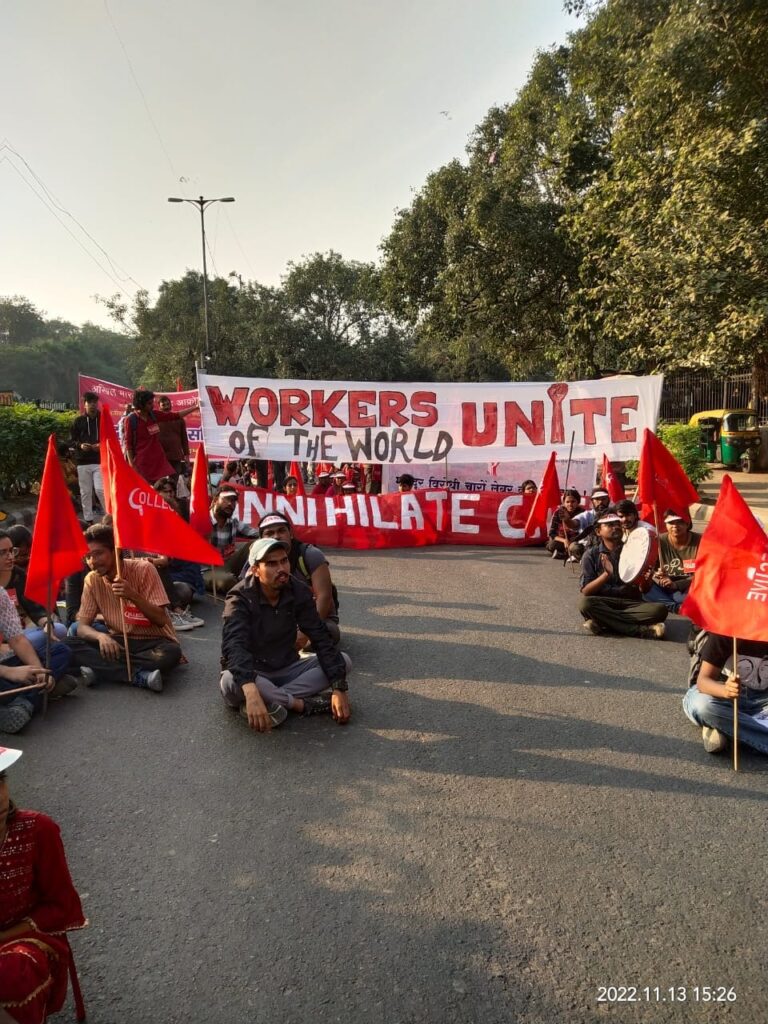


 Cultural performances by teams from Karnataka, Telangana, Tamil Nadu, Punjab and West Bengal energised the rally with songs of struggle and transformation.

 The program was the culmination of a four month long widespread agitational campaign on six central demands. The campaign was carried out both jointly and independently by the constituent organizations of MASA at factory gates, labour lines, fields, mines and industrial areas across the country.
Three regional conventions were held in Kolkata, Hyderabad and Delhi in the build up to the march.
The march reflected the rising disquiet within the working class in India, being pushed to the wall with rising cost of living, stagnant and even decreasing wages and rising unemployment and social insecurity.
 Slogans for working class unity across lines of communal divisions, regional and sectoral differences were also raised. Such a wide ranging section of the country’s working class coming together as an organised force sent an important message to the central and state governments.
The sense of unity and camaraderie in the march is sure to bring fresh energy among all who participated in the demonstration, to organise the working class and fight back the unbridled capitalist exploitation ongoing in the country and the world today!