Taliban Suspends University Education for Afghan women

In a move that will have a damaging effect on the welfare of female population of Afghanistan, Taliban regime has ordered an indefinite ban on university education for the country’s women. The order was issued by the ministry of higher education in a letter issued to all government and private universities. “You all are informed to implement the mentioned order of suspending education of females until further notice,” said the letter signed by the minister for higher education, Neda Mohammad Nadeem. The ban on higher education comes less than three months after thousands of girls and women sat university entrance exams across the country, with many aspiring to choose engineering and medicine as future careers. After the takeover of Afghanistan by the hardline Islamists in August last year, universities were forced to implement new rules including gender-segregated classrooms and entrances, and women were only permitted to be taught by female professors or old men. Most Afghan teenage girls have already been banned from secondary school education, severely limiting university intake. The move provoked an international chorus of condemnation, with the US warning the Taliban would be held to account. “This unacceptable stance will have significant consequences for the Taliban and will further alienate the Taliban from the international community,” said state department spokesperson Ned Price. The UN was “deeply concerned” by the order, said Ramiz Alakbarov, the secretary general’s deputy special representative for Afghanistan. “Education is a fundamental human right. A door closed to women’s education is a door closed to the future of Afghanistan,” he tweeted. Taliban regime is at odds with many officials in Kabul and some of their rank and file, who had hoped girls would be allowed to continue learning after the takeover.

Allies in Afghanistan: Where from here?

A day after the Taliban regime banned women students from universities, several male students at the Nangarhar University in Jalalabad and at Kandahar University in Afghanistan reportedly staged a protest and expressed solidarity with the women. The male students walked out of the examination hall at the University and stood by women’s rights in the country. Responding to the ban, the International Rescue Committee said: “The closure of universities to women and girls is a chilling step backwards for Afghanistan. There are no two ways about it: women must be allowed to work and to move freely, and girls must be allowed to continue to go to school.” Women have been pushed out of many government jobs or are being paid a slashed salary to stay at home. They are also barred from travelling without a male relative, and must cover up outside the home, ideally with a burqa. In November they were prohibited from going to parks, funfairs, gyms and public baths. In a cruel U-turn, the Taliban in March blocked girls from returning to secondary schools on the morning they were supposed to reopen. Several Taliban officials say the secondary education ban is only temporary, but have given a litany of excuses for the closure, from a lack of funds to time needed to remodel the syllabus along Islamic lines.

Fatal Attack on Ex Student Leader at Allahabad Central University 

0
Prayag Raj: Former Students who were trying to enter the campus of Allahabad Central University were fired upon by the security guards. The students have alleged that they were thrashed with sticks and iron rods. It is worth noting that for the past several months, the students’ protest is going on in the campus regarding the restoration of the student union and 40% fee hike. The incident started when Vivekanand Pathak, an alumnus of Allahabad University and UP Congress Secretary, was attacked by the security guards. This led to students protests in which the security guards beat students badly and caused severe head injuries to many students. This led stone pelting by the protesting students. This is when the security guards of the university opened fire, in response to which the furious students ransacked the campus and pelted stones. Former student of Allahabad University and Congress leader Vivekanand Pathak while speaking to Jan chowk told that he has an account in the bank located at Allahabad University campus. He was going to the bank to get his account KYC done.  Where on seeing him at the gate, a security guard Prabhakar Singh stopped him abusing him. According to Vivekanand Pathak, he told the said security guard that he was going to the campus bank for KYC. He was stopped by the security guard Prabhakar Singh who also abused him and brought 40-50 security guards with him and made a fatal attack on him. Vivekanand Pathak has alleged that this is being done at the behest of Allahabad University administration. Vivekanand Pathak further tells that the security guards had come with a conspiracy to kill him. He had an iron rod in his hands and directly hit his head causing the fatal head injuries. Regarding the incident, eyewitness students say that the security guards of the university have fired dozens of rounds on the students in the presence of the inspector. On the other hand, the student organization AISA has demanded action against the accused security guards, terming the murderous attack on the students by the security guards along with the Chief Proctor in Allahabad University as reprehensible. AISA has said that the students of Allahabad university will not tolerate this ill-intended attempt to suppress the ongoing agitation against the fee hike. ACU AISA Secretary Manish Kumar has made a serious allegation on the Allahabad University administration, saying that the university administration is continuously and for no reason forcefully closing the university. He also accused the security guards are restricting the movement of students and are often harassing the students. Girls are not allowed to enter the university campus on Saturdays and Sundays. He further said that this kind of shameful attitude of the university administration towards the students has been there since the beginning. Describing the incident as the result of dictatorial and arbitrary attitude the university administration, AISA representative Manish Kumar said that the security guards misbehaved with students for entering the university campus and attacked them causing serious injuries to students. He alleged that the Vice Chancellor wants to run the university with the might of bullet and boot, which the students here will never tolerate. Congress worker Ankit Singh Babu has expressed anger over the incident and said that if the culprits are not punished then they will show the resistance in Lucknow.

25 Protesters Die in Post Parliamentary Coup Violence in Peru

0
Extreme violence against civilians protesting the parliamentary coup and arrest of democratically elected Pedro Castillo, continues to rage across Peru. Despite the repression, the protests continue to grow and have spread to all major cities across the country, calling for snap elections and a new constitution. In the city of Ayacucho, where a massacre was reportedly perpetrated by security forces against protesters with nine people shot to death, outraged and grieving residents came out on the streets to condemn the killings. The de facto government, led by unelected Dina Boluarte who has been recognized by the U.S. and EU, announced a curfew last week and ordered a violent crackdown by security forces on protesters.
So far, at least 25 people have lost their lives, and more than 300 have been injured, according to the country’s health minister. Twelve of the protesters were between 15 and 18 years old.
Despite the rising death-toll, protests in Peru against the right-wing coup that is keeping democratically elected left-wing President Pedro Castillo imprisoned continue to rage. Here are some pictures from the last few days.

Peru ’s Ousted Leftist President to Remain Jailed for 18 Months

Peru’s former president Pedro Castillo will remain in pretrial detention for 18 months, the country’s Supreme Court ordered on Thursday. Leftist Castillo was impeached and removed from office last week after attempting to dissolve congress, claiming opposition forces misused corruption investigations in order to remove him from power. He has been accused of rebellion and conspiracy, which he denies.
Most of the coverage in western media has been focused on the evacuation of the stranded tourists who were visiting Peru’s Inca citadel of Machu Picchu. Scores had been trapped in and around the Inca ruin after protesters had used rocks to block trains that run to Cusco since Tuesday.

Savarkar’s portrait Unveiled in Karnataka Assembly

0
Belgavi: The first day of the Winter Session of the Karnataka Assembly began at the Suvarna Vidhana Soudha in Belagavi. The first day started with a controversy when Chief Minister Basavaraj Bommai unveiled a portrait of Hindutva ideologue V D Savarkar inside Karnataka Assembly Hall. Congress leaders, including Shivakumar and Siddaramaiah, sat outside the Assembly to mark their protest. Bommai also unveiled the portraits of Mahatma Gandhi, Swami Vivekananda, Dr B R Ambedkar, social reformer Basavanna, Subhash Chandra Bose, and Sardar Vallabhbhai Patel. Speaking to the media, Shivakumar said it was just a tactic of the BJP to divert attention from the real issues. “I got a call from the Speaker’s office they were unveiling Dr B R Ambedkar’s photo in the assembly hall. But I came to know about the Savarkar photo being installed in the hall through the media. Savarkar is neither related to Karnataka nor to Indian politics. He is a controversial figure. Let the BJP install photos of Jawaharlal Nehru, social reformers Narayana Guru, Kanakadasa and Basavanna, we demand them to do so,” he said.

Karnataka Govt. decision to honour Savarkar: A Collaborator of the British Rulers and Muslim League

Former chief minister Siddaramaiah called the decision to install Savarkar’s portrait unilateral and said it was done without any information. He added, “If any portrait is being installed, the entire House must be taken into confidence or at least it needs to be discussed with the business advisory committee. I am not against Savarkar’s photo being installed but I would demand the government to install photos of other national leaders and social reformers”. While Congress staged a protest against the Savarkar portrait, BJP General Secretary N Ravi Kumar told the media about the letter written by former prime minister Indira Gandhi where she had mentioned that Savarkar was a ‘remarkable son of India’ and lauded his efforts against fighting the British.

Supreme Court rejects Bilkis Bano plea against allowing early release of  Gang Rape and Murder Convicts

0
The Supreme Court has dismissed the review petition filed by Gujarat riots gangrape survivor, Bilkis Bano challenging the early release of the 11 men convicted for gang-raping her and murdering her family members in 2002. All 11 of them were sentenced to life imprisonment for the crime. However, the 11 men who were convicted in 2008 in the case, walked out of the Godhra sub-jail on August 15 after the Gujarat government allowed their release under its remission policy. Bano was gangraped in the aftermath of the 2002 riots and her three-year-old-daughter was among twelve people killed by a mob in Limkheda taluka of Dahod district in Gujarat. Bano’s plea against the top court’s May 13 judgment, contended that the remission policy of State of Maharashtra should apply in present case, instead of 1992 remission policy of Gujarat since the trial in the case had happened in Maharashtra. The order was passed by a bench of Justices Ajay Rastogi and Vikram Nath. The Supreme Court had on, May 13, ruled that remission of the convicts in the case should be considered as per the the policy existing at the time of conviction in the State where the crime was actually committed. The top court’s judgment came on a petition filed by one of the convicts, Radheshyam Bhagwandas Shah @Lala Vakil seeking direction to the State of Gujarat to consider his application for premature release under the policy dated July 9, 1992 which was existing at the time of his conviction. The Supreme Court in its May 13 verdict said that the crime was admittedly committed in Gujarat and ordinarily the trial was to be concluded in the same State and in terms of Section 432(7) CrPC, the appropriate government in the ordinary course would be the Gujarat government. Therefore, since the crime happened in Gujarat, all further proceedings including plea for remission has to be considered as per the policy of Gujarat government. Pursuant to the May 13 judgment of the top court, the Gujarat government had granted remission to 11 convicts who had gangraped and murdered Bano’s family members during the riots. The convicts, who had been sentenced to life imprisonment, were released by the Gujarat government ahead of the assembly polls in the State. The 11 convicts who were set free are Jaswant Nai, Govind Nai, Shailesh Bhatt, Radhyesham Shah, Bipin Chandra Joshi, Kesarbhai Vohania, Pradeep Mordhiya, Bakabhai Vohania, Rajubhai Soni, Mitesh Bhatt and Ramesh Chandana. Bano then moved the present review petition challenging the May 13 verdict. She has also separately filed a writ petition challenging the Gujarat government’s decision to release the convicts. Justice Bela M Trivedi had recused from that matter on Monday, December 13.

Toppling Castillo on the third attempt: Peru’s recent scandal

0
On 7 December 2022, Pedro Castillo, former President of Peru, was impeached after attempting to dissolve the Peruvian Congress. Castillo comes from one of the poorest regions of Peru. His family was very poor. As a child, he had to earn money with farm work while continuing his studies. He became a primary school teacher and came into political prominence as part of the teacher’s union. He attempted to enter politics as early as 2002. He said that he was motivated by the poor conditions of the students of the schools and wanted to work for change. In 2017, the teachers of Peru went on strike to increase support for education. Castillo rose to prominence as a leader. Many left political parties began to support him. He ran for President in 2021. Castillo’s rise was meteoric. Without any political position, he became the first left President of Peru. He defeated the right-wing Keiko Fujimori, daughter of former dictator Alberto Fujimori for the Presidential run. The Legislature was hung, with no party winning a majority. However, Castillo’s Free Peru party was the largest party with 37 of 130 seats. Fujimori’s Popular Force was the next largest party with 24 seats. In total, most of the seats were held by Right-wing candidates.
FILE PHOTO: Peru’s presidential candidate Pedro Castillo addresses supporters from the headquarters of the “Free Peru” party, in Lima, Peru June 8, 2021. REUTERS/Sebastian Castaneda

Plot to end Castillo

Almost immediately, Castillo was faced with the COVID pandemic. Many sectors of the economy were already suffering. In the midst of the crisis, members of Fujimori’s Popular Force were already plotting to depose him. Only four months into his presidency, in November 2021, there was already one attempt to impeach him. The right-wing members of Congress made the claim that Castillo was “morally unfit” for office, alleging that he was a corrupt leader. In tandem with the impeachment attempt, big businesses funded strikes and protests. There was also a media smear campaign against Castillo declaring him to be a corrupt communist leader. In February 2022, supporters of Fujimori attempted another impeachment attempt on the same grounds of moral unfitness. The impeachment could not muster the required two-thirds majority to impeach Castillo, but the smear campaign led to mass protests. In March and April 2022, the Union of Multimodal Transport Guilds of Peru. Collaborated with big business owners and Fujimori supporters to organize a massive strike. They demanded Castillo step down and insisted that his corrupt government had caused rising fuel prices and economic inflation. In June 2022, in an effort to appease right-wing factions in the government, Castillo left the Free Peru Party to lead as an independent. This backfired, as it only intensified the campaign against him. By December 2022, Castillo was looking forward to a third impeachment attempt. He dissolved the Congress in anticipation of impeachment. He did not have any legal grounds to dissolve Congress, so his attempt failed.
Peru
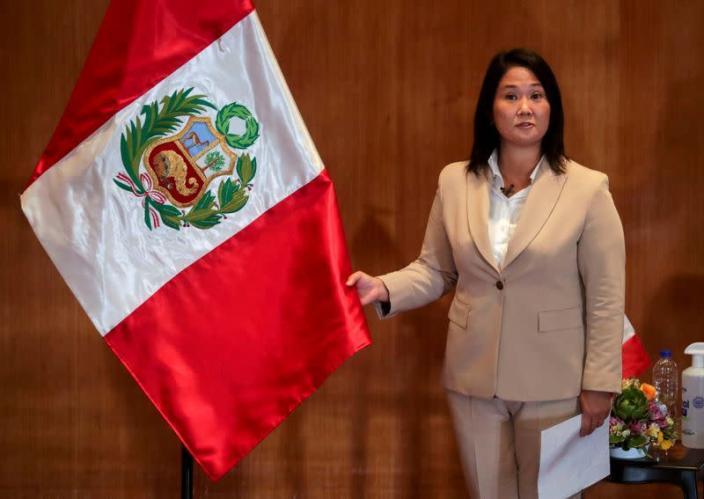
Keiko Fujimori, daughter of former dictator Alberto Fujimori

The “Left” Castillo

Castillo comes from a working-class background. He was propelled to leadership very fast with very little political experience. Castillo is a staunch Catholic and has been conservative on many issues, particularly regarding sexuality. He campaigned on a position of nationalization and changing the Fujimori Constitution. He promised to increase spending on education and healthcare. As President, he tried to work across the political spectrum. He has distanced himself from communists and other left groups. Popular Force politicians were hostile from the beginning. While in power, he was not able to move on any issue. The hostility in Congress and the COVID pandemic stopped him before he could even begin. This has made him vulnerable on multiple sides. First, the Peruvian government is governed by a Constitution that was put into place to promote neo-liberal policies. It allows Congress to impeach a President on grounds as flimsy as moral unfitness. Most countries have two houses of Parliament, but Peru has only one. This allows the process to be speedy and has been done many times. This makes movements for change ineffective. Peru has not been able to see a President completely to term without supporting extremely conservative and neo-liberal policies. Second, Peru did not have any international support. When Latin American countries swung to the left historically, they had to rely on each other. Castillo is an outsider and did not make those international inroads while he was campaigning. Since his removal, many Latin American countries, like Bolivia and Mexico, have offered him support, but it has not been able to help him through his Presidency. Third, as an outsider in politics, Castillo had to face an elite class. He alienated the leftists in power by resigning from the Free Peru Party, and would never be able to work with the right-wing politicians. He did not have a mass support base to rely on. Within his party, his own Vice President turned her back on him. Many Peruvians have expressed discontent with the removal, but this has only resulted in protests. The protests do not look like they would lead to his returning. Fourth, the allegations of corruption and nepotism are not without merit. Many left-wing leaders in Latin America have been taken down through allegations of corruption. These allegations work through the politicians and the judiciary and remove agency from the people. As we can see, in the case of Castillo, these allegations can be launched multiple times and can work in tandem with a smear campaign. Any amount of corruption and corruption charges can be the most effective way for right-wing politicians to take down a left-wing government. Castillo has either accepted or rejected help from the business elites many times, and as a left-wing politician, he was very vulnerable. Fifth, Castillo’s background from a poor, mostly indigenous portion of Peru, made him a target of an extremely racist and classist hate campaign.

Aftermath

Since he was deposed, he was succeeded by his Vice President, Dina Boluarte.  Boluarte has completely disowned him and has promised early elections. The combined hate campaign and scandal will work in favour of the Popular Force in the elections next year. A  30 day national emergency has been declared in light of protests against the imprisonment of Castillo.

Political activists have right to protest against the Administration

0
Recently, The Allahabad HC stated that Political activists have the right to protest against the Administration by staging Dharana against perceived discrimination. The bench of Justice Dinesh Kumar Singh was dealing with the application filed under Section 482 Cr.P.C. seeking the quashing of the proceedings of the Criminal Case registered under Sections 141, 145, 283 and 341 IPC. In this case, The applicant is a political activist. He is a 3rd-time Member of the Legislative Council and at present he holds the position of Minister of State in the Government of Uttar Pradesh; earlier, he was in Congress Party. It is alleged that party in power at the relevant time (Samajwadi Party) was pressurizing the applicant to quit Congress Party and join Samaswadi Party, however, the applicant, despite pressure being exerted on him from several quarters, did not agree to leave Congress Party and join Samajwadi Party. The issue for consideration before the bench was: Whether the order passed by the Additional Sessions Judge needs interference or not? The bench stated that “in a democracy based on adult franchise, the political activist and other public-spirited persons would have right of protest against the Administration by staging Dharana etc. against perceived discrimination/atrocities, inaction, omission or commission of the State Authorities. In a criminal case, regarding assault on a person, who was a political activist, name of the local MLA, Late Akhilesh Singh came, however, the police was not taking any action in the said case and no fair investigation was being carried out.” High Court opined that to put pressure on the State Authorities, the applicant, along with his supporters, staged protest on Raebareli-Sultanpur Road. This protest might have caused inconvenience to the commuters, but the fact remains that no offence was committed by the applicant or other co-accused. This is not even the case of the prosecution that the applicant and his supporters had indulged in any violence or criminal activity.

Dalit protesters demand implementation of Sadashiv Committee report

0
Bangalore: On Sunday evening, police lathicharged and detained Dalit protesters demanding internal reservations as per Sadashiv Committee. The protestors who walked 350 kilometers from Davanagere despite severe cold and rain were dispersed using lathi charge and their leading members were detained late Sunday. The protest march demanded the implementation of the Sadashiv Committee report which recommends internal reservation within the various Dalit communities according to their respective population. Veteran leader and president of Karnataka Madiga Rakshana Vedike Kariappa Gudimani was hit in the head in the scuffle and was rushed to KC general hospital in Malleshwaram. Later around 8 PM police released the protestors. The Protest is still going on at freedom park in Bangalore. The march led by the Committee for Scheduled Castes to enforce internal reservations reached Freedom Park in Bengaluru on Sunday (December 11). The protest was started at the founder of Dalit Sangharsa Samiti and activist Prof.B. Krishnappa’s memorial at Hariharada, Davanagere. Thousands of Dalits marched and reached the capital on December 11th. Dalit Protesters reached Bangalore on Sunday morning bracing against cyclonic rain and cold were disappointed at the government’s response. They demanded Cheif minister Basavaraj Bommai come to the protesting site and listen to their demands and act on them. Earlier Minister Somanna was booed and sent back by protesters. They condemned the audacity of the government for sending Minister Somanna who was caught slapping a Dalit woman at an event in the Chamarajnagar district recently. Many from the opposition have condemned the lathi charge and arrest of Dalit leaders and had urged the government to release them immediately. Opposition leader Siddaramiah has tweeted saying he supports the demand and shall implement the same after consultations if congress comes back to power. Priyank Kharge also tweeted that when the violent protests in saffron robes are handled with utmost care this is the love shown by the BJP government’s lathi for peaceful protests by Dalits.

Modern India is Not Free From Caste Oppression: On Population Based Reservation

Sadashiv Committee Report and Protest

The struggle for internal reservation has been going on for over three decades. Finally around 2005 the congress and JDS coalition government constituted the Justice AJ Sadashiva Commission for reclassifying the sub-castes within the scheduled castes and their representation. After 7 years it was presented to the BJP government headed by Sadananda Gowda in 2012. The report itself has not been tabled in the assembly so far though the state has seen 5 chief ministers since then. Dalit According to the information leaked to the public – the Justice AJ Sadashiva Commission classified 101 sub-castes in the Scheduled Castes into 4 groups and recommended allotment of internal reservations in the existing 15% reservation on the basis of their respective population. According to the commission’s said ‘recommendations’, the reservations for the 33.4 percent of the left-handed (Madiga) community should get 6 percent, 32 percent of the right-hand (Holeya) community should get 5 percent, 23.64 percent of the touchable scheduled castes should get 3 percent and other Scheduled castes should get 1 percent. The voices to release the report and open it for public debate are getting louder.

BJP Government has broken its promise to Dalit Polulation

Speaking to the media the injured senior leader Kariappa Gudimani said “The BJP Government which promised to implement the Sadashiv committee report has backstabbed us. 10 years back the BJP government had lathi-charged our movement during the assembly session held at Belagavi. Today the same BJP government is trying to silence our voice by attacking us again. I was hit on the head and I am now in Hospital. Even if I lose my life do not worry, this struggle should not stop, and agitating communities should not lose. Tomorrow the struggle will continue even more fiercely. All supporting brothers and sisters should be ready for this struggle and take it toward victory.” Senior leader Ambanna Arolikar said  ‘when the Chief Minister comes to Raichur, he says don’t panic, we will implement internal reservation, But when we came to Bangalore we were treated badly like this. We are Ambedkar’s children, we are not the ones who are afraid of the government’s baton. He has taught us the law. We will fight accordingly. If you know the law, implement internal reservation,” Dalit All leaders in this struggle have condemned the political parties for their turncoat attitude toward implementing internal reservations and have warned to teach them a lesson in the upcoming assembly elections.

Chilume Voter Data Scam: How did the names of 27 lakh voters of Karnataka get dropped?

0
Bangalore: In Indian Democracy right from gram panchayat elections to parliament the electorate does not elect their representatives but, they choose ruling governments. It is essential that this electoral system be free and fair. Otherwise, there is no difference between a democratic country and a military dictatorship. In the past there was illegal vote rigging in some places; We heard that people were voting in fear of guns, under the shadow of goons. Illegal means used to be visible and criticized. But in today’s modern era, high-tech election irregularities are taking place. By that, we have created a situation to question whether we are a real democratic country. For so long, we all have cursed election irregularities like asking for votes on the basis of caste and religion, creating artificial threats that religion and country are in danger, luring voters with money and alcohol in elections, and buying MLAs after the results are announced. The ruling BJP government has gone hundreds of steps further and is facing accusations of removing the names of lakhs of people from the electoral rolls who are suspected to be ‘not their voters’. By that, there is a doubt that victory is being ensured even before the elections. Such a huge conspiracy in Karnataka has made us lose faith in the entire election process.

27 lakh people lost their right to vote

In the past, complaints were heard that many people were deprived of voting because they did not know their names had been omitted from the voter list. It was said that it was happening due to technical problems or due to negligence or blunder of election officials at the booth level. But now, there are allegations that their names have been removed from the voter list deliberately targeting a particular community. It is said that polls were conducted as to whose names should be dropped, and finally, more than 27 lakh voters were silently dropped from the list across the entire state of Karnataka. Names of 6.69 lakh voters were deleted in Bangalore city alone. In the 2018 assembly elections, Congress candidate Krishna Bhairegowda won the Batarayanpur assembly constituency in Bangalore by a margin of 5,671 votes against the BJP candidate. This time the number of voters left in that constituency in the voter revision is 30,757. The ruling BJP is facing allegations that an average of 25,000 names of voters who disagree with them have been removed from the list in almost all constituencies.

A large number of Muslim voters’ names are deleted!

It is customary to remove a person’s name from the electoral roll if he/she dies, or transfers his/her voter ID card to another location. But this time the revision of the list has been done targeting the Muslim voters, people and political activists have complained. There is growing suspicion that the names of some Dalits and some people who are interested in progressive ideas have been removed from the list. “BJP party leaders who openly declare that we don’t want Muslim votes, refuse to give tickets to even a Muslim person in the elections, know that we will not get those votes. “That’s why it is the BJP’s ambition to win before the election by removing those voters who vote for the opposition parties from the list,” alleged the opposition leaders.

BJP supported Chilume Voter Data theft scams

An educational, cultural, and rural development trust (NGO) called ‘Chilume’, which has the political and financial support of BJP ministers and MLAs, has been accused of being behind the whole process and a complaint has also been filed. The investigation was carried out by the joint effort of the newsminute and pratidhwani web portals. Questions have been raised about whether the Chilume organization has illegally carried out the revision of the voter list, which should be conducted by the Independent Election Commission, with the patronage of the state government, BBMP, and local election officials. Having obtained permission only to conduct voter awareness, it has roped in some election officials and created fake identity cards called Booth Level Officer (BLO) and collected complete data of voters of 243 wards in Bengaluru. It not only got all the information like name, mobile number, caste, and religion but also conducted a survey on what is your opinion about the government and who will you support in the next election. Thereby they have collected invaluable voter details on who is with the government and who is against the government. Also, elements have come to light that BLOs who were actually appointed by the Election Commission have paid money and got their user name and password and started to modify the voters themselves. Along with the names of Muslims and Dalits, the ruling BJP government is facing serious accusations that the names of those who have expressed displeasure with the current BJP government have been removed without hesitation.It has been alleged that the BLOs were not lured to the field but paid for the full details of each identity card. Four persons, including its founder Ravikumar, have been arrested by the police after the scandal of the Chilume organization, which illegally stole information and deleted the names of voters, came to light. Three government officials who helped him have been suspended. In the preliminary investigation of this scam, alarming information has come to light that the Chilume organization was ready to sell the data it collected. The theft was revealed when many people, including former MLAs, were contacted by email and offered to sell their data.The fact that checks, letterheads and even a note counting machine were found during the arrest underscores the scale of the scam. The opposition Congress has alleged that “this scam has taken place with the orders of CM Bommai and with the cooperation of Minister Aswathanarayan.” “Therefore, instead of the government-controlled police, a judicial investigation of the case should be conducted under the supervision of High Court judges,” it demanded. It has submitted a request to the Chief Electoral Officer that the revision of voter list carried out by the Chilume organization should be abandoned and real officials should be investigated, and criminal cases should be filed against the organization, individuals and those who have cooperated with the information stolen. Opposition leader Siddaramaiah alleged that Ahinda voters who were supporting us were identified and dropped from the voters list.

Central Election Commission is under pressure from Modi Shah – Devasahayam

“Article 324 of the Constitution makes it clear that an Independent Election Commission is responsible for conducting the entire election, from the preparation and revision of the electoral roll. But Karnataka CM Bommayi says about this scam, ‘Congress has a role in this, I will issue an order to investigate the irregularities that have taken place since 2013’.Who are they to investigate? By this statement, he is proving that he is an irresponsible Chief Minister. He has been accused in this scam and it is an investigation that should be conducted by the Election Commission. But the problem is that the Central Election Commission in Delhi has bowed to the pressure of Modi and Sarawak,” says MG Devasahayam, a retired army and IAS officer who has worked on electoral reforms. “Senior officials from the Center should come and conduct a comprehensive investigation and punish the culprits. But he has given that responsibility to the junior officers here. BJP is complaining against Congress in governance. The media is also writing what the CM said without writing the truth.Our question is on what basis you dropped the names of the voters when the election commission itself is acting against the minority community? Overall, a social audit of this scam should be done,” he said. We all know that the Narendra Modi government has proposed to take away the citizenship of some communities through the CAA/NRC Acts, but there has been a widespread movement across the country and it has backed off. Allegations are rife that the same party has tried to prevent most of those communities from voting. The Election Commission, which should investigate and prevent it, is sitting on its hands. Like CBI, ED, IT departments, the Election Commission is also becoming a puppet of the central government. How can a free and fair election be expected in such a situation? The article was published in nyaya patha, our sister newspaper in Kannada. It is translated in English by Bharath Hebbal.


From Colonial Codes to Regressive Review: Indonesia passes a new Criminal Code

On 6 December 2022, the Indonesian Parliament passed the draconian Criminal Code Act, which completely overhauled the Criminal Code. As per the new Act, adultery and cohabitation would be illegal with punishments of 6 months to a year in prison. The new criminal code bans the promotion of contraception, spreading communism, criticizing the sitting President, or vice president, and religious blasphemy. It also severely restricts access to abortion for pregnant women. The Act still may be many years from being implemented but has been severely criticized for its draconian nature by Civil Liberty activists in Indonesia.

Revising the Criminal Code

There has been a movement to completely rehaul the criminal code bill for a long time in Indonesia. The original Criminal Code was passed during Dutch rule. Many have called for a criminal code that reflects the will of the Indonesian people along with their values. This is the source of the conflict.

Role of the MUI

Indonesian Civil Society has always been influenced by religion. Progressive forces cite the humanitarian side of religion, and conservative elements try to advance the traditional order. Since the late 1990s, conservative elements have become more politically powerful. Recently, the conservative elements of civil society have been able to lobby for a draconian Criminal Code. The rise of this branch goes back to the 1990s. In campaigning for the fall of Suharto back in the late 1990s, civil society groups campaigned on principles of democracy and populism. This involved a coalition between religious traditionalists and progressive elements. The traditionalist voices were initially very diverse, reflecting the plurality of religious practices in Indonesia. They were united in their call for a return to traditional values, a rejection of authoritarian elites, and a commitment to the electoral process. In the early 2000s, the Majelis Ulama Indonesia (Council of Indonesian Islamic Scholars, known as MUI) became a leading voice for religious traditionalists. The MUI is Indonesia’s top Muslim Clerical body. It was founded in 1975 to aid the Suharto regime. Suharto used the MUI to delegitimize popular struggles by political Islamists and leftists. After the fall of Suharto, the MUI adapted to be more populist. Against the tradition of religious practice being mixed into local practices, the MUI promoted a more fundamentalist version, which was also seen as universal. They could speak to values from different parts of Indonesia. In a growing frustration against corruption in government, the MUI’s appeal to moral authority and character was popular with the people. The organization has issued fatwa’s against other versions of Islam calling for a homogeneous version. The MUI has also issued fatwas condemning the LGBT community, abortion, and extramarital sex. These fatwas have influenced public opinion and have been very influential in political circles.

Indonesia: Omnibus “killing us slowly”, police-protestors clashes intensify

The 2014 election and the 2019 election were very polarizing. The ex-son-in-law of Suharto, Prabowo Subianto, ran for President both times on a platform of reactionary populism. Following in line with the election of Donald Trump in the United States. He promised to fight for traditional and religious values, take a stand against elites and corrupt journalists, and “Make Indonesia great again.” Prabowo lost the election, prompting riots by his supporters amidst conspiracies of the elections being fixed. Despite their loss, Prabowo’s campaign affected the body politic. In September 2019, the Parliament approved the bill to revise the Criminal Code. The bill was introduced in 2015 after the 2014 election and was made to appeal to the reactionary elements that Prabowo courted. In 2019, Yasonna Laoly, the Minister of Law and Human Rights, supported a new bill completely. The bill came in parallel with an anti-corruption bill, changes to the labour code, and agrarian reforms.

Response in 2019

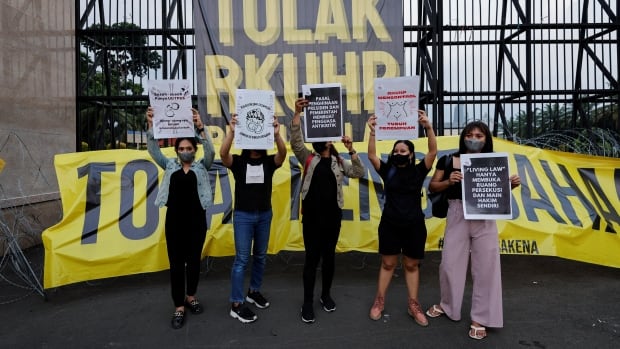
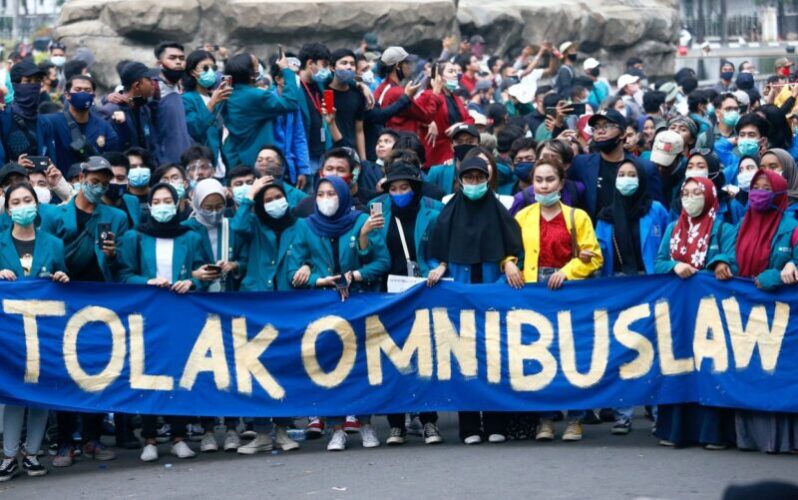
Both Bills were met with student-led mass protests in 2019. The anti-corruption bill was called politically motivated, as it reduced the autonomy of the Corruption Eradication Commission and gave politicians more power. The Criminal Code Bill was seen as a draconian step that undermined the democratic values of Indonesian society. IndonesiaUniversity students hold a sign reading “Refuse Omnibuslaw” during a protest against the government’s labor reforms bill in Jakarta, Indonesia, October 16, 2020. REUTERS/Ajeng Dinar Ulfiana Internationally, the Indonesian protests were overshadowed by the Hong Kong protests and the anti-CAA protests. Media coverage was restricted to the ban on extra-marital sex and missed out on the broader issues of the growing authoritarian nature of the bills. Protests called for changes to all of the articles in the Bills that worked against the autonomy of the Corruption Eradication Commission, workers’ rights, farmers’ rights, and civil liberties. The protests were very violent with many confrontations between the protesters and the police. Hundreds were injured.

2022 protests

In September 2022, student-led protests again erupted in Indonesia following rumours of an amendment to the constitution that removed term limits for the President and postponement of the 2024 elections. The protests initially were against the current government, though after the rumours were dispelled, the protests continued. Protesters shifted to focus on general discontent in light of the rising costs of living. In December, the Criminal Act came to light again. Most English media has focused on elements of the Act that deal with sexuality, but this coverage does not take into consideration how comprehensive the change is. The change has been sold to the people as being respectful of Indonesian values but disregards the pluralistic culture of the Indonesian people and their religious beliefs. Under the guise of nationalism, the Indonesian parliament has only tried to protect the political class by criminalizing its citizenry and its ability to dissent. Indonesia has the world’s largest Muslim population and has been home to many variations in the practice of that religion. The rise of a homogeneous version of that identity that sweeps away diversity right now threatens the democratic fabric of society. Updating the Criminal Code to reflect Indonesian values sounds good in theory, but the new version reproduces one of the worst aspects of the colonial legacy, an authoritarian state. Conservative forces are now using that state to enforce their opinions over the whole of society. The writer is a mathematician and political observer based in Bangalore.