Under the watchful eyes of the market, International Women’s Day has been turned into a consumer driven festival. The grand events organized on this occasion by the governments and corporates who have an opposite perspective to the basic spirit behind the celebration of this day, many a times generate anger.
International Women’s Day was recognized by the United Nations in 1975. The theme of the 2022 International Women’s Day is ‘Gender Equality Today for a Sustainable Tomorrow’, but gender equality seems like an impossible dream in India.
The World Economic Forum’s Gender Gap Report 2021, based on women’s participation in economic opportunities, politics, education and health, points to the increasingly pathetic condition of women in India. India’s rank has fallen further down by 28 steps, come down to rank 140 out of 156 countries. Covid seems to be responsible for this decline.
It is a known fact that war and epidemics hit the vulnerable sections the most, such as women. The LinkedIn Opportunity Index shows that the negative impact of COVID-19 on Indian women was greater than for women in the rest of the world. They faced the most gender discrimination among the Asia Pacific countries and were seen fighting for equal pay and equal opportunities.
The World Gender Gap Report 2021 says that if the situation remains the same, it will take 135.6 years for the world to achieve the goal of gender equality. It is scary to even imagine how long it will take for India to reach that goal.
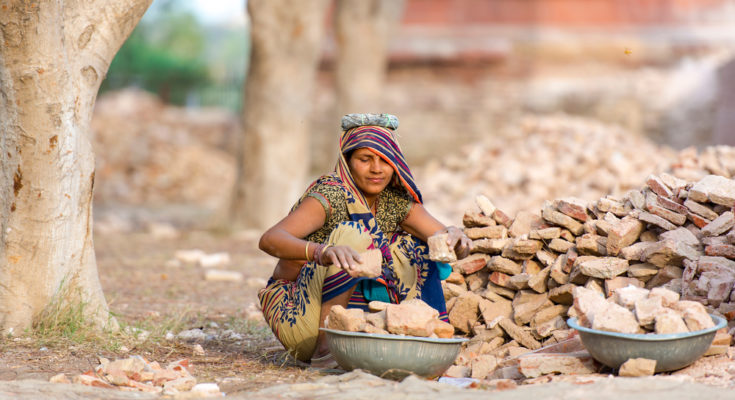
The early history of International Women’s Day is directly linked to working women and workers when the streets of New York witnessed a protest of 15,000 women on March 8, 1908. Their demands were for reduced working hours and increase in wages. Despite the long journey of International Women’s Day, women’s labor has not been accepted and respected.
It is the natural tendency of the male centric economy to consider female labor as lowly, insignificant and negligible. According to NFHS 5 (National Family Health Survey-5) , only 25.4 percent of working women aged 15-49 have received cash payments in the last 12 months.
State of Working Women in India
According to Oxfam’s 2019 “Mind the Gap: State of Employment in India” report, Indian women collectively work 1,640 million hours a day for which they get nothing. OECD data says that Indian men spend only 56 minutes a day in domestic work while women spend 353 minutes a day. The Time Use Survey 2019 of the Government of India shows that 92 percent of working age women on an average spend five hours and fifteen minutes a day in household chores. Experts estimate the value of domestic labor of 350 million domestic women to be $613 billion. The striking thing in these figures is that a man whether illiterate or highly educated, stays away from domestic work but a highly educated woman is burdened with domestic work as much as an illiterate woman.
Unpaid domestic work
Some recent surveys show that the position of Indian women has improved a bit on several parameters. According to the NSS (75th Round, July 2017–June 2018), India’s female literacy rate is now 70 percent. The Government of India’s All India Survey on Higher Education 2019-20 says that women’s enrollment in higher education is also reaching the same level as men and the number of women enrolling in higher education is now 39%. But it is also notable that the presence of women in medical and engineering education is negligible.
The NFHS 5 figures also indicate a better position of women in certain areas. According to NFHS-4, the percentage of married Indian women involved in important family decisions was 84 percent, it is now 88.7 percent. According to NFHS-4, 45.9 percent of women had a mobile phone, which has now increased to 54 percent, while the number of women who have bank accounts has increased from 53 percent in NFHS-4 to 78.6 percent.
Though small, but improvements in all these parameters does not show the effect of increasing economic-socio-political power of women, it needs to be investigated.
If the NSSO and Periodic Labor Force surveys of the last few years are to be analysed, we can see that there is a sharp decline in the presence of women in the labor force during the last three decades. The share of women in the workforce was 41 per cent in 1999-2000 which declined to 32 per cent in 2011-12 and is 20.3 per cent as per the 2019 data. For Bangladesh and Sri Lanka these figures are 30.5 and 33.7 percent respectively. According to a 2018 McKinsey report, a 10% increase in the number of women in the workforce could add $770 billion to our GDP.
There are many explanations for this decline. Advocates of the neoliberal economy believe that it is a sign of economic prosperity. The income of the men in the family has increased, due to which women do not need to go to work. Surveys by the Economic and Political Weekly and some other organizations show that if the income of men in the family is decent, then about 40 percent of both men and women want women to stay at home. Such explanation is completely unacceptable amidst rampant poverty, hunger, rising unemployment and falling wages.
The decline in labor participation rate can be explained in simple words. 80 percent of women of working age in India are engaged in domestic and other unpaid work without earning a living.
Garment workers
Agriculture was the biggest source of employment for women, but privatization of agriculture has encouraged mechanization and the need for human labor has decreased. Employment opportunities for both men and women in agriculture have decreased. Men have become migrant laborers by migrating to small and medium cities and metros, women have remained in villages. A large number of cheap male workers are posing a challenge to women and they are getting preference over women in jobs considered reserved for women. After agriculture, the textile and readymade garments industry is the second job giver for women, where 75 percent of the 4.5 crore workforce is women, but even here the entry of big players has led to reduced employment. Many tasks are reserved for men by law and were traditionally women are not even considered to be given opportunities.
The National Council of Applied Economy Research estimates that 97 percent of women workers in India are employed in the unorganized or informal sector. According to the experts of International Labour Organisation, the biggest drawback of the policies made for the unorganized sector is that data related to the number of women working in different sectors is not collected before policy formulation. While discussing the official statistics for the declining number of women workers, it should also be noted that the sectors which have the highest number of women workers are not part of these numbers. If only domestic work figures are included in this, then the labor force participation of women will be 81 percent.
Equal wages, social security, maternity leave, maternity benefits and protection from sexual exploitation are just a dream for women working in the unorganized sector. Our Justice and legal system is deeply patriarchal. Even some of the laws that are made in favour of women, their implementation is hindered by the male dominated system and makes these laws effective.
Equal wages, social security, maternity leave, maternity benefits and protection from sexual exploitation are just a dream for women working in the unorganized sector
According to studies, our labor market gives women only half the cost of their labor as compared to men. Even at the supervisory level in the private sector, women are paid 20 per cent less than their male counterparts.
The Maternity Benefit (Amendment) Act, 2017 has made provision for 26 weeks of paid maternity leave along with mandatory creche facility. As a result, it was seen that private sector employers refrained from hiring women and created conditions for pregnant women to quit. In November 2018, government also announced that it would pay the wages of the 7 weeks of maternity leave to the companies. But the fact remains that every year about three crore women become pregnant but the benefit of this law is only for one lakh women.
Sexual harassment at Workplace
A survey by Human Rights Watch (October 2020) discusses limited government efforts to enforce sexual harassment laws in informal sector. The survey specifically mentions that women in the informal sector and the women workforce engaged in the implementation of government welfare programs are more likely to be ignored. The survey conducted by the Indian National Bar Association in 2017 also comes up with similar findings. According to this there is sexual harassment in various sectors of employment. Most of the women do not report harassment due to stigma, fear of retaliation, shame, lack of awareness about reporting policies or distrust in the redressal mechanism.
There has not been any authentic study about sexual harassment, nor are there any official data about it. Women do not discuss it in family out of fear. Fear being that in most cases the family would make them quit job itself. of the cases the family loses the job. It is also difficult to tell what percentage of women quit their job due to sexual harassment.
According to the International Institute of Population Sciences (Nodal Agency, NFH4) and ICF, USA, working women in India are more likely to face physical violence. Non-working women make up 26 percent of those who have faced physical violence, while 40 percent of working women have faced physical violence.
A myth is being spread that the neoliberal economy will lead to economic emancipation of women while the truth is that it has led to shrinking of the organized sector and the exploitative nature of the unorganized sector is openly embraced.
The contract system and the practice of contractual appointment have increased and women have become easy prey. Naive and unorganized women are hired for low wages and fired at will. Randstad’s Gender Perception Survey 2019 shows that 63 percent of women have either faced gender discrimination while hiring in the private sector or know a woman who has been subjected to gender discrimination during employment. This discrimination is also seen in increment and promotion.
Women Entrepreneurs
Only 20 percent of the enterprises in our country are owned by women. Only 6 percent of women are the founders of Indian startups. Startups with female founders could receive only 1.43 per cent of the gross investor funding. 69 percent of women believe that cultural and personal barriers make their journey as an entrepreneur difficult. According to one analysis, the number of female leaders in industries is less than half that of men.
One of the reasons the path to gender equality in India is difficult because of less women representation in politics. Secondly, the women who are at top political positions in politics follow the same masculine outlook when in power. Only 14 per cent of the current parliament is women. Some of them hold senior positions in the central government, but they also seem to support the ideology that dreams of replacing our Constitution with Manusmriti. The same manusmriti according to which women need to be under the control of father in childhood, husband in adulthood and sons in old age.
Dr. Raju Pandey is a Gandhian writer and thinker. He lives in Raigarh. Views are personal. The article was first published in junputh. It is translated into English by Dr. Swati.
Its been nine months since the tragic incident that took place in Chamarajanagar district government Covid hospital when 32 people died due to lack of oxygen. The family members of the deceased have still not received any compensation till date.
The incident happened on the night of May 2, 2021, when the Covid patients admitted in the hospital for treatment died as the oxygen supply had run out.
SDPI State president Abdul Majeed has alleged that even after nine months of the incident, the government has not given any relief money to the families of the victims.
Speaking after participating in the meeting with the families of the victims in Mysuru, he said that the committee constituted to look into the incident, has reported that the death was caused due to lack of oxygen. The report blames the then Deputy Commissioner for his irresponsible action that caused the death.
“ But still, the government has not taken any action against any official including the DC”, he complained.
On the other hand, the single-member committee constituted by the government which was chaired by B. A. Patil has not been made public till date.
The government has given a meager compensation to 24 families of 37 victims. Remaining 13 families have received no money so far.
Of the total 37 victims, the majority of them were from SC/ST communities and daily wage workers. The families have lost the sole bread earners. The lives of the families have shattered after their death. The families are facing enormous financial difficulties in meeting their both ends.
The government is behaving like deaf, dumb and blind even after looking at the pathetic situation of these families.
“ We have decided to meet the Governor seeking his intervention to get Rs. 50 lakh compensation to each family of each victim and government to one family member of the victims. Besides this we will also demand action against the erring persons. Our fight will continue till we get justice for the victims “, he said.
The meeting was attended by C. S. Dwarakanath, Abrar Ahmed, Alfonso Franko, Bhaskar Prasad, Afsar Kodlipet, Majid Khan and Riyaz Kadambu.
Expressing concern over the future of Indian medical students who have returned from Ukraine in the middle of their studies owing to war, Former Chief Minister, H.D. Kumaraswamy has asked the Centre whether it has thought of the future of the students after bringing them back under ‘operation Ganga’?
In his series of tweets, he asked this question, where he cast doubt over the possibility of the students returning to Ukraine which is already ravaged by war.
“The educational institutions and Universities in Ukraine have already been destroyed by Russian forces. Then how it is even possible for the students to return to continue their studies”, he tweeted.
He added that around 1000 students of Karnataka and over 20,000 Indians who were studying medicine in Ukraine, have returned to India. Some of them are on their way to India. Now, what is the future of their education? “ Many parents must have borrowed loans to send their children to Ukraine for studies. Now, their education is hanging in balance because of the war”, he said.
Kumaraswamy asserted that it is the responsibility of the Centre to build the careers of the students who have returned to India because of the war. Karnataka has around 60 medical colleges. If required, then separate entrance tests can be conducted for these students for giving entry in Indian colleges. Each college should offer free education to at least ten students, he suggested.
Wondering whether it is too difficult for the BJP government of Karnataka to spend just around Rs. 100 crore for the students, out of Rs. 2.65 lakh crore budget presented by the government, he said that Centre should also bear at least half of the money required for providing education to the medical students here. “ Both governments should think about the future of students with compassion”, he noted.
“If all the students who have returned from Ukraine become doctors, then India will add a good number of doctors to its list. These doctors can save more lives in the country.” He added.
“ It is not right to commercialize the dreams of students who wish to become doctors. Both governments should take immediate steps in helping the worried students”, Kumaraswamy warned.
It may be noted that many leaders have already expressed similar views. They have urged the Centre to ensure that the careers of the medical students should not get destroyed. The Centre should make alternate arrangements for the continuation of their studies in India itself so students don’t have to go to foreign country for studies.
Its been 12 days since Russia started its invasion on Ukraine. The Russian army has captured the eastern border of Russia Ukrainian border regions of Donetsk and Luhansk and declared them sovereign states.
The Russian army has reached Kyiv, the capital and another important city Kharkiv. These also happen to be cities where thousands of Indians are studying medicine. Being in a war zone, airport is closed and students have no choice but to reach the nearest border by any means possible. Those who travelled for 10-15 hours to reach Kyiv were sent back. It was suggested that they head to Romania and Poland borders and cross the Ukraine border to reach India.
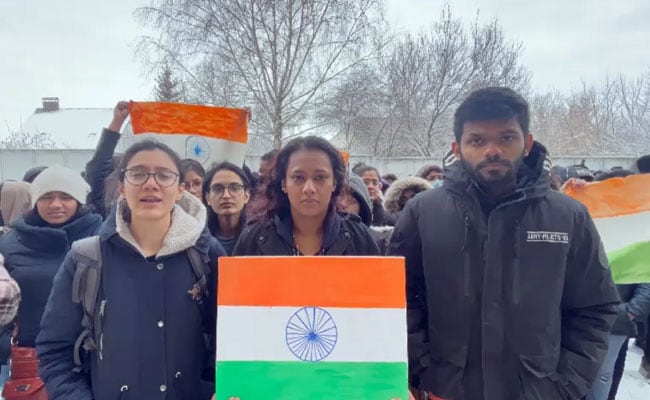
There have been accounts of racism by Ukrainian border forces towards Indian and African students. Many viral videos show only Ukranians allowed to cross the border. With the temperature of 5 degrees and falling to below -5, students are stranded outside with no food, water or toilet facilities.
One student form Karnataka have died due to shelling from the Russian side. A 22-year-old Indian student named Chandan Jindal died on Wednesday in Ukraine after suffering a stroke. Another student from Punjab also got hit and is hospitalised. Several students have also sustained injuries due to attacks by the army and suffering from cold and anxiety attacks. Still they are waiting for help from Indian government but not getting any response from the Indian embassy.
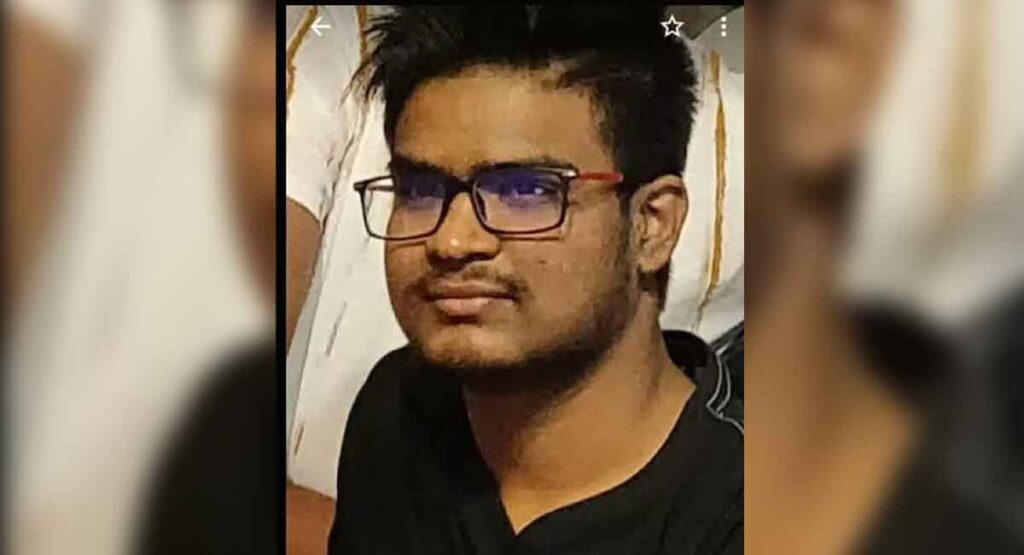
Naveen Shekharappa Gyangoundar was killed while he was standing in a grocery line.
After much hue and cry and death of one student, Indian delegation ramped up its efforts to bring back students but that is also made into a PR drive.
These students, who have been victims of the war, are being punished for none of their wrongdoing. It is not easy to imagine their pains, anxieties and sufferings. We speak to some of the students and their parents who have managed to return to Karnataka to understand their ordeal.
Why do Indian students head to Ukraine for medical education?
“My daughter scored 100 on 100 in Biology in her Pre-University exams. She has scored more than 90 in other subjects including English. However, the NEET exams did not go well for her. All students have to compete for only a few seats which seems like a game of musical chairs where only a few get to win. We belong to the middle class and cannot afford private medical seats. Hence, I decided to send my daughter to Ukraine for medical education” said Shivaraju, a resident of Kanakapura, located outside bangalore, whose daughter is studying at the Bukovinian State Medical University in Chernivtsi, Ukraine.
Further, “the first year of my daughter’s medical education cost Rs. 9 lakhs towards fees, hostel and plane tickets. The second year cost around 3.5 lakhs. Students are divided into batches of 13 and are given individual attention and better quality education. Why is it not possible to provide similar education in India? Why aren’t there more government colleges? Why is the share of private colleges more than 60%?” he asks.
“The Government of Karnataka should reduce the cost of medical education in the long run. Only the wealthy in Karnataka are able to afford medical education. However, middle-class families are unable to afford the heavy costs and hence are forced to send their children to low-cost foreign university to get educated. This is exactly why we had to send our son to Ukraine, ”said Fernandez from Udupi, whose son is studying at the Town National Medical University in Ukraine.
Listening to both of them speak, we understand the harsh truth of how expensive has education become in our state and our country and how it is being privatized and made a commodity to be traded.
Education has become an expensive privatised commodity. The education sector is no longer a service, but a mafia by which big businessmen and politicians make money. Even the middle classes, with some difficulty, take loans and send their wards to countries like Russia and Ukraine that provide low-cost education. But what do the poor, who make up almost 60% of our country’s population do? The question that must be raised is, whether we have assumed that they do not need education.
However, Prime Minister Modi is now appealing for private investors to invest in medical education. Despite education already being unaffordable for the poor, Prime Minister Modi seems too eager to transfer his responsibility (responsibility of the state) of providing education to private entities. We have no idea when the Ukraine war will cease. In this context, what is the future of the students who are now half-educated at Ukraine? The government has no answer as to whether the costs incurred by the students and their families, be returned or compensated.
What did India do to protect students?
More than 80,000 students from across the world are attending medical schools in Ukraine. Data published by the Ministry of Education and Sciences of Ukraine states that about 25% of these students hail from India followed by students from Morocco, Azerbaijan, Turkmenistan and Nigeria.
Russia did not attack on Ukraine all of a sudden. It deployed its troops on the eastern Ukraine border several days ago the attack happened. At a time when US asked its citizens in Ukraine to leave the country, Indian students were only given the the message that they could leave Ukraine if they wanted to. The Government of India informed the students to leave Ukraine only after 20th February. But tickets were not immediately available for students to return back and the costs of travel also had become five to ten times more. Air tickets that were available from Ukraine to many cities in India for Rs. 20,000 to 30,000 earlier, increased to around Rs. 1 to 2 lakhs as the tensions escalated.
Yogita, a student from Mehboobnagar in Telangana who is studying at Zaporizhzia State Medial University in Ukraine cried for help stating that she was unable to comprehend the status quo there and was unable to return to the country as the air ticket prices had risen by more than one lakh rupees and demanded that the Government of India must initiate necessary actions to get back Indian students safely.
Operation ganga
On February 26th and 27th , two planes landed in Mumbai. Aviation Minister Jyotiraditya Scindia addressed these students inside the plane stating that “We are happy to have you back. I welcome you on behalf of our Prime Minister Narendra Modi” merrily. The minister was celebrating the return of around 400 students when more than 15,000 more students were still stuck back at Europe.
Jyotiraditya Scindia welcoming students at shelters in Poland
Many are complaining that BJP making use of the return of some students to further its electoral campaign and questioning the need to name the rescue operations as Operation Ganga when the Uttar Pradesh polls were underway. Moreover, when civil wars were underway in Libya, Prime Minister Manmohan Singh had quietly arranged for the return of more than 15000 people in the name of Operation Safe Homecoming. Many are questioning as to what is the need to be hailed and lauded when the government has only fulfilled its responsibility?
Anger towards the Union Government and Godi media
The union government has taken the Russia Ukraine war and its students coming by themselves also as an opportunity to pat its own back.
When all around there was anger that Indian govt did not do anything to bring back its citizens, Godi Media started its propaganda by saying Indian govt is bringing back its students when even the United States, China and England have not done so.
The students know what is they have gone through and still now their future is uncertain.
“Where are you Modiji? You have been busy in the Uttar Pradesh elections for a month. Today, no American students in Ukraine are in trouble. When Biden was able to understand, why weren’t you able to understand? How many times did we not mail you?” asks a student live broadcast of Aaj Tak. No one came to help us. No representatives have met us. No trains have been arranged for us” responds the student to Aaj Tak reporter.
“When all countries are taking back their students respectfully, why is our government not doing so? It is very cold here. There’s no toilet, no lunch. We have no respect. We are living in constant fear. We had not thought that our own government would cheat us.”, a student expressed his pain.
The students have gone abroad to study because of the bad policies in India. Now, the war has begun. Students are longing to return back but the shameless government has not made a scientifically actionable plan to bring them back. Although only few students have been brought back, it has been made use of, for electoral gains. We have lost one of our Indian students. We do not know what awaits till all Indians return back. Could these painful incidents push the government to act responsibly, to fight against the privatization of education?
Author is a activist and writer. The article has been translated from Kannada to English by Shashank SR
Chamarajanagar district of Karnataka is getting notorious for the frequent tragic incidents where precious lives are lost.
People of the district believe that the government has neglected the development. Amid the cry for the development, the tragic incidents and mishaps are getting reported on regular basis.
On December 14, 2018, the entire state was shocked to hear the news where 17 persons lost their life and 129 got hospitalized after they consumed Prasad at Kittugutti Maramma temple of the district. It was reported that Prasad had been poisoned out of personal enmity by one of the temple priest.
It was alleged that one of the priests of Saluru Brahanmath of Male Mahadeshwara Betta was involved in the act that killed 17 persons. The innocent people died because of the personal enmity between the members of the temple trusts. The main culprit is now in jail and the trial is underway.
COVID oxygen tragedy and labour deaths
COVID pandemic took many lives across the world but tragedy stuck in Chamrajnagar government hospital when 37 people died of lack of oxygen. It was alleged that the negligence of the district administration resulted in the death of patients who were undergoing treatment for Covid in the hospital.
While 37 persons lost their lives for no fault, the government offered relief money only to some 24 families of the victims. Some 13 families have yet to get relief amounts from the government.
Rubbing salt on the wounds, another tragedy occurred on March 4 in the district where three laborers working in the quarry died after a portion of quarry collapsed. Five persons sustained injuries in the incident.
While the bodies of three persons recovered from the debris, search was on to retrieve two more bodies. The chances of their survival is said to be very slim.
The deceased were identified as Azimulla (24), Miraj (28) and Sarfaraz (18), all from Gorakhpur district of Uttar Pradesh, the reports said.
While Azimulla and Miraj were working in earthmover operations, Sarfaraz was their assistant. The body of Azimulla which was trapped under boulders along with the vehicle, was retrieved by the members of SDRF and NDRF after a 10 hour long operation.
Since the foul smell was emitting from a nearby boulder, it was suspected that remaining bodies could be trapped there. The operation continued where the team of 70 members of NDRF and SDRF not only retrieved bodies but rescued other workers. The injured are being treated at the government hospital.
V. Somanna, the district in-charge minister visited the spot and said that he has directed the district administration to stop quarry works of the district in order to identify illegal quarries.
He said that the DC has been asked to personally visit all the quarries and check which are operating with licenses which are illegally operating.
However sources say that such incidents have become common in the district but not all are getting reported. Illegal quarrying has become rampant which is the result of the district administration and the elected representatives not taking necessary action to curb it.
किसी अलक्षित सूर्य को, देता हुआ अर्घ्य
शताब्दियों से इसी तरह, गंगा के जल में
अपनी एक टाँग पर खड़ा है यह शहर
अपनी दूसरी टाँग से, बिलकुल बेखबर!
(And for centuries now, praying to the unseen sunthe city has stood in the water on one leg, completely oblivious to the other.)
Great Hindi poet Kedarnath Singh poem beautifully describes Varanasi or Banaras as it is popularly known. The 3000 year old living and breathing city where even death is celebrated is at the epicenter of a crucial fight which will decide the fate of not just prominent leaders of the country but for the country itself.
As Uttar Pradesh nears the last phase of legislative assembly elections, everyone’s attention is hooked to Varanasi and its surrounding constituencies. A total of 54 seats will go to the polls in the seventh phase across nine districts.
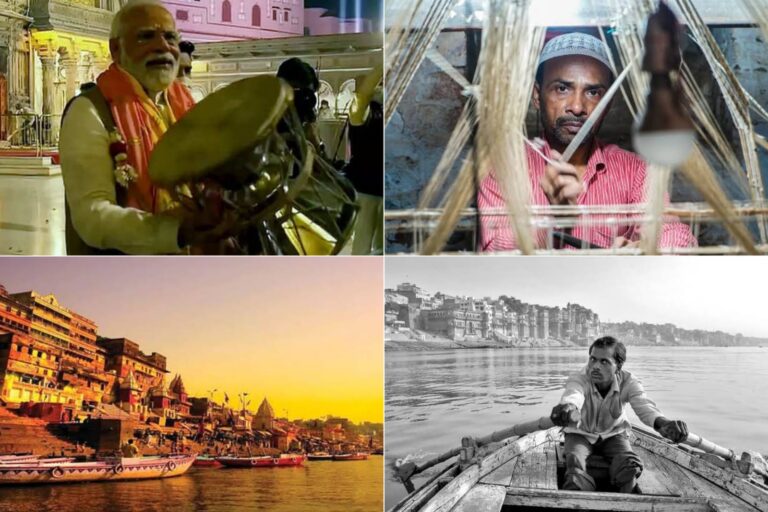
For the last six months ruling party BJP and its leaders have been flocking the city in a last bid to impress the voters. Most of the mainstream media coverage sing paeans of the city (and justifiably so) about the river Ganga, ghats and temples. The working class on the shoulders of whose city runs have disappeared amidst the grand roadshows. It is as if it’s only the leaders who are fighting and the people are nowhere in sight.
Banaras is known for temples and ghats but it is also known for its boat rides and elegant banarasi sarees. We speak to the people who make it all possible. The weavers and the boatmen community (nishads/Mallah) are still reeling under the effect of first Demonetisation and then the COVID lockdown.
Weavers of Banaras: The threads that bind
The weaving of the finest Banarasi Silk Sarees not only employs the people from Banaras but the nearby small villages also rely on this community-based business of weaving.
PC: CNN
Apart from the drop in sales of the product, the weavers also suffer from adverse effects of inflation. Before lockdown the weaving thread used to cost around 200-220 Rs., now the price has gone up by Rs 100 making the production process expensive.
“Apart from the fetishisation of Banarasi sarees nobody, not even the government cares about the very hands that weave these intricate and beautiful designs,” says Rehman (30), who is third generation weaver of his family.
Before the current Bharatiya Janata Party ruled state government, the weavers were also exempted from paying unit-wise electricity bills instead they used to pay 100-150 rs. per machine but things took a vile turn when Yogi Adityanath was elected to power in the year 2017 and stopped the flat-rate electricity scheme for weavers. Currently per machine electricity consumption costs up to Rs. 3000.
“Chief Minister Yogi announced to bring back flat rate electricity only when he realized that he might lose voters in Purvanchal ”, says Manish Jha, Convenor of Communist Front who has been fighting for weavers’ rights for many years now.
The silk weaving neighborhood comes under Prime Minister Narendra Modi’s parliamentary constituency. Weavers say that even before the pandemic arrived, they were struggling for their livelihood. Lockdown turned out to be the final nail in the coffin as demand dropped to an all-time low leaving the weavers no option but to leave the city to meet their ends. “On some days we do not earn anything, we have to rely on the mercy of our traders to provide us loans so that we can keep the business going”, emphasizes Rehman, in a low voice.
The weavers who make the second-largest occupation of Eastern UP after farming, are struggling to make ends meet. “The Make in India campaign welcomes foreign countries to manufacture in India with open arms, this corporate- friendly campaign has pushed the small handloom industry to margins and even has thrown many out of the business leaving weavers of Banaras in a vulnerable situation”, adds Manish. According to Jha, these jullahas (weavers) are outrightly rejecting the BJP’s politics of polarization and they are solely going to vote on the basis of performance by the ruling party, on which the Yogi led government terribly failed.
Will the Nishad community in Banaras Rock BJP’s Boat?
Nishads or the boatmen community of Banaras are seen as decisive stakeholders in this election. The Nishad or Mallah community is classified as Other Backward Castes in the state and has a long history of being involved in water-related activities in this area. People from these communities work as boatmen, grow eatables like cucumber, melon, and other fruits and vegetables along the river’s sandy bank off-season and act as tourist guides during peak seasons. The Mallah community has been hit with a double whammy.
Boatsmen of Ganga, PC: Flickr
The state government decided to allow a private five-star cruise to operate on the river Ganga in January 2019. Boatmen from the Mallah village protested against it “We didn’t want the cruise to run between Ramnagar and Raj Ghat since we make a living doing ferry rounds in that area,” said Ratan Nishad, a major member of the Varanasi Nishad Raj Kalyan Samiti (VNRKS), that had coordinated the demonstrations. He further claimed that local boatmen were denied a motorboat license due to the harm caused by the use of diesel to the river’s freshwater turtle wildlife sanctuary, but the cruise owners were granted licenses.
This along with large reduction in income during and after the pandemic has brought the community to its knees and their anger is palpable.
“Government can only try to appease the upper caste, upper-class voter in the name of development and beautification of Ganga, but we know what this so-called modernity ruined for us”, says Vishnu Nishad who do not visit the site anymore as it reminds him of the days when he used to sail a boat across ghats.
Although Nishad Party is in alliance with BJP, the boatmen have decided to keep the ruling party under scrutiny. “This angst is not just the result of negligence by state and central government on economic ends, but these voters are also keen on rejecting the Bramhanical politics of the Bharatiya Janata Party ”, adds Manish.
Kashi Vishwanath Corridor: Erasing the Past
Apart from big claims of homecoming by Prime Minister Narendra Modi, the Yogi government proceeded with the 600-crore Kashi Vishwanath (KV) Corridor Project in the city in 2019 to create a comfortable pathway to the iconic Kashi Vishwanath temple. The demolition of stores, houses, and temples, some of which were many centuries old, yielded a total area of 5 lakh sq ft. resulting in the displacement of houses and livelihoods of around 2500 people, recalls Suresh Pratap, a senior journalist and author of acclaimed book “Udta Banaras”.
Shops, houses and temples demolished for Kashi Vishwanath corridor PC: The New Indian Express
In the year 2018, the Cabinet approved the ambitious Jal Marg Vikas Project aimed at linking Varanasi to Haldia via waterway. The proposed Rs-5,369-crore waterway project is one of the flagship infrastructure projects of the government and involves a significant investment from the World Bank. Many ecologists have raised concerns over the debilitating effects due to navigation of large vessels weighing up to 1500-2000 tonnes. “Alongwith erosion, dredging will effectively destroy the river’s aquatic life and the fisher communities that depend on them,” claims Suresh. “We have not been contacted by the government for this project, instead we have been asked to show license over private players to sail our boats on the river”, says Vishnu when asked about the government’s claim to have the Mallah community in support.
The fishermen are scared that due to dredging the water might get polluted and a drop in the fishing might put their livelihood in trouble. “On another hand, this multi-modal terminal on River Ganga is completely in contradiction to the Clean Ganga Movement, they are as ambiguous as their laws and schemes,”Manish reiterated. The very project of privatization of the river throws out the very people who have contributed to the development of ghats and continue to nurture the tradition.
Luxury Cruise Liner introduced in 2019. PC:Tour My India
“Projects on and around Ganga do not seem to be in favor of people, they are for profit and private companies friendly”, says Suresh Pratap. The fear and insecurity among the voters might help the opposition parties, he remarked.
Beneficiary Voters
Beneficiary voters have been referred to as having the most crucial role in the election of Uttar Pradesh. This strata of voters are described as the direct beneficiaries of government schemes. Especially women and migrant workers who have returned home after the Nationwide lockdown in 2020, from several parts of the country are counted upon as the trustworthy and ‘loyal’ supporters of the ruling party. Two weeks ago, Prime Minister in a speech said that he had received a video of an elderly lady who says “Humne Modi ka namak khaya hai, vishwasghat nahi karenge” (We have been fed by Modi, we will not betray him), to which Reena Kanojia who works as a washerwoman around the banks of Ganga says, “I am migrant as well as the woman beneficiary, we have been left stranded during the lockdown as well as when our safety is concerned. We survived on salt and roti and Modi talks about returning him the favour.”
The rise in price of LPG refilling has pushed 8 out of 10 women in Uttar Pradesh to rely on chulha over cooking gas.
Manish challenges this narrative and adds that women from marginalised groups such as SCs, OBCs and Muslim have understood the anti-Dalit, anti-Dalit and anti-poor politics of Bharatiya Janta Party. “Schemes like Ujjwala Yojna are good to talk about but what about the cost of refilling?”, asks Reena. The rise in price of LPG refilling has pushed 8 out of 10 women in Uttar Pradesh to rely on chulha over cooking gas. Varanasi achieved the record turnout of 67% women voters in 2017 Assembly elections.
People deciding their politics
Veteran journalists of the region are of the belief that all the corporate-friendly policies and rising unemployment will help other parties gain momentum over the ruling Bharatiya Janata Party. Due to anti-incumbency, Akhilesh Yadav and Mayawati have become popular.
“The issue with brand Modi is that he never takes the responsibility for the failures of his party,” says Suresh Pratap. He also added that the ruling party is in denial and voters are now disillusioned and this election is going to be“people v/s BJP”. BJP has sensed the situation and due to this, PM Modi has cut Yogi Adityanath from campaigning in Banaras, and has taken charge.
The author is a a student of Convergent Journalism from Jamia Millia Islamia. Inputs from Manish Jha, Surendra Pratap and Swati S.
In his maiden budget for 2022-23 presented on Friday, Karnataka Chief Minister Basavaraj Bommai proposed for doing away with government control on temples in the state by giving autonomy to those coming under the purview of Endowment department. We talk to students and educationist what they feel about the budget.
A visionless Karnataka budget of 2022-23
T. R. Chandrashekhar, a retired lecturer have no hopes of a good budget from a government that gave priority to issues like Hijab, religious conversions, love jihad and privatization of temple.
And, the budget clearly show it!
The government has allocated Rs. 100 crore for Anjanadri temple development in Koppal. The government has allocated Rs. 15 crore for Raichur University. One can see what are the priorities of the government.
Encouragement for temples and negligence for education
The Union Government had granted Rs. 21.73 crore to the State government for 2019-20 as share of the State from the tax collection. But this year, the Centre has given only Rs. 17.71 crore. Actually, the State was supposed to receive a share of Rs. 18,109 crore from the centre.
The revenue deficit of the government for 20220-23 is around Rs. 14699 crore. The total budget size is Rs. 2.65 lakh crore, of which the loan amount is 27.09 %. This will again have to be borne by the poor citizens of the State.
The government has allocated only 14.98% budget for the welfare of Dalits and Tribal communities who are 24.01% of the total population of the state. There hasnt been any allocation for the welfare of minorities especially muslims who form 15% of the population.
Around 2.53 lakh posts are vacant in different government departments. The budget has no mention of this aspect as to how and when these vacancies will be filled up.
There are demands from the people to extend MGNREGA even to urban areas as many people have lost their employment. There is no reference in the budget.
NITI Ayog has already said that poverty is rampant in Kalyana Karnataka (Hyderabad Karnataka) region, but the budget mentions nothing on this aspect.
Government has completely shed its responsibility for the people
AIDSO (All India Democratic Student organisation) State Committee leader also points out the government hypocrisy in its allocation for education.
The government has allocated only 12% for the education sector in the budget. This is despite many experts had suggested it to be atleast 40% of the total budget. With the limited allocation, it is indeed possible to maintain the present educational institutions, however it is not possible to construct new schools and colleges.
The government is claiming that it is offering help to avail loan facilities to poor and meritorious engineering students. This is certainly not any help, but an attempt of the government to run away from its responsibility.
The government should have reduced the cost of higher education. More government colleges should be established. This would have immensely helped the students. But in the guise of loan, the government is putting more financial burden on the students.
The government had announced that the budget would be pro-student, but the announcement did not materialize.
Meaningless budget
B. Sripad Bhat, an Educationist and Activist from Bengaluru questions the limited education budget. He says that experts have already cautioned the government on the hurdle to be faced during the implementation of new education policy in the State. The Budget is reflecting all the issues mentioned already.
Anganwadis are like a non-formal education system. But the government is now trying to make it formal. The discussion started on NEET mainly after we saw the situation of the Indian medical students who were stranded in Ukraine.
But leave NEET, the government is running away from the public education system itself.
If the government takes complete responsibility for the education sector and in a way, it should run the public education system properly.
The budget has lost the importance related to vital sectors such as agriculture, health and education.
Negligence of districts of central Karnataka
Mallikarjunappa, who is a Retired Principal and an economic and educational Thinker from Chitradurga district has questioned the absence of central Karnataka in the budget.
The budget has given prominence for the development of Bengaluru and the districts of North Karnataka region. The government has assured the establishment of medical colleges in the district such as Chitradurga but has not allocated required funds.
It is more an election budget as the State is heading towards assembly polls next year. But belief that a double engine government ( BJP in centre as well as state) gives more importance to development, has fallen flat.
The article was first published in naanugauri.com, our sister website. It is translated into English by Firoz Rozindar.
Bengaluru: The 13th edition of Bangalore International Film Festival (BIFFes) which began on Thursday evening and already got into controversy for portrayal of Hindutva icon, V. D. Savarkar but exclusion of Dr. B. R. Ambedkar.
The event is being organised by Karnataka Film Academy and was inaugurated by Chief Minister Basavaraj Bommai.
In the inaugural program, cutouts of Sardar Vallabhai Patel and Savarkar were also placed on the stage.
Savarkar is a hero for cheerleaders of hindutva. During his incarceration at the cellular jail in Andaman Islands, Savarkar wrote several mercy petitions to the British government.After his release from the jail Savarkar professed his loyalty to the British government and started giving speeches and started working towards his theory of Hindutva and Hindu nation. He was staunch opponent of Mahatma Gandhi’s principle of plurality and Hindu muslim unity.
In 1948, Savarkar was also charged as a co-conspirator in the assassination of Mahatma Gandhi; however, he was acquitted by the court for lack of evidence.
Karnataka Govt. decision to honour Savarkar: A Collaborator of the British Rulers and Muslim League
The presence of Savarkar cutout has brought strong criticism from the people and social media is rife with comments on Basavaraj Bommai and BJP govt. love for Savarkar.
BIFFes Inaugral Event
The BIFFes inaugural event was at University of Agricultural Sciences Bangalore’s auditorium.
Before inviting CM on the stage, a small introductory video clip about Chief Minister Bommai was shown. Similar clips about the chief guests, actor Bharati Vishnuvardhan, Malayalam director Priyadarshan was also presented.
Other dignitaries including Minister Muniratna, actor Darshan, producer Rockline Venkatesh, Ahwini Punit Rajkumar Information Commissioner P. S. Harsha and academy chairman Sunil Puranik.
After the address of Bommai, the cultural event started. With some of the songs, tribute was paid to actor Punit Rajkumar who died recently.
In one the events on the portrayal of ‘role models’, a dance was presented where icons such as Kittur Chennamma, Sangolli Rayanna, Chatrapati Shivaji, Mahatma Gandhi, Jhansirani Lakshmibai, Subhas Chandra Bose and Onake Obbavva were remembered.
At the end of the dance event, the artists stood together on the stage. At that time, around a ten feet tall cutout of Patel and Savarkar was displayed.
Among the list of ’role models’ there was no inclusion of B. R. Ambedkar or Karnataka Warrior Tipu Sultan who fought the British.
Later, gaurilankeshnews.com contacted Chairman Puranik why Savarakar’s cutout was displayed Puranik shot back ” Do you think Veer Savarkar was a terrorist? He further said that the government is celebrating Azadi ka Amrit programme to mark 75years of Indian independence. Therefore, they are remembering people such as Bhagat Singh, Savarkar and Chandrashekhar Azad.
When asked why they did not consider Ambedkar for the event, he said that “ We have remembered all those who have fought for the freedom of Indians. We are working as per the constitution of India written by Ambedkar”, he said.
When inquired why Shivaji was presented, Puranik said that like Sangolli Rayanna and Laksmibai, Shivaji too was a warrior. ” He strove to protect Indianism. And you are saying he was not a freedom fighter?”, he replied.
When asked why Tipu Sultan was neglected, he gave justification that it was not possible to include everyone in a 10 minute long programme. Moreover Tipu is a controversial man, he said.
When asked why he did not consider Shivaji as a controversial person who meted out injustice to Kannadigas, Puranik said that in his view, Shivaji was a gallant warrior. “ Don’t talk of patriotism or love for Kannada etc. Over six lakh people have fought for freedom in India. Is it possible to show all of them in a ten minute event?”, he replied.
On December 16 2020, UN general assembly passed a resolution on “Combating Glorification of Nazism, neo-Nazism and other practices that contribute to fuelling contemporary forms of racism, racial discrimination, xenophobia and related intolerance”.
Out of 193 member countries – 130 voted in favour; 51 countries including Australia, Canada, New Zealand, and all members of the European Union, abstained from voting; while only two countries voted against the resolution. The two countries were USA and Ukraine. The reason for American intervention in Ukraine is not new. It is steeped in the geopolitics of the collapse of the Soviet Union and the subsequent enticement of eastern European countries into joining the European Union and NATO.
Ukraine is one of the largest and poorest countries in Europe, with a population of 4.4 Crore. Since the Maidan Revolutionof 2014 that led to ouster of corrupt Pro-Russian President Vicktor Yanukovych in a violent coup, Ukraine has become a US puppet state, and now a dump yard of American Weapons at Russia’s Borders. The orange revolution or the “Revolution of Dignity” that promised freedom from Russian Influence in Government, Corruption and Poverty only ended up installing far Right, neo-Nazisin key government positions. Since 2014, Ukraine has plunged further into poverty, corruption and a normalisation of Nazi Ideology. Far right groups have been absorbed into Ukrainian military which mostly depends on US and EU Aid.
Orange Revolution, 2014
American model of Regime Change
The current war has its roots in American foreign policy and the Obama-Joe Biden era regime change doctrine. Current US president Joe Biden is one of the architects of this war. During his tenure as the vice president in the Obama regime, he oversaw brutal war/regime change operations in seven countries. Obama administration was also experimenting with hybrid war fare in countries like Brazil, Venezuela and Ukraine. Jair Bolsonaro is one such benevolent dictators approved in these experiments by the Western democracies.
Donald Trumpwas impeached the first time in 2020 for trying to investigate Joe Biden’s investment in Ukraine by withholding crucial military Aid (portable Javelin missiles) to Ukraine. After the coup in 2014, Hunter Biden, Joe Biden’s son become an employee of scandal-plagued Ukrainian natural gas company named Burisma, with a salary of $50,000 per month. The company’s head was Mykola Zlochevsky, who had been Ukraine’s ecology minister under the pro-Russian former Ukrainian President Viktor Yanukovych. The same Zlochevsky was accused of holding assets worth $23 million in London which the UK authorities had seized.
Obama and Biden
The overthrow of Yanukovych was not accepted by Russia and it did not recognise the government formed under the Oligarch Petro Poroshenko, who won a landslide victory in the 2014 elections. Pro-West Poroshenko initiated a large-scale administrative purge from the previous regime and began privatisation of national assets. The privatisation drive was further intensified by the now incumbent President Zelensky including privatisation of Agricultural Land. Ukraine has largest size of arable land with the most fertile black soil in entire Europe. Around same time, strong anti-government protests erupted in the eastern side and southern side with considerable ethnic Russian population. When protests grew, Russia intervened militarily and annexed Crimea and Donbass region comprising of Donetsk and Luhansk. A referendum in Crimea was conducted with 83% voter turnout. In the referendum, 97% voted in favour of joining Russia. Since then, Russia has been accusing Kiev regime of ethic cleansing campaigns in Donbass region including war crimes in some cases.
Collapse of Soviet Union and NATO’s Expansion
NATO expansion after collapse of Soviet Union in 1989-1991 is at the heart of this issue between Russia and the West. At the time of German unification, the west promised Russia that there wouldn’t be an inch of eastward expansion of NATO threatening the security of Russian federation. The declassified documents by America also confirm the same. But, in 1999, three eastern European countries, Czech Republic, Poland and Hungary joined NATO. Poland and Hungary are Russian neighbours . Then in 2004 at Istanbul NATO summit seven countries (five Russian neighbouring countries) Bulgaria, Estonia, Latvia, Lithuania, Romania, Slovakia and Slovenia joined NATO increasing tensions in the region. Currently there are 1,75,000 troops stationed and encircling Russia and plans of moving nuclear missiles to its borders is reminiscent of Cuban missile crisis. Putin has explicitly warned Biden that missile at Russia’s borders is equal to knife at Russia’s throat.
On the other hand, post-Soviet collapse, Russia witnessed rise of wealthy Oligarchs. There was unprecedented transfer of wealth into the hands of few with the privatisation of state run enterprises. Putin with the help of these oligarchs came to power during end of this transition period. Before becoming president, he was not known to the public. After becoming president his first intervention in second Chechen war (1999-2000) increased his popularity from zero to 80%. His popularity increased again during Georgia war in 2008 where he personally went to front lines for PR drive and Crimean takeover in 2014. He has marshalled his resources towards a strong authoritarian state with 22 years as President and Prime Minister and now declared himself as full-time president of Russia without expiry date. The billionaire class increased from small group to more than 100 in the last 2 decades. Putin modelled himself as a populist, strong no-nonsense guy who is good for Russia and has basically crushed every protest against him with Iron fist. His main opponent Navalny though speaks about the illegality of Privatisation in the 90’s and criticize Oligarch’s wealth, does not have an alternative to the Neoliberal model of development that Russia is already in.
Vladimir Putin, Russian President
The billionaire class enjoys the full support of Putin and vice versa and his dream for tsarist Russia much like Karl Marx’s Bonapartism. Before he went to war in Ukraine, he criticized the role of Lenin and Bolsheviks in giving independent status and right to succession to Ukraine under Soviet Union. In his televised address to people of Russia on 21st Feb address to Russian people he asserted that Ukraine was always a part of Russia’s history, culture and spirituality. He criticized Bolshevik revolution as October putsch (violent overthrow attempt) which gave legitimacy to various Nationalists inside the Russian Country.
Putin’s ambitions of Tsarist Russia and Russian Chauvinism are fundamentally against Lenin’s internationalism. Post Ukraine crisis, Western nations have put severe sanctions on Russia. This will also affect the transnational capitalist class who form the bulk of Billionaires in Russia. This will further increase the contradiction between the capitalist class and security state (involved in war). The Russian economy is also under stagnation since 2014 with a growth rate of 1 to 2%. Though the west is deliberating to restrict the Russian banks out of its Swift global payment system, China and Russia both strong authoritarian states have been working on finding alternatives since west has used this tactic many times by illegally sanctioning weak countries into submission. For example, Cuba, Iran and Myanmar. Any financial repercussions will have global impact as global economy is already reeling from 2008 financial crisis.
With the current war, the Migrant Crisis in Eastern Europe especially the neighbouring countries of Poland, Lithuania, Latvia, Estonia, Hungary, Belarus and Romania will intensify causing more conflict within European Union. Europe is already having problems dealing with the migrant crisis due to the wars it supported and funded with weapons in the last 2 decades in Middle east and north African countries. The European counties will see a colder winter as more sanctions against Russia will drive the gas prices higher and some projects like Nordstream2 to be halted. This will push America and Europe into a recession. Although America has promised energy to Europe but will most likely fail to provide cheap energy to Europe as its fracking industry has collapseddue to low international oil prices. The cost of oil from transporting across Atlantic is not viable option yet. With two large oil producing countries Venezuela and Iran under sanction and now Russia out of global supply chain, the oil prices will skyrocket.
US Intervention and Global Anti War Movement
China has asserted that the current situation is sponsored by many countries including United states and that the sovereignty and territorial integrity of all states should be respected, and that the principles of the UN Charter should be jointly upheld. India without asserting its position clearly on the situation has shown a lack of statesmanship to address the crisis and is still in the shadows of America and Russia.
US led Saudi coalition has been bombing Yemen, one of the poorest countries in the world since 2015. It’s been described as the world’s largest humanitarian crisis by UN. US has supported extremist forces in Syria since 2015 and US Army occupies more than half the Syrian land and is looting Syrian oil and destroying Syrian state.
Libya which was one of the wealthiest African countries has been reduced to a country ridden by civil war. People are being sold in slave markets resembling that of Middle Ages. Libyan President Mohammad Gaddafi was killed in America and NATO led intervention. Palestinians have been rendered stateless within their own country while US continues to gift Jerusalem (Palestinian territory) and Golan heights (Syria’s territory) to settler colonialism project of Israel. Yugoslavia was balkanised (broken into pieces) due to intervention of NATO in 1999.
From Kabul to Kiev US led plundering projects under the garb of bringing democracy has left nations to rubbles. It is only now, the new imperialist powers such as China and Russia are flexing its economic and military might to further their expansion.
During the cold war there was a strong anti-war movement. The present situation needs a broader anti-war Left movement to minimise the war build up across the globe.
People of Ukraine need solidarity not because the bombs have reached the borders of Europe as projected and amplified by the western mainstream media. It is because all the oppressed countries have been suffering and fighting against American interventions across the globe. With the emerging economic might of China and Russia’s military power a new multipolar world is coming to forefront. The world it at crossroads where the global anti-war movement is the necessity of the hour.
Author is a political observer based in Bangalore. Views are personal.
Former Chief Minister of Karnataka and the leader of Opposition, Siddaramaiah has accused the Modi government for the terrible situation the Indian students are facing in war-torn Ukraine.
Addressing media persons, he said that hundreds of Indians have already been stranded in Ukraine while one student from Karnataka has already died in the war.
“ The BJP government’s failure to gauge the situation and take necessary steps has led to creation of such a horrible situation for the Indians stranded in Ukraine”, he charged.
He said that it was already getting reported in the media for over a month that war could be declared between Russia and Ukraine at any time. Other countries had already evacuated their citizens by sensing the imminent danger. But India waited till the war started and did not bother about the lives of people. Modi failed to take required precautions.
Because of the irresponsibility of the Modi government, one student from Karnataka lost his life in the war. His parents are now devastated with his death. “ The angry response of the parents of the deceased students and his friends stranded in Ukraine is clear evidence of the blatant failure of the Modi government in bringing back the people of India safely before the war broke out. If the timely action had been taken then the boy could have survived”, he said.
He said that despite the political and ideological differences with the parties, it is the duty of all the political parties to support the central government for any development taking place at international level.
“ But now we are hearing reports of Indians being beaten up by soldiers in Ukraine. This is a matter of grave concern”, Siddaramaiah said.
He said that it is not new for India to bring back Indian citizens from war-torn countries as over a lakh Indians were brought back safely during the Gulf war. During the war in Libya and Yemen, over 20000 Indians were brought back safely.
The Congress party never tried to take publicity for bringing the Indians from war-torn countries in the past.
“ But the Modi government has named the evacuation process as ‘Operation Ganga’ to use it as political mileage in the Uttar Pradesh election. This is nothing but a glaring example of the cheap politics of BJP”, he said.
He suggested the Karnataka government keep in constant touch with the Central Government to bring the stranded people of Karnataka from Ukraine.
At the same time, the Central Government should hold discussions with Ukraine and the Russian government to ensure the safety of all Indians stranded in Ukraine, he said.


 The World Economic Forum’s Gender Gap Report 2021, based on women’s participation in economic opportunities, politics, education and health, points to the increasingly pathetic condition of women in India. India’s rank has fallen further down by 28 steps, come down to rank 140 out of 156 countries. Covid seems to be responsible for this decline.
It is a known fact that war and epidemics hit the vulnerable sections the most, such as women. The LinkedIn Opportunity Index shows that the negative impact of COVID-19 on Indian women was greater than for women in the rest of the world. They faced the most gender discrimination among the Asia Pacific countries and were seen fighting for equal pay and equal opportunities.
The World Gender Gap Report 2021 says that if the situation remains the same, it will take 135.6 years for the world to achieve the goal of gender equality. It is scary to even imagine how long it will take for India to reach that goal.
 The early history of International Women’s Day is directly linked to working women and workers when the streets of New York witnessed a protest of 15,000 women on March 8, 1908. Their demands were for reduced working hours and increase in wages. Despite the long journey of International Women’s Day, women’s labor has not been accepted and respected.
It is the natural tendency of the male centric economy to consider female labor as lowly, insignificant and negligible. According to NFHS 5 (National Family Health Survey-5) , only 25.4 percent of working women aged 15-49 have received cash payments in the last 12 months.


 There has not been any authentic study about sexual harassment, nor are there any official data about it. Women do not discuss it in family out of fear. Fear being that in most cases the family would make them quit job itself. of the cases the family loses the job. It is also difficult to tell what percentage of women quit their job due to sexual harassment.
According to the International Institute of Population Sciences (Nodal Agency, NFH4) and ICF, USA, working women in India are more likely to face physical violence. Non-working women make up 26 percent of those who have faced physical violence, while 40 percent of working women have faced physical violence.
A myth is being spread that the neoliberal economy will lead to economic emancipation of women while the truth is that it has led to shrinking of the organized sector and the exploitative nature of the unorganized sector is openly embraced.
The contract system and the practice of contractual appointment have increased and women have become easy prey. Naive and unorganized women are hired for low wages and fired at will. Randstad’s Gender Perception Survey 2019 shows that 63 percent of women have either faced gender discrimination while hiring in the private sector or know a woman who has been subjected to gender discrimination during employment. This discrimination is also seen in increment and promotion.


 Education has become an expensive privatised commodity. The education sector is no longer a service, but a mafia by which big businessmen and politicians make money. Even the middle classes, with some difficulty, take loans and send their wards to countries like Russia and Ukraine that provide low-cost education. But what do the poor, who make up almost 60% of our country’s population do? The question that must be raised is, whether we have assumed that they do not need education.
However, Prime Minister Modi is now appealing for private investors to invest in medical education. Despite education already being unaffordable for the poor, Prime Minister Modi seems too eager to transfer his responsibility (responsibility of the state) of providing education to private entities. We have no idea when the Ukraine war will cease. In this context, what is the future of the students who are now half-educated at Ukraine? The government has no answer as to whether the costs incurred by the students and their families, be returned or compensated.






 US led Saudi coalition has been bombing Yemen, one of the poorest countries in the world since 2015. It’s been described as the world’s largest humanitarian crisis by UN. US has supported extremist forces in Syria since 2015 and US Army occupies more than half the Syrian land and is looting Syrian oil and destroying Syrian state.
Libya which was one of the wealthiest African countries has been reduced to a country ridden by civil war. People are being sold in slave markets resembling that of Middle Ages. Libyan President Mohammad Gaddafi was killed in America and NATO led intervention. Palestinians have been rendered stateless within their own country while US continues to gift Jerusalem (Palestinian territory) and Golan heights (Syria’s territory) to settler colonialism project of Israel. Yugoslavia was balkanised (broken into pieces) due to intervention of NATO in 1999.
From Kabul to Kiev US led plundering projects under the garb of bringing democracy has left nations to rubbles. It is only now, the new imperialist powers such as China and Russia are flexing its economic and military might to further their expansion.
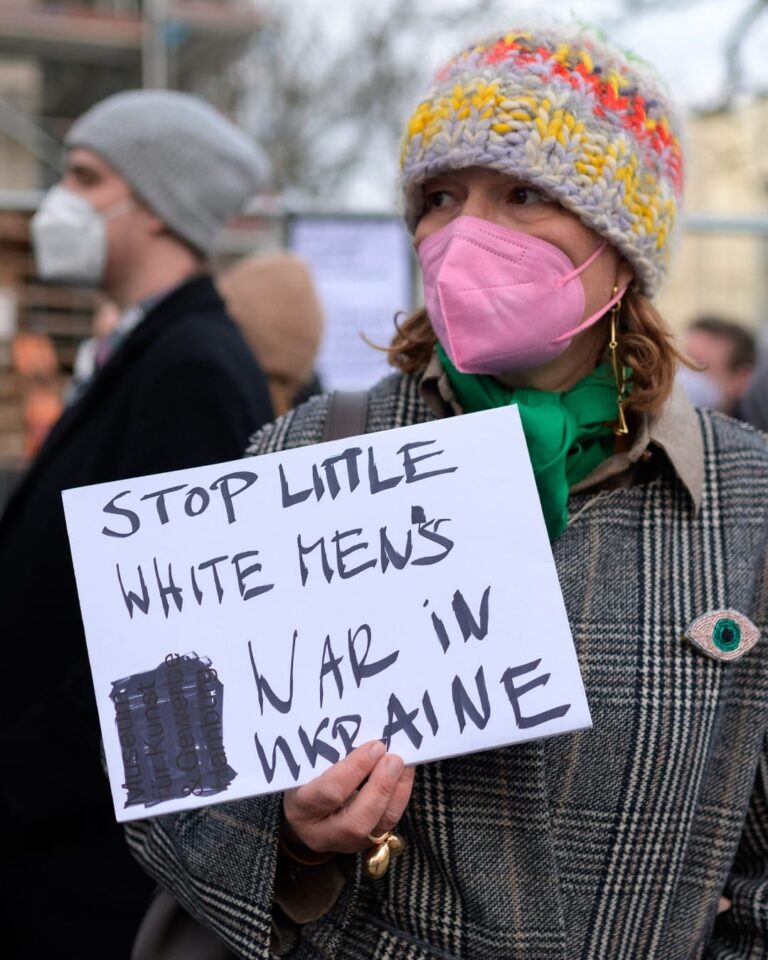
During the cold war there was a strong anti-war movement. The present situation needs a broader anti-war Left movement to minimise the war build up across the globe.
People of Ukraine need solidarity not because the bombs have reached the borders of Europe as projected and amplified by the western mainstream media. It is because all the oppressed countries have been suffering and fighting against American interventions across the globe. With the emerging economic might of China and Russia’s military power a new multipolar world is coming to forefront. The world it at crossroads where the global anti-war movement is the necessity of the hour.