China’s Belt and Road Initiative (BRI) formerly known as One Belt One Road is a global infrastructure development strategy adopted by the Chinese government in 2013 to invest in nearly 70 countries and international organizations.
It aims to interconnect the world’s nations through a network of land roads, railroads, ports, pipelines, maritime routes and telecommunications networks.
Syria and China on Thursday signed in Damascus an agreement to join this Levantine nation to the initiative of the Silk Road Economic Belt and the 21st-Century Maritime Silk Road.
The document was signed by Fadi al-Khalil, Chairman of the Planning and International Cooperation Commission, and Chinese Ambassador to Syria Feng Biao.
In statements to the press, Al-Khalil said that Syria is already part of the initiative and this helps it open broad horizons of cooperation with China and other countries. Cooperation between the two nations will include the exchange of goods, technology and capital, in addition to activating the movement of people and the cultural exchange.
He said that Beijing and Damascus will cooperate to facilitate trade barter and the reconstruction of infrastructure, and electric and alternative energy.
To date, some 150 countries and 32 organizations joined this initiative announced by China in 2013.
Belt and Road Initiative is considered a centerpiece of the Chinese leader Xi Jinping’s foreign policy. The initiative plans to connect the historical Silk Route that connected trade routes from Asia to Central Asia till Europe.
The project proposed overland routes for road and rail transportation through landlocked Central Asia along the famed historical trade routes of the Western Regions and the Indo-Pacific sea routes through Southeast Asia to South Asia, the Middle East and Africa.
Examples of Belt and Road Initiative infrastructure investments include ports, skyscrapers, railroads, roads, bridges, airports, dams, coal-fired power stations, and railroad tunnels.
Three belts are proposed. The North belt would go through Central Asia and Russia to Europe. The Central belt passes through Central Asia and West Asia to the Persian Gulf and the Mediterranean. The South belt runs from China through Southeast Asia and South Asia and on to the Indian Ocean through Pakistan. The strategy will integrate China with Central Asia through Kazakhstan’s Nurly Zhol infrastructure program.
The big two-page advertisement appearing in leading Kannada dailies of Karnataka on Mekedatu project is creating confusion and apparently misleading the readers.
Normally, every advertisement will have the name of the person, agency or the government in the advertisement.
But the advertisements given to newspapers like Prajavani, Samyukta Karnataka, Hosadigantu, Vijay Karnataka etc. have no mention of any person.
To find the fact, gaurilankeshnews.com tried to make an effort to know exactly who gave these big advertisements. We tried to find the answer to this question from the authorities of the newspapers.
The advertisement was shared by Karnataka Health Minister Dr. Sudhakar in his twitter account after the Congress launched its ambitious 10-day Padayatra for the implementation of the Mekedatu project from Saturday.
The advertisement was published in Samyukta Karnataka and Prajavani on January 8 while the Minister shared the same advertisement through his twitter handle on January 9.
The same advertisement which got published in Hosadigantha newspaper was shared by Karnataka BJP’s official twitter handle.
In his twitter handle, Sudhakar said that the congress did not make an attempt to implement the Mekedatu project when it was in power, but now the party which is in opposition is showing concern for the project for its political existence. The people are noticing everything, said Dr. Sudhakar in his twitter handle by attaching an advertisement published in Prajavani.
“ It is the moral responsibility of the newspapers to publish the name of the person, agency or party which has given the advertisement. But the advertisement which accuses the failure of the Congress to implement the Mekedatu project, does not mention the name of the person or agency that has given the advertisement.
Will these newspapers carry any such advertisement for the sake of money”, wondered writer V. R. Carpenter. Many others too have raised their objection to such misleading actions.
After publication of the advertisement, Prajavani carried an article the next day. Speaking to media persons, Water Resources Minister Govind Karjol has accused the Congress of making Mekedatu a political issue. Efforts have been made to reply in the political term itself. The advertisement does not carry the picture either of him nor of CM. “ We have only told the truth to the people. The information that is present in the files of the government has been presented before the people”, Karjol has said.
In his reply, Leader of the Opposition in Assembly, Siddaramaiah has said that the BJP which did not make any efforts to implement the project in its over two and half years of tenures, is now misleading the people with the advertisement.
In his sharp reply, Former Water Resources Minister, M. B. Patil termed Minister Karjol as ineligible person to hold the chair. The Minister has no knowledge about the interstate water sharing dispute. “ Whatever water is being received by the people of Benglauru today is the result of the efforts of the Congress government. When the advertisement has no owner mentioned, then who sponsored it? BJP is behaving cheaply and Karjol is responsible for that”, Patil remarked.
Interestingly, though Karjol admitted to giving advertisements, he has not mentioned whether the advertisement is given by the Government itself or the party has given it.
More than political statements and counter-statements, will the newspapers continue to carry such sponsor less advertisements?
Will such advertisements not create confusion among the readers?
In order to find the answer to these questions, gaurilankeshnews.com contacted the authorities at Prajavani, Vijayavani and Samyukta Karnataka.
We were unable to get any response from the CEO of Prajavani. Then we contacted Deccan Herald General Manager Sudeep Nag. Nag said if the website wants to talk about Mekedatu advertisement then he suggested speaking to Nanadakumar who is responsible for taking ads related to notification or notification.
Nandakumar said that the advertisements come through agencies, and the advertisement related to Mekedatu has come from a particular agency. The same agency has given the advertisement to all newspapers.
When asked whether the newspaper will publish the advertisement without even knowing he is sponsoring the advertisement, he said that some do not get to know the subject of the advertisement.
Thus the paper only mentions it as advertising one of the top corners of the advertisement.
When further asked whether the paper accepts the ad without the sponsor, Nandakumar said that when the ad has come, it means often it will be sent by a particular department. The department gives ads through the agency.
We later asked who gave the ad, then he replied that an agency called ‘Jhenkar’ has given the ad and added that the agency has secured government approval.
To a question, he said that normally, they receive an ad after confirming who is giving the ad, “ But this is for the first time that we received an ad without the name of the sponsor”, he said.
Asked if the paper will take similar ownerless ads in the coming day too, Nanadakumar said that for any matter of the ad, the paper is not responsible. Now with regard to the Mekedatu ad, it has been received from the agency. “ But we don’t know who is going to make the payment of the ad to the agency”, he said.
When asked whether the paper will take any ad from the agency even if it is given by an unknown person or source, he said that the current ad has come from a government recognized agency, therefore the paper believes it.
“ Otherwise it is not possible to take ad from just anybody”, he replied.
When asked directly whether the paper will carry a similar ad if it comes from the same agency, the official made it clear that in no case such an incident will be repeated.
He asserted that the paper will henceforth remain alert before taking any advertisement.
He said that even the Information Commissioner clarified that since the ad has not been given by any department, therefore, the department will not clear any bills.
“ The commissioner asked us to collect money from the agency itself “, he said. Later, even Bhatt regretted receiving such an unowned ad.
“ We have directed the ad department not to take any such ad. This has come without my notice. The moment I saw the ad in the morning I inquired with the ad department. I have given instruction not to carry such as that which has no owner”, Bhatt said.
When the same question was asked to the Vijayvani editor, Channegowda, he said normally the matter related to advertisement is normally brought to the notice of the editorial section. “ We carry the ad if we are sure that the ad does not defame anybody. The said ad also falls under the same norms. “ It is not necessary that all the ads should have a source, even if the ad gives some information to the general public then we take such ad”, he said.
He said that the person who was giving the ad, requested personally not to carry the name of the advertiser. “ Since the person was convinced as to why the name is nor important, we agreed and carried the ad”, he said.
When asked whether the readers ask the source of the ad, he replied that nobody so far questioned about the ad. “ We will take such an ad if tomorrow Congress offers it”, he asserted.
Interestingly, when contacted by the Samyukta Karnataka paper, the editor, Hunasawadi Rajan asked the website to seek information from the government and not from the paper. “ Whatever the Irrigation Department says about it, it will be final”, he said.
We all might have read the story of the burning down of the private library of Kannada lover, Sayed Issac of Mysuru.Some drunken guy had lit up the library by mistake while he was trying to smoke Beedi in April last year.
After that incident, many people had stepped forward to offer help Isaac for reestablishing his library which had set up for people where he was offering books for free to read.
People had showered praises over Isaac for his great admiration for Kannada.
Several media houses had carried the news about him. Elected representatives also visited his library and assured all possible help to reset the library.
One of the persons called Misba Faten has launched a fundraising act to collect money in order to donate to Isaac for the library. But after the Government announced to take the responsibility of setting the library, Rs. 29 lakh donated money was returned.
Isaac had been running the library on a site reportedly belonging to some NGO since 2011. The officials had assured him that the site will be taken away from the NGO and will be given to Isaacfor the library. The site was also allotted but the construction of the library was delayed.
When Isaac realized that the construction was getting late as promised by the administration, Isaac did not wait further and decided to start construction with the money donated by the people.
“ Though the site was indeed allotted but the construction was getting delayed inordinately. I thought it would be too late if I waited further for the government to construct the library. Thus, I decided to take the money donated by some philanthropists to set up the library. Since I could not construct a full-fledged library with the little money, I made a shed-like house to restart the library”, he said.
He said that he began keeping hundreds of books he had received from the donors. Isaac had been saying that a Kannada library was needed in the Rajivnagar area of Mysuru where majority of Urdu speaking people live.
“ Now, my dream has come true in this way at least as I have a library having hundreds of Kannada books”, he said.
Speaking to naanugauri.com, Isaac said that I have constructed the library with the money of people. MLA Zamir Ahmed Khan had donated Rs. 2 lakh, MP, Pratap Simha had given Rs. 50,000, Minister, S. T. Somashekhar had given Rs. 25,000 and other people had given as per their capacity. “ The total donated money was about Rs. 3.45 lakh. The total money spent on the reconstruction of the library is around Rs. 4 lakh. Though I wanted to install CCTV, but since I could not manage more money, I am happy at least with this”, he said.
Isaac plans to officially open the library on Republic Day with local children.
“ I had six plastic chairs, two of them have broken, so I’m planning to purchase some for new chairs. If I am unable to arrange it, then I will use cement bricks as chairs”, he replied humbly.
Isaac said that though the government has not got the library constructed, he is grateful at least for offering the site. The library has taken some shape.
Money paid to Library department: Corporation Commissioner
In the past when gaurilankeshnews team had contacted the City Corporation Commissioner, Lakshmikant Reddy to know the reason for the delay in construction of the library, he had said it was the job of the Library Department.
He had claimed that the Corporation had already handed over money collected as Library Cess to the Library Department.
But when contacted B. Manjunath, the Deputy Director of Mysuru Central Library, he claimed that they have not received any funds from the Corporation.
“ The City Corporation has to pay Rs. 20 crore to us but it has not given money so far. We are finding difficulty in managing our own accounts so how can we spend money for the construction of the library of Isaac”, he said.
He said that the department needs at least Rs. 3 to 4 crore for the ongoing construction work of the library at People’s Park library of Mysuru city.
Manjunath said that a project report was prepared to construct the library of Isaac at an estimated cost of Rs. 35 lakh. He said that if the Corporation gives at least Rs. 20 lakh, then work can be started. A letter in this regard has already been written to the Corporation.
Meanwhile, without getting bothered much for the construction of the library from the government, Isaq took the initiative to start it on his own.
Since he had received thousands of books from the donor, he could not keep that at home for too long. Thus he has now got a simple library set up where he has kept the books.
He however said that as he needs more furniture, he is hoping to receive them from donors. Those interest to donate, can contact him on 99012 66487
Vijayapura(Bijapur): Minister for Religious and Charitable Endowments that includes Muzarai, Hajj and Wakf, Shashikala Jolle has said that the Chief Minister Basavaraj Bommai will soon take a decision on constituting an expert committee on freeing temples from government control.
Addressing a press meet on wednesay, she said that the government has not taken any final decision on handing over the total control of the Muzarai temples to the temple trusts.
“ As we all know, the Chief Minister made an announcement related to this. He only said that the government is contemplating to free the temple from government control”, he said.
Jolle said that the government first wants to study various laws and models being implemented in other parts of the State on control over the temples.
The expert committee will find out the details on how other States are managing the temples and what laws have been made. Based on the report of the committee, the government will take a final call.
On the allegations of the Congress that the BJP is conspiring to handover the temple to trusts managed by RSS, she refuted the allegations.
“ Even today, we have a check and balance system in temple that comes under Muzarai department. While each temple has its own advisory committee or endowment committee, their activities are monitored by a government appointed official”, she said.
She said that based on the total earning of the temple from donations and charities, the temple has been categorized as A, B and C.
The department of Religious and Charitable Endowments popularly known as Muzrai administer about 35,000 Hindu religious institutions which receive grants from the Government of Karnataka. The department is operated under the Karnataka Hindu Religious Institutions and Charitable Endowment (amended) Act, 2011.
Grade ‘A’ temple means those temples that have annual earnings beyond Rs. 25 lakh. “ The government has made the rule that the temple should give 10 % of the total amount to the government and the remainder the temple trust will keep for the development and maintenance of the temple.
Karnataka has around 1,80,000 temples, of which only 35,500 temples come under the Muzrai department. These temples are put in three categories based on their annual income. Grade A has 205 temples that earn more than Rs 25 lakh annually; Grade B has 139 temples earning between Rs 5 and Rs 10 lakh per annum; Grade C has 34,219 temples that earn less than Rs 5 lakh per annum. The temples have been directed to submit their annual audit report to the government before the end of this month.
Only temples under Grade A and B contribute to the Muzrai department — an amount of 10% and 5% of their annual income respectively. This money goes into a common pool administered by the Commissioner of the Hindu Religious Institutions and Charitable Endowments department. The money is used to pay for the maintenance of the smaller Hindu temples that don’t make enough money. This includes payment of the archakas (priests), payment of electricity and water bills, maintaining the cleanliness of the temple premises, expenses incurred for provisions for pooja like flowers, coconuts etc. Only the temple employees are paid salaries drawn from the temple funds. The salaries of the Muzrai department employees who are involved in activities like audit of temple ledgers, distribution of funds to low-income temples, organising facilities including food and lodging for pilgrims, is paid for by the state government.
Haveri:The country is in deep economic crisis and everyday lakhs of people are pushed further into a life of poverty and misery. One such incident came to light in Haveri district of Karnataka.
A 33 year old man had applied for a bank loan at the Canara bank branch in the Hedigonda village in Haveri district . But the bank refused to grant him loan. Angered and frustrated by the rejection from the bank, he tried to set the bank on fire.
The incident took place on Sunday night when the accused was caught by the residents residing near the bank, when he was allegedly trying to escape after setting fire in the Canara bank branch.
According to the Kaginele police which have filed the case, the accused who is the native of Rottihalli village was running an NGO. He was facing severe financial crises and had borrowed loan from private money lenders.
Since he had no other sources to clear the debt, he thought of borrowing a loan from the bank. He applied for the loan in various banks, but all the banks refused to offer loan considering his weak financial position.
A month ago, he visited the Canara bank branch in Hedigonda village to apply for the loan. He was apparently hopeful of getting a positive response. But here too, he received only disappointment as the bank refused to offer a loan.
Frustrated by the rejection, he decided to take revenge from the bank. According to the police, he had carried a can of petrol with them to set the bank on fire. He broke one of the windows and threw petrol and lit up the fire.
The fire suddenly started spreading and the accused was taken aback. As the fire began erupting fast, he tried to escape from the scene. During the process, he sustained minor injuries. He was caught by the neighbours while he was trying to escape who then handed him over to the police.
The police have registered a case based on the complaint filed by branch manager H. M. Naik. He is booked under various sections of IPC including 435, 436, 427 and 447.
Loans and Bank NPAs
Incidents like these are a reflection of growing economic crisis in the country that pushes people to take such extreme measures. While the accused is arrested one need to question the circumstances that pushes people to take such actions.
Banks and financial enterprises that should work as safety net for the poor have been hollowed out and are only working as coffers for corporates. While people are committing suicides for not being able to return bank loans, big corporates are given not just given big loans, those loans are also waived off. This can be seen in the increasing number of Non performing assets(NPA) in majority of Indian banks.
Indian Banking industry is seriously affected by Non-Performing Assets (NPA). More than Rs. 7 lakh crore worth loans are classified as Non-Performing Loans in India.
The weakening of banking institutions has resulted in bankruptcy and bank mergers and privatisation of national banks. In the case of public sector banks, the bad health of banks means a bad return for a shareholder which means that government of India gets less money as a dividend. Therefore it may impact easy deployment of money for social and infrastructure development and results in social and political cost.
The farmers’ historic struggle and victory have upset not merely political arrogance, but conventional wisdom in more than one way. It has shown the limitations of class analysis, and has thrown up new ideas for organizing peaceful protests in a democracy.
The fact that the relatively better off famers from Punjab, Haryana and U.P often led the movement should teach us the lesson that class position is not always the determining factor. When pushed to the wall, dissent spread across all classes in the entire agricultural sector and inequality within agriculture became less important. Conditions were created for a movement based on unprecedented solidarity. We witnessed this as small and marginal farmers, landless agricultural labourers mostly dalits, men and women cutting across caste, gender, religion and region joined the movement. The fact that the better off farmers had greater economic staying power was an advantage. To this was added the nature of agricultural activity. It is different from factory work in so far as men and women could share the agricultural daily work routine. It prepared them for an indefinitely long resistance. In this game of patience the government blinked first; its highhanded arrogance collapsed with several state elections looming large in the background.
It would be wrong to say that the farmers were unaware of the class character of the state and its policies. They took no time to point out that the now-repealed three farm laws were primarily meant to promote the interests of the two biggest business houses in the country, the Ambanis and the Adanis. The role of the government was that of a facilitator for their profit from agriculture. This contrasts starkly against Gandhian vagueness of “Trusteeship’’ of national wealth in the hand of big business.
Singhu Border, Delhi
Superficially the farmers’ movement might look similar to J.P. led movement of ‘total revolution’, or Anna Hazare led ‘’anti-corruption’’ agitation. However, they miss the mark. The ‘total revolution’ reminds one of a French saying , ‘the more you try to embrace, the less you do’. A way of paraphrasing it is, if a movement spreads too thin across too many issues, it fails to capture any; prioritization of issues is essential for effectiveness. The anti-corruption movement was even hollower. It never made clear the difference between personal and systemic corruption. Consider that the three farm laws were made legal (however dubiously), but it does not negate the fact that they were meant to hollow out our democracy further by making the livelihood of half of India’s population dependent on the profit motive of two large private business houses. It is less relevant whether Prime Minister Modi is personally corrupt or not. His action was meant to further corrupt our democracy, and that matters more. The farmers did not create any such confusion.
The farmers could rise above the blame game of party politics, and vicious narratives of false nationalism. Instead they forged solidarity of caste and class, and rejected the “Manuvad’ of gender domination. To be effective, they now face the problem of negotiating their demand for MSP with the broader objectives of the society where many different interest groups coexist.
Much of the discussion about providing legal guarantee for the minimum support price (MSP) for agricultural produce, 23 crops in total (7 grains, 5pulses, 7 oilseeds and four cash crop) focused mostly on its role as an income support policy for the farmers. This is indeed a priority in the backdrop of the distressed conditions of the farmers which have been all too apparent in the large number of farmers’ suicide each year, their mounting debts pointing to the unviability of a situation where the cultivation cost often tends to exceed the selling price, and false promises made by the Prime minister of doubling farmers’ income is a cruel joke. Average farm income is at about Rs1800 per month, about 1/3rd the national average.
If income support to the farmers, especially the small farmers materialize, it would have a tremendous positive external economy, raising demand for industry, especially small and medium scale industries in the unorganized sector. The non-agricultural population stands to gain from it. Through Legal guarantee for MSP, steps need to be taken to make especially small farms viable, and take the wider non-agricultural public along with it. A higher support price to raise farmers’ income might appear incompatible with the national food security policy (NFSP) through an extended public distribution system. It had originated in measures for stabilizing prices of essential commodities against speculation in 1955, and creating adequate storing facilities. The government now spends on an average about 3 lakh crores annually mostly for price stabilization through public distribution without income stabilization policy for farmers. MSP can link the two, price stabilization with income support.
The price of each of the 23 crop has to be set within a band. In general lower price in good and higher price in bad harvest year may be set to limit speculation. Several coarse grains and pulses which are climatically suited for low rain fed areas, may be set at the higher end of the band to induce change in the longer run cropping pattern through relative price incentives.
The Swaminathan Committee’s recommendation as a benchmark for MSP will cost some 17 lakh crores according to the government. This is certainly an overestimate. Taking into account non-traded self-consumption by the farmers which is higher for coarse grains, some 45-50 percent of the production is marketed surplus. The money recovered by sales through the public distribution system is a deduction from the total cost of a minimum support price scheme, and another deduction is stabilization of price through public distribution. Reckoning with all this, most estimates converge in the range of 5 to7 lakh crores. Compare this with DA etc. given to government employees (maximum 5 per cent of the population) which is about 5 lakh crores; all tax breaks and revenue forgone to help a handful of big business, about 4 lakh crores; an unofficial reliable estimate of deliberate default of bank loans is some 10 lakh crores for 28 borrowers, whose names are known. Interestingly, all of them except one (Vijay Malaya) are from Gujarat. Does 5-7 lakh crores for 50 percent of India’s population sound too high in view of these facts? Or, is it simply because the farmers did not have a strong enough political voice?
Taking 7- 8 lakh crores of budgetary support needed from the central government with MSP price of each crop fixed bands, the focus should be making economically viable some 85 percent of farmers with small holdings. Not merely for justice, also the movement will lose momentum without such a focus on solidarity which was at the core of its success.
The focus requires increasing land productivity, not labour productivity. Heavily mechanized agriculture which increases labour productivity enhances the profitability of the employer at the cost of reducing employment, as has happened in organized industry under stagnant demand conditions. What we need instead is higher productivity of land through minor irrigation, innovation in organic fertilizers, water management and climatically suited cropping pattern supported by MSP to be stored and sold in local markets as far as possible. Warehousing facilities have to be decentralized as far as possible as an objective to minimize transport and storage cost. The climate disaster has been accentuated by profit seeking water intensive cropping patterns that are not suited to some areas. It has undermined food security particularly of the poor in arid areas by discouraging the production of several nutritious drought resistant coarse grains and pulses due to their low market profitability. This has to be reversed.
Second, mounting agricultural debt affects most farmers, but the poorer the farmer, more badly hit he is on this count. Inability to repay debt chokes off institutional sources of credit forcing reliance on private credit which results in a vicious spiral of exorbitant, unrepayable interest burden and informal land grab. Bank credit per acre of operational land holding should be the norm. It is possible to devise schemes that links selling certificate of grains under MPS with provision of bank credit.
Finally, these measures can only work through panchayats and local gram sabhas that must have fiscal right and autonomy, (which is already in the 73rd amendment of the Constitution) to be reviewed and revised every 5 years in the light of performance regarding parameters like, yield, loan repayment, cropping pattern and perhaps also criteria like gender, caste and religious minority participation.
The India farmers struggle organized through Panchayats and Mahapanchyats with little money has been spectacular, almost unbelievably so in recent years. Constitutional provision for greater power to them for organizing the rural economy already exists, and nobody else can do it better. Indeed they alone can do.
Prof. Bhaduri is currently teaching at Pavia University, Italy. He is a visiting professor at the Council for Social Development, Delhi University.
The Supreme Court on Monday agreed to hear a PIL filed against hate speeches made at the three-day-long ‘Dharam Sansad’ held in Haridwar, targeting Muslims and calling for violence and assassination.
Senior advocate Kapil Sabil mentioned the matter before the Chief Justice of India NV Ramana, stating, “We’re living in different times where slogans in the country have changed from Satyamev Jayate to Shashtramev Jayate.”
Senior advocate Kapil Sibal told the Supreme Court that the Dharm Sansad hate speech issue is “very dangerous”. “An FIR has been registered but no action or arrest has been made so far,” I request the Supreme Court to take cognisance of the matter,” .Without the intervention of your lordships no action will be taken.” Following this, the CJI agreed to take up the matter.
Provocative and communal speeches were made against minority communities during a three-day “Dharam Sansad” or religious assembly held in Uttarakhand’s Haridwar from December 17 to December 19. Several Hindu religious leaders, who addressed the gathering, called upon the community to take up arms against Muslims as they gave a clarion call for a ‘Hindu nation’.
The plea has been filed by journalist Qurban Ali and former Patna High Court judge, Justice Anjana Prakash, seeking the apex court’s intervention and an independent and impartial probe by a Special Investigation Team (SIT) into the matter.
On January 1, Uttarakhand police added the names of Yati Narsinghanand and Sagar Sindhuraj Maharaj in the FIR registered in connection with the three-day ‘Dharam Sansad’, taking the total number of accused to five. A day later, a second FIR was filed naming Jitendra Narayan Tyagi, along with “unidentified others”.
During the 17-19 December religious conclave, repeated calls were allegedly given by several speakers to wage a war against Muslims and reduce their population in India. Narsinghanand, who is already facing several FIRs in UP, called for a “war against Muslims” and urged “Hindus to take up weapons” to ensure a “Muslim didn’t become the Prime Minister in 2029.”
‘News First’, one of the Kannada news channels of Karnataka has played a fabricated and assumption-based news on the possible assassination bid of Prime Minister Narendra Modi.
The channel which was carrying the news of the alleged intelligence failure when Modi was traveling to Punjab for an election campaign, has used a year old animated video to support its story.
Interestingly, the channel has uploaded its ‘news’ in its YouTube channel also.
In the video which lasts for around 13.19 seconds, the anchor questions whether the conspiracy to kill Modi was hatched a year ago itself.
Then the female news anchor continues to read the news giving a sensational touch with hypothetically posed questions.
‘ The sensational video of the plan to kill Modi is out, whether the plan was made to assassinate Modi on the Firozpur flyover,? An animated video has been prepared regarding the assassination bid, it 1.7 minute long the video, etc.’
The anchor continues to give such information ending with question marks.
But when analyzed, one can easily gauge that there is no base in her claim. She does not corroborate her claims with any facts or confirmed details.
In the first place, she questions whether the conspiracy was hatched back in 2020 itself on Firozpur flyover.
The basic point is. If any such plan was made in 2020 itself, then the intelligent agencies would have captured the perpetrators already.
Now even after a year, if any such bid fails to catch the attention of intelligent sources, then it should be clearly considered as the intelligent failure.
The anchor later shows a video which she claims to be related to the preparation for the assassination of Modi.
She calls the video sensational, but in reality, it is not at all sensational.
Innumerable such videos are available on YouTube.
It is not known whether any action has been taken against such people.
The news channel openly claims that the video is related to an attack that was planned to kill Modi. Surprisingly, no investigating agency of the country has declared that the video was actually related to the planning of any such attack.
Even if the video was genuine, then it should have got leaked a year ago itself and should have become big news. But no such news got reported. Otherwise those who made this video would have been in jail by now.
About the video, the Anchor says that around 1.7 minute long video was released in December 2020. Even if the video was uploaded on the mentioned date, then quite interestingly, the same video is already available in a YouTube channel called ‘Dhakka Gaming’. Similarly, the same video can also be seen in another YouTube channel called BP Shorts. Both videos last for little over three minutes.
The anchor claims that the video has been prepared at Firozpur itself, but she fails to give proof to her claim. Even the other two YouTube channels that have uploaded the video, have not made any claim on the place where the video was prepared.
While one YouTube channel calls the location as America, another says India.
Even to the claim that the plan was made to gheroa PM in 2020 itself, too has no proof. The members of Kisan Morcha have made it clear that they had no plan to prevent the movement of PM in Punjab.
“ As per our schedule, we had planned to hold peaceful rallies across Punjab from January 5. When police asked the protestors not to hold a protest in Firozpur, the protestors staged Dharna on the road itself where they were stopped from moving further. One of the places was the flyover from where the convoy of the PM was supposed to pass. The farmers were not aware of this as they came to know only after PM’s convoy returned from the flyover.
The protestors too did not make any attempt to move towards the convoy. This has now been proven from the video which got viral on Friday.
Some people carrying BJP flags and raising slogans supporting Modi reached the convoy, says Kisan Morcha.
But News First channel, in its 13 minute video claims that the bid to assassinate Modi took place just like the animated video.
Later, another anchor of the channel carries on with the news by claiming to analyze the same video in a different manner.
He questions where the Punjab police was, why only SPG, the special security force meant for PM was at the spot.? The Punjab police personnel were enjoying team with the protestors, the anchor confidently claims as if he was witness to the incident.
But in reality, the Punjab police was at the spot. If they had ran away or had tea with protestors, then it would have become major news. But nothing of that sort happened.
In one of the videos that went viral on Friday itself, people could be seen moving close to the convoy of Modi by carrying the BJP flag.
It makes it amply clear that those who reached close to the convoy were not protesting farmers but BJP workers.
Reacting to the incident, Punjab CM Charanjit Singh Channi has defended his government by saying that no security lapse happened from his government.
He said that it was not told to the government about the change of plan of Modi’s convoy that it would be heading by road.
It may be noted that from the day the farmers’ protest started in the country, a large section of the media has been preparing anti-farmer news.
The section of the media has been working hard to appease the government. The media should have been reporting the news responsibly about the farmers’ agitation which lasted for over a year where farmers faced several natural and man-made adversaries.
Over 700 farmers have lost their lives during the protest.
By following the path of Mahatma Gandhi, the farmers made the arrogant and adamant BJP government kneel down.
While reporting such news, the media should verify all facts before presenting the news to the public.
The article was first published in naanugauri.com.It has been translated into English by Firoz Rozinder.
The Supreme Court on Monday said it will appoint a committee headed by a retired judge of the top court to probe the security breach during Prime Minister Narendra Modi’s visit to Punjab on January 5.
“We are thinking on these lines. One retired Supreme Court judge will head the committee which will be the same like before…Also IG, Intelligence of Punjab,” a bench headed by Chief Justice of India N V Ramana said, after hearing arguments from the Centre and the Punjab government.
The CJIs’ apparent reference was to the committee set up by it earlier to secure the documents in connection with the Prime Minister’s travel plans. It comprises the Director General of Police of the Union Territory of Chandigarh, and an officer of the National Investigation Agency, not below the rank of Inspector General who is nominated by NIA’s Director General, to assist the Registrar General of Punjab and Haryana High Court to secure and seize the records.
Solicitor General Tushar Mehta said he would not object to it, but the IG, Intelligence, himself might be subject to scrutiny as he, too, is responsible for the security arrangements, as per the Blue Book.
Punjab Advocate General D S Patwalia submitted that the ADGP Intelligence may be the person to be included and the court said it will pass detailed orders soon.
The Bench, consisting of Justices Surya Kant and Hima Kohli, also allowed both the Centre and the state to conduct their individual inquiries into the matter.
The Supreme Court bench was hearing a plea by the Punjab government seeking an independent probe into the PM’s security breach incident.
“We got seven show-cause notices from the chief secretary saying you are guilty of violations and disciplinary action will be taken,” AG Patwalia added.
AG Patwalia said the show-cause notices were issued for disciplinary action against seven officials of Punjab government. He said the show-cause notices “presume and premeditate” everything against the Punjab government.
“There has been no inquiries, all documents have been seized. The matter is before the Supreme Court. How did they issue show-cause notices?” the AG asked.
“I demand a court-monitored inquiry. If there was a lapse, hang my officers,” he added.
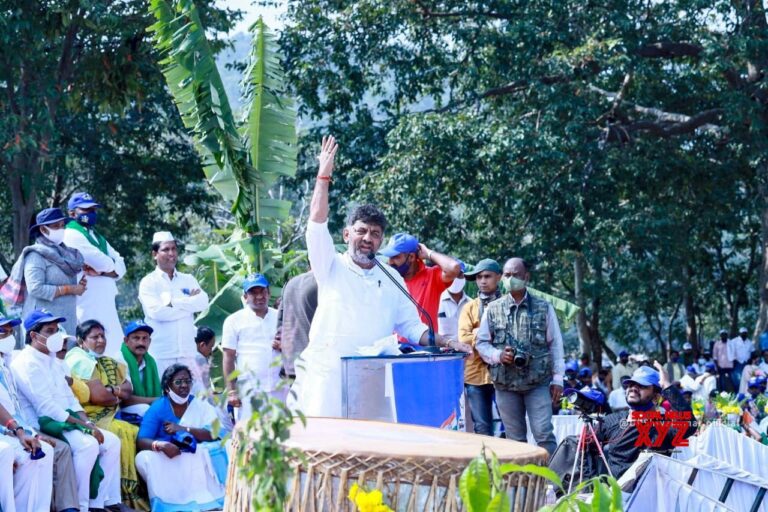
Bengaluru: As many as 30 Congress leaders and workers, including Karnataka Pradesh Congress Committee President DK Shivakumar have been booked for taking out a rally from Mekedatu, violating the weekend curfew on Sunday.
A complaint has been filed against 30 Congress leaders and workers, including Karnataka Pradesh Congress Committee President DK Shivakumar for taking out a rally from Mekedatu, violating the weekend curfew on Sunday.
Ramnagara SP Girish said that the complaint by the tehsildar alleged that they had flouted Covid 19 protocols.
Chief Minister Basavaraj Bommai said: “Action would be taken against anyone who violates Covid rules. There would be no differentiation in dealing with them.”
Karnataka Chief Minister Basavaraj Bommai lashed out at Congress leader DK Shivakumar for holding Mekedatu march amid rising Covid cases and called him ‘irresponsible’ for refusing to get tested.
“We are worried about their health. Not only DK but others should get their health tested. It’s the duty of the health department. DK doesn’t understand this. It shows how irresponsible he is,” CM Bommai said.
The Karnataka government has also decided to press charges against DK Shivakumar and Leader of Opposition Siddharamaiah for violating Covid protocols and conducting march.
“We will file a case against padayatra. Not just them anyone who violates the law, case will be filed. Law will take its course after the case is registered. No matter who it is and how big the leader is,” Bommai said.




 The price of each of the 23 crop has to be set within a band. In general lower price in good and higher price in bad harvest year may be set to limit speculation. Several coarse grains and pulses which are climatically suited for low rain fed areas, may be set at the higher end of the band to induce change in the longer run cropping pattern through relative price incentives.
The Swaminathan Committee’s recommendation as a benchmark for MSP will cost some 17 lakh crores according to the government. This is certainly an overestimate. Taking into account non-traded self-consumption by the farmers which is higher for coarse grains, some 45-50 percent of the production is marketed surplus. The money recovered by sales through the public distribution system is a deduction from the total cost of a minimum support price scheme, and another deduction is stabilization of price through public distribution. Reckoning with all this, most estimates converge in the range of 5 to7 lakh crores. Compare this with DA etc. given to government employees (maximum 5 per cent of the population) which is about 5 lakh crores; all tax breaks and revenue forgone to help a handful of big business, about 4 lakh crores; an unofficial reliable estimate of deliberate default of bank loans is some 10 lakh crores for 28 borrowers, whose names are known. Interestingly, all of them except one (Vijay Malaya) are from Gujarat. Does 5-7 lakh crores for 50 percent of India’s population sound too high in view of these facts? Or, is it simply because the farmers did not have a strong enough political voice?
Taking 7- 8 lakh crores of budgetary support needed from the central government with MSP price of each crop fixed bands, the focus should be making economically viable some 85 percent of farmers with small holdings. Not merely for justice, also the movement will lose momentum without such a focus on solidarity which was at the core of its success.
 The focus requires increasing land productivity, not labour productivity. Heavily mechanized agriculture which increases labour productivity enhances the profitability of the employer at the cost of reducing employment, as has happened in organized industry under stagnant demand conditions. What we need instead is higher productivity of land through minor irrigation, innovation in organic fertilizers, water management and climatically suited cropping pattern supported by MSP to be stored and sold in local markets as far as possible. Warehousing facilities have to be decentralized as far as possible as an objective to minimize transport and storage cost. The climate disaster has been accentuated by profit seeking water intensive cropping patterns that are not suited to some areas. It has undermined food security particularly of the poor in arid areas by discouraging the production of several nutritious drought resistant coarse grains and pulses due to their low market profitability. This has to be reversed.
Second, mounting agricultural debt affects most farmers, but the poorer the farmer, more badly hit he is on this count. Inability to repay debt chokes off institutional sources of credit forcing reliance on private credit which results in a vicious spiral of exorbitant, unrepayable interest burden and informal land grab. Bank credit per acre of operational land holding should be the norm. It is possible to devise schemes that links selling certificate of grains under MPS with provision of bank credit.
Finally, these measures can only work through panchayats and local gram sabhas that must have fiscal right and autonomy, (which is already in the 73rd amendment of the Constitution) to be reviewed and revised every 5 years in the light of performance regarding parameters like, yield, loan repayment, cropping pattern and perhaps also criteria like gender, caste and religious minority participation.
The India farmers struggle organized through Panchayats and Mahapanchyats with little money has been spectacular, almost unbelievably so in recent years. Constitutional provision for greater power to them for organizing the rural economy already exists, and nobody else can do it better. Indeed they alone can do.