

Netflix´s Bulbbul: Far from a Feminist Film

1
Bulbbul, directed by Anvita Dutt, has been trending on Netflix’s ‘Top 10 in India’ list for the past couple of weeks. The film is being hailed as a ‘fiercely feminist tale‘ tackling the ‘putrid core of patriarchy‘ and exposing the ‘pervasiveness of male violence‘. But the film is not a feminist revision of old myths; it instead continues in the long tradition of rape-revenge dramas where a violated woman hunts down or haunts her abusers. Set in the late-1800s in the Bengal presidency, the story revolves around a wealthy zamindar family, into which Bulbbul enters as a child bride. Bulbbul named after the songbird wants to live freely and fly away, but the society and patriarchy have caged her in a big mansion and married to a much older man Indranil, who is the head (‘Thakur’) of the family. Young Bulbbul is caged with the luxuries, jewels, and toerings meant to “tame” her. Other members of the family also act as agents of patriarchy. Bulbbul´s only refuge is Satya, her brother in law, who is also close to Bulbbul´s age. Her life is shattered when the family schemes to move him away from her.  Apart from the problematic portrayal of revenge as justice, this category of films, by celebrating the idea of a vigilante heroine or ‘goddess’, obscure the need for structural changes within a patriarchal society. What is missing is an analysis of patriarchal institutions like marriage which, for example, is based on notions of private property and inheritance. Women’s subjugation to abusive husbands is a consequence of their economic dependence, which is linked to the gendered expectation on women to stay at home and raise children. When we strip away the elements of inherited property (ensured through monogamy) and the gendered division of labour in social reproduction, what is really left of ‘marriage’ as we know it? The film makes perfunctory references to many patriarchal practices such as; child marriage, men taking on multiple wives, enforced widowhood, familial rape, and domestic abuse, but offers no meaningful insights about any of them. There is overt symbolization of toe-rings as a form of controlling women’s sexuality.  It seems as though the film wants us to believe that, by simply ticking all these boxes, it is somehow feminist. However, there is nothing fresh or feminist about this tale of a woman wronged, who then sets out to avenge other women suffering similar abuse. This is also reflective of the larger problem with the trend of so-called feminist movies, where if the story is centered around women it is somehow feminist, even though it has all the usual tropes.  It is easier for films like Bulbbul to simply get rid of abusive men rather than challenging the patriarchal structures which perpetuate such abuse. The murders of the male abusers in the village by Bulbbul remain very much within the framework of feudal paternalism; it is as traditional as the head of the local zamindar family ‘taking care’ of the village and meting out justice as they see fit. The only difference is that the head of this feudal family is a woman, not a man. But in no way does she act to change the structures of feudalism and patriarchy which entrap and exploit her. As the ‘Thakurain’ of the household, she is as controlling as a male ‘Thakur’ would be. The relationship between the two female characters, Bulbbul and Binodini, is also typically patriarchal. Binodini is the jealous and scheming sister-in-law who tries to control Bulbbul’s interactions with Satya and who is indirectly responsible for Bulbbul´s fate. Almost every conversation between the two women is vicious and bitter. Although Binodini is also is a victim of patriarchy (in being forced into marriage with Mahendra), she reinforces the patriarchal household structure by continuing the cycle of control and thus enabling the men in the household.  More importantly, by making the incident of rape central to the transformation of Bulbbul’s character, the movie reinforces the patriarchal notion of a rape victim being ‘damaged’ forever and her identity being defined by her experience of violation. Some viewers have seen this as perpetuating “the (problematic) trope that in order to blossom, a woman must first be (violently) broken”. Why is it that “in Bollywood films, a rape survivor is either an angry embittered witch or an innocent victim who later takes her life…Is it not possible for once to have a climax where the survivor moves forward and forges a new storyline for herself?” Even the most ‘progressive’ character in the film, Dr. Sudip, disappoints us when he protects Bulbbul stating that “she is not a demon (chudail), she is a goddess (devi)”. Feminists have long fought against both; the idealization of women as goddesses and their denigration as demons, as neither positions respect women for simply being human. Instead of an escape into the supernatural realm, what we need is a close examination of the patriarchal structures of family and marriage which allow the perpetuation of domestic abuse and violence.  Read Next: Women & the Pandemic: The Challenge of Domestic Violence

Two African Students Assaulted at Roorkee Institute of Technology

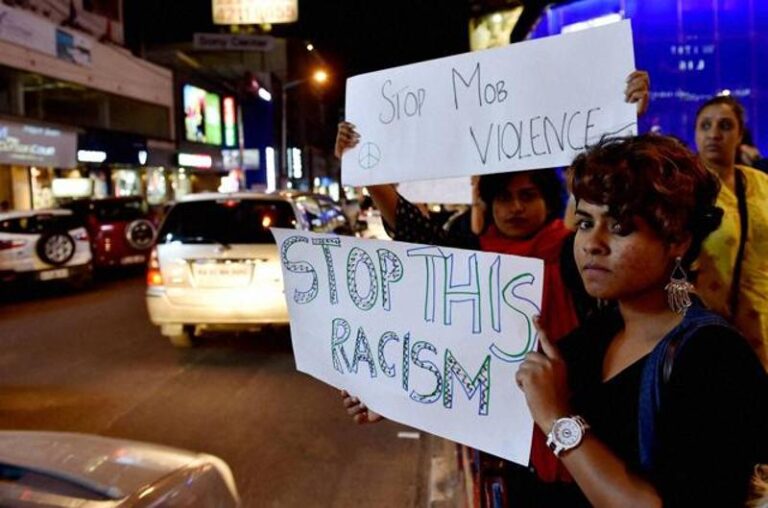
Two African students were brutally assaulted by security guards at the Roorkee Institute of Technology in Haridwar, Uttarakhand on 15 July 2020. The students were dragged out of the hostel and their clothes were torn. Videos show the students forcibly being dragged on the floor and more than 10 guards can be seen beating up and assaulting the two students. This incident occurred after there was allegedly an argument between the students and the guards when the two African nationals were asked to vacate their hostel rooms. The Institute has stated that the students were given notice to vacate the hostel a week ago, but failed to comply with the lockdown-related rules of the college. It has been alleged that the Institute hired 30 men to beat up the international students and force them to vacate the premises. After more than 200 Indian students extended support to these students, an FIR was registered by the police. The local police have reportedly arrested 6 people for this assault on the students. It is unclear whether or not the students have been rusticated from the college. This is not an isolated instance of such violence against Africans in India. Racist attitudes towards Blacks are widely prevalent within the country. Previously, in 2017, four Nigerians were attacked near a mall in Greater Noida. Another incident of hostility towards Blacks was reported when two African women were shouted down by a group of men in the Delhi Metro in 2017. An African professor in Delhi pointed out, “India is a racist country. Indians are not ready to accept foreigners, especially those from Africa.” Many have pointed out the hypocrisy of upper caste Indians condemning the death of George Floyd in America and tweeting ‘#BlackLivesMatter’ while continuing to perpetuate casteist and racist violence within India. Read Next: Black Lives Matter: Protests Across US Over the Murder of George Floyd

Nepali Man’s Head Shaved Off and Forced to Chant Jai Shri Ram

0
In the backdrop of Nepal’s Prime Minister KP Oli Sharma claiming that the real Ayodhya was in Nepal and that Ram was a Nepali, Hindutva fringe elements in the state of Uttar Pradesh (UP) had forcefully shaved off the head of a Nepali man. It was also reported that the members of the Hindutva fringe group forced him to chant ‘Jai Shri Ram’ slogans and also wrote the same on his head.

The victim was also forced to call out slogans against his will including ‘Nepal PM Murdabad’ and also ‘Vishwa Hindu Sena Zindabad’.

In this regard, Nepal’s ambassador to India, Nilamber Acharya had discussed the issue with the Chief Minister of Uttar Pradesh Yogi Adityanath and was assured about the safety of Nepali nationals in the state by the CM. The following tweet was retweeted by Nilamber Acharya in this regard. Arun Pathak, Convenor of a Varanasi-based Hindutva Fringe group, Vishwa Hindu Sena, had recorded the video of the incident and had shared the same on his Facebook profile. The video previously went viral on social media and consequently, an FIR was filed against him. Varanasi Police had registered an FIR against Arun Pathak under Sections 505(2) and 295 of the Indian Penal Code and Section 67 of the IT Act. Senior Superintendent of Police, Amit Pathak has informed ANI that one of the persons involved in the incident was arrested while the police were on the search for others as well. According to the reports of The Quint, the man arrested was Santosh Pandey.

जय जय श्रीराम।।#विहिसे।

Posted by Arun Pathak on Thursday, July 16, 2020
  It must be noted that the spread of hate, especially pursued by the Hindutva fringe elements might irreversibly damage the bilateral relations between not just the nations but also between the citizens of the two nations. Nepal and India have shared a long-term relationship with one another by following the non-requirement of Visas for citizens to enter each other’s borders and close trade-ties under the Indo-Nepal Treaty of Peace and Friendship since 1950. The nations had also shared close linguistic and cultural ties with one another which stands disturbed owing to the rise of the Hindutva-nationalism sentiments in the country. Read About: 25-year-old Dalit Man Killed in Gujarat’s Banaskantha District

25-year-old Dalit Man Killed, Paraded naked in Gujarat

0
In Ravi village, Banaskantha district, Gujarat, another incident of caste atrocity has come to light. A 25-year-old Dalit man, Pintu Galchar, was stripped, killed and his naked body was dragged around the village. The Gujarat police has taken cognizance of this caste atrocity and all the accused persons have been arrested. Jignesh Mevani, MLA from Gujarat, posted on Twitter condemning this violence against Dalits and comparing it to a similar incident in Guna, Madhya Pradesh. He has urged for a free and fair investigation, so that justice is ensured. On Tuesday, a Dalit farmer couple in Guna consumed pesticide in an attempt to commit suicide after the police destroyed their soybean crop, allegedly as part of an anti-encroachment drive. The state BJP President, V. D. Sharma, said that this incident had no ‘caste angle’. Although the two farmers have been hospitalized and are in a stable condition, questions have been raised about the police brutality which has been recorded in videos that went viral. A magisterial probe has been ordered and the State Human Rights Commission has also asked for a report on the incident. It has now been reported that six police officers have been suspended. It’s unfortunate that even during lockdown that caste atrocities continue unabated. Police force instead of helping the poor are only working as agents of upper caste and add to the miseries of the poor. Many activists and social workers say that the lockdown is used as an opportunity for assault by the upper castes. Read Next: Yogi’s Ramrajya is a Graveyard for Dalits: Chandrashekhar Azad

Karnataka High Court: Form Expert Committee for Supervision of COVID-19 hospitals

1
On Thursday, a division bench of Chief Justice Abhay Oka and Justice Alok Aradhe of the Karnataka High Court directed the State government to promptly constitute an expert committee of doctors, who would inspect and supervise COVID-19 hospitals in the state. The High Court referred to the June 19 order of the Supreme Court by which all states were required to constitute expert committees within a week. The High Court stressed that this expert committee must start functioning immediately in the state. Furthermore, the bench directed the state and all stakeholders involved to bring out measures for the protection of public servants who are working at the forefront of this pandemic such as pourakarmikas, police, doctors, nurses, ASHA workers, and housekeeping staff in hospitals. The court directed the state to conduct random testing among these groups of workers who are most exposed to COVID-positive patients. The advocate representing the All India Central Council Of Trade Unions brought to the notice of the bench that, despite previous court directions, the BBMP has not issued the neccessary PPE kits to personnel working in Containment Zones. The court was informed that around 1000 police personnel have been infected with the virus. The court reiterated that the BBMP must strictly implement the directions previously issued on providing PPE kits to front-line workers. Read Also: ASHA Workers & Sanitation Workers Protest against the Government The High Court also addressed the problem of private hospitals refusing to admit COVID-positive patients. The Addl. Advocate General Dhyan Chinappa, submitted that the State government has issued a circular that private hospitals and ambulances are bound to admit and treat COVID patients. According to the government circular, any of the the following three documents can be used as proof by patients to seek treatment: i) SMS alert from an authorised source indicating COVID-positive status, ii) COVID-positive alert on the Aarogya Setu app, or iii) a report from an accredited laboratory indicating positive status. The court directed the government to set up a dedicated telephone number which patients or aggrieved persons can call to lodge complaints regarding the failure of any hospital to admit a COVID patient. The court pointed out that the government must invoke the Disaster Management Act to enforce directions against private hospitals. The matter will be heard next on July 20th. The Court directed: “State to give details about steps taken to provide medical facilities in the districts? Details of hospitals, beds, doctors etc in each of the districts to be placed on record. Number of testing centres and ambulances available to be stated.” First published in Live Law. 

Herbal Products: A Growing Multi-Billion Dollar Industry

The earliest evidence of plants used for healing purposes by human beings dates back to the Neanderthal period. This enormous knowledge and experience of man to identify and apply healing herbs in the form of medicines to promote health has been accumulated over a period of centuries. This rich resource of information is readily available now for ongoing and future modern scientific research works in the field of medicine. According to the World Health Organisation, about 70 to 80% of the world’s population relies on plant-based medicine, or herbal products, for their primary healthcare. The inclination towards treatment with complementary and alternative medicine is mainly due to increased side effects related to synthetic drugs, the lack of holistic approach for several chronic diseases in modern medicine, high medicine and hospital expenses, microbial resistance and emerging diseases.

Indian Market for Herbal/Ayurveda Products

In India, about 80% of rural population uses medicinal herbs, Ayurvedic medicines or indigenous health practices for most of their ailments. It is estimated that nearly 960 plant species are used by the Indian herbal industry. Herbal exports include medicines of AYUSH (Ayurveda, Yoga & Naturopathy, Unani, Siddha and Homoeopathy) products, which occupy a share of 3% of total pharmaceutical exports. 70% of the herbal sector consists of largely raw materials and 30% of the export includes finished products. The Indian plant extract market is showing an astonishing growth as there has been a shift in universal trend from chemical based medicines to herbal based ones. Due to its wide range of medicinal and aromatic uses, the plant extract market is expected to grow at a CAGR of around 17% between 2018 and 2023. The current valuation of the Indian herbal market is at Rs 5000 crore.

Exponential Growth of Herbal Medicines during COVID-19 Pandemic

Sales of immunity boosting foods, minerals, herbal medicines have shot up by an estimated 20 to 40%. Online searches for such products have multiplied six fold with Ayurvedic home remedies, Giloy and vitamin C. ‘Dabur India Limited’ which sells Chyawanprash and honey reported a 400% surge in demand for its Chaywanprash and 80% growth in Dabur honey. “There is spike in demand for magnesium supplements and energy drinks” said Varun Khanna, CMO and co-founder of Fast & Up. The Coronavirus outbreak has lead to renewed focus on staying fit and healthy. People are warming up to the idea of improving immunity to avoid catching any infection. Seeing these kinds of trends, companies have been quick to capitalise on this idea of immunity boosters. Some organisations, popular Ayurveda pharmaceutical companies and companies manufacturing herbal medicines have even claimed a cure for Coronavirus. On the other hand, some herbal industries are claiming to have immunity-boosting products which will help to fight against the Coronavirus. Also Read: An Ayurvedic Perspective of Immunity The ministry of AYUSH has issued more than one advisory on herbal and non herbal preparations that can boost immunity. The ministry has also issued statutory clearance for Ayurveda, Siddha and Unani drugs in an effort to promote immunity boosting products for healthy people. The AYUSH ministry said that it is necessary to generate clinical data which is scientifically valid and credible while undertaking the research. It is mandatory for all organisations to comply with the conditions listed in the AYUSH gazette notification dated 21st April 2020. Yet, how many products, already on the market as immunity boosters or cures for Coronavirus, have followed the guidelines while undertaking research? This is an important question to be asked not only by consumers but also by the concerned authorities. The AYUSH ministry and concerned authorities in India should pay close attention to health-related claims of foods, mineral supplements, and herbs that falsely claim to be the cure or preventive care for Coronavirus. They should take all necessary steps to stop even the smallest bit of misinformation or false claims to spread among the public.

International Collaboration of Ayurveda Practitioners

Indian ambassador to the United States, Taranjit Singh Sandhu said that, “A group of eminent Indian-American scientists, academicians and Ayurveda doctors are planning to initiate joint clinical trials for Ayurveda formulations against novel Coronavirus”. This is indeed great news for Ayurveda practitioners all over the world. The Indian herbal market can improve its stake at global business platform by international cooperation and pooling of research data from different parts of the world. It can also improve the study design of clinical studies to establish herbal drug safety for therapeutic use, while taking into account the basic difference between Ayurveda and modern science when designing the research protocols. The role of genetic engineering should be emphasized as this will play an important role in saving the medicinal plants which are endangered or threatened with extinction. The government should also actively take part in preparing a road map for the progressive development of Ayurveda education and research. As the demand for herbal products is increasing by the day, procuring enough raw materials at a reasonable price is a big challenge faced by many herbal medicine manufacturing industries. Strict action must be taken by the government to fulfill the market demand. In order to meet this growing demand for medicinal plants, herbal agriculture or farming of medicinal plants should be encouraged. Last but not least, the principles of ecological ethics should be upheld by preserving biodiversity while utilizing natural resources for drug discovery. The philosophical significance of sustainable development should be emphasized in the process of herbal medicine discovery, research and development. As Mahatma Gandhi rightly said, “Earth provides enough to satisfy every man’s needs, but not every man’s greed”. Man does not have the right to wipe out any species, whether plants or animals, arbitrarily for his own benefits as man is just one of the residents of earth. Dr.Manasa is an Ayurvedic practitioner based in Bangalore. Views are personal.

After Pressure from Students & Activists, Akhil Gogoi Granted Bail in 3 Cases

On Sunday, more than 100 eminent writers from Assam had written an open letter to Assam Chief Minister Sonowal, demanding proper medical treatment for Gogoi and other activists who have tested COVID-19 positive and admitted to hospitals. Hundreds of Assamese students across the country had also written to Sonowal, demanding the immediate release of peasant leader Akhil Gogoi who was arrested by NIA for his alleged role in violent anti-CAA protests. In the face of this mounting pressure to release Gogoi, he has today been granted bail by the Gauhati High Court in three cases lodged by the Assam Police. However, he will remain in jail for the cases being probed by the National Investigation Agency (NIA). The three cases, for which Gogoi was arrested on May 29 while he was already in jail, were related to burning of a post office, a circle office and a branch of the United Bank of India in Chabua during violent protests against the controversial Citizenship (Amendment) Act. NIA is investigating two cases, which were initially registered at Chandmari and Chabua police stations, related to the alleged role of Gogoi in the violent protests. Hearing the bail applications in the three cases registered at Chabua police station in Dibrugarh district, Justice Manash Ranjan Pathak granted bail to the Krishak Mukti Sangram Samiti (KMSS) leader. Gogoi’s advocate Santanu Borthakur said: “Now he has got bail in all cases, except the two NIA cases. The hearing in one of these two cases will start in the next few days. We hope the court will grant bail to him.” Gogoi, the adviser of KMSS, had tested positive for COVID-19 inside Guwahati Central Jail on July 11 and is being treated at Gauhati Medical College and Hospital (GMCH) at present. In the midst of the intense anti-CAA movement, Gogoi was arrested on December 12 last year from Jorhat as a “preventive measure” in view of the deteriorating law and order situation in the state and his three colleagues were taken into custody the next day. The four leaders were later arrested in a number of old cases registered across different police stations in Assam. They have got bail in most of these cases. The special NIA court had granted bail to Gogoi on March 17 in the Chandmari police station case and subsequently to others after the investigating agency failed to file a charge sheet within the specified period of 90 days. The Gauhati High Court later stayed the bail. On May 29, the NIA filed the charge sheet against Gogoi and three of his colleagues for sedition and terror activities. KMSS leader Bittu Sonowal, who was arrested by NIA along with Gogoi, was granted bail by a special NIA court on Wednesday. On Monday, another KMSS leader Manash Konwar got bail by the special NIA court here and he was released from the jail on Tuesday. The fourth associate, Dhaijya Konwar, has not yet received bail. He along with Gogoi and Sonowal are being treated at GMCH after testing positive for COVID-19. Read: Akhil Gogoi shows Covid-19 symptoms: Not treated despite Court Orders

Poet Varavara Rao tests positive for COIVD-19

0
Varavara Rao, activist, and poet who is currently in jail in the Bhima Koregaon case has tested positive for COVID-19. According to reports, Rao was shifted to the JJ Hospital on Monday after he complained of dizziness. Family members have maintained that the 80-year-old has been experiencing health problems for quite some time. Rao, who has been in the jail since his arrest in June 2018, for his alleged role in the Elgar Parishad- Koregaon Bhima case of Maharashtra, was, along with other accused, moved from Pune’s Yerwada prisons to Taloja central jail in the outskirts of Mumbai earlier this year. This was just a few days before the COVID-19 pandemic broke out in India. Since then, the condition, especially in Mumbai, has been worrisome.

Despite Govt. Advice and Student Protests, Christ University Continues with Online Exams

Despite the government’s advice and students’ opposition amidst an increasing number of COVID-19 cases in Bengaluru, Christ University is continuing with the semester online exams. After student protests outside the university’s central campus, the Karnataka State Higher Education department has written a letter to Christ University advising them not to conduct examinations for intermediate semesters/years. Citing another order issued by the Karnataka State Higher Education Department, the students had previously made several representations to the university urging for cancellation of examinations and direct promotion barring the final year students who required sitting for the examinations. Christ University, on the other hand, says that they follow the UGC guidelines and thus are not bound to follow the cited orders. Christ University Vice-Chancellor Father Abraham told the media that 94.47% students had registered to write the online examination, thus they can be assumed to have agreed with the online mode. However, an internal poll conducted by the students says otherwise; 90% of around 2,000 students who took part in the poll have opined that the online examination should be cancelled and the students should be provisionally passed based on internal marks. A source informed Gauri Lankesh News that an email sent by the office of Controller of Examination, Prof. Johny Joseph, to the faculties on 15th July 2020 stated that there has been “numerous complaints received from students” regarding the examination process. The email lists that the students did not receive replies to their queries in time and that there was confusion regarding some of the rules and instructions, “causing inconvenience to students even leading to withdrawal of exam”. It had earlier been reported by students that uploading the answer sheet on Mettl (the online platform used by the institute for exams) is stressful due to connectivity issues. Moreover, they say that an extra charge of Rs. 500 was extracted besides the examination fees paid earlier for installation of the new online examination system. However, no specific arrangements have been made by the University to ensure that all students have access to steady internet connectivity or a system for writing the exams. The students did not anticipate such a long stay at home and hence, most of them left their study materials and books behind. A student reported, “We have been studying for six new subjects for the past two weeks. We gave tests for that too. Now we have to study for subjects that we learned way back in March. But if we don’t appear now, we’ll have to appear in the middle of a new semester without any preparatory leave. The University is not giving us any choice.” While the institute says that in case of any “serious issues” the student can withdraw from the exam and take the test later, the students argue that since 70% of the grade point average has already been evaluated, the institute can take that into consideration and not drag them through stress and anxiety for the rest 30%. Read Next: Karnataka High Court stays Ban on Online Education

UP Congress President Ajay Kumar Lallu arrested on his way to Sonbhadra

0
Police have arrested UP Congress President Ajay Kumar Lallu while he was on his way to attend A program in Sonbhadra UP. The program called Balidan Diwas (Sacrifice Day) was organised in memory of 10 Adivasi who had lost their lives in police firing last year. Ajay Kumar Lallu´s vehicle was stopped by police and he was arrested. He wanted to meet the Adivasis and their families. Lot of police force was put up for his journey.
 
  During the arrest, he said that under the BJP government, atrocities on Dalits and Adivasis are continuing. This can be seen in different districts from UP to MP. He mentioned about the incident on Dalits in Guna district of Madhya Pradesh.