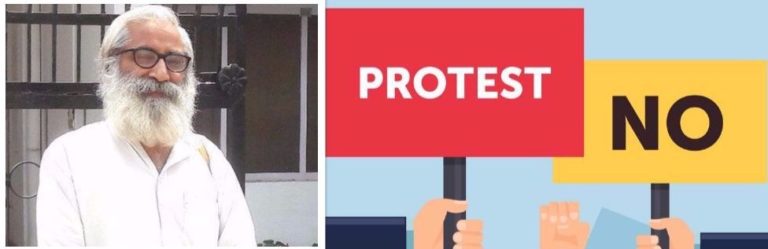
SOCIAL activist and Magsaysay Award winner Sandeep Pandey and his activist wife Arundhati Dhuru were put under house arrest in Lucknow on Sunday to prevent them from holding a protest dharna against the revocation of article 370 and communication blockade in Jammu and Kashmir.
The proposed protest ‘Stand for Kashmir’ was to be held on Sunday evening at the GPO Park, according to an IANS report.
“All of a sudden, police in four vans arrived at our house in the morning and told us that we cannot stage the dharna, because of prohibitory orders in the city. They said the prohibitory orders would be lifted after Independence Day. So I told them that we would stage the dharna after the orders are lifted. Yet, they are standing outside my house and no one is allowed to enter or leave the house,” Pandey was quoted as saying over the telephone.
His wife Arundhati Dhuru is the national convener of the National Alliance of People’s Movement.
Several activists, journalists, and civil society members have slammed the UP government for their house arrest.
Courtesy: the leaflet
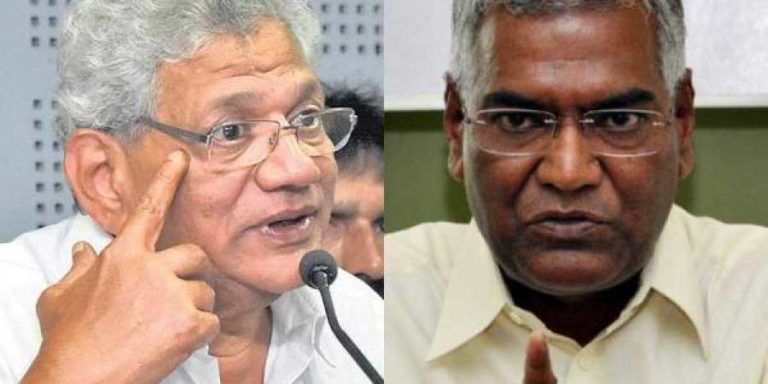
Today CPI(M) general secretary Sitaram Yecury and D. Raja were detained at the Srinagar airport and denied entry into the city. They had gone to Srinagar to meet their party colleagues.
“They showed us a legal order which did not allow any entry into Srinagar. It stated that even escorted movement int the city is not permitted due to security reasons. We are still trying to negotiate with them,” Mr. Yechury told PTI over the phone.
Mr. Yechury told the press that he had written to Jammu and Kashmir Governor Satya Pal Malik on August 8, informing him of their visit and requesting him to facilitate their entry. In the letter, he mentions the purpose of the visit. He also tweeted the handwritten letter to Jammu and Kashmir governor Satya Pal Malik earlier today. The letter was to notify him that he and D. Raja would be taking the 9.55 am IndiGo flight to Srinagar to visit CPI(M) leader Yusuf Tarigami. Tarigami, an MLA in the “dissolved J&K assembly” was not well, Yechury had written.
Com D Raja and I are on our way to Srinagar on the 9.55 am Indigo flight to meet Com Yousuf Tarigami and our other comrades in Jammu & Kashmir pic.twitter.com/axRKZkLbV6
He said – “Both of us had written to the Governor requesting him that there should be no hurdles to our visit… despite that we have been detained. I wanted to meet my ailing colleague and our comrades who are here,”
In a statement issued by the CPI(M) party, it said such an act by the government is “anti-democratic” and showed the ruling BJP’s “authoritarian face”.
.@SitaramYechury has being detained at Srinagar Airport and not allowed to move anywhere. This despite the fact that he had informed the administration about his visit to meet CPIM MLA MY Tarigami who is not well & other party workers. We strongly protest this illegal detention.
On August 8, Congress leader Ghulam Nabi Azad was detained and sent back to Delhi from the Srinagar airport.
There are reports of around 500 political workers and leaders including ex-chief minister Omar Abdullah and Mehbooba Mufti. National Conference leader and ex-chief minister Farooq Abdullah is also under house arrest.
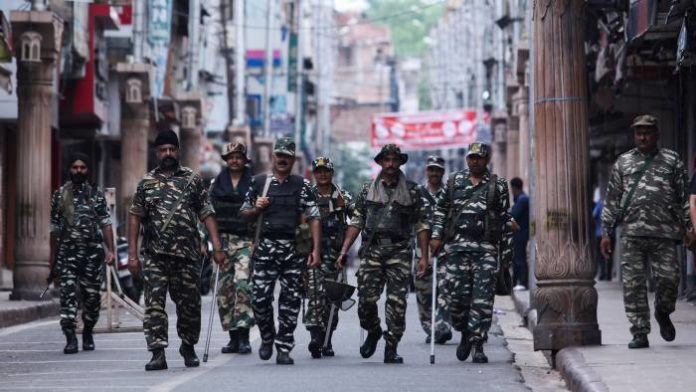
Section 144 has been imposed on the state and security forces have been deployed in massive numbers across the Valley, particularly in Srinagar city and major towns, and barricades have been erected every 100 meters. As of now, all telephone and internet connections have also been snapped in the Valley and only three news channels, including state-run Doordarshan, can be accessed through cable TV networks.
Bombay High Court grants bail to the three accused doctors Bhakti Mehre, Hema Ahuja and Ankita Khandelwal. The three doctors were accused of abetment of suicide of Dr. Payal Tadvi. The three will have to submit a surety of Rs 2 Lakh and appear before the crime branch every alternate day. They are not allowed to travel outside Mumbai without permission and not allowed to go inside Nair Hospital.
Dr. Payal Tadvi, who belonged to the Scheduled Tribe community, committed suicide in her hostel room at BYL Nair hospital on May 22. Since her suicide, the family had accused the three doctors who had been harassing her with casteist slurs on a daily basis.
During the investigation, the team found that there was a handwritten suicide note that was destroyed by the three doctors after she was found hanging in her room. They also deleted the suicide note from her phone. But the investigating team managed to retrieve it.
The suicide note details her daily ordeal under the hands of the three senior doctors and how her complaints were ignored by the Department head. Based on the suicide letter retrieved from her phone and statements from the colleagues, the three doctors were booked under charges of abetment of suicide and under SC/ST Prevention of Atrocities Act.
A Delhi court on Friday framed charges against expelled BJP MLA Kuldeep Singh Sengar for allegedly raping a minor in 2017. The court ordered the framing of charges under various charges, including rape, criminal conspiracy, and kidnapping.
Since the vicitm was a minor at the time fo the incident in 2017, the judge directed the charges to be framed under the Protection of Children from Sexual Offences (POCSO) Act.
On July 28th, the rape survivor met with an accident where a truck rammed into the car she was traveling with her lawyer and two aunts to Raebareli court. While the two aunts didnt survive, the survivor and her lawyer suffered fatal injuries and are now airlifted to AIIMS, Delhi for treatment. The survivor is battling a severe blood infection making her treatment difficult.
BJP MLA Sengar and the accomplices also framed for criminal conspiracy
The CBI told the court yesterday that Sengar and his brother had assaulted the father of the girl and framed him in an Arms Act case, accusing him of possessing a country-made pistol and four live cartridges. This was done in collusion with three state police officials and five others. These three police officials, accused in the case of assaulting the survivor’s father, included the then Makhi police station’s in-charge Ashok Singh Bhadauria, Sub Inspector Kamta Prasad and Constable Amir Khan.
“Hitler´s primary rules were: never allow the public to cool off; never admit a fault or wrong; never concede that there may be some good in your enemy; never leave room for alternatives; never accept blame; concentrate on one enemy at a time and blame him for everything that goes wrong; people will believe a big lie sooner than a little one; and if you repeat it frequently enough people will sooner or later believe it.”
The above quote is from the report, A Psychological Analysis of Adolph Hitler: His Life and Legend, by Walter C. Langer.
On Monday, Amit Shah proposed to scrap Article 370 and made claims about how article 370 is an impediment in the development of the region.
He said that people of “the country” wanted to know why Article 370 was still in operation in Jammu and Kashmir, and why “despite getting so much money, its people are still poor.” “Article 370 ensures there is no PPP model, no private investment in the state. 370 ensures healthcare in Jammu and Kashmir suffers, no doctor wants to go there. 370 ensures there is no right to education for the children of Kashmir,” Shah said.
Well, he lied.
According to national family health survey 205-16, Kashmir is far better on the development indices compared to other Indian states and much better than Gujarat, the purported model state according to BJP and its supporters.
Although it is true that while J&K lags in job creation, investment and growth but that is the case with the rest of the country. The per capita domestic product of Jammu and Kashmir as of 2016-17 is low but higher than most other northern states.
Despite being heavily militarized, the state is not as backward as several north Indian states that have had no such exceptional laws, and have in fact been ruled for substantial periods by the BJP itself.
According to a report from Hindu, Jammu, and Kashmir also fares much better in other human development indices like life expectancy, healthcare, and education compared to other states in India, something that the esteemed Home minister claimed is the reason 370 should be removed.
In 2017, Jammu and Kashmir’s Human Development Index (HDI) was 0.68, higher than even States like Andhra Pradesh and Gujarat. Kerala had the highest HDI (0.77) while Bihar had the least (0.57). The Human Development Index (HDI) is a composite index of life expectancy, education, and per capita income indicators.
Jammu & Kashmir has a fertility rate of 1.6 which is comparable to developed countries like the UK and US. Also, the state has better systems in place for the children born as compared to other states with an infant mortality rate (IMR) of 24 while Madhya Pradesh had the highest (47 infant deaths per 1000). The national average for IMR was 31. Goa had the lowest IMR (8 infant deaths per 1000)
Amit Shah claimed that Article 370 is the reason the state is “still poor”. Once again he was wrong. J&K stood eighth in terms of poverty rate (10.35)%. while Chhattisgarh had the highest poverty rate of 39.93%. The national average was 21.92%. Goa had the lowest poverty rate of 5.09%.
According to Amit Shah, scrapping of 370 and 35A, will bring in investment, growth, and jobs. Well, the same rhetoric was fed to the rest of the country minus any article abrogation, before 2014 elections. 5 years on, the economy is in recession, unemployment rates are the highest in last 45 years, Prime minister solution to it is to open ´pakora stalls. There was no article stopping development in UP, Bihar and other backward states of India. Can the home minister explain?
What does Amit Shah mean when he says Kashmir is lacking development?
Since the last couple of years, we have been fed this model that development only happens when large industries are set up. For the large industry to be set up, the land is acquired from the locals by force or coercion by the government and state machinery. When the locals become landless, they either flee the region or work for measly wages in these industries. We have seen this kind of development model in Central and East India. These are also the regions which are the poorest and fail in all development indices. So whose development is Mr. Amit Shah talking about?
Why would the home minister lie to the parliament and to the people of India?
This was never about development. Its a land acquisition project. The whole point of the exercise was to take away whatever remaining autonomy the people of Kashmir have and bring it further under the control of the central government. Centre´s muscular approach of militarization has further alienated the population. If that was NDA´s intention then it has succeeded in it. Now as next step it wants to control it through political subjugation.
Kashmir valley is the only Muslim majority region in the country. By taking away article 35A, BJP is pushing its agenda of changing the demographics of the region. By allowing Hindu settlers to buy land there, the intention is to reduce the Muslim majority and make them second class citizens. The move is to bulldoze any future resistance that may come when the central government wants to push the local muslim population out, remove its claim of autonomy and complete its nationalisation project.
“I say with all respect to our Constitution that it just does not matter what your Constitution says; if the people of Kashmir do not want it, it will not go there. Because what is the alternative? The alternative is compulsion and coercion…We have fought in good fight about Kashmir on the field of battle… (and) …in many a chancellery of the world and in the United Nations, but, above all, we have fought this fight in the hearts and minds of men and women of that State of Jammu and Kashmir.”– Nehru, speaking in the Lok Sabha in 1952
Nehru’s promise lies in tatters today; as does every other promise of autonomy made by the Government of India. Article 370 gives a ‘special status’ to the State of Jammu and Kashmir. On Monday, the Government effectively abolished that status. It did so without touching the provision. It also brought in a constitutional amendment, without amending the constitution. Crucially, it did all of this after zero consultation with the people affected by it all. Before delving into the legalities of what happened in Parliament, it is imperative to understand the background in which Article 370 was made a part of the Indian Constitution.
Partition and the Indian Independence Act
British rule ended with the creation of two new dominions – India and Pakistan. The princely states were not incorporated into either dominion. The Indian Independence Act provided that all powers returned to the individual states. Rulers had the authority to determine their state’s future. They were encouraged by then Viceroy Lord Mountbatten to accede to one of the dominions. Prior to partition, 562 accessions were accepted by the incoming Indian and Pakistani governments. However, three major princely states, declined to accede to either dominion.
The Accession of Kashmir
At the time of partition, Jammu and Kashmir was a Muslim majority state ruled by a Hindu king. Accession to either India or Pakistan seemed equally plausible. When British sovereignty lapsed, Maharaja Hari Singh had not decided as to whether Kashmir would accede to India or Pakistan. He executed a standstill agreement with Pakistan, and requested India for time to consider an agreement.
During this standstill, Pakistani raiders, with the support of the Pakistani Army, began advancing on Kashmir in October 1947. A panicked Maharaja invited Indian forces into Kashmir to provide temporary protection. Subsequently, the Maharaja executed an instrument of accession with India. Under the instrument, defence, external affairs, and communications were listed under the exclusive domain of the central government. All other plenary powers would remain vested within the state government.
Kashmir and the Indian Constitution
Article 370 limits the authority of Parliament to pass legislation for the State of Jammu and Kashmir. Under Articles 370 (1) (b) and 370 (1) (d), the Parliament has to confine legislation affecting the state to areas enumerated in a list attached to the Instrument of Accession. Legislation on other matters can be passed only if it is explicitly concurred to by the Government of Jammu and Kashmir. Under Article 370 (3), the President can modify or even repeal Article 370. However, this could be done only with the concurrence of the Constituent Assembly of the state.
The Amendments
The Constituent Assembly of Kashmir disbanded in 1956. Almost all members are presumably dead. Since Article 370 could be modified only with the concurrence of the Assembly, many believed that Article 370 had become a permanent part of the Constitution. The Government has however paved the way for amending Article 370 by a novel way. At the core of yesterday’s legislative business, lies Presidential Order C.O. 272 which amends Article 367. Article 367 is the interpretation clause of the Constitution.
The amended Article 367 declares that “the expression ‘Constituent Assembly of the State…’ in Article 370 (3) shall be read to mean ‘Legislative Assembly of the State’. Now bear in mind, that Article 370 could only be modified by the Constituent Assembly of the state. However, because of the amendment, it can now be done away by a recommendation of the state legislature. Given that the State does not presently have a legislature, this role can be performed by the Governor. Thus, all the Government now needs to do away with Article 370 is to get a recommendation from the Governor.
Legal Issues
The Presidential Order amending Article 367 draws its authority from Article 370 (1). Article 370 (1) deals with the power of the Parliament to make laws for the State of Jammu and Kashmir. It does not provide the President the power to amend sundry provisions of the Constitution. An amendment to the Constitution can only be made under Article 368. It requires a 2/3rd majority of Parliament, present and voting. This has not been attempted and leaves the legality of the Presidential Order in serious doubt.
Further, assuming that the President did indeed have the power to pass the order under Article 370 (1), the same could only have done with the concurrence of the State Government. In fact, the order itself begins by saying that it has been made “in the exercise of powers conferred by clause (1) of Article 370 of the Constitution, the President with concurrence of the Government of State of Jammu and Kashmir”.
Jammu and Kashmir has not had a government for months. Instead of consulting the government, the President has consulted the governor. As is well-known, the governor is the representative of the Union Government in the State. So in effect, the Union Government has consulted itself. It is hard to see how this is legal.
It must also be noted that the Presidential Order does not ostensibly amend Article 370. It amends Article 367. However, assuming that these amendments are legal, the ultimate effect of the amendments is on the substance of Article 370. Thus in essence, since the Government could not amend Article 370 directly, it chose to do so indirectly. The Supreme Court has time and again held that this is not legal.
Conclusion
Article 370 has not been amended yet. However, given the amendments to Article 367, the writing is on the wall. The Rajya Sabha has already passed a resolution recommending that the president abrogate most of Article 370. The government has also introduced a re-organization bill that splits up the state of Jammu and Kashmir into the Union Territories of Ladakh (without a legislature) and Jammu and Kashmir (with a legislature).
In the aftermath, cheerleaders of the Government have tried to sell the constitutional changes as ones that will usher in prosperity for the people of Kashmir. If that was the case, the people would have been consulted. Yesterday’s events come at the end of weeks of troop mobilisation, lies by those in the highest offices of the state, and a complete shut-down of communications in the valley. They are a fraud on the people of Kashmir, on the Constitution and on all the values that our democracy holds dear.
The article was first published in Business standard. The authors are lawyers who practise in the Supreme Court.
Bhoomi matu Vasati hakku vanchitara horata Samiti (The committee for land and shelter rights ) headed by freedom fighter HS Doreswamy, will hold a special program for land and housing for the poor in Bangalore from August 14 to August 15.
The team held a press meet today at the press club Bangalore. Here are some points discussed at the press meet. A member of the Bhim Army had also joined the press meet.
Mr. Chandrashekar Azad ‘Ravan’ from UP, the founder of the Bheem Army and the thunderous voice of the Dalits and the persecuted people, will be the chief guest on this occasion and will deliver his message of the unflinching struggle of the people for emancipation. A number of veteran pro-people agitators, leaders of fighting organisations, social activists will stand shoulder-to-shoulder with thousands of the aggrieved people from all over the state on this meaningful occasion. Outline of the programme: ✰ Aug. 14th – a lamp (hanate) procession after sunset: Majestic rly.stn to Banappa Park. ✰ 14th-15th – whole night: program of Resistance – speeches, cultural programmes, etc. ✰ 11.30-12 midnight – Message of Struggle from Mr. Chandrashekar ‘Ravan’, chief guest. ✰ 12.05 midnight: Flag Hoisting and call for real independence: by H.S.Doreswamy. ✰ 15th morning – March for our Rights – from Banappa Park towards Parade Grounds. Noor Sridhar, Committee member said, The Mid-night Independence Day programme is being organised on the night of 14th of August this year in order to make the “souls-sold” rulers and their governments to act once again on these issues, to reprimand their unconcern and lethargy towards the poor, to send a firm message to them that ‘this is not a movement that would subside and die out’, and to mark the occasion of the Independence Day as a day of taking a pledge of consolidating and intensifying the struggle.
the government has not granted land to farmers who submitted for land grant even after three decades. The government has not even formed the tehsil level Land Grant Committees. And sanction of pattas for the houses/huts built by the poor people on government/private lands under the promised ‘Akrama- Sakrama’ (94C/94CC) scheme has also not been undertaken. Instead, forceful, violent eviction of these ‘unauthorized’ dwellers and tillers is going on everywhere; and the infamous Forest Department has launched a virtual ‘bulldozer war’ on these poor people all over the state!
Kumar Samatala of Karnataka Janashakti said- Mr. H.S.Doreswamy, who unfurled the National Flag 72 years ago on the joyful occasion of the country’s hard-fought independence will also unfurl the ‘Poor People’s Independence Day National Flag’ on this occasion, and will initiate another ‘never-say-die’ battle for the real freedom of the poor and oppressed people.Bhoomi mattu vasati hakku vanchita horata samiti (Committee for the Rights of the Land and Housing Deprived), an umbrella forum of several pro-people fighting organisations, was launched three years ago in 2016 to coincide with the occasion of the Birth Centenary of the former CM D.Devaraj Urs. The aim of the committee was –
‘To achieve at least a piece of land enough for a dignified life for those agricultural families who want to pursue agriculture, and a small home enough for a respectful living for all the housing deprived’.
Thanks to the series of struggles conducted under the leadership of this forum, a high level meeting of several ministers and principal secretaries of the concerned ministries and the Chief Secretary along with a delegation of the ‘Committee’ led by the veteran, centenarian freedom fighter Mr. H.S. Doreswamy was convened by the then CM Mr. Siddharamaiah in January 2018. The government acceded to all the demands put forward by the Committee, and constituted a High-Level Committee consisting of the principal secretaries of the concerned departments and two members of the Committee, to facilitate the speedy redressal of the problems cited by the Committee. It also agreed to allow fresh applications in Form no. 57 for grant of land by the bagair-hukum’ tillers up to January 2005 and made amendments to the Land Revenue Act to this effect. More than 4 lakh people have applied for new applications. However, the committee complains that the old Form 50-53 petitions have not been disposed of, no new applications have been touched, and no land grant committees have been restructured.
Yesterday, Article 370 of the Indian constitution that gave special status and autonomy to the state of Jammu and Kashmir was abolished in the parliament. According to the Article, the other articles of the Indian Constitution that gave power to the Central Government would be applied to Jammu and Kashmir only with the concurrence of the State’s constituent assembly. The move by the home minister Amit Shah was brought amidst curfew, communication blockade and arrests of political leaders in Kashmir. While the decision was cheered by many BJP supporters, the move brought sharp criticism from some opposition leaders and civil society activists that it has ignored the voice of the people of Kashmir and will further escalate tension in the region.Protests started in different parts of the country soon after the bill was passed. The Left parties staged a demonstration at Jantar Mantar here, slamming the Modi government for scrapping Article 370 and demanded that the earlier status of the state be restored.DelhiDelhiDelhi
Protests by civil right groups also took place in Bhopal, Khammam (Andhra Pradesh) and Bangalore
BangaloreBhopalBhopalKhammam, Andhra PradeshThe article was revoked through a presidential order rendering Article 370 and article 35A ineffective. Amit Shah also introduced Jammu and Kashmir reorganization bill bifurcating the state into Jammu and Kashmir and Ladakh, both given the status of the union territory. The move demoted the status of Jammu and Kashmir and Ladakh to Union territory undermining the autonomy of the people of Jammu and Kashmir while bringing it directly under the control of the central government.
The National Medical Commission (NMC) bill was passed in the Rajya Sabha on August 1st. It stands to repeal the Indian Medical Council act of 1956 and dissolves the Medical Council of India(MCI), hitherto the apex body involved in the regulation of undergraduate and postgraduate medical education in the country.
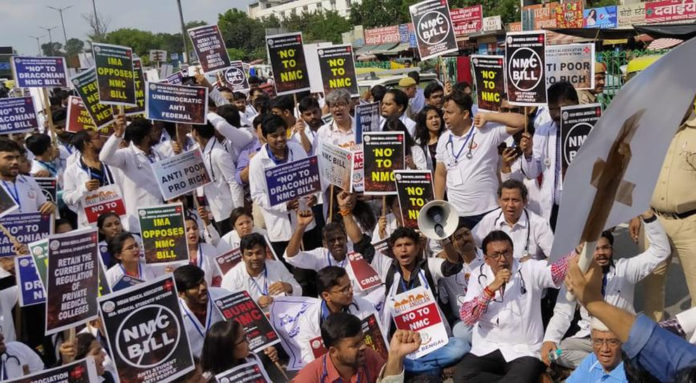
The MCI has faced a host of corruption charges since 2001 and come under increasing criticism and scrutiny. It was eventually dissolved by the President of India in 2010. This paved the way for the introduction of the NMC act, passed as an ordinance in January 2019 and eventually by the Lok Sabha and the Rajya Sabha. Following this, there were nationwide protests by medical students and doctors in the form of strikes. What led to these protests and why are doctors opposed to the NMC bill?
The NMC for effective functioning needs to be an autonomous and ideally a representative body. Further, professional concerns require it to be an institution at least predominantly made up by doctors. However as per the NMC bill most of the members of the council will be appointees of the central government and mostly ex-official government servants and Directors of reputed institutions. While the recommendation for selection was through a rigorous process of predefined criteria, the bill provides for election of only 20% of the members through the process. Thus the new council for regulation of medical education assumes the character of a bureaucratic department which does not represent all the different regional concerns of the country and may thus fail at appropriate and sensitive state-wise regulation and implementation.
The second and a major concern of the doctors is the provision of license to community healthcare practitioners/practitioners of AYUSH system of medicine for practicing modern medicine after a bridge course of 6 months. The rationale behind this policy is the shortage of medical practitioners in the rural areas and the poor doctor to patient ratio in the country. While the rationale is justified, the means here seems misguided and may lead to detrimental consequences. The training in these systems of medicine even with respect to the basics of anatomy and physiology greatly differs. A training of 6 months is extremely inadequate for the induction of one practitioner into another system. It undermines the AYUSH systems of medicine. It also does not address the fact that most rural hospitals suffer more from a lack of basic medicines and infrastructure than a lack of trained staff. The practice may in turn lead to increased errors and cause a delay in dispensation of ideal medical treatment to patients with untoward consequences. Differential regulation of the practice in rural and urban areas gives rise to further ambiguity.
The MCI was mainly found to be corrupt with respect to regulation of education in private medical colleges. The bill is extremely weak when it comes to ensuring that these practices are discontinued. The previous act required medical colleges to be inspected at multiple check points. However, each inspection was said to have become an excuse for extortion. The present bill instead of ensuring that inspections are duly supervised by external ombudsman or reviewed, has simply curtailed the number drastically. That is an ineffective system of regulation and provides no regulatory mechanism to ensure that standards of education are consistently maintained. The other major concern with private medical colleges was the fee structure. The present bill will regulate only upto 40% of the seats thus leaving at least 60% if not more unregulated and thus affordable only to the rich.
A major concern and in particular the cause for the strike by the medical students is an addition exam ‘NEXT’ to be introduced for licensing of medical practitioners. Ideally, the NMC should aim at the standardisation of medical education. The very need for an additional exam for licensing apart from the annual examinations that Medical students undergo through a rigorous and stressful process belies confidence in the system and makes those examinations redundant. The proposed objective format of the exam is not ideal for such purpose. This exam cannot substitute the entrance exam for postgraduate training as both have completely different objectives. While a licensing exam needs to assess basic competence, a competitive exam needs to be rigorous to differentiate between two candidates. It only adds further ambivalence to an already stressful situation.
Accountability or its lack thereof was the primary reason for the malpractices within the MCI. The bill does nothing by way of ensuring “checks and balances” to ensure that NMC does not suffer from the same lapses.
While doctors have raised the above objections, they recognise that they have failed at ethical internal regulation of their own systems. The bill may be a step in the right direction but is severely inadequate in its present form. Medical education requires systematic, long term planning. Also it is only one aspect of building the health infrastructure of the country which is the final Aim. The bill introduces multiple stop gap policy measures which might become more of a liability in the future and proposes few if any creative solutions to the problems encountered.
The author Kirti Sharma is a fetal medicine specialist/ Obstetrician with an MA in History of Medicine. She is also a member of Swaraj Abhiyan
Netravati river usually flows very slowly near Jappinamogaru-Mangalore as if it is reluctant to join the sea. But during high monsoon its like a flood. The sea is just a few kms away from there. Siddartha wanted to meet the sea of success in the corporate world, though he started as a very small entrepreneur from western Ghats from where rivers like Netravati take origin. In life, to most people, Siddhartha was only known as the son-in-law of the important politician, SM Krishna. To the outside world, his empire was only an off-shoot of SM Krishna’s political power. He often stands as an example of the nepotism of those in power, the interests of businessmen who fund political battles, and business that transgresses government rules and regulations. But that’s not all Siddhartha is. Siddhartha was born to Chatnalli Gangayya Hegde, in Malnad. His is a story of an ambitious young man in an ordinary family, rising to heights, and killing himself in order to exit the insides of the corporate system. His journey cannot be understood with superficial details. When this author visited Mudigere a few years back, something surprising took place. One of the comrades, who organized the coffee plantation workers there, spoke of Siddhartha Hegde with immense pride. According to him, most workers at ABC company’s estate were getting the facilities which were otherwise the maximum demands of the workers’ movements at that time. Probably the workers’ demands themselves were so minimum. And it is also because if rich businessmen possess basic simplicity and compassion, people are satisfied. Those businessmen become idols for the public. Due to Siddhartha’s simple ways, and for the way he used a very small share of his profits for the benefit of the general public, he did not have many critics in the Chikmagalur district.Siddhartha studied Economics in St. Aloysius College in Mangalore. In one of his interviews, he claimed that he read Marx in the communist library next to Aloysius college, but he always believed that like other corporates, that he must first generate wealth. After his degree, he went to Mumbai and trained under Mahendrabhai in Lonavala. He realised the importance of the stock market in its early days, in the ‘80s. After spending two years in Bombay, he received 7.5 lakhs from his father, returned to Bengaluru and started ‘Shivan Securities’. He bought 60,000 shares of Infosys and sold it all when its value had increased 6 times. Then, he took on the coffee plantation, during a time when coffee rates were low. In 1992, the regulations over coffee were lifted and its value quadrupled. By 1993, the coffee plantation had expanded to 3000 acres! Thus, the ABC company was born. Its turnover went from Rs. 6 Crore to Rs. 2500 crore by 2015. By 1995, it had grown into one of the largest coffee exporters in the country. In the next few years, he continued to expand through Mindtree Software, Chetan Wood Processing Pvt Ltd, Barefoot Resorts and Dark Forest Furniture. He also got married to SM Krishna’s daughter, Malavika.A chance meeting with a third-generation coffee seller from Germany inspired him. Soon, 20 Coffee Day shops propped up in various parts of South India. Rather than selling coffee beans, they would sell coffee powder, at a significant profit. Later, inspired by Beer Cafe in Singapore, he started an internet cafe with his friends on Brigade Road. That’s how Cafe Coffee Day was born. Now, there are over 1500 cafes and over 600 shops across the country. By then, his father-in-law became the Chief Minister of Karnataka. He took advantage of this situation and expanded. He moved his company to the Mumbai Stock Exchange. Meanwhile, SM Krishna became the Governor of Maharashtra in 2004, and later, the Union Foreign Minister in 2009. In 2011, he entered the shipping business. His circles now claim that he was pushed to suicide due to his attempts to acquire a company that owned 70% of the global market. By 2015, Siddhartha had encountered a major crisis. He was stuck within debts for some of his companies. To solve these problems, he simply had to sell the shares of his reputed brands: Cafe Coffee Day and Mindtree. Apparently, Cafe Coffee Day was being negotiated to be sold to Coca Cola; 20% of Mindtree’s shares were sold to L&T. This was when the IT problem began, he wrote in his last letter. The Income Tax Department began to attach his assets and transactions. This closed the only available route to set his business right. Siddhartha’s letter states that he then conducted transactions that his family and top business officials have not been privy to. While the Ministry of Corporate Affairs marks his debt at Rs. 8,000 crores, CCD circles claim it could be anywhere between Rs. 10 thousand crores to Rs. 15 thousand crores. The government currently in power abandons rules to help such entrepreneurs; it puts out a red carpet to make corporations comfortable. However, why these problems were not resolved even after SM Krishna’s joined BJP remains a mystery. In fact, the IT Officer, supposedly Arun Jaitley’s confidante, is accused in Siddhartha’s letter. How was an entrepreneur with a 12000-acre estate, a stock exchange company, and an influential father-in-law still unable to solve his financial crisis? More information may shed light on this baffling question in the coming days. His empire, it must be noted, led to the creation of around 50,000 jobs. Coffee Day sustained the livelihoods of many in Karnataka. On one of his frequent visits to Kolkata, he is said to have stepped into his own Cafe Coffee Day in uniform, to serve coffee. He saw the way that they treated workers: nobody said thanks, no ‘Happy New Year’s, no smiles. He wondered how the staff would maintain their enthusiasm in such an environment, and empathized with their predicament. Siddhartha had a delicate personality; he generously helped schools in Malnad and Chikmagalur. He was known, not only as the son of Gangayya Hegde but also as the son-in-law of SM Krishna.However, the cracks within his business brought him down, as he himself once said“It’s true that his holding company had a loan of Rs. 1000 Crore; this debt was incurred to buy the shares of Sequoia Capital and Goldman Sachs in Retail. Another Rs. 200 Crores was borrowed to buy more shares of Mindtree. If we sold our Mindtree shares, the entire company’s debt would be taken care of. But we do not wish to sell the company, it has brought us 40% profit in the last 16 years.”Apart from having problems in his business, this situation highlights the extent to which Siddhartha was being squeezed out by the IT department and his creditors. These problems exist even for Gujarati businessmen, but Gujarati politicians are currently in power in Delhi and can assist them. Perhaps the Gujarati politicians did not help resolve Siddhartha’s crisis in order to undermine his influential father-in-law. In a crony, capitalist world, there are a growing number of people who are willing to go to any lengths to ease their wealth. Perhaps, due to his sensitive personality, Siddhartha Hegde was unwilling to play by the crooked rules of this game. As someone who set out to achieve great things, discovering his status as a failed entrepreneur perhaps incited his death.In an interview with a journalist, he himself said almost prophetically, “Entrepreneurs don’t retire. They die.”




 He said that people of “the country” wanted to know why Article 370 was still in operation in Jammu and Kashmir, and why “despite getting so much money, its people are still poor.” “Article 370 ensures there is no PPP model, no private investment in the state. 370 ensures healthcare in Jammu and Kashmir suffers, no doctor wants to go there. 370 ensures there is no right to education for the children of Kashmir,” Shah said.
 Although it is true that while J&K lags in job creation, investment and growth but that is the case with the rest of the country. The per capita domestic product of Jammu and Kashmir as of 2016-17 is low but higher than most other northern states.


 During this standstill, Pakistani raiders, with the support of the Pakistani Army, began advancing on Kashmir in October 1947. A panicked Maharaja invited Indian forces into Kashmir to provide temporary protection. Subsequently, the Maharaja executed an instrument of accession with India. Under the instrument, defence, external affairs, and communications were listed under the exclusive domain of the central government. All other plenary powers would remain vested within the state government.


 Outline of the programme:
✰ Aug. 14th – a lamp (hanate) procession after sunset: Majestic rly.stn to Banappa Park.
✰ 14th-15th – whole night: program of Resistance – speeches, cultural programmes, etc.
✰ 11.30-12 midnight – Message of Struggle from Mr. Chandrashekar ‘Ravan’, chief guest.
✰ 12.05 midnight: Flag Hoisting and call for real independence: by H.S.Doreswamy. ✰ 15th morning – March for our Rights – from Banappa Park towards Parade Grounds.
Noor Sridhar, Committee member said, The Mid-night Independence Day programme is being organised on the night of 14th of August this year in order to make the “souls-sold” rulers and their governments to act once again on these issues, to reprimand their unconcern and lethargy towards the poor, to send a firm message to them that ‘this is not a movement that would subside and die out’, and to mark the occasion of the Independence Day as a day of taking a pledge of consolidating and intensifying the struggle.


 The NMC for effective functioning needs to be an autonomous and ideally a representative body. Further, professional concerns require it to be an institution at least predominantly made up by doctors. However as per the NMC bill most of the members of the council will be appointees of the central government and mostly ex-official government servants and Directors of reputed institutions. While the recommendation for selection was through a rigorous process of predefined criteria, the bill provides for election of only 20% of the members through the process. Thus the new council for regulation of medical education assumes the character of a bureaucratic department which does not represent all the different regional concerns of the country and may thus fail at appropriate and sensitive state-wise regulation and implementation.
 A major concern and in particular the cause for the strike by the medical students is an addition exam ‘NEXT’ to be introduced for licensing of medical practitioners. Ideally, the NMC should aim at the standardisation of medical education. The very need for an additional exam for licensing apart from the annual examinations that Medical students undergo through a rigorous and stressful process belies confidence in the system and makes those examinations redundant. The proposed objective format of the exam is not ideal for such purpose. This exam cannot substitute the entrance exam for postgraduate training as both have completely different objectives. While a licensing exam needs to assess basic competence, a competitive exam needs to be rigorous to differentiate between two candidates. It only adds further ambivalence to an already stressful situation.

 Siddhartha studied Economics in St. Aloysius College in Mangalore. In one of his interviews, he claimed that he read Marx in the communist library next to Aloysius college, but he always believed that like other corporates, that he must first generate wealth. After his degree, he went to Mumbai and trained under Mahendrabhai in Lonavala. He realised the importance of the stock market in its early days, in the ‘80s. After spending two years in Bombay, he received 7.5 lakhs from his father, returned to Bengaluru and started ‘Shivan Securities’. He bought 60,000 shares of Infosys and sold it all when its value had increased 6 times. Then, he took on the coffee plantation, during a time when coffee rates were low. In 1992, the regulations over coffee were lifted and its value quadrupled. By 1993, the coffee plantation had expanded to 3000 acres! Thus, the ABC company was born. Its turnover went from Rs. 6 Crore to Rs. 2500 crore by 2015. By 1995, it had grown into one of the largest coffee exporters in the country. In the next few years, he continued to expand through Mindtree Software, Chetan Wood Processing Pvt Ltd, Barefoot Resorts and Dark Forest Furniture. He also got married to SM Krishna’s daughter, Malavika.
A chance meeting with a third-generation coffee seller from Germany inspired him. Soon, 20 Coffee Day shops propped up in various parts of South India. Rather than selling coffee beans, they would sell coffee powder, at a significant profit. Later, inspired by Beer Cafe in Singapore, he started an internet cafe with his friends on Brigade Road. That’s how Cafe Coffee Day was born. Now, there are over 1500 cafes and over 600 shops across the country. By then, his father-in-law became the Chief Minister of Karnataka. He took advantage of this situation and expanded. He moved his company to the Mumbai Stock Exchange. Meanwhile, SM Krishna became the Governor of Maharashtra in 2004, and later, the Union Foreign Minister in 2009.
In 2011, he entered the shipping business. His circles now claim that he was pushed to suicide due to his attempts to acquire a company that owned 70% of the global market. By 2015, Siddhartha had encountered a major crisis. He was stuck within debts for some of his companies. To solve these problems, he simply had to sell the shares of his reputed brands: Cafe Coffee Day and Mindtree. Apparently, Cafe Coffee Day was being negotiated to be sold to Coca Cola; 20% of Mindtree’s shares were sold to L&T. This was when the IT problem began, he wrote in his last letter. The Income Tax Department began to attach his assets and transactions. This closed the only available route to set his business right. Siddhartha’s letter states that he then conducted transactions that his family and top business officials have not been privy to. While the Ministry of Corporate Affairs marks his debt at Rs. 8,000 crores, CCD circles claim it could be anywhere between Rs. 10 thousand crores to Rs. 15 thousand crores.
The government currently in power abandons rules to help such entrepreneurs; it puts out a red carpet to make corporations comfortable. However, why these problems were not resolved even after SM Krishna’s joined BJP remains a mystery. In fact, the IT Officer, supposedly Arun Jaitley’s confidante, is accused in Siddhartha’s letter. How was an entrepreneur with a 12000-acre estate, a stock exchange company, and an influential father-in-law still unable to solve his financial crisis? More information may shed light on this baffling question in the coming days.
His empire, it must be noted, led to the creation of around 50,000 jobs. Coffee Day sustained the livelihoods of many in Karnataka. On one of his frequent visits to Kolkata, he is said to have stepped into his own Cafe Coffee Day in uniform, to serve coffee. He saw the way that they treated workers: nobody said thanks, no ‘Happy New Year’s, no smiles. He wondered how the staff would maintain their enthusiasm in such an environment, and empathized with their predicament. Siddhartha had a delicate personality; he generously helped schools in Malnad and Chikmagalur. He was known, not only as the son of Gangayya Hegde but also as the son-in-law of SM Krishna.
However, the cracks within his business brought him down, as he himself once said
“It’s true that his holding company had a loan of Rs. 1000 Crore; this debt was incurred to buy the shares of Sequoia Capital and Goldman Sachs in Retail. Another Rs. 200 Crores was borrowed to buy more shares of Mindtree. If we sold our Mindtree shares, the entire company’s debt would be taken care of. But we do not wish to sell the company, it has brought us 40% profit in the last 16 years.”
Apart from having problems in his business, this situation highlights the extent to which Siddhartha was being squeezed out by the IT department and his creditors. These problems exist even for Gujarati businessmen, but Gujarati politicians are currently in power in Delhi and can assist them. Perhaps the Gujarati politicians did not help resolve Siddhartha’s crisis in order to undermine his influential father-in-law. In a crony, capitalist world, there are a growing number of people who are willing to go to any lengths to ease their wealth. Perhaps, due to his sensitive personality, Siddhartha Hegde was unwilling to play by the crooked rules of this game. As someone who set out to achieve great things, discovering his status as a failed entrepreneur perhaps incited his death.
In an interview with a journalist, he himself said almost prophetically, “Entrepreneurs don’t retire. They die.”