10 days ago, Pawan kumar Jaiswal, journalist broke the story of school children in Mirzapur district being fed Rotis with salt as mid-day meal. He was just doing his job as a journalist. Little did he know that he would be booked under criminal conspiracy for doing his job.
The story went viral and has brought the ire of the state administration who does not want another story of negligence from Uttar Pradesh. Normally, the administration takes action against the negligent authorities, but the UP government wants to cut the source of the information itself and in its attempt to shoot the messenger has booked the journalist for reporting on the story itself.
Pawan Kumar Jaiswal, the journalist who recorded the video of the school children, and village-head representative Rajkumar Pal have been booked under Sections 120B (criminal conspiracy), 186 (obstructing public servant in discharging duty), 193 (false evidence) and 420 (cheating) of the Indian Penal Code.
Pawan Kumar Jaiswal says that he was informed of the irregularity in mid-day meal scheme. The children were given rotis with salt or rice with salt. He had also informed the assistant primary education authority and went to cover the news. The district administration said that they will take action against the culprits but instead they booked the journalist for reporting the story.
After the video became viral, many higher authorities have visited the village and met with children and villagers. But instead of taking action against the school administration, the education secretary have filed a case against the journalist for interfering the government work by fraudulent video and defamation of the state government.
The fourth pillar of democracy is already under attack. Journalists are paying the big price of reporting stories in India especially reportage from smaller towns and interior of the country. Most journalists are either devoted/ bought by the government, the remaining journalists who have spine are being silenced by police intimidation or slapped arbitrary charges against them.
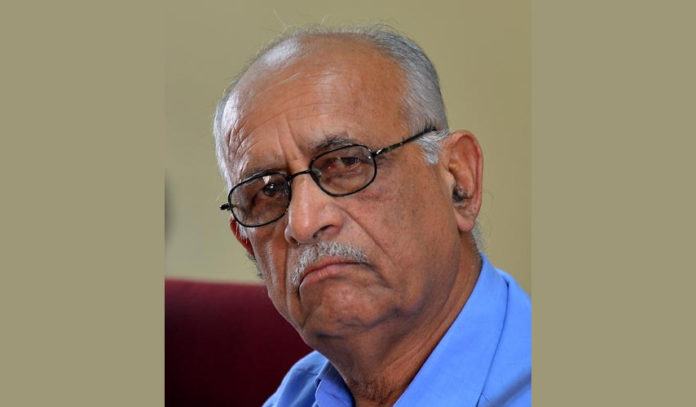
A.K. Subbaiah was one of the most distinguished and honest politicians of Karnataka and one of the patrons of the Gauri Memorial Trust passed away at Manipal Hospital Bengaluru on Tuesday. Despite suffering from a chronic illness, he was committed to social causes. Today, Gauri patrike pay our tribute to the life of A.K. Subbaiah. His long-time friend Manu Shenoy has written about him.
Subbaiah was one of the greatest Parliamentarians of the state of Karnataka. Throughout his life, he organized and participated in many peoples’ struggles and had success. Kambadakada and Barepole struggles in Kodagu district were his early days of the movement. In a prolonged struggle waged by him in the high court of Karnataka, he was successful to an extent in resolving the Jamma Bane land issue which still affects the people of Kodagu.
Born on 9th august 1934 in Hudhikeri in Kodagu district, Subbaiah lost his father at an early age. After his mother’s remarriage, he was raised in his Uncle’s house in Harihara village. Nobody bothered to admit him to school. He himself got school admission and attended school in Harihara village in 1943. He completed high school in T. Shettigeri village secondary school and then Hudhikeri.
After completing the Intermediate at Government College, Madikeri, he worked as a teacher for some time in Gejjehanagodu in Somwarpet taluk. He then worked as a Second Class Assistant in the Health Department at Madikeri. A small incident at that time pained his mind. So he quit the job and joined BSC in Madikeri. There he organized protests based on the problems at the hostel. As a result, he was not allowed to sit for his second-year B.Sc. degree exam. He met with the Vice-Chancellor and made an appeal and then he was allowed to take the exam.
As a student during the 1958 assembly by-elections, he campaigned for PSP party and was instrumental in bringing PSP parties to win against Congress.
He studied law at the Sharadavilasa College, Mysore in 1963 and began his career as a lawyer in Virajpet. He was already attracted to the Janasangh and became involved further in its organization. Jansangh and Sangh Parivar recognised his organising skills and he was elected to the Karnataka Vidhan Parishat in 1968 from the Kodagu-Mangalore-Mysore constituency. He was subsequently elected to as a member of the legislative council in 1974 and 1980.
When the Emergency was declared in 1975, AK Subbiah was one of the first political figure to be arrested. He was considered a political prisoner. Even after the emergency was lifted in 1977, he remained in jail for a few days. He was finally released. In 1979, he contested in the Madikeri Assembly constituency and lost to MC Nanaiah.
He was a member of the Legislative council for a total of four terms and served as the leader of the opposition in the 1980s. Under Devraj Urs administration he was considered a threat to the ruling party. At one point the government even considered abolishing the Legislative council itself. Subbaaiah was already well known with his sharp tongue as “Suddhi Subbaaiah”.
When Gundurao was the Chief Minister, he was responsible for the resignation of his government’s two ministers, Renuka Rajendran and KM Ibrahim. Renuka Rajendran was involved in a bribe scam of Rs 25,000 to get a job, KM Ibrahim’s Rolex watch scam forced him to resign.
In 1983-84, when Janata let govt came to power AK Subbaiah was the state unit head of the Bharatiya Janata Party. The Kranti ranga group also had gained a lot of ground. The then Janata Party’s Ramakrishna Hegde was given external support by BJP. The formation of the government required the support of the BJP legislators and Subbaiah decided that their party would remain outside the government, Will is not become a partner in government. He said he would act as a constructive opposition party. He had all the chances of becoming Deputy Chief Minister if he wanted to.
Ramakrishna Hegde could not digest AK Subbayya’s support. Many of his scandals were uncovered by AK Subbaaiah. Ramakrishna Hegde has been embroiled in a number of cases, most notably the bottling scandal, the Bharat Hegde case and the phone bugging case.
On the same occasion, AK Subbaaiah and Dr. Rajkumar fans also clashed and Rajkumar fans have reached the point of attacking AK Subbaaiah. It was successfully handled by Subbaiah. Subbaya was expelled from the BJP due to a conflict with the RSS. Subbaya used to openly critique RSS clashing against it. Rajkumar fans, Ramakrishna Hegde administration, and the RSS used to attack Subbaaiah together. He managed all this and formed a regional party called Kannada Nadu. But that party didn’t last long. Then many of those who were with Subbayya re-joined the BJP.
Subbaiah then started his career as a lawyer in the state high court in 1987. When the Babri Mosque was demolished in Ayodhya in 1993, Subbaaiah undertook traveling across the state with a message of peace and harmony.
Till recently, he has been carrying out several struggles in Kodagu region and Karnataka. Subbaiah was a key figure in the struggle for land and shelter of tribal community members who were evacuated from the forest land of Diddalli in Kodagu district. He was also involved in the “Save the Constitution” campaign. Though his health has deteriorated, his fighting spirit has not diminished. He along with H.S. Doreswamy participated in many struggles like Karnataka communal harmony forum and save the constitution. When several ruling parties tried to intimidate and harass activists who were involved in many people’s struggle he fought for them in High court. Karnataka has lost a special politician and activist fighter.
We are hearing the news of the loss of millions of jobs. Millions of young people are writing exams for a hundred jobs. self-employment opportunities and small businesses have declined. Contract workers are the first victims of the present job loss scenario. The unemployment situation in Karnataka is a ticking time bomb that can cause social unrest, anarchy, and crimes in society if we did not wake up before it explodes, says Sarovar Benkikere, the convener for “Youth for Employment” movement.
Sarovar was addressing a gathering during the open signature campaign program. He says – Indian economy is facing an economic downturn, the solution lies in creating jobs locally based on local resources. “Let us urge governments to implement the youth manifesto, a scheme to create 50 lakh new jobs and stabilize 1 crore jobs in Karnataka”.
Thousands of students signed up for a job creation campaign in front of the SJP Polytechnic College in Bangalore.
Demands of the Youth manifesto
People are losing jobs due to government policies, the government must pay wages for those who have lost their jobs.
The unemployment allowance should be paid to the unemployed until the employment generation plan is implemented.
Those working under contract basis should be given job security.
Education, employment, security, and dignity should be everyone’s right.
Convener Narasimhamurthy further talked about the plans to take the movement forward. The campaign plans to conduct consultations, seminars and study programs on the possibility of job creation locally from September 8. This will be followed by a state-level consultation on the next steps of the movement in Bangalore on September 16.
“Youth for Employment” members Anil Kumar Chikkadalavatta, Sripad Bhat, Vasu HV, Rajashekhar Akki, Mallige, Solidarity for Youth Movement Mahmoud Nawaz were also present.
On Monday, thousands of ASHA workers and community health workers under the umbrella of CITU (Centre for Indian trade unions) arrived from all of 13 districts to stage a protest at Lenin Circle in Vijayawada under the slogan of Chalo Vijayawada.
The new Chief Minister of Andhra Pradesh, Jagan Mohan Reddy, made several promises before state elections. One of his prepoll promises was salary increment up to Rs.10,000 for ASHA (Accredited Social Health Activist) workers. Many ASHA workers had voted overwhelmingly in favour of Reddy because of these promises but that they were now disappointed.
Four months after the Andhra Pradesh government came to power, the salary increment remains pending for eight months. The implementation of a new grading system has also made their job precarious. The state leaders of the Andhra Asha Union say that even though the names of Asha operatives are included on all government web sites, they are not considered government employees but are deprived of identity cards and other facilities.
The grading system
Instead of payment of pending salaries, the government has introduced a grading system from the month of August, according to which workers will be categorised into three grades, A, B, and C. The worker’s grades are said to depend on the services provided by them, and the salary is issued depending on their grading after review by district officials, which means only workers falling in category A can receive a payment of Rs 10,000. The amount would reduce with every demotion and if a worker happened to be in C grade for a period of three months, she would be effectively removed from her job. The B and C grade workers are not getting the Rs 10,000 that was promised by Jagan Mohan Reddy.
According to The Hindu, ASHA workers union State General Secretary K. Dhanalakshmi said that the new rules create job insecurity, as consistently low grades, can lead to the worker losing her job. Also, as per the new rule, only workers with a matriculation certificate were eligible for the job, which was not the case earlier.
“We have been serving the people of the State for 15 years now without any educational qualification. This is the only thing we can do best. The government cannot remove us from the job on the basis of our education. We will fight to keep our jobs,” she said.
Meanwhile, police have stopped many buses with ASHA workers from reaching Vijaywada. Several ASHA workers in Visakhapatnam who staged a sit-in at Gandhi Statue, and were to take part in the Vijayawada protest, were detained by the police. The police also reportedly filed cases against CITU (Centre of Indian Trade Unions) leaders. Police have also detained ASHA workers in West Godavari district’s Palakollu Mandal for protesting as a part of the same campaign.
ASHA workers from an intermediary link in villages between few primary health centers and the villagers. They ensure the government’s health schemes are implemented in villages across the country. In many states, these workers are not paid regular salaries and are only given incentives for specific functions they perform, such as immunisation. There are nearly 45,000 health workers in Andhra Pradesh. The previous government, led by the Telugu Desam Party, paid an honorarium of Rs 3,000 per month to the ASHA workers and performance-based incentives.
Yesterday Delhi saw massive protest march at the site of the temple demolished by the Delhi Development Authority (DDA) in Tughlakabad area of south Delhi. The Saint Ravidass temple was demolished on August 10 on the orders of the Supreme Court. There were widespread protests and bandh in Punjab on August 13th due to the temple demolition. Protesters claimed that the land where the temple exists has been given to the followers by Sikandar Lodhi of the Lodhi Dynasty in the 1500s and is not government property. The protests were led by young and charismatic leader Chandrashekhar Azad ́Ravan ́, one of the founders of Bhim Army. Bhim Army is working for Dalit emancipation through education. Protests at Sant Ravidas temple demolitionYesterday with the call of “mandir Yehi banayenge” and Jai Bheem, the protestors turned the roads of central Delhi into blue with thousands of supporters of Bhim army and Ravidas followers continued to march towards the demolition site. They demanded that the government hand over the plot of land to the community and rebuild the temple.However, police opened fire at the protestors, shelled tear gas and resorted to brutal lathi-charge injuring protestors. Due to a rumor that one of the protestors has died, the protest turned violent and there were some instances of vandalism. According to some reports, the area is cordoned off and markets closed. Police have arrested around 50 members along with Chandrashekhar Azad.
Delhi Development authority claims
DDA wanted the temple demolished in 1992, with the claims that the temple is neither historic nor of archaeological significance and falls under the green zone, which does not allow construction in the region. The Ravidas Jayanti samaroh samiti went to court to overturn the order but it lost. Now in August, DDA won the case in the supreme court and went ahead with the demolition. However, they did not realise the political implications of their actions.
What the Followers of Ravidas are angry?
The followers of the faith say – “Would the authorities acted with the same speed and impunity if it was a mainstream Hindu temple or a mosque? Because it is a temple where only Dalits come to worship, authorities didn’t care for our sentiments.”
Many supporters draw parallels with Ram temple and many other Hindu temples that have come upon government land and street corners, on which the government has not taken any action. They argue- How is our demand different from that for the construction of a Ram temple in Ayodhya? If that is so important for a particular community, this is important for us.”“thousands of religious structures have come up on government and forest land. “Why only a temple of Sant Ravidas was razed? The government should answer”.“They are asking us to construct the temple at an alternative place. Why don’t they shift the Ram Mandir to some other place? Everything happened in the blink of an eye. We didn’t even get to know of the SC order. Are we not citizens of India?”
Legacy of Sant Ravidas
Sant Ravidas was a poet-saint, social reformer and a spiritual figure of the Bhakti movement during the 15th-16th century CE. He is considered Guru in Punjab, Haryana, Uttar Pradesh, Maharashtra, and Rajasthan. Ravidas was born in Varanasi and his original occupation was leatherwork. He spent most of his life in the company of Sufi saints, sadhus, and ascetics. Ravidas taught the removal of social divisions of caste and gender and promoted unity in the pursuit of personal spiritual freedoms. He traveled extensively, visiting Hindu pilgrimage sites in Andhra Pradesh, Maharashtra, Gujarat, Rajasthan and those in the Himalayas. He is revered in the Sikh scripture, and 41 of Ravidas’ poems are included in the Adi Granth. These poems are one of the oldest attested sources of his ideas and literary works. Ravidas’ devotional songs were included in the Sikh scriptures, Guru Granth Sahib. He is also considered guru of Meera, another Bhakti movement poet. He spoke about the secular ideology and worship of formless God. His egalitarian ideas found resonance among the poor and oppressed who were denied temple entry and till today most of his followers are from the marginalised community.
On 6 August 2019, the Rajasthan Legislative Assembly passed the second anti-lynching legislation in the country, after Manipur passed similar legislation. The Bill called the ‘Rajasthan Protection from Lynching Bill, 2019’, follows the Supreme Court prescriptions for states to prevent lynching. The Bill was introduced by Minister Shanti Dhariwal in the state assembly and was passed by the Congress majority. The opposition party, the BJP, opposed the bill claiming that existing provisions in the Criminal Procedure Code and Indian Penal Code were sufficient to combat lynchings.
Content of the Bill Summary:
The bill defines lynching as “an act or series of acts of violence or those of aiding, abetting or attempting an act of violence, whether spontaneous or preplanned, by a mob on the grounds of religion, race, caste, sex, place of birth, language, dietary practices, sexual orientation, political affiliation or ethnicity”. It imposes varying degree of punishment ranging from 7 years imprisonment and Rs. 1 lakh fine in cases of simple injuries of the victim, and up to a maximum of life imprisonment and Rs. 5 lakh in cases of death of the victim. Planning or conspiracy to lynching will be given the same punishment, and the bill includes punishments for those impeding justice. The bill requires the appointment of a nodal officer to prevent lynchings at the rank of Inspector or higher. The bill also provides a compensation package to the families of the victim as well as directions to the state for the rehabilitation of the family, setting up of relief camps for all victims of the violence.
Critique of the Bill:
The Bill is still limited, as it does not address the cause of lynchings, but only the aftermath. Studies of lynchings in India have shown that victims of lynchings are socially and economically vulnerable members of society. Victims and their families are often subject to further hostility from the local community and the bill does not address needs of those who were economically dependent on the victim particularly the needs of the elderly, women and children who were reliant on the victim. Compensation schemes should ideally make the economic situations of the families better than they were before lynchings.
The Bill also does not address situations where perpetrators include state actors as well. In cases of encounter killings and administrative indifference, the lines between lynchings and encounter-killings can blurry and the bill only covers action by the state and does not provide mechanisms to cases when the state itself is part of the violence.
The Bill does not address when the fallout of the lynching is a culture of fear. Beyond the victim and their families, lynchings have been used to promote a culture of fear and hate against communities and practices by members of those communities, which impinges upon the Right to freedom of expression, as given in Article 19 of the Constitution and the Right to Life and Personal Liberties in Article 21 of the Constitution. As lynching can be a political tool to enforce a social order based on suppressing those rights, the response to lynching needs to undo that suppression.
Pehlu Khan case
On Wednesday, a Rajasthan court acquitted all six men accused of lynching Pehlu Khan to death in 2017. The accused men were let off on the benefit of the doubt despite video evidence of the incident. Pehlu Khan, a cattle trader, was beaten to death allegedly by self-proclaimed cow vigilantes on suspicion of cow smuggling in Alwar district in 2017. The crime grabbed national headlines when a video showing a mob of cow vigilantes beat up Pehlu Khan went viral on social media.
Ashok Gehlot, present CM said that the Rajasthan government will monitor the court proceedings of cases like those of Pehlu Khan’s. “In the Pehlu Khan case, the previous govt intentionally shielded the accused. Now this heinous crime will be investigated separately. A monitoring cell will be created to probe this crime,” said Gehlot.
Pehlu Khan’s younger son, Mubarik who drives a lorry said, “I have invested nine months of my earning in pursuing the case in court. When I heard about the judgment I was shattered. Two of my brothers stay at home and not earn because of the court case. Justice is denied because police diluted the case and produced no evidence.”
Chandrashekhar Azad Ravan of Bhim Army addressed a crowd at the midnight celebrations of Independence Day, held in Bengaluru by the committee for land and housing rights. There, he said, “The cops here have made me sign a statement barring me from making an objectionable speech, but I will say what I’ve come here to say anyway. I will not stay silent from fear of arrest or of being put in jail. I have faced one and a half years of jail time in Uttar Pradesh, for being involved in the Dalit movement. Here, I am ready to fight for the land of marginalized communities and go to jail. It is a crime to stay silent in the face of injustices and atrocities, a crime we must not commit. Our fight against injustice works to keep the constitution alive.”
He added, “Several forces seek to destroy our unity in this battle, and we must not allow this to happen. I plan to raise the struggle for land to the national level. We must be the ones to teach the government to respect the constitution, and to abide by the law of the land.”
“The government must understand the seriousness of this struggle. Those who currently rule us are rich. Our rights can only be ensured once there is a government of the poor. We must compel the government to overcome its negligence and respond to the needs of the poor. We must strengthen our voice in order to be heard by its deaf ears. The rich have ruled us by leveraging the power of their wealth. We must show this government that our land cannot be seized. The government can oppress us, but it cannot make us bend or scare us away. Bhim Army is with you, it is for the rights of the poor,” he assured the people. Thousands had assembled despite the rains at Sirur Park to listen to Chandrashekhar. This was his first time in South India.
Activist Noor Sridhar, who also spoke at the event, said, “When people migrate from the village to the city, they are forced to live next to the gutters, amid terrible odor. Even these areas are now denied to the poor. Even their basic needs, of having a place to live in order to do their daily wage work, has not been met. Under Bengaluru’s bright sunshine, there is deep darkness.” His anger was clear.
“We are observing a day meant for celebration, with great sadness and pain. True independence has not reached the oppressed in this country, it has not reached Dalits and women. This day will only realize its full meaning when these sections of society are able to lead their lives with dignity and self-respect. And this is not just a rural or tribal issue. Urban workers and slum dwellers also suffer routinely. They are not demanding thousands of acres of land, but just enough to survive with dignity,” he said.
The government’s response: the call for a meeting
On the orders of the Chief Minister, his special correspondent/officer Dr. A Lokesh arrived at the protest site and promised to arrange a High Power Committee meeting to discuss land and housing issues, within two days of forming a new Cabinet. He offered to discuss all these issues then, and move towards a solution.
Candlelight Parade
KJS Mariyappa, the head of the committee for land and housing rights struggle Bengaluru unit inaugurated the event. Thousands of poor, homeless & landless people from various districts went along a ‘Candlelight parade ́ and observed a satyagraha at Sirur Park, at midnight. Freedom fighter HS Doreswami hoisted the flag at midnight and addressed the crowd. He said that the liberation of the poor itself is real independence. “I will fight for this cause till my last breath,” he vowed.
The midnight celebrations were kicked off by playing drums at Sirur Park. HS Doreswami, Chandrashekhar Azad Ravan, Dr. Vijaya, Noor Sridhar, DH Poojar, Siddhanagowda Patil, R Manasayya, Indira Krishnappa, Kumar Samathala, Sirimane Nagaraj, Heggodu Prasanna, Siddhanagowda Modige, Agalaganchi and the founder of Vishwashaanti Souharda Peetha, Vijayananda Swamiji were all present. Cultural programs and slogans for the poor went on throughout the night. The committee planned to march to the parade ground if the government had not heard them by morning; however, the protest was called off at twelve, as representatives from the government arrived to hear the protestors out.
Its been a week since the scrapping of Article 370 was announced by Home Minister Amit Shah. What we saw and heard on mainstream media was celebrations all over the country for this “historic” decision. Amidst all this, there was no news of Kashmir or voices of Kashmiris outside the valley. The state turned Union territory was under lockdown. All means of communication such as mobile connectivity, telephone lines, internet, and cable television were cut off. People in the region had no idea what has caused this recent clampdown. The most militarized region in the world was further barricaded, cordoned and 46000 troops stationed before centre scrapped the region of its autonomy in a surprise move. It will be 10 days tomorrow that any local newspaper was published in Kashmir, the last local newspapers were on the 4th of August 2019. Even the Indian journalists in the region were not allowed to get press passes and were prohibited from taking pictures. The only way for any news to come off outside Kashmir is through the footage released by the government sources which claimed that everything is normal in Kashmir and the security beef-up is for people ́s own safety. A couple of journalistic voices started trickling down a few days after the clampdown. There were reports of anger among people, food and medicine scarcity, trouble with medical emergency services, people having to spend hours for a distance of a few kilometers. Doordarshan was reinstated after 3 days. But the mainstream media showed photos of few roads with government vehicles movement as a state of “normalcy”. Photos from Zee newsTwo days after the announcement, National security advisor Ajit Doval lands in Kashmir to assess the security situation in the state, and the photos and video of him eating biryani with the locals were put on a 24/7 loop in all mainstream media to highlight the supposed “calm” and “normalcy” in Kashmir despite the withdrawal of special status and its statehood; Kashmiris were happy!Seeing such “normal” conditions and happy Kashmiris, the opposition leader and ex-chief minister of J &K, Ghulam Nabi Azad, decided to see for himself, but he was stopped at Srinagar airport and sent back to New Delhi. Same happened the day after when CPI-M leaders Sitaram Yechury and D. Raja were also prevented from entering Srinagar and detained at the airport. Meanwhile, everyday drone photos and videos of streets of J &K were being circulated by officials in New Delhi showing open markets, crowded streets, few mosques open before Eid. Many news channels even went ahead with saying that section 144 is not imposed in the valley.
And “All is Well” in Kashmir! Not really…
Meanwhile, on 8th August, The Wire ́s editor Siddharth Vardarajan released footage from a hospital in Kashmir speaking to patients with pellet gun eye injuries. Some said they were shot during protests in the city’s downtown area while others said they were targeted by the security forces even though there was no protest or stone pelting going on at the time. He was also told that every day there are protests all over the valley. On 9th August, NDTV reported that there were some protests in Kargil against the 370 scrapping, and that there is still lockdown and curfew in many areas.Photos from NewYork TimesNew York Times reported- On Friday afternoon after the Friday prayers, tens of thousands of peaceful demonstrators were moving through the streets of Srinagar, chanting freedom slogans and waving Kashmiri flags, when Indian forces opened fire. It also reported about heavy deployment at every corner of the valley. In some villages, even remote ones, a soldier was posted outside the gate of each family’s home. Some soldiers have also commented that “people are very angry and not scared” and have admitted to stone-pelting incidents. Amidst the shutdown, a few local papers have resorted to pen and paper to report, and are printing with old hulking machines with 1-2 page newspapers. The next day, BBC released exclusive footage showing massive protests, bordering on violence, after evening prayers on Friday in Soura, Srinagarcontradicting Central government’s claims that all is well in there. bbc kashmir footageal jazeera footageAl Jazeera, Washington Post, and Reuters also reported of mass protests in Kashmir on Friday post prayers ignoring the curfew, and firing of tear gas and shooting in the air to disperse the crowd. The Indian government, not too happy about the unfavorable reporting about the shutdown and protests in international media at first denied by accusing BBC, Al- Jazeera and Reuters of spreading fabricated videos of violence. Some of the popular Indian media channels” acted as government propaganda machines and put allegations on BBC and Al Jazeera reporting as part of an international conspiracy. As per the latest news, yesterday, Ministry of home affairs had admitted to “stray stone pelting incidents/protests” but denied any retaliation from the security personnel. None of the media channels showed this news!
Stories in media on a said incident in Soura region of #Srinagar. On 09/08, miscreants mingled with people returning home after prayers at a local mosque. They resorted to unprovoked stone pelting against law enforcement forces to cause widespread unrest.@diprjk@JmuKmrPolice
— Spokesperson, Ministry of Home Affairs (@PIBHomeAffairs) August 13, 2019
Among the Indian media houses, barring “The Wire” and “Quint” news portals, most media outlets toed the government line and shied away from any genuine reporting on J&K. As the days have passed, most media houses are still showing videos of mosques in Jammu claiming it to be Srinagar to show the calm and “normalcy” in the valley. Some channels are also showing how J&K is gearing to celebrate Independence day. There are videos of army and police preparations, parades and cultural programs. But they don’t explain the irony. How are people celebrating Independence day when they are in curfew and lockdown!As the next step of media propaganda, after 10 days, mainstream media has switched the narrative to Pakistan aggression and India´s need to be prepared for war in case of terrorist infiltration. Republic TV has released a media byte with general Bipin Rawat stating that “army is prepared to deal with any security challenge in J&K. Mainstream media reporters are seen mingling with army men and chanting repeatedly “how is the Josh? ”. These are the same channels that also claimed that Demonetization was a success and have been acting as government spokesperson for last 5 years. What is the need for Indian mainstream media channels to show the atmosphere of normalcy when nothing about the whole episode of 370 abrogation is normal?
Haryana wrestler and Commonwealth Games champion Babita Phogat and her father Mahavir Phogat have joined the Bharatiya Janata Party (BJP) in the presence of Union minister Kiren Rijiju at BJP headquarters in New Delhi on Monday. The development comes barely two months before the Haryana Assembly polls.
Babita Phogat and Geeta Phogat along with their other four sisters are popularly known as Phogat sisters. The Phogat sisters and their father Mahavir shot to limelight after Aamir Khan’s 2016 film “Dangal”. The success of the Phogat sisters has attracted substantial media attention, particularly due to the prevalent social issues in Haryana such as gender inequality, female foeticide.
Delhi: Wrestler Babita Phogat and her father Mahavir Singh Phogat join Bharatiya Janata Party in the presence of Union Minister Kiren Rijiju. pic.twitter.com/p4itp7hxMX
Phogat sisters are quite popular on social media and have been known for their pro-BJP and nationalistic tendencies for some time. Recently Babita Phogat also defended Haryana Chief Minister Manohar Lal Khattar after he courted controversy with his remarks on Kashmiri girls. She said- “Haryana Chief Minister Manohar Lal Khattar has not made any such statement that is offensive to our sisters and daughters. I urge media to not misinterpret his statement,”
Article 370 abrogation in Jammu and Kashmir last week has not just the valley simmering in uncertainty, it has also polarised the country with many lauding the efforts of the BJP government but many also criticizing the government for not taking the opinion of people of the state into consideration and the heavy-handed manner in which it was done.
Latest in the list is Tamil actor Vijay Sethupathi who called the decision of scrapping article 370 without consulting Kashmiri people undemocratic and unconstitutional.
The actor was in Australia to take part in the Indian Film Festival in Melbourne, Australia. Sethupathi won the Best Actor award for his role as a transgender in the critically-acclaimed film Super Deluxe. He spoke about the issue in an interview to SBS Tamil Australia, a radio channel.
“This is against democracy- Sethupathi said. He also quoted Tamil socialist leader Periyar EV Ramasamy. Periyar had said earlier itself that people themselves should decide on their problems and issues. Can I interfere in the affairs of your house? It is you who live there and know what is best for you. I can be concerned about you, but cannot impose my decisions on you. These are two different things,” “As people living outside Kashmir, we can be concerned about them, but we should not step in to offer suggestions. We only talk on what we have heard, but it is those who are living there who know what the actual problem is. I am deeply pained about it. he added.
Contrary to that, Rajinikanth lauded the NDA government for revoking article 370 in Jammu and Kashmir. In a function, he also congratulated Home Minister Amit Shah and said “My heartfelt congrats to you for mission Kashmir. The speech you delivered in Parliament was fantastic.” In his speech, Rajinikanth said that the relationship between the Home Minister and the Prime Minister is like that of Krishna and Arjuna.
Earlier also, Rajinikanth had echoed pro- BJP leaders stand in the state during anti-Sterlite protests last year where 13 people died in the government crackdown on the agitators who were protesting against the Vedanta’s Sterlite copper smelter in the area. He criticized people for the protests and praised the AIADMK government for “clamping anti-social elements with an iron fist”.




 Thousands of students signed up for a job creation campaign in front of the SJP Polytechnic College in Bangalore.

 Four months after the Andhra Pradesh government came to power, the salary increment remains pending for eight months. The implementation of a new grading system has also made their job precarious. The state leaders of the Andhra Asha Union say that even though the names of Asha operatives are included on all government web sites, they are not considered government employees but are deprived of identity cards and other facilities.


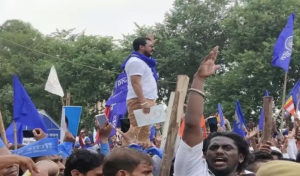 Yesterday with the call of “mandir Yehi banayenge” and Jai Bheem, the protestors turned the roads of central Delhi into blue with thousands of supporters of Bhim army and Ravidas followers continued to march towards the demolition site. They demanded that the government hand over the plot of land to the community and rebuild the temple.
However, police opened fire at the protestors, shelled tear gas and resorted to brutal lathi-charge injuring protestors. Due to a rumor that one of the protestors has died, the protest turned violent and there were some instances of vandalism. According to some reports, the area is cordoned off and markets closed. Police have arrested around 50 members along with Chandrashekhar Azad.

 Sant Ravidas was a poet-saint, social reformer and a spiritual figure of the Bhakti movement during the 15th-16th century CE. He is considered Guru in Punjab, Haryana, Uttar Pradesh, Maharashtra, and Rajasthan. Ravidas was born in Varanasi and his original occupation was leatherwork. He spent most of his life in the company of Sufi saints, sadhus, and ascetics. Ravidas taught the removal of social divisions of caste and gender and promoted unity in the pursuit of personal spiritual freedoms. He traveled extensively, visiting Hindu pilgrimage sites in Andhra Pradesh, Maharashtra, Gujarat, Rajasthan and those in the Himalayas. He is revered in the Sikh scripture, and 41 of Ravidas’ poems are included in the Adi Granth. These poems are one of the oldest attested sources of his ideas and literary works. Ravidas’ devotional songs were included in the Sikh scriptures, Guru Granth Sahib. He is also considered guru of Meera, another Bhakti movement poet.
He spoke about the secular ideology and worship of formless God. His egalitarian ideas found resonance among the poor and oppressed who were denied temple entry and till today most of his followers are from the marginalised community.


 The midnight celebrations were kicked off by playing drums at Sirur Park. HS Doreswami, Chandrashekhar Azad Ravan, Dr. Vijaya, Noor Sridhar, DH Poojar, Siddhanagowda Patil, R Manasayya, Indira Krishnappa, Kumar Samathala, Sirimane Nagaraj, Heggodu Prasanna, Siddhanagowda Modige, Agalaganchi and the founder of Vishwashaanti Souharda Peetha, Vijayananda Swamiji were all present. Cultural programs and slogans for the poor went on throughout the night. The committee planned to march to the parade ground if the government had not heard them by morning; however, the protest was called off at twelve, as representatives from the government arrived to hear the protestors out.


 Two days after the announcement, National security advisor Ajit Doval lands in Kashmir to assess the security situation in the state, and the photos and video of him eating biryani with the locals were put on a 24/7 loop in all mainstream media to highlight the supposed “calm” and “normalcy” in Kashmir despite the withdrawal of special status and its statehood; Kashmiris were happy!
Seeing such “normal” conditions and happy Kashmiris, the opposition leader and ex-chief minister of J &K, Ghulam Nabi Azad, decided to see for himself, but he was stopped at Srinagar airport and sent back to New Delhi. Same happened the day after when CPI-M leaders Sitaram Yechury and D. Raja were also prevented from entering Srinagar and detained at the airport.
Meanwhile, everyday drone photos and videos of streets of J &K were being circulated by officials in New Delhi showing open markets, crowded streets, few mosques open before Eid. Many news channels even went ahead with saying that section 144 is not imposed in the valley.


 The Indian government, not too happy about the unfavorable reporting about the shutdown and protests in international media at first denied by accusing BBC, Al- Jazeera and Reuters of spreading fabricated videos of violence. Some of the popular Indian media channels” acted as government propaganda machines and put allegations on BBC and Al Jazeera reporting as part of an international conspiracy.
As per the latest news, yesterday, Ministry of home affairs had admitted to “stray stone pelting incidents/protests” but denied any retaliation from the security personnel. None of the media channels showed this news!
 Some channels are also showing how J&K is gearing to celebrate Independence day. There are videos of army and police preparations, parades and cultural programs. But they don’t explain the irony. How are people celebrating Independence day when they are in curfew and lockdown!
As the next step of media propaganda, after 10 days, mainstream media has switched the narrative to Pakistan aggression and India´s need to be prepared for war in case of terrorist infiltration. Republic TV has released a media byte with general Bipin Rawat stating that “army is prepared to deal with any security challenge in J&K. Mainstream media reporters are seen mingling with army men and chanting repeatedly “how is the Josh? ”. These are the same channels that also claimed that Demonetization was a success and have been acting as government spokesperson for last 5 years. What is the need for Indian mainstream media channels to show the atmosphere of normalcy when nothing about the whole episode of 370 abrogation is normal?


