The increasing communal polarisation and targeting of minorities is beginning to affect various other trade sectors too. Today, Biocon chief Kiran Mazumdar Shaw flagged concern on the growing religious divide in the state over various issues, including the hijab row.
In her tweet, she had tagged Chief Minister Basavaraj Bommai, addressing her concerns. “Karnataka has always forged inclusive economic development and we must not allow such communal exclusion- If ITBT became communal it would destroy our global leadership. @BSBommai please resolve this growing religious divide,”.
Karnataka has always forged inclusive economic development and we must not allow such communal exclusion- If ITBT became communal it would destroy our global leadership. @BSBommai please resolve this growing religious divide🙏 https://t.co/0PINcbUtwG
Responding to people who reacted to her message to the BJP-ruled government in Karnataka, she tweeted, “Our CM (Chief Minister) is a very progressive leader. I am sure he will resolve this issue soon.”
Shaw’s comments have come in the wake of series of communally charged episodes of targetting of muslims in the state.
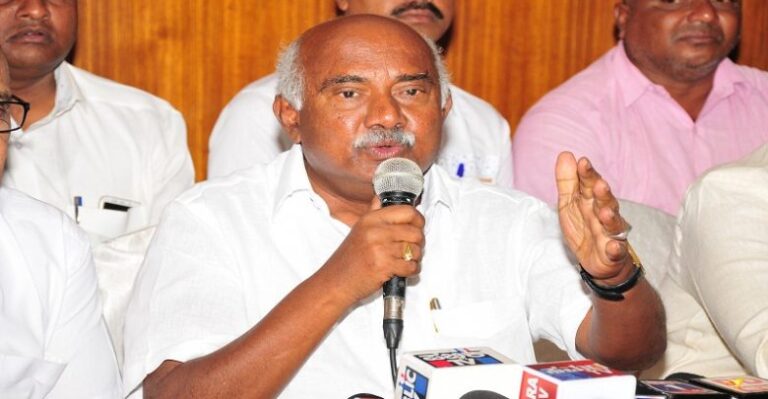
BJP MLC Vishwanath Slams the Ban on Muslim Traders in Karnataka
The hijab controversy has put the state on simmer since January. The state HC ruling on the Hijab controversy has given more support to the Karnataka govt order stating that Hijab is not an essential part of Islam forcing Muslim girls to remove Hijab before they enter the schools. This has deeply polarized the state and caused deep anxiety in the muslim community.
As if this was not enough, Hindu right wing elements are forcing Muslim shopkeepers and vendors to keep away from the temple areas during the temple fairs. This has severely hit the economic prospects of communities hit by covid pandemic.
BJP leader Amit Malviya, however, did not take Shaw’s appeal well and tweeted, “It is unfortunate to see people like Kiran Shaw impose their personal, politically coloured opinion, and conflate it with India’s leadership in the ITBT sector. Rahul Bajaj once said something similar for Gujarat, it is today a leading automobile manufacturing hub. Go figure…”
It is unfortunate to see people like Kiran Shaw impose their personal, politically coloured opinion, and conflate it with India’s leadership in the ITBT sector. Rahul Bajaj once said something similar for Gujarat, it is today a leading automobile manufacturing hub. Go figure…
There have been several voices of concern regarding this increasing attempts of communal polarisation by BJP and its organisations affiliated to it. Lately former chief minister HD Kumaraswamy also slammed the CM Basavaraj Bommai for acting as puppet at the hands of RSS and letting Karnataka be a playing field for right wing elements.
Two of Karnataka BJP legislators have termed as “wrong”, “undemocratic” and “madness” the restrictions being placed on Muslim traders from participating in temple festivals in parts of the state at the behest of pro-Hindutva groups.
The remarks by A H Vishwanath, an MLC, and Anil Benake, an MLA, came in the wake of some temples in Udupi and Shivamogga barring Muslim traders from participating in the festivals following demands by groups like VHP, Hindu Jagarana Vedike, Bajrang Dal and Sree Rama Sene. Such calls are now being raised in other parts of the state as well.
At the time when there is growing pressure from rightwing elements to ban Muslims from doing trade near temples, Former Chief Minister and JD(S) leader, H. D. Kumaraswamy has severely criticized the BJP government for letting loose these elements that are hell-bent to create communal discord in the society.
Demanding the government to take stern action against such people and outfit. He demanded nobody should be spare no matter how much influential that person is. He also appealed to people to boycott those who are creating communal divide and spreading hatred in Karnataka in the name of religion.
Speaking to media persons, he expressed displeasure over the BJP government for remaining quiet even when so many activities taking place that are dangerous to the unity and harmony of the State.
“ Chief Minister, Basavaraj Bommai has become mute spectator after becoming a puppet in the hands of RSS”, he retorted.
Making it clear that the Chief Minister and Home Minister are not confined to any particular caste or community, he said that they are the protectors of every single citizen of the State. “ You cannot run the government by protecting only a group of people and not giving any protection to another. The Kannadigas will not tolerate it and they will throw such a government away”, he remarked.
Referring to messages being circulated in social media by pro Hindu outfits that are calling for a ban on Muslims from doing trade near temples, Kumaraswamy advocated the need to find out which miscreants are doing it and who are behind such people. Those forces should be nipped in the bud. Even if MLAs and Ministers are involved in these acts, they too should not be spared. Common people should boycott them, he said.
Replying to the call given to prohibit Muslims from doing business in the State, he said that a systematic plan is being hatched in the State to brainwash youths. Some people are spreading the message that Hindus should buy materials only from Hindus shops. “ Where are they taking our country to?. They are destroying the social fabric of the State”, he asked.
Holding both the Congress and the BJP responsible for creation of such a terrible situation in Karnataka, he made fervent appeals to Hindu youths not to get driven from the communal agenda which will only destroy their careers. “ Do not listen to those spoiling your brain for their dirty political gains. Do not allow peace and harmony of the State to go for a toss”, he asserted.
Accusing the BJP of taking Karnataka on a path of devastation, he wondered whether the government is existing in the State, if so, then what it is doing?
He asked when a person who spoke against the CM, was arrested, then why those people instigating communal violence are spared.
Criticizing Assembly speaker for raising the issue of reforms in elections, Kumaraswamy said that when the State is burning and communal hatred is becoming the order of the day, the speaker is talking about reforms in elections.
“ Actually, I had no interest in participating in the session, but I wanted to expose these communal bigots. For that reason I came here. These are important and critical issues which must be debated in the session, he remarked.
Yogi Adityanath, a monk turned politician is set to return as chief minister of Uttar Pradesh. He has taken oath for the second consecutive chief ministership of Uttar Pradesh on March 25. BJP has comfortably managed to script a jubilant victory in the recently concluded legislative elections in Uttar Pradesh. BJP with its allies got two-thirds of the total seats and crossed the majority mark on itself. The vote percentage of the BJPincreased in comparison to the last election, helping it to win the elections in Uttar Pradesh by a thumping majority.
From successfully managing the social caste groups of Hindus as a consolidated voting bloc, providing targeted welfare and making them loyal votary or women voters being a decisive factor to script BJP’s victory, all forms of explanation to the election victory is floating around.
But a question that needs an eye on is how the mandate is taken by BJP itself? What does this clinical electoral victory of BJP express about the political dynamics of Uttar Pradesh? The current analysis of this result shall be in the backdrop of Yogi Adityanath’s five-year rule. For Yogi, who held the reins of power in an authoritarian style and got re-elected with a comfortable margin, the mandate comes as legitimate support for his governance style, policies, and the specific kind of state he created in five years.
Elections in a flawed democracy
Elections are sacrosanct in democracy if it exists in reality. The occasional procession of elections allows the politically equal rights-bearing citizens to engage in choosing their representative. Particularly in the times when India is described as a partly free democracy, elections become more important as it allows people to vote against the shrinking democratic space and in support of genuine, everyday life issues. Also, since BJP has squeezed Indian democracy just to the procedural event of elections after defeating its spirits in social and economic aspects, the election becomes an important phenomenon to expand the scope of democracy. BJP has an inherent incompatibility with a democratic society consisting of an active civil society, organic social movements, empowered citizenry, independent public institutions, inclusive civic community & pluralism. This contributes to establishing a democratic political culture that is not just limited to occasional events of elections but effectively works in cultivating Ambedkar`s dream of “associated life”. BJP, since its ascendance to power, has relentlessly attacked the country’s political culture, suffocating Indian democracy. It has brought in a new and different political order which, in the words of Prof James Manor, could be described as electoral authoritarianism.It is a hybrid system that remains democratic only in appearance, having liminal actuality. It provides a disproportionate benefit to BJP in elections as the political control over institutions and erosion of social democracy provides no level playing field for opposition to challenge its electoral prominence. The election witnessed an unprecedented level of a communal political campaign by BJP. From Garmi nikal denge to 80:20, Yogi himself spoke the language of a religious fanatic, instilling fear amongst the Muslim community and bringing religious fault lines in the election. Following its track record, the Election Commission capitulated in front of BJP`s divisive electoral campaigns. Throughout the election, the language of communalism was firmly imbibed in the electoral campaign of the BJP.
Image courtesy: Sabrang.in
The Hindutva underpinning of Yogi win
While providing any form of analysis to the result, it is extremely necessary to acknowledge the Hindutva majoritarian underpinning of the mandate. The impressive victory of BJP under Yogi Adityanath provides legitimacy to the inflammatory communal campaign. The Majoritarian Hindutva political discourse set the tone for BJP in UP elections, giving energy to the BJP`s ambitious creation of a Hindu unity cutting across the caste class boundary. This gets reflected in the increasingly bipolar contest, the first time after the rise of subaltern politics in UP which brought multipolarity in the political contest. BJP`s social engineering of Hindu caste groups as well as the broadcast of welfare developmentalism also worked in favour of it. The victory celebration by parading bulldozers in the streets and roads throughout the state speaks volumes regarding the form of state Yogi has developed in Uttar Pradesh. Here CM is metaphorically attached to an extralegal and unconstitutional practice of bulldozing houses that undermines the Rule of Law and his constitutional position.
A specific form of state has been created in Uttar Pradesh by firebrand Hindu monk Yogi Adityanath during his first tenure as CM. Adhering to the communal ideology of hardline Hindu majoritarianism, Yogi Adityanath has persistently used the mandate of 2017 to the causes of democratic erosion and political subjection of Muslims in Uttar Pradesh. The state has been an experimenting laboratory for numerous forms of unaccustomed crime against Muslims.
Ever since his ascendance as Chief Minister of Uttar Pradesh, the hate crimes against Muslims rose to an unprecedented level. While BJP RSS has been working on the ground for a long time to create a communal majoritarian society based on frequent episodes of communal tensions. Various Hindu militant organisations including Hindu Yuva Vahini, founded by CM Yogi Adityanath himself, work on the ground to communalise petty issues with an aspiration to create a permanent riftamongst Hindu Muslims. But after coming to power, communal politics gets legitimate support from the state in Uttar Pradesh in many different ways. Yogi Adityanath utilised the state public institutions to further the communal political agenda and persecution of Muslims by making them function in the Hindutva political tone. A massive centralisation of power and using the repressive state apparatus such as police for the communal agenda remains core to the governance of UP under Yogi. Promoting himself as a CM who glorifies police encounters, the state Police in Uttar Pradesh did encounters that disproportionately targeted Muslimsand killed them. Similar is the story of cow-related lynching where Muslims were killed and persecuted in the name of cow protection, majorly by Hindutva vigilante groups.
Vikas Dubey, a gangster was killed in an encounter shooting by UP police
Yogi Adityanath also brought controversial laws that fulfilled the needful demands of Hindutva. The government ban on animal slaughter and closing of slaughterhouses was also a well-intended communal attack on Muslim economic enterprise and falsely accused them of cow slaughtering.
The passing of the controversial Anti-conversion bill in Uttar Pradesh was also a step forward not only to criminalise any form of inter-religious affiliation but also to attack the Muslim community for captivating Hindu girls and forcefully performing religious conversions. It was in line with RSS`s bogey of Love Jihad which attempts to script a communal basis of interfaith love marriages, denying women agency and egregiously targeting Muslim men. Noteworthy to find is that the law was misused intentionally by vigilante groups, police officials often target Muslim men. A large number of false cases were registered and Muslim men were punished, beaten and falsely charged.The name changing of prominent cities, towns and railway stations in Uttar Pradesh also contributed to the socio-cultural erosion of Muslim history from the collective memory and conscience.
The form of repression Muslims faced during the anti CAA protest was unimaginable. Uttar Pradesh police not only brutally cracked down on the protestors but their bullets took the lives of more than 20 innocent Muslims. Yogi Adityanath openly supported the act of police, claiming that those who came out to get killed, how will they remain alive?
Yogi Adityanath vigorously used state police for targeted persecution of Muslims. Under the able leadership of Adityanath, Uttar Pradesh police top the list of human rights abuse, for the third year in a row. Punitive laws like UAPA and NSA are also used as state government weapons to target Muslims, political dissenters and repress the civil society movements.
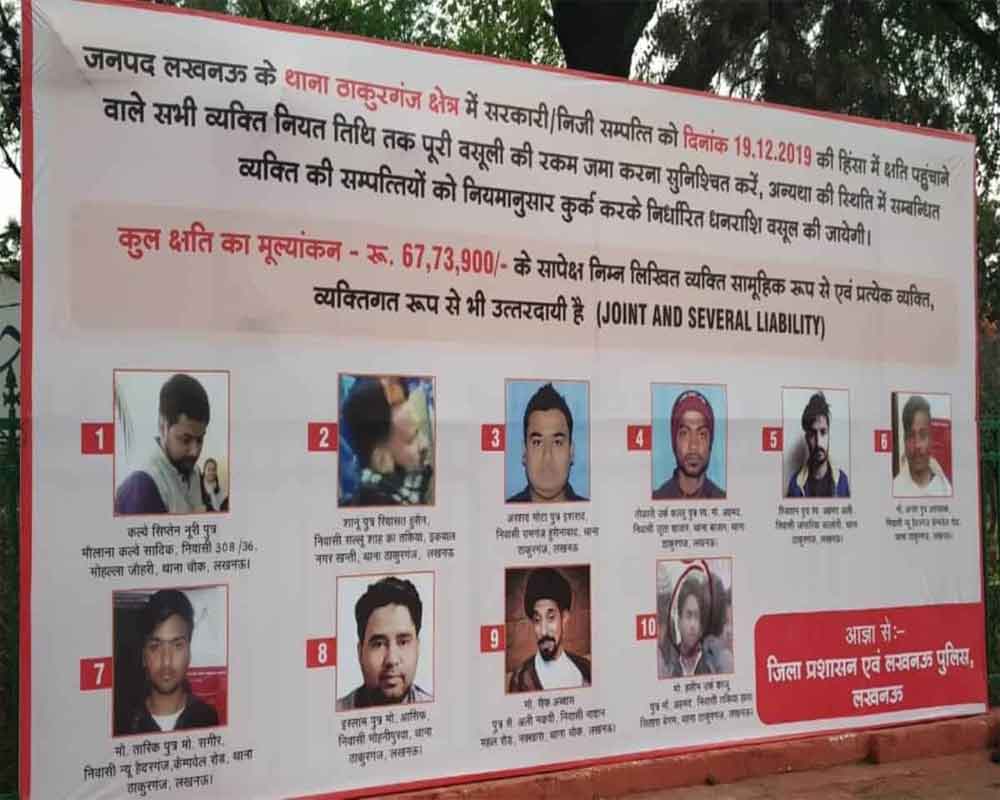
Yogi govt. issued diktat to retrieve the damage during anti CAA protests from the protesting members
The state of Uttar Pradesh has taken an authoritarian administrative turn during the Yogi Adityanath regime where social, political and institutional erosion of Muslims is taking place. They remain at the receiving end of state repression as well as Hindutva vigilantism, both endorsed and supported by Yogi Adityanath. By a constant instilling of fear amongst the Muslim community, a democracy of fear has been created by Adityanath in Uttar Pradesh where Muslims are deinstitutionalized, robbed of their civil rights, culturally marginalised and turned into passive citizens. This is what Christophe Jaffrelot describes as a de facto Hindu state. All this unravels the deep down Muslim hatred Yogi Adityanath regime installed and practised in the state institutions, leading to the severe aberration of secular principles of constitution and saffronisation of the public sphere. As Hannah Arendt mentions in her seminal work. The origins of Totalitarianism, terror in a totalitarian regime must be instrumentalised to carry out a specific ideology by gaining the adherence of the majority. The minority here becomes a power losing group that doesn’t have any public influence left. The state of governance in Uttar Pradesh has taken this course since the 2017 elections where the confluence of state institutions and Hindutva vigilante groups have reduced Muslims as an ethnic group one the mercy of the majority community and the present mandate legitimise the democracy of fear created by Yogi Adityanath.
What remains the possible way out against this regime is a constant democratic struggle and strong social movement against the hegemonic Hindutva state-building. This shall be done by creating a popular front, based on coming together of the like minded secular political forces. Big movements based on genuine demands of public will also help in challanging the BJP’s politics. Even in this election, the defeat of several communal leaders of BJP who have been prime accused of the Muzaffarnagar riots showcases that it is possible to defeat by making a broad social coalition. The inter electoral social struggle against Hindutva vigilantism and deserting of the active citizenry will help change the electoral arithmetic against BJP. As optimised by Sudha Pai before the elections, a rejuvenated opposition’s success in reducing the tally of BJP can reshape the 2024 election result. SP, the principal opposition can pose a formidable challenge to BJP in UP by continuing to raise genuine issues, democratic inter-electoral political struggle against Hindutva as well as making the social coalition broader to counter BJP. The retaining of the legislative seat by Akhilesh Yadav to focus on UP state politics is a positive signal in the prospect of UP politics. The future, however, remains ambivalent.
The author is postgraduate from DU in Political Science this and currently work as a researcher for Greenpeace.
Omkareshwar Thakur, the creator of Sulli deals app has been granted bail. Chief Metropolitan Magistrate Dr Pankaj Sharma observed that he was a first time offender, whose long incarceration could prove detrimental to his well-being.
According to a report by the Hindu, Neeraj Bishnoi, too, was granted bail by the Patiala House court on Monday.
Thakur was arrested on the basis of the disclosure statement of co-accused Niraj Bishnoi.
“Accused is a first time offender and a young person as such prolonged incarceration would be detrimental to his overall well-being. Accused has roots in the community and he is not a flight risk. The trial would take considerable time to conclude as such no fruitful purpose would be served by keeping him detained any further,” the order held.
Sulli Deals, hosted on GitHub, was an app that staged ‘auctions’ for Muslim women by using doctored images of them without their consent, accompanied with derogatory remarks
According to Bar & Bench, the defence counsel argued that other than the concocted and fabricated disclosure statements that have no evidentiary value, there is no material on record that by any stretch of imagination even remotely exhibit a prima facie case against the applicant with respect to the alleged offences, in particular Section 153A of the Indian Penal Code.
The prosecution opposed his bail plea saying the investigation was on and forensic reports besides responses from intermediaries in the case were awaited. It was feared that he may threaten the witnesses and tamper with the evidence.
The Court, however, held the pending forensic reports and replies were not sufficient grounds to deny bail to Thakur, who had been in judicial custody since January 9, 2022.
The Court, thus, allowed bail on a surety bond of ₹50,000 on the condition that he shall not influence or contact any of the survivors. Thakur was ordered to provide his phone number to the investigating officer and not tamper with the evidence.
Besides, he was also directed to drop a pin on Google maps so that his location is available with the police.
Sulli Deals, hosted on GitHub, was an app that staged ‘auctions’ for Muslim women by using doctored images of them without their consent, accompanied with derogatory remarks. It had surfaced in July, 2021, and the Delhi police had registered a first information report (FIR) on July 8 that year under Indian Penal Code (IPC) Section 345A (sexual harassment).
Belagavi: At the time when the right wing activists are demanding ban of Muslims traders for doing business near the temple, and BJP Ministers justifying the demand citing the law, Senior BJP leader and MLC H. Vishwanath has criticized very people of his party for opposing Muslims from doing business near temples.
Addressing media persons in Gokak taluk of Belagavi district, the veteran leader said that people should not be divided on caste and religion bases when it comes to doing business for a living.
“ Those who do petty business during the temple festivals are poor people. They come only for little earning. Priority should be given to human needs and not caste or religion. I strongly oppose those who are advocating the need to ban Muslims from doing business near the temples to eke out a living “, Vishvanath said.
Stating that innumerable Indians are working and earning money in Muslim countries. He wondered what would happen if those countries ban Hindus or Indians from doing business in their countries.
“ In that case, is Karnataka ready to provide jobs to NRIs of India if Muslim countries start sending them back”, he asked.
Cautioning that playing caste politics is dangerous to society, he said that one could win one or two elections on that basis, but cannot win every election only on caste and religion bases.
He asked whether it is written in the Constitution that Muslims should be sent away from India and they should not be allowed to do business here.
The controversy erupted in view of the recent controversy that triggered after instances of Muslim traders being barred from setting up shops and stalls in some temple premises and religious gatherings in Karnataka’s coastal districts came to the limelight.
Recently, Hindu activists in the Madikeri district of the state on staged a protest demanding the administration to remove Muslim traders from carrying out their business during a annual religious event held at Shanivarasante of Somavarapet taluk.
The move to ban Muslim traders from Karnataka temple fairs has spread to more districts of the state and is likely to snowball into a major crisis in the coming days.
The trend which surfaced in coastal districts and capital Bengaluru has made its way into Hassan, Tumakuru, Chikmagalur and Shivamogga districts.
The 12 year old boy was beaten up by a local leader of an upper class community for a small issue. Hanumataraya Madikeshwar, a 45 year old man of the village is accused of beating up the boy. According to the reports, the boy had reportedly sent some objectionable voice message to the accused on his social media account. Enraged with the message, the man caught the boy and beat him up by stripping him and tying to an electricity pole.
Meanwhile some local youth have captured the video of the incident in their mobile phones which later went viral. The incident is said to have happened on March 18 however it came to light only last week.
The video shows that the man is throwing used engine oil on the private parts of the boy while beating him up.
Following the incident, the parents have filed case at the Basavana Bagewadi police station. The police reportedly assured the family to arrest the culprit.
It is said that on the day of Holi festival, the minor boy belonging to Kuruba community had allegedly sent a derogatory message to a man belonging to Reddy community.
After which, the man next day caught the boy and tied him to a pole near his shop, stripped him and beat him up.
Expressing anger over the incident, Ahinda Raita Sangha state president, Mallappa Bidari said that the boy has been admitted in the government hospital. He demanded police security for the family as he said that the family is now being threatened.
“ The police should have filed a suo moto case, but now since the family has filed the case, the accused must be arrested”, he said.
The police meanwhile has filed cases under section 323, 342, 504, 506 of the IPC against the accused. The police said that they have arrested the accused, however it’s notable that the police have not filed a case under POCSO act.
PSI Basavaraj Patil however said that they are consulting the higher officials on filing cases under the POCSO act.
He said that the Act is applied only when a person does sexual act with the child. “ However we will take opinion of the higher officials before adding that act in the case”, he told our team.
The article was firs published in naanugauri.com, our sister website. Its translated into English by Firoz Rozindar.
The All India Muslim Personal Law Board has moved the Supreme Court against the Karnataka High Court judgment which held that Hijab is not an essential religious practice (ERP) of Islam and, thereby, upheld the power given to colleges to ban wearing of hijab in college campus.
The AIMPLB along with two other petitioners have contended that High Court did not address the core issue of whether or not it was necessary to consider the doctrine of essential religious practice where the petitions have asserted their Fundamental Rights under Article 25(1) and 19(1)(a).
Further, it was stated that the idea of bringing uniformity could not be placed on such a high pedestal that it amounted to negation of other constitutional and basic rights of different groups.
“Hence laying too much emphasis on bringing “uniformity” in the uniform without accommodating a person of one religion ‘to cover her hair with a piece of cloth’ is travesty of justice,” the plea stated.
The petition also emphasised that the determination of ‘essentials’ under the principles of essential religious practice fell within the complete autonomy of the religious denomination according to tenets of a religion.
“Over a period of time, it appears that the Courts have completely taken upon themselves the task to determine what are the essentials and integrals of any and every religion practiced in our country for the purpose of regulatory control over them by the State authorities,” it was submitted.
It was also submitted that the concept of intelligible differentia was given a completely erroneous interpretation by the High Court by grouping all the students in uniformity.
The plea claimed that the High Court of Karnataka failed to appreciate the legal impact of developments made by way of the judgments in KS Puttaswamy v Union of India and Kantaru Rajeevaru v Indian Young Lawyers Association.
The petitioners claimed that since the High Court did not maintain clarity while framing questions, the discussions on diverse constitutional principles resulted in conceptual overlapping leading to indirect discrimination.
“The ground reality is that the petitioners are compelled to remove their Hijab to avail the right of education, at the cost of self – respect and dignity,” it was contended.
Pertinently, it was also submitted that as far as interpretation of scriptures in the Quran is concerned, there is a consensus among Islamic religious scholars of all schools of thought that the practice of Hijab is mandatory.
At least two appeals are already pending before the top court against the Karnataka High Court verdict.
The Supreme Court had last week declined request for urgent listing of appeals against the High Court verdict.
The matter was mentioned before Chief Justice of India (CJI) NV Ramana by Senior Advocate Devadatt Kamat but the CJI asked the petitioners not to sensationalise the issue and refused to give any specific date for hearing the matter.
Bagalkot: Congratulating people on account of Republic Day of Pakistan proved costly to a Muslim woman of Mudhol taluk Bagalkot district of Karnataka as the police filed case against her under various sections of the IPC.
A 25-year-old woman has been arrested for posting celebratory messages on Pakistan Republic Day on her WhatsApp status on Thursday.
The accused is identified as Kuthma Sheikh, a resident of Mudhol town and student at local Madrasa. The incident reportedly occurred on March 23, where Pakistan celebrates its Republic Day.
According to police, “She has put up Whatsapp status conveying Pakistan Republic Day wishes on Wednesday. A person identified as Arun Bhajantri soon after noticing Kuthma’s WhatsApp status has filed a complaint with providing evidence. Based on the complaint, action was initiated and Kuthma Sheikh has been taken into custody.”
As per the photo shared by the department of police, “The accused WhatsApp status stated that ‘Allah Har Mulk me Ittihaad…Aman…Sukoon…Ata Farma Maula’ (may Allah grant unity, peace and harmony in every country). Along with this she had also put up a photo conveying wishes to Pakistan on their Republic Day.”
A complaint has been registered in Mudhol Police Station. She has been charged with Indian Penal Code (IPC) section 153(A) (promoting enmity between different groups on grounds of religion, race, place of birth, residence) and 505(2) (Statements creating or promoting enmity, hatred or ill-will between classes). She has been sent to judicial custody.
Speaking to reporters, SP Lokesh Jagalasar, said that, the woman has been arrested on the same day. There are no protests and the town is peaceful. “ We will not spare anyone that tries to spread hatred and create unrest by putting such posts in social networking sites. We are monitoring the social media posts closely”, he said.
In mid-March 2022, Opposition Senator, Gustavo Petro, won the Colombian Presidential primaries for the Historic Pact Coalition with nearly 80% of the votes. The selection has been noteworthy as Petro for 45 lakh votes, which is higher than the number of votes cast in the primaries of the rival collation. Analysts see this as a strong signal that Petro will do very well in the upcoming Presidential election.
Petro is making international news as a former Guerilla Leftist who came overground to become successful in electoral politics. With the cap on terms, the current President of Colombia, Ivan Duque, will not be able to contest, so Petro’s win could signal a strong shift in the Electoral ethos of Colombia.
To call Petro a hard leftist candidate is an exaggeration. His proposals are mainstream and liberal. Wealth redistribution and demanding stronger actions against climate change are no longer political positions, but necessary actions for the future in Colombia. Those who are concerned about Petro becoming President for being an extreme leftist cites his history in M19 and his stances on the fossil fuel and mining industries, but his proposals are very mainstream and reasonable. He has long given up on demanding that American politicians and business owners be accountable for their crimes against humanity in Colombia. The so-called new left candidates coming up in Latin America are very aware of the Global opposition to a radical leftist coming to power. They are also looking to the issues of crony capitalism and ecological destruction as immediate issues that need to be addressed.
Petro is a sign of a new form of the left in Latin America. He is not a radical. He is a nationalist and his positions prioritise the future of Colombia. He is left in the sense that he has seen the destructive aspects of capitalism, for his country and the world. He does not stand for any international alliance. He said he will work with the USA, Russia or China, provided they are willing to work against Climate Change. He understands that American governments and corporations are responsible for decades of civil war, violence to the land and people of Colombia, and support for the corruption of the Colombian government.
From the 1960s, Colombian society has seen growing armed conflict. This began when the American government, and various corporations like Coca Cola and Chiquita (formerly American Fruit Corporation), worked with the Colombian government and Right-wing paramilitary organizations to destroy leftist resistance groups in the rural areas. This escalated in the 1970s when America began cracking down on narcotics, like Cocaine and Cannabis. These crackdowns drove up the price and violence of the drug trade, leading to the development of elaborate drug cartels across the country. These cartels would work with Multinational corporations, and the government would work with the American government to crush any rebellions, leading to a very violent conflict that grew through the 1990s.
Gustavo Petro joined the 19th of April Movement, or M-19, a Guerrilla movement that came up against the corrupt elections of 19 April 1970, the first elections in Colombia after 5 years of military rule. M-19 was the second-largest guerrilla group in Colombia after the Armed Revolutionary Forces of Colombia – People’s Army (FARC).
Petro was captured in 1980 for his work in M-19. M-19 was active, but in the 1990s, they transitioned towards mainstream politics. Starting with local elections, they started shifting to mainstream politics in the 2000s.
Petro’s political positions also shifted at that time. He is still vocal about the horrendous violence wrought on Colombia by America and the various Multinational corporations, but his concerns started shifting more towards the environment and inequality. He feels that the older conflict of right and left do not make sense anymore. He has even taken stances against leftists who do not take the concerns of climate change seriously.
In terms of ideology, M-19 has followed the Latin American form of nationalism. They did not subscribe to a socialist revolution but believed that the running of the country should be open to the people of the country. Authoritarian rulers and pro-market policies are anti-national. They are pushed by cowards who serve the invading imperialist interests.
Petro began running on a platform of welfare, wealth redistribution and environment. He supports Universal Healthcare and wants to bring banking into the public sector. He is against fracking and the mining industry. He condemns deforestation and holds the American companies responsible for the loss of forest areas in Colombia.
If Petro succeeds in his Presidential bid, he might face opposition on the same level Lula faced in Brazil. Beyond his political and international opponents, the cartels are a very real threat to his life. His policies will face violent opposition in the State, from overseas and in the forests. Many of the groups against him have a lot of money invested in seeing him fail, but these policies are essential for Colombia in the long run. Many of Petro’s old enemies from the various Right-wing militias still send him and his family death threats. With the de-escalation of the conflict, the old drug cartels have been making way for right-wing cartels that are still very powerful. These new cartels are called BACRIM cartels (bandas criminales emergentes).
Petro’s work as mayor made him world-famous as someone who can see pro-people policies work for everyone. He was famous for implementing a very effective public transport system and is often quoted saying that a rich country is not one where the poor drive cars but where the rich ride the bus. The Integrated Public Transport System he developed in Bogota is world-famous and has been a model for urban-based public transport.
In 2008, Petro announced his desire to run for the 2010 Presidential elections and came in fourth. In 2014, he became the mayor of Bogota. In 2018, Petro ran a second time for President and came in second. The coming election marks his third attempt, and the situation looks very hopeful for Petro.
Author is a mathematician and political observer based in Bangalore, Karnataka.
Dakshina Kannada: Uppinangady police of Dakshin Kannada district have filed a case against some people for spreading false information with malicious intentions by misusing the names of the shops of Hindu traders in order to create communal tension.
The case has been filed following the complaint given by New Ashwini Traders shop proprietor B. Ganesh. The case has been filed under section 505(2) of the IPC for creating enmity between two groups.
The police officials of the station have said that they are still investigating who spread the false news.
Ganesh said that he owns a shop in Uppinangady town. “ I get customers from people of all faiths. I don’t discriminate among them as I am a trader. But now some miscreants have misused the name of my shop to create communal tension”, he said.
On March 24, some miscreants posted a message on a social media site and spread it that aimed at dividing the society on religious lines, he said.
“ The message claimed that it was sent by Hindu Traders Association, where names of 32 shops were mentioned including my shop. The message said that my shop does not sell any items of Muslims. I need only Hindu buyers. This was in the message”, he said.
Ganesh has called the attempt a conspiracy and has urged the police to investigate cases who have sent false information about his shop”, he said in the complaint.
Meanwhile Hindu traders have also condemned the act and demanded action against the culprits.
The delegation had traders including Yatish Shetty, Shivprasad, Sandeep Shetty, Jagdish Nayak, Chetan Nayak, Prashant Dicosta, Shabeer Kempi, Abdul Rehman Yunik etc.