Prayagraj police have filed a sedition case against a person for his comment on a Facebook post on migrant workers’ issue, saying that he was “disrespecting” Chief Minister Yogi Adityanath.
Police said that Anup Singh has been booked under IPC sections 124-A (sedition), 500 (defamation), 188 (disobedience to order duly promulgated by public servant) and section 66 of the Information Technology Act.
The case has been registered at the Shivkuti police station in Allahabad. The FIR alleges that the man made ‘aapattijanak tippanee’ (objectionable remarks) about Adityanath in response to an individual’s Facebook post.
The complaint lodged by Sub-Inspector Amrita Singh, based on which the FIR was registered, stated: “A post by Rajesh Kumar Shukla, a resident of Prayagraj, on his Facebook ID said that I can’t understand why Priyanka Gandhi Vadra did not hire UP transport (department) buses?
In this post, a resident of Allahabad, Anoop Singh, made objectionable remarks against Yogi Adityanath. He said, “Yogi kutta hai is liye (because Yogi is a dog).”
“Through his Facebook, he is trying to disturb the peace of the country and insult honorable Chief Minister Yogi Adityanath,” the FIR says.
The Allahabad police is yet to determine the identity of the accused. “We are investigating the case which was lodged after we received some complaints on social media from users. During the investigation, we will know about the accused. Our cyber cell teams are collecting his details. We are also going through his old posts and will track him down soon,” senior superintendent of police Satyarth Aniruddha Pankaj told the Indian Express.
The complaint was lodged by sub-inspector of police Amrita Singh, based on which the FIR has been registered.
Twenty days after being admitted to a private hospital in Raipur, first Chief minister of Chhattisgarh Ajit Jogi passed away on Friday after suffering two cardiac arrests. Jogi had suffered multiple arrests in the past 20 days, was comatose and on ventilator support as doctors were trying to revive his brain activity. He was 74 years old at the time of his death.
On Friday, Ajit Jogi breathed his last at around 3.30 pm at Shri Narayana hospital in Raipur. Dr Sunil Khemka, a senior doctor looking after Jogi said, “He suffered two heart attacks one after the other, and we tried to revive his heart activity for over two hours, but he was finally declared dead.”
On May 9, Jogi had suffered a cardiac arrest after breakfast when he was revived at home and rushed to the hospital, where he was put on a ventilator.
Jogi is survived by his wife MLA Renu Jogi and son Amit Jogi, who took to Twitter to confirm his father’s death. “20-year-old young Chattisgarh is facing the loss today, like me,” he wrote.
२० वर्षीय युवा छत्तीसगढ़ राज्य के सिर से आज उसके पिता का साया उठ गया।केवल मैंने ही नहीं बल्कि छत्तीसगढ़ ने नेता नहीं,अपना पिता खोया है।माननीय अजीत जोगी जी ढाई करोड़ लोगों के अपने परिवार को छोड़ कर,ईश्वर के पास चले गए।गांव-गरीब का सहारा,छत्तीसगढ़ का दुलारा,हमसे बहुत दूर चला गया। pic.twitter.com/RPPqYuZ0YS
Jogi studied Mech. Eng. at the Maulana Azad College of Tech., Bhopal, winning the University Gold Medal in 1968.
A bureaucrat-turned politician, Jogi had served as the first chief minister of Chhattisgarh from November 2000 to November 2003 in then Congress government, after the state came into existence.
Prior to his stint in politics, Ajit Jogi was selected for the Indian Police Service (IPS) and the Indian Administrative Service (IAS). He served as a district collector of Indore in Madhya Pradesh between 1981 and 1985. Before he took office as the first CM of Chhattisgarh in November, 2000, Ajit Jogi served as a Rajya Sabha Member of Parliament (MP) from Madhya Pradesh.
Jogi parted ways with the Congress in 2016 after he and his son got embroiled in a controversy over a by-election. Later, he quit the Congress and formed Janata Congress Chhattisgarh (J).
Condolences are pouring in from all political quarters.
Pained to hear the passing away news of Former Chhattisgarh CM Ajit Jogi. He was a good friend of Netaji.
They would sit together in 1990s to discuss various political opinions. May his soul rest in peace. Om Shanti !#AjitJogipic.twitter.com/yw7FbA3z4A
— Mulayam Singh Yadav(FC)🌎 (@NetajiTweets) May 29, 2020
Saddened by the demise of Shri Ajit Jogi, the first Chief Minister of Chhattisgarh and a former Member of Parliament. My condolences to the bereaved family. May his soul rest in peace. pic.twitter.com/DV0mngAJEl
— Vice President of India (@VPSecretariat) May 29, 2020
My heartfelt condolences at the passing away of former CM of #Chhattisgarh Ajit Jogi ji. My thoughts and prayers are with his family members in this hour of grief…may God give them strength to bear the loss. May his soul rest in peace.
Days after a special bench of the Gujarat High Court made scathing criticism on the state’s BJP government for its inept handling of the COVID-19 crisis, the bench has abruptly been changed. In its order, Chief Justice of the Gujarat High Court Vikram Nath has now replaced the bench comprising Justices JB Pardiwala and Justice IJ Vora with a new bench comprising himself and Justice JB Pardiwala.
The change in the judges’ roster comes abruptly on the last working day of the week when it is due to hear the public interest litigation (PIL) on all issues pertaining to Covid-19. The PIL was being heard by a division bench headed by Justice Pardiwala, along with Justice Ilesh Vora, since May 11. Prior to May 11, the PIL was taken up seven times by the bench headed by the Chief Justice, since March 13, when the PIL came to be registered following the court’s suo motu cognisance of WHO’s declaration of Covid-19 outbreak as a pandemic.
The division bench of the Gujarat High Court had earlier this week come down heavily on the state government as the COVID-19 deaths in Ahmedabad neared 1,000-mark. Singling out the appalling condition of the Civil Hospital in Ahmedabad for criticism, the high court bench had termed the condition ‘pathetic’ and ‘as good as a dungeon or maybe even worse.’ While 764 people have died in Ahmedabad alone, close to 400 of them have died at the city’s Civil Hospital alone.
The bench had said, “It is very distressing and painful to note that the condition prevailing, as on date, in the Civil Hospital, is pathetic… We are very sorry to state that the Civil Hospital Ahmedabad, as on date, appears to be in extremely bad shape.”
The bench had also slammed Health Minister Nitin Patel and Principal Secretary, Health and Family Welfare, Jayanti Ravi for poor monitoring of health care facilities.
Justices J.B. Pardiwala and Ilesh Vora had even warned the state government without mincing words, “We sound a note of caution. The Superintendent of the Civil Hospital and other authorities of the Health Department of Gujarat shall keep themselves ready to find our presence one fine morning on a given day in the Civil Hospital. This would put an end to all the controversies with regard to the functioning of the Civil Hospital at Ahmedabad.”
In an order on March 22, Justice Pardiwala’s bench had pulled up senior IAS officers, deputy chief minister Nitin Patel who also holds the health portfolio, and questioned the state government if it was “artificially” controlling the number of cases in the state by gatekeeping testing in private laboratories, among several other issues.
The court had also taken on its record an anonymous report by a medical officer listing out 22 problem areas in Civil Hospital as well as an anonymous letter by a resident doctor of Civil Hospital, highlighting the dire conditions.
Following the 143-page order, the state government on May 25 had moved a civil application on urgent priority, with Chief Justice Vikram Nath’s endorsement for urgent hearing the same day. The application had “endeavored” to clarify that the condition of Civil Hospital “was not as pathetic” as the high court observed in its May 22 order. However, Justice Pardiwala’s bench had said “it was too early to give a final certificate” and had said that the bench will visit the civil hospital “one fine morning” and put an end to all controversy.
Subsequently, from May 11 to May 15, May 18 to May 22, as well as from May 25 until May 28, a division bench of Justices Pardiwala and Vora was functioning, conducting four hearings of the said PIL. The new roster for Friday now includes two division benches, one headed by the Chief Justice along with Justice Pardiwala while another bench will be headed by Justice R M Chhaya, along with Justice Ilesh Vora.
Congress president Sonia Gandhi on Thursday led the party’s ‘Speak up India’ campaign, asking the government to come to the rescue of lakhs of labourers and small traders who continue to battle the economic impact COVID19 and the lockdown.
Key demands raised through the campaign:
Direct cash transfer of Rs. 7,500 per month for a period of six months for poor households
Distribution of free ration to the needy
A financial package to help the MSME
Safe transportation of the stranded migrants back to their native towns and villages
Increasing the workdays under MGNREGA to 200
With the Centre indifferent to a slew of demands raised by the Congress party for easing the burden of the ongoing lockdown on common citizens, the Grand Old Party, on Thursday, launched a massive social media campaign – #SpeakUpIndia – to urge Prime Minister Narendra Modi’s government to take immediate corrective measures.
In two video messages today, Sonia said the government must immediately open its coffers and help the needy and if it feels constrained about finances, it should scrap the costly Central Vista project that seeks to build a new Parliament complex and government buildings and use that money to feed the vulnerable.
In her morning message, Sonia cited the travails of migrantlabourers who continue to walk back home thousands of kilometres without food and water and asked the government to arrange their free transport back to their home states.
“It is for the first time since Independence that the country has witnessed such a scale of pain and trauma, with lakhs of famished labourers forced to walk hundreds of kilometres in the absence of transport,” said Sonia, accusing the government of not doing enough for the poor.
The campaign launched simultaneously on social media platforms Twitter, Facebook, Instagram and WhatsApp at 11 am, saw scores of Congress leaders, including interim party chief Sonia Gandhi, Wayanad MP Rahul Gandhi and AICC general secretary Priyanka Gandhi Vadra share video messages, listing out their demands from the government.
It's time for every Indian to stand together & speak up in one voice. #SpeakUpIndia
for our brothers & sisters struggling for survival;
The key demands raised by Congress leaders and workers, through the campaign, were for direct cash transfer of Rs. 7,500 per month for a period of six months for poor households, distribution of free ration to the needy, a financial package to help the MSME, safe transportation of the stranded migrants back to their native towns and villages and increasing the workdays under MGNREGA to 200. These were also part of an 11-point charter of demands agreed upon by 22 Opposition parties, who had held a video conference with the interim Congress president recently to discuss ways of forcing the Centre’s hand to provide relief to the citizens over and above the Rs. 20 lakh crore economic package, which was announced by Modi in his last televised address to the nation a fortnight ago.
🔸Why were migrant labourers abandoned? 🔸Why is PM Cares fund not spent? 🔸Why did ₹20L Cr package have nothing for common man? 🔸Why is Central Vista needed? 🔸Why 'Maun' on Chinese Incursions?
The Congress party had directed its leaders, functionaries and social media volunteers – AICC office bearers, chief minister’s, state, district, and booth level functionaries numbering around 50 lakh across the country – to post video messages raising these demands on various social media platforms between 11 am and 2 pm on Thursday. Social media volunteers of the Congress party were also directed to share these messages through WhatsApp and other messaging services.
The campaign, the first such effort by the Congress party during the lockdown, triggered a Twitter storm between 11 AM and 2 PM, making #SpeakUpIndia the top trend on the microblogging site with nearly 2 lakh posts using the hashtag.
Karnataka government has dropped the naming of a flyover in Bangalore as “Swatantra Yodha Veer Savarkar ” after much outrage from Kannada intellectuals and opposition parties.
On 27th May 2020, the BJP government in Karnataka announced the inauguration of Yelhanka overpass bridge in the name of the Hindutva idealogue V.D Savarkar.
The Bridge will be inaugurated by Chief Minister Yeddyurappa on May 28, that is on the birthday of Savarkar, said S.R. Vishwanath, a MLA from Yelahanka constituency.
The bridge is being built at the cost of 34 crores, near the Dairy circle in Yelahanka.
Even before the inauguration of the Yelhanka overpass bridge has taken place, there are a lot of controversies about it, the only reason for this is, naming the bridge by V.D. Savarkar’s name.
Many have opposed the naming of the bridge as a disgrace to the freedom fighters and others who struggled for the development of the country and also as an insult to those who struggled throughout their life for the development of Karnataka.
Former chief minister, H.D. Kumaraswamy has expressed his dissent with the state government and said that this action of the state government is shocking. Adding to this, he also said that there are many freedom fighters and others who have struggled for the development of this country before and after Independence. The overpass bridge could have been named after them.
He also questioned- Will other states name projects in their state on real freedom fighters from Karnataka or who have worked for the development of Karnataka?
He said that the state government should have considered the people of this country before taking such decisions.
Another former chief minister and opposition leader, Siddaramaiah has also expressed his outrage against the naming of the overpass bridge on Savarkar’s name. He said that this is an insult to the ones who fought for the freedom and development of this state.
I urge the chief minister to immediately abandon this decision and name one of the freedom fighters of the state. Siddaramaiah said that the decision to name the Yelahanka overpass in name of Savarkar was proof that the government is not for the people and is not elected by the people of this state.
Responding to the tweet from H.D. Kumaraswamy, Minister C.T. Ravi said, “Savarkar fought for the sake of the country. I don’t know why Kumaraswamy is so small-minded. Deve Gowda was born in Holenarasipura. Why should we accept and call him a national leader.? ”
He added that V.D. Savarkar did not fight for the freedom of one state, but for the freedom of the entire country and he said that the Kumaraswamy should not speak of him in that way.
The controversy over VD Savarkar is not limited to his not being from Karnataka. There are many questions of his claim to be a true freedom fighter as well. During his stay in Andaman jail, Savarkar wrote mercy petitions to the British asking for forgiveness and be forever in the service of British if he is let out of jail.
In 1948, Savarkar was charged as a co-conspirator in the assassination of Mahatma Gandhi; however, he was acquitted by the court for lack of evidence.
The article was first published in naanugauri.com. It was translated into English by Neha Kumari.
Supreme Court on Thursday directed states to bear the cost of bus and train fares being charged from the migrants who are heading home due to loss of employment during the nationwide lockdown.
Taking note of the miseries of stranded migrants across the country, the Supreme Court on Thursday passed a slew of significant directions.
They are :
No fare either by train or bus shall be charged for migrant workers. Railway fare to be shared by states.
Migrant workers shall be provided food by the concerned state and UT at places to be publicized & notified for the period they are waiting for their their turn to board a train or a bus.
At the commencement of train journey, originating states should provide meal & water.
During the journey, railways should provide meal and water to migrant workers . Food and water to also be provided in buses.
State shall oversee the registration of migrants & states to ensure that after registration, they are made to board transport as early as possible.
Those migrant workers found walking on the roads, immediately be taken to shelters & provided food and all facilities.
The bench comprising Justices Ashok Bhushan, S K Kaul and M R Shah also directed the Centre to place on record information regarding number of migrants awaiting , transportation to native places, plan for transportation and mechanism of registration and other requisite details.
“As and when the state governments put in a request for trains, railways has to provide them”, the bench further ordered.
The next hearing on the matter will be on June 5.
During the hearing, the bench posed several questions to the Central Government on the issues concerning migrant workers, who have been stranded during the lockdown.
On May 26, the top court had taken cognizance of the miseries of migrant workers and said there have been “inadequacies and certain lapses” by the Centre and the states, and asked them to provide transport, food and shelter immediately free of cost.
We take suo motu cognisance of problems and miseries of migrant labourers who had been stranded in different parts of the country. The newspaper reports and the media reports have been continuously showing the unfortunate and miserable conditions of the migrant labourers walking on-foot and cycles from long distances”, the bench said.
Shortly before that, a group of 20 leading advocates had submitted a representation before the CJI, complaining that the Court’s passivity in the issue resulted in the executive going unchecked amidst a grave humanitarian crisis. They said that the Court was showing “excessive deference” to the executive, by showing unwillingness to question the Central Government’s “patently false” claims.
Several former judges, and senior advocates, including Senior Advocate Dushyant Dave, President of the Supreme Court Bar Association, have been vocal in criticizing the top court for its inaction on the migrants issue.
It is hard to think of another crisis in recent memory that so thoroughly exposes multiple vulnerabilities of our society and economy and that is so sadly predictable in its outcomes. The economic hardship imposed by the COVD19 lockdown has been borne unequally along expected lines – lower caste, working-class, informal, female, migrant – these are the groups paying with their savings, their mental and physical well-being, and ultimately with their lives. Where a majority of workers, self-employed as well as casual, earn their incomes daily, a stoppage of economic activity instantly destroys employment as well as earnings. This is further compounded by the uneven nature of economic growth, which has created a large divide between the rich and the poor states, which manifests as migration flows of millions of workers over thousands of kilometers every year. The same uneven growth process has created employment opportunities in Tier 1 and Tier 2 cities much faster than the smaller towns and villages, resulting in dense populations of the urban poor. These structural characteristics of the Indian economy and decades of underinvestment in public goods have combined with the sudden and severe lockdown to generate widespread misery.
The 20 lakh crore stimulus package is mainly a monetary stimulus, not a fiscal one. This means that the majority of 20 lakh crores will be available in the form of loans to businesses, not direct spending by the government.
Beyond the economic features of the crisis, two more disturbing aspects need to be noted. First, the poisoning of communal relations has destroyed solidarity and compassion when they are needed most. And we turn on each other exactly when we should be holding hands. Second, the concentration and centralisation of political power that we have come to accept in this country enable a few men (gender intended) to sit in a room and decide the economic fate of millions. Kings and emperors of older days can only dream of such absolute power.
The Union government has so far announced two COVID19 response measures; the initial 1.7 lakh crore package announced in late March, as well as the more comprehensive 20 lakh crore stimulus package, announced earlier this month. The initial package, even adding the state-level measures to it (bringing it up to 2 lakh crores), was very inadequate to meet the crisis. In addition to food relief, the announced cash relief at Union and State level amounted to hardly 2 to 3 thousand rupees per household. Even that has not been received by a large fraction of vulnerable households. By contrast, surveys show that the vast majority of households have lost almost their entire income for at least two months. In urban India, the self-employed, the SMEs, the casual and home-based workers, all lost their earnings. In rural India, farmers have been having difficulty harvesting crops, transporting to mandis, etc. The announced cash relief thus falls far short of what is needed to prevent people from depleting their savings, going into debt, and ultimately, starving and dying.
The new 20 lakh crore stimulus package is multi-dimensional, containing everything from additional MGNREGA spending to privatisation of PSUs and space travel. It does have many interesting provisions, such as a 1 lakh crore fund for Farmer Producer Organisations to invest in local storage and value-addition, as well as cheaper loans for MSMEs. But it is mainly a monetary stimulus, not a fiscal one. This means that the majority of 20 lakh crores will be available in the form of loans to businesses, not direct spending by the government. This type of stimulus may be welcomed by fiscal conservatives who dislike any expansion of the public debt, but it is not the right kind of stimulus for these times.
We should remember that even before the lockdown, the Indian economy was in a slowdown phase and private investment was weak, joblessness was high. On top of that the lockdown has resulted in a severe demand shock, the vast majority has little or no money to spend. In such a situation, businesses are unlikely to borrow, banks are unlikely to lend. So monetary measures will be ineffective. The need of the hour is for the Union government to spend directly to revive demand, and to share a greater share of revenues with the state governments for the same purpose. What should the spending be on?
Many good proposals have already been published in the past few weeks. I will not repeat them here. Instead, I outline four broad areas below that can serve as immediately actionable points that also have a long-term vision behind them.
1. National Employment Guarantee to rebuild and revive the economy – MGNREGA
needs to be strengthened and extended in its scope. And its urban version is urgently needed. This is not merely payment to the unemployed. Rather it is money spent in securing our ecological future and creating public goods without which we will, quite simply, perish, with future crises to come.
2. Universal Basic Services: We must build our public resilience. Our lack of basic health infrastructure forced us to impose a harsh lockdown (for fear of overwhelming our hospitals). The cure has turned worse than the disease. Meanwhile, what is now being experienced by the majority is often a lot of the vulnerable – always one disease away from economic ruin. The way forward goes through another immediately actionable policy -Universal Basic Services. Not insurance, but rather direct or indirect provisioning of health, education, housing, and other services publicly.
3. Let a Thousand Cities Bloom: The crisis is an opportunity to put the resources needed into our small towns to revive the local private economy. Distributed (and not merely decentralised) economies are robust economies. We can imagine an India that has a thousand dynamic towns, instead of ten or fifteen pampered and unlivable cities. These towns already exist, with their histories, their artisanal traditions and their business cultures. But they are starved of the resources they need. Such distributed urbanisation is the only reasonable way a large rural country like India can urbanise.
4. Towards Prosperous Villages – For too long we have forced people to choose between living with their communities and families or earning a decent living. The COVID-19 crisis has exposed the vulnerability of this model. Reviving the village economy must rise to the top of our agenda. The policy ideas are ready and waiting – sustainable farming, remunerative prices, local storage and value-addition, small-scale industry – to be conceptualised into a whole that will complement the urban economy instead of being at war with it.
All the above policies need public resources at the national, state, and local level. We are talking of spending that may amount to 10% of India’s GDP (20 lakh crores), but it is actually spending instead of easier loans, a fiscal stimulus instead of a monetary one. Raising the resources for such action will require multiple avenues. Part of the money can be raised from taxes on top incomes and wealth, a part from borrowing, and part from direct printing of money. Inflation need not be feared if the money is well-spent in generating assets and improving productivity via investments in health, education, housing, transportation, and other public goods. An unprecedented crisis calls for a bold action with a long-term vision. Let us now waste this opportunity to transform India into an inclusive, just, sustainable, and vibrant society.
Amit Basole is an Associate Professor of Economics at Azim Premji University, Bangalore, Karnataka
Prime Minister Narendra Modi does not face the media. Autocrats do not need to face the media – especially when they act independently. Compare this with leaders of democracies across the world who frequently meet with the media and defend their actions. This indicates their capacity not only to operate as democratic leaders but also as a statement of their confidence. By this logic, Modi comes across as a leader unwilling to justify his decisions, a critical feature of a democratically elected leader.
The last time Modi faced a true journalist is when as Chief Minister of Gujarat he briefly appeared on Karan Thapar’s show. Unable to defend Thapar’s searching questions over his role in the Gujarat pogrom, Modi walked out. This indicates that somewhere deep within Modi’s conscience troubles him. And that he does not like that. It is possible this compels him as Prime Minister to adopt a masquerading approach: he tells people what to do, what to think, and how also to think of his government. If this is his public disposition, one can well imagine how his indoor official meetings are conducted.
One leaked picture of a Union Cabinet meeting is particularly telling about Modi’s manner of conducting the office of the Prime Minister. In this picture from his first term, Modi is seen sitting on an elevated platform with all his Cabinet colleagues on a lower level. Each one of the Union Cabinet Ministers was required to stand up and address the Prime Minister when their turn came, just as a student behaves in a stern teacher’s class. Expectedly, this manner of treating his Union Cabinet colleagues drew sharp and widespread criticism, and an embarrassed Modi administration never repeated this Rashtriya Swayamsevak Sangh (RSS) Shakha manner of meeting.
The style of communication of a political leader defines, in many ways, how she or he thinks and decides. In curating Modi’s public appearances, there has been a conscious effort to present him as a man with clear thinking and strong leadership. This is more than evident in his recent multiple appearances on TV about the COVID pandemic, when he asked people to behave in this manner and that. But when evidence of the catastrophic consequences of his decisions became apparent nation-wide, most strongly indicated by migrants walking hundreds of kilometers home in the desperate hope of some safety and security, and most importantly peace of mind not once did Modi speak in any of his speeches to their distressing condition which he had caused with his unplanned lockdown. Compassionate leadership appears to be anathema for Modi’s persona.
If this is how Modi speaks to millions who voted him to power for a second term, one can only imagine what his attitude is to those who cannot vote, but are impacted by his decisions – India’s biodiversity and environment. When we evaluate Modi’s performance on matters environmental in the first year of his second term, the answer is simple: he has become more disastrous to India’s environment and human rights than any PM before, including himself during his first term as PM.
To get some perspective of why such harsh criticism is fair, let’s switch back to the first major policy decision Modi took when he became Prime Minister – this was to direct a comprehensive review of India’s environment, forest and biodiversity protection laws to identify bottlenecks for business, industrial and infrastructure growth. This task was undertaken in three months by a committee constituted under the chairmanship of TSR Subramanian. The Committee promoted recommendations articulated on the “principle of utmost good faith” in investors to do right. In simple terms, the recommendations wanted environmental regulatory institutions to not regulate investors and industrialists – instead trust them to do right and catch them if they did wrong. It’s like allowing a civil engineer to build a massive skyscraper without any requirement of architectural oversight or regulatory approvals, trusting all goes right. On the basis of such a principle, several ‘reforms’ were recommended to environmental, forest, and biodiversity laws to promote business interests.
Widespread condemnation of such ways of diluting environmental standards forced the shelving of the Subramanian report. However, environmental and forest laws continued to be systematically diluted by the Ministry of Environment, Forests, and Climate Change (MoEF&CC) employing its Executive powers, issuing Notifications and Circulars that privileged business interests over well-settled environmental norms and human rights standards. In a Parliament with a weak Opposition, there were hardly any questions raised about such systematic dilution, delivering a body blow to environmental safeguards and human rights.
It is not as though this is the first time environmental norms and laws have been diluted in India. Under Dr. Manmohan Singh’s UPA I administration, comprehensive dilutions of environmental regulations were undertaken with the introduction of Environment Impact Assessment Notification 2006. Peoples’ rights to involve meaningfully in environmental decision making were comprehensively whittled down, playing havoc in the lives of millions of natural resource-dependent and urban poor communities across India. As Jairam Ramesh who became Environment Minister in UPA II admitted, there was hardly any reason, compassion, and science in such environmental decisions of MoEF&CC. He admitted, in fact, that most of the Ministry’s decisions were suspect, even downright fraudulent and corrupt.
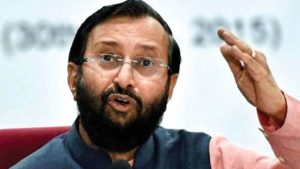
Prakash Javdekar, Environment Minister
The distinctive difference in the nature of environmental decision making under Modi is that there is no effort to invested to explain, forget to apologise, for the widespread destabilisation caused in peoples’ lives and devastation of forests and ecologically sensitive areas due to business first policies adopted. Be it Environment Minister Prakash Javdekar, Transport Minister Nitin Gadkari, Defense Minister Rajnath Singh or anyone else from the Modi Cabinet, none care to justify their actions. Just as Modi does not. They merely state their intent and then lean on rhetoric to explain. Such didactic administrative approaches should not have any place in a parliamentary democracy.
It gets worse. When the entire nation was under lockdown, Environment Minister Prakash Javdekar issued a slew of clearances for mega projects involving massive felling of forests and irreversible destruction of ecologically sensitive areas in the Western Ghats and the Himalayas. He took these decisions on the basis of virtual meetings online which did not allow any of the members of the review committees to review documentation involved. The projects approved included clearing railway and road projects through thick jungles of Western Ghats and Himalayas, initiating steps for the construction of massive hydro projects across Karnataka’s over-dammed Sharavathi river, approving a mega-dam in Arunachal Pradesh which would destroy some of the state’s richest forests, recklessly and advancing road and rail expansion projects adversely impacting tens of villages and forests across India. To make such reckless clearances even easier, Javdekar now proposes to comprehensively amend the EIA Notification, unabashedly to advance corporate and investor interests over the critical need to protect India’s highly threatened forests and natural resources, and associated livelihoods.
When Dr. Harsh Vardhan was Environment Minister of India a couple of years ago, he had redrafted India’s Forest Policy was mooted which clearly sought to dilute, even defeat, the implementation of the historic Forest Rights Act which secures rights of tribals. Besides, it weakened the implementation of the Biodiversity Act and people’s sovereign rights to bioresources. The policy also proposed to privatise forests and promote corporate control over them, methods which would probably have shocked even the East India Company. Thankfully, the Parliament came to India’s rescue. On the basis of representation from Coalition for Environmental Justice in India, the Parliamentary Standing Committee on Environment and Forests reviewed the policy, found it to be against the rights of tribals and other forest dwellers, even found it to be destructive of forests, and sent it back to the Environment Ministry for review. It has not yet reappeared.
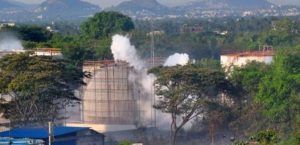
Gas leak at LG Polymers, Vishakhapatnam
With the economy now in a tailspin given Narendra Modi’s hubristic, disastrous and unsuccessful lockdown to contain COVID, and the desperate need to generate revenue streams and jobs, we are already hearing grumblings from industry and corporate lobbies. They have particularly targeted environmental norms and labour laws, and want them to be diluted further. All this in the backdrop of the disaster in LG Polymers at Vizag which killed over a dozen and injured thousands with its toxic release – a disaster that is the direct consequence of weak regulation, the operation of the ‘principle of utmost good faith’ and of Modi’s penchant to take decisions without rationale and without appreciating its potentially disastrous consequences. An approach that emerges out of his constant attempt to project himself as a man who will deliver India from his specious, though popular, claim of ‘seven decades of non-development’. Despite such political posturing by Modi, India’s economic situation is grim now. It is more than likely now that the Modi administration will push for industrial and infrastructure growth at any cost. This will mean accelerated environmental destruction and social disruption, and at an unprecedented scale. Megaprojects will be recklessly pursued on the claim they will redeem India from the post-COVID economic downturn. All this may even be presented by Nirmala Sitharaman as part of the post COVID reboot India ‘package’.
Stopping this inhuman and environmentally disastrous push for industrial and infrastructure growth at any cost, which is only likely to be disastrous overall, is a Constitutional obligation we all have. We must not shirk from that as our quality of life and our livelihoods, and also those of generations to come, depends entirely on we succeed in resisting the environmentally disastrous plans of India’s Bolsonaro – which Modi is.
Leo F. Saldanha is a well known Environmental Activist and has been working relentlessly works advancing environmental and social justice, particularly of vulnerable communities.
Many think that lockdown has brought unspeakable misery to the life of the migrant workers. That is not true. The poor and oppressed were always in a precarious existence on the margins of society. Lockdown has only exposed the festering wound that was long invisible to our eyes.
The plight of two Adivasi women migrant workers from Jharkhand in Bengaluru further exposes the precariousness and vulnerability that migrant workers in general and women workers in particular face. The two women hail from the Dumka district in Jharkhand. They were working in an incense factory called Bharat Chemical Products in Kumbalgudu Police Station limits in the outskirts of Bengaluru. Each woman has a child, one aged 5 and the other 8, who has also been living with them.
A chance encounter with a construction worker, Nicolas, who hails from the same district as the two women, at Kumbalgudu Police Station on May 5th brought their excessive exploitation to light. The women and Nicolas had gone to the same police station on May 5th to register to return home to Jharkhand.
The women know Santhali language and are not able to converse in any other language. On finding someone who could understand their language, they told Nicolas what they had undergone in the last 6-7 months.
Nicholas was horrified to hear their story and reached out to friends in his district and some aspects of the issue then came to light through a Tweet by Alok Sharma of Jharkhand. The matter was then picked up by Stranded Workers Action Network (SWAN) and Migrant Workers Helpline of Karnataka Janashakti.
Victims of Human Trafficking and Bonded labour
According to their account, the women were trafficked from Jharkhand to Bengaluru via Delhi in September- October 2019. They were taken straight to the incense factory from the Bengaluru railway station. They were promised Rs 9,000 and Rs 7,000 respectively as monthly wages. However, from October 2019 till they escaped the factory in March 2020, they were only paid Rs 200 per week and were provided food two times a day. Their salaries have still not been paid.
The factory employed hundreds of workers and the workers were huddled and made to sleep in a cramped room. These two women were made to work 15 hours a day on a regular basis and were forced to work despite being sick on occasions. They were confined in the factory and not allowed to go out even to buy basic essentials like soap and oil. They tried to escape the factory in early January 2020 but through a network of links with various contractors, the factory Supervisor, Sanjeev, using the company owner’s vehicle tracked the two women down at the Bangalore railway station and forced them to return to the factory.
Physical Assualt, Rape, and Threat to life
Upon being brought back to the factory, they were brutally beaten up in the factory by Sanjeev who issued life threats and threats of rape. The Aadhaar card and phone of one of the women were snatched away by Sanjeev. Subsequently, two other men known as Sanjay and Kiran in the factory, under tacit sanctions from Sanjeev, took turns to rape one of the two women. She was raped two times on the premises of the factory. Sanjeev supposedly left the factory site in March and went off to Bihar. The two rape accused have been identified by the complainant and are in judicial custody. According to the two women, the factory owner remained silent about these atrocities. The two women successfully escaped from the factory sometime in mid-March.
Through the lockdown period, in fear of getting caught by the factory contractors again, they were hiding in a bushy forest in Kumbalgodu. The had only 500Rs with them and they were living on one meal a day along with two children for almost four weeks.
They had no choice but to beg and scrounge for food. During this time, Ali Asgar, a contractor offered them food and shelter. They agreed. While food and shelter were provided, he started to make sexual advances to one of them. At this point, they reached out to Nicolas, whom they had met on May 5th. And the matter came to light.
Present Situation
Since then two FIRs have been registered in Kumbalagudu Police Station and Kengeri Police Station. No FIRs have so far been filed against the company owner, Devendran. The police in both stations have been helpful in dealing with this case with urgency. The Department of Social Welfare has acted promptly and has paid compensation to the rape survivor.
This particularly grave case involving multiple crimes such as human trafficking illegal confinement, bonded labour, and rape brings to light the severe lack of women’s safety at the workplace. This is another grim reminder of exploitation by some private companies who remain unaccountable to the government and the people.
On its part, the exploitation is happening under the aegis of the government so this calls into question government accountability as well. Further, the administrative procedures to even file FIRs and seek compensation are inaccessible and opaque to the poor. This makes it near impossible for the poor, without civil society mediation, to have a stake at the justice system.
Migrant workers in cities, especially women, work in extremely exploitative conditions even in normal times. But added to this has been the spate of deaths of migrant workers in road accidents, exhaustion due to walking long distances, dehydration, hunger, and police brutality that continue unabated due to the lockdown. Despite these deplorable incidents the continued silence of the Prime Minister, the Home Minister, and the ruling dispensation concerning the utter indignity towards the migrant workers highlights their apathy towards the poor.
The tragic saga of these two Adivasi women also highlights that women’s safety at the workplace, especially the safety and dignity of women in the unorganised sector, was never spared a thought by the Prime Minister before the announcement of a unilateral lockdown. At a time when some ministers want to dilute labour laws, this case, horrifically so, underscores the need for stronger social security measures, stronger safety measures for all workers and women in particular.
Demands
There has to be a comprehensive investigation of such human trafficking networks that are the source of such exploitation and subversion of constitutional rights.
Ensure that the Labour Department forces the Bharat Chemical Products to pay all the pending dues along with penalties and interest to the two women.
Ensure payment of compensation for both the women for having suffered the trauma due to bonded labour, illegal confinement.
Revoke the license of Bharat Chemical Products and ensure that the owner is given strict punishment as per law.
The government must ensure that they maintain a detailed record of all the migrant workers, proactively register them in welfare boards and ensure adequate social security is extended to them.
Form an action group to focus on women migrant workers and ensure that basic universal social protection measures such as safety, security, nutrition, education, health are proactively provided.
Fascism (noun): “a political system based on a very powerful leader, state control of social and economic life, and extreme pride in country and race, with no expression of political disagreement allowed.”
This defines our India now, the ‘greatest democracy in the world’ (allegedly) that has become a classic fascist regime propped up by a totalitarian society.In January 2020, when the world had started preparing for a major healthcare emergency, India was busy oppressing and demonizing ‘anti-national liberal intellectuals’ struggling for their basic human rights and protesting against CAA+NRC. Many of them are still struggling for survival, many in prisons without trial and denied free speech and rights we probably cannot even count.
FASCISM IS INHUMANE
INDIFFERENCE BEGETS EVIL
IGNORANCE DOESN’T ABSOLVE
SILENCE IS CONSENT
In February, when WHO had already declared Covid-19 a ‘Public Health Emergency of International Concern’ (PHEIC) and had asked countries with weak healthcare systems to start preparing, India was busy with ‘Namaste Trump’ aka Indo-U.S. ‘Fascist Alliance’ event, the agenda and benefits of which still remain evidently nil. We were busy succumbing to the evergreen communal Divide-and-Rule strategy that lead to Delhi pogrom (not riots), the instigators of which are still free without even an FIR filed against them. Courtesy : twitterIn March, when WHO declared it a pandemic and repeatedly warned against the alarming levels of spread and severity, made worse due to negligence and inaction, the government was busy purchasing MLAs in Madhya Pradesh. Towards the end of the month the authorities had finally started to wake up to the fact that this pandemic cannot be ignored and enforced the Janata Curfew. Just when it seemed we might unite to fight this crisis, lo and behold, the Tablighi Jamaat gathering gave us enough fuel to push divisive bigotry, an Islamophobic narrative that is still multiplying at a rate even faster than coronavirus, thanks to the super spreaders- our desi ‘Fourth Reich’ press and social media. Then the ‘5 Baje, 5 Minute’ event made it clear that the administration’s incompetent approach would continue as it not only ignored the socio-economic problems faced by our Emergency Services’ workers but also continued to oppress those speaking out against the lack of PPEs and fair pay. Then came the launch of ‘PM-CARES’ fund, the need and use of which still remains unclear due to lack of auditing andanswerability. In April, when the lockdowns were extended and developed nations of Europe were reeling under as the coronavirus hotspots, we continued with tasks like the ‘9 PM, 9 Minutes’ event. Another narrative of ‘Corona-terrorism’ was attempted with the usual scapegoat Pakistan to distract people from real issues. Meanwhile USA, which is probably the ‘greatest DEVELOPING country in the world’ when it comes to healthcare, emerged as the new hotspot with Donald Trump making the same mistakes Modi did (or is it the other way round?).And now we are into May, which has again started with the ‘Thanksgiving’ event that has left our brave heroes, the doctors, nurses and the emergency services workers, feeling like proud ‘Thanksgiving Turkeys’ as they continue to suffer due to lack of real support from society, governments and administrations. We also continue to ignore the plight of millions of the poor, vulnerable workers who have helped build our country with their sweat and now blood since we have ‘normalized’ their suffering as something unavoidable to save our nation. Meanwhile another ‘greatest country in the world’, Vladimir Putin’s Russia, has become another hotspot since it has followed a similar path like Trump’s America. Similar trends can be observed in other nations such as Bolsonaro’s Brazil and the numbers, if reported correctly, are enough to show it. Modi’s India appears to have been quite lucky despite its failure in Testing/Tracing and the disastrous lockdowns at the expense of its economy. As we keep looking for a non-existent flattening of India’s Covid-19 curve, the only curve that has flattened and looks set to collapse is that of our economy’s GDP. Fascists love lockdowns because they represent power and control, but unplanned, failed lockdowns have catastrophic results. As the cases continue to rise exponentially and we remain in denial of how unprepared we are, what happens when India emerges as the next hotspot?We need to understand that Fascism is directly proportional to destruction in the times of a pandemic and the economic collapse. It escalates inhumanity and injustice. Such countries are failing at saving their economies and protecting their people. Media, which is one of the pillars of any democracy, has either sold out or has been censored. And those who question this are either ignored/oppressed or labelled ‘anti-national’. Our ‘Economic Task Force’ has announced the great, fake 20-L Crore package that has failed to reach millions of vulnerable citizens who need help RIGHT NOW. How can we look up to a Prime Minister who has not held any real press conference since he came to power and has no interest in answering our questions? His addresses to the nation have always proven to be out of touch with reality and on-ground situations and have merely been reduced to PR campaigns. During this mass-migration of Indian workers left with no food, no jobs and no hope, why hasn’t he even addressed them directly and advised them to stay where they are while assuring all possible help (even if it would not come)? We have been forced to depend on one man for the answers, the man who refuses to take any real question, even when millions of lives depend on it. Does the PM have no accountability, at least to the thousands of these workers who voted for him and have been left without help on roads and rail tracks right now? The lockdown has FAILED and we have wasted the last 5 critical months instead of fighting the pandemic and building our healthcare system, which should have been the primary goal of the lockdown. Let us at least start asking questions and demand for practical, constructive answers.Just because we are better off (for now) than the migrant workers dying on the streets and railway tracks they built, we are going to turn a blind eye (as always) towards this crisis? Do we understand the hypocrisy in cheering this government’s ‘twitter trend policies’ that have not reached those who do not even own smartphones and are starving without the support they deserve?Let us be proud of the NGOs and people selflessly working day and night to help them. But let us not forget that it is the government’s responsibility and NGOs can never match the demand and scale of the support-system that is the need of the hour. This is a humanitarian crisis and the whole world is watching. And if there is any humanity left in the world leaders, there will be consequences if the government does not address this situation in time, because this crisis is too big to go unnoticed.There is so much to think about, ask and discuss, most of which would probably not be allowed because, in the words of hon’ble Home Minister Amit Shah ji, ‘Western Standards of Human Rights’ unfortunately do not apply in India anymore.We are all responsible for what has happened and we would all be guilty for what is coming. Maybe it is not too late.The author is an IT professional based in Hyderabad.




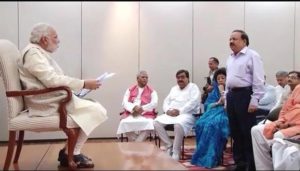 One leaked picture of a Union Cabinet meeting is particularly telling about Modi’s manner of conducting the office of the Prime Minister. In this picture from his first term, Modi is seen sitting on an elevated platform with all his Cabinet colleagues on a lower level. Each one of the Union Cabinet Ministers was required to stand up and address the Prime Minister when their turn came, just as a student behaves in a stern teacher’s class. Expectedly, this manner of treating his Union Cabinet colleagues drew sharp and widespread criticism, and an embarrassed Modi administration never repeated this Rashtriya Swayamsevak Sangh (RSS) Shakha manner of meeting.
The style of communication of a political leader defines, in many ways, how she or he thinks and decides. In curating Modi’s public appearances, there has been a conscious effort to present him as a man with clear thinking and strong leadership. This is more than evident in his recent multiple appearances on TV about the COVID pandemic, when he asked people to behave in this manner and that. But when evidence of the catastrophic consequences of his decisions became apparent nation-wide, most strongly indicated by migrants walking hundreds of kilometers home in the desperate hope of some safety and security, and most importantly peace of mind not once did Modi speak in any of his speeches to their distressing condition which he had caused with his unplanned lockdown. Compassionate leadership appears to be anathema for Modi’s persona.
If this is how Modi speaks to millions who voted him to power for a second term, one can only imagine what his attitude is to those who cannot vote, but are impacted by his decisions – India’s biodiversity and environment. When we evaluate Modi’s performance on matters environmental in the first year of his second term, the answer is simple: he has become more disastrous to India’s environment and human rights than any PM before, including himself during his first term as PM.


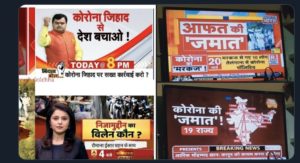

 Just because we are better off (for now) than the migrant workers dying on the streets and railway tracks they built, we are going to turn a blind eye (as always) towards this crisis? Do we understand the hypocrisy in cheering this government’s ‘twitter trend policies’ that have not reached those who do not even own smartphones and are starving without the support they deserve?
