Rural peoples are under attack by an onslaught of ‘new wave’ policies and mechanisms of land and resource grabbing, colonial plunder, and human rights violations.
The last decade has been marked by a continuous rise in foreign and domestic large-scale land acquisitions led by the world’s biggest TNCs and imperialist governments. In fact, a 2020 report highlights that only 1% of landowners operate 70% of the world’s farmland. This stark reality also emphasizes the growing army of landless peasants in the Global South.
In the hands of both corporations and domestic landlords, the ballooning land concentration has facilitated deforestation, rural poverty, and the degradation of rural food security and national food sovereignty.
Worse, these also come with increased militarization and relentless attacks against land and environmental defenders, taking the lives of at least 212 people in 2020 alone. Rising fascism in the Global South complements these neoliberal policies of plunder to thwart the growing demand for radical transformation for just, equitable, healthy, and sustainable food systems and societies.
‘New wave’ of landgrabs
The corporate-led United Nations’ Food Systems Summit has legitimized and popularized the most notorious schemes of land and resource grabbing in the last decade: the financialization of ‘farmlands’ and ‘natural capital’, biofuel frenzy, conservation-as-carbon-offsets, and digitalization of ‘assets’, including land.
The UNFSS also birthed(US-UAE led AIM 4 Climate) and entrenched (BMGF funded MSIs like SUN, Global Alliance for Improved Nutrition (GAIN) and Initiative for Smallholder Financing; Nestle-led Food and Land Use Coalition) TNC-led multi-stakeholder initiatives to support these land and resource grabbing schemes.
Some of the major offshoots of these discussions are the various ‘nature-positive solutions’, which the UNFSS proponents also advocated for at the 26th Conference of Parties last December. Taking off from the World Economic Forum’s carbon offset initiatives, nature-positive solutions are poised to greenwash polluting companies with ‘green’ initiatives like the Trillion Tree project, conservation projects, and carbon sequestration programs targeted mostly at the lands of the Global South.
These green land and resource grabs are now legitimized as part of the arsenal to combat climate change — a facade for TNCs to evade carbon reduction and continue colonial plunder in the Global South. Despite the failure of similar schemes in the past, including REDD+ programs, they are rehashing these ‘nature-based solutions’ to evade accountability, continue colonial plunder, and increase profits.
Not in our name, not in our lands
The Global People’s Summit, led by the People’s Coalition on Food Sovereignty, PAN Asia Pacific, and other Global South NGOs and peoples’ organizations, has made a mark last year in demanding that these greenwashing schemes be done ‘not in our name’. This year, we’re building on the strength of the landless people’s movements and rural people to demand: NOT IN OUR LANDS.
Amid the rising prices of food—pushed by imperialist trade regimes, neoliberal policies, and rising biofuel prices—we are standing our ground to advocate for a radical transformation in land ownership and tenure.
A genuinely redistributive land reform program in the Global South is crucial in achieving food security and people’s food sovereignty. Furthermore, it should be complemented with the increased struggle against foreign and TNC land and resource grabs.
Human rights violations, including killings of peasant leaders, harassment, community evictions, related to the struggle for land, must be exposed and perpetrators held accountable.
Day of the Landless
Led by the Asian Peasant Coalition (APC) since 2015, the Day of the Landless is commemorated every March 29 to gather landless rural peoples’ movements and land advocates to highlight the struggles for land in the Global South.
Since then, the Day of the Landless has been instrumental in broadening and deepening the understanding of landlessness and land monopoly in the Global South. It also widened the support for landless farmers’ movements for rights, land, and food sovereignty.
This year, the APC, PCFS, PANAP, International League of Peoples’ Struggle (ILPS) Commission 6, and the Rural Constituency of the CSO Partnership for Development Effectiveness (CPDE) will hold both virtual and on-ground discussions and actions with allies to:
To expose ‘new normal’ and greenwashed land and resource grabs, which are prompted and supported by the corporate-led UN Food Systems Summit in 2021
To highlight the growing policy-driven land inequality, landlessness, and land and resource grabbing the Global South
To gather support for land and environment defenders under attack
This year’s Day of the Landless commemoration also serves as a build-up to the Stop Killing Farmers campaign, a 2019 resolution of the ILPS Commission 6, underscored every October.
Join Peasants Rise Up vs Land Grabs and Fascist Attacks (webinar on peasants’ political repression)
PANAP, PCFS, APC, ILPS Commission 6, and the Coalition of Agricultural Workers International (CAWI) are holding a webinar on the continued and worsening political repression of peasants asserting their right to land.
Register to join: https://bit.ly/DOTL2022
Our calls:
Resist land and resource grabbing!
Reject neoliberal land reforms!
End neoliberal food systems now!
Land rights are human rights!
Genuine agrarian reform now!
Land to the tillers, food for all!
Defend land rights defenders!
Stop killing farmers!
Fight for just, equitable, healthy, and sustainable food systems!
Uphold people’s food sovereignty!
Even after a week has passed, Uttar Pradesh (UP) assembly election results are being publicly discussed. Barring mainstream media channels that predicted a clear majority for Bhartiya Janta Party (BJP+ got 273 seats), socio-political circles in Lucknow and Delhi are still trying to figure out the electoral defeat of Samajwadi Party alliance (SP+ got 125 seats) and decimation of Bahujan Samaj Party (BSP) to a single seat that used to dictate the subaltern landscape of largest and politically most significant state in India. A large section of independent media and social media outlets that were predicting an anti-BJP wave across the state is now hiding in closet. Wishful thinkers, academicians, and scribes have resorted to blaming the voters for voting against the opposition alliance.
A couple of post-poll studies (like CSDS-Lokniti and Arvind Kumar) tried to explain how people voted for BJP but none of them could break the jinx of caste divisions. Traditionally, sociological and ethnographical studies weigh upon caste more than class. Going by the CSDS-Lokniti data, we could see that BJP has not only increased its Hindu voters but also gained 8 percent of Muslim voters in this election. Among Hindu voters, it has not only retained its upper caste support but fairly dented the OBC and SC electorate.
CSDS lokniti survey of how caste and communities voted in 2022
But it is not ‘how people voted’ that is haunting the informed citizenry. The question that has remained unanswered is ‘why people have voted for BJP’. This question is central to the discourse.
The fundamental question
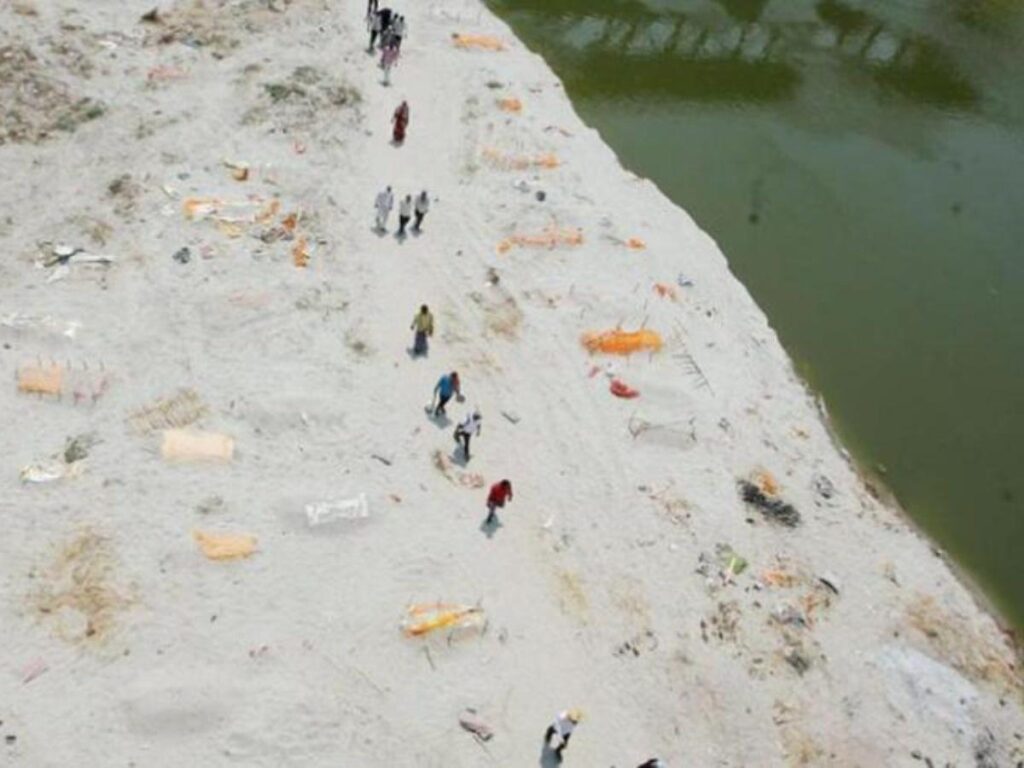
To put this in perspective, one must recall the horrors of consecutive lockdowns that witnessed a large-scale reverse migration of workers in 2020 and a huge number of deaths in 2021. The first lockdown saw 19448 FIR’s in the first month of its impositionwhere 60,258 people were booked under Section 188 of IPC and Epidemic Act. The second lockdown in 2021 saw roughly 23000 deaths in UP according to official figures. But upon analyzing the mortality data obtained under the Right to Information act, the deaths in UP districts with the highest official caseload were between 10 to 335 times higher than the government’s data on COVID deaths from July 2020- 31 March 2021.
corpses buried near banks of river Ganga during the second wave of COVID pandemic in 2021
The number of registered educated unemployed in UP stood at 21.39 lakh as of June 30, 2018. By February 7, 2020, this data reaches to 33.93 lakh registered unemployed people. This amounts to a 58.43 percent growth in the number of unemployed people in the state in the last two years. The CMIE data further states that the unemployment rate in the state increased to 21.5 per cent in April 2020, during the first lockdown due to the COVID-19 pandemic. One can imagine what two years of consecutive pandemics and resulting lockdown wreaked havoc on peoples lives and livelihoods.
Pandemic-related woes and mismanagement on one hand, the impunity with which the incumbent government under Yogi Adityanath carried out targeted encounter killings forced NHRC and Supreme Court to take cognizance at one point. Then, bulldozing the properties of the mafia in a targeted manner was another aspect of this lawlessness. This impunity extended to demanding compensation and seizures from anti-CAA protesters across the state. This lawlessness reflects in the killing of 12 scribes during five-year tenure and around 150 cases of physical attacks on journalists, not to mention the illegal detention and arrests that stretched up to false bookings under dreadful UAPA and NSA. The complete scenario of civil liberties under the Yogi regime turned into a nightmare for anyone who dared to speak.
In a nutshell, the whole spectrum of constitutional values i.e. freedom, equality, fraternity, and justice seemed to turn upside down during five-years of the BJP regime in Uttar Pradesh. This resulted in several protests and ground-level agitations from various sections of contract employees, government workers, teachers, medical personnel, and even home guards. The situation was ripe for a regime change. Wishful thinkers were not incorrect in predicting an anti-BJP wave. The bipolar character of elections that I had predicted in an earlier article was not a myth.But the final result was counter-intuitive!
This counter-intuitiveness embedded in the final figures released on March 10th is a matter of great speculation and curiosity across the state. A pertinent question must be asked at this stage: Why disadvantaged voters cast their votes in favor of a party that represents the policy interests of the wealthy? This question may lead us into the changing patterns of class as well as caste hierarchies in Uttar Pradesh during the last two decades of liberalism and privatization where the state has ultimately become the custodian of elite (caste and class elites) power.
The ‘beneficiary’ factor
Much has been talked of the so-called ‘beneficiary’ factor in the context of UP elections. This is nothing new, seems easy to grasp but many complexities are involved in resorting to using it as a tool to understand BJP’s fortunes. Since the concept of a welfare state was decisively thrown away by late nineties, all political parties in India have been regularly trying to woo voters by distributive politics in two ways: (a) Private provision of local public goods; (b) Manipulation of public resources in a program-oriented manner.
Tarique Thachil of Yale University says that privately financed electoral strategies, outside of some forms of direct vote-buying, have received comparatively scant scholarly attention from scholars of the global south. Most studies of distributive politics have instead focused on how parties can manipulate public resources to their political advantage. Yet, for actors who are largely in opposition, including elite parties, strategies that require public resources are not a viable initial option.
In his painstakingly written book “Elite Parties, Poor Voters: How Social Services win votes in India”, Thachil says that the BJP’s experience shows that making services locally public enables individual providers to establish contact with a relatively large number of poor voters. Meanwhile, the monetary expenses of welfare can be kept relatively low by providing only the most rudimentary of services. Provisions like free ration, money, gas cylinders, etc. that have been much publicized during election campaigns of BJP were joint product of two factors:
Thachil writes:
“…its demand (as an elite party) for a non-threatening strategy of poor voter recruitment and its supply (as a party founded by a social movement) of thick organizational resources. My theoretical argument anticipates private welfare to prove similarly attractive to all political actors with elite core constituencies. However, only those elite formations that are also endowed with thick organizational resources will prove capable of implementing this painstaking approach. The most substantively important examples of such parties across Asia and Africa are those that are tied to religious social movements”.
BJP is one such party that fulfills all these pre-conditions. This strategy is not exactly an exchange of goods for support but a multidimensional social process that has unfolded across several stages in Indian polity. He writes:
“Activists in India (read RSS) have converted this everyday contact into electoral returns by patiently earning voter goodwill, rather than by enforcing quid pro quo clientelist protocols. Service providers converted this goodwill into electoral returns among beneficiaries and some non-beneficiaries through the networks of friends and associates they developed and through their own powers of rumor and suggestion as apolitical residents of high local standing”.
In this context, the role of RSS in BJP’s electoral success is one point that has been completely missed by analysts this time.
Mayawati, BSP Supremo’s party was reduced to one seat in UP Assembly elections 2022
The other point that has been overlooked is the decaying presence of the Bahujan Samaj Party in rural UP that once proved influential in politicizing lower caste identities but did not also compel an equivalent broadening of social provisioning. Thachil writes based on his field experiences in UP and Chhattisgarh: “Thus, Uttar Pradesh constitutes a blend of a sharply politicized subaltern community (akin to Kerala’s) and inadequate basic service provisioning (similar to Chhattisgarh’s)”. This subaltern community was mobilized by BSP in a top-to-bottom manner that helped resist RSS’s overtures in the rural landscape until the late nineties. As BSP lost hold of its cadres and subaltern classes, RSS with its provisioning services made inroads. This process has come almost full circle in this election with BSP losing 22 percent Jatav and 17 percent of other SC votes.
To conclude with Thachil’s comments:
“In addition to balancing the material concerns of rich and poor, service proved remarkably rhetorically malleable. This flexibility enabled Hindu nationalists to simultaneously sell the strategy to three sets of actors: skeptical lower caste communities, fretful upper-caste supporters, and an ideologically committed activist core”.
These three sets of actors can easily be identified on the basis of caste distribution in the CSDS chart if CSDS data is to be believed.
Other considerations
There are other considerations too, like EVM tampering, voter list manipulation, etc. that have been used to explain BJP’s victory in UP. For the sake of anti-EVM activists, simplistically, even if 70 seats could be attributed to tampering or fraud , it still requires valid arguments to explain the simple and clear majority. These factors alone cannot explain the counter-intuitiveness of results.
To sum up, the Hindutva card of BJP mixed with private provisioning of social benefits through RSS and its private affiliates is the single most convincing factor that justifies the 2022 verdict. This has happened because the only cadre-based party BSP gradually lost socio-political ground in rural areas where it previously used to act as a bulwark against RSS. Other parties like SP and Congress did not have sufficiently thick organizational built and vision to counter the mixed strategy of BJP. Neither they had any political vision or program apart from mimicking BJP in announcing freebies which never works when you are in opposition.
Opposition parties need to re-think their strategies and programs if they seriously want to ouster BJP from power.
The author is senior journalist and editor of junputh.com
Farmers will observe MSP guarantee week from April 11 to 17
Samyukta Kisan Morcha has announced the next phase of its nationwide campaign. Yesterday, in a meeting of all the organizations associated with the SKM at Gandhi Peace Foundation in Delhi, it was unanimously decided that between 11th to 17th April next month, a nationwide campaign would be launched by observing MSP Legal Guarantee Week. During this week, all the constituent organizations associated with the Samyukta Kisan Morcha will organize dharnas, demonstrations, seminars, demanding legal guarantee of Minimum Support Price (C2+50%) as recommended by the Swaminathan Commission, to all farmers on all their agricultural produce.
Farmers will protest against protecting the criminals and implicating innocent farmers in Lakhimpur Kheri
In the meeting, after reviewing the legal process going on in the Lakhimpur Kheri case, concerns were expressed that the police administration and the prosecutors together are trying to protect the criminals and implicate the innocent farmers. It is a matter of surprise that in such a serious case, the son of the Union Minister got bail so soon while the farmers implicated in the same case are still in jail. Samyukta Kisan Morcha expresses serious concern at the news that a key witness in the case has been attacked after Monu Mishra’s release. The Morcha decided that there would be no relaxation in the legal battle in this matter, and full legal help would be given by the Morcha to the families of the farmers.
Government has not implemented the assurances given to the farmers movement even after three months
The Morcha reviewed the written assurances given by the Government of India to the Samyukta Kisan Morcha on 9th December and found that even after three months, the government had not acted upon its key assurances. There is no trace of the assurance of forming a committee on MSP.
Except Haryana, the police cases registered against the farmers during the agitation in other states have not been withdrawn. Delhi Police has spoken of partial withdrawal of some cases but there is no concrete information about that as well. Nothing has happened about the cases registered during Rail Rokos across the country.
Samyukta Kisan Morcha has decided to organize a nationwide protest on March 21, regarding the role of the government in the Lakhimpur Kheri incident, and the betrayal of the assurances given to the farmers’ movement.
The Morcha reiterated that the Samyukta Kisan Morcha supports the call for Bharat Bandh by trade unions on March 28th and 29th, and that farmers across the country will actively participate in it.
Representatives of farmers’ organizations from Punjab, Haryana, Delhi, Rajasthan, Uttar Pradesh, Uttarakhand, Bihar, Jharkhand, Assam, Tripura, Odisha, Telangana, Andhra Pradesh, Karnataka, Tamil Nadu, Kerala, Maharashtra, Gujarat, Madhya Pradesh and Chhattisgarh participated in this national meeting convened by the coordination committee of Samyukta Kisan Morcha.
Issued by-
Dr. Darshan Pal, Hannan Mollah, Jagjit Singh Dallewal, Joginder Singh Ugrahan, Shivkumar Sharma (Kakkaji), Yudhveer Singh, Yogendra Yadav.
A full bench of the Karnataka High Court Tuesday dismissed a batch of petitions filed by Muslims girls from pre university (PU) colleges in the Udupi region of the state seeking the right to wear hijabs or head scarves along with uniforms inside classrooms.
“We are of the considered opinion that wearing of the hijab by Muslim women does not make up an essential religious practice in Islamic faith,” the full bench said in the gist of its order that was read out by the Karnataka chief justice Ritu Raj Awasthi Tuesday morning.
The Karnataka High Court on Tuesday upheld the government order (GO) effectively banning the wearing of hijab (headscarves) by Muslim girl students in educational institutions in the State (Smt Resham v. State of Karnataka).
The High Court in its order also upheld a February 5 government order which suggested that the wearing of hijabs can be restricted in colleges where uniforms are prescribed.
It added, “The second question is whether the prescription of school uniform is not legally permissible as being violative of the petitioners fundamental rights guaranteed under article 19 1 a of the constitution that is freedom of expression and article 21 that is privacy. The third question is whether the government order dated February 5, 2022 apart from being incompetent is issued without application of mind and further whether it is arbitrary and therefore violates article 14 and 15 of the Constitution.”
“The last question is whether any case is made out in a petition for ordering an inquiry against respondents 6 to 14 and for issuance of a writ of quo warranto against the respondents 15 and 16,” the High Court said.
While stating that “wearing of the hijab by Muslim women does not make up an essential religious practice in Islamic faith”, that “prescription of a school uniform is a reasonable restriction constitutionally permissible which the students cannot object to”, that “the government has the power to issue the impugned government order dated February 5, 2022 and no case is made out for its invalidation”, the court also rejected the plea for action against college authorities for restricting students from entering their colleges wearing hijabs.
“The answer to the fourth question is no case is made out in writ petition 2146/2022 for issuance of a direction for initiating disciplinary action against respondents six to 14 and for issuance of writ or quo warranto against respondents 15 and 16. They are rejected as being not maintainable,” the bench said.
“Accordingly in the above circumstances all these writ petitions being devoid of merit are dismissed,” the court concluded.
Karnataka CM Basavaraj Bommai also commented on the HC verdict- “Everyone should follow court order for benefit of children. It is a question of fate & education of our children. Necessary arrangements have been made to maintain law and order”
On Sunday, in the presidential primaries in Colombia, the Historical Pact, a coalition that brings together the bulk of the Colombian left, won 17 seats in the Senate and 25 seats in the House of Representatives.
In these elections, the big loser was the Democratic Center, a right-wing party led by former President Alvaro Uribe that had been the main political force in the country until now.
With just over 99 per cent of votes counted in the leftwing primary, Gustavo Petro had taken over 80 per cent of the vote in a contest between five candidates. He will now go on to the first round of the presidential election on May 29 and most opinion polls suggest he is favourite to win.
“This is the best result for progressives in the history of Colombia,” Petro told supporters on Sunday night. “We’re on the verge of winning the presidency of Colombia in the first round.” If he wins the presidency, Petro, a senator, former congressman and ex-mayor of Bogotá, would take Colombia sharply leftwards after four years of rightwing rule under President Iván Duque.
However, the Colombian right, although fragmented into six parties, will continue to be a majority in Congress, which will force the Historical Pact to seek alliances with the Green Alliance Coalition and the Hope Center, both of which have 14 seats in the Senate.
In the upper house, the rest of the positions were reached by the Conservative Party (15), the Liberal Party (15), the Democratic Center (14), Radical Change (11), the U Party (10) and the Coalition Mira-Colombia Free Fair (4).
In the right-wing forces, the Democratic Center candidate Miguel Uribe Turbay, former Secretary of the Government of Bogota, was the most voted politician of all the candidates for the Senate. His party will be the predominant force with 19 senators.
In the Lower House, the Democratic Center lost 17 seats, going from 32 representatives to 15 in these elections. Another big loser on the right was “Radical Change”, a party which barely got 11 seats in the Senate and 16 in the Lower House.
Petro has pledged to wind down Colombia’s oil industry by halting all exploration, and said the country should focus on manufacturing and agriculture instead. Economists say the policy would have a huge impact. Fossil fuels generate about half of Colombia’s export revenue.
The 61-year-old has also pledged wholesale land reform, a wealth tax on the largest 4,000 fortunes in the country and the repeal of laws from two decades ago that liberalised the labour market.
A Delhi court on Monday, 14 March, granted bail to former Congress councillor Ishrat Jahan, in connection with the Delhi Riots Larger Conspiracy Case, registered under FIR 59 of 2020.
Additional Sessions Judge Amitabh Rawat had reserved orders in Jahan’s bail plea in February this year.
She was arrested on 26 February 2020.
The charges registered against Jahan include Sections 13, 16, 17, 18 of the stringent Unlawful Activities Prevention Act (UAPA), Sections 25 and 27 of the Arms Act, and Sections 3 and 4 of the Prevention of Damage to Public Property Act, 1984 among other offences under the Indian Penal Code (IPC).
Appearing for Jahan, Advocate Pradeep Teotia had claimed that she had been falsely implicated in the matter, and that there is “no single iota of evidence regarding her involvement in the conspiracy”.
Eighteen people have been named accused in this case, but prior to Jahan, only five others had received bail. Jahan is also the first accused in this case (registered under FIR 59) to have been granted bail by a sessions court. The other five had to go all the way up to the Delhi High Court before they were granted any relief.
Meanwhile, orders in the bail pleas moved by co-accused Umar Khalid has been deferred to 21 March, and by Saleem Malik and Sharjeel Imam to 22 March.
Earlier Jahan was granted interim bail in June 2020 for 10 days to get married and was directed not to tamper with the evidence or influence the witnesses.
The violence had erupted during the protests against the Citizenship (Amendment) Act (CAA), 2019, and the National Register of Citizens (NRC).
Jahan, along with co-accused Gulfisha Fatima and Khalid Saifi, have allegedly suffered custodial violence, according to World Organisation Against Torture (OMCT).
Besides Jahan, activist Khalid Saifi, Umar Khalid, JNU students Natasha Narwal and Devangana Kalita, Jamia Coordination Committee members Safoora Zargar, former AAP councillor Tahir Hussain and several others have also been booked under the stringent law in the case.
It was a stormy night in the last week of January five years back. The huge bungalow that housed Aam Aadmi Party election office in Chandigarh was shattered and torn due to heavy rains and wind. War room tabernacle made of white canvas was fully blown out of its place. Around half-a-dozen workers were running helter-skelter busy on their mobile phones. All indications pointed to a hung legislative assembly in Punjab. Enjoying hot coffee on the terrace, the war room head Bipin Rai, an old friend who was recently appointed a Consultant with the Delhi Urban Shelter Improvement Board (DUSIB), told us, “Look! There is no chance of any alliance with Congress. It would be suicidal for us. Let the assembly go hung and remain under President’s rule for six months. We will sweep in the next elections!”
His confidence was not unfounded. On January 27th, 2017 Arvind Kejriwal took to Patiala streets in an open jeep to campaign for his candidate Balbeer Singh. He was accompanied by Bhagwat Mann, now the CM face but not until then. Streets were buzzing with AAP supporters. An old women cried in euphoria, “Kranti aa gayi” (The revolution is here)! I was witness to the frenzy that accompanied Kejriwal’s campaign in Punjab in the last elections but was not very sure that he was going to form the government since Congress was the first choice in face of an incumbent Akali government. With these doubts, I sent a futuristic dispatch to a Capital’s daily that this Punjab election is a new chapter unfolding in the “Congressmukt Bharat” campaign of BJP.
प्रभात खबर, 29 जनवरी 2017 की क्लिपिंग। पंजाब के दौरे से चुनावी डिस्पैच। पंजाब का 'काँग्रेसमुक्त' ऑपरेशन तब शुरू हुआ था। कल पूरा हुआ। मैंने ऑपरेशन थिएटर में घुस कर देख लिया था और लिख दिया, पर उस समय लोगों ने नहीं माना क्योंकि कैप्टन जहाज को बचा ले गए थे। अबकी डुबा दिए। pic.twitter.com/z0EEMd8Aet
It may be said that the royalty of Patiala, Captain Amarinder Singh, who was running the last lap of his political career also heard the footsteps of “This Revolution”. As expected, the verdict came clearly in favour of Congress and not hung, thanks to the highly aspirational Captain who risked his riches for every possible seat that could be won by Congress by hook or by crook. The old woman’s Kranti had to wait for a another five years.
AAP and Punjabiyat
Now in 2022 Punjab Assembly elections, AAP’s broom has swept the political ground. What was supposed to have happened five years back is now a reality. Amarinder Singh immediately tweeted on the verdict.
I accept the verdict of the people with all humility. Democracy has triumphed. Punjabis have shown true spirit of Punjabiyat by rising and voting above sectarian and caste lines. Congratulations to @AAPPunjab and @BhagwantMann.
Interesting to notice that a party that was termed as an outsider just five years back is now being welcomed as the harbinger of Punjabiyat by none other than Captain. Is this the general public perception?
Vijay Shankar, a Sikh bullion trader in Varanasi who has close links with the trading community in Punjab says, “The only major difference from 2017 is that they have declared Bhagwant Mann as prospective Chief Minister. Punjabis will never accept any non-turban person even if it is Kejriwal. This verdict is in favour of Mann, not Kejriwal”.
This is an insightful comment that has various political implications. ”Non-turban” essentially refers to Jatt Sikh identity in Punjab. Is that the reason why INC’s Dalit card did not work? Congress was hopeful that making Charanjeet Channi the Chief Minister in slog overs would prove productive. The verdict shows that a major chunk of Dalits voted AAP in the Malwa region. Channi himself lost his seat. To put things in perspective, we must look at a brief FB post by Bangalore resident writer Amandeep Sandhu, whose book “Punjab: Journeys through Fault Lines” is one of the most authentic works in recent times on Punjabi identity:
The man in the picture here is Sunil Jakhar, seniormost INC leader in Punjab. Sandhu regrets that Jakhar was not trusted in the role of CM after Captain Amarinder was ousted. This may be partly true going by the overlapping definitions of Punjabiyat, turbaned and Jatt Sikh which is essentially anti-Dalit too. This led to Channi’s loss .
Some Immediate questions
The overwhelming majority that Jatt Sikhs have provided to AAP may prove to be contradictory baggage in the coming times. There have been myriad pending issues between Delhi and Punjab, including stubble burning and riparian water distribution. Since Delhi and Punjab will be having the same party government it is still unclear how they will stick to their interests and resolve the issues amicably. We have not heard a single word from Kejriwal on these striking issues.
Sandhu raises a more fundamental question:
“…where is the money to fulfil these promises? In 2017, when Congress won Panjab quite decisively – AAP win this time is bigger – just after the oath-taking Panjab finance minister said: the treasury is empty. Lest AAP say that this time …”
Question of finances and policy-related decisions are a matter of long term but the ideological part is much more disturbing if we go by the opinion of popular poet Monika Kumar who also teaches at Punjab University. She apprehends that AAP may play on patriotic sentiments that are at the heart of the Punjabi electorate owing to a large number of people serving in forces.
Talking to Kumar on a panel on March 10th, the incident in context was the alleged security breachof Prime Minister Narendra Modi in Punjab after which Kejriwal had slammed Channi led Punjab government and promised Narendra Modi of providing full-proof security if AAP forms government. Monika Kumar was of the view that there is not much difference between BJP and AAP when it comes to national security. She says, “there is a thin line between patriotism and nationalism… I am afraid that AAP may harness this sentiment to hide its ideological leanings and policy-related issues.”
A more striking factor in hindsight that helped AAP to rise to a majority is the alleged Khalistani affiliation which was made by its ex-leader Kumar Vishwas in mid-February. This allegation has helped AAP. Many informed people in Punjab think that this allegation was a designed plot to harness the secessionist perception in a section of Punjabi voters. In the last assembly elections too, Kejriwal was alleged to have stayed overnight in Moga with an ex-Khalistani. That ploy did not work then but it was much publicised in local and national newspapers.
Non-ideological politics
AAP and Kejriwal have been consistently branded as post-ideological and non-ideological as far as their political philosophy matters. In Delhi too, their stand during February 2020 riots and Article 370 abrogation was contested by its left-liberal supporters. The Delhi Model that he has promised to Punjab rests solely on freebies and governance issues. Punjab on the other hand is a highly political electorate that has stood four seasons on Delhi borders against new farm laws. Harjot Banti, a young scholar and translator ask a pertinent question, “I am not sure as to why this highly conscious electorate has given a majority to an apolitical sort of party”. He says sweepingly that Punjabis have a tendency to buy something new.
Anil Chaudhary, an old-time political commentator and Chief Educator of PEACE in Delhi, has a different view. He says that the farmer’s movement has strengthened dejection among Punjabi voters towards traditional leaders and parties. This dejection has resulted in the acceptance of an alternative. The so-called alternative is AAP. He contends that this is not a question of real ‘alternative’ for the people as academics view it. AAP has the same neo-liberal economic template as BJP and Congress have, just differing in its correctional course concerning governance. He says, “people do not go into academic details. Alternative for them means anything but traditional. AAP represents that.”
In the past couple of days, there have been talks of Narendra Modi’s speech just after the verdict where he had indirectly commented on AAP by warning of separatism in a border state like Punjab. Going by the Kumar Vishwas episode, this warning may work either way for AAP. It is not sure whether BJP has contended with AAP’s full majority but one thing is sure AAP is a part of its larger gameplan of Congressmukt Bharat. This has been a trend of late that BJP has worked in tandem with AAP to replace Congress. We have been witness to the active support by Rashtriya Swayamsevak Sangh (RSS) to the anti-corruption movement (IAC/Anna Movement) and there is evidence to prove that the opposition between both is just a game of optics.
A senior RSS functionary comments on the Punjab verdict, “We had never imagined this sort of victory for AAP neither wanted to. Anyways it is just a question of a few months stretching up to a year that AAP will succumb to peoples’ aspirations. Punjab is not Delhi. Bhagwant Mann’s government is going to be sabotaged, hopefully not by BJP but internally. Kejriwal’s long term plan is to personally hold the reigns of Punjab. This would soon get reflected.”
Farmer union leader Rakesh Tikait on Friday welcomed the results of the 2022 Assembly elections in five states, saying that the decision of the people is paramount.
“In the great festival of democracy, the decision of the people is paramount. The farmers’ movement showed its effect. We hope that all the governments that have been formed will work for to uplift farmers and labourers in their respective states. Congratulations to all on the victory,” Tikait tweeted.
लोकतंत्र के महापर्व में जनता का फैसला सर्वोपरि होता हैं। किसान आंदोलन ने अपना असर दिखा दिया। हम आशा करते हैं कि जो भी सरकारें बनी हैं, वे सभी अपने-अपने राज्यों में किसानों-मजदूरों के उत्थान के लिए कार्य करेंगी। सभी को जीत की बधाई। @ANI@PTI @AMARUJALA@ndtv@DainikBhaskarpic.twitter.com/USP3mGaIHA
Tikait’s Bharatiya Kisan Union is a part of the Samyukt Kisan Morcha that spearheaded the year-long farm protests along the borders of Delhi and western Uttar Pradesh. The farmer leader had been vocal against the Bharatiya Janata Party, which he had supported in the 2017 Assembly elections and the 2019 Lok Sabha polls.
The Bharatiya Janata Party managed to slide over the anti-incumbency in four of states that went to polls, especially the most crucial Uttar Pradesh.
According to the wire, the farmers’ movement did manage to reverse some of these trends. The BJP saw a near total washout in the recently-concluded assembly elections in the two districts that were most affected by the sectarian violence of 2013.
In Western Uttar Pradesh, the farmers’ movement was primarily concentrated and found the bulk of its support in four Jat-dominated districts in the sugarcane belt – Muzaffarnagar, Shamli, Baghpat and, to a lesser extent, Meerut.
Together, these districts account for 19 seats. Of these 19, the BJP won only six and of these six seats, three (Meerut South, Meerut Cantonment and Muzaffarnagar) are largely urban seats, where the impact of the farmers’ movement was minimal.
In Muzaffarnagar, it lost five out of six seats, winning only the urban seat. In Shamli, the BJP saw a complete washout, where it lost all three seats. In Meerut, too, it won only three of seven seats.
It won all eight seats in Lakhimpur Kheri, which witnessed violence with union minister Ajay Mishra Teni’s son Ashish Mishra allegedly mowing down four farmers and a journalist.
The eight seats in Lakhimpur Kheri are Palia, Nighasan, Gola Gokarnath, Sri Nagar, Dhaurahra, Lakhimpur, Kasta, and Mohammadi.
The clean sweep of these seats has raised eyebrows, given the strength of anti-BJP emotions in the aftermath of the farmers being mowed down.
The farmers were part of a larger group protesting the central government’s controversial farm laws (which have since been scrapped) when they were hit from behind by a car allegedly driven by Ashish Mishra.
The incident was flagged by opposition parties to underline their criticism of the BJP as ‘anti-poor’ and ‘anti-farmer’, but it appears the critiques did not stick.
The Samajwadi Party had hoped to ride the anti-BJP wave generated by farmers’ protests and anger over rising prices and unemployment, but could not do so.
Kerala finance minister KN Balagopal on Friday earmarked ₹10 crore for students brought back from war-torn Ukraine in the state budget. The money is meant to facilitate students’ future academic plans. Balagopal tabled the 2022/23 budget in the Assembly on Friday.
He said over 3,000 residents of the southern state, including students, who had been trapped in Ukraine as a result of Russia’s invasion, had been brought back safely.
He also said the state government would provide necessary assistance to recover lost and other valuable documents of students to avoid any hindrance to their education.
Rs 10 Cr earmarked in State Budget to help students who have returned to the state in wake of #RussiaUkraineCrisis, to continue their studies. 3123 people have returned safely through various flights, incl 15 chartered flights amid the crisis: Kerala Finance Minister
“State government to provide necessary assistance to recover lost certificates and other valuable documents to help them continue their education. Special intervention by the central government is required to facilitate the resumption of studies of students who’ve returned home”, the minister was quoted as saying by news agency ANI.
Speaking on the issue of admissions for evacuated students, Balagopal said, “It’s not a simple matter and has to be discussed with central government. We’ve to look into it and something will be decided soon. It’s a serious issue to give seats in colleges, there’re many students”.
Lakhimpur Kheri the largest district in Uttar Pradesh, bordering Nepal came to centre stage when Union Home Minister Ajay Misha ran over protesting farmers killing eight people of which there were four farmers in October last year. The farmers were protesting against the three farm laws.
Today the counting started from 8 AM for assembly elections in UP, Uttarakhand, Punjab and Manipur.
The vote count is still going on 8 assembly seats in Lakhimpur Kheri. The constituency is a part of the Kheri parliamentary constituency and falls under the Kheri district.
Current counting trends show that Yogesh Verma of BJP is leading in the Lakhimpur Kheri Assembly seat. While Utkarsh Verma Madhur of SP is on the second number.
There was lot of anger among farmers all over India and Ajay Mishra Teni was also arrested after much pressure. But he was released from jail a month ago on bail. There was expectations that people would show their anger for the ruling party in elections too.
In the fourth phase of election in Lakhimpur Kheri, 62.5% has voted. In the last election BJP has done a clean sweep. After the farmers maccascre, the road was not easy for BJP and it was a prestige issue for BJP too.
The candidates from different parties are as such;
Congress’s Ravishankar Trivedi, BJP’s Yogesh Verma, SP’s Uttarkash Verma, BSP’s Mohan Bajpai and AIMIM’s Mohd. Usman Siddiqui has joined.
It is seen in the early stages that the farmers massacre had no impact on this election. The Samajwadi Party is leading in two of the eight constituencies Lakhimpur Kheri, while the BJP is leading in the remaining six seats.
The BJP has been leading in the election with 4,832 votes in Lakhimpur Kheri, 9,468 in Gola Gokarnnath, 12,854 in Mohammadi 4,777 in Dhaurhara, 3,966 in Kasta and 4,711 in Srinagar. On the other hand, the Samajwadi party candidates have taken the lead in Mohammedi and Paliya.
Earlier, all eight Assembly seats were held by the BJP in Lakhimpur Kheri. In Lakhimpur city, defending legislator Yogesh Verma is contesting against SP’s Utkarsh Verma Madhur. The Congress was looking forward to its candidate Ravi Shankar Trivedi. BJP’s Yogesh Verma is currently leading with 2,787 votes over SP’s Utkarsh Verma Madhur.




 In his painstakingly written book “Elite Parties, Poor Voters: How Social Services win votes in India”, Thachil says that the BJP’s experience shows that making services locally public enables individual providers to establish contact with a relatively large number of poor voters. Meanwhile, the monetary expenses of welfare can be kept relatively low by providing only the most rudimentary of services. Provisions like free ration, money, gas cylinders, etc. that have been much publicized during election campaigns of BJP were joint product of two factors:
Thachil writes:
“…its demand (as an elite party) for a non-threatening strategy of poor voter recruitment and its supply (as a party founded by a social movement) of thick organizational resources. My theoretical argument anticipates private welfare to prove similarly attractive to all political actors with elite core constituencies. However, only those elite formations that are also endowed with thick organizational resources will prove capable of implementing this painstaking approach. The most substantively important examples of such parties across Asia and Africa are those that are tied to religious social movements”.
BJP is one such party that fulfills all these pre-conditions. This strategy is not exactly an exchange of goods for support but a multidimensional social process that has unfolded across several stages in Indian polity. He writes:
“Activists in India (read RSS) have converted this everyday contact into electoral returns by patiently earning voter goodwill, rather than by enforcing quid pro quo clientelist protocols. Service providers converted this goodwill into electoral returns among beneficiaries and some non-beneficiaries through the networks of friends and associates they developed and through their own powers of rumor and suggestion as apolitical residents of high local standing”.
In this context, the role of RSS in BJP’s electoral success is one point that has been completely missed by analysts this time.

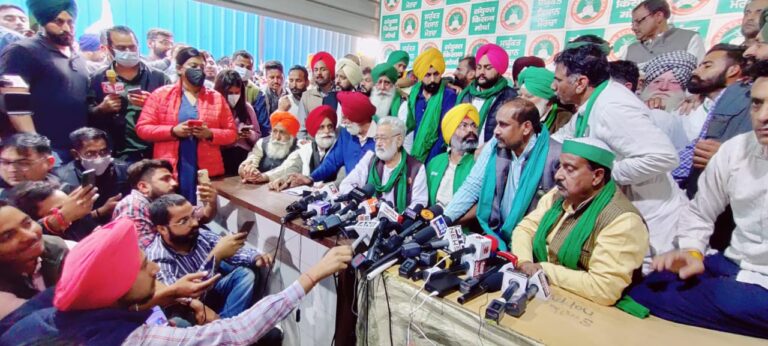


 The man in the picture here is Sunil Jakhar, seniormost INC leader in Punjab. Sandhu regrets that Jakhar was not trusted in the role of CM after Captain Amarinder was ousted. This may be partly true going by the overlapping definitions of Punjabiyat, turbaned and Jatt Sikh which is essentially anti-Dalit too. This led to Channi’s loss .