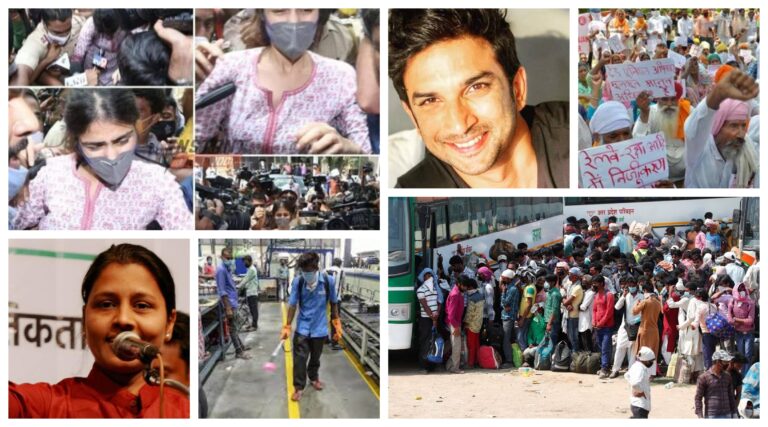
K Satyanarayana and KV Kurmanath Have Appeared Before NIA, Will Continue to Dissent

0

K Satyanarayana and KV Kurmanath appeared before the National Investigative Agency (NIA) in Mumbai, as summoned, on September 9, at 10:15 am.

K. Satyanarayana is an Associate Professor at the Department of Cultural Studies at the English and Foreign Languages University, Hyderabad. He is a distinguished scholar and one of the most prominent academics of Dalit and anti-caste studies in India. K.V. Kurmanath is a senior journalist based in Hyderabad.

Both of them have been harassed for their relationship with Varavara Rao (they are married to his daughters), who is currently incarcerated in connection with the Bhima Koregaon and Elgar Parishad case. Their homes were raided in a suspicious and unlawful manner in 2018, along with Rao’s home.

K. Satyanarayana has spoken about the casteist ill-treatment he faced during the raid, along with the fact that the police had no grounds to raid his home. The police’s attempt to delegitimize, isolate, stigmatize and criminalize a vocal anti-caste scholar by harassing him in his own home in his own university campus, he said, was no doubt an attack on the creation of Dalit knowledge.

In Mumbai, the NIA recorded oral statements from them about the material seized from their flats in 2018, which they had said included books on progressive topics, personal belongings, and even academic manuscripts. K Satyanarayana and KV Kurmanath answered all the queries, and were at the office for nearly 11 hours, after which they were allowed to return to Hyderabad. Both of them have maintained throughout that they have no connection with Bhima Koregaon whatsoever, and they reiterated that to the NIA on September 9.

In a statement released today, they wrote,

“Though we both travelled alone to Mumbai, we never felt alone at any moment. We imagined many people waiting outside the building for us.  We could hear statements of solidarity, messages, and protests by artists, academics, activists, journalists, students and democratic voices from all over the world. This solidarity gave us moral support and strength at this moment of crisis. It was reassuring.
The strident voices of dissent in this country and the world have rekindled our hope that the ruthless dismantling of democratic values, Constitutional guarantees, and rule of law in this country will NOT be allowed.”

Thanking all their well-wishers, including students, scholars, and media, they assured their continued participation in protecting dissent and democracy in the country.

Suicide Prevention in India: Are We Doing Enough?

1

The stigma around mental health issues does not merely refer to whether mental health issues are being addressed, but also how they are being addressed. In terms of suicide, much is being done to create interventions for suicidal tendencies and behavior. However, there is still a lack of acknowledgment over the various factors that contribute to such.

When addressing the issue of suicide, one needs to recognize and work on both, the risk factors and the protective factors. The risk factors are those which create a situation wherein individuals are more likely to consider, attempt, or die by suicide. These can range from experiencing mental illnesses to socio-economic issues. Protective factors are those characteristics that make it less likely that an individual will die by suicide. These can be enhanced by providing interventions such as mental health services and improving socio-economic conditions.

In the popular discourses around mental health in India, the societal forces that contribute to the risk and protective factors remain ignored. It is not strange to have another western model of medicine and health being adopted in India, as much of that is evident in the discourses around mental health. However, has it been adapted enough for the various kinds of issues that are faced by the citizens of our country uniquely?

Suicide Prevention in India: Who is it for?

Suicide prevention in India is mostly addressed by mental health practitioners and helplines. The major strategy that has been adopted is to provide protective care in terms of emotional support and referrals in times of distress. In India, these helplines were established mainly to cover the treatment gap in psychological disorders, which is calculated as the absolute difference between the true prevalence of a disorder and the treated proportion of the population affected (reported to be as high as 83%).

Due to the lack of mental health practitioners and government allotted resources, many non-governmental organizations and voluntary agencies have stepped in to cover up for such gaps. Organizations such as Sanjivini Society for Mental Health in New Delhi, Sneha in Chennai, iCall, and Aasra in Mumbai provide a range of services over telephonic helplines such as referrals, information, emotional support, and psychotherapeutic interventions.  Responding to the mental health crisis in the past few months, the Ministry of Social Justice and Empowerment also launched a mental helpline named KIRAN, which is available in 13 languages.

It is important to note here that mental health helplines address only protective factors, in terms of providing immediate intervention for mental illnesses. However, not all suicides are caused by mental illnesses.

There is a complete lack of engagement with the risk factors other than mental illness, such as socio-economic conditions and lack of material resources, which drive people to suicide

The Social Structures Behind Suicide

One of the major causes of suicide is trauma. Trauma is not only selective to a particular experience but can also be a result from continued social exclusion. In India, caste is a cause for distress for many people. However, it is often omitted in popular discourses of mental health. While illnesses are being addressed through psychiatry and psychotherapy, the impacts of caste-based trauma on mental health need to be addressed within these institutions. Incidents such as those of Rohith Vemula and Dr. Payal Tadvi, even after being brought forward as a form of institutional violence, are cast aside as individual incidents.

Cases of farmers’ suicides remain in headlines throughout the year. In lockdown, it has become even more clear that the causes for such are a lack of material resources. It is important here to note that mental health helplines can only do so much for people who are suffering from a lack of resources. It would be ignorant to overlook the material realities that end up becoming the risk factors for suicide. There was a conversation that arose addressing this when 14-year-old Devika from Kerala died by suicide because she could not access online schooling. However, there is nothing being done to address these factors. Schooling continues to happen online without support being extended by the government to those lacking resources to access it, caste-based discrimination continues in institutions, and what we are provided with instead are mental health helplines.

Are we doing enough?

While addressing mental health concerns, there is no ‘one size fits all’. This expression has been understood well enough for there to have emerged not only multiple ways of dealing with distress but also multiple forms of psychotherapy. When it comes to suicide, the measure that is being undertaken is mostly helpful for people facing mental illnesses.

Suicides are not just a reflection of mental health, but also a reflection of the socio-economic conditions and social structures that affect a person. It is high time we address the societal factors that contribute to the high suicide rates in the country. Mental health helplines might be effective in the short term, but they do not count as a preventative strategy.

Charvi Arora is a graduate in Psychology and Sociology aiming to work in the field of education.

World Suicide Prevention Day 2020- India at a standstill amidst COVID

0
India is facing the colossal mental health crisis amidst COVID 19 pandemic, which has posed a challenge to public health systems. The dire state of Mental Health in India has created havoc in public health systems. Stigma and vulnerabilities that a person with mental health issues are subjected to continues to persist in India. The Global Burden of Disease report states that mental disorders account for 13% of total Disability Adjusted Life Years (DALYs) lost for Years Lived with Disability (YLD) with depression being the leading cause. The lack of awareness and conversation discussing the issues of mental health has created health disparities and a system of inequities.

Mapping the Journey of WSPD

World Suicide Prevention Day (WSPD) is observed on the 10th of September to shed light on the importance of suicide prevention and seeking healthcare services. The day is marked for spreading awareness and creating safe spaces within the system. The initiation of the day came into existence in the year 2003, when the International Association for Suicide Prevention (IASP) collaborated with the World Health Organisation (WHO) and the World Federation for Mental Health (WFMH). “WHO suicide data collection says that close to 800,000 people die each year, due to suicide. The statistics by WHO in 2019 says that one person takes their life every 40 seconds.” Ideally, policy implementation and interventions enable mental health support systems. However, at the grassroots, the health care systems are deficient in terms of efficacy, well-equipped infrastructure, system responsiveness, human resources, and incentives to support the health workers. The empirical pieces of evidence and the narratives highlights the gap between inequities and inequalities. The public health system of India has left the citizens in the state of conflict. The lack of inclusive policies to address the health requirements of the population and the marginalised community has created a rift and lack of trust in the system- the lack of representation, high-quality care and improving health outcomes.

New Wave in Mental Health Scenario- Sushant Singh Rajput

The criticality of the sociopolitical landscape plays a role in constructing narratives and misconceptions. The recent case of Sushant Singh Rajput (SSR) has left the country jarred and opened a minefield of possibilities for the opportunist. The dismantling of the reasons about why someone like him- a rich superstar, with all the money and luxury how can he die by suicide? The question that arises is how does a person with depression look, what constitutes a person with mental illness, what are the social constructs that fit the labelling of the society. The whole incident has reflected the perception of how we understand mental health and the systems are created; we are part of these systems.

Also Read: Suicide Prevention in India: Are We Doing Enough?

The fabric of mental health systems has failed in India; the conversation on suicide prevention is on the sidelines. The lack of acknowledgment of a man going through mental health issues has infuriated the patriarchal system. The blameshifting and public shaming of Rhea Chakrobarthy has muddled all the possibilities of suicide prevention in India. The wavelength and the influence of social media and the artists have created a blur in fighting a just and fair trial.

Vulnerabilities amidst COVID 19- Way Forward 

The post-COVID 19 worlds will be challenging to settle in, conversation and programs need to come back, and center around how to equip health systems. Furthermore, they have to start focusing on interventions and tackling prejudices, biases, and social constructs prevailing in our society and absorbing all the changes.

Suicide Helpline Numbers

  1.     http://www.suicide.org/hotlines/international/india-suicide-hotlines.html
  2.     https://www.spif.in/
  3.     https://www.thelivelovelaughfoundation.org/helpline.html
  4.     http://www.aasra.info/
  5.     http://befriendersindia.net/contact-us.php
Sana Thapa holds a MA in Development with a specialization in Public Health from Azim Premji University and is pursuing a post-graduate diploma in Mental Health. Her previous research focus has been on the role of therapeutic shrines on mental health and alternative healing.

The Economy and the Black Magic of the Rhea and Sushant Pulp Fiction

Just until a few weeks ago, images of the horrors of the nation-wide lockdown were everywhere. Rural migrants working in cities had come out on the streets in such large numbers that the media was forced to turn its camera towards them. The discussion everywhere revolved around how the lockdown had created more decay in an already decaying economy, or that the decaying state of the economy was caused by the lockdown itself. Questions were being raised against the government about the state of the economy and the lockdown. The amount of anger simmering amongst the youth can be understood from the Tali-Thali protests on September 5. People everywhere were worried about what will happen now, the uncertainty of the future making everyone afraid.

Before March 2020, when people got bored with their daily routines and work and wanted to escape the monotony and forget the worries of their life, they would watch a serial or a film. While watching a film, and for some time before and after watching it, one escapes all their worries and loses themselves in the glittering world, the costumes and makeup, of the film.

But now the cinemas are closed and no matter how much they yell China-Pakistan on TV, the effects of the falling economy cannot be ignored.

At this time, the Sushant-Rhea case has been presented in front of the people in the form of a film that has heroes and heroines, villains and vamp, love and betrayal, sex, and suspense, all within it. Needless to say, the producer of this film is the Government and the distributor is the media. Thanks to the media as the distributor, this film/serial is being watched in every household. The people have picked their heroes, heroines, and villains according to their own understanding.

This case has pushed all discussion of economic depression into the background. The effect of this is so widespread that even those who had for long avoided this media spectacle have been forced to pick their own heroes and villains in this story. It is natural for progressive-minded people to show their support for the female character of the film, seeing the way in which she is being treated, and they did.

The media has shown its vulture-like treatment of many before this as well. When the image of the media falling over Rhea became viral on social media, I was reminded of another image, when in 2007 a teacher accused of trafficking children was not just groped and pushed by the media and a crowd of people, but even her clothes were torn off. If one tries to look back, they will be reminded of many such visuals and incidents.

This vulture-like character of the media was deemed righteous by those on the side of the late actor, and after this, the numbers of those supporting Rhea also increased. The number of followers and commentators of this film being distributed by the media also increased. By writing this, I too have now included myself in these numbers.

Meanwhile, in the media tamasha , three artists from Kabir Kala Manch an anti caste cultural group were arrested, out of whom Jyoti Jagtap was followed and arrested by the police, but this got buried somewhere because of the film of Sushant and Rhea

Airports got sold off, an education policy that will ruin the education system and leave the people uneducated was passed, the Railways got sold off, preparations are being made for LIC to be sold, and labour laws got scrapped. Lakhs of people were brought out into the streets with one blow. The economy is drowning, but the space for discussing all of these issues has been occupied by the Sushant-Rhea film peddled by the government.

Sushant-Rhea are part of this society, and so there should of course be a discussion about them. But if during these times a case like this becomes an election issue, then it can only be seen as a conspiracy.

The black magic, in this case, was not done by Rhea on Sushant, but by the government on its people through the media, because of which we have forgotten how to look at the truth. 

The story of Rhea and Sushant is the story of this exploitative, sinking, economy. It is the story of the dirty gutter flowing behind the glitter and glamour of Bollywood. In an interview with Rajdeep Sardesai, more than the story of her being innocent is the story of this gutter. Where there is endless money, and not all of it earned from films. Where there is a big business of drugs, in which most people from the industry are involved in some way or the other. Where film stars invest in business ventures to amplify their wealth (Sushant, Rhea, and Shouvik had registered their own artificial intelligence company).

Where the successful have every comfort and luxury in their life, but their lives are in the hands of psychiatrists and their sleep is in the hands of drugs. Where they spend endless amounts of money to go abroad thinking that they will roam the streets of a different country, but lock themselves up in a room because of strange fears.

This is not the story of any one person, but the truth behind the glamour of this industry, a truth that comes out every now and then through someone or the other. Sometimes it is Parveen Babi, sometimes Sanjay Dutt, and now Sushant, or Rhea. Where reports of sexual abuse of women keep coming out and are considered commonplace. Rhea may be calling her fight a fight against patriarchy, but in her interview, her views regarding the Me Too movement, against the patriarchal abuse of power, did not seem to be too positive. During the Me Too movement also the stink of this gutter had come to the forefront, which they attempted to drive away by sprinkling perfume. The story of Rhea and Sushant should be seen as an example of this ‘elite’ organization of society. It is such an organization that might use even this story of their problems and make a film on it to make more profit.

The sinking of the entire country’s economy has affected the film industry as well, and this havoc has been exaggerated by the lockdown, with many artists reportedly going into depression. It may be that Sushant’s death was also a part of this.

Whatever it may be, this spectacle being broadcast in the form of a serial by the media has done the work of leaving behind the discussion on the failure of the government, because a national issue has been made out of the Bihar elections and Maharashtra politics even as unemployment remains a big question. Since this has become a football match between a handful of Hindu fundamentalist parties, and because of this we have forgotten our own circumstances, the question arises- was this actually an issue or is the government broadcasting this serial/film to cast black magic on us?

The faster we escape this black magic, the better.

The article is translated into English by Damayanti Saha.

Over 1000 Academics Urge Govt. to End Crackdown on Dissidents and Focus on Real Perpetrators in Bhima-Koregaon case

0

More than 1000 members of the scientific and academic community from Indian and foreign universities and research institutes pledged their support for the dissidents who are being harassed in the Bhima-Koregaon case. They have called on the government to immediately end the harassment crackdown on dissidents and instead focus on identifying and prosecuting the true perpetrators of the Bhima-Koregaon violence. The signed statement has been issued on 9th September, exactly a day before Dr. Partho Sarothi Ray has been asked to appear before the NIA in Mumbai.

The statement was initiated by Suvrat Raju (ICTS-TIFR, Bangalore), Bhavtosh Bansal (IISER Kolkata), Koel Das (IISER Kolkata), Sugata Ray (IACS Kolkata), Saikat Ghosh (IIT Kanpur) on 6th September. They said, “After the statement was opened for signatures, we received news that the NIA had arrested three cultural activists from the Kabir Kala Manch and also sent a notice to Prof. K Satyanarayana from the English and Foreign Languages University, Hyderabad and the senior journalist KV Kurmanath. These events add urgency to the statement’s call for ‘the government to immediately end its crackdown on dissidents, release those whom it has arrested in the Elgar-Parishad case, and instead focus on identifying and prosecuting the true perpetrators of the Bhima-Koregaon violence’.”

The statement is being re-produced verbatim below. The original statement with the list of 1039 signatories can be found here.

Statement on NIA Actions and Crackdown on Dissidents in the Bhima-Koregaon cases

Initiated: 6 September 2020. 

Released:  9 September 2020.

We are members of the scientific and academic community.

We are writing to express our deep concern at the actions of the National Investigation Agency (NIA) in its investigation of the Bhima-Koregaon violence. Instead of investigating those responsible for the actual violent clashes in Bhima-Koregaon, the NIA (and earlier,  the Pune police) has focused on the Elgaar Parishad event—a large cultural and political gathering—where the main organizers were reportedly two eminent retired judges. Surprisingly, in this process, the investigating agencies have arrested several illustrious citizens—including academics, lawyers, and prominent activists.

Most of the individuals who have been taken into custody were not even present at the Elgaar Parishad event. So it is very unlikely that the government will secure a conviction in this case. However, by using the draconian Unlawful Activities Prevention Act (UAPA), the government has prevented those who have been arrested from obtaining bail. As Gautam Navlakha pointed out on the eve of his arrest, under the UAPA, “the process itself becomes punishment” since the accused are deemed “guilty unless proven innocent.”

Therefore, it appears to us that the NIA’s claims of investigating the “conspiracy” in the Elgaar-Parishad case are actually a flimsy cover for cracking down on “urban Naxals”—who, in reality, are only dissident intellectuals—and keeping them in prison indefinitely.

After arresting Prof. Hany Babu of Delhi University a few weeks ago, the NIA has continued to interrogate academics and activists, and even the defence lawyers for some of the accused. Most recently, we understand that the NIA has summoned the well-known scientist and activist, Prof. Partho Sarothi Ray, of the Indian Institute of Science Education and Research (Kolkata) to Mumbai on 10th September for questioning in this case. Separate from his outstanding scientific work, Prof. Ray has also been deeply involved in social causes. He has been working extremely hard in coordinating efforts in the Nadia district to battle the COVID-19 pandemic, by helping to set up and operate the government-run COVID-testing center in the district.

Prof. Ray has publicly stated that he has no knowledge of the Bhima-Koregaon incident and has never visited the area. But of course, it is well known that Prof. Ray has been critical of the central government’s response to the pandemic and we suspect that this may not be unrelated to the summons that has been issued to him. We are concerned that Prof. Ray may also be arrested on false charges.

We call on the government to immediately end its crackdown on dissidents, release those whom it has arrested in the Elgaar-Parishad case and instead focus on identifying and prosecuting the true perpetrators of the Bhima-Koregaon violence.

“Media Can’t Run Parallel Trial” :Delhi HC Directs Arnab Goswami in Sunanda Pushkar Case

0
Since the day Sushant Singh Rajput committed suicide the media has doggedly pursued the story putting out the intimate details of the personal lives of Sushant Singh Rajput and Rhea Chakraborty. A moment that could have begun a national conversation on mental health and structural forms of exclusion has been milked for more than a month now for cheap headlines. Hundreds of news articles on the most minor and irrelevant details of the whereabouts, social media posts, so on, of every single person to have ever been associated with Sushant Singh Rajput, are posted every day. News reports have publicly announced Rhea’s address, her phone number, have tracked her every day whereabouts, leaked her call and message records, and made conspiracy theories without any proof.

Also Read: Media Hampering Investigation in Sushant Singh Rajput Case: Bombay HC

This is during one of the biggest crises of human rights, social justice, healthcare, education, and economic welfare in the country. These include but are not limited to large scale unemployment, lack of accessible healthcare during a pandemic, dilution of labour rights, large-scale privatisation of public sector undertakings, anti-farmer laws, unlawful arrests of anti-caste activists and interrogations of dissenting voices, arrests of protestors, medical negligence in prisons, auctioning off of natural resources, inaccessible online education, and so on.

Arnab Goswami and Sunanda Pushkar Suicide Case

Today, Delhi High Court has directed Arnab Goswami to exercise restraint and ‘bring down the rhetoric’, till the plea moved by Tharoor seeking injunction against allegedly defamatory broadcasting on Sunanda Pushkar case is disposed of as reported by livelaw.com While issuing notice to Goswami to file a reply, the Single Bench of Justice Mukta Gupta highlighted that during the pendency of an investigation in a criminal case, media should refrain from running a parallel trial, or from calling someone guilty, or from making unsubstantiated claims. The sanctity of an investigation and evidence has to be understood and respected’, the court said The order has come in a plea moved by Shashi Tharoor seeking interim injunction against Republic TV’s Editor Arnab Goswami, restraining him from reporting any news or broadcasting any show related to the death of Mrs. Sunanda Pushkar till the present case is pending and also to restrain him from maligning and defaming the plaintiff in any manner. Appearing for Tharoor, Senior Advocate Kapil Sibal argued that despite the chargesheet being filed in the Sunanda Pushkar case, where no case for murder is made out, Arnab Goswami is claiming in his shows that he has no doubts that Sunanda Pushkar was murdered. The court further observed that when a chargesheet has been filed by an agency authorised to conduct investigation and a competent court, while taking cognisance of the same, has prima facie concluded that the case involves abetment to suicide and not murder, the statements made by the defendant insinuating murder being committed by Tharoor and not murder, the statements made by the defendant insinuating murder being committed by Tharoor ‘Press has to exercise care and caution while reporting criminal matters that are under the investigation’, the court said. Therefore, the court directed Arnab Goswami to comply with this court’s previous order and exercise restraint till the next date of hearing. Earlier this month, the Bombay High Court on 3rd December passed an order stating that it urges and expects the media to show restraint while reporting the developments in the case relating to the death of Bollywood actor Sushant Singh Rajput. The bench also said that the media should not report in a manner that hampers the ongoing investigation in the matter. “We urge and expect the media to exercise restraint in reporting of the investigation with respect to the death, which should not hamper investigation in any manner”, the bench said.                                

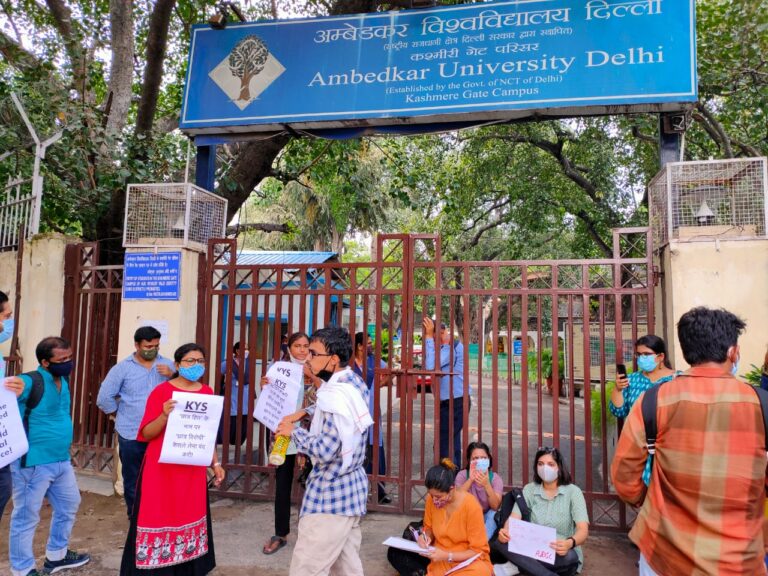
AUD Scraps Fee Waiver for SC/ST/PwD, Students Protest Outside Gates

1

If the administration of AUD has been consistent in something, it has been in creating constant chaos among students. Even during the pandemic, they didn’t fail to create a ruckus to disrupt the peace of students. Since the last few months concerns have been raised regarding the lack of infrastructural support to the students, especially for those from marginalized communities, in attending online education.

The fee structure in AUD is many times higher than other state universities in the country. Even during the pandemic, when students are struggling to make the ends meet, the AUD administration is adamant about levying high fees from the students.

Despite the many flaws and inconsistencies, the one policy that has always upheld social justice in the university was the full fee waiver extended to SC/ST/PwD students.

Since 2016, the policy of full fee waiver to SC/ST/PwD students was adopted in line with the Act of AUD to ensure reparative justice to students from marginalized communities.

Today, the policy is under review and this news comes to the students from a newspaper daily rather than from their own administration. It is highly disappointing that a university named after Dr. B.R. Ambedkar is even reconsidering whether or not to uphold social justice.

AUD fee waiver

The conversations around whether or not the fee waiver will be extended to the new batches from 2020 started when a student from the reserved category applied for MBA admissions in the university and was denied admission since she couldn’t pay the full fees. Many students of the reserved categories apply in AUD keeping in mind the full fee waiver extended to them. Similarly, the concerned student applied in the university under the impression that she would get the fee waiver as her sister who is a Ph.D. scholar in the university avails the same. Even the university website till date does not mention any change in the fee waiver policy to SC/ST/PwD students. The fact that a student of the reserved category was denied admission on grounds of the anticipated change in the policy can never be justified.

Many petitions were sent to the administration from the Students’ Council, political organizations in the university, and students seeking clarification on the same which were met with the administration’s stone-cold silence.  Since the administration was not responding through the internal communication channels, the students were forced to take the issue to Twitter on Sunday. This was frowned upon by the administration as this has allegedly been an attempt by students to ‘malign’ the university’s reputation.

The policy on fee waiver was being reviewed by the Board of Management on Tuesday, information that the students got hold of from a newspaper article and not the AUD administration. The Students’ Council gave a call for protest on Monday to express the concern of the student community as the administration was not responding to any other means of expressing dissent.

The students were stalled at the university gate and denied entry to the university. The huge force of Delhi Police stationed outside the university gate was found constantly threatening the protesters with the support of AUD administration,  in an attempt to disperse the crowd.

However, this is not the first time that the AUD administration had the audacity to risk the students to Police detention.

AUD police
Courtesy: Rukmini Banerjee

After many hours of negotiation, the Students’ Council met with the AUD administration while the other students waited outside the gate under the threat of Police detention. Throughout the meeting, AUD administration, especially the Registrar of the university constantly tried to derail and disrupt the meeting. When the concerns were raised and the memorandum was read out, the administration faked their helplessness in making any promises as the policy on fee waiver will apparently be a decision of the Board of Management.

AUD students protest

Of the 11 members that form the Board of Management, 4 are members of the university including the Vice-Chancellor. When the Pro-Vice-Chancellor, who is also a member of the Board of Management was asked about his stand on the concern, he responded that he cannot reveal it and instead added how he has learned to make ‘compromises’. It is highly shameful how a voting member of the Board of Management is not hesitant to compromise the future of thousands of students. A memorandum has been submitted to all the members of the Board of Management, including the Registrar who is the Secretary of the Board of Management.

The student community of AUD is impatiently waiting for the decision of the Board of Management. The initial principle of the university in the name of Dr. B.R. Ambedkar to uphold social justice and economic rights of the socially marginalized is under threat. But the student community will continue to fight the rightwing agenda of the Sanghi administration.

Elizabeth Alexander is a research scholar at the School of Development Studies at Ambedkar University Delhi. The AUD administration has announced that the fee waiver will be reinstated but only for a year. 

#9Baje9Minute Top Trend on Twitter: Youth Raise Their Voice Against Rising Unemployment

0
Thousands of Indian citizens, on September 9, expressed their dissatisfaction with the BJP government under the hashtag #9Baje9Minute . The call for the symbolic protest, first given by former Uttar Pradesh Chief Minister and Samajwadi Party national president Akhilesh Yadav, was soon endorsed by various groups, political parties, and opposition leaders. The protest aimed to raise the question of rising unemployments and the failing economy, especially after the GDP contracted by 23.9%.  The symbolic act of turning off lights for 9 minutes at 9 PM and instead lighting candles etc, was a play on earlier mobilisations of the people during lockdown by PM Modi. PM Modi had earlier given calls to bang thalis, turn off lights, and so on at specific times. This act was used as a distraction from the issues facing the country in the pandemic, including the lack of equipment and protection for frontline workers. The hashtag #9Baje9Minute has been trending along with the hashtag #NoMoreBJP as people criticise the government for privatisation, the lack of jobs, its unsatisfactory handling of the pandemic as COVID-19 infections are on the rise, inflation in food and essential goods prices, the decision to hold NEET-JEE exams in spite of widespread opposition from students, and the spreading of propaganda by media channels. The government has recently announced that barring 18 strategic sectors, all other sectors will be completely privatised, and the rest will have increased privatisation. This has already been opposed strongly by workers organizations and Adivasi groups, but now it is the general public, and especially the youth which is expressing its opposition as privatisation will directly impact employment and access to services for a large part of the population. The government is willingly sacrificing the economy for the profit of a handful of industrialists, as Amit Bhaduri writes, “Liberalization is the name of the game. Indeed it is the only game in town this government wants to continue to play by giving unstinted support to big industrialists. No matter lockdown or pandemic, it changes labor and environmental laws to help the industry. It gave them tax break in terms of foregone government revenue which is almost double the money it spends today on MGNREGA. It turns a forgiving eye to the known looters of bank money.”

Anganwadi Centres Still Shut After Unlock: Children and Women’s Nutrition In Danger

1

In his address to mark the beginning of ‘Nutrition Month’ in the country on September 7, Prime Minister Narendra Modi asked for recipes of nutritional food to be shared on government portals in order to get rid of malnutrition from society. This appeal by the PM has confirmed the assumption that the government is rapidly turning its back on its responsibility to provide nutrition for children up to the age of 6, pregnant women, and lactating mothers.

Government figures themselves stand witness to the fact that since the lockdown began on March 25, Anganwadi centers and health facilities at the lowest level across the country have been adversely affected, and as such, the number of malnourished children will drastically increase in the coming months.

Data from the National Health Mission says that from April to June this year, malnourished children were admitted to only 9 to 13 percent out of the full capacity of the 966 nutrition rehabilitation centres in the country. The number of children admitted to the Nutrition Rehabilitation Centers (NRC) in April 2020 was 1315, which is just 9% of the number of children admitted to NRCS in April last year. Similarly, 3472 children were admitted to NRCs in May, which is just 13 percent of the number of children admitted in the same month last year, while 3472 children were admitted in June, which is 16 percent of the number of children admitted in June last year.

If we look at the Madhya Pradesh, NRCs are lying vacant in Dhar, Alirajpur, and Jhabua, the districts worst hit by malnutrition. Since Anganwadi centres in these districts have been shut down since March 25, neither is the growth of children being monitored and nor are malnourished children being identified. Data released by the National Nutrition Centre in Hyderabad in 2018, identified 38.5%, 54.6%, and 48.6% of children to be malnourished in Dhar, Alirajpur, and Jhabua respectively.

In September 2016, malnutrition claimed the lives of 116 innocents, in Sheopur, Madhya Pradesh, a district infamous for widespread malnutrition.

After this, for the first time in Madhya Pradesh, the district was divided into three parts and 23 growth monitors were appointed. But on May 31 last year, the contract period for the growth monitors expired and the contract was not extended by the government. The district does not have even one growth monitor for observation for the Nutrition Project.

Madhya Pradesh has a total of 8903 Anganwadi centers in urban areas and 51558 Anganwadi centers in rural areas. During the pandemic, the Shivraj Singh government of the state put Anganwadi workers and volunteers to the task of COVID-19 testing and gave the orders for dry ration kits to be distributed amongst children up to the age of 6, pregnant women, and lactating mothers.

When the self-help groups did not receive any money for four months for the ration kits that were to be distributed through them, they stopped working. This is also the case for the 108 ambulance service in the State, which is being used to carry COVID-19 patients.

Anganwadi centers are closed. Schools are shut. Six essential nutritional services for children are closed, and the MIS of the state’s Department of Women and Child Development is closed as well. The Shivraj government has opened up markets in the state in accordance with Unlock-4. The ban on movement has been lifted, and buses have begun operating. However, no one is concerned about the reopening of Anganwadi centers. Instead, politics is being started again on the question of whether or not eggs should be fed to children for nutrition.

In India, two out of three children under the age of five are malnourished. In spite of this, the MIS of the National Health Mission has also been closed for the last six months. The months of September and October are the season of malaria and dengue. Children affected by malaria are three times more likely to become prey to malnutrition.

The government, however, is still not aware of how many children’s lives have been sacrificed to malnutrition across the country in the last six months and how many children are currently counting their hours until death due to malnutrition. At the rate at which COVID-19 is spreading to the villages from the cities, if this affects malnourished children most severely, then entire villages will drown in the grief of the death of their children.

This article was first published in Hindi on Janjwar.com. 

Academics in Solidarity with Dr Maroona Murmu, Harassed by Casteist Trolls

0

The following is a letter from alumni of the Centre for Historical Studies in solidarity with Dr. Maroona Murmu, a powerful anti-caste voice and scholar, who was recently harassed by casteist trolls on social media. 

We the undersigned, the alumni of Centre for Historical Studies, JNU along with several concerned citizens, are writing in unequivocal support of Dr. Maroona Murmu, Associate Professor of History at Jadavpur University, who is  being incessantly trolled, and having to face casteist abuse, for a comment she posted on a social media platform on the ongoing debate about holding examinations during the COVID-19 pandemic.

Background: On September 2, Professor Murmu commented on a Facebook post by her friend Neelkonto Naskar regarding the issue of holding examinations, saying students’ lives were being put at risk by the government’s decision.

A young woman replied to her comment saying, “Maroona Murmu, what surprised me was the fact that Jadavpur University has professors with such mentality. I am astonished. Let me brief you a bit on the difference between ‘quota’ and ‘unquota’ (non-quota). To know that life is more important than an academic year, one doesn’t require to be a professor [sic]. It’s not about lagging one year but about how some unqualified and incompetent people take undue advantage of the reservation system and their caste is now helping them be successful, while the deserving lag behind for ever. Our parents are stepping out, taking a risk every day to get us food, while some are sitting at home and getting paid for doing nothing.”

After a few hours, the same person put up a post on her Facebook profile saying, “Today morning, just reminded one ‘Murmu’ a Santhal about her Adivasi lineage. That too in a polite manner. But some people like her, just made me realise that so-called professors are getting fat simply drawing paychecks.”

Since then, Dr Murmu has been trolled incessantly, with numerous hate messages and casteist comments being directed towards her.  The troll machine has been at work against Prof. Murmu unceasingly. This has been reported here, here, and here.

Dr. Murmu is an accomplished and highly respected historian and educator, who has published widely on women’s history and literary production in Bengal. In addition to her many scholarly contributions, she has also been an important and active voice against discrimination based on caste and adivasi identities in the realm of education in West Bengal  and across India.

Dr. Murmu has been a tireless advocate of increased representation of Dalit-Bahujan-Adivasi voices in education and in public life, and has written extensively on systematic and structural discrimination in post-independence India.

Her writings and public activism have played a significant role in bringing the ‘caste question’ to the forefront of discussions in West Bengal, in a manner that has been transformative and path-breaking. The love and respect that she receives from her colleagues and students is evidence of the important role she plays within the university community — as a teacher and a mentor as well as a highly-regarded scholar.

The vicious and hateful social media campaign against one of the most powerful voices of Dalit and Adivasi empowerment in contemporary India is utterly deplorable. Strict action must be taken against the perpetrators of this kind of violence that seeks to silence marginalized voices, denigrate the contributions of a leading Adivasi scholar-activist, and maintain established forms of Brahmanical hierarchy in our society. It is a matter of great consternation for us that our casteist society does not sensitize its young members to the long history of violence against Adivasis, Dalits, and Bahujans and to the need for affirmative action for the purpose of representation and empowerment, which have been previously stolen from them. It is a matter of grave concern that Dr. Murmu is being subjected to such vicious attacks. These attacks throw light on structural inequalities in the academe, despite the usual legal and institutional safeguards.

We stand in solidarity with Professor Maroona Murmu and with her fight against casteist oppression.

Yours sincerely,

CHS ALUMNI Ajeet Kumar, Assistant Professor, History, ARSD College, University of Delhi Anirban Bandhopadhyay, History, Karnavati University, Gandhinagar Anubhuti Maurya, Assistant Professor, History, Shiv Nadar University Aparna Vaidik, Associate Professor, History, Ashoka University, Kundli Ashish Kumar, Assistant Professor, History, Punjab University, Chandigarh Ganganpreet Singh, Assistant Professor, History, Banaras Hindu University Haimanti Roy, Associate Professor, History, University of Dayton Hemanth Kadambi, Assistant Professor, History, Shiv Nadar University Kalyan Kumar, General Secretary, Shramik Elgar, Chandrapur, Maharashtra Khalid Akhter, Delhi-based journalist Mahesh Gopalan, Assistant Professor, History, St. Stephen’s College, University of Delhi Poornima Paidipaty, LSE Fellow in Inequalities, London School of Economics, LSE, UK Prabhat Kumar, CSDS, Delhi Radhika Khajuria, Gender and Health Activist Rachna Singh, Assistant Professor, History, Hindu College, University of Delhi Rahul Jayaram, Associate Professor, Jindal School of Liberal Arts and Humanities, Sonipat Ranjana Das, Assistant Professor, History, Ramjas College, University of Delhi Sabyasachi Dasgupta, Assistant Professor, History, Visva-Bharati, Shantiniketan Sanjeev Kumar, CHS, JNU, Alumni Siva Arumugam, PhD, Columbia University Varuni Bhatia, Associate Professor, History, Azim Premji University Vikas Pathak, faculty, Asian College of Journalism, Chennai Vishal Chauhan, Assistant Professor, History, PGDAV College, Delhi University Yengkhom Jilangamba, Assistant Professor, TISS, Guwahati campus