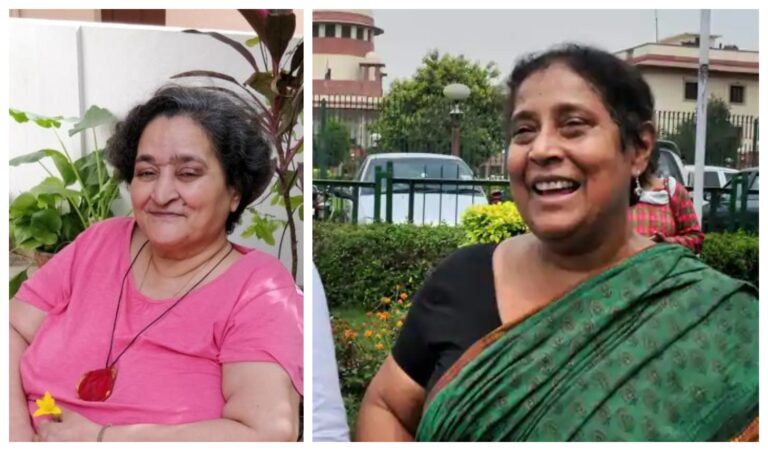
Legacy and Lifetime of Kalpana Mehta and Ilina Sen

0

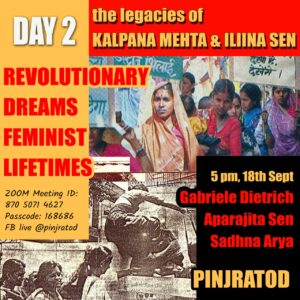
On the 17th and 18th of September, 2020, Pinjra Tod, a Delhi based organization of women students, organised a two-day public discussion on the legacy of Kalpana Mehta and Ilina Sen. The discussion sought to bring together a reflective conversation on the development and lessons of the contemporary women’ movement through looking at the lives and times of Kalpana Mehta and Ilina Sen, both of whom we lost to the movement in the past few months. Joining the conversation were women activists from various walks of life whose journeys touched and wove into the life and works of Kalpana Mehta and Ilina Sen, as were young women students and activists seeking to understand this history with a view to addressing challenges before the women’s movement today. 

The first discussion was led by Ranjana Padhi and Laxmi Moorthy. The second day’s panelists included Aparajita Sen, Gabriel Dietrich, and Sadhna Arya.
Laxmi began the discussions by presenting a series of posters from different organisations archived by Zubaan, depicting the struggles of feminists and women’s organizations across the country. Through these posters, she recounted the history of the autonomous women’s movement of the 70s and 80s, a time when multiple women’s organisations began rising to prominence and campaigned against sexual violence, dowry, price rise, amniocentesis (enabling sex-selective abortions), population control, communal violence, women’s work and various issues, some inviting significant mobilizations of women in urban centers. The presentation also delved into various points of criticism of the movement and how these limitations were also reflected in the posters, such as the predominant representation of women as Hindu goddesses and how this led to the marginalisation of certain communities within the movement, and the lessons to be drawn from these experiences. 

Laxmi also shared various aspects of Kalpana’s work. Besides her sustained contribution through Saheli, Laxmi discussed her work against the privatisation of health care and raising consciousness about women’s bodies. She recollected how the language of healthcare was made available to the masses, especially women from working-class backgrounds through plays, posters, and paintings at melas and other public events. She also spoke of Kalpana’s involvement with religion and personal laws, and her activism in the wake of the demolition of the Babri Masjid. Through this, a critical discussion of the movement’s engagement with organized religion, the Uniform Civil Code and the challenges thrown up with the rise of the right wing was opened up.

Ranjana Padhi spoke of both Kalpana and Ilina’s work, and its relationship to workers and people’s movements. She recounted the work of the Chhattisgarh Mukti Morcha, and Ilina’s association with the same, as well as her later efforts in the civil liberties movement. She emphasised how Ilina realised the need for core feminist principles to inform the working-class movement and her argument that unionisation around women’s issues is as important as that around working-class issues. She emphasized the role of the National Conferences in building collective action and bringing together different women’s organisations,  clarifying both similarities and differences between them. She recounted the space for discussions, debates, and differing opinions within the movement while also looking at the points where positions developed through active struggles within, such as initially on issues raised by the LGBTQ community. Ranjana also electrified the air with songs from the movement, one in particular written by Kalpana. 

We then had Gabriele Dietrich, Aparijita Sen and Sadhna Arya speaking. Gabriele, a close friend and companion of Ilina, spoke of Ilina’s dream to realise a socialist society and how that informed her politics against the narrative of population growth that looked towards coerced sterilisation or abortions. She realised that the population is the product of a lack of access to security, and these problems could be eradicated once a just society is ensured. Gabriele then talked herself about the issue of population growth and how it must be viewed through the angle of rising communalism in the country and its threat against minorities to reduce their population and simultaneously increase the population of the majority by breeding fear sentiments. She talked of the tensions between religions and the women’s movement, an intersection that needs to be critically looked at.

Next Aparijita, Ilina’s daughter, spoke of her mother’s feminist consciousness and how she always viewed feminism through the lens of the workers’ struggle. She spoke of her work at Rupantar and how it evolved to be a resource centre and a collective, with its own school, public health centre and initiatives to conserve viable seed practices. She set up the curriculum in the school herself and stressed on the importance of children understanding their own history. The school had no classrooms and was based on free interactions and critical pedagogy, which was strongly opposed by the state. She worked to educate locals to detect early signs of malaria and other diseases, and worked with the Shramik Hospital alongside her husband, Binayak Sen. She shared anecdotes about Ilina’s politics of deep respect for working people’s culture, language. customs and festivals.

As the final speaker, Sadhna Arya presented an incisive overview of the evolution of the women’s movement including both autonomous groups and the left; analysing different issues along the way and tying up loose ends in the discussions. She discussed the changing meaning of autonomy, and the cross cutting alliances and dialogue among movements, the difficulties posed by Brahmanism, the right wing, as well as questions like funding, the individual struggles of feminists and the solidarity between them. Sadhna very succinctly put down the argument informing many of the organizational efforts of the period, i.e that women must make their struggles against the oppression they face daily, within families, at work etc a part of the overall struggle for the revolutionary transformation of society. She reflected on the limitation of the women’s movement in dealing with questions of tradition, culture and religion and concluded by pointing to three questions — of Freedom, Equality, Justice – which pose the greatest challenge to the movement today.

Activists from all parts of the country participated and refreshed memories, discussed the current state of the movement,  and the challenge presented by an expanding fascist state. The two day program was concluded with people singing protest songs handed down through various movements and feeling ever so slightly more hopeful about the future.

The above summary hardly represents a fraction of the discussions and presentations. Full recordings of the discussion can be accessed here (Day 1) and here (Day 2).

UP CM Yogi Promises Youth Jobs, ‘Yogi is a Liar’ Trends on Twitter

1

‘Yogi is a Liar’ has been trending on Twitter. Uttar Pradesh Chief Minister Yogi Adityanath has announced that youths will be appointed to vacant posts in various government departments. The recruitment process for filling these posts will be started within three months. After completing the process, appointment letters will be handed over to the selected candidates in the next six months. The CM has also announced that all departments have been requested to provide data of vacant positions. 

Similar promises had been made by the Yogi government regarding teacher recruitment, regarding which he had said that joining letters would be sent out within a week, but no such letters were received by any teachers. As a result, #झूठ_बोलता_है_योगी (Yogi is a liar) has been trending on social media. 


Under the Yogi government, Uttar Pradesh has seen a massive spike in unemployment, especially in the last two years. 

As of February 7, 2020, there were 33.93 lakh unemployed persons registered on the UP government labour portal. This amounts to a 58.43% growth in the number of unemployed people in the state in the last two years. 

Yogi’s attempt at covering up comes after massive online and offline protests by students and youth across the country and in Uttar Pradesh. On September 9, students demanded employment by shutting down their lights for 9 minutes at 9 pm, clapped, banged plates, and lit lamps. On 17 September, they observed Modi’s birthday as National Unemployment Day. Protesters in Barabanki and Lucknow districts sold pakodas, and students in Prayagraj and Varanasi put up posters. There were many scuffles reported between students and the police as well. 

The students and the youth have received support from Opposition leaders like Akhilesh Yadav and Priyanka Gandhi Vadra. 

It seems then that the protests have been widespread enough that the Yogi government has felt threatened and been forced to take cognizance of the issue. However, the state of Uttar Pradesh has gone beyond the point when the people will be pacified by such empty promises and the youth has seen right through Yogi’s appeasement tactics. 

Trade Unions Call for Nationwide Protest Against Labour Codes on Sept 23

0

Central Trade Unions have called for a nation-wide protest on September 23 against the Anti-worker Labour codes and Agriculture Acts put forth in the current session of Parliament, Workers Unity reported. 

The Labour Ministry on Saturday introduced three new labour codes in the Lok Sabha. These three codes, along with the Code on Wages passed in 2019, are meant to consolidate all existing labour laws.

The three new labour codes include the Industrial Relations Code Bill, 2020, Code on Social Security Bill, 2020 and Occupational Safety, Health and Working Conditions Code Bill, 2020 and were introduced by BJP Labour Minister Santosh Gangwar amidst strong opposition.

The Agriculture acts are the Farmers’ Produce Trade and Commerce (Promotion and Facilitation) Act, 2020, The Farmers (Empowerment and Protection) Agreement on Price Assurance and Farm Services Act, 2020, and The Essential Commodities (Amendment) Ordinance, Act.

Both the labour codes and the agriculture acts have been criticised for being pro-business interests and diluting the protections for workers and farmers respectively. The Agriculture Acts have been passed amidst widespread resistance and opposition leaders have alleged that the ruling party broke rules of parliamentary procedure to pass them. 

The situation of India in the pandemic has been steadily deteriorating without any meaningful interventions by the government, and in this crisis, the poor are the most vulnerable, especially workers and poor farmers. Even as India is set to become the worst-affected country in the world, the government has been destroying the economy of the country completely. The almost 24% fall in the GDP is the biggest fall that any country has faced. 

The poor are bearing the burden of both the pandemic and the economy. The rate of unemployment was already the highest it has ever been in the last 45 years, but during the pandemic, nearly 1.89 crore people lost their jobs. Meanwhile, due to the government’s priorities, there has been a 35% increase in Ambani’s wealth since April. 

The government has been pushing a large scale move towards privatisation, with major PSUs including banks, oil companies, defence, coal, etc on the way to being privatised. The Indian Railways and various Airports are also going to be privatised. 

Much before the Parliament session began, various state governments passed ordinances suspending many of the existing labour laws, hence allowing employers to make the workers work overtime, for how many ever hours, without holidays, and without minimum wages.

Workers on a car assembly line

The new labour codes now give the employer allowance to hire and fire workers as they please, reduce the power of trade unions, and make it nearly impossible to legally strike. They also relax penal provisions for employers who violate labour laws. 

What all of the new labour codes reveal is a move towards reducing regulation and increasing flexibility for employers, and a dilution of workers rights that is whitewashed as ‘ease of doing business’. The supposed simplification of laws into four codes is an attempt to remove or modify the various protections that ensure the basic rights of workers to employment security, safety, social security, and the right to protest, and pushes workers towards precarious forms of labour. 

Various groups across the country have been protesting throughout the lockdown, but the protests have largely been ignored by the government, which has continued with its anti-people policies. Hence the trade unions have called for a nationwide protest against the labour codes that will send a stronger message to the government. 

The demands of the protest are as follows: 

  1. The attempts at bringing in the anti-workers labour codes should be stopped. 
  2. Fair minimum wages for workers across the country should be declared. 
  3. Workers who have been laid off during the pandemic should be given cash transfers of ten thousand rupees each. 
  4. All workers should be given full pay for the lockdown period. 
  5. Contractual arrangements should be stopped in work of permanent nature. 
  6. Anti-people and anti-national policies like privatisation and NEP should be scrapped. 
  7. 5% of the GDP should be allotted for the public healthcare system. 
  8. Every labourer working throughout the pandemic should be given insurance of 50 lakh rupees. 
  9. Full payments should be made to workers’ provident funds.
  10. All workers and pensioners should be given an inflation allowance. 
  11. The government must stop putting the burden of the pandemic on the backs of workers and toiling people. 

Present government is ensuring land for the Rich : Siddaramaiah

1
Bengaluru: Leader of the Opposition Siddaramaiah said then Chief Minister Devaraj Urs brought a law that ensured land to the tiller. In contrast, the present government was trying to ensure land for the rich, we will never allow such a bill to get realized. He was addressing the Aikya Horata  (United Struggle) launched by farmer, Dalit, and labours organisations at Freedom Park in Bengaluru on the second day of the monsoon legislature session. The earlier law enacted in 1974 had ensured land to the tillers while there was also a ceiling on agriculture landholding. However, the ruling dispensation was bringing sweeping changes that eased the restriction on buying agricultural land that will lead towards the return of zamindari system to the forefront. Earlier there the agriculture sector provided huge income, unlike industries and service sectors. Subsequently, there was a contrasting change and now there is a scenario where all the sectors are yielding the least revenue for which he held the unscientific policies of Modi’s government responsible. The small and marginal farmers were turning into mere laborers while measures should be taken to restrict such changes. While expressing his solidarity with the agitation launched by progressive organizations, he alleged that the policies of the present government will render small farmers into landless laborers. Slamming Modi’s dispensation, Siddaramaiah said there was a struggle going on between dictators and protectors of democracy. The Modi government was trying to suppress voices of dissent and questioned the suspension of eight parliament members representing the upper house. The opposition party would not allow the passing of the bill that would snatch the lands of the farmers. We would also not allow the tabling of the bill in the upper house where the ruling party does not enjoy a majority. He called upon opposition party legislators including the Janata Dal (Secular) should strongly oppose this move of the government. The land rights also belonged to farmers, labours and Dalits, and poor should also have land ownership rights – he asserted.

Also Read: Ambedkar´s vision of Land distribution should be realised: Noor Sridhar


Ambedkar´s vision of Land distribution should be realised: Noor Sridhar

1
Bengaluru: Farmer, Labour, land and shelter struggle, and Dalit organisations have launched a united parallel public session along with the ongoing legislative session in Bangalore. The struggle is against the amendments brought by the Karnataka government. These are the Land Reform Amendment Act, Agriculture Produce Marketing Committee (APMC) Act and Electricity Act. The protest entered the second day at freedom park in Bengaluru on Tuesday. Following a massive protest on the first day of the monsoon session, the protesting farmers staged an overnight protest and have decided to continue their agitation until the completion of the state legislative session and until the government agrees to their demands. Activist Noor Shridhar of the Committee for the land and shelter struggle slammed the government for its anti-agriculture and anti-farmer policies. “The proposed amendments being brought to the Karnataka Land Reforms Act were detrimental to the interest of the farmers and poor. Despite strong opposition by farmers, opposition parties, and continued protest and agitation against the draconian law, the ruling government was bent upon bringing in the amendments”- he said while speaking on the struggles faced by the poor and landless in Karnataka. Shridhar said the struggle for land rights is not new. It is over 100 years old. The All India Congress conference in Lahore passed a resolution that the government should pass land reforms Acts and give land to the tiller. Dr. Ambedkar wanted all the land should be nationalized and distributed among the poor. The same struggle for land distribution continues till today. Expressing his disappointment, Sridhar said- “Although land distribution has been part of India’s state policy and Indian government should have made the ceiling on land holding its priority,the aspiration of the constitution has been never fulfilled. The government has always conspired against the poor. It was Devraj Urs the champion of land reforms who brought major land reforms. But still a large chunk of Dalits, tribals have not got land ownership rights”. Kagodu Timmappa who himself was the revenue minister and at the forefront of the campaign for land reforms has not been successful in ensuring land to the landless. Since last 3 years the struggle has been continuing under the leadership of freedom fighter H N Doreswamy. This is not a campaign against any government or party instead it is against the anti-poor policies. However, the campaign was being given a colour that it favored the Congress party. We are always pro-people and against the ruling class, he clarified. The people session which is going to be held indefinitely has been pressing for four significant demands including land rights for the landless, audit of the land and redistribution of surplus land to the landless, permit to submit applications seeking for land, and withdrawal of cases against the activists. Labour organisation leader R Manasaiah speaking on the topic of Revenue Land and problems of Bagar hukum land. He expressed concerns over the government’s move to privatize government land. Almost every sector including airport, rail, industries are being privatized. Now the government is inclined toward handing over the ownership of government land to few individuals. Devaraj Urs every effort of ensuring land to the landless was being nullified. He called upon the landless people to put a unified fight. Former minister H D Revenna, D R Patil, B Patil assured of fighting against the ordinance route of the ruling dispensation both inside and outside the house.

Also Read: Massive Protest in Bangalore against the Anti labour and Anti farmer Bills


Sudarshan News ‘UPSC Jihad’ Hate Speech Similar to Radio Rwanda: Adv Shadan Farasat to SC

0

The Sudarshan News case which is currently being heard in the Supreme Court is raising important questions about the nature of hate speech and the role of democratic institutions in protecting communities from the same. 

Recently, Suresh Chavhanke, editor-in-chief of Sudarshan News, announced an expose of “Muslim infiltration” of civil services, calling students passing out of Jamia’s Residential Coaching Academy (RCA) and clearing the Union Public Service Commission (UPSC) as “Jamia ke Jihadi” and the phenomenon of Muslims in the civil services as “UPSC Jihad”.

The channel and this show, known as Bindass Bol, received widespread opposition, especially from teachers, students, and alumni from Jamia Millia Islamia University, and former members of the civil services.

Advocate Shadan Farasat has been representing three students from Jamia Millia Islamia who filed the petition regarding this show in front of a bench comprising Justices DY Chandrachud, Indu Malhotra, and KM Joseph. 

The Supreme Court stayed the telecast of the show on September 15 and suggested that this case has Constitutional implications on hate speech and freedom of speech. 

On September 21, Advocate Farasat said to the Supreme court that there is an “affirmative responsibility” on the State to ensure that rights emanating from Articles 14 & 21 of the Constitution for a citizen are not violated, as reported by the legal website LiveLaw.com.  He argued that hate speech laws were clearly applicable to this show and made a case for restraint on telecasting of the remaining episodes, especially since Sudarshan News had not shown any inclination to change the content of the show in front of the Supreme Court. 

The hate speech included statements which implied that Muslim candidates are “infiltrating” into the category of OBC, calling for the banning of Urdu, and that Muslims were doing a conspiracy to “capture” Hindustan. Advocate Farasat said that if ‘Muslims’ were replaced by ‘jews’ it would become clear that this hate speech. 

He argued that the show’s content was a violation of Article 14 and Article 21. To show the violation of Article 14, he built on three main arguments. Firstly, the show demeans the right to equality of employment. Secondly, it creates an image of Muslims not being worthy of public life in the country and strikes at the core of dignity of the community. Thirdly, there is affirmative responsibility on everybody of the state to protect the fundamental rights enshrined in the constitution. 

He argued that hate speech has a strong impact on the right to life under Article 21. He gave the examples of Nazi Germany, Radio Rwanda which sparked the fire in the Rwandan Genocide and the media campaign against Rohingyas in Myanmar, arguing that hate speech had led to genocide and violence against the community that was being targeted in the speech. 

He argued that the case was not due to the mere grievance of one individual but was of constitutional importance and hence warranted interference under Article 32 and stressed on the need for a nuanced and guarded judicial approach so that the Court was able to curb hate speech but at the same time not create precedence for the curbing of freedom of speech. 

Where do the Political Parties in Punjab stand on the Farm Bills?

1

The passing of the Agriculture acts reveals the complexities of Punjab politics, and the struggle for power between the SAD, BJP, INC, and other parties. In the midst of the pandemic and while the country was under lockdown, the government passed three ordinances relating to the Agriculture sector. The Farmers’ Produce Trade and Commerce (Promotion and Facilitation) Ordinance, 2020, The Farmers (Empowerment and Protection) Agreement on Price Assurance and Farm Services Ordinance, 2020, and The Essential Commodities (Amendment) Ordinance, 2020.

The introduction of these ordinances, supposedly aimed at increasing freedom for farmers, creating a ‘one nation one market’, and so on, were widely opposed by farmers across the country, who led many protests in the months of July and August. Farmers, especially in the states of Punjab and Haryana, took out many tractor protests against the ordinances, and on 8th August, farmers joined the nationwide ‘Save India’ campaign that protested against the center’s anti-people policies. 

In this monsoon session of the Parliament, the bills were passed amidst strong opposition and ridiculous techniques to stifle opposition by the party in power. TMC Rajya Sabha MP Derek O’Brien accused the BJP of silencing 13 opposition parties and breaking the rules of parliamentary procedure in order to pass the bills. The Rajya Sabha TV feed was also cut off while these proceedings took place.

Impact on Punjab Politics and BJP-Akali Alliance

On September 17, Harsimrat Kaur Badal, Shiromani Akali Dal’s leader and Cabinet Minister for Food Processing Industries Harsimrat Kaur Badal resigned from the Union Government in protest of these legislations as well. This was notable as the SAD has been a long time ally of the BJP. 

The movement against the ordinances at first and now the Acts has been extremely strong since August in Punjab, which is recorded to have 12 lakh farming families and 28,000 registered commission agents, and the State government collected Rs 3,600 crore as revenue from agricultural trade fees in the last year itself. The issue of these agriculture acts is then very crucial to Punjab, however, until recently, political leaders in the State have been negligent and avoided taking a stand in the issue. 

Until August, most protests were mainly opposing Modi, and the protestors were criticised for their closeness to the Akali leaders. But soon, the farmers openly opposed the Akalis, who were pressured to either leave their alliance with the BJP or accept that they too are anti-farmer. 

Now after the resignation, it is clear that the BJP-Akali alliance in Punjab is at risk. Keeping in mind the constantly shifting popularity of the Akali Dal in Punjab, the BJP has not yet ascertained its strategy for the future. While sometimes they proclaim that their BJP-Akali alliance will last forever, at other times some or the other BJP minister announces that they will stand for elections on their own. 

With Aam Aadmi Party, one thing is clear that in spite of their complete political immaturity in the worst of scenarios, their leaders are still not excluded from the centre of political discourse in Punjab because the people of the state are still holding out hope for an honest and strong political option outside of the traditionally powerful political parties of the state. 

The dictatorial attitude of the national leadership of AAP, and their mindless indifference and opportunistic silence on the issues in Punjab will once again, ruin whatever remaining chances AAP has in the state. The farmers also understand the two-faced politics of Kejriwal and hence, while Bhagwant Mann of AAP is standing behind the farmers, the farmers don’t support Bhagwant Mann just yet. 

Having separated himself from the Akali Dal, Sukhdev Singh Dhindsa may have opened his own Akali Dal (Democratic) Party, but there are no signs that it will necessarily be successful. There are hopes that the BSP will see a gain in popularity after Jasvir Singh Garhi has been made the chief. 

While leftists too are mostly absent from the political scenario of Punjab, some Marxist-Leninist leaders like Sukhdev Natt can be seen working with sincerity in people’s causes in areas like Mansa. The national youth leader of the left is, on the other hand, distant from local issues and cannot be seen engaging on the ground. 

While those in power in Delhi may be dictators or fascists, they are carrying out all of their anti-people actions with discipline and unity, unlike the opposition. They can only be defeated when every big and small force comes together and fights them with unfaltering conviction and unity. For this, farmers and workers across the country will need to come together. But the situation is that in this fight, many state governments are nowhere to be seen. 

Dr Kafeel Khan Raises Issue of Draconian Security Laws to UNHRC, Congress

0

Dr Kafeel Khan has given a clear message that the continuous attempts by Yogi Adityanath to silence him will not be successful.

Weeks after his release from Mathura Jail, he has started raising the issue of draconian security laws and their misuse by the BJP government to suppress dissent.

Dr Kafeel Khan has written to the United Nations Human Rights Commission (UNHRC) pointing out the large scale violation of human rights by the Indian government, and is reportedly in talks with Priyanka Gandhi Vadra about the issue as well.

In January this year, the Uttar Pradesh government slapped the National Security Act (NSA) against Dr Kafeel Khan for allegedly making provocative comments during his speech on the Citizenship Amendment Act at Aligarh Muslim University (AMU) on 12th December 2019, where he addressed a gathering of around 600 students.

The FIR against him accused him of provoking the religious sentiments of Muslim students.

Under the NSA, people can be detained without a charge for up to 12 months if authorities are satisfied that they are a threat to national security or law and order.

He was released after the Allahabad High Court termed his detainment as illegal and scrapped the charges against him.

On June 26, the UNHRC had recognised 11 cases of human rights violations by the Indian government against human rights activists and dissenters, including that of Dr Kafeel Khan, and written to the Indian government about the same. Kafeel Khan, now writing to the UNHRC, pointed out that the Indian government had ignored the UNHRC’s appeal.

In his statement, he wrote-

“Authorities continue to invoke counter-terrorism and national security legislations using procedural police powers against these human right defenders for raising issues which would affect India’s poorest and most marginalised community, violating international human right standards”.

He alleged inhumane treatment during his 7 months of unlawful incarceration. In the Mathura jail, which was congested far beyond its capacity, he was denied food and water and tortured mentally and physically.

During his incarceration, the UP Congress’s minority cell under Shahnawaz Alam had campaigned for his release.

After his release, Dr Kafeel Khan and his family have been in touch with Priyanka Gandhi Vadra.

dr kafeel khan
Courtesy: ANI

He met Priyanka Gandhi Vadra on September 21 in New Delhi, and raised the issue of draconian security laws, and pointed out that he is only one of many other peaceful protestors who have been arrested, and while he has been lucky to be released, there are many others who are still languishing in jails.

Dr Kafeel Khan was first targeted by Yogi Adityanath in 2017 after the shortage of oxygen in the BRD Medical College in Gorakhpur resulted in the death of over 60 children. At the time, he was merely a junior consultant in the hospital and had been at the forefront of the emergency response to the entire tragedy.

He has alleged that the shortage of oxygen occurred due to the corruption of the authorities, and that he was scapegoated by UP CM Yogi Adityanath in order to protect the corrupt health ministers. Due to the vendetta of the BJP UP government against him, he had been incarcerated for nine months at that time without any evidence, and there at attempts at murder of his family members.

Since his arrest in 2017, he has been working for an inclusive public healthcare system, and has been targeted continuously by the BJP.

Why are farmers opposing the new agriculture bills?

0

In the midst of the pandemic and while the country was under lockdown, the government passed three ordinances relating to the Agriculture sector. The Farmers’ Produce Trade and Commerce (Promotion and Facilitation) Ordinance, 2020, The Farmers (Empowerment and Protection) Agreement on Price Assurance and Farm Services Ordinance, 2020, and The Essential Commodities (Amendment) Ordinance, 2020.

These ordinances have now been passed in the parliament in spite of nation-wide protests by farmers and strong opposition in the parliament. The ordinances and now the Agriculture Acts have been criticised for being anti-farmer and pro-agricultural business.

While Modi government and his supporters are trying to discredit all protest and opposition and making it look like the protesting farmers are misguided and misled by “some forces”. In confusion, one should know all the facts and decide on their own. Here we present the three recent bills that were passed in the Parliament.

Farmers Produce Trade and Commerce (Promotion and Facilitation) Act, 2020

This act relates to the trading of agricultural produce in mandis regulated by the Agricultural Produce & Livestock Market Committee (APMC). Before this Act was passed, farmers would sell their produce only in APMC mandis of their own area, where Minimum Support Price (MSP) was guaranteed.

This earlier system had its own problems. Yogendra Yadav has written that in these mandis farmers would often be over-charged and exploited and the APMC was rife with corruption. However, instead of reforming the existing system which is intended to protect farmers, this agriculture act is aimed at withering away the ecosystem of the APMC. It allows for zero-tax intra-state and inter-state trade to take place outside of the APMC mandis.

This does incentivise private players to buy farmer’s produce, however, it means that traders outside the APMC mandis get an advantage and may provide higher prices to the farmers in the short-term. Although MSPs will not be assured in these trade centres, farmers will be pushed to sell to them, hence slowly withering away the APMC mandis. Once the APMC mandis are disintegrated, the private traders will have a monopoly over the trade, and farmers will be forced to sell at exploitative prices.

This can be seen from the condition of farmers in Bihar, where the APMCs were shut in 2006, and today agents purchase crops from farmers at throwaway prices and sell that in other states at MSP, thus making huge profit margins.

This act will also harm APMC licensed commission agents also known as arhtiyas, and cause a huge dent in State revenue that is earned from taxes in the APMCs.

Only farmers who own large plots of land and have access to a lot of resources will reap the benefits from this act, as Parikshit Goyal writes on Down To Earth, sufficient capital, enough understanding of the free-market forces, comprehension of price and market fluctuations and electronic/broadband connectivity is necessary to be able to compete in an open pan-India market. Marginal and small farmers with extremely small plots of land will all be harmed by the lack of protection and liberalisation of the agricultural market. Farmers without storage facilities will be taken advantage of as private players will try to buy their produce at lower prices, knowing that they cannot store their produce for too long.

Farmers (Empowerment and Protection) Agreement on Price Assurance and Farm Services Act, 2020

This act provides a legally enabling framework for contract farming. In the absence of mandis, farmers will be forced to depend on contractual farming and enter into potentially exploitative agreements with big corporates. Farmers will not only not have control over the prices at which they sell their produce, but will also not have control over what they produce. Small and marginal farmers without the ability to engage in legal battles or without any collective bargaining power are likely to enter into unfair contracts with big corporates. The act does not mandate MSP for contract farming.

The Essential Commodities (Amendment) Act, 2020

The Essential Commodities (Amendment) Act, 2020 supersedes the Essential Commodities Act-1955. The new act is expected to give rise to hoarding and higher prices of commodities for consumers. The act’s aim is to promote competition in the agricultural sector; augment farmers’ income; taking care of consumers while liberalizing the regulatory system. According to Yogendra Yadav, it may sometimes help crop prices from falling.

The glaring absence in all of these policies is any redressal of the crisis that farmers have been going through, especially in recent times. There has been no attempt made to protect farmers from floods, droughts, or cyclones, or address the massive debts that small farmers are placed under due to the exploitative conditions of the agriculture sector. The government has shown complete disregard for the opinions of farmers who have not once been consulted either in the sudden passing of the Ordinances during the lockdown or now in the equally suspect passing of the Acts.

B V Karanth: The man who lived Theatre and the true spirit of India

0
B V Karanth (19 September 1929 – 1 September 2002), the thespian theatre and film director, music composer, actor, writer, has been always regarded as a one-man institution in view of his great personality and immense contribution to the field of Indian theatre and music. Karanth who is known as “Rangabhishma’  has left a formidable legacy bringing revolutionary changes not only to Kannada theatre but Indian theatre in general. The genius contribution to music is unique. He gave a magical touch to Indian music and created a new genre called “adaptive music” beyond the framework of classical music to which his plays stand as testimony. Karanth directed over 100 plays and has left an indelible impression in the theatre field that has recognition across India and abroad. The majority of his contribution was in Kannada followed by Hindi. He has also directed plays in other Indian languages including Urdu, Punjabi, Gujarati, Sanskrit, Telugu, Malayalam as well as in English and also directed children’s plays. He served as director of the Delhi National Drama School from 1977-81. Then came to Mysore and, in 1989, brought about a revolutionary change in the theatre scene of Karnataka with the establishment of a repertory under the auspices of the government. Mysore Rangana and Rangayana Director, Amanda Kariyappa has written to the government that Padma Shri BV should celebrate his birthday as “Indian Music Day”. Hayavadana ( Horse face) by Girish Karnad, Evam Indrajit, Sankaranti, Oedipus, Jokumaraswamy, Panjarshale, Gokula Nirgamana, Sattavara Neralu are his Kannada productions. He served as an assistant director in Vamshavruksha, Tabbaliyu Ninade Magane while Chomanaduri which he directed bagged the National award. His caliber of producing innovative music is evident in films like Hamsageete, Chomandudi, Aadishankara, Phaniyamma. He was also bestowed with various awards including the Sangeet Nataka Academy Award, Padmashri, Kalidas Samman by the Madya Pradesh government and the Gubbi Veeranna Award instituted in the name of the legend. Disciples of Karanths across India have been following the trend set by the musical giant who had produced unique music like Shrinivas Bhat who had assisted Karanth in almost all his works. Bhat himself is a leading music director in the state and considers that the contribution of BV Karant to the field of theatre music was unique. He not only set songs to tunes but also speech and expressions. He ensured that anyone could sing. If you listen to his songs, they don’t sound like songs. But they have all the ingredients of music”. He had an experimental mindset. He believed that society was the real school for theatre. He argued that those who want to work in theatre should first have varied and rich experiences in life. They should see and observe society at close quarters. He sent all the young people who came to learn theatre on fieldwork.

Also Read-Veteran Tulu Theatre and Film Artist Arvind Bolar forced to Apologize to VHP