Karnataka BJP Govt dismantles another PSU: RTPS fires 1500 employees

Raichur: Around 1500 contractual employees of Raichur Thermal Power Station (RTPS) have been terminated in the wake of the falling demand for its output. The termination of the employees has come in after the BJP Government ordered the Raichur Thermal Power Station and Yerasmus Thermal Power Station in the state to stop operations and had initiated to procure its electrical needs from private sources. This is yet an attempt of the BJP government to dismantle the Public Sector Undertakings in the country.

Farmers had given up their fertile agricultural lands in return for the permanent employment of their family members. They also had to deal with the ill-effects on their health after the thermal power station had been established in the area and that the termination of employees including the ones who had served for almost 20-25 years has left them in deep crisis especially in the Corona affected times- Basanagouda Daddal

The Raichur Thermal Power Station which has on its rolls at least 3500 government employees, 10000 contract employees, and more than 500 apprentices being trained recently ordered to temporarily shut down its operations “due to the falling demands for the electricity output.” Basanagouda Daddal, MLA of Raichur Rural Constituency in Karnataka where Raichur Thermal Power Station (RTPS) and Yerasmus Thermal Power Station (YTPS) were located had written to the Chief Minister BS Yeddyurappa. In his letter 20th July 2020, he had requested the CM to keep the power plants that have supplied nearly 40% of the state’s electrical needs to keep it functioning. The RTPS and YTPS together supply nearly 40% of the states’ electricity requirements.
Basanagouda Daddal Letter to CM about RTPS and YTPS
Basanagouda Daddal, has noted in his letter that, during the establishment of Raichur Thermal Power Station, farmers had given up their fertile agricultural lands in return for the permanent employment of their family members. They also had to deal with the ill-effects on their health after the thermal power station had been established in the area and that the termination of employees including the ones who had served for almost 20-25 years has left them in deep crisis especially in the Corona affected times. He has also noted that wage workers and traders from more than 30 villages under his constituency would be affected by the shutting down of operations at the Thermal Power Stations. He has also noted that the heavy equipment in the Power Stations would lay idle and stop functioning if not used for a long period of time in addition to the wastage of coal stored in the warehouse of the Thermal Power Stations. The order by the BJP Government to stop the operations at the Thermal Power Stations is in line with their larger agenda of allowing big corporate houses to profiteer by deliberately failing public institutions by either defunding it or dismantling it. Read About: One year for Yeddi’s Government: Kneeling before BJP’s Central Leadership

NEP and the Dangerous Business of Online Education

The final version of the National Education Policy (NEP), approved without parliamentary discussion or public feedback, carried a last-minute addition of six pages that was different from the version last released in December 2019. These six pages were dedicated to the promotion of digital and online education. On 1st May 2020, the Prime Minister had reviewed the policy saying that online education will be the core of the NEP which is aimed at making India a “global knowledge superpower”.  In July, Google’s CEO Sundar Pichai announced that he would invest Rs 33,737 crores for 7.7 percent stake in Ambani’s Jio Platform. This announcement was soon followed by a virtual meeting between the Prime Minister and Pichai where he discussed possibilities for investment in online education. The eagerness of Google to invest billions of dollars in order to “digitize” India is in the potential that it sees in monetizing online education, as outlined in a 2017 report. The proof of this burgeoning business is in the recently revised UGC guidelines, which mandates final examinations to be held online, even as seven state governments had decided against it. This move is based on the business interests of online education companies.  The most urgent and widely discussed problem posed by online education and examinations is that of access. In June, a 14-year-old Dalit girl, Devika, committed suicide due to the uncertainty and distress of lacking access to online education. Recent student protests against online exams have also highlighted the lack of access to high-speed internet in highly regulated areas like Kashmir, besides the problems with access to technology that is the reality for the majority of the country’s population. 

Alienated personal digital spaces

However, NEP whose buzzword is ‘inclusivity’, does not make the problematic system of education more equitable. Even in the ideal case scenario, if every corner of the country had access to a 4G or 5G internet connection, and if 100 percent of the population owned a smartphone and a laptop, how would going online transform education as we know it today? The RSS-BJP government has always been suspicious and threatened by the communities built for students in hostels and campuses, where they live together, form connections, think together, and raise questions. In online education, students can no longer find organic spaces for such discussions and organization. In online education, the connection between a teacher and a student is destroyed. Teachers can no longer pay personal attention to ideas and interests of students, or nudge them towards reading or discovering something that is important to the formation of their ideas. This will, not only rob education of its critical potential by giving way to homogenized interactions, but also become a source of data that can lead students’ behaviours to be monetized, manipulated, regulated, or criminalized. The question that is crucial to evaluate what online education will mean is – who is giving online education and why is it being given? The goal of online education is to create profit for global capital, and as such, the social character of education is completely transformed. This education built around the objective of profit will not be interested in the anti-imperialist ideas of the freedom struggle, or the various anti-caste discourses of Ambedkar, Phule, or Periyar. To maximize profits and minimize costs, education will be as generalized as possible. A very likely scenario is this – some content creation agency based in the US will create a module on Indian history, which will be distributed across India, watching which will complete the syllabus for that topic, leading students to learn about crucial discourses in a superficial, homogenized, and formulaic manner, divorced from any immediate context. Students who best internalize the logic of profit and caste and have the easiest access to technology will perform the best in online exams and be hailed as meritorious students.  In spite of the dozens of times the NEP document mentions the phrase “critical thinking”, the truth is that such an education is aimed at robbing students of the ability to raise any critical questions and creating a corporatized, mass-production friendly education which will dilute the very crucial social characteristics of education.  This article is based on a recent webinar by Dr. Anil Sadgopal titled ‘New “Exclusion” Policy 2020: Corporatization, Manuvadikaran, and Over-centralization of Education ‘. 

Read About:Narrow Vision and Missed Opportunities: National Education Policy 2020

The Kashmir Model: One Year of Article 370 and 35A Abrogation

August 5, 2019, a year ago, the Indian government abrogated Article 370 and Article 35A of the Indian constitution that gave special status and autonomy to the state of Jammu and Kashmir. The move demoted the status of Jammu and Kashmir and Ladakh to Union territory undermining the autonomy of the people of Jammu and Kashmir while bringing it directly under the control of the central government. KashmirThe move by the home minister Amit Shah was brought amidst curfew, communication blockade, and arrests of political leaders in Kashmir. While the decision was cheered by many BJP supporters, the move brought sharp criticism from some opposition leaders and civil society activists that it has ignored the voice of the people of Kashmir and will further escalate tension in the region. The decision had also led to protests in different parts of the country soon after the bill was passed slamming the scrapping of Article 370. With the mobiles and internet blockade, the voices from Kashmir were not heard to the rest of the world. The only thing that came out are the reports from the civil society groups that documented how the scrapping of article 370 and the information and communication blockage has affected the people of J&K.

Human Rights Violations

From August 2019 onwards, there have been arbitrary and mass detention of politicians, activists, and children. The Public Safety Act (PSA) of J & K, a draconian law, has been used rampantly as it allows for detention without a trial for up to 2 years. The official figures of the Ministry of Home Affairs (MHA) show that 6,605 people, including “miscreants, stone-pelters, over ground workers (OGWs), separatists”, have been taken into preventive custody since August 2019. At least 144 of these detainees were minors, the youngest being only 9 years old. Shockingly, half of these children have been arrested under the stringent PSA, despite this being a violation of children’s rights under the law. This was only in a month post the complete lockdown in J&K.  Even though many of these preventive detentions have no valid justification, over 400 detainees continue to remain in custody because the Supreme Court has postponed the hearing of their petitions. Most families are not informed of where their relatives are being detained and live in a state of constant anxiety about whether they are even alive or dead. It is almost impossible to gather accurate data on state violence and related deaths, due to the overwhelming surveillance and suppression of information. The South Asia Terrorism Portal reported that there have been 37 terrorism-related civilian deaths between August 2019 and 16 July 2020, although these represent only a partial picture. Children too have died and suffered injuries, “mainly caused by torture in detention, shootings, including from pellet guns, and cross-border shelling”. Despite widespread human rights criticism over the use of pellet guns, the armed forces in Kashmir continue to use such weapons of excessive force against young protestors who are ‘armed’ only with small stones. Numerous instances have been reported of children being permanently blinded due to pellet gun injuries, and some have also died from the same. Most protestors who suffer pellet injuries do not even go to the hospital for medical care due to the fear that FIRs would be filed against them. Casualties include innocent civilians who have died from suffocation due to tear gas shells, which have been used regularly by the armed forces to disperse crowds protesting the Article 370 abrogation. The police have refused to file FIRs for such deaths caused by the state forces. Custodial torture and killings of civilians who are picked up in arbitrary searches/raids have also been a routine occurrence. Custodial torture of young boys and men includes sexual abuse and, in some instances, has led young boys to commit suicide after being released from custody.

Media/Communication Blockade

The reason, why even after a year of thousands of human rights violations, we Indians aren’t able to have Kashmiri voices and their narratives on mainstream media can largely be attributed to the attack on media and journalism in the region.  In Jammu & Kashmir, newspapers – both print and online- were not published for a couple of months following the abrogation of Article 370. Since criticism of the governmental actions was actively stifled upon across the region, opinions and content dwindled which has decreased their readership. The Covid-19 lockdowns have also severely hampered journalism in the region. Also, advertisements fell drastically both from government and private players as their circulation was restricted. In a domino effect, journalists – especially the onfield reporters lost jobs. Also, the now union territory administration under the orders of the Ministry of Home Affairs, controlled by BJP’s Home Minister Amit Shah in Union Government, has also introduced a Media Policy which seeks censorship by Directorate of Information and Public Relations (DIPR) at least for the next five years. This is a massive blow to the freedom of press and expression in a region being monitored and oppressed by the Indian army.

Political Vacuum

Mr. Modi likes to shock the population with his grand announcements be it demonetisation or nationwide lockdown. The decision to nullify article 370 and article 35A was also sprung on the Indian population in a morning announcement. The decision did not take the politicians from Jammu and Kashmir into consideration. Not just that, fearing protests from the politicians from J&K, the Indian government put the mainstream politicians into house arrest and detentions. More than 200 politicians, including two former chief ministers of the state, were arrested, along with more than 100 leaders and activists from an umbrella organization of pro-separatist political groups. Of the detained political leaders, more than 80 were from the People’s Democratic Party, formerly in coalition in Jammu and Kashmir state with the ruling Bharatiya Janata Party. About 70 are from the National Conference, which has for years dominated politics in Indian Kashmir, and more than a dozen from India’s main opposition Congress party. This included former chief ministers Farooq Abdullah, his son Omar Abdullah, Mehbooba Mufti and Shah Faisal of `Jammu and Kashmir People´s movement´. The Abdullahs have been released from detention after 8 months, but haven’t said much of the developments of the last year. This has put the political activities in the Valley in a frozen state.
A year later, a political vacuum still lingers in the region. The elections to Block Development Councils (BDCs) held last October were considered as rather farcical by both the Opposition political parties and observers. The elections were held on party basis at a time when the leaders of all Opposition political parties had been incarcerated. On March 8 this year, a former state minister Altaf Bukhari along with some two dozen-odd former belligerent lawmakers, mostly from PDP, and constituted a new political party called ‘Jammu and Kashmir Apni Party’. In the Valley, the party has, however, been largely labelled as the ‘B-team of Bharatiya Janata Party’, formed by a band of quislings from both National Conference and PDP.
     

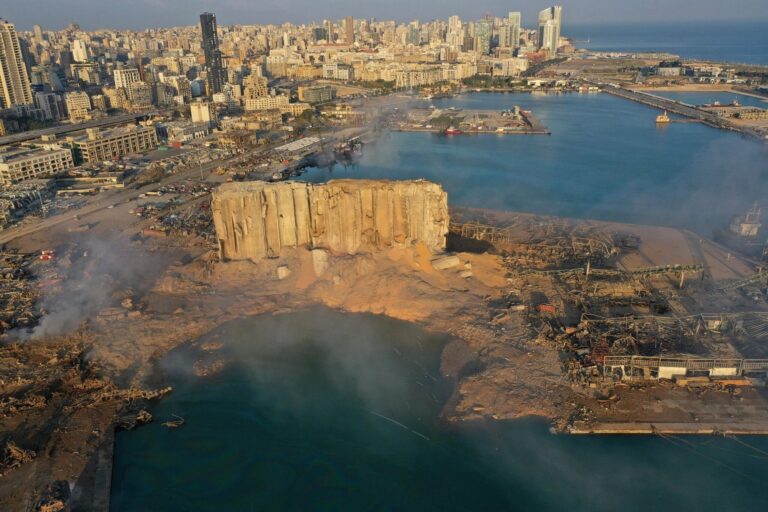
Lebanon: Massive explosion in Beirut kills 100 and counting

2
Around 2,750 tonnes of ammonium nitrate exploded after a fire in the port area of Beirut just after 15:00 GMT on Tuesday. Currently, the death toll as reported by Red Cross Lebanon is at 100, with more than 4,000 injuries and more deaths being expected as the rubble and debris is cleared, as around 100 people have been reported as being missing. The blast was felt and heard as far as Cyprus which is 200 km away across the Mediterannean and it also triggered a 3.5 magnitude earthquake The two most common uses of ammonium nitrate are as fertilisers and explosives and since it is highly explosive when it comes into contact with fire, there are strict rules on how to store it safely. President Michel Aoun declared a three-day mourning period, and said the government would release 100 billion lira of emergency funds, and the Supreme Defence Council recommended declaring a 2-week state of emergency and handing over security responsibility to military authorities and forming a committee to investigate the blast and present its findings within five days to mete out the maximum punishment to those responsible.  The Beirut port is locally known as the “Cave of Ali Baba and the 40 Thieves” for the vast amount of state funds that have reportedly been stolen there over the decades due to widespread bribery and schemes to undervalue imports. In fact, letters and documents between customs officials and the Urgent Matters judge show that the authorities were well aware of the dangers posed by the storage of the ammonium nitrate in the port ever since it was offloaded from a ship headed to Mozambique in 2013, but they were neglected. While the exact cause of the explosion is not clear, many Lebanese pointed out the root causes: immense mismanagement in a broken state run by a corrupt political class who they say treat the country’s inhabitants with contempt.   Lebanon was already dealing with multiple crises, with hospitals already at full capacity and rapidly rising numbers of those infected with Covid-19. Large numbers of the people of Lebanon also took to the streets in October last year against government corruption, austerity measures and a lack of basic infrastructure, leading to the resignation of the then Prime Minister. However little has changed, and the economic crisis in the country has only been deepening with food prices climbing by up to 80%, half of the country’s population below the poverty line, 35% of the population unemployed, and national debts worth almost 170% of its GDP.  Besides the massive loss to life, the blast also destroyed at least 3 Beirut hospitals and damaged 2 hospitals, leading to an additional stress on an already overwhelmed healthcare system. The blast also destroyed wheat stored in the port’s granaries leading to fears of an impending food crisis in a country already facing shortages, especially as Lebanon imports 90% of its wheat through the port which has been destroyed, which was then likely holding 85% of the country’s cereals. 

The ‘VADH’/Annihilation Of The Indian Republic

The sovereign-democratic Indian Republic came into existence on January 26, 1950 coinciding with the promulgation of a historic constitution which in its Preamble declared its firm commitment to “JUSTICE, social, economic and political; LIBERTY of thought, expression, belief, faith and worship; EQUALITY of status and of opportunity; and to promote among them all FRATERNITY assuring the dignity of the individual and the unity and integrity of the Nation…” This Republic is slated for public execution on August 5, 2020, with great pomp and show at Ayodhya. The issue is not building a peerless Ram Temple [Temple] at the place where once Babri Mosque [Mosque] stood. The legitimacy for the construction of the Temple was ‘managed’ courtesy the highest court of justice of India. Betraying all norms of fair-play, rule of law and common sense, the Supreme Court approved construction of the Temple despite admitting also that no Temple was destroyed to build the Babri mosque in the past, it was illegal to place the Ram idols in the Mosque on the night of 22-23 December 1949 and destruction of the Mosque by the Hindutva mob on December 6, 1992, was a criminal act. There is no doubt that Temple has the judicial sanction despite the criticism that what Hindutva zealots could not achieve on December 6, 1992, was facilitated through the judiciary. This rushing up with the construction of the Temple at Ayodhya is a serious setback to the Indian democratic-secular polity but a far more dangerous spectacle would unroll at Ayodhya on August 5 when Narendra Modi as PM of India, would perform bhoomi poojan [land-worship] for the Temple at 12.30 noon in the august presence of chief of RSS, Mohanrao Bhagwat as chief guest. This moment is going to be the final death blow to Indian Republic, the hectic preparations for which were afoot with Modi’s ascendancy to power. In fact, it started earlier when Modi as chief minister of Gujarat while talking to two Reuters journalists, Ross Colvin and Sruthi Gottipati, on July 12, 2013, had identified himself as a ‘Hindu Nationalist’ and credited the Rashtriya Swayamsevak Sangh (RSS) for instilling in him the spirit of a patriot. The Ayodhya ceremony is going to be the ‘vadh’ ceremony (a Brahmanical ritual) of Indian Republic is no exaggeration as the following facts would bear out the truth. When PM Modi does bhoomi pooja at Ayodhya in the presence of RSS chief, Bhagwat, the chief guest, he knowingly would be violating the oath he took last time in 2019 as PM of democratic-secular Indian polity as RSS is dead against what Modi committed himself to. Modi, when took over as PM in 2014 and 2019, took the following oath as prescribed in the Constitution: “I, (name), do swear in the name of God/solemnly affirm that I will bear true faith and allegiance to the Constitution of India as by law established, that I will uphold the sovereignty and integrity of India, that I will faithfully and conscientiously discharge my duties as a Minister for the Union and that I will do right to all manner of people in accordance with the Constitution and the law, without fear or favour, affection or ill-will.” PM thus is committed to uphold the constitution which according to the Supreme Court has the following elements as ‘Basic-structure’, sovereignty, democratic and secular character of the polity, rule of law, independence of the judiciary, fundamental rights of citizens. This commitment of the PM Modi needs to be compared with the oath a RSS member takes where each RSS member is committed to working only for ‘Hindu religion, Hindu society, and Hindu culture’. It reads: Before the all-powerful God and my ancestors, I most solemnly take this oath, that I become a member of the RSS in order to achieve all-round greatness of Bharatvarsha by fostering the growth of my sacred Hindu religion, Hindu society, and Hindu culture. I shall perform the work of the Sangh honestly, disinterestedly, with my heart and soul, and I shall adhere to this goal all my life. Bharat Mata Ki Jai. RSS has been demanding that democratic-secular Indians wanted this Constitution should be replaced by Manusmriti or Manu Code which is known for its derogatory and inhuman references to Sudras, Untouchables, and women. The Constituent Assembly of India finalized the Constitution of India on November 26, 1949, RSS was not happy. Its organ, Organiser in an editorial on November 30, 1949, complained: “But in our Constitution, there is no mention of the unique constitutional development in ancient Bharat. Manu’s Laws were written long before Lycurgus of Sparta or Solon of Persia. To this day his laws as enunciated in the Manusmriti excite the admiration of the world and elicit spontaneous obedience and conformity. But to our constitutional pundits, that means nothing.” How loyal the RSS is to the Constitution of India can be known by the following statement of MS Golwalkar, the most prominent RSS ideologue. It is being reproduced from Bunch of Thoughts which is not only selection of the writings of Golwalkar but also a Bible for the RSS cadres. “Our Constitution too is just a cumbersome and heterogeneous piecing together of various articles from various Constitutions of Western countries. It has absolutely nothing which can be called our own. Is there a single word of reference in its guiding principles as to what our national mission is and what our keynote in life is?” When India resolved to become a democratic-secular Republic RSS, following in the footsteps of Savarkar, rejected out rightly the idea that Hindus and Muslims and other religious communities together constituted a nation. The English organ of the RSS, Organiser, on the very eve of Independence (August 14, 1947) editorially chalked out its concept of nation in the following words: “Let us no longer allow ourselves to be influenced by false notions of nationhood. Much of the mental confusion and the present and future troubles can be removed by the ready recognition of the simple fact that in Hindusthan only the Hindus form the nation and the national structure must be built on that safe and sound foundation…the nation itself must be built up of Hindus, on Hindu traditions, culture, ideas and aspirations.” The RSS organ in the same issue denigrated the National Flag (which PM Modi is supposed to honour) in the following words: “The people who have come to power by the kick of fate may give in our hands the Tricolour but it will never be respected and owned by Hindus. The word three is in itself an evil, and a flag having three colours will certainly produce a very bad psychological effect and is injurious to a country.­” The RSS, contrary to the principles of democracy, has been constantly demanding India to be ruled under a totalitarian regime. Golwalkar while delivering a speech at the RSS headquarters before 1350 top-level cadres of the RSS in 1940 declared, “RSS inspired by one flag, one leader and one ideology is lighting the flame of Hindutva in each and every corner of this great land.” In the history of independent India there has never been such a brazen ganging up of an Indian PM with the RSS. Temple at Ayodhya, ostensibly, is being celebrated as redressal of the ‘wrong-done” by Muslims in the past (it may be interesting to note that Goswami Tulsi Das-1522-1623, who played the most prominent role in popularizing the story of Ram by penning Ramcharitmanas in India and the greatest worshipper of Ram did not mention in his epic penned between 1575-1576 that Babri mosque was built at the site of Ram Temple in the years 1538-1539) but reality is that ‘Hindu nationalist’ PM is using the occasion as an opportunity to put Indian Republic to death. — Prof. Shamsul Islam (5th August, 2020). Views expressed here are personal

Also Read:Unsung martyr Udham Singh who avenged the Jallianwala Bagh massacre

Bengaluru school launches ‘Freedom From Fees’ Program

The Freethinking School in Bengaluru has started its ‘Freedom From Fees’ program wherein parents can pay for their wards’ education as they wish. Under the ‘Freedom from Fees’, parents can pay as they wish’. Parents are asked to pay how much ever possible and whenever possible towards school fees. The program is introduced in the times when private schools are demanding pressurizing parents and guardians to pay an exorbitant amount of fees during corona affected times in the garb of providing online education to its students. The private schools are doing so despite several governmental orders to not pressurize parents to pay school fees. The school in Bengaluru which is following the Montessori model of education has asked parents to pay fees in accordance with their financial abilities. This program is applicable till the month of March in 2021. The monthly subscription program is applicable to early year children. The school has also requested parents to get the wards of their drivers, house helps and other employees admitted to the school so that they could be educated without having to worry much about the ability to pay fees in these difficult times. The program is also offered free for the wards of COVID Warriors. Sandy Philip, Directress of The Freethinking School said to Deccan Herald that “In harmony with this spirit of freedom, the program is offered free to frontline Asha workers, nurses and other COVID warriors. It has been my dream to take Montessori to the masses. My vision was always to make quality education accessible, reachable…” More details about the same can be accessed from its website here. Read about: Why National Education Policy – 2020 is losing on Languages?

Sri Lanka: Ninth Parliamentary Elections to be held tomorrow

 Sri Lanka’s Ninth General Parliamentary elections will be held on tomorrow (August 5th) amidst the Corona crisis in accordance with full health procedures. Chairman of Election Commission of Sri Lanks Mahinda Deshapriya informed that all arrangements have been made in this regard.
The election will end the uncertainty of political leadership in Sri Lanka that arose when President Gotabaya Rajapaksa dissolved the Parliament Five-months before the schedule for an early election.
The petitions filed by Opposition parties and civil societies against this decision also did not help as the Supreme Court rejected their pleas and the elections were scheduled for April 25th. However, due to the Covid-19 pandemic outbreak, the Election Commission postponed its elections to June 20th. The election was again was postponed to August 5th.
According to sources, 70 political parties, 313 independent groups, and 7452 candidates are contesting in the elections this time. The Sri Lankan citizens will vote for their representatives tomorrow starting at 7 AM. The voting process has been extended to continue until 5 PM in the evening. The voting schedules are open for an hour more than usual owing to the Corona scare.
The President of Sri Lanka, Gotabaya Rajapaksa has summoned the new Parliament to meet on 20th August 2020 (Thursday) following the General Parliamentary Elections tomorrow. An unusual Gazette notification was issued last night (3rd August 2020) in this regard. The decision has been made by the President using the powers vested in him by the Constitution of Sri Lanka and the Parliamentary Electoral Act.
To ensure the smooth conduct of election without becoming a public health hazard, the Election Commission had previously held mock elections. With the country, all set for elections, ballot boxes and ballot papers were sent to the polling stations today.
All the activities are being carried out under the supervision of District Election Officials, The Election Commission of Sri Lanka.

Read About:Mission HOPE – UAE becomes the first Arab country to launch Mars Mission

James Baldwin´s writings show a mirror to the racially fractured America

August 2 marked the birth anniversary of James Baldwin, one of the most important and radical voices in American literature, who in his works, explored deeply the intricacies of racial, sexual, and class distinctions in American society. Some of his notable works are Go Tell it on the Mountain, The Fire Next Time, and Notes of a Native Son.
Baldwin was born as James Arthur Jones in 1924 to Emma Berdis Jones, in Harlem, New York. His mother worked as a cleaning woman to support herself, and James never knew his biological father. Three years later, she married a Baptist preacher named David Baldwin, whom James referred to as his father throughout his life. His parents were children of former slaves, and Baldwin wrote throughout his life about what this meant for him, living in a deeply racist America, and the rage and sorrow that consumed his life in the country.

Also Read: Losing the Race for Justice: How the Police system shapes America

At the time, Harlem was known to have a large Black population, especially as large numbers of Black people migrated from the Jim Crow riddled South with its culture of racist lynching and violence in an attempt to seek better education and opportunities for their families. However, Harlem was far from the American dream, and at the time racism and racial segregation were rife in the country. The urban ghettoization of blacks into specific areas like Harlem led to an inequality of opportunities and quality public services such as education in these areas. After World War I, Harlem became the center for art, literature, music, and cultural movement known as the Harlem Renaissance, which would challenge white-dominated art and culture. A young Baldwin was influenced and mentored by poets of this movement such as Countee Cullen. One of the striking features of his fiction work was the way in which he reflected on his personal experiences, weaving them with radical commentary on society. In these works, he explored his strained relationship with his father who was also navigating his own ideas about race, the prejudices he faced and his resulting personal torment about his sexuality and his race, his feelings of isolation within his community at a time when homosexuality went strictly against many of their Christian beliefs, interracial relationships, and so on. After his close friend Eugene Worth committed suicide, Baldwin decided to move to Paris, to distance himself from the suffocation of living in such a highly prejudiced America. It was in Paris that he was able to write most freely, where even though the French had their own racism, a lot of talented Black Americans were welcomed. Baldwin’s ideas and searing critique of American society are relevant across the world and show lessons in what power and resistance are. Baldwin wrote about the core of the White psyche as being marked by denial and suppression of truth and a gap between their public and private selves. The history of colonialism and genocide of Native Americans and the legacy of slavery were all obfuscated in American legends of origin and promises of the American dream. Similarly, today, the violent and oppressive brahminical history of India is glossed over constantly and the thread of caste running through all of India’s social and political changes is erased in favour of a falsified narrative of the glorious Indian past and culture, and promises of economic prosperity. Baldwin also spoke about the ideas of inclusion and progress thrust upon Black people in America based on White capitalistic standards. White society applauded itself on the rising presence of Black people in sports and media and so on, but Baldwin pointed out, “Insofar as the American public wants to think there has been progress, they overlook one very simple thing: I don’t want to be given anything by you. I just want you to leave me alone so I can do it myself”. Further, he questioned the benchmark of progress as being the American dream, saying, “Perhaps I don’t think that this republic is the summit of human civilization. Perhaps I don’t want to become like Ronald Reagan or like the president of General Motors. Perhaps I have another sense of life… Perhaps I don’t want what you think I want.” Baldwin recognized that the history of racism was intrinsically tied to the history of capitalism, and said “I attest to this: The world is not white; it never was white, cannot be white. White is a metaphor for power, and that is simply a way of describing Chase Manhattan Bank.” Baldwin also critiqued the idea of ‘nonviolence’, which was used to vilify and delegitimize the resistance of the oppressed, especially at that time with the growth of the Black Panthers movement and leaders like Malcolm X, H. Rap Brown and Stokely Carmichael who no longer conformed to ideas of acceptable resistance. In turn, he pointed out how violence was accepted and even applauded when it came from white people and those in power. Today, in India, this is more important than ever, as acts of large scale violence committed by the State or by capital are seen as necessary- be it in colonial subjugation of Kashmir or the North East or Adivasi lands, forests and water, the dilution of labour rights, the imprisonment of activists, institutional prejudice against and incarceration of the Bahujan. All while any attempt at resistance is branded as militant anti-nationalism, ‘rioting’, and so on. Although he passed away in 1987, James Baldwin’s ideas have stood beside the anti-race struggle in America for years, as police brutality and racist violence remains just as much of a reality now as it did during his lifetime, marked by protests against the murder of Michael Brown in 2014, and most recently, the murder of George Floyd, and the resulting nation-wide Black Lives Matter protests.

References: https://www.theatlantic.com/culture/archive/2020/07/raoul-peck-james-baldwin-i-am-not-your-negro/613708/

https://www.mentalfloss.com/article/627055/james-baldwin-talks-racism-dick-cavett-show

https://www.theschooloflife.com/thebookoflife/james-baldwin/

https://biography.com/writer/james-baldwin

https://www.newyorker.com/magazine/1998/02/16/the-enemy-within-hilton-als

Narrow Vision and Missed Opportunities: National Education Policy 2020

The Covid-19 pandemic brought to surface some of the raw truths about educational deprivation that are usually invisible, forgotten or considered to be the thing of past: Long-distance distress migration of families, many with children; anxiety over the loss of mid-day-meals; families taking extraordinary measures to arrange for a device for online classes; support staff and teachers losing their jobs. Amidst the pandemic, school closures, and uncertainties of re-opening, the National Education Policy 2020 was approved by the union cabinet. Going by the document that is publicly available, the policy continues to invisibilize the working classes and disadvantaged communities. Peppered with buzz words that are used by international development agencies, the NEP 2020 is a document that has aspiring middle-class and elite interests at heart. As choice, flexibility, “light but tight regulation” and “bagless period” are placed on the table, the policy tells us that good education is essential for India to compete in the global economy as we are on our way to becoming a developed country. Good education, according to NEP 2020 is also one that instills Indian values, ancient Indian knowledge system, and ethos. One could ignore the all-too-common trope of “modern-yet-traditional” take on social issues as a benign view of the world. However, there are more compelling, imaginative possibilities that exist within which Indian education can be thought and would be more relevant. For instance, more than 50 years ago, Kothari commission (1966) framed public education in terms of justice, democracy, and pluralism. This report could have been a strong point of reference for NEP 2020, which largely confines itself to the 1986 policy that prepared the ground for greater privatization in education.

Read About: Karnataka – 35000 Private School Teachers lose Jobs, 8 Guest Teacher commit suicide

The policy needs to stand scrutiny on a number of issues. Let us focus on the restructuring of school education and the expansion of pre-schooling.  NEP 2020 plans to revamp the current schooling structure by introducing a 5+3+3+4 model used primarily in the United States. Covering the ages 3-to-18, the policy considers pre-school (ages 3-to 6) and classes 1 and 2 (ages 6-to-8) to be part of the foundational stage. Proposing universalization of Early Childhood Care and Education (ECCE), the phased expansion of pre-schooling over the next decade is suggested along the following way: (1) stand-alone  Anganwadis (2) Anganwadis co-located with primary schools (3) pre-primary schools co-located with existing primary schools (4) stand-alone pre-schools. While universalizing ECCE is much needed and welcome step, the purpose and role of Anganwadis and formal preschools are very different. While the former is part of the Integrated Child Development Scheme (ICDS), covering maternal and early childhood health, nutrition, immunization, and education; the latter is exclusively focused on education. The Education Policy calls for strengthening Anganwadi centers “…with high-quality infrastructure, play equipment, and well-trained Anganwadi workers/teachers. Every Anganwadi will have a well-ventilated, well-designed, child-friendly, and well-constructed building with an enriched learning environment.” Not a word on remuneration for Anganwadi teachers and staff and no details about how ECCE can be operationalized in terms of the current framework of the Right to Education (RTE) Act.  As the comprehensive child development provisions transition towards becoming pre-school, what would happen to the existing maternal and neo-natal nutrition and health provisions? In the last few years, the pre-school sector has witnessed a growing expansion and interests of private actors. Contrary to the recommended learning goals in early years involving sensory, activity-driven, and play-based focus, a number of private pre-schools operate as preparatory places for primary schools. The impetus for reform in ECCE in many parts of the world is also closely connected to the largely middle-class preference to “start early” in order to avail of academic advantage. Foundational literacy, as the policy advocates, can easily become the very prescriptive, rote-learning practice that the policy hopes to correct. As ECCE enters the space of formal education, it is important to think about a range of diverse contexts in which children grow up and go to school. NEP specifically states that ECCE will be part of Ashram schools in Adivasi regions. Given that a majority of Ashram schools in Adivasi regions are residential in nature, it would be disastrous to separate children as young as 3 years old from their families and communities. Multiple, locally relevant arrangements will be needed in a number of cases. The other lines of restructuring include a focus on attaining numeracy and literacy by class 3; flexible course choices with the possible inclusion of vocational education and multilingualism. Some of these issues have been part of the debates on Indian education for long. NEP 2020 desires to enhance the quality of public education in India. If the desire is sincere then substantial investment in allied provisions such as food security, health care will be the points to start. — Shivali Tukdeo is a faculty at the National Institute of Advanced Studies (NIAS), Bangalore. Views are personal.  

Delhi Violence: DU Prof. Apoorvanand investigated

0
In continuation of the witch-hunt of academicians by the Police forces, Professor Apoorvanand who teaches Hindi at the University of Delhi was interrogated by the Delhi Police in connection with the Nort-East Delhi Riots on Monday (3rd August, 2020). He was interrogated for nearly 5 hours and his phone was also confiscated by the Special Cell of Delhi Police in this regard. The well-known academician Apoorvanand has co-operated with the police in the investigation and through his statement in a tweet has urged the Delhi Police to conduct a fair, just and thorough investigation into the violence.  The incident took place in February this year which lead to the death of 53 people and had left more than 400 people injured. The Special Cell of Delhi Police had on 31st July, 2020 interrogated former JNU Student and Activist Umar Khalid in connection with North East Delhi Violence. The Police had confiscated his phone as well. Prof Apoorvanand’s statement read as under: On Monday, August 3, 2020, I was asked by the Special Cell, Delhi Police, to appear before it in the investigation into FIR no 59/20 related to the violence that happened in NE Delhi in February, 2020. I spent five hours there. The Delhi Police also considered it necessary to seize my phone for the purpose of investigation. While cooperating and respecting the right of police authorities to conduct a full, fair and thorough investigation, one can only hope that the probe would focus on the real instigators and perpetrators of the violence against a peaceful citizens’ protest and the people of Northeast Delhi. It should not lead to further harassment and victimization of the protestors and their supporters, who asserted their democratic rights through constitutional means, while stating their dissent to the passage of the Citizenship Amendment Act, 2019 (CAA) and the decision of the GOI to operationalise the National Population Register (NPR) and the National Register of Citizens (NRC), all over the country. It is disturbing to see a theory emerging which treats the supporters of the protestors as the source of violence. I would urge the police and expect their probe to be thorough, just and fair so that truth prevails.” Read About: Dr Hany Babu arrested by NIA in Bhima Koregaon Case