
Glimpses of May Day Around the World

This International Labour Day or May day, demonstrations and protests erupted across the world in full swing. With the rise of anti-worker reforms such as the Labour Codes in India or the Pension Reforms in France, May Day processions were used to protest these anti-worker measures and demand an increase in wages, a control on inflation and an end to contractualisation.

May day, Brief History: 

In 1884, the Federation of Organized Trades and Labor Unions called for May 1, 1886, to be the beginning of a nationwide movement for the eight-hour day. Though the eight-hour workday law already existed, the federal governments had failed to enforce it.

On May 1, 1886, 80,000 workers reportedly marched in Chicago. The next day, around 35,000 workers held another peaceful protest. But on May 3, the Chicago police attacked and killed picketing workers, provoking a protest meeting at Haymarket Square the next day. During this meeting, protestors were once again attacked by over a hundred policemen and someone unknown to this day, threw the first dynamite bomb ever used in peacetime history of the United States. The police panicked and many shot at their own men. Seven policemen and four workers died while several others were injured.

The next day martial law was declared throughout the United States. Anti-labor governments around the world used the Chicago incident to crush local union movements. Eight labour leaders were blamed for the Haymarket Square violence, of whom five received the death penalty were hanged later in the year.

In July 1889, a labour conference in Paris declared that May 1 would be set aside as International Labor Day in memory of Haymarket martyrs and the injustice of the Haymarket Affair. Today in almost every major industrial nation,  May day is celebrated on the May 1 of every year to uphold labour rights and to commemorate the efforts and sacrifices of past labour movements in achieving rights such as the eight-hour workday or the five-day workweek. 

India:

Centre of Indian Trade Unions (CITU) organised several rallies across the country, such as in Hyderabad and in Siliguri.

Factory workers in Manesar including the Maruti Suzuki Powertrain Employees’ Union and Mazdoor Sehyog Kendra held a rally and program in IMT Manesar’s Tau Devilal Park.

Factory workers in Kundli village, Sonepat, also gathered to demand that contractualisation be eradicated, the minimum wage be raised to Rs. 25,000 and the workday be reduced to eight hours. 

In Karnataka, Communist Party of India (Marxist) held several rallies in Bengaluru and Bagepalli in support of their candidates for the upcoming Karnataka Assembly Elections, 2023.

Asia:

In South Korea, the Korean Confederation of Trade Unions (KCTU) organised a rally by the name of “World Labor Day convention” in Jongno, Seoul. The Federation of Korean Trade Unions (FKTU) gathered in Yeouido for a national labour congress that was reportedly attended by 30,000 people. Attendees spoke out against the current conservative government’s efforts to push labour reforms and weaken union powers. FKTU demanded that labour reforms be deterred, minimum wage be increased, revisions of the Serious Disaster Punishment Act and the pension systems be stopped. Workers of leading food delivery app Baedal Minjok held a rally in front of the company’s headquarters in southern Seoul to demand a rise in their basic delivery fee that has remained the same in nine years despite massive inflation. The Solidarity Against Disability Discrimination also held a rally near Seoul City Hall.

In Indonesia, the Confederation of Indonesian Trade Unions (KSPI), representing 32 labour unions, organised a rally in Jakarta that reportedly saw attendance from 50,000. They gathered near the National Monument and marched to the Constitutional Court to demand the new repeal of the anti-labour Job Creation Law.

In Manila, Philippines, nearly 6000 protestors gathered under fourteen labour groups, including Kilusan and West Philippine Sea (WPS). They marched demanding regularisation of contractual workers, raise in salary and control over inflation. More than 3000 workers from the Federation of Free Workers (FFW), Partido Manggagawa (PM), Public Services International (PSI), and Association of Women Workers in the Construction Industry (AWVCI) also hit the road along España Blumentrit. Members of the Communication Workers of the Philippines (CWP) also held a program at the Supreme Court of the Philippines in Ermita, Manila at around 9 a.m. to call for an end to contractualization or “endo” in commemoration of Labor Day.

In Tokyo, Japan, thousands gathered at Yoyogi Park to demand an increase in wages. They criticised Prime Minister Fumio Kishida’s plan to double the defence budget through tax increases, and said the money should be spent on welfare and social security and improving people’s daily lives.

In Phnom Penh, Cambodia, hundreds gathered to fight for better working conditions and greater pay. Cambodian Confederation of Unions (CCU) and Cambodian Alliance of Trade Unions (CATU) had called for a rally from the Council for the Development of Cambodia (CDC) to the National Assembly. Nearly 2000 people are said to have attended the rally. 

In Taipei, Taiwan, workers – including government hospital and insurance professionals – came together to demand better wages and working conditions. 

In Lebanon, hundreds marched through the streets of downtown Beirut in a rally organised by the Communist Party and other trade syndicates. 

In Pakistan, though authorities have banned rallies in some cities in the name of a tense security situation, several rallies took place in Lahore, Peshawar and Karachi.

Europe

In France, protestors hit the streets in around 300 different rally points across the country to show that they won’t abandon the fight against Macron’s pension reforms which raises the retirement age from 62 to 64. Authorities predict that between 500,000 and 650,000 people could protest across the country, including 80,000 to 100,000 in Paris. Air traffic was also disrupted as airport unions joined the demonstrations.

In Germany, feminist and queer groups organised a rally by the name of ‘Take Back The Night’ to protest against violence directed at women and LGBT people. More than 3000 people reportedly attended the event. Around 15,000 people are also expected to participate in the usual “Revolutionary 1st of May Demonstrations” of left and radical left groups from Neukölln to Kreuzberg.

Read Also: Workers March in Delhi Against Anti-worker Labour Codes and Privatization

#PayCMCryPM, Congress Take Jibe Over Modi’s Speech

There are only 10 days left for the Karnataka assembly elections and the campaigning has gotten intense. PM Modi’s rallies have been going on for two days in Karnataka. During that time he launched a sharp attack on the Congress . He attacked Congress by saying that he has been abused 91 times by Congress leaders. A day after Congress general secretary Priyanka Gandhi Vadra remarked that Prime Minister Narendra Modi was the first PM to “cry” in front of people, the Congress on Monday trended the “CryPMPayCm” hashtag on social media. Congress General Secretary Priyanka Gandhi Vadra on Sunday remarked about Prime Minister Narendra’s statement about verbal abuse, saying one has to take such attacks in their stride in public life, and counselled him to learn from her brother Rahul Gandhi, who “is ready to take a bullet for the sake of the country”. At a public meeting in Bagalkote district, Vadra, commenting on the PM’s statement, said: “At least they (91 abuses) are fitting on one page; if you look at the abuses by them to my family and if we start making a list, we will publish books after books about it”. Congress workers have taken it a step further and released a poster today. Congress workers are seen putting up this poster across the state. It has now become viral. Congress has released a “PayCM CryPM” poster taking a dig at PM Modi. The context is that the Congress has been accusing the BJP government of Karnataka of 40 percent commission for the past one year. In one such case, his minister Eshwarappa even had to resign.
Congress widely shared a picture of Prime Minister Narendra Modi’s face on social media with the QR code “Cry PM”. Congress also shared a video of party general secretary Priyanka Gandhi criticizing Modi, in which Priyanka is seen saying: This is the first PM whom we have seen abusing. Many on social media also criticized PM Modi for not having any data on COVID deaths, farmers death or data on death of migrant workers but data on how many time PM Modi was abused. Some months ago, congress workers had put up posters of PayCM when accusations came that BJP govt. in Karnataka is taking 40% commission from contractors for building infrastructure and were not clearing projects unless 40% commission is paid. One such contractor even committed suicide not being able to pay his debts and had accused BJP leader Eshwarappa in his suicide note.

Manipur: Violence Breaks Out in Churachandpur as Protests Against BJP Survey Continue

0
Violence erupted on Friday night as security forces in Churachandpur district of Manipur used batons, tear gas and rubber bullets against those who were protesting the BJP government’s land survey. This took place only a night after the internet was shut down and Section 144 was imposed in the district in response to the burning of a gym that was to be inaugurated by Manipur CM N Biren Singh. Singh later said he cancelled his visit at the request of local MLA LM Khaute who had invited him. The Indigenous Tribal Leaders Forum (ITFL) called a “total shutdown” from 8 am till 4 pm on Friday to press for their demands to call off the survey that residents believe could lead to the authorities declaring tribal land in hill districts as a Protected Area. On Friday, the police inflicted violence upon those enforcing the eight-hour shutdown. ITFL protestors also destroyed about 100 chairs and other equipment.  Violence was reported in New Lanka, Tuibong Bazar, Sielmat Bridge, Lanva Bridge and T Champhai. Internet has been further suspended for 5 days in Churachandpur and its neighbouring district Pherzawl for five days. Tribal activist and chief of Bungmual village, H Mangchingkhup, told The Indian Express that the state government did not mention the purpose of the survey or consult any local leaders when it was conducted. “The only purpose I can perceive for such a survey is to declare our areas as protected forest, and subsequently our eviction from there,” Machingkhup said. “We will not take this lightly.” Read Also: Network of indigenous communities on padyatra for rights in Nagarhole Tiger Reserve

Background

The ITFL direct action efforts should not be painted as sudden escalation as they are the culmination of several months of rising tensions relating to indigenous land rights at the face of increasing evictions and state clampdown. Earlier in February, several houses in Chhurachandpur’s K. Songjang village were demolished along the Churachandpur-Khoupum Protected Forest stretch for allegedly being built after 2021. A show-cause notice was also issued to residents of Kunpinaosen, Kangvai sub-division, Churachandpur, to vacate their houses for the same reason. The Deputy Commissioner of Churachandpur district even ordered a verification drive from February 27 to March 17 to identify ‘illegal immigrants’ in the district. According to the notice, all villagers would be required to give their biometrics for the drive, which raised privacy concerns and violated the right to bodily integrity. In response to this, the ITLF, along with Kuki Innpi Manipur (KIM) and Kuki Students Organisation (KSO) organised a peaceful rally on March 10. Despite the imposition of Section 144 CrPC, heavy state clampdown on the protestors and some reported incidents of police brutality, the rally saw widespread attendance from various communities. Lanka town even saw the coming together of various Zo tribes among the Zomi, Hmar, Mizo and Kuki groups.  A community leader from the rally in Lanka spoke out against the imposition of Section 144. “…144 CrPC cannot be used to suppress a legitimate expression of the people, our expression through a peaceful rally is our fundamental right given in the Constitution. Our fundamental rights are above all else,” he told EastMojo. Several protestors pointed out that the recent government orders in the region did not pass through the Hill Areas Committee. This procedure is mandated by Article 371C and the 1972 Presidential Order, i.e., The Manipur Legislative Assembly (HILL AREAS COMMITTEE) ORDER, 1972. Some have raised the demand for greater autonomy and self-governance for tribal communities through a separate tribal administration, such as the Southern Manipur Territorial Council (SMATC). Despite this, some revenue and forest officials were deployed in Mid-April to carry out a survey in the so-called Churachandpur-Khoupum Protected Forest in Churachandpur district. On April 12, the KSO and Zomi Student’s Federation objected to the survey and stopped officials from conducting it at Sielmat village. Villagers of Valpakot also blocked all entrance and exit points of the village to register their protest against such surveys being carried out in their villages. Various political and civil society organisations also spoke out against the survey.  As reported by Imphal Free Press, the survey team led by Tuibong SDO Jangminlen Lupho and Churachandpur ADM S Thienlaljoy Gangte could not go ahead with the survey as the villagers.  On April 15, Singh held a meeting with the MLA of Churachandpur LM Khaute along with the village chiefs and declared that he would renew the initiative to conduct the survey in the district. Finally, ITLF members called for an eight-hour total shutdown in Churachandpur and resorted to burning an open gym facility that was scheduled to be inaugurated by Singh.

Largest Voter Survey in Karnataka Shows Anti-Incumbency Wave Against BJP

According to a recent survey conducted by Eedina.com, there is an anti-incumbency wave against the Basavaraj Bommai’s led BJP government in Karnataka. The survey, which is said to be the biggest in the history of Karnataka elections, was conducted in all assembly constituencies across the state, covering 183 constituencies so far, with work still continuing in some more, including 28 constituencies in Bengaluru. It saw participation from people belonging to different sections, communities, and areas.

Details of Survey 

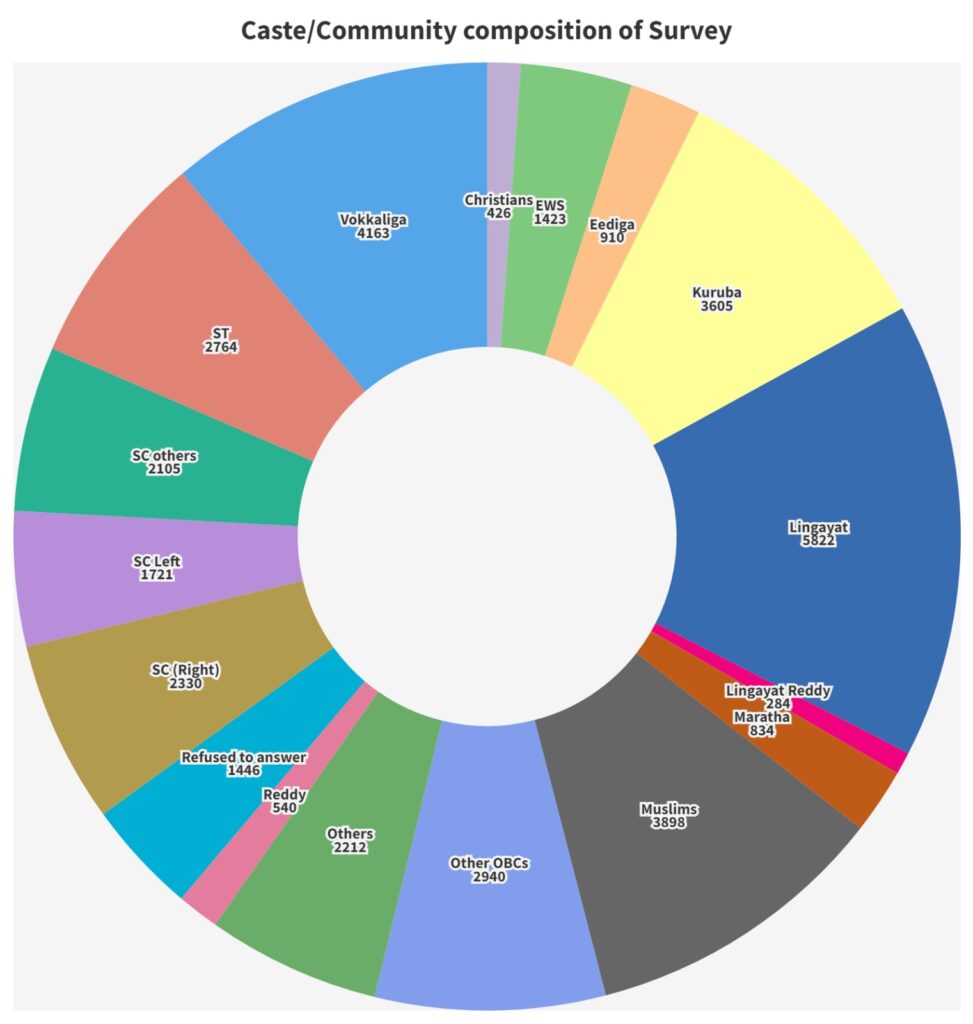
The survey was conducted from March 23rd till date, with 39,181 interviews conducted so far. 16 booths were selected in each constituency and 25 people from each of the booths were interviewed, with random sampling employed in both cases. The door-to-door survey was conducted in-person with a Kannada questionnaire. Its methodology aimed to have representation from all communities of the society, with the final survey achieving a sample in which the percentage of people belonging to a particular community was very close to their actual representation in the population of Karnataka. The proportion of respondents from urban and rural areas was proportional to their percentage in the population of the state. 55% of the respondents were male and 45% were female. The survey covered various communities, with opinions of 17% scheduled castes, 8% scheduled tribes, 11% Muslims, 17% Lingayats, 11% Okkaligas, and 10% Kuruba community.  Caste

Anti-Incumbency Wave

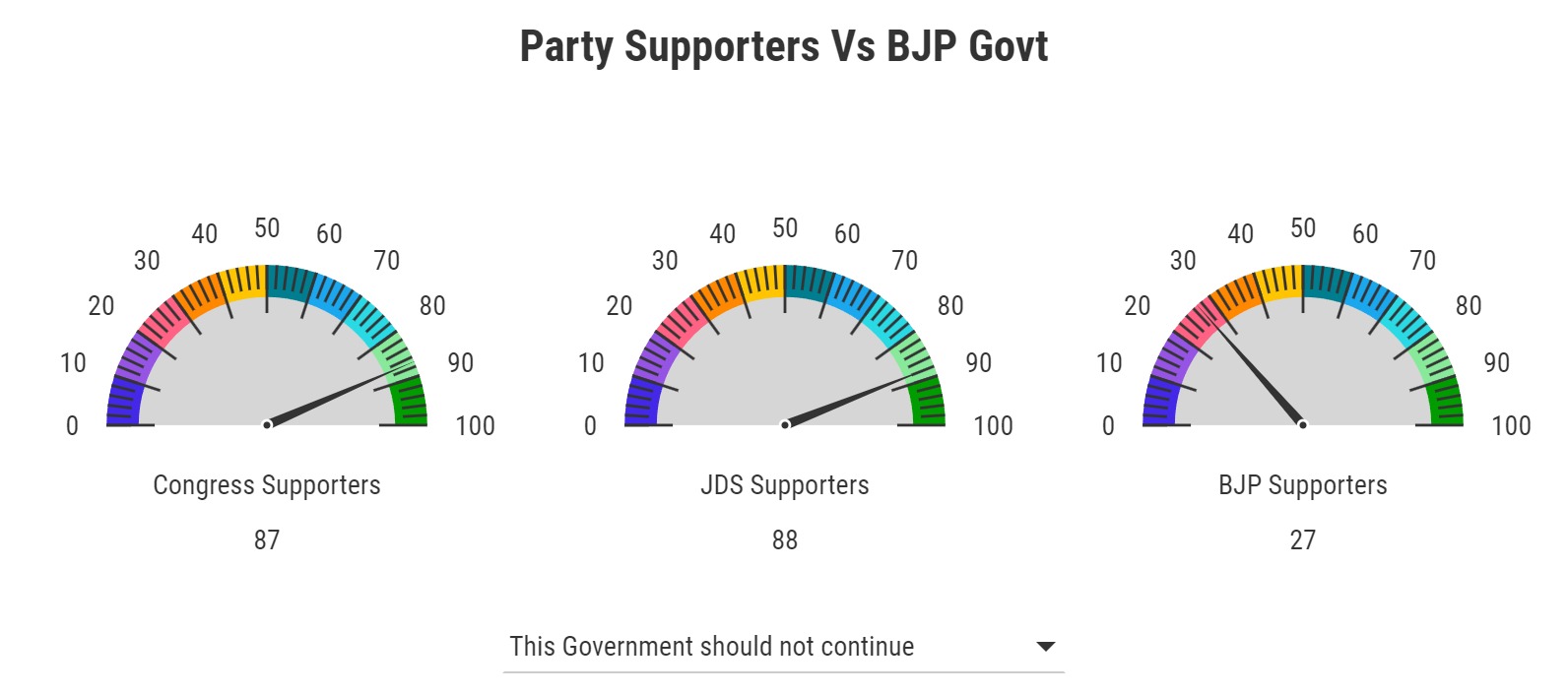
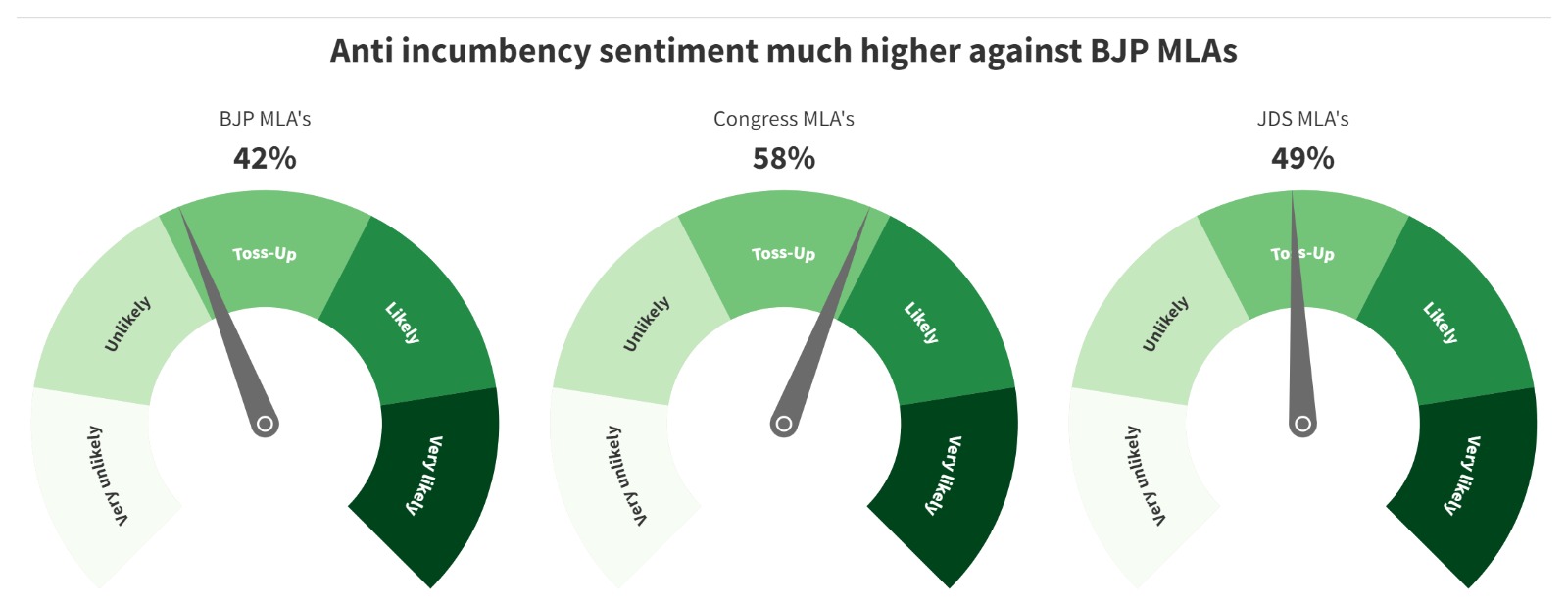
The question asked in the survey was whether the current government should be given another chance to govern. The results showed that two-thirds of the voters want the BJP government to go, and a quarter (27%) of BJP supporters are not happy with the current government. The survey also found that most Congress and JDS supporters have spoken against the government, with 87% of Congress supporters and 88% of JDS supporters expressing that the government should not be given another chance to govern. anti-incumbency Interestingly, 57% of respondents belonging to upper castes such as Brahmins and Vaisyas favored the current government, while Lingayats were found to be more or less equally divided on both sides of the issue. Additionally, Scheduled Castes, Scheduled Tribes, Muslims, Okkaligas and Kurubas have largely expressed their opinion against the continuation of this government. Within this group, Muslims (86%) and Okkaligas (78%) are the most opposed to the continuation of the current government. The survey also found that anti-incumbency sentiment against MLAs from the ruling BJP is higher compared to their Congress or JDS counterparts. Only 33% of respondents were willing to give their sitting MLA another chance, while a little less than that were against it. Another one-third were indifferent. However, when broken down by political party, anti-incumbency sentiment against the BJP MLAs was much higher, with only 42% of voters in the 87 seats with sitting BJP MLAs wanting to give them another chance, and 58% not wanting to give them another chance. In the 44 seats with Congress sitting MLA the proportion was reversed: 58% wanted to give the MLA another chance, while 42% were against it. The constituencies with sitting MLA from JDS has a mixed record with equal proportion of pro and anti-incumbency. survey

Role of Operation Kamala

Eedina.com also included questions that looked at the impact of Operation Kamala, an infamous political move in which winning Congress MLAs switched over to the BJP. While voters in the state disapproved of the operation by a two-to-one ratio, voters in the constituencies affected by the operation remained ambivalent. A total of 42% of respondents disapproved of the operation, twice as many as those who approved, and more than one-third did not have an opinion. In the affected constituencies, the disapproval was milder, with 22% disapproving against Operation Kamala and 15% approving. Opinion on the issue followed partisan lines, with BJP supporters being more likely to approve of Operation Kamala. Illiterate voters were more unequivocal in their condemnation than the highly educated. Most importantly, 63% of respondents chose to remain silent on the ethics of defection in their own seat, compared to 37% in the state. It should be noted that public opinion and voting behavior can differ, and even though people may feel that the government is not right, they might end up voting for the same party. It remains to be seen how this will affect the upcoming elections in Karnataka. The full survey results can be found on the Eedina.com website. Read also: SC Directs Karnataka Government To Uphold Muslim Quota Till May 9

Supreme Court Directs States To Take Suo Moto Cognizance Of Hate Speech

0
The Supreme Court on Friday directed all states and union territories to register FIRs against hate speech even if no complaint is made. This was done by extending the application of its October 2022 order where Delhi, Uttar Pradesh and Uttarakhand police were asked to take suo moto action against hate speech.  As reported by LiveLaw, A bench comprising Justices KM Joseph and BV Nagarathna stated that “as and when any speech or any action takes place which attracts offences such as Section 153A, 153B, 295A and 506 of IPC etc, without any complaint being filed suo motu action [should] be taken to register cases and proceed against the offenders in accordance with law.”  The apex court termed hate speech a serious offence capable of affecting the fabric of the country. It stated that “such action be taken irrespective of the religion of the maker of the speech, so that the secular character of Bharat as envisaged by the Preamble is preserved.” Failure to file a case will be read as contempt of court. The bench was hearing a collection of petitions on hate speech crimes. Advocate Nizam Pasha, representing one such petition, recommended that a nodal officer be appointed for each state and that a set procedure be established to take down hate speech from social media. Senior Advocate Sanjay Parikh, appearing for PUCL said that the organisation wished to supplement Pasha’s suggestions. The bench in-turn suggested a nodal officer for each district.  Read also: Hate speeches sullying atmosphere, need to be stopped: Supreme Court The contempt petition against the state of Maharashtra was also addressed, where permission was given to the Sakal Hindu Samaj to hold rallies in Maharashtra despite rampant hate speech and no measures were taken to prevent such speeches from being made. In February, the apex court had provided instructions to the Maharashtra authorities with respect to a rally that was to be held by Sakal Hindu Samaj on 5 Feb, including orders to videorecord the speeches.  In March, the Court had sought the response of the State of Maharashtra in a contempt petition which alleged that the State authorities failed to take action against hate speeches made during rallies.  In Friday’s hearing, Justice Joseph told the Additional Solicitor General SV Raju, appearing for Maharashtra, that Maharashtra should not take the court’s orders lightly. The ASG responded that the rally proposed for Feb 5th, that the rally did not take place and that, “Even in cases which the petitioners have not pointed out, we have registered FIR.”  However, Advocate Parikh alleged inaction on part of the State. He submitted, “After 5th Feb, several rallies took place. And there are some individuals who are repeatedly making statements, but no action taken.” The Supreme Court will hear the matter next on May 12. Source: LiveLaw

Will register FIR today on wrestlers’ complaint: Delhi Police tells Supreme Court

0
The Delhi Police told the Supreme Court today that it will register an FIR by the end of the day today in the complaint filed by wrestlers alleging sexual harassment by Wrestling Federation of India (WFI) president and BJP MP Brij Bhushan Sharan Singh. The Solicitor General (SG), Tushar Mehta, made the submission before a bench of Chief Justice of India DY Chandrachud and Justice PS Narasimha. The court has posted the case for further hearing next week to consider the threat perception to one of the survivors – a minor. The wrestlers had approached the Supreme Court for an urgent hearing into their request seeking a case against Mr Singh, the Wrestling Federation of India chief and BJP MP. The Supreme Court had issued notice to Delhi Police on the wrestlers’ request, alleging no case was registered on their charges. “There are serious allegations made in the petition by wrestlers who have represented India in international games about sexual harassment meted out to them. The matter requires consideration by this court,” said a bench led by Chief Justice of India DY Chandrachud. The wrestlers, who are protesting at Jantar Mantar in Delhi, have asserted they would stay put until a case is lodged in the matter. Among them are star wrestlers like Sakshi Malik, Vinesh Phogat, and Bajrang Punia. Brij Bhushan Singh, who had denied the sexual misconduct allegations and indicated he will fight fiercely to prove he is innocent, yesterday released a video saying he would wish to embrace death the day he feels helpless.
The wrestlers are on a sit-in protest in Delhi’s Jantar Mantar demanding action against Brij Bhushan Sharan Singh over the allegations of sexual harassment against him. The wrestlers first took to the streets in January with their charges against Brij Bhushan Sharan Singh and other trainers but withdrew their protest following an assurance by Mr Thakur. They returned to the capital city with fresh protests this week, alleging no action was taken on their charges.

Karnataka: Will Corruption and Price Rise be a deciding factor?

In the run-up to the Karnataka Assembly Elections, Eedina.com conducted a pre-election survey to gauge the shift in voter preference. The survey was conducted in all assembly constituencies across the state, covering 183 constituencies so far, with work still continuing in some more, including 28 constituencies in Bengaluru.

More details about the survey methodology can be found here.

Here are some important insights from the survey:

Issues faced by voters:

The survey asked respondents to pick two issues that would matter to them the most while deciding who to vote for. Corruption, price rise, and unemployment are the three main issues that are going to influence the 2023 assembly elections in Karnataka, with each receiving an overall amount of 68% votes, 47% and 34% votes respectively. Women’s security(13%), drinking water and electricity(13%), health and education(12%), and crime, violence and atrocities(10%) were identified as other issues of concern for voters.

Karnataka

Corruption was found to be an issue affecting supporters of all political parties as 73% Congress voters, 61% BJP voters and 66% JDS voters chose corruption as one of the issues affecting them.

Price rise remains an important issue and affects the poor the most. The survey found that the lower-middle(45%), poor(51%) and very poor(50%) classes were most concerned about price rise. Women(50%) were also found to be marginally more sensitive to the issue of price rise than men.

karnataka

Unemployment was identified as major problem in Karnataka, despite the fact that the state’s unemployment rate is lower than the national average. The survey found that the educated groups expressed more concern about unemployment then uneducated groups, with graduates(42%) and post-graduates(43%) expressing most concern about the issue. The youth were also more likely to identify unemployment as a problem, with 47% of those between 18-25 years of age and 42% of those between 26-35 years of age choosing unemployment as their one of their main causes of concern.

Corruption:

The survey also found that the Bommai government has earned the reputation of being the most corrupt government among the last four governments witnessed by the state, with 36% naming the Bommai government as the most corrupt. 14% of respondents said the most corrupt government was led by BS Yediyurappa, 13% said so for the government led by Siddaramaiah, and 8% said so for the Kumaraswami government. The remaining 29% either said that all governments were corrupt or none of them were corrupt. Interestingly, among those who named the Bommai government as the most corrupt, 20% were BJP supporters.

On being asked who amongst the above four is the most incompetent chief minister, 45% of those who responded named Basavaraj Bommai as the most incompetent chief minister. 

karnataka

Schemes:

The survey found that the number of people who have benefited from the central government’s schemes is low, with only 21% of those who responded having benefited from the PM Kisan Yojana, 21% from Ayushman Bharat, and 23% from Ujwala Gas Yojana.

The survey further revealed that even among those who could have been beneficiaries of these schemes, the number of actual beneficiaries is very small. For instance, only 33% of farmers claimed to have benefited from the PM Kisan scheme.

The survey also showed that voters have been unable to name any state government schemes that the BJP government has initiated. Only a dismal 0.01% of those who responded could name at least one scheme of the state government. 18% named central government schemes when asked about state government schemes. 2.3% named state government schemes that were implemented during the Congress government’s terms.

karnataka

While the Congress has announced four big ‘guarantees’ relating to schemes such as the Grihalakshmi Guarantee Scheme or the Griha Jyoti Yojana, the survey indicates that about one third of voters, particularly the targeted voters, haven’t even heard of those announcements. Moreover, half of those who are aware of the promises do not have confidence that Congress will fulfill them, making it difficult for the party to convince their plausible voter.

Read also: Karnataka: Farmers Release Charter Of Demands Ahead Of Assembly Elections

Karnataka: Farmers Release Charter Of Demands Ahead Of Assembly Elections

0

Samyukta Kisan Morcha and prominent state level farmers organisations of Karnataka today organised Samyukta Kisan Panchayat at Bangalore which was attended by over 200 farmer leaders and activists from more than 20 organisations. Senior national leaders of SKM, Shri Hannan Mollah, Shri Yogendra Yadav, Smt. Kavitha Kuruganti and Shri Avik Saha addressed the Panchayat.

The Panchayat began with a homage ceremony to Martyred Farmers who have sacrificed their lives in various struggles of farmers to get their rights and dues.

The Panchayat began with a homage ceremony to Martyred Farmers

With the increase of corporate control over agriculture, land is being snatched from farmers, employment guarantee has also been reduced, and farmers are finding themselves steeped in debt. While none of the previous governments have provided relief to farmers in their ever-deepening distress, the last four years of the BJP government has taken the situation of Karnataka farmers into a deeper downward spiral. The BJP government has taken up several anti-farmer measures such as passing the Land Reforms (Amendment) Act and the APMC Amendment Act despite widespread farmer opposition. For the past two years, farmers’ organisations had put up a united resistance and joint struggles against these anti-farmer approaches, but the BJP government did not even show the courtesy of calling them for a dialogue.

It is in this background, where agriculture has been battered and farmers are left as a deeply-worried lot, that elections are being held. SKM and the farmers’ alliances have put forward the following demands before all the political parties in the election fray in the upcoming elections, especially the major parties like BJP, Congress and JD(S). Farmers’ organisations have asked that these political parties address the following demands and solutions placed by farmers through steadfast commitment, by incorporating them in their Manifestos immediately and by specifying their stand on all of them through public statements and commitments.


Read Also: Farmer Organisations Condemn Govt Reduction of Wheat Procurement Price

The 15 key demands of the farming community are as follows:

1. The anti-farmer laws enacted by the BJP government in 2019-2020, such as the Land Reforms (Amendment) Act, the APMC Amendment Act and the ‘Prevention of Cattle Slaughter Act’ should be repealed as soon as the new government is formed.

2. Electricity supply and services should not be privatised. The power subsidy given to the farmers should continue. Even if the central government brings in a law on privatisation of the sector, the state should fight for its constitutional authority in this sphere for pro-farmer and pro-citizen policy making.

Farmers
3. A new law to legally guarantee the realisation of remunerative prices by all farmers for all agricultural commodities should be enacted. The reports of KAPC under the Chairpersonship of Dr Prakash Kammardi should be debated with the farmers’ organisations, revised as needed, approved and implemented.

4. Farmers should be adequately compensated for the various losses being suffered due to numerous disasters through effective disaster relief and crop insurance mechanisms set up by the government. A fund of at least Rs.10,000 crores should be kept available at all times to deal with the farmers’ crop losses from natural disasters.

5. The state government should enact an effective “Farmers’ freedom from Indebtedness Act”, to ensure that the farmers and agricultural workers do not experience distress under the weight of debts and commit suicides due to agricultural losses. The government should also waive off all outstanding farm loans of farmers given that the government policies are the main reason for such losses incurred by farmers. Further, farmers who do not have land titles but are actual cultivators should also be entitled to avail the institutional agricultural loans.

6. Women farmers in all farm suicide families should be issued ID cards for proper rehabilitation of the families, and all outstanding debt should be waived off so that the families can start their lives afresh.

7. Bagair Hukum lands should be allotted to poor tillers with immediate effect. The plots of houses built by the poor on government lands should be allotted to them immediately. A policy should be declared and implemented for proper housing for every family. Housing should be the first priority for allotment of government land. The high-level committee set up by the government in 2018 but made defunct by the BJP government, should be re-constituted and policy implemented.

8. Arbitrary distribution of government lands to companies, politicians, powerful people, institutions and ashrams / religious entities should be stopped. The land being transferred from the forest department to the revenue department should not be diverted to planters / plantation houses. It should be reserved and allotted to dependent families and landless households. The amendments brought in by the BJP government to the Land Acquisition, Resettlement and Rehabilitation Act (LARR) 2013 should be scrapped. No land should be acquired against the wishes of farmers. Even if the government acquires land due to unavoidable reasons, the ownership of the farmers should not be cancelled and regular income should be made available to the farmer’s family.

9. There should be proper implementation of the Forest Rights Act 2006, in full letter and spirit. No forest dependent families should be evicted on any pretext which are, in fact, only anti-people schemes or reports or projects, or a result of lack of proper implementation of FRA 2006.

10. The NREGA scheme should be strengthened and implemented in full measure, in the most friendly and accessible manner possible for the workers in the scheme. A welfare board should be appointed for the development and social security of agricultural labourers.

11. Pending irrigation projects should be completed immediately and projects like Yettinahole, Mekedatu etc. should be implemented.

12. The Karnataka government should stop promoting hazardous technologies in agriculture (toxic pesticides or Genetically Modified Organisms), to protect the health of ecosystems, producers and consumers. Corporate takeover of seeds through GM technology should be stopped and farmers’ seed sovereignty upheld.

13. Farming communities of Karnataka have been peace-loving, and take pride in the harmonious social fabric of the state, irrespective of caste, ethnicity and religion. One of the key demands of farmers is therefore against Hate Politics disrupting our society, and destroying our frail livelihoods.

14. Farmers also seek a corruption-free government, where governance related to agriculture is transparent and fair with the involvement of farmers in policy formulation and decision-making processes along with all regulations in favour of farmers to primarily protect the interests of farmers and not corporates.

15. On several matters pertaining to agriculture, farmers demand that the state government ensure its constitutional authority over the subject, and resist any takeover by the Union Government.

SKM has also added a special immediate demand: The state government should immediately drop the anti-farmer measures of merging Nandini with Amul or allowing Amul to compete with Nandini in Karnataka. Nandini is a conglomeration of more than 15 thousand Milk producers’ cooperatives involving more than 60 lakh farmers’ families. The government should not venture to help the giant corporate company of Ambani.

The Charter of Demands was presented to the major political parties of Karnataka, JDS and Congress, whose leadership were invited to and attended the Panchayat. Though invited, leadership of BJP did not turn up. The leaders of political parties gave solemn promise to include the farmers demands in their election manifestos.

In view of the upcoming Karnataka Assembly Elections where anti-farmer BJP is a major contestant, the Panchayat discussed the role that can and should be played by farmers organisations and after detailed discussion and deliberation, a unanimous clarion call to Defeat anti-farmer, anti-people communal BJP in the upcoming polls was given. All organisations agreed to take this message to the grassroots level through door-to-door campaign and other means of communication.

The Kisan Panchayat was attended by many farmer leaders including Shri GC Bayyareddy of KPRS, Badagalapura Nagendra of KRRS, HR Basavarajappa of KRRS, Deepak Lamba of Jai Kisan Andolan, Dr Prakash Kammaradi (veteran agriculture scientist), Shri Noor Sridhar of Karnataka Janashakthi.

SC Directs Karnataka Government To Uphold Muslim Quota Till May 9

The Supreme Court of India on Tuesday directed the Karnataka government to uphold the old quota system till the next hearing on the Karnataka government decision to scrap the 4% quota available to Muslims in the Other Backward Castes (OBC) category.

A division bench of Justices KM Joseph and BV Nagarathna adjourned to May 9 the hearing of a petition challenging the Basavaraj Bommai-led BJP government’s decision to scrap an almost three-decade-old reservation provided to Muslims under Category 2B for OBCs in the state. Instead, The government pooled them with the Economically Weaker Sections (EWS) category that has a 10% reservation. Following this, reservations for Vokkaligas and Lingayats each went up by 2%, now standing at 6% and 7% respectively. This decision was taken in the lead-up to the Karnataka Assembly Elections, happening on May 10.

The court adjournment was done in response to the request by the counsel for the Karnataka government, solicitor-general Tushar Mehta. Mehta assured the court that it would not take any decisions on appointments or admissions till the next hearing on May 9.

Senior advocate Dushyant Dave, appearing for members of the Muslim community from Karnataka, argued that this is the fourth adjournment and one adjournment away from the summer vacation. As reported by LiveLaw, he said, “This is a matter of great importance and concerns the rights of a socially and educationally backward community here.” He also argued that, “The quota has been scrapped altogether. It has been brought to zero. Mr Mehta’s statement only says that they would not make any new admissions or appointments on the basis of the recent government order. Only if they say that as per the 2002 notifications, the reservation will continue, we will not have a problem.”

When the top law officer reiterated that the government’s assurance would continue, the bench recorded his two statements: that the disputed orders would not be put into effect until the next hearing, and that the prior system of Muslim reservation according to a 2002 notification would remain in place during this time. Following this, the hearing was adjourned to May 9.

Read Also: SC Slams Karnataka Govt Scrapping of 4 percent Muslim Reservation as “Shaky and Flawed”

Kashmir: Human Rights Violations by the Indian Occupational Army

According to human rights activists, more than 8,000 persons have gone missing in Kashmir since 1989. Over the past three decades or more of turmoil in Kashmir, thousands of civilians have gone missing in the custody of security forces. Although the bodies of some were found, most remain untraced. Both India and Pakistan claim ownership of the Kashmir area, which has contributed to the escalation of tensions between the two countries in this region over the course of the last few decades. The situation has been characterized by violence and violations of human rights, including extrajudicial executions, which have been a recurrent occurrence in the area. These killings have been carried out without following legal procedures. When persons are murdered by members of the government or other organizations, there has been no recourse to the judicial system or a trial. A young guy from the Kashmir area named Abdul Rasheed was recently kidnapped and murdered by the Indian occupation force. The murdering of people without due process of law is becoming more common in that area, and his story is only one illustration of that trend. It has been reported that Rasheed was arrested by the Indian army on suspicion that he was a member of a militant group; however, Rasheed’s family maintains that he is innocent and has no ties to any militant organizations. The Indian army has a long history of kidnapping and murdering innocent Kashmiri people, most of the time on the pretense that they were involved in terrorist activity. The government of Kashmir and the human rights activists in the region have both reacted with shock and condemnation to the situation. Mehbooba Mufti, who had previously served as the Chief Minister of Jammu and Kashmir, said in a tweet that “The murder of Abdul Rasheed is just another example of the cruelty that the Indian occupation has brought. After 2019, these kinds of occurrences have become routine since no one is held accountable for their occurrence. Probes & investigations fail to nail criminals & achieve justice.” In Kashmir, the problem of murders that do not follow established legal procedures is not new and has been a big concern for many years. From the beginning of the war, there have been thousands of extrajudicial executions in the area, according to the reports of groups that advocate for human rights. It has been said that the Indian military targets innocent young men and women, frequently falsely accusing them of involvement in terrorist activities, and then killing them in simulated gun battles. These random executions have had a devasting effect on the community, with families being left to mourn the death of their loved ones and with no avenue for justice being available to them. A culture of dread and distrust has developed in the area as a result of the worry that people have about being targeted by the Indian army. Read also: Kashmir: Son Killed in ‘Gunfight’, Father Booked Under UAPA for Demanding Son’s Body The absence of accountability and justice in Kashmir is one of the most significant problems caused by extrajudicial executions in that region. In many instances, the individuals responsible for the murders are not subjected to appropriate investigations or prosecutions, and they are thus permitted to continue their crimes without fear of repercussions. Because of this, members of the security forces now have the impression that they are above the law, which has only resulted in more breaches of human rights in the area. The government of India has come under fire for several reasons, including the fact that it has failed to address the problem of extrajudicial executions and has failed to deliver justice to the victims and the families of those killed. As a result of a lack of political will to address the problem, more violations of human rights have been committed in the area. The problem of extrajudicial executions in Kashmir has not gone ignored by the world community, as shown by the fact that the Indian army’s acts have been condemned by a large number of human rights groups as well as the United Nations. The United Nations has requested that an inquiry be conducted on the state of human rights in the area, and they have asked India to take action to remedy the problem. The international community has brought attention to the fact that there is a pressing need for more pressure to be applied to India to resolve violations of human rights in Kashmir. The topic has been brought up in several international venues, and India is coming under increasing amounts of pressure to take action to address the problem of extrajudicial murders and other violations of human rights in the area. The purpose of the demonstration held at the United Nations Headquarters in Geneva was to bring attention to the violations of human rights that are taking place in India. It included a variety of diverse activities, such as standees, 4D view tents, posters, and banners, all of which were aimed to emphasize the concerns of minority rights and women’s rights in India. These topics were brought to light through the event. The problem of extrajudicial executions in Kashmir is a major violation of human rights that requires immediate attention and action. This is a situation that must be addressed as soon as possible. More violations of human rights have occurred as a direct result of the absence of responsibility and justice for the victims and their families.   Muhammad Wasama Khalid is a Correspondent and Researcher at Global Affairs. He is pursuing a Bachelor’s degree in International Relations at National Defense University. His interests include history, politics, and current affairs. He has been published in the London Institute of Peace and Research, South Asian Journal, Diplomatic Insight, International Policy Digest, Sri Lanka Guardian, Global Village Space, Global Defense Insight, Global Affairs, And Modern Diplomacy. He tweets at @Wasama Khalid and can be reached at [email protected]